Bloomberg

Not Sure What Your Internet Service Provides? Check the Label

(Bloomberg) — US regulators adopted a requirement for broadband providers to display easily understood labels about the cost, speed, data allowances of their internet services.

The rule aims to make it easier for consumers to comparison shop for internet access, the Federal Communications Commission said Thursday after adopting the requirement.

“Consumers need to know what they are paying for, and how it compares with other service offerings,” FCC Chairwoman Jessica Rosenworcel, a Democrat, said in a news release. “For over 25 years, consumers have enjoyed the convenience of nutrition labels on food products.  We’re now requiring internet service providers to display broadband labels for both wireless and wired services.”

Providers must display the labels prominently, the FCC said. The commission didn’t immediately set an effective date for the requirement.

More stories like this are available on bloomberg.com

©2022 Bloomberg L.P.

IEX Seeks New Crypto Path After FTX Unraveling Undoes Its Partnership

(Bloomberg) — IEX Group Inc., owner of the stock exchange made famous by “Flash Boys,” is looking for a new crypto partner after FTX’s crash ended a collaboration the pair started earlier this year. 

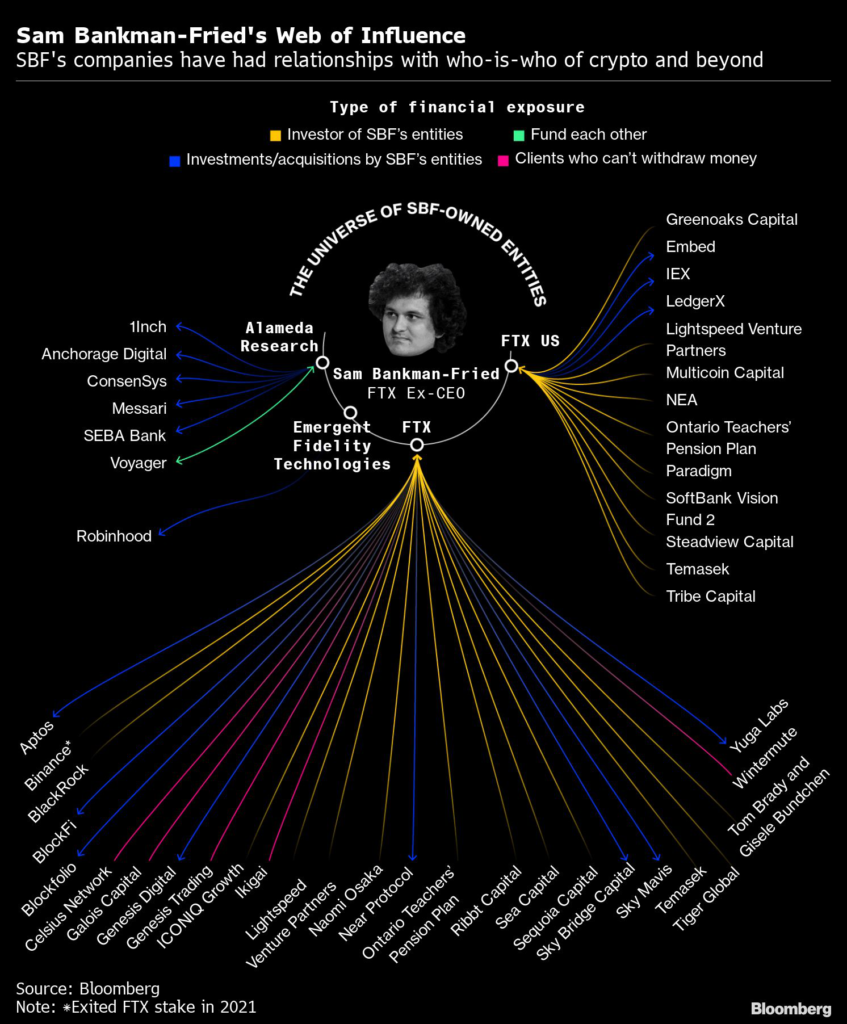
IEX has cut its ties with FTX, the digital-asset firm which spiraled into bankruptcy last week, according to people familiar with the situation. In April, FTX US acquired a stake in IEX as part of an effort to expand access to digital assets for retail and institutional investors. That stake represented less than 20% of the company, the people said. 

Companies are trying to distance themselves from the collapsed FTX amid an onslaught of revelations about the firm’s demise and spreading industry contagion. Former Chief Executive Officer Sam Bankman-Fried was a driving force behind crypto’s campaign to penetrate traditional finance, efforts that are likely to draw deeper regulator scrutiny in the wake of his firm’s downfall. 

For exchange operator IEX, the FTX relationship offered an opportunity to leverage its registration with the US Securities and Exchange Commission and gain a crucial first-mover advantage in the crypto industry, the people said. Although IEX scrapped those plans amid FTX’s collapse, the firm is still keen to enter digital-asset trading.

“Our goal is to help shape the future market structure for digital asset securities, which we believe is a key factor in the digital-asset sector reaching its full potential,” IEX said in a statement to Bloomberg. “We remain focused on that goal and intend to continue constructive engagement with regulators and other market participants.” 

FTX’s recent bankruptcy has no impact on IEX’s business, which didn’t extend beyond the equity stake, it said. The crypto platform’s stake in IEX is non-transferable, restricted and cannot be sold to a third party without IEX’s consent, according to its statement. IEX said it’s evaluating legal options related to the transaction and declined to comment further. 

An FTX US official declined to comment.

SEC Meetings

IEX, the exchange operator featured in the Michael Lewis book “Flash Boys” about high-frequency trading, launched its securities exchange in 2016. The firm sees itself as a champion for market integrity and fairness in pricing for participants.

Speculation began to swirl around IEX’s plans for crypto after its executives and those from FTX met with SEC Chair Gary Gensler in March. The meeting included Bankman-Fried as well as staff from FTX US: former President Brett Harrison, general counsel Ryne Miller and head of policy and regulatory strategy Mark Wetjen. The discussion centered on possible ways to establish an SEC-registered crypto platform, the people said.

In that meeting, which lasted just under an hour, the two firms tried to pitch an alternative trading system to trade digital-asset securities. Such exchanges typically have less onerous rules than traditional exchanges. They got to the first slide on their presentation when Gensler swiftly rejected the idea, saying he wanted to see the full sweep of investor protections that an exchange would provide. 

Over the following months, IEX went back to the drawing board and continued talks with regulators over how an exchange design might work. But indications that the plan was cracking began to emerge, as Bankman-Fried and other executives at the crypto exchange had become less responsive, the people said. FTX was also deeply invested in legislative efforts to give the Commodity Futures Trading Commission more power to oversee digital assets. 

Read more: FTX US Invests in ‘Flash Boys’ Exchange in Crypto-Trading Push

The thinking was IEX would operate an exchange with broker-dealers — people or companies that trade securities for themselves or on behalf of customers — as members. FTX could have applied for a special purpose broker-dealer license and become a member of the exchange along with others, or, FTX could have possibly received new licenses from the SEC to provide custodial services to IEX, the people said. The digital-asset firm’s involvement was important to IEX because it was well-known in the crypto industry and had crucial infrastructure. 

The SEC has met with other companies — both in traditional finance and crypto — but the IEX-FTX plan was the furthest along and the closest to what Gensler was looking for, one of the people said. Still, it would have been a long time before a formal deal was reached because the options being explored would have required them to work with the SEC’s Division of Trading and Markets on a filing, which would have to be circulated among the commissioners and ultimately come to a vote.

A representative for the SEC declined to comment.

–With assistance from Lydia Beyoud.

More stories like this are available on bloomberg.com

©2022 Bloomberg L.P.

GM Sees Sales Rising 12% Yearly Through 2025, Mostly From EVs

(Bloomberg) — General Motors Co. said its electric-vehicle program will be profitable by 2025 — answering a key question about its longer-term strategy — and predicted annual revenue growth of 12% over the next three years, chiefly through rising purchases of EVs.

In an presentation to investors Thursday, the automaker said it expects EVs to start generating a profit in 2025. For this year, the company now projects free cash flow of as much as $11 billion, compared with prior guidance of $7 billion to $9 billion. Adjusted earnings before interest and taxes will be $13.5 billion to $14.5 billion, narrowing both ends of its projection by $500 million.

Beyond 2022, management expects GM to cumulatively grow by almost 50% over the next three years, with EVs a solid contributor to the bottom line by 2025. Bloomberg reported earlier this week that GM plans to turn a profit on EVs in that time frame.

“GM’s ability to grow EV sales is the payoff for many years of investment in R&D, design, engineering, manufacturing, our supply chain and a new EV customer experience that is designed to be the best in the industry,” Chief Executive Officer Mary Barra said in a statement.

Analysts expect revenue to exceed $153 billion this year. Shares of GM closed little changed at $38.64 in New York.

Electric-vehicle sales should top $50 billion in 2025, GM said. The Detroit-based company plans to build 400,000 EVs in North America from 2022 through the first half of 2024. Production capacity will reach 1 million units annually in North America in 2025.

Market Share

Chief Financial Officer Paul Jacobson said the breadth of GM’s EV program will increase its market share. By 2025, its family of electric crossover SUVs, pickups and luxury models will compete in segments that represent about 70% of EV industry volume. 

That’s when GM expects to reach sufficient volume to earn a profit on its entire EV portfolio, the CFO told reporters on a conference call. 

EVs won’t be as profitable as internal combustion vehicles at that point, but GM’s margins in North America will still be in the 8% to 10% range, Jacobson said. EVs are expected to earn “low-to mid-single-digit Ebit-adjusted margins” in 2025, the company said.  

With electric-vehicle credits offered by the US’s Inflation Reduction Act, GM could see parity between margins on EVs and gasoline-fueled vehicles.

GM’s EVs should be eligible for $3,750 in per-vehicle consumer tax credits next year, according to Jacobson, who said the company will start working toward sourcing production of battery materials to qualify for the full $7,500 after that.

Batteries Matter

A key to EV profit will be lower battery costs, he said. GM aims to lower battery costs to about $87 per kilowatt hour in 2025 and get under $70 by later in the decade. 

Backed by its forecast for higher profit and rising cash flow, GM plans to boost capital spending to as much as $13 billion a year from $9 billion and $10 billion. That will fund a rapid launch of its EVs and internal-combustion models, the company said.

GM also expects its BrightDrop electric delivery vans to bring in $1 billion in sales next year and $10 billion by the end of the decade. The Cruise self-driving business plans to add $1 billion in revenue in 2025, the company has said.

The automaker invests about $2 billion a year in Cruise, which provides robotaxi services in San Francisco and is expanding to Austin, Texas, and Phoenix. The company has been giving driverless rides at night and started providing daytime service for employees, Cruise CEO Kyle Vogt said on Twitter.

Barra said that if a recession comes, GM will have to look at spending, but maintained that the automaker is committed to investing in its autonomous vehicle (AV) business.

“We are the only AV company that is out there ready to launch in three markets and bringing in revenue,” Barra said. “When we think about the strength of the business and what we have built, we feel we can reinvest in the business because we see these great opportunities.”

(Updates shares, adds capital spending plans in 13th paragraph.)

More stories like this are available on bloomberg.com

©2022 Bloomberg L.P.

Stocks Drop for a Second Day as Fed Hawks Circle: Markets Wrap

(Bloomberg) — US stocks and Treasuries slumped as Federal Reserve officials hammered home their resolve to remain persistent in their fight against inflation and warned of more pain to come.  

The S&P 500 and the tech-heavy Nasdaq 100 declined for the second straight session. Commodities from oil to copper fell while the dollar snapped a two-day drop.

US 10-year Treasury yields climbed after St. Louis Fed President James Bullard said policy makers should increase interest rates to at least 5% to 5.25% to curb inflation. He also warned of further financial stress ahead. 

With inflation only starting to ease and a gauge of US retail sales increasing at the fastest pace in eight months, Fed speakers in recent days have emphasized that they need to go further to extinguish prices pressures. Bullard’s comments came a day after San Francisco Fed President Mary Daly said a pause in rate hikes was “off the table.” Their hawkish tone was echoed by Minneapolis Fed President Neel Kashkari on Thursday afternoon.

“The takeaway is that the Fed is following the same playbook they have now for a long time,” said Johan Grahn, head of ETFs at Allianz Investment Management. Fed Chair Jerome Powell persistently reiterates his hawkish stance to keep markets at bay, so the rally after softer inflation data was not what central bank officials wanted to see, he said.

“It’s a game of chicken between basically the economy, the markets and the Fed right now,” Grahn said. “And most people, I think, would be wise to believe that the Fed might win in the end.”

On Thursday, fresh data showing weekly jobless claims came in below the forecast further underscored the strength of the labor market. US mortgage rates posting their biggest weekly decline since 1981 briefly improved sentiment, even though Freddie Mac’s chief economist said there’s a long road ahead for the housing market.

Read More: Bullard Sets Tone for Fed Officials Signaling Hikes Will Roll On

A handful of earnings reports trickled in after markets closed on Thursday. Applied Materials Inc., the biggest maker of chip-manufacturing equipment, gave a better-than-feared sales forecast for the current period. Gap Inc., meanwhile, jumped after its quarterly sales and profit surpassed Wall Street’s estimates. 

Read More: Record Options Trading Shows Jitters Before $2 Trillion ‘OpEx’

Meanwhile, European Central Bank policy makers are said to be mulling a smaller 50 basis-point rate hike next month, signaling their concern for the economy and pushing the euro lower. 

The pound dropped after Chancellor Jeremy Hunt outlined a £55 billion ($65 billion) package of tax rises and spending cuts even as the economy slid into recession. Gilt yields rose.

Key events this week:

  • US Conference Board leading index, existing home sales, Friday

Some of the main moves in markets:

Stocks

  • The S&P 500 fell 0.3% as of 4 p.m. New York time
  • The Nasdaq 100 fell 0.2%
  • The Dow Jones Industrial Average was little changed
  • The MSCI World index fell 0.8%

Currencies

  • The Bloomberg Dollar Spot Index rose 0.4%
  • The euro fell 0.3% to $1.0368
  • The British pound fell 0.4% to $1.1863
  • The Japanese yen fell 0.5% to 140.19 per dollar

Cryptocurrencies

  • Bitcoin rose 0.9% to $16,682.04
  • Ether fell 0.4% to $1,200.56

Bonds

  • The yield on 10-year Treasuries advanced eight basis points to 3.77%
  • Germany’s 10-year yield advanced two basis points to 2.02%
  • Britain’s 10-year yield advanced five basis points to 3.20%

Commodities

  • West Texas Intermediate crude fell 4.3% to $81.95 a barrel
  • Gold futures fell 0.7% to $1,763.50 an ounce

This story was produced with the assistance of Bloomberg Automation.

–With assistance from Peyton Forte and Vildana Hajric.

More stories like this are available on bloomberg.com

©2022 Bloomberg L.P.

FTX’s New Boss Reveals Chaos Left Behind by Bankman-Fried

(Bloomberg) — Advisers overseeing the ruins of Sam Bankman-Fried’s FTX Group laid bare a stunning list of allegations against the company’s former leadership Thursday, slamming non-existent oversight and the misuse of client funds as they struggle to locate billions of dollars in missing assets.

“Never in my career have I seen such a complete failure of corporate controls and such a complete absence of trustworthy financial information,” John J. Ray III, the group’s new chief executive officer who formerly oversaw the liquidation of Enron Corp., said in a sworn declaration submitted in bankruptcy court. 

For the full declaration filed in FTX’s bankruptcy case, click here

Read the craziest parts of the new bankruptcy filing

“From compromised systems integrity and faulty regulatory oversight abroad, to the concentration of control in the hands of a very small group of inexperienced, unsophisticated and potentially compromised individuals, this situation is unprecedented,” he added.

The documents depict a free-wheeling crypto enterprise devoid of virtually every policy and practice that would be the norm for almost all other corporations. What’s more, they’ll likely help fuel any criminal and regulatory action against Bankman-Fried, with FTX already facing a probe by US prosecutors.

Bankman-Fried didn’t immediately respond to a request seeking comment.

The slipshod record keeping and lack of organization will make it even more challenging for scores of FTX advisers working around the clock to recover billions of dollars customers are owed.

Ray pulled no punches in the declaration, calling Bankman-Fried’s recent public statements “erratic and misleading.” In their attempts to round up FTX’s cash, advisers have told financial institutions to freeze withdrawals and reject any instructions from Bankman-Fried.

Advisers have located “only a fraction” of the digital assets that they hope to recover during the Chapter 11 bankruptcy, Ray said. They’ve so far secured about $740 million of cryptocurrency in offline cold wallets, a storage method designed to prevent hacks. 

The company’s audited financial statements — some of which were done by a firm that touted itself as the first CPA to open an office in the metaverse — should not be trusted, Ray said. Advisers are working to rebuild balance sheets for FTX entities from the bottom up, he added.

FTX “did not maintain centralized control of its cash” and failed to keep an accurate list of bank accounts and account signatories, or pay sufficient attention to the creditworthiness of banking partners, according to Ray. Advisers don’t yet know how much cash the company had when it filed for bankruptcy, but have found about $560 million attributable to various FTX entities so far.

The company’s record keeping was so lax, Ray said, that advisers “have been unable to prepare a complete list of who worked for the FTX Group as of the petition date, or the terms of their employment.”

Among other alarming claims in the filing: software was allegedly used to conceal the misuse of customer funds; Alameda Research, Bankman-Fried’s trading firm, was secretly exempt from some aspects of FTX.com’s trading policies; and a single, unsecured group email was used to access private keys and sensitive data around the world, according to the court documents.

Ray also noted that lasting records of decision-making are hard to come by: Bankman-Fried often communicated through applications that auto-deleted in short order and asked employees to do the same.

Corporate funds of FTX Group were used to buy homes and other personal items for employees, Ray said. Some of the real estate was recorded in the personal names of employees and FTX advisers, he wrote, and the company’s disbursement controls were not appropriate for a business.

“For example, employees of the FTX Group submitted payment requests through an on-line ‘chat’ platform where a disparate group of supervisors approved disbursements by responding with personalized emojis,” according to the statement.

A footnote in the documents indicates Alameda Research Ltd., a subsidiary of the crypto trading house, had lent $1 billion to Bankman-Fried and more than $500 million to FTX co-founder Nishad Singh as of Sept. 30. The financial reports detailing the transactions were unaudited, produced while Bankman-Fried controlled the business, and Ray emphasized that he does not have confidence in their accuracy.

FTX is now fighting Bankman-Fried about whether his empire should be under the jurisdiction of US courts, where more than 100 related companies are in bankruptcy, or in the Bahamas, his preferred location. FTX’s legal team has blamed the meltdown in part on poor oversight by non-US regulators.

The case is FTX Trading Ltd., 22-11068, U.S. Bankruptcy Court for the District of Delaware. 

–With assistance from Kyle Kim.

(Updates 11th paragraph with details on advisers’ inability to determine FTX employees)

More stories like this are available on bloomberg.com

©2022 Bloomberg L.P.

Google Paid Activision $360 Million to Not Compete, Epic Says

(Bloomberg) — Alphabet Inc.’s Google paid Activision Blizzard Inc. and Riot Games millions of dollars to not launch competing app stores or to prevent developers from making Android apps outside of the Play Store, according to a court filing from Epic Games Inc. 

Fortnite maker Epic Games is in a heated legal battle with Google and Apple Inc. over whether the tech giants’ app store practices are anti-competitive. In an amended complaint on Thursday, Epic says Google agreed in January 2020 to pay Activision $360 million over three years after the game publisher discussed launching its own app store. 

Activision, which had said such a decision would depended on whether it could “find the right deal/solution” with Google, then agreed to launch its games on the Google Play store before they debuted on other app stores, the complaint says. 

The complaint also alleges that in March 2020, Google entered into a similar agreement, for approximately $30 million, with Tencent Holdings Ltd.-owned Riot Games, maker of hit game League of Legends.  Riot had also explored launching its own app store. A spokesperson for Riot declined to comment on the complaint.

“Google understood that its agreement with ABK effectively ensured that ABK would abandon its plans to launch a competing app store, and Google intended this result,” according to the complaint. A Google spokesperson denied this characterization, saying these deals do not restrict gaming companies from launching competing app stores. 

In an email, a Google spokesperson said Epic incorrectly portrayed business conversations. The program associated with these mobile gaming deals, known as Project Hug, was designed to give incentives to developers to give early access to Google Play consumers for new app content, according to Google.

Activision called Epic’s allegations “nonsense. We’ve confirmed Google has never asked or pressured us or made us agree not to compete with the app store,” the company said in a statement. “We’ve submitted documents and testimony that proves this.”

In October, Microsoft Corp., which is in the process of acquiring Activision Blizzard, revealed in a filing that it plans to build its own “next generation game store which operates across a range of devices, including mobile.” Microsoft did not immediately respond to a request for comment.

More stories like this are available on bloomberg.com

©2022 Bloomberg L.P.

FTX Latest: Liquidators Say Firm’s Bankruptcy Is Unauthorized

(Bloomberg) — There’s “significant” concern that FTX management, led by Sam Bankman-Fried, lacked authority to put the crypto businesses into bankruptcy in the US, liquidators, appointed by a Bahamian court to take over FTX Digital Markets Ltd.’s affairs said. The embattled cryptocurrency mogul and two other top FTX executives, received massive loans from affiliated trading arm, Alameda Research, according to a bankruptcy court filing Thursday. 

Advisers overseeing the bankruptcy of FTX Group are struggling to locate the company’s cash and crypto, citing poor internal controls and record keeping. The complete failure of corporate controls at the company is “unprecedented,” according to new Chief Executive Officer John J. Ray III, who had a more than 40-year career in restructurings, including overseeing the liquidation of Enron.

US lawyers for the bankrupt crypto platform said in a court filing that Bankman-Fried is undermining efforts to reorganize his crumbling empire with “incessant and disruptive tweeting.” 

Key stories and developments:

  • Here Are the Wildest Parts of the New FTX Bankruptcy Filing
  • FTX Offers a Master Class in Crypto Market’s Flaws: Editorial
  • Odd Lots: Understanding the Collapse of Sam Bankman-Fried’s Crypto Empire
  • Winklevoss Faithful Have a $700 Million Problem in Genesis Halt
  • Silbert’s Once-$10 Billion Crypto Empire Is Showing Cracks 

(Time references are New York unless otherwise stated.)

FTX’s ‘Zombie’ Token Still Has Value (3:34 p.m.)

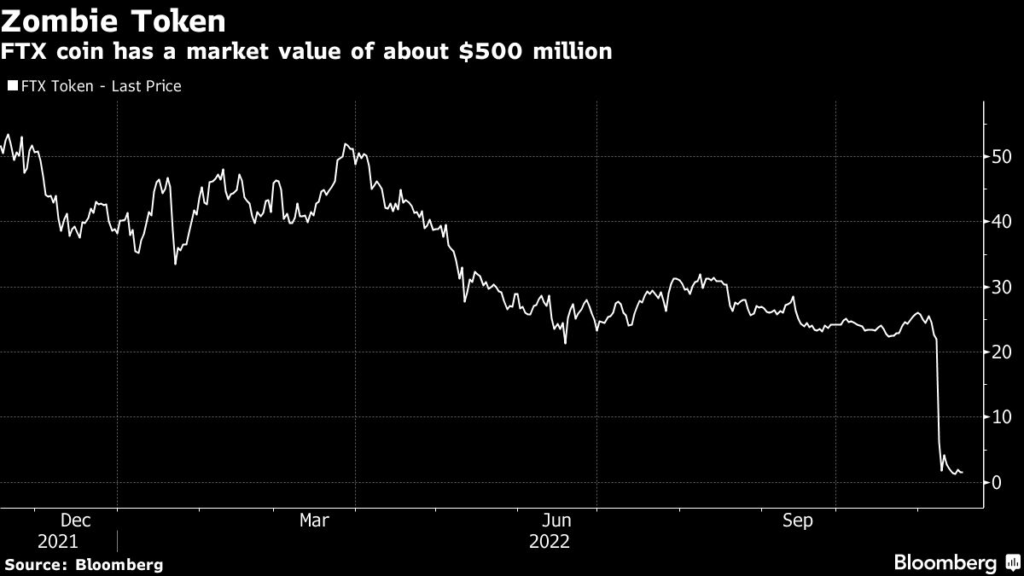
A cryptocurrency whose sponsor went belly up, with no obvious use and a sordid role in a complicated deception? And still there’s about $500 million of the tokens sloshing around on digital trading platforms.

That’s the FTT token from the now-bankrupt exchange FTX, whose demise has cast a pall on the crypto space that industry participant say could take years to be lifted. The token reached a high of nearly $85 in September of last year, and though it’s seen its price drop roughly 98% since then, it still sports an eye-popping hypothetical market value on different exchanges and platforms. 

Liquidators Concerned That FTX Had No Authority to File Bankruptcy (1:07 p.m.)

Liquidators, appointed by a Bahamian court to take over FTX Digital Markets Ltd.’s affairs said they have “significant” concern that FTX management, led by Sam Bankman-Fried, lacked authority to put the crypto businesses into bankruptcy in the US.

More than 100 FTX-related entities filed for Chapter 11 in the US Bankruptcy Court for the District of Delaware after insolvency proceedings for Bahamas-based FTX Digital began on the island on Nov. 10.

Bankman-Fried Received $1 Billion Loan (11:39 a.m.)

FTX co-founder Samuel Bankman-Fried, one of his related companies, and two other top executives at the collapsed cryptocurrency exchange received massive loans from affiliated trading arm, Alameda Research, according to a bankruptcy court filing Thursday.

Alameda’s receivables included $4.1 billion in combined loans to “related parties,” according to a footnote in a document filed by John J. Ray III, who was appointed to oversee FTX as its chief executive officer during the proceedings. That includes $1 billion to Bankman-Fried, $2.3 billion to Paper Bird Inc., an entity majority owned by Bankman-Fried, $543 million to Nishad Singh, head of engineering at FTX, and $55 million to Ryan Salame, head of FTX Digital Markets. 

Franklin CEO: Decentralized Exchanges Will Get More Attention (11:24 a.m.)

Franklin Templeton’s Jenny Johnson sees the downfall of FTX likely pushing investors toward decentralized exchanges and seeking professional guidance on crypto assets.

The failure of the centralized exchange would drive crypto investors toward versions like Uniswap or SushiSwap, which are built on public chains, Franklin’s president and chief executive officer told Bloomberg News on Wednesday.

Democratic Senators Want Answers (11:14 a.m.)

Democratic Senators Elizabeth Warren and Dick Durbin seek information from FTX founder Sam Bankman-Fried on FTX’s collapse, in a letter to Bankman-Fried and the crypto exchange’s newly appointed CEO John Jay Ray III.

New FTX CEO Can’t Locate Company’s Cash, Crypto (9:29 a.m.)

Advisers now overseeing the carcass of Sam Bankman-Fried’s FTX Group are struggling to locate the company’s cash and crypto, citing poor internal controls and record keeping. 

“Never in my career have I seen such a complete failure of corporate controls and such a complete absence of trustworthy financial information,” John J. Ray III, the group’s new chief executive officer who formerly oversaw the liquidation of Enron Corp., said in a sworn declaration submitted in bankruptcy court. 

FTX Lawyers Accuse Bankman-Fried of Undermining Bankruptcy (8:39 a.m.)

Embattled cryptocurrency mogul Sam Bankman-Fried is undermining efforts to reorganize his crumbling empire with “incessant and disruptive tweeting” that appears aimed at moving assets away from the control of a US court in favor of one in the Bahamas, US lawyers for the bankrupt crypto platform FTX said in a court filing.

FTX, which is now under the control of John J. Ray III — a restructuring lawyer who oversaw the liquidation of Enron — asked a federal judge in Wilmington, Delaware, to transfer a competing bankruptcy case filed in New York by Bahamian liquidators to Delaware.

Binance Suspends Deposits of USDC (SOL), USDT (SOL) Token (7:57 a.m. New York)

Binance has temporarily suspended deposits of USDC (SOL) and USDT (SOL) “until further notice,” the company announced on its blog.

Binance Evidence on FTX Collapse Unacceptable, UK Lawmakers Say (6:27 a.m. New York)

Binance sent news articles — rather than internal records — to a UK Parliamentary committee probing the collapse of FTX.com and its planned sale of FTT token, a move that some UK lawmakers called disappointing and unacceptable.

Alison Thewliss, a member of the UK’s Treasury Committee, said in an interview on Bloomberg Radio that Binance sent news articles to the committee, while it had expected to receive internal records about the potential market consequences of Binance’s announced divestment of FTT. Thewliss said that Binance’s lack of transparency would influence the committee’s recommendations to government on regulating the crypto industry.


Gopax Says Some Payments Being Delayed Due to Genesis Global (5:35 p.m. HK)

South Korean crypto exchange Gopax notified its users that payments in one of its depository products linked to Genesis Global Capital are being delayed, according to a statement on its website posted late Wednesday. The product named ‘GOFi’ is provided by Genesis, Gopax’s second largest shareholder and a key business partner

Binance Is Preparing to Bid for Voyager Digital, CoinDesk Says (4:10 p.m HK)

Binance.US is preparing to bid for bankrupt crypto lender Voyager Digital, CoinDesk reported, citing a person familiar with the matter. 

Voyager has been trying to sign a deal to sell itself to one of the bidders that lost out in an auction won by FTX. The sale to FTX valued at about $1.4 billion collapsed after the former’s own bankruptcy. 

Voyager filed for bankruptcy protection in July after a failed attempt by FTX-affiliated Alameda Research to bail it out with a revolving line of credit.

FTX Wipeout Is Fresh Test of Nerves for Asia Regulators (4:00 p.m. HK)

Crypto’s latest existential crisis flared amid far-reaching planned changes in the digital-asset rulebooks of Asian centers including Hong Kong and Singapore. Officials in both jurisdictions and further afield face calls to ensure greater transparency, especially on customer assets.

Hong Kong two weeks ago pivoted to a more welcoming stance, detailing plans to become a crypto hub with legalized retail trading and dedicated exchange-traded funds. Singapore, in contrast, is clamping down on retail crypto trading, focusing instead on productive applications of blockchain technology.

Both appear to be sticking with their diverging regulatory paths.

–With assistance from Sunil Jagtiani and Dara Doyle.

More stories like this are available on bloomberg.com

©2022 Bloomberg L.P.

FTX’s ‘Zombie’ Token Still Has a $500 Million Market Value

(Bloomberg) — The FTT cryptocurrency ensnared in the blowup of Sam Bankman-Fried’s empire still has a market value of $500 million, even though it has no obvious use.

That’s the token from the now-bankrupt exchange FTX, whose demise has cast a pall on the crypto space that industry participant say could take years to be lifted. The token reached a high of nearly $85 in September of last year, and though it’s seen its price drop roughly 98% since then, it still sports an eye-popping hypothetical market value on different exchanges and platforms. 

“It’s a zombie coin,” Matt Hougan, chief investment officer of Bitwise, a crypto-focused asset manager, said on Bloomberg’s “What Goes Up” podcast. “If you look, there it is — half a billion dollars of worthless money.”

Hougan posits that part of the reason the market value could look so inflated is that adrenaline-chasing day-traders might be dabbling in something that’s seen huge price shifts over the past week. But, more importantly, “people maybe can’t access most of it because it’s held on FTX exchange,” he added.

The sudden collapse of Sam Bankman-Fried’s FTX crypto empire has rocked the digital-assets industry, with prices of all manner of tokens plunging, and a number of firms coming down with it. 

Earlier this month, news site CoinDesk reported on the balance sheet of FTX sister company Alameda, a trading firm, saying that a significant portion of its assets were in FTT, whose holders could get discounts on trading fees and other perks. In fact, FTX and its affiliated companies owned a big chunk of all the FTT in existence. 

Binance, an FTX rival, also held a lot of the token thanks to a prior investment in FTX. Its chief executive, Changpeng Zhao, announced on Twitter that he’d be selling because of “recent revelations.” That sparked the crypto equivalent of a bank run. FTT on Thursday hovered around $1.50, Bloomberg data showed.

“If you put a true value on it, it’s got to be zero,” Chris Gaffney, president of world markets at TIAA Bank, said of FTT. “FTX locked everything, so I have to believe that’s just a function of having those locked up and not being able to trade. There’s no market cap left there.”

FTX is now in bankruptcy, with revelations of its inner workings during its last days slowly trickling out in a dramatic way through court filings. More than $300 million of FTT was minted by “an unauthorized source” following the bankruptcy filing, FTX’s new chief executive said in court papers Thursday. 

The concept of a “market capitalization” can be murky in the crypto space as some projects can have a large number of tokens out — and huge chunks of them can often be controlled by founders or just a handful of whales. 

Read more: Think Crypto’s Real Value Was $3 Trillion? Try $875 Billion

But FTT might be attracting investors with a “hodl” mentality, said Max Gokhman, chief investment officer at asset manager AlphaTrAI, who said that it was reminiscent of traders buying shares of Hertz Global Holdings Inc. after it filed for bankruptcy during the pandemic.

“There is a tendency for traders who don’t understand risk management to throw good money after bad,” he said. “In crypto that mentality is even more deeply ingrained, as in the notion of comeback stories. Plus, very few folks in the space were even around when Enron went down — so they’re treading through unfamiliar territory with perhaps too much optimism.” 

–With assistance from Muyao Shen, Michael P. Regan and Jeremy Hill.

More stories like this are available on bloomberg.com

©2022 Bloomberg L.P.

FTX Collapse Will Spur Move to Decentralized Exchanges, Franklin’s CEO Says

(Bloomberg) — Franklin Templeton’s Jenny Johnson sees the downfall of FTX likely pushing investors toward decentralized exchanges and to seek professional guidance on crypto assets.

The failure of the centralized exchange would drive crypto investors toward versions like Uniswap or SushiSwap, which are built on public chains, Franklin’s president and chief executive officer told Bloomberg News on Wednesday.

“Those types of things are proving out to have real value,” Johnson said in an interview on the sidelines of a conference in Mexico City. The suspect transfers between FTX and Sam Bankman-Fried’s crypto trading company Alameda Research would have been visible on a decentralized exchange, she said.

Johnson said FTX’s collapse would likely scare some investors away from the asset class while others would embrace more transparent products.

“You’re gonna have people who say, ‘You know what, I’m either gonna have somebody professionally who understands the space to do it or I’m not gonna get in it,’ ” she said.

Financial professionals had been skeptical of the returns offered by so-called stable coins, Johnson said.

“If you actually take FTX and follow the dominoes, they lead you all the way back to the stable-coin blowups in the spring,” she said. “The contagion, I think went backward and anywhere where people are creating their own coins, like a loyalty program and borrowing against it, you’re going to have a problem because there isn’t something real behind that,” she said.

ESG and Congress

Asked if Republicans taking control of the US House of Representatives would lead to push-back against corporate ESG strategies, Johnson said she didn’t think it would make a difference.

“In this movement toward say renewable energy, there are going to be choke holds in the process that are going to be really investing opportunities,” she said. “I think that the trend isn’t going to change.”

–With assistance from Nacha Cattan.

(Updates with comments on US elections in last two paragraphs.)

More stories like this are available on bloomberg.com

©2022 Bloomberg L.P.
FTX Lawyers Accuse Bankman-Fried of Undermining Bankruptcy

(Bloomberg) — Embattled cryptocurrency mogul Sam Bankman-Fried is undermining efforts to reorganize his crumbling empire with “incessant and disruptive tweeting” that appears aimed at moving assets away from the control of a US court in favor of one in the Bahamas, US lawyers for the bankrupt crypto platform FTX said in a court filing.

FTX, which is now under the control of John J. Ray III — a restructuring lawyer who oversaw the liquidation of Enron — asked a federal judge in Wilmington, Delaware, to transfer a competing bankruptcy case filed in New York by Bahamian liquidators to Delaware.

Such a move would consolidate all US-based insolvency proceedings in one court. They also asked the Delaware judge to block “all persons and all governmental units” from taking action in any court around the world to seize assets or collect money from the company.

“Enormous efforts are underway to bring some semblance of order to a chaotic environment,” lawyers for FTX wrote in the bankruptcy filing. “It is critical to the efforts to end the chaos and to ensure that assets can be secured and marshalled in an orderly process.


Liquidators in the Bahamas moved earlier this week to solidify control over the insolvency of FTX Digital Ltd., a subsidiary within Bankman-Fried’s crypto enterprise, bankruptcy court papers show. They argue that account holders with assets in FTX’s custodial wallets are likely creditors of the Bahamian unit and are seeking to probe the rest of the crypto exchange’s corporate entities.

In their New York filing, the liquidators asked a federal judge to officially recognize and support their case in the Supreme Court of the Bahamas. In any other insolvency case, such a move would be considered routine. The move is unusual in this case, however, because FTX put itself and more than 100 affiliates into court protection in federal court in Delaware. 

In an article published Wednesday by Vox Media, a reporter posted screen shots of Twitter direct messages in which Bankman-Fried criticized regulators and called the decision to put FTX into bankruptcy a mistake. “Everything would be ~70% fixed right now if I hadn’t,” Bankman-Fried wrote in the DMs.

He went on to suggest that he could still fix the matter if “we can win a jurisdictional battle vs. Delaware.”

FTX’s lawyers included the comments in the bankruptcy filing Thursday morning.

Bankman-Fried “appears to be supporting efforts” by the Bahamian liquidators “to expand the scope of the FTX DM proceeding in the Bahamas, to undermine these Chapter 11 cases, and to move assets from the debtors to accounts in the Bahamas under the control of the Bahamian government,” the lawyers wrote.

The liquidators in the Bahamas said in court papers and during a hearing on Thursday that the US bankruptcy case may not have been properly authorized. 

Bankman-Fried didn’t respond to messages seeking comment on the Vox article, but in his own Twitter feed, he sought to walk back the comments, which he said were not intended to be public and part of a conversation with “a friend of mine.”

In the hours before Bankman-Fried quit as CEO, he talked with his personal lawyers, other senior FTX people and his father, Joseph Bankman, a professor at Stanford Law school who is considered an expert on tax law.

He resigned at 4:30 a.m. on Nov. 11, Ray took over and the bankruptcy case in Wilmington, Delaware began. 

(Updates with position of Bahams regulators in the 11th paragraph. A previous version of this story corrected the spelling of Stanford Law School.)

More stories like this are available on bloomberg.com

©2022 Bloomberg L.P.

Close Bitnami banner
Bitnami