Bloomberg

FTX Advisers Find ‘Only a Fraction’ of Company’s Crypto Assets

(Bloomberg) — Advisers now overseeing the ruins of Sam Bankman-Fried’s FTX Group are struggling to locate the company’s cash and crypto, slamming poor internal oversight and record keeping at the now-bankrupt company. 

“Never in my career have I seen such a complete failure of corporate controls and such a complete absence of trustworthy financial information,” John J. Ray III, the group’s new chief executive officer who formerly oversaw the liquidation of Enron Corp., said in a sworn declaration submitted in bankruptcy court. 

For the full declaration filed in FTX’s bankruptcy case, click here

Read the craziest parts of the new bankruptcy filing

“From compromised systems integrity and faulty regulatory oversight abroad, to the concentration of control in the hands of a very small group of inexperienced, unsophisticated and potentially compromised individuals, this situation is unprecedented,” he added.

The documents depict a free-wheeling crypto enterprise devoid of virtually every policy and practice that would be the norm for almost any other corporation. The slipshod record keeping and lack of organization will make it even more challenging for scores of FTX advisers working around the clock to recover billions of dollars customers are owed.

Ray pulled no punches in the declaration, calling Bankman-Fried’s recent public statements “erratic and misleading.” In their attempts to round up FTX’s cash, advisers have told financial institutions to freeze withdrawals and reject any instructions from Bankman-Fried.

Advisers have located “only a fraction” of the digital assets that they hope to recover during the Chapter 11 bankruptcy, Ray said. They’ve so far secured about $740 million of cryptocurrency in offline cold wallets, a storage method designed to prevent hacks. 

The company’s audited financial statements should not be trusted, Ray said. Advisers are working to rebuild balance sheets for FTX entities from the bottom up, he added.

FTX “did not maintain centralized control of its cash” and failed to keep an accurate list of bank accounts and account signatories, or pay sufficient attention to the creditworthiness of banking partners, according to Ray. Advisers don’t yet know how much cash the company had when it filed for bankruptcy, but have found about $560 million attributable to various FTX entities so far.

Among the alarming claims in the filing: software was allegedly used to conceal the misuse of customer funds; Alameda was secretly exempt from some aspects of FTX.com’s trading policies; and a single, unsecured group email was used to access private keys and sensitive data around the world, according to the court documents.

Ray also noted that lasting records of decision-making are hard to come by: Bankman-Fried often communicated through applications that auto-deleted in short order and asked employees to do the same.

Corporate funds of FTX Group were used to buy homes and other personal items for employees, Ray said. Some of the real estate was recorded in the personal names of employees and FTX advisers, he wrote, and the company’s disbursement controls were not appropriate for a business.

“For example, employees of the FTX Group submitted payment requests through an on-line ‘chat’ platform where a disparate group of supervisors approved disbursements by responding with personalized emojis,” according to the statement. 

A footnote in the documents indicates Alameda Research Ltd., a subsidiary of the crypto trading house, had lent $1 billion to Bankman-Fried and more than $500 million to FTX co-founder Nishad Singh as of Sept. 30. The financial reports detailing the transactions were unaudited, produced while Bankman-Fried controlled the business, and Ray emphasized that he does not have confidence in their accuracy.

FTX is now fighting Bankman-Fried about whether his empire should be under the jurisdiction of US courts, where more than 100 related companies are in bankruptcy, or in the Bahamas, his preferred location. FTX’s legal team has blamed the meltdown in part on poor oversight by non-US regulators.

The case is FTX Trading Ltd., 22-11068, U.S. Bankruptcy Court for the District of Delaware. 

(Updates with additional information from bankruptcy court declaration throughout)

More stories like this are available on bloomberg.com

©2022 Bloomberg L.P.

Pubs and Shops to Benefit From UK Property Tax Support

(Bloomberg) — British companies will get state support to help them cope with rising business rates — an unpopular commercial property tax — as the government tries to protect shopping districts that are suffering from soaring inflation and the start of a likely recession.

Chancellor of the Exchequer Jeremy Hunt said Thursday that more than £13.6 billion ($16 billion) would be put into a package including a cap on any increase in rates following a revaluation of property prices next year.

Other measures will provide targeted help to small businesses, and specifically companies in the retail and hospitality sectors.

The policies, announced in the Autumn Statement, “are the early Christmas presents many businesses needed” according to Mike Flecknoe from commercial property giant Cushman & Wakefield Plc.

“The money businesses will save through this measure could be put toward hiring or retaining workforce or covering higher energy bills,” he added.

However, some companies said the business rates system still needed deeper reform and complained that the government has dropped plans for an online sales tax that had been raised as a way of helping bricks-and-mortar retailers compete with digital rivals.

“The failure to provide any further relief for our industry today will hit pubs, breweries and their customers extremely hard this winter,” said Emma McClarkin, head of the British Beer and Pub Association.

–With assistance from Katie Linsell.

More stories like this are available on bloomberg.com

©2022 Bloomberg L.P.

Crypto Stocks’ Rout Delivers $469 Million Win to Short Sellers

(Bloomberg) — The fallout for publicly-traded companies exposed to cryptocurrencies has been a boon for investors betting against them, delivering roughly $469 million in paper profits for November alone. 

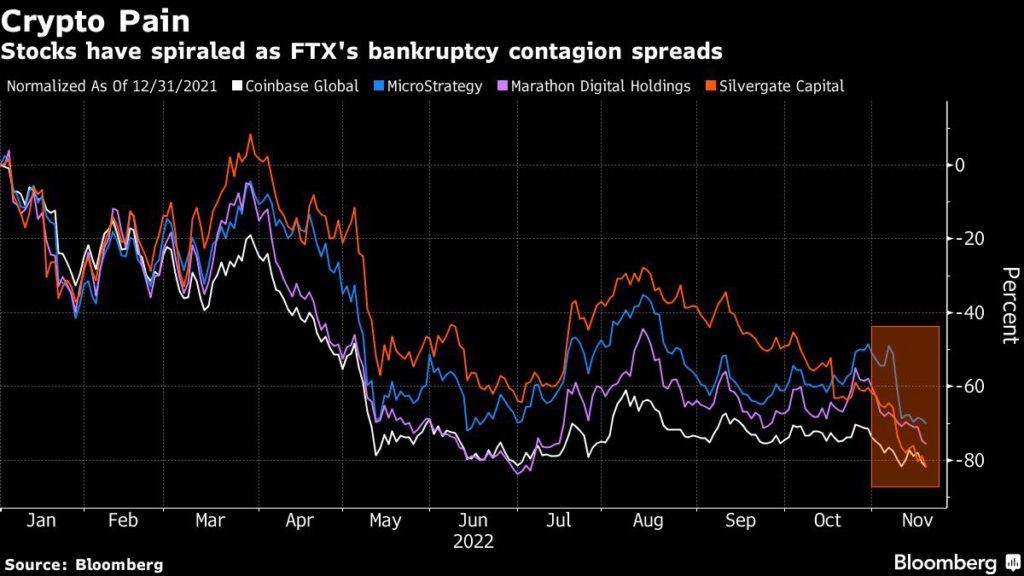
MicroStrategy Inc. is down 37% this month through Wednesday’s close, handing shorts $286 million in mark-to-market profits, while Coinbase Global Inc.’s 26% decline delivered another $229 million in gains, according to financial analytics firm S3 Partners. Huge losses for other peers, including Marathon Digital Holdings Inc. and Silvergate Capital Corp., have helped drive profits in November for investors betting against the industry through short sales, Ihor Dusaniwsky, S3’s managing director of predictive analytics, wrote in a note.

The group of stocks has tumbled as investors weigh how far reaching the fallout from the collapse of Sam Bankman-Fried’s FTX Group will be across the cryptocurrency ecosystem. Contagion from FTX’s bankruptcy has forced management teams to attempt to distance themselves from the company, with exposed stocks following tokens, including Bitcoin, lower. The largest cryptocurrency by market value has fallen nearly 20% so far this month, compared with a 1.1% gain for the S&P 500 Index.

“We expect increased short selling in these stocks as the possibility for broader sector wide price weakness increases,” Dusaniwsky wrote. With the underlying cryptocurrency market in temporary disarray, he expects shorting activity to “see-saw between shorting and covering as momentum trading overtakes fundamental investing in these stocks.”

Skeptics have added to bearish bets over the past week, driving almost $93 million of new short selling, according to S3 data. More than one-quarter of MicroStrategy shares available for trading are currently sold short, while Marathon Digital, Bakkt Holdings Inc. and Coinbase each have short interest levels above 15% of the shares available for trading, the data show.

Despite the industry fallout, Cathie Wood’s funds have continued to pile onto bets in Coinbase, Silvergate Capital and Grayscale Bitcoin Trust. Funds run by Wood’s Ark Investment Management have been on wild rides this year as growth stocks have been battered by Federal Reserve interest rate hikes and fears of a recession. 

More stories like this are available on bloomberg.com

©2022 Bloomberg L.P.

BMO Launches ARK-Managed ETF Series Focusing on Innovation

(Bloomberg) — BMO Investments Inc. is introducing a suite of innovation-focused funds that will be overseen by Cathie Wood’s ARK Investment Management, in a bet that investor appetite for growth-centered products will persist even after this year’s slump.

The arm of the Canadian lender is expanding its thematic fund offerings with three ETFs and three mutual funds, according to a press release Thursday. They’ll have mirroring tickers — BMO ARK Genomic Revolution Fund (ticker ARKG), BMO ARK Innovation Fund (ARKK) and BMO ARK Next Generation Internet Fund (ARKW). 

The new offerings come as markets are grappling with the crucial question of whether inflation has ebbed enough to give the Federal Reserve room to slow its aggressive campaign of interest-rate hikes. Wood’s flagship ARKK ETF surged the most on record last week after a report of slower-than-expected US inflation data. It’s given back some of the gains this week.

“Based on the strength and expertise of the ARK team, these three new BMO ARK funds are expertly positioned to benefit from important long-term trends in the market,” Kevin Gopaul, president of ETFs at BMO Global Asset Management, said in the release.

The funds will seek to invest broadly in companies involved in the technological development of fintech innovation, genomic innovation, industrial innovation and next generation Internet innovation, according to the release. 

It’s been a brutal year for riskier investments. The crypto space has floundered and is now contending with contagion risks spurred by the collapse of the popular exchange FTX.com. 

Even after last week’s surge, the ARK Innovation ETF (ARKK) is down about 60% this year, with top holdings Tesla Inc. and Zoom Video Communications Inc. pummeled by tightening financial conditions. It has still netted $1.9 billion of total inflows year-to-date, putting it in the top 10 of actively managed ETFs for new cash, according to data compiled by Bloomberg.

Todd Sohn, ETF strategist at Strategas Securities, says the debut of the new products reflects a continued appetite for growth-centric strategies, though “the market environment is still a headwind for this segment.”

Each of the new BMO ETFs has a management fee of 0.75% and will be listed on the Toronto Stock Exchange. 

More stories like this are available on bloomberg.com

©2022 Bloomberg L.P.

Tech Firm ID.me Overstated Jobless Fraud to Win US Contracts, House Finds

(Bloomberg Law) — Tech company ID.me misled US officials and the public about processing delays and the scope of fraud in the unemployment insurance system, and used those claims to secure more government business, a House investigation found.

Early results from Democrats on the House Oversight Committee, released Thursday, show that ID.me’s estimate of $400 billion in fraud from pandemic-related jobless aid relied on figures that didn’t exist when the company first publicized the number. At least 25 state agencies separately spent nearly $45 million on the company’s facial recognition technology, according to the committee, even though the software potentially blocked “hundreds of thousands” of unemployed Americans from receiving federal help.

Committee Chair Carolyn Maloney (D-N.Y.) said in a statement that she was concerned the company provided “inaccurate information to federal agencies in order to be awarded millions of dollars” in business.

The company hasn’t seen the House report and couldn’t comment early today, an ID.me spokesman said.

The cybersecurity company touts itself as a digital gatekeeper for government benefits. It allows officials to confirm virtually that Americans are who they say they are, often using facial-recognition software. Its services became especially attractive to officials in the early days of the pandemic, when in-person government offices closed and state unemployment insurance systems struggled to process a flood of new jobless claims.

US officials have since continued to use its services, albeit with some tweaks. The Internal Revenue Service said in February it would move away from the company’s facial-recognition tool but continue using other ID.me options. The Department of Veterans Affairs decided to keep the software. The agency never used the facial-recognition features, Gary Kunich, a VA spokesman, said in February. Id.me hired hundreds of employees in early 2022 to overcome issues with the facial recognition software and help people who were uncomfortable using it.

The committee’s findings support the results of a Bloomberg investigation in January that reported ID.me’s fraud estimate was overstated. Fraudsters likely stole at least $163 billion in benefits during the pandemic, the Labor Department’s internal watchdog said separately in March.

President Joe Biden promised earlier this year that he’d sign an executive order to crack down on identity theft involving public benefits, but hasn’t done so. His Labor Department in September 2021 recommended ID.me, along with competitors TransUnion and LexisNexis, to state unemployment offices looking to crack down on pandemic fraud.

The company’s automated facial-recognition software failed to verify the identities of 10% to 15% of people who used it to apply for unemployment checks, according to the committee. When it sent those individuals to video chat appointments, wait times averaged more than four hours in the 14 states that used the company’s services, the report said.

The company also falsely told the IRS in April 2021 that it had cut wait times to two hours, according to meeting minutes obtained by the committee.

Democrats and advocacy groups earlier this year pressed ID.me over its “performance failures” and storage of biometric information, warning that it has negatively affected state unemployment programs and could be discriminatory.

In response to concerns about the vendor, a Labor Department official pointed to the agency’s work on the government’s own identity verification software. That tool performs better for Americans seeking government benefits than privately owned options such as ID.me, equity advocates said.

Congress increased scrutiny over the jobless aid safety net in the wake of the massive delays and increase in fraud during the pandemic. It gave the DOL $2 billion to help states improve how they pay out benefits.

To contact the reporters on this story: Courtney Rozen in Washington at crozen@bgov.com; Rebecca Rainey in Washington at rrainey@bloombergindustry.com

To contact the editor responsible for this story: Martha Mueller Neff at mmuellerneff@bloomberglaw.com

More stories like this are available on bloomberg.com

©2022 Bloomberg L.P.

US Stocks Slump as Hawkish Fedspeak Lifts Yields: Markets Wrap

(Bloomberg) — US stocks declined and the dollar surged as Federal Reserve officials hammered home their resolve to remain persistent in their fight against inflation and warned of more pain to come.  

The S&P 500 and the tech-heavy Nasdaq 100 slumped. US 10-year Treasury yields rose after St. Louis Fed President James Bullard became the latest policy maker to flag that interest rate rises had further to rise. Rates might need to rise to a 5%-7% range, Bullard said on Thursday while also flagging the risk of further financial stress. 

Bullard’s comments came a day after San Francisco Fed President Mary Daly said a pause in rate hikes was “off the table.” With inflation only starting to ease after hitting decades-high levels, and a gauge of US retail sales increasing at the fastest pace in eight months, the message from Fed speakers is that they have further to go to extinguish prices pressures. Fresh data showing weekly jobless claims came in below the forecast in a Bloomberg survey further underscored the strength of the labor market. 

“In a different world, low inflation, steady jobless claims and a solid labor market would be good news,” said Jim Baird, chief investment officer at Plante Moran Financial Advisors. “Instead, steady labor-market conditions against a backdrop of persistent inflation raises the stakes for the Fed.”

Earnings beats from tech and consumer-facing companies did little to help sentiment. Nvidia Corp. posted quarterly sales that topped analysts’ estimates while Cisco Systems Inc. gave a bullish revenue forecast. Macy’s Inc., meanwhile, climbed as it succeeded in bringing in shoppers despte a trend away from discretionary purchases as inflation persists.

Prices for growth-sensitive oil and copper extended losses on signs of a dimming demand outlook. European Central Bank policy makers too are said to be mulling a smaller 50 basis-point rate hike next month, signaling their concern for the economy and pushing the euro lower. 

The pound dropped as Chancellor Jeremy Hunt outlined a £55 billion ($65 billion) package of tax rises and spending cuts even as the economy slid into recession. Gilt yields rose.


Key events this week:

  • Fed’s Neel Kashkari, Loretta Mester speak, Thursday
  • US Conference Board leading index, existing home sales, Friday

Some of the main moves in markets:

Stocks

  • The S&P 500 fell 1% as of 10:40 a.m. New York time
  • The Nasdaq 100 fell 0.8%
  • The Dow Jones Industrial Average fell 0.6%
  • The Stoxx Europe 600 fell 0.5%
  • The MSCI World index fell 0.8%

Currencies

  • The Bloomberg Dollar Spot Index rose 0.7%
  • The euro fell 0.6% to $1.0331
  • The British pound fell 1% to $1.1789
  • The Japanese yen fell 0.8% to 140.59 per dollar

Cryptocurrencies

  • Bitcoin rose 0.6% to $16,627.51
  • Ether rose 0.3% to $1,208.83

Bonds

  • The yield on 10-year Treasuries advanced 10 basis points to 3.79%
  • Germany’s 10-year yield advanced four basis points to 2.04%
  • Britain’s 10-year yield advanced seven basis points to 3.22%

Commodities

  • West Texas Intermediate crude fell 2.1% to $83.78 a barrel
  • Gold futures fell 0.6% to $1,764.60 an ounce

This story was produced with the assistance of Bloomberg Automation.

–With assistance from Sujata Rao.

More stories like this are available on bloomberg.com

©2022 Bloomberg L.P.

FTX Latest: CEO Laments Inability to Find Most of Crypto Assets

(Bloomberg) — Advisers overseeing the bankruptcy of FTX Group are struggling to locate the company’s cash and crypto, citing poor internal controls and record keeping. The complete failure of corporate controls at the company is “unprecedented,” according to new Chief Executive Officer John J. Ray III, who had a more than 40-year career in restructurings, including overseeing the liquidation of Enron.

US lawyers for the bankrupt crypto platform said in a court filing that embattled cryptocurrency mogul Sam Bankman-Fried is undermining efforts to reorganize his crumbling empire with “incessant and disruptive tweeting.”

More retail money is getting trapped as crypto companies falter. Crypto lender BlockFi, which has suspended customer withdrawals, is reportedly preparing to file for bankruptcy. Gemini Trust Co., the crypto platform run by the Winklevoss brothers, paused withdrawals on its lending program. And Binance CEO Changpeng Zhao told CNBC his company “would be interested in looking at the assets, buying assets, especially some of the better ones” that may be sold in the form of bankruptcy.

Key stories and developments:

  • Here Are the Wildest Parts of the New FTX Bankruptcy Filing
  • FTX Offers a Master Class in Crypto Market’s Flaws: Editorial
  • Odd Lots: Understanding the Collapse of Sam Bankman-Fried’s Crypto Empire
  • Winklevoss Faithful Have a $700 Million Problem in Genesis Halt
  • Silbert’s Once-$10 Billion Crypto Empire Is Showing Cracks 

(Time references are New York unless otherwise stated.)

New FTX CEO Can’t Locate Company’s Cash, Crypto (9:29 a.m.)

Advisers now overseeing the carcass of Sam Bankman-Fried’s FTX Group are struggling to locate the company’s cash and crypto, citing poor internal controls and record keeping. 

“Never in my career have I seen such a complete failure of corporate controls and such a complete absence of trustworthy financial information,” John J. Ray III, the group’s new chief executive officer who formerly oversaw the liquidation of Enron Corp., said in a sworn declaration submitted in bankruptcy court. 

FTX Lawyers Accuse Bankman-Fried of Undermining Bankruptcy (8:39 a.m.)

Embattled cryptocurrency mogul Sam Bankman-Fried is undermining efforts to reorganize his crumbling empire with “incessant and disruptive tweeting” that appears aimed at moving assets away from the control of a US court in favor of one in the Bahamas, US lawyers for the bankrupt crypto platform FTX said in a court filing.

FTX, which is now under the control of John J. Ray III — a restructuring lawyer who oversaw the liquidation of Enron — asked a federal judge in Wilmington, Delaware, to transfer a competing bankruptcy case filed in New York by Bahamian liquidators to Delaware.

Binance Suspends Deposits of USDC (SOL), USDT (SOL) Token (7:57 a.m. New York)

Binance has temporarily suspended deposits of USDC (SOL) and USDT (SOL) “until further notice,” the company announced on its blog.

Binance Evidence on FTX Collapse Unacceptable, UK Lawmakers Say (6:27 a.m. New York)

Binance sent news articles — rather than internal records — to a UK Parliamentary committee probing the collapse of FTX.com and its planned sale of FTT token, a move that some UK lawmakers called disappointing and unacceptable.

Alison Thewliss, a member of the UK’s Treasury Committee, said in an interview on Bloomberg Radio that Binance sent news articles to the committee, while it had expected to receive internal records about the potential market consequences of Binance’s announced divestment of FTT. Thewliss said that Binance’s lack of transparency would influence the committee’s recommendations to government on regulating the crypto industry.


Gopax Says Some Payments Being Delayed Due to Genesis Global (5:35 p.m. HK)

South Korean crypto exchange Gopax notified its users that payments in one of its depository products linked to Genesis Global Capital are being delayed, according to a statement on its website posted late Wednesday. The product named ‘GOFi’ is provided by Genesis, Gopax’s second largest shareholder and a key business partner

Binance Is Preparing to Bid for Voyager Digital, CoinDesk Says (4:10 p.m HK)

Binance.US is preparing to bid for bankrupt crypto lender Voyager Digital, CoinDesk reported, citing a person familiar with the matter. 

Voyager has been trying to sign a deal to sell itself to one of the bidders that lost out in an auction won by FTX. The sale to FTX valued at about $1.4 billion collapsed after the former’s own bankruptcy. 

Voyager filed for bankruptcy protection in July after a failed attempt by FTX-affiliated Alameda Research to bail it out with a revolving line of credit.

FTX Wipeout Is Fresh Test of Nerves for Asia Regulators (4:00 p.m. HK)

Crypto’s latest existential crisis flared amid far-reaching planned changes in the digital-asset rulebooks of Asian centers including Hong Kong and Singapore. Officials in both jurisdictions and further afield face calls to ensure greater transparency, especially on customer assets.

Hong Kong two weeks ago pivoted to a more welcoming stance, detailing plans to become a crypto hub with legalized retail trading and dedicated exchange-traded funds. Singapore, in contrast, is clamping down on retail crypto trading, focusing instead on productive applications of blockchain technology.

Both appear to be sticking with their diverging regulatory paths.

El Salvador’s Bukele Vows to Buy Bitcoin Everyday (1:30 p.m. HK)

President Nayib Bukele tweeted, “We are buying one #Bitcoin every day starting tomorrow,” without elaborating. 

The country’s 2,381 Bitcoins have suffered a huge drop in value amid the recent selloff of the cryptocurrency. However, the nation’s finance minister said in an interview last week that the government has not sold any of its Bitcoin and has therefore not realized any loss. Tron founder Justin Sun said he’d join Bukele in buying one Bitcoin per day.

Bankman-Fried Tells His Side of FTX-Collapse Story in Tweets (1:10 p.m. HK)

On Wednesday, Bankman-Fried added a further 18 tweets to a meandering thread he started at the beginning of the week. 

The posts, published at sporadic intervals, have combined apologies for his failings with his perspective on what went wrong at the companies he founded and ran. They add to a previous series of cryptic posts. “We got overconfident and careless,” he said. 

Temasek Writes Down $275 Million FTX Investment (8:50 a.m. HK)

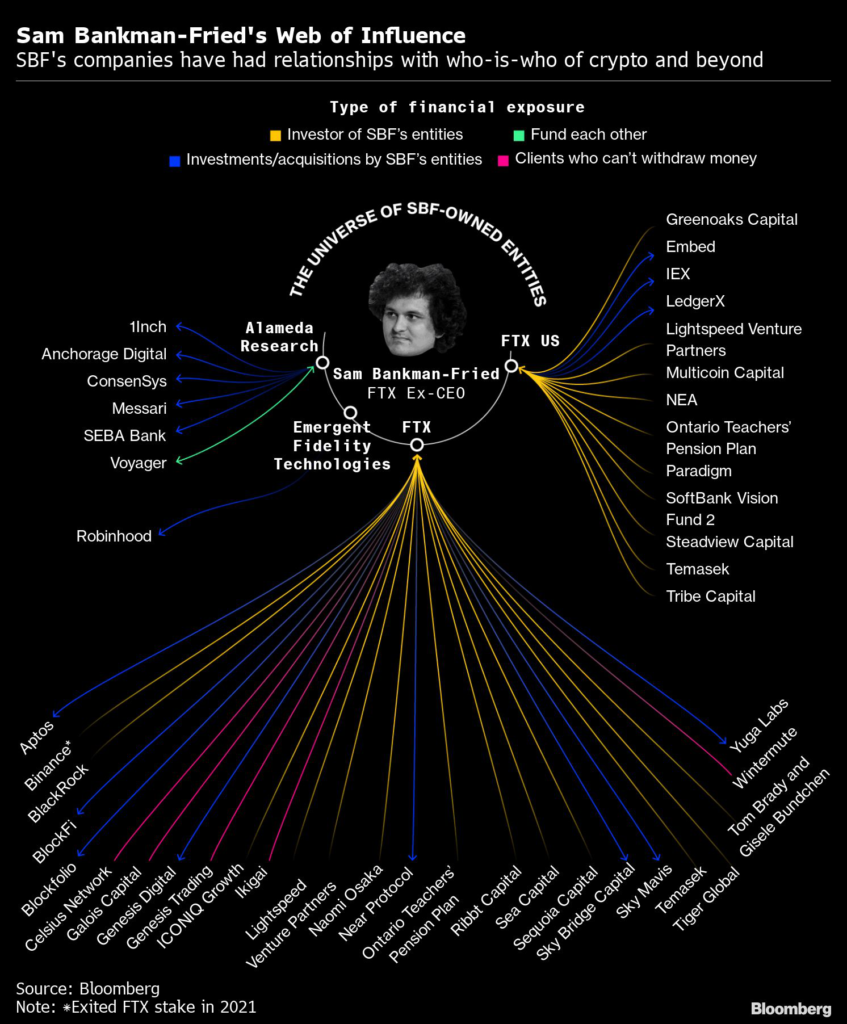
Singapore’s state-owned investor said in a statement that its belief in Sam Bankman-Fried was likely “misplaced” after it invested $210 million in FTX International and $65 million in FTX US across two funding rounds. It added that it has no direct exposure to cryptocurrencies remaining. 

Temasek said it had conducted an “extensive due diligence process” on FTX and that its audited financial statement showed the company to be profitable. It added that while the writedown has no significant impact on its overall performance, “we treat any investment losses seriously and there will be learnings for us from this.”

Winklevoss Faithful Have a $700 Million Problem in Gemini (8:00 a.m. HK) 

Customers of crypto exchange Gemini, founded by brothers Cameron and Tyler Winklevoss, are caught in the fallout from FTX due to a high-yield product called Gemini Earn — which has just Genesis Global listed as a single accredited borrower that passed its vetting process. Gemini halted redemptions from the product on Wednesday after Genesis suspended withdrawals. 

That left in limbo a program that, according to a person familiar with the matter, has $700 million of customer money tied up in it. Whether Gemini Earn customers ever get their money back remains to be seen. And much depends on Genesis itself, which has hired advisers to explore all possible options, including raising new funding.

Silbert’s Crypto Empire Is Showing Cracks (7:05 a.m. HK)

Suspended withdrawals at cryptocurrency brokerage Genesis have cast an unwanted spotlight on Barry Silbert, the man at the helm of the Digital Currency Group empire.

Last year, DCG’s valuation reached $10 billion, after it sold $700 million of stock in a private sale led by SoftBank. In addition to Genesis, it has more than 200 companies in its portfolio including Grayscale Investments, which offers the world’s largest crypto fund. DCG is also the parent of crypto-mining service provider Foundry Digital, Coindesk and exchange Luno. 

BlockFi Said to Plan Bankruptcy (3:34 p.m.)

Cryptocurrency lender BlockFi Inc. is preparing to file for bankruptcy within days, according to people with knowledge of the matter who asked not to be named because discussions are private. 

The crypto lender paused client withdrawals, citing bankruptcy uncertainties with FTX, while saying it had adequate liquidity and was exploring options with outside advisers. 

Congress to Probe FTX Collapse (3:18 p.m.)

FTX and its former chief executive officer, Democratic mega-donor Bankman-Fried, will be in congressional cross hairs next month as House and Senate panels probe the company’s collapse.

The House Financial Services and Senate Banking committees plan December hearings that will look at FTX’s sudden demise and its ripple affects in the broader digital asset industry. Democrats and Republicans alike have expressed anger about the current state of the crypto marketplace.

SBF Mistaken About FTX’s Leverage Levels (2:25 p.m.)

Bankman-Fried says he was mistaken about the cryptocurrency exchange’s leverage levels, thinking it was about $5 billion when it was $13 billion. 

In his latest series of tweets explaining how FTX imploded, Bankman-Fried says the company got “overconfident and careless.”

–With assistance from Sunil Jagtiani and Dara Doyle.

More stories like this are available on bloomberg.com

©2022 Bloomberg L.P.

Automakers Brace for GOP-Led House to Try to Erode EV Incentives

(Bloomberg) — Automakers have long relied on incentives to bolster the electric-vehicle market. With Republicans now set to take control of the US House of Representatives next year, the industry isn’t so sure it can count on those perks much longer.

The Republican takeover of the House could potentially imperil initiatives from EV credits to funding for charging stations passed in recent years by Democrats, who retained control of the US Senate in last week’s elections. Even if lawmakers don’t actively undo incentives, they could still let some programs phase out.

Prominent conservative lawmakers who are likely to play outsized roles in national debates under the coming Republican-led House like Georgia Representative Marjorie Taylor Greene have derided the Biden administration’s push to accelerate the transition to electric cars. In an October campaign appearance in Michigan, Greene accused Democrats of wanting to “emasculate the way we drive and force all of you to rely on electric vehicles.” 

Automakers are bracing for changes under a GOP-led House but aren’t likely to overhaul their positions, industry leaders say, particularly as new EV plants and jobs garner increasing support from lawmakers on both sides of the aisle.

“I’ve been around long enough to know that elections can mean a shift in policy priorities in Washington and state capitals, but it won’t fundamentally change the top automaker priorities: electrification, automation and connectivity,” said John Bozzella, chief executive officer of the Alliance for Automotive Innovation, which represents companies such as Ford Motor Co., General Motors Co. and Honda Motor Co. 

Here are some key programs that could be in line for changes following the election:

Charging Stations

Since President Joe Biden took office, Congress has appropriated $7.5 billion for electric-car charging stations, down from an initial request of $15 billion. Carmakers argue more is likely to be needed to convince consumers to go electric, but the prospects of more money from a GOP Congress are unclear.

Consumer Tax Credits

Automakers have been pushing the federal government to ease restrictions that limit the $7,500 credits for consumer purchases. Under a new law, the credits are only applicable to cars where the battery materials are sourced from the US and certain countries. Since China is a key provider of these materials, the industry is concerned that many of their US car models won’t qualify. Republicans have historically opposed the tax credits, arguing they’re a giveaway for rich Tesla Inc. car buyers.

See also: Ford, Toyota are at odds with their suppliers over EV tax credit 

Used Car Incentives

Under a new law, used EVs — at least cheap ones — will qualify for the tax credit for the first time. A $4,000 credit for some cars will become available after Dec. 31 for buyers with income under certain thresholds. Also for the first time, starting in 2024, consumers who buy new or used clean vehicles at registered dealers would be allowed to receive discounts at the point of sale equal to the value of their credits. The tax credits are set to last for 10 years, unless new congressional leaders move to repeal them early.

EV Cap

Under an old policy, only the first 200,000 EVs sold by a given manufacturer qualified for tax credits — irking companies such as GM and Tesla, which had surpassed the limit. Beginning next year, their vehicles will be eligible again — as long as they meet the new sourcing requirements. That could be undone if all or some of the Inflation Reduction Act is repealed.

More stories like this are available on bloomberg.com

©2022 Bloomberg L.P.
Digital Virgo to Merge With SPAC of Ex-Michael Jordan Agent

(Bloomberg) — Digital Virgo, a French mobile payment solutions company, is going public through a merger with a blank-check company founded by prominent sports executives including basketball great Michael Jordan’s former agent.

The company has agreed to a combination with Goal Acquisitions Corp. in a deal that would value it at $513 million including debt, the companies said in a statement Thursday, confirming a Bloomberg News report. The transaction is expected to provide Digital Virgo with at least $100 million in growth capital to expand in North America and elsewhere. 

“After years of steady growth and profitability, now is the time for us to go public and pursue more rapid growth by satisfying customer demand for a one destination platform that fulfills their content, commerce, and financial needs, Digital Virgo Chief Executive Officer Guillaume Briche said in a statement. “It’s also the right moment to bring our offerings to the U.S. market.”

Mergers with SPACs, after reaching a record of 250 deals totaling more than $113 billion last year, have fallen from favor after the disappointing trading performances by many of those companies. About $24 billion worth of these deals have been announced so far this year, according to data compiled by Bloomberg. 

Goal Acquisitions raised $259 million in an initial public offering last year with the intention of merging with a sports- or media-related company. Its chief executive officer is Harvey Schiller, a former executive with the New York Yankees and New Jersey Devils, according to a filing with the US Securities and Exchange Commission. Schiller is also a board member of the Baseball Hall of Fame and World Baseball Classic.

Its management team also includes David Falk, who has 40 years of experience as a National Basketball Association agent. Falk has represented stars such as Michael Jordan and Patrick Ewing. Veteran media executive and Internet investor Jon Miller was listed as chairman of the company’s advisory board. Sports executive Donna Orender is also on the board. 

“I’ve always had an interest in working with cutting-edge technologies, creating innovative ways for people to connect and communicate,” Orender said in a statement. “This idea of convergence as a way to simplify and amplify our lives in positive ways is really exciting right now.”

Digital Virgo, based in Lyon, France, allows users to pay for online subscriptions as part of their phone bills through the carriers, according to its website. Through acquisitions and organic expansion, the company operates in Africa, Europe, South America and the Middle East. The company also has content packages in different territories including sports and games. 

JMP Securities advised Goal Acquisition in the transaction, which is expected to close in the first quarter of 2023. 

(Adds quote from Orender in seventh paragraph)

More stories like this are available on bloomberg.com

©2022 Bloomberg L.P.

One Year From a Record High, the Nasdaq Has a Long Road to Recovery

(Bloomberg) — A year after the Nasdaq 100 Index last closed at an all-time high, there’s no sign the index is heading back to those heights any time soon. 

The 249 trading sessions since the close on Nov. 19, 2021, is the tech-heavy benchmark’s longest stretch since the dot-com era, and the third-longest ever: It took the gauge 3,925 trading days — more than 15 years — to recover from the dot-com crash and 416 sessions to rebound from the Crash of 1987.

This bear market in tech stocks is shaping up to be the longest that many young investors have ever seen, and may curb their appetite for risk for years to come. Even after a bounce this month, the Nasdaq 100 is still down 29% from its record close. 

“Big tech still has secular growth drivers, but the growth will be lower, which means they’ll have valuations under the levels they had when times were good,” said Anthony Saglimbene, chief market strategist at Ameriprise Financial. “That could mean, from a sentiment perspective, that there will be some reservation about jumping back in.”

Investors’ risk appetite got a shock this year when inflation raged out of control, prompting the Federal Reserve to begin its most aggressive campaign of interest rate increases since the early 1980s. Multiple routs ensued as investors fled the high-growth, high-valuation stocks that had prospered in the era of near-zero global interest rates.

Among US benchmarks, the Nasdaq 100, which was created in 1985 by the National Association of Securities Dealers, has taken the brunt of the selling. Technology companies account for half of its value. Add in some companies that are classified as parts of other sectors, like Google parent Alphabet Inc. and Amazon.com Inc., and the weighting jumps above 60%. 

Now, 11 members are down 50% or more this year, compared to just two stocks in the same period last year. The selloff has wiped $5.7 trillion off the benchmark’s market value, and lowered its valuation to 21 times projected earnings from 29 a year ago. The tech gauge fell 1.2% on Thursday, extending losses for a second session. 

A report a week ago of cooler-than-expected inflation triggered the steepest rally in more than two years, giving new vigor to battered stocks like Meta Platforms Inc. and DocuSign Inc. Still, one central bank governor said the Fed has a “ways to go” before it pauses its cycle of interest rate increases, and plenty of economists expect a recession that will hammer corporate earnings in the coming months.

“Things have gotten less bad, which is good, but that isn’t enough to give me confidence that valuations are at the bottom,” said Jordan Stuart, client portfolio manager at Federated Hermes.

Investors are still fleeing the sector: Bank of America Corp.’s latest survey highlighted that fund managers are the most underweight technology they’ve been since August 2006. Traders of exchange-traded funds are placing a record wager against the big comeback in tech stocks, according to data compiled by Bloomberg.

“The risk appetite today isn’t there, but it will come,” said Sylvia Jablonski, CEO and CIO of Defiance ETFs. Portfolios in coming years will be more diversified. “A few years ago, it would have been fine to pick the FAANGs, set it and forget it. That has changed, the process is more thoughtful.”

Tech Chart of the Day

Apple Inc. has embarked on the most aggressive share buyback program on Wall Street in recent years. The iPhone maker, which typically tops up its share repurchase authorization after its fiscal second quarter ends in March, has expanded its program by at least $50 billion every year since 2019. Apple spent almost $90 billion last year — equal to about the market value of Citigroup Inc. — and $32 billion more than the next highest company, according to Bloomberg data. 

Top Tech Stories

  • Alibaba Group Holding Ltd. reported a surprise loss after quarterly revenue barely grew, as China’s rigid Covid controls continue to sap consumer sentiment.
  • Nvidia Corp. assured investors Wednesday that demand remains strong for its artificial-intelligence and data-center chips, even as the company struggles with a slowdown in the personal-computer market.
  • NetEase Inc. and Blizzard Entertainment Inc. plan to end their 14-year partnership after January, depriving the Chinese firm of a slice of revenue and suspending service for some of the country’s most popular games.
  • Elon Musk will be creating room for competitors of Twitter Inc. to emerge if he breaks the “ethos” of the influential social media company, former Chairman Patrick Pichette said.
  • Tencent Holdings Ltd.’s plan to dole out $20 billion of stock in meal delivery giant Meituan triggered a broad selloff of Chinese internet stocks on Thursday as investors fear more divestments by the online gaming company are in the offing.
  • Taiwan expanded tax breaks for companies that invest in technology research and production in an attempt to strengthen the island’s semiconductor industry and help maintain its leading position in the global chip supply chain.
  • Shares of One 97 Communications Ltd., the parent of India’s leading digital payments brand Paytm, plunged in Mumbai as a unit of Japan’s SoftBank Group Corp. lowered its stake in the company.
  • Grab Holdings Ltd. reported a narrower third-quarter loss than analysts had estimated, helped by cost cuts by the Southeast Asian ride-hailing and delivery giant.

–With assistance from Matt Turner and Tom Contiliano.

(Updates to market open.)

More stories like this are available on bloomberg.com

©2022 Bloomberg L.P.
Close Bitnami banner
Bitnami