
Bloomberg

APEC Latest: Xi Pitches Competing Development Vision for Asia

(Bloomberg) — Chinese President Xi Jinping warned against making the region an “arena for big power contest” as he pushed back against US influence at the start Asia-Pacific Economic Cooperation meetings in Thailand.  

Xi made the comments in a written speech distributed at the APEC CEO Summit in Bangkok on Thursday. The Chinese leader is among almost a dozen world leaders to descend on Bangkok, for the last of the three major summits that have seen discussions range from climate change to the war in Ukraine and food inflation. 

Thai Prime Minister Prayuth Chan-Ocha opened the Asia-Pacific Economic Cooperation meetings with a speech Thursday morning, kicking off three days of talks focused on boosting economic prosperity and environmental sustainability. Xi is expected to continue face-to-face meetings with several leaders including Japanese Prime Minister Fumio Kishida and New Zealand’s Jacinda Ardern. 

There will be at least one notable absence from the Bangkok meetings. US President Joe Biden is heading back to the White House for his granddaughter’s wedding Saturday and will be represented by Vice President Kamala Harris at APEC. Harris was expected to arrive late Thursday. 

Key Developments

  • Asia-Pacific Shouldn’t Be Arena for ‘Big Power Contest,’ Xi Says
  • China’s Xi Set for Japan Summit as Mends Ties With US Allies
  • Businesses Urge APEC Summit to Tackle Inflation, Energy Crisis
  • China’s Xi Confronts Trudeau at G-20 Over Meeting Leak
  • Xi Looks Away From Putin Toward West in Return to World Stage
  • G-20 Latest: Most Leaders Decry War in Ukraine in Blow to Putin

(All times local)

Asia-Pacific No One’s Backyard: Xi (4:12 p.m.)

Asia-Pacific region, especially its small and medium-sized economies have been able to embark on a fast track toward modernization and create a miracle after being freed from the shadow of the cold war, Xi said in his written speech.

“The Asia-Pacific is no one’s backyard and should not become an arena for big power contest,” Xi said. “No attempt to wage a new cold war will ever be allowed by the people or by our times.”

Any attempt to disrupt or even dismantle the industrial and supply chains formed in the Asia-Pacific over the years will only lead APEC to a dead end, Xi said.

Chile’s Boric Warns on Populism (2:40 p.m.)

Chilean President Gabriel Boric said the key to boosting stability globally was “protecting and improving democracy” and the right to vote “cannot be taken for granted nowadays.”

It is important for democracies to not “lose our way into populism,” Boric told the APEC CEO Summit, adding that democracy wasn’t just a system of government but a method of sharing the benefits of economic development equally among the population. In the post-Covid world, Boric said politicians in democracies were struggling to take “long-term solutions” in a “short-term” election cycle. 

Xi Arrives in Bangkok (2:34 p.m.) 

Xi Jinping’s Air China Ltd. plane arrived in Bangkok, where he was expected to resume a flurry of diplomatic meetings that have seen the Chinese president move to bolster ties with the US and some of its key allies. 

Thai PM Seeks EU FTA Revival (1:40 p.m.)

Thai Prime Minister Prayuth Chan-Ocha urged French President Emmanuel Macron to support the revival of the kingdom’s free-trade talks with the European Union, government spokesman Anucha Burapachaisri said in a statement after the two leaders met.

The EU froze talks with Thailand for the free trade deal in 2014 after Prayuth, who was army chief at the time, seized power from a civilian government. Prayuth will also look to set up a “dialogue mechanism” with France to discuss security challenges and tighten military ties, Anucha said. 

Japan Blasts Russia’s ‘False Narrative’ (1:22 p.m.)

Japanese Foreign Minister Yoshimasa Hayashi used comments at an APEC ministerial session Thursday to condemn Russia’s invasion of Ukraine. The war has undermined stable supplies of of food and energy and severely affected the development of the Asian region, Hayashi said. He expressed his opposition to what he said was a false Russian narrative that the current weakening of the global economy was due to sanctions being imposed on Russia.

Police Outnumber Protesters (12:30 p.m.)

A small crowd of protesters gathered in the Asok area, near the convention center where the APEC Leaders’ Meeting is scheduled to take place. Some dressed up in dinosaur costumes, in a symbolic dig at what they view as Thailand’s outdated and calcified government. 


One protester told the gathering that they will march to the convention center, intending to show world leaders how the Thai government has failed to address long-standing economic and social problems. The demonstrations are taking place under a large police presence, with the Bangkok Post reporting that more than 35,000 security personnel had been deployed for the summit. 

Vietnam Pushes Green Technology (11:30 a.m.)

The world is changing in a “complex and unpredictable way” and technologies that target net-zero emissions will be the “strongest driver of FDI in the future,” Vietnamese President Nguyen Xuan Phuc said at the APEC CE Summit at a session trade and investment. 

Many Vietnamese factories have reduced production or even shut down as a result of supply chain problems from the pandemic and Ukraine war, Phuc said. The Covid-19 pandemic showed the “importance and indispensability of digital-based business and production,” he said.

Macron Still Open to Australia Sub Cooperation (11:10 a.m.)

French President Emmanuel Macron said his government was still open to revisiting a submarine deal with Australia. The option for Australia to build together or purchase French-made submarines remained “on the table,” although there had been no indication yet from Canberra that it was looking to revisit the deal, he told a press conference in Bangkok.

Macron met with Australian Prime Minister Anthony Albanese on the sidelines of the Group of 20 summit in Bali on Wednesday evening. While the French president acknowledged they had discussed the subject, the Australians “haven’t decided to change strategy on that subject” yet.

Philippines President Urges Greater Climate Action (10:20 a.m.)

Philippine President Ferdinand Marcos Jr. called for stronger action on climate change, which he described as the “most pressing existential” issue of all time. He told the APEC CEO Summit meeting that “not enough” progress has actually been made to lower emissions.

Marcos also urged nations to prioritize food security and to invest in pandemic preparedness. He also said “”the geopolitical currents that we must live with are something that we still need to be concerned about.”

Kasikornbank Sees Tourism as Engine of Thai Growth (10:12 a.m.)

Tourism will be the “engine to drive” Thailand’s economy in 2023 and beyond, Kobkarn Wattanavrangkul, chairperson of Kasikornbank Pcl, the nation’s second-biggest bank by assets, said in a Bloomberg TV interview on the sidelines of the APEC CEO Summit. 

The bank expects hotel operators and other tourism related business customers to recover strongly as Thailand’s travel industry rebounds from the Covid-19 pandemic. Thailand, where tourism accounts for 12% of gross domestic product and a fifth of jobs, needs to diversify its foreign tourist market beyond China to maintain the industry’s long-term growth, Kobkarn said.

Thailand Says Environmental Sustainability a Key APEC Agenda (9:43 a.m.)

Thai Prime Minister Prayuth Chan-Ocha said the world was facing unprecedented environmental challenges and sustainability would be the single most important agenda for the APEC leaders summit this week.

He also called upon the public and private sectors to cooperate on supporting sustainability initiatives, adding “we must ensure that we leave no one behind on the path of development and growth.”

Prayuth urged APEC leaders to sign a so-called Bangkok Goals declaration on the “bio-circular-green” economic model at the end of the summit. “No country can achieve its objectives alone,” Prayuth said. “We inhabit the same earth.”

NZ PM to Meet with China’s Xi Jinping at APEC (2:54 a.m.)

New Zealand Prime Minister Jacinda Ardern will meet Chinese President Xi Jinping​ on the sidelines of the APEC Leaders’ Summit in Thailand, Stuff reports without citing a source for the information.

Arden had earlier said that if a meeting were to take place it would cover issues including trade, climate change and areas of differences, the media outlet reported. 

–With assistance from Samy Adghirni, Pathom Sangwongwanich, John Boudreau, Anuchit Nguyen and Jing Li.

More stories like this are available on bloomberg.com

©2022 Bloomberg L.P.

Stock Bets That Wiped Out ESG Returns May Do More Harm Yet

(Bloomberg) — ESG investors holding on to so-called FAANG stocks with the hope that 2023 will right some of this year’s wrongs may be in for a nasty surprise.

Facebook parent Meta Platforms Inc., Amazon.com Inc., Apple Inc., Netflix Inc. and Google parent Alphabet Inc. dominate some of the biggest ESG funds and are a big reason they’ve underperformed this year. Over the past 12 months, the MSCI World Information Technology Index has slumped about 26%, with Amazon down more than 45% and Meta having lost two-thirds of its value.

Those losses may not be the end of the bad streak. “We could potentially see a continuation of some of the issues that we’ve had in the tech sector next year,” Amarachi Seery, a sustainability analyst at Janus Henderson Investors.

In their pursuit of low-carbon portfolios, many ESG investors spent the past few years piling into Big Tech as a fast fix to their environmental goals. And as long as interest rates were low and risk appetites high, those allocations reaped outsized returns, making ESG look good in the process. But with rates now much higher, tech-laden ESG portfolios are struggling. 

Relative Weighting of 15 Large US ESG Funds

Janus Henderson, where Seery’s research guides ESG investment decisions, has excluded FAANG stocks from its Global Sustainable Equity Fund “for a very long time,” she said. And “that has served us incredibly well.”

The fund is down about 12% this year, less than half as much as the MSCI World Information Technology Index. Over the past three years, it’s beaten 93% of peers, according to data compiled by Bloomberg, having gained at an annual rate of 12% in the period.

Avoiding FAANG stocks also helped the Premier Miton Global Sustainable Growth Fund outperform the broader market this year. The decision was based partly on valuations, as well as an assessment of growth risks, Duncan Goodwin, who manages the fund for Premier Miton Investors, said in an interview. 

“And in some areas, we felt that some of the ESG, particularly the governance criteria, fell down against our analysis,” he said.

Goodwin doesn’t entirely rule out a return to FAANG stocks, but said there “are other areas in the technology sector that we are probably more interested in,” such as cybersecurity.

There’s also evidence that some corners of the tech industry may have a bigger carbon footprint than assumed. Emissions linked to cloud computing aren’t being properly accounted for in carbon calculations, potentially overstating corporate progress on net-zero pledges and hindering the broader effort to curb greenhouse gases, according to an analysis by Greenpixie.

Janus Henderson’s Seery said the ESG case around FAANG is tough to defend, especially if the goal is to “invest with positive impact.” In the case of Meta, she said the firm was “not able to determine positive impact,” based on its criteria. The fund expects portfolio stocks to have “at least 50% of revenues associated with that and we weren’t able to find that for Meta,” she said.

Microsoft Corp., on the other hand, meets that standard, which is why the Janus Henderson Global Sustainable Equity Fund is holding on to the company despite recent losses. 

“When I think what would happen if Microsoft and all their products cease to exist tomorrow, it would be a huge detriment,” Seery said. 

Another tech stock that scores well at Janus Henderson is Nintendo Co. Ltd.

It’s “probably one of our more controversial holdings, but we’d done the work on it and there was a lot of science that had come out in particular from the University of Oxford to suggest that actually some of Nintendo’s best-selling games were really good for people’s mental health and wellbeing,” she said.

“We’re not philanthropists, we are investors and investors should be making money,” Seery said. “We also believe that we can do that whilst being sustainable.” 

(Adds reference to carbon footprint of tech industry)

More stories like this are available on bloomberg.com

©2022 Bloomberg L.P.

Zelenskiy Tempers Rocket Remarks; Wong Talks Xi-Biden: NEF Wrap

(Bloomberg) — Ukrainian President Volodymyr Zelenskiy appeared to soften his stance on the origin of the rocket that caused a lethal blast in Poland this week and said a team would investigate, in an interview that concluded the Bloomberg New Economy Forum in Singapore.

“I don’t know 100% — I think the world also doesn’t 100% know what happened,” Zelenskiy said via a translator in an interview at the Bloomberg New Economy Forum in Singapore on Thursday. “We can’t say specifically that this was the air defense of Ukraine.”

Speaking via video with Bloomberg News Editor-in-Chief John Micklethwait, Zelenskiy said he “was sure that it was a Russian missile” but also that he was certain Ukraine had launched weapons to defend against a Russian barrage.

He added that his military officials had told him that images of the crater at the blast site suggested it couldn’t have been caused solely by the remnants of a Ukrainian anti-air rocket. 

Early Thursday, US President Joe Biden was asked about the Ukrainian leader’s previous denial that the blast was caused by a missile fired by Ukraine’s air defenses, saying that it was “not the evidence.” Biden didn’t elaborate.

Zelenskiy’s comments came during a wide-ranging interview in which he said that only the return of territory seized by Russia over the past eight years – including the Crimea Peninsula and the eastern Donbas region – would lead to the end of the war.

“Crimea is part of Ukraine. This is not just a state within a state, it’s part of our country and part of our sovereignty,” he said. “Therefore, indeed the de-occupation of Crimea and Donbas will bring an end to the war.”

In an example of the rebuilding task that Ukraine is facing, Fortescue Metals Group Ltd. founder Andrew Forrest pledged $500 million to help kickstart a plan to attract at least $25 billion to help upgrade decaying and destroyed infrastructure in Ukraine with more advanced, greener replacements.

The Ukrainian leader’s remarks capped three days of discussions among executives, investors and policymakers attending the forum that were dominated by worries over geopolitical tensions and inflation.

Earlier Thursday, speakers at the forum pointed to signs of stabilizing relations between the world’s two biggest economies following Monday’s face-to-face meeting of US President Joe Biden and his Chinese counterpart Xi Jinping, but concerns remain over flash points. 

Singapore’s prime minister-in-waiting Lawrence Wong said that the meeting between Biden and Xi was “a good start,” but that fundamentals between the competing economies had not changed. Former Australian Prime Minister Kevin Rudd said neither power wants a war over Taiwan, in part because neither are in a position to win. 

“The reason for that is not because of a lack of nationalism, the reason for that is because both sides are concerned they might lose, militarily,” Rudd said on a panel discussion. That’s “quite apart from the monumental economic catastrophe globally which would come from a full-scale military encounter in the Taiwan Strait.”

On the forum’s other big theme, inflation, International Monetary Fund Deputy Managing Director Gita Gopinath described rising prices as one of the biggest challenges facing economies around the world and noted there are few parallels in recent decades to this year’s pace of monetary policy tightening.

“It is very important for central banks to stay the course,” Gopinath said. “We’ve had false dawns before.”  

In its first two days, the NEF featured speakers including US trade chief Katherine Tai, Chinese Vice President Wang Qishan and former Secretary of State Henry Kissinger. 

Here are some of the other issues that were top of mind for executives on the forum’s concluding day:

Central Banks

The IMF’s Gopinath cautioned that it’s going to take time for the full extent of this year’s interest-rate hikes to become apparent and she cautioned against hidden risks in the shadow banking system.

“Interest rates may need to go up much more than any of us would like it to,” she said. “I still do believe monetary policy works in the traditional way of reducing demand” as it takes time for their full effect to be felt.

Policymakers will likely need to continue raising interest rates even amid signs of slowing inflation, said Axel Weber, former UBS Group AG chairman. Continuing to hike offsets second round effects as inflation becomes embedded, he said.

“I don’t think they are done, I think they have some more work to do,” he said on a panel discussion. Emerging markets have been “amazingly resilient,” though frontier markets will see potentially “massive” pressures, he said.

Long Journey

Singapore’s Deputy Prime Minister Lawrence Wong said in an interview at the forum that the meeting between Xi and Biden was “important and constructive,” but also “just the beginning of a long and difficult journey.”

“We shouldn’t have any illusions that this one meeting has changed things overnight,” he said.

Wong warned that the lesson from Ukraine was not to wait until conflict arises, but to ensure communications remain open and red lines are understood.

“Accidents can happen,” Wong said. “Miscalculations can happen.”

Covid Zero

Worries over how and when China eventually pivots away from Covid Zero were flagged by James McGregor, the chairman for APCO Worldwide Greater China, who said the government needs to address dampened consumer confidence.

“The thing about a consumer economy, you can’t order people to spend, they have to have confidence,” McGregor said on the same panel as Australia’s Rudd. The government may need to “move ahead with some economic reforms that we’re not expecting out of necessity.”

Rudd said that barring a new Covid variant, China will by the middle of next year be “well on its way to being out of this — that will have a huge positive impact on domestic consumer demand, which has been suppressed for a very long period of time.”  

Listen to our Stephanomics podcast on the climate for foreign companies operating in China. 

Climate Change

Extreme weather events like deadly floods in Pakistan have made the issue of who will pay for loss and damage in poorer nations a central climate issue, said Sameh Shoukry, COP27 president and Egyptian foreign affairs minister.

The issue of how developed nations should compensate developing countries for climate change-fueled disasters they had little role in causing is on the agenda for the first time, which in itself is progress, Shoukry said in a video interview.

Richer countries, already falling short on previous commitments to the developing world, are wary about exposing themselves to open-ended liabilities. There’s still a “substantial gap” in climate finance going to developing countries, Shoukry said. The loss and damage issue will likely continue to be refined and further developed at next year’s COP28 in the United Arab Emirates, he said.

Energy

In a warning of what’s still to come, Europe shouldn’t let its guard down on conserving energy despite the recent drop in natural gas prices and success in refilling inventories, according to the region’s top operator of gas infrastructure.

“We are in a better situation, but that doesn’t mean we should relax,” Catherine MacGregor, chief executive officer of Engie SA, said on a panel discussion. “On prices, one can expect continued volatility.”

Volatility in energy prices is not good for the system or long-term planning, Yngve Slyngstad, chief executive officer of Industry Capital Partners, said during the same panel.

Future of Work

LinkedIn Corp. Chief Executive Officer Ryan Roslansky said there’s continued to be a surge in job listings for remote work: They account for 15% of listings on LinkedIn, compared to only 1% before the pandemic. 

On the same panel, PayPal Holdings Inc. Chief Executive Officer Dan Schulman said productivity at his company increased substantially when everyone had to work from home, though he still sees the need for in-person venues to welcome and train new hires. PIMCO Managing Director John Studzinski said the finance industry has embraced in-office culture as the most effective way to collaborate. 

The New Economy Forum is being organized by Bloomberg Media Group, a division of Bloomberg LP, the parent company of Bloomberg News. 

–With assistance from John Micklethwait, Philip Glamann, Lulu Yilun Chen, Zhang Dingmin, Russell Ward, David Stringer, Jeff Sutherland, Stephen Stapczynski, Dan Murtaugh, Sheryl Tian Tong Lee, Selina Xu, Michelle Jamrisko, Vladimir Savov, Siegfrid Alegado, Philip J. Heijmans, Adrian Kennedy, Bill Faries, Clarissa Batino, Cecilia Yap, Aradhana Aravindan, John Cheng, Rebecca Choong Wilkins, Jill Disis and Daryna Krasnolutska.

(Updates with more comments from Zelenskiy.)

More stories like this are available on bloomberg.com

©2022 Bloomberg L.P.

Netherlands, South Korea to Boost Chip Ties Amid US Curbs

(Bloomberg) — South Korean President Yoon Suk Yeol and Dutch Prime Minister Mark Rutte discussed ways to enhance economic security ties, seeking cooperation in the chip industry after US export curbs to China rattled the global semiconductor market.

The two “underscored the significance of further strengthening existing collaboration between the two countries’ semiconductor industries and expressed their intention to support the private sector in order to sustain a resilient supply chain in that sector,” according to a joint statement released after their summit in Seoul Thursday.

The statement made no mention of China or the US, or provided details of any cooperation between the powerhouse chipmakers in their respective countries trying to navigate the Biden administration’s semiconductor controls.

The US has been pressuring allies and partners including South Korea and the Netherlands to comply with the sweeping curbs on the sale of advanced chips in a policy aimed at preventing China’s advance in a range of cutting-edge technologies that could threaten America’s status as the world’s pre-eminent power.

Chinese President Xi Jinping this week urged the Dutch leader to avoid “decoupling” as the US pressures the Netherlands. In separate meeting with Yoon on the sidelines of the Group of 20 summit in Bali, Xi called for increased cooperation in high-tech manufacturing with South Korea 

In the Netherlands, home of ASML Holding NV, which has a virtual monopoly on a type of machine needed to make the most advanced chips, people familiar with the talks with the Biden administration described the US as applying a great deal of pressure. 

Biden’s Chip Curbs Beat Trump in Forcing World to Align on China (1)

ASML holds a role as a linchpin of the $580 billion global chip industry. It’s also a key supplier to South Korean chip giants Samsung Electronics Co. and SK Hynix Inc., which hosts one of the two centers outside the Netherlands that train semiconductor engineers to fabricate cutting-edge chips on ASML machines.

Hynix, one of the world’s biggest memory chipmakers, has warned that the Biden administration’s escalating restrictions could force the closing or sale of a major plant in China, an “extreme situation” it hopes to avert.

ASML Avoids Worst Impact From US Chip Restrictions, for Now

The meeting comes a day after ASML’s Chief Executive Officer Peter Wennink attended a groundbreaking ceremony of its maintenance and training centers in South Korea, in which the company invested 240 billion won ($181 million). Yoon and Rutte met in June to discuss cooperation in semiconductor and nuclear power sectors on the sidelines of the NATO summit in Madrid. 

Ahead of the bilateral meeting, the two leaders and Wennink also met Samsung Executive Chairman Jay Y. Lee and SK Group Chairman Chey Tae-won and discussed additional investment from the Dutch manufacturer.  

–With assistance from Shinhye Kang.

More stories like this are available on bloomberg.com

©2022 Bloomberg L.P.

Matt Levine Weighs In on the Post-FTX Crypto Ecosystem

  • Listen to Bloomberg Crypto on the iHeartRadio App
  • Listen to Bloomberg Crypto on Apple Podcasts
  • Listen to Bloomberg Crypto on Spotify  

(Bloomberg) — This week on the podcast, we’ve attempted to unpack the spectacular downfall of one of the biggest crypto exchanges and how it has possibly changed the sector forever. A month ago, if someone would have told us that crypto exchange FTX was potentially mismanaging customer funds, funneling money into its sister trading firm Alameda Research, and would soon weigh on the crypto industry, we wouldn’t have believed them.

As more details about its general finances emerge, we’re starting to better understand how FTX and its former CEO Sam Bankman-Fried might have managed to change the industry forever. How much of a mess was FTX in? How did nobody notice? And how will this shape the future of crypto? Bloomberg reporters Katie Greifeld and Vildana Hajric ask Bloomberg opinion columnist Matt Levine for the long view.


 Subscribe to the Bloomberg Crypto Newsletter at https://bloom.bg/cryptonewsletter This podcast is produced by the Bloomberg Crypto Podcast team: Supervising producer: Vicki Vergolina, Senior Producer: Janet Babin, Producers: Sharon Beriro and Muhammad Farouk, Associate Producers: Mo Andam and Ty Butler. Sound Design/Engineer:  Desta Wondirad.

More stories like this are available on bloomberg.com

©2022 Bloomberg L.P.
Laid-Off Tech Workers Have the Skills That Climate Startups Crave

(Bloomberg) —

Hello from Singapore (not Sharm El-Sheikh), where I am joining the fifth annual Bloomberg New Economy Forum. Climate is on the agenda here, and so too is Big Tech, for good reason. 

The past few weeks in the technology sector have been eventful, and for many people, painful. Some of the largest and most established firms have laid off tens of thousands of employees, bringing the total so far this year to more than 120,000 layoffs at close to 800 companies.  Then there is the recent jaw-dropping implosion of one of the world’s biggest cryptocurrency players, whose dealings seem  very bad even within the already bad domain of bankruptcy. 

The world of climate, meanwhile, is moving in the opposite direction. Climate-tech venture funding is holding strong , according to the latest figures from clean energy research firm BloombergNEF. The US Inflation Reduction Act (IRA) is set to unlock hundreds of billions of dollars of capital for technology and asset investment. And everywhere, climate challenges are more urgent and more addressable, in broad and narrow terms , than ever. 

Tech is shedding jobs, and in places, shedding luster. Climate is expanding, and so are its human capital needs. If this sounds like the start of a great rotation in attention, interest, and employment — it could be. 

Peter Reinhardt, the founder of carbon capture company Charm Industrial, recently posted a roadmap for where people with certain software skills might find a quick home in climate tech (Reinhardt himself is a good example, having previously founded and sold a software company). Transferable experience, Reinhardt wrote, ranges from remote imaging software, to industrial controls, to high-performance scientific computing for solving still-vexing challenges such as methane oxidation. Reinhardt pointed to the website  Climate Draft as a resource for those laid off and looking to learn more and find new roles. 

It is not only the tech skills of tech, so to speak, that will be of value for climate companies. At the New Economy Forum I caught up with Parag Khanna, the Singapore-based author and himself the chief executive of a climate company (it uses AI to forecast climate risks to real estate). Khanna noted that climate businesses are also going to need general corporate skills as they grow, including in areas that are less cutting-edge but no less essential. Experience with significant scaling is one such skill: Very rapid corporate growth is impossible to learn in the abstract. Successful climate businesses will scale to the point that they inevitably encounter policy and regulatory challenges, the navigation of which could be critical to global success. Experience navigating complex policy, regulatory, and political environments is also something that many former tech workers have. 

As Conor Sen, my colleague at Bloomberg Opinion, has written, the sour taste left from the collapse of the cryptocurrency exchange FTX might change how people look at “the hoodie/beanbag thing ” — a reference to the ultracasual attire and unusual sleeping habits of that company’s former chief executive, Sam Bankman-Fried. Perhaps it is time for innovation to take on a more “normie vibe,” Sen proposed. 

I would argue that climate fits that bill, even if many people in the field are still wearing hoodies (I cannot speak to the beanbags). Note that the issue of climate change has been normalized enough that the recent passage of the IRA did not really prompt political attacks in the midterm elections. 

As I was writing this column, I received an alert for an online event hosted by the jobs board Climatebase that’s specifically tailored to tech careers in climate. Worth participating in, perhaps, if you’re looking for that great rotation from tech into climate (tech). 

Nat Bullard is a senior contributor to BloombergNEF and Bloomberg Green. He is a venture partner at Voyager, an early-stage climate technology investor. 

More stories like this are available on bloomberg.com

©2022 Bloomberg L.P.
Computer Says No? A Robot May Decide Who Gets Next Bank Bailout

(Bloomberg) — Governments could soon predict whether a bank bailout will ultimately save taxpayer money using an artificial intelligence tool developed at two London universities.

Researchers at UCL and Queen Mary University of London have built an algorithm that assesses whether a bailout is the best strategy for the public purse, according to a UCL release on Thursday. It also suggests which firms should be saved as well as how much money should be spent.

The AI tool, described in a new peer-reviewed paper in Nature Communications, was tested by the authors using data from the European Banking Authority on a network of 35 European financial institutions. 

It will help officials “assess specifically financial implications – this means checking if a bailout is in the best interest of taxpayers, or whether it would be better value for money to let the bank fail,” Neofytos Rodosthenous, one of the paper’s authors, said in the release. “Our techniques are freely available for banking authorities to use as tools in their decision-making process.”

A variety of finance firms were nationalized during the 2008 crisis, with taxpayers paying billions of pounds to support entities including the Royal Bank of Scotland, now called NatWest Group Plc. These interventions are still being unwound, with the UK still the biggest shareholder in NatWest.

Read More: BOE Says UK’s Biggest Lenders Are No Longer Too Big to Fail

More stories like this are available on bloomberg.com

©2022 Bloomberg L.P.
US Futures Slip as Fedspeak Dashes Rate Pause Hope: Markets Wrap

(Bloomberg) — US equity index futures ceded earlier gains, as mixed signals about the health of the American economy and interest rates dampened investor sentiment.

Contracts on the tech-heavy Nasdaq 100 slipped after the underlying gauge ended down 1.5% Wednesday, while S&P 500 index futures and European stocks also traded in negative territory. However, chipmakers rallied in New York premarket trading, with Nvidia Corp. up more than 2.5% on forecast-topping quarterly sales. Cisco Systems Inc. jumped 4% on a bullish revenue forecast, while rivals Advanced Micro Devices, Inc. and Intel Corp. also advanced. 

The dollar rose against a basket of currencies while Treasury 10-year yields edged higher after dropping on Wednesday amid indications from Federal Reserve officials that policy would tighten policy further. A closely watched section of the US yield curve remained near levels not seen in four decades — a sign of investor concern about the world’s biggest economy.

In a scenario that has played out repeatedly across world markets in recent weeks, equities were forced to hit pause on their multi-day rally on Wednesday, as stronger-than-expected US economic data and a raft of Fed speakers dampened hopes the US central bank could end its rate-hiking cycle earlier than expected. 

“We are cognizant that each time global markets attempt to rally on the back of speculation that the end of the Fed’s tightening intentions may be in sight, FOMC officials come out with a new paragraph of hawkish narrative, to tamp down any prospect of irrational exuberance,” Simon Ballard, chief economist at First Abu Dhabi Bank, wrote in a note to investors. 

With inflation only starting to ease after hitting decades-high level, and a gauge of US retail sales increasing at the fastest pace in eight months, the message from Fed speakers is that they have further to go to extinguish prices pressures. 

Other San Francisco Fed President Mary Daly said a pause in rate hikes was “off the table,” and New York Fed President John Williams said the central bank should avoid incorporating financial stability risks into its considerations.

Goldman Sachs Group Inc. increased its forecast for peak US interest rates to 5.25% at the top of the range, up from the previous call 5%. 

Yet other signs suggest the world’s biggest economy is losing steam as American consumers get squeezed by the highest inflation in four decades. Retailer Target Corp. undershot forecasts Wednesday, saying a pullback from US shoppers had hit earnings.

“The overall macro outlook for the U.S. economy is one of fragile strength and this scenario continues to favor a modest easing – and then plateauing – of the pace of incremental tightening,” Ballard wrote.

Oil extended losses as investors shifted their focus back to concerns over the demand outlook after geopolitical tensions eased. 

In Britain, the pound retreated, with Chancellor Jeremy Hunt expected to detail spending cuts as well as tax hikes to repair the hole in government finances but he will have to tread carefully as a fresh round of austerity could further dent the economy which is facing the worst cost-of living squeeze in four decades.

Read more: Watch UK Domestic Stocks as Chancellor Hunt Delivers Budget

While the consensus is for Hunt to stick to fiscal orthodoxy, traders are wary about being caught off guard again.

Key events this week:

  • Eurozone CPI, Thursday
  • US housing starts, initial jobless claims, Thursday
  • Fed’s Neel Kashkari, Loretta Mester speak, Thursday
  • US Conference Board leading index, existing home sales, Friday

Stocks

  • Futures on the S&P 500 rose 0.2% as of 4:04 a.m. New York time
  • Futures on the Nasdaq 100 rose 0.3%
  • Futures on the Dow Jones Industrial Average rose 0.2%
  • The Stoxx Europe 600 was little changed
  • The MSCI World index fell 0.2%
  • Futures on the S&P 500 rose 0.2%
  • Futures on the Nasdaq 100 rose 0.3%
  • The MSCI Asia Pacific Index fell 0.7%
  • The MSCI Emerging Markets Index fell 1%

Currencies

  • The Bloomberg Dollar Spot Index rose 0.2%
  • The euro fell 0.1% to $1.0384
  • The British pound was little changed at $1.1922
  • The Japanese yen was little changed at 139.45 per dollar
  • The offshore yuan fell 0.4% to 7.1351 per dollar

Cryptocurrencies

  • Bitcoin rose 0.1% to $16,556.13
  • Ether fell 0.3% to $1,201.64

Bonds

  • The yield on 10-year Treasuries advanced three basis points to 3.72%
  • Germany’s 10-year yield was little changed at 2.00%
  • Britain’s 10-year yield was little changed at 3.15%

Commodities

  • West Texas Intermediate crude fell 0.5% to $85.14 a barrel
  • Gold futures fell 0.3% to $1,770.30 an ounce

This story was produced with the assistance of Bloomberg Automation.

–With assistance from Richard Henderson.

More stories like this are available on bloomberg.com

©2022 Bloomberg L.P.
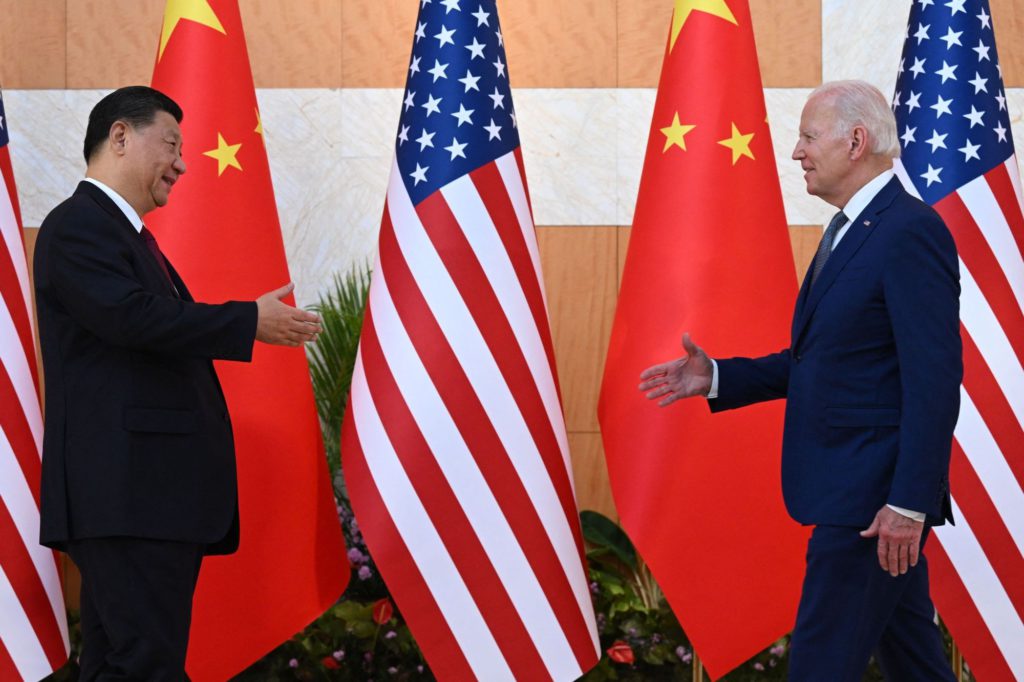
Singapore’s Wong Says Xi-Biden Meet Start of a Long Journey

(Bloomberg) — Singapore’s prime minister-in-waiting said the meeting between US President Joe Biden and Chinese counterpart Xi Jinping was “a good start” as Asian leaders greet diplomatic efforts between the top two economies with guarded optimism.

Deputy Prime Minister Lawrence Wong, 49, said in an interview with Bloomberg News Editor-in-Chief John Micklethwait that the meeting between the two leaders was “important and constructive,” but also “just the beginning of a long and difficult journey.”

“We shouldn’t have any illusions that this one meeting has changed things overnight because there has been such deep suspicions and distrust built up over so many years,” Wong said.

Singapore has been among the most vocal in Asia as US-China ties worsened over the years, calling on both nations to avoid a clash that could economically hit smaller countries. The city-state is clearly wedged between the two, allowing Washington to bolster its presence in the region via access to military facilities, while counting on China as its top trading partner. 

While Wong lauded the first in-person meeting between Xi and Biden, he urged communication needed to continue at all levels, including between militaries, and not just at the top levels. 

“Everyone is saying the right things, but maneuvering for maximum advantage, and that’s not helpful because accidents can happen, miscalculations can happen,” he said at Bloomberg’s New Economy Forum.

‘Red Line’

That dynamic has only gotten more complicated as ties between Washington and Beijing have soured on everything from trade to technology, and over Taiwan. The Biden administration has meanwhile stepped up engagement in Southeast Asia to reassure nations that it can be trusted an an indispensable security partner.

Singapore’s Foreign Minister Vivian Balakrishnan previously said the relationship between the two global powers has gotten so bad the stage is “almost pre-set” for an accident akin to the events precipitating World War I. Wong himself said in an earlier interview with Bloomberg News that he was worried the US and China could “sleepwalk into conflict” over Taiwan.

On Thursday, Wong concurred with Biden, who said after meeting Xi that he doesn’t believe China plans an “imminent” attack on Taiwan. “China and President Xi have so many immediate domestic preoccupations,” Wong said. “Why would they want to do something like this? But having said that, for China, Taiwan is a red line.”

Here’s a brief transcript on Wong’s interview during the Bloomberg New Economy Forum:

Economic Downsides 

“We are clear eyed about the challenges and we will deal with these downsides. The downsides includes dealing with making sure Singaporeans can have access to affordable housing. The downsides includes looking at how we can ensure inclusive growth, dealing with income and wealth inequalities and also continuing to invest in Singaporeans.”

Rising Rentals 

“That impacts more the foreign professionals who are looking to rent but it does have an impact on competitiveness. But prices are also a concern with regards to affordability.”

“Fortunately, we do have in Singapore public housing that caters to 80% of Singaporeans. We can keep prices affordable, but we monitor this very, very closely, the entire property market as well as affordable housing for Singaporeans.”

Crypto Speculation

“We are open to digital innovation and digital asset innovation, but we are not open to crypto speculation at all.”

“We were on the right track to go big on digital assets innovation, which is an important enabler and I think something that potentially can transform financial markets, cross border payments, settlements, capital markets, a lot of potential there.” 

“But, and we’ve said this for a long time, even when people criticized us for saying that, which was that we need to take a strong stance against crypto speculation and trading especially by retail investors. So we had put out even before FTX happened, we had put out a consultation paper on tightening regulatory rules around this aspect — on crypto trading, on retail investors access to crypto.” 

(Updates with more context, comments from Wong)

More stories like this are available on bloomberg.com

©2022 Bloomberg L.P.
Risks of Dubai Housing Boom Surface With Empty Palm Island Plots

(Bloomberg) — For 14 years, Muhammad Azam has been waiting for construction to start on a five-bedroom luxury villa he bought on the largest — but least developed — of Dubai’s famous palm-shaped artificial islands that jut out into the Persian Gulf.

An unexpected email from Nakheel PJSC in September confirmed it never would. Dubai’s real estate regulator apparently had decided months earlier to cancel the project on Palm Jebel Ali, and the government-backed developer told him they would refund less than a quarter of what Azam had paid for the villa in the secondary market shortly before construction had got off the ground. 

Cypriot businessman Azam, 44, wasn’t alone. He’s among hundreds of investors who bought homes on Palm Jebel Ali that have never been built. While many owners swapped their purchase for an alternative Nakheel property years ago, hundreds are now being offered a refund for the amount the developer collected from primary investors until it stopped working on the project in 2009, according to interviews with seven investors and documents seen by Bloomberg.

Investors told Bloomberg they’re among just over 400 who own more than 700 properties in The Palm Jebel Ali Fronds and The Palm Jebel Ali Water Homes developments who are being offered about 850 million dirhams ($231.4 million) in total from Nakheel. 

Owners say they should be compensated for the delay of over a decade and the jump in home prices since then. Canceled real estate projects often have messy fallout, but this case of buyer beware is playing out in the midst of one of the world’s biggest housing booms. It also raises questions over the legal framework surrounding real estate in the city, even though foreigners have been allowed to buy homes in the emirate since 2002.

Nakheel — chaired by Mohammed Ibrahim Al Shaibani, the managing director of the emirate’s sovereign wealth fund, the Investment Corporation of Dubai — says it’s giving back what it received from the development’s original investors and can’t help if people bought at higher prices in resale deals over the past two decades. The developer also says it has offered voluntary refunds for years and is also offering owners a bonus credit note toward a new Nakheel home. It’s also telling some owners that it will restart a revamped version of the project early next year.

“It’s so unfair,” said father-of-two Azam who owns a property management company. “I would have accepted the cancellation if Nakheel went bankrupt in 2009 and the project was canceled back then. But to do it now when the market has recovered and waterfront villas are selling at a high premium is just absurd.”

Eighth Wonder

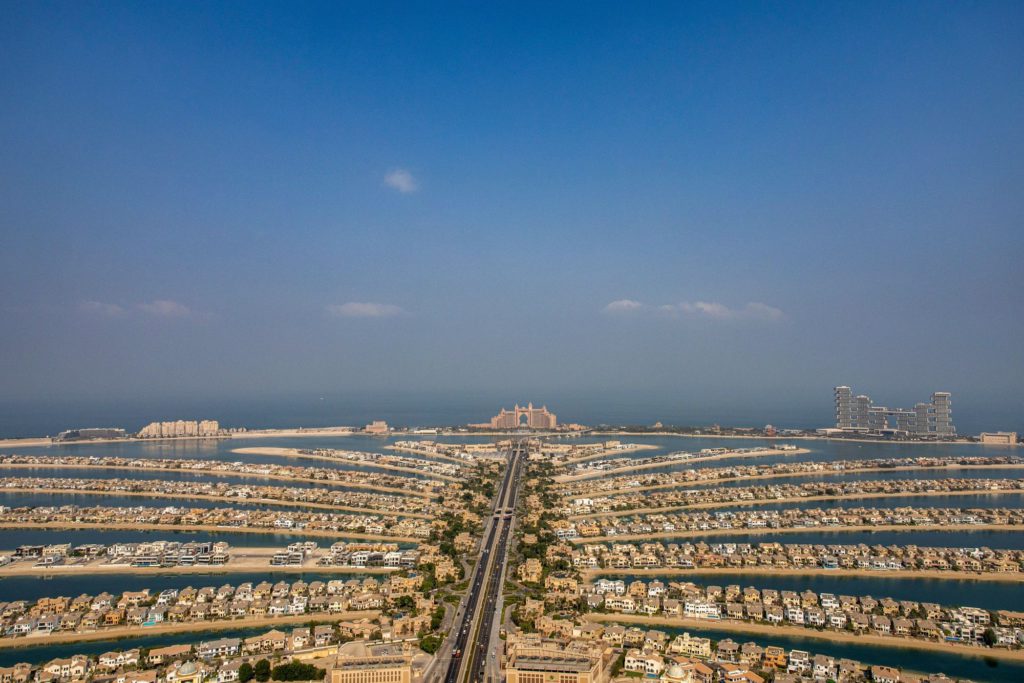
Nakheel unveiled The Palm Jebel Ali Fronds and The Palm Jebel Ali Water Homes in 2003. In a sales brochure, the developer called Palm Jebel Ali the eighth wonder of the world. At roughly the size of London’s Heathrow airport, the development — about 50 kilometers from downtown Dubai — has 17 palm leaves. It was meant to host marinas, a theme park, beachside villas and a thousand homes on stilts that spelled out a poem by Dubai ruler Sheikh Mohammed bin Rashid Al Maktoum, according to reports at the time.

Nakheel originally sold the off-plan villas on Palm Jebel Ali for about 1.8 million dirhams to 5.6 million dirhams. They were then resold many times in the boom years that followed without a single brick being laid. Prices had more than doubled by the time some of the current owners — including Azam — invested five years later.

Dubai-born Azam says he took out a 10-million-dirham mortgage to pay for the 14.8 million dirham, 13,000 square-foot so-called Signature Villa. He fully repaid the mortgage to Noor Bank in 2016, according to a copy of a bank letter. He was told that Dubai’s Real Estate Regulatory Agency had canceled the two projects because of Nakheel’s inability to complete them and that a judicial committee in May had ordered the developer to distribute a refund to owners. 

Now, he says Nakheel is offering to pay him 2.8 million dirhams or a credit note for 4.2 million to repurchase a home once the project restarts. The value of the credit note represents 50% more than the amount Nakheel collected from buyers but the developer has only made the offer verbally and not in writing, according to Azam. 

“Nakheel is being ordered to repay the amounts it collected nearly 20 years ago, but as they restart the project they will earn a lot more,” Azam said. “We’re only entitled to the amount Nakheel initially collected from original buyers and not secondary buyers. No interest, no loss of opportunity, no loss of rental income.”

On top of regular payment installments from owners, Nakheel collected money each time the villa (or plot of sand) changed hands in the secondary market. Azam says when he bought his villa he was charged 119,590 dirhams as a transfer fee by Nakheel, which isn’t being refunded. 

A comparable villa to the one Azam purchased is now selling for at least 30 million dirhams on Palm Jumeirah — the first and smallest of three palm-shaped islands Nakheel is developing in Dubai, according to Property Finder. Palm Jebel Ali is almost twice the size of the completed Palm Jumeirah where demand and the price of waterfront homes, in particular, have soared.

Dubai’s property market is benefitting from an influx of newcomers including bankers fleeing strict Covid restrictions in Asia, crypto investors and wealthy Russians escaping their sanctions-hit country after its invasion of Ukraine. Prime real-estate prices surged 89% over the past 12 months through October, making it the biggest gainer on Knight Frank’s global index, which focuses on a city’s most desirable and expensive homes. 

To tap the high demand for beachfront real estate, Nakheel is now planning to build 1,700 villas and 6,000 apartments on Palm Jebel Ali, the Financial Times reported in September.

The developer “is probably calculating they can wipe the slate clean and start over with new investors, but this shows that the old system is still very much there despite all the effort to present a fairer one to protect investors’ rights,” said Ryan Bohl, an analyst at risk intelligence consultancy Rane Network. “If you put money into the Emirates or any Gulf country, except Kuwait, you have to be prepared to take a loss because investors’ rights are always going to be at the pleasure of the ruler.” 

A representative for RERA referred requests for comment to Dubai’s Media office. A representative for Dubai’s Media Office said: “Judicial independence is guaranteed under the constitution and laws of Dubai and the UAE.”

$10 Billion Lifeline

Construction on Palm Jebel Ali halted when the global financial crisis hit Dubai. Nakheel, along with Emaar Properties PJSC, had led a building boom before that, until it almost defaulted on repaying about $4 billion in bond payments. Nakheel, along with then-parent Dubai World, was given a $10 billion lifeline by Abu Dhabi.

At the time, the developer offered homeowners on Palm Jebel Ali two options: swap their investment for completed properties in other Nakheel developments or wait for their original purchase to be ready. Several investors said that the company repeatedly reassured them that Palm Jebel Ali wouldn’t be canceled.

Despite a market rebound between 2011 and 2014, the project stood untouched. In a 2015 interview with Gulf Business, former Nakheel Chairman Ali Lootah said: “It is very costly, with regards to infrastructure and everything. But we have a commitment to it, and will not cancel the project.”

The Palm Jebel Ali project “was based on a masterplan developed over 15 years ago. It required extensive planning and redesign to meet the current standards for master planning of modern waterfront living,” Nakheel said in a statement. “Accordingly, after extensive consultation, the project was officially cancelled earlier this year.”

Not far from Palm Jumeirah, apartment owners have been petitioning local authorities to recoup money tied to a stalled 20-year-old project called the Dubai Pearl. They say they should be entitled to more than their original investment now the land is worth more than it was in 2002. The government has said it is holding talks with master developer, state-owned Dubai Holding, to relaunch the project but hasn’t disclosed further details.

Homeowners in Dubai aren’t the only real estate investors facing risks that can extend to delayed developments and multi-million dollar losses. In China, a mortgage boycott is ongoing among angry buyers waiting for stalled apartment buildings to be completed and some creditors are taking developers to court seeking wind-up petitions.

‘Safe With Us’

Like Azam, Palestinian investor Ahmad Mahmoud Mahmoud, 55, only found out that his dream retirement home wouldn’t be built when he received an email from Nakheel that read: “The Palm Jebel Ali project is officially cancelled; however we would like to reassure you that your investment in Nakheel is protected and safe with us.”

Saudi resident Mahmoud, who works in the oil and gas industry, says he also bought a Signature Villa for 6.7 million dirhams in 2005. He says he paid 2.7 million dirhams worth of installments to Nakheel and 1 million dirhams directly to the seller. Nakheel, he says, is now offering him a 2.7 million refund or a 4 million dirham credit note.

“Contracts in Dubai aren’t worth the ink they’re written with,” he said. “What’s the value of a contract if it can be cancelled without even informing us?”

Mahmoud and British national Aarti Chana — who sold her house in London to buy a garden home on Palm Jebel Ali in 2005 — are now among a group of 30 investors who have lodged an appeal with the Dubai Ruler’s Court, Sheikh Mohammed’s office where Nakheel Chairman Al Shaibani is director general.

“The ruler is our last hope,” said Chana, who’s lived in the UAE for about 30 years. A representative for Al Shaibani declined to comment.

Since 2011, Nakheel has “proactively contacted owners of units in Palm Jebel Ali and ran highly visible public communications offering to repay the full investment paid to the company by the original investors,” the developer said. “Following this initiative, the investments made by many of the owners of Palm Jebel Ali units have been repaid in full by Nakheel.”

The developer has also “offered a multiple of up to 1.5 times the initial investment paid to Nakheel, to be used as credit towards an investment in upcoming projects at the new Palm Jebel Ali,” it said. The company is “working with the remaining investors to complete the financial formalities, with funds set aside for such repayments.”

The claims made by a group of individuals “are for premiums they paid for units on Palm Jebel Ali to original investors and not to Nakheel,” the developer said. The company “continues to be committed to working with this group; but all settlements will be based on the full amount received by Nakheel, and not based on secondary market transactions which did not involve the company.”

Since the 2009 crisis, Nakheel has largely recovered. Last week it said it raised a $4.6 billion loan from local lenders to refinance debt and to develop another set of man-made islands called Dubai Islands and other large waterfront projects. The company secured the loan at a significant time. Interest-rate hikes have battered other property markets around the world, making it more expensive for developers, that mainly rely on loans and bonds, to raise funds.

And while demand for property in Dubai is now strong, and the city’s current resurgence dates back more than a year, previous boom times that fueled a wave of ambitious construction projects have often been followed by sudden downturns.

“The bigger question is with interest rates rising and the strengthening of the dollar, are macro-economic conditions as good as Nakheel hopes?” said Bohl. “This could be a double miscalculation. One, the market may not be as strong as they think it is and two, by burning investors now, prospective investors may decide the returns aren’t high enough if it all goes belly up again.”

(Updates with details in eighth paragraph and second from bottom.)

More stories like this are available on bloomberg.com

©2022 Bloomberg L.P.

Close Bitnami banner
Bitnami
