Bloomberg

Europe’s Car Sales Recovery Is Held Back by Economic Turmoil

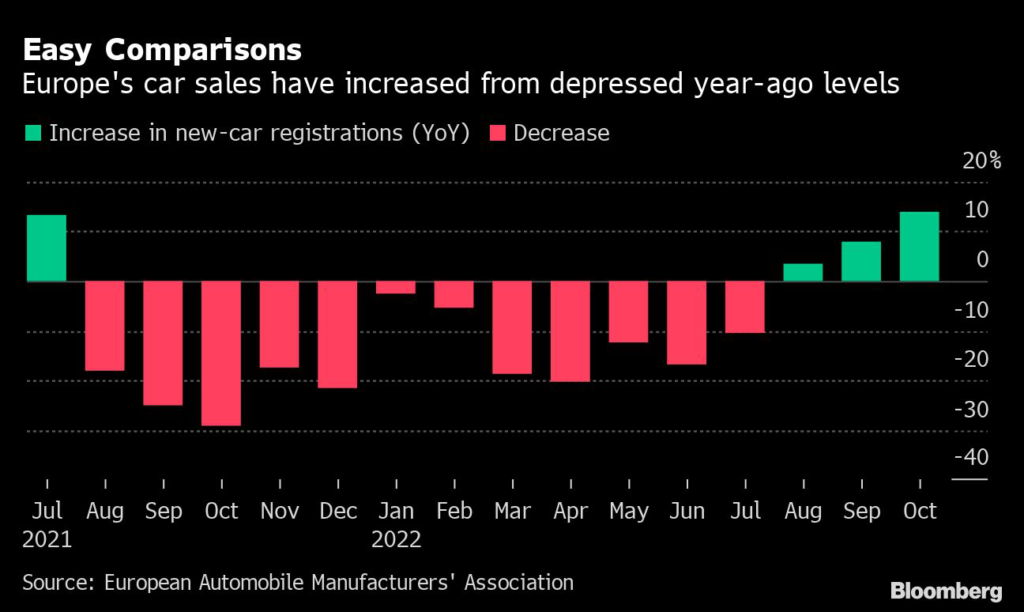
(Bloomberg) — Auto sales in Europe rose for a third month in October as supply-chain issues eased, though there’s growing concern that deteriorating economic conditions are beginning to put off buyers.

New-car registrations climbed 14% to 910,753 vehicles last month, the European Automobile Manufacturers’ Association said Thursday. The industry returned to growth in August after 12 consecutive months of decline.

While carmakers are having a somewhat easier time securing semiconductors and other components that have been in short supply, the region’s energy crisis is driving up costs and standing in the way of a more substantial recovery. Last month’s sales compared with an abysmal performance a year ago and were well below levels a few years back.

“Even with some improvement assumed next year, the market will remain far below what was considered normal operating volume pre‐pandemic,” LMC Automotive analysts wrote in a report last week.

Europe is bracing for a grim winter as double-digit inflation grips the region. Germany, the area’s biggest economy, is expected to contract while France, Italy and Spain may expand only slightly. In the UK, where car sales are on course for the worst year since 1982, inflation hit a 41-year high last month.

Manufacturers in the region are starting to see signs consumers are taking pause, with Stellantis NV flagging a slight pullback in purchases. Germany’s BMW AG similarly warned the region is on the back foot, with a leveling off in demand being more pronounced in northern European countries.

High-end luxury vehicles have been relatively resilient, and automakers are still benefiting from unfilled orders accumulated during the height of their supply-chain crises.

Registrations rose 26% in the UK, 17% in Germany and 15% in Italy. Volkswagen AG was the standout performer for the month, with a 40% jump from a year ago.

More stories like this are available on bloomberg.com

©2022 Bloomberg L.P.

UAE Royals Back AI Startup Founded by Former Goldman Banker

(Bloomberg) —

Members of Dubai and Abu Dhabi’s royal families are among investors backing a London-based artificial intelligence startup, according to people with knowledge of the matter, a rare haul in the midst of the current tech rout.

Abu Dhabi-based AI firm G42, part of a business empire overseen by the United Arab Emirates’ national security adviser Sheikh Tahnoon Bin Zayed, invested in The Applied AI Co., the people said, asking not to be identified because the matter is private. Dubai’s Al Maktoum family also took part in the $42 million funding round, the people said. 

The investment will help AAICO, set up by former Goldman Sachs Group Inc. banker Arya Bolurfrushan, to develop AI products in the insurance, government, pharmaceutical and healthcare sectors, according to the founder and chief executive officer. The firm has a 34-strong engineering team with alums from Amazon.com Inc., Alphabet Inc. and JPMorgan Chase & Co.

AAICO is planning its expansion against a challenging backdrop as rising interest rates, market upheaval and a global slowdown in funding threaten the prospects of an industry after a boom in 2021. After expanding rapidly in recent years, the growth of Middle Eastern and North Africa technology firms slowed in the last three quarters, according to Dubai-based research firm Magnitt.

G42’s investment comes as Abu Dhabi — a city that’s among the few globally to manage over $1 trillion in sovereign wealth capital — plows oil revenue into the technology sector and diversifies its economy. 

Mubadala Investment Co., an Abu Dhabi wealth fund that owns a minority stake in G42, has itself stepped in to invest in the sector despite the recent market turmoil. Meanwhile, G42 is setting up a $10 billion fund with a focus on technology investments in emerging markets.

A representative for AAICO declined to comment on the details of the firm’s latest backers but said they included a “prominent AI and cloud platform company” as well as “distinguished families” from Europe and the Middle East. A representative for G42 confirmed the investment, while the Dubai Media Office did not respond to requests for comment. 

Dubai-based Bolurfrushan — whose previous experience includes two years at Goldman Sachs until 2008, Harvard Business School, and a chief financial officer role at RAK Petroleum — founded UAE-based AAICO in 2021 after first setting up Accrete Capital Technologies, essentially a hedge fund that sells stakes in itself through digital tokens.

More stories like this are available on bloomberg.com

©2022 Bloomberg L.P.

FAANG Bets That Wiped Out ESG Returns May Do More Harm in 2023

(Bloomberg) — ESG investors holding on to so-called FAANG stocks with the hope that 2023 will right some of this year’s wrongs may be in for a nasty surprise.

Facebook parent Meta Platforms Inc., Amazon.com Inc., Apple Inc., Netflix Inc. and Google parent Alphabet Inc. dominate some of the biggest ESG funds and are a big reason they’ve underperformed this year. Over the past 12 months, the MSCI World Information Technology Index has slumped about 26%, with Amazon down more than 45% and Meta having lost two-thirds of its value.

Those losses may not be the end of the bad streak. “We could potentially see a continuation of some of the issues that we’ve had in the tech sector next year,” Amarachi Seery, a sustainability analyst at Janus Henderson Investors.

In their pursuit of low-carbon portfolios, many ESG investors spent the past few years piling into Big Tech as a fast fix to their environmental goals. And as long as interest rates were low and risk appetites high, those allocations reaped outsized returns, making ESG look good in the process. But with rates now much higher, tech-laden ESG portfolios are struggling. 

Relative Weighting of 15 Large US ESG Funds

Janus Henderson, where Seery’s research guides ESG investment decisions, has excluded FAANG stocks from its Global Sustainable Equity Fund “for a very long time,” she said. And “that has served us incredibly well.”

The fund is down about 12% this year, less than half as much as the MSCI World Information Technology Index. Over the past three years, it’s beaten 93% of peers, according to data compiled by Bloomberg, having gained at an annual rate of 12% in the period.

Avoiding FAANG stocks also helped the Premier Miton Global Sustainable Growth Fund outperform the broader market this year. The decision was based partly on valuations, as well as an assessment of growth risks, Duncan Goodwin, who manages the fund for Premier Miton Investors, said in an interview. 

“And in some areas, we felt that some of the ESG, particularly the governance criteria, fell down against our analysis,” he said.

Goodwin doesn’t entirely rule out a return to FAANG stocks, but said there “are other areas in the technology sector that we are probably more interested in,” such as cybersecurity.

Janus Henderson’s Seery said the ESG case around FAANG is tough to defend, especially if the goal is to “invest with positive impact.” In the case of Meta, she said the firm was “not able to determine positive impact,” based on its criteria. The fund expects portfolio stocks to have “at least 50% of revenues associated with that and we weren’t able to find that for Meta,” she said.

Microsoft Corp., on the other hand, meets that standard, which is why the Janus Henderson Global Sustainable Equity Fund is holding on to the company despite recent losses. 

“When I think what would happen if Microsoft and all their products cease to exist tomorrow, it would be a huge detriment,” Seery said. 

Another tech stock that scores well at Janus Henderson is Nintendo Co. Ltd.

It’s “probably one of our more controversial holdings, but we’d done the work on it and there was a lot of science that had come out in particular from the University of Oxford to suggest that actually some of Nintendo’s best-selling games were really good for people’s mental health and wellbeing,” she said.

“We’re not philanthropists, we are investors and investors should be making money,” Seery said. “We also believe that we can do that whilst being sustainable.” 

(updates stock and index values)

More stories like this are available on bloomberg.com

©2022 Bloomberg L.P.

GOP Retakes US House by Slim Margin in Washington Power Shift

(Bloomberg) — Republicans won a narrow House majority that gives them the power to halt President Joe Biden’s agenda, yet their slim margin marked a letdown for a party that had counted on decisive election results as a springboard for the 2024 presidential race.

More than a week after Election Day, the party finally gained the minimum 218 seats needed to control the chamber, the Associated Press reported Wednesday night, when incumbent GOP Representative Mike Garcia defeated Democrat Christy Smith in California. Roughly a half-dozen races still remain undecided.

Despite concerns about Biden’s handling of the economy and the prospects of a recession, voters delivered a split verdict over who was to blame and how much weight to put on issues such as abortion rights and election deniers’ threats to democracy. While giving control of the House to the GOP, they kept the Senate in the hands of Democrats.

Slender as it is, the House majority hands Republicans control of committees with subpoena authority, allowing them to make good on campaign pledges to investigate Biden’s administration and family, as well as social-media companies that conservatives claim are biased against them.

Republicans also have promised to slash government spending, expand fossil fuel production and extend Trump-era tax cuts on the wealthy. Much of that agenda, however, will be left to wither in the Democratic-controlled Senate.

For businesses, the return of Republicans to control of the House takes the possibility of corporate tax increases favored by Democrats off the table while diminishing the changes of workforce-boosting reforms to legal immigration. But markets may become turbulent in the middle of next year if Republicans carry through on threats to hold the nation’s debt ceiling hostage to force the president to accept spending cuts. 

Biden, on his way back to Washington from the G-20 summit in Indonesia, said he would work with House Republican leader Kevin McCarthy. “I congratulate Leader McCarthy on Republicans winning the House majority, and am ready to work with House Republicans to deliver results for working families,” the president said in a statement.

McCarthy cheered the results, tweeting: “Republicans have officially flipped the People’s House! Americans are ready for a new direction, and House Republicans are ready to deliver.”

The GOP has spent the past week brooding over its poor showing in the midterm elections, with some Republicans blaming former President Donald Trump for losses in key races, not only in Congress but in statehouses as well. 

Yet even as they chided him for promoting candidates that Democrats beat in Republican-favored races, Trump waded right back in to announce his third run for the White House.

The Senate will remain under Democratic control after John Fetterman flipped a Republican seat in Pennsylvania and incumbents Mark Kelly and Catherine Cortez Masto won re-election in Arizona and Nevada.

The Senate race in Georgia between Raphael Warnock, the Democratic incumbent, and Herschel Walker, the Republican, will be decided in a Dec. 6 runoff. But Fetterman’s win gave the Senate 50 seats, and therefore the majority.

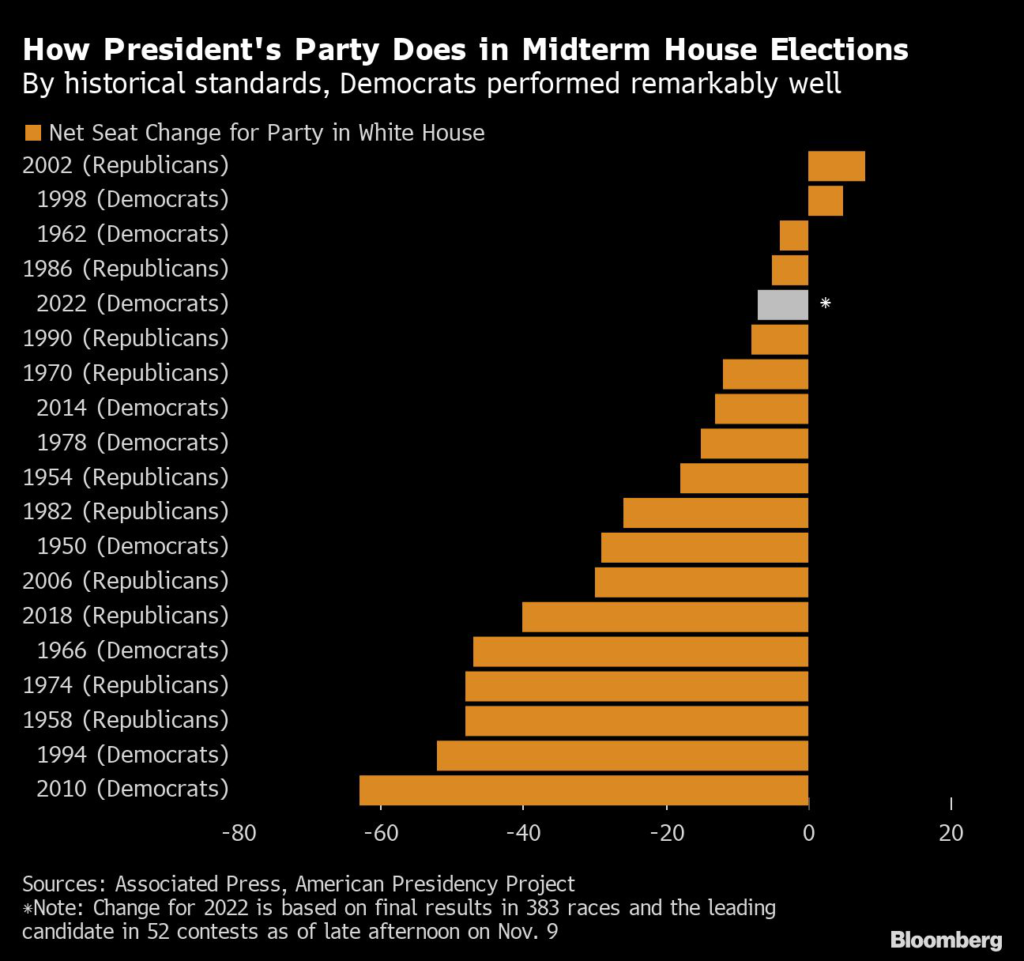
Biden’s agenda will still be largely stalled by the GOP House, but their advantage was one of the smallest gained by either party in a midterm election in modern times.

The chair of the right-wing Freedom Caucus, Representative Scott Perry of Pennsylvania, suggested conservatives would use the election results to at least extract promises from McCarthy, including changes in the rules governing how the House is run. 

“As a leader in the party, you have a duty to provide a vision that informs voters of what you’re going to do if you win,” Perry said. “I don’t think that vision was adequately provided by multiple folks on the top of our party.”

Since World War II, the party holding the White House has, on average, lost 26 House seats and four Senate seats. Barack Obama’s Democrats lost 63 House seats in 2010 and Trump’s Republicans 40 House seats in 2018.

The midterm result could spell the end of House Speaker Nancy Pelosi’s run as the Democratic Party’s leader in the House, where a new generation of leaders is eager to ascend. 

Pelosi, in a statement Wednesday night, hailed her party for having “defied expectations.” 

“House Democrats will continue to play a leading role in supporting President Biden’s agenda — with strong leverage over a scant Republican majority,” she said.

Later, her spokesman, Drew Hammill, tweeted that she would discuss her “future plans” on Thursday. 

The new GOP House majority was secured in part by victories in Democratic parts of New York State, where Representative Sean Patrick Maloney, the head of the Democratic campaign arm, lost a race for a Hudson Valley seat. An attempt by Democrats to gerrymander New York seats was rejected in court earlier in the year. Republicans also ousted Democratic incumbents in Florida, Iowa, Virginia, New Jersey to pick up seats.

And Republican candidates who joined in Trump’s baseless claims of widespread voter fraud in 2020 and promised to take steps to ensure GOP wins in the future, were roundly defeated.

The election ends four years of Democratic control in the House, which saw passage of the largest infrastructure and climate change bills in history, a massive coronavirus stimulus program, an overhaul of the Medicare drug benefit and an historic investment in US semiconductor manufacturing. 

Republicans expected voters to punish Democrats with a lost of 60 or more seats as inflation hit 40-year highs and gasoline prices soared. But in the end, just a few Democratic incumbents lost their re-election campaigns. 

(Updates with Pelosi to discuss future, in 20th paragraph.)

More stories like this are available on bloomberg.com

©2022 Bloomberg L.P.

LinkedIn CEO Sees Growth Outside US, With India Leading

(Bloomberg) — LinkedIn Chief Executive Officer Ryan Roslansky is gearing up for growth for the social-networking site in markets such as India, even as it prepares for economic headwinds more broadly by pausing hiring.

India has become LinkedIn’s fastest-growing market as more companies and advertisers come online, with sales in the country rising at a 50% year-on-year clip, Roslansky told Bloomberg TV on Thursday on the sidelines of the Bloomberg New Economy Forum in Singapore. “What’s going to happen in the next 10 years in India is being written right now,” he said.

The business networking service owned by Microsoft Corp. is looking abroad for new growth opportunities as the worsening economic climate weighs on its US home market. He said LinkedIn has paused hiring to prepare for tougher conditions.

The majority of LinkedIn’s growth is happening outside of the United States, he said, adding that new members are joining the networking site in markets such as India, Indonesia and Western Europe.


More stories like this are available on bloomberg.com

©2022 Bloomberg L.P.

Thyssenkrupp Sees Earnings Dropping in Weakening Economy

(Bloomberg) — Thyssenkrupp AG expects earnings to fall over the next year due to a combination of higher energy costs, inflation and rising interest rates.

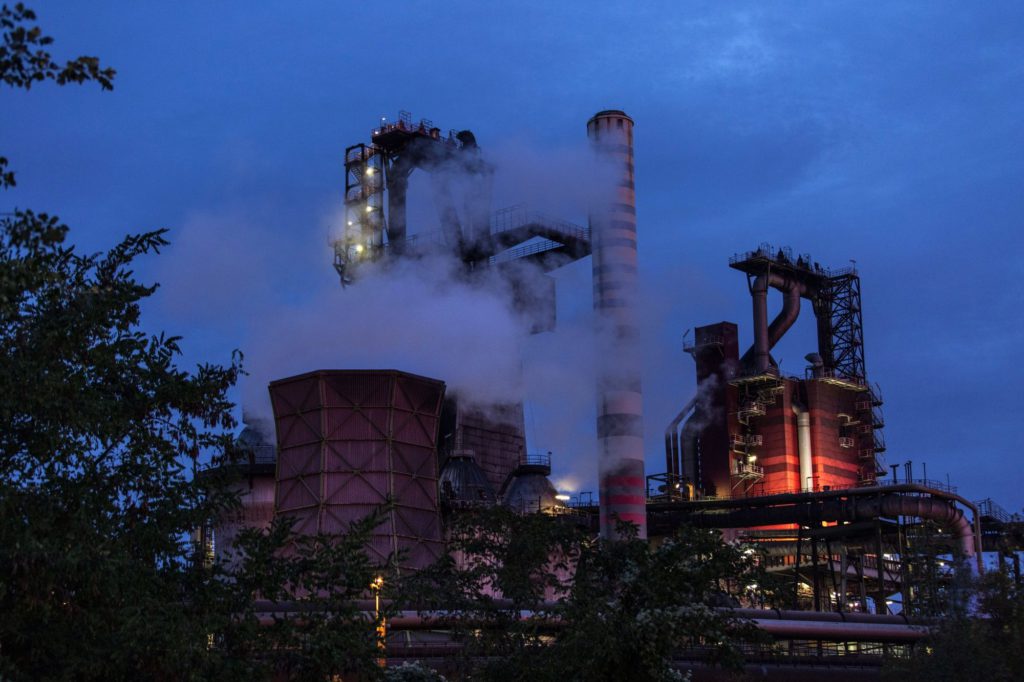
Adjusted earnings before interest and taxes are expected to fall to the mid to high three-digit million euro range, below the €2.1 billion reported for the financial year ended Sept. 30, the company said Thursday. The company said the pace of its restructuring has slowed, and that it’s impossible right now to decide on the best step forward for its steel division due to the uncertain geopolitical and macroeconomic backdrop.

“The momentum of our transformation process has been dampened, but we have proven comparatively robust in the face of three external shocks — the pandemic, the semiconductor shortage and war,” Chief Executive Officer Martina Merz said in a statement accompanying full-year earnings.

Merz is leading a deep restructuring of the conglomerate, which was fighting for survival even before the pandemic and European energy crisis hit. Once synonymous with German industrial prowess, Thyssenkrupp has struggled for years to staunch a cash drain as a global steel glut compounded profound structural issues across the firm.

Still, the company expects to at least stem cash outflows for its 2022/23 financial year, ending a six-year streak. The company’s cash outflow narrowed to €476 million in the financial year just ended, less than the €1.3 billion drain seen in the previous financial year.

Improvement in the company’s operating performance will allow Thyssenkrupp to pay a dividend for the first time since 2018, the company said Thursday. The firm will propose paying a dividend of 15 cents a share to the company’s annual general meeting in February.

Thyssenkrupp said it still plans an initial public offering of shares in its Nucera hydrogen electrolysis unit, but said such a move was dependent on developments in financial markets.

More stories like this are available on bloomberg.com

©2022 Bloomberg L.P.

APEC Latest: Leaders Turn Spotlight on Climate, Technology

(Bloomberg) — World leaders descended on Bangkok for the Asia-Pacific Economic Cooperation meetings, the last of the three major summits in the region that have seen discussions range from climate change to the war in Ukraine and food inflation. 

Thai Prime Minister Prayuth Chan-Ocha opened proceedings with a speech to the CEO Summit on Thursday morning, kicking off three days of talks focused on boosting economic prosperity and environmental sustainability. Chinese President Xi Jinping will give a speech and then continue with face-to-face meetings with several leaders including Japanese Prime Minister Fumio Kishida and New Zealand’s Jacinda Ardern. 

There will be at least one notable absence from the Bangkok meetings. US President Joe Biden is heading back to the White House for his granddaughter’s wedding Saturday and will be represented by Vice President Kamala Harris at APEC.

Key Developments

  • China’s Xi Set for Japan Summit as Mends Ties With US Allies
  • Businesses Urge APEC Summit to Tackle Inflation, Energy Crisis
  • China’s Xi Confronts Trudeau at G-20 Over Meeting Leak
  • Xi Looks Away From Putin Toward West in Return to World Stage
  • G-20 Latest: Most Leaders Decry War in Ukraine in Blow to Putin

(All times local)

Police Outnumber Protesters (12:30 p.m.)

A small crowd of protesters gathered in the Asok area, near the convention center where the APEC Leaders’ Meeting is scheduled to take place. Some dressed up in dinosaur costumes, in a symbolic dig at what they view as Thailand’s outdated and calcified government.  

One protester told the gathering that they will march to the convention center, intending to show world leaders how the Thai government has failed to address long-standing economic and social problems. The demonstrations are taking place under a large police presence, with the Bangkok Post reporting that more than 35,000 security personnel had been deployed for the summit. 

Vietnam President Bats for Green Technology (11:30 a.m.)

The world is changing in a “complex and unpredictable way” and technologies that target net-zero emissions will be the “strongest driver of FDI in the future,” Vietnamese President Nguyen Xuan Phuc said at the APEC CE Summit at a session trade and investment. 

Many Vietnamese factories have reduced production or even shut down as a result of supply chain problems from the pandemic and Ukraine war, Phuc said. The Covid-19 pandemic showed the “importance and indispensability of digital-based business and production,” he said.

Macron Open to Submarine Cooperation With Australia (11:10 a.m.)

French President Emmanuel Macron said his government was still open to revisiting a submarine deal with Australia. The option for Australia to build together or purchase French-made submarines remained “on the table,” although there had been no indication yet from Canberra that it was looking to revisit the deal, he told a press conference in Bangkok.

Macron met with Australian Prime Minister Anthony Albanese on the sidelines of the Group of 20 summit in Bali on Wednesday evening. While the French president acknowledged they had discussed the subject, the Australians “haven’t decided to change strategy on that subject” yet.

Philippines President Urges Greater Climate Action (10:20 a.m.)

Philippine President Ferdinand Marcos Jr. called for stronger action on climate change, which he described as the “most pressing existential” issue of all time. He told the APEC CEO Summit meeting that “not enough” progress has actually been made to lower emissions.

Marcos also urged nations to prioritize food security and to invest in pandemic preparedness. He also said “”the geopolitical currents that we must live with are something that we still need to be concerned about.”

Kasikornbank Sees Tourism as Engine of Thai Growth (10:12 a.m.)

Tourism will be the “engine to drive” Thailand’s economy in 2023 and beyond, Kobkarn Wattanavrangkul, chairperson of Kasikornbank Pcl, the nation’s second-biggest bank by assets, said in a Bloomberg TV interview on the sidelines of the APEC CEO Summit. 

The bank expects hotel operators and other tourism related business customers to recover strongly as Thailand’s travel industry rebounds from the Covid-19 pandemic. Thailand, where tourism accounts for 12% of gross domestic product and a fifth of jobs, needs to diversify its foreign tourist market beyond China to maintain the industry’s long-term growth, Kobkarn said.

Thailand Says Environmental Sustainability a Key APEC Agenda (9:43 a.m.)

Thai Prime Minister Prayuth Chan-Ocha said the world was facing unprecedented environmental challenges and sustainability would be the single most important agenda for the APEC leaders summit this week.

He also called upon the public and private sectors to cooperate on supporting sustainability initiatives, adding “we must ensure that we leave no one behind on the path of development and growth.”

Prayuth urged APEC leaders to sign a so-called Bangkok Goals declaration on the “bio-circular-green” economic model at the end of the summit. “No country can achieve its objectives alone,” Prayuth said. “We inhabit the same earth.”

NZ PM to Meet with China’s Xi Jinping at APEC (2:54 a.m.)

New Zealand Prime Minister Jacinda Ardern will meet Chinese President Xi Jinping​ on the sidelines of the APEC Leaders’ Summit in Thailand, Stuff reports without citing a source for the information.

Arden had earlier said that if a meeting were to take place it would cover issues including trade, climate change and areas of differences, the media outlet reported. 

–With assistance from Samy Adghirni, Pathom Sangwongwanich and John Boudreau.

More stories like this are available on bloomberg.com

©2022 Bloomberg L.P.

Paytm Shares Slump as Much as 10% After SoftBank Unit Cuts Stake

(Bloomberg) — Shares of One 97 Communications Ltd., the parent of India’s leading digital payments brand Paytm, plunged in Mumbai as a unit of Japan’s SoftBank Group Corp. lowered its stake in the company.

SoftBank’s SVF India Holdings (Cayman) Ltd. sold 29 million shares of Paytm at 555 rupees ($6.8) each, according to people familiar with the matter, raising 16.1 billion rupees. The trade — equivalent to 4.5% of the Mumbai-listed firm’s equity capital — pulled down shares by as much as 10%, their biggest plunge since July 29.

Representatives for SoftBank and Paytm declined to comment on the pricing.

Paytm is among a number of Indian startups that went public last year amid a boom in IPOs and zest for the country’s tech sector that have since suffered a slump in market value. When Paytm’s founder Vijay Shekhar Sharma pulled off the IPO last November, it was the largest in the Indian market up to that point. 

READ: Buffett, Son India IPO Stakes Watched as $14 Billion Lockups End

The company raised 183 billion rupees, but its shares went on to plummet in what would become one of the Indian bourse’s worst-ever debuts as investors shunned its high valuation and loss-making startup status. They are down about 75% from their IPO price.

Some early investors are making “desperate exits” as they grapple with the performance of their own funds amid a drop in global valuations, said Abhay Agarwal, a fund manager with Piper Serica Advisors Pvt. Still, these investors will make a profitable exit as their cost per share was lower than the current price, he added.

SoftBank is one of Paytm’s biggest shareholders, along with Alibaba Group Holding Ltd. and its fintech affiliate Ant Group Co.

A representative for Paytm communicated earlier this year that the effective cost of SoftBank’s 17.47% stake in the company is 800 rupees per share. After this sale, it will hold roughly 12.9% of the company.

Read: After $10 Billion Selloff, India’s Paytm Faces Another Reckoning

Other IPOs

SoftBank, the world’s biggest technology investor, has been grappling with declines on its portfolio of more than 400 investments in both public and private tech companies around the world. Its core Vision Fund segment posted a $7.2 billion loss in the July-September quarter, following a record 2.33 trillion yen ($17 billion) loss in the preceding period.

The lock-up period on $4.3 billion worth of Paytm shares expired on Tuesday, freeing investors to sell shares after they endured a year in which the company shed more than $12 billion of market value.

FSN E-Commerce Ventures Ltd., owner of beauty e-retailer Nykaa has seen selling by some holders, including private equity firm TPG Inc, since a lock-up on its shares ended last week.

Meanwhile, food-delivery company Zomato Ltd. plunged to a record low in July when a lock-up on its shares expired. Zomato’s successful IPO last year had set the tone for a generation of buoyant Indian unicorns to make their stock market debuts. 

–With assistance from Rajesh Kumar Singh and Anto Antony.

(Recasts, adds pricing details.)

More stories like this are available on bloomberg.com

©2022 Bloomberg L.P.

Zelenskiy to Speak as War, Inflation Take Center Stage: NEF Wrap

(Bloomberg) — This year’s twin shocks of inflation and geopolitical tensions dominated talks among business and policy leaders on the closing day of the Bloomberg New Economy Forum in Singapore.

Speakers pointed to signs of stabilizing relations between the world’s two biggest economies following Monday’s face-to-face meeting of US President Joe Biden and his Chinese counterpart Xi Jinping, but concerns remain over flash points. Former Australian Prime Minister Kevin Rudd said neither power wants a war over Taiwan, in part because neither are in a position to win. 

“The reason for that is not because of a lack of nationalism, the reason for that is because both sides are concerned they might lose, militarily,” Rudd said on a panel discussion. That’s “quite apart from the monumental economic catastrophe globally which would come from a full-scale military encounter in the Taiwan Strait.”

Singapore’s former permanent secretary for foreign affairs, Bilahari Kausikan, said that nations shouldn’t exaggerate the threat of a rising China.  

“China is a formidable competitor, but it’s a competitor within the same system,” he said. “China may want to dominate the system, but he doesn’t want to destroy it because he has benefited from it.”

The afternoon session will see International Monetary Fund Deputy Managing Director Gita Gopinath speak on a panel discussing inflation. Lawrence Wong, Singapore’s finance minister and prime minister-in-waiting, will also address the forum. 


The final day of the three-day event — which has seen policymakers and business leaders discuss issues including inflation, sustainable investment and the future of the global economy — will conclude with a virtual address by Ukrainian President Volodymyr Zelenskiy. 

In its first two days, the NEF featured speakers including US trade chief Katherine Tai, Chinese Vice President Wang Qishan and former Secretary of State Henry Kissinger. 

Here are some of the other issues that were top of mind for executives on the forum’s concluding day.

Covid Zero

Worries over how and when China eventually pivots away from Covid Zero were flagged by James McGregor, the chairman for APCO Worldwide Greater China, who said the government needs to address dampened consumer confidence.

“The thing about a consumer economy, you can’t order people to spend, they have to have confidence,” McGregor said on the same panel as Australia’s Rudd. The government may need to “move ahead with some economic reforms that we’re not expecting out of necessity.”

Rudd said that barring a new Covid variant, China will by the middle of next year be “well on its way to being out of this — that will have a huge positive impact on domestic consumer demand, which has been suppressed for a very long period of time.”  

Energy

In a warning of what’s still to come, Europe shouldn’t let its guard down on conserving energy despite the recent drop in natural gas prices and success in refilling inventories, according to the region’s top operator of gas infrastructure.

“We are in a better situation, but that doesn’t mean we should relax,” Catherine MacGregor, chief executive officer of Engie SA, said on a panel discussion. “On prices, one can expect continued volatility.”

Volatility in energy prices is not good for the system or long-term planning, Yngve Slyngstad, chief executive officer of Industry Capital Partners, said during the same panel.

Scarcity

Price volatility in metal supply chains for electric vehicles and renewable energy will continue for several years because of a lack of investment in lithium and nickel mines, according to Gene Berdichevsky, chief executive officer of specialist materials supplier Sila Nanotechnologies Inc.

“We are going to go through supply chain shortages, we are going to go through commodity curve spikes,” Berdichevsky said in a Bloomberg TV interview on the NEF’s sidelines. “This will take the rest of the decade to work itself out.” 

Clean energy and storage technology will ultimately be cheaper and help nations become less reliant on fuel imports, he said. Sila produces silicon anode material to boost energy storage in batteries, and has partnerships with firms including BMW AG and Daimler AG.

Future of Work

LinkedIn Corp. Chief Executive Officer Ryan Roslansky said there’s continued to be a surge in job listings for remote work: They account for 15% of listings on LinkedIn, compared to only 1% before the pandemic. 

On the same panel, PayPal Holdings Inc. Chief Executive Officer Dan Schulman said productivity at his company increased substantially when everyone had to work from home, though he still sees the need for in-person venues to welcome and train new hires. PIMCO Managing Director John Studzinski said the finance industry has embraced in-office culture as the most effective way to collaborate. 

All three stressed the importance of giving workers a sense of belonging and purpose as an advantage in recruiting, especially the younger cohort who are more comfortable with switching jobs often.

“Covid was a wakeup call for dignity in the workplace,” Studzinski said. 

Rebuilding Ukraine

Fortescue Metals Group Ltd. founder Andrew Forrest said his $500 million pledge will help kickstart a plan to attract at least $25 billion to help upgrade decaying and destroyed infrastructure in Ukraine with more advanced, greener replacements.

Discussions with Ukraine’s President Zelenskiy, US President Biden, BlackRock Inc. Chief Executive Officer Larry Fink and others have continued since March on the proposal aimed at drawing support from sovereign funds, philanthropists, institutions and other investors, according to a statement.

“What the Russians have destroyed can readily be replaced with the latest, most modern green and digital infrastructure,” Forrest said in a Bloomberg TV interview on sidelines of the NEF. “Those funds will be ready to roll when the Ukrainian government and the Ukrainian people say so.”

Asset Management

Allianz SE sees a “huge opportunity” from asset management in China because the nation needs to diversify overseas investments, its chief executive officer said.

Chinese investors need to diversify, which requires advice on how to invest in Europe or US credit markets, CEO Oliver Baete said in an interview with Bloomberg Television. “I think we can add a lot of value to that.”

Baete told Chinese media in early October that his company is still optimistic about the future of China. Allianz won approval to establish the first foreign insurance group in the world’s most populous country, and it subsequently set up the first fully-owned foreign insurance asset management firm.

The New Economy Forum is being organized by Bloomberg Media Group, a division of Bloomberg LP, the parent company of Bloomberg News. 

–With assistance from Adrian Kennedy, Bill Faries, Clarissa Batino, Cecilia Yap, Aradhana Aravindan, John Cheng, Rebecca Choong Wilkins, Jill Disis, Philip Glamann, Lulu Yilun Chen, Zhang Dingmin, Russell Ward, David Stringer, Jeff Sutherland, Stephen Stapczynski, Selina Xu, Michelle Jamrisko, Vladimir Savov, Siegfrid Alegado and Philip J. Heijmans.

More stories like this are available on bloomberg.com

©2022 Bloomberg L.P.

Australian Exchange Pauses Delayed Blockchain Project

(Bloomberg) — Australia’s main exchange is reassessing plans to replace its settlement and clearing platform with a blockchain-based system after reviews, suspending work on the years-long project that’s been plagued by delays.

ASX Ltd. will revisit all aspects of its work to swap its Clearing House Electronic Subregister System, known as CHESS, for newer technology following an independent review by Accenture Plc and its own internal assessment, the Sydney-based firm said in a statement Thursday.

“While ASX is keen to embrace technology that benefits the market, it’s clear we need to revisit the solution design as well as validate and test the feedback from the independent review to assess changes required to bring the project to market safely, efficiently and for the long-term,” said Helen Lofthouse, ASX’s chief executive officer.

The high-profile plans had been seen as a major coup for the blockchain industry, but came under scrutiny following a string of delays, several millions of dollars of investments and leadership reshuffles at the exchange. Accenture’s report identified a slew of problems with the project, including unclear timelines, design complexity and communication snags.

Read: Blockchain Scores Major Win as Aussie Exchange Plans Shift

Startups and clearing houses have been testing out blockchain systems in a bid to cut down settlement periods to hours from days. Depository Trust & Clearing Corp., the main clearing house for US equities, has rolled out a platform built on blockchain as part of a goal to replace its current system.

The way ASX wanted to implement the technology “was very challenging, because essentially what they have tried to do is replicate an existing infrastructure,” making the project more complex, said David Ferrall, chief executive officer of market infrastructure firm FinClear.

The bourse will write off A$245 million ($165 million) to A$255 million in pre-tax costs related to the project in the first half of the financial year, the company said. Its shares have dropped 24% in 2022, underperforming the benchmark S&P/ASX 200 Index’s 4.2% decline.

Regulators are closely monitoring ASX’s ongoing management of clearing and settlement under its licenses, the Australian Securities and Investments Commission and the Reserve Bank of Australia said in a joint letter to the exchange.

–With assistance from Suvashree Ghosh.

(Updates with additional context starting in 5th paragraph)

More stories like this are available on bloomberg.com

©2022 Bloomberg L.P.
Close Bitnami banner
Bitnami