Bloomberg

Bankman-Fried Says He Was Mistaken About FTX’s Leverage Levels

(Bloomberg) — Former FTX CEO Sam Bankman-Fried says he was mistaken about the cryptocurrency exchange’s leverage levels, thinking it was about $5 billion when it was $13 billion. 

In his latest series of tweets explaining how FTX imploded, Bankman-Fried says the company got “overconfident and careless.”

  • NOTE: FTX Latest: Winklevosses’ Gemini Back Online, Lending Arm Halted


More stories like this are available on bloomberg.com

©2022 Bloomberg L.P.

Adams Keeps Faith in Crypto for NYC, Plays Down Market Collapse

(Bloomberg) — New York Mayor Eric Adams said cryptocurrency and blockchain are still an “incredible opportunity” for the city as it recovers from the pandemic, despite the market meltdown following the collapse of FTX. 

“As with all financial products, price fluctuations are an expected feature of the market — and it is shortsighted to believe that setbacks in an industry are an indication that it won’t experience long-term growth,” City Hall spokesman Jonah Allon said, responding on the mayor’s behalf. 

Known as a crypto enthusiast, Adams has vowed to make New York the “center of cryptocurrency” and even suggested schools should teach about the asset class and the blockchain. The mayor, who took office this year and makes $258,750 a year, converted his first three paychecks to Bitcoin and Ethereum through Coinbase Global Inc.’s exchange, following up on a vow he made about a year ago. 

The crypto world is facing a reckoning in the wake of Sam Bankman-Fried’s FTX’s bankruptcy, with crypto lenders and other exchanges halting withdrawals. At stake is whether a crisis of confidence topples the lucrative business of borrowing, lending and leveraging crypto and causes an industry-wide retrenchment.

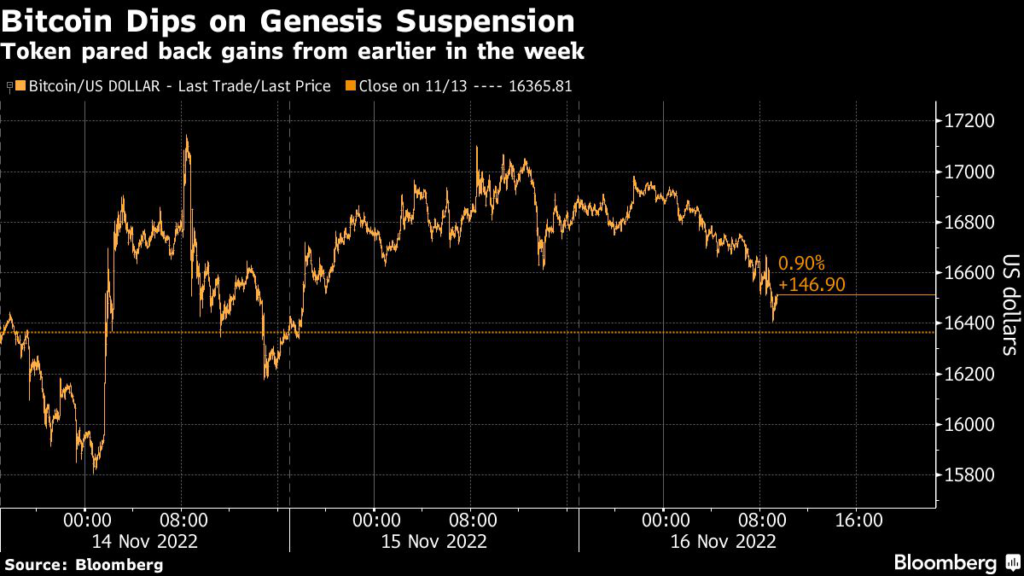
Bitcoin fell as much as 3.1% on Wednesday and has tumbled around 75% from a record high of almost $69,000 reached about a year ago. Ether dropped as much as 3.6%. 

The mayor’s 2021 tax filings, which he released last month, also show that he bought virtual currency that year and likely didn’t sell any, since Adams didn’t claim capital gains or losses. 

Allon added that the mayor supports the innovation and economic growth this sector could bring for the city and isn’t recommending New Yorkers invest in cryptocurrency. He declined to share further details of Adams’s crypto holdings, saying that they are personal investment decisions. 

–With assistance from Fola Akinnibi.

More stories like this are available on bloomberg.com

©2022 Bloomberg L.P.

Fed’s Barr Says Stablecoins Are Urgent Risk Requiring Guardrails

(Bloomberg) — A top Federal Reserve official warned Congress that it needed to pass legislation with strong crypto guardrails to prevent future financial-stability risks.

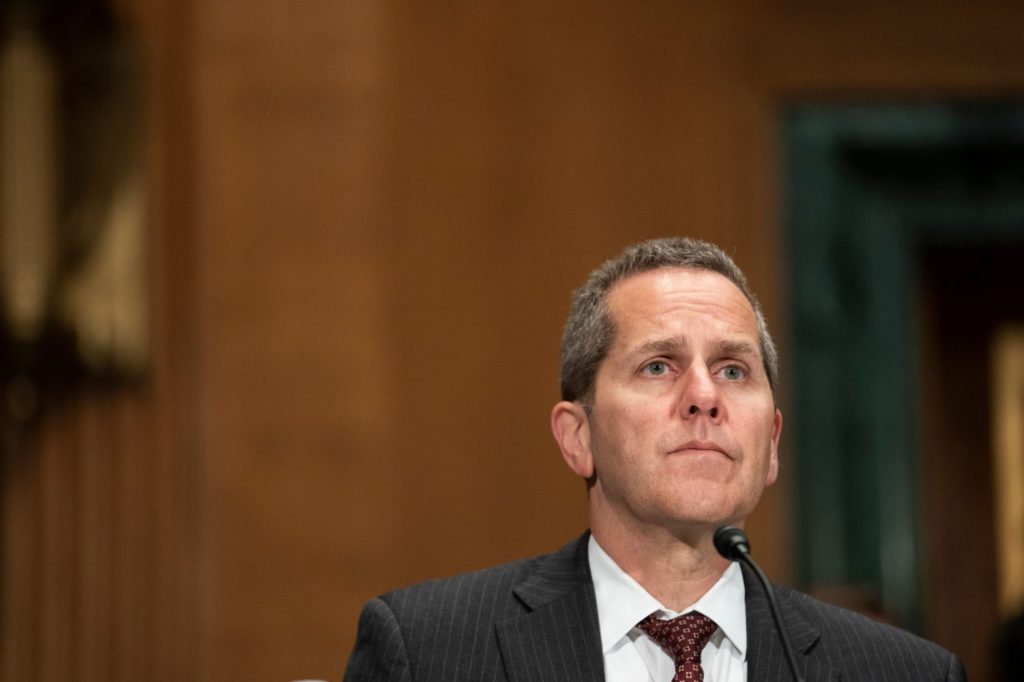
Entities offering stablecoins — cryptocurrencies pegged to a separate asset — are an urgent risk that must be addressed, because they’re backed by the dollar and “really borrow the trust of the Federal Reserve,” Fed Vice Chair for Supervision Michael Barr said Wednesday before the US House Financial Services Committee.

It’s “important for Congress to step in and say you’re not permitted to offer a stablecoin unless it’s done under a strong prudential framework with Federal Reserve oversight, supervision, regulation and approval,” Barr said. “Private money can create enormous financial-stability risks, unless it’s appropriately regulated.”

Throughout the committee hearing, Barr reiterated that it’s Congress’s role to intervene. He said bills should include a strong role for Fed oversight of stablecoins, which he called a form of private money.

“And as I’ve said earlier, you know, the historical evidence is that private money without appropriate regulation can lead to runs and financial instability,” Barr said. He noted that the meltdown of Sam Bankman-Fried’s FTX has had a muted impact on the banking system.

On Wednesday, Senator Kirsten Gillibrand, a Democrat, said she was working with Senators Cynthia Lummis and Pat Toomey, the top Republican on the Banking Committee, on a bipartisan stablecoin bill. They hope to introduce the legislation in the next few weeks, she said.

Gillibrand said the Office of the Comptroller of the Currency should be the main regulator for stablecoins but that state regulation should also be allowed.

“The OCC can be the floor and create a certification process for any state that also wants to have a regulatory framework,” she said at event in Washington hosted by the Blockchain Association. “There is a role for state regulators, and I don’t want to dismiss that.”


–With assistance from Ana Monteiro and Allyson Versprille.

More stories like this are available on bloomberg.com

©2022 Bloomberg L.P.

Confusion Reigns for Foreign Companies Operating in China

(Bloomberg) — Subscribe to Stephanomics on Apple PodcastsSubscribe to Stephanomics on Spotify

Investors were floored when China started cracking down on homegrown tech giants like Alibaba Group Holding Ltd. and Tencent Holdings Ltd. in late 2020. They shouldn’t have been, argues Kendra Schaefer, an expert on Chinese tech policy with Beijing-based Trivium China.

For almost 20 years, the Chinese Communist Party has struggled to understand how its sprawling internet and financial technology industry fit with a socialist market economy—and things finally boiled over two years ago, Schaefer says. Increasingly, Chinese leader Xi Jinping and his party want technology firms to meet “state-directed goals,” she says.

In this special edition of the Stephanomics podcast from the Bloomberg New Economy Forum in Singapore, we dive into the complexities of Chinese economic policy. One of the more recent challenges for investors and foreign businesses operating in China is a lack of good intelligence, Schaefer tells host Stephanie Flanders. There’s been an “exodus” of Chinese policy experts since the pandemic began, Schaefer says, partly because of restrictions on travel inside the country. Schaefer herself recently relocated to the US from Beijing.

For now, many foreign companies have been confused by recent aggressive moves out of Beijing, and powerless to do much about it. While investors were befuddled by new regulations on China’s big tech firms, behind the scenes the country was increasingly uneasy with their power and apparent lack of interest in Communist Party objectives. Instead of “disrupting pizza delivery,” tech giants should focus more on developing high-end computer chips, Schaefer says, citing the opinion of party leaders. 

Meantime, manufacturers have seen production grind to a halt at the slightest spread of Covid-19. For sure, some companies have talked about mitigating risk and diversifying outside of China. However, leaving altogether is hardly an option for many. Duplicating the country’s supply chain would take 10 years, so “people are just doing their best to hedge their bets,” Schaefer says.

More stories like this are available on bloomberg.com

©2022 Bloomberg L.P.

US Consumers Prove Resilient as Fed Doles Out Pain Elsewhere

(Bloomberg) — Consumer spending is proving largely resilient in the face of high inflation and steep interest-rate hikes from the Federal Reserve that are dealing a sizable blow to housing and squelching manufacturing. 

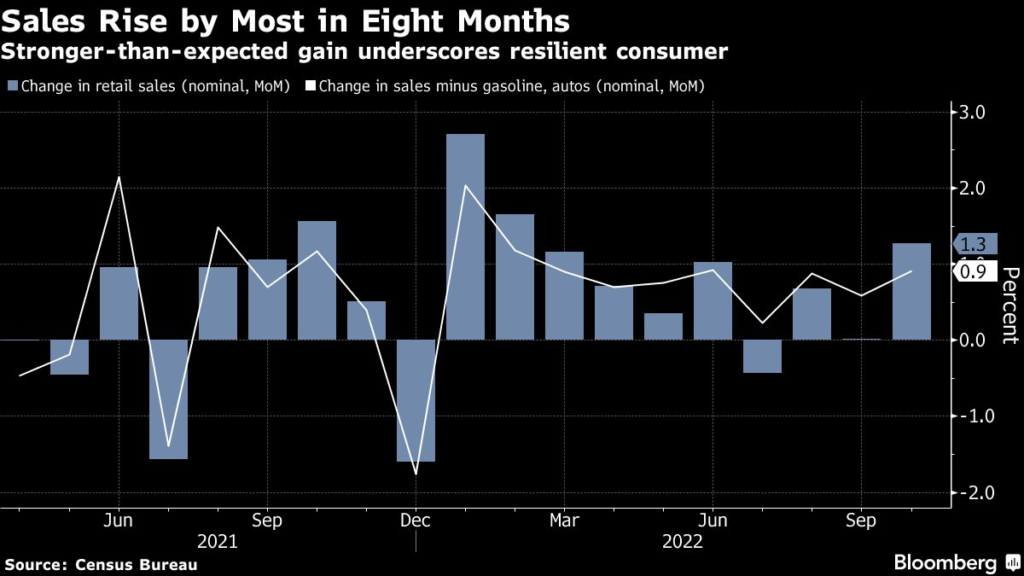
Retail sales — a measure of household spending that is the powerhouse of the nation’s economy — charged ahead in October with the biggest gain in eight months, according to Commerce Department data Wednesday. Meantime, more interest-rate sensitive sectors like housing and factory production continued to show signs of weakness.

The sales figures show that the Fed’s inflation fight is far from over as it tries to restrict demand, but also indicates firm spending that risks keeping inflation elevated for longer. While many central bankers judge it will soon be appropriate to slow the pace of tightening, their task is complicated by a steadfast consumer. 

The Atlanta Fed’s GDPNow forecast for fourth-quarter growth moved up to 4.4% from a previous estimate of 4% after the stronger retail sales report.

“So long as people remain willing to run down excess savings in the face of higher borrowing costs and uncertainty over the economic outlook, consumption will stay reasonably strong into next year, partly offsetting weakness elsewhere and keeping the economy as a whole out of recession,” Kieran Clancy, senior US economist at Pantheon Macroeconomics, said in a note. “But it will still be close.”

Not all economists are as sanguine. JPMorgan Chase & Co. joined most other Wall Street banks in forecasting a US recession next year, though expects it to be “mild.” The stronger-than-expected retail sales data potentially heightens the risk of a downturn if it’s met by even more punishing interest rates, according to Wells Fargo & Co. economists.

“It is tempting to cheer on the ‘resilience’ of the consumer, but the staying power of spending gives businesses no incentive to forgo price increases, thereby making the task of getting inflation in check more difficult for policymakers,” Wells Fargo’s Tim Quinlan and Shannon Seery said in a note.

Goldman Sachs Group Inc. economists on Wednesday added another Fed hike in May to their forecasts, in part due to what they see as “some risk that consumer spending could reaccelerate too much.”

Broad Advance

The sales advance was broad-based, defying expectations that any strength would be a result of gains at auto dealers and gasoline stations. The retail figures aren’t adjusted for inflation.

However, it’s not clear whether household spending growth will be sustained into early 2023. The retail sales report showed the value of receipts at department stores and other discretionary categories like electronics and sporting goods fell, reinforcing earlier commentary from Target Corp. that shoppers are “increasingly impacted by inflation, rising interest rates and economic uncertainty.”

What’s also potentially troubling about consumer spending is that it’s being supported by borrowing and depleting savings. US household debt climbed at the fastest annual pace since 2008 in the third quarter, with credit-card balances surging, according to data released by the New York Fed on Tuesday.

Also bolstering consumers is a tight labor market, marked by robust job creation, low unemployment and rising wages. Fed Chair Jerome Powell said earlier this month that supply and demand for jobs remains out of balance and that conditions haven’t softened yet in an “obvious” way.

The Fed’s tightening so far — nearly four percentage points in the last eight months — has mainly had an impact on smaller sectors of the economy. Separate data Wednesday showed homebuilder sentiment fell again amid a steep climb in mortgage rates, and factory output barely rose in October.

While inflation is showing signs of moderating — consumer and producer price growth both slowed by more than forecast last month — it’s still too soon to declare that the Fed has won the fight against price pressures. San Francisco Fed President Mary Daly said Wednesday that the consumer is “hanging in there” and a pause in hiking rates is “off the table right now.”

“I think it is far too soon to expect a persistent and rapid downshift in inflation, and the answer to that question is far more important than economic growth prospects, but they all tie together,” Stephen Stanley, chief economist at Amherst Pierpont Securities, said in a note. 

“If the economy muddles through rather than falling into recession, then the labor market is likely to remain strong for a while longer and, most importantly, inflation will probably remain elevated for now.”

–With assistance from Augusta Saraiva.

(Adds latest Atlanta Fed GDPNow forecast)

More stories like this are available on bloomberg.com

©2022 Bloomberg L.P.

FTX Latest: Winklevosses’ Gemini Back Online, Lending Arm Halted

(Bloomberg) — Gemini Trust Co., the cryptocurrency platform run by the Winklevoss brothers. said in a tweet that its exchange is fully back online hours after the company said it paused withdrawals on its lending program. Gemini is a lender to crypto brokerage Genesis, which suspended redemptions at its lending business after facing what it described as “abnormal withdrawal requests” in the aftermath of the collapse of FTX. 

Meanwhile, Singapore’s state-owned investor, Temasek International, invested $200 million to $300 million in cryptocurrency giant FTX before its implosion and is preparing to write down the entire bet, people familiar with the matter said.

Michael Novogratz, the billionaire founder of Galaxy Digital Holdings, said the crypto crisis could get worse, as the industry braced for more contagion from the fall of Sam Bankman-Fried’s FTX empire. 

The fallout from the crisis is threatening the future of crypto lenders like BlockFi Inc. and Voyager Digital Ltd. Digital-asset markets extended losses Wednesday morning, with Bitcoin down 2% at 1:34 p.m. New York time.


Key stories and developments:

  • Singapore’s Temasek to Write Down Over $200 Million in FTX
  • FTX Leaves an Empty Black Box Where Due Diligence Used to Be
  • FTX Hacker Emerges With a $288 Million Stash of the Token Ether
  • Matter Labs Raised $200 Million Just Before Crypto Market Chaos
  • FTX’s Crypto Kids Came Dangerously Close to Upending Futures

(Time references are New York unless otherwise stated.)

Gemini Exchange Back Online (1:31 p.m.)

Gemini says its exchange is fully back online and that all customer funds held on it are “available for withdrawal at any time,” it said in a tweet.

Senate Banking Committee Hearing (1:18 p.m.)

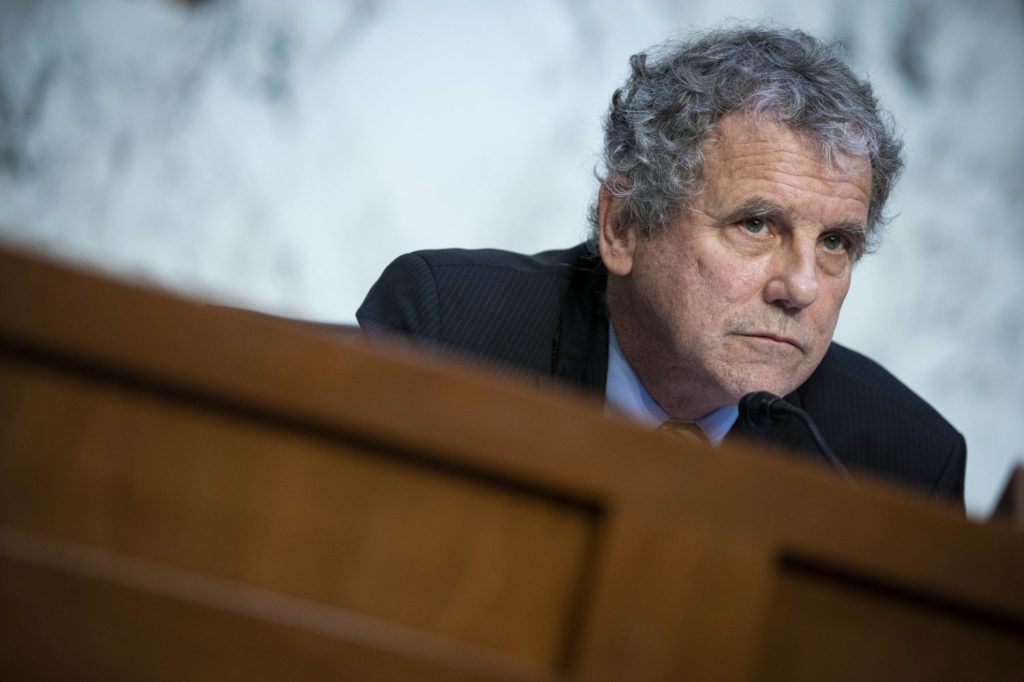
Senate Banking Committee Chairman Sherrod Brown said he plans a hearing on the FTX exchange collapse before the end of the year.

Genesis Hires Alvarez, Cleary Gottlieb (10:29 a.m.)

Crypto brokerage Genesis is working with financial and legal advisers to explore options as it halts redemptions and originations at its lending business amid a liquidity crunch. 

The company hired Alvarez & Marsal and law firm Cleary Gottlieb Steen & Hamilton for advice, according to a spokesperson for Digital Currency Group, the parent of Genesis.

Jay Sidhu’s Bank Says It Dodged the Crash (10:02 a.m.)

No US regional bank stock climbed higher during last year’s crypto mania than Customers Bancorp Inc. Now, the bank built by finance veteran Jay Sidhu and other firms riding the digital wave are trying to distance themselves from the crisis created by the unraveling of FTX’s empire.

“We have no exposure associated with FTX,” Sam Sidhu, Customers Bancorp’s chief executive officer and Jay Sidhu’s son, said in an interview, emphasizing his bank’s exposure was limited because it’s a “new entrant” in the market. “We’re still building our business and taking market share, and people are migrating over to us.”

Hearing Set for December (10:01 a.m.)

The House Financial Services Committee will hold a hearing in December on the collapse of cryptocurrency platform FTX, according to committee statement. 

FTX and Celebrity Backers Sued (9:15 a.m.)

FTX and former chief executive officer Sam Bankman-Fried were sued by an investor over claims that the cryptocurrency exchange now in crisis targeted “unsophisticated investors” using celebrity endorsers including Tom Brady and Stephen Curry, who are also named as defendants.

In a complaint filed Tuesday in federal court in Miami, Oklahoma resident Edwin Garrison is asking to represent a class of “thousands, if not millions, of consumers nationwide.” That includes all investors in the US who were enrolled in yield-bearing FTX crypto accounts, which he alleges constitute unregistered securities in violation of US and Florida laws.

Winklevoss’ Gemini Pauses Withdrawals (8:35 a.m.)

Gemini Trust Co., the cryptocurrency platform run by the Winklevoss brothers, has halted withdrawals from its Earn program after partner Genesis Global did the same. 

This does not impact any other Gemini products and services, the company said in a statement.

Genesis Suspends Withdrawals (8:00 a.m.)

Crypto brokerage Genesis is suspending redemptions and new loan originations at its lending business after facing what it described as “abnormal withdrawal requests” in the aftermath of the collapse of FTX. 

The withdrawal requests exceeded current liquidity at Genesis Global Capital, the lending arm, according to interim Chief Executive Officer Derar Islim. Genesis has hired advisers to explore all possible options, including raising new funding, and will deliver a plan for its lending business next week, Islim said.

Temasek Takes a Hit (6:45 a.m.)

Temasek invested between $200 million and $300 million in FTX before its implosion, according to people familiar with the matter.

Temasek is now preparing to write off the entire amount, one of the people said, asking not to be identified as the matter is private. Another backer, Sequoia Capital, wrote down the full value of its $214 million bet on the exchange, while a person with knowledge of the situation said SoftBank Group Corp. is expecting a loss of around $100 million on its investment. 

FTX Hacker’s Haul (6:05 p.m. HK)

The hacker who raided Sam Bankman-Fried’s collapsed crypto exchange FTX is now one of the world’s biggest holders of the token Ether.

A wallet linked with the exploit swapped about $49 million of stablecoins — mainly Dai — for Ether on Tuesday, security specialists PeckShield said. 

Wallets on FTX were drained of over $663 million in tokens, with $477 million of that suspected to have been stolen and the remainder moved into secure storage by FTX, according to blockchain specialist Elliptic.

Novogratz Warns Worst May Lie Ahead  (6 p.m. HK)

Mike Novogratz said the worst of the crypto crisis in the wake of the FTX exchange’s collapse may yet unfold. Galaxy, the crypto financial services firm founded by Novogratz, last week disclosed $76.8 million in exposure to FTX.com

Novogratz was speaking at a conference on Wednesday alongside Binance Holdings Ltd.’s Chief Executive Officer Changpeng ‘CZ’ Zhao. The Binance CEO said he saw a lot of investor interest in a crypto industry recovery fund he plans to set up to assist otherwise strong projects that are facing a liquidity squeeze. 

Crypto Exchange AAX Needs Capital (5:55 p.m. HK) 

Resuming operations on the cryptocurrency exchange AAX depends on whether it can raise funds, the company said. Hong Kong-based AAX suspended withdrawals on Monday citing a glitch in a system upgrade.

“If AAX is unable to secure funding to enable us to restart operations, AAX is committed to initiating legal procedures to secure and ensure the distribution of asset,” the company said. 

Most Bitcoin Retail Buyers Lost (2:20 p.m. HK)

A study of how retail investors use cryptocurrency exchange apps suggests about three-quarters have lost money on Bitcoin, according to the Bank for International Settlements.

Data spanning 95 countries from 2015 to 2022 indicates the vast majority of app downloads occurred when Bitcoin’s price was above $20,000, the working paper from the Basel, Switzerland-based BIS says.

The world’s largest token has plunged over 70% from a record hit about a year ago, pressured by rapidly tightening monetary policy and a series of huge blowups at crypto outfits, most recently FTX.

FTX Digital Markets Files for Chapter 15 (noon HK)

Bahamas-based FTX Digital Markets Ltd. has submitted a Chapter 15 petition for recognition of a foreign proceeding in the Southern District of New York, according to a filing on the court’s website.

It’s a subsidiary of FTX Trading Ltd., which filed for Chapter 11 bankruptcy on Nov. 11.

–With assistance from Amanda Fung, Sidhartha Shukla and Suvashree Ghosh.

More stories like this are available on bloomberg.com

©2022 Bloomberg L.P.

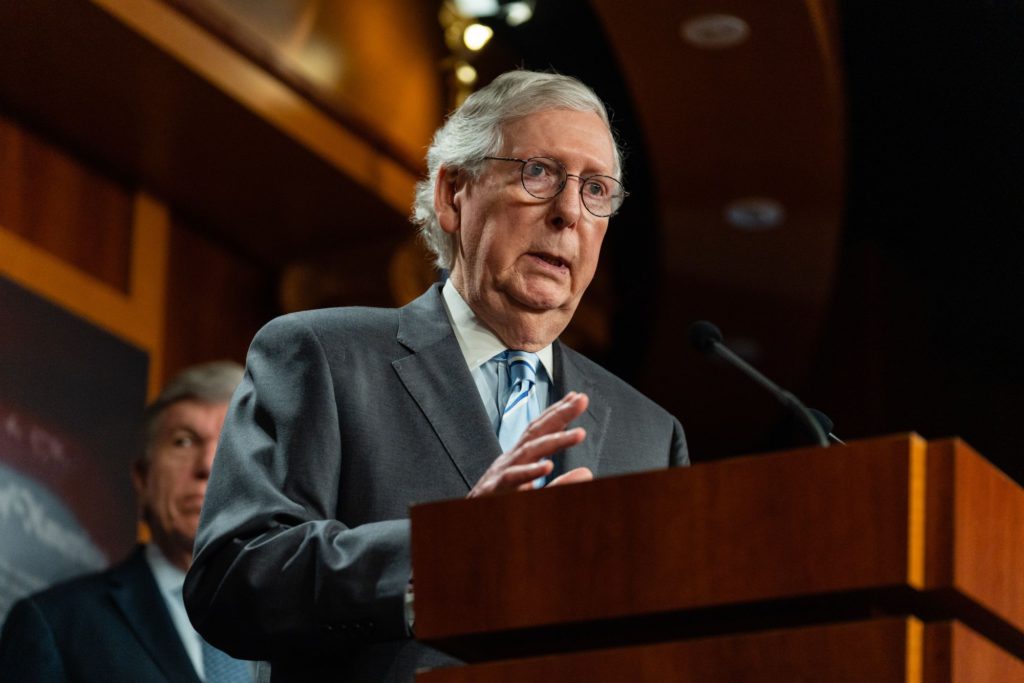
McConnell Is Re-Elected to Lead Senate GOP, Overcoming Party Revolt

(Bloomberg) — Mitch McConnell overcame an eleventh-hour challenge and a revolt by some Republicans frustrated with the GOP’s unexpectedly poor showing in the midterms to win reelection as his party’s leader in the US Senate. 

McConnell, an 80-year-old Kentucky lawmaker known as an adept tactician and a hard-nosed partisan, prevailed Wednesday over Senator Rick Scott of Florida, who was in charge of his party’s campaign apparatus in the midterms and announced his candidacy for the minority leader job the day before. 

McConnell received 37 votes to Scott’s 10 votes, several Republican senators said after the secret-ballot tally. 

“We collectively, I think, had a good discussion about what happened in the election and what happens in the next election,” McConnell said after the closed-door meeting to decide on leadership. 

The vote, held in the ornate Old Senate Chamber, followed a tense closed-door Republican meeting Tuesday to hash out their concerns about the loss of the Senate despite soaring inflation and low approval ratings for President Joe Biden. It also comes a day after House Republicans reelected Kevin McCarthy of California as their leader, making the two lawmakers the GOP’s standard bearers heading into the 2024 presidential election. 

But both McConnell and McCarthy face significant challenges with growing schisms between the GOP’s more moderate and pragmatic lawmakers from those aligned with former President Donald Trump as he mounts his third White House bid. 

Scott’s decision Tuesday to challenge McConnell and an unsuccessful drive by a bloc of GOP senators to delay the elections until after a Dec. 6 runoff for Georgia’s Senate seat underscores that loyalty to McConnell, who long has been at odds with Trump, was shaken after Democrats managed to hold on to Senate control. During a closed-door meeting on Tuesday McConnell and Scott blamed each other for the failure of Republicans to win the majority, according to senators present.

In the House McCarthy overcame a challenge from conservative Representative Andy Biggs, but he must consolidate support within his party before the full House votes on the next speaker Jan. 3.

McConnell next year will become the longest-serving Senate party leader, surpassing the 16-year record held by Democrat Mike Mansfield for more than four decades. While Republicans fell short of a majority in a Senate now split 50-50 between the two parties, McConnell’s reputation as a solid party strategist and a prolific fundraiser helped him beat Scott, who chaired the National Republican Senatorial Committee for two years leading up to the midterms.

The Senate Leadership Fund, a Super-PAC allied with McConnell, spent more than $240 million in the elections, according to AdImpact data. That’s more than any other outside group seeking to affect the outcome of elections in 2022.

McConnell and Scott have had differences for months over spending to help GOP candidates in last week’s election and Scott’s controversial proposal to switch the popular Medicare and Social Security from permanent entitlements to temporary programs renewed every five years by Congress. McConnell has complained about weak Trump-backed GOP candidates in critical races, including in Arizona, Nevada and New Hampshire where GOP candidates lost to Democratic incumbents.

In their elections today, Senate Republicans also elected McConnell’s top deputies. They include: 

  • Senator John Thune of South Dakota as Senate minority whip.
  • Senator John Barrasso of Wyoming as chairman of the Senate Republican Conference.
  • Senator Joni Ernst of Iowa to run the Senate Republican Policy Committee.
  • Senator Shelley Moore Capito to serve as vice chair of the Senate Republican Conference.
  • Senator Steve Daines of Montana to replace Scott at the helm of the NRSC.

(Updates with vote tally, McConnell remarks in third, fourth paragraphs, other positions at end)

More stories like this are available on bloomberg.com

©2022 Bloomberg L.P.

US Stocks Decline as Fed Pivot Seems Less Likely: Markets Wrap

(Bloomberg) — US stocks declined after strong retail sales and at least two Federal Reserve speakers recast bets that the central bank’s policy tightening regime is nearing an end. 

The S&P 500 fell after a report showed retail sales posted the biggest increase in eight months in October, outpacing estimates and indicating the economy can withstand additional Fed hikes. The tech-heavy Nasdaq 100, which is typically more sensitive to interest rates, dropped as much as 1.7%. 

The market pullback comes after a hefty rally fueled by softer-than-expected US inflation data that fanned expectations the Fed may be able to slow its tempo of interest-rate hikes. That alongside news of China’s post-Covid reopening had pushed the dollar and Treasury yields lower in recent days.  

But on Wednesday, New York Fed President John Williams bruised sentiment after he said the central bank should avoid incorporating financial stability risks into its considerations as it raises interest rates. San Francisco Fed President Mary Daly, meanwhile, emphasized that a pause is “off the table.” Goldman Sachs Group Inc. now expects the Fed to boost its key rate to a range of 5% to 5.25%, up from the previous call of 4.75% to 5%. 

“The market is just trying to grasp for news and it’s prone to overcompensate for the news, whether it’s good news or bad news,” Sandi Bragar, chief client officer at Aspiriant, said by phone. “We’re just at that point in the cycle where we think there’s still the high likelihood for potential downward trajectory of stocks as we head into 2023.”

The stronger retail numbers give the Fed more room to be aggressive, as officials have consistently communicated, Oksana Aronov, alternative fixed income head of markets strategy at JPMorgan Asset Management, said on Bloomberg TV. The disparate economic data that has hit the markets in recent weeks complicates the central bank’s mandate, she said.

In corporate news, Target Corp.’s shares plunged after it warned that US shoppers are pulling back. Micron Technology Inc. shares also tumbled after it said the market outlook for 2023 has weakened. 

Earlier, comments from US President Joe Biden that Ukrainian air defenses, rather than by Russia, had likely caused Tuesday’s explosion in Poland soothed fears of an escalation in military conflict. While the White House backed Poland’s call on the matter, it emphasized that Russia was ultimately to blame.

Elsewhere, European Central Bank policy makers may slow down their tempo of rate hikes, with only a 50 basis-point increase next month, according to people with knowledge of the matter.

Key events this week:

  • Fed’s Lael Brainard and SEC Chair Gary Gensler speak, Wednesday
  • ECB President Christine Lagarde speaks, Wednesday
  • Eurozone CPI, Thursday
  • US housing starts, initial jobless claims, Thursday
  • Fed’s Neel Kashkari, Loretta Mester speak, Thursday
  • US Conference Board leading index, existing home sales, Friday

Some of the main moves in markets:

Stocks

  • The S&P 500 fell 0.8% as of 1:36 p.m. New York time
  • The Nasdaq 100 fell 1.3%
  • The Dow Jones Industrial Average fell 0.1%
  • The MSCI World index rose 1.1%

Currencies

  • The Bloomberg Dollar Spot Index rose 0.2%
  • The euro was little changed at $1.0357
  • The British pound was little changed at $1.1872
  • The Japanese yen fell 0.3% to 139.67 per dollar

Cryptocurrencies

  • Bitcoin fell 2% to $16,551.33
  • Ether fell 2.7% to $1,212.41

Bonds

  • The yield on 10-year Treasuries declined five basis points to 3.72%
  • Germany’s 10-year yield declined 11 basis points to 2.00%
  • Britain’s 10-year yield declined 15 basis points to 3.15%

Commodities

  • West Texas Intermediate crude fell 2.1% to $85.13 a barrel
  • Gold futures were little changed

This story was produced with the assistance of Bloomberg Automation.

–With assistance from Vildana Hajric, Emily Graffeo and Peyton Forte.

More stories like this are available on bloomberg.com

©2022 Bloomberg L.P.
Senate Banking Committee Plans Hearing on FTX Collapse, Brown Says

(Bloomberg) — Senate Banking Committee Chairman Sherrod Brown said he plans a hearing on the FTX exchange collapse before the end of the year.

Brown said he wasn’t sure yet on the witnesses who will appear, but they will include officials from the Securities and Exchange Commission.

The House Financial Services Committee earlier Wednesday said it will hold a hearing in December on the collapse of the cryptocurrency platform FTX.

More stories like this are available on bloomberg.com

©2022 Bloomberg L.P.
Elon Musk’s Twitter Quest Turns Tesla’s Edge Into a Risk

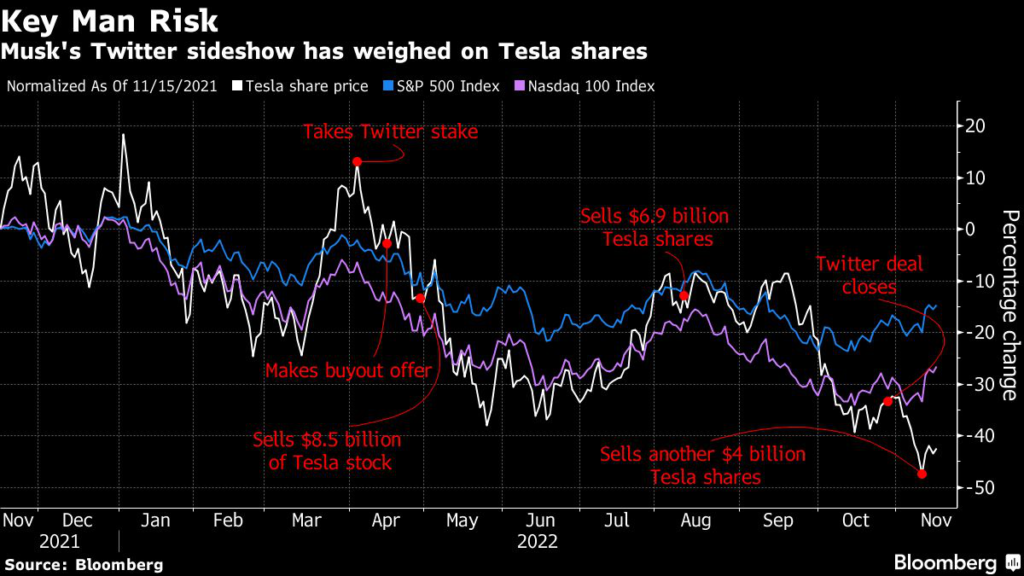
(Bloomberg) — Many Tesla Inc. investors watched in dismay as Elon Musk plunged into a battle over buying Twitter that pulled his attention away from the electric-car maker. Now that the deal is done, some are fretting Twitter is an even bigger drag on Tesla than before.

Tesla’s stock has plummeted 46% this year, compared with a 28% drop for the Nasdaq 100 Index. However, unlike the megacap technology companies that have seen similar or bigger routs, such as Meta Platforms Inc., earnings estimates for Tesla are actually higher than they were a year ago.

Many Tesla bulls see Musk’s singular management style as the company’s biggest edge over the century-old automakers across the globe. Yet he’s been deeply involved in overhauling the social-media company, to the point that he said this week that he had too much on his plate and was working “morning to night, seven days a week.”

“The question some investors are asking is, how many balls can he keep in the air while he’s juggling all of these responsibilities?” said Brian Mulberry of Zacks Investment Management. “The concern is that there are only so many hours in the day for Musk to manage all of these projects, and we’re starting to see a deterioration in the stock price because of that.” 

Tesla didn’t reply to a request for comment on Musk’s workload. However, Musk, during a trial related to his Tesla pay package in Delaware on Wednesday, said he is now spending almost all his time reorganizing Twitter. He expects the “fundamental organizational restructuring” will be completed by the end of next week.  

Apart from Tesla and Twitter, his other ventures include Space Exploration Technologies Corp., or SpaceX, the tunnel construction company Boring Co. and neurotechnology firm Neuralink Corp. 

While Tesla investors are most worried about Musk’s focus deviating from the EV maker, there are other risks as well. For example, after taking over Twitter, Musk asked engineers from Tesla to review Twitter workers’ code. 

Zacks’ Mulberry said that though Musk is expected to dedicate a lot of time to his newest acquisition for the initial month or so, “if he continues to use staff from other companies like Tesla, or SpaceX, to keep helping Twitter, then obviously there’s going to be a degradation of productivity to those other companies.” Zacks owns Tesla stock through its All-Cap Core fund. 

These latest doubts have also deflated hopes that once the Twitter deal closed, and Musk was done with his related sale of Tesla shares, the cloud over the automaker’s stock would lift. For one, it’s hard to say with any certainty that Musk won’t soon sell more shares, given that his latest offloading of about $4 billion in Tesla came despite assurances from the CEO that he was done selling.   

“Elon Musk has never dispelled the notion that he is the man, the person behind Tesla,” said Mark Stoeckle, Adams Funds’ chief executive officer. “And because of that the market cannot give the current other managers at SpaceX, Tesla, or Boring Co. enough credit to run those without Musk.” Adams owns about 143,000 Tesla shares.

Even without the Twitter chaos, Tesla has plenty to tackle. The threat of a recession sent US stocks tumbling this year, with valuations of growth companies such as Tesla taking the hardest hit. At the same time, analysts have warned that demand for its electric cars may soften as consumers are squeezed between high prices and slowing growth. 

Still, investors have a lot to look forward to once the Twitter overhang is gone and the market stabilizes. As the global leader in EVs, Tesla is set to benefit from the auto industry’s shift to battery-powered cars from gas-fueled ones. In the US, President Joe Biden’s Inflation Reduction Act is also expected to give a jolt to EVs, helping Tesla. 

Meanwhile, Wall Street analysts’ average price target for Tesla suggests a 52% return over the next 12 months.  

“I believe the Twitter noise will die out by month end as Musk gets a handle on Twitter’s issues,” said Gary Black, managing partner at The Future Fund, which advises the Future Fund Active ETF. At that point, he expects Tesla’s stock to be driven by the rising adoption of EVs and the launch of the company’s Cybertruck pickup, among other factors. 

Tech Chart of the Day

Amid a bull market for technology stocks in August 2020, the keepers of the Dow Jones Industrial Average ejected Exxon Mobil Corp. from the world’s most famous equity benchmark and added software maker Salesforce Inc. The timing couldn’t have been worse: Exxon has more than tripled including dividends since then, while Salesforce has dropped 22%. With the battering that tech has taken this year, investors are now their most net underweight in the sector since August 2006, Bank of America Corp.’s fund manager survey shows, while being overweight in energy for an 18th straight month. 

Top Tech Stories

  • Apple Inc.’s most in-demand iPhones this year, the premium Pro models, will fall short of earlier shipment estimates by 6 million units, due to the disruption at their main assembly hub in China, Morgan Stanley said in a note.
    • Apple is preparing to begin sourcing chips for its devices from a plant under construction in Arizona, marking a major step toward reducing the company’s reliance on Asian production.
  • Tencent Holdings Ltd. pledged to give away the majority of its shares in meal-delivery company Meituan, as the social-media giant whittles away at its extensive holdings across China’s internet industry.
  • Hit video app TikTok is investing to address US concerns about its data security and anticipates being able to deliver a satisfactory solution with partner Oracle Corp.
    • TikTok’s CEO suggested Elon Musk and Twitter Inc. are heading down a risky path.
  • Tesla disclosed to US regulators two new fatal crashes involving automated driver-assist systems, bringing its total to 16 since the government required carmakers to begin submitting data on such accidents in June 2021.
  • Panasonic Holdings Corp. would “almost certainly” choose another US location if it decides to go forward with plans to build another battery production site, said Shoichiro Watanabe, chief technology officer of Panasonic Energy.

–With assistance from Subrat Patnaik.

(Updates stock move in second paragraph, adds details from pay-deal lawsuit in fifth, updates estimated return in 13th.)

More stories like this are available on bloomberg.com

©2022 Bloomberg L.P.

Close Bitnami banner
Bitnami