Bloomberg

Dell to Pay $1 Billion to Settle Suit Over 2018 Stock Conversion

(Bloomberg) — Dell Technologies Inc. agreed to pay $1 billion to settle a shareholder lawsuit relating to a controversial 2018 stock conversion transaction.

The settlement, if approved by the court, will end the dispute over the $23.9 billion conversion of Dell stock in a deal four years ago. In that transaction, Dell founder Michael Dell and other controlling investors including Silver Lake Partners, authorized the issuance of common stock in exchange for tracking shares. The plaintiffs alleged that the transaction was billions of dollars below market value, according to a company filing. 

The share conversion was for a class of Dell stock created as part of the 2016 acquisition of EMC Corp. The lawsuit was set to go to trial in the Delaware Court of Chancery next month, said a spokesperson for Quinn Emanuel Urquhart & Sullivan LLP, the firm representing the shareholders. 

The settlement amount will be reflected in Dell’s fiscal third quarter results, which will be reported on Monday. The company’s $7 billion balance sheet will help to cushion the impact of this payment, and it shouldn’t impact its spending strategy, wrote Bloomberg Intelligence’s Woo Jin Ho. It also “eliminates a modest nonoperational overhang on the company.” 

The settlement includes attorney fees and covers claims against Goldman Sachs Group Inc., which advised Dell in the transaction.

More stories like this are available on bloomberg.com

©2022 Bloomberg L.P.

FTX Latest: Contagion Spreads to Genesis, Winklevosses’ Gemini

(Bloomberg) — Crypto brokerage Genesis is suspending redemptions at its lending business after facing what it described as “abnormal withdrawal requests” in the aftermath of the collapse of FTX. Genesis’ lenders include Gemini Trust Co., the cryptocurrency platform run by the Winklevoss brothers. Gemini said it has paused withdrawals on its lending program. 

Meanwhile, Singapore’s state-owned investor, Temasek International, invested $200 million to $300 million in cryptocurrency giant FTX before its implosion and is preparing to write down the entire bet, people familiar with the matter said.

Michael Novogratz, the billionaire founder of Galaxy Digital Holdings, said the crypto crisis could get worse, as the industry braced for more contagion from the fall of Sam Bankman-Fried’s FTX empire. 

The fallout from the crisis is threatening the future of crypto lenders like BlockFi Inc. and Voyager Digital Ltd. Digital-asset markets extended losses Wednesday morning, with Bitcoin down 2% at 10:36 a.m. New York time.


Key stories and developments:

  • Singapore’s Temasek to Write Down Over $200 Million in FTX
  • FTX Leaves an Empty Black Box Where Due Diligence Used to Be
  • FTX Hacker Emerges With a $288 Million Stash of the Token Ether
  • Matter Labs Raised $200 Million Just Before Crypto Market Chaos
  • FTX’s Crypto Kids Came Dangerously Close to Upending Futures

(Time references are New York unless otherwise stated.)

Genesis Hires Alvarez, Cleary Gottlieb (10:29 a.m.)

Crypto brokerage Genesis is working with financial and legal advisers to explore options as it halts redemptions and originations at its lending business amid a liquidity crunch. 

The company hired Alvarez & Marsal and law firm Cleary Gottlieb Steen & Hamilton for advice, according to a spokesperson for Digital Currency Group, the parent of Genesis.

Jay Sidhu’s Bank Says It Dodged the Crash (10:02 a.m.)

No US regional bank stock climbed higher during last year’s crypto mania than Customers Bancorp Inc. Now, the bank built by finance veteran Jay Sidhu and other firms riding the digital wave are trying to distance themselves from the crisis created by the unraveling of FTX’s empire.

“We have no exposure associated with FTX,” Sam Sidhu, Customers Bancorp’s chief executive officer and Jay Sidhu’s son, said in an interview, emphasizing his bank’s exposure was limited because it’s a “new entrant” in the market. “We’re still building our business and taking market share, and people are migrating over to us.”

Hearing Set for December (10:01 a.m.)

The House Financial Services Committee will hold a hearing in December on the collapse of cryptocurrency platform FTX, according to committee statement. 

FTX and Celebrity Backers Sued (9:15 a.m.)

The exchange and Sam Bankman-Fried, were sued by an investor who claimed the platform targeted “unsophisticated investors,” using celebrities, including Tom Brady and Stephen Curry, who are also named as defendants.

Winklevoss’ Gemini Pauses Withdrawals (8:35 a.m.)

Gemini Trust Co., the cryptocurrency platform run by the Winklevoss brothers, has halted withdrawals from its Earn program after partner Genesis Global did the same. 

This does not impact any other Gemini products and services, the company said in a statement.

Genesis Suspends Withdrawals (8:00 a.m.)

Crypto brokerage Genesis is suspending redemptions and new loan originations at its lending business after facing what it described as “abnormal withdrawal requests” in the aftermath of the collapse of FTX. 

The withdrawal requests exceeded current liquidity at Genesis Global Capital, the lending arm, according to interim Chief Executive Officer Derar Islim. Genesis has hired advisers to explore all possible options, including raising new funding, and will deliver a plan for its lending business next week, Islim said.

Temasek Takes a Hit (6:45 a.m.)

Temasek invested between $200 million and $300 million in FTX before its implosion, according to people familiar with the matter.

Temasek is now preparing to write off the entire amount, one of the people said, asking not to be identified as the matter is private. Another backer, Sequoia Capital, wrote down the full value of its $214 million bet on the exchange, while a person with knowledge of the situation said SoftBank Group Corp. is expecting a loss of around $100 million on its investment. 

FTX Hacker’s Haul (6:05 p.m. HK)

The hacker who raided Sam Bankman-Fried’s collapsed crypto exchange FTX is now one of the world’s biggest holders of the token Ether.

A wallet linked with the exploit swapped about $49 million of stablecoins — mainly Dai — for Ether on Tuesday, security specialists PeckShield said. 

Wallets on FTX were drained of over $663 million in tokens, with $477 million of that suspected to have been stolen and the remainder moved into secure storage by FTX, according to blockchain specialist Elliptic.

Novogratz Warns Worst May Lie Ahead  (6 p.m. HK)

Mike Novogratz said the worst of the crypto crisis in the wake of the FTX exchange’s collapse may yet unfold. Galaxy, the crypto financial services firm founded by Novogratz, last week disclosed $76.8 million in exposure to FTX.com

Novogratz was speaking at a conference on Wednesday alongside Binance Holdings Ltd.’s Chief Executive Officer Changpeng ‘CZ’ Zhao. The Binance CEO said he saw a lot of investor interest in a crypto industry recovery fund he plans to set up to assist otherwise strong projects that are facing a liquidity squeeze. 

Crypto Exchange AAX Needs Capital (5:55 p.m. HK) 

Resuming operations on the cryptocurrency exchange AAX depends on whether it can raise funds, the company said. Hong Kong-based AAX suspended withdrawals on Monday citing a glitch in a system upgrade.

“If AAX is unable to secure funding to enable us to restart operations, AAX is committed to initiating legal procedures to secure and ensure the distribution of asset,” the company said. 

Most Bitcoin Retail Buyers Lost (2:20 p.m. HK)

A study of how retail investors use cryptocurrency exchange apps suggests about three-quarters have lost money on Bitcoin, according to the Bank for International Settlements.

Data spanning 95 countries from 2015 to 2022 indicates the vast majority of app downloads occurred when Bitcoin’s price was above $20,000, the working paper from the Basel, Switzerland-based BIS says.

The world’s largest token has plunged over 70% from a record hit about a year ago, pressured by rapidly tightening monetary policy and a series of huge blowups at crypto outfits, most recently FTX.

FTX Digital Markets Files for Chapter 15 (noon HK)

Bahamas-based FTX Digital Markets Ltd. has submitted a Chapter 15 petition for recognition of a foreign proceeding in the Southern District of New York, according to a filing on the court’s website.

It’s a subsidiary of FTX Trading Ltd., which filed for Chapter 11 bankruptcy on Nov. 11.

–With assistance from Amanda Fung, Sidhartha Shukla and Suvashree Ghosh.

More stories like this are available on bloomberg.com

©2022 Bloomberg L.P.

Zara’s Owner Scrambles to Stop Hometown Black Friday Strike

(Bloomberg) — Inditex SA, owner of the Zara fashion chain, is scrambling to stop shop workers from striking in its hometown during Black Friday, one of the busiest days of the year for retailers.

Representatives from the company and three unions are set to meet Thursday morning after shop-workers in A Coruna, Spain, called a strike for Nov. 24 and 25, when Black Friday occurs, according to a statement from the Confederacion Intersindical Galega union, following a vote on Tuesday. Another union in the Basque region, called ELA, has also called a strike for Nov. 25.

CIG workers are demanding a pay increase of €440 ($459) per month, effective immediately, for staff earning €1,058 while the company is offering €182, staggering the increase over three years, according to a CIG spokesman. A key bone of contention is that shop staff want their salaries to be more aligned with those of the retailer’s better-paid logistics employees. The Basque union ELA are demanding pay be linked to inflation. 

The protest highlights growing pressure from workers in Spain for salary increase to offset inflation at decades-high levels. But in spite of the cost-of-living crisis, Inditex, the world’s largest apparel firm, has posted record revenues this year, as it passes cost increases on to clients across the globe.

A press officer for Inditex declined to comment.

Spain is Inditex’s largest market by number of stores, but it’s also one of its main manufacturing centers. The country is also its core logistics center, as most of its products are distributed to some 7,000 stores globally from Spain. 

Inditex’s revenues rely heavily on online sales and on a strategy of servicing e-commerce sales from its stores, rather than from dedicated warehouses. 

(Updates with monthly salary in third paragraph.)

More stories like this are available on bloomberg.com

©2022 Bloomberg L.P.
Jay Sidhu’s Bank Says It Dodged the Crypto Crash Spurred by FTX Collapse

(Bloomberg) — No US regional bank stock climbed higher during last year’s crypto mania than Customers Bancorp Inc. Now, the bank built by finance veteran Jay Sidhu and other firms riding the digital wave are trying to distance themselves from the crisis created by the unraveling of FTX’s empire.

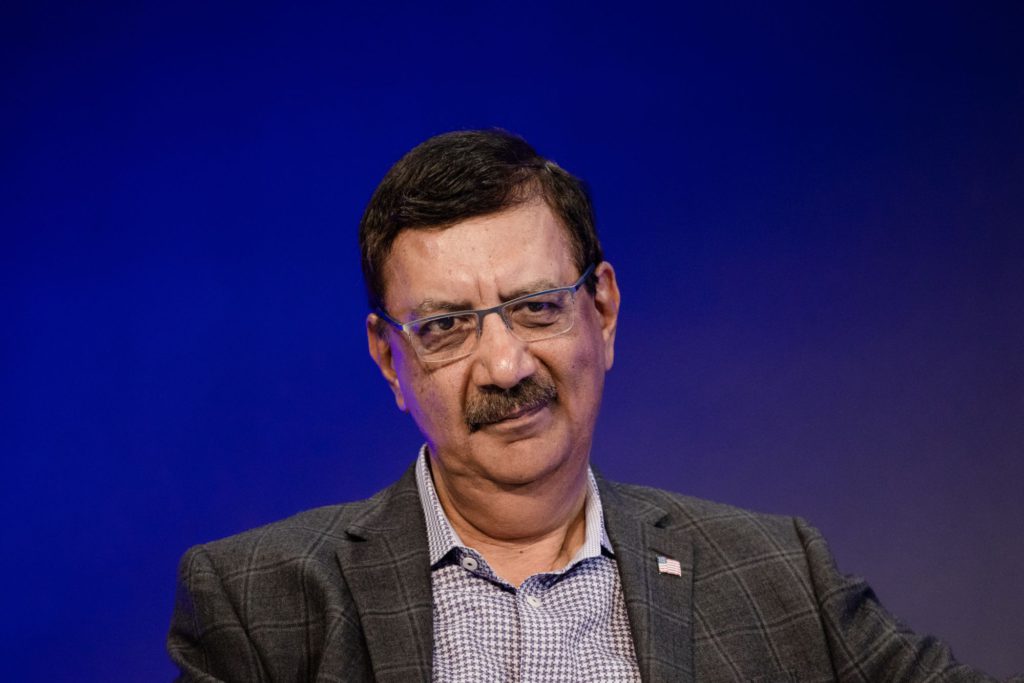
“We have no exposure associated with FTX,” Sam Sidhu, Customers Bancorp’s chief executive officer and Jay Sidhu’s son, said in an interview, emphasizing his bank’s exposure was limited because it’s a “new entrant” in the market. “We’re still building our business and taking market share, and people are migrating over to us.”

Nevertheless, a year after digital assets touched their peak, companies with exposure to the sector are seeing their stock prices waver. Customers Bancorp is down about 50% since the start of 2022, while crypto-heavy Signature Bank has lost almost 56% and Silvergate Capital Corp. has sunk 81%.

Silvergate said deposits from FTX represent less than 10% of the $11.9 billion it has from “all digital asset customers.” And Signature Bank said deposits from FTX and related entities were “less than 0.1% of the bank’s overall deposits” as of Nov. 14.

Customers Bancorp has pushed in the past few years to increase its digital capabilities, including the introduction of a real-time payments platform that caters to businesses such as crypto-trading firms and institutional investors. The Pennsylvania bank closed out 2021 up almost 260% — a better record than the best performers in blue-chip indexes such as the S&P 500 and the the Dow Jones Industrial Average. 

The company’s potential to increase its book value and capital were major drivers of the gain, according to KBW analyst Michael Perito, with loan growth and cryptocurrency exposure offering upside as well.


Jay Sidhu helmed the bank when it filed to go public in 2012, and still serves as executive chairman. He previously headed Sovereign Bancorp, which once ranked as the second-largest savings and loan in the US before it was acquired by Spain’s Banco Santander SA. Sidhu was ousted from Sovereign in 2006 after a spat with investors, and failed in his attempt to purchase the firm using a blank-check company in 2008.

Banks that offer real-time payments and digital tokens used in such transactions aren’t facing the same contagion risks staring down crypto exchanges and other businesses with more direct exposure.

“There could be a chunk of deposits at risk of going away, but it’s nothing that should be damaging to the company’s CBIT platform,” Perito at KBW said in an interview, referring to Customers Bancorp’s real-time payments platform. “It’s going to be a challenging business for all these banks for the next quarter or two at least, but there’s nothing that will structurally impair the bank’s ability to grow or invest in growth in this platform.”

Even so, FTX’s spectacular fall and the resulting bankruptcy of founder Sam Bankman-Fried’s business empire is causing a crisis of confidence that lenders including Customers Bancorp are being forced to contend with. 

“There’s a lot of folks probably on the sidelines who are saying, ‘It was a question of when, not if,’” Sam Sidhu said, adding that he and his bank are “disappointed” to hear of excessive risk-taking in any industry.

More stories like this are available on bloomberg.com

©2022 Bloomberg L.P.
FTX Contagion Spreads to Crypto Brokerage Genesis, Winklevosses’s Gemini

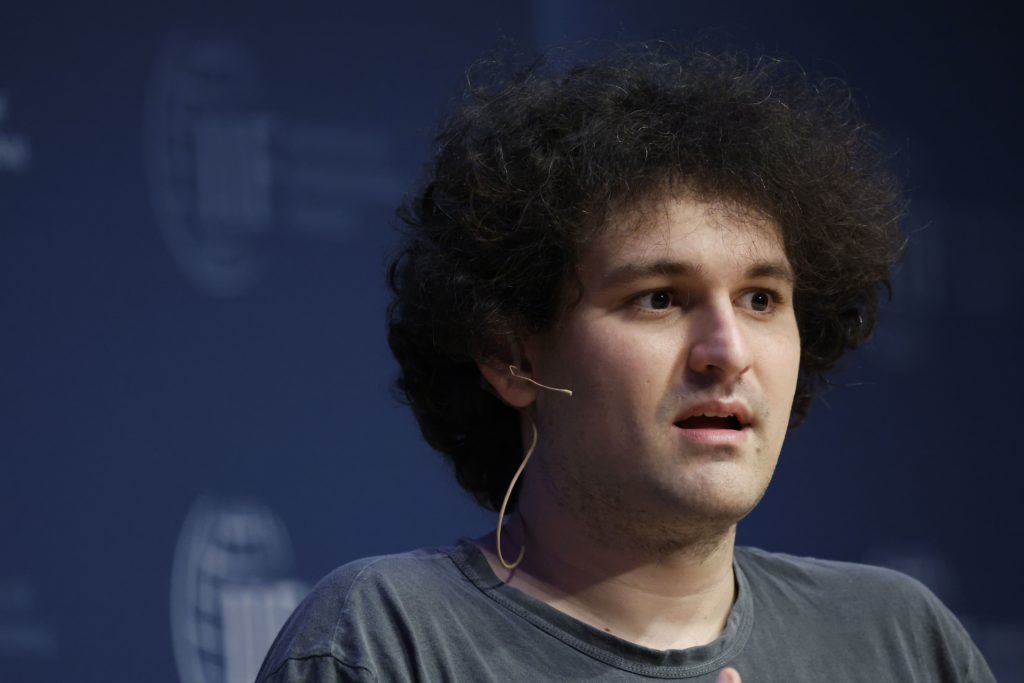
(Bloomberg) — The fallout from the collapse of Sam Bankman-Fried’s sprawling crypto empire spread Wednesday, with digital-asset brokerage Genesis and crypto exchange Gemini becoming the latest pain points. 

Genesis is suspending redemptions and new loan originations at its lending business after facing what it described as “abnormal withdrawal requests.” Gemini, founded by Cameron Winklevoss and Tyler Winklevoss, subsequently announced its yield product targeting retail investors will also halt redemptions as Genesis was a key partner in the program. 

As a counterparty to many in the sector, Genesis’ financial health has been closely watched as a gauge of the industry’s strength or for signs of potential contagion. Some of Genesis’ biggest lenders include crypto exchange Gemini, which offers a product to users to generate yield through Genesis, according to its website. On Wednesday, Gemini announced that it’s working with Genesis to help customers redeem their funds from the Earn product “as quickly as possible.” 

FTX’s sudden tumble into bankruptcy is cascading through crypto markets, with panicky customers rushing to pull their assets from other platforms. Also at risk are troubled crypto lenders like BlockFi Inc. and bankrupt Voyager Digital Ltd., which was forced to try to find a new buyer for its assets to replace FTX. Investors such as crypto hedge fund Galois Capital, which reported “significant” funds stuck on FTX’s platform, are also feeling the impact. Even miners are getting hit as the decline in crypto prices sparked by the collapse of FTX has also put further pressure on profits.

Last week, Genesis said it would get a $140 million equity infusion from its parent company, Barry Silbert’s Digital Currency Group, after disclosing that its derivatives business had $175 million in funds locked in an FTX trading account. The lending business had previously been affected by its exposure to bankrupt crypto hedge fund Three Arrows Capital, to which it had made a $2.4 billion loan. 

Genesis is one of oldest and most well-known cryptocurrency brokers, offering trading and custody services to professional investors in digital assets. Over the past few years it had also established itself as one of the largest cryptocurrency lenders, allowing funds or other market makers to borrow dollars or virtual currencies to leverage their trades. 

Genesis’s withdrawal requests exceeded current liquidity at Genesis Global Capital, the lending arm, according to interim Chief Executive Officer Derar Islim. The New York-based company has hired advisers to explore all possible options, including raising new funding, and will deliver a plan for its lending business next week, Islim said. Alvarez & Marsal and the law firm Cleary Gottlieb are advising Genesis.

The move will affect only the lending business, according to Islim, who said Genesis’s spot and derivatives trading and custody businesses “remain fully operational.”

The lending business has shrunk dramatically this year, with loan originations falling to $8.4 billion in the third quarter from $44.3 billion in this year’s first three months. 


Three Arrows put down about half of the required capital against that loan, according to court filings. DCG assumed the outstanding liabilities and is now the largest creditor to the failed hedge fund, which was run by Su Zhu and Kyle Davies. 

Genesis has experienced a wave of senior executive departures this year and has been cutting staff. In August, the company eliminated 20% of its then 260-person workforce and appointed Islim as interim CEO, replacing Michael Moro. Later that month, Noelle Acheson said she was leaving her post as head of market insights. 

In September, Matthew Ballensweig stepped down as co-head of sales and trading and said he would move into an advisory position. In October, Chief Risk Officer Michael Patchen left after three months in the role. 

Digital Currency Group also controls Grayscale Investments, which offers the Grayscale Bitcoin Trust, or GBTC, the largest investment vehicle in the crypto market. The trust is trading at about a 40% discount to the market price of Bitcoin.  


–With assistance from Muyao Shen.

(Adds Gemini announcement in lede, Genesis’ advisers)

More stories like this are available on bloomberg.com

©2022 Bloomberg L.P.

Micron Says Outlook for 2023 Has Weakened; Shares Tumble

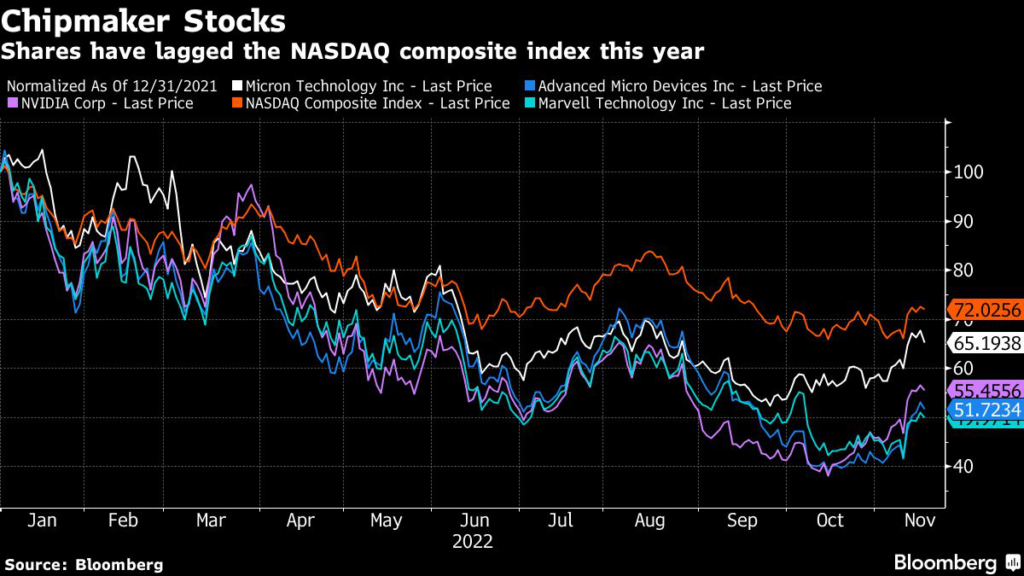
(Bloomberg) — Micron Technology Inc. said it’s reducing production of DRAM and NAND wafers by about 20% compared with the fiscal fourth quarter “in response to market conditions.”

“Recently, the market outlook for calendar 2023 has weakened,” Micron said in a statement on Wednesday. The company said year-on-year DRAM bit supply will need to shrink and NAND bit supply growth will need to be significantly lower than previous estimates.

The leading US maker of memory semiconductors said it’s also working toward additional capital spending cuts. In September, the company said it would cut spending by 30% in its fiscal year. The shares tumbled as much as 4.8% as trading got underway in New York, dragging down Nvidia Corp. and Advanced Micro Devices Inc. as well.  

“Micron is taking bold and aggressive steps to reduce bit supply growth to limit the size of our inventory,” Chief Executive Officer Sanjay Mehrotra said. “We will continue to monitor industry conditions and make further adjustments as needed.” 

Global chipmakers had been riding high during the pandemic, when the work-from-home trend fueled demand for computers and other consumer technology. But inflation and recession fears — plus a return to the office — have put a damper on purchases. That’s left memory customers sitting on stockpiles of unused chips.

In the past several weeks, almost every major memory chipmaker has warned of a supply glut and tumbling prices, announcing it was time to slash capital spending. In its latest financial statement, Micron reported downbeat earnings and forecast quarterly sales that were almost $2 billion below Wall Street estimates. The company said then it expects sales of about $4.25 billion in its fiscal first quarter, which ends in November. 

Memory chips are unique in the semiconductor field in that they’re built to industry standards, meaning products from rival companies are interchangeable. They’re traded like commodities, with publicly available pricing.

(Updates shares in third paragraph)

More stories like this are available on bloomberg.com

©2022 Bloomberg L.P.
Winklevosses’ Gemini Delays Withdrawals on Lending Program

(Bloomberg) — Gemini Trust Co., the cryptocurrency platform run by Tyler and Cameron Winklevoss, said redemptions by customers for its Earn program are being delayed after its partner in the product, Genesis Global, paused withdrawals on its borrowing platform amid a liquidity crunch.

Genesis is one of the main borrowers of Gemini Earn, a product used to generate yields for its customers, according to Gemini Earn’s website. Gemini is working with Genesis to allow users to redeem funds as ‘quickly as possible.” The delay doesn’t impact any other Gemini products and services, the New York-based firm said in a statement.

“The past week has been an incredibly challenging and stressful time for our industry. We are disappointed that the Earn program SLA will not be met, but we are encouraged by Genesis’ and its parent company Digital Currency Group’s commitment to doing everything in their power to fulfill their obligations to customers under the Earn program,” the statement said.

Genesis suspended lending withdrawals, as the spectacular collapse of crypto exchange FTX shocked the digital-asset industry. The firm said it has hired advisers to explore all possible options, including new funding, and will deliver a plan for its lending business next week. Genesis’ lending business had previously been affected by its exposure to bankrupt crypto hedge fund Three Arrows Capital. Trading and other services at Genesis remain operational.

The Winklevoss twins, who first became known when they challenged Mark Zuckerberg over the mantle of who invented social network Facebook, are early Bitcoin investors and believers. Last November, Gemini raised $400 million in a round of funding that valued the company at $7.1 billion.  

More stories like this are available on bloomberg.com

©2022 Bloomberg L.P.
US Retail Sales Rise Most in Eight Months as Consumers Hold On

(Bloomberg) — US retail sales posted the biggest increase in eight months in October, indicating demand for goods is broadly holding up despite decades-high inflation and a worsening economic outlook.

The value of overall retail purchases climbed 1.3% last month after stagnating in September, Commerce Department data showed Wednesday. Excluding gasoline and autos, retail sales were up 0.9%. The figures aren’t adjusted for inflation. 

The median estimate in a Bloomberg survey of economists called for a 1% increase in total retail sales.

Nine of 13 retail categories rose last month, according to the report, including firm results at auto dealers, grocery stores and restaurants. The value of sales at gas stations climbed 4.1%, mostly reflecting higher pump prices.

The data illustrate that consumers are continuing to prove largely resilient and suggests the economy got off to a good start in the fourth quarter. That may complicate the argument posed by several Federal Reserve officials pushing for a slower pace of interest-rate hikes in the coming months, but policymakers acknowledge that inflation is still far too high.

Consumer and producer price growth both eased by more than forecast last month, spurring a rally in stock and bond markets in hopes that the Fed will downshift to smaller hikes as soon as December. US stocks opened lower after Wednesday’s retail report.

Even though some price pressures are easing, retailers are still seeing the impact of inflation in earnings. Home Depot Inc.’s profit exceeded expectations last quarter, but was driven by higher prices rather than more transactions. Walmart Inc., meanwhile, raised its full-year guidance as US shoppers flocked to its stores to find discounts.

At the same time, Target Corp. warned that shoppers are pulling back, “with guests’ shopping behavior increasingly impacted by inflation, rising interest rates and economic uncertainty,” Chief Executive Officer Brian Cornell said in a statement Wednesday.

What Bloomberg Economics Says…

“Consumers kept their wallets open at the start of the fourth quarter, with strength in retail sales extending beyond expected sources like autos and gasoline. A Bloomberg Economics model suggests there’s a good chance consumers will hunker down early in 2023, but resilience in the October retail data means the Fed will need to stay the course on rate hikes at coming meetings.”

–Eliza Winger and Andrew Husby, economists

To read the full note, click here

Many retailers, stuck with a glut of inventory, have deployed deep discounts to try to move stock off their shelves for the crucial holiday season. Sales at clothing stores were little changed while those at department stores fell 2.1%.

Other discretionary categories like electronics and sporting goods also declined, suggesting price cuts and weaker demand are weighing on the value of sales.

Besides not being adjusted for price increases, the retail sales report only captures a sliver of services spending, where Americans have been shifting more of their dollars. A fuller picture of October household demand, which includes both services spending and inflation-adjusted figures, will be released in two weeks.

So-called control group sales — which are used to calculate gross domestic product and exclude food services, auto dealers, building materials stores and gasoline stations — increased 0.7% in October, the most in four months.

–With assistance from Joshua Robinson and Reade Pickert.

(Adds market open)

More stories like this are available on bloomberg.com

©2022 Bloomberg L.P.
Ex-Calpers, Alaska Permanent CIO Russell Read Joins 10X

(Bloomberg) — Russell Read, the former chief investment officer of California Public Employees’ Retirement System, the Alaska Permanent Fund and Gulf Investment Corp., has joined 10X Capital as CIO.

Read, who’s joining the firm’s executive committee, will oversee 10X’s global investment strategy and report to founder and Chief Executive Officer Hans Thomas. 

“Russell’s exceptional track record and skill set will help the 10X Capital team continue to deliver on our mission of democratizing access to elite, institutional-quality investment strategies,” Thomas said in a statement.

The New York-based firm has ambitions to expand from its current focus on venture capital, crossover and private credit into global equity, private equity, fixed income, real assets, infrastructure, health care and commodities investments, Thomas said. 

Read, most recently managing partner at C Change Group, currently serves as an investment committee member for a fund managed by the state of Wyoming, it website shows. 

At 10X, Read will focus on “guiding the firm through the evolution of their venture capital franchise, the establishment of income trusts and their expansion into other major asset classes and strategies” he said in the statement. He’ll work out of New York and Abu Dhabi.

The firm has invested in companies including DraftKings Inc., Robinhood Markets Inc. and REE Automotive Ltd., its website shows. It’s also been a sponsor of various special purpose acquisition companies.

(Adds SPAC sponsorships in last paragraph. A previous version of this story was corrected to remove extraneous reference to credit in fourth paragraph.)

More stories like this are available on bloomberg.com

©2022 Bloomberg L.P.

Coal Miners Pay Highest US Dividends as Prices Soar to Records

(Bloomberg) — Coal is paying off for investors. 

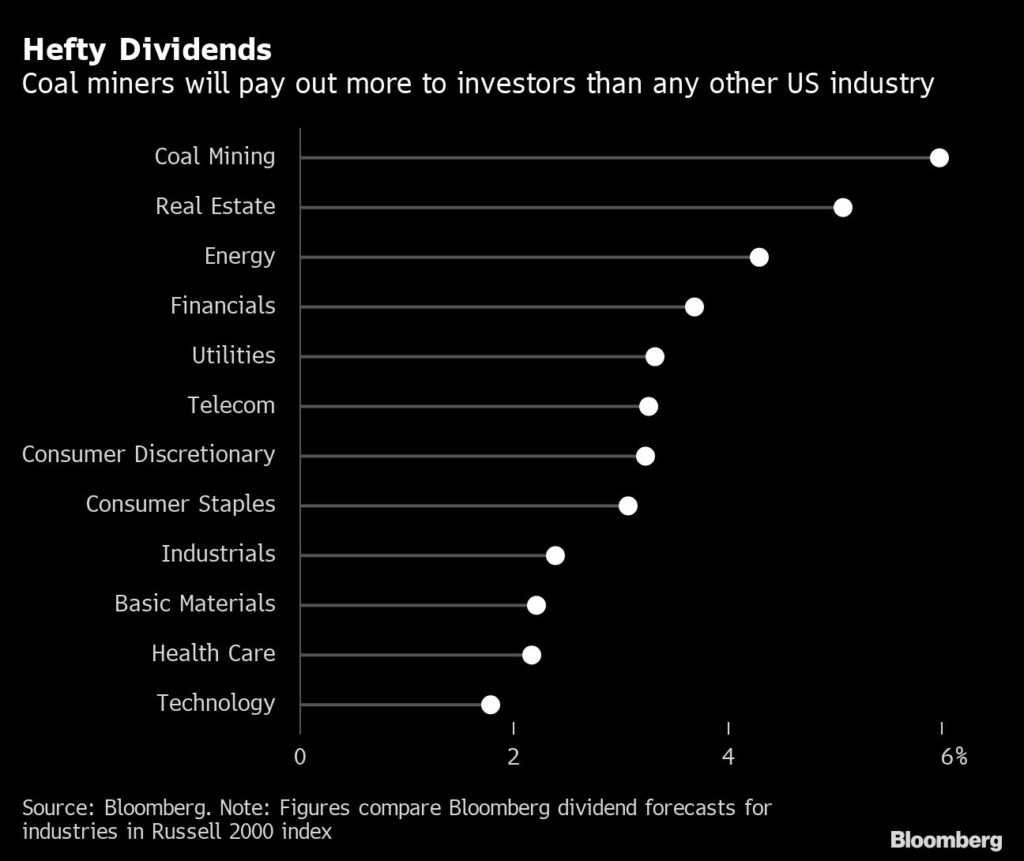
Miners of the fossil fuel are raking in cash and paying out hefty dividends, with shares surging as the global energy crisis boosts coal prices to record highs. US coal producers are projected to offer an average return of about 6% to investors over the next year, more than any other industry. That’s led by Arch Resources Inc., which is about to distribute a substantial $10.75-a-share payout.

It’s a notable turnaround for an industry that experienced waves of bankruptcies in recent years as power producers shift away from the dirtiest fossil fuel. The resurgence comes as Russia’s war in Ukraine roils energy markets, and underscores that the market for coal remains robust even as environmentalists, progressive politicians and many corporations push to abandon the fuel to fight climate change. 

Still, coal’s long-term prospects remain bleak, which is why miners enjoying record profits are returning cash to shareholders instead of spending on new projects.

“The name of the game in coal right now is capital returns,” Lucas Pipes, an analyst with B Riley Securities, said in an interview.

Arch’s payout follows a $6-a-share quarterly dividend announced in July and an $8.11 one declared in April. The dividend yield of the second-biggest US coal miner is expected to reach 25% over the next year, the highest on the Russell 2000 Index. Since the company has explicitly pledged to hand half of its cash flow back to shareholders, investors can expect healthy returns for the next several quarters or more, said Andrew Blumenfeld, director of data analytics at McCloskey by Opis.

Other US miners show similar promise, including Alliance Resource Partners LP’s projected 12-month dividend yield of 9.5% and the projected 4.2% yield of Ramaco Resources Inc. Alpha Metallurgical Resources Inc. just raised its regular dividend and announced a special payout of $5 a share.

Coal miners are in a unique position, Blumenfeld said. The market is healthy, for now, as utilities clamor to secure enough fuel to keep the lights on. But the world is inexorably shifting to cleaner sources of power and demand for coal is expected to gradually decline during the next few decades. There’s little reason to spend money on mines to boost output, but offering beefy payouts will make stocks appealing to investors and drive up share prices.

“They’re saying ‘we believe the best place for this cash is back with our investors’,” Blumenfeld said.

More stories like this are available on bloomberg.com

©2022 Bloomberg L.P.

Close Bitnami banner
Bitnami