Bloomberg

First UK Spaceport Wins License, Boosting Branson Launch Bid

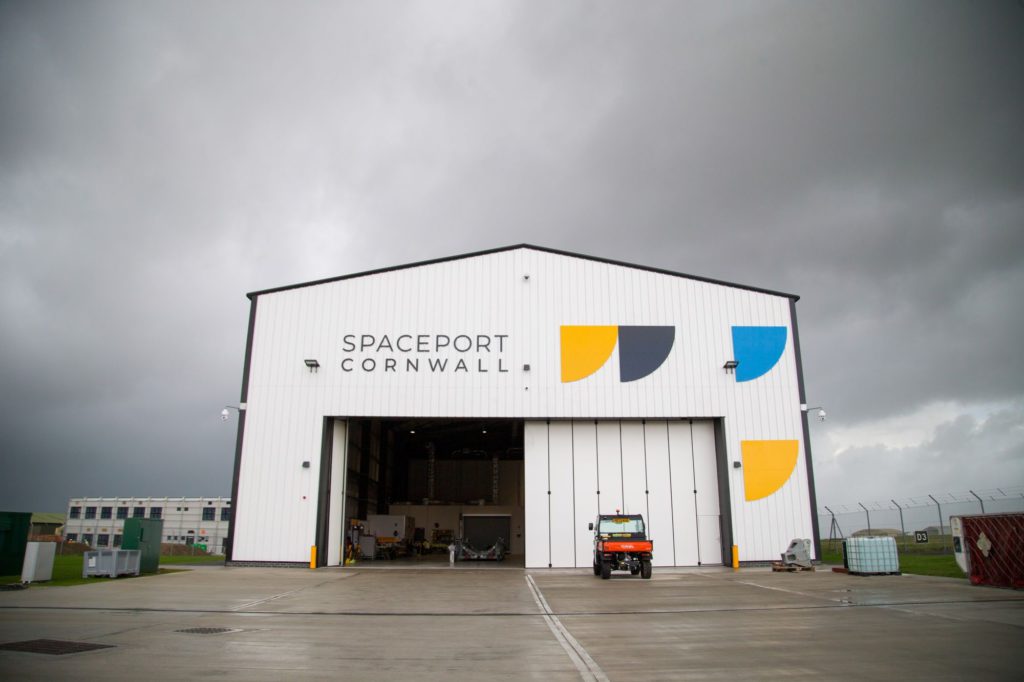
(Bloomberg) — The UK issued its first-ever spaceport license to a launch hub in southwest England, paving the way for a ground-breaking mission by billionaire Richard Branson’s Virgin Orbit Holdings Inc. later this month.

The UK Civil Aviation Authority granted the license to Spaceport Cornwall following official sign-off from Transport Secretary Mark Harper, approving the base’s safety and security together with the infrastructure and equipment needed for horizontal space launches, according to a statement Wednesday.

The CAA said it’s also in the “very advanced stages” of giving the go ahead for the Virgin Orbit mission, as well licensing the companies planning to deploy satellites on what will be the first orbital launch from the UK and western Europe. Virgin’s re-purposed Boeing Co. 747 will take off from Cornwall carrying a rocket under its wing which will then blast away at high altitude.

The CAA, which took over UK space regulation after the country’s split from the European Union, is also progressing applications from other would-be spaceports, including the proposed SaxaVord launch site in Scotland.

Britain is seeking to establish a network of hubs able to undertake a variety of missions, including more traditional vertical launches, amid rapid growth in the planned deployment of communications satellites. The UK space industry is already worth around £16.5 billion, supporting 47,000 jobs.

Read more: Branson Says First UK Space Launch on Course for Next Month

Spaceport Cornwall won approval on the same day that NASA launched its most powerful rocket in 50 years, sending an uncrewed capsule skyward on a 25-day mission to orbit the Moon and return safely to Earth.

The blastoff marked the inaugural flight of both the Space Launch System rocket and Orion crew capsule, kicking off the multi-mission Artemis program to send astronauts back to the lunar surface as early as 2025.

(Updates with details of planned launch in third paragraph, NASA Artemis mission from sixth)

More stories like this are available on bloomberg.com

©2022 Bloomberg L.P.

Tencent to Distribute $20 Billion Meituan Stake as Dividend

(Bloomberg) — Tencent Holdings Ltd. pledged to distribute the majority of its shares in meal delivery giant Meituan to investors, as China’s social media leader ramps up plans to reduce its extensive holdings across the world’s largest internet industry.

Tencent, which had announced plans to pare its stake in online retailer JD.com Inc., will dole out more than 958 million Class B stock in Meituan as a special dividend to existing shareholders. Tencent announced the move as it reported revenue shrank for the second straight quarter, underscoring the extent to which China’s worsening economy is hurting its biggest private corporations.

The decision marks another milestone in Tencent’s evolution from a sprawling internet empire with investments across much of China’s tech sphere to a more focused, cost-conscious gaming and social media operator. Its exit from JD and now much of Meituan comes after Xi Jinping imposed a series of withering curbs on the industry in 2021, including restrictions on play time and content.

Tencent executives had previously denied the company intended to sell its slice of Meituan, China’s leader in food delivery. The stock to be paid out, valued at about HK$155 billion ($19.8 billion), marks about 91% of Tencent’s Class B stake. Apart from JD and Meituan, Tencent also owns part of Kuaishou Technology, Didi Global Inc. and Bilibili Inc. And this year it sold about $3 billion worth of shares in Southeast Asia’s biggest internet company, Sea Ltd.

“Tencent giving away Meituan shares looks like a move to become regulatory compliant,” said Shawn Yang, an analyst with Blue Lotus Capital Advisors who has a buy rating on Tencent. “They won’t be in the same camp anymore but will be normal business partners going forward,” which reduces Tencent’s influence over the online commerce industry. 

Click here for a live blog of the earnings.

Read more: Tencent Hands Out $16 Billion of JD Stock in Crackdown-Led Shift

The move marks another retreat for Tencent, which along with Alibaba Group Holding Ltd. held sway over much of China’s tech sector. 

Beijing has punished the country’s tech giants for anti-competitive behavior, including maintaining closed ecosystems that favor certain companies at the expense of others. The JD and Meituan dividends may buy goodwill with the government, which has pushed for the dismantling of such barriers and for tech firms to share the wealth. 

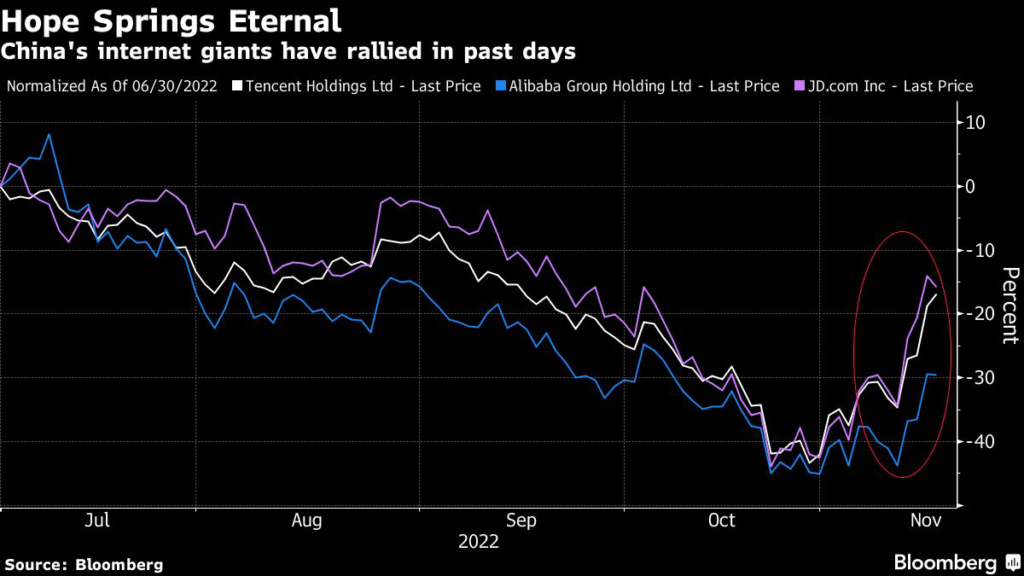
Chinese tech shares recovered some of their losses this month, after the Communist Party began pulling back from its Covid-Zero playbook and offered more incentives to the Biden administration to work together. Xi’s shift on those fronts, coupled with perceptions of a renewed focus on reviving the world’s No. 2 economy, is spurring speculation that Beijing will begin to unshackle the private sector.

On Wednesday, executives reassured investors that Tencent will soon resume winning crucial licenses to release new major titles, reviving growth in domestic gaming. Shares in Prosus NV, Tencent’s largest shareholder, rose more than 4.5% in Europe while Naspers Ltd. was up more than 8%.

“The overall regulatory environment is trending towards a more supportive environment,” President Martin Lau told analysts on a conference call.

China’s internet industry has made peace with a new era of sedate growth, shifting focus to enhancing profitability from chasing market share after Beijing’s crackdown wiped more than $1 trillion off their combined market value in 2021. While regulators have eased up on their campaign against tech, the once-freewheeling sector remains saddled by weak consumer spending and strict Covid restrictions.

Tencent’s revenue fell 2% to 140.1 billion yuan ($19.8 billion) in the September quarter, missing the average projection for 141.4 billion yuan. Net income came in at 39.9 billion yuan, versus the 25.2 billion yuan estimate. 

But Tencent remains vulnerable to macroeconomic headwinds. Tighter marketing budgets worldwide and growing competition from TikTok-owner ByteDance Ltd. are cutting into digital advertising profits. In cloud computing, revenue fell this year as the company works to cut loss-making contracts.

In its core video gaming operations, Tencent has yet to find its next big hit to take up the slack from Honor of Kings, first released in 2015. Domestic gaming sales dropped 7% for the third quarter while the overseas division grew 3%. Only one Tencent game has been approved for domestic launch since Beijing’s censors resumed handing out licenses in April. 

Tencent is co-developing a new mobile game with Capcom Co. for the Japanese studio’s popular Monster Hunter franchise, in a bid by China’s premier game developer to remake itself for the international market.

The company’s appetite for foreign gaming assets is increasing at a time when it is divesting other assets and spending more judiciously at home. In September, the Shenzhen outfit spent roughly $300 million to double its stake in Ubisoft Entertainment SA.

While investors have cheered Tencent’s recent cost-cutting, some are clamoring for faster fixes to its top line than long-term gaming bets. Attention is on growth at its WeChat short video feed, which has yet to fully monetize its content with e-commerce and advertising offerings. Executives said advertising revenue generated by the new feature will surpass 1 billion yuan in the fourth quarter.

–With assistance from Peter Elstrom, Vlad Savov, Jane Zhang, Sarah Zheng, Jennifer Ryan and Ville Heiskanen.

(Updates with comments on gaming approvals in ninth-10th paragraphs, details from results in 14th and last paragraphs)

More stories like this are available on bloomberg.com

©2022 Bloomberg L.P.

Ford Is Building Its First New Auto Plant in 53 Years. Not Everyone Is Happy

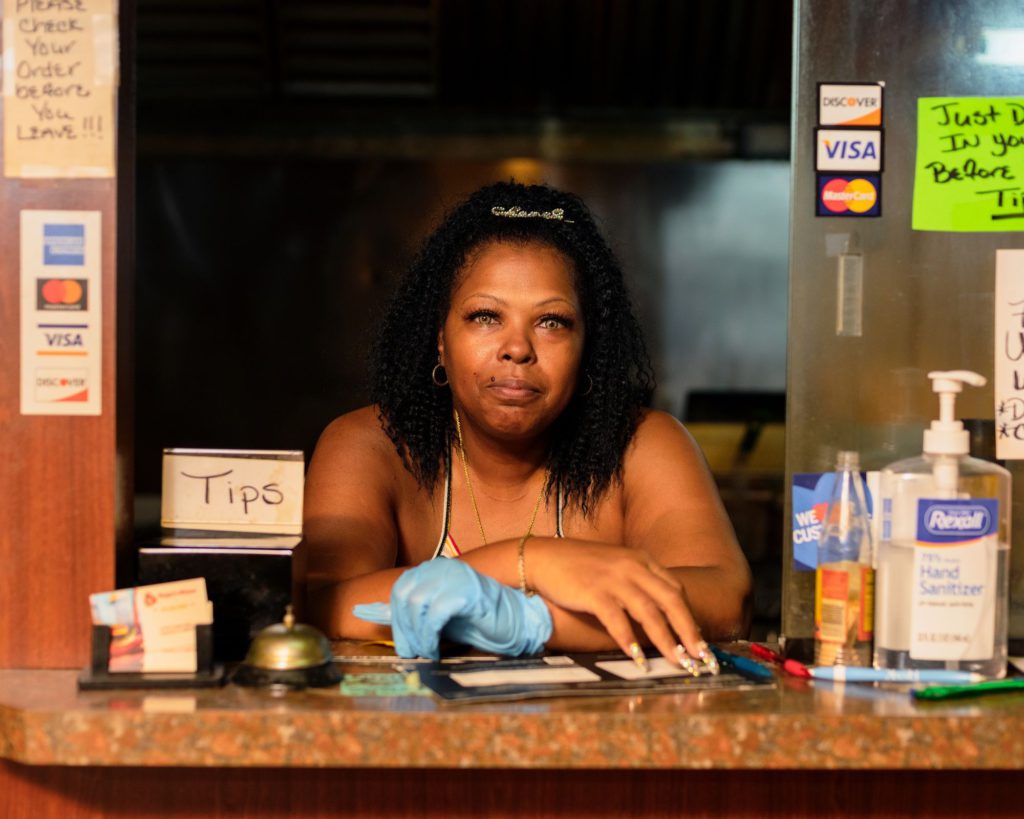
(Bloomberg) — The dinner rush is on at Suga’s Diner in Stanton, Tennessee, the only restaurant in this town of 452 souls. Business is booming thanks to Ford Motor Co.’s massive electric pickup factory being built just down the road. Lesa “Suga” Tard, owner and chief cook, is desperately seeking extra staff now that she’s extended hours, added a day of operation and sent a new food truck to the construction site.

“I don’t know how much more I can do,” she says from behind the counter, scribbling orders for deep-fried catfish with her blue-gloved hands. “People are excited, but other people retired here, looking for the quiet life, the country life, with no crime. They’re worried that all could change.”

Change is certainly coming to Stanton, about 45 miles northeast of Memphis. Ford and South Korea’s SK On broke ground in September on the sprawling, six-square mile manufacturing complex that is due to begin building electric F-Series pickup trucks and the batteries that power them in three years. Known as BlueOval City, the $5.6 billion compound will eventually teem with nearly 6,000 workers and spit out about 350,000 plug-in trucks per year from Ford’s first all-new automotive assembly plant in more than a half century.

BlueOval City is a linchpin in Chief Executive Officer Jim Farley’s $50 billion plan to build 2 million battery-powered automobiles a year by the end of 2026, up from about 63,000 last year. Ford’s push to take on Tesla Inc., which now controls almost three-quarters of the EV market, relies on the factory’s success.

But the project has rattled Michigan officials who fear that Ford’s center of gravity is shifting south. Rural Tennessee offered Ford plentiful land, potentially lower labor costs than the Midwest and $2.4 billion in state government incentives, equal to about $414,000 for each job at BlueOval City, according to a Bloomberg investigation. The company also plans two SK battery plants in Kentucky and a research center in Atlanta.

Southern Shift

Ford executives say they aren’t abandoning their Michigan roots. But BlueOval City has been designed for growth. The vast 3,600-acre site is three times the size of the mighty Rouge factory complex Henry Ford built near Detroit a century ago for the Model A and that today builds gasoline and electric versions of the F-150 pickup. Farley sees EV demand in the U.S. — now accounting for fewer than one-in-10 sales — surging 90% annually through 2026, more than double industry forecasts.

“We wanted to pick a site that could grow with us,” said Lisa Drake, Ford’s vice president of EV industrialization, in an interview “If there’s anything we’ve learned about our EV strategy as we’re retooling all our plants to grow as fast as we can, it’s that we needed to make sure we had the space to grow.”

Ford’s shift South also unnerves union officials. The United Auto Workers has no guarantee it will represent BlueOval City’s employees, who must vote to accept the union. Auto workers in Tennessee, a right-to-work state, have already rejected organizing drives by the UAW at Nissan Motor Co. and Volkswagen AG factories.

“UAW members are rightly concerned that automakers will take advantage of the EV transition to de-unionize,” UAW Vice President Cindy Estrada wrote in an essay last month that she co-authored with Ramon Cruz of the Sierra Club. “More and more automakers and manufacturers have also been funneling investment to the South, where corporations and politicians have staunchly opposed union rights for workers.”

Drake said Ford has not yet talked to the UAW about organizing the new workers since they haven’t been hired yet. But she noted that Ford has a long history with the union and employs more UAW workers than any other automaker in the US.

For now, the 11,000 jobs Ford and SK are creating in Tennessee and Kentucky don’t compare to the 45,000 Ford employees in Michigan, according to the Center For Automotive Research in Ann Arbor.

“If they get a few more wins down in the southeast, then you could say maybe the center of gravity is shifting,” Alan Amici, chief executive officer of CAR, said in an interview. “But ultimately, the cars are still designed in Detroit.”

From Cotton to EVs

At this point, BlueOval City is a big dig, with thousands of construction workers boring deep holes for foundation footings using gargantuan drills that would look at home in a Mad Max movie. More than 6,300 holes that could accommodate a compact car dot the landscape. Rising from the Tennessee soil is the start of a white steel skeleton that will frame the half-mile long battery plant taking shape at one end of a site that a year ago grew cotton. 

“Big trucks, big rollers, lots of things happening here and you just have to keep your head on a swivel,” Donna Langford, Ford’s project manager said as a giant earth mover turned in front of her car while touring the site. 

In the small towns nearby, residents view the future manufacturing colossus with hope and trepidation.

Take Brownsville, a town of 9,788 whose chief claim to fame is being Tina Turner’s childhood home. Signs welcoming Ford fill the storefronts, and a newly painted mural honoring the automaker adorns a building wall. Meanwhile, in the center of Brownsville’s town square stands a soaring monument topped with a Confederate soldier and bearing the inscription: “Honoring the Confederate Dead of Hayward County.”

John Ashworth, a retired airline worker, hopes the Ford plant will provide opportunities for the area’s Black community, and maybe bring Brownsville’s Black and White halves closer together. Working at the town’s corner drug store in his youth, Ashworth was required to eat lunch in the basement, away from White diners. Racial divisions continue to be part of local life, he said.

“This community has largely segmented itself – it’s either White or it’s Black,” said Ashworth, 79, over lunch with a friend in a restored 1950s-style diner, the kind of place he said probably wouldn’t have welcomed him as a young man. “Ford Motor Co. is not only going to cause Black and White to interact more, it’s going to bring other people from other parts of the world, and that is going to be good for everybody.”

Ford hopes to address that history by recruiting workers from communities of color, Drake said. She met last month with Tennessee Gov. Bill Lee to present Ford’s “curriculum” for the skills required for the high-paying jobs at BlueOval City. That’s now being incorporated into lesson plans at Tennessee’s technical colleges and high schools. Drake said Tennessee educators are even counseling eighth graders on what to study to land a job with Ford.

Small Town Reservations

The automaker also has deployed BlueOval City plant manager Kel Kearns into the community to speak to business groups, drum up job applicants and allay fears about the changes coming. The Australia native opened and operated Ford factories in India, Thailand and China, and he’s certain he can mesh Ford’s way of doing business with rural Tennessee.

“I hired people in India, from villages, who had never worked in a factory before or owned a car,” Kearns said. “But the plant ran as a team.”

At Livingston’s Soda Fountain & Grill in Brownsville, the excitement and anxiety over the change that is coming is the talk of the lunch crowd.

“A lot of people don’t like it, but I am 100% for it,” says Ernestine Tinsley, 74, a Stanton retiree who used to work at a Sharp Electronics plant in Memphis. “My grandchildren are already talking about getting a job there.”

But others quietly express reservations.

“Farmers are concerned about what it’s going to do to the land, to the ground, to the environment,” says Marcia Watson, 53, who says Ford’s arrival has already driven up prices of everything from land to groceries and led to more traffic congestion.

“We’re all from small towns,” says her husband Danny, 70. “We don’t like to get too big, too quick.”

More stories like this are available on bloomberg.com

©2022 Bloomberg L.P.

Ford Is Building Its First New Auto Plant in 53 Years. That’s Stirring Mixed Emotions

(Bloomberg) — The dinner rush is on at Suga’s Diner in Stanton, Tennessee, the only restaurant in this town of 452 souls. Business is booming thanks to Ford Motor Co.’s massive electric pickup factory being built just down the road. Lesa “Suga” Tard, owner and chief cook, is desperately seeking extra staff now that she’s extended hours, added a day of operation and sent a new food truck to the construction site.

“I don’t know how much more I can do,” she says from behind the counter, scribbling orders for deep-fried catfish with her blue-gloved hands. “People are excited, but other people retired here, looking for the quiet life, the country life, with no crime. They’re worried that all could change.”

Change is certainly coming to Stanton, about 45 miles northeast of Memphis. Ford and South Korea’s SK On broke ground in September on the sprawling, six-square mile manufacturing complex that is due to begin building electric F-Series pickup trucks and the batteries that power them in three years. Known as BlueOval City, the $5.6 billion compound will eventually teem with nearly 6,000 workers and spit out about 350,000 plug-in trucks per year from Ford’s first all-new automotive assembly plant in more than a half century.

BlueOval City is a linchpin in Chief Executive Officer Jim Farley’s $50 billion plan to build 2 million battery-powered automobiles a year by the end of 2026, up from about 63,000 last year. Ford’s push to take on Tesla Inc., which now controls almost three-quarters of the EV market, relies on the factory’s success.

But the project has rattled Michigan officials who fear that Ford’s center of gravity is shifting south. Rural Tennessee offered Ford plentiful land, potentially lower labor costs than the Midwest and $2.4 billion in state government incentives, equal to about $414,000 for each job at BlueOval City, according to a Bloomberg investigation. The company also plans two SK battery plants in Kentucky and a research center in Atlanta.

Southern Shift

Ford executives say they aren’t abandoning their Michigan roots. But BlueOval City has been designed for growth. The vast 3,600-acre site is three times the size of the mighty Rouge factory complex Henry Ford built near Detroit a century ago for the Model A and that today builds gasoline and electric versions of the F-150 pickup. Farley sees EV demand in the U.S. — now accounting for fewer than one-in-10 sales — surging 90% annually through 2026, more than double industry forecasts.

“We wanted to pick a site that could grow with us,” said Lisa Drake, Ford’s vice president of EV industrialization, in an interview “If there’s anything we’ve learned about our EV strategy as we’re retooling all our plants to grow as fast as we can, it’s that we needed to make sure we had the space to grow.”

Ford’s shift South also unnerves union officials. The United Auto Workers has no guarantee it will represent BlueOval City’s employees, who must vote to accept the union. Auto workers in Tennessee, a right-to-work state, have already rejected organizing drives by the UAW at Nissan Motor Co. and Volkswagen AG factories.

“UAW members are rightly concerned that automakers will take advantage of the EV transition to de-unionize,” UAW Vice President Cindy Estrada wrote in an essay last month that she co-authored with Ramon Cruz of the Sierra Club. “More and more automakers and manufacturers have also been funneling investment to the South, where corporations and politicians have staunchly opposed union rights for workers.”

Drake said Ford has not yet talked to the UAW about organizing the new workers since they haven’t been hired yet. But she noted that Ford has a long history with the union and employs more UAW workers than any other automaker in the US.

For now, the 11,000 jobs Ford and SK are creating in Tennessee and Kentucky don’t compare to the 45,000 Ford employees in Michigan, according to the Center For Automotive Research in Ann Arbor.

“If they get a few more wins down in the southeast, then you could say maybe the center of gravity is shifting,” Alan Amici, chief executive officer of CAR, said in an interview. “But ultimately, the cars are still designed in Detroit.”

From Cotton to EVs

At this point, BlueOval City is a big dig, with thousands of construction workers boring deep holes for foundation footings using gargantuan drills that would look at home in a Mad Max movie. More than 6,300 holes that could accommodate a compact car dot the landscape. Rising from the Tennessee soil is the start of a white steel skeleton that will frame the half-mile long battery plant taking shape at one end of a site that a year ago grew cotton. 

“Big trucks, big rollers, lots of things happening here and you just have to keep your head on a swivel,” Donna Langford, Ford’s project manager said as a giant earth mover turned in front of her car while touring the site. 

In the small towns nearby, residents view the future manufacturing colossus with hope and trepidation.

Take Brownsville, a town of 9,788 whose chief claim to fame is being Tina Turner’s childhood home. Signs welcoming Ford fill the storefronts, and a newly painted mural honoring the automaker adorns a building wall. Meanwhile, in the center of Brownsville’s town square stands a soaring monument topped with a Confederate soldier and bearing the inscription: “Honoring the Confederate Dead of Hayward County.”

John Ashworth, a retired airline worker, hopes the Ford plant will provide opportunities for the area’s Black community, and maybe bring Brownsville’s Black and White halves closer together. Working at the town’s corner drug store in his youth, Ashworth was required to eat lunch in the basement, away from White diners. Racial divisions continue to be part of local life, he said.

“This community has largely segmented itself – it’s either White or it’s Black,” said Ashworth, 79, over lunch with a friend in a restored 1950s-style diner, the kind of place he said probably wouldn’t have welcomed him as a young man. “Ford Motor Co. is not only going to cause Black and White to interact more, it’s going to bring other people from other parts of the world, and that is going to be good for everybody.”

Ford hopes to address that history by recruiting workers from communities of color, Drake said. She met last month with Tennessee Gov. Bill Lee to present Ford’s “curriculum” for the skills required for the high-paying jobs at BlueOval City. That’s now being incorporated into lesson plans at Tennessee’s technical colleges and high schools. Drake said Tennessee educators are even counseling eighth graders on what to study to land a job with Ford.

Small Town Reservations

The automaker also has deployed BlueOval City plant manager Kel Kearns into the community to speak to business groups, drum up job applicants and allay fears about the changes coming. The Australia native opened and operated Ford factories in India, Thailand and China, and he’s certain he can mesh Ford’s way of doing business with rural Tennessee.

“I hired people in India, from villages, who had never worked in a factory before or owned a car,” Kearns said. “But the plant ran as a team.”

At Livingston’s Soda Fountain & Grill in Brownsville, the excitement and anxiety over the change that is coming is the talk of the lunch crowd.

“A lot of people don’t like it, but I am 100% for it,” says Ernestine Tinsley, 74, a Stanton retiree who used to work at a Sharp Electronics plant in Memphis. “My grandchildren are already talking about getting a job there.”

But others quietly express reservations.

“Farmers are concerned about what it’s going to do to the land, to the ground, to the environment,” says Marcia Watson, 53, who says Ford’s arrival has already driven up prices of everything from land to groceries and led to more traffic congestion.

“We’re all from small towns,” says her husband Danny, 70. “We don’t like to get too big, too quick.”

More stories like this are available on bloomberg.com

©2022 Bloomberg L.P.
Lamborghini Gets Hollywood Treatment on the Heels of Porsche’s IPO

(Bloomberg) —

Lamborghini is getting the Hollywood treatment.

The Lionsgate biopic Lamborghini: The Man Behind The Legend opens in theaters Friday, offering audiences a big-screen account of how tractor magnate Ferruccio Lamborghini challenged Enzo Ferrari for the supercar crown in postwar Italy.

Stirring up House of Gucci-like publicity or replicating the sales boost that The Lego Movie generated for the Danish toy company seems a long shot. After all, the 2019 drama Ford v Ferrari, which featured more star power and bagged two Academy Awards, did little for its title role brands beyond stoking nostalgia.

Still, this film comes at an opportune moment. Lamborghini is probably the likeliest candidate within the Volkswagen group stable to be offered up to the market the way Porsche was in September. The German manufacturer’s wager that investors would assign a big valuation to an asset that wasn’t getting its due under the thumb of its parent has panned out: Porsche quickly surpassed VW’s market capitalization and now ranks behind only Tesla and Toyota.

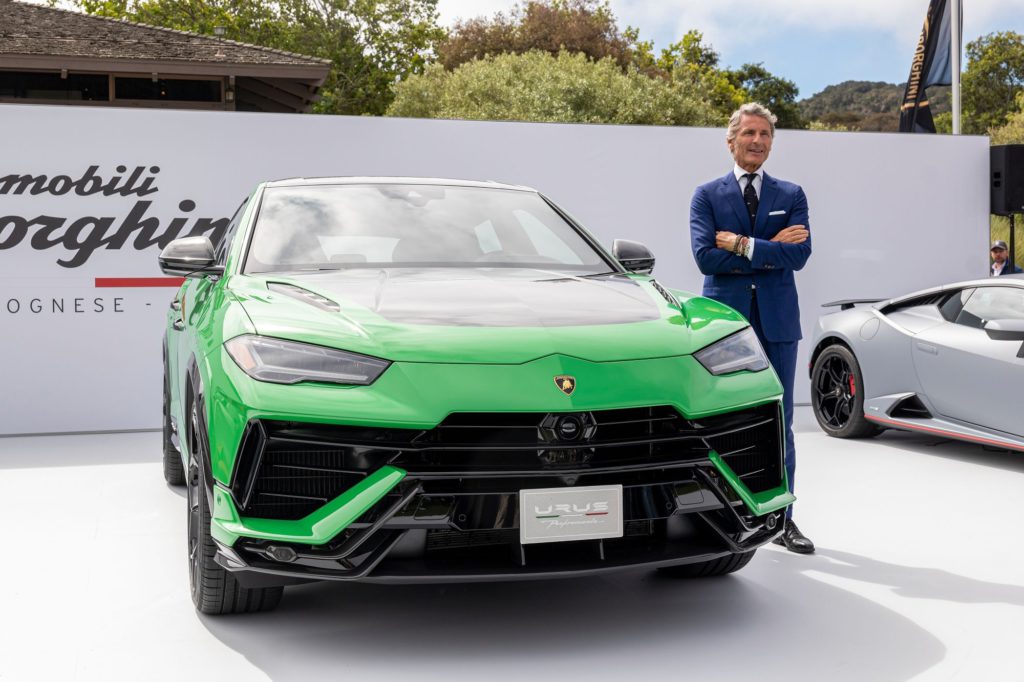
Recent executive comments indicate preparations are well underway. Lamborghini has been developing a strategy for presenting itself to investors since well before VW asked each of its brands to come up with virtual equity stories, CEO Stephan Winkelmann said last week.

“We’ve been working on this with other agencies in order to create clarity,” Winkelmann told reporters. “As a brand, we’ve done so for a long time, to show what worth, what value we have.”

Automakers across Europe are trying to find ways to unlock more value by reworking their corporate structures. In France, Renault is splitting up into five different units as CEO Luca de Meo tries to raise money for electric vehicle development. Germany’s Daimler ended more than a century of making cars and big rigs under one roof, splitting up last year into separately listed Mercedes-Benz and Daimler Truck. Stellantis just hinted it may jump on the bandwagon, with CFO Richard Palmer suggesting this month that Maserati eventually may be able to stand on its own.

The €9.4 billion Porsche IPO — Europe’s largest in more than a decade — raised a tidy sum VW will put to use trying to unseat Tesla as the EV leader. VW CEO Oliver Blume has said he sees the listing as a blueprint for the broader group, which also includes Audi, Bentley and motorcycle brand Ducati.

Still, it’s difficult to judge how close another listing might be. Audi, which oversees VW’s premium brands, said last month there are no concrete plans for a Lamborghini IPO. A previous push to potentially spin off the supercar and motorcycle units ran into opposition from labor leaders.

VW’s own shares also haven’t fared well since the Porsche listing, bearing more of the brunt of investor concerns about how demand will trend if the ill effects of the war in Ukraine push Europe further into recession.

While high-end car sales have proven relatively resilient so far, Lamborghini knows how painful energy catastrophes can be. The company’s sales cratered as a result of the 1973 oil crisis, sparking several ownership changes and a bankruptcy five years later.

Lamborghini can rest assured by orders booked for its Aventador, Huracan and Urus models all the way out to early 2024, covering about 18 months of production. The manufacturer delivered a record 5,090 vehicles in the first half, putting up a 31.9% operating margin.

“An IPO is something that could potentially happen in the next 18 months, depending on market conditions,” Mike Dean, a Bloomberg Intelligence analyst, said last week. “A €15 billion valuation is entirely justifiable and could be even higher, given the margin metrics.”

More stories like this are available on bloomberg.com

©2022 Bloomberg L.P.
Airbnb Rolls Out New Features to Encourage More Owners to List Properties 

(Bloomberg) — Airbnb Inc. is rolling out new guest verification tools and offering extra support to beginner hosts in an effort to encourage more owners to list their properties on the home-rental platform.

The San Francisco-based company expects more people to become hosts to bring in a second source of income as the economy slows. To help them feel safer with the prospect of renting their homes to strangers, Airbnb is expanding its identity verification process to the 35 most popular countries. The company says that will help build trust between its 4 million hosts and their guests, who will need to identify themselves with a government ID and other information, along with a selfie. Airbnb will corroborate the information through a third-party database. 

“If we want to bring more people together and do more activity on Airbnb, we have to increase trust,” Chief Executive Officer Brian Chesky said in an interview. “We needed to take a leap forward in trust if we wanted to make a leap forward in growth.”

Airbnb and other online travel companies reported record revenue in the third quarter amid pent-up demand for vacations despite high inflation and rising average daily rates for accommodations. But Airbnb said it expects the pace of bookings will moderate in the last three months of the year. 

“The softer the economy, the more people want to put their homes on Airbnb,” Chesky said during a press event, adding that guests will be looking for better deals. 

Read about Chesky’s views on the future travel and demand for Airbnb

Airbnb will help link new property owners with a more experienced “superhost” in their area to provide them with assistance in creating their listing. Superhosts who participate will get a cash reward for recruiting new hosts, who get their their first booking. 

The company is also deploying a new anti-party screening tool, which uses machine learning to predict listings that may be a location for unauthorized gatherings. Red flags such as a young person with a new account making a last minute reservation for a large house near their home address could lead to a listing getting blocked, Chesky said. The program will first roll out in the US and Canada and expand worldwide next year. 

Airbnb formally codified a party ban this summer, which was instituted during the early days of the pandemic as a health measure, and suspended more than 6,000 guests for breaking the rule last year. 

More stories like this are available on bloomberg.com

©2022 Bloomberg L.P.
US Advises Academic Researchers on Stopping Chinese Spying

(Bloomberg) — The US intelligence community has begun an effort aimed at stopping spies and hackers from China and elsewhere from accessing American academic research on emerging technologies.

The new counterintelligence guidance, developed in consultation with scientific researchers and federal agencies, focuses on best practices for academic institutions working on artificial intelligence, biotech, autonomous systems, quantum and semiconductors. It carries no regulatory heft. 

“Every foreign national requires some level of due diligence,” said Michael Orlando, acting director of the National Counterintelligence and Security Center at the Office of the Director of National Intelligence. He added that US intelligence officials are trying to appeal to the scientific community to protect its “crown jewels.” 

He advised all US research institutions working in these areas to set up their own threat evaluation process based on the free guidelines, which were developed over the past year, and use it to vet any foreign national applying to join a research lab.

The free online toolkit, named “Safeguarding Science,” provides advice on topics such as stopping insider threats, safeguarding supply chains, detecting phishing attempts and following protocols for overseas travel.

China relies on spies, academic collaboration, recruiting insiders and front companies in order to access cutting-edge research, according to the NCSC. Liu Pengyu, spokesperson at the Chinese Embassy in Washington, said the US government and has frequently “hyped” the notion of Chinese espionage. China hopes the US will work to promote rather than disrupt scientific exchange and cooperation between the two countries, he said.

Gregory Strouse, a physicist at National Institute of Standards and Technology who helped develop the guidance, said NIST intended to keep working with scientists from 100 countries and that the aim of the effort wasn’t to undermine the pursuit of open and collaborative scientific endeavor.

The NCSC’s guidance comes after Charles Lieber, a former Harvard University chemical biology professor, was convicted in December in connection with hiding ties to a Chinese-run recruitment program. 

The NCSC outreach is designed to help researchers prevent such cases from developing into criminal matters, Orlando said.

Rebecca Morgan, director of the National Insider Threat Task Force at the NCSC who helped develop the toolkit, said no ethnicity or background was mentioned or targeted but rather that “behaviors of concern” were key to identifying potential insider threats. 

US officials have for years claimed that China is stealing critical research including from the defense industry as well as personal data of American citizens, claims that Beijing has consistently denied. 

In February, the Justice Department announced that it was ending a program started under the Trump administration to investigate and prosecute Chinese and Chinese-American researchers it said were stealing US secrets while hiding their links to Beijing. The “China Initiative” came under intense criticism for fanning discrimination against Asian-Americans even as several of its high-profile criminal cases failed in court.

US President Joseph Biden on Monday told Chinese President Xi Jinping that he wanted the two countries to prevent competition from reaching “anything ever near conflict.” 

Beijing has said it wants to become the world leader in several of emerging technology fields, including artificial intelligence, by 2030 and that it’s pursuing a $10 billion investment in quantum science, according to industry researchers.

(Updates to include a comment from the Chinese Embassy in Washington. A previous update included other foreign threats in first paragraph.)

More stories like this are available on bloomberg.com

©2022 Bloomberg L.P.
Spar Plunges as South African Grocer Fails to Capitalize on Neighbourhood Locations

(Bloomberg) — Spar Group Ltd. shares fell the most since its 2004 listing after the South African food and liquor retailer lost market share in its domestic market and cut dividend.

In South Africa, where Spar gets the bulk of its sales, full-year operating profit rose 1.1%, according to a statement Wednesday. Shoprite Holdings Ltd., the country’s largest grocer, reported a 12% gain when it reported earnings in September.

“The South African earnings were very, very weak and the company doesn’t want to increase debt levels any further,” said Alec Abraham, an analyst at Sasfin Securities, after the Durban-based company more than halved its full-year dividend. “It doesn’t make for a decent shareholder return.”

Spar’s neighborhood stores were once seen as a winning formula as shoppers increasingly wanted convenience when buying groceries. But as competitors started to bulk up their on-demand online-shopping options, Spar’s advantage shriveled. That’s been exacerbated by challenges such as falling consumer spending and a high rate of unemployment.

The stock sank 14% to 141.81 rand as of 12:42 pm in Johannesburg. Pick n Pay Stores Ltd., which posted the next biggest decline on the FTSE/JSE Personal Care, Drug and Grocery Stores Index, fell 1.8%. 

The company’s own online option, SPAR2U, opened in 87 stores during the second half of the financial year. Shoprite’s one-hour delivery app is offered from more than 300 stores, while Woolworths Holdings Ltd. and Pick n Pay Stores Ltd. have both reported rapid online sales growth.

With debt-to-equity at about 100%, Spar was “prudent” in not raising its debt further just to pay a larger dividend, Abraham said. Still, “obviously shareholders weren’t appreciative of it.”

More stories like this are available on bloomberg.com

©2022 Bloomberg L.P.

Finnair to Shed a Quarter of Cabin Crew Jobs in Race for Savings

(Bloomberg) — Finnair Oyj revealed plans to eliminate about a quarter of its cabin-crew posts in Finland after the closure of Russian airspace upended a business model based on flights to Asia, forcing the firm into steep cost cuts.

Finland’s state-controlled carrier is looking to scrap as many as 450 of its 1,750 flight-attendant post there and extend the outsourcing of cabin services if no deal on revised contracts is reached, according to a statement Wednesday.

“We now need a genuine will from the negotiators to find solutions that would allow us to continue in-flight service with our own crew, and avoid redundancies,” Chief Executive Officer Topi Manner said.

Finnair said in September it would drop its focus on East Asia due to ongoing coronavirus curbs and airspace closures following the Ukraine invasion, which rendered many services impractical and unprofitable. The strategy calls for a slimmed down jetliner fleet and a lower cost base.

As part of the plan to slash expenses, Finnair has consulted with all of its staff on revised employment terms. Yet while agreements were reached with some groups there has been no accord with Finnish cabin crew, according to the company, whose shares traded 4.2% lower as of 1:29 p.m. in Helsinki.

Proposals put forward concerning flight attendants, who comprised 40% of the airline’s 5,000 staff at the end of 2021, include crew utilization, hotel layovers and pay-per-hour rules for longer flights.

In the absence of a deal, Finnair said it may need to subcontract cabin services on flights from Helsinki to Thailand and the US, having already done so to Singapore, Hong Kong and India, and from Stockholm and Copenhagen to Doha.

Finnair is “openly blackmailing its workers to cut their wages with the threat to outsource cabin services and by threatening to fire hundreds of people,” Ismo Kokko, head of the AKT transport union, said in a statement.

The union has proposed other savings measures, such as flexible working arrangements, but these have been rejected by the airline, he said.

Finnair said talks on matters including outsourcing will begin on Nov. 23 and last at least six weeks.

The carrier said previously it would cut up to 200 executive, management and expert roles, including 120 in Finland, amid the network revamp.

–With assistance from Kati Pohjanpalo.

More stories like this are available on bloomberg.com

©2022 Bloomberg L.P.

FTX Latest: Temasek Takes Hit as Novogratz Warns Worst Is Ahead

(Bloomberg) — Singapore’s state-owned investor, Temasek International, invested $200 million to $300 million in cryptocurrency giant FTX before its implosion and is preparing to write down the entire bet, people familiar with the matter said.

Michael Novogratz, the billionaire founder of Galaxy Digital Holdings, said the crypto crisis could get worse, as the industry braced for more contagion from the fall of Sam Bankman-Fried’s FTX empire. 

Bankman-Fried took to Twitter on Wednesday, telling his followers that “there was too much leverage — more than I realized” in his business. That came a few hours after he posted that FTX US had enough money to repay customers. 

The fallout from the crisis is threatening the future of crypto lenders like BlockFi Inc. and Voyager Digital Ltd. Digital-asset markets were steady in a break from recent turmoil, with Bitcoin hovering around $16,700. 


Key stories and developments:

  • Singapore’s Temasek to Write Down Over $200 Million in FTX
  • FTX Leaves an Empty Black Box Where Due Diligence Used to Be
  • Matter Labs Raised $200 Million Just Before Crypto Market Chaos
  • FTX’s Crypto Kids Came Dangerously Close to Upending Futures

(Time references are New York unless otherwise stated.)

Temasek Takes a Hit (6:45 a.m.)

Temasek invested between $200 million and $300 million in FTX before its implosion, according to people familiar with the matter.

Temasek is now preparing to write off the entire amount, one of the people said, asking not to be identified as the matter is private. Another backer, Sequoia Capital, wrote down the full value of its $214 million bet on the exchange, while a person with knowledge of the situation said SoftBank Group Corp. is expecting a loss of around $100 million on its investment. 

FTX Hacker’s Haul (6:05 p.m. HK)

The hacker who raided Sam Bankman-Fried’s collapsed crypto exchange FTX is now one of the world’s biggest holders of the token Ether.

A wallet linked with the exploit swapped about $49 million of stablecoins — mainly Dai — for Ether on Tuesday, security specialists PeckShield said. 

Wallets on FTX were drained of over $663 million in tokens, with $477 million of that suspected to have been stolen and the remainder moved into secure storage by FTX, according to blockchain specialist Elliptic.

Novogratz Warns Worst May Lie Ahead  (6 p.m. HK)

Mike Novogratz said the worst of the crypto crisis in the wake of the FTX exchange’s collapse may yet unfold. Galaxy, the crypto financial services firm founded by Novogratz, last week disclosed $76.8 million in exposure to FTX.com

Novogratz was speaking at a conference on Wednesday alongside Binance Holdings Ltd.’s Chief Executive Officer Changpeng ‘CZ’ Zhao. The Binance CEO said he saw a lot of investor interest in a crypto industry recovery fund he plans to set up to assist otherwise strong projects that are facing a liquidity squeeze. 

Crypto Exchange AAX Needs Capital (5:55 p.m. HK) 

Resuming operations on the cryptocurrency exchange AAX depends on whether it can raise funds, the company said. Hong Kong-based AAX suspended withdrawals on Monday citing a glitch in a system upgrade.

“If AAX is unable to secure funding to enable us to restart operations, AAX is committed to initiating legal procedures to secure and ensure the distribution of asset,” the company said. 

Most Bitcoin Retail Buyers Lost (2:20 p.m. HK)

A study of how retail investors use cryptocurrency exchange apps suggests about three-quarters have lost money on Bitcoin, according to the Bank for International Settlements.

Data spanning 95 countries from 2015 to 2022 indicates the vast majority of app downloads occurred when Bitcoin’s price was above $20,000, the working paper from the Basel, Switzerland-based BIS says.

The world’s largest token has plunged over 70% from a record hit about a year ago, pressured by rapidly tightening monetary policy and a series of huge blowups at crypto outfits, most recently FTX.

FTX Digital Markets Files for Chapter 15 (noon HK)

Bahamas-based FTX Digital Markets Ltd. has submitted a Chapter 15 petition for recognition of a foreign proceeding in the Southern District of New York, according to a filing on the court’s website.

It’s a subsidiary of FTX Trading Ltd., which filed for Chapter 11 bankruptcy on Nov. 11.

–With assistance from Amanda Fung, Sidhartha Shukla and Suvashree Ghosh.

More stories like this are available on bloomberg.com

©2022 Bloomberg L.P.
Close Bitnami banner
Bitnami

