

Bloomberg

Apple Prepares to Get Made-in-US Chips in Pivot From Asia

(Bloomberg) — Apple Inc. is preparing to begin sourcing chips for its devices from a plant under construction in Arizona, marking a major step toward reducing the company’s reliance on Asian production.

Chief Executive Officer Tim Cook made the disclosure during an internal meeting in Germany with local engineering and retail employees as part of a recent tour of Europe, according to remarks reviewed by Bloomberg News. He added that Apple may also expand its supply of chips from plants in Europe.

“We’ve already made a decision to be buying out of a plant in Arizona, and this plant in Arizona starts up in ’24, so we’ve got about two years ahead of us on that one, maybe a little less,” Cook told the employees. “And in Europe, I’m sure that we will also source from Europe as those plans become more apparent,” he said at the meeting, which included Apple services chief Eddy Cue and Deirdre O’Brien, its head of retail and human resources.

Cook is likely referring to an Arizona factory that will be run by Taiwan Semiconductor Manufacturing Co., Apple’s exclusive chip-manufacturing partner. That plant is slated for a 2024 opening. And TSMC is already eyeing a second US facility, part of a broader push to increase chip production in the country.

Shares of TSMC climbed as much as 2.9% in Taiwan trading Wednesday after Bloomberg News reported on Cook’s remarks. Apple was little changed. 

TSMC’s stock surged 7.9% on Tuesday after Warren Buffett’s Berkshire Hathaway Inc. disclosed it had taken a stake in the company. 

Representatives for Apple and TSMC declined to comment.

Intel Corp. is also building plants in Arizona that will open as early as 2024. The chipmaker was a major Apple supplier for years, but it’s unlikely to recapture that business. Apple has swapped out Intel processors in Macs and other products in favor of its own components, and the chipmaker has an unproven track record of manufacturing other companies’ designs.

The US government is dangling roughly $50 billion in incentives — part of legislation known as the Chips and Science Act — to encourage semiconductor manufacturing to expand stateside. The iPhone maker currently sources its device processors from TSMC plants located in Taiwan, an area with an outsized share of production. During the meeting, Cook said that 60% of the world’s processor supply comes out of Taiwan.

“Regardless of what you may feel and think, 60% coming out of anywhere is probably not a strategic position,” he said.

Processors are at the heart of nearly every Apple product, whether it’s the high-end Mac Pro desktop computer, the iPhone or even AirPods. The chips are designed by Apple and then manufactured by TSMC. Bringing even a portion of that production back to the US — after years of relying on Asia — would be a significant step. 

A lingering question is whether the factory as planned is suited to Apple’s needs. The Taiwanese company has said that the plant will initially have a capacity of 20,000 chips per month and use a 5-nanometer production process. That wouldn’t satisfy Apple’s near-future desire for more advanced, 3-nanometer chips.

TSMC could theoretically introduce advanced production more quickly than it has so far announced. Apple also could potentially use the Arizona production for less complex components in its devices.

While most of the final assembly for Apple products is handled in China and surrounding countries in Asia, Apple does have a set of suppliers that manufacture components domestically. The Cupertino, California-based company has touted that Mac Pro models sold in the US are assembled in Texas.

Like the US, Europe has been offering incentives to spur more chip manufacturing. In his remarks, Cook didn’t specify where in Europe the company might get additional chips from, but Bloomberg News has reported that TSMC is in discussions with the German government about establishing a plant in that country.

Apple is growing significantly in Germany. The company has several hundred local engineers working on an effort to replace Qualcomm Inc. components in iPhones with a homegrown cellular modem.

More broadly, the Chips and Science Act and the complementary effort in Europe are poised to reshape the chip industry, Cook said during the meeting in Germany.

“I think you will wind up seeing a significant investment in capability and capacity in both the United States and Europe to try to reorient the market share of where silicon is produced.”

–With assistance from Debby Wu and Ian King.

(Updates with TSMC shares in fifth paragraph.)

More stories like this are available on bloomberg.com

©2022 Bloomberg L.P.
Singapore’s Sea Posts $9 Billion Surge After Cost Cutting Push

(Bloomberg) — Sea Ltd. shares jumped 36% in its biggest-ever single-day jump after the gaming and e-commerce company posted a smaller-than-expected quarterly loss, helped by drastic cost cuts. 

Sea has cut about 7,000 jobs, or roughly 10% of its workforce, in the past six months, according to a person familiar with the matter. It has also closed down operations in India and some European and Latin American markets to trim costs. Headcount reduction is an “ongoing exercise,” Chief Corporate Officer Yanjun Wang said on a conference call, signaling more cuts may be in the works.

While growth is decelerating, the pathway to profitability for Sea’s e-commerce arm Shopee is “becoming clear,” said Morgan Stanley analyst Mark Goodridge in a note to investors. The company has said that it will “work toward” breaking even for Shopee on an adjusted Ebitda basis by the end of next year.

Sea’s adjusted loss before interest, taxes, depreciation and amortization widened to $357.7 million from $165.5 million a year ago, the company said on Tuesday. Analysts had estimated $457.4 million on average. The net loss stood at about $569 million, little changed from a year earlier. Sales at Shopee climbed 32% to $1.9 billion.

The results prompted CGS-CIMB analyst Khang Chuen Ong to raise his recommendation on the company to “Add” from “Hold.”

Sea’s market valuation climbed to $35 billion after the report, adding $9 billion in a single day. That’s still far below its peak valuation of more than $200 billion last year.

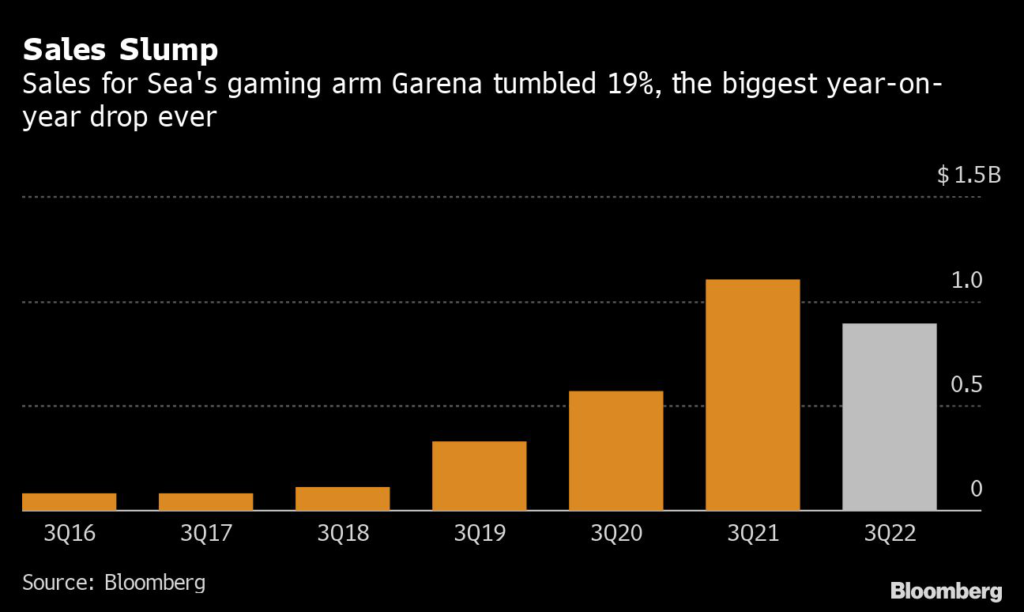
Southeast Asia’s largest tech company continues to adjust to a fallout in demand for its core games operations. Revenue at its digital-entertainment arm Garena tumbled 19% in the biggest year-on-year drop ever, as hit mobile game Free Fire’s momentum wanes.

Sea cut its full-year forecast for Garena’s bookings to between $2.6 billion and $2.8 billion from its previous guidance of $2.9 billion to $3.1 billion, set to be its first annual decline ever. It said it isn’t providing financial guidance for 2023. 

The decision of management to not provide future guidance will “no doubt” add more uncertainty on future forecast, said Citi analyst Alicia Yap in a note to investors.

–With assistance from Joel Leon.

More stories like this are available on bloomberg.com

©2022 Bloomberg L.P.
Elon Musk’s Tumultuous Twitter Takeover: Timeline

(Bloomberg) — It’s been a rough start for Twitter Inc. under Elon Musk.

Since the tech billionaire took ownership of Twitter almost three weeks ago, he’s axed half of the company’s more than 7,000 employees, fired most of its executive leadership and demanded that those who remain return to the office immediately — ending remote work, monthly “days of rest” and free food. He’s also told staffers to brace themselves for long hours, that “the road ahead is arduous and will require intense work to succeed,” and said bankruptcy was possible if the company doesn’t stop bleeding cash soon. 

With $1.2 billion of annual interest payments from the acquisition coming due, and possibly going higher with rising interest rates, Musk is in a rush to shore up cash. But with brands pulling back on spending as fears of recession loom, he’s also in a race to find new sources of revenue. With teams working around the clock to add blue “verification” check marks to the subscription product, impersonator accounts are proliferating, resulting in an exodus of brands that is causing the company to lose $4 million a day, according to Musk.

Here’s how the saga is unfolding:

Oct. 27: Musk takes control

After being forced to complete the deal to buy Twitter for $44 billion, Musk announces he has taken possession of the social network. His first act is to fire the board along with Chief Executive Officer Parag Agrawal, Chief Financial Officer Ned Segal, head of legal and policy Vijaya Gadde and General Counsel Sean Edgett, among others in executive leadership. 

After changing his Twitter bio to call himself “Chief Twit,” Musk forms a small advisory team that includes celebrity attorney Alex Spiro, venture capitalist and engineer David Sacks, Neuralink Corp. CEO and head of Musk’s family office Jared Birchall, tech investor Jason Calacanis, and general partner of Andreessen Horowitz Sriram Krishnan. 

Oct. 28: Brands begin to take pause

As Musk plans to unban accounts and says he will charge for user verification, advertisers start to get nervous. General Motors Co. suspends ads, and others review their Twitter budgets.

Oct. 31: Top tweeters protest

Amid murmurings of plans to charge existing verified accounts, bestselling author Stephen King tweets, “$20 a month to keep my blue check? F— that, they should pay me. If that gets instituted, I’m gone like Enron.” Musk replies, “We need to pay the bills somehow! Twitter cannot rely entirely on advertisers. How about $8?” Musk double downs on promoting the product. A possible release date of Nov. 7 is debated.

Nov. 1: Teams working around the clock

The product team works over the weekend on Musk’s idea to charge users for blue check marks. A photo of product director Esther Crawford sleeping on the floor of a conference room, trying to make the deadline, goes viral. Meanwhile, managers are asked to make lists of who can be fired. Employees print out their software code for review by Musk and engineers from Tesla Inc., to determine if their contributions are worthy of keeping a job.


Nov. 3: Massive layoffs begin 

A memo is sent to all employees telling them of imminent layoffs and to watch for an email with the subject line: “Your Role at Twitter.” Badge access to offices is suspended as about  3,700 staffers receive word that they’ve been cut. Sources report chaos in the aftermath with “survivors” not knowing who will be their boss or which projects to work on, and project leads not knowing who is left on their team. Realizing employees essential for the continuity of the business have been let go by mistake, some are asked to come back.

Co-founder Ev Williams tweets, “Heart’s out to the tweeps getting laid off today.” Days later, co-founder and former CEO Jack Dorsey, who was a proponent of Musk’s acquisition, adds, “I realize many are angry with me. I own the responsibility for why everyone is in this situation: I grew the company size too quickly. I apologize for that.” 

A class action lawsuit is filed questioning whether California employees were given enough notice under state law. 

Meanwhile, more advertisers tap the brakes, concerned that cuts to content moderation teams mean that their ads could show up alongside unsavory content.

Nov. 5-6: Musk responds to celebrity protests

Unrest grows on the platform over the weekend, particularly over the issue of impersonator accounts. Actress Valerie Bertinelli starts a movement of people changing their Twitter names to “Elon Musk.” Comedian Kathy Griffin joins the protest, finds her account locked, and then Musk announces, “Going forward, any Twitter handles engaging in impersonation without clearly specifying ‘parody’ will be permanently suspended.”

Nov. 7: Musk urges followers to vote Republican before Election Day

Musk breaks out of the normal neutral posture of social media leaders when he tweets to his more than 100 million followers, “To independent-minded voters: Shared power curbs the worst excesses of both parties, therefore I recommend voting for a Republican Congress, given that the Presidency is Democratic.” He then pins the tweet to the top of his profile.

Nov. 8: Musk sells more Tesla

Despite a previous vow not to sell any more Tesla stock, Musk unloads an additional $3.95 billion, bringing the total sold in past year to $36 billion.

Nov. 9: Musk answers advertisers’ questions

In an attempt to stem the departure of brands from the platform, Musk hosts a Twitter Spaces Q&A with the head of sales Robin Wheeler, head of trust and safety Yoel Roth, and the CEO of the Interactive Advertising Bureau, David Cohen. More than 114,000 listeners tune in, including a number of official brand accounts such as Target, Pandora, Chipotle and Chevron. Musk brainstorms about how his subscription product can grow by building more commerce into the platform, including by offering high yield money market accounts on Twitter that users can link with their bank accounts.Soon after, the company’s blue check mark option becomes available for purchase, and immediately becomes a tool for impersonators. An account masquerading as Nintendo posts an image of Super Mario holding up a middle finger, while a fake Eli Lilly & Co. account tweets that insulin is now free. An impersonator Tesla account jokes about the carmaker’s safety record. Politicians and celebrities are also spoofed.

Nov. 10: More key executives quit as Musk warns of bankruptcy

In his first meeting with employees, Musk tells them to brace for  80-hour weeks and requires everyone back in the office full time, ending remote work and other perks like free food. He also says bankruptcy for the company is not out of the question if it doesn’t start generating more cash, and that teams need to move with urgency on the $8 subscription product.

Several executives in charge of keeping Twitter safe and accountable to its users quit, including Chief Information Security Officer Lea Kissner, Chief Privacy Officer Damien Kieran and Chief Compliance Officer Marianne Fogarty. Their departures raise concerns about the company’s ability to keep its platform secure and comply with regulations. Later in the day there is news that both Roth and Wheeler have resigned, although soon after Wheeler returns.

Nov. 11: Verified accounts get “official” tags 

Twitter adds badges that say “official” to verified accounts in some places, though confusion abounds.

More brands depart the platform, including theater guide Playbill. “Because of its tolerance for hate, negativity, and misinformation, our time with the social media platform has come to an end,” the company says in a statement. It warns fans to ignore any tweets from a Twitter account that contains the Playbill name. “Please understand that it is not us,” it says.

Nov. 14-15: Twitter quitter ranks grow

With the annual Macy’s Thanksgiving Day Parade fast approaching, the department store retailer tells Ad Age it’s taking a pause on the platform — the brand spent more than a $1 million on Twitter ads the first half of November, according to Ad Age’s report. Fast food chain Chipotle, which hadn’t tweeted since Halloween, has suspended ads. And luxury fashion brand, Balenciaga, has deleted its account altogether, without so much as saying goodbye. 

A feeling is growing across the site that perhaps the platform’s days are numbered, as more people post links to their Mastodon account and celebrities like Monica Lewinsky reminisce about good times. 

Meanwhile, Musk is busy purging engineers criticizing him and freezing the ability to write new code. He tells the B20 business conference that he has “too much on his plate” and is working the maximum he can “from morning to night seven days a week.” He says he’s been sleeping at Twitter headquarters in San Francisco, and intends to continue until the company is fixed: “The amount that I torture myself is next-level, frankly,” he says.

–With assistance from Kurt Wagner.

(A previous version corrected the acquisition amount in the Oct. 27 section.)

More stories like this are available on bloomberg.com

©2022 Bloomberg L.P.

Sam Bankman-Fried Facing Possible Trip to US for Questioning

(Bloomberg) — American and Bahamian authorities have been discussing the possibility of bringing Sam Bankman-Fried to the US for questioning, according to three people familiar with the matter.

The conversations between law-enforcement officials in the two countries have intensified in recent days as they probe his role in the implosion of cryptocurrency firm FTX. Bankman-Fried has been cooperating with Bahamian authorities, said one of the people, who like the others asked not to be identified due to the sensitivity of the matter. 

A lawyer for Bankman-Fried didn’t respond to a request for comment, nor did the Royal Bahamas Police’s financial crimes unit.

Representatives for the US Justice Department in Washington and the US Attorney’s Office for the Southern District of New York, which is investigating FTX’s collapse, declined to comment. 

No one has been placed under arrest or taken into custody in relation to the matter, according to a person familiar with the situation.

Since FTX began its tailspin last week, prosecutors and regulators in the US and the Bahamas have opened probes. Bahamian police interviewed Bankman-Fried on Saturday.

Bankruptcy Filing

Bankman-Fried has been speaking with Bahamian authorities, but has said he hasn’t been made aware of any plan with US officials, a person familiar with the conversations said.

Bankman-Fried, who stepped down as chief executive officer of the FTX group as part of a bankruptcy filing on Friday, has apologized to customers on Twitter and said last week that he was “shocked to see things unravel the way they did.” 

On Tuesday, he posted that he was meeting with regulators and wanted to help FTX customers.

To be sure, the group’s new chief executive and a slate of freshly appointed independent directors — along with teams of restructuring advisers — will now have the most direct control over how customers fare going forward. A company’s owners have very little say in what happens to their enterprises once insolvency proceedings begin.

–With assistance from Ava Benny-Morrison, Chris Strohm, Olga Kharif and Jeremy Hill.

(Updates with SDNY declining to comment in fourth paragraph and Bankman-Fried comments on Twitter.)

More stories like this are available on bloomberg.com

©2022 Bloomberg L.P.
SpaceX Is in Funding Talks That Would Value It at Over $150 Billion

(Bloomberg) — Elon Musk’s SpaceX is in talks to raise a funding round that values the rocket-launch and satellite company at more than $150 billion, people familiar with the matter said.

The transaction being discussed represents a jump from the $125 billion valuation the company commanded earlier this year, the people said, asking not to be identified discussing confidential information. Terms including the price haven’t been finalized and could still change, the people said.

Shares are being discussed at roughly $85 apiece, up from a split-adjusted $70 during the last funding effort, according to the people. Investors may buy new shares in SpaceX at the same time employees sell via a private placement, or tender offer, at the same valuation, they said. 

In a tweet replying to the Bloomberg News story, Musk wrote “false” without elaborating. Representatives of SpaceX didn’t respond to requests for comment before publication.

SpaceX dominates the market for commercial space launch. The company sends payload to orbit for private sector customers, the National Aeronautics and Space Administration and other government agencies. It also ferries astronauts to and from the International Space Station for NASA, and has run the first private space tourism mission for civilians to orbit the earth for several days.

The closely held company, led by Musk, the world’s richest man, is also building a constellation of thousands of Starlink satellites to beam broadband internet coverage to the Earth below. Musk has previously said Starlink could be spun off in a public listing once cash flow is more predictable. In June 2021, Musk said the company would need to invest $20 billion to $30 billion to maintain Starlink’s competitive position.

At more than $150 billion, SpaceX is poised to leapfrog ByteDance as the most valuable closely held company, according to data from CBInsights.

It’s not uncommon for secondary share sales at big private companies to be done concurrently with a regular funding round. 

Earlier SpaceX investors include Sequoia Capital, T. Rowe Price and Ontario Teachers’ Pension Plan Board. 

–With assistance from Katie Roof.

(Updates with Musk tweet in fourth paragraph.)

More stories like this are available on bloomberg.com

©2022 Bloomberg L.P.
Before the Blowup, Wall Street Heavyweights Went to Bat for FTX

(Bloomberg) —

“No one saw this coming” has been a common refrain in the financial world since the swift disintegration of Sam Bankman-Fried’s cryptocurrency empire. Nowhere is that sentiment more plain to see than in the letters sent to US regulators in support of FTX’s application for a controversial plan that would have revolutionized trading of derivatives, a heavily regulated corner of Wall Street.

From Fidelity Investments to Fortress Investment Group, Susquehanna International Group and Virtu Financial, from faculty members at Georgetown, the University of Chicago, William & Mary and Stanford, from the Jones Day law firm and the Heritage Foundation think tank, hundreds of letters in support of FTX’s plan landed with the CFTC earlier this year. 

Collectively, the comments highlight how, even in some of the most sophisticated corridors of finance, Bankman-Fried’s operation had been looked upon as an important source of innovation with the potential to helpfully disrupt not just the crypto industry but traditional markets as well. Instead, FTX’s collapse revealed a tangle of businesses rife with the potential for conflicts. Scant oversight jeopardized customers’ funds, leaving a gaping balance-sheet hole that sent the firm into bankruptcy. 

While FTX US Derivatives, formerly known as LedgerX, wasn’t among the more than 130 FTX-related entities involved in the bankruptcy, the company withdrew its application with the CFTC amid the turmoil. Before the reckoning, though, it garnered much support. 

“The FTX proposal innovates in risk management,” Virtu’s general counsel Justin Waldie wrote of the application, also adding support for the plan’s ambition to provide broader access to markets “subject to a robust disclosure, compliance and surveillance framework.” A spokesperson for Virtu declined to comment for this story.

The “innovations” that impressed the market maker Virtu and many other supporters were contained in FTX’s application with the Commodity Futures Trading Commission seeking approval to allow its derivatives exchange to trade directly with investors using margin generated via algorithms rather than traditional financial intermediaries such as brokers. The plan was for margin levels to be computed by FTX every 10 seconds at all hours of the day, rather than the traditional practice of computing them once daily and only on regular trading days. Under-collateralized positions would be liquidated automatically.

Fidelity Digital Assets President Tom Jessop wrote to the CFTC to support FTX’s plan: “We believe innovations like the proposed FTX margin model, in principle, generally help to decrease systemic risk, increase investor protection, and facilitate broader access to financial products,” while adding that the plan would substantially change market structure. He also noted there were several questions that needed to be answered about it. Spokespersons for Fidelity declined to comment.

Several others praised FTX’s plan to interact directly with investors in crypto derivatives, allowing retail traders access to a new set of opportunities previously only available to pros. The application indicated the company planned to execute every aspect of customers’ crypto derivatives trades on its own, cutting out other exchanges, banks and brokerages known technically as futures commission merchants.

The fact that customers’ assets were controlled by FTX, rather than by brokerages like in traditional finance, is why many of its users’ cryptocurrencies were frozen by FTX as it collapsed. The fate of those funds will be determined in bankruptcy court.

The promise of added liquidity from this new type of derivatives exchange also played into much of the support for FTX, whose failure ultimately stemmed from a lack of liquidity to meet a groundswell of withdrawal requests.

“FTX has a direct-to-investor model that enables investors to access the market though an application on their mobile device,” Peter St. Onge, research fellow at the Heritage Foundation, wrote in his letter supporting FTX’s application. “The mobile accessibility alone is an attractive user experience for retailer investors. When combined with other features of FTX US’s overall product offering, FTX US could offer customers a superior experience and, as a result, could meaningfully attract liquidity to its platform for these derivatives products.”

St. Onge said in an interview that FTX reached out a “number of times” to get his support, and while he was suspicious at first, he agreed to write the letter not because he supported Bankman-Fried’s company, “but the whole reason why I would back anything that FTX was trying to do is to open up these industries to new competition.”

‘Responsible Innovation’

Not too surprisingly, FTX investors Sequoia Capital and SoftBank chimed in with their support, as did Anthony Scaramucci of SkyBridge Capital, which counted FTX as an investor. “We believe this proposal, if approved, will empower retail participants and harness responsible innovation as the digital asset market continues to grow and advance,” wrote Brian Conklin, SoftBank’s co-head of global government affairs, wrote. Conklin did not reply to an email seeking comment for this story. 

Several letters noted the fact that the derivatives market had become concentrated in a dwindling number of players, and argued that it would be safer to trust middleman-free operations such as Bankman-Fried’s. “In the traditional intermediated model, a dependence on a limited number of clearing organizations creates a systematic concentration of risk,” Richard J. McDonald, chief regulatory counsel for Susquehanna International Group, wrote. “The CFTC has an opportunity to minimize market risk by enabling platforms, such as FTX, to provide direct access to trading on margin without required intermediation.”FTX’s plan would “protect and empower” US investors, permitting retail investors access to products “previously available only to the small subset of well-resourced and powerful investors able to connect to the complex, traditional market infrastructure,” Peter L. Briger, CEO of investment manager Fortress Investment Group, wrote to the CFTC. “We note that FTX has previously succeeded in providing services directly to customers who did not have the infrastructure or relationships to support the involved clearing mechanisms required by competitors.” A spokesperson for Fortress declined to comment.

One of the longer letters of support came from William & Mary Law School professor Kevin S. Haeberle, whose 14-page comment includes disclaimer that West Realm Shires Inc., an affiliate of FTX US Derivatives, compensated him for the effort, adding that “My conclusions and reasoning are my own, and are consistent with my scholarly publications as well as with my larger thinking on the optimal market structure for financial-instrument trading markets.”

Haeberle said in an interview this week that he was asked to write the letter by Bankman-Fried’s father, the Stanford law professor Joseph Bankman, who was familiar with his academic papers on market structure. He wouldn’t disclose how much he was compensated but said that there were no efforts to shape or constrain what he wrote. “I read the proposal and I said, well, this could bring a lot of benefits from the digital-asset market structure to secondary markets for trading in more traditional financial instruments.” He stands by his opinion that the innovations proposed by FTX would be helpful to markets, though FTX’s bankruptcy means that those improvements are unlikely to implemented. “People will be dubious of that, because of the larger problems of this company,” he said.

Apart from the lawyers, financial professionals and professors writing in to support FTX’s application, there were hundreds of individuals who wrote to the CFTC, many of them apparently using a form letter with identical language. “As an independent investor, I am urging the Commission to support direct access to trading on margin without intermediaries,” reads the beginning of a six-paragraph letter sent to the CFTC over and over and over again. “ I believe that independent investors should not face any barriers to entry on markets, other than access to the Internet or a phone app.”Not all comment letters were supportive, especially among firms with the most at stake from FTX’s attempt at a derivatives revolution. CME Group and Intercontinental Exchange Inc. were among those voicing criticisms.

Read more: Crypto Billionaire Rankles Titans With Futures-Trading Plan

“The purported `innovations’ of FTX’s proposal are best understood as simple cost-cutting measures utilized in its offshore markets,” CME’s general counsel Kathleen Cronin wrote. “These cost cutting measures would come at the expense of risk management best practices, market integrity and ultimately, financial stability.” Another conspicuous critic of the proposal was FTX’s rival Binance. Norman Reed, general counsel for Binance.US, wrote in to say that individual investors could get hurt by the plan: “FTX has not adequately demonstrated that its proposal is fair to its retail customers.”

More stories like this are available on bloomberg.com

©2022 Bloomberg L.P.
FTX’s Crypto Contagion Threatens Firms From BlockFi to Voyager

(Bloomberg) — Reverberations from the collapse of Sam Bankman-Fried’s empire continue to spread through financial markets, threatening the future of crypto lenders like BlockFi Inc. and Voyager Digital Ltd.

BlockFi, which said in a Monday blog post that it had “significant exposure” to FTX and the company’s related entities, is preparing a potential bankruptcy filing, the Wall Street Journal reported. BlockFi halted withdrawals last week over uncertainties about FTX.  

A representative for the company didn’t respond to a request for comment.

Bankrupt crypto lender Voyager was forced to try to find a replacement buyer for its assets after concluding FTX wouldn’t close a planned $1.4 billion deal to buy the company.

“I don’t think we’ve seen the end of the contagion factor or the fear that is running through the market,” Voyager’s main bankruptcy attorney Joshua Sussberg said during a court hearing Tuesday.

Elsewhere, crypto hedge fund Galois Capital has some $40 million to $50 million of exposure to FTX, with “significant” funds stuck. And brokerage Genesis needed a $140 million infusion from its parent company after it disclosed $175 million in funds locked in a FTX trading account. 

The falling price of cryptocurrencies is also squeezing over-leveraged miners and hedge funds that have lent money to the sector, said Frank Holmes, the executive chairman of Hive Blockchain Technologies. The price of Bitcoin has fallen in recent days to less than $17,000, from more than $20,000 at the start of the month. 

“There are still many more bankruptcies” to come, Holmes said in a phone interview.

FTX violated its contract to buy Voyager out of bankruptcy, Sussberg told the judge overseeing Voyager’s Chapter 11 case. FTX has agreed that Voyager can pursue other bids, but hasn’t yet confirmed that the now-bankrupt company is pulling out of the contract to buy the smaller crypto firm, Sussberg said.

“We were shocked, disgruntled, dismayed,” Sussberg said during a Voyager bankruptcy hearing. “There will be no transaction with FTX, I think that is quite obvious.”

All of the trouble has long-time crypto skeptics repeating their warnings. 

“It’s partly fraud and partly delusion,” Charlie Munger, vice chairman of Berkshire Hathaway said on CNBC Tuesday. “That’s a bad combination. I don’t like either fraud or delusion. And the delusion may be more extreme than the fraud.”

Not all digital asset firms have been so unlucky. Celsius Network, the already-bankrupt crypto lender dogged by claims of mismanagement, had slashed its exposure to FTX by 99% prior to the group’s collapse.

Celsius had entanglements with FTX totaling $3.6 billion in January, Chief Restructuring Officer Chris Ferraro said in a bankruptcy court hearing Tuesday. That figure is now closer to $13 million, he said, following a concerted effort to wean itself off of third-party crypto platforms.

More stories like this are available on bloomberg.com

©2022 Bloomberg L.P.
Stocks, Bonds Rally With Inflation Data in Focus: Markets Wrap

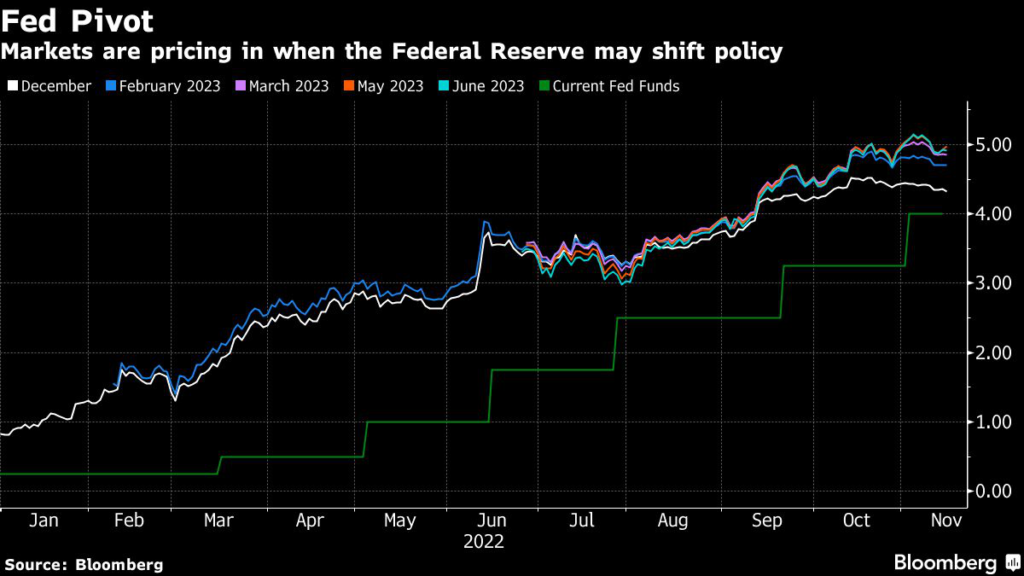
(Bloomberg) — US stocks rose as fresh data added to evidence inflation may have peaked, strengthening the case for the Federal Reserve to moderate its pace of interest-rate hikes. Treasuries also ended Tuesday higher while the dollar fell.

The S&P 500 climbed 0.9% and the tech-heavy Nasdaq 100 closed at its highest level since Sept. 19. While equities soared for most of Tuesday’s session, it gave back some of its gains after an Associated Press report citing an unidentified US intelligence official said that Russian missiles landed in NATO-member Poland. 

Commodities from oil to corn also jumped on geopolitical worries from Europe. While Poland later said an explosion near its eastern border with Ukraine killed two people, it didn’t confirm the Associated Press report. 

Markets have turned risk-on in recent days, trading off a softer-than-expected US consumer price index reading that many reckon will allow the Fed to raise rates in half-point increments. While a slew of Fed speakers in recent days indicated that officials could slow their tempo, they also emphasized the central bank has more work to do to tame inflation. 

On Tuesday, the producer price index for October came in at 8% year-on-year, undershooting the 8.3% estimate and further easing inflation concerns.  

Still, some investors are not convinced the recent data will do much to move the Fed.

“Markets appear to be pricing in a best case scenario of a soft landing and falling inflation triggering a Fed pause,” Venu Krishna, head of US equity strategy at Barclays Plc. “In our view, this is not a given and remains a low probability scenario – these are just a few data points on inflation and it needs to be sustained. Even if the Fed eventually pauses, it might not be able to prevent a shallow recession.”

Read More: The Great Inflation Trade Falters, Whiplashing Momentum Players

Key events this week:

  • US business inventories, cross-border investment, retail sales, industrial production, Wednesday
  • Fed’s John Williams, Lael Brainard and SEC Chair Gary Gensler speak, Wednesday
  • ECB President Christine Lagarde speaks, Wednesday
  • Eurozone CPI, Thursday
  • US housing starts, initial jobless claims, Thursday
  • Fed’s Neel Kashkari, Loretta Mester speak, Thursday
  • US Conference Board leading index, existing home sales, Friday

Some of the main moves in markets:

Stocks

  • The S&P 500 rose 0.9% as of 4 p.m. New York time
  • The Nasdaq 100 rose 1.5%
  • The Dow Jones Industrial Average rose 0.2%
  • The MSCI World index fell 0.6%

Currencies

  • The Bloomberg Dollar Spot Index fell 0.3%
  • The euro rose 0.3% to $1.0353
  • The British pound rose 0.9% to $1.1863
  • The Japanese yen rose 0.5% to 139.21 per dollar

Cryptocurrencies

  • Bitcoin rose 2.6% to $16,816.92
  • Ether rose 2.1% to $1,251.32

Bonds

  • The yield on 10-year Treasuries declined seven basis points to 3.78%
  • Germany’s 10-year yield declined four basis points to 2.11%
  • Britain’s 10-year yield declined seven basis points to 3.29%

Commodities

  • West Texas Intermediate crude rose 0.9% to $86.67 a barrel
  • Gold futures rose 0.3% to $1,782.70 an ounce

This story was produced with the assistance of Bloomberg Automation.

–With assistance from Natalia Kniazhevich.

More stories like this are available on bloomberg.com

©2022 Bloomberg L.P.
Electric Truck Stops Will Need as Much Power as a Small Town

(Bloomberg) — Next month, Tesla Inc. plans to deliver the first of its electric Semi trucks—able to haul a full 40 ton-load some 500 miles on a single charge. These massive batteries-on-wheels may accelerate the transition to electrified transport, but those responsible for delivering the power are starting to ask: Are we ready for this? 

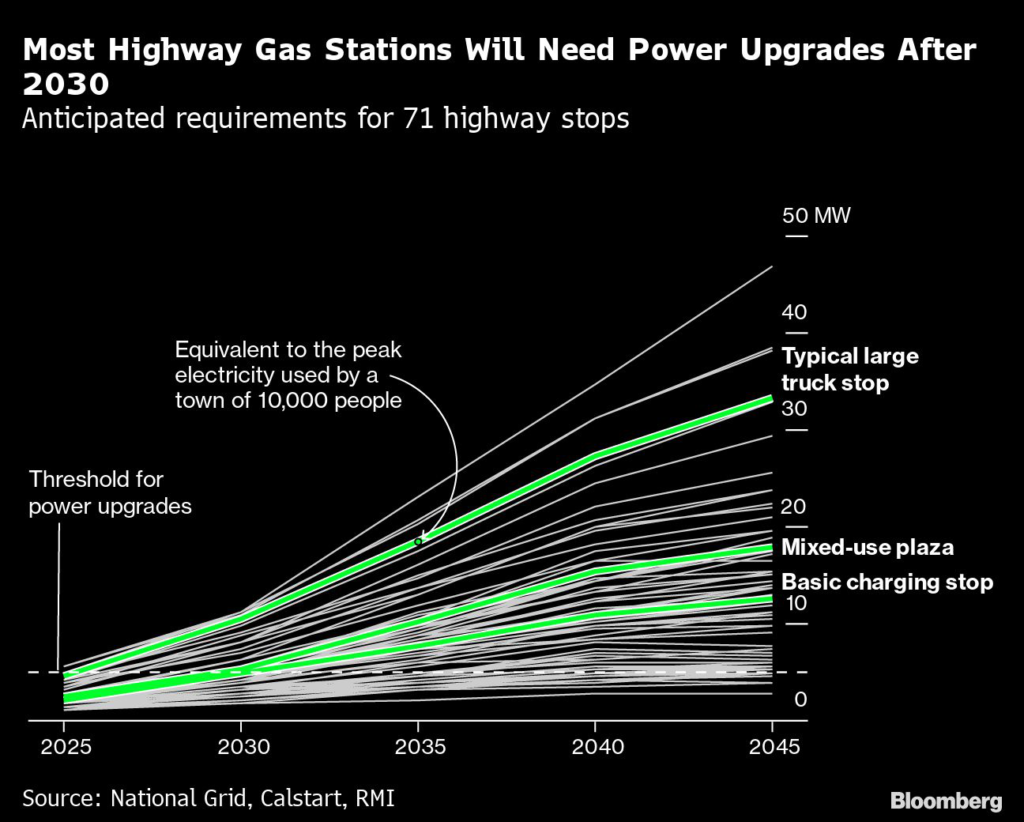
Probably not, according to a sweeping new study of highway charging requirements conducted by utility company National Grid Plc. Researchers found that by 2030, electrifying a typical highway gas station will require as much power as a professional sports stadium—and that’s mostly just for electrified passenger vehicles. As more electric trucks hit the road, the projected power needs for a big truck stop by 2035 will equal that of a small town.

Even the authors  who planned the study were caught off guard by how quickly highway power demands will change. A connection to the grid that can handle more than 5 megawatts takes up to eight years to build, at a cost tens of millions of dollars. If power upgrades don’t start soon, the transition to electric vehicles—let alone electric trucks—will quickly be constrained by a grid unprepared for the demand, warned Bart Franey, vice president of clean energy development at National Grid.

“We need to start making these investments now,” Franey said in an interview. “We can’t just wait for it to happen, because the market is going to outpace the infrastructure.” 

Misunderstanding the challenge

The total amount of new electricity that EVs will consume isn’t the problem. Even if the world stopped making new gasoline-powered cars and trucks altogether by the early 2030s—an optimistic scenario—it would add no more than 15% to the world’s electricity consumption by 2040, according to an analysis by BloombergNEF. In the age of cheap wind and solar power, that’s not a lot.

The real challenge is how quickly high-speed chargers will need to deliver electricity at a single place and time. Think of electricity like water flowing through a hose. You could fill an olympic-sized swimming pool with a garden hose if you had a few months, but filling it in a few hours would require a firehose. In the world of electric vehicles, an 18-wheeler is like a swimming pool—and the connections available at today’s highway stops are akin to garden hoses.

It “requires a paradigm shift from a policy and a regulatory perspective.”  

“It’s not like plugging in a toaster. If you put 50 trucks somewhere, that is basically equivalent to a factory,” said Dave Mullaney, who leads analysis of electric trucking at the RMI energy research institute. “Utilities know how to build factories, but it’s the process and sequencing required that’s scary to me. Utilities need to be starting half a decade ahead of the trucks in order to not be bottlenecking the transition to electric trucks.”

National Grid studied fueling behaviors at 71 highway gas stops of varying size along interstate corridors in New York and Massachusetts. They applied those behaviors to projections for EV adoption to estimate peak electricity demand. To model the behavior of passenger-vehicle projections, industry consultants at Stable Auto Corp. provided data from 3,000 fast-chargers across the US. For medium and heavy-duty trucking, the study used fleet-tracking telematics from Geotab Inc.

The big rigs are coming

Tesla’s upcoming Semi may be the first with a battery range that’s capable of long-haul trips across the country, but it isn’t the first electric truck. Daimler Truck Holding and Volvo Group already have Class 8 heavy-duty trucks on the road. These electric vehicles are designed for local and regional deliveries, and charge between deliveries or overnight at the factories and distribution centers where they’re based. But even for short-distance routes, some customers are already running into problems with infrastructure, said Rakesh Aneja, head of electric trucks at Daimler North America. Several customers had to reconsider purchasing Daimler’s Freightliner eCascadia after discovering that it would take a year longer to connect their chargers than it would to receive their trucks. 

“Utilities are waiting for a customer application to come in requesting new service before they start their work, and that process is just too long,” Aneja said. “You really have to anticipate that demand and then get started ahead of time. That requires a paradigm shift from a policy and a regulatory perspective.”  

Charging infrastructure for commercial trucks is still in its infancy. More than $1.2 billion of investments have been announced for chargers in 2022 and 2023, enough to build more than 4,000 truck-charging points in the US and Europe, according to a tally by BloombergNEF. Most of that is for pilot projects, with bigger investments to follow. 

In the US, government incentives pushed the timeline for mass electric truck adoption forward by 5 to 10 years, according to an RMI analysis. The landmark climate component of President Joe Biden’s Inflation Reduction Act, passed this year, will supercharge truck demand with a $40,000 incentive for each heavy-duty truck sale. Biden’s Infrastructure package, passed in 2021, set aside $7.5 billion to help fund a national system of chargers, with additional funds for help pay for upgrades to the grid.

Still, for the next few years most of the focus will be on building out charging networks for passenger vehicles. By 2030, it will be electric cars and electric pickup trucks that will be responsible for pushing half of the 71 stations studied by National Grid close to the key 5 megawatt threshold. That’s typically when major upgrades are required, including a new substation connection to high-voltage power lines.

The way many utilities are currently structured, most of the cost would be paid upfront by the fueling station, at a cost of tens of millions of dollars per rest stop, even though the same substation could later be used for decades by multiple facilities within a one mile radius. That kind of huge expense would halt charger upgrades at many locations, according to US government officials with access to National Grid’s report.

The high-voltage lines that will be central to the coming transformation are extremely robust. In major storms with power outages, those lines are rarely the problem. Indeed, some towers raised by teams of horses in the early 1900s are still in use more than a century later. Over that time, standards for modifying and upgrading transmission lines evolved gradually, just as demand rose predictably over the decades.

That will not be the case this time. With the amount of change the grid will be experiencing in the next few decades, the old rules for when to build interconnection upgrades—and who pays for them—no longer make sense, said Brian Wilkie, director of transport electrification at National Grid. Building connected electricity highways will be a competitive advantage for states that move the fastest, and every utility should be conducting similar studies to evaluate future demand, he said.

National Grid says the location of these high-voltage taps should help guide decisions for where future charging stations and distribution facilities will be built, rather than the other way around, leading to cost savings of about 35%. 

“The number one concern for fleets wanting to electrify all of their vehicles is the infrastructure required,” Wilkie said. “They know they can’t sell trucks without the power to charge. If they can solve that piece, they can scale the market much more quickly.”

(Corrects number of stations approaching the 5 megawatt threshold in the 14th paragraph.)

More stories like this are available on bloomberg.com

©2022 Bloomberg L.P.
FTX Latest: Regulators Discuss Questioning Bankman-Fried in US

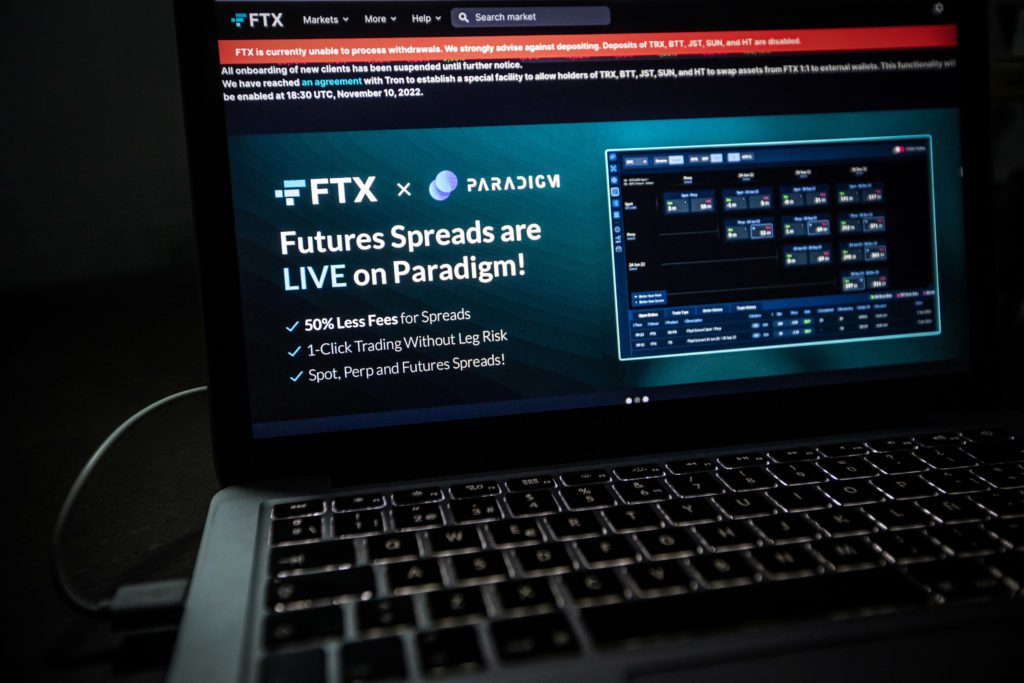
(Bloomberg) — US and Bahamian authorities are talking about bringing Sam Bankman-Fried to America for questioning, according to three people familiar with the matter. Meanwhile, Bankman-Fried took to Twitter Tuesday afternoon, telling his followers that he would be meeting with regulators in-person. The tweet came a few hours after he posted on the social-media platform that FTX US had enough money to repay customers. 

FTX Group named a slate of new independent directors as the Supreme Court of the Bahamas appointed partners from PricewaterhouseCoopers provisional liquidators to oversee FTX’s assets. The implosion of Sam Bankman-Fried’s FTX empire has other crypto billionaires distancing themselves from the bankrupt exchange.

Bitcoin stabilized Tuesday, trading under $17,000, providing some respite from a damaging selloff triggered by the FTX crisis.

Key stories and developments:

  • FTX Wrangles More Than a Million Creditors Amid Chaotic Collapse
  • Crypto Billionaires With $96 Billion Loss Add Distance From FTX
  • FTX Collapse Leaves Power Vacuum on Push for US Regulation
  • Sam Bankman-Fried Posts Cryptic Tweets After Wealth Wipeout

(Time references are New York unless otherwise stated.)

Regulators Discuss Bringing SBF to US (3:19 p.m.)

US and Bahamian authorities have been discussing the possibility of bringing Sam Bankman-Fried to America for questioning, according to three people familiar with the matter.

The conversations between law-enforcement officials in the two countries have intensified in recent days as they probe his role in the implosion of cryptocurrency firm FTX. Bankman-Fried has been cooperating with Bahamian authorities, said one of the people, who like the others asked not to be identified due to the sensitivity of the matter. 

SBF Meeting with Regulators (2:58 p.m.)

Bankman Fried said he is meeting “in-person with regulators” to “do right by customers,” according to a tweet.

Tweet Says FTX Had Enough to Repay Customers (12:17 p.m.)

FTX US had enough to repay all if its customers “as of post-11/7,” Bankman-Fried said in a tweet. But he acknowledged that “not everyone necessarily agrees with this.”

Crypto Lender Voyager Deal Void (11:48 a.m.)

Bankrupt crypto lender Voyager Digital Ltd. doesn’t plan to sell itself to FTX after the crypto exchange itself was forced into insolvency proceedings, according to a lawyer for Voyager.   

FTX violated its contract to buy Voyager out of bankruptcy, according to Voyager’s main bankruptcy attorney Joshua Sussberg. FTX has agreed that Voyager can pursue other bids, but has not yet confirmed that the company is pulling out of the contract to buy the smaller crypto company, Sussberg said in court Tuesday.

PwC Named Liquidators (9:35 a.m.)

The Supreme Court of the Bahamas approved partners from PricewaterhouseCoopers, also known as PwC, as provisional liquidators to oversee the assets of crypto exchange FTX.

The Bahamas Securities Commission wrote in a statement that it “moved swiftly to use its regulatory powers” to further protect clients. 

Scaramucci Sees Zhao’s Sale as Retaliation (9:28 a.m.)

Scaramucci, in whose company FTX owns a 30% stake, accompanied Bankman-Fried on a recent fundraising trip to the Middle East, he said at the Bloomberg New Economy Forum on Tuesday. During some of those meetings, Bankman-Fried appears to have made unspecified remarks about Zhao, Scaramucci said.  

“I think what happened frankly is he said something about CZ, the founder of Binance, in possibly one or two of those meetings, that got back to CZ and he got super upset about it,” Scaramucci said. He said ‘OK, we are in a divorce, we are not gonna make love,’ that was the Twitter comment. He hit him with $500 million worth of FTT tokens.”

After Zhao’s Nov. 6 tweet announcing the sale of FTT tokens worth roughly $530 million at the time, concerns around FTX’s financial health spiraled into a panic and clients yanked some $5 billion from the platform in a day. FTX quickly unraveled, filing for bankruptcy last week. 

“FTX’s problems arose from mismanagement of their user funds and their highly leveraged business,” a Binance spokesperson said in an emailed response to questions about Scaramucci’s remarks. Binance decided to sell its holding of FTT after a Nov. 2 CoinDesk article called into question the health of the balance sheet of Alameda Research, Bankman-Fried’s trading house, the spokesperson said. 

“CZ’s tweet came only after the community asked questions about the movement of a large amount of FTT which is transparent on the public blockchain,” the Binance spokesperson said. A representative for FTX didn’t immediately reply to a request for comment. 

Binance will submit evidence to UK lawmakers on its decision making around the sale of FTT, Daniel Trinder, the company’s vice president of government affairs in Europe, said at a hearing with the UK Parliament’s Treasury Committee on Monday. 

Charlie Munger Calls Crypto ‘Delusion’ (7:33 a.m.)

Berkshire Hathaway Inc.’s Charlie Munger doubled down on his criticism of digital assets in the wake of FTX’s collapse.

“It’s partly fraud and partly delusion,” Munger, vice chairman of Berkshire Hathaway said on CNBC Tuesday. “That’s a bad combination. I don’t like either fraud or delusion. And the delusion may be more extreme than the fraud.”

Scaramucci Says His Due Diligence ‘Not Enough’ (Tuesday, 5:05 p.m. HK)

Anthony Scaramucci, whose SkyBridge Capital was caught up in the implosion of FTX.com, said he did a thorough background check on its founder Sam Bankman-Fried, but it wasn’t enough to protect himself from “misrepresentations.”

“I was doing a lot of due diligence on him, but clearly not enough,” Scaramucci said at the Bloomberg New Economy Forum on Tuesday. He added that FTX’s stake in SkyBridge can’t be transferred to anybody “without my permission.”

Binance to Submit Evidence on FTX Deal (Tuesday, 4:20 p.m. HK)

Binance said it will submit evidence to UK lawmakers regarding discussions held about FTX.com when the two were in deal talks, as well as on its decision-making around the sale of FTX.com’s native token FTT.

Daniel Trinder, Binance’s vice president of government affairs in Europe, said the company would provide the information to members of the UK Parliament’s Treasury Committee as part of the crypto exchange’s appearance as a witness in a cryptoasset inquiry. 

Trinder was grilled by lawmakers on Monday over the firm’s decision to announce a planned sale of more than $500 million in FTT on Nov. 6 — a move that caused trading volumes for the token to spike to their highest in more than a year. It was also part of the chain of events that led to FTX eventually filing for bankruptcy.

SBF Posts Cryptic Tweets (Tuesday, 2:05 p.m. HK)

Former FTX chief Sam Bankman-Fried in a series of cryptic tweets over the last 24 hours spelled out the words “What HAPPENED.” He finished with the message: “NOT LEGAL ADVICE. NOT FINANCIAL ADVICE. THIS IS ALL AS I REMEMBER IT, BUT MY MEMORY MIGHT BE FAULTY IN PARTS.”

The bizarre sequence sparked hot debate — and not a little anger — on Twitter as users tried to second guess what would come next.

FTX Talking With ‘Dozens’ of Regulators (Tuesday, 1:10 p.m. HK)

FTX Group named a slate of new independent directors to oversee the collapsed crypto empire and is speaking with the US Attorney’s Office and “dozens” of US and international regulatory agencies, according to new bankruptcy court papers. 

“Questions arose about Mr. Bankman-Fried’s leadership and the handling of FTX’s complex array of assets and businesses under his direction,” lawyers for the crypto company wrote. FTX plunged into bankruptcy court after facing “a severe liquidity crisis that necessitated the filing of these cases on an emergency basis.”

More stories like this are available on bloomberg.com

©2022 Bloomberg L.P.

Close Bitnami banner
Bitnami
