Bloomberg

FTX’s $1.4 Billion Deal for Bankrupt Lender Voyager Is Canceled

(Bloomberg) — Voyager Digital Ltd. is trying to sign a deal to sell itself to one of the bidders that lost the auction for the bankrupt crypto lender, after the winner of that auction, FTX, was itself forced into insolvency proceedings.   

One of the losing bidders included crypto exchange CrossTower. CrossTower did not immediately respond to a request for comment.

FTX violated its contract to buy Voyager out of bankruptcy, according to Voyager’s main bankruptcy attorney Joshua Sussberg. FTX has agreed that Voyager can pursue other bids, but has not yet confirmed that the company is pulling out of the contract to buy the smaller crypto company, Sussberg said in court on Tuesday.

“We were shocked, disgruntled, dismayed,” Sussberg said during a Voyager bankruptcy hearing. “There will be no transaction with FTX, I think that is quite obvious.”

The events underscore how the sudden implosion of FTX, the second-biggest cryptocurrency exchange in the world, is rippling through the industry, hurting smaller, troubled crypto companies like Voyager. The Voyager deal unraveled after FTX founder Sam Bankman-Fried resigned as chief executive and the company filed its own Chapter 11 bankruptcy. 

“I don’t think we’ve seen the end of the contagion factor or the fear that is running through the market,” Sussberg said in court.

FTX won a weeks long auction for Voyager under a deal tied to court approval of the creditor payment plan, lawyers said during a court hearing held by telephone.

Bankman-Fried’s empire is being run by restructuring experts brought in when the company filed for bankruptcy and regulators in the Bahamas started their own proceedings against FTX. Voyager filed bankruptcy earlier this year after a steep decline in cryptocurrency values.  

The sale to FTX was valued at about $1.4 billion, of which $51 million is in cash. As part of the sale, FTX would have moved customers on to its platform. 

The bankruptcy is Voyager Digital Holdings Inc., 22-10943, U.S. Bankruptcy Court for the Southern District of New York (Manhattan).

(Updates with additional comment in paragraph six)

More stories like this are available on bloomberg.com

©2022 Bloomberg L.P.

FTX Latest: PwC Named as Liquidator, Munger Sees ‘Delusion’

(Bloomberg) — FTX Group named a slate of new independent directors as the Supreme Court of the Bahamas appointed partners from PricewaterhouseCoopers provisional liquidators to oversee FTX’s assets. 

The implosion of Sam Bankman-Fried’s FTX empire has other crypto billionaires distancing themselves from the bankrupt exchange and SkyBridge Capital founder Anthony Scaramucci speculated Binance Chief Executive Officer Changpeng “CZ” Zhao’s decision to sell a big holding of FTX.com’s native crypto token FTT appears to have been retaliation for something Bankman-Fried said.

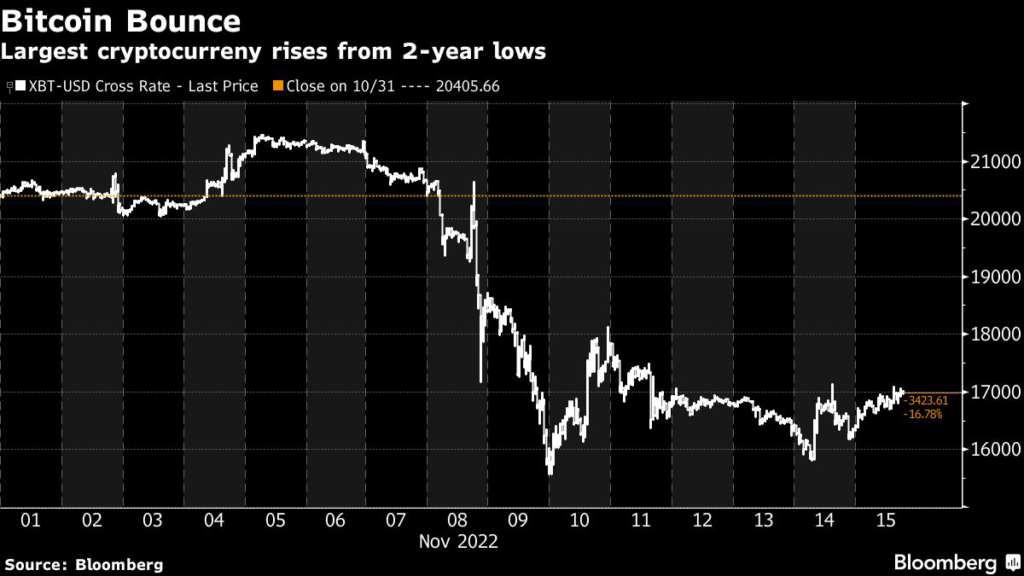
Bitcoin rose Tuesday, trading around $17,000, providing some respite from a damaging selloff triggered by the FTX crisis.

Key stories and developments:

  • FTX Wrangles More Than a Million Creditors Amid Chaotic Collapse
  • Crypto Billionaires With $96 Billion Loss Add Distance From FTX
  • FTX Collapse Leaves Power Vacuum on Push for US Regulation
  • Sam Bankman-Fried Posts Cryptic Tweets After Wealth Wipeout

(Time references are New York unless otherwise stated.)

Crypto Lender Voyager Deal Void (11:48 a.m.)

Bankrupt crypto lender Voyager Digital Ltd. doesn’t plan to sell itself to FTX after the crypto exchange itself was forced into insolvency proceedings, according to a lawyer for Voyager.   

FTX violated its contract to buy Voyager out of bankruptcy, according to Voyager’s main bankruptcy attorney Joshua Sussberg. FTX has agreed that Voyager can pursue other bids, but has not yet confirmed that the company is pulling out of the contract to buy the smaller crypto company, Sussberg said in court Tuesday.

PwC Named Liquidators (9:35 a.m.)

The Supreme Court of the Bahamas approved partners from PricewaterhouseCoopers, also known as PwC, as provisional liquidators to oversee the assets of crypto exchange FTX.

The Bahamas Securities Commission wrote in a statement that it “moved swiftly to use its regulatory powers” to further protect clients. 

Scaramucci Sees Zhao’s Sale as Retaliation (9:28 a.m.)

Scaramucci, in whose company FTX owns a 30% stake, accompanied Bankman-Fried on a recent fundraising trip to the Middle East, he said at the Bloomberg New Economy Forum on Tuesday. During some of those meetings, Bankman-Fried appears to have made unspecified remarks about Zhao, Scaramucci said.  

“I think what happened frankly is he said something about CZ, the founder of Binance, in possibly one or two of those meetings, that got back to CZ and he got super upset about it,” Scaramucci said. He said ‘OK, we are in a divorce, we are not gonna make love,’ that was the Twitter comment. He hit him with $500 million worth of FTT tokens.”

After Zhao’s Nov. 6 tweet announcing the sale of FTT tokens worth roughly $530 million at the time, concerns around FTX’s financial health spiraled into a panic and clients yanked some $5 billion from the platform in a day. FTX quickly unraveled, filing for bankruptcy last week. 

“FTX’s problems arose from mismanagement of their user funds and their highly leveraged business,” a Binance spokesperson said in an emailed response to questions about Scaramucci’s remarks. Binance decided to sell its holding of FTT after a Nov. 2 CoinDesk article called into question the health of the balance sheet of Alameda Research, Bankman-Fried’s trading house, the spokesperson said. 

“CZ’s tweet came only after the community asked questions about the movement of a large amount of FTT which is transparent on the public blockchain,” the Binance spokesperson said. A representative for FTX didn’t immediately reply to a request for comment. 

Binance will submit evidence to UK lawmakers on its decision making around the sale of FTT, Daniel Trinder, the company’s vice president of government affairs in Europe, said at a hearing with the UK Parliament’s Treasury Committee on Monday. 

Charlie Munger Calls Crypto ‘Delusion’ (7:33 a.m.)

Berkshire Hathaway Inc.’s Charlie Munger doubled down on his criticism of digital assets in the wake of FTX’s collapse.

“It’s partly fraud and partly delusion,” Munger, vice chairman of Berkshire Hathaway said on CNBC Tuesday. “That’s a bad combination. I don’t like either fraud or delusion. And the delusion may be more extreme than the fraud.”

Scaramucci Says His Due Diligence ‘Not Enough’ (Tuesday, 5:05 p.m. HK)

Anthony Scaramucci, whose SkyBridge Capital was caught up in the implosion of FTX.com, said he did a thorough background check on its founder Sam Bankman-Fried, but it wasn’t enough to protect himself from “misrepresentations.”

“I was doing a lot of due diligence on him, but clearly not enough,” Scaramucci said at the Bloomberg New Economy Forum on Tuesday. He added that FTX’s stake in SkyBridge can’t be transferred to anybody “without my permission.”

Binance to Submit Evidence on FTX Deal (Tuesday, 4:20 p.m. HK)

Binance said it will submit evidence to UK lawmakers regarding discussions held about FTX.com when the two were in deal talks, as well as on its decision-making around the sale of FTX.com’s native token FTT.

Daniel Trinder, Binance’s vice president of government affairs in Europe, said the company would provide the information to members of the UK Parliament’s Treasury Committee as part of the crypto exchange’s appearance as a witness in a cryptoasset inquiry. 

Trinder was grilled by lawmakers on Monday over the firm’s decision to announce a planned sale of more than $500 million in FTT on Nov. 6 — a move that caused trading volumes for the token to spike to their highest in more than a year. It was also part of the chain of events that led to FTX eventually filing for bankruptcy.

SBF Posts Cryptic Tweets (Tuesday, 2:05 p.m. HK)

Former FTX chief Sam Bankman-Fried in a series of cryptic tweets over the last 24 hours spelled out the words “What HAPPENED.” He finished with the message: “NOT LEGAL ADVICE. NOT FINANCIAL ADVICE. THIS IS ALL AS I REMEMBER IT, BUT MY MEMORY MIGHT BE FAULTY IN PARTS.”

The bizarre sequence sparked hot debate — and not a little anger — on Twitter as users tried to second guess what would come next.

FTX Talking With ‘Dozens’ of Regulators (Tuesday, 1:10 p.m. HK)

FTX Group named a slate of new independent directors to oversee the collapsed crypto empire and is speaking with the US Attorney’s Office and “dozens” of US and international regulatory agencies, according to new bankruptcy court papers. 

“Questions arose about Mr. Bankman-Fried’s leadership and the handling of FTX’s complex array of assets and businesses under his direction,” lawyers for the crypto company wrote. FTX plunged into bankruptcy court after facing “a severe liquidity crisis that necessitated the filing of these cases on an emergency basis.”

‘No One Can Protect a Bad Player’ (Monday, 6:06 p.m. HK) 

Speaking at the B20 Summit in Indonesia, Binance Holdings Ltd Chief Executive Officer Changpeng “CZ” Zhao pledged to launch a fund to help crypto markets recover from FTX’s collapse. He singled out people he described as bad actors in the crypto space who “try to cut corners to grow quickly,” and called on industry leaders to “set strong standards” in volatile digital markets. 

Zhao, who briefly entertained plans to buy the struggling exchange before backing out a day later, exhorted his crypto counterparts to behave better. “No one can protect a bad player,” he said.    

FTX Japan Assesses Client Damage (Monday, 5:33 p.m. HK) 

FTX Japan K.K., the Japanese subsidiary of Sam Bankman-Fried’s failed digital asset exchange, is investigating whether its parent company’s bankruptcy will affect its ability to return crypto holdings to regional clients. Last week, the unit was ordered to suspend some of its operations as regulators assessed the wreckage of the FTX collapse. 

A company spokesman said that FTX Japan will make a statement once the situation is clearer. As of Nov. 10, FTX Japan held about 19.6 billion yen ($140 million) in cash and deposits. 

Singapore Says FTX Not Licensed There (Monday, 2:40 p.m. HK)

Singapore’s central bank said that while bankrupt crypto exchange FTX doesn’t have a license to operate in the city-state, it’s not possible to prevent local users from “directly accessing” overseas service providers. 

As a result, FTX was “able to onboard Singapore users,” a spokesperson at the Monetary Authority of Singapore said in an emailed statement to Bloomberg News on Monday. “MAS has consistently reminded the public of the risks of dealing with unlicensed entities,” the spokesperson said in the statement. 

More stories like this are available on bloomberg.com

©2022 Bloomberg L.P.

Microsoft to Adopt New Sexual Harassment Policies After Gates, Misconduct Audit

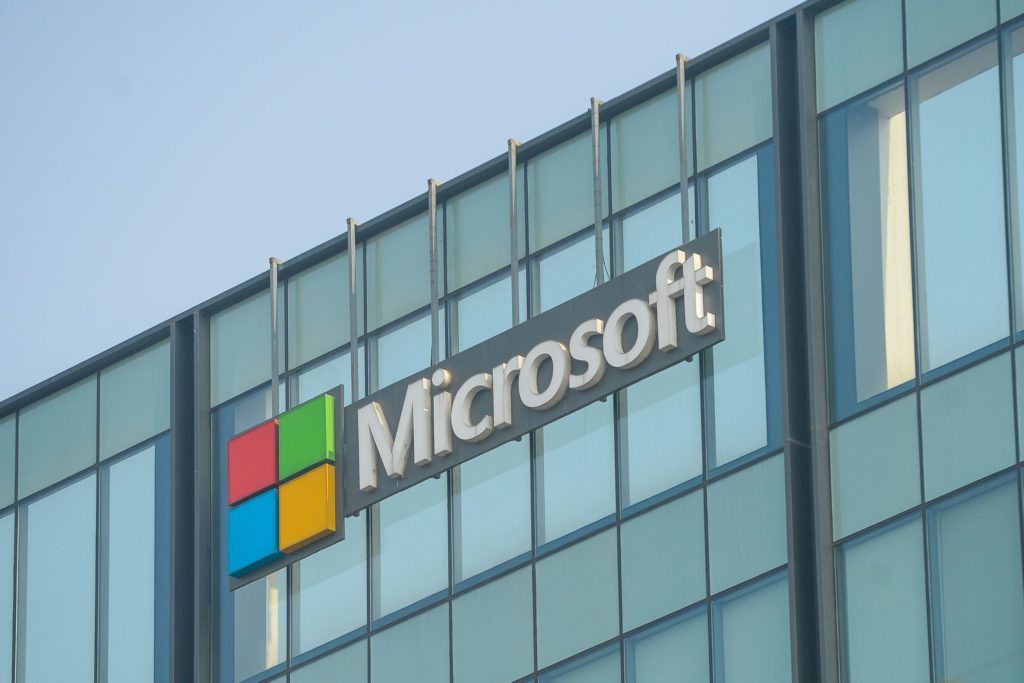
(Bloomberg) — Microsoft Corp. will adopt a series of new sexual harassment policies, following recommendations made by a law firm the company hired to review its practices after reports of misconduct and employee complaints.

The 50-page report, released Tuesday, outlined 11 recommendations for the software giant, including requiring leaders to disclose consensual relationships with employees. Microsoft in a blog post said it will address all the recommendations by June 30, including releasing an annual review of internal harassment claims with how many were substantiated and what kinds of action were taken as a result. The inaugural report will come by Dec. 1. 

“Our review revealed that the Company strives to follow best practices,” wrote lawyers from the firm ArentFox Schiff LLP, which prepared the report shared with Bloomberg News by Microsoft. “Nevertheless… we recommend that the Company consider implementing certain enhancements to their existing policies, procedures, and practices.”

Among the other changes Microsoft has said it’s making: The company will fix a tool that failed to adequately remind senior leadership to take required harassment training and it will consider adding questions to a survey launched in March 2022 for workers on their experiences with the sexual harassment investigation process.

Microsoft shareholders in November 2021 passed a non-binding resolution asking for an internal review of policies and practices in response to sexual harassment allegations at the company, including those made against co-founder and former chairman Bill Gates. 

“It’s an unprecedented piece of work,” said Natasha Lamb, managing partner at Arjuna Capital, the firm behind the proposal. “I’ve never seen this kind of report be publicly published. It’s extremely comprehensive. It provides a model for other companies to follow.”

As part of its report, ArentFox reviewed how Microsoft handled various claims, including the board’s investigation of Gates, though it did not reopen any cases.

In its timeline of the Gates incident, ArentFox detailed a complaint made in July 2019 by an employee, who said Gates subjected her to inappropriate conduct while she was working at the company. Microsoft hired an outside lawyer to look into the claim. The lawyer confirmed meetings and communications between Gates and the employee. Gates also admitted to the conduct, but alleged it was consensual. The lawyer presented her findings to the board in November 2019; Gates resigned as chairman in March 2020. ArentFox did not comment on the board’s investigation.

“We had hoped to see more was in regard to the Bill Gate’s investigation,” Lamb said. 

ArentFox also detailed the investigations into two Corporate Vice Presidents, referring to Tom Keane and Alex Kipman, who both departed in the wake of an Insider report on alleged misconduct that in Keane’s case involved bullying and verbal abuse. While talking to workers about those cases, ArentFox found that “there is and has been a perception among some employees that the Company tolerates and to some degree protects high performing senior executives who may be engaging in inappropriate conduct.” 

The software maker said it will “emphasize that senior leaders will continue to be held accountable for substantiated policy violations and behavioral concerns.” 

ArentFox reviewed the handling of sexual harassment complaints and policies from 2019 onward. The firm found most claims came from the sales and engineering groups.

The firm found that most of the investigations were conducted in a “fair, timely and thorough manner” as required by the company’s policies. But, more recently, the investigations process has started to lag due to various factors, including an increase in the volume of reports, ArentFox found. In Microsoft’s fiscal year 2021, 51% of investigations were finished within 30 days but that rate has dropped to 39% in the current fiscal year so far. 

The firm also noted that while Microsoft has improved the percentage of women in its highest ranks, it still needs to do better. Microsoft’s median pay gap figures, released last month, found women in the US still earn 10% less than men do. 

The law firm interviewed some employees who had raised complaints to ask about their experience with the process. They found most had switched jobs and some said they got negative performance reviews that held back their pay and promotions. Employees, particularly senior women, also alleged human resources, at times, discouraged workers from making complaints that would need to be referred to the investigation team

Some also expressed frustration that they were told there was no policy violation because the bad behavior wasn’t directed at one particular protected class. To paraphrase one witness: “It makes no sense that they found a pattern of bad behavior but told me my complaint couldn’t be substantiated because he treated everyone that way instead of just some people,” the law firm wrote in the report. 

More stories like this are available on bloomberg.com

©2022 Bloomberg L.P.

Comcast Says Its Cable Upgrade to Cost 80% Less Than Fiber Plans

(Bloomberg) — Comcast Corp. is bringing penny-pinching to the costly US broadband arms race.

The Philadelphia-based cable giant says upgrading its network with new cable transmission technology to provide high-speed internet access will cost a fraction of what the rest of the industry is spending on fiber optics.

The upgrade will “cost us, on a gross basis, less than $200 per home passed,” Comcast’s Chief Network Officer Elad Nafshi said Tuesday at the RBC Capital Markets Global Technology, Internet, Media and Telecommunications Conference.

That number compares with about $1,000 per home for laying new fiber optic cable lines. Neither amount includes the cost of connecting all the way to a home.

Comcast and its cable peer, Charter Communications Inc., are taking an alternate path in the federally funded race to expand broadband service to more people in more parts of the US. Instead of replacing their networks of coaxial wires with higher-capacity fiber, the two companies have opted for a technology called DOCSIS 4.0 that uses amplifiers to allow existing cable systems to give customers multigigabit speeds. 

Comcast currently passes 61 million homes and businesses, which would put a complete upgrade of its network in the ballpark of $12 billion. Rival AT&T Inc., meanwhile, has set its future on a fiber path, and expects to pass 30 million homes by 2025. Its broadband investment may ultimately be larger as a result.


More stories like this are available on bloomberg.com

©2022 Bloomberg L.P.

Crypto Market Stabilizes as Traders Weigh FTX Meltdown Fallout

(Bloomberg) — Crypto markets stabilized Tuesday as investors grow hopeful that the fallout from FTX’s insolvency might remain somewhat contained.

Bitcoin, the largest token, climbed as much as 4.4% to $17,102, while second-ranked Ether advanced as much as 5%. Smaller cryptocurrencies known as altcoins such as Solana and Polkadot also advanced for a second day.

The modest gains provides some much-needed reprieve after the most recent plunge. Bitcoin dipped last week to its lowest price since November 2020 as the meltdown of crypto exchange FTX rattled investors. 

Since Sam Bankman-Fried’s digital empire filed for Chapter 11 bankruptcy protection on Friday, investors have been wary of contagion. Even so, no major crypto-related entities have seen the same outcome since, boosting optimism that the fallout may be more muted than at once feared.

“It looks bad but we’ve seen a lot of smoke but not that much fire just yet,” said Ilan​ Solot, co‑head of digital assets at Marex Solutions. “That gives a little bit of a sense of the calm.”

Cryptocurrencies rose alongside broader markets, with gains in the tech sector pushing US stocks higher. The S&P 500 advanced as much as 1.8% after producer prices confirmed a slowdown in inflation. 

Fairlead Strategies’ Will Tamplin said that crypto’s stabilization comes after oversold conditions last week. 

Bitcoin futures slid below the spot price, something that did not occur in previous selloffs, according to Solot. Those conditions could be the result of “speculative shorts” or “proxy hedging,” he wrote in a note.

Despite the gains, Bitcoin prices have sunk close to 18% over the past week, and the token has only briefly broken above $17,000 over the past several days of trading. 

“The insolvency has short-term led to a distorted derivatives market and harmed liquidity,” wrote Arcane’s Bendik Schei and Vetle Lunde in a note. “We believe this will cause prolonged headwinds related to contagion, regulation, and institutional presence.”


More stories like this are available on bloomberg.com

©2022 Bloomberg L.P.
Twitter-Musk Legal Fight Officially Ends as Judge Dismisses Suit

(Bloomberg) — Twitter Inc.’s four-month court battle with new owner Elon Musk is officially over, after one of the most contentious merger fights in US history.

Delaware Chancery Court Judge Kathaleen St. J. McCormick on Tuesday dismissed the lawsuit Twitter filed in July after Musk sought to pull out of the $44 billion acquisition. He later changed his mind, and completed the purchase last month.  

At the request of both Twitter and Musk, McCormick dismissed “any and all claims and counterclaims” over the billionaire entrepreneur’s bid to walk away from his $54.20-per-share bid. 

Musk has faced a rocky transition as the social-media platform’s owner since agreeing Oct. 4 to complete the transaction on its original terms. He’s slashed the workforce, changed policies and been confronted with an advertising slump, prompting him to say bankruptcy was a possibility if the company didn’t start generating more cash. 

During his bid to exit the takeover deal, Musk had claimed Twitter officials misled him about bot and spam accounts among its more than 230 million users and that justified the cancellation. 

Musk is back in the same Delaware court this week for a separate legal fight: He’s facing claims by a Tesla Inc. investor that he steamrolled directors into giving him a lavish pay package worth as much as $55 billion. 

The Twitter case was Twitter v. Musk, 22-0613, Delaware Chancery Court (Wilmington). The Tesla case is Tornetta v. Musk, 2018-0408.

More stories like this are available on bloomberg.com

©2022 Bloomberg L.P.

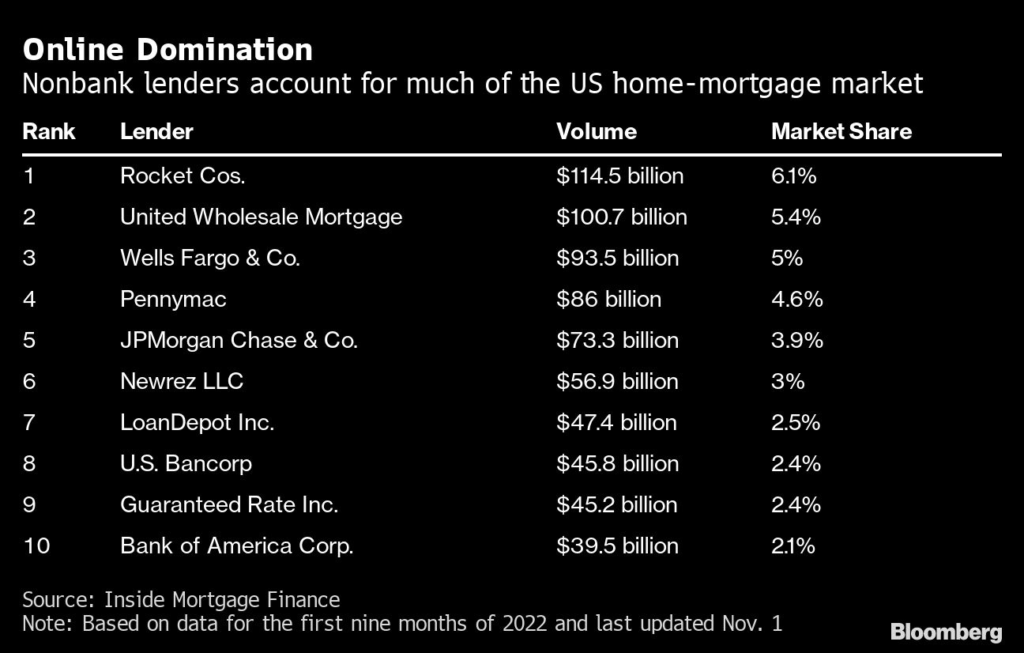
Mortgage Lenders Vie to Be ‘Last Man Standing’ as Rates Soar

(Bloomberg) — In the wake of the last housing crash, online lenders came to dominate the mortgage market. Those firms are now struggling to survive the latest downturn, with soaring interest rates hurting home sales and refinancing demand.

Better, the beleaguered mortgage provider that’s cut roughly two-thirds of its workforce, is poised to eliminate even more jobs. LendingTree Inc., Pennymac and Home Point Financial Corp. have also reduced their staffs. Such cost-cutting could be helpful in the short term, but may not be enough to allow the nonbank lenders to last long enough to see a mortgage-market recovery.

“Over the next several quarters, we expect to see significant separation between the well-capitalized players in the mortgage space — those who have clearly defined long-term strategic plans — from those who don’t,” Rocket Cos. Chief Executive Officer Jay Farner said on a conference call discussing his company’s third-quarter earnings, which plunged 93%. “In the end, only the strong will be left standing.”

Nonbank lenders focused on mortgage origination tend to be something of one-trick ponies. The firms thrived when borrowing costs were close to historic lows, spurring Americans to buy homes or refinance their loans, but they have few other business lines to lean on during a downturn, unlike traditional banks. Any shakeup that drives some online mortgage providers out of business would leave those remaining in a position to dictate who can borrow and at what price.

Borrowing costs for 30-year, fixed-rate mortgages are hovering around their highest level in two decades, with the average interest rate now above 7%. That’s pushed some homebuyers out of the market and forced others to cancel purchases. Mortgage costs have been boosted by the Federal Reserve’s efforts to tamp down inflation, including a 75-basis-point hike to its benchmark interest rate in early November.

Falling Sales

The housing market is “the most interest-rate sensitive segment of the economy,” and declining home sales “are not expected to improve” any time soon, Freddie Mac Chief Economist Sam Khater said last week. Total transactions for existing single-family homes, apartments and condos plummeted more than 21% across the US in the third quarter.

In a bid for survival, nonbanks are counting on unique offerings beyond home loans and the strength of their balance sheets to help them weather the worst of the housing rout so they’ll still be around to offer mortgages when the market ultimately recovers.

“We want to make sure that we will be there at the other end of the economic cycle no matter what,” Harit Talwar, chairman of Better and formerly an architect of Goldman Sachs Group Inc.’s consumer bank, said in an interview. “We want to be the last man standing.”

Talwar estimates New York-based Better has cut some 7,000 jobs in the last year or so. While it’s still trimming its workforce, the latest round is for just 28 positions, according to a filing with the state this month. 

Banks were once the largest players in home-loan origination, but after the US housing market collapsed, triggering the global financial crisis of 2007 and 2008, risk-reducing reforms were enacted that led traditional lenders to pull back from the mortgage market. That retreat allowed nonbank lenders to pick up the slack.

Since then, companies such as Detroit-based Rocket and Foothill Ranch, California-based LoanDepot Inc. have come to dominate the space, with financial-technology firms backed by venture capital also breaking into the business.

“The nonbanks took over from the banks as they withdrew from what was a very risky business,” said Susan Wachter, a professor of real estate at the University of Pennsylvania’s Wharton School. “They’ve done extremely well — very efficient — particularly because they had new systems in place for scalable, rapid increases in capacity.”

The Covid-19 crisis and resulting government-stimulus efforts that left consumers awash in cash and sent interest rates to rock-bottom levels fueled a surge in homebuying and mortgage refinancing. Mortgage providers originated a record $4.3 trillion of home loans last year, according to data provider Black Knight Inc.

As interest rates rose, demand crumpled. Black Knight estimates origination volume will drop to $2.3 trillion this year, and Fannie Mae expects a further decline in 2023. The decrease in volume has forced lenders to make fast, deep cuts. Nonbanks aren’t the only ones feeling the pain. Citigroup Inc., JPMorgan Chase & Co. and Wells Fargo & Co have all cut staff in their mortgage businesses.

Loan Options

That pullback may reduce borrowing options for consumers, particularly those on the “lower end of the economic spectrum,” said Jacob Channel, LendingTree’s senior economist.

“They might struggle a little bit more as lenders tighten,” he said.

Instead of depending on diverse business lines to survive times of upheaval, nonbanks tend to rely on variable cost structures that can be ramped up or down to meet demand. That means expenses associated with originating mortgages — for marketing and employees, mostly — can be increased or decreased depending on the market cycle. But fewer people and less advertising can make it tougher to quickly increase originations when things improve.

“The problem is not so much making that work in the downward direction,” said Bloomberg Intelligence analyst Ben Elliott. “How do you ramp back up in the next cycle?”

Pennymac’s job cuts were based on acting “as a prudent and responsible business,” the lender said in an emailed statement. “Pennymac conducted a thoughtful review of its operational workforce needs following the continued and measurable industrywide reduction in US mortgage applications, originations and refinancing.”

Better, for its part, said in an emailed statement that it’s “focused on making prudent decisions that account for current market dynamics.”

Profitability Struggle

For now, lenders are struggling to find ways to be profitable. LoanDepot, for example, reported net losses of $137.5 million in the third quarter as loan volume and revenue slumped. The company touted a reduction in expenses, the result of “right-sizing staffing levels” and cutting marketing costs.

LoanDepot may end up losing market share because of the problems it’s having returning to profitability, Elliott said. If the lender has to make deep cuts to its origination capacity to make ends meet, it will start from a lower base when rebuilding into the next market cycle, when demand for refinancing returns, he said.

“Those who can hold onto more staff and more volume when it’s less profitable can ramp up more quickly when refis come back,” Elliott said.

Farner, the CEO of Rocket, said his company is taking a different approach from other lenders, opting to diversify to retain customers during down markets. The company offers a personal-finance platform, auto lending and other services on top of its mortgage-focused lines of business.

“That drives a client back to your experiences daily, weekly or monthly,” Farner said in an interview.

Despite the weakness, consolidation isn’t likely among nonbank lenders because struggling mortgage originators aren’t offering a unique service, said Kyle Joseph, a research analyst with Jefferies Financial Group Inc. While a new technology or high-performing loan officers may make a particular company a bit more attractive, takeovers aren’t likely in large numbers, he said.

“I would expect ongoing exits,” Joseph said. “Those without size or scale are vulnerable right now.”

More stories like this are available on bloomberg.com

©2022 Bloomberg L.P.
Wall Street Tests Crypto Dollars With Fed, Defying FTX Gloom

(Bloomberg) — A Federal Reserve Bank of New York unit will partner with almost a dozen banks and other financial institutions to test out digital dollars, a sign that Wall Street intends to push ahead with its cryptocurrency agenda despite recent upheaval in the market. 

Banks including Citigroup Inc. and Wells Fargo & Co. will work with the Fed’s New York Innovation Center on a new network as part of the 12-week test. The technology — known as a regulated liability network — will allow banks to simulate issuing digital money representing their customers’ own funds before settling through central bank reserves on a distributed ledger.

The new system could solve problems including the movement of cash across borders, a sometimes lengthy and cumbersome process because of the myriad systems used by banks and governments around the world.

“Programmable US dollars may be necessary to support new business models and provide a foundation to much-needed innovations in financial settlements and infrastructure,” Tony McLaughlin, managing director for emerging payments and business development at Citigroup’s treasury and trade solutions division, said in a statement Tuesday. “Projects like this, that focus on the digitization of central bank money and individual bank deposits, could be expanded to take a broader view of the opportunity.”

For years, Wall Street’s biggest banks have explored the use of blockchain in their businesses for everything from interbank payments to mortgages and cross-border trades. Still, this week’s move comes amid a rout in cryptocurrency markets following the collapse of Sam Bankman-Fried’s digital-asset empire last week.

The tokens involved in the test are different from the FTX token, known as FTT, that was at the center of the exchange’s collapse. Instead, each simulated digital dollar will represent one US dollar.

Other Participants

Bank of New York Mellon Corp., HSBC Holdings Plc, PNC Financial Services Group Inc., Toronto-Dominion Bank, Truist Financial Corp. and U.S. Bancorp are also participating in the test, along with payments network Mastercard Inc.

In addition to weighing central bank digital currencies and compliant stablecoins, “there should be the option of leveraging the scale and economic value of bank deposits,” Raj Dhamodharan, Mastercard’s head of crypto and blockchain, said in the statement. The regulated liability network “is an innovative proof of concept led by the industry that could help shape how consumers and businesses view the credibility of token-based payments.”

The new network is meant to follow existing laws and regulations for deposit-based payments processing, including anti-money-laundering requirements. After the 12-week test, the banks will publicize the results, they said in a statement, though lenders “are not committed to any future phases of work” once the test is complete.

While the initial work will focus on simulating digital money issued by regulated institutions in US dollars, the concept could be extended to multicurrency operations and stablecoins, which are typically backed one-to-one by another asset such as the dollar or euro. 

The New York Innovation Center “looks forward to collaborating with members of the banking community to advance research on asset tokenization and the future of financial market infrastructures in the US as money and banking evolve,” Per von Zelowitz, director of the center, said in a statement.

(Updates with details about new system in third paragraph.)

More stories like this are available on bloomberg.com

©2022 Bloomberg L.P.

Wall Street ETF Gets $211 Million Mystery Inflow, Most Since 2008

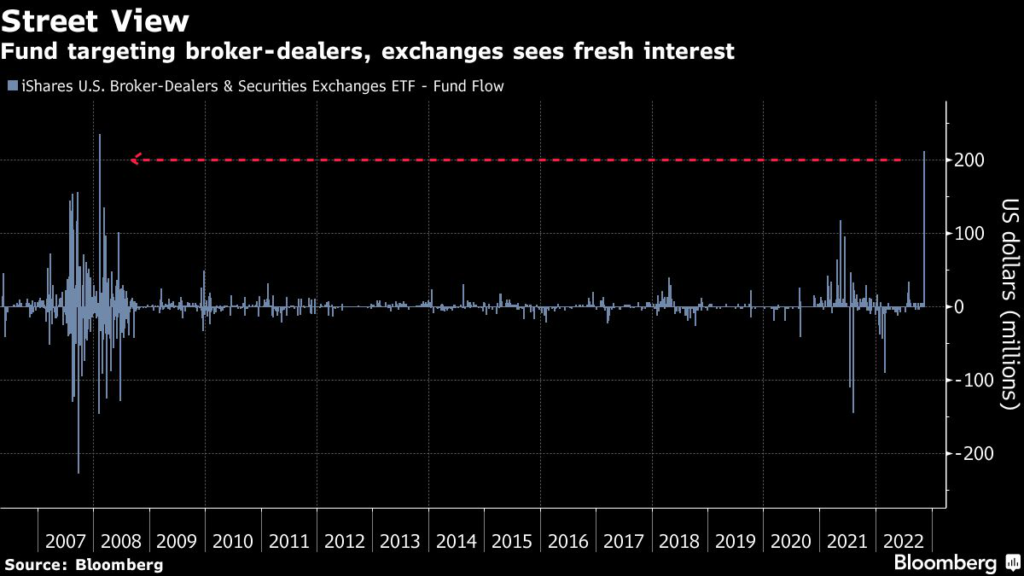
(Bloomberg) — Seemingly out of nowhere, an exchange-traded fund tracking the fortunes of Wall Street has been lavished with its largest inflow since February 2008. 

After months with barely any capital moving in or out, the iShares U.S. Broker-Dealers & Securities Exchanges ETF (ticker IAI) added $211 million on Monday, according to data compiled by Bloomberg. It was the second-best influx since the product launched in 2006, and one of only two inflows of more than $100 million in well over a decade.

Trading data for the fund — which follows an index of investment-service providers as well as securities and commodities exchanges — shows the value of shares changing hands on-exchange was only about $30 million on Monday. That suggests the cash came from an over-the-counter transaction, meaning it could all be one investor.

IAI invests in a range of well-established Wall Street players including the likes of Nasdaq Inc. and Intercontinental Exchange Inc. 

It’s been rallying in recent weeks following strong quarterly earnings from major firms, jumping 25% from this year’s low. That’s trimmed its 2022-to-date loss to about 5.5%, compared with a return of around minus 15% for the S&P 500 Index. 

It’s unclear who was behind the flow. Given that IAI sits on losses this year, and the lack of liquidity in the fund, the flow could theoretically be the first half of a tax trade known as a heartbeat. This involves an unusual large inflow followed by a corresponding outflow in the days following.

A spokesperson for BlackRock Inc., issuer of the fund, declined to comment.

Read more: ETF Tax Dodge Is ‘Dirty Little Secret’ to Escape Capital Gains

Still, IAI shows no obvious history of such trades. Another theory holds that the chaos engulfing crypto following the collapse of digital-asset exchange FTX is burnishing the appeal of old-school Wall Street, according to Todd Rosenbluth, head of research at ETF data provider and research consultant VettaFi.

“The recent downfall within the cryptocurrency markets could spark renewed interest in traditional market trading and provide a boost for investment banks and exchanges,” he said. “IAI provides concentrated exposure to this theme within the financial services sector compared to broader sector-based funds.”

More stories like this are available on bloomberg.com

©2022 Bloomberg L.P.
Tech Boosts Stocks as Data Ease Inflation Concerns: Markets Wrap

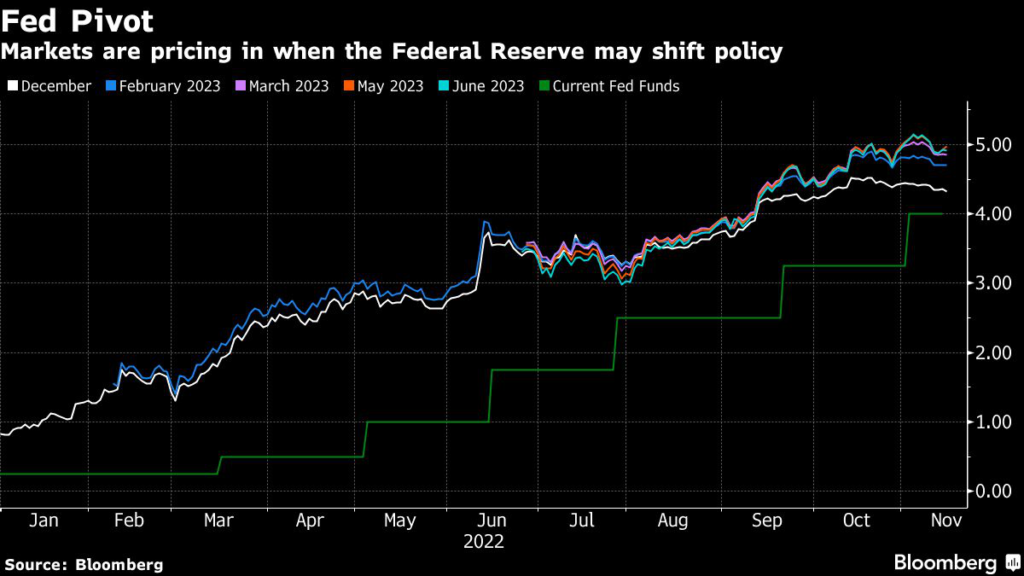
(Bloomberg) — US stocks climbed after producer prices confirmed a slowdown in inflation, strengthening the case for the Federal Reserve to slow its pace of interest-rate hikes. 

The S&P 500 rose as much as 1.8% while the tech-heavy Nasdaq 100 soared as much as 2.8%. Both indexes were buoyed by gains in Apple Inc., Microsoft Corp. and Amazon.com Inc.. Walmart Inc.’s earnings, which topped estimates, also boosted sentiment and lifted stocks. 

Treasuries rallied, with the 10-year yield declining to around 3.80%. The dollar fell and the pound rallied.

Markets have turned risk-on in recent days, trading off a softer-than-expected US CPI data print that many reckon will allow the Fed to raise rates in half-point increments, after consecutive hikes of three-quarters of a percentage point. That view was encouraged by Federal Reserve Bank of Philadelphia President Patrick Harker on Tuesday, who said he expects officials to slow the pace of interest-rate increases. 

Vice Chair Lael Brainard made similar remarks at a Bloomberg event on Monday, even though she emphasized the central bank has “additional work” to do to tame inflation. 

On Tuesday, October producer prices came in at 8% year-on-year, undershooting the 8.3% estimate and further easing inflation concerns. 

“Taken alone, the data today supports the Goldilocks scenario, where growth is holding up very well — per the solid Empire Manufacturing report — but inflation pressures are rapidly easy — per the PPI print,” said Dan Suzuki, deputy chief investment officer at Richard Bernstein Advisors LLC. “I think that supports the ongoing rally that you’ve seen over the past month, but I question where this narrative will hold up in the coming months.”

Meanwhile, Monday’s meeting between President Xi Jinping and Joe Biden generated hopes of warmer ties between the two superpowers. It came after Beijing had announced measures to support China’s beleaguered property sector, and to relax Covid curbs. 

Read: Everything Is Suddenly Falling In Place for Chinese Stocks

Data showing Japan’s economy unexpectedly shrank in the third quarter, as well as softer-than-expected Chinese retail sales figures, highlighted risks for global growth. 


Key events this week:

  • Former US President Donald Trump plans to make an announcement, Tuesday
  • US business inventories, cross-border investment, retail sales, industrial production, Wednesday
  • Fed’s John Williams, Lael Brainard and SEC Chair Gary Gensler speak, Wednesday
  • ECB President Christine Lagarde speaks, Wednesday
  • Eurozone CPI, Thursday
  • US housing starts, initial jobless claims, Thursday
  • Fed’s Neel Kashkari, Loretta Mester speak, Thursday
  • US Conference Board leading index, existing home sales, Friday

Some of the main moves in markets:

Stocks

  • The S&P 500 rose 1.6% as of 10:27 a.m. New York time
  • The Nasdaq 100 rose 2.6%
  • The Dow Jones Industrial Average rose 1%
  • The Stoxx Europe 600 rose 0.3%
  • The MSCI World index fell 0.6%

Currencies

  • The Bloomberg Dollar Spot Index fell 0.5%
  • The euro rose 0.7% to $1.0402
  • The British pound rose 1.4% to $1.1916
  • The Japanese yen rose 0.6% to 139.10 per dollar

Cryptocurrencies

  • Bitcoin rose 3.4% to $16,950.18
  • Ether rose 3.3% to $1,266.7

Bonds

  • The yield on 10-year Treasuries declined six basis points to 3.79%
  • Germany’s 10-year yield declined six basis points to 2.08%
  • Britain’s 10-year yield declined four basis points to 3.33%

Commodities

  • West Texas Intermediate crude fell 0.7% to $85.23 a barrel
  • Gold futures fell 0.1% to $1,774.80 an ounce

This story was produced with the assistance of Bloomberg Automation.

–With assistance from Allegra Catelli, Tassia Sipahutar and Cecile Gutscher.

More stories like this are available on bloomberg.com

©2022 Bloomberg L.P.
Close Bitnami banner
Bitnami