Bloomberg

Twitter Turmoil Sparks ‘Close’ Privacy Scrutiny in EU

(Bloomberg) — Twitter Inc.’s European privacy watchdog said it’s “closely” monitoring the situation after an exodus of key staff including the social-media firm’s data-protection chief in recent days sparked safeguarding fears.

Ireland’s Data Protection Commission commented after an initial meeting Monday to clarify next steps with staff in Dublin, where Twitter — recently taken over by Elon Musk — has its European base.

“We are still engaging” with Twitter, which told regulators it will continue to take decisions on EU users’ data in Dublin, said Graham Doyle, deputy commissioner at the Irish authority. Doyle said the company appointed Renato Monteiro as its acting data protection officer after Damien Kieran departed.

Read More: Musk Warns Twitter Bankruptcy Possible If Cash Burn Lingers

Twitter has seen a dramatic few days since Musk bought the company. He fired around 3,700 of its global workforce, ushered out several executives and ordered the remaining employees to stop working from home.

Twitter didn’t immediately respond to requests for comment on the Irish talks.

The Irish watchdog supervises privacy compliance of some of Silicon Valley’s biggest firms, who have their EU hub in the country, and has probes open against several. The regulator, like all EU watchdogs, had their powers boosted through the General Data Protection Regulation, which allows them to fine companies as much as 4% of annual sales for serious violations of data privacy.

More stories like this are available on bloomberg.com

©2022 Bloomberg L.P.

Meta Loses More Key Executives in India Amid Regulatory Hurdles

(Bloomberg) — Meta Platforms Inc. said on Tuesday it lost two more senior executives in India, days after the firm’s country head quit to join a rival. 

Abhijit Bose, head of WhatsApp in India, and Rajiv Aggarwal, Meta’s public policy director in the country, have resigned, according to an emailed statement by Meta. The resignations come amid heightening regulatory challenges big technology firms face in the country, with Prime Minister Narendra Modi’s government heaping compliance burden on them.   

Meta said the latest exits aren’t linked to the “recent news cycles,” and pledged its commitment to India. The company, which owns WhatsApp, Facebook and Instagram — some of the world’s busiest social media platforms — said earlier this month it would cut more than 11,000 jobs worldwide, equal to about 13% of its workforce, joining a spate of technology companies that have announced job reductions.

WhatsApp hired Bose, the co-founder of mobile payments company Ezetap, in 2018, when the messaging platform was trying to set up a payments business. But New Delhi’s data localization push and misinformation on the platform held back the company’s plans for years. WhatsApp has also taken the Indian government to court over demands it says will break encryption on the messaging service.

Aggarwal, a former bureaucrat in the Indian government, joined Meta’s India unit in late 2021 after leading public policy for Uber in the country for almost two years. Meta promoted Shivnath Thukral, a former journalist, to replace Aggarwal as the director for public policy in India, the statement said. 

More stories like this are available on bloomberg.com

©2022 Bloomberg L.P.

Canada Told It Lacks Means to Track Increasing Arctic Traffic

(Bloomberg) — The Canadian government’s ability to track foreign vessels through the Arctic is woefully inadequate and the situation may get worse, according to a new report by the Auditor General of Canada.

Domestic surveillance of the region is incomplete, data that’s collected is insufficient, and there is no effective way of sharing information on maritime traffic, the watchdog said. Meanwhile, new icebreakers, aircraft, satellites and infrastructure required to fix these problems have been delayed to the point where some equipment likely will be retired before it can be replaced.

“Federal organizations that are responsible for safety and security in the Arctic region do not have a full awareness of maritime activities in Arctic waters and are not ready to respond to increased surveillance requirements,” said the report from Auditor General Karen Hogan.

The Arctic is warming roughly four times as fast as the rest of the world, opening the region to increased traffic for cargo, tourism or military purposes. The number of voyages through Canada’s Arctic more than tripled between 1990 and 2019, the auditor notes, and is expected to continue increasing.  

The report examined five government organizations responsible for surveillance in Arctic waters — the Department of National Defence, the Canadian Coast Guard, Transport Canada, Fisheries and Oceans Canada, and Environment and Climate Change Canada — to determine whether they’re capable of dealing with security and safety risks caused by more vessels.

While the problems have been identified, for the most part, actions haven’t been taken to fix them, the auditor found. 

For example, satellites monitoring Canada’s Arctic territory can’t meet all the federal demands for radar imagery. Those same satellites are expected to reach the end of service long before replacements arrive, Hogan’s report said.

That could leave Canada with limited surveillance capacity “for years,” the report warns, which “would likely increase Canada’s reliance on its allies for surveillance information.”  

Russia’s War Revives Arctic Rivalry in a Setback for Climate

Heightened tensions with Russia after its invasion of Ukraine have put more focus on the Arctic. The US and Canada are cooperating to modernize the North American Aerospace Defence Command. In June, the Canadian government announced C$38.6 billion ($29 billion) in funding over 20 years for new radar stations, aircraft and other infrastructure.

The government is also planning to replace six aging icebreakers that patrol the region. The old ships are expected to start reaching the end of their service lives by 2029; the first new ship was supposed to be delivered by 2030 but will likely be delayed, the report says.

About 75% of Canada’s coastline is in the Arctic — more than 162,000 kilometers (100,660 miles) — making the country the second-largest Arctic nation, after Russia. 

More stories like this are available on bloomberg.com

©2022 Bloomberg L.P.

Arctic Sea Traffic Is Rising. Canada Isn’t Ready for It

(Bloomberg) — The Canadian government’s ability to track foreign vessels through the Arctic is woefully inadequate and the situation may get worse, according to a new report by the Auditor General of Canada.

Domestic surveillance of the region is incomplete, data that’s collected is insufficient, and there is no effective way of sharing information on maritime traffic, the watchdog said. Meanwhile, new icebreakers, aircraft, satellites and infrastructure required to fix these problems have been delayed to the point where some equipment likely will be retired before it can be replaced.

“Federal organizations that are responsible for safety and security in the Arctic region do not have a full awareness of maritime activities in Arctic waters and are not ready to respond to increased surveillance requirements,” said the report from Auditor General Karen Hogan.

The Arctic is warming roughly four times as fast as the rest of the world, opening the region to increased traffic for cargo, tourism or military purposes. The number of voyages through Canada’s Arctic more than tripled between 1990 and 2019, the auditor notes, and is expected to continue increasing.  

The report examined five government organizations responsible for surveillance in Arctic waters — the Department of National Defence, the Canadian Coast Guard, Transport Canada, Fisheries and Oceans Canada, and Environment and Climate Change Canada — to determine whether they’re capable of dealing with security and safety risks caused by more vessels.

While the problems have been identified, for the most part, actions haven’t been taken to fix them, the auditor found. 

For example, satellites monitoring Canada’s Arctic territory can’t meet all the federal demands for radar imagery. Those same satellites are expected to reach the end of service long before replacements arrive, Hogan’s report said.

That could leave Canada with limited surveillance capacity “for years,” the report warns, which “would likely increase Canada’s reliance on its allies for surveillance information.”  

Russia’s War Revives Arctic Rivalry in a Setback for Climate

Heightened tensions with Russia after its invasion of Ukraine have put more focus on the Arctic. The US and Canada are cooperating to modernize the North American Aerospace Defence Command. In June, the Canadian government announced C$38.6 billion ($29 billion) in funding over 20 years for new radar stations, aircraft and other infrastructure.

The government is also planning to replace six aging icebreakers that patrol the region. The old ships are expected to start reaching the end of their service lives by 2029; the first new ship was supposed to be delivered by 2030 but will likely be delayed, the report says.

About 75% of Canada’s coastline is in the Arctic — more than 162,000 kilometers (100,660 miles) — making the country the second-largest Arctic nation, after Russia. 

More stories like this are available on bloomberg.com

©2022 Bloomberg L.P.

Learning from Losing: Toto Wolff’s F1 Playbook Built to Rebound

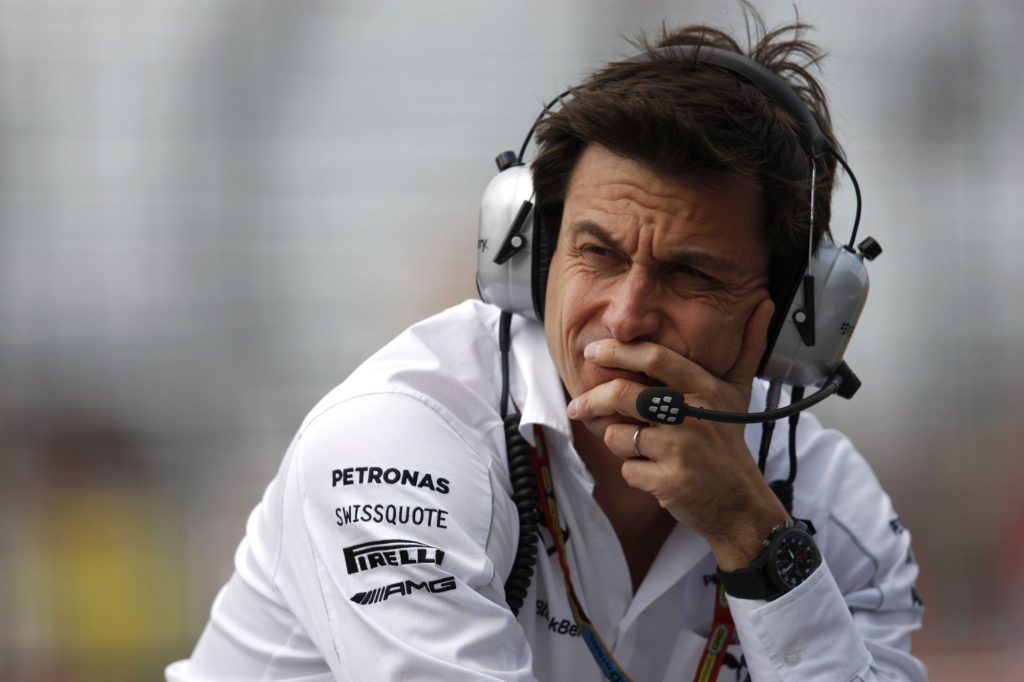
(Bloomberg) — Toto Wolff has reached selfie fame.

The co-owner, chief executive officer and team principal of the Mercedes-AMG Petronas Formula 1 team doesn’t drive cars on a racetrack anymore, at least not professionally. Yet owing to the exploding popularity of the F1 circuit, and a star turn on Netflix Inc.’s hit documentary series Drive to Survive, the 50-year-old Austrian has turned into a head-turning celebrity across the sports world.

Winning helps. During the past decade, Wolff oversaw one of the most remarkable streaks in professional sports history as his team racked up eight straight team titles and his star driver, Lewis Hamilton, won seven individual championships. That run came to an abrupt end over the past year, and now Wolff is betting his playbook can get him and Mercedes back to the podium.

“The weekends or the races we lose are the ones that our competitors will regret the most because we learn the most,” Wolff said in a series of interviews in Austin, Monaco and England for the latest episode of Bloomberg’s “Business of Sports” docuseries. “It’s going to make us better.”

Formula 1 has gone from an afterthought for US fans — something to watch when no football, basketball, baseball, hockey or soccer game is on — to a sport that commands weekend afternoon coverage on ESPN.

In the US, Formula 1 is already rivaling homegrown IndyCar racing — not the same as F1, despite appearances — and Nascar, which is still the most popular of the three. This year’s US Grand Prix, at Austin’s Circuit of the Americas, drew 440,000 fans, the most of any of the 22 races around the world.

Wolff, who started as a driver before turning to investments and, ultimately, the business of racing, has been an architect and beneficiary of that success, which he credits in part to the ownership of Liberty Media Corp., which bought Formula 1 in 2017 for $4.4 billion.

‘Massive Upswing’

“Although we were skeptical at the beginning, that’s where we really started to have this massive upswing,” Wolff said. “Together with the governing body, the FIA, we were able to put on a show during Covid that was the only global sport and it obviously helped a lot.”

The pandemic is also when viewers got their first look at Drive to Survive, which took them deep into the drama among drivers and their teams, including the principals. Mercedes and Wolff were absent from the first season by choice — Wolff didn’t see the value. He signed up for season two.

Liberty always saw massive potential for Formula 1 in the US, and Netflix provided evidence. The circuit put on a grand prix in Miami in May, drawing 330,000 fans, and next year will hold the Las Vegas Grand Prix on a street course that will see cars fly down the Strip at 200-plus miles per hour at night. 

“We had the opportunity to really take Formula 1 to the next level in the United States through the explosion of popularity through Netflix, as well as Americans beginning to embrace the sport more,” said Renee Wilm, the chief legal officer and chief administrative officer of Liberty Media who is also serving as the CEO of the Las Vegas Grand Prix. “The timing was absolutely right.”

Vegas Grand Prix

Formula 1 and Liberty have more at stake in Las Vegas because the circuit will act as the promoter for the new grand prix, giving it both more potential upside and more financial risk. Across the rest of the calendar, Formula 1 works with local promoters who buy the right to host the race and shoulder infrastructure and promotion costs.

“We said: ‘OK, now it’s time to think bigger,’” Stefano Domenicali, CEO of Formula 1, said in an interview. “We took the decision to go for it, to invest and buy a property here.”

All of that accrues to the benefit of the drivers and their teams. Wolff is uniquely positioned to benefit, since he is essentially the coach, the business head and the owner.

Wolff’s precision and success managing Mercedes inspired a Harvard Business School case study, written by Anita Elberse, who teaches about the intersection of sports, entertainment, media and business. Wolff visited the campus this year to participate in a discussion and walked out of the class to fans waiting outside to catch a glimpse.

Lagging Redesign 

A season of discontent for Mercedes followed, though.

New regulations by the sport’s governing body required each team to redesign its car. Wolff’s team came up with a design that failed to keep pace with its rivals, especially Red Bull. Max Verstappen secured his second-straight drivers’ championship with several races to spare, and Red Bull captured the Constructors’ Championship, the team prize Mercedes had won for the previous eight seasons.

“The winning streak has definitely come to an end and I’m sure it’s been a really tough year for everyone at Mercedes,” Elberse said in an interview. “But what goes to the very heart of why they are so successful is this idea of realizing that losing is always just around the corner, that the winning at some point will have to end.”

With the sport growing so fast in the US, sponsorships continue to pour in, though not without some risk. Mercedes said last week it was suspending its relationship with FTX, shortly before the cryptocurrency exchange filed for bankruptcy. The team removed FTX’s logo from the cars ahead of the Brazilian Grand Prix on Sunday.

Abu Dhabi Next

The Sao Paulo race, the penultimate of the season, produced the best result of the year for Mercedes, with George Russell winning his first-ever Grand Prix and Hamilton coming in second. That pushed Mercedes within striking distance, behind Ferrari, for second place in the team championship with only one event to go, this coming weekend in Abu Dhabi.

As Wolff looks ahead to a critical off-season, where Mercedes designers and engineers will aim to create a car to start a new winning streak, he said he’s trying to remember that while science will help drive decisions, he’s ultimately managing people.

“The joint objective is so massive that we just need to remind ourselves in these moments that we just want the same,” he said. “So we just need to get together and say, what is it that we want to do? And at the end, data are important to develop a quick car, but data don’t make decisions. Humans do, right?”

More stories like this are available on bloomberg.com

©2022 Bloomberg L.P.

Nvidia’s Rebound Hides Tough Reality for Chipmakers

(Bloomberg) — US semiconductor stocks have come roaring back over the past month, and the largest of them — Nvidia Corp. — has led the charge. Even some bulls on the company say the rally may not have much further to run. 

Nvidia’s third-quarter results late Wednesday are likely to show that demand for electronics is still drying up, with analysts predicting an 18% drop in sales. Yet the stock, at 39 times estimated earnings, is still priced for a much better environment, at a time when the global economy appears to be heading for recession. 

“It’s the worst of all worlds, because the rate of revenue growth is declining, macro fundamentals are deteriorating, and the valuation is still exceptionally high,” said James Abate, chief investment officer at Centre Asset Management. “If we do go into a recession, which I think we will, the next stage will be a deterioration in earnings, and it would not be abnormal to see further weakness in Nvidia.”

Abate owns Nvidia but has been trimming his position in the stock, which has risen nearly 50% from its mid-October low. It’s still down by 43% for the year. The stock rose 2.9% on Tuesday, supported by the latest data on producer prices, as well as signs of improving China-US relations.

Plenty of investors are betting that this year’s bear market in tech stocks has run its course: Regulatory filings this week showed that Warren Buffett’s Berkshire Hathaway Inc. took a stake of about $5 billion in Taiwan Semiconductor Manufacturing Co., which makes chips for Nvidia among others. 

The bull case is that the Federal Reserve will slow the pace of interest rate increases as inflation gradually cools off, allowing the economy to dodge a recession. In that scenario, investors can look ahead to an imminent rebound in tech demand. 

Nvidia is a bellwether in all this because it’s the largest component of the Philadelphia Stock Exchange Semiconductor Index by market value, and a leader in the key market for data-center chips. It’s long been a favorite of institutional investors because of its record: In the decade leading to their peak a year ago, Nvidia shares returned 58% annually, far outpacing Apple Inc., Microsoft Corp. or Amazon.com Inc.

Yet there’s still no evidence the worst has passed. Delivery times for semiconductors shrank by six days in October, the biggest drop since 2016, while Morgan Stanley wrote that the latest industry data showed weakness across product categories. Texas Instruments Inc., Qualcomm Inc., and Intel Corp. all issued cautious forecasts in their results this earnings season, as Nvidia did last quarter. 

Geopolitical concerns have also weighed on the stock, given US restrictions on China’s access to semiconductor technology, though Nvidia is producing a processor that conforms to the regulations.

Analysts have been slashing their estimates on the sector, and Nvidia hasn’t been spared. The average estimate for the company’s 2023 earnings has dropped 16% over the past three months while the consensus for revenue is down 11%. Revenue growth is expected to be barely positive in 2023.

Yet the stock, at 39 times earnings, is a third more expensive than its average for the past decade, and sells for more double the multiple of the semiconductor index. 

Analysts do forecast that Nvidia will return to double-digit growth in 2024. That expected rebound is a reason why they remain largely positive on Nvidia’s long-term prospects. Citigroup Inc. says the stock is “close to a bottom,” with data-center sales likely to trough in the first quarter, while Morgan Stanley also sees the business bottoming.

Some longtime bulls on the stock are, like Abate, hedging their bets. Funds run by Cathie Wood’s ARK Investment Management LLC — which have held the stock since the firm began operating in 2014 — have been paring their stakes in recent weeks.

Tech Chart of the Day

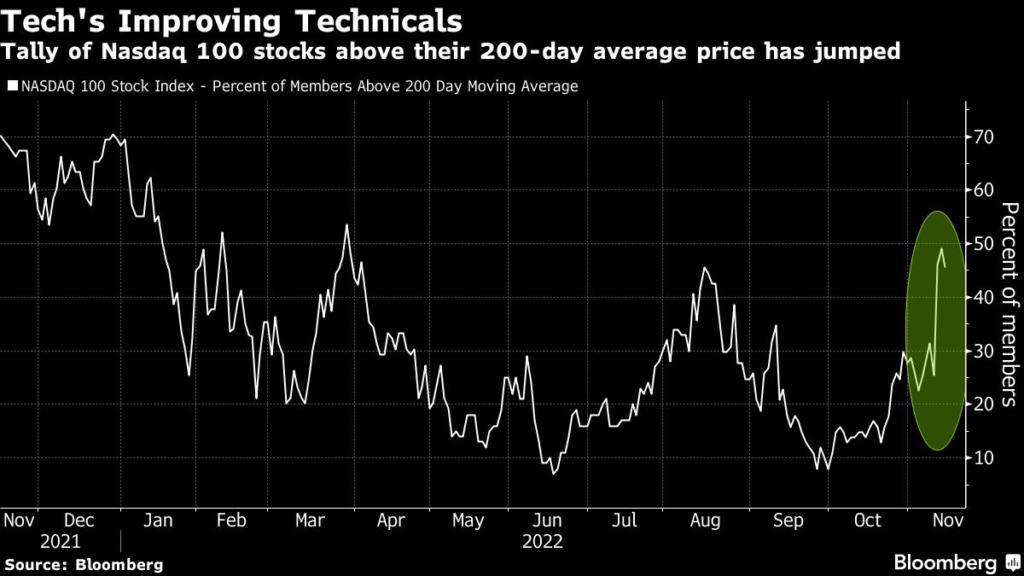
The Nasdaq 100 Index last week posted its biggest weekly gain since November 2020, and the advance has it looking much stronger on a technical level. On Friday almost half the index’s components were above their 200-day moving average price, the highest percentage since March, and up from about 8% in late September. Over the past year, an average of 32% of components have been above this closely watched technical level.

Top Tech Stories

  • Amazon.com plans to cut about 10,000 jobs, the largest ever headcount reduction at the e-commerce giant as it braces for slower growth and a possible recession.
  • Apple is trying to spur Mac sales with a rare promotional deal for small businesses that buy computers in bulk, an effort to cope with a slowdown during the holiday quarter.
  • Warren Buffett’s Berkshire Hathaway Inc. took a stake of about $5 billion in Taiwan Semiconductor Manufacturing Co., a sign the legendary investor thinks the world’s leading chipmaker has bottomed out after a selloff of more than $250 billion.
  • ASML Holding NV may conduct acquisitions to meet soaring demand for advanced chips worldwide, its chief executive officer said, defying the broader sector downturn.
  • Twitter Inc. owner Elon Musk, who has called himself a “free speech absolutist,” has resorted to firing company engineers who publicly criticize him on the social-media service.
  • Samsung Electronics Co. said the global technology industry is in search of alternative sources for advanced semiconductors given rising political risks.
  • A group of small tech companies, which compete with Alphabet Inc.’s Google, Amazon, Apple and Meta Platforms Inc., this week will launch an advertising campaign urging lawmakers to pass landmark legislation that would diminish the power of the country’s largest internet giants.
  • Sea Ltd. has cut about 7,000 jobs, or roughly 10% of its workforce, in the past six months as it fights to stem ballooning losses and win back investors, according to a person familiar with the matter.

–With assistance from Subrat Patnaik.

(Updates to market open.)

More stories like this are available on bloomberg.com

©2022 Bloomberg L.P.

FTX Latest: Scaramucci Says Zhao Likely Sold FTT in Retaliation

(Bloomberg) — Binance Chief Executive Officer Changpeng “CZ” Zhao’s decision to sell a big holding of FTX.com’s native crypto token FTT appears to have been an act of retaliation for remarks FTX founder Sam Bankman-Fried made about him, SkyBridge Capital founder Anthony Scaramucci said. 

FTX Group named a slate of new independent directors to oversee the collapsed crypto empire and said its bankruptcy may involve more than a million creditors.

Bitcoin rose Tuesday to close to $17,000, providing some respite from a damaging selloff triggered by the FTX crisis. Investors are awaiting details about a crypto recovery fund promised by Zhao.

Key stories and developments:

  • FTX Talking With ‘Dozens’ of Regulatory Agencies, Taps Directors
  • Binance’s Billionaire CEO Casts Himself as Crypto’s New Savior
  • Sam Bankman-Fried’s Magic Money Box Enriched Vast Crypto Network
  • Scaramucci Says His Due Diligence on Bankman-Fried ‘Not Enough’

(Time references are New York unless otherwise stated.)

Scaramucci: Zhao’s Sale of FTT Tokens Likely in Retaliation (9:28 a.m)

Scaramucci, in whose company FTX owns a 30% stake, accompanied Bankman-Fried on a recent fundraising trip to the Middle East, he said at the Bloomberg New Economy Forum on Tuesday. During some of those meetings, Bankman-Fried appears to have made unspecified remarks about Zhao, Scaramucci said.  

“I think what happened frankly is he said something about CZ, the founder of Binance, in possibly one or two of those meetings, that got back to CZ and he got super upset about it,” Scaramucci said. He said ‘OK, we are in a divorce, we are not gonna make love,’ that was the Twitter comment. He hit him with $500 million worth of FTT tokens.”

After Zhao’s Nov. 6 tweet announcing the sale of FTT tokens worth roughly $530 million at the time, concerns around FTX’s financial health spiraled into a panic and clients yanked some $5 billion from the platform in a day. FTX quickly unraveled, filing for bankruptcy last week. 

“FTX’s problems arose from mismanagement of their user funds and their highly leveraged business,” a Binance spokesperson said in an emailed response to questions about Scaramucci’s remarks. Binance decided to sell its holding of FTT after a Nov. 2 CoinDesk article called into question the health of the balance sheet of Alameda Research, Bankman-Fried’s trading house, the spokesperson said. 

“CZ’s tweet came only after the community asked questions about the movement of a large amount of FTT which is transparent on the public blockchain,” the Binance spokesperson said. A representative for FTX didn’t immediately reply to a request for comment. 

Binance will submit evidence to UK lawmakers on its decision making around the sale of FTT, Daniel Trinder, the company’s vice president of government affairs in Europe, said at a hearing with the UK Parliament’s Treasury Committee on Monday. 

Scaramucci Says His Due Diligence on Bankman-Fried ‘Not Enough’ (Tuesday, 5:05 p.m. Hong Kong)

Anthony Scaramucci, whose SkyBridge Capital was caught up in the implosion of FTX.com, said he did a thorough background check on its founder Sam Bankman-Fried, but it wasn’t enough to protect himself from “misrepresentations.”

“I was doing a lot of due diligence on him, but clearly not enough,” Scaramucci said at the Bloomberg New Economy Forum on Tuesday. He added that FTX’s stake in SkyBridge can’t be transferred to anybody “without my permission.”

Binance to Submit Evidence on FTX Deal (Tuesday, 4:20 p.m. Hong Kong)

Binance said it will submit evidence to UK lawmakers regarding discussions held about FTX.com when the two were in deal talks, as well as on its decision-making around the sale of FTX.com’s native token FTT.

Daniel Trinder, Binance’s vice president of government affairs in Europe, said the company would provide the information to members of the UK Parliament’s Treasury Committee as part of the crypto exchange’s appearance as a witness in a cryptoasset inquiry. 

Trinder was grilled by lawmakers on Monday over the firm’s decision to announce a planned sale of more than $500 million in FTT on Nov. 6 — a move that caused trading volumes for the token to spike to their highest in more than a year. It was also part of the chain of events that led to FTX eventually filing for bankruptcy.

Sam Bankman-Fried Posts Cryptic Tweets (Tuesday, 2:05 p.m. Hong Kong)

Former FTX chief Sam Bankman-Fried in a series of cryptic tweets over the last 24 hours spelled out the words “What HAPPENED.” He finished with the message: “NOT LEGAL ADVICE. NOT FINANCIAL ADVICE. THIS IS ALL AS I REMEMBER IT, BUT MY MEMORY MIGHT BE FAULTY IN PARTS.”

The bizarre sequence sparked hot debate — and not a little anger — on Twitter as users tried to second guess what would come next.

FTX Talking With ‘Dozens’ of Regulatory Agencies (Tuesday, 1:10 p.m. Hong Kong)

FTX Group named a slate of new independent directors to oversee the collapsed crypto empire and is speaking with the US Attorney’s Office and “dozens” of US and international regulatory agencies, according to new bankruptcy court papers. 

“Questions arose about Mr. Bankman-Fried’s leadership and the handling of FTX’s complex array of assets and businesses under his direction,” lawyers for the crypto company wrote. FTX plunged into bankruptcy court after facing “a severe liquidity crisis that necessitated the filing of these cases on an emergency basis.”

Binance CEO: ‘No One Can Protect a Bad Player’ (Monday, 6:06 p.m. Hong Kong) 

Speaking at the B20 Summit in Indonesia, Binance Holdings Ltd Chief Executive Officer Changpeng “CZ” Zhao pledged to launch a fund to help crypto markets recover from FTX’s collapse. He singled out people he described as bad actors in the crypto space who “try to cut corners to grow quickly,” and called on industry leaders to “set strong standards” in volatile digital markets. 

Zhao, who briefly entertained plans to buy the struggling exchange before backing out a day later, exhorted his crypto counterparts to behave better. “No one can protect a bad player,” he said.    

FTX’s Japan Branch Assesses Client Damage (Monday, 5:33 p.m. Hong Kong) 

FTX Japan K.K., the Japanese subsidiary of Sam Bankman-Fried’s failed digital asset exchange, is investigating whether its parent company’s bankruptcy will affect its ability to return crypto holdings to regional clients. Last week, the unit was ordered to suspend some of its operations as regulators assessed the wreckage of the FTX collapse. 

A company spokesman said that FTX Japan will make a statement once the situation is clearer. As of Nov. 10, FTX Japan held about 19.6 billion yen ($140 million) in cash and deposits. 

Singapore Central Bank Says FTX Wasn’t Licensed in the City-State (Monday, 2:40 p.m. Hong Kong)

Singapore’s central bank said that while bankrupt crypto exchange FTX doesn’t have a license to operate in the city-state, it’s not possible to prevent local users from “directly accessing” overseas service providers. 

As a result, FTX was “able to onboard Singapore users,” a spokesperson at the Monetary Authority of Singapore said in an emailed statement to Bloomberg News on Monday. “MAS has consistently reminded the public of the risks of dealing with unlicensed entities,” the spokesperson said in the statement. 

More stories like this are available on bloomberg.com

©2022 Bloomberg L.P.

Bahamas Court Appoints PwC Partners Liquidators in FTX Collapse

(Bloomberg) — The Supreme Court of the Bahamas approved partners from PricewaterhouseCoopers, also known as PwC, as provisional liquidators to oversee the assets of crypto exchange FTX.

The Bahamas Securities Commission wrote in a statement that it “moved swiftly to use its regulatory powers” to further protect clients. Sam Bankman-Fried’s FTX empire filed for Chapter 11 bankruptcy in Delaware on Friday. FTX is registered in the Bahamas. 

“Over the coming days and weeks, the Commission expects to engage with other supervisory authorities on a regulator-to-regulator basis as this event is multijurisdictional in nature,” the Securities Commission press release said. 

The Bahamian police said Sunday they are working with the country’s Securities Commission to investigate whether there was any criminal misconduct in the collapse of FTX. 

Read more: FTX Latest: Bankruptcy May Involve More Than a Million Creditors

For crypto market prices: CRYP; for top crypto news: TOP CRYPTO.


More stories like this are available on bloomberg.com

©2022 Bloomberg L.P.

PwC Partners to Oversee FTX Assets as Court Appointed Liquidators

(Bloomberg) — The Supreme Court of the Bahamas approved partners from PricewaterhouseCoopers, also known as PwC, as provisional liquidators to oversee the assets of crypto exchange FTX.

The Bahamas Securities Commission wrote in a statement that it “moved swiftly to use its regulatory powers” to further protect clients. Sam Bankman-Fried’s FTX empire filed for Chapter 11 bankruptcy in Delaware on Friday. FTX is registered in the Bahamas. 

“Over the coming days and weeks, the Commission expects to engage with other supervisory authorities on a regulator-to-regulator basis as this event is multijurisdictional in nature,” the Securities Commission press release said. 

The Bahamian police said Sunday they are working with the country’s Securities Commission to investigate whether there was any criminal misconduct in the collapse of FTX. 

Read more: FTX Latest: Bankruptcy May Involve More Than a Million Creditors

For crypto market prices: CRYP; for top crypto news: TOP CRYPTO.


More stories like this are available on bloomberg.com

©2022 Bloomberg L.P.

EU Monitoring FTX Collapse With Major Crypto Law in Final Stages

(Bloomberg) — The European Union is monitoring the collapse of crypto exchange FTX Group as the bloc tries to cross the finish line on adopting a broader set of regulations for digital assets.

The bloc is examining whether the crisis has any consequences for the single market, according to an EU official, who spoke on the condition of anonymity.

The FTX unraveling, which led to its bankruptcy filing and lopped about $200 billion off crypto market value in the last week, is occurring as the EU is about to implement new legislation on supervision of cryptoasset service providers. The measure will also add consumer protection and environmental safeguards for cryptoassets, including digital currencies like Bitcoin and Ether. 

After the EU reached a provisional agreement in June on its landmark Markets in Cryptoassets, or MiCA, directive, work has been undergoing legal review and translation into the various EU languages. It will then go to the European Parliament for the final vote, expected in February, before being adopted by the bloc’s 27 member states. 

There won’t be any immediate consequences from FTX’s collapse on the path of MiCA’s adoption, as the remaining steps are procedural, not political, another EU official said. 

FTX Europe originally gained its license in Cyprus two months ago after acquiring a local business earlier this year, a move which permitted it to operate its services across the EU, Norway, Lichtenstein and Iceland. That license was suspended on Nov. 11 hours after the company’s bankruptcy filing.

FTX Collapse Leaves Power Vacuum on Push for US Regulation

MiCA is intended to bring the unregulated cryptoasset market under a financial-services regulatory framework, help root out bad actors, prevent market abuse, and limit the risks to consumers and market integrity, the first EU official said. 

MiCA will also address risks of market manipulation and theft of cryptoassets stemming from providers having inadequate IT security procedures and systems in place. FTX experienced a series of unauthorized withdrawals on Nov. 11 as it moved some funds to other wallets owned by the exchange, with the total size of the theft amounting to more than $475 million.

But there are still questions about whether the legislation is strong enough or whether the EU and its member states can marshal the necessary expertise to enforce it.

“Even though MiCA is finalized, we still foresee multiple ways FTX’s crash will have an indirect and longer-term effect on crypto regulation and its application,” Marina Markezic, a co-founder of the Brussels-based European Crypto Initiative advocacy group, said in a statement.

First presented in 2020, MiCA went through several iterations, with some proving more controversial than others. An earlier draft of the legislation included a clause that sought to effectively ban Bitcoin and other cryptocurrencies created using the energy-intensive proof-of-work mining process, but it was later scrapped following major industry backlash.

–With assistance from Emily Nicolle.

More stories like this are available on bloomberg.com

©2022 Bloomberg L.P.
Close Bitnami banner
Bitnami