
Bloomberg

FTX Wrangles More Than a Million Creditors Amid Chaotic Collapse

(Bloomberg) — The team of restructuring experts that took control of Sam Bankman-Fried’s failed crypto empire are engaged with “dozens” of regulatory authorities around the world as they rush to secure customer accounts and begin to engage with creditors that are likely to exceed a million people, according to bankruptcy court filings.

The documents, while still sparse in detail, offer the first official glimpse into what’s been happening inside FTX and its trading arm, Alameda Research, in the four days since a restructuring lawyer took charge and ushered the companies into bankruptcy court.

John J. Ray III, who replaced Bankman-Fried in the early morning hours of Nov. 11, appointed five men, including a former federal judge, as independent directors of FTX, Alameda and three other main entities.

“Questions arose about Mr. Bankman-Fried’s leadership and the handling of FTX’s complex array of assets and businesses under his direction,” lawyers for the crypto company wrote in the filings, adding that Bankman-Fried agreed to step aside from the company at 4:30 a.m. local time on Nov. 11. 

The companies plunged into bankruptcy court hours later after facing “a severe liquidity crisis,” according to the filing.


A team of external advisers that include lawyers and restructuring experts at law firm Sullivan & Cromwell and Alvarez & Marsal began moving customer accounts into so-called cold wallets and responding to a Nov. 11 hack that the company has said led to unauthorized withdrawals, the lawyers wrote.

Ray, who oversaw the liquidation of Enron, appointed former US District Court Judge Joseph J. Farnan Jr. as lead independent director, overseeing FTX Trading Ltd.

Given the volume of creditors in the case, FTX lawyers are asking US Bankruptcy Court Judge John Dorsey for flexibility on bankruptcy rules that usually require contact via physical addresses. Instead, they are seeking permission to use email customer email addresses. The lawyers said they plan to file a list of FTX’s 50-largest creditors by Nov. 18.

In the last three days, FTX representatives have been in contact with authorities that also include the US Securities and Exchange Commission and the Commodity Futures Trading Commission, according to the filing. 

Other independent directors appointed include:

  • Matthew A. Doheny at FTX Trading Ltd.
  • Mitchell I. Sonkin at West Realm Shires Inc.
  • Matthew R. Rosenberg at Alameda Research LLC
  • Rishi Jain at Clifton Bay Investments LLC

–With assistance from Steven Church.

(Updates with details from bankruptcy court documents throughout story.)

More stories like this are available on bloomberg.com

©2022 Bloomberg L.P.
Singapore’s Sea Has Smaller-Than-Expected Loss on Cost Cuts

(Bloomberg) — Sea Ltd.’s quarterly loss swelled less than analysts had estimated, helped by measures to curtail expenses as the Singapore online company’s growth slows.

The adjusted loss before interest, taxes, depreciation and amortization widened to $357.7 million from $165.5 million a year ago, the company said Tuesday. Analysts had estimated $457.4 million on average. The net loss amounted to about $569 million, little changed from a year earlier.

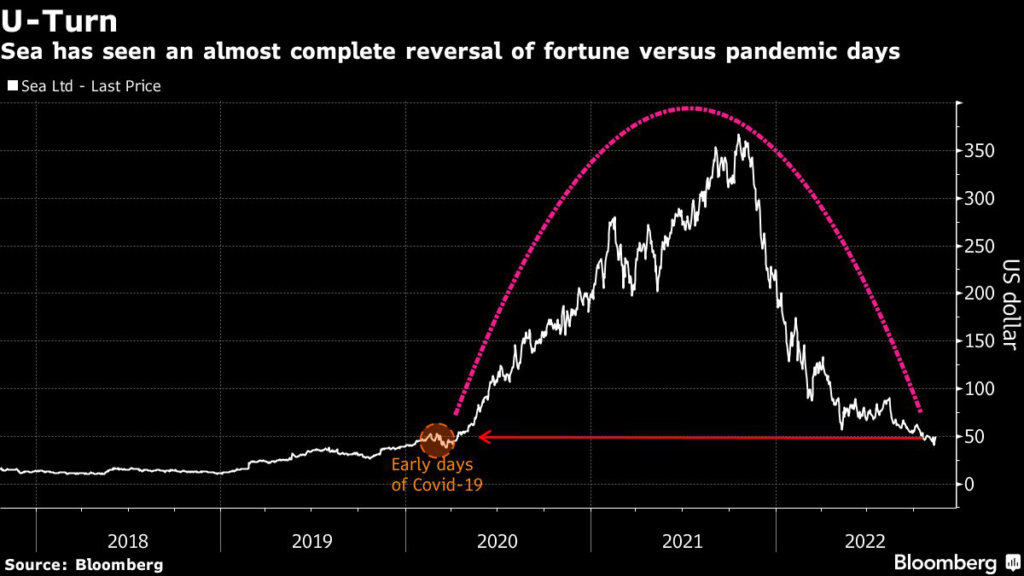
The gaming and e-commerce company and regional tech peers Grab Holdings Ltd. and GoTo Group — all of which are loss-making — have seen their stock prices plummet this year as they navigate an economic slowdown, rising interest rates and accelerating inflation. The slowing growth in Southeast Asia’s internet economy shows that even emerging digital markets aren’t immune to economic headwinds.

Fall of the World’s Hottest Stock Cost Sea Founders $32 Billion

To navigate a more challenging market, Sea has cut about 7,000 jobs, or roughly 10% of its workforce, in the past six months, according to a person familiar with the matter. It has also shuttered operations in India and some European and Latin American markets in a bid to trim costs and reach positive cash flows. Headcount reduction is an “ongoing exercise,” Chief Corporate Officer Yanjun Wang said on a conference call, signaling more cuts may be in the works.

Shares of the company advanced 20% in trading before US markets opened. The stock had plunged 80% this year in New York through Monday.

Sea, Southeast Asia’s largest tech company, cut its full-year forecast for digital-entertainment arm Garena’s bookings to between $2.6 billion and $2.8 billion from its previous guidance of $2.9 billion to $3.1 billion, set to be its first annual decline ever. It said it isn’t providing financial guidance for 2023, but added it’s “working towards” adjusted Ebitda breakeven for online-shopping arm Shopee by the end of next year.

Total revenue rose 17% to $3.2 billion in the September quarter. Revenue from Garena tumbled 19% to $893 million, the biggest year-on-year drop ever, reflecting waning popularity of hit mobile game Free Fire. Sales at Shopee climbed 32% to $1.9 billion.

–With assistance from Abhishek Vishnoi.

(Updates with pre-market trading in fifth paragraph)

More stories like this are available on bloomberg.com

©2022 Bloomberg L.P.
Druckenmiller Reloads on Amazon, BlueCrest Bolsters Gold Bet

(Bloomberg) — Stanley Druckenmiller’s Duquesne Family Office reloaded on Amazon.com Inc., adding a $102 million position in the third quarter after selling its entire $199 million stake in the prior three-month period.

Duquesne continued to scale back its stake in Microsoft Corp., according to the firm’s 13F filing Monday. Other new positions include about $30 million of Sea Ltd., the maker of battle royale game Free Fire whose stock tumbled 75% this year through the third quarter, and $22 million of Meta Platforms Inc.

Family offices, the investment firms of the ultra-rich, took different approaches in the third quarter, which was rife with volatility. From June 30 to Aug. 16, the S&P 500 Index gained almost 16%, only to fall 17% from then to the end of September as Federal Reserve Chair Jerome Powell indicated the central bank would still raise interest rates aggressively.

At BlueCrest Capital Management, Michael Platt’s investment firm, there was an increase in stocks tied to commodities, with the purchase of more than 1 million of the SPDR Gold Shares, making it the largest disclosed holding. It also raised wagers on Matador Resources Co. and Chord Energy Corp. as part of increased exposure to energy and materials companies.

BlueCrest’s US equity holdings totaled almost $1 billion at the end of the quarter, a fraction of its overall bets, but a rare glimpse into a secretive firm that runs money for Platt and his partners. The firm is up 114% this year benefiting from bonds and commodities trading.

Read: Michael Platt’s BlueCrest Set for Record Year With 114% Gain

BlueCrest has been on a hiring spree to bolster its team of traders, adding a slew of commodities specialists this year, including Amir Ravan, who was previously head of Goldman Sachs Group Inc.’s precious-metals trading division. 

Soros Fund Management boosted its stake in Biohaven Pharmaceutical Holding Company Ltd. to $336 million, while taking a new $81 million position in Chemocentryx Inc. The firm, with almost $5 billion in US equities, still holds a small $24 million position in Elon Musk’s Tesla Inc., which it added in the second quarter.

Iconiq Capital, a multifamily office which has served high-profile Silicon Valley clients like Mark Zuckerberg, Sheryl Sandberg, Jack Dorsey and Reid Hoffman, reduced its stake in DoorDash Inc., after reporting a new $275 million position in the company in the prior three-month period. It also sold 3 million shares of Snowflake Inc., though the company remains its biggest single holding.

David Tepper’s Appaloosa Management didn’t add any new stocks in the third quarter, though it shed its entire positions in Kohl’s Corp., Occidental Petroleum Corp. and Micron Technology Inc.

Blue Pool Capital, which manages part of the fortunes of Alibaba Group Holding Ltd. co-founders Joe Tsai and Jack Ma, had only Blue Owl Capital in its US equities portfolio as of June 30. While it still makes up the overwhelming majority of its holdings, the firm also added stakes in Charter Communications Inc., AT&T Inc., Intel Corp. and Adobe Inc. in the following three months.

The investment firm that manages the Walton family’s fortune decreased its holdings in emerging-market funds. The asset class has been pummeled this year, with the MSCI Emerging Markets Index down 24% since Dec. 31.

SEC rules require investors who manage more than $100 million in US equities to disclose their holdings quarterly, with some exceptions granted to family offices upon appeal.

(Updates with BlueCrest investments in fourth paragraph.)

More stories like this are available on bloomberg.com

©2022 Bloomberg L.P.
Cathie Wood Buys the Dip in Bitcoin Fund as Discount Hits Record

(Bloomberg) — The Grayscale Bitcoin Trust’s record discount to assets has finally got too much for Cathie Wood to ignore.

Ark Investment Management snapped up more than 315,000 shares worth roughly $2.8 million of the beleaguered crypto fund on Monday for the ARK Next Generation Internet exchange-traded fund (ticker ARKW), Bloomberg data show. That’s the firm’s first purchase of the Grayscale product (ticker GBTC) since July 2021, according to website Ark Invest Daily Trades, which tracks the firm’s portfolio moves.

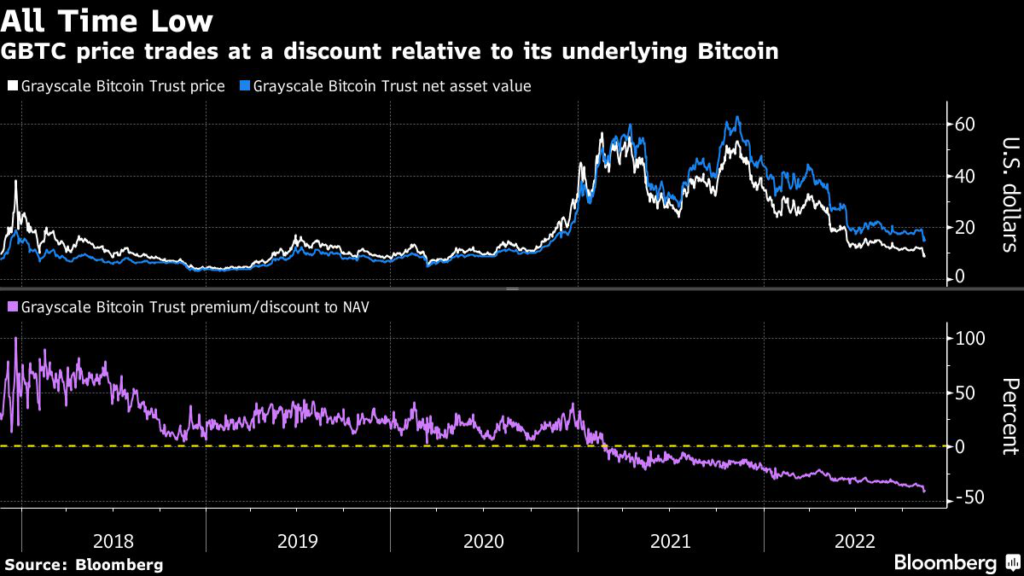
Wood’s purchases come as the trust, which is solely invested in Bitcoin and meant to track its price, has languished near an unprecedented discount relative to the value of its underlying cryptocurrency. The dislocation is a product of the fund’s structure, which doesn’t allow for redemptions, meaning that shares can’t be destroyed to keep pace with shifting demand. That dynamic has widened GBTC’s gap dramatically in the past week, as fallout from crypto exchange FTX’s shock Chapter 11 bankruptcy filing drags Bitcoin lower.

GBTC is the ninth largest holding in ARKW, which has held shares of the trust since late 2015. 

While long-term holders of the $10 billion Bitcoin fund have been punished by the discount — the trust has surged nearly 1,200% since the start of 2016, compared to Bitcoin’s meteoric 3,700% rise — the dislocation could also be seen as an opportunity. 

Buying GBTC at a 40% discount to its net-asset value is akin to buying Bitcoin near $11,000, versus its current price of $16,400, according to Bloomberg Intelligence.

More stories like this are available on bloomberg.com

©2022 Bloomberg L.P.

Amazon Starts Virtual Health Referral Service Linking Patients to Doctors

(Bloomberg) — Amazon.com Inc. is starting a health referral service that seeks to link patients to virtual visits with providers who treat conditions like acne, hair loss and allergies. 

The initiative, called Amazon Clinic, is the Seattle company’s latest effort to break into health care. It already operates an online pharmacy, and is in the process of buying 1Life Healthcare Inc., which manages clinics under the One Medical brand, for $3.49 billion. 

In a blog post announcing the service on Tuesday, Amazon called the new clinic a “virtual health storefront,” connecting patients to “award-winning telehealth providers.” The post didn’t name those partners. 

The offering will be initially available in 32 US states and doesn’t yet accept insurance, Amazon said. 

Patients select their condition, choose a provider from a list, and complete an intake questionnaire. From there, they connect directly to the provider through a “message-based portal.” 

The marketplace model is a new direction for Amazon in health care. The company tried through Amazon Care to offer medical services itself, hiring and directing nurses and other medical professionals, but that initiative is being wound down. 

More stories like this are available on bloomberg.com

©2022 Bloomberg L.P.
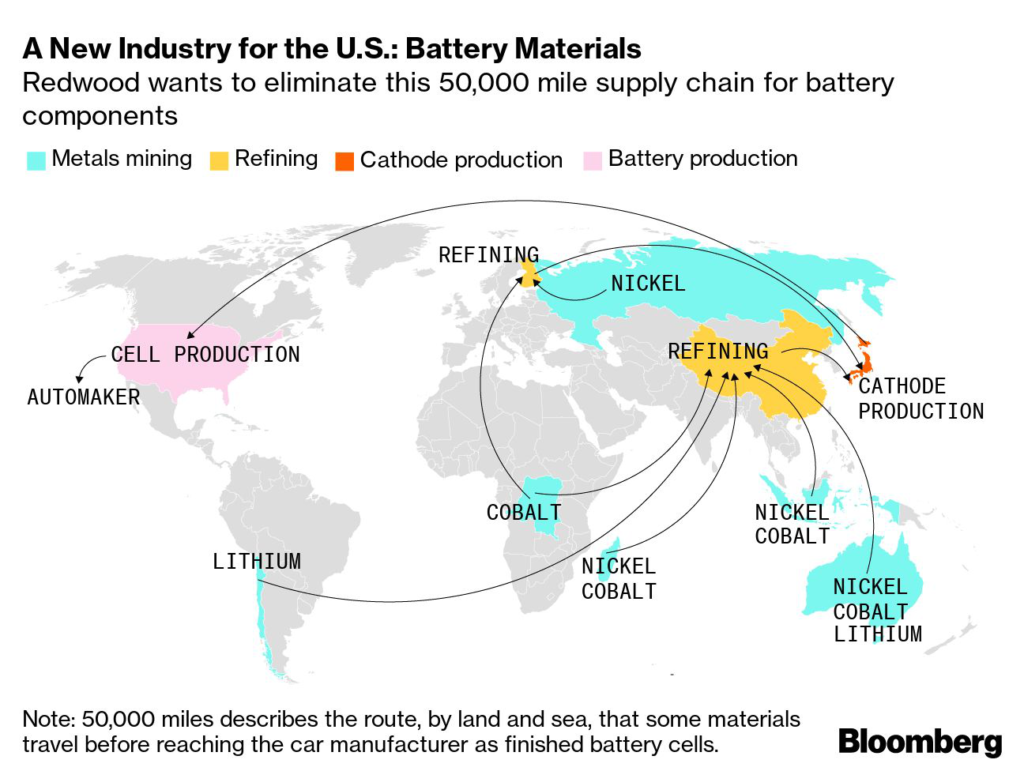
The Battery Supply Chain Is Finally Coming to America

(Bloomberg) — It’s official: the supply chain for electric vehicle batteries is coming to America.  

Redwood Materials Inc., the battery recycling company created by Tesla co-founder J.B. Straubel, said it has reached a deal to supply Panasonic with billions of dollars in critical battery components that will be produced in the US for the first time.  

The agreement marks the first major contract for domestically processed cathode material, a substance that’s responsible for more than one third of the expense of a finished battery pack. The material will supply Panasonic’s new battery plant in Kansas City, Kansas, when mass production begins there in 2025. The plant is expected to produce cells primarily for Tesla electric vehicles.

“Panasonic has been a partner for many years, but this is very significant,” Straubel said in an interview. “This is a large portion of their cathode supply. It’s such an impactful announcement for the US supply chain in general—and of course for us as a company.” 

Straubel declined to specify the amounts of material to be supplied or the specific price structure, other than to say that it would total billions of dollars over several years. 

A new US industry

Straubel left Tesla in 2019 after he grew concerned about a widening gap between electric vehicle demand and the availability of materials needed to make them. Redwood quickly rose to become the biggest lithium-ion battery recycler in the US, before branching out into anode and cathode production. 

Every battery has two electrodes—a cathode and an anode—between which trillions of charged lithium atoms travel. It’s the cathode that largely determines a battery’s performance, cost and environmental footprint. Cathode today is produced almost entirely in Asia. 

Straubel says the materials in Redwood’s cathode will help electric vehicles qualify for new $7,500 federal tax incentives available under stringent guidelines that will take effect between now and 2024.

To qualify for the full incentive under President Joe Biden’s 2022 Inflation Reduction Act, half of a battery’s minerals (by cost) must either be recycled in North America or mined from a country with which the US has a free trade agreement. The cathode Redwood plans to provide Panasonic will be made with 100% recycled cobalt and 25% to 30% recycled nickel and lithium, Straubel said. He declined to say where the company would procure the remaining mineral supplies.

“We were already going at supersonic speeds,” Straubel said, but the manufacturing provisions in Biden’s climate plan were “like what happens if you attach a rocket engine to supersonic airplane.” 

Read more: A Tesla Co-Founder Aims To Build an Entire US Battery Industry

Cobalt is one of the most expensive and controversial ingredients for batteries. The majority of the world’s supply comes from the Democratic Republic of Congo, where allegations of human rights abuses in the mining industry have been common. The reason Redwood has such a large amount to recycle is that it’s used in much higher concentrations for batteries that power consumer electronics than for those used in EVs. For example, it would take 6,147 recycled iPhone batteries to provide enough lithium for a Tesla Model Y, but only 166 iPhones to provide enough cobalt, according to BloombergNEF data.

For now, most battery recycling consists of consumer electronics and scrap material from factories. That’s expected to change dramatically as the first fleets of mass-produced EVs continues to age. 

Panasonic’s new Kansas City plant will be the company’s second major battery factory in the US, after the Nevada Gigafactory it jointly operates with Tesla. Straubel said the $4 billion Kansas City plant is likely to eventually exceed Nevada production. Redwood already recycles the scrap materials produced at Panasonic’s Nevada factory, and in turn will supply that factory with refined materials, including anode copper foil, by the end of this year.

Enough for one million cars

Redwood says it is spending billions of dollars to bring its cathode production up to the equivalent of 100 Gigawatt hours a year by 2025. That’s enough material for 1 million EVs. By 2030, the company said it plans to expand to 500 GWh per year. It currently has three recycling and production facilities in Nevada.

Straubel says words like “cathode” and “anode” still sound strange to most car buyers, but over time they will become as familiar as “spark plugs” and “catalytic converters” are today.

“It’s just an incredibly high percentage of the cost of the car,” Straubel said of cathode. “As the world is shifting to electrification, there’s going to be a bit of a new vocabulary and new list of components that everyone will get familiar with.” 

More stories like this are available on bloomberg.com

©2022 Bloomberg L.P.
China Has Shot at Seizing 60% Share of Global EV Sales This Year

(Bloomberg) —

China just reported electric-vehicle sales data for October, and the numbers continue to break records. A total of 722,000 plug-in passenger and commercial vehicles were sold. Battery-electric vehicles were 22% of the passenger car market, and plug-in hybrids claimed another 9% share.

Analyzing China’s EV market takes up a growing share of our time at BloombergNEF, mostly because China represents an ever-growing portion of the global EV market. China’s share of global passenger EV sales has gone from 26% in 2015, to 48% in 2021, to 56% in first half of 2022. We’re expecting a big surge in the final months of the year that could push the share north of 60%. In other segments like trucks, buses and two-wheeled vehicles, China is even further ahead.

Last month, we covered how China’s commercial vehicle market is now picking up speed. This week, I’m highlighting some new analysis by my colleague Siyi Mi in our Beijing office that goes into more detail on the trends within the passenger vehicle market there. Here are five takeaways from her recent report:

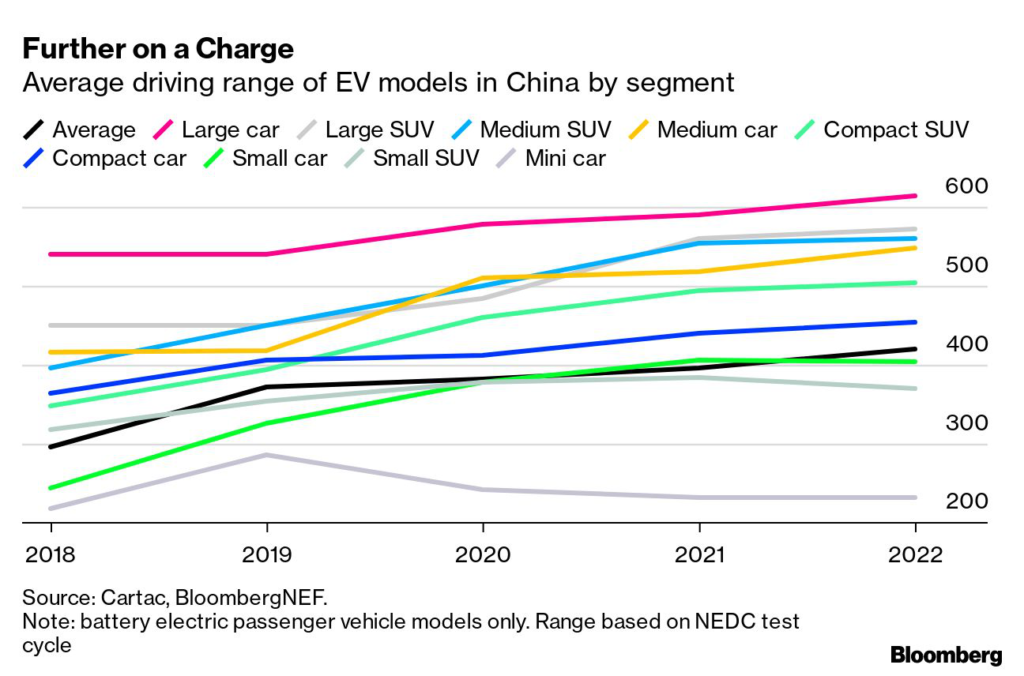
1) Average EV range is rising steadily. There are now almost 250 different battery-electric models for sale in China’s passenger car market, and the average range of models sold so far this year was 420 kilometers(1)(261 miles). That average figure hides a lot of variation, with mini cars below 250 kilometers of range on average and large cars and SUVs pushing well over 500 kilometers. Average range across all segments has risen 42% since 2018.

2) Lithium-ion phosphate (LFP) batteries keep taking more market share. LFP batteries contain no cobalt or nickel and generally cost less than other types of EV batteries as a result. The number of new EV models in China that use LFP batteries is rising quickly and now accounts for half of all models launching in the market. Many of these models are high-volume sellers, so the actual share of shipped units is already well above that threshold. More automakers are adopting the chemistry to help keep a lid on costs. This is leading to major downward revisions in forecast demand for cobalt and highlights how the EV market is able to adapt to different price dynamics and external pressures. Other automakers outside of China are starting to follow suit and setting the stage for even higher levels of LFP adoption globally in 2023.

3) The efficiency of EVs in China is improving slowly but steadily. Despite rising average ranges and associated battery pack sizes, the average efficiency of EVs has improved by about 2% per year since 2018. That’s mostly due to more efficient motors and power electronics, better thermal management systems and efforts to cut weight in other parts of the car. The largest vehicles have seen the biggest improvements, despite their average battery pack sizes increasing over this period. There’s probably still more room to run here, with more dedicated EV architectures launching in the years ahead, more cell-to-pack and cell-to-chassis battery designs and other advancements.

4) Plug-in hybrids (PHEVs) are taking off in the larger vehicle segments. While plug-in hybrid sales are slowing in Europe and never really took off in North America, they’re finding real traction in the larger vehicle segments in China. PHEVs hit 15% of sales in the large car segment and nearly 25% in the large SUV segment from January to August. Part of this is because high battery prices are making it difficult to fully electrify larger, heavier vehicles while keeping them cost-competitive. Chinese automakers also have provided much higher electric range on their PHEVs than most global brands, many of which treated PHEVs primarily as a compliance tool to meet emissions targets rather than designing them around consumer needs. Plug-in hybrids are also emerging as a popular choice in regions where public charging infrastructure is not as developed. The sales patterns in China show that the technology is certainly not dead yet and likely still has a role to play. The biggest challenge is ensuring they’re actually charged.

5) EV sales are spreading beyond the biggest cities. Places like Shanghai and Beijing have had high EV adoption rates for several years now, due in part to city-level policies that restrict the number of new license plates issued. EVs were exempt from some of these restrictions, making them a popular choice in China’s megacities. These cities also have clusters of local automakers and component suppliers, good charging infrastructure and other incentives helping drive EV adoption. But the last two years have seen EV sales spreading quickly into smaller cities and towns, highlighting that electrification isn’t just a big city phenomenon.

China’s EV market is a fascinating example of how fast technology can change, and there will certainly be more interesting developments ahead. BNEF clients can access the full report on EV trends in China here.

–With assistance from Siyi Mi.

(1) Ranges are based on the NEDC test cycle. Real-world driving range will be lower.

More stories like this are available on bloomberg.com

©2022 Bloomberg L.P.
Vodafone Shares Approach Lowest Levels Since Winter of 1997

(Bloomberg) — Vodafone Group Plc shares fell as much as 9.2%, putting them on track to close at their lowest levels since 1997.

Tuesday’s fall was triggered by the telecommunications group warning of poor sales in key markets, soaring power costs, and tough competition.

Vodafone expects powering its vast internet infrastructure of mobile antennas and street-side broadband cabinets to cost €500 million ($521 million) more next year than this year, it said in slides accompanying half-year results Tuesday. That’s on top of a €300 million increase for the current year over the prior period.

Energy inflation has hit phone groups across the continent, including at Tele2 and BT Group Plc. The latter also faced industrial action amid a cost-of-living crisis. But analysts pointed to some of Vodafone’s specific operational woes as reasons for Tuesday’s selloff, such as worse-than-expected sales in Germany — its biggest market — and in Italy. 

The results “don’t really make for pretty reading,” New Street Research analyst James Ratzer told clients in a note. Goldman Sachs analyst Andrew Lee said investor sentiment will likely be dominated by interpretations of the German outlook and that service revenue growth in the country may worsen before it improves.

Read more: Vodafone Eyes Lowest Close Since 1997 on ‘Mixed’ 2Q: Street Wrap

Vodafone shares were trading down 6% to 97.8 pence at 12:23 p.m. in London, giving the company a market capitalization of £26.8 billion ($31.8 billion). They haven’t closed that low since November 1997, though they have briefly traded lower intraday in the intervening 25 years. 


Vodafone isn’t unique among peers, with most European phone groups having lost value over the past two decades. But that hasn’t been enough to reassure high-profile investors, such as activist Cevian Capital, which sold down most of its stake earlier in the year after rising interest rates undermined its investment thesis. 

In an attempt to reverse the decline and pay down a €45.5 billion debt pile, Chief Executive Officer Nick Read has pledged to reshape the group through big deals. Last week he agreed to sell private equity a large stake in mobile-mast business Vantage Towers AG, and he’s in talks to merge Vodafone’s UK arm with CK Hutchison Holdings Ltd.’s Three UK. He recently signed a deal to merge with a rival in Portugal, and since taking over has also sold operations in Hungary, New Zealand and Malta. 

Some investors piled in behind Vodafone’s strategy and longer-term potential. In September, French billionaire Xavier Niel bought 2.5% of the company, and in May, Emirates state-backed e& became its largest shareholder. 

What Bloomberg Intelligence Says

Guidance downgrades “reflect Vodafone’s limited ability to mitigate inflationary cost pressures amid a challenging performance in Germany, Italy and Spain, with each country registering worse-than-expected fiscal 2Q sales. The curbed figures now align guidance with consensus, but also suggest the midterm ambition for mid-single-digit FCF growth is becoming unattainable.” 

— Erhan Gurses, Bloomberg Intelligence Analyst

Click here to read the full report

For now, Vodafone has adjusted its outlook to the low end of a previous range, cut its cash flow guidance, and launched a fresh cost savings plan. It will cut more than €1 billion by 2026 “through streamlining and simplifying our group-wide structure and further accelerating the digitalization of our operations,” Vodafone said in an earnings statement on Tuesday.

“In terms of redundancies, of course when we drive efficiency improvements, productivity improvements, digitalization, there are impacts on some job roles,” Read added on a call with reporters later in the morning.

Second-quarter organic service revenue growth was 2.5%, versus an average estimate of 2.3% from analysts in a Bloomberg survey, as growth in the UK offset falls in Germany, Italy and Spain. Adjusted free cash flow will be about €200 million lower than previous guidance, the company said. 

It expects adjusted full-year adjusted earnings of between €15 billion to €15.2 billion before interest, taxes, depreciation and amortization after leases. That removes upside from previous guidance, which set out a range of €15 billion to €15.5 billion.

More stories like this are available on bloomberg.com

©2022 Bloomberg L.P.
Berkshire Hathaway’s Charlie Munger Criticizes Crypto ‘Delusion’

(Bloomberg) — Berkshire Hathaway Inc.’s Charlie Munger doubled down on his criticism of digital assets in the wake of FTX’s collapse.

“It’s partly fraud and partly delusion,” Munger, vice chairman of Berkshire Hathaway said on CNBC Tuesday. “That’s a bad combination. I don’t like either fraud or delusion. And the delusion may be more extreme than the fraud.”

The 98-year-old billionaire has long been a critic of Bitcoin, previously calling it “stupid and evil.” He has also previously urged cryptocurrencies to be banned.

The disintegration of FTX has upended the crypto industry, leaving a power vacuum for the industry just as regulators consider ways to oversee it. FTX Group has said its bankruptcy may involve more than a million creditors.

Read More: FTX Latest: Bankruptcy May Involve More Than a Million Creditors

Warren Buffett’s number two was interviewed after Berkshire Hathaway took a stake of about $5 billion in Taiwan Semiconductor Manufacturing Co., signaling confidence in long-term growth of leading-edge technology, despite chipmakers having a down year due to the global economic slump.

More stories like this are available on bloomberg.com

©2022 Bloomberg L.P.

Buffett-Backed Nubank Surges After Profit Triples, Revenue Jumps

(Bloomberg) — Nu Holdings Ltd., the Brazilian digital lender that counts Warren Buffett’s Berkshire Hathaway Inc. as a backer, soared 15% in early trading after posting a surge in third-quarter profit and revenue. 

Shares of the company, which had slumped 54% this year through Monday, climbed to $5 from $4.35 at 7:30 a.m. in early trading.

Management’s comments on an earnings conference call were positive, especially regarding personal loan originations, Morgan Stanley analysts led by Jorge Kuri said in a note. Nubank is well-positioned to build “one of the largest and most valuable banking franchises” in Latin America due to factors such as superior technology and best-in-class customer satisfaction, the analysts said.

Adjusted net income more than tripled from a quarter earlier to $63.1 million, topping the average estimate of $32.6 million in a survey of six analysts by Bloomberg. Nubank’s revenue surged to a record $1.3 billion, above the expected $1.1 billion, with clients climbing to 70.4 million. 

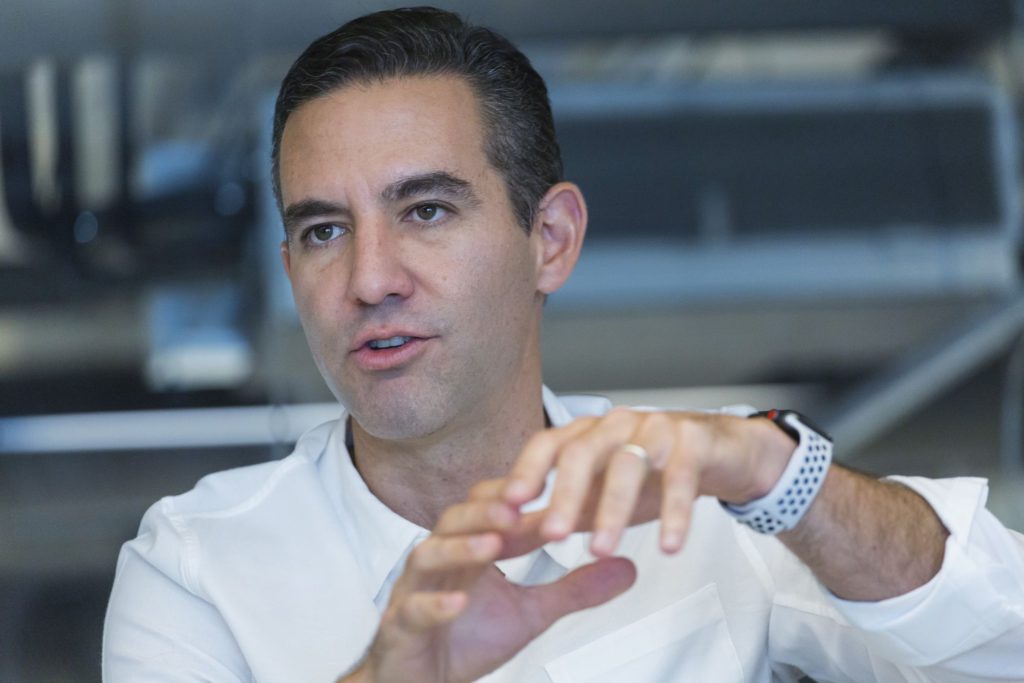
“Souring loans have been rising given the current stage of the economic cycle, but we’ve being able to price in that surge really well,” Chief Executive Officer David Velez said in an interview Monday. Efficiency gains and recent measures aimed at reining in funding costs also shored up results, Velez said. 

The percentage of loans more than 90 days overdue rose to 4.7% from 4.1% three months earlier, better than the 5% estimate by Goldman Sachs Group Inc. Banco Bradesco SA last week raised its guidance for bad-loan provisions, fueling concerns that credit quality in Latin America is deteriorating. 

“The pace of personal-loan origination has been slower than we expected as we’re carefully monitoring the macro backdrop, so origination was nearly flattish” compared to the second quarter, Velez said.

Fintech companies are expanding and boosting headcount across the region. Nubank will finish this year with at least 1,000 more employees, co-founder Cristina Junqueira said in a separate interview. The idea is to create “global platform teams” to replicate the success the Sao-Paulo-based firm has had in Brazil in Mexico and Colombia, where the fintech only offers credit cards, she said. The hirings are mostly in areas such as fraud prevention, collections and information security.

In Brazil, where Nubank offers services such as credit, debit cards and investments, the main focus is to expand into areas including secure lending and payroll loans, as it seeks to diversify revenue, Velez said. The firm should launch a “beta test” for its payroll-loan product in the fourth quarter and make it available to all clients in early 2023, he said, adding that more products for the “upmarket customer” are also planned. 

Acquisition Opportunities

After raising $2.8 billion in its initial equity offering in December, Nubank is “in a very, very strong position to look at acquisitions more actively,” Velez said, adding that “it would likely be verticals in financial services or even beyond in sectors where we haven’t built in-house.”

But he added that it’s unlikely the firm would pursue a big acquisition, given the opportunities it has to grow organically.

“It’s so important not to get too distracted with a shiny object that might be on sale somewhere else,” Junqueira said. 

Velez said he’s unfazed about recent elections that changed the leadership in some Latin America nations, since “both the right and the left kind of agree that more competition in financial services is a good thing, that more financial inclusion is a good thing.” 

Other key points:

  • The average revenue per active client, or ARPAC, rose to $7.90 in the third quarter from about $7.80 a quarter earlier
  • Early delinquency indicators, from 15 to 90 days, rose to 4.2% in September from 3.7% in June

–With assistance from Felipe Marques and Joel Leon.

More stories like this are available on bloomberg.com

©2022 Bloomberg L.P.

Close Bitnami banner
Bitnami