
Bloomberg

NEF Latest: Scaramucci Talks FTX Implosion; Griffin on Trump

(Bloomberg) — US-China talks and the global outlook dominated discussions during the first day of the Bloomberg New Economy Forum in Singapore on Tuesday, where Chinese Vice President Wang Qishan said his country will keep opening up and working for peace.

Citadel founder Ken Griffin also weighed in on the importance of US-China relations, along with US politics and the collapse of Sam Bankman-Fried’s crypto exchange FTX. 

Scaramucci Sees Crypto World ‘Cut to Ribbons’ (4:03 p.m. SGT)

The crypto industry has been “cut to ribbons” this year, said Anthony Scaramucci, whose firm SkyBridge Capital was caught up in the implosion of FTX.

Asked about investment mistakes involving Sam Bankman-Fried and FTX, Scaramucci said it’s tough to protect one’s self from some types of “misrepresentation.”

“If you’re running a background check on somebody like Sam, you’re not going to find anything,” he said, adding that Bankman-Fried’s record was previously “unblemished.” US regulators are investigating the FTX founder and his exchange for potential violation of rules.

“What should the industry do to survive and make itself better? My opinion is more collaboration,” Scaramucci said, adding that the public battle between Bankman-Fried and Binance Holdings Ltd. CEO Changpeng “CZ” Zhao was an example of how things shouldn’t be handled. 

Africa Frustration on Energy Transition (3:54 p.m. SGT)

There’s frustration in Africa that it’s “at the end of the queue” in terms of accessing the technology necessary for the energy transition, according to Josephine Wapakabulo, founder and managing director of business consultancy TIG Africa. That’s despite the fact the continent is a major producer of many of the commodities needed for it, she said.

Africa is being asked to use less fossil fuels but also pay a premium for clean energy technology, Wapakabulo said at an NEF session called Beating the Resource Curse. “There’s this general feeling of where do we win?”

Digital Potential in Africa, Serbia (2:51 p.m. SGT)

Zimbabwe-born billionaire Strive Masiyiwa, whose firms include Africa’s largest fiber-optic cable network, said the continent will become the world’s biggest market by century’s end, when it accounts for 40% of the planet’s population. Companies ignore that potential at their risk.  

“Many people have talked about Africa and people who live on less than $2 a day,” he said. “They are a market. If you’re in business, you need to be in Africa.”

On the same panel, Serbian Prime Minister Ana Brnabic said her country envisions using artificial intelligence to drive economic growth and work toward providing personalized medicine. And Infosys Ltd. Chairman Nandan Nilekani said governments are needed to provide the digital infrastructure on top of which entrepreneurs can innovate. 

“We have to create a new model, which is equitable, which is digitally enabled, where everybody gets it’s inclusive,” Nilekani said. 

SGX CEO on Boosting Liquidity for Traders (2:20 p.m. SGT)

Singapore Exchange Ltd. is working to increase liquidity for traders, Chief Executive Officer Loh Boon Chye said in an interview on the sidelines of NEF.

The bourse will use a combination of organic and inorganic means to “bring different pools of liquidity, different venues together,” Loh said.

Former Norway Wealth Fund Head on Energy Transition (1:50 p.m. SGT)

Global warming will likely exceed the Paris Agreement’s goal of 1.5 degrees Celsius by the end of the century unless more investment is devoted to the green-energy transition, Yngve Slyngstad, the CEO of Industry Capital Partners and the former head of the Norwegian sovereign wealth fund, said in a Bloomberg Television interview on the sidelines of the NEF.

He described the scale of funding needed to prevent catastrophic warming as the “biggest investment challenge ever,” while warning that further investment in oil and gas is still needed during the transition to ensure energy security.

“You can’t stop investing in oil and gas before you build something else,” he said.

Ken Griffin Talks Trump, China (12:45 p.m. SGT)

Citadel’s Griffin, a vocal supporter and financial backer of Ron DeSantis, said the Florida governor will run for president on the back of a strong record, likely facing “three-time loser” Donald Trump. 

Griffin said this month’s midterm elections — which saw DeSantis elected by a landslide while Democrats outperformed expectations nationally — were a “great result” given overall turnout and voters splitting their ballots between the parties.

The billionaire also slammed Bankman-Fried’s FTX, saying it represented a travesty which undermines trust in financial markets. He said the US should avoid a recession this year, but may not be able to do so 2023. Even as he sees the inflationary path as having peaked, Griffin said the Fed should “get the job done now” in fixing inflation or risk losing credibility.

In a morning that was dominated by discussion of US-China relations, Griffin said the US remains dependent on Taiwan for semiconductors. 

Nardini Says China Leading Race Into Space (12:30 p.m. SGT)

There will likely be eight space stations in orbit in 10 years time, said Helene Huby, co-founder and CEO of The Exploration Co., which is developing modular, reusable craft to carry cargo, and eventually people, into space. Two of those stations will be in orbit around the moon, and there will be at least three privately-owned US stations, she said.

In a panel discussing the commercialization of space, Flavia Tata Nardini, co-founder and chief executive officer of Australia’s Fleet Space Technologies, which uses low-earth orbit satellites to search for minerals on earth, said China is currently leading the space race, with the most satellite companies and workable rockets. 

Ex-Australian PM on Biden-Xi (11:17 a.m. SGT)

Former Australian Prime Minister Kevin Rudd said the meeting between Presidents Joe Biden and Xi Jinping on Monday yielded “reasonable progress” and showed two competing nations seeking to ease tensions.

“Things were beginning to spiral out of control and to be frank the US-China relationship has been in freefall for quite some time,” he told Bloomberg Television’s Haslinda Amin in an interview Tuesday. “So, if before it was eight out of 10 in terms of the heat factor, we may have brought it down to seven.”

Qiming on China Startup Funding (11:10 a.m. SGT)

Qiming Venture Partners Founding Managing Partner Gary Rieschel said China’s early-stage startups have seen no decline in funding even as geopolitical headwinds affect venture capital investments more broadly.

“There’s still a vast amount of money for early-stage venture capital,” Rieschel told Bloomberg Television at NEF. “The funds that have had a hard time raising money now are the later-stage crossover funds.”

US Trade Rep on Xi-Biden, IPEF (10:55 a.m. SGT) 

The face-to-face meeting between Biden and Xi was a powerful signal to the rest of the world that both leaders can manage ties, according to US Trade Representative Katherine Tai.

On the Indo-Pacific Economic Framework, an economic accord the US is negotiating with 13 other countries, Tai said an agreement is possible and could happen within the next two years. She said Biden has directed her to design a “worker-centered” trade policy, though IPEF is deliberately not a trade deal. 

“This is a global economy that’s going through a lot of changes” so by design IPEF allows countries to “evolve” engagement, she said. Tai declined to weigh in on whether China should have been admitted to the World Trade Organization a generation ago, saying there was no going back on that decision. 

Singapore, Japan Discuss Outlook (10:00 a.m. SGT)

The current spell of weakness in the global economy is the result of central banks the world over misreading inflation a year ago, Singapore’s Senior Minister Tharman Shanmugaratnam said. Recession is the “price we pay” for misreading inflationary pressures, said Tharman, who is also chairman of Singapore’s central bank.

Speaking on the same panel, Japan’s Minister of Economy, Trade and Industry Yasutoshi Nishimura said cooperation, not decoupling, is important at a time of crises, disruptions and conflicts in supply chains, noting he was committed to carrying forward former Prime Minister Shinzo Abe’s vision of a free economic order.

Tharman also noted that reduced US-China tensions won’t assure the world of peace, and there will continue to be constant friction between the world’s two biggest economies.  “But it’s much safer than a world that is decoupled.”

Kissinger on Xi-Biden, Russia (9:40 a.m. SGT)

The former secretary of state praised Monday’s meeting between Biden and Xi as part of the needed “bridge building” between the world’s two biggest economies. Pressed on whether “extremists” in each country were dominating the political debate, Kissinger said that underscored why the meeting in Bali was so important. 

“The two leaders that met briefly will know the consequences of economic disaster and military impact on each other,” Kissinger said. “All we can say today is that a method for discussion has been agreed on and general statements have been made that are compatible with a cooperative world, but a long road still has to be undertaken.”

Biden, Xi Take Biggest Step in Years to Avoid US-China Clash

Turning to the war in Europe, Kissinger said countries need to focus on what their longer-term objectives are with Ukraine and Russia, and not be distracted by short-term pressures. But he demurred on what Russian President Vladimir Putin would agree to, saying “there’s no question that for some people, Vladimir Putin is an obstacle to this vision.”

BPEA CEO Says China ‘Investable’ (9:30 a.m. SGT)

China’s path is showing more clarity for investors, according to the head of private equity firm BPEA EQT, who underscored how the market is still investable even with a global slowdown of private-equity money deployed in the country.

“I am pretty confident the directions become more clear as things progress,” Jean Eric Salata, who is also EQT AB’s Asia chairperson, said in an interview with Bloomberg Television on the sidelines of the NEF.

Wang Says China Wants Peace (9:25 a.m. SGT)

Leaders of the world’s No. 2 economy will stick to a path of peaceful development, Chinese Vice President Wang Qishan pledged, a day after the Biden-Xi meeting in Bali. 

“Upholding world peace and stability is in the fundamental interest of the Chinese nation,” Wang said in a recorded speech. “China safeguards and promotes world peace through its own development.”

Wang also sought to reassure his audience that the ruling Communist Party would continue opening China, and “maintain strong policy continuity to provide greater certainties and stability for the world.”

Bloomberg Warns on Climate (9:10 a.m. SGT)

“Unless bolder, more urgent global action is taken,” those challenges will only get worse, said Michael R. Bloomberg, founder of Bloomberg LP, adding that the leaders gathered at the annual forum should focus on “practical, concrete ways to tackle issues that governments alone cannot or will not solve.”

The New Economy Forum is being organized by Bloomberg Media Group, a division of Bloomberg LP, the parent company of Bloomberg News.

The forum begins a day after Presidents Joe Biden and Xi Jinping met in Bali, Indonesia, on the sidelines of the Group of 20 summit. After years of souring relations, the leaders managed to agree on how to get talks between the world’s two biggest economies back on track.

PwC’s Moritz Talks China (8:20 a.m. SGT)

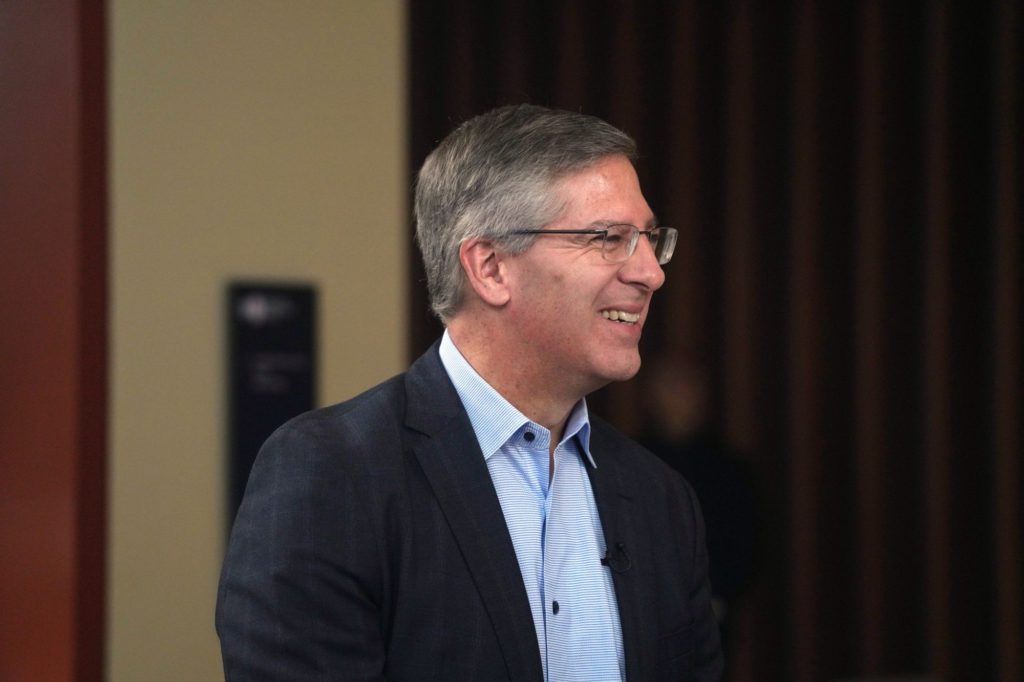
On the sidelines of the NEF, PricewaterhouseCoopers LLP Chairman Bob Moritz said companies are thinking of how to structure their operations in China and around the region because of US-China tensions.

“You see a number of companies thinking through: do I need to restructure my operations in terms of what I have in China, outside of China or around the region?” Moritz said in a Bloomberg Television interview. “But it’s with flexibility to say I’m not sure it’s going to get worse or better so I want multiple options and flexibility to be agile to react to that market opportunity, depending on what comes up.”

See more Bloomberg New Economy stories here, where you can sign up for our newsletter.

–With assistance from Anjali Cordeiro, Samson Ellis, Karthikeyan Sundaram, Tom Redmond, Bill Faries, Adrian Kennedy, Martin Ritchie, stacy-marie ishmael, Jing Li, Jill Disis, Sarah Zheng, Michelle Jamrisko, Ville Heiskanen, Philip J. Heijmans, Rebecca Choong Wilkins and Abhishek Vishnoi.

More stories like this are available on bloomberg.com

©2022 Bloomberg L.P.
Binance to Submit Evidence On FTX Deal, FTT Transactions

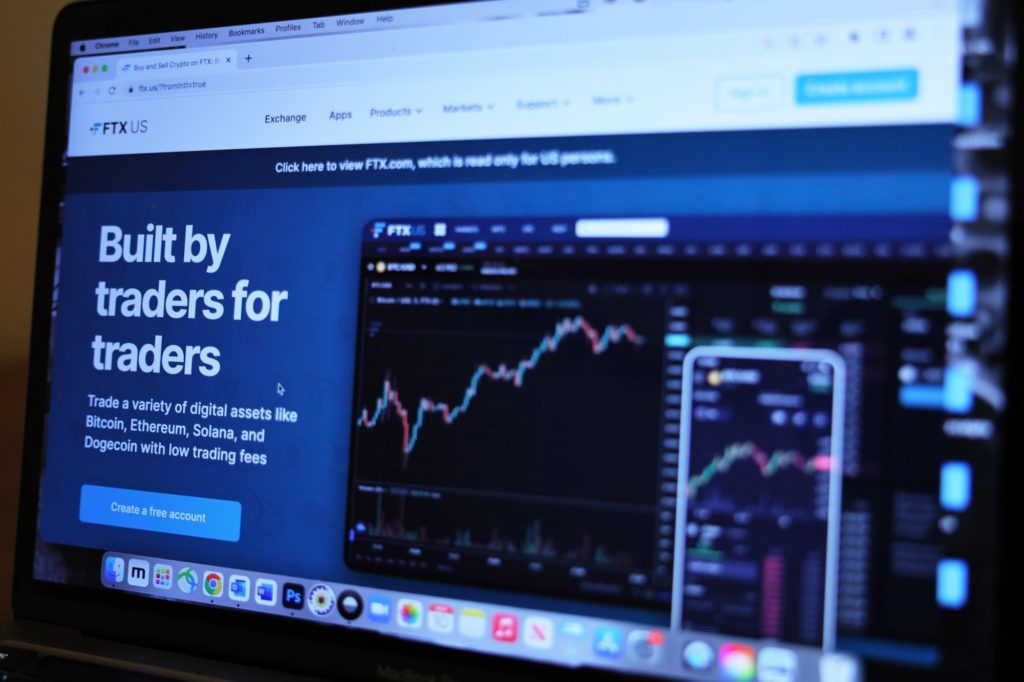
(Bloomberg) — Binance said it will submit evidence to UK lawmakers regarding discussions held about FTX.com when the two were in deal talks, as well as on its decision-making around the sale of FTX.com’s native token FTT.

Daniel Trinder, Binance’s vice president of government affairs in Europe, said the company would provide the information to members of the UK Parliament’s Treasury Committee as part of the crypto exchange’s appearance as a witness in the group’s cryptoasset inquiry. 

The committee’s chair Harriett Baldwin said that the group expects to receive evidence including internal correspondence and records about potential market consequences of Binance’s announced divestment of FTT, and about the due diligence carried out regarding the potential acquisition of FTX.

Trinder was grilled by lawmakers on Monday over the firm’s decision to announce a planned sale of more than $500 million in FTT on Nov. 6 — a move that caused trading volumes for the token to spike to their highest in more than a year. It also kickstarted the chain of events that led to FTX filing for bankruptcy five days later.

  • FTX Latest: Binance CEO Plans Recovery Fund, Laments Bad Actors

When asked if it was apparent to Binance that selling its FTT pile would trigger FTX’s collapse, Trinder said that “wasn’t the intent at all”. He promised to deliver evidence to back up that claim by Nov. 15.

Once made public, the correspondence may answer swirling questions around whether Binance was aware of how its announcement could impact markets, and at the time, the fate of one of its closest rivals. It may also shed light on its later decision to extend a rescue offer to FTX two days later, as well as the state of FTX’s books at that time.

“Binance will provide the documents it committed to sharing,” a Binance spokesman said.  

Due to several ongoing investigations against FTX in the US, Trinder said Binance may choose to redact certain information. Baldwin said at the hearing that the exchange would have to make clear why it is withholding any evidence.

Baldwin, chair of the committee, said at the hearing that Binance’s due diligence on FTX “surfaced an issue that triggered a sequence of events that led to the collapse of FTX.” 

“You’ve got to admit that you were a player in that sequence of events,” she told Trinder. Binance’s intention was to protect its own users, Trinder replied.

The world’s largest crypto exchange has sought to portray itself as a unifying force for the crypto industry since FTX’s decline began, both as an olive branch to the failing platform and as a source of financial rescue for impacted projects. 

Much of the industry has felt the brunt of FTX’s collapse, with major firms including Galaxy Digital, Wintermute and Crypto.com declaring tens of millions of dollars in exposure. A Nov. 10 balance sheet for FTX showed it had just $900 million in liquid assets against $9 billion in liabilities.

The fallout is likely to set back the sector several years, other witnesses told lawmakers at the inquiry. 

“There were a lot of very experienced eyes on this. And what it tells us is that this was a bad actor, who was doing things in behind very closed doors that we had we had no view into as a broader group,” said Tim Grant, head of Europe for Galaxy Digital, which lost $77 million to FTX’s bankruptcy. “That’s not a crypto problem. That’s a governance problem.”

More stories like this are available on bloomberg.com

©2022 Bloomberg L.P.

Samsung Customers Seek Chip ‘Second Source’ on Geopolitical Risk

(Bloomberg) — Samsung Electronics Co. said the global technology industry is in search of alternative sources for advanced semiconductors given rising political risks.

Speaking at the South Korean company’s investor briefing, Sim Sang-pil, the head of corporate planning for its foundry business, laid out ambitious goals for the operation, which competes directly with Taiwan Semiconductor Manufacturing Co. Samsung expects to increase its foundry capacity by 3.3 times by 2027 compared with 2022.

“When I meet customers these days, they think the current geopolitical risk is serious; they need their second source,” Sim said. “Samsung foundry has many opportunities with customers who want to have that second source.”

TSMC manufactures the world’s most advanced semiconductors, crafting silicon to meet the designs of clients like Apple Inc. and Nvidia Corp. The world’s reliance on that single company, based in Taiwan — which China considers part of its territory — has grown into an area of concern for political leaders in the US and Europe.

Taiwan Tensions Spark New Round of US War-Gaming on Risk to TSMC

As geopolitical tensions have risen between the US and China, businesses have been preparing contingency plans in case foreign companies are no longer able to operate in China or there’s a military confrontation around Taiwan.

Samsung, the world’s biggest maker of memory chips, has been investing heavily to compete for logic processor production orders from large-scale customers like Qualcomm Inc.

Sim said that Samsung’s foundry was a little behind TSMC in 4-nanometer and 5nm technology, but it sees an opportunity to catch up in more advanced nodes. Samsung’s development of a new iteration of chip design called Gate All Around, or GAA, is one area where the company thinks it will gain an edge over TSMC and US rival Intel Corp.

Samsung is also working closely with the American government, which passed legislation this year to subsidize development of domestic chip manufacturing. The company is building a new fab in Taylor, Texas, in large part to supply the domestic US market.

More stories like this are available on bloomberg.com

©2022 Bloomberg L.P.

Canadian Police Charge Battery Researcher With China Spying

(Bloomberg) — A 35-year-old Hydro-Quebec employee who worked on battery materials research has been charged with espionage for allegedly obtaining trade secrets for China.

Yuesheng Wang, of Candiac, Quebec, was arrested following an investigation that began in August. Wang was charged with obtaining trade secrets — the first time such a charge has been laid in the country, according to the Royal Canadian Mounted Police.

Wang also faces charges of unauthorized use of a computer, fraud for obtaining trade secrets and breach of trust by a public officer.

The investigation was sparked when the company’s security branch contacted authorities, the RCMP said. “While employed by Hydro-Quebec, Mr. Wang allegedly obtained trade secrets to benefit the People’s Republic of China, to the detriment of Canada’s economic interests,” the police force said in a news release.

Wang conducted research on battery materials at Hydro-Quebec’s Center of Excellence in Transportation Electrification and Energy Storage. The unit develops advanced technologies for electric vehicles and energy storage systems. His employment has been terminated for “serious violations” of the company’s code of ethics, Hydro-Quebec said in a news release. “He did not have access to information related to Hydro-Quebec’s core mission,” it said.

Wang used his position at Hydro-Quebec to do research at a Chinese university and other Chinese research centers, David Beaudoin, who heads the RCMP’s national security team in Quebec, said at a news conference. Wang allegedly “submitted scientific articles and submitted patents in association with this foreign actor.”

Wang, who will appear in court Tuesday in Longueuil, Quebec, is the only person facing criminal charges in this matter. The alleged activities took place between February 2018 and October 2022.

Canada-China relations have become increasingly strained in recent years. Last week, Prime Minister Justin Trudeau’s top diplomat called the country an “increasingly disruptive global power.” 

Chinese Foreign Ministry spokeswoman Mao Ning said Tuesday at a regular press briefing in Beijing that she was unaware of the matter. She added that the “Canadian side should handle the relevant individual case in accordance with the law and not politicize it.”

–With assistance from Lucille Liu.

(Updates with comment from China’s Foreign Ministry.)

More stories like this are available on bloomberg.com

©2022 Bloomberg L.P.

Energy Prices Squeeze Vodafone as Wages Jump: The London Rush

(Bloomberg) — High energy prices continue to impact consumers in more way than one. First, there’s the direct impact on household bills, but it also squeezes businesses, causing them to raise prices in mitigation — as Vodafone said they have this morning. Meanwhile energy companies and electricity generators are making large profits from higher oil and gas prices, putting them in the crosshairs of the chancellor as he prepares to deliver an Autumn Statement later this week.

Here’s the key business news from London-listed companies this morning:

In The City

Labour Market Data: UK wages grew at the fastest pace in more than a year in the third quarter, adding to inflationary pressures that are concerning the Bank of England.

  • Average weekly earnings excluding bonuses rose 5.7% from a year ago, the most since August 2021, the Office for National Statistics said

Vodafone Group Plc: High energy costs and wider inflation have impacted the telecommunication company’s financial performance, forcing it to lower its full year guidance to the bottom end of its prior range.

  • The company said a “comprehensive action plan” is underway to mitigate the effects of the wider economy, including raising prices across Europe and finding cost savings across the business

Imperial Brands Plc: Higher prices for the cigarette maker have helped to offset a decline in tobacco product volumes, as people returned to pre-pandemic buying patterns and the company exited their Russian operations. 

  • Revenue growth from its “Next Generation Products” like vapes at tobacco pouches helped support its group level result, although the division still made a loss

BAE Systems Plc: The weapons maker said the “elevated threat environment” has caused many of its customers — countries — to increase their defense spending.

  • Although the company is still working through supply chain challenges, particularly in products using microelectronics, labour shortages have eased  since the start of the year

In Westminster

Chancellor Jeremy Hunt is considering a new 40% windfall tax on the “excess returns” of electricity generators as part of his sprawling package of tax rises and spending cuts this week, a person familiar with the matter told Bloomberg. That’s as Rishi Sunak indicated that he will keep the so-called triple lock on state pensions. 

UK investors, meanwhile, are facing the biggest glut of gilts in nearly a decade even with the government’s plans to slash spending and hike taxes.

In Case You Missed It 

A surge in demand for sexual health services and contraception is overwhelming UK clinics, which are already struggling after years of funding cuts.

Britain’s housing meltdown is threatening to end the era of bumper payouts by the country’s largest homebuilders.

Looking Ahead 

UK inflation data are due at 7:00 a.m. tomorrow. Bloomberg Intelligence expects a jump in consumer prices to 10.8% in October from 10.1% in the prior month. The Bank of England probably won’t be comfortable “taking its foot off the brake until services inflation shows signs of dropping back toward its long-run average,” according to BI. 

Utility  SSE Plc, real estate investor British Land Co. and private equity group Bridgepoint Group Plc are set to report results tomorrow.

For a news fix when the day is done, sign up to The Readout with Allegra Stratton, to make sense of the day’s events.

More stories like this are available on bloomberg.com

©2022 Bloomberg L.P.
Top South Africa Companies Outline Extra Costs of Rolling Blackouts

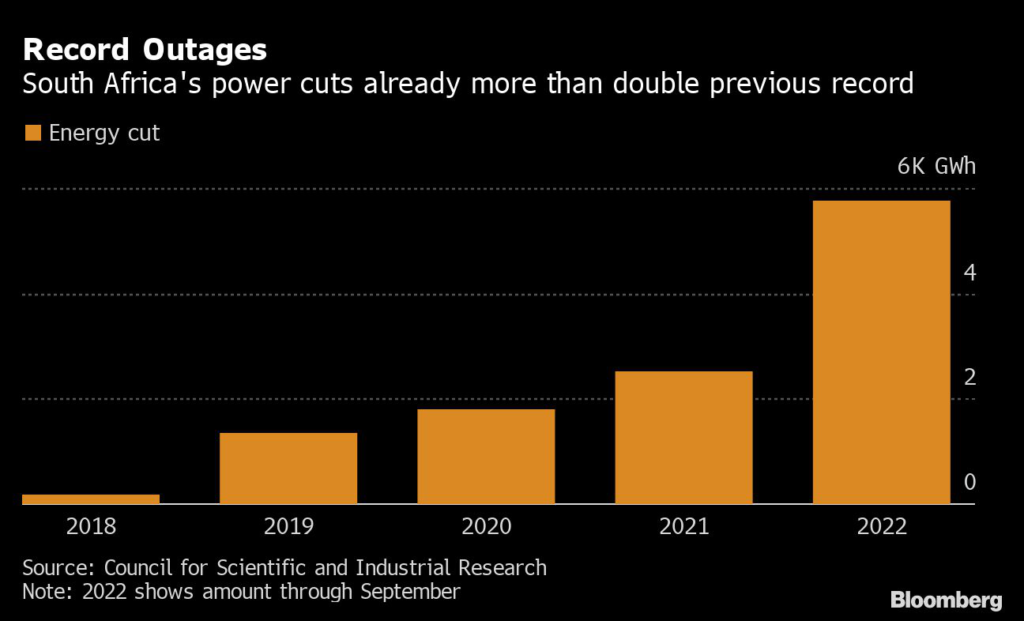
(Bloomberg) — The cost of South Africa’s energy shortages is weighing heavily on the country’s biggest companies.

During a year that’s seen the worst national power cuts on record, groceries giant Shoprite Holdings Ltd. said buying diesel to keep stores lit costs an extra 100 million rand ($5.8 million) a month. That’s on top of the cost of an extensive network of solar panels and generators in the Cape Town-based company’s biggest market.

South Africa has battled electricity shortages since 2008, so companies are used to making contingency plans — but the problem is only getting worse. Breakdowns at plants operated by state-owned utility Eskom Holdings SOC Ltd. reached unprecedented levels in October, raising the cost of doing business. While the biggest companies can work out ways to absorb the additional levies, small businesses are more at risk.

“At loadshedding stages five and six, it comes at significant cost,” Shoprite said in a statement Monday, referring to the categories of rolling blackouts where power in some areas is cut for as much as 10 hours a day. The company owns the Checkers chain of supermarkets, among others.

Vodacom Group Ltd. invested 5.8 billion rand in its network in its first-half through September to “enhance the customer experience at a time when the country experienced record levels of power outages,” according to a statement from South Africa’s largest wireless carrier by subscribers. 

The Johannesburg-based company — majority owned by the UK’s Vodafone Group Plc — has spent more than 2 billion rand over two years on batteries that keep mobile towers working during power cuts. Even so, the stop-start outages mean they can’t fully recharge and their lifespans shorten.

One thing is clear: as blackouts continue to cause disruptions countrywide, the costs will keep mounting.

Shoprite shares gained 7.8% by the close in Johannesburg after reporting strong quarterly sales despite the blackouts. Vodacom fell 6.2% following a dividend cut and earnings that missed estimates.


(Updates with closing share prices in final paragraph.)

More stories like this are available on bloomberg.com

©2022 Bloomberg L.P.
Sam Bankman-Fried Posts Weird Cryptic Tweets After Wealth Wipeout

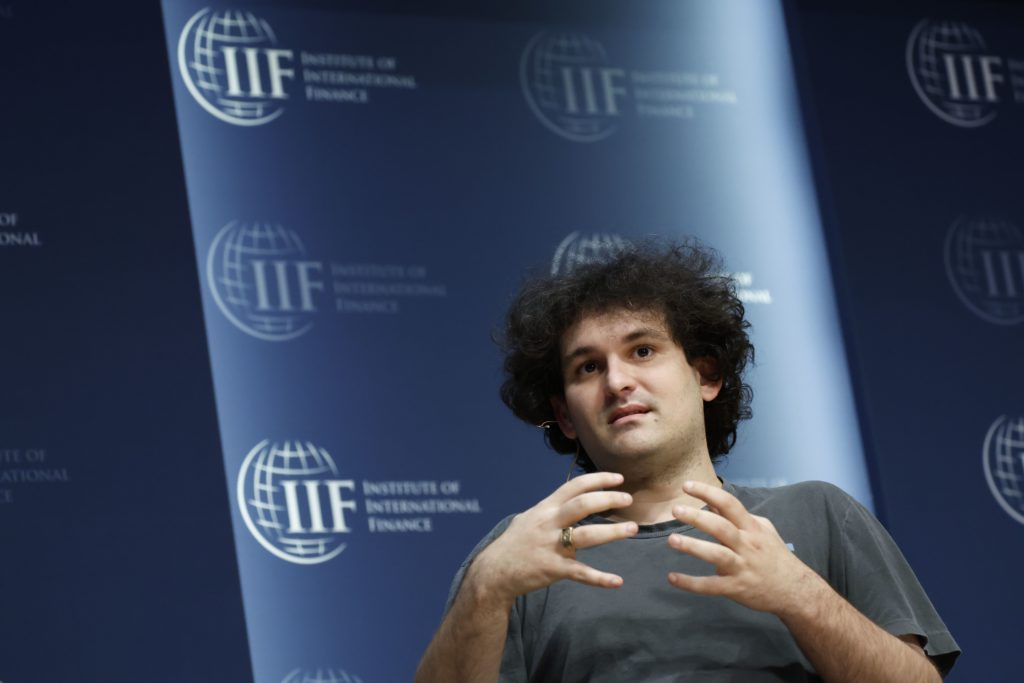
(Bloomberg) — He might have lost his company, his wealth and his credibility, but former FTX.com Chief Executive Officer Sam Bankman-Fried isn’t shying away from the spotlight.

A series of cryptic tweets spelled out the words “What HAPPENED” over the last 24 hours on Bankman-Fried’s account. The first tweet, posted Monday, simply read “What.” That was followed by the word “happened” in capital letters, tweeted out one character at a time in a little over 24 hours.

He finished with the message: “NOT LEGAL ADVICE. NOT FINANCIAL ADVICE. THIS IS ALL AS I REMEMBER IT, BUT MY MEMORY MIGHT BE FAULTY IN PARTS.”

The bizarre sequence sparked hot debate — and not a little anger — on the platform as users tried to second guess what would come next.

In an interview with the New York Times shortly after the initial two posts were sent, Bankman-Fried said: “It’s going to be more than one word. I’m making it up as I go.” When the interviewer asked if he was “planning a series of cryptic tweets,” he replied, “Something like that.”


“No one knows what it means, but it’s provocative,” wrote one Twitter user named The Crypto Dog, referencing the Will Ferrell movie Blades of Glory. Another, Ari Paul, wrote: “This wasn’t a game for many people. Most of the industry may be ponzis, but not all. You’ve reduced trust in the industry and in the world.”

The mysterious thread comes days after Bankman-Fried’s estimated $16 billion fortune was obliterated in one of the greatest wealth wipeouts the world has ever seen. At his peak, the 30-year-old was worth $26 billion. The collapse of FTX is already drawing comparisons to Lehman Brothers, Enron and Bernie Madoff’s Ponzi scheme.

Elsewhere on Twitter, the man who hastened the demise of Bankman-Fried — Binance Holdings Ltd. Chief Executive Changpeng Zhao — has been using the platform to position himself as crypto’s new savior, as evidenced by a flurry of tweets in recent days.

As for Bankman-Fried, he’s just asked the burning question — now people are waiting for the answers.

More stories like this are available on bloomberg.com

©2022 Bloomberg L.P.
Bitcoin Extends Gains as Investors Await Recovery Fund Details

(Bloomberg) — Cryptocurrencies pushed higher on Tuesday as investors awaited more details about an industry recovery fund promised by Binance Holdings Ltd.’s Chief Executive Officer Changpeng ‘CZ’ Zhao.

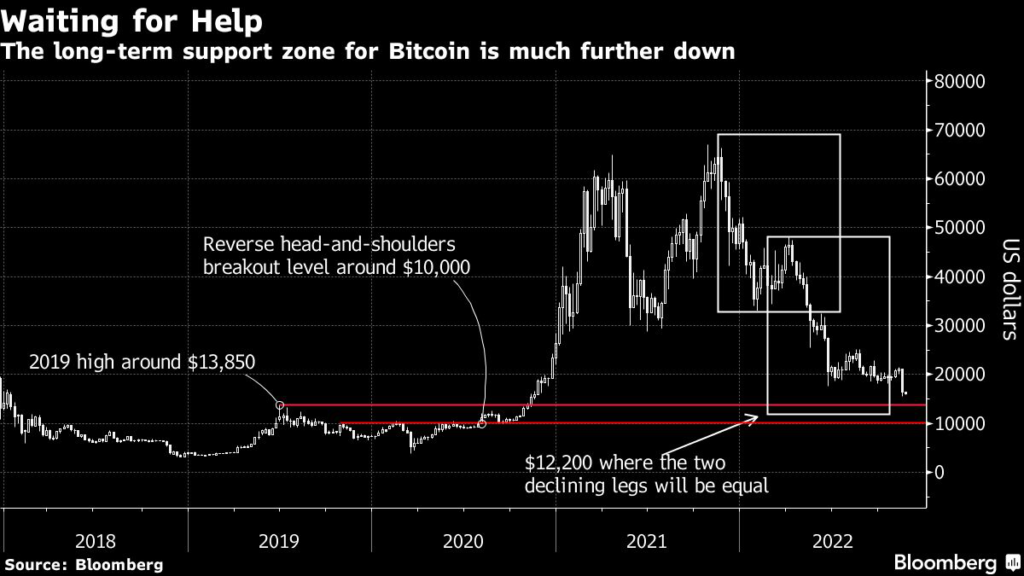
Bitcoin, the largest token, climbed toward $17,000 with a gain of about 2%, while second-ranked Ether added a similar percentage as of 1:20 p.m. in Hong Kong. The moves provided some respite from a damaging selloff triggered by the descent into bankruptcy of Sam Bankman-Fried’s FTX exchange.

Digital assets linked to his now-fallen empire, such as Solana and Serum, stabilized. So did Cronos, the native coin of Crypto.com, whose platform is under scrutiny for any signs of stress as the sector reels from the FTX wipeout.

Billionaire Zhao, operator of the world’s biggest crypto exchange, announced the plan for the fund Monday and said more details would follow. That helped to stabilize sentiment on speculation the step may stem contagion after a $200 billion drop in the value of digital assets since FTX first began teetering.

Meanwhile, an Elon Musk tweet that Bitcoin “will make it” also salved the mood. Dogecoin, a token the Tesla chief executive officer has touted in the past, edged up for a third day.

While markets have gained on Zhao’s move, such a fund may not be best for the industry, said Quantum Economics Chief Executive Officer Mati Greenspan. Binance already has too much control in a decentralized market, he said.

“That sort of concentration of power makes me uncomfortable,” said Greenspan. “It’s the kind of thing crypto was designed to avoid and one of the lessons we should have learned from last week.”

Some of the first court documents to hit FTX’s bankruptcy docket showed that the collapse may involve more than one million creditors, illustrating the reach of Bankman-Fried’s business before it rapidly unraveled.

Derivatives markets highlight ongoing concerns about the outlook. The Bitcoin futures curve shows the token’s spot price is higher than its futures price — an inversion hinting at bets that the digital asset will resume declines.

Caroline Pham of the US Commodity Futures Trading Commission said the crypto sector suffers from poor risk management. 

“It is hard to see where the contagion might stop,” Pham told Bloomberg TV. “More news will come out as people continue to work through their exposures.”

–With assistance from Akshay Chinchalkar and Carly Wanna.

More stories like this are available on bloomberg.com

©2022 Bloomberg L.P.
Stocks Gain on China Economy Support, US Talks: Markets Wrap

(Bloomberg) — Stocks climbed with Hong Kong leading gains as traders weighed better prospects for the world’s second-biggest economy and signs of reduced US-China tensions. 

The benchmark index in Hong Kong jumped 4%, and is poised to hit the milestone of a technical bull market. More measures to ease a cash crunch in China’s beleaguered property sector, a relaxation of Covid curbs, and efforts by the central bank to maintain ample liquidity boosted sentiment.

Contracts for the S&P 500 and the Nasdaq 100 were up as well. The yen fell after Japan unexpectedly reported a contraction in its economy, reinforcing expectations for a dovish monetary stance. 

Read: Everything Is Suddenly Falling In Place for Chinese Stocks

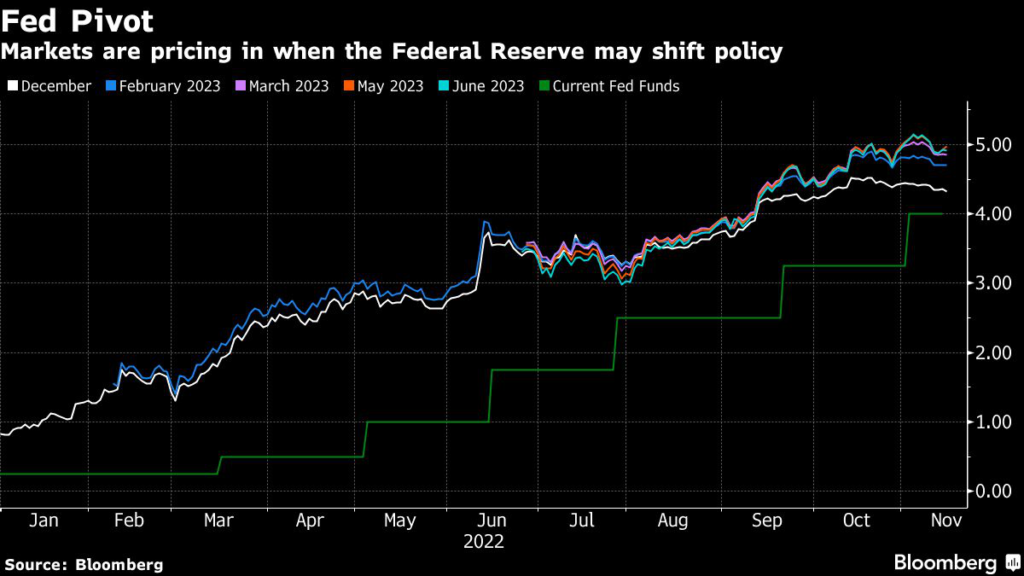
The dollar and Treasury yields held their gains, with the 10-year rate around 3.87% after Federal Reserve speakers highlighted their resolve to tackle inflation. Fed Vice Chair Lael Brainard briefly buoyed sentiment after she said it would be appropriate “soon” to slow the pace of interest-rate hikes.

“It’s certainly a time to be thinking about a recovery regime unfolding for markets,” Kristina Hooper, chief global market strategist at Invesco, said on Bloomberg Radio. “But it’s going to take a little time before we know if this really is something of a turning point for inflation and the Fed can be a lot more comfortable about hastening the end of tightening.”

Chinese technology stocks were among the top contributors to gains in the MSCI Asia Pacific Index as investors bet the worst may be over for some of the major players. Taiwan Semiconductor Manufacturing Co. surged as much as 9.4% after Warren Buffett took a stake of about $5 billion in the chipmaker.

Now may be an interesting time to reinvest in emerging markets, according to Kathryn Kaminski, chief research strategist and portfolio manager at AlphaSimplex Group. “You’ve really seen a lot of value taken out of some of those indices,” she said on Bloomberg Radio.

Investors poured money into exchange-traded funds tracking emerging-market assets last week at the fastest pace in six months, according to data compiled by Bloomberg.

Despite these positive signs in Asia and indications of moderating inflation in the US, higher borrowing costs are a headwind for the global economy. Covid lockdowns also impacted China, with the latest data showing retail sales contracting for the first time since May.

In Japan, gross domestic product shrank in the three months through September, as consumers spent less amid a resurgence of Covid cases and the weak yen battered trade. The yen was at about 140 versus the dollar on Tuesday, having strengthened from the 150 level seen in October.

Elsewhere, oil extended losses as concerns over the near-term demand outlook overshadowed signs of tightening supply heading into winter. Gold was steady.

Key events this week:

  • Former US President Donald Trump plans to make an announcement, Tuesday
  • US empire manufacturing, PPI, Tuesday
  • US business inventories, cross-border investment, retail sales, industrial production, Wednesday
  • Fed’s John Williams, Lael Brainard and SEC Chair Gary Gensler speak, Wednesday
  • ECB President Christine Lagarde speaks, Wednesday
  • Eurozone CPI, Thursday
  • US housing starts, initial jobless claims, Thursday
  • Fed’s Neel Kashkari, Loretta Mester speak, Thursday
  • US Conference Board leading index, existing home sales, Friday

Some of the main moves in markets:

Stocks

  • S&P 500 futures rose 0.5% as of 2:26 p.m. in Tokyo. The S&P 500 fell 0.9%
  • Nasdaq 100 futures rose 0.7%. The Nasdaq 100 fell 1%
  • Japan’s Topix index rose 0.5%
  • South Korea’s Kospi index was little changed
  • Hong Kong’s Hang Seng Index rose 4.1%
  • China’s Shanghai Composite Index rose 1.5%
  • Australia’s S&P/ASX 200 Index was little changed

Currencies

  • The Bloomberg Dollar Spot Index was little changed
  • The euro was little changed at $1.0332
  • The Japanese yen fell 0.2% to 140.20 per dollar
  • The offshore yuan was little changed at 7.0377 per dollar

Cryptocurrencies

  • Bitcoin rose 2.3% to $16,755.62
  • Ether rose 2.7% to $1,258.93

Bonds

  • The yield on 10-year Treasuries advanced two basis points to 3.87%
  • Australia’s 10-year yield declined one basis point to 3.75%

Commodities

  • West Texas Intermediate crude fell to $85.35 a barrel
  • Spot gold rose to $1,773.24 an ounce

This story was produced with the assistance of Bloomberg Automation.

–With assistance from Isabelle Lee.

More stories like this are available on bloomberg.com

©2022 Bloomberg L.P.
FTX Talking With ‘Dozens’ of Regulatory Agencies, Taps Directors

(Bloomberg) — FTX Group named a slate of new independent directors to oversee the collapsed crypto empire and is speaking with the US Attorney’s Office and ‘dozens’ of US and international regulatory agencies, according to new bankruptcy court papers. 

John J. Ray III, who took the reins from Sam Bankman-Fried on Friday, appointed the new directors to ensure proper corporate governance during FTX’s bankruptcy, lawyers for the company wrote. Former US District Court Judge Joseph J. Farnan Jr. will serve as lead independent director, overseeing FTX Trading Ltd.

“Questions arose about Mr. Bankman-Fried’s leadership and the handling of FTX’s complex array of assets and businesses under his direction,” lawyers for the crypto company wrote. FTX plunged into bankruptcy court after facing “a severe liquidity crisis that necessitated the filing of these cases on an emergency basis.”

The moves were disclosed in some of the first court documents to hit FTX’s bankruptcy docket since the company and more than 100 related entities filed for Chapter 11 protection on Nov. 11. The filings show lawyers from Sullivan & Cromwell and advisers with Alvarez & Marsal are working to untangle the situation, which may involve more than a million creditors.


In the last three days, FTX representatives have been in contact with authorities that also include the US Securities and Exchange Commission and the Commodity Futures Trading Commission, according to the filing. 

Other independent directors appointed include:

  • Matthew A. Doheny at FTX Trading Ltd.
  • Mitchell I. Sonkin at West Realm Shires Inc.
  • Matthew R. Rosenberg at Alameda Research LLC
  • Rishi Jain at Clifton Bay Investments LLC

(Updates headline and first paragraph to include discussions with regulators.)

More stories like this are available on bloomberg.com

©2022 Bloomberg L.P.

Close Bitnami banner
Bitnami
