Bloomberg

Singapore’s Sea Slashed 7,000 Jobs in Six Months to Curb Losses

(Bloomberg) — Sea Ltd. has cut about 7,000 jobs, or roughly 10% of its workforce, in the past six months as it fights to stem ballooning losses and win back investors, according to a person familiar with the matter.

Among the latest reductions is about 100 positions at Sea’s e-commerce arm Shopee, and those affected started to receive notices on Monday, according to people familiar with the matter. The newest cuts are a part of several waves of layoffs since June.

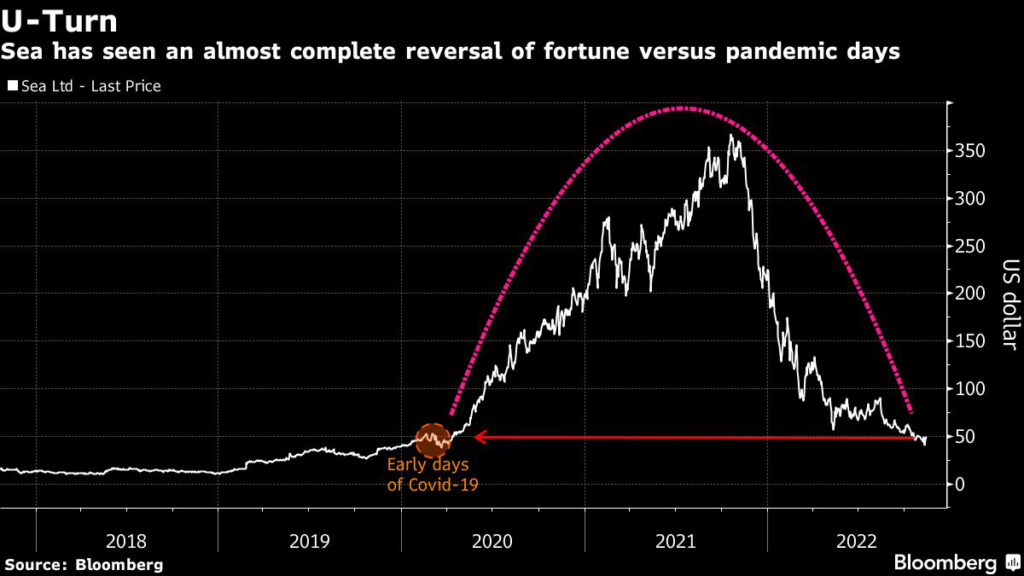
The gaming and online-retail giant has lost almost 90% of its value since a peak last year on questions about its money-making prospects in an era of rising interest rates and intensifying competition. The company has slashed jobs, shuttered its e-commerce operations in some European and Latin American markets and said it would reduce expenses to cope.

Sea is scheduled to report quarterly results on Tuesday, with analysts estimating widening losses and the slowest year-on-year revenue growth since 2017.

The latest cuts span recruitment, employee relationship management, training and other human resources functions in Singapore and China, the people said, asking not to be named discussing internal actions. The Information earlier reported the extent of Sea’s recent layoffs.

Affected staff include those supporting hiring and training across Shopee and its digital financial services arm SeaMoney, which oversees payment product ShopeePay, the people said. Managers have also been told to recruit more prudently as the company braces for an economic downturn.

“As part of the previously communicated exercise to optimise operating efficiency, we continue to carefully review our business projects and priorities in line with our goal of achieving self-sufficiency. We are also working to support our affected colleagues during this transition,” Sea said in a statement. The company ended 2021 with more than 67,000 people overall.

In September, billionaire co-founder Forrest Li announced in an internal memo that top management will forgo their salaries and tighten company expense policies as it attempts to curb spending.

–With assistance from Yoolim Lee.

More stories like this are available on bloomberg.com

©2022 Bloomberg L.P.

Druckenmiller Reloads on Amazon as Family Offices Weather Tumult

(Bloomberg) — Stanley Druckenmiller’s Duquesne Family Office reloaded on Amazon.com Inc., adding a $102 million position in the third quarter after selling its entire $199 million stake in the prior three-month period.

Duquesne continued to scale back its stake in Microsoft Corp., according to the firm’s 13F filing Monday. Other new positions include about $30 million of Sea Ltd., the maker of battle royale game Free Fire whose stock tumbled 75% this year through the third quarter, and $22 million of Meta Platforms Inc.

Family offices, the investment firms of the ultra-rich, took different approaches in the third quarter, which was rife with volatility. From June 30 to Aug. 16, the S&P 500 Index gained almost 16%, only to fall 17% from then to the end of September as Federal Reserve Chair Jerome Powell indicated the central bank would still raise interest rates aggressively.

Soros Fund Management boosted its stake in Biohaven Pharmaceutical Holding Company Ltd. to $336 million, while taking a new $81 million position in Chemocentryx Inc. The firm, with almost $5 billion in US equities, still holds a small $24 million position in Elon Musk’s Tesla Inc., which it added in the second quarter.

Iconiq Capital, a multifamily office which has served high-profile Silicon Valley clients like Mark Zuckerberg, Sheryl Sandberg, Jack Dorsey and Reid Hoffman, reduced its stake in DoorDash Inc., after reporting a new $275 million position in the company in the prior three-month period. It also sold 3 million shares of Snowflake Inc., though the company remains its biggest single holding.

David Tepper’s Appaloosa Management didn’t add any new stocks in the third quarter, though it shed its entire positions in Kohl’s Corp., Occidental Petroleum Corp. and Micron Technology Inc.

Blue Pool Capital, which manages part of the fortunes of Alibaba Group Holding Ltd. co-founders Joe Tsai and Jack Ma, had only Blue Owl Capital in its US equities portfolio as of June 30. While it still makes up the overwhelming majority of its holdings, the firm also added stakes in Charter Communications Inc., AT&T Inc., Intel Corp. and Adobe Inc. in the following three months.

The investment firm that manages the Walton family’s fortune decreased its holdings in emerging-market funds. The asset class has been pummeled this year, with the MSCI Emerging Markets Index down 24% since Dec. 31.

SEC rules require investors who manage more than $100 million in US equities to disclose their holdings quarterly, with some exceptions granted to family offices upon appeal.

More stories like this are available on bloomberg.com

©2022 Bloomberg L.P.

Online Ketamine Clinics Face Tougher Times After Covid-Era Boom

(Bloomberg) — A controversial depression treatment that boomed during the pandemic could become far less accessible by next year — potentially leaving patients high and dry and the internet upstarts that supply them looking for a contingency plan. Covid-era measures that allowed doctors to remotely prescribe ketamine, an often-abused drug increasingly popular for treatment-resistant depression, could unwind this spring. That could spell trouble for companies such as Mindbloom and Nue Life that will be forced to rethink their businesses amid concerns that at-home access has increased abuse of the drugs.

“I tell these folks, ‘There’s going to be a reckoning coming, and when that reckoning comes, you probably will lose everything,’” said Anthony Coulson, a retired DEA regional head who now consults for startups about controlled substances.  

For the past three years, the public health emergency has temporarily suspended a 2008 law called the Ryan Haight Act that forbids the prescription of controlled substances via telemedicine. That allowed patients with depression to access ketamine — a drug originally designed as an anesthetic that also has hallucinogenic effects — without leaving their homes.

But whether the Biden administration will renew the emergency status yet again when it expires in the spring remains to be seen. Republican lawmakers including Washington congresswoman Cathy McMorris Rodgers have been actively pushing against it. If that happens, mail-order businesses might be required to make drastic changes to their business models, such as requiring patients to attend at least some in-person visits.

Making ketamine available via telehealth has had two major effects that may ultimately influence the fate of these companies. It is now wildly more accessible, with companies like Mindbloom advertising mail-order treatments to millennials via Instagram. Some companies offer sessions for as little as $167. It is also far more vulnerable to abuse: People who want to use the drug recreationally for its mind-bending effects or because they have become dependent on it can now get it more easily.

“One of the big concerns about ketamine is about its abuse liability,” said John Krystal, a pioneering Yale researcher who helped define the drug’s therapeutic potential. “If people are getting many doses at home, then the potential for abuse goes up significantly.”

One ketamine startup, Mindbloom, opened its first in-person clinic in Manhattan with much fanfare in early March 2020, promising a “spa-like setting” with zero-gravity chairs, weighted blankets and aromatherapy. Then, within weeks, the world shut down. Mindbloom had already tested at-home ketamine options, so it pivoted fully to virtual treatment, and business boomed. Mindbloom is now available in 35 states and Washington DC.

While there are still plenty of in-person ketamine clinics, the virtual business is what has caught the attention of venture capitalists. Shipping ketamine through the mail offers better profit margins and the possibility of quickly scaling. Instead of paying rent for an office, you can use software and virtual calls to guide patients through the experience. Mindbloom, which offers at-home options, charges roughly $200 per treatment. Meanwhile Polaris, a well-known San Francisco clinic, can cost up to $1250 for a three-hour session including talk therapy.

Unlike in-person patients, a patient doing at-home treatment could take more in one sitting than is prescribed, or could give the drugs away to someone else. And supervision over teleconference is less rigorous. At Mindbloom, for example, patients must do a video call ahead of their first session, but subsequent sessions are “self-led.” The patients are told they must have a monitor in the house – like a friend or family member – during a session, but Mindbloom declined to specify how that request was enforced.

Leonardo Vando, Mindbloom’s medical director, said in a statement that the concerns about at-home ketamine therapy are “speculative” and have been “raised by people whose businesses compete with telehealth.” He added that data indicates remote ketamine therapy can be effective and safe, and that “it’s important to make lower-cost, more-accessible treatment options like this available if we’re going to turn the tide of the mental health crisis.”

Julia Mirer, a physician who’s now a psychedelics consultant, including to some of Mindbloom’s competitors, said she was taught in medical school that doctors should never assume patients are taking drugs correctly. Ketamine, she’s observed, is no different. “I’ve talked to people who said, ‘My doctor sent me three sessions. It was really great, but after the second time, my wife and I took some to have fun,’” Mirer said. At its worst, ketamine can be treated like “a dependable escape,” she added. “It becomes too easy to enjoy the ketaverse.”

Often, patients start with an online appointment with a prescribing clinician. If approved, the drugs are administered virtually by often-unlicensed ketamine guides, who videoconference with patients before, after, or sometimes during their session. Mindbloom’s guides, for example, are hourly contract workers who are not required to have a medical license, though many of them have coaching experience. Providers are also still refining the best doses and treatment schedules for the virtual environment. And virtual clinics also face many of the same complications and criticisms as other upstarts launched to prescribe specific drugs, like Hims and Roman. With this business model, typically the company makes money if a doctor is able to treat a patient with the specific drugs the company offers. Mindbloom, for example, offers ketamine therapy, not generalized treatment for depression. 

Coulson, the retired DEA agent, said that companies selling ketamine via telehealth may not be thinking of the health of their patients first. “The concerns are making money,” he said. 

All of these factors mean that when the public health emergency ends — and it will, eventually — things may get complicated for businesses built around prescribing ketamine at home. Mindbloom, for one, said it is prepared to re-introduce in-person exams if needed by using partnerships with other clinics, in-home exams, or their own spaces. The company said it is also betting that telehealth waivers may remain even if the public health emergency ends. For now, the US government is extending the deadline three months at a time, with calls to end it only growing louder. Whenever regulations change, it’ll likely mean patients will have to be seen in person at least once — and that an already-tangled web of state licenses will get even knottier.

That uncertainty has left some investors wary. Dustin Robinson invests in psychedelic startups, but his firm hasn’t invested in any that depend on telehealth, he said: “I’m probably too familiar with the risks involved of what could happen.”

–With assistance from Riley Griffin.

(Updates license requirements in the 13th paragraph.)

More stories like this are available on bloomberg.com

©2022 Bloomberg L.P.

Crypto Market Turmoil Shows Possible Risks for Mainstream Finance, Fed’s Barr Says

(Bloomberg) — The Federal Reserve’s top banking regulator sees a warning for the broader financial system in the recent crypto-market turmoil.

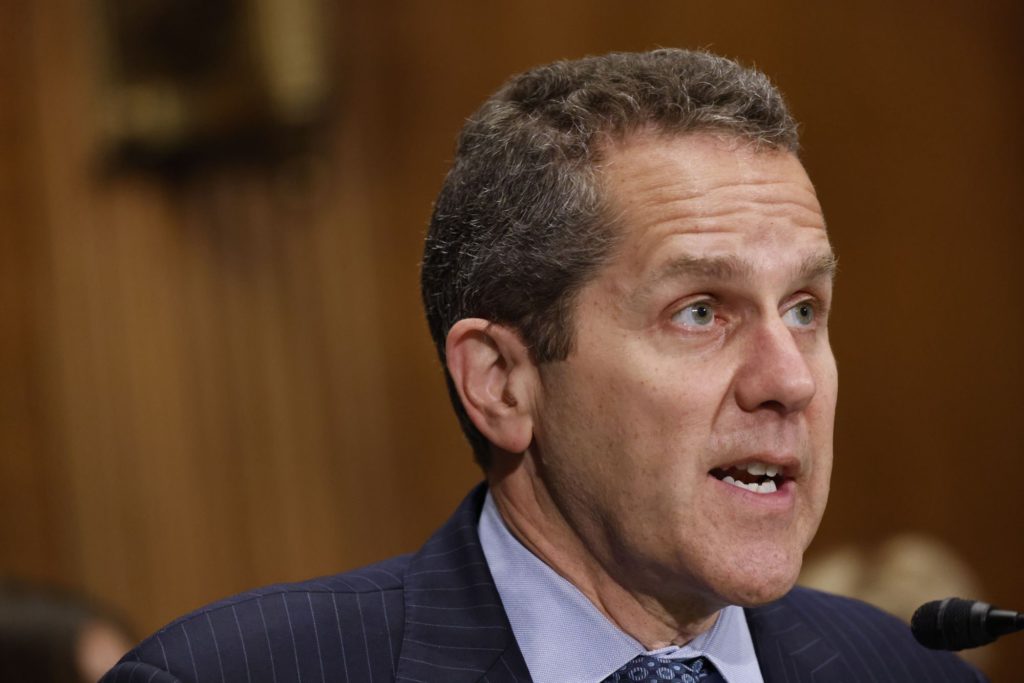
Fed Vice Chair for Supervision Michael Barr says that more regulation is needed for digital assets and that crypto firms should face rules that resemble those that apply to Wall Street. The comments, which he plans to deliver on Tuesday before the US Senate Banking Committee, follow a chaotic week for crypto as the industry reels from the collapse of Sam Bankman-Fried’s FTX. 

“Recent events remind us of the potential for systemic risk if interlinkages develop between the crypto system that exists today and the traditional financial system,” Barr said in remarks posted on the Fed’s website on Monday. “Crypto-asset-related activity, requires effective oversight,” he said without mentioning any firms by name. 

Barr added that the Fed, the Office of the Comptroller of the Currency and the Federal Deposit Insurance Corp. are working together “to assess the risks and opportunities posed by a range of crypto-asset-related activities.” The heads of those agencies are also scheduled to testify at the Tuesday hearing. 

More stories like this are available on bloomberg.com

©2022 Bloomberg L.P.

Hedge Funds Mostly Missed Stock Rally After Muted Buying Last Quarter

(Bloomberg) — Some of the world’s biggest equity hedge funds held back from ramping up bullish bets in the third quarter, likely missing out on a 10% rally in the S&P 500 since the end of September.

Firms including Chase Coleman’s Tiger Global Management and Lee Ainslie’s Maverick Capital made relatively modest additions to their portfolios after incurring heavy losses earlier in the year. They also continued to reduce their largest holdings.

The conservative posture may eventually look prescient if, as some economists and business leaders predict, the Federal Reserve’s recent string of interest rate increases tips the economy into a recession, reversing recent market gains. 

Tiger Global, on pace for its worst year on record with a loss of 54.6% through October, added just five new companies to its US holdings. Three of those stakes were valued at less than $100 million each at the end of the third quarter — and one, PayPal Holdings Inc. was worth less than $5 million. The hedge fund exited 14 stocks. 

Maverick reported 183 new buys, though most of those positions were worth less than $500,000 each. Ainslie’s biggest new purchase was a $120 million stake in Avantor Inc., a provider of chemicals and advanced materials to industries including health care and biopharma.

Last month, Coatue Management founder Philippe Laffont said his firm still had 70% to 80% of its assets in cash after slashing positions earlier this year. The firm’s biggest purchase was a $178 million stake in Lam Research Corp., a semiconductor equipment supplier. Most of Coatue’s 16 new stock holdings were valued at less than $50 million. 

The firm reduced positions in some of its largest holdings, including Tesla Inc., Amazon.com Inc., JD.Com Inc., Microsoft Corp. and Facebook parent Meta Platforms Inc.

Monday was the deadline for thousands of institutional investors, including hedge funds, pension funds and endowments, to report certain US equity holdings to the Securities and Exchange Commission through quarterly 13F filings.

For TOPLive blog coverage of 13F disclosures, click here

Other highlights:

  • Andreas Halvorsen’s Viking Global Investors ramped up its stake in Elevance Health Inc. by 59%, making it the hedge fund’s biggest US equity investment. The shares gained 5.9% this year. Viking slashed its stake in former top holding T-Mobile US Inc. by 64%, leaving the wireless carrier as the firm’s 17th-largest position.
  • Even though Coatue pared its Amazon stake, the retail behemoth was a popular buy among other hedge funds, which collectively snapped up about 9 million shares last quarter. That’s according to an analysis of 679 firms — more than half of the total that needed to file by Monday. About 121 hedge funds increased their Amazon positions, while 100 pared them.
  • Activist hedge fund Jana Partners disclosed a new 4% stake in health care services provider Enhabit Inc., whose shares have tumbled 50% this year.

–With assistance from Sabrina Kharrazi, Francesca Maglione, Dayana Mustak, Scott Deveau, Miles Weiss and Bill Austin.

More stories like this are available on bloomberg.com

©2022 Bloomberg L.P.

Elliott Takes Stake in Clarivate With Take-Private Wave Rising

(Bloomberg) — Elliott Investment Management disclosed a new stake in Clarivate Plc amid a wave of take-private transactions in the information services sector. 

The Florida-based hedge fund said in a regulatory filing Monday that it owned a 1.5% stake in the company, without giving any other details about the nature of the investment. The stake is valued at about $94 million, although Elliott often bolsters its positions in companies that it invests in through derivatives. 

Clarivate’s shares are down about 57% since the start of the year as the company saw some of its top executives replaced. The company said in July that Chief Executive Officer Jerre Stead was retiring and was being replaced by Jonathan Gear. 

The company’s shares closed Monday down 4.7% to $10.10, giving London-based Clarivate a market value of $6.8 billion. 

Clarivate is a provider of critical data, insights and analytics used by universities, corporations, the legal community and other institutions around the world, according to its website. It was purchased from Thomson Reuters Corp. in 2016 by a group of investors led by Onex Corp. and Baring Private Equity Asia. 

The company went public in 2019 through a merger with a special purpose acquisition company led by Michael Klein. Several of its top investors are private equity companies, including Leonard Green & Partners, which is its largest shareholder with a 17.3% stake in the company, according to data compiled by Bloomberg. 

The investment by Elliott comes at a time when large information services companies are increasingly being taken private. Elliott itself partnered with Brookfield Asset Management Inc. this year to acquire Nielsen Holdings Plc in a deal valued about at $10 billion. Last month, Veritas Capital Fund Management agreed to acquire Wood Mackenzie Ltd. from Verisk Analytics Inc. for $3.1 billion. 

More stories like this are available on bloomberg.com

©2022 Bloomberg L.P.

Bitcoin Miner Expects ‘Many More’ Bankruptcies After FTX Collapse

(Bloomberg) — Crypto mining firms listed in Toronto expect more turmoil and a lingering crisis of confidence in digital assets after the collapse of Sam Bankman-Fried’s FTX. 

Bitcoin dropped as low as $15,804.76 on Monday and has lost nearly a quarter of its value since Nov. 5, shortly before FTX began to unravel. The falling price of the largest cryptocurrency, as well as smaller ones, is squeezing overleveraged miners and hedge funds that have lent money to the sector, according to the executive chairman of Hive Blockchain Technologies Ltd.

“There are still many more bankruptcies” to come, Frank Holmes said in a phone interview. FTX’s stunning tumble into bankruptcy has even affected already-insolvent firms like Voyager Digital Ltd., a crypto brokerage that filed for Chapter 11 in July and for which FTX had made a takeover offer, he noted. Voyager announced Friday that it’s reopening a bidding process as part of its own bankruptcy proceedings. 

“I just don’t know who’s next. Maybe this is the Lehman Brothers event,” said Holmes, likening the FTX collapse to that pivotal moment in the global financial crisis of 2008 when the Wall Street firm toppled. 

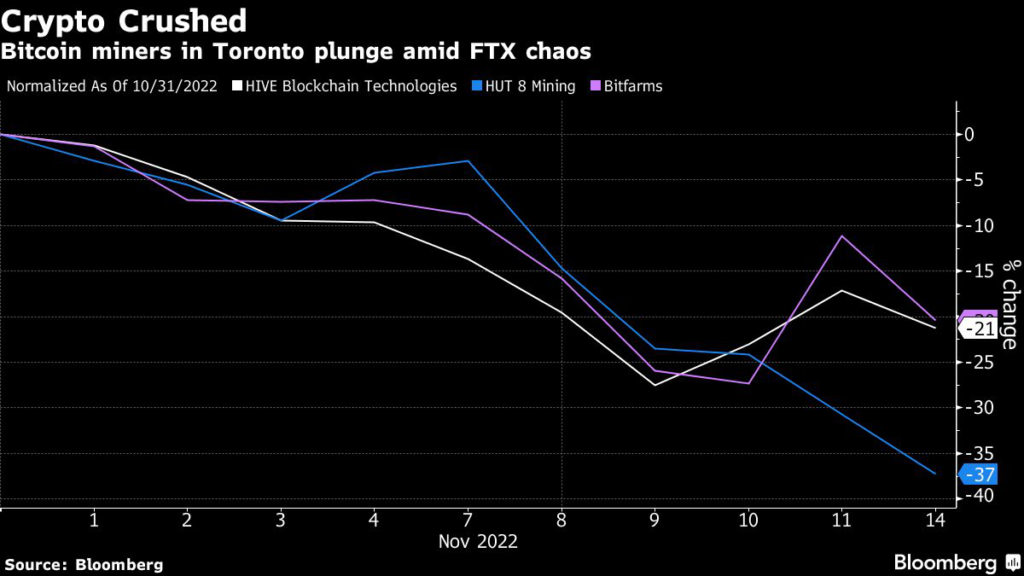
Toronto-listed crypto miners have plunged as the FTX saga has unfolded. Hut 8 Mining Corp. has led the way, plummeting 37% this month, while Hive has fallen 22% and Bitfarms Ltd. 24%.

All Bitcoin miners’ margins have been compressed, Bitfarms President Geoffrey Morphy said Monday during an earnings call that focused on the company’s attempts to keep costs low to survive the “crypto winter.” For miners, high energy costs are compounding the problem of falling crypto prices. 

For many crypto entities, the capital markets are now firmly shut. “In the coming weeks and months, we will uncover how many executives and insiders knew what was happening under the hood,” Ether Capital Corp.’s CEO Brian Mosoff said in an email, noting that he expects “many dominos” to fall.

“Companies — startups or established — looking to raise capital in this environment will likely be met with resistance,” Mosoff said. “I expect this will take months, if not years, to play out.”

Hive Blockchain is organizing webcasts and meeting with investors to address concerns about investor sentiment. Part of the message: the Vancouver-based company has never used FTX as a trading firm and doesn’t leverage its crypto holdings, and any exposure Hive might have to FTX is “de minimus,” Holmes said.  

Pulling Funds 

Bitvo Inc., a Calgary-based cryptocurrency trading platform, has given assurances to customers that it continues to operate. FTX announced plans to buy the firm in June, but the deal did not close. 

The trading platform operates on a full reserve basis and doesn’t lend money, CEO Pamela Draper said by phone. While “volatility” on the platform has increased, the company hasn’t paused deposits or withdrawals.

“It hasn’t affected our platform at all,” she said. For now, Bitvo is still bound by the FTX acquisition agreement, but the company will disclose “when or if” that’s canceled, Draper said.

The crash of Bankman-Fried’s empire has fueled outflows across global crypto exchanges, with users pulling $3.7 billion worth of Bitcoin and $2.5 billion of Ether from Nov. 6 to Nov. 13, according to data provider CryptoQuant. 

More stories like this are available on bloomberg.com

©2022 Bloomberg L.P.

Balenciaga Is Latest Twitter Quitter Amid Exodus Under Musk

(Bloomberg) — Balenciaga has joined other brands in quitting Twitter after billionaire Elon Musk acquired the social-media platform last month and upended content rules.

The luxury brand confirmed that it deleted its Twitter account and has not yet commented further.

Balenciaga, based in Paris, is the latest company to quit the troubled platform since Musk took it private on Oct. 27 and made major changes, including firing half its workforce and starting a paid verification service that led to the proliferation of imposter accounts. One pretended to be Eli Lilly and tweeted “insulin is free now,” which caused a steep decline in the drugmaker’s stock.

Other companies have paused advertising on the platform, including General Motors, Volkswagen, Pfizer and General Mills.

On Friday, theatrical guide Playbill left a final tweet for its 400,000 followers that read: “Because of its tolerance for hate, negativity and misinformation, our time with the social media platform has come to an end.” It warned fans to ignore any content from a Twitter account that contains the Playbill name. “Please understand that it is not us.”

Vogue reported on the departure earlier.

More stories like this are available on bloomberg.com

©2022 Bloomberg L.P.

How Elon Musk Scored a $55 Billion Pay Package That’s Now Under Fire

(Bloomberg) — A Silicon Valley venture capitalist who served on Tesla Inc.’s  board testified that the largest executive-pay package in US corporate history was necessary to keep Elon Musk “engaged” in the electric carmaker he founded. 

Taking the stand Monday as the first witness in a trial over the propriety of paying Musk some $55 billion, Ira Ehrenpreis said the Tesla board recognized in 2017 that the chief executive officer was a “serial entrepreneur” and wanted to make sure he didn’t leave the company to pursue other interests.

“We wanted Elon to be at the head of Tesla for a long time,” Ehrenpreis testified.

Ehrenpreis’s testimony, which aimed to establish that it was the board rather than Musk that determined the compensation deal, underscored a continuing concern about the Tesla CEO. Since he recently completed his controversial $44 billion acquisition of Twitter Inc., Musk has plunged the social-media platform into chaos and a threat of bankruptcy with a series of policy, product and personnel upheavals and an exodus of advertisers.

Amid all of that, Musk is expected to take the stand himself this week in Delaware Chancery Court. 

How Elon Musk’s Twitter Takeover Turned Into Chaos: QuickTake

The trial stems from a shareholder’s suit that claims Tesla’s board failed to exercise independence from Musk as it drew up a new pay package for its charismatic CEO. If Judge Kathaleen St. J. McCormick sides with the shareholder — a long shot — she could order Musk to pay back some or all of the stock awards to Tesla.

McCormick is the same judge who presided over a showdown between Musk and Twitter in recent months when he was trying to back out of the buyout — before he capitulated and agreed to honor his original offer.

‘All for Elon’

Musk has acknowledged he had little to fear from the Tesla board’s review of his pay proposal, according to court filings. “Me negotiating against myself” is how he described the process of tweaking the pay package’s details in a pretrial deposition.

During cross-examination of Ehrenpreis, a lawyer for the shareholder raised a March 2018 email Musk sent to the company’s then-Chief Legal Officer Todd Maron in which the CEO warned that, if a particular institutional investor voted against the package, they would be told they “weren’t welcome” at Tesla anymore.

Ehrenpreis, who was copied on the email, testified that he didn’t think it was threat against all major shareholders, and said he didn’t know why Musk got worked up about that one investor. 

It’s not clear if Musk ever directly communicated his warning to the investor. Maron, who took the stand after Ehrenpreis, wasn’t asked about it on Monday.

Ehrenpreis said the board discussed Musk’s compensation with 10 of the company’s largest institutional investors, who all agreed on the need to keep Musk at Tesla.

Representatives of Fidelity Investments said they were “all for Elon making a bunch of money” when Tesla made leaps in value, Ehrenpreis recalled.

Time Spent Elsewhere 

Musk spends considerable time on his other startups, including aeronautics firm Space Exploration Technologies Corp., Boring Co. and Neuralink Corp., and now, Twitter.

Lawsuits targeting executive compensation traditionally face a high bar, partly because the packages are contingent on ambitious share-price targets. Under Delaware law, directors generally get leeway to use their “business judgment” to set pay.

“It’s true the executive compensation package approved for Elon Musk is remarkably large, but Delaware courts are usually rather deferential” to directors’ decisions on pay when a majority of shareholders vote to back the plan, said Paul Regan, a Widener University law professor who specializes in Delaware corporate law. 

Still, the failure of the Tesla directors to disclose to investors some of the pay package’s “challenging” milestones were likely to be achieved within a little over a year could be problematic, said Joel Fleming, a partner at law firm Block & Leviton, who isn’t involved in the case.

“This is a strong case,” Fleming said. “Tesla’s board appears to have misled Tesla’s stockholders” who voted to back the package, he said. 

In addition, “the fact that Musk has spent all this time on the Twitter takeover” strengthens the argument that he’s spread too thin to focus enough on Tesla.

The case is playing out in Delaware because Tesla is incorporated in the state, the home to 1.8 million US companies and more than 60% of Fortune 500 firms. Judges in its chancery court are business-law experts who hear cases without a jury. 

Heavy-Metal Drummer

The suit was filed by Richard Tornetta, who has owned nine Tesla shares since February 2018, according to court filings. Tornetta, whose business sells car parts for stereo systems and radar detectors, has been threatened online for bringing the case against Musk, his lawyers said. 

Besides once playing drums for a now-defunct heavy-metal band, Tornetta is the lead plaintiff in another securities case in Delaware over Sirius XM’s 2018 buyout of Internet radio service Pandora. Tornetta didn’t respond to a request for comment.

Musk’s Tesla equity awards helped him become the world’s richest person last year. At his peak, Musk was worth $340 billion last November, according to the Bloomberg Billionaires Index. His net worth dropped below $200 billion this month as Tesla shares hit a 52-week low.

Tesla directors justify Musk’s compensation in court filings by pointing to the company’s 12-fold increase in value over four years to $690 billion as of last month — including a brief period starting in October 2021 when it exceeded more than $1 trillion. 

Most US companies have adopted a similar pay-for-performance model, they say.

Tornetta also contends Tesla’s board is loaded with Musk’s friends and confidantes, making it so rife with conflicts of interest that it was incapable of making an independent decision on the billionaire’s pay. 

He points to Musk’s long ties to Ehrenpreis, who headed up the board committee responsible for reviewing the CEO’s pay, as an example of the conflicts. Ehrenpreis was one of Tesla’s early investors and served as one of Musk’s advisers on the Twitter buyout. 

Musk also had the help of Maron in finalizing the compensation plan, Tornetta said. Maron left Tesla in 2018. 

Tesla directors denied in court filings that they were beholden to Musk or that their judgment about his pay was tainted by conflicting interests.

Read More: Musk Can’t Escape Investor’s Claims Over ‘Extraordinary’ Award

Tornetta wants McCormick to tag Musk as Tesla’s controlling shareholder even though he owned only about 22% of the car company’s shares as of early 2018.

If Musk is deemed Tesla’s effective controller, the company must prove his pay package was “entirely fair,” a higher legal standard to meet rather than just relying on directors’ business judgment. 

Tornetta filed his so-called derivative suit against Musk and other Tesla directors on behalf of the company. That means any money recovered will go back to the electric-car maker and not to Tornetta. 

The case is Tornetta v. Musk, 2018-0408, Delaware Chancery Court (Wilmington).

(Updates with additional trial testimony.)

More stories like this are available on bloomberg.com

©2022 Bloomberg L.P.

Abortions, Drug Use Exposed in Cyberattack on Australian Health Insurer

(Bloomberg) — When the Australian health insurer Medibank Private Ltd. was hit with a ransomware attack last month, it provided regular updates to its customers, including the revelation that personal information from nearly 10 million of them was exposed. It also followed the government’s guidance on how to respond to the extortion demand.

Medibank didn’t pay the ransom. But that plan hasn’t worked out so well.

Following through on a threat, the hackers began publishing the most private medical details of some of Medibank’s customers, including terminated pregnancies, treatment for drug and alcohol addiction and heart attacks, according to a cybersecurity analyst, victims who have spoken publicly about the incident and local media reports.

About 1,000 patients have already had deeply personal data revealed on dark web forums, according to Medibank, and the hackers, who Australian authorities believe are Russian, have warned that more is coming.

“Unfortunately we expect the criminal to continue to release stolen customer data each day,” said David Koczkar, Medibank’s chief executive officer.

Medibank’s experience represents a nightmare scenario for companies and organizations attacked by ransomware, a type of cyberattack in which a victim’s data is encrypted until a payment is made to unlock it. Many ransomware gangs now steal data too and threaten to release the information unless payment is made. Despite guidance from government agencies, including the FBI, not to pay ransom demands, many victims end up doing so, including Colonial Pipeline Co., after a ransomware attack last year forced it to shut down a pipeline that provides fuel to the US East Coast.

Koczkar said in a statement that the company had been warned there was only a limited chance the data would be returned and not published even if they paid. The hackers sought $1 for every patient, or about $10 million, according to the Sydney Morning Herald.

“In fact, paying could have the opposite effect and encourage the criminal to directly extort our customers, and there is a strong chance that paying puts more people in harm’s way by making Australia a bigger target,” Koczkar said. 

Emily Ritchie, a Medibank spokesperson, said the company wasn’t doing interviews “because the criminal is watching our every move, and we are trying to be really careful to not fuel the criminal.”

There have been other instances where hackers have released personal data, though it is unusual for such personal medical information to be exposed. In one episode disclosed in 2020, hackers breached a privately run psychotherapy center in Finland called Psykoterapiakeskus Vastaamo Oy and stole patient information, including session notes. The hackers extorted the center and individual patients for money, and distributed some data online.

The online leaks from the Medibank hack have so far revealed scores of phone numbers, addresses, dates of birth, billing codes, ID numbers and full names of the people who’d been impacted, according to some documentation viewed by Bloomberg News and reported in Australian media. Databases labeled “abortions,” “good list,” “students” and “naughty list” were among those found on the dark web, according to screen shots shared with Bloomberg. Another labeled “boozy” included patients who have sought help for alcohol dependency, according to CNN.

“When you consider both the sensitivity of the information and the massive number of individuals, this is one of the worst –if not the worst — breaches to ever have happened,” said Brett Callow, a threat analyst at the cybersecurity firm Emsisoft.  

Meredith Griffanti, co-head of cybersecurity and data privacy communications at FTI Consulting, said her firm counsels hacking victims to not talk publicly about their decision on whether to pay a ransom. The hacking groups are tuned into the public responses of victims and media coverage, and if they feel like they aren’t getting what they want, “they’re going to do everything they can to make the ‘naming and shaming’ and/or extortion process as painful as possible,” she said.

“To put it bluntly, don’t antagonize the bad guys,” Griffanti said.

In Australia, meanwhile, people fretted about what information about them might be posted on the dark web and expressed disgust at the data that was already exposed.

David Shoebridge, a state senator for the environmental Greens Party said on Wednesday that “like millions of Australians, I’ve been left in the dark as to precisely what data of mine and my family has been obtained by the hackers.” 

“This has moved from a theoretical problem to a very personal problem,” he told Bloomberg. “Obviously you’re anxious about it and you have a sense of betrayal both by Medibank, and also by the Australian government in not ensuring that there are adequate protections in the first place.”

Kat, a woman in her mid-30s who works in human resources, posted on social media that she was among those whose data had been compromised.

Her health information isn’t “something I’m necessarily embarrassed about,” she told Bloomberg by phone. But she added, “I read that there’s an abortion list and people being good and bad. That’s completely horrific, something that might not have been discussed with family or even your partner but is now freely available is incredibly concerning.” She requested anonymity to discuss personal information.

Before the data was leaked, Medibank had told local media that it didn’t have cyber insurance, which sometimes covers the cost of ransom payments. It’s the policy of the Australian government that ransomware victims not pay, said Home Affairs Minister Clare O’Neil.

“The cyber thugs responsible for the Medibank cyber incident have weaponized medical information – particularly women’s – relating to some deeply personal, private matters,” she posted on Twitter on Friday. “It’s sickening and morally reprehensible.”

On Sunday, O’Neil said it was “pretty clear that Medibank was right not to pay the ransom,” because of the hackers’ subsequent release of the material. “The idea that we will trust these people to delete data that they have taken off and may have copied a million times is frankly silly,” she said in an interview on an ABC News program.

On Friday, the Australian Federal Police attributed the attack to a “group of loosely affiliated cyber criminals who are likely responsible for past significant breaches in countries across the world.”

“We believe those responsible are in Russia,” AFP Commissioner Reece Kershaw said in a televised statement, adding that they would be holding talks with Russian law enforcement about the attacks. “We know who you are.”

The Medibank hack was one of several major cybersecurity incidents Australian companies had reported in recent weeks. In late September, Singapore Telecommunications Ltd.’s Optus unit disclosed a vast leak of data on past and present customers. A ransom was demanded in that case as well, but it was later retracted by the alleged hacker.

Melbourne-based Australian Clinical Labs Ltd. reported in October that data on almost 250,000 patients and staff had been accessed in February. Health records and credit card details were among the information that was compromised, it said. 

–With assistance from Keira Wright and William Turton.

(Corrects the spelling of Meredith Griffanti’s name in 13th paragraph.)

More stories like this are available on bloomberg.com

©2022 Bloomberg L.P.

Close Bitnami banner
Bitnami