
Bloomberg

US Stocks Fluctuate as Traders Ponder Fed’s Path: Markets Wrap

(Bloomberg) — US stocks struggled for direction as investors mulled the Federal Reserve’s path of interest-rate hikes after hawkish comments from central bank Governor Christopher Waller.

Traders are awaiting comments from Fed Vice Chair Lael Brainard, who is set to discuss the economy outlook at an event hosted by Bloomberg News in Washington.  

The S&P 500 swung between modest gains and losses. The tech-heavy Nasdaq 100, which is typically more sensitive to interest rates, fell as much as 1.3% before paring declines. It was dragged by losses in Microsoft Corp., Amazon.com Inc. and Apple Inc. 

The dollar turned higher after weekend comments from Waller that policymakers had “a ways to go” before ending interest-rate hikes. Treasury yields rose, with the 10-year rate hovering around 3.88%.

Signs of cooling in US inflation and the prospects of a dovish tilt by the Fed had propelled the S&P 500 to its best week since June. But some of the world’s largest money managers are still clinging to risk-off positioning against the threat of entrenched inflation. JPMorgan Asset Management has a record allocation in cash in at least one of its strategies while a hedge fund solutions team at UBS Group AG is staying defensive.

“Even the biggest bull would have to say that investors need to be careful about extrapolating last week’s slightly better CPI number into something that is giving investors definitive proof that the inflation is about to decline in a substantial manner over the coming weeks and months,” Matt Maley, chief market strategist at Miller Tabak + Co., wrote. 

Read more: Wall Street Managers Are Pushing Back on Easing Inflation Hopes

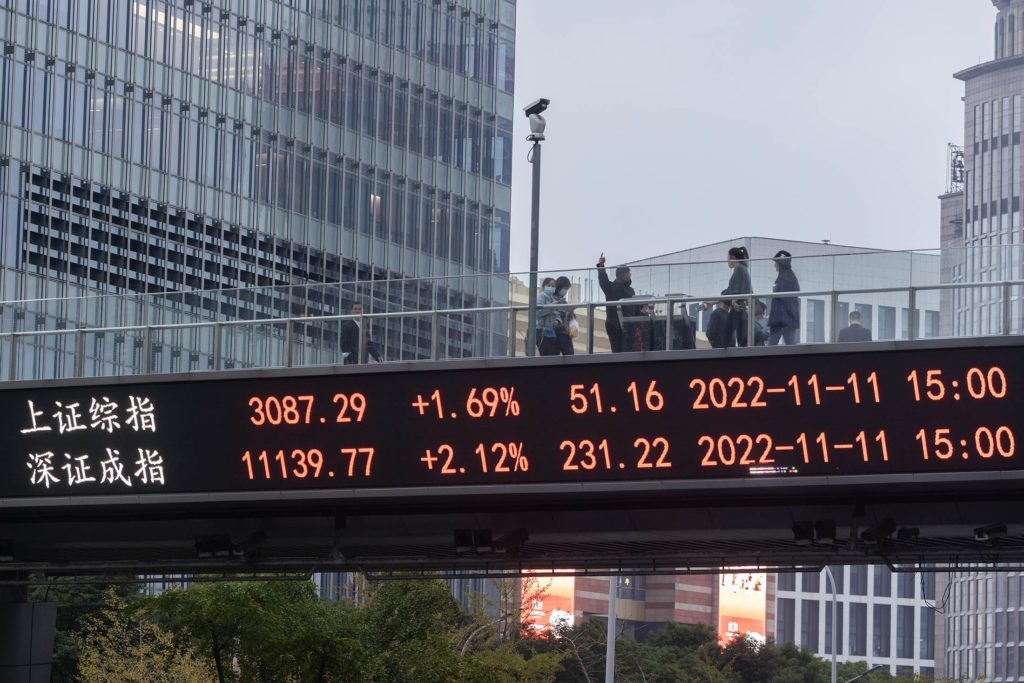
Meanwhile, Chinese stocks listed in the US are on track to extend their rally to a third day, after Joe Biden and Xi Jinping called for reduced tensions between the world’s two biggest economies during a meeting in Bali, Indonesia. The White House said in a statement afterward that Secretary of State Antony Blinken would travel to China.

Cryptocurrencies rose on plans by Binance Holdings Ltd. to set up a recovery fund to stabilize the industry after FTX’s bankruptcy sparked market-wide losses of around $200 billion in the past week. 

Key events this week:

  • Fed’s John Williams moderates panel, Monday
  • China retail sales, industrial production, surveyed jobless, Tuesday
  • Former US President Donald Trump plans to make an announcement, Tuesday
  • US empire manufacturing, PPI, Tuesday
  • US business inventories, cross-border investment, retail sales, industrial production, Wednesday
  • Fed’s John Williams, Lael Brainard and SEC Chair Gary Gensler speak, Wednesday
  • ECB President Christine Lagarde speaks, Wednesday
  • Eurozone CPI, Thursday
  • US housing starts, initial jobless claims, Thursday
  • Fed’s Neel Kashkari, Loretta Mester speak, Thursday
  • US Conference Board leading index, existing home sales, Friday

Some of the main moves in markets:

Stocks

  • The S&P 500 was little changed as of 10:25 a.m. New York time
  • The Nasdaq 100 fell 0.5%
  • The Dow Jones Industrial Average rose 0.2%
  • The Stoxx Europe 600 rose 0.5%
  • The MSCI World index rose 1.8%

Currencies

  • The Bloomberg Dollar Spot Index rose 0.4%
  • The euro fell 0.2% to $1.0327
  • The British pound fell 0.7% to $1.1745
  • The Japanese yen fell 1.2% to 140.54 per dollar

Cryptocurrencies

  • Bitcoin rose 1% to $16,536.86
  • Ether rose 2.4% to $1,245.7

Bonds

  • The yield on 10-year Treasuries advanced seven basis points to 3.88%
  • Germany’s 10-year yield declined three basis points to 2.13%
  • Britain’s 10-year yield declined four basis points to 3.32%

Commodities

  • West Texas Intermediate crude fell 0.9% to $88.19 a barrel
  • Gold futures rose 0.5% to $1,778 an ounce

This story was produced with the assistance of Bloomberg Automation.

–With assistance from Tassia Sipahutar, Cecile Gutscher, Brett Miller, Cristin Flanagan and Vildana Hajric.

More stories like this are available on bloomberg.com

©2022 Bloomberg L.P.
Treasuries Fall as Fed’s Waller Pushes Back on Dovish Rate Bets

(Bloomberg) — Treasuries fell across the curve and the dollar strengthened against most of its major peers after Federal Reserve Governor Christoper Waller pushed back on bets the US central bank was nearing the end of its hiking cycle, while traders were also on alert for a scheduled appearance by his colleague Lael Brainard.

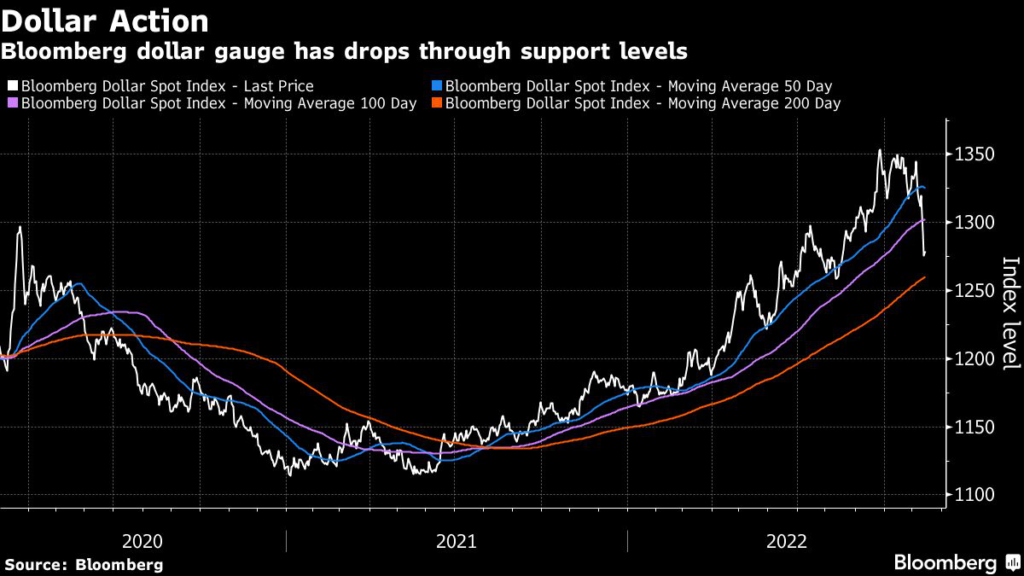
Benchmark 10-year Treasury yields climbed as much as nine basis points to 3.90% as trading kicked off again after a public holiday Friday, befor moving to around 3.88% in New York morning trading. Waller said the Fed has got a ways to go before its stops hiking and the market got “way out in front” over the unexpected cooling in inflation last week. A gauge of the greenback rose as much as 0.6% before shifting to be up around 0.4% on the day.

“Easier financial conditions risk undoing the Fed’s work to bring inflation sustainably down to target, so it is not surprising to see officials push back a bit,” Goldman Sachs Group Inc. analysts including Isabella Rosenberg wrote in a client note. 

The dollar’s advance comes after a gauge of the currency slid 3.5% last week, its biggest decline since the early days of the pandemic, as traders trimmed bets on aggressive Fed hikes after US inflation was slower in October than economists forecast. Treasury yields also tumbled and stocks surged amid optimism the Fed wouldn’t need to increase rates as much as anticipated. 

US two-year yields — among the most sensitive to changes in monetary policy — climbed as much as 10 basis points to 4.43%, after sliding 33 basis points last week. German and UK 10-year yields fell 4 basis points to 2.12% and 4 basis points to 3.31% respectively, paring some of Friday’s advance.  

Fed Speakers

Fed speakers this week are likely to push back on last week’s market reaction as they want to tighten financial conditions, not loosen them, Commonwealth Bank of Australia strategists wrote in a note to clients. The dollar can partly unwind last week’s decline as they were out of proportion to the size of the miss in inflation, they said.

Fed Vice Chair Lael Brainard is set to speak on Monday as part of a week featuring many central bank appearances. US producer price index data are due Tuesday. 

Meanwhile in Asia, Joe Biden and Xi Jinping agreed to a series of goodwill gestures intended to improve ties between their countries after the first in-person meeting between the leaders of the US and China since the pandemic began. The two men met for about three hours on the sidelines of the Group of 20 summit in Bali, Indonesia, greeting each other with a handshake and conciliatory remarks in which they both called for calming tensions.

–With assistance from Ruth Carson, Garfield Reynolds and James Hirai.

(Updates throughout.)

More stories like this are available on bloomberg.com

©2022 Bloomberg L.P.
Primark Website Crashes After Starting Click and Collect Service

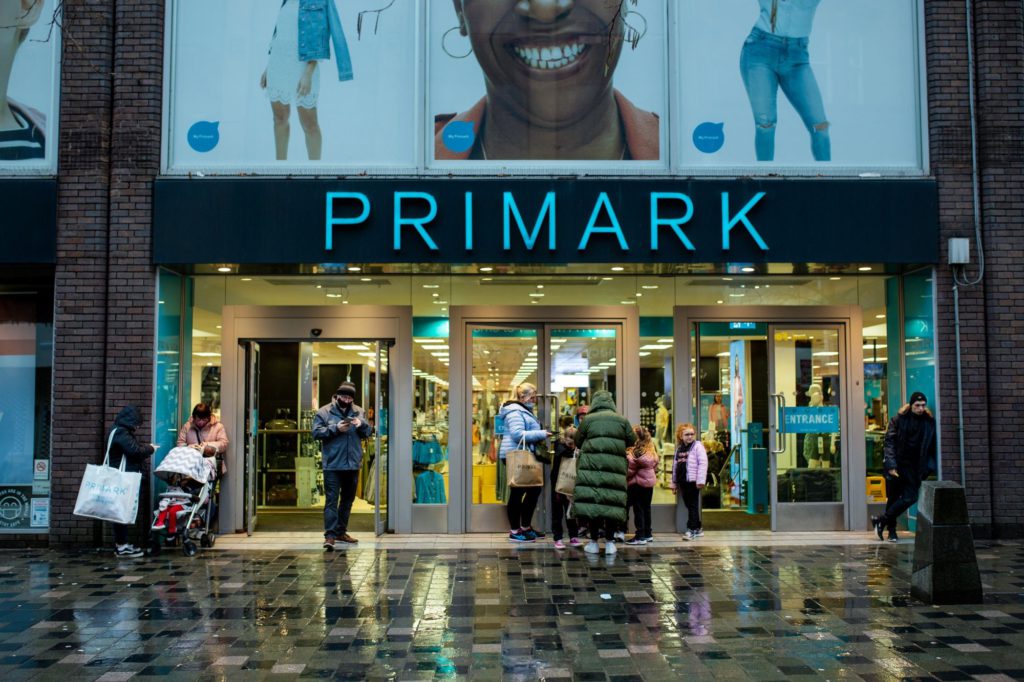
(Bloomberg) — Primark’s website crashed Monday after the budget fashion retailer offered British shoppers a click and collect service, the first time that customers could buy from the company online.

The website was blank at 2.40 p.m. with a message saying that “some people have had issues accessing” the site and the company was working hard to ensure shoppers could browse easily. The click and collect trial on children’s products is operating across 25 stores in the north west of England, Yorkshire and north Wales.

Primark struggled during Covid lockdowns because stores were forced to close for months and the business had no e-commerce site to fall back on. The trial allows shoppers to buy online and collect in store. Primark has previously updated its website to allow customers to check availability of items in stores while still not transacting online.

“Our approach to online is all about supporting and complementing our stores, which will always be at the heart of our business,” said Chief Executive Officer Paul Marchant.

More stories like this are available on bloomberg.com

©2022 Bloomberg L.P.
German Regulator Sees Need for Global Crypto Rules

(Bloomberg) — Crypto assets need to be subject to global rules if they’re adopted by mainstream finance and expose banks and a wider swathe of investors to risk, Germany’s top regulator said.

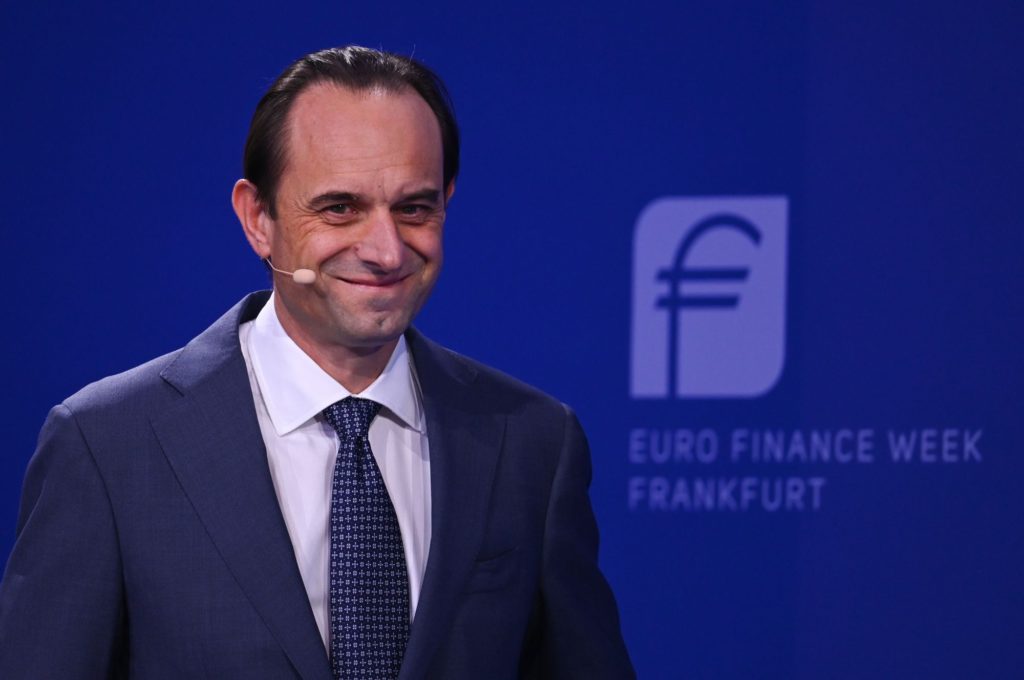
The recent crash in digital assets was well-timed given the ties between traditional finance and crypto are still limited, meaning it doesnt pose a risk to financial stability, BaFin President Mark Branson said at an event in Frankfurt on Monday. 

Branson, responding to questions about the fallout from FTX Group, didn’t identify any crypto firms by name and indicated his comments were on the industry more broadly. 

The fall of Bahamas-based FTX, until recently widely perceived as among the most dependable names in the sector, has sparked fresh concerns over the loosely-regulated nature of crypto companies and what guardrails are in place to safely oversee clients’ assets. FTX is the latest in a long list of large crypto businesses to come undone this year, including hedge fund Three Arrows Capital, crypto lender Celsius Network and broker Voyager Digital. 

“What was especially disturbing about what we’ve seen in the last days, weeks and months is the consumer protection aspect,” Branson said. “We currently solve that problem via exclusion and saying investors need to decide if they will play in a certain casino that has nothing to do with the regulated system, where no German or European supervisor or regulator will help. The question is how sustainable is that strategy?”

The BaFin head said crypto either needs to be shut out by building a “very, very strong wall” around the traditional banking system or by regulating the industry and “then see if crypto money is in real competition with fiat money.”

Crypto is also “massively susceptible for money laundering risks and doesn’t have a handle on these,” Branson said. A set of rules for the industry would need to be tackled on a global level rather than just by Europe, he said.

“A lot of what we have seen recently has happened far away from us, if you can figure out where it is,” Branson said. “You really have to let this sink in: no one knows where certain large platforms are.”

More stories like this are available on bloomberg.com

©2022 Bloomberg L.P.
World’s Biggest Crypto Fund Hits Record 42% Discount to Value of Bitcoin It Holds

(Bloomberg) — Problems are multiplying for the world’s biggest crypto fund as chaos engulfs the industry in the wake of exchange FTX’s shock bankruptcy filing.

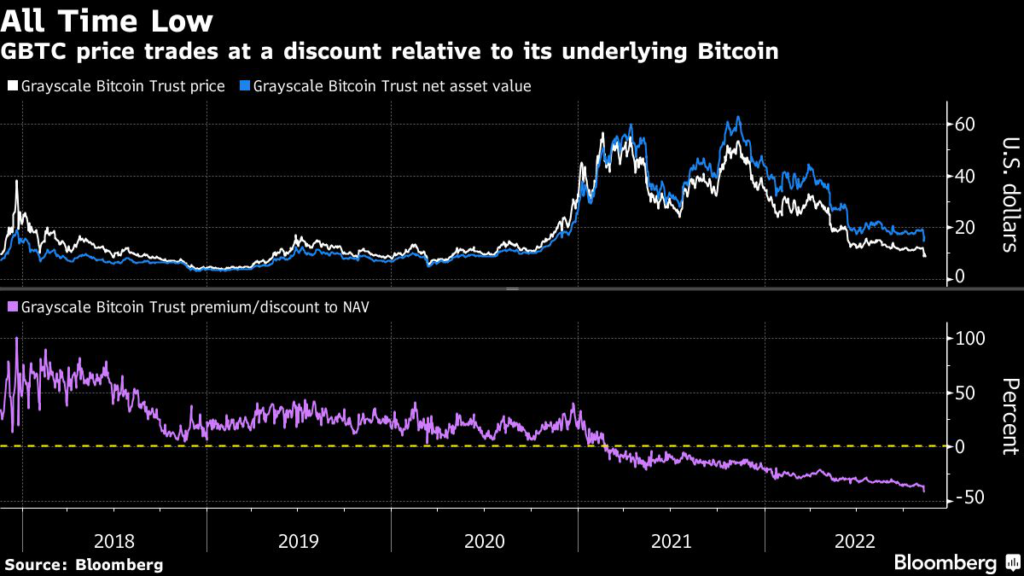
The $11.4 billion Grayscale Bitcoin Trust (ticker GBTC) has plunged more than 74% this year, outpacing the cryptocurrency’s 64% decline. That gap has widened dramatically over the past week, dragging the price of GBTC to an unprecedented 42% discount to the value of the Bitcoin it holds, according to Bloomberg data.

The dislocation is rooted in the fact that despite Grayscale’s best efforts, US regulators have repeatedly denied applications to convert GBTC into a physically-backed exchange-traded fund — a structure that the Securities and Exchange Commission has yet to approve, despite allowing the futures-backed ProShares Bitcoin Strategy ETF (BITO) to launch a year ago. In its structure as a trust, GBTC isn’t able to redeem shares to keep pace with shifting demand, exacerbating its net-asset value discount while the derivatives-backed ETFs stay in lockstep with theirs. 

“We have a broken product in GBTC that the SEC allows any retail investor to get their hands on,” said Nate Geraci, president of advisory firm The ETF Store. “BITO sticking to its NAV is yet another demonstration of the superiority of the ETF structure and adds to the growing list of reasons why a spot Bitcoin ETF should exist.”

BITO has dropped 65% so far in 2022, similar to Bitcoin’s slide. Though fears about BITO’s roll costs — the expense of having to continually roll forward futures contracts as they expire — produced much hand-wringing before its debut about the fund’s potential tracking error, those concerns have been largely unfounded.

Meanwhile, GBTC’s discount is one of the primary reason why Grayscale has pushed for the trust’s conversion into an ETF. The SEC’s denial in June led the firm to sue the agency. 

The contrast between GBTC’s record discount and BITO’s tight tracking should bolster the case for spot Bitcoin ETF approval, but “the likelihood has dwindled further due to FTX’s struggles,” in the eyes of Bloomberg Intelligence. 

“As far as GBTC goes, I don’t know what stops this thing from sinking into a further discount,” said Bloomberg Intelligence ETF analyst James Seyffart. “There’s also an argument to be made that the widening discount is reflective of a lower probability or at last a longer time frame before GBTC is able to convert to an ETF.”

More stories like this are available on bloomberg.com

©2022 Bloomberg L.P.
Apple-Epic App Store Legal Battle Worries US Antitrust Enforcers

(Bloomberg) — The US Justice Department is taking a stance in the latest showdown between Apple Inc. and Epic Games Inc. over the iPhone maker’s dominance of the marketplace for mobile applications.

The world’s most valuable technology company will on Monday defend its App Store business model when Epic, the maker of the popular Fortnite game, asks the Ninth US Circuit Court of Appeals to find that Apple’s online marketplace policies are anticompetitive. 

The DOJ says it’s worried that “errors” by the lower-court judge who mostly sided with Apple last year may weaken its hand in future enforcement actions.

The case, which is about online marketplace policies for transactions related to apps and services, is being closely watched as US regulators continue to scrutinize big tech companies in their role as gatekeepers to the digital economy. 

Why App Store Fees Are Drawing Fire Worldwide: QuickTake 

While the DOJ said in a court filing that it’s not siding with either Epic or Apple, it argued that two provisions of the Sherman Act, a central pillar of US antitrust law, were misapplied in the September 2021 ruling by US District Judge Yvonne Gonzalez Rogers.

The department didn’t specify what kinds of enforcement actions might be imperiled, but it’s likely concerned about its own investigations of Apple’s and Google’s business practices. The DOJ will have 10 minutes at Monday’s hearing to air its concerns.

The dispute before the Ninth Circuit started in 2020 when Apple expelled the Fortnite game from the App Store because Epic created a workaround to paying a 30% fee on customers’ in-app purchases.

Following a three-week trial in Oakland, California, Gonzalez Rogers rejected Epic’s claims that the App Store is run like a monopoly. The judge didn’t see the need for third-party app stores or to push Apple to revamp policies over app developer fees.

But Justice Department attorneys say the judge “narrowly and wrongly” interpreted parts of antitrust law in a way that would weaken safeguards against unlawful deals and business conduct.

The federal government lawyers also say Gonzalez Rogers failed to accurately weigh the harms and benefits of App Store policies challenged by Epic. That “could significantly harm competition and consumers by allowing a minor benefit to condone a major harm,” the DOJ said in a filing.

Apple is expected to argue the issue isn’t ripe for the appeals court to address because it didn’t come up during the Epic trial.

What Bloomberg Intelligence Says

Antitrust scrutiny of Apple’s practices is increasing globally, with the US Justice Department’s probe reportedly accelerating. Any lawsuit that may ensue will likely have to plead facts or theories different than Epic’s to be successful.

— Jennifer Rie, Senior Litigation Analyst

Click here to read the full report

The case is Epic Games Inc. v. Apple Inc., 21-16695, US Court of Appeals for the Ninth Circuit (San Francisco).

More stories like this are available on bloomberg.com

©2022 Bloomberg L.P.
Alibaba Stock Primed for Rebound on Sales Recovery

(Bloomberg) — Investors are betting Alibaba Group Holding Ltd. may finally see its fortunes turn around after a rough 2022 plagued by a 40% slump in the shares and rare sell calls from Wall Street analysts.

Options data show that traders are pulling back on buying bearish contracts that benefit from further declines, with the put-to-call ratio for Alibaba’s US stock nearing a record low. The tech firm is expected to return to sales growth in the September quarter when it reports earnings on Thursday, following its first-ever drop for the prior period.  

While dip buyers in the past year have been burned repeatedly when it comes to investing in China tech stocks, belief is growing that the worst of the private-sector crackdown is over. Beijing’s plans to ease a raft of virus restrictions in a significant pivot away from Covid Zero and a sweeping package to rescue the nation’s beleaguered property market are also adding to the optimism.  

Alibaba is expected to report a 4.3% revenue increase for the quarter, along with the first margin gain since 2019. Investors will also be watching for updates on its effort to lower expenses along with guidance on further share buybacks. Shares rose as much as 4.6% on Monday morning in New York.

“Net income could beat Street consensus, given the cost-cutting measures and that the company has suspended lots of investments in some initiatives,” said Julia Pan, Shanghai-based analyst at UOB Kay Hian. She added that the company’s business should improve next month after the new quarantine rules are in place. 

The consumption recovery is also looking more steady. Although Alibaba didn’t disclose full sales results for its signature Singles’ Day shopping festival for the first time, China’s biggest e-commerce company said gross merchandise value was in line with last year’s performance despite Covid headwinds. Ad sales, which had been hammered by lockdowns over the past year, may finally rebound as reopening measures lift the economy.

“Despite a more challenging economic backdrop, we expect this year’s shoppers to be equally exuberant,” said Nicholas Yeo, head of China equities at abrdn. “Disposable incomes are climbing across the nation and this affluence is driving growth in aspirational areas.” 

To be sure, Alibaba faces broader challenges with the days of breakneck growth seen as over for the industry. Worries about the impact of US chip export legislation on the company’s cloud business are weighing on sentiment, while China’s full exit from Covid Zero is expected to be a long haul.

Yet sentiment is turning more positive, and it’s not just for Alibaba. According to options data, bearish bets are also easing for peers including JD.com and Tencent Holdings Ltd. Analysts are also expecting their earnings results to meet or even beat expectations. 

“Valuations of tech and innovation stocks in China look very attractive compared to historical level and global peers,” said Minyue Liu, investment specialist for Asian and Greater China equities at BNP Paribas Asset Management. “The risk-reward is more on the reward side at current valuation level.” 

Tech Chart of the Day

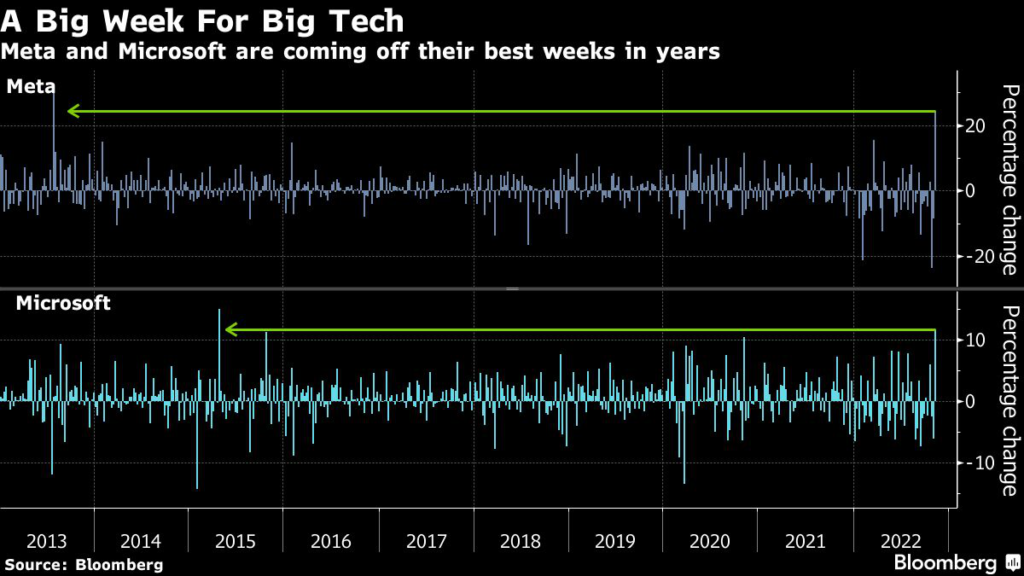
US technology and internet stocks staged a massive rally last week, with the Nasdaq 100 Index climbing 8.8% in its biggest advance since November 2020. The rally came as inflation cooled in October by more than forecast, fueling optimism the Federal Reserve will be less aggressive in raising interest rates. Microsoft Corp. climbed 12%, its biggest weekly gain since April 2015. Meta Platforms Inc. had an even bigger rally, soaring 24%, the most since July 2013. Meta, which remains down 66% this year, was also supported after it announced job cuts, a move that could help address concerns over expenses.

Top Tech Stories

  • Apple Inc.’s recent job listings shed light on plans for its upcoming mixed-reality headset. A few job listings indicate Apple is ramping up its work to bolster the device with content, while others imply that Apple is looking to build a video service for the headset featuring 3D content that can be played in virtual reality.
    • The Apple Store where you’ll do some holiday shopping this year looks the same as always. Behind the scenes, though, things have changed, as interviews with dozens of Apple Store employees across nine cities make clear.
  • GlobalFoundries Inc., the biggest US-based provider of made-to-order semiconductors, is beginning job cuts and has enacted a hiring freeze.
  • Freyr Battery SA is in talks with KKR & Co. Inc. about raising financing, according to people familiar with the matter.
  • SoftBank Group Corp. shares plunged 13% Monday in its biggest drop since the outbreak of the pandemic in early 2020, after the company failed to announce a widely-expected stock buyback.
  • President Joe Biden came to office pledging to abandon Donald Trump’s with-us-or-against-us approach to China. Instead, he’s forcing US partners to pick sides in a deepening global technology standoff.

–With assistance from Subrat Patnaik, Ryan Vlastelica and Phil Serafino.

(Updates with Alibaba stock price in fourth graph)

More stories like this are available on bloomberg.com

©2022 Bloomberg L.P.
Crypto to Resemble Currency Market After FTX Collapse, Cumberland Says

(Bloomberg) — The collapse of Sam Bankman-Fried’s FTX exchange is likely to hasten the crypo market’s evolution to a less-concentrated structure resembling the one underpinning traditional currency markets, according to crypto trading firm Cumberland. 

The firm, an offshoot of the Chicago-based trading giant DRW, tweeted on Monday that a few parties had dominated crypto spot trading and derivatives markets. But the bankruptcy of one of the world’s biggest crypto trading platforms could change that. Crypto’s future remains unpredictable, Cumberland noted, but its market structure might start to mirror that of “FX – a world where assets and capital aren’t parked on centralized exchanges.” 

“The functions of custody, lending, settlement, clearing, and [most importantly] liquidity will be offered by an array of intermediary nodes and providers in an interconnected but non-interdependent web,” wrote Cumberland. 

Bankman-Fried’s FTX empire filed for Chapter 11 bankruptcy on Friday, solidifying the meltdown of yet another centralized crypto player. Cumberland expects that the empire’s undoing will, by 2023, give rise to regulated entities that provide defined services. In carving out specific niches, the groups will partner with one another “to offer a full-service stack to end users,” according to Cumberland. 

That structure would mimic traditional currency markets. In the foreign-exchange world, banks gather over-the-counter liquidity to offer their clients various services, said Cumberland. 

Toward the end of the post, Cumberland compared FTX’s meltdown to the likes of Enron and Theranos. Even so, the cryptocurrency trading firm offered an optimistic outlook for the sector.  

“FTX’s insolvency absolutely must be differentiated from the viability of blockchain technology,” wrote Cumberland. “These industry-defining events are usually the predecessors of market recovery.” 

Crypto prices paint a grimmer picture, at least for now. Through Sunday, Bitcoin sank 23% in its worst week of trading since mid-June when crypto lender Celsius experienced a meltdown of its own. The largest cryptocurrency by market value touched $15,731 on Wednesday, its lowest price since November 2020.

Bitcoin rose around 1% to $16,527 as of 9:43 a.m. in New York. It’s down about 75% from a record high of around $69,000 reached last November.    


More stories like this are available on bloomberg.com

©2022 Bloomberg L.P.

Nike to Open Its Own Virtual Sneaker Store and Trading Platform

(Bloomberg) — Nike Inc. is opening an online store and trading platform for virtual sneakers as management pumps investment into the metaverse.

The world’s largest sportswear company will release its own goods on the .Swoosh platform, and users will be able to collect and show off their items on it. The digital products will include various types of tie-ins and some may unlock access to physical items, make them available in video games or provide entry to real-life events. Registration opens Nov. 18.

“We’re entering a test-and-learn phase,” Ron Faris, head of Nike Virtual Studios, said in an interview. “We don’t know quite yet what the behavior will be that consumers will have with the virtual product.”

Nike is focused on introducing the product category to consumers and will go on a six-city tour to educate shoppers on web3 and blockchain technology. All products will be priced in US dollars to reduce volatility and keep the process familiar for new buyers, with the first collection set to debut in January. Users eventually will be able connect their own wallets to bring items to other marketplaces.

Some athletes signed to Nike will have their own storefronts on the site. Individual creators may also be able to co-create products with Nike through community challenges and earn royalties on their designs.

Nike has been investing in the so-called metaverse over the past year and now has a devoted design team for its digital wares. Last year, it began filing trademarks for virtual goods, opened its own virtual world on Roblox and acquired virtual sneaker creator RTFKT. 

Its efforts are paying off. Nike has earned nearly $200 million to date from NFT products, far outpacing fashion peers including Adidas, Gucci and Dolce & Gabbana, according to August data from blockchain research firm Dune Analytics.

“This whole effort is about providing Nike members a safe environment to play,” Faris said.

More stories like this are available on bloomberg.com

©2022 Bloomberg L.P.
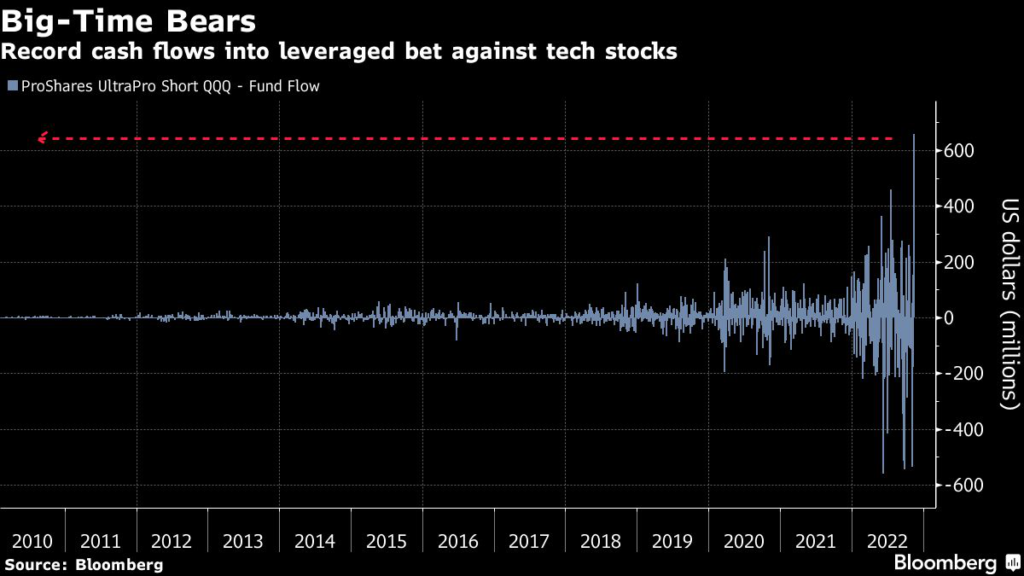
Traders Pump Record $658 Million Into Bet Against Tech Stocks

(Bloomberg) — ETF traders just placed a record wager against the big comeback in tech stocks.

As the Nasdaq 100 Index soared late last week, some $658 million was funneled into the ProShares UltraPro Short QQQ exchange-traded fund (ticker SQQQ). That’s the largest-ever inflow for a product that aims to deliver three times the opposite performance of the US benchmark for major technology companies.

The inflow came on Thursday, just as the Nasdaq posted its biggest jump in more than two years on hopes that softer-than-expected inflation data can persuade the Federal Reserve to slow its pace of monetary tightening. 

As money flowed to SQQQ, investors pulled $256 million from its bullish leveraged sibling, the ProShares UltraPro QQQ ETF (TQQQ). That was the largest outflow since January, according to data compiled by Bloomberg.

While the gauge advanced again on Friday, the SQQQ influx constitutes a sizable bet that the tech-led rally will prove fleeting since the ETF is designed to work on an ultra short-term basis.

Futures for the Nasdaq 100 were down 0.6% as of 9:14 a.m. in New York.

“Tools like SQQQ were basically designed for big moves like we’ve been seeing where investors — and probably more importantly hedge funds — want to take strong positions counter to big moves,” said Dave Nadig, financial futurist at data provider VettaFi. Large players are likely using it for “quick inverse exposure to express their lack of faith in the rally,” he said.

The bearish inflows boosted assets in SQQQ to about $3.6 billion, more than double their level at the start of 2022. Meanwhile the Invesco QQQ Trust Series 1 ETF (QQQ), a vanilla product tracking the Nasdaq 100, received $1.9 billion Thursday. Its assets now total $162 billion, down from $218 billion in the early new year thanks to the interest rate-induced rout in growth shares.  

Settlement arrangements for SQQQ and TQQQ mean that flow data arrives with a one-day lag. 

More stories like this are available on bloomberg.com

©2022 Bloomberg L.P.

Close Bitnami banner
Bitnami
