Bloomberg

Ant Consumer Unit Raises $1.5 Billion From Sunny Optical, Yuyue

(Bloomberg) — Ant Group Co.’s consumer finance unit is raising 10.5 billion yuan ($1.49 billion) in a scaled-down capital boost from investors after China Cinda Asset Management Co. unexpectedly backed out of its investment plan this year.  

A subsidiary of Sunny Optical Technology Group Co. will take 1.1 billion yuan of Chongqing Ant Consumer Finance Co.’s capital, for a 6% stake, according to an exchange filing Monday. Jiangsu Yuyue Medical Equipment & Supply Co. plans to add 524 million yuan, taking a 4.99% stake. Ant Group will contribute 5.25 billion yuan to retain its 50% holding, while a group of other backers are also investing, statements show. 

The investment proposal is still pending regulatory approval, the filings added. 

Cinda Asset Management, one of China’s bad debt managers, withdrew its plan to invest 6 billion yuan for a 20% stake in the consumer finance giant in January, without disclosing a reason. At the time, Chongqing Ant was planning to raise about 22 billion yuan to boost its capital to 30 billion yuan. The finance unit combines the company’s most lucrative online lending operations, Huabei and Jiebei. 

Jack Ma’s Ant Group has been restructuring its operations, including beefing up capital, curbing consumer lending, and shuffling its management. In a filing in July, Alibaba Group Holding Ltd. reiterated that Ma “intends to reduce and thereafter limit his direct and indirect economic interest in Ant Group over time” to a percentage that doesn’t exceed 8.8%.

China’s campaign to rein in its tech businesses kicked off with snuffing out Ant’s planned $35 billion initial public offering in late 2020. The crackdown snowballed into an assault on every corner of China’s technosphere as Beijing seeks to end the domination of a few heavyweights and create a more equitable distribution of wealth.

–With assistance from Charlotte Yang.

More stories like this are available on bloomberg.com

©2022 Bloomberg L.P.

Telefonica Opts for Higher Costs to Appease Hybrid Investors

(Bloomberg) — Telefonica SA had to pay a punchy coupon of more than 7% as it sought to replace some subordinated notes early, showing the soaring cost of maintaining clout with hybrid bond investors.

The Spanish company got more than €4.75 billion ($4.9 billion) in orders for a €750 million green hybrid bond on Monday at a final yield of 7.125%, according to a person familiar with the matter, who asked not to be identified because they’re not authorized to speak about it. The huge demand meant pricing was reduced from an opening target range, although it’s still the highest coupon for an existing Telefonica bond in euros.

At the same time, the telecommunications firm is looking to buy back part of two hybrid notes — which have characteristics of debt and equity — that will reach their first call dates next year. The early replacement comes amid a bumper few days for bond sales in Europe as a gauge of credit risk fell to its lowest since August, with market sentiment helped by softer US inflation data.

Telefonica’s moves underline its “strong track record of being a good actor in the hybrid markets and could help its subordinated debt outperform peers,” Bloomberg Intelligence senior credit analyst Aidan Cheslin wrote on Monday. While there has been speculation that some companies may end up breaking with the market convention of calling hybrids at the first opportunity, Cheslin sees more so-called extension risk in sectors like real estate and energy.

The interest rate on the new note far exceeds what Telefonica is currently paying for the bonds it wants to buy back, as well as the rate it would pay if they were extended. The notes callable next March and September currently pay 2.625% and 3%, respectively, and would both pay coupons of more than 5% if they were extended, based on current market rates.

Companies typically seek to replace hybrids at the first opportunity in order to please investors and retain equity content in their financial profiles, which supports credit ratings. While Telefonica is utilizing a good market window to replace the notes early, other companies have made more unusual decisions about their hybrid bonds as the cost of issuing new debt soars.

Companies Get Creative With a $50 Billion Hybrid Bond Dilemma

The purpose of the buyback is to give bondholders “the opportunity to switch into the new notes ahead of upcoming first call dates,” according to a company statement. Telefonica cut pricing on its new notes from an opening target range of 7.625%-7.75%. Representatives at the company did not immediately respond to a request for comment.

(Updates with final terms.)

More stories like this are available on bloomberg.com

©2022 Bloomberg L.P.

Jeff Bezos Plans to Give Most of His Fortune to Charity

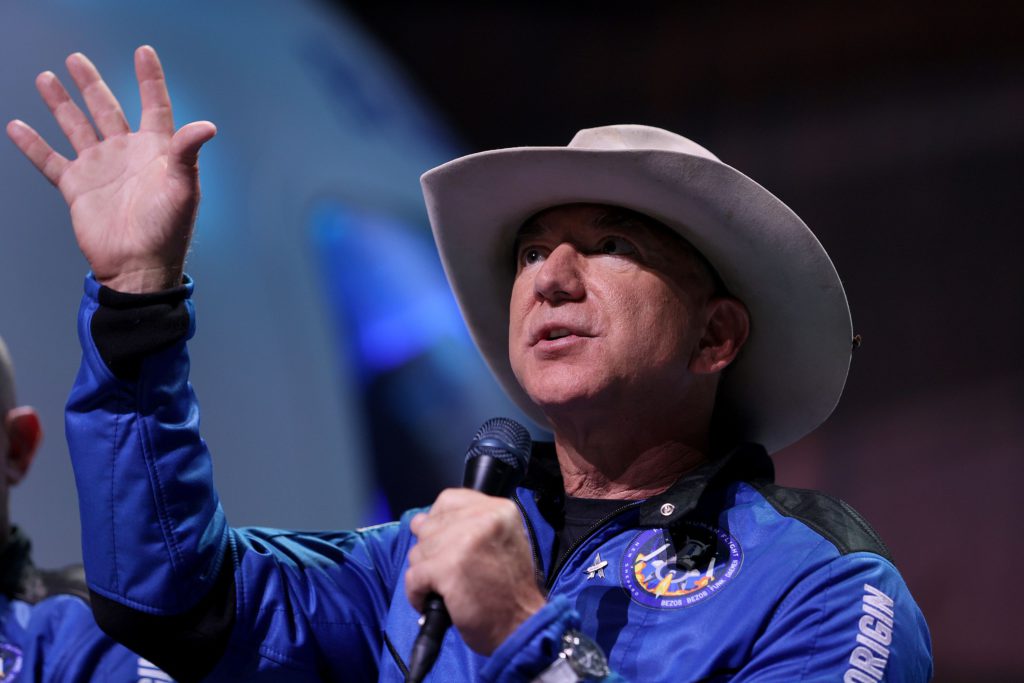
(Bloomberg) — Jeff Bezos, the founder of Amazon.com Inc. and the fourth-richest person in the world, said he plans to give away the bulk of his fortune during his lifetime.

Bezos will devote the money to fighting climate change and supporting those who seek to unify people amid wide social and political divisions, the billionaire told CNN, the first time he has committed to such a pledge.

Bezos is worth $123.9 billion, according to the Bloomberg Billionaires Index, a fortune that has declined almost $70 billion this year, but has surged in the past decade as his e-commerce giant raced past rivals. 

Bezos, 58, has focused more attention on his philanthropy in recent years while also assuming a much larger public role, acquiring the Washington Post newspaper in 2013 as well as luxury homes in New York, Los Angeles and Hawaii. A $500 million yacht he commissioned is under construction in the Netherlands, and he’s among those interested in bidding for the NFL’s Washington Commanders, possibly with music mogul Jay-Z as an investor.

Bezos has drawn criticism for not signing the Giving Pledge, a promise by many of the world’s richest people to donate the majority of their wealth to charitable causes. For years he largely stayed on the philanthropy sidelines, instead focusing on Amazon and Blue Origin, his for-profit space-exploration company.

Climate Change

But recently Bezos has committed billions of dollars to charity and has increased the pace of his giving since stepping down as Amazon’s chief executive officer last year.

His ex-wife MacKenzie Scott has sent more than $12 billion to nonprofits since the two split in 2019, mostly focusing on smaller charities in the US that are often overlooked by larger donors.

Bezos has set his attention on climate change with his $10 billion Earth Fund and also announced a $200 million gift to the Smithsonian National Air and Space Museum. 

On Saturday, he named Dolly Parton the latest recipient of his Courage and Civility award, handing the music legend $100 million to direct to any charities she chooses. He previously awarded similar amounts to chef Jose Andres, whose World Central Kitchen feeds people in disaster-stricken areas, and Van Jones, the founder of Dream.Org. 

(Adds details of Bezos assets in fourth paragraph.)

More stories like this are available on bloomberg.com

©2022 Bloomberg L.P.

Barclays Veteran Jason Whiting to Join Mercury Financial as CFO

(Bloomberg) — Varde Partners-backed Mercury Financial, a financial-technology company focused on providing credit to “near-prime” borrowers, hired former Barclays Plc executive Jason Whiting as chief financial officer. 

Whiting was most recently Barclays’s head of strategy for the Americas, and before that spent more than two decades in investment banking at both Barclays and Lehman Brothers, where he held roles including head of banks and specialty finance. He starts at Mercury in December and succeeds Steve Carp, who will take on a senior strategic planning role. 

“Bringing Jason on board will set us up for the next stage of our corporate development,” James Peterson, chief executive officer at Wilmington, Delaware-based Mercury Financial, said in a statement.

Founded in 2013, Mercury — formerly known as CreditShop — is focused on financial inclusion and said it provides its customers more than $4.7 billion in credit lines.

More stories like this are available on bloomberg.com

©2022 Bloomberg L.P.

US Probes Sam Bankman-Fried After FTX Collapse: Crypto in DC

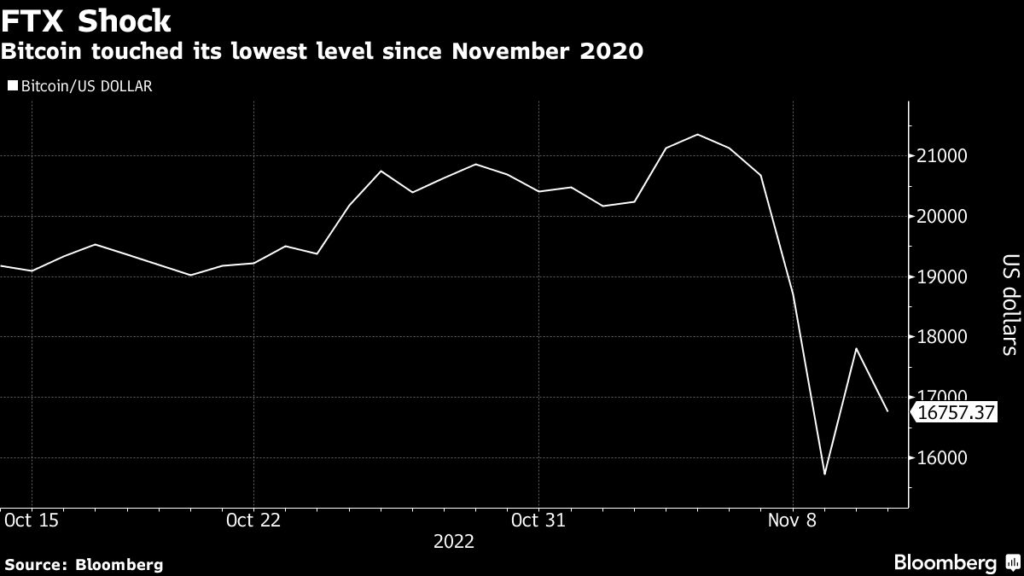
(Bloomberg) — US regulators are investigating Sam Bankman-Fried and FTX.com for potential violation of rules following the crypto exchange’s sudden collapse, which marks yet another crisis of confidence for the cryptocurrency industry. 

Bankman-Fried was also interviewed by Bahamian police and regulators on Saturday, a person familiar with the matter told Bloomberg, as the authorities in the country investigate whether there was any criminal misconduct in FTX’s collapse. The firm is registered in the Bahamas. 

Senate Banking Committee Chairman Sherrod Brown pushed for federal watchdogs’ investigation into FTX, while Massachusetts Democrat Elizabeth Warren urged more aggressive enforcement of rules for the crypto industry. 

But with both chambers of Congress likely to be almost evenly split following the Midterm elections, the path forward for stronger crypto regulations remains murky. 

CHARTING CRYPTO

WEEKLY ROUNDUP FROM WASHINGTON

  • Retiring Senate Republican Pat Toomey said FTX’s collapse underscores the need for a “sensible regulatory regime” and called on lawmakers to find common ground during the lame-duck session of Congress on stablecoins regulation
    • Kristin Johnson, one of the Commodity Futures Trading Commission’s commissioners, also said FTX.com’s collapse demonstrated the need for more regulation
  • A banking-industry group called on US officials to prohibit crypto firms from getting access to Federal Reserve accounts to ward off the risk of a crypto industry crisis threatening broader financial stability.
  • Manhattan prosecutors said they seized almost $3.4 billion in Bitcoin from a property developer that scammed the dark web marketplace Silk Road more than a decade ago
  • US Treasury Department imposed sanctions on a drug trafficking network funded through cryptocurrencies.
    • The network allegedly supplied fentanyl and other synthetic drugs to buyers through the Internet
  • FTX.com’s collapse may wipe out two major US political donors in Sam Bankman-Fried and Ryan Salame
  • US Internal Revenue Service provided new guidance to digital asset brokers, who will be required to report client transactions starting Jan. 1
  • A federal judge ruled that blockchain-based publishing platform LBRY Inc. violated US law by selling its blockchain token without registering its offerings with the SEC

MORE READING

  • FTX’s Freefall Into Bankruptcy Shows Why Case File Is Empty
  • Crypto Enforcement Gears Up as the States Set the Pace: Analysis
  • Most Urgent Crypto Question Is How Far FTX Tentacles Might Reach
  • Crypto Contagion Seen Limited as Speculative Stocks Fringe Soars
  • FTX Withdraws US Derivatives Clearing Plan From CFTC
  • FTX Latest: European License Suspended by Cyprus Regulator
  • Odd Lots Newsletter: The Real Problem With Crypto
  • FTX Empire Goes Bankrupt in Sudden Fall of Bankman-Fried
  • Thai Regulator Urges Caution Against Crypto Mining Investment
  • Lawmaker Behind Japan Crypto Strategy Says Rules Still Too Tight


More stories like this are available on bloomberg.com

©2022 Bloomberg L.P.

Solana Games Stumble as Ecosystem Takes a Hit After FTX Collapse

(Bloomberg) — Gaming tokens across the Solana crypto ecosystem are proving to be yet another casualty in the fallout from FTX.com’s collapse, with some dropping even further than the blockchain’s main coin after the network lost its biggest supporter.

Among the top games for the nascent ecosystem is Aurory, a turn-based role-playing game which saw the price of its in-game token slump more than 70% in the last seven days, according to data from CoinGecko. Comparatively, Solana’s SOL token has lost 56%.

FTX CEO Sam Bankman-Fried was a major backer of Solana, and had pledged to invest $100 million in gaming projects on its blockchain as part of a consortium of venture capital firms a year ago. His crypto empire began to implode on Nov. 6 as the value of FTX’s own token declined, and it emerged later that FTX had been nursing about $9 billion in liabilities with only $900 million in liquid assets to cover them.

Solana’s gaming space remains incredibly small compared to others in blockchain gaming. Data collated by analytics firm DappRadar showed the blockchain’s top game TapFantasy had just 3,500 unique active wallet addresses interacting with it in the last 24 hours, compared to crypto’s largest game Alien Worlds, which had 501,000.

  • FTX Latest: Balance-Sheet Blowup Reverberates in Crypto Markets

Star Atlas, a space-themed strategy game on Solana, saw its coin fall more than 36% in the last seven days. Others that were thought to be some of the ecosystem’s most popular platforms, such as Panzerdogs and Faraway Studios’ Mini Royale: Nations, have yet to launch their own tokens. FTX previously led a $21 million funding round for Faraway.

Both Aurory and Star Atlas sought to ease players’ concerns around whether they might be impacted by FTX’s failure in recent days. In statements shared on Twitter, Aurory said its exposure to FTX was “minimal”, while Michael Wagner, the CEO of Star Atlas’s lead developer ATMTA Inc., said a portion of its “liquid cash assets” had been affected. 

Trading volumes across crypto games are also largely down in the last seven days, including falls of between 16.4% and 36.3% across major games DeFi Kingdoms, The Sandbox and Axie Infinity. 

More stories like this are available on bloomberg.com

©2022 Bloomberg L.P.

US Earnings to Watch: Walmart, Home Depot, Nvidia, Gap

(Bloomberg) — Even as most of the US reporting season nears its end, this week’s earnings will put big-box chains, chipmakers and home-improvement retailers under a stark spotlight amid a deteriorating economic environment. Yet glimmers of optimism can still be seen.  

Tyson Foods gained in premarket trading Monday after the biggest US meat producer said sales could rise to a record next year amid “solid profitability”, despite the company’s missing adjusted EPS estimates as inflation fears pushed consumers to buy less pork and prepared foods and trade down to cheaper products. Shares of Alibaba and JD.com, both due to report full results in the coming days, are also rising premarket, shrugging off mixed reports from their Singles’ Day promotions, as China plans to ease Covid restrictions and implement a sweeping package to address the struggling property market. 

Still, more than half of the S&P 500 sectors could fall into earnings recession by the next reporting season, Bloomberg Intelligence wrote, with the positive-to-negative revenue guidance ratio now at the lowest level since 2019. Lackluster results from Disney, Lyft and Roblox last week underlined the entertainment industry’s earnings weakness in the face of a broader economic slowdown. Among the 11 S&P 500 sectors, communications firms have posted the highest proportion of earnings misses so far this season. Meanwhile, Ralph Lauren and Tapestry also took a hit, citing the strong dollar. This week, reports from US retailers including Walmart, Target, Home Depot, Lowe’s and Gap will offer more clarity around consumer spending as regulators look to stem heightened inflation rates.

S&P 500 futures were little-changed early Monday as investors watched a handshake between President Joe Biden and his Chinese counterpart Xi Jinping that marked the start of their first face-to-face summit since the pandemic began. The two join other G-20 leaders to gather in Bali, Indonesia, on Tuesday and Wednesday amidst heightened geopolitical tensions, a war in Ukraine, and soaring inflation, which central banks and corporations have scrambled in recent months to address. As the G-20 wraps up, focus will shift to former President Donald Trump, who could send shock waves through the markets from his “big announcement” expected Tuesday. 

Votes across the country continue to be counted in key midterm races, with Democrats retaining control of the Senate while Republicans look poised to take control of the House, albeit by smaller margins than forecast. Congress returns to Washington Monday for its year-end push that could see legislative action over matters like the debt ceiling in the weeks ahead.

  • To subscribe to earnings coverage across your portfolio or other earnings analysis, run NSUB EARNINGS.
  • Click to see the highlights to watch this week from earnings reports in Europe and Asia.
  • Follow results, analysis and market reaction to reports by Walmart and Alibaba in real-time on the TOPLive blog this week.

Earnings highlights to look for this week:

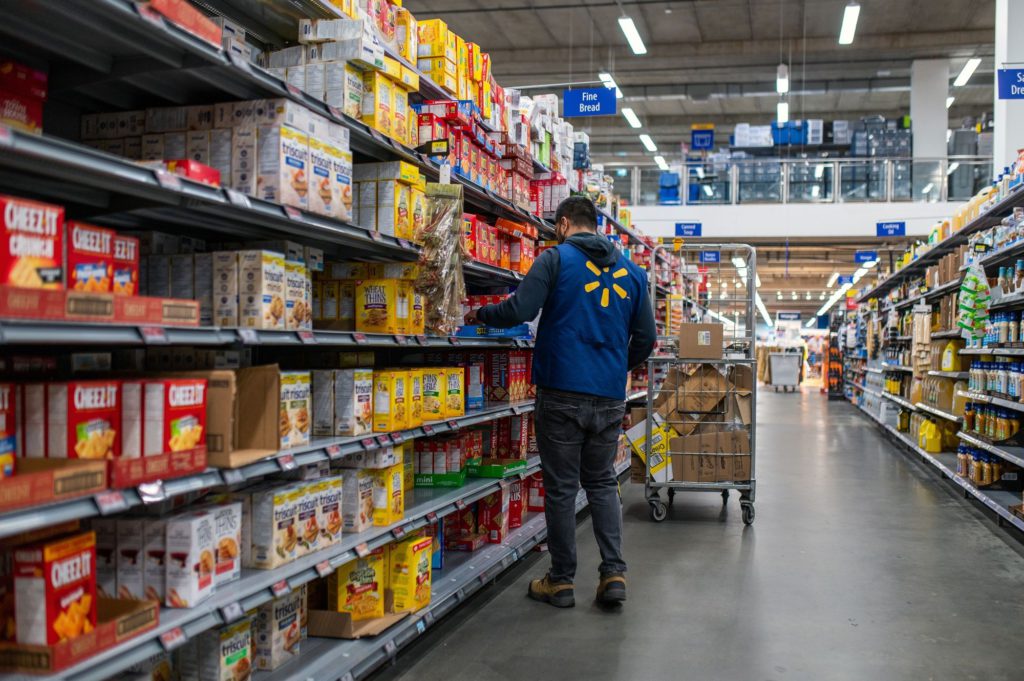
Tuesday: Walmart (WMT US), releasing its third-quarter results before the bell, is projected to benefit from a strong back-to-school season and a consumer shift to value amid rising costs, per Bloomberg Intelligence. Still, inflation is causing a shift in the mix of sales and margins as customers spend more on food and less on discretionary items. The company’s inventory will be of note, as it tried to sell-through excess stock and minimize markdown risk ahead of the holiday season. Generally, retail sales fell in October, as more promotions from inventory-laden sellers led to falling net sales despite increased traffic. Still, Walmart, along with peer Target (TGT US) due to report on Wednesday, saw October non-cash sales that were up year-over-year, aided by the flight to value. 

  • Home Depot (HD US) is due before the bell, and is expected to report resilient same-store sales growth for the third quarter, with consensus calling for around 3%, due to increasing retail sales at home centers, according to Bloomberg Intelligence. The growth could be supported by higher prices, partly due to inflation, which would offset a sixth quarter of declines in the number of transactions. Still, though Home Depot’s exposure to professional customers will help it outperform peer Lowe’s (LOW US), which reports its own results Wednesday, overall industry demand is expected to fall through the end of the year and into 2023 given the housing market decline amid rising mortgage rates.

Wednesday: Nvidia (NVDA US) results are due after the closing bell, and the most valuable chipmaker in the US is expected to deliver year-over-year drops in both revenue and earnings for the first time in two years. Its gaming segment may take the biggest hit as economic conditions continues to weigh on demand which could call for cuts to guidance, according to Bloomberg Intelligence. Investors will look for commentary about the company’s elevated exposure to China, where it originates about 25% of sales, after the Biden administration expanded restrictions on semiconductor sales to the country last month. Earlier this week, Nvidia announced it began the production of a new chip that is said to conform to the new export rules, hoping to recover revenue put at risk by government action. The company has lost almost half its value this year, following three straight years of gains in the stock market.

  • ESG in focus: The chipmaker’s advances in “green computing,” the practice of limiting the environmental impact of computer chips, has the potential to help address energy usage concerns at data centers, as data traffic continues to increase. Nvidia estimates that companies could save as much as 19 terawatt-hours of electricity a year, equivalent to taking 2.9 million cars off the roads for a year, if artificial intelligence and high performance computing were run on its more efficient chips. Read more in this week’s ESG Stock Watch.

Thursday: Gap (GPS US) reports after the closing bell. Investors will seek signs of earnings growth after the owner of Old Navy and Banana Republic brands pulled its full-year guidance and ended its partnership with Kayne West and his Yeezy Gap label. Bloomberg consensus is calling for adjusted EPS of $0.01 for the third quarter, down 83% from last quarter’s surprise profit. The apparel retailer’s turnaround, which includes an ongoing CEO search, the axing of 500 corporate jobs and an impairment charge to address inventory glut, will take several quarters to complete, according to analysts at Argus Research. 

  • Alibaba (BABA US) is due before the opening bell. The Chinese e-commerce behemoth could report its first year-on-year expansion in adjusted Ebita margin since 2019, thanks to narrower losses expected at its online food delivery platform Ele.me and its Southeast Asian arm Lazada, Bloomberg Intelligence wrote. The retailer said Sunday that gross merchandise value from its Singles’ Day shopping event was roughly in line with last year, although it broke from its past tradition of disclosing the full sales results from the promotion, and China’s Covid-Zero policy could also force Alibaba to focus on boosting profits rather than top-line growth. In the upcoming fiscal second-quarter report, Wall Street analysts are expecting sales to grow by 4.3% — down from the 29% gain seen in the same period last year — mirroring revenue concerns raised by JPMorgan when they cut the price target in September.

Friday: JD.com (JD US) reports before the market open. Third-quarter results from China’s second-largest online retailer will come on the heels of the Singles’ Day shopping spree and peer Alibaba’s earnings, with Bloomberg consensus projecting the highest gross margin in two years. Improved product mix and platform fees could compensate for higher fulfillment expenses stemming from the country’s mobility curbs, Bloomberg Intelligence wrote. Nevertheless, BI also pointed out that potentially weaker business sentiment in China could drag down service revenue contribution in the current quarter. 

More stories like this are available on bloomberg.com

©2022 Bloomberg L.P.

BlackRock in Pact With Saudi Wealth Fund for Infrastructure

(Bloomberg) —

BlackRock Inc signed a pact with Saudi Arabia’s $620 billion wealth fund to explore infrastructure projects in the Middle East.

Projects will be sourced across sectors including energy, power, utilities, water, environment, transportation and telecommunications, according to a statement. In its first project, the partnership will work with Saudi Investment Recycling Co. to develop and operate waste management projects in the region.

The U.S. asset manager said it plans to build a dedicated infrastructure investment team to cover the Middle East. BlackRock Alternatives will also establish a Middle East infrastructure strategy.

Separately, Hassana Investment Co., controlled by the Saudi government’s pension fund, said it signed a memorandum of understanding with BlackRock to promote and develop the infrastructure investment strategy.

Read more: BlackRock Gets New Saudi Mandate for Infrastructure Fund

(Updates with Hassana and BlackRock pact in fourth paragraph.)

More stories like this are available on bloomberg.com

©2022 Bloomberg L.P.

China’s Big Tech Becomes Target for Investors Fearing Missing Out

(Bloomberg) — What do you do when China’s fast-moving markets offer investors a taste of the rebound they’ve been longing for? Buy the country’s beaten-down technology stocks.

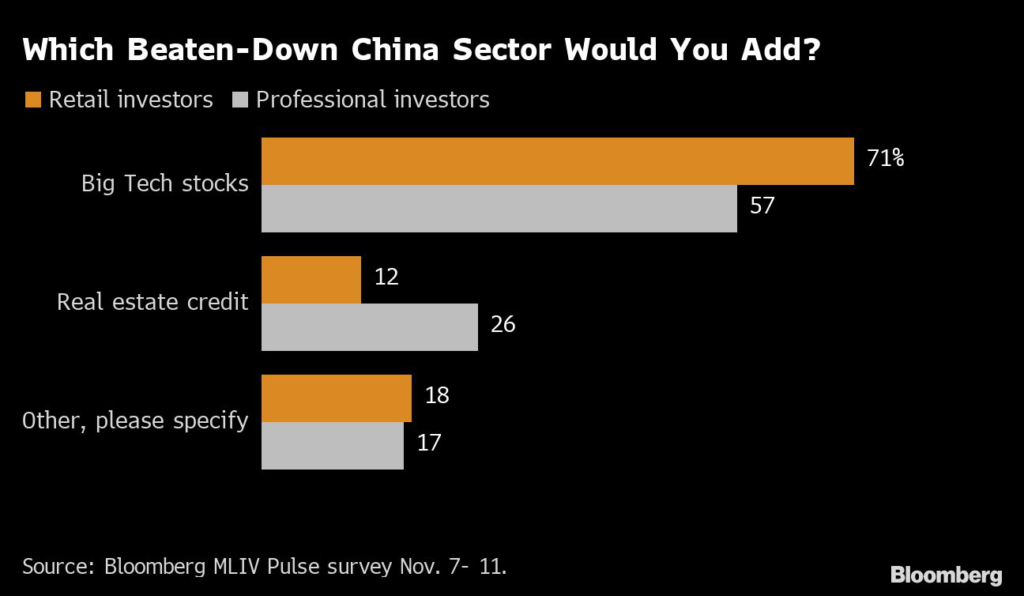
Big Tech is the most-favored Chinese sector by institutional and retail respondents in the latest MLIV Pulse survey, with 42% of 244 investors also saying they plan to increase their exposure to the country in the next year. 

Chalk it up to a fear of missing out. The wider the gap between the share price and metrics such as earnings and sales, the greater the potential for gains when good news lands, the logic goes. That’s playing out this month amid signs that China may have started to pivot away from its Covid-Zero policy, with widely-followed stocks like Alibaba Group Holding Ltd. showing intraday surges of 20%.

There’s plenty of room for a rebound. The Hang Seng Tech Index and the Nasdaq Golden Dragon China Index of US-listed companies are down about 70% since peaking in February 2021. That’s worse than any of the 92 benchmarks tracked by Bloomberg. In September alone, funds sold $33 billion of Chinese tech stocks, according to a recent note by Morgan Stanley quants.

To be clear though, nothing fundamental has changed for the tech industry. There’s little evidence that President Xi Jinping will reverse his campaign to rein in the country’s tech giants, and efforts to prevent the delisting of Chinese stocks from US exchanges are progressing slowly. Lockdowns in key cities like Guangzhou serve as a reminder that the determination to eliminate Covid-19 is still stifling consumption and hammering the economy.

But when Chinese markets rally, they do it with gusto. Short-covering and momentum-chasing have been the major drivers of the country’s equities over the past three weeks, with mainland-based investors also snapping up bargains in Hong Kong. That’s even as big names like Tiger Global Management throw in the towel on China and reduce their allocations.

Chinese stocks in the US are poised to extend their rally to a third day after China ‘s financial regulators issued a 16-point directive to support the property industry — a sign authorities are serious about addressing a crisis that’s been a key drag on markets and economic growth. US stock futures declined Monday and Treasury yields rose as a cautious tone from a Fed speaker tempered some of the ebullience that inflation may have peaked.

It’s no surprise that stocks can be deemed cheap. The Golden Dragon gauge trades at less than 15 times its members’ projected earnings, a 34% discount to its average of the past 10 years. Investors will get more clarity on the health of corporate China in the coming weeks, with bellwethers like Alibaba, JD.com Inc. and Pinduoduo Inc. due to report results.

Nearly a half of market participants who responded to the survey expect US-listed Chinese shares to recoup some of the losses by the end of the year. Fewer than a fifth of them saw declines continuing. Markets are underpricing a potential Covid Zero exit, according to 48% of respondents. Some 46% said markets are too enthusiastic about a reopening.

Beijing’s virus-containment policy is seen as both the biggest potential catalyst for gains and a top risk to Chinese markets next year, underscoring how central it’s become to the outlook. Goldman Sachs Group Inc. says reopening would trigger a 20% gain in Chinese equities. 

In a potentially telling development, China last week cut quarantine for inbound travelers and scrapped the so-called circuit breaker system that penalizes airlines for bringing virus cases into the country. The new Politburo Standing Committee recently said the country needed to stick with the Covid Zero policy, but that officials also needed to be more targeted with their restrictions.

High interest rates will be the main risk for international financial markets next year, according to a majority of investors, followed by a slowdown in China. A global recession was also among concerns cited by respondents. 

MLIV Pulse is a weekly survey of readers of the Bloomberg Professional Service and website. The latest poll was conducted in Nov. 7-11. 

For more markets analysis, see the MLIV Blog. To subscribe and see previous MLIV Pulse stories, click here. 

–With assistance from Kasia Klimasinska.

(Updates with Monday’s US trading in seventh paragraph.)

More stories like this are available on bloomberg.com

©2022 Bloomberg L.P.

Musk’s Polar Starlink Satellites Win Raves at Pentagon While Twitter Flails

(Bloomberg) — For all the turmoil surrounding billionaire Elon Musk’s takeover of Twitter Inc., his SpaceX remains a success story — especially at the Pentagon, where its Starlink satellite communications system is winning new praise as a potential way to reach US troops in the distant reaches of the Arctic.

The Arctic is increasingly seen by the US as contested territory with Russia and China. But its rough climate and remote latitudes limit communications through existing military satellites. That’s where the portable Starlink units from Musk’s Space Exploration Technologies Corp. come in as a possible solution.

“We have started testing high-rate connectivity to very remote Arctic bases,” Brian Beal, principal aerospace engineer with the Air Force Research Laboratory’s Strategic Development and Experimentation office, said in a statement. At one such base, he said, data rates using Starlink improved almost 30-fold over previous capabilities. 

Musk’s $44 billion purchase of Twitter has spawned controversies, from his tweet before the midterm election urging votes for Republicans to his mass firings at the social network. President Joe Biden said last week that Musk’s “cooperation and/or technical relationships with other countries is worthy of being looked at,” although he said he wasn’t suggesting whether Musk is “doing anything inappropriate.”

But Musk’s provocative public pronouncements seem to be mostly taken in stride at the Pentagon, where he has pushed his way into winning a substantial share of sensitive national security satellite launches for SpaceX over an alliance of top defense contractors Boeing Co. and Lockheed Martin Corp. 

His Falcon Heavy rocket last month launched its first national security mission. Next month SpaceX is scheduled to launch the initial two of four planned missile-tracking satellites it was awarded by the Air Force’s Space Development Agency.

Pentagon spokespersons mostly fended off requests for comment when Musk briefly threatened to stop footing the bill for operation of Starlink terminals that have become crucial for Ukrainian troops and civilians fighting Russia’s invasion.

Nor have Musk’s latest controversies touched the Arctic tests of Starlink, with results that Beal said will be evaluated later by the US Space Force for potential contracts amid an increasing focus on the frigid Arctic expanse that caps the Earth. 

The service has been piggybacking off of Starlink commercial services as they become available in the polar region, Beal said. 

More than half the Arctic coastline belongs to Russia, which is increasingly isolated from its northern neighbors. That’s turned the region into a growing security concern for the US, which has a foothold through Alaska, and for NATO. Russia set up a Northern Command in 2014, and has opened hundreds of new and former Soviet military sites in the Arctic. It’s also developing new nuclear submarines for Arctic operations, including Arcturus, which can deploy underwater drones and hypersonic missiles.

So far, Starlink is demonstrating “very high-rate communications” and is easy to set up, Beal said. 

“You can imagine an Army, Air Force or Navy unit deployed to a remote location that doesn’t have the cell-phone service niceties and very quickly have communications at high-rates that an airman can set up in 10 minutes — that’s a great capability to have,” he said. 

Todd Harrison, a space analyst with Metrea Strategic Insights, said Starlink is an example of “where commercial space capabilities have pulled ahead of military space capabilities.” 

SpaceX didn’t respond to an email request for comment on the Arctic testing. Starlink’s first customers were mostly people living in rural areas in Canada and the US. Since then, it has grown to more than 400,000 subscribers.  

In addition to Starlink, the Pentagon is looking at a system from London-based OneWeb Ltd, although Beal said he doesn’t consider them to be in competition.

Key tests of Starlink in the Arctic are underway, Beal said last Thursday. He said the Pentagon has deployed 50 terminals in locations across the region and is collecting data on throughput, latency and other metrics. The tests will continue for six to 12 months as airmen use the terminals.

“We demonstrated Starlink on a moving ground vehicle in Alaska in just the last couple weeks,” he said, referring to one of the two most demanding tests of military capability. An equally difficult Arctic demonstration of an airborne US aircraft receiving Starlink signals will occur in the spring, he said. 

“We’ll be looking for any unexpected impacts of the harsh environment on the system’s performance,” he said.

The service has been piggybacking off of Starlink commercial services as they become available in the polar region, Beal said. SpaceX’s Starlink satellites in polar orbit have grown from about 20 in May to about 235 today with plans to launch 240 more in the next six months, Beal said.

–With assistance from Danielle Bochove.

More stories like this are available on bloomberg.com

©2022 Bloomberg L.P.

Close Bitnami banner
Bitnami