
Bloomberg

FTX Latest: Criminal Probe Possible; Galois Admits Exposure

(Bloomberg) — The Bahamian police are working with the Bahamas Securities Commission to investigate whether there was any criminal misconduct in the collapse of Sam Bankman-Fried’s crypto exchange FTX. He was questioned by Bahamian police and regulators Saturday, according to a person familiar with the matter.

Crypto altcoin Solana, which was tied to a blockchain backed by Bankman-Fried, declined for a third day as the fallout from the collapse of his FTX empire continued to reverberate. Hedge fund Galois said its exposure was as much as $45 million, and the crypto market has lost about $200 billion in value in the past week.

In other developments, analysts say about $662 million in tokens mysteriously flowed out of both FTX’s international and US exchanges. According to investment materials seen by the Financial Times, FTX Trading International held just $900 million in liquid assets on Thursday against $9 billion of liabilities.

Key stories and developments:

  • Bankman-Fried: From Crypto King to King of Tech Bubble’s Losers
  • Big Investors Are Giving Up on Crypto Markets Going Mainstream
  • Summers Says FTX Meltdown Has ‘Whiffs’ of Enron-Like Scandal (1)
  • ‘It’s All Gone’: FTX Bankruptcy Is Worst Fear for Retail Traders
  • Alpha-Male Crypto ‘Bloodsport’ Sows a Catastrophe at FTX

(All time references are New York)

FTX’s Serum Project Is in Distress (1:05 p.m.)

Tokens issued by Serum, a liquidity infrastructure hub built by FTX and used by market makers and lending protocols on Solana, tumbled more than 23% on Sunday alone, pricing data from CoinGecko showed. FTX owned more than $2.2 billion worth of the token as of Thursday, the Financial Times reported, citing investor materials.

Developers attached to Serum split off the project’s code in a so-called fork amid concern that an upgrade key controlling the program could be compromised, a Solana spokesperson said. 

Galois Confirms $40 Million Exposure (12:26 p.m.)

Crypto hedge fund Galois Capital is the latest company to confirm its exposure to the collapsed FTX cryptocurrency exchange. In a direct message to Bloomberg News, Galois said its exposure was between $40 million to $45 million. On Friday, Galois said on Twitter that it had “significant” funds in FTX. Galois was an early critic of the now failed Terra blockchain and its TerraUSD algorithmic stablecoin.

Bahamian Police Look Into Criminal Probe (11:53 a.m.)

A team from the Financial Crimes Investigation Branch is working with the Bahamas Securities Commission to investigate if any criminal misconduct occurred in the collapse of FTX.

Solana Slide Deepens; Bitcoin and Ether Stable (8:30 a.m.)

A three-day decline for crypto altcoin Solana deepened on Sunday, as developers considered spinning off one of the blockchain network’s most prominent and FTX-affiliated project. Solana fell as much as 14% to $12.86 as of 1:30 p.m. in London. Crypto bellwethers Bitcoin and Ether have lost a little over 1% each in the last 24 hours. 

Other altcoins including Polkadot, Avalanche and Tron, typically more volatile than larger cryptocurrencies due to lower liquidity levels, lost between 1.7% and 5.4%. 

Binance Stops Deposits of FTX’s Token FTT (3:30 a.m. Sunday)

Binance halted deposits of FTT, FTX’s token, “to prevent potential of questionable additional supplies affecting the market,” Binance CEO Changpeng “CZ” Zhao said on Twitter. Zhao said that he would encourage other exchanges to do the same thing. Justin Sun said Huobi Global would echo Zhao’s advice.

Zhao added that FTT contract deployers moved all remaining FTT supplies worth $400 million, “which should be unlocked in batches.” Binance followed up to say it had noticed a “suspicious movement” of a large amount of FTT by the token’s contract deployers.

Matrixport Says 79 Clients Affected by FTX, ‘No Risk of Insolvency’ (11:38 p.m. Saturday)

Crypto financial-services platform Matrixport “continues to operate normally and the company has no risk of insolvency with respect to the developments at FTX and Alameda,” according to Ross Gan, head of public relations.

Matrixport had 79 clients that incurred losses via exposure to three products on its platform that were linked to FTX, Gan said.

Kraken Freezes Accounts Possibly Related to FTX (11:33 p.m.)

Crypto exchange Kraken said it has frozen Kraken account access to certain funds it suspects to be associated with “fraud, negligence or misconduct” related to FTX. Kraken said in a tweet it’s in contact with law enforcement and plans to resolve each account on a case-by-case basis.

Bankman-Fried Interviewed by Police in Bahamas (9:42 p.m.) 

Former crypto mogul Sam Bankman-Fried was interviewed by Bahamian police and regulators on Saturday, according to a person familiar with the matter. Bankman-Fried didn’t immediately respond to a request for comment.

The inquiries from Bahamian authorities add to the mounting legal pressure that Bankman-Fried is facing since his FTX empire crumbled over the past week. In the US, he is facing scrutiny from the Securities and Exchange Commission over whether he broke securities rules.

Bahamas Says it Didn’t Authorize Local Withdrawals by FTX Exchange (9 p.m.)

Bankrupt crypto exchange FTX’s move to allow withdrawals in the Bahamas was questioned by the nation’s securities regulator.

The Securities Commission of the Bahamas in a statement Saturday said that it hadn’t “directed, authorized or suggested” the prioritization of local withdrawals to FTX Digital Markets Ltd.

It added that such withdrawals could be clawed back.

Jump Crypto Says It Remains Well Capitalized After FTX Exposure (5:59 p.m.)

Jump Crypto, a cryptocurrency trading firm, told customers on Saturday it remains “well capitalized” after exposure to FTX. In a series of tweets, Jump said its exposure was “managed in accordance with our risk framework.” The company did not specify the exact nature of its exposure.

FTX to Seek Enforcement Aid on Unauthorized Withdrawals (1:46 p.m.)

FTX is launching an investigation with law enforcement into unauthorized withdrawals from some of its crypto wallets, a company executive said. The company, which filed for bankruptcy this week, said it is cooperating and coordinating with “law enforcement and relevant regulators.”

Liabilities Dwarfed Liquid Assets: FT (1:13 p.m.)

FTX Trading held $900 million in liquid assets against $9 billion of liabilities the day before the bankruptcy filing, the Financial Times reported, citing investment materials and a spreadsheet the newspaper had seen. Most of the recorded assets are either illiquid venture capital investments or crypto tokens that are not widely traded. The biggest asset as of Thursday was listed as $2.2 billion worth of a cryptocurrency called Serum.


(Updates with Galois exposure)

More stories like this are available on bloomberg.com

©2022 Bloomberg L.P.
Big Tech Loses Sway as S&P 500 Becomes More Exxon, Less Amazon

(Bloomberg) — The power the world’s technology giants wielded over the US stock market for years as it surged to record highs has been greatly diminished by the bust of 2022.

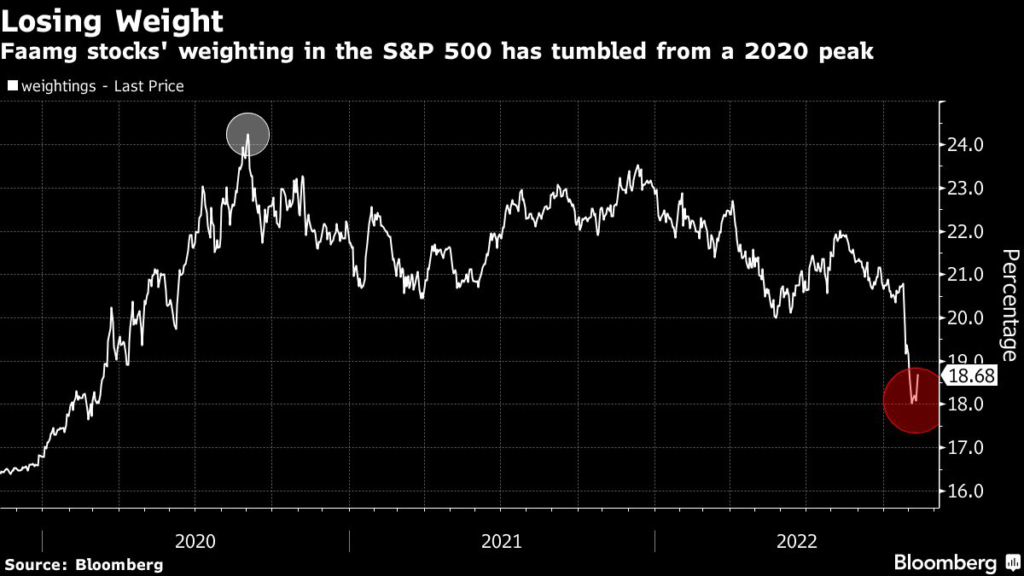
Even after last week’s rally, Apple Inc., Microsoft Corp., Amazon.com Inc., Alphabet Inc. and Meta Platforms Inc. have lost more than $3 trillion in market value this year as slowing revenue growth and rising interest rates battered valuations. That’s cut their weighting in the S&P 500 Index to about 19% from a record of more than 24% in September 2020. 

The shift shows how much the contours of the stock market have shifted since the Federal Reserve made a sharp break from the easy money policies that set off a speculative frenzy. As the tech sector’s sway diminishes, more traditional sectors such as energy and banking are accounting for a greater share of the S&P 500, with companies like Exxon Mobil Corp. and Wells Fargo & Co. benefiting from high oil prices or rising interest rates. 

The reversal of fortunes means that investors who piled into the S&P 500 back when tech stocks were surging are now far less exposed to the sector — and its potential rebound — than they were before. By the end of 2021, there was about $7 trillion invested in funds that are tied to the index.

“The average investor doesn’t have a clue about this stuff,” said Michael Mullaney, director of global market research at Boston Partners. “This is going to be something that plays out not just this year but into next year and longer.” 

The technology sector got some relief from data on Thursday that showed inflation slowed more than expected in October, fueling optimism that the Fed could soon pause its most aggressive cycle of interest-rate hikes in decades. That sent the Nasdaq 100 Index up 9.4% on Thursday and Friday for its best two-day performance since 2008.

Even so, the Nasdaq is still down 28% this year, while the S&P 500 has lost 16%. And not everyone is convinced last week’s tech rebound will last. 

Strategists at Ned Davis Research raised their exposure to value stocks on Thursday, saying an eventual Fed pivot could deliver more gains to sectors closely tied to the economy. Bank of America Corp. strategists said they expect the biggest tech companies to underperform over the next few years due to continuing cost pressures.

Apple, Microsoft, Alphabet, Amazon and Meta Platforms have been responsible for about half of the S&P 500 Index’s drop this year, according to data compiled by Bloomberg. If all the companies in the benchmark are weighted equally — instead of by market value, which is how the index is actually constructed — its drop would have been cut by six percentage points this year.

While investors are optimistic that interest rate increases will end next year, some big tech companies are bracing for the impact of an economic slowdown. 

Amazon has warned of a weak holiday shopping season ahead. Last week, Facebook’s parent, Meta Platforms, said it would cut more than 11,000 jobs, the first major round of layoffs in the company’s history as it seeks to reduce costs amid a slowdown in digital advertising. Microsoft has also cut jobs, while Amazon, Alphabet and Apple have all slowed or paused hiring.

“Big technology stocks in particular have benefited from the almost endless liquidity and cheap money financed by the immense pace of growth,” said Dirk Friczewsky, market analyst for ActivTrades. “Now a different wind is blowing on the financial markets and investors don’t want to suddenly be without a chair when the music stops playing.”

–With assistance from Tom Contiliano.

More stories like this are available on bloomberg.com

©2022 Bloomberg L.P.
FTX Faces Criminal Misconduct Probe by Bahamas Authorities

(Bloomberg) — The Bahamian police said they’re working with the Bahamas Securities Commission to investigate whether there was any criminal misconduct in the collapse of the crypto exchange FTX. 

“In light of the collapse of FTX globally and the provisional liquidation of FTX Digital Markets Ltd., a team of financial investigators from the Financial Crimes Investigation Branch are working closely with the Bahamas Securities Commission to investigate if any criminal misconduct occurred,” a police spokesperson said in a statement Sunday. FTX is registered in the Bahamas.

FTX co-founder Sam Bankman-Fried was interviewed by Bahamian police and regulators on Saturday, according to a person familiar with the matter. In the Bahamas, law-enforcement inquiries don’t necessarily mean someone will be arrested or charged with a crime. 

On Friday, more than 130 entities tied to FTX.com, FTX US and trading firm Alameda Research Ltd. were listed in bankruptcy filings at federal court in Delaware. Bankman-Fried resigned as chief executive officer of FTX Group as part of the filing.

The US Securities and Exchange Commission is investigating Bankman-Fried for potential violations of securities rules as the regulator deepens its probe into his crumbling FTX crypto empire, a person familiar with the matter said last week. The Justice Department is also looking into the situation.

(Updates with information on other investigations.)

More stories like this are available on bloomberg.com

©2022 Bloomberg L.P.

Crypto Hedge Fund Galois Confirms $40 Million Exposure to FTX

(Bloomberg) — Crypto hedge fund Galois Capital, known as an early critic of the now failed Terra blockchain and its TerraUSD algorithmic stablecoin, confirmed that it had up to $45 million in exposure to the now collapsed FTX cryptocurrency exchange.

The firm told Bloomberg News in a Twitter direct message that its exposure was in the range of $40 million to $45 million, after it said on Twitter on Friday that it had “significant” funds stuck on FTX. 

Galois co-founder Kevin Zhou gained notoriety earlier this year when he warned about Terra and profited from shorting the now collapsed Luna token. The meltdown of Luna and TerraUSD ecosystem led to a sector contagion, including to the bankruptcy of hedge fund Three Arrows Capital. 

Galois is one of the firms that have come out in the past week to disclose exposure to FTX. Others include prime brokerage Genesis Trading and Michael Novogratz’s Galaxy Digital. 

More stories like this are available on bloomberg.com

©2022 Bloomberg L.P.
Dollar and Yuan in Frame as a New Week in Markets Gets Underway

(Bloomberg) — Chinese and US assets will be key focuses for traders when activity in major macro markets gets underway for the new week in the Asia-Pacific on Monday.

Investors will be looking to the outcome from a meeting between US President Joe Biden and China’s Xi Jinping as leaders from around the world gather at the Group-of-20 summit in Indonesia. 

The dollar, which last week notched its worst week since the early days of the Covid pandemic, will be center stage along with the yuan, a possible barometer of developments around China’s Covid Zero and housing policies. Foreign-exchange markets open around 5 a.m. Sydney time. Meanwhile, US Treasury markets will reopen on Monday following a holiday closure on Friday.

New government plans to rescue China’s ailing property sector will be front of mind along with the policy and legislative prospects for the US as the balance of power in Congress remains unresolved. The Democratic Party will keep control of the Senate, but the House of Representatives is up in the air still with ballot counting ongoing in a number of districts following last week’s midterm elections.

On top of that, there are questions about when and how lawmakers in Washington might move to resolve questions around the approaching debt ceiling, which is on track to be breached at some point in 2023. US Treasury Secretary Janet Yellen said it would be “great” to get it done this year — a move that would involve passing legislation before the new Congress is sworn in.

The response of key Federal Reserve policy makers to last week’s slower-than-expected consumer-price index reading will be critical for market direction more broadly, with Christopher Waller and Lael Brainard both scheduled to speak early this week.

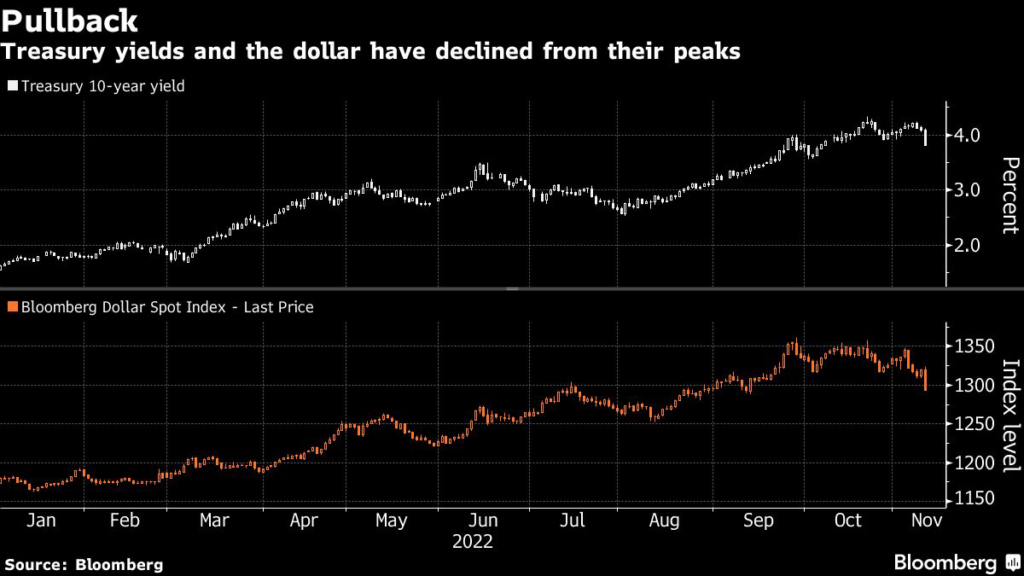
Treasury yields tumbled last week and stocks surged after the inflation slowdown stirred hope among investors that the Fed won’t need to lift interest rates quite as much as anticipated before, while the Bloomberg Dollar Spot Index notched its biggest weekly drop since the early days of the pandemic. Any pushback by officials could cause a rethink of those moves, while encouragement could see them extend.

All this is taking place against a backdrop of ongoing uncertainty in the crypto world, which could risk spilling over into other markets. Revelations about the collapse of Sam Bankman-Fried’s FTX empire, which last week filed for bankruptcy, continue to roil various crypto assets and investors.

Meantime, Turkish assets are also set to be in the frame following a suspected bomb attack in one of Istanbul’s popular tourist districts that killed at least six people and wounded 53, highlighting the threat of a revival terrorism in one of the Middle East’s biggest economies.

More stories like this are available on bloomberg.com

©2022 Bloomberg L.P.
Your Sunday Briefing: Inflection Points and the Crypto Fallout

(Bloomberg) — Hello there: Whether you’re watching inflation markers, retail earnings, your crypto wallet or the balance of power in Washington — and the wider world — this week will bring plenty of action. The big summit: Joe Biden will meet Chinese leader Xi Jinping on Monday at the Group of 20 meeting in Bali, Indonesia. It’s the first time the two leaders — each arriving with their domestic standing bolstered recently — have met since Biden became president. The list of issues before G-20 leaders is long: global financial instability and a looming recession, worldwide hunger exacerbated by Russia’s invasion of Ukraine, growing tensions in Asia, struggling efforts to curb climate change, the lingering economic and social turmoil of the pandemic.The big win: Catherine Cortez Masto appears to have won the US Senate race in Nevada, meaning Democrats are almost certain to keep control of the upper chamber. Barring a reversal in any recount, it was a win for Biden and a loss for Donald Trump, who endorsed Masto’s challenger Adam Laxalt, one of several election deniers who went down to defeat. Democrats defied political forecasts and political trends this midterm election, avoiding what’s usually deep losses for the party in power. The final unsettled Senate race is a runoff in Georgia, on Dec. 6, while control of the House of Representatives is still up for grabs.

The big market thought: Institutional investors were souring on cryptocurrencies even before the sudden downfall of Sam Bankman-Fried’s FTX. But the crypto empire’s demise last week might have permanently damaged the prospects of digital assets being included in mainstream portfolios. “There was a period when it was being considered as a potential asset class that every investor should have in their strategic asset allocation and that’s off the table entirely,” said Hani Redha, a multi-asset portfolio manager at Pinebridge Investments in London.

The big fallout: The former crypto king (reminder: he’s only 30 years old) was interviewed by Bahamian police and regulators. Meantime, investigators are trying to get to the bottom of a mysterious outflow of some $662 million in tokens from both FTX’s international and US exchanges.

The big opinion: When historians look back on the spectacular rise and collapse of the cryptocurrency market, they will conclude that it couldn’t have happened without the pandemic. And they’d be right, Robert Burgess writes in Bloomberg Opinion. The combined money supply of the US, China, the euro zone, Japan and eight other major developed economies surged by $21.5 trillion over 2020 and 2021 to a record $102.3 trillion, and the speculative frenzies of the past decade reached a fever pitch during the pandemic. If fiscal authorities had done their part earlier, bank quantitative easing programs could have been much smaller, helping to contain bubbles, Burgess says.

The big spend:  US inflation has been stubborn, though last week’s lower-than-projected price growth gave a bounce to markets. But many Americans are still relying on credit cards and savings to keep up with everyday needs. US credit card balances surged to a record in the third quarter, with balances soaring 19% and average credit lines also climbing to an all-time high, according to data from TransUnion. As essentials get pricier there can be little leftover for discretionary purchases. Major retailers, including Home Depot, Walmart, Target and the Gap, report earnings this week amid rising inventory levels, moderating sales, and a shift in consumer behavior coming out of the pandemic. Meantime, October retail sales data ahead of the all-important holiday period will show if consumers keeping shelling out in the face of a broader economic slowdown. 

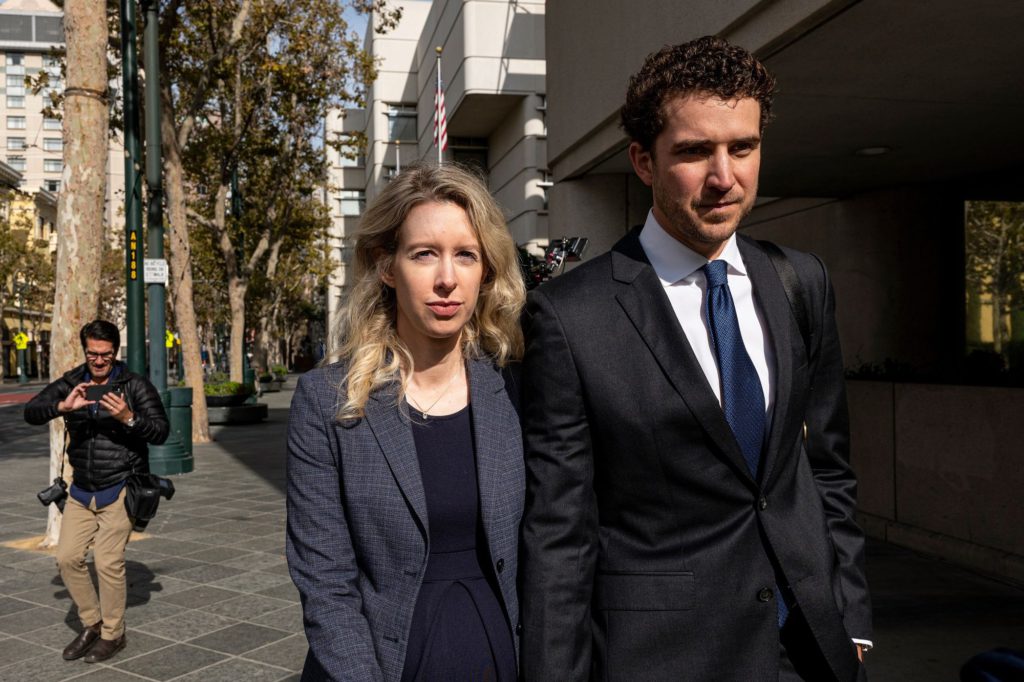
The big payday:  Elon Musk is slated to testify Monday in a lawsuit brought by a Tesla investor who argues Musk’s $55 billion pay package in 2018 was marred by conflicts of interest and improper disclosures about performance benchmarks.  Richard Tornetta says the billionaire engineered the windfall pay deal by pushing it through a “supine board.” Legal experts say the case will spotlight the role of courts in regulating executive compensation and shine a light on Musk’s peripatetic management of Tesla. The big sentence: Elizabeth Holmes will learn her fate, perhaps for the next decade-plus, on Friday. The former Theranos CEO should spend 15 years in prison for one of the most serious white-collar crimes in Silicon Valley history, prosecutors told a federal judge. Holmes’s attorneys have sought to humanize her through personal letters and are seeking home confinement and community service for her fraud conviction. Criminal defense lawyers have said the Judge Edward Davila will not only seek to penalize Holmes for defrauding investors, but also to send a message to the technology sector, where the lines between hype and fraud are often blurred. 

ICYM our Big Take:  An exclusive Bloomberg analysis shows that European fuel demand and the strong US dollar have left emerging markets facing years of shortages and potential unrest. The center of the issue is Europe’s rush to replace Russian fuel, coupled with a worrying lack of new supply in the near-term and fears that emerging nations won’t be able to repay debts. 

Hear this:  Thailand is grappling with how to manage both its own plastic waste and that of other countries, which increasingly lands on its shore after China banned such imports. Despite policies to stem the influx and activism by a variety of civil society groups, the rich world’s incentives to dump its plastic on the developing world remain powerful and the practice is hard to stop.

And finally…. The fifth annual Bloomberg New Economy Forum returns to Singapore on Nov. 14-17. It will mark the country’s third time as Forum host, following the inaugural event in 2018 and 2021’s successful return to in-person convening.

Have a good week. We’ll see you on the other side.

More stories like this are available on bloomberg.com

©2022 Bloomberg L.P.

FTX Latest: Solana Sell-Off Deepens; Bankman-Fried Questioned

(Bloomberg) — Crypto altcoin Solana, which was tied to a blockchain backed by Sam Bankman-Fried, declined for a third day Sunday as the fallout from the collapse of his FTX empire continued to reverberate. The crypto market has lost about $200 billion in value in the past week.

Bankman-Fried was questioned by Bahamian police and regulators Saturday, according to a person familiar with the matter, as authorities try to unravel what led to the demise of FTX and its affiliates, which sought Chapter 11 protection in the US on Friday. 

In other developments, analysts say about $662 million in tokens mysteriously flowed out of both FTX’s international and US exchanges. According to investment materials seen by the Financial Times, FTX Trading International held just $900 million in liquid assets on Thursday against $9 billion of liabilities.

Key stories and developments:

  • Bankman-Fried: From Crypto King to King of Tech Bubble’s Losers
  • Big Investors Are Giving Up on Crypto Markets Going Mainstream
  • Summers Says FTX Meltdown Has ‘Whiffs’ of Enron-Like Scandal (1)
  • ‘It’s All Gone’: FTX Bankruptcy Is Worst Fear for Retail Traders
  • Alpha-Male Crypto ‘Bloodsport’ Sows a Catastrophe at FTX

(All time references are New York)

Solana Slide Deepens as Bitcoin and Ether Remain Stable (8:30 a.m.)

A three-day decline for crypto altcoin Solana deepened on Sunday, as developers considered spinning off one of the blockchain network’s most prominent and FTX-affiliated project. Solana fell as much as 14% to $12.86 as of 1:30 p.m. in London. Crypto bellwethers Bitcoin and Ether have lost a little over 1% each in the last 24 hours. 

Other altcoins including Polkadot, Avalanche and Tron, typically more volatile than larger cryptocurrencies due to lower liquidity levels, lost between 1.7% and 5.4%. 


Binance Is Stopping Deposits of FTX’s Token FTT (3:30 a.m.)

Binance halted deposits of FTT, FTX’s token, “to prevent potential of questionable additional supplies affecting the market,” Binance CEO Changpeng “CZ” Zhao said on Twitter. Zhao said that he would encourage other exchanges to do the same thing. Justin Sun said Huobi Global would echo Zhao’s advice.

Zhao added that FTT contract deployers moved all remaining FTT supplies worth $400 million, “which should be unlocked in batches.” Binance followed up to say it had noticed a “suspicious movement” of a large amount of FTT by the token’s contract deployers.

FTT fell as much as 21% on Sunday to $1.65, though had recovered to around $2 as of 8:26 a.m. in London.

Matrixport Says 79 Clients Affected by FTX, ‘No Risk of Insolvency’ (11:38 p.m.)

Crypto financial-services platform Matrixport “continues to operate normally and the company has no risk of insolvency with respect to the developments at FTX and Alameda,” according to Ross Gan, head of public relations.

Matrixport had 79 clients that incurred losses via exposure to three products on its platform that were linked to FTX, Gan said.

Kraken Freezes Accounts Possibly Related to FTX (11:33 p.m.)

Crypto exchange Kraken said it has frozen Kraken account access to certain funds it suspects to be associated with “fraud, negligence or misconduct” related to FTX. Kraken said in a tweet it’s in contact with law enforcement and plans to resolve each account on a case-by-case basis.

Bankman-Fried Interviewed by Police in Bahamas (9:42 p.m.) 

Former crypto mogul Sam Bankman-Fried was interviewed by Bahamian police and regulators on Saturday, according to a person familiar with the matter. Bankman-Fried didn’t immediately respond to a request for comment.

The inquiries from Bahamian authorities add to the mounting legal pressure that Bankman-Fried is facing since his FTX empire crumbled over the past week. In the US, he is facing scrutiny from the Securities and Exchange Commission over whether he broke securities rules.

Bahamas Says it Didn’t Authorize Local Withdrawals by FTX Exchange (9 p.m.)

Bankrupt crypto exchange FTX’s move to allow withdrawals in the Bahamas was questioned by the nation’s securities regulator.

The Securities Commission of the Bahamas in a statement Saturday said that it hadn’t “directed, authorized or suggested” the prioritization of local withdrawals to FTX Digital Markets Ltd.

It added that such withdrawals could be clawed back.

Jump Crypto Says It Remains Well Capitalized After FTX Exposure (5:59 p.m.)

Jump Crypto, a cryptocurrency trading firm, told customers on Saturday it remains “well capitalized” after exposure to FTX. In a series of tweets, Jump said its exposure was “managed in accordance with our risk framework.” The company did not specify the exact nature of its exposure to Sam Bankman-Fried’s collapsed digital-asset empire. Jump’s assurance comes after FTX was hit by a mysterious outflow of about $662 million in tokens.

FTX to Seek Enforcement Aid on Unauthorized Withdrawals (1:46 p.m.)

FTX is launching an investigation with law enforcement into unauthorized withdrawals from some of its crypto wallets, a company executive said. The company, which filed for bankruptcy this week, said it is cooperating and coordinating with “law enforcement and relevant regulators.”

Liabilities Dwarfed Liquid Assets: FT (1:13 p.m.)

FTX Trading held $900 million in liquid assets against $9 billion of liabilities the day before the bankruptcy filing, the Financial Times reported, citing investment materials and a spreadsheet the newspaper had seen. Most of the recorded assets are either illiquid venture capital investments or crypto tokens that are not widely traded. The biggest asset as of Thursday was listed as $2.2 billion worth of a cryptocurrency called Serum.

Some FTX Staffers Leaving for HK: Semafor (11:55 a.m.)

Engineers and traders working at FTX and Alameda Research in the Bahamas, where the crypto exchange is based, have left for Hong Kong and elsewhere, Semafor reported, citing people close to current and former Caribbean-based FTX employees. Bankman-Fried and most of his inner circle are still in the Bahamas, the report said.

Kraken to Help In Probing Unauthorized Withdrawals (11:51 a.m.)

Crypto exchange Kraken said it knows the identity of an attacker who performed unauthorized withdrawals from rival FTX’s platform. The perpetrator moved some funds from a Kraken account to the wallet they were using to hold some stolen tokens on Saturday, blockchain security firm Hacken.io said, citing transaction data. Kraken was then able to identify the attacker by checking its platform for data on the original address, its chief security officer Nick Percoco said in a tweet.

Yellen Says Debacle Shows Need for Regulation (5:48 a.m.)

US Treasury Secretary Janet Yellen said the implosion of FTX “shows the weaknesses” within the sector and that the market for digital assets required “very careful regulation.” She added digital assets are not currently a threat to the wider financial system. 

FTX Hit by Mysterious Outflow of About $662 Million (3:03 a.m.)

Blockchain analytics firm Nansen, which gave the overall estimate of $662 million in withdrawals, said the coins flowed out of both FTX’s international and US exchanges. Elliptic said initial indications show almost $475 million had been stolen in illicit transactions, with the stablecoins and other tokens that were taken being rapidly converted to Ether on decentralized exchanges — “a common technique used by hackers in order to prevent their haul being seized.”


More stories like this are available on bloomberg.com

©2022 Bloomberg L.P.
Europe Poised for a Warmer-than-Normal Winter, Copernicus Says

(Bloomberg) — Europeans have a greater probability of experiencing temperatures significantly higher than normal this winter, potentially offering relief to tight heating-fuel markets, according to the European Union’s Copernicus Climate Change Service. 

Scientists at Copernicus reported Sunday in their most-closely-watched seasonal forecast that coastal regions along the Baltic, Mediterranean and North Sea are almost certain to see temperatures exceeding historical averages. The degree of certainty of warmer weather rose over the last month.

Abnormally high temperatures could slacken demand for natural gas, which European countries have been rushing to put into storage. Russia’s war on Ukraine propelled prices for the fuel to record heights, contributing to a cost-of-living crisis across the region.

There is a 50% to 60% probability that temperatures will be significantly above historic norms across much of the UK, central and southern Europe. Warmer temperatures would help to prevent scarce natural gas reserves from being depleted. 

“With most weather models predicting relatively mild conditions for the rest of 2022, there will probably be sufficient gas to meet demand even in the event of a cold start to 2023,” Eurasia Group wrote in a note published before Sunday’s Copernicus report.

Much of France and Germany also have a 40% to 50% probability of experiencing well-below average precipitation over the next three months. Lack of rain and snowfall could impact inland river transport and hydropower operators, as well as affect the ski season.

The Copernicus model combines data from scientists in the UK, France, Germany, Italy and the US. The EU program uses billions of measurements from satellites, ships, aircraft and weather stations around the world for its monthly and seasonal forecasts and concluded that 2019 was the continent’s hottest year on record.


Globally, Copernicus reported with 60% to 70% certainty energy markets across the central and southern US as well as much of China, Japan and Russia will have winter temperatures well above normal — a signal that long-term global warming trends are impacting economies.

More stories like this are available on bloomberg.com

©2022 Bloomberg L.P.
Crypto.com Recovers $400 Million After Misplaced Ether Transfer

(Bloomberg) —

Crypto.com said it recovered almost $400 million in cryptoasset Ether from Asian exchange Gate.io, after it accidentally transferred the funds to the wrong account.

The company was supposed to move 320,000 in Ether to a new cold storage address — a type of offline wallet — but the funds were sent instead “to a whitelisted external exchange address,” Crypto.com Chief Executive Officer Kris Marszalek said on Twitter.

Crypto.com’s initial Oct. 21 transfer represented more than 80% of the exchange’s total Ether holdings, according to a partial proof of reserves provided by Marszalek on Nov. 11. 

A spokesperson for the company said the Gate.io address was a corporate account that belonged to Crypto.com, and that the entirety of the Ether was “successfully withdrawn over the following days” after Gate.io increased its daily withdrawal limits.

Crypto.com’s website says all of its users’ funds are held in cold storage, while so-called hot wallet usage is solely for corporate assets. The spokesperson declined to clarify whether user funds were involved in the transfer.

The error comes after Crypto.com mistakenly sent about A$10.5 million ($7 million) to a woman in Melbourne last year, when an account number was accidentally entered into the payment field. 

The cryptocurrency industry has come under intense scrutiny in recent days following the collapse of rival exchange FTX.com, prompting greater focus on firms’ internal labeling and risk management procedures. Crypto companies have sought to ease user concerns by promising to publish audits on their reserves in the coming days.

Read FTX Latest: Police Interview Bankman-Fried; Mystery Outflows

“We worked with Gate team and the funds were subsequently returned to our cold storage. New process and features were implemented to prevent this from reoccurring,” Marszalek added in his tweet. 

Gate.io founder Lin Han said on Twitter that its own proof of reserves audit was based on a snapshot taken two days before Crypto.com’s accidental deposit. 

Originally based in China, Gate.io later shifted its home to the Cayman Islands. It operates a separate US exchange.

–With assistance from Joanna Ossinger.

More stories like this are available on bloomberg.com

©2022 Bloomberg L.P.

Key Takeaways From Asean Meeting Before Xi-Biden Summit at G-20

(Bloomberg) — World leaders discussed the fraying geopolitical landscape at the Association of Southeast Asian Nations meetings in Cambodia, covering everything from Russia’s war in Ukraine and the escalating conflict in Myanmar to rising food prices.  

This is the first gathering of leaders ahead of President Joe Biden’s first in-person meeting with Chinese leader Xi Jinping this week at the Group of 20 summit in Indonesia. It will be followed by the leaders’ meeting at the Asia-Pacific Economic Cooperation in Bangkok. 

Here are the key takeaways from Asean:

No Joint Statement

Russia and the US failed to agree on language for a joint statement following an 18-nation summit in Cambodia, making it unlikely the Group Of 20 countries will reach a consensus. Russian Foreign Minister Sergei Lavrov put the blame on the US and its allies, saying on Sunday they “insisted on absolutely unacceptable language regarding the situation in Ukraine.”

The context: Growing geopolitical tensions is making it harder for countries to find the middle ground on much of anything these days. While Russian President Vladimir Putin’s absence from all the meetings in Southeast Asia may help lower the temperature on differences between the US and China over Ukraine to some extent, there are still hot-button issues like Taiwan, South China Sea and escalating competition over semiconductor technology.

Myanmar Split

Indonesian President Joko Widodo aired his country’s proposal that the Myanmar junta be excluded from all Asean meetings in the future until it shows progress in a so-called five-point consensus that includes stopping violence and committing to elections. Asean later came out with a more neutral statement to say it will review Myanmar’s representation at Asean meetings “if the situation so requires.”

The context: Asean has come under pressure from the US and its allies to convince the junta to end the political instability since coup leader Min Aung Hlaing seized control from the civilian government last year. With the latest statement, there appears to be no signs of a consensus within Asean on dealing with Myanmar though with Indonesia as the next Asean chair, there may be more moves to hold the military government accountable.

‘Hunger Games’

Ukraine Foreign Minister Dmytro Kuleba urged Asean to “take every method possible to stop Russia from playing hunger games with the world” when it comes to the grain corridor. “Whatever happens on the battleground, Russia should not use this corridor as a blackmail, as the leverage in international relations as it tried to do recently by withdrawing and then returning to the grain initiative under pressure,” he told reporters in Cambodia.

The context: Moscow recently resumed its participation in the Black Sea grain-export deal after receiving written guarantees from Ukraine that the safe-passage corridor will only be used for grain exports. At a time world leaders are increasingly worried over food insecurity and soaring inflation, Ukraine has been taking to the world’s stage to accuse Russia of slowing activity at the ports.

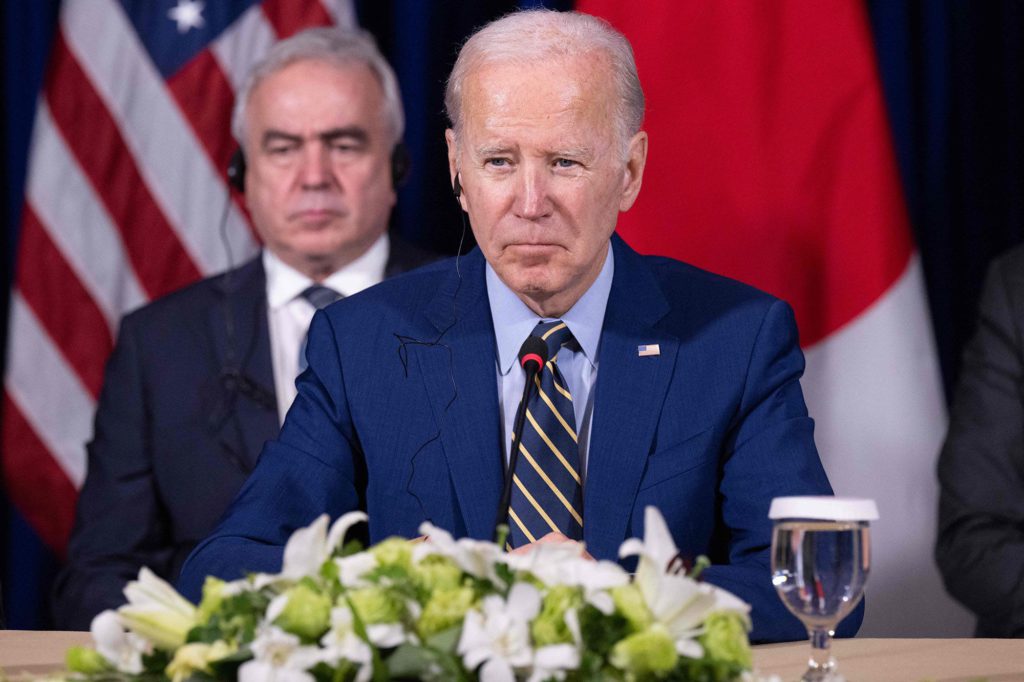
‘Stronger’ Biden

Biden said he’ll enter an intense meeting with Xi on Monday with a stronger hand, after US voters returned control of the Senate to his party. “I know I’m coming in stronger,” Biden said of the Xi meeting as he celebrated the victory in Cambodia.

The context: The Democratic performance in the midterm elections defied expectations that voters would hand control of at least one chamber of Congress by a wide margin in a rebuke to Biden and his policies. Instead, the election has been far closer, offering better than expected domestic support ahead of his meeting with the leader of the world’s second biggest economy.

Closer Ties

The US and the Southeast Asian leaders elevated relations to a comprehensive strategic partnership as the White House lauded what it called an “unprecedented expansion” in ties between the two sides under President Joe Biden.  Under the new partnership, the two sides with enjoy new high-level dialog processes on health, transportation, women’s empowerment, environment and climate, and energy.

The context: China and the US are locked in bitter competition for influence in Southeast Asia. While many regional governments count on the US as a key security partner, China has been Asean’s biggest economic ally. At the same time, Asean has been going out to upgrade ties with several other countries including Australia, India and Japan. 

More stories like this are available on bloomberg.com

©2022 Bloomberg L.P.

Close Bitnami banner
Bitnami