Bloomberg

Playbill Quits Twitter Amid Elon Musk Takeover Chaos

(Bloomberg) — In its last tweet, Playbill told its more than 412,000 followers that as of Nov. 11, it will no longer be active on Twitter across its five accounts and warned, regardless of verification marks, “If you see a tweet from a Twitter account that contains our name, please understand it is not us.”

The theater guide that is symbolic if not synonymous with Broadway went on to explain how in recent weeks Twitter has greatly expanded its tolerance for hate, negativity and misinformation and that as a respected news outlet, it felt it would be irresponsible to continue on a platform where readers might have a hard time distinguishing real news from fake.

Since acquiring the social network on Oct. 27, Elon Musk has met with criticism for mismanaging the platform. In his first weeks of ownership, the tech billionaire fired half of the company along with executive leadership, and disabled content moderation tools. This has caused an  exodus of brands from the social network fearful of having their ads and tweets appear next to hate speech.

“The issue concerning us all is content moderation and its impact on BRAND SAFETY/SUITABILITY. You say you’re committed to moderation, but you just laid off 75% of the moderation team!” said MMA Global President Lou Paskalis in a tweet to Musk.

Others have been urging brands to take a pause. NAACP President and CEO Derrick Johnson tweeted, “It is immoral, dangerous, and highly destructive to our democracy for any advertiser to fund a platform that fuels hate speech, election denialism and conspiracy theories. Until actions are taken to make this a safe space, we call on companies to pause all advertising on Twitter.” Playbill will still be active on Facebook, Instagram, and TikTok, pending an ongoing review.

More stories like this are available on bloomberg.com

©2022 Bloomberg L.P.

Tech Money Fueled FTX’s Rise. The Crash Exposes Deep Flaws in VC

(Bloomberg) — Among the last people to realize that the cryptocurrency exchange FTX was a financial time bomb were the company’s own investors. On Nov. 7 — as troubling signs began to emerge, customers were withdrawing money and the founder was tweeting unconvincingly that “assets are fine” — a broker of startup stock made inquiries to FTX’s venture capitalists and other shareholders to see if anyone wanted to sell, according to correspondences seen by Bloomberg. No one did.

A transaction probably wouldn’t have gone through anyway, given how quickly FTX hurtled toward bankruptcy after that, but the fact that the offer was declined indicates how ill-equipped investors were to assess the company’s toxicity. This highlights a long-running flaw in venture capital: Technology investors are drawn to the idea of funding the next PayPal, but many lack the expertise needed to evaluate the legal and financial risks associated with so-called fintech businesses.

There’s a legacy of venture-backed fintech scandals and collapses. They include Lending Club and OnDeck Capital’s shady loans, Greensill Capital’s risky debt, LendUp’s allegedly predatory payday loans, Fast and Xinja Bank’s unsustainable business models and Reali’s economically fragile mortgage product.

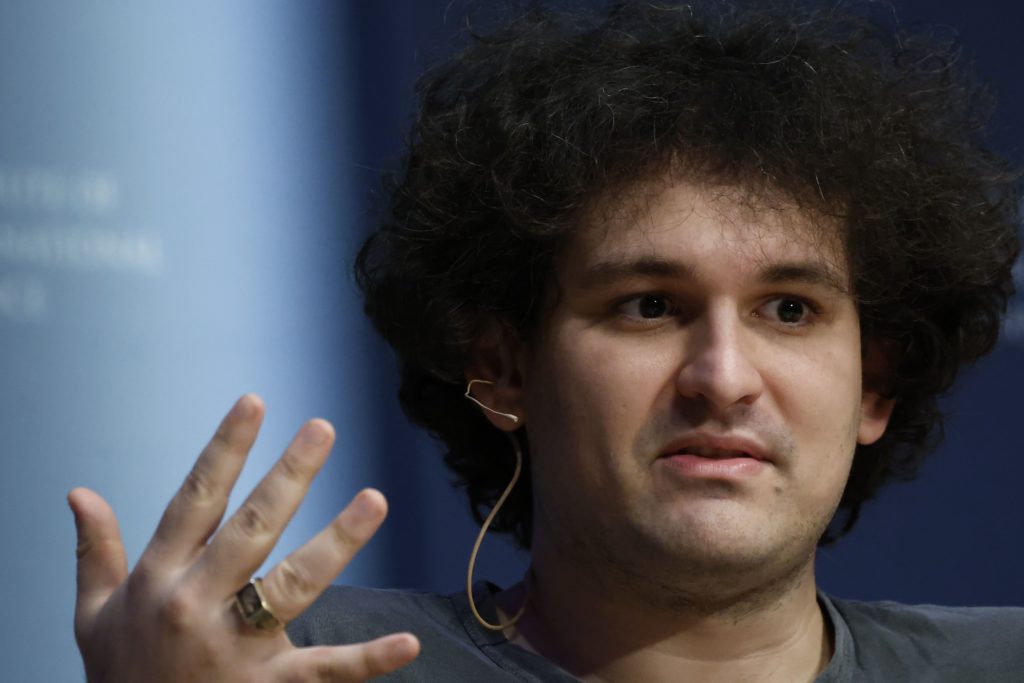
In the case of FTX, Sam Bankman-Fried built a pair of successful crypto exchanges similar to Binance or Coinbase Global Inc.’s but with an immensely risky twist. He owned a separate company, Alameda Research, that was conducting trades using money customers deposited into FTX, according to the Wall Street Journal. On top of that, Alameda’s assets were built on a token sold by FTX, according to Coindesk.

The Coindesk article, published last week, was the first alarm for many. It prompted a large selloff of the FTX-affiliated token and withdrawals from the exchange. But FTX’s backers seemed unfazed. Many said that they were blindsided on Nov. 8 when Bankman-Fried agreed to sell the company to Binance and that they learned of the deal on Twitter. The next day, Binance backed out after a financial review and suggested there were unresolvable problems with the business.

In theory, severe flaws like this could be caught by VCs in a pre-investment review period called due diligence. But because Bankman-Fried had a complex web of businesses, investors lacked the full picture. For example, Sequoia Capital said in a statement that it conducted a “rigorous” due diligence process. But when the firm invested in two of Bankman-Fried’s companies, FTX.com and FTX.us, it didn’t have access to Alameda’s balance sheet, Bloomberg reported.

In several cases, the VCs closest to FTX had limited experience in finance. For example, Ravi Mhatre, a partner at Lightspeed who oversaw the firm’s FTX investment, specializes in software.

FTX’s backers didn’t demand board seats as a condition of their investments, as they typically do. The three-person board consisted of Bankman-Fried; Jonathan Cheesman, a former FTX executive; and Arthur Thomas, a lawyer in Antigua who specializes in online gaming.

The peer-to-peer lending crisis of 2016 revealed similar failures of oversight by investors. OnDeck relied on suspect brokers to source deals, many of whom had been convicted of crimes like insider trading and embezzlement. The Lending Club CEO was forced to resign amid alleged ethical breaches that involved misdated loans and conflicts of interest. Meanwhile, the US Consumer Financial Protection Bureau halted the operations of LendUp, saying it was “backed by some of the biggest names in venture capital” while “repeatedly lying and illegally cheating its customers.”

VCs sometimes bring a misguided assumption that technology can change the economics of a lending business, said Nelson Chu, founder of Percent Technologies, which facilitates transactions for private credit investors, borrowers and underwriters. “They almost magic powder, wish it away through technology,” he said.

A visible example is last year’s collapse of Greensill, the UK and Australia-based supply chain finance company. It was built to a large extent on money from SoftBank Group Corp.’s tech fund to act as a middleman for corporate debt. Its mistakes cost SoftBank a lot of money and were near-catastrophic for the Swiss lender Credit Suisse.

“Venture capital keeps trying to tell this story to the public market investors, or maybe themselves, of this suspension of disbelief,” said Jason Mikula, a fintech consultant and former product manager at Goldman Sachs Group Inc. “‘We’re going to bring in tech, and everything is going to be different now.’ We’ve seen plenty of examples of that not being the case.”

SoftBank is exposed again as a shareholder in FTX but with less to lose this time — about $100 million. Perhaps more worrying for SoftBank and the VC community is the contagion FTX will spread to crypto at large. VCs put $30 billion into crypto just in 2021. The FTX saga erased billions this week from the market values of publicly traded crypto stocks and much more of digital currencies.

“It really is devastating for the image, credibility and legitimacy of the crypto market that connects to every day people,” said Yesha Yadav, a professor of law who focuses on securities and cryptocurrency regulation at Vanderbilt University. “This is as big as it gets.”

–With assistance from Sarah McBride.

More stories like this are available on bloomberg.com

©2022 Bloomberg L.P.

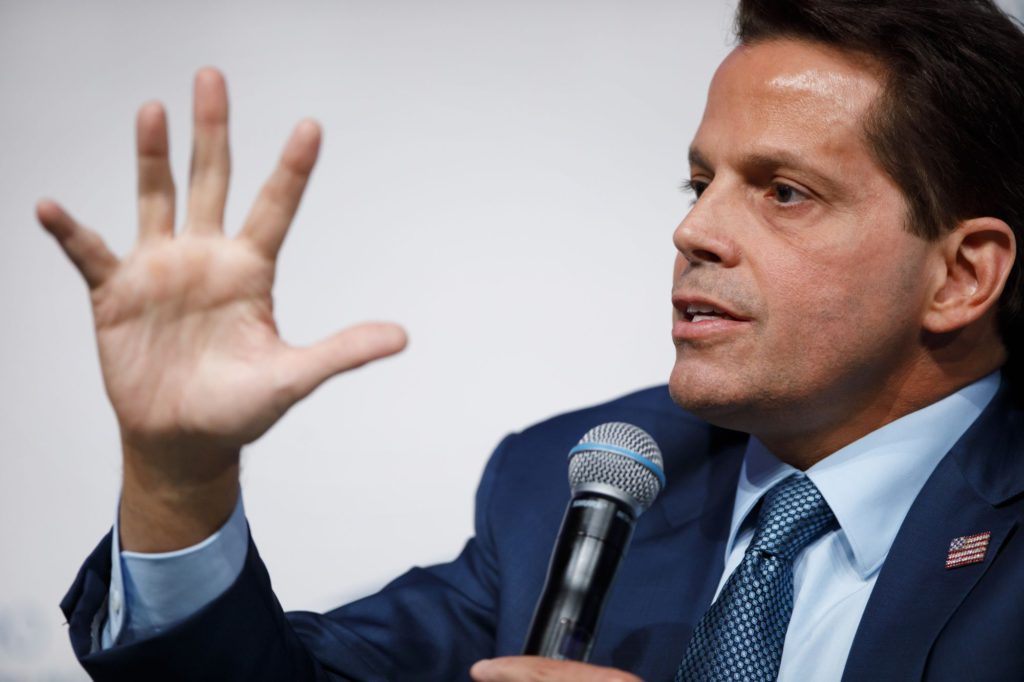
Scaramucci’s SkyBridge Is Trying to Buy Back FTX’s 30% Stake

(Bloomberg) — Anthony Scaramucci said SkyBridge Capital is trying to repurchase the 30% of his company that Sam Bankman-Fried’s FTX acquired months before the crypto exchange imploded — an attempt now complicated by FTX’s bankruptcy.

“My legal team and my other partners are working to buy back that stake,” Scaramucci said Friday in a CNBC interview shortly before FTX filed for bankruptcy. “We’re in a worse position because of the fact that we made the decision to have Sam join the cap table at SkyBridge. There’s no question that we’re in a worse position — he’s hurt the industry.”

Less than two hours after Scaramucci’s remarks, FTX disclosed the start of bankruptcy proceedings. More than 130 entities tied to FTX.com, FTX US and trading firm Alameda Research Ltd. were listed in filings at federal court in Delaware, with Bankman-Fried resigning as chief executive officer of FTX Group as part of the filing.

Any repurchase of FTX’s stake in SkyBridge would now have to go through the bankruptcy court. It’s a potentially prolonged process, one that SkyBridge will pursue with the administrator, Scaramucci told Bloomberg News after the filing. FTX creditors will be scouring the company’s books for units, contracts, joint ventures or ownership stakes with any value left to help cover their losses.

“The administrator will be inundated with requests from people who have claims against FTX,” Greg Kidd, co-founder of venture fund Hard Yaka, a small equity investor in FTX US, said in an interview. “And that includes people that were beneficiaries of investments from FTX. But there’s no way to jump the queue. Scaramucci can try to buy his stake back in bankruptcy court. There will be a process, and he could be outbid.”

Just two months ago, FTX said it was acquiring the stake in Scaramucci’s firm, which manages about $2.2 billion and invests in both hedge funds and digital assets. FTX Ventures provided SkyBridge with cash to fund growth and new product launches, and to purchase cryptocurrencies that SkyBridge would hold on its balance sheet.

On Tuesday, the SkyBridge founder flew to the Bahamas in an attempt to help Bankman-Fried, he told CNBC. 

“The original idea was this is a rescue finance situation and could we somehow help,” Scaramucci said. Upon arrival, however, it became clear “at least from some of the people that worked on the legal team and compliance team, that perhaps there was more going on than it being a rescue situation.” Scaramucci left that afternoon, distressed, he said.

Scaramucci said he hesitates to call what he saw fraud “since that’s a legal term,” but he implored Bankman-Fried to tell the truth to investors, and explain what happened to regulators. “And if there was fraud, let’s clean it up to the extent possible,” he said.

Scaramucci said that his firm has had to mark down some of its securities given the swift decline in cryptocurrencies. It had exposure to FTX’s FTT tokens, he said, and has taken “a loss” on that. 

In a September statement disclosing the deal with FTX, Scaramucci, 58, described Bankman-Fried, 30, as “a visionary who has built incredible businesses that are synergistic with the future of SkyBridge.” Bankman-Fried said FTX, which has sponsored SkyBridge’s annual SALT conference, would collaborate with Scaramucci’s firm on crypto- and non-crypto-related investments.

A few months earlier, SkyBridge suspended redemptions in its Legion Strategies Fund — one of its smaller offerings — after sharp declines in stocks and cryptocurrencies left its exposure to private companies at 20%. FTX was among the fund’s private investments.

The crisis enveloping FTX has snowballed this week, rattling the entire crypto market, with competitor Binance Holdings Ltd. agreeing to a hastily arranged rescue only to back out a day later. US authorities are investigating FTX.

Scaramucci told CNBC that he feels “disappointed” and “duped” by the collapse of Bankman-Fried’s crypto empire, calling this the worst week in cryptocurrency history.

–With assistance from Vildana Hajric.

(Updates with FTX bankruptcy, Scaramucci comments starting in first paragraph.)

More stories like this are available on bloomberg.com

©2022 Bloomberg L.P.

Compass Soars 89% Over Two Days on Cost Cuts, Housing Hopes

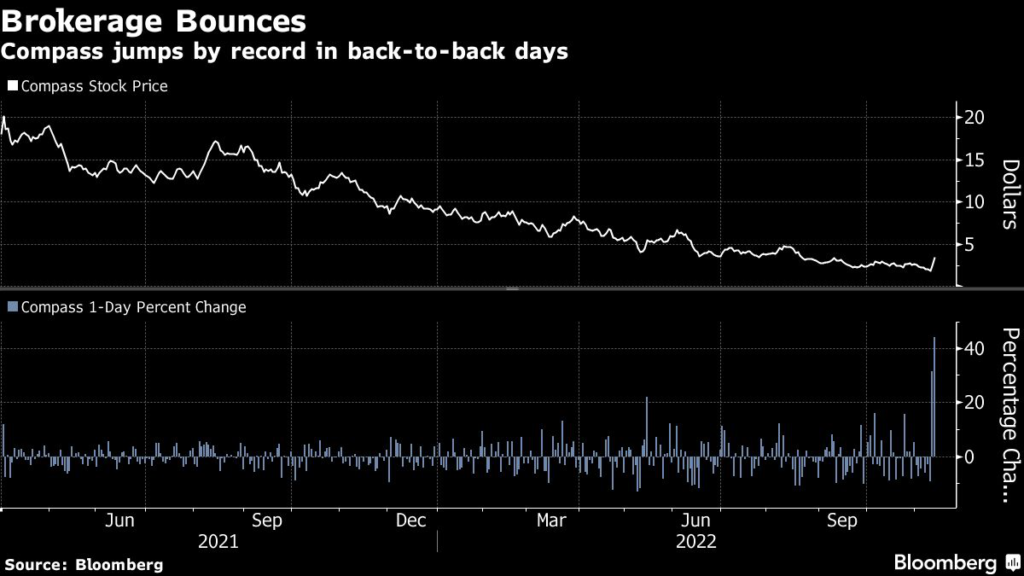
(Bloomberg) — Compass Inc. has surged 89% over two days as the hard-hit home seller committed to managing costs, building on investors’ optimism that the Federal Reserve could slow the pace of rate hikes.

Shares of the New York-based residential real estate firm gained 44% Friday, after the chief executive officer said Compass is managing the business to reduce the cost base toward the goal of becoming free cash flow-positive in 2023. That gain topped a record rally notched Thursday after US inflation data bolstered the idea that a less-aggressive Fed would ease pressure on mortgages.

“This cost-cutting story is the best way to derive equity value in our digital real estate coverage,” Needham analyst Bernie McTernan, who holds a buy rating on the stock, wrote in a Friday note. “The most significant takeaway from the earnings call is how serious the company is on their ability to reduce expenses.”

Compass had been slammed this year alongside peers as the housing market was roiled by the steep rise in borrowing costs from the central bank’s campaign to curb inflation. 

The brokerage’s stock is paring a sell-off that had reached 80% this year before the latest bounce, amid deteriorating conditions in the housing market. Hard-hit residential real estate technology peers from Redfin Corp. to Opendoor Technologies Inc. are joining in the multi-day bounce, gaining 60% and 38% over the two sessions, respectively.

–With assistance from Patrick Clark and Brandon Harden.

(Updates throughout to market close.)

More stories like this are available on bloomberg.com

©2022 Bloomberg L.P.

Stocks Cap Best Week Since June; Tech Regains Mojo: Markets Wrap

(Bloomberg) — US stocks gained surer footing after a choppy morning session, extending a rally sparked by a slowdown in inflation. The dollar fell, declining for a fourth week.

The S&P 500 closed near session highs in the biggest weekly gain since June. The tech-heavy Nasdaq 100 climbed more than 1.5%, notching its best week in two years. Cash Treasury trading is closed for Veterans Day.

Elsewhere, China easing some Covid restrictions helped underpin risk sentiment Friday, with US-listed Chinese stocks rising along with commodities from oil to soybeans to precious metals.

Meanwhile, cryptocurrencies resumed a selloff amid FTX’s deepening woes with Sam Bankman-Fried’s crypto empire filing for bankruptcy. While that news weighed on sentiment in early trading, investors downplayed contagion risks. 

“From my vantage point, the real-world impact seems somewhat limited,” said Dan Suzuki, deputy chief investment officer at Richard Bernstein Advisors LLC. “It’s hard to imagine how it has a big impact on the overall economy. Crypto makes up a relatively small portion of financial markets, financial transaction, jobs, consumer spending, business spending, etc.”

US stocks soared the most since 2020 on Thursday after a better-than-forecast cooling in US inflation improved prospects of a dovish tilt by the Federal Reserve. On Friday, the University of Michigan’s preliminary November survey showed US consumer inflation expectations increased in the short and long run while sentiment retreated. 

Boston Fed President Susan Collins said that the risks of going too far have risen after a string of jumbo-sized rate hikes, but noted a smaller, more “deliberate” increase should not be confused with backing down from curbing price pressures.

“The moderation in the pace of inflation is a welcome development, while it is still far too early to declare the inflation threat over,” Mark Haefele, chief investment officer at UBS Global Wealth Management, wrote. “We still think the Fed is likely to raise at least another 100 basis points in total before it pauses the rate hiking cycle.”

While markets reacted positively to the inflation print Thursday, Credit Suisse strategists led by Jonathan Golub said the rally was “out of sync with the size of the surprise.” This, they note, follows a pattern of outsize responses to CPI prints, which has averaged 2.8% on the day in the past seven releases.

The dollar slumped more than 1% on Friday in the biggest weekly drop since the pandemic-fueled volatility in March 2020. 

Bitcoin dropped as much as 8% to $16,376 and Ether fell as much as 9.2%. FTX.com’s bankruptcy filing capped a swift reversal of fortune for the crypto exchange led by Bankman-Fried.

Summers Says FTX Meltdown Has ‘Whiffs’ of Enron-Like Scandal

Pinduoduo Inc. and JD.com Inc. jumped in US trading amid growing optimism Beijing is on its way to ending the crippling Covid Zero policy. China reduced the amount of time travelers and close contacts must spend in quarantine. 

Some of the main moves in markets:

Stocks

  • The S&P 500 rose 0.9% as of 4 p.m. New York time
  • The Nasdaq 100 rose 1.8%
  • The Dow Jones Industrial Average rose 0.1%
  • The MSCI World index rose 1.9%

Currencies

  • The Bloomberg Dollar Spot Index fell 1.3%
  • The euro rose 1.4% to $1.0357
  • The British pound rose 1.1% to $1.1845
  • The Japanese yen rose 1.6% to 138.68 per dollar

Cryptocurrencies

  • Bitcoin fell 6.7% to $16,606.42
  • Ether fell 5.8% to $1,244.44

Bonds

  • The yield on 10-year Treasuries was little changed at 3.81%
  • Germany’s 10-year yield advanced 15 basis points to 2.16%
  • Britain’s 10-year yield advanced seven basis points to 3.36%

Commodities

  • West Texas Intermediate crude rose 2.9% to $88.94 a barrel
  • Gold futures rose 1% to $1,770.50 an ounce

This story was produced with the assistance of Bloomberg Automation.

–With assistance from Georgina Mckay, Masaki Kondo, Tassia Sipahutar, Farah Elbahrawy, Srinivasan Sivabalan and Vildana Hajric.

More stories like this are available on bloomberg.com

©2022 Bloomberg L.P.

Binance Reserves Show Almost Half of Holdings Are in Its Own Tokens

(Bloomberg) — Binance Holdings’ major crypto token holdings include $74.7 billion worth of coins, of which around 40% are in its branded stablecoin and native coin, according to data compiled by Nansen based on information from the world’s largest digital-asset exchange.

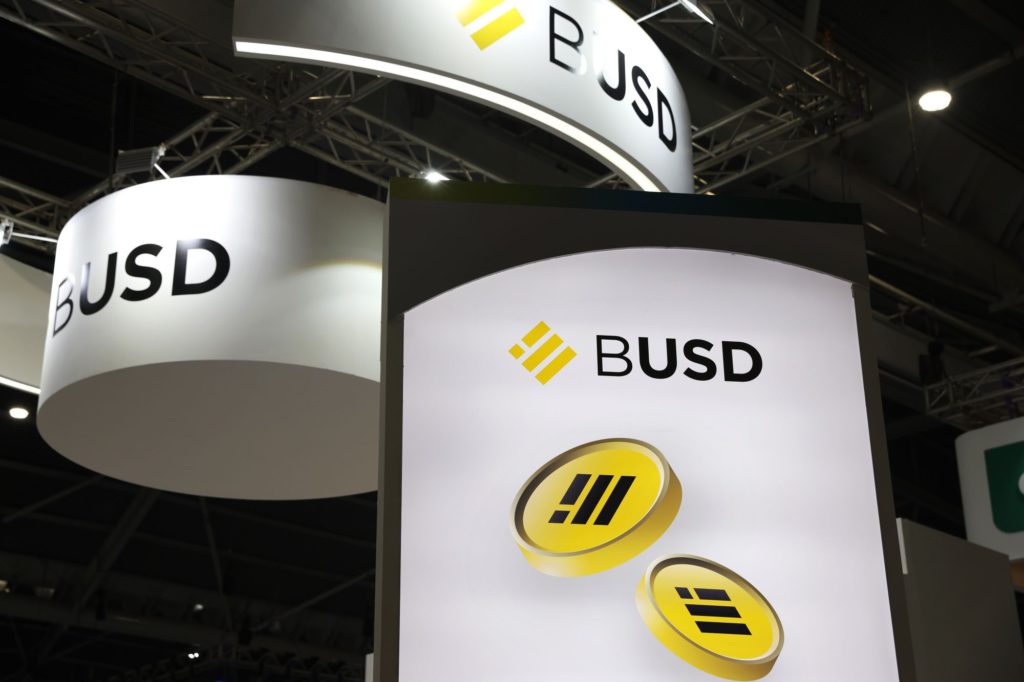
Of the $74.6 billion termed as net worth, about $23 billion was in the BUSD stablecoin, issued by Paxos, and $6.4 billion in its Binance Coin, according to Nansen. The exchange also has 10.5% of its major token holdings in Bitcoin and 9.8% in Ether, Nansen data shows. In a Nov. 10 blog post, Binance said its disclosure of holdings was a “snapshot” of major token holdings and “starting point,” and that more data will be shared later in a “full audited report.” While Binance shared details of its reserves, the dashboard does not break down how much of the assets are its own holdings, versus those of its customers. 

“These are users assets, in the form users choose to store with us,” Binance co-founder  Changpeng “CZ” Zhao, said in a tweet Friday. “We don’t convert for them.”

The world’s largest exchange released the information after Zhao announced earlier this week that Binance would provide proof-of-reserves to be more transparent. The demise of Sam Bankman-Fried’s FTX.com has raised concerns over the opacity of exchange balance sheets and is prompting companies to increase disclosures. Crypto.com has also publicly shared its reserves pool on Friday.

Binance is the first unlisted crypto exchange to come out with the details since FTX collapsed, the latest in a series of crypto businesses to go bust this year. Crypto exchanges including OKX, KuCoin, Poloniex, and Huobi this week vowed to increase transparency and provide greater clarity on their holdings. 

The swift collapse of FTX.com and the rest of SBF’s empire was partly triggered by revelations of potential over-exposure to the exchange’s native token FTT. As FTT prices crashed, so did FTX.com, pushing it to the brink of bankruptcy.

“The net worth number on the site indicates the value of the token holdings in the addresses we’ve added based on the document from Binance,” a spokesperson at Nansen said, adding that those are addresses from the chains the blockchain analytics firm supports. 

(Corrects first and second paragraphs to reflect that holdings are only a partial list, and clarifies that BUSD is issued by Paxos.)

More stories like this are available on bloomberg.com

©2022 Bloomberg L.P.

FTX Latest: Employees Explore Sale of US Derivatives Exchange

(Bloomberg) — Sam Bankman-Fried’s digital-asset empire filed for Chapter 11 bankruptcy in Delaware. His crypto trading company, Alameda Research, listed at least $10 billion of assets and liabilities each. 

Cyprus has suspended FTX’s license to operate an investment business in Europe. The crisis could lead to a tightening of US and EU crypto regulations. Wider crypto markets were hit by the fallout, with Bitcoin falling more than 8% at one point. Former Treasury Secretary Lawrence Summers compared the meltdown to that of Enron Corp. 

Troubled crypto lender BlockFi said it can no longer operate as usual, citing “a lack of clarity” in relation to FTX. Earlier, Bankman-Fried said he’s closing Alameda Research, the trading house at the center of speculation about whether his crypto exchange mishandled customer funds. 

Key stories and developments:

  • FTX Empire Goes Bankrupt, Capping Sudden Fall for Bankman-Fried
  • SoftBank Is Said to Expect About $100 Million Loss on FTX Stake
  • FTX’s Sam Bankman-Fried Faces SEC Probe as His Empire Crumbles
  • Crypto Markets Buckle as FTX Filing Spurs Search for Casualties
  • FTX Retail Investors Fear Wipeout, Shaking Their Faith in Crypto

For crypto market prices: CRYP; for top crypto news: TOP CRYPTO

(Times are US Eastern Standard unless specified otherwise.)

FTX.US Employees Said to Explore Sale of Prized Asset LedgerX (3:00 p.m.)

FTX.US employees are exploring a sale of a digital currency futures and options exchange the company acquired in October 2021, according to people with knowledge of the matter. The unit, rebranded as FTX US Derivatives from LedgerX, was excluded from FTX.US’s bankruptcy filing on Friday, Chief Executive Officer Zach Dexter said in a tweet.

FTX Withdraws US Derivatives Clearing Plan From CFTC (2:26 p.m.)

FTX’s LedgerX has withdrawn a controversial plan under consideration by US regulators to cut the middleman out of Bitcoin and Ether futures trading, according to a person familiar with the matter. The Commodity Futures Trading Commission declined to comment. LedgerX didn’t immediately respond to a request for comment. 

FTX’s European License Suspended by Cyprus Regulator (1:01 p.m.)

The Cyprus Securities and Exchange Commission said it had suspended FTX Europe’s licence on suspicion of alleged violations of several laws, stating that “the company does not appear to comply at all times” with the conditions of its authorization. Other alleged violations included laws relating to the suitability of members of management, and FTX’s safeguarding of customer assets. 

Bloomberg News first reported the potential suspension earlier on Friday.

Genesis to Get $140 Million Infusion From DCG After FTX Collapse (11:52 a.m.)

Crypto brokerage Genesis will get a $140 million equity infusion from its parent company, the Digital Currency Group, after it disclosed its derivatives business has $175 million in funds locked in a FTX trading account. 

FTX Empire Goes Bankrupt (11:12 a.m.)

After days trying to shore up his teetering crypto empire, Bankman-Fried sought Chapter 11 bankruptcy for more than 130 entities in the FTX Group, including Alameda. 

Bankman-Fried resigned as chief executive officer of the FTX Group as part of the filings, and John J. Ray III was appointed to replace him, according to a statement. Ray, a turnaround and restructuring expert, has previously served senior roles in bankruptcies including Enron.

“I’m going to work on giving clarity on where things are in terms of user recovery ASAP,” Bankman-Fried said in a Twitter thread on Friday. 

FTX Facing EU License Suspension (6:29 a.m.)

Cyprus is planning to suspend FTX.com’s two-month-old license, which allows the troubled crypto exchange to operate throughout Europe, people with knowledge of the matter said. 

An announcement on the decision could come as soon as Friday, said the people, who asked not to be named discussing internal deliberations. FTX said in September that it received the permit from the Cyprus Securities and Exchange Commission, covering the EU as well as Norway, Iceland and Lichtenstein. 

Bankman-Fried Loses Entire Fortune (6 a.m.)

Sam Bankman-Fried’s entire $16 billion fortune has now been wiped out, one of history’s greatest-ever destructions of wealth.

The collapse of FTX and Alameda Research means assets owned by the mogul once likened to John Pierpont Morgan have become worthless. At the peak, the 30-year-old was worth $26 billion, and he was still worth almost $16 billion at the start of the week.

The Bloomberg Billionaires Index now values FTX’s US business — of which Bankman-Fried owns about 70% — at $1.

Bitcoin Under Pressure (6:32 p.m. Hong Kong)

Shares in cryptocurrency-exposed companies edged lower on Friday, easing after yesterday’s US CPI-fueled surge, with the price of Bitcoin under pressure amid the unfolding crisis at FTX. The price of Bitcoin fell 3.1% to around $17,255 as of 5:26 am New York time.

In US premarket trading, Coinbase was down 0.2%, Riot Blockchain down 0.7%, Marathon Digital fell 1.7%, MicroStrategy lost 0.6% and Hut 8 Mining slumped 2.3%.

Tighter Regulation on the Cards (6 p.m. Hong Kong)

Watchdogs and industry experts in both the US and Europe said the unraveling of Sam Bankman-Fried’s crypto empire will lead to stricter rules and scrutiny.

In the US, the Financial Stability Board, which last month published a framework for regulating crypto assets, said it would do more work on exchanges and other service providers next year as the FTX implosion emphasized the need for tighter supervision. The comments echo remarks from two US senators, who said the FTX collapse shows that the Commodity Futures Trading Commission needs more oversight powers.

Marina Markezic, co-founder of the European Crypto Initiative, said FTX’s collapse will have indirect consequences and “a tremendous effect on shaping up crypto regulation.”

Softbank Said to Expect About $100 Million Loss on FTX Stake (4:30 p.m. Hong Kong)

SoftBank Group invested just under $100 million in FTX.com and anticipates writing down the entire value of the stake, according to a person familiar with the matter. 

The Japanese company had put in a total of less than $100 million and had kept the investment marked close to cost, rather than boosting the valuation and recording a profit, the person said, asking not to be identified because the details are private. SoftBank will likely write down the holding in the December quarter.

Binance CEO Talks about Regulators’ Next Focus after Fresh Crypto Fallout (4 p.m. Hong Kong)

Regulators will look more closely at account balances and reserves at centralized crypto exchanges after the shocking unraveling of FTX.com, Binance CEO Zhao Changpeng said at a fintech event in Indonesia.

Binance decided to pull a proposal to take over FTX International within 24 hours of offering a letter of intent as it did not find much value in the deal, the CEO, known as CZ, said. The deal didn’t make sense in financial terms, number of users and technology, according to CZ, speaking for the first time in public after the deal collapsed. He added that Binance will look at improving transparency and disclosures.

Crypto Markets Retreat on Concerns About FTX Contagion (12:35 p.m. Hong Kong)

Virtual coins were in retreat Friday, with the largest token Bitcoin falling as much as 5.5% and second-ranked Ether sinking almost 8% at one point. The crisis engulfing FTX and signs of spreading contagion undid investor sentiment. 

Easing US inflation had delivered a fillip for risk assets generally on Thursday, propelling the biggest advance in a gauge of the top 100 crypto tokens since early September.

Crypto Lender Hodlnaut Uncertain About Recovery of Assets at FTX (noon Hong Kong)

About 72% of digital assets deployed by Hodlnaut on centralized exchanges were held with FTX, with an estimated market value of S$18.5 million ($13.3 million), its interim judicial managers said. The extent of the recovery of those digital assets is currently uncertain, they added.

Embattled Crypto Lender BlockFi Pauses Withdrawals (8:45 p.m.)

Troubled crypto lender BlockFi said in a statement on Twitter that the company can no longer operate business as usual, citing “a lack of clarity” on the status of FTX.com, FTX and Alameda Research. 

The company said it is limiting platform activity and pausing client withdrawals. BlockFi asked customers not to deposit funds at this time.

FTX US Legal Chief Tells Working to Preserve Platform (8 p.m.)

FTX US general counsel Ryne Miller said in an internal memo he’s working with advisers to preserve “whatever is preservable” of the crypto exchange.

“We should not be optimistic for an outcome that is positive,” Miller wrote. “I’m working with outside advisers to be best prepared to navigate FTX entities to next steps.”

Sponsor of Key US Crypto Bill That Empowers CFTC Is to Review Legislation (7 p.m.)

John Boozman, a lead co-sponsor on legislation that would give the Commodity Futures Trading Commission more power to oversee digital assets, said the bill’s backers are “taking a top-down look to ensure it establishes the necessary safeguards the digital commodities market desperately needs.”

“Chairwoman Stabenow and I remain committed to advancing a final version of the DCCPA that creates a regulatory framework that allows for international cooperation and gives consumers greater confidence that their investments are safe,” he added.

He was referring to Debbie Stabenow, a leader of the Senate Agriculture Committee along with Boozman. DCCPA refers to the bill, the Digital Commodities Consumer Protection Act of 2022.

Broker Genesis’ Derivatives Unit Has About $175 Million on FTX Platform (6:20 p.m.)

Crypto broker Genesis said its derivatives business has about $175 million “in locked funds” in the company’s FTX trading account.

“This does not impact our market-making activities,” the firm said in a Twitter thread, adding “our operating capital and net positions in FTX are not material to our business.”

The fallout from the collapse of the FTX empire has left investors on edge about the risk of contagion.

Bahamas Seeks to Place FTX.com Into Receivership (5:50 p.m.)

The Bahamas Securities Commission has frozen the assets of FTX Digital Markets “and related parties.” An asset freeze was “the prudent course of action” to preserve assets and stabilize the company, the agency said Thursday in a statement. 

An attorney has been appointed provisional liquidator as the Bahamas securities regulator seeks to place the beleaguered crypto exchange into receivership. 

“The commission is aware of public statements suggesting that clients’ assets were mishandled, mismanaged and/or transferred to Alameda Research. Based on the commission’s information, any such actions would have been contrary to normal governance, without client consent and potentially unlawful,” it said.

Junior Employees Try to Sell Assets With Bankman-Fried Away (2:20 p.m.)

Employees of the US-based crypto exchange are in talks about selling parts of the business, including some assets that Bankman-Fried amassed on a sweeping acquisition tear across the industry, according to two people with direct knowledge of the matter, who requested anonymity because the talks were private. 

White House Is Monitoring Crypto Markets (1:52 p.m.)

The Biden administration is aware of recent developments surrounding cryptocurrencies and will “continue to monitor the situation,” White House Press Secretary Karine Jean-Pierre told reporters on Thursday.

Jean-Pierre said the White House believes cryptocurrency markets require “proper oversight,” but declined to comment on specific steps regulators can or should take. 

“The most recent news further underscores these concerns and highlights why prudent regulation of cryptocurrencies is indeed needed,” Jean-Pierre said at her daily press briefing.

FTX US Says Trading May Be Halted in a Few Days (1:31 p.m.)

FTX US, the American entity of Bankman-Fried’s crypto exchange, said trading may be halted on it in a few days. FTX.com and FTX US are separate entities with separate management personnel, tech infrastructure, and licensing, but have similar owners and investors, representatives for the firms have said in the past.

Japan Cracks Down on Local FTX Unit; Freezes Exchange Activity (12:52 p.m.)

Japan’s government has ordered FTX.com’s local subsidiary to suspend some of its operations, saying it has no structure in place to properly offer cryptocurrency exchange services to users.

FTX Resumes Withdrawals After Two-Day Pause (12:28 p.m.)

FTX.com has resumed withdrawals on the platform, according to blockchain data, after halting such activities on Tuesday. Nansen and Kaiko, another blockchain data firm, both confirmed the resumed activities. FTX processed $8 million worth of withdrawals in an hour on Thursday, Nansen said.

Bankman-Fried Shuts Down Trading Firm (11:40 a.m.)

Bankman-Fried is shutting down Alameda Research, the trading house at the heart of his digital-asset empire, as he seeks last-ditch financing to save his troubled crypto exchange FTX.

–With assistance from Yueqi Yang, Muyao Shen, Jordan Fabian, Takashi Nakamichi, Nao Sano, Philip Lagerkranser, Derek Decloet, Eva Szalay and Rheaa Rao.

More stories like this are available on bloomberg.com

©2022 Bloomberg L.P.

Crypto Contagion Seen Contained as Speculative Stocks Fringe Soars

(Bloomberg) — Investors worried that the cryptosphere’s meltdown will spread to the broader stock market got some reassurance as the speculative fringe of the equities universe surged anew.

A basket of unprofitable tech firms added nearly 10% at one point Friday and Cathie Wood’s ARK Innovation ETF (ticker ARKK), widely seen as a symbol of retail traders’ appetite, jumped roughly the same magnitude. The advances came even as Bitcoin fell as much as 8%. The largest coin by market value sank to around $15,500 this week, its lowest since 2020. Other cryptocurrencies, from Ether to Solana, also plunged amid the collapse of Sam Bankman-Fried’s digital-asset empire.

The overarching concern was that burnt investors would dump their riskiest stock holdings and flee to safer bets such as passive indexes. However, the resilience of these speculative assets proved a source of comfort as these wagers on future growth soared during the equity market’s best week in months.

“That ARKK is up and Bitcoin is down is a tell that the contagion is pretty limited,” said Michael Purves, founder of Tallbacken Capital Advisors. “There are probably some time bombs lurking on some companies’ balance sheets, but I think those are probably idiosyncratic events.”

The downfall of Bankman-Fried’s FTX.com has caused widespread angst in the crypto space. Investors have been left to assess the full extent of the collateral damage from one of the industry’s highest-profile firms, especially after his empire filed for bankruptcy Friday.

For Citigroup Inc. strategists led by Joseph Ayoub, the crypto market just isn’t big enough to threaten other asset classes. 

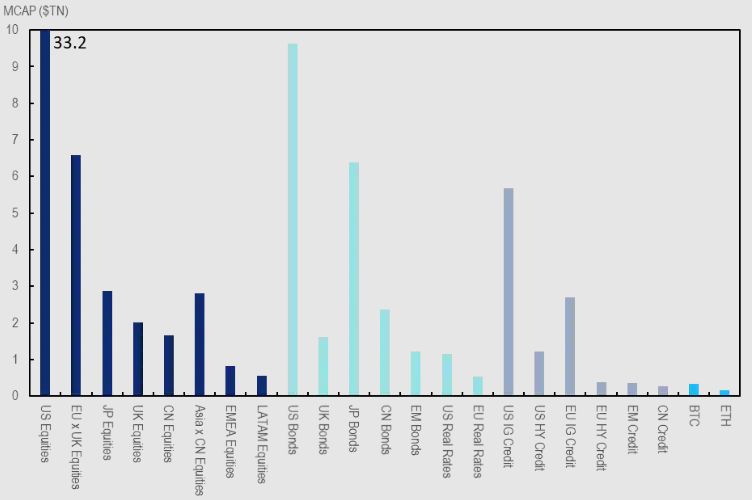
“Cryptocurrency markets remain too small and too siloed to cause contagion in financial markets, with an $890bn market cap in comparison to US equity’s $41tn,” they wrote in a note Friday.

The potential black hole in FTX’s financial reporting and accounting remains largely unknown. But the Citigroup strategists point to other crypto firms that collapsed, such as Luna, which saw an estimated $60 billion loss, as well as the technology sector’s 2022 drawdown, which saw megacap firms shed around $477 billion in combined market value. If anything, it’s the cash FTX raised from venture capital and venture funds whose effects may prove most painful, they said.

“This is the primary way financial markets could suffer, as it may have further minor implications for portfolio shocks in a volatile macro regime,” the strategists said.

As the cryptocurrency industry faces what could be the toughest phase yet in its 14-year history, the current slump is drawing comparisons to other times of severe market stress, such as the collapse of Lehman Brothers.

Matt Maley at Miller Tabak + Co., for one, doesn’t see the validity of that line of thought.

“I don’t see it being anything close to what we saw when Lehman went under,” said Maley, the firm’s chief market strategist. “However, it does show that there are still a lot of assets that are overvalued and overleveraged. Therefore, I do think it will still have a negative impact on the stock market before long.”

More stories like this are available on bloomberg.com

©2022 Bloomberg L.P.

FTX Withdraws Big Plan to Overhaul How Crypto Derivatives Trade

(Bloomberg) — FTX US Derivatives has withdrawn a controversial plan that was under consideration by Washington regulators to overhaul how Bitcoin and Ether futures trade, according to a person familiar with the matter. 

The US Commodity Futures Trading Commission was weighing the proposal, which had drawn pushback from Wall Street giants. It would have had the firm execute every aspect of customers’ crypto derivatives trades on its own — thus bypassing other exchanges, banks and financial intermediaries. 

The CFTC declined to comment. FTX US Derivatives, which was previously known as LedgerX, didn’t immediately respond to an emailed request for comment. 

The decision to pull the proposal is the latest twist in a days-long collapse of Sam Bankman-Fried’s crypto empire. More than 130 entities tied to FTX.com, FTX US and trading firm Alameda Research Ltd. were included in a bankruptcy filing on Friday. 

The plan was a lightning rod from the start, with many in traditional finance warning the model could be applied to other assets, threatening Wall Street’s stranglehold over lucrative aspects of market plumbing. 

The centerpiece of FTX’s proposal was to use algorithms rather than brokers to help clear trades, a crucial process for settling transactions that ensures sellers get their funds and buyers get the assets they’ve purchased. 

–With assistance from Annie Massa.

(Updates with details of plan starting in fourth paragraph.)

More stories like this are available on bloomberg.com

©2022 Bloomberg L.P.
FTX US Employees Explore Sale of Prized Asset LedgerX

(Bloomberg) — FTX.US employees are exploring a sale of a digital currency futures and options exchange the company acquired in October 2021, according to people with knowledge of the matter.

The unit, rebranded as FTX US Derivatives from LedgerX, was excluded from FTX.US’s bankruptcy filing on Friday, Chief Executive Officer Zach Dexter said in a tweet. A representative for FTX.US declined to comment, and Dexter could not immediately be reached for comment. The people familar with the matter asked for anonymity because the discussions are private. 

Any sale is likely to be contested by creditors, who will be scouring the company’s books for units, contracts, joint ventures or ownership stakes with any value left to help cover their losses.

Cboe Global Markets Inc. in May closed on its purchase of Eris Digital Holdings LLC, which does business as ErisX, and is a competitor to the FTX.US unit. Both are regulated by the Commodity Futures Trading Commission.

FTX.US employees have been racing to sell off assets, including stock-clearing platform Embed and naming rights to an arena in Miami.

Read more: Inside FTX.US, Employees Are Trying to Sell Assets With SBF Away

For crypto market prices: CRYP; for top crypto news: TOP CRYPTO.

–With assistance from Yueqi Yang.

More stories like this are available on bloomberg.com

©2022 Bloomberg L.P.
Close Bitnami banner
Bitnami