Bloomberg

Fast Fashion Giant Shein to Open First Physical Store in Tokyo

(Bloomberg) — Online fast-fashion behemoth Shein will open its first ever permanent physical store on Sunday, setting up shop in one of Tokyo’s most-popular areas as it seeks to live up to a lofty valuation that’s been shaken by slowing sales growth and concerns about its environmental and social impacts.

The two-story showroom, decorated mostly in gray tones, is located in Cat Street, an alley that runs between Harajuku and Shibuya and is a haven of culture and fashion. The 200-square meter venue has three changing rooms and a photo booth for shoppers to capture their outfits, and will also showcase bags and cosmetics, according to the company.

The opening follows the popularity of pop-up shops both in Japan and abroad, and the venue may also be used for events, according to Shein.

Despite the foray into brick-and-mortar retail, customers will still have to do all their ordering online. Shoppers will scan a product’s QR code, which will direct them to Shein’s website or app where they can make purchases and organize delivery. 

The online-only model, and booming popularity of at-home shopping during the pandemic, helped fuel the breakneck growth that made Shein the global face of ultra-fast fashion and underpinned its $100 billion valuation in a funding round in April — more than Hennes & Mauritz AB and Inditex SA’s Zara combined. 

The lack of physical presence and business model of ordering very small product batches means it doesn’t face the risk of managing inventories and can sell its products at ultra-low prices. The Chinese retailer typically orders 100 to 200 pieces of a particular style in order to gauge demand, only ordering larger volumes of its most popular products, the company said.

But Shein’s outlook is looking increasingly shaky. Its valuation had dropped by about $30 billion by July on concerns its rapid sales growth was stalling and as the company faces growing criticism over its environmental, social and governance record practices, including worker exploitation and copyright theft. 

The company is now looking to diversify into more expensive products, rolling out a premium line of fashion called MOTF, though it’s image as a low-price retailer is deeply rooted. It’s also pushing to get its products on US doorsteps faster by establishing distribution centers in the Midwest and California, a significant shift from its practice of shipping individual orders directly from overseas. 

Shein has told existing investors that it hopes to have an IPO in the US as soon as 2024, people familiar with the matter have said. 

–With assistance from Daniela Wei.

More stories like this are available on bloomberg.com

©2022 Bloomberg L.P.

Ireland’s Financial ‘Blind Spot’ Hit by Mass Tech Job Cuts

(Bloomberg) — The wave of job cuts across the technology industry is a particular concern for Ireland and its finances, thanks to its huge exposure to tax revenue from multinational corporations.

The announcement from Meta Platforms Inc. that it’s cutting 13% of its workforce — which would equate to about 350 roles in Ireland — followed news of huge reductions at Stripe Inc. and Twitter Inc. That’s hundreds of jobs lost or at risk within days, with more expected. 

“There will be further layoffs in other companies in the coming weeks,” Deputy Prime Minister Leo Varadkar told Ireland’s parliament Thursday. While the government hasn’t any details, “it’s likely to happen,” he said.

While the technology sector is a big employer in Ireland, the country’s exposure runs far deeper. 

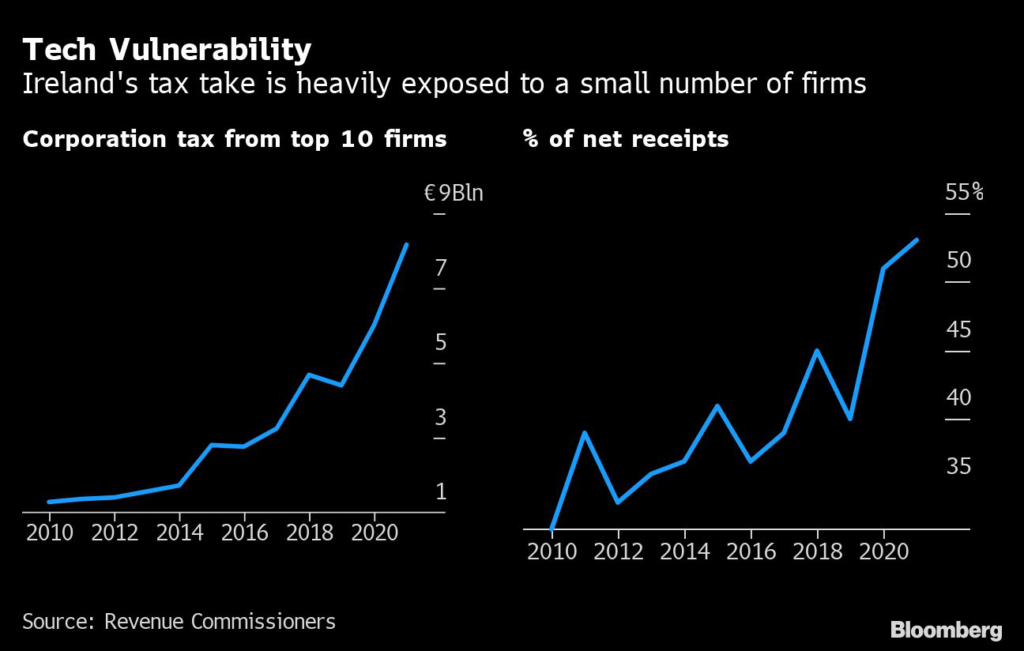
Companies account for about a quarter of tax revenue, and it’s heavily concentrated among a handful of big tech and pharmaceutical firms. More than half of corporate tax receipts come from just 10 businesses, according to Department of Finance analysis.

It’s a reliance that the department has described as a “blind spot,” noting that it can be a volatile income source.

Total corporate tax receipts jumped 30% to €15.3 billion in 2021 and the government expects them to reach €22-€23 billion in 2023.

As a revenue stream, it’s “getting to the point where it’s frightening,” Alan Barrett, director of Ireland’s Economic and Social Research Institute, said this week. “The worry is that it could evaporate.”

It’s not a risk that’s lost on the government, which estimates that up to €10 billion may be vulnerable to a shock. It’s planning to maintain a rainy-day reserve of €6 billion despite pressure to spend more on measures to ease a cost-of-living squeeze.

The energy-bill aid, in the wake of the vast sums spent during the Covid pandemic, means government finances are under strain. 

While the country’s debt ratio is expected to be less than 50% of GDP this year, that’s skewed by multinational activities. Measured against gross national income, it will be about 92%, according to the ESRI.

“Clearly any job loss is a major disappointment,” Minister for Public Expenditure Michael McGrath said in an interview. “But it is a scale of loss that we believe we can absorb. We are close to full employment.” 

Still, in the wake of the tech job shock, the government is finalizing a review of its enterprise policy. 

It wants to “make sure that our offering for foreign direct investment is sharp and is relevant to market,” said Dara Calleary, a minister in the Department of Enterprise. 

Meanwhile, Ireland also faces uncertainty from changes to the way multinational corporations are taxed under an OECD agreement. It stipulates that companies will in part be taxed on where they do business instead of where they book profits. 

The impact of this is hard to quantify, according to the IDA, Ireland’s inward investment agency.

In addition to corporate taxes, the tech slowdown may hit the take from income taxes. Multinationals typically pay higher salaries, so those employees contribute more to the public coffers.

The wave of job cuts has shone a light on the risk, according to the ESRI’s Barrett. “When you see people at Twitter and Stripe losing their jobs, income tax is a bit vulnerable as well,” he said.

More stories like this are available on bloomberg.com

©2022 Bloomberg L.P.

Alibaba’s Lazada Says Shoppers Cautious as Mega-Sale Kicks Off

(Bloomberg) — Alibaba Group Holding Ltd.’s Southeast Asia e-commerce unit Lazada Group is seeing a slight pullback in higher-ticket items including electronics as the annual mega-sales event Singles’ Day kicks off.

Consumers are being more cautious when spending on high-ticket items such as very expensive electronics, Lazada Chief Business Officer James Chang said in an interview with Bloomberg Television’s Rishaad Salamat and Haslinda Amin on Friday. “People are thinking, now that things open up, is there going to be a lot of pullback. Indeed, in certain sectors and areas, we see that,” he said.

Still, the e-commerce platform is expecting customers to spend more and take advantage of discounts ahead of an anticipated era of accelerating inflation and a possible economic downturn. Many customers — especially for repeat purchase goods — are looking to enjoy the discounts to stock up, he said.

Lazada and Sea Ltd.’s Shopee have been luring online shoppers during monthly mega-sales events, offering bargains and special deals in Southeast Asia, a region of more than 650 million people. The discount-driven monthly affair reaches a peak during Singles’ Day, a 24-hour-long sales bonanza on Nov. 11 which seeks to replicate the success of its Chinese peers.

This year, online sales are set to stagnate as consumers cut back on spending amid rising inflation and the threat of a recession. Alibaba, the tech giant that dominates Singles’ Day in China, is expected to post flat to meager growth in takings from this year’s event — Bloomberg Intelligence has even raised the prospect of an unprecedented fall in the value of its transactions.

It’s hard to see where sales are going to end up at the end of Singles’ Day, but Lazada is “quite bullish,” Chang said.

–With assistance from Rishaad Salamat and Haslinda Amin.

More stories like this are available on bloomberg.com

©2022 Bloomberg L.P.

Ukraine Latest: New US Arms Package Valued at Up to $400 Million

(Bloomberg) — The Biden administration is sending an additional weapons package to Ukraine that includes Avenger anti-aircraft systems made by Boeing Co., National Security Advisor Jake Sullivan said. The Pentagon said the weapons, drawn from US stocks, are valued at as much as $400 million.

Ukrainian forces moved deeper into Russian-occupied areas of the southern Kherson region, a day after the Kremlin ordered a withdrawal ahead of the winter months. Kyiv’s troops have advanced 7 kilometers (4 miles) in two directions in Kherson in the last 24 hours, liberating 12 towns, according to the commander-in-chief of Ukraine’s armed forces, Valeriy Zaluzhnyi. 

Ukraine’s power grid operator said that all regions will face power cuts lasting several hours on Friday, as the nation continues to limit electricity in the aftermath of Russia’s attacks against energy infrastructure.

(See RSAN on the Bloomberg Terminal for the Russian Sanctions Dashboard.)

Key Developments

  • South Korea Says Not Sending Ukraine Arms, Amid Artillery Report
  • US Adds Boeing Anti-Aircraft Missile System in New Ukraine Aid
  • Ukraine Cautious Over Russia’s Kherson Exit as Army Advances 
  • Russia to Ease Child-Labor Rules as War Squeezes Worker Supply
  • Food Prices Add to Agony for Ukrainians as Russia’s War Rages On
  • Ukraine Wants Russia to Pay for Climate Damage Wreaked by War
  • Russia Quietly Checks Its Bomb Shelters as War Fears Spread

On the Ground

Russian troops shelled the Nikopol district in the Dnipropetrovsk region overnight, local authorities said on Telegram. Over the past day forces also struck areas in the Donetsk, Luhansk, Zaporizhzhia, Mykolaiv, Sumy and Kherson regions, Ukraine’s General Staff said in a morning update. Ukrainian troops repelled attacks near 12 settlements in Donbas and shot down 8 Russian drones, according to the statement. 

(All times CET)


South Korea Says It Is Not Sending Arms to Ukraine (5:30 a.m.)

South Korea’s military said the country has maintained its position of not sending lethal arms to Ukraine, after the Wall Street Journal reported Seoul had struck a secret deal with the US that would supply Kyiv with artillery.

The Defense Ministry said in a text message to reporters on Friday that negotiations were underway between a South Korean company and the US to export arms to help Washington stock up on its inventory of 155 mm artillery rounds, under the premise the US would be the end-user of the shells.

While Seoul has provided 4.7 billion won ($3.5 million) worth of non-lethal aid that includes bulletproof vests, blankets, helmets and medicine, it has not accepted multiple requests from Ukraine to supply weapons. President Volodymyr Zelenskiy even made a personal appeal for the military assistance when he spoke to the South Korean parliament in April. 

US Weapons Package to Total Up to $400 Million (9:30 p.m.)

The latest US weapons package for Ukraine, drawn from Pentagon inventories, is valued at as much as $400 million, according to the Defense Department.

The Avenger systems included in the package will help the Ukrainians defend against cruise missiles, helicopters and drones, Defense Department deputy press secretary Sabrina Singh told reporters at the Pentagon.

Ukraine’s President Volodymyr Zelenskiy tweeted his appreciation to President Joe Biden for the new package, calling it help in “building an air shield to protect civilians.”

Ukraine Plans Power Cuts Across Country (7:48 p.m.)

The northern Zhytomyr, Kyiv and Chernihiv regions, as well as the central Cherkasy region and the capital Kyiv, will face the most significant power cuts, while the country expects to avoid emergency blackouts on Friday, the nation’s power grid operator said on its Telegram channel.

NPC Ukrenergo limits power supplies to various regions on a scheduled basis after Russia began systematic shelling of its energy infrastructure last month.

US Announces Ukraine Weapons Package With Avenger Air Defenses (7:31 p.m.)

Sullivan said the US is sending Ukraine an additional weapons package including missiles for Hawk air defense systems, as well as four US Avenger air defense systems. The equipment will complement contributions announced by partners in the context of the Ukraine Defense Contact Group, he said.

The Avenger air defense system is a mobile, surface-to-air unit equipped with Stinger missiles, and can operate in extreme weather conditions, according to Boeing.

Russian Bank in Luxembourg Lays Off Half of Workforce (5:33 p.m.)

East West United Bank will cut about half its workforce amid “unprecedented challenges” after the Kremlin-led invasion of Ukraine, but reached an accord to help protect remaining staff and keep operating, Luxembourg’s main trade unions said in a joint statement.

East West, owned by conglomerate Sistema PJSC, provides wealth management and transaction services to Russian-speaking clients in and around Luxembourg, a European Union member state and financial hub. Between 32 to 44 of the bank’s 80 employees will be let go.

Read more: Russian Bank in Heart of EU Lays Off Half of Workforce

Russia Quietly Checks Its Bomb Shelters as War Fears Spread (4:28 p.m.) 

Bomb shelters across Russia are being brought back to life after more than three decades of neglect since the end of the Cold War. State workers are quietly checking basements and other protected facilities, repairing and cleaning installations not used since the Soviet era, according to people familiar with the efforts. 

The moves are part of a broader push by authorities to make sure civil-defense infrastructure is ready in case of a wider conflict, people familiar with the situation said, speaking on condition of anonymity to discuss matters that aren’t public.  

Russia’s Cash Inflow Recovers as Current-Account Surplus Widens (3:52 p.m.)

Even as the Kremlin continues to contend with sanctions, Russia’s current account surplus showed signs of growing again in October after three months of decline. For the first 10 months of the year, the surplus reached a record $215 billion, according to preliminary central bank data.

While the Bank of Russia doesn’t disclose monthly figures, they can be estimated by subtracting previous cumulative statistics. On that basis, October’s surplus widened to $17 billion, the first month-on-month increase since June.  

Food Prices Add to Agony for Ukrainians (2:57 p.m.) 

The prices of eggs, vegetables and fruit spurred inflation to a six-year-high in Ukraine, while companies predicted a gloomy future for businesses hurt by Russia’s war. Inflation in October climbed to 26.6%, beating economists’ estimates. Egg producers and farmers say the destruction brought by Russia’s invasion may further increase prices.

Still, the central bank said last month that inflation remains below its expectations and is “quite moderate” given the war, which has killed tens of thousands of people, crippled the economy and damaged more than a third of the nation’s power infrastructure. 

Ukraine Says Russia-Backed Cyber Attacks Are Increasing (12:45 p.m.)

Cyber attacks against state information resources and critical infrastructure have been rising since the start of Russia’s war, with incidents having almost doubled in the third quarter, Ukraine’s State Service of Special Communication and Information Protection said on its website. 

The “absolute majority of cyber incidents are linked to hacker groups financed by the Russian government,” according to the statement. “Hackers resort to cyber espionage, disruption of state information services and even destruction of information systems by so called program wipers.”

European Commission Unveils Crisis Response Proposal (12:40 p.m.)

The European Commission, the bloc’s executive body, proposed plans to help European armed forces more speedily respond to a crisis by improving transport and other infrastructure within the EU. 

The proposal aims to ensure the EU’s bridges, trains and roads can support heavy duty vehicles and military trucks, allowing them to move seamlessly across the bloc’s countries. It also aims to design a fuel supply chain, ensuring forces have fuel as they travel. 

“When crisis hits, we need to make sure that member states’ military can move quickly,” Executive Vice President Margrethe Vestager told reporters. 

Estonian Premier Says Russia Is Losing Momentum in Ukraine (12:30 p.m.)

Kaja Kallas said Russia should not be given a chance to “pause” and regain the initiative after suffering setbacks in the fighting in Ukraine.

“Maybe I am overly optimistic, but I would like to hope that the moment is near where Russia sees that there is no point in continuing this war,” Kallas said at a news conference in Tallinn on Thursday.

Kallas praised the arrival in Ukraine of air defense weapons from Norway, Spain and the US in recent days. 

Russia to Ease Child-Labor Rules as War Squeezes Worker Supply (12:18 p.m.) 

Russia is planning to ease restrictions on child labor, removing rules that had made it hard for teenagers to get jobs as the economy struggles under sanctions and the impact of the mobilization of 300,000 reservists for the war in Ukraine.

Citing the need to boost the supply of labor amid “sanctions pressure from unfriendly countries,” legislators from the ruling United Russia party proposed legal amendments to make it easier for teenagers from 14 years old to get part-time jobs. “A teenager’s income also would be additional financial support for families and help instill a sense of responsibility,” the proposal said.

Ukraine Wants Russia to Pay for Climate Damage Wreaked by War (12 p.m.) 

Ukraine is taking its fight to repel the Russian invasion to the climate arena with demands that aggressors be forced to pay for greenhouse gas emissions caused by war. 

Weapons manufacturing and military vehicles running on fossil fuels generate significant emissions of planet-warming gas, even in times of peace. Missiles and bombs kill people but also disrupt power generation, destroy infrastructure and contribute to the warming of the atmosphere, while Russia’s decision to cut gas supplies into Europe has prompted a scramble for fossil fuels.

Baerbock Warns Hungary Over Ukraine Funds (11:30 a.m.)

German Foreign Minister Annalena Baerbock cautioned Hungary over its threat to block EU financial aid for Ukraine amid a dispute with the bloc over rule of law and Budapest’s access to recovery funds. 

Russia’s “deliberate destruction” of energy infrastructure in Ukraine is putting lives at risk this winter and EU funds will help prevent more deaths, Baerbock said at a news conference in Berlin, when asked about Hungary’s position.

“This is not some run-of-the-mill European issue where you can haggle over money,” Baerbock said. “This European financial support saves lives every day and so I believe and expect that everyone is aware, and should be aware, of that in these such difficult times.”


More stories like this are available on bloomberg.com

©2022 Bloomberg L.P.

Crypto Prices Sink Amid Further FTX Woes After Surging on US CPI

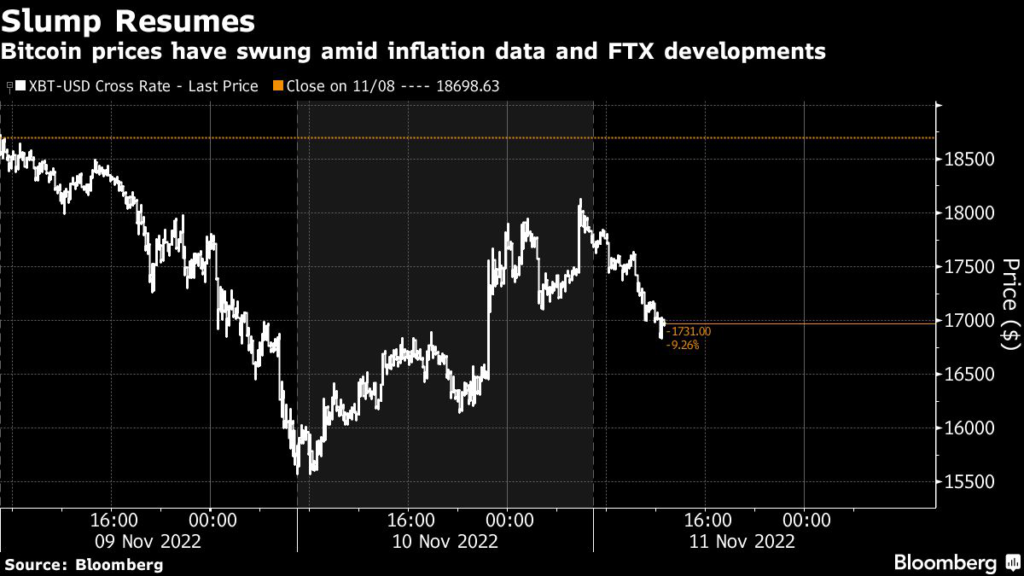
(Bloomberg) — Cryptocurrency prices retreated Friday as the knock-on effects from FTX’s downfall persisted, even as other risk assets surged after US inflation data.

Bitcoin dropped as much as 5.5% to as low as $16,837. It had jumped 13% on Thursday as the CPI reading came in lower than expected, fueling expectations that the Federal Reserve would slow the pace of rate increases. A gauge of Asia-Pacific shares rose as much as 3.6%.

“Contagion risks in cryptocurrencies, following on from the FTX-Alameda collapse, will take a long time to work through and the market remains vulnerable,” said John Toro, head of trading at digital-asset exchange Independent Reserve in Sydney.

Ether fell as much as 7.9%. After more than doubling Thursday, FTX’s FTT token declined up to 40% on Friday.

FTX founder Sam Bankman-Fried reportedly faces an investigation by the US Securities and Exchange Commission, and crypto lender BlockFi has halted withdrawals due to the turmoil. That’s on top of the Bahamas freezing FTX.com’s assets, and the general counsel of FTX.US telling staff he’s working with advisers to preserve what they can of the exchange.

The uncertainty is likely to roil crypto markets for a while.

“We’re going to see definite lower volumes because people are going to hold back at this moment in time,” Coinbase Chief Financial Officer Alesia Haas said on Bloomberg Television. 

–With assistance from Sonali Basak.

More stories like this are available on bloomberg.com

©2022 Bloomberg L.P.

Exclusive Satellite Images Show Methane Cloud Near Canada Waste Site

(Bloomberg) — Scientists say reducing emissions of methane, which has 84 times the warming power of carbon dioxide during its first two decades in the atmosphere, is one of the fastest and cheapest ways to cool the planet. Throughout COP27, Bloomberg Green will exclusively publish new satellite images of methane releases around the world, in collaboration with emissions monitoring firm GHGSat Inc.

Quebec, Canada, Nov. 9, 1:36 pm local time

A cloud of methane was observed near a suburb of Montreal that GHGSat attributed to the waste sector. The satellite company estimated an emissions rate for the plume of 1,185 kilograms per hour. 

Landfills and wastewater contribute about 20% of the global methane emissions attributable to human activity. Piles of garbage can generate the potent greenhouse gas when organic material like food scraps break down in the absence of oxygen. Failing to curb releases from the waste sector could derail global climate goals.

Environment and Climate Change Canada spokesperson Cecelia Parsons acknowledged a Bloomberg email asking if the agency was doing anything about the release and said she was looking into it. A spokesperson for Quebec’s ministry of environment also acknowledged a request for comment.

The release offers yet another disconnect between Canada’s climate ambitions and its emissions. Prime Minister Justin Trudeau has pitched the country as a global environmental leader but the nation’s methane and carbon dioxide releases have climbed more than any other G-7 country, relative to a 1990 baseline, according to European Commission data through early 2021.

Last month Bloomberg News reported on a methane plume near oil and gas production and pipelines that Canadian regulators said they were unaware of. Environment Minister  Steven Guilbeault has said the country is on track to cut methane emissions more than 40% by 2025, relative to a 2012 baseline. 

Read more: A Methane Cloud Highlights Cracks in Canada’s Climate Ambitions

Diverting food scraps and other organics before they enter a landfill is crucial to limiting future emissions. The impact of legacy dumps can be mitigated through aerating piles of trash and gas capture systems.

Pszczyna County, Poland, Nov. 8, 1:25 pm local time

Two distinct methane plumes were observed in southern Poland near the border with the Czech Republic by a GHGSat satellite on Nov. 8. The emissions monitoring firm attributed the concentrations of methane to the coal sector and estimated the combined rate for the two plumes at 3,410 kilograms per hour. 

Poland’s Ministry of Climate and Environment didn’t immediately respond to an emailed request for comment sent outside normal business hours. 

Methane can leak from coal mines when sedimentary rocks are crushed or coal seams are exposed. Miners often attempt to drain methane from coal seams before mining the fossil fuel to reduce the risk of explosions and fires. The sector is responsible for about 30% of the total emissions of the potent greenhouse gas coming from the energy sector. Halting intentional venting of methane and accidental leaks from coal mines and oil and gas infrastructure is viewed by scientists as some of the lowest hanging fruit in the fight against climate change.

Both plumes were near Poland’s KWK Pniówek coal mine, according to Global Energy Monitor, a San Francisco-based non-profit that catalogs global fossil fuel infrastructure. Vents for large underground mines can be several kilometers from where coal is coming is coming out of the ground. 

The KWK Pniówek mine was highlighted in a 2015 report from the U.S. Environmental Protection Agency as part of its Coalbed Methane Outreach Program that works with mines in the U.S. and internationally to encourage the economic use of coal mine methane that is otherwise vented to the atmosphere. 

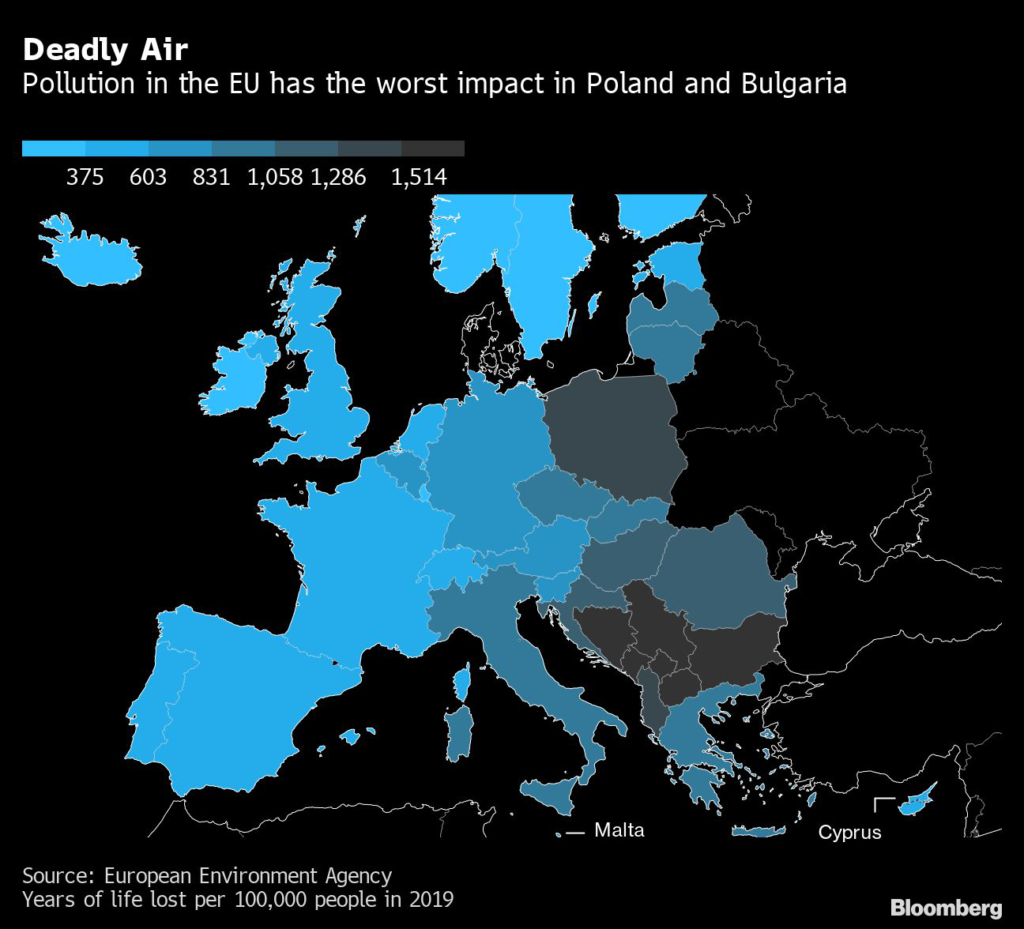
Poland remains heavily reliant on coal for home heating and the country is home to 40 of the 100 cities with the worst air quality in the European Union. The nation has one of the continent’s highest prevalence of premature deaths linked to contaminated air. 

Fars Province, Iran, Nov. 6, 9:25 am local time

A GHGSat satellite observed methane emissions near fossil fuel facilities Nov. 6 in a remote corner of Fars Province, in southern Iran. The emissions monitoring company attributed the plume to the oil and gas sector and estimated methane was spewing at a rate of 795 kilograms an hour at the time of the observation. 

Officials with the National Iranian Oil Co., the country’s government-owned oil and natural gas producer, didn’t immediately respond to an email sent outside normal business hours. 

The emissions occurred near the Arsanjan-Kheirgoo Gas Compressor Station. The site’s three compressors help ship as much as 110 million cubic meters of gas a day from the South Pars field 1,050 kilometers (650 miles) north to Tehran and were designed to increase transmission capacity during the winter heating season, according to a promotional video from the site’s operating subsidiary Sekafco.

National Iranian Oil spews more methane than any other global energy producer, according to a report by Global Energy Monitor. The non-profit group found that that just 30 fossil fuel companies account for nearly half of the sector’s emissions of the potent greenhouse gas.

Methane is the primary component of natural gas and responsible for about 30% of the Earth’s warming. Leaks can occur during extraction and transport of the fossil fuel.

The potent greenhouse gas, which has 84 times the warming power of carbon dioxide during its first two decades in the atmosphere, is also routinely generated as a byproduct of oil or coal production and if operators don’t have infrastructure to get the gas to market they may release it into the atmosphere. The International Energy Agency has called for oil and gas operators to halt all non-emergency methane venting. 

Near Kirtland, New Mexico, USA, Nov. 6, 1:48 pm local time

A GHGSat satellite observed methane emissions near a coal mine Nov. 6 in New Mexico that the emissions monitoring firm said was coming from a mine vent. The company estimated the release was spewing at a rate of 440.4 kilograms per hour. 

Operational coal mines often vent methane to reduce the risk of explosion. Closed or abandoned coal mines can leak methane for years if they aren’t properly sealed. 

GHGSat said they first detected emissions from the site through a demonstrator satellite in 2016. An official with the New Mexico Environment Department said Westmoreland Mining LLC is the operator of the facility near the plume. An official at Westmoreland didn’t immediately respond to a request for comment after normal business hours.Matthew Maez, a spokesperson for the New Mexico Environment Department said that fugitive emissions from coal mines are not subject to the department’s air quality rules.

Near Lucknow, India, Nov. 5, 1:28 pm local time

The satellite image was taken on Nov. 5 and shows a plume of methane that GHGSat attributed to a landfill in India. The estimated emissions rate was 1,328 kilograms per hour of methane. Landfills tend to be persistent emitters, according to the Montreal-based company. 

The detection highlights how piles of garbage — which generate the potent greenhouse gas when organic material like food scraps break down in the absence of oxygen — are triggering some of the world’s strongest and most persistent methane emissions. Landfills and wastewater are responsible for about 20% of the methane emissions generated from human activity.

Read more: The Trash Mountains of South Asia That Threaten the Climate

Failing to curb releases from the waste sector could derail global climate goals. Diverting food scraps and other organics before they enter a landfill is crucial to limiting future emissions. The impact of legacy dumps can be mitigated through aerating piles of trash and gas capture systems.

Near Daqing, China, Nov. 4 at 1:15pm local time

On Nov. 4 a satellite identified six methane releases in northeast China near the Daqing oilfield, according to GHGSat. Estimated emissions rates ranged between 446 and 884 kilograms per hour and the cumulative rate was 4,477 kilograms an hour. If the releases lasted for an hour at that rate they would have the same short-term climate impact as the annual emissions from about 81 US cars.

• Read more:  Countries Set to Bolster Global Methane Pledge at Climate Summit

The detections highlight the rapidly expanding ability of satellites to identify and track methane almost anywhere in the world that is driving a new era of climate transparency in which greenhouse gases will be quantified and attributed in near real-time to individual assets and companies.  

More companies and institutions are launching multi-spectral satellites that can detect methane’s unique signature. GHGSat has six satellites in orbit now dedicated to monitoring industrial methane and aims to launch another five by the end of next year. US non-profit Environmental Defense Fund plans to launch its MethaneSAT in 2023 and a consortium including Carbon Mapper, the state of California, NASA’s Jet Propulsion Laboratory and Planet Labs expects to launch two satellites next year. 

In 2021, concentrations of methane in the atmosphere had the biggest year-on-year jump since measurements began four  decades ago, according to the World Meteorological Organization. 


–With assistance from Golnar Motevalli.

(This story updates through Nov. 18 with new satellite images of methane releases around the world.)

More stories like this are available on bloomberg.com

©2022 Bloomberg L.P.
Cathie Wood’s ARKK ETF Heads for Best Day Ever as Risk Assets Surge

(Bloomberg) — Cathie Wood’s flagship fund clocked its best session on Thursday as riskier assets bounce following a softer-than-expected inflation report.

The ARK Innovation ETF (ticker ARKK) surged 15%, the most on record, after data showed that prices rose slower than forecast, which fueled bets that the Federal Reserve could dial back its aggressive tightening efforts. That’s good news for riskier assets that have been weighed down by the central bank’s rate-hiking efforts. 

ARKK’s best day ever shows how swiftly battered growth stocks can recoup losses and outperform major asset classes when inflation softens. Ark Investment Management LLC’s funds capitalized on Thursday’s sizzling rebound by paring stakes in self-driving technology provider TuSimple Holdings Inc., 3D printing services provider Materialise NV, defense systems maker Elbit Systems Ltd. and Southeast Asian e-commerce company Sea Ltd.

In the days leading up to the consumer price index print, Wood had boosted bets on some of her favorites like electric vehicle bellwether Tesla Inc., cryptocurrency exchange operator Coinbase Global Inc, online broker Robinhood Markets Inc., software maker Adobe Inc. and even small biotechnology firms like Nurix Therapeutics Inc. Key exits included chipmaker Nvidia Corp.


Meanwhile, the AXS 2X Innovation ETF (TARK), which tracks double the performance of Wood’s fund, raced ahead by 28%, the most since its inception earlier this year, while the AXS Short Innovation Daily ETF (SARK), which is structured to deliver the inverse of ARK Innovation’s performance each day, slid 14%, the most on record. 

“It’s a super mean-reversion day,” said Todd Sohn, ETF strategist at Strategas Securities. “A little beat on inflation and we see market relief,” he said, adding that a lot of investors who had shorted ARKK might also be forced to cover their positions. 

Stocks and cryptocurrencies surged on Thursday for its best day since April 2020, with the S&P 500 adding 5.5%. Bitcoin, the largest digital token by market value, gained more than 13% to trade above $17,000, following a two-day drubbing that saw it tank below many closely-watched technical levels as the collapse of the popular crypto exchange FTX.com spurred industry wide angst. A basket of the most shorted companies gained more than 8%. 

Wood’s other key funds — the ARK Fintech Innovation ETF (ARKF), ARK Genomic Revolution ETF (ARKG) and ARK Next Generation Internet ETF (ARKW) — each added more than 11% Thursday. ARK Space Exploration & Innovation ETF (ARKX) and ARK Autonomous Technology and Robotics ETF (ARKQ) rose more than 6% each.

“This is a very highly skewed buy-day. I think this is well-needed good news for the market after the last 48 hours. ARK’s fund was getting destroyed all week,” said Anthony Denier, CEO of trading platform Webull. “It’s kind of one of those ‘hoorah’ moments for the market that there’s finally some good news, or at least finally some light at the end of the tunnel, that we’re kind of making way through this inflation cycle.”

Still, the year hasn’t been the kindest for Wood and her suite of products. ARKK’s top holdings — tech companies that project growth far out into the future — have suffered amid the Fed’s monetary tightening campaign. ARKK is down more than 60% this year as is ARKF, while the ARKG has shed about 44%.

–With assistance from Emily Graffeo.

(Adds Ark Investment Management LLC’s trading activity in third and fourth paragraphs, and updates prices throughout)

More stories like this are available on bloomberg.com

©2022 Bloomberg L.P.
Stocks Surge in Asia to Extend Post-CPI Rally: Markets Wrap

(Bloomberg) — Asian stocks extended the rally seen on Wall Street after slower-than-projected US inflation spurred bets the Federal Reserve will moderate its aggressive rate-hike path.

A benchmark of Asian equities headed for a second week of gains, boosted by a surge in Hong Kong-listed technology stocks. The call by leaders in Beijing for more precise and targeted Covid control measures added to the updraft for Chinese shares.

US stock futures fluctuated after the S&P 500 climbed 5.5% on Thursday — the best first-day reaction to a CPI report in decades. 

Government bonds rallied in Japan and Australia after Treasuries surged on Thursday in move that sent yields down by 20 to 30 basis points across the US curve. Rates traders downgraded the odds of another three-quarter-point rate increase by the Fed in December almost to nil. 

A Bloomberg gauge of the greenback held most of its 2% slide from Thursday, which was the biggest move since 2009. The yen weakened against the dollar after leaping the most since 1998 on Thursday. The won jumped the most in more than two years.

The sentiment shift also helped crypto markets stabilize despite the turmoil surrounding crypto exchange FTX.

Headline US inflation came in at 7.7%, the lowest since January, before Russia’s war in Ukraine pushed up commodity prices. More important for the Fed, the core measure that excludes food and energy slowed more than anticipated. 

“Touch wood, we can kiss 75-basis-point hikes goodbye as long as incoming data allows, but with inflation likely to remain elevated, I suspect we’ll see rates above 5% next year,” said Matthew Simpson, senior market analyst at StoneX Financial. “And the Fed will want more data before hinting at a lower terminal rate, even if markets behaved like rates were cut overnight.”

Still, Thursday’s intense rally only partially claws back steep losses for risk assets hammered this year by the Fed’s tightening. The S&P 500 is still down 17% and the Nasdaq 100 is off nearly 30%, with both headed for their worst years since 2008. The MSCI World Index is down about 18% this year.

Fed officials appeared to back a downshift in rate hikes after a stretch of four jumbo-sized increases. They also stressed the need for policy to remain tight. 

Dallas Fed President Lorie Logan said it may soon be appropriate to slow the pace to better assess economic conditions. San Francisco’s Mary Daly said the moderation was “good news,” but noted “pausing is not the discussion, the discussion is stepping down.” 

Elsewhere, oil headed for a weekly loss as China’s Covid policies weaken the outlook for demand. Gold was on track for its biggest weekly gain since March.

Key events this week:

  • US University of Michigan consumer sentiment, Friday

Some of the main moves in markets:

Stocks

  • S&P 500 futures rose were little changed as of 12:02 p.m. in Tokyo. The S&P 500 rose 5.5%
  • Nasdaq 100 futures were little changed. The Nasdaq 100 rose 7.5%
  • Euro Stoxx 50 futures rose 0.2%
  • Japan’s Topix index rose 1.9%
  • South Korea’s Kospi index rose 2.9%
  • Hong Kong’s Hang Seng Index rose 5.4%
  • China’s Shanghai Composite Index rose 1.3%
  • Australia’s S&P/ASX 200 index rose 2.6%

Currencies

  • The Bloomberg Dollar Spot Index was little changed
  • The euro fell 0.2% to $1.0191
  • The Japanese yen fell 0.7% to 141.95 per dollar
  • The offshore yuan fell 0.3% to 7.1716 per dollar

Cryptocurrencies

  • Bitcoin fell 3.8% to $17,134
  • Ether fell 5.5% to $1,249.38

Bonds

  • The yield on 10-year Treasuries fell 28 basis points to 3.81% on Thursday. Trading was closed for a holiday Friday
  • Australia’s 10-year yield declined seven basis points to 3.66%

Commodities

  • West Texas Intermediate crude rose 0.3% to $86.76 a barrel
  • Spot gold fell 0.2% to $1,752.39 an ounce

This story was produced with the assistance of Bloomberg Automation

–With assistance from Georgina Mckay, Stephen Kirkland and Masaki Kondo.

More stories like this are available on bloomberg.com

©2022 Bloomberg L.P.
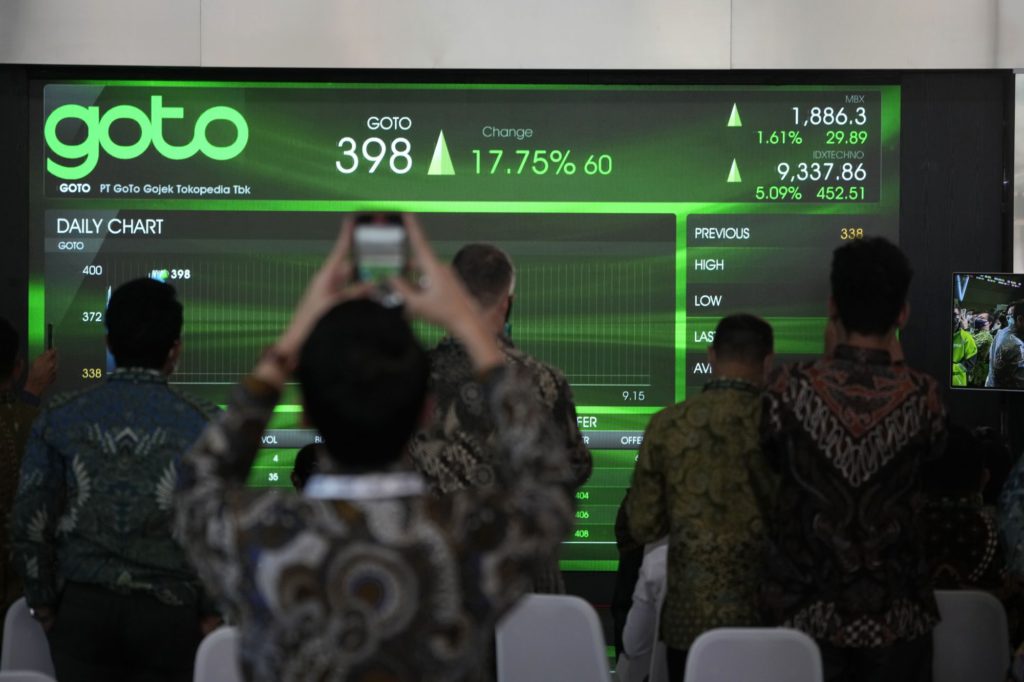
GoTo Plans to Cut Over 1,000 Jobs in Bid to Reach Profit

(Bloomberg) — Indonesia’s largest internet company GoTo Group is planning to cut more than 1,000 jobs as it seeks to trim costs and shore up its finances, according to people familiar with the matter.

The reduction, equal to more than 10% of the workforce, will affect all divisions, said the people, who asked not to be identified as the deliberations are private. Shares of the company rose as much as 9.6% in Jakarta, the biggest intraday gain in almost two months.

GoTo joins tech giants from Meta Platforms Inc. to Apple Inc. that are cutting staff or pausing hiring after years of heady expansion succumbed to a global economic downturn. Job cuts in the technology industry are nearing levels seen in the early stages of the Covid-19 pandemic, as companies both large and small curtail ambitions and brace for tough times ahead.

The ride-hailing, e-commerce and fintech company and its publicly traded peers such as Sea Ltd. and Grab Holdings Ltd. — all of which are loss-making — have seen valuations drop as they navigate an economic slowdown, rising interest rates and accelerating inflation. GoTo executives have said they are trying to balance spending on growth with its effort to reach profitability.

The Jakarta-based company, which also operates in Singapore and Vietnam, may announce the cuts to its employees in the coming weeks, the people said. The size of the reduction may change, they said. A representative for GoTo declined to comment.

GoTo is initiating the staff cuts as it prepares to unveil quarterly results on Nov. 21. In August, it reported its second-quarter adjusted loss before interest, taxes, depreciation and amortization widened to 4.14 trillion rupiah ($264 million) from a pro-forma loss of 3.9 trillion rupiah a year earlier.

Formed through a merger of ride-hailing provider Gojek and e-commerce firm Tokopedia, the company went public in April in one of the year’s biggest initial public offerings and its shares have lost about 40% since. GoTo has said it is in talks with its owners for a controlled sale of their stakes, seeking to avoid a potential stock slump when a lock-up on their holdings ends on Nov. 30.

GoTo had 9,630 permanent employees at the end of June, according to its quarterly financial statement which didn’t disclose the number of non-permanent staff. It had 455 non-permanent employees at the end of 2021, a number which has changed little since, according to a person familiar with the matter.


(Updates with stock reaction in second paragraph)

More stories like this are available on bloomberg.com

©2022 Bloomberg L.P.
Japan Cracks Down on FTX Unit, Freezing Exchange Activity

(Bloomberg) — Japan’s government has ordered FTX.com’s local subsidiary to suspend some of its operations, saying it has no structure in place to properly offer cryptocurrency exchange services to users.

The Kanto Local Finance Bureau instructed the unit to pause client services until Dec. 9, according to a statement released Thursday. The company is not allowed to accept new assets from clients over that period.

“We need to do everything possible to protect the interests of FTX Japan’s users,” Finance Minister Shunichi Suzuki said at a news briefing on Friday. “It’s extremely regrettable that the situation has come to this.”

The move follows the dramatic downfall of crypto mogul Sam Bankman-Fried, who on Wednesday told investors that his troubled exchange FTX may have to seek bankruptcy if it doesn’t get a bailout. He is shutting down Alameda Research, the trading house at the heart of his digital-asset empire, in an attempt to save the exchange. 

Suzuki said Japanese law requires crypto exchanges to manage user assets separately from their own, which provides a certain amount of protection to users.

FTX’s decision to halt clients’ asset withdrawals means it doesn’t have the necessary structure to provide crypto exchange services in a manner deemed appropriate under domestic standards, the regulator said. The government has asked the company to submit a business improvement plan by Nov. 16. 

For crypto market prices: CRYP; for top crypto news: TOP CRYPTO.

–With assistance from Yuko Takeo and Gareth Allan.

(Updates with finance minister’s comments in third and fifth paragraphs)

More stories like this are available on bloomberg.com

©2022 Bloomberg L.P.
Close Bitnami banner
Bitnami