Bloomberg

Amazon Surges the Most Since February on Cost-Cutting Review

(Bloomberg) — Amazon.com Inc. shares gained 12% on news that Chief Executive Officer Andy Jassy has embarked on a review of expenses, part of broader efforts to streamline the world’s largest e-commerce company. 

Amazon said in a statement to Bloomberg News that its annual operating-plan review will have a particular focus on trimming expenses this year as it copes with a slowing economy. The Wall Street Journal reported earlier that the assessment was underway and that employees in certain divisions have been told to look for jobs elsewhere in the company because their teams are being suspended or shut down. 

“Our senior leadership team regularly reviews our investment outlook and financial performance, including as part of our annual operating plan review, which occurs in the fall each year,” the Seattle-based company said in the statement. “As part of this year’s review, we’re of course taking into account the current macro-environment and considering opportunities to optimize costs.”

The news boosted a stock that was already up on positive inflation news. The latest data on consumer prices came in better than expected Thursday, easing concerns about Federal Reserve interest rate hikes.

Amazon shares rose to $96.63, marking their largest one-day gain since Feb. 4. They had been down 48% this year through Wednesday, part of a rout that has hammered the biggest tech companies.

Already, Amazon has been taking increasingly aggressive steps to rein in expenditures. The company said last week that it was pausing “new incremental” hiring across its corporate workforce as it copes with a slower economy. Amazon has effectively stopped recruiting for new roles companywide, even at profitable divisions, such as its advertising business.

Amazon said Thursday that it remains confident in its overall operations, as well as initiatives such as Prime Video, Alexa, Grocery, Kuiper, Zoox and its health-care efforts. 

Most big tech companies are hitting the brakes on hiring plans, but Amazon is dealing with an especially severe pandemic hangover. The company almost doubled its headcount during Covid-19 restrictions to handle a surge in orders from home-bound consumers.

When shoppers returned to their previous habits this year, Amazon had to pare back its logistics operations. As the economic outlook darkened and it became clear that a slowdown in online sales growth was here to stay, the cutbacks spread to Amazon’s corporate offices.

When Amazon forecast its slowest-ever holiday growth last month, Chief Financial Officer Brian Olsavsky said the company was “taking actions to tighten our belt.” 

(Updates shares in first paragraph.)

More stories like this are available on bloomberg.com

©2022 Bloomberg L.P.

Bain Goes on Japan Buying Spree With $40 Billion in Investments

(Bloomberg) — Bain Capital is stepping up private equity deals in Japan, bringing its investment tally to more than $40 billion as the buyout giant boosts its presence in the world’s third-largest economy. 

The US firm is on a buying spree, sealing a multi-billion dollar deal last month to acquire Hitachi Ltd.’s metals unit, while it is involved in a bidding war for Toshiba Corp. Bain is also hiring more people in Japan as it prepares to open an office in Osaka — home to a number of high-profile technology companies. 

The expansion underscores a significant shift in Japan Inc.’s sentiment toward buyout firms following years of a frosty reception. Bain, along with Carlyle Group Inc. and KKR & Co., is increasing its footprint in the country as competition heats up to win deals from Japanese businesses undertaking overhauls.

Hitachi Metals Ltd. is “another example of private equity coming of age in Japan,” David Gross-Loh, managing director at Bain, said in an interview. “The raw size of the opportunity is very large.”

A consortium led by Bain succeeded in its tender offer for Hitachi Metals shares last month, clinching a stake for about 332 billion yen ($2.3 billion). That’s after Hitachi agreed to sell its shares to the group last year for 382 billion yen. Bain said it will proceed to take the metals maker private as planned.

Gross-Loh said the deal was significant “in its scale and its complexity.” Hitachi has global leadership in specialty steel products used in industries across autos, electric vehicles and consumer electronics, according to Gross-Loh. The plan is to “invest heavily” in such areas and scale up the business, he said. He cited an initial public offering as the most likely exit strategy. 

With at least 25 Japan deals since it entered Japan in 2006, Bain is no longer a stranger to the country’s corporate world. Now some businesses are even knocking on its doors for help, which Gross-Loh says was “never ever the case” in the early days.

“There’s been tremendous potential in Japan for the private equity market for decades, but not everything has been in place to facilitate that” in the past, he said. “That’s changed, dramatically.”

Gross-Loh counts the acquisition of restaurant-chain operator Skylark Holdings Co. as one of his most memorable deals that helped change Japanese companies’ perception of Bain and private equity. The firm acquired the struggling company in 2011, turned it around and listed it in 2014, exiting in 2017. 

“Skylark was a very pivotal deal for us and for the private equity market in total,” Gross-Loh said. “It was a success story.”

Toshiba is up next in the pipeline of deals eyed by global private equity giants. Last month, the Tokyo-based company granted a consortium led by Japan Industrial Partners Inc. preferred bidder status for a buyout, according to people with knowledge of the situation. State-backed investment fund Japan Investment Corp. is leading a rival bid, with investors such as Bain and MBK Partners in talks to be involved, Bloomberg News has reported.

Bain declined to comment on Toshiba. 

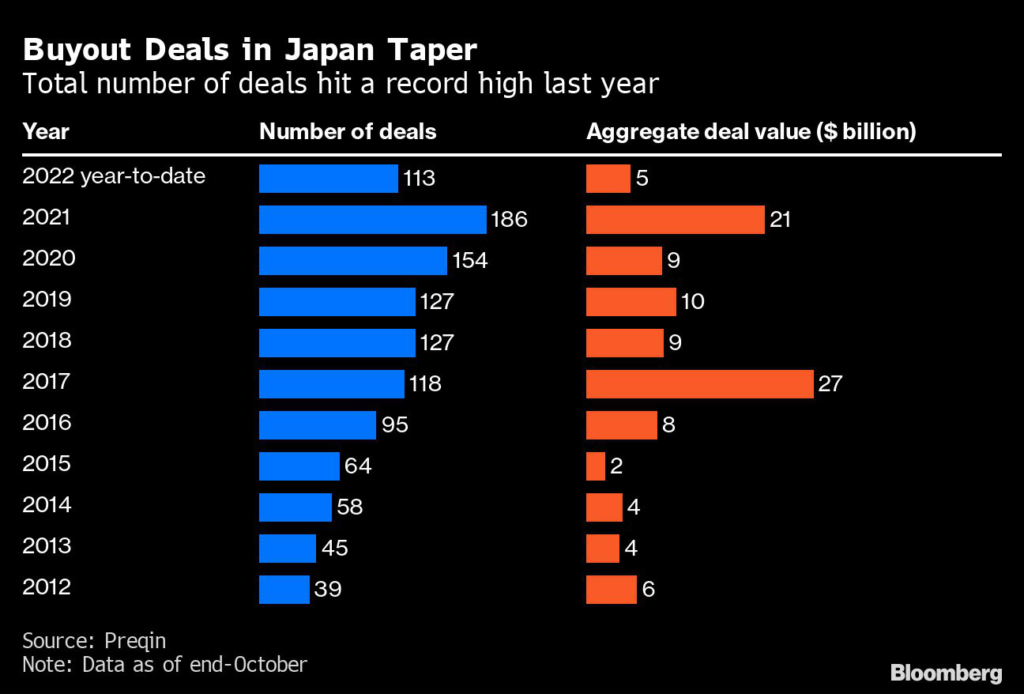
Japan hasn’t been immune to a slowdown in private equity this year, with the number of buyout deals falling to 113 this year through October, from 186 for all of 2021, Preqin figures show. The global industry is facing challenges including rising borrowing costs, difficulties raising cash from cautious investors, and struggles with exiting during a stock-market slump. 

But Bain is taking a long-term view on Japan, where it now has more than 50 employees. 

“We’ve expanded our team quite a bit,” Gross-Loh said. “Now that this has been validated that it works, you’re almost dealing with a huge backlog of opportunity that’s been there for a long time.” 

More stories like this are available on bloomberg.com

©2022 Bloomberg L.P.

GOP’s Rubio, Gallagher to Seek TikTok Ban as US Security Threat

(Bloomberg) — Two influential Republican lawmakers are introducing legislation to ban TikTok from use in the US, and criticized the Biden administration for insufficient action against the Chinese-owned social media platform.

“TikTok is a major threat to US national security,” Senator Marco Rubio and Representative Mike Gallagher wrote in a joint column in the Washington Post Thursday. “This is why we’re introducing legislation which would ban TikTok and other social media companies that are effectively controlled by the CCP from operating in the United States,” they wrote, referring to the Chinese Communist Party.

Rubio is a potential candidate to lead the Senate Intelligence Committee, should Republicans win control of that chamber. Gallagher is a member of the House Intelligence Committee.

“Congress needs to act against the TikTok threat before it’s too late,” the duo wrote.

President Joe Biden’s administration is currently weighing a proposal to allow TikTok to continue to operate in the US under its ownership of Chinese parent ByteDance Ltd. The arrangement would route all US user traffic through servers maintained by Oracle Corp., with the US-based database giant auditing the app’s algorithms.

Rubio and Gallagher argued that the administration’s plan would “dangerously compromise national security” and allow other Chinese companies to start data-centric operations in the US with minimal oversight.

While the opinion piece was only signed by the Republican pair, lawmakers from both parties have expressed concern about TikTok, including the Senate Intelligence Committee’s current chairman, Democrat Mark Warner. 

Read More: TikTok Deal Likely to Leave US Data Leaking to China

The Biden administration has made efforts in recent months to court TikTok influencers to get its message out on issues ranging from the Russian invasion of Ukraine to the midterm elections. The app is banned on some government devices — including those used by Pentagon personnel — but there are no blanket restrictions across the government on using the platform on personal devices.

Republican lawmakers are already rolling out their priorities for the new Congress even as the count continues from Tuesday’s midterm elections. Republicans are on track to gain a slim majority in the House, but a runoff election in Georgia next month may end up determining control of the Senate.

More stories like this are available on bloomberg.com

©2022 Bloomberg L.P.

Biden to Tap Boston Consulting’s Werfel as New IRS Commissioner

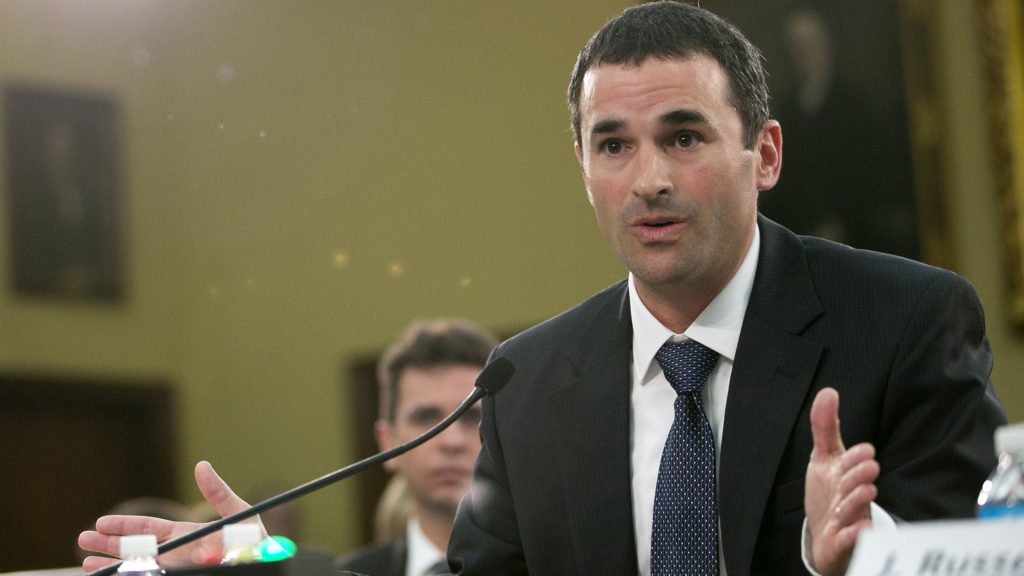
(Bloomberg) — President Joe Biden will nominate Danny Werfel as the next head of the Internal Revenue Service, the White House announced Thursday.

Werfel is a global leader at the Boston Consulting Group and former acting administrator of the IRS under President Barack Obama.

The goal is to confirm a new leader for the agency before Jan. 3, when Democrats may no longer control both chambers of Congress following Tuesday’s midterm elections. 

Treasury Secretary Janet Yellen hailed the pick. 

“Danny’s prior service under both Democratic and Republican administrations, his deep management experience, and his work directing significant transformation efforts, make him uniquely qualified to lead the agency at this critical juncture,” Yellen said in a statement, urging his swift confirmation. 

With Republicans inching toward securing a House majority, Werfel would take over at a time of increased congressional scrutiny for Biden’s administration. 

The leak of thousands of internal documents and tax returns to the non-profit newsroom ProPublica is one likely topic of Republican inquiries. 

The incoming commissioner also could potentially be the target of impeachment attempts from far-right House lawmakers, as was the case for former IRS Commissioner John Koskinen. 

House Republicans repeatedly, and unsuccessfully, tried to impeach Koskinen following reports that the IRS’s non-profit division was slow-walking requests for tax-exempt status from conservative groups.

The next commissioner also will have to contend with Republican claims that additional funding for the agency passed by Democrats will lead to a massive increase in the number of armed IRS agents and that enhanced enforcement would be aimed at middle-income taxpayers. 

Republicans could seek to cut — or even eliminate — funding for the agency. 

The IRS is getting an infusion of $80 billion from the Inflation Reduction Act that will be used to rebuild the agency’s enforcement capacity and upgrade its computer systems. 

Any new commissioner will oversee how that funding is deployed in the agency, which has been plagued by staffing shortages and technology challenges for roughly a decade.

“Americans interact with the IRS more than any other federal agency, and I’m confident he will effectively deploy the new resources approved by Congress to better serve American taxpayers and ensure the wealthiest Americans and most profitable corporations pay the taxes they owe,” Senate Finance Chairman Ron Wyden, whose panel has jurisdiction over the nomination, said in a statement. 

Wyden added, “I look forward to working with my colleagues to move his nomination as quickly as possible.”  

In addition to serving as the acting IRS administrator under Obama, Werfel spent 16 years at the Office of Management and Budget, as deputy controller and then as federal controller.

The IRS Commissioner job has historically been a difficult post to fill partially because of the special skills needed to lead an agency of roughly 80,000 employees that is responsible for collecting the revenue that funds the federal government.

–With assistance from Kaustuv Basu.

(Adds details, reaction starting in fourth paragraph)

More stories like this are available on bloomberg.com

©2022 Bloomberg L.P.

Twitter Buyout Loans Get Bid at 60 Cents as Banks Sound Out Investors

(Bloomberg) — Wall Street banks that lent $13 billion to help fund Elon Musk’s buyout of Twitter Inc. have been quietly sounding out hedge funds and other asset managers for their interest in a chunk of the buyout debt at deeply discounted prices.

Some funds have offered to take a piece of the loan package at a discount as low as 60 cents on the dollar, which would be among the steepest markdowns in a decade. The banks have so far deemed those bids unattractive, according to people with knowledge of the discussions who asked not to be identified because the talks were private.

The lukewarm investor reception shows just how big of an albatross the Twitter debt is becoming for a Morgan Stanley-led cohort that committed to finance Musk’s acquisition of the social-media firm back in April, before credit markets cratered. The seven banks are now saddled with risky loans that they never intended to keep on their books, and face an increasingly uphill battle to minimize losses.

Read more: Twitter’s Big Debt Bills Add Urgency to Musk’s Turnaround Plans

Discussions so far have centered around the $6.5 billion leveraged loan portion of the financing, the people said. Banks had seemed unwilling to sell for any price below 70 cents on the dollar, one of the people said. Even at that level, losses could run into the billions of dollars, Bloomberg calculations show.

The discussions were informal, and there’s no certainty that they will lead to an agreement, the people said. 

Barclays Plc, BNP Paribas SA, Mizuho Financial Group Inc. and Mitsubishi UFJ Financial Group Inc. declined to comment. Bank of America Corp., Morgan Stanley and Societe Generale SA did not respond to requests for comment.

Big Buyouts

Musk has acknowledged a “massive drop” in revenue while the social media company’s growth prospects look uncertain. That doesn’t bode well for Twitter’s annual interest burden, which is estimated to be $1.2 billion a year. The billionaire also alluded to loosening policies that restrict free speech, a risk that is spooking advertisers.

The Twitter financing package also comprises $6 billion of junk bonds split evenly between secured and unsecured notes and a $500 million loan called a revolving credit facility.

Junk bond and leveraged loan yields have surged since April, meaning that Wall Street banks risk losing money on big buyouts after having agreed to provide financing at lower yields than the market will accept now. Lenders have already sustained billions of dollars of writedowns and losses this year after central banks worldwide have started hiking rates to tame inflation. 

Moody’s Investors Service recently cut Twitter’s rating two notches to B1, or four steps into junk territory. The agency cited a substantial increase in debt and reduction of cash as well as governance for rating action. 

“Twitter’s governance risk is highly negative reflecting Moody’s expectation for aggressive financial policies and concentrated ownership by Elon Musk,” the ratings firm said.

–With assistance from Gowri Gurumurthy and Lisa Lee.

More stories like this are available on bloomberg.com

©2022 Bloomberg L.P.

Neutron Elon: Why Twitter’s Boss Is More Like Jack Welch Than You Think

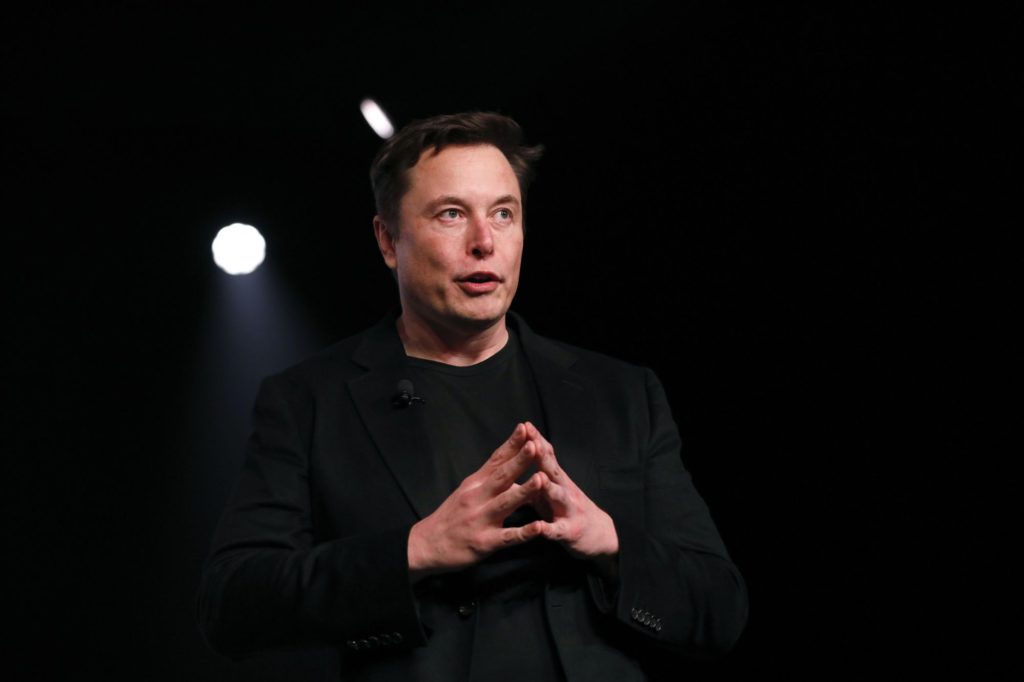
(Bloomberg) — Elon Musk’s recent moves to put his stamp on Twitter Inc. call to mind another cult figure of corporate America — Jack Welch.

Both men have achieved mythic status in capitalism, generating vast wealth and cultivating slavish devotion in the process. Welch, who helmed General Electric Co. from 1981 to 2001, became famous for massive layoffs, championing shareholders over staffers and for financial engineering that ultimately led to catastrophe after he left. The style earned him the nickname “Neutron Jack.” Musk has a Steve Jobs-ian ability to know what customers want before they do, which has made him the world’s richest man and, now, the head of the world’s virtual town square.

But Musk is as erratic as he is brilliant, micromanaging decisions just as Welch once did and spreading himself thin by running five companies at once, which could lead to his star dimming over time just as Welch’s has. Welch entitled his autobiography Jack: Straight From the Gut, but it’s Elon who’s shooting from the hip lately, whether it’s axing half of Twitter’s workforce along with its board, retweeting (then deleting) a conspiracy theory about Nancy Pelosi’s husband, or eliminating the company’s cherished remote-work policy.

“They’re both pretty ruthless in the sense that they’re not too worried about the effects on the broader community or on the employees,” said Peter Cappelli, director of the Center for Human Resources at the Wharton School of the University of Pennsylvania. “They’re thinking first that their job is to look after their money.”

Adds Kate Bezrukova, associate professor at the University of Buffalo’s School of Management: “It’s almost like a blast from the past.”

Twitter didn’t immediately respond to an email seeking comment.

Both are infamous micromanagers. Welch penned a 2016 LinkedIn post entitled “Why I Love Micromanaging and You Should Too,” where he counseled managers to butt in when they felt they had “unique expertise” or experience. “In such situations, you have to micromanage,” he said. “It’s your responsibility.” Musk, who in 2015 called himself a “nano-manager,” is known for ignoring the advice of experts and inserting himself into the tiniest operational and design details of his Tesla electric vehicles.

The two leaders have at times taken a less-than-rational approach to big mergers and acquisitions. Musk’s attempt to back out of buying Twitter, and his off-the-cuff tweets along the way, are well-documented. Back in 2000, GE tried to buy Honeywell International Inc. just to stymie an effort by rival United Technologies Corp. Welch even delayed his retirement by a year to see through the Honeywell deal, which fell apart when the European authorities blocked it, prompting a similar animosity toward regulators that Musk now harbors.

There are differences, of course. While Welch laid off thousands of workers, and let go many more through the company’s ruthless forced-rankings system, he knew what he wanted to achieve financially through the cuts, Cappelli said. Elon’s recent layoffs look haphazard by comparison, he said. And on Oct. 30, Musk mockingly tweeted out a missive he received from Twitter telling him to complete the company’s mandatory management-training course. Welch, who valued management training and development and built GE’s Crotonville leadership academy into a model that other companies followed, would never have done that.

Both leaders, though, will keep the writers of business-school case studies employed for years.

“Elon has become, like Jack, a touchpoint for discussion,” said Michael Useem, faculty director of the Wharton Leadership Center. “People know so much about their style and what they’ve achieved. But they both have shortcomings. Behind Welch’s facade, back then we should have asked, ‘Is there a there there?’ The Twitter acquisition is also reminding us that we need to be cautious of admiring people like Musk.”

–With assistance from Rick Clough.

More stories like this are available on bloomberg.com

©2022 Bloomberg L.P.

US to Brief Taiwan on Outcome of Biden-Xi Meeting, Sullivan Says

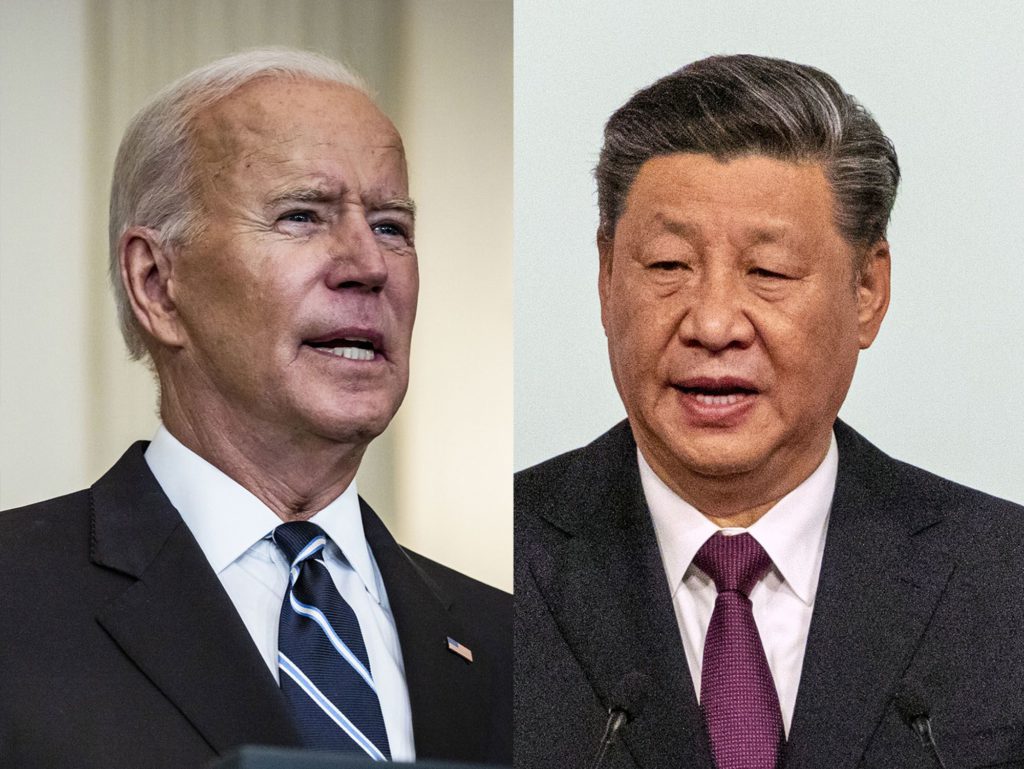
(Bloomberg) — President Joe Biden’s top national security aide said the US will brief Taiwanese officials on the president’s upcoming meeting with China’s Xi Jinping and expressed confidence that Taipei would feel secure about its support from the US.

“I’m confident that they will feel very secure and comfortable in the United States, his position when it comes to our support for peace and stability across the Taiwan Strait and our commitment to the Taiwan Relations Act, which does commit the United States to ensuring we’re providing the articles for Taiwan’s defense,” National Security Advisor Jake Sullivan told reporters Thursday.

Biden on Wednesday stopped short of committing to defending the island militarily, as he’s done several times in the past. When asked how Taiwan should interpret his comments, Sullivan said the president prefers not to preview what he tells foreign leaders before their meetings but instead “likes to actually go say it to them.”

Biden will seek to set a floor to prevent US-China ties from deteriorating further when he meets Xi on Nov. 14 in Bali, Indonesia, a senior Biden administration official said.

The official, who briefed reporters earlier Thursday, said the meeting’s main objective was for Biden and Xi to deepen their understanding of each other’s priorities and intentions — and to set so-called rules of the road.

That’s a goal that the White House has been seeking since the leaders’ first call in 2021. 

Taiwan is likely to loom large after Biden’s previous assurances to defend the island in the event of a Chinese attack, despite the US’s longstanding One China policy of maintaining “strategic ambiguity” about its commitment to intervene militarily. Biden said Wednesday he was “going to have that conversation” with Xi, adding that US policy toward Taiwan “has not changed at all.” 

The two leaders also will discuss the war in Ukraine, recent North Korean nuclear activity, efforts to curb climate change and other areas where the nations can work together, the official said. 

In the latest sign the White House isn’t expecting any tangible policy breakthroughs from Biden and Xi’s first face-to-face meeting, the official said the session during the Group of 20 summit in Indonesia was not being driven by a search for deliverables and that there would not be a joint statement from the event. 

Still, Sullivan said the leaders will direct their teams to work together on a range of issues with the goal of trying to bridge differences where possible. 

“That will include direction to the economic teams to address our concerns about Chinese economic practices, and to deal with some of the underlying differences of view and perspective on economic matters,” he said. “It will also involve giving direction to try to work on issues on which we do have common interest, whether it’s health, counter-narcotics, climate or other areas.”

Biden vowed Wednesday to make no “fundamental concessions” to Xi, reinforcing already low expectations for any major breakthrough in strained ties between the world’s two largest economies. 

Xi’s last meeting with a US leader came in June 2019, when he reached a truce with Donald Trump that led to a trade deal six months later — right before relations fell into a downward spiral as Covid-19 spread around the globe.

Biden said Wednesday that he expects to discuss contentious issues such as trade and Taiwan, which China has put under increased military pressure since US House Speaker Nancy Pelosi visited Taipei in August. His administration also imposed sweeping curbs on the sale of advanced chips to China, a move designed to maintain the US’s technological edge over Beijing.

Recent US measures to curb China’s access to semiconductors are not aimed more broadly at containing China, the official said, adding that it was a targeted approach to prevent Beijing from using high-end chips for advanced military applications.

The US and China have veered toward confrontation over the past few years even as they face greater calls to cooperate on trade and pressing issues like climate change, Covid-19 and Russia’s war in Ukraine. 

Both are increasingly suspicious of each other’s intentions: The National Security Strategy released by Biden last month cast China as trying to supplant the US as the world’s dominant power, while a defiant Xi declared that the “rejuvenation of the Chinese nation is now on an irreversible historical course.”

With relations between the two nations at their lowest point in decades, both presidents have put some domestic uncertainty behind them in recent weeks. 

Xi has secured a precedent-breaking third term as leader and stacked the Communist Party’s leadership with loyalists. Biden emerged stronger than expected from US midterm elections, telling reporters Wednesday that he plans to run for re-election in 2024, though he has yet to make a formal announcement. 

Sullivan touted the bipartisan support for the Biden team’s approach to China and said the president looks forward to working with the new Congress and both parties on the issue.

“He goes out on this trip feeling like the results from Tuesday show that the American people are sending him out onto the world stage and in a very strong position,” Sullivan said.

China so far hasn’t confirmed the Xi-Biden meeting, with Foreign Ministry spokesman Zhao Lijian saying Thursday that Beijing took the US proposal “seriously” and the two sides were in communication.

Beijing was “committed to realizing mutual respect, peaceful coexistence and win-win cooperation with the US,” he added.

–With assistance from Akayla Gardner, Jordan Fabian and Nancy Cook.

More stories like this are available on bloomberg.com

©2022 Bloomberg L.P.

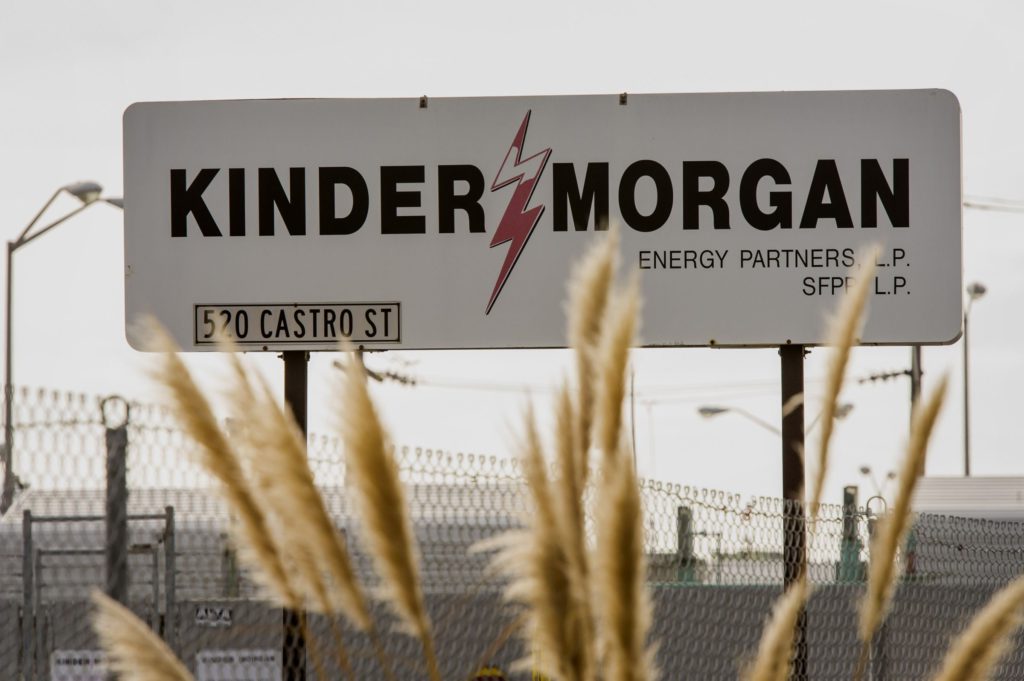
Kinder Morgan Fire Likely Led to Methane Cloud Seen From Space

(Bloomberg) — A methane cloud spotted over Alabama last month appears to have been caused by a natural-gas release following a fire at a Kinder Morgan Inc. compressor station, the pipeline giant said.

The flash fire was confined to a small area of its Gallion Compressor Station, according to Kinder Morgan spokesman Katherine Hill. Workers “followed standard safety protocols by performing an emergency shutdown of the compressor station, resulting in a controlled release of natural gas from the facility to help extinguish the fire.”

While deliberate releases during emergencies can limit damage and loss of life, the Kinder Morgan incident still spewed about 38,400 thousand cubic feet of gas — and thus methane — over a period of about 20 minutes. It underscores the tradeoffs posed by fossil fuels between safety and climate: the release could prove to have the same climate warming impact over a 20-year period as the annual emissions from about 11,700 US cars.

Methane is the primary component of natural gas and has more than 80 times the warming power of carbon dioxide during its first two decades in the atmosphere. Since the industrial revolution, methane has accounted for about 30% of the increase in global temperatures, according to the IEA. The energy industry is responsible for about 40% of the world’s methane emissions generated from human activity.

The Gallion fire occurred Oct. 20 during the commissioning of a so-called automation upgrade project, Kinder Morgan said. The cause is under investigation. Gallion is on the Southern Natural Gas pipeline system.

The European Space Agency’s Sentinel-5P satellite spotted the plume and the data was analyzed by Kayrros SAS. Satellite observations, aerial surveys and other measurement campaigns have shown that malfunctions and emergencies — like the fire at Kinder Morgan’s compressor station — can significantly increase the climate impact of operations.

More stories like this are available on bloomberg.com

©2022 Bloomberg L.P.
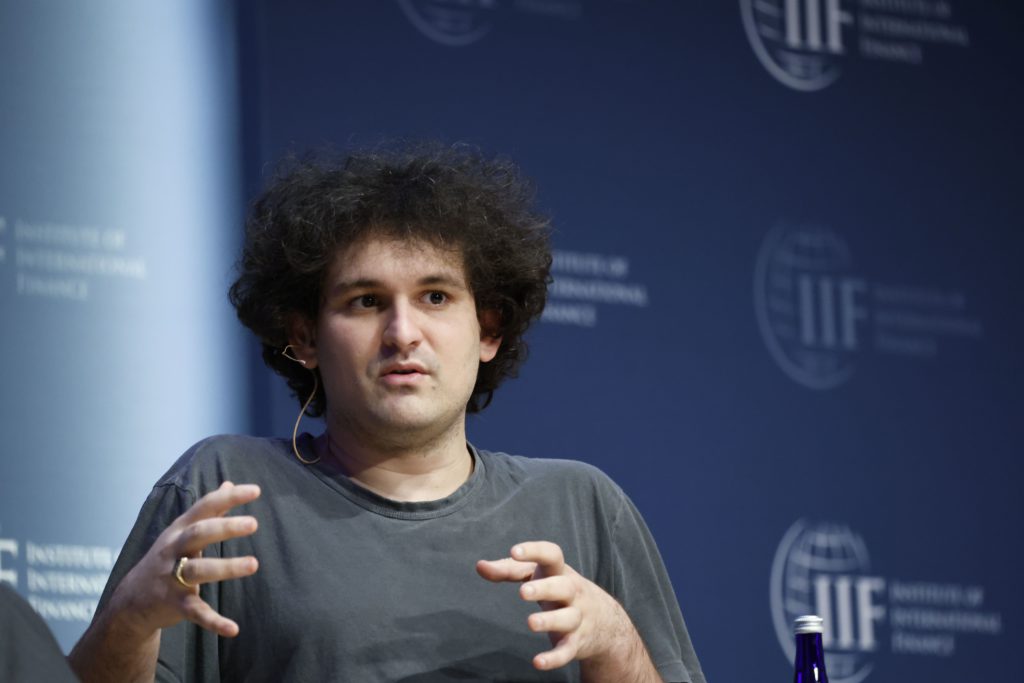
Inside FTX.US, Employees Are Trying to Sell Assets With Sam Bankman-Fried Away

(Bloomberg) — There’s a scramble to sell assets inside FTX.US, the part of Sam Bankman-Fried’s crypto empire where he insisted on Thursday that “USERS ARE FINE!”

Employees of the US-based crypto exchange are in talks about selling parts of the business, including some assets that Bankman-Fried amassed on a sweeping acquisition tear across the industry, according to two people with direct knowledge of the matter, who requested anonymity because the talks were private. 

Those employees, in some cases without Bankman-Fried’s participation, are pitching assets including stock-clearing platform Embed and naming rights to an arena in Miami, one of the people said.

A representative for FTX.US declined to comment. 

Bankman-Fried’s empire descended into chaos this week after a liquidity crunch at FTX.com, an international crypto exchange affiliated with FTX.US. The 30-year-old is the chief executive of both firms.

Though FTX.com and FTX.US are separate entities, investors are becoming increasingly anxious over the blurred lines among Bankman-Fried’s business interests. 

FTX.US on Thursday said that customers should close out any positions they want to and that trading may be halted in a few days.

In a series of apologetic tweets earlier Thursday that detailed his missteps and failure to understand certain risks, Bankman-Fried said FTX.US “was not financially impacted” by the events of the past few days.

“It’s 100% liquid. Every user could fully withdraw,” he said in a tweet. “Updates on its future coming.”

With FTX.com facing a shortfall of as much as $8 billion, Bankman-Fried has been attempting to raise rescue financing, claiming to need $4 billion to remain solvent. A bailout from rival crypto exchange Binance fell apart on Wednesday. Bankman-Fried said on Thursday that Alameda Research, the secretive proprietary trading firm he started before launching FTX, is winding down amid the fallout.

Any asset sales could be complicated by reports that the company might wind up in bankruptcy. Potential buyers sometimes balk at making deals with companies in deep distress because creditors can ask a judge to void recent sales, arguing they weren’t in the best interest of everyone with money at stake.

While FTX’s unraveling could make for a splashy restructuring case, some bankers are hesitant to get involved until they get a clearer sense of the company’s business dealings, said advisers with experience in crypto reorganizations.

As for Bankman-Fried’s personal net worth: Following FTX.US’s announcement about a potential trading halt, its value was reduced to $1 by the Bloomberg Billionaires Index. Bankman-Fried owns about 70% of the business, according to the index. It had been valued at $8 billion in a January fundraising round.

A 7.6% stake in Robinhood Markets Inc. was also removed from his wealth calculation, after Reuters reported that it was owned through Alameda and may have been used as collateral for loans.

As a result, Bankman-Fried now has no material assets tracked by the Bloomberg wealth index. At the start of this week, his fortune was $15.6 billion.

–With assistance from Jeremy Hill, Tom Maloney and Rachel Butt.

More stories like this are available on bloomberg.com

©2022 Bloomberg L.P.
New Computer Chips May Help Fight Global Warming and Be Super-Fast

(Bloomberg) — Digital activity uses a huge amount of electricity. And the semiconductors that make all that clicking possible are nearing the limit of efficiency, constrained by inescapable laws of science. Now researchers are racing to perfect new kinds of chips that use much less power and handle much more data.On this episode of The Spark, we explain how the next generation of technology at the very heart of modern society could fight global warming while turbocharging the flow of data on all the electronics we use. 

More stories like this are available on bloomberg.com

©2022 Bloomberg L.P.

Close Bitnami banner
Bitnami