Bloomberg

Spyware Tied to China Targets Apps Used by Uyghurs, Cybersecurity Firm Says

(Bloomberg) — Nearly a third of Uyghur-language Android apps shared on social media platforms or downloaded from third-party app stores since July are infected with spyware, according to research provided exclusively to Bloomberg News.

The apps are predominately infected by two new malware strains that secretly enable hackers to access and transmit private photos, messages and contacts, according to researchers at the San Francisco-based cybersecurity firm Lookout Inc. The company is scheduled to publish its findings later on Thursday.

Different types of malware have targeted Uyghurs with cyber-espionage for about a decade, but the new campaigns are much broader in scope and sophistication, said Kristina Balaam, a staff threat intelligence researcher at Lookout. The new malware is hidden in more apps than before and harder to detect, she said. 

The attackers, Balaam said, are “very, very active.” 

“People are still being actively targeted and compromised,” she said.

Because Google Play is blocked to Android users in China, many users download apps from “sketchy, unofficial app stores” or from links that circulate on platforms such as Telegram that turn out to be infected, she said. Lookout’s research found that Uyghurs living abroad — who often delete popular Chinese apps such as TikTok and WeChat to avoid surveillance — may also have had their phones infected by downloading apps from unofficial platforms or by opening malicious links. Some devices in Turkey were compromised, Balaam said.

Lookout’s researchers believe the attackers are Chinese because some of the infrastructure overlaps with past Uyghur surveillance campaigns tied to China. In addition, Mandarin language was discovered on one of the servers used in the attacks, she said.

Liu Pengyu, spokesperson at the Chinese Embassy in Washington, said “we oppose wild guesses and malicious slurs against China,” adding the country opposes “all forms of cyber attacks.” 

Many of the targeted apps offer sought-after services such as Uyghur-language dictionaries, translation and keyboards that enable users to type in Uyghur script. Other infected apps available on Uyghur-language social media chats and download stores offer battery managers, video players, radio, GPS and religious texts, all of which appear to be working normally but are in fact spying on the owner. Common messaging apps such as Telegram have also been compromised in cases where the app store itself is infected, Balaam said.

A representative for Telegram didn’t respond to a message seeking comment. 

Lookout researchers named the newest of the malware families BadBazaar. It was first identified in late 2021, but samples date back to 2018 and it is still found now, including this month in a popular prayer app named Quran Majeed, she said. The other malware family, Moonshine, was first disclosed in 2019 by the University of Toronto’s Citizen Lab as being used in targeted phishing attacks of Tibetans sent over WhatsApp. 

By tracking three different command-and-control servers associated with Moonshine, Balaam said researchers confirmed at least 637 devices had installed the poisoned apps. Similar figures weren’t available for BadBazaar because researchers haven’t been able to access the infrastructure associated with it, she said.

The company shared its findings with Alphabet Inc.’s Google, Apple Inc. and others in advance of publication, and also sent take-down requests to the servers that host malicious infrastructure, she said. Balaam said deleting the infected apps will remove the malware. She also recommends only downloading apps from Apple or Google’s stores.

Representatives for Apple didn’t respond to a request for comment. A spokesperson for Google said apps flagged by Lookout were never published and were rejected as part of a review process.

Beijing has repeatedly denied accusations of maltreatment of Uyghurs — a large, predominantly Muslim minority group — and defended its policy as countering separatism. In June, the US condemned China’s policies toward religious minorities and repeated accusations that China had committed “genocide and crimes against humanity” against ethnic Uyghur Muslims and other minorities.

While surveillance is common inside China, some Uyghurs living elsewhere told Bloomberg they were taken aback by the potential breadth of the alleged spyware campaign. 

One of them, Nursiman Abdureshid, a Uyghur living in Istanbul, said she lost contact with her family in China in 2017 and later learned they’d been arrested. She said she was shocked by the scope of Lookout’s findings. (She doesn’t believe she’s been infected by the malware identified by Lookout because she doesn’t use an Android phone, nor does she download Uyghur-language apps).

But Abdureshid added that she is already convinced the Chinese government is watching her and has decided to get on with her life anyway.

“Before I was so afraid I didn’t even go to Uyghur restaurants. I didn’t do anything and they still destroyed my life,” she said, referring to what Chinese officials told her was the arrest of her family members. “So now I feel like I can download anything, go to restaurants and attend protests. I’ve been living with this pain for more than five years. We don’t have any choice.”

More stories like this are available on bloomberg.com

©2022 Bloomberg L.P.

Prosus Gives Up $403 Million Stake in Russia’s VK Social Network

(Bloomberg) — Prosus NV gave up its stake in Russia’s largest social network for nothing, walking away from a company run by an executive under US sanctions. 

VK sold the shares acquired from the Dutch e-commerce company to its management team at market price in a deal valued at 24.8 billion rubles ($403 million), VK said in a statement Thursday.

Prosus, which owned a 27% stake in VK, said in March it would write off $769 million following the Russian invasion of Ukraine. Trading of VK’s shares in London was suspended and its Chief Executive Officer Vladimir Kiriyenko was sanctioned by the US Treasury. He’s the son of one of Russian President Vladimir Putin’s top aides, Sergei Kiriyenko, and VK is controlled by companies affiliated with Gazprom PJSC, the state-owned gas giant. 

Prosus sold its largest Russian asset, the classified app Avito, for 151 billion rubles last month. 

VK has more than 49 million daily users in Russia and has expanded its dominance in the market as the government targeted foreign social media platforms during an internet crackdown.

Read more: Putin Aide Leads Talks on Fate of Yandex, Russia’s Top Internet Company

More stories like this are available on bloomberg.com

©2022 Bloomberg L.P.

Musk Starts Assembling New Cadre of Leaders Inside Twitter

(Bloomberg) — Elon Musk, who acquired Twitter Inc. two weeks ago and immediately pushed out almost all of its top executives, has started to assemble a new group of senior leaders atop the social network.

The company started reshuffling teams this week following a massive round of job cuts that eliminated roughly half of its 7,000-plus workers on Nov. 4. Among managers who remained after the dust settled, a few have begun to emerge as stewards of some of Twitter’s most important internal divisions as Musk seeks to rapidly overhaul the struggling business.

The rise of new leadership under Musk has provided at least a glimmer of internal stability after a two-week stretch of chaos. The most visible among the new guard has been Yoel Roth, a Twitter veteran who reports to Musk and is now running all of the company’s Trust and Safety efforts — some of which previously fell under other executives, according to people familiar with the matter. That includes content policies, election efforts and plans to fight spam and fake accounts.

Roth has been sending tweet threads regularly to share details about Twitter’s efforts to fight election misinformation — an area of concern to many critics as the company’s changes played out on the eve of the US midterm vote. Roth has also been attempting to explain the site’s plans around account verification, which have been evolving at a dizzying pace. Musk has been retweeting and replying to Roth’s posts, and encouraging others to read them — a signal to followers that Roth is someone the billionaire trusts to communicate the company’s message.

On the product side, Behnam Rezaei, listed as a senior director of engineering on his LinkedIn, is now overseeing all of engineering and product development at Twitter, reporting directly to Musk, according to multiple people with knowledge of the matter who asked not to be identified because they’re not authorized to speak on behalf of the company. Twitter previously separated its product groups into three organizations: Bluebird, the consumer product group; Goldbird, the revenue-generating product group; and Redbird, an engineering and infrastructure product group. These divisions no longer exist, according to several of the people.

Twitter’s marketing and sales divisions are now run by Robin Wheeler, the people said. Wheeler, a sales vice president also reporting to Musk, has been leading the social network’s efforts to soothe advertiser concerns about its brand and content policies. On Wednesday, she hosted a town hall-style meeting on Twitter Spaces with Musk. 

The session was intended for advertisers, but reached an audience of well over 100,000 listeners. Last week, Wheeler introduced Musk during a separate private call with a group of marketing advisers and top chief marketing officers at other companies, people familiar with the matter said.

Wheeler showed backbone during the question-and-answer session of the Twitter Spaces, and didn’t shy away from asking Musk hard questions. She said she was representing the concerns of advertisers and inquired about such thorny issues as hate speech, brand safety and how the company plans to address content moderation.

Read more: Musk Tries to Soothe Concerns of Twitter Advertisers

The company’s new structure is still being worked out, and it’s possible — even likely — things will continue to change, people familiar said. 

Musk emailed his workers for the first time late Wednesday to prepare them for “difficult times ahead” and ban remote work unless he personally approved it.

Musk, who named himself “Chief Twit” upon his acquisition, continues to receive some advice and counsel from a cadre of close friends and former colleagues, people with knowledge of the matter said. That includes his former PayPal colleague David Sacks; friend and investor Jason Calacanis; Andreessen Horowitz partner Sriram Krishnan; investor and SpaceX board member Antonio Gracias; and Alex Spiro, Musk’s lawyer.

This group, which was most active in the immediate aftermath of the deal closing, has helped advise Musk on everything from product ideas to layoffs to Twitter’s new leadership, the people said. For example, Rezaei and other engineers who are suddenly stepping into senior roles at Twitter worked closely with Krishnan when he was on staff at the company a few years ago.

Sacks, for his part, recently sought to suggest his role at Twitter isn’t formal, tweeting, “I have no official role. I’m not ‘in charge’ of anything. I’m doing what investors try to do in Silicon Valley, which is be helpful at the margins.”

Twitter’s legal division is also unsettled, and it’s not clear who will ultimately take over as general counsel. Spiro, Musk’s lawyer and a key player in his court battle to walk away from the $44 billion deal, has been assisting the legal team in the meantime, people familiar said.

Even if things even out after the frenzy of the initial transition, Twitter is still far from stable. Musk, who also helms Tesla Inc. and SpaceX, is expected to eventually hire a chief executive officer, or someone with a similar title, to help run the social media company’s day-to-day operations.

Until then, Musk seems to be quickly making most decisions himself, and his Twitter feed remains the central megaphone for communicating them. 

(Updates with reference to Musk’s email to staff in 10th paragraph.)

More stories like this are available on bloomberg.com

©2022 Bloomberg L.P.

Holiday Discounts on Electronics Drive Drop in US Online Prices

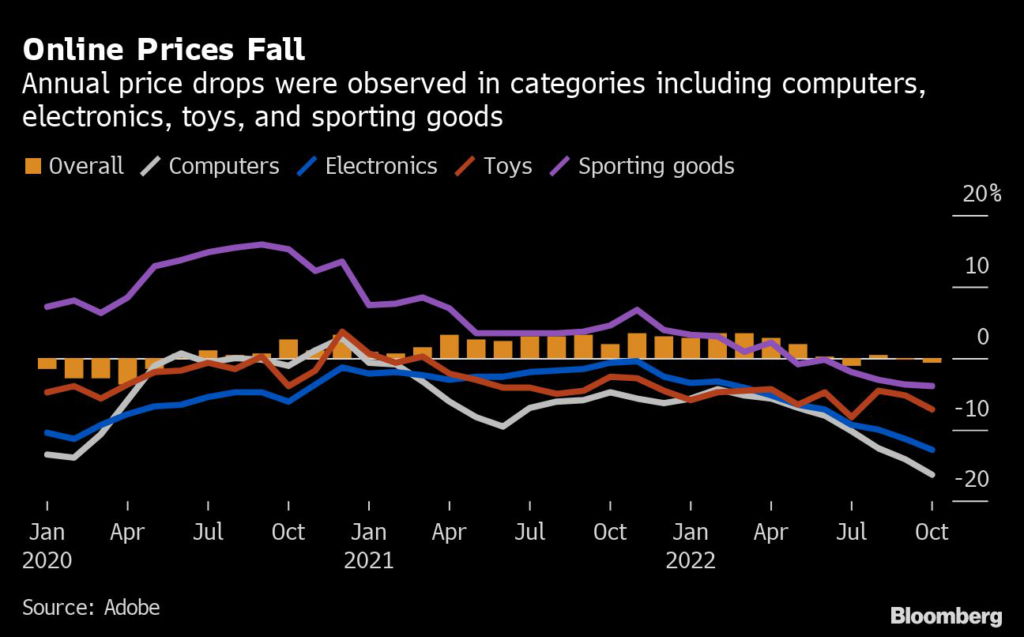
(Bloomberg) — Prices of goods sold online in the US declined for the second consecutive month in October, led by a record fall in the prices of electronics as early holiday discounts kicked in, according to Adobe Inc.

October online prices fell 0.7% from a year earlier, Adobe said Thursday, following a 0.2% slide the previous month.

Online prices of electronics dropped 12.9%, the largest decline of any of the 18 categories tracked by Adobe in records since 2014. Computers, toys and sporting goods also slid. 

Grocery prices rose for a 33rd consecutive month, gaining 14% from a year ago, a slight deceleration from 14.3% in September.

In total, 10 categories in Adobe’s Digital Price Index saw gains, including products for pets and for home improvement. The index rose 0.3% month-on-month.

The Federal Reserve Bank of Cleveland “nowcast” expects that the October consumer price index, scheduled to be released on Thursday, rose 8.1% from a year earlier. 

More stories like this are available on bloomberg.com

©2022 Bloomberg L.P.

US Futures Rise as CPI Bets Keep Bonds on Edge: Markets Wrap

(Bloomberg) — US stock-index futures rose, while Treasuries fluctuated, as investors remained on the edge before a report projected to show inflation in the world’s largest economy moderated for a fourth successive month.

December contracts on the S&P 500 and Nasdaq 100 added at least 0.2% each, a day after the underlying indexes tumbled to one-week lows amid a blurry midterms verdict and crypto-industry turmoil. Chinese technology shares rose in New York premarket session. Treasuries’ yield curves bear-flattened. The dollar advanced, while oil extended its slide to a fourth day.

Investors are looking for firmer signs of a peak in US inflation that could herald a slowdown in the pace and severity of the Federal Reserve’s monetary tightening. While economists forecast year-on-year headline inflation fell to 7.9% for October, traders remain cautious given the reading has repeatedly overshot projections this year. According to a scenario analysis by JPMorgan Chase & Co., the S&P 500 could rally more than 5% if the reading falls to 7.6% or below, but a higher-than-estimated figure would spark a 6% slump.

“The consumer price index is the center of attention,” Stephen Innes, managing partner at SPI Asset Management, wrote in a note. “An upside surprise could be temporarily painful given the current risk-off momentum. Investors are still incredibly jittery due to the crypto train wreck, US election bets that failed to materialize, and the seemingly never-ending Covid malaise in China.”


Two-year Treasuries, the most sensitive to monetary policy, fell as the yield added 2 basis points. The 10-year rate was little changed.

In the US midterms, Republicans headed for control of the House by smaller margins than forecast while the race for Senate continued. That belied investors’ expectation of a GOP wave and a consequent Congress gridlock seen as positive for risk sentiment. Both the S&P 500 and Nasdaq 100 tumbled more than 2% on Wednesday.

The disappointment echoed in Asia and Europe Thursday. A gauge of Chinese technology stocks in Hong Kong lost more than 3%, with heavyweights Tencent Holdings Ltd. and Alibaba Group Holding Ltd. sliding ahead of their earnings next week. Mainland Chinese stocks also declined as the nation tightened Covid restrictions on some of its biggest cities, killing of expectations for a relaxation in its pandemic policy. The Stoxx 600 index was dragged by real estate, retail and commodity sectors.

China’s Covid struggles also weighed on the demand outlook for oil, sending West Texas Intermediate crude futures slipping toward the $85-per-barrel mark.

This week’s brutal selloff in cryptocurrencies eased even though sentiment remained impaired as FTX.com stared at the possibility of a bankruptcy if a $8 billion rescue doesn’t come through. Bitcoin traded around $16,300.

In early New York trading, Pinduoduo Inc. led Chinese shares higher after the nation’s leaders at a Politburo Standing Committee meeting chaired by President Xi Jinping called for more precise and targeted Covid control measures.

Gen Digital Inc. rose 6.1% after posting second-quarter earnings per share in line with expectations. Depositary shares of AstraZeneca Plc climbed 3.9% as the drugmaker raised guidance after posting better-that-forecast quarterly results.

Key events this week:

  • US CPI, US initial jobless claims, Thursday
  • Fed officials Lorie Logan, Esther George, Loretta Mester speak at events, Thursday
  • US University of Michigan consumer sentiment, Friday

Some of the main moves in markets:

Stocks

  • Futures on the S&P 500 rose 0.2% as of 7:44 a.m. New York time
  • Futures on the Nasdaq 100 rose 0.3%
  • Futures on the Dow Jones Industrial Average were little changed
  • The Stoxx Europe 600 rose 0.2%
  • The MSCI World index fell 0.4%

Currencies

  • The Bloomberg Dollar Spot Index rose 0.2%
  • The euro fell 0.6% to $0.9946
  • The British pound rose 0.4% to $1.1400
  • The Japanese yen was little changed at 146.40 per dollar

Cryptocurrencies

  • Bitcoin rose 3.8% to $16,329.01
  • Ether rose 7.9% to $1,193.76

Bonds

  • The yield on 10-year Treasuries was little changed at 4.09%
  • Germany’s 10-year yield was little changed at 2.17%
  • Britain’s 10-year yield was little changed at 3.45%

Commodities

  • West Texas Intermediate crude fell 0.5% to $85.42 a barrel
  • Gold futures fell 0.1% to $1,711.20 an ounce

–With assistance from Richard Henderson.

More stories like this are available on bloomberg.com

©2022 Bloomberg L.P.

Brighton Park’s New Fund Exceeds Target With $1.8 Billion Raise

(Bloomberg) — Brighton Park Capital, the growth-equity firm led by General Atlantic alum Mark Dzialga, has closed its second fund and it’s oversubscribed with $1.8 billion in capital commitments, according to a statement reviewed by Bloomberg News.

Similar to its predecessor fund, Brighton Park Capital Fund II LP will invest in early stage software, health care and technology-enabled services industries. The fund, which had targeted $1.5 billion, received financial support from existing and new investors including endowments and foundations, public and corporate pension funds, family offices and financial institutions.

“Brighton Park navigated the software meltdown that has been experienced in the past year by avoiding investing in large loss-making hypergrowth companies and shunning the unicorn chasing pursued by so many growth and venture capital firms,” Dzialga said in an email.

The Greenwich, Connecticut-based firm manages more than $3.5 billion in assets, according to a person familiar with that matter who asked not to be identified because it was private.

This year, Brighton Park has invested in TheMathCompany, Darktrace and Coralogix, according to the firm’s website. It also announced a follow-on investment in AppViewX.

“Our strategy is to invest in entrepreneurial growth companies, where founders and CEOs want the support of former operators who have the practical experience, relationships and scar tissue to help them make better decisions,” Dzialga said.

More stories like this are available on bloomberg.com

©2022 Bloomberg L.P.

Ukraine Latest: UK Has Frozen Over £18 Billion in Russian Assets

(Bloomberg) — More than 100,000 Russians and probably the same number of Ukrainian forces have been killed or wounded in the war, General Mark Milley, chairman of the US Joint Chiefs of Staff, was cited by the Associated Press as saying. 

Russia has ordered its troops to withdraw from Kherson, the first major urban center seized in its invasion. Milley said Moscow had amassed 20,000 to 30,000 troops in the southern city, and a full retreat could take several weeks. He added that a potential stalemate in fighting over the winter could provide a “window of opportunity” for negotiations. 

The UK, meanwhile, said it has frozen over £18 billion ($20.5 billion) in Russian assets, some £6 billion more than any other sanctioned regime, according to the Office of Financial Sanctions Implementation.

(See RSAN on the Bloomberg Terminal for the Russian Sanctions Dashboard.)

Key Developments

  • Russia Embassy in Indonesia Confirms Putin Won’t Attend G-20
  • Hungary Threatens to Block EU Joint Funds for Ukraine Aid
  • Russia to Exit Kherson, Its First Big City Seized in Ukraine 
  • Russian Inflation Dips Again as Risks Mount From Putin’s Call-Up
  • Top Putin Aide Visits Iran as Weapons Bolster Russia’s War 

On the Ground

Russian troops shelled the Nikopol district in the Dnipropetrovsk region overnight, local authorities said on Telegram. Over the past day forces also struck areas in the Donetsk, Luhansk, Zaporizhzhia, Mykolaiv, Sumy and Kherson regions, Ukraine’s General Staff said in a morning update. Ukrainian troops repelled attacks near 12 settlements in Donbas and shot down 8 Russian drones, according to the statement. Ukrainian forces have moved as deep as 36.5 kilometers (23 miles) into Russia’s defense lines in Kherson region since Oct. 1, Valeriy Zaluzhnyi, commander-in-chief of Ukraine’s armed forces said on Telegram. They have liberated 1,381 square kilometers in the area, including 41 towns and villages, he said.

(All times CET)

Ukraine Says Russia-Backed Cyber Attacks Are Increasing (12:45 p.m.)

Cyber attacks against state information resources and critical infrastructure have been rising since the start of Russia’s war, with incidents having almost doubled in the third quarter, Ukraine’s State Service of Special Communication and Information Protection said on its website. 

The “absolute majority of cyber incidents are linked to hacker groups financed by the Russian government,” according to the statement. “Hackers resort to cyber espionage, disruption of state information services and even destruction of information systems by so called program wipers.”.

European Commission Unveils Crisis Response Proposal (12:40 p.m.)

The European Commission, the bloc’s executive body, proposed plans to help European armed forces more speedily respond to a crisis by improving transport and other infrastructure within the EU. 

The proposal aims to ensure the EU’s bridges, trains and roads can support heavy duty vehicles and military trucks, allowing them to move seamlessly across the bloc’s countries. It also aims to design a fuel supply chain, ensuring forces have fuel as they travel. 

“When crisis hits, we need to make sure that member states’ military can move quickly,” Executive Vice President Margrethe Vestager told reporters. 

Estonian Premier Says Russia Losing Momentum in Ukraine (12:30 p.m.)

Kaja Kallas said Russia should not be given a chance to “pause” and regain the initiative after suffering setbacks in the fighting in Ukraine.

“Maybe I am overly optimistic, but I would like to hope that the moment is near where Russia sees that there is no point in continuing this war,” Kallas said at a news conference in Tallinn on Thursday.

Kallas praised the arrival in Ukraine of air defense weapons from Norway, Spain and the US in recent days.

Baerbock Warns Hungary Over Ukraine Funds (11:30 a.m.)

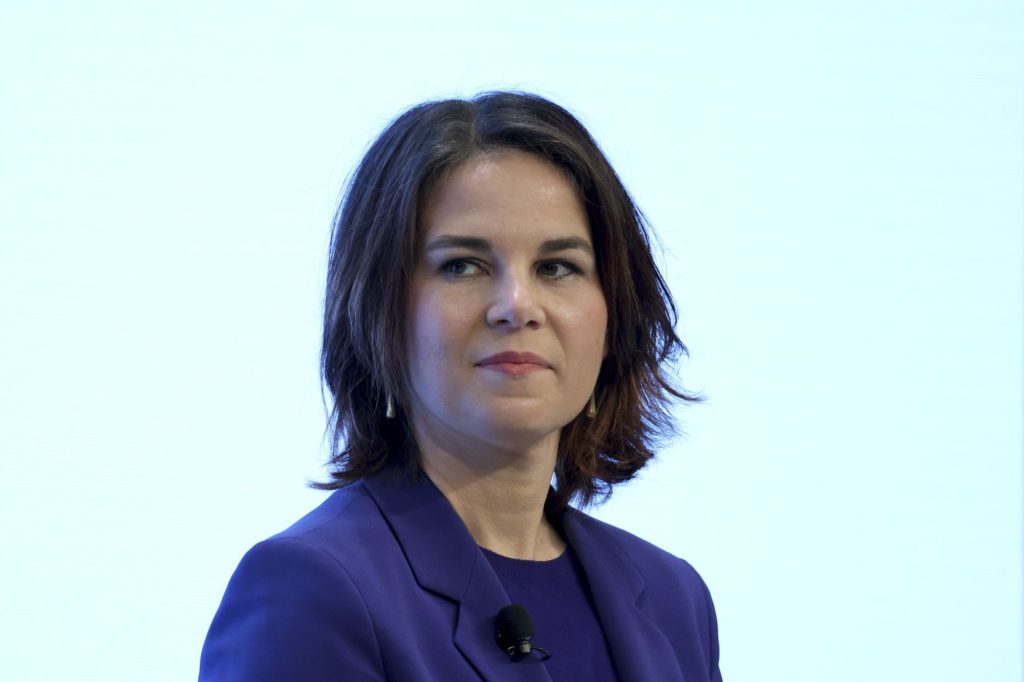
German Foreign Minister Annalena Baerbock cautioned Hungary over its threat to block EU financial aid for Ukraine amid a dispute with the bloc over rule of law and Budapest’s access to recovery funds. 

Russia’s “deliberate destruction” of energy infrastructure in Ukraine is putting lives at risk this winter and EU funds will help prevent more deaths, Baerbock said at a news conference in Berlin, when asked about Hungary’s position.

“This is not some run-of-the-mill European issue where you can haggle over money,” Baerbock said. “This European financial support saves lives every day and so I believe and expect that everyone is aware, and should be aware, of that in these such difficult times.”

UK Has Frozen More Than £18 Billion in Russian Assets (10:55 a.m.) 

The UK has frozen £18.4 billion ($20.9 billion) in Russian assets since sanctions were imposed on the country following its invasion of Ukraine.

The Office of Financial Sanctions Implementation said Thursday that represents about £6 billion more than held against all other sanctioned regimes. In conjunction with its allies, the UK has penalized more than 1,200 people and 120 businesses, it said in its annual review.

Amnesty International Accuses Russia of Crimes Against Humanity (8:52 a.m.) 

Amnesty International accused Russian forces of deporting Ukrainian civilians from occupied areas, according to a report. The actions amount to war crimes and crimes against humanity, the group said.

Amnesty said children were separated from their families and people were held in overcrowded conditions, denied food or water, tortured and threatened with execution, according to the report. 

Milley Says 100,000 Russians Dead or Wounded (7:43 a.m.)

Milley, speaking at the Economic Club of New York on Wednesday night, put the toll of Russian forces killed or injured since the war began in February at “well over 100,000,” according to the Associated Press. He added that about the same number of Ukrainian forces have been killed or wounded.

He said that the pending Russian retreat from Kherson and a potential standoff over the winter could provide a chance for negotiations to end the war, according to the AP report.  

100,000 Russian Troops Killed Or Injured in Ukraine, US Says

More stories like this are available on bloomberg.com

©2022 Bloomberg L.P.

Target Bets on Bigger Stores to Fulfill More Online Orders

(Bloomberg) — Target Corp. is mapping out its next generation of stores near Houston, and this much is clear: the retail giant thinks bigger is better.

The new store in Katy, Texas, covers almost 150,000 square feet, compared with the company average of about 130,000. The backroom space devoted to handling online orders for same-day pickup is five times as large as at stores of a similar size.

Target is betting that the new blueprint will boost its strategy of using stores as fulfillment hubs for digital orders — an approach that gained ground during the pandemic. Next year, the retailer will incorporate updated design elements into about 30 new locations of all sizes and half its planned 200 remodels and then expand their use in 2024.

The bigger footprint “is what we think the next generation should be to deliver for both the store guest and our digital business,” Chief Operating Officer John Mulligan said in an interview. “Those two things came together, and we ended up with a store design that’s a little bit bigger.”

The new concept, which opens Thursday, is roomy enough to fit an expanded food section and outposts for partners such as Ulta Beauty Inc. and Walt Disney Co. It also adds large windows, plants and walls of reclaimed wood. The righthand entrance is designed to cater to customers looking to stay and shop for a while. It funnels shoppers by a Starbucks counter illuminated by natural light.

“This is by far the most windows and light we’ve brought in,” said John Conlin, Target’s senior vice president of properties.

An upgraded employee breakroom isn’t far from the staging area for same-day orders and the merchandise earmarked for replenishing the sales floor. Target’s stores already fulfill more than 95% of the company’s online orders. Handling both businesses smoothly is key to its growth strategy.

“A large store allows us to really stand up stores as hubs,” Conlin said. “It allows us to do a lot more.”

More stories like this are available on bloomberg.com

©2022 Bloomberg L.P.

Addicts Signed Up for Telehealth Giant. Deaths, Overdoses Followed

(Bloomberg) — Greg Grant knew he was in danger. Just fired from a freelance gig, the 51-year-old Texan responded by drinking heavily, beginning in the morning and continuing for hours. By the time he reached out to his mental healthcare provider, he was a dozen drinks in.

“I need help,” he wrote in a chat log set up by Cerebral Inc., a startup that offers online only psychiatric services and was treating Grant for anxiety and depression. “Alcohol poison.”

On the other side of that July 2021 chat, employees wondered how dire his situation really was. “I know 12 drinks is a lot, but I am trying to gauge if he needs immediate assistance or not,” a member of the company’s crisis team wrote to colleagues who were not licensed clinicians. No medical professional weighed in as team members opted to do what they’d done in dozens of other urgent situations: call the cops. Grant was taken by ambulance to an emergency room.

It was only afterward that a nurse practitioner in charge of Grant’s treatment informed coworkers that he had been prescribed medications that carried “risk of negative interactions” with alcohol. Mental health advocates say one of the drugs, an antidepressant, might increase suicidal thoughts in patients who drink. The nurse wrote: “Avoiding drinking or other illicit substance is always mentioned during the session and will be on [patient]’s risk.”

In interviews, Grant’s family members and a psychiatrist who treated him previously said he suffered from alcoholism, but his Cerebral medical records don’t include any mention of that condition. They do show that Grant’s Cerebral nurse practitioner had increased his dosage of the antidepressant four days before his binge.

Less than a month later, he was found slumped under a tree in his back yard, dead by suicide.

The potential for suicide or self-harm among patients presents complicated challenges for mental-health caregivers, whether they operate in brick-and-mortar settings or by telehealth technology. Grant’s case and others illustrate how Cerebral, once the fastest-growing startup in mental telehealth, was ill-equipped to treat some of its most vulnerable patients: those who don’t disclose their substance-use disorders.

As it grew, Cerebral took on a number of patients with complicated conditions, despite concerns that former members of its medical staff say they harbored. At least a handful of cases, like Grant’s, ended in overdoses and deaths, according to internal company records and interviews with dozens of current and former employees. 

Those records and interviews show that tools frequently employed by addiction specialists, such as urine or breathalyzer tests, weren’t used by the telehealth provider even when addictive medications were administered. During appointments that clinicians say were often shorter than standard, the medical histories taken on some patients were incomplete — reflecting gaps that might have been closed if the nurse practitioners who serve as Cerebral’s prescribers had taken additional steps.

At a company that says it has treated about 200,000 people, it’s impossible to say precisely how many adverse outcomes have occurred, in part because it’s unclear how complete Cerebral’s records are. In Grant’s case and three others, Cerebral learned of an overdose or death only after a patient’s family member — or in one instance, a pharmacy — notified the company. In that case, a Cerebral nurse practitioner had prescribed Xanax to the man, according to internal records seen by Bloomberg News. The patient, who had a history of substance abuse, later died in a recovery home after overdosing on fentanyl, according to a medical examiner’s report.

Like other healthcare organizations, the company attempts to track patient deaths; a “mortality log” listed more than two dozen of them as of early this year. Some, such as a motorcycle accident, may well have been unrelated to the patient’s mental health or care.

Such documentation is crucial to what David Mou, Cerebral’s chief executive officer, described as a culture of constant improvement. Cerebral executives, citing healthcare confidentiality requirements, declined to discuss any individual patient’s case. But in an interview, Mou said Cerebral’s nurse practitioners are empowered to employ patient-safety steps, including ordering drug screens, when they think they’re needed. The company declined to say how long that has been the case or how often such tests are used.

“I think what is most important here is that absolutely every incentive that we have here is aligned to quality,” said Mou, who had been Cerebral’s chief medical officer. He took the top post in May after a tumultuous period for the company.

Cerebral quickly expanded last year by promising to make mental healthcare widely available at a time when the Covid-19 pandemic had cut off many who desperately needed such help. That promise, along with enthusiastic investors including SoftBank and persistent social-media advertising, helped Cerebral achieve a $4.8 billion valuation.

Controversy soon followed. As Bloomberg Businessweek first reported in March, clinicians at the company said they felt pressured to prescribe controlled medications for attention deficit/hyperactivity disorder. After that story appeared, the Drug Enforcement Administration interviewed at least two Cerebral employees about its handling of controlled substances. In May, a federal grand jury served a subpoena on the company, and its board ousted founder Kyle Robertson. Cerebral also announced it would stop writing prescriptions for most controlled substances.

Before that, a company spokesman had said Cerebral could treat “almost all patients who suffer from mental health conditions.” Since then, its executives have charted a course for Cerebral to continue offering substance-abuse treatment, even as it has gone through rounds of cuts. The most recent, which dismissed 20% of its staff, came in late October. 

For most of its history, the company delegated the delicate task of interacting with patients in emergency situations to front-line customer-care employees and mostly unlicensed personnel. In interviews, eight such employees, who asked not to be named in order to discuss internal company matters, said they felt ill-equipped to do their jobs. Company documents show that as of earlier this year, the time budgeted for their crisis training was about one hour, followed by a “condensed” 10-minute safety training video and a slide deck on managing suicidal clients.

Mou, a Harvard-educated psychiatrist, said the company has made recent improvements to address such issues. In April, it began shifting the responsibility for dealing with patients in crisis to a separate team of workers, who he said receive a week of training. 

During the hour-long interview, Mou largely declined to discuss the company’s previous policies or his predecessor, Robertson, who oversaw Cerebral’s aggressive growth. “I don’t want to talk about the past,” he said. Mou said Cerebral has strived to improve during his time as top executive. 

“All the evidence, I would say, would suggest that over the last five months, since I’ve been CEO, if you look at the things that have been done, we’re marching toward that at a speed that is very uncommon for healthcare companies,” he said.

But Mou’s 16-month stint as chief medical officer generated criticism too. Matthew Truebe, a former vice president, alleged in an April lawsuit that when patient overdoses or instances of suicidal ideation were reported, Cerebral was often slow to address the incidents and “sometimes failed to respond at all.” Truebe said in his lawsuit that he told the company’s former CEO that Mou “appeared more focused on business development than clinical safety.”

 In a statement, Cerebral said Truebe’s claims were “unfounded.” But his allegations reflect a tension that dozens of other former Cerebral employees cited in interviews: They said the company’s executives emphasized rapid growth over the need to achieve the highest quality of care, leading to such outcomes as appointments that were too short and follow-up sessions that were too infrequent.

Cerebral has rejected those statements as well, saying it has always sought the best care standards. Now, executives are reallocating some marketing spending to “clinical quality and safety, to compliance, to other initiatives that help with clinical care,” Mou said.

He said the company’s performance exceeds standards of care practiced at the average brick-and-mortar mental health clinic. The company cited features that include a 24/7 crisis response team and pay incentives it has created for nurses to reach out to suicidal patients.

But a patient advocacy group said such services are typically offered by traditional providers as well. “While we appreciate efforts including regular audits of clinical guidelines, dedicated crisis response teams, and internal care coordination, we note that these aspects of care are routinely provided by psychiatrists and mental health clinics across the country,” Physicians for Patient Protection said in a statement.

The bigger issue is that patients can suffer from high-volume corporate medicine if adequate safeguards aren’t in place, said Alyson Maloy, a Maine-based psychiatrist and neurologist and a member of the advocacy group’s board. Maloy said she was speaking generally — not about any particular company. 

“When corporations come in and they try to squeeze the practice of medicine into this corporate model of productivity and maximizing profit, there are many situations in which it doesn’t work,” she said. “And those tension points are where people get hurt.”

Greg Grant was the quietest one in a quiet family of hardworking Texans. He was often home alone, watching soccer with his rescue dog, Xena. But he could also be counted on to attend family gatherings, where seats next to Uncle Greg were prized for the chance to hear his soft-spoken quips. His sister Rhea Anne Teague describes him as kind, a good gift giver and fiercely loyal. Despite grappling with alcoholism and anxiety, he’d assembled a stable life, regularly seeing a psychiatrist he first met during a 2010 stint at an addiction recovery center. Grant worked as a live video engineer for an audio-visual company for more than two decades, a job that took him across the country to concert venues and conference centers.In 2020, he left that job and became a freelancer, just before the pandemic ended live concerts and conferences. By the end of the year, he’d sold his house and started renting. He dipped into savings from the sale, and his lack of income became anxiety-inducing, Teague said. In April 2021, he told his psychiatrist’s office he needed to take a break. He said he’d be back in six months. 

That’s when Grant sought help from Cerebral. He got access to a prescribing nurse, medication deliveries by mail and check-ins with a “care counselor,” a sort of life-coach position that doesn’t require licensure, for $85 a month at the time. By comparison, the cost of a single appointment with a licensed therapist in the US frequently falls between $100 and $200, according to Psychology Today.

Patients with alcoholism can be challenging: In the worst cases, weaning them off alcohol can trigger seizures and even death, sometimes requiring round-the-clock monitoring. Cerebral’s model, with no physical offices or clinics, makes that impossible, prompting concerns among a number of employees about fielding alcoholic patients at all. Even in less-dire situations, the remote appointments that telehealth depends on can mean practitioners miss important clues about patients’ wellbeing, such as the smell of alcohol.

Grant’s own longtime psychiatrist, Lenae White, says her addiction patients take drug and breathalyzer tests on every visit, helping her gauge her clients’ health so she can treat them effectively. She also collects “collateral” information — patients’ prior medical records and even interviews with family and friends. Such information gathering should come from “a variety of sources” and “at a minimum, data should include current and historic substance use” and “substance-related treatment histories,” according to a guide on addiction counseling published by the Substance Abuse and Mental Health Services Administration.

Mou said taking a medical history in patient interviews is standard at Cerebral. But the broader information-collecting is not, several nurse practitioners told Bloomberg. 

Grant’s Cerebral nurse merely asked him a few questions, and Grant wasn’t forthcoming about his alcoholism. During a 32-minute initial appointment — which clinicians have described as typical for Cerebral but is shorter than the standard at many physical clinics — Grant said he wasn’t suicidal, and that he had three or four beers a couple of times a month, according to medical records Cerebral furnished to Teague. The notes indicate that Grant was told his medication had a so-called black box warning stating that it was linked to “suicidal ideation.” He was advised against drinking while taking it and was given the drugs. 

“Telehealth is terrible for addicts,” said White, who practices in both brick-and-mortar and telehealth settings. “They can lie to you and they can lie to themselves. Addicts assess the literacy of the person they’re dealing with and act accordingly. You can’t do these very short online appointments unless you’re very well-trained and very well-versed in the patient.”

But Grant’s new caretaker was unfamiliar with him and relatively new to mental health. He’d spent most of his working life as a dental technician before getting his psychiatric nurse practitioner license seven months earlier.

Similar blind spots in Cerebral’s system were evident when a man in his 20s with a history of substance-use disorder received a Xanax prescription from the company, according to internal communications and public records reviewed by Bloomberg News.

The incident raises questions about how effectively Cerebral and similar companies can screen out patients with drug-seeking behavior — and properly track them when things go awry. As with Grant, this patient’s family members were aware of his condition. It’s unclear how much his Cerebral clinician knew about it, but records show the patient was living in a recovery home while his Cerebral Xanax prescription was active.

Xanax, a benzodiazepine used to treat anxiety, can present what addiction experts describe as a high potential for misuse, especially for people with substance-use disorders in their histories, according to research compiled by the National Library of Medicine.

The patient, whose identity Bloomberg News is not disclosing at the request of his family, died from a fentanyl overdose in November 2020.

Cerebral only learned of his death when the patient’s pharmacy contacted the company. A nurse practitioner had issued a Xanax refill prescription for the patient about a month after his death, and the pharmacy feared that someone was using the name of a deceased person to obtain the controlled substance, which has a significant street value. In fact, Cerebral’s nurse simply didn’t know he had fatally overdosed.

The incident drew the attention of Cerebral’s executive suite after the pharmacy raised its concerns. “There’s no foul play involved?” asked Cerebral’s then-chief medical officer in an internal message. “Trying to understand if this could have been prevented.” 

“I had no idea of the death,” the patient’s nurse practitioner responded. “Don’t think we can prevent a death.”

Another patient described to Bloomberg News how he used Cerebral appointments as part of a spiraling series of drug-seeking incidents that would eventually result in a non-fatal overdose in March of last year.

In the weeks leading up to that incident, the 36-year-old father, who suffered from bipolar disorder, was dealing with mounting financial stress, culminating in a joint bankruptcy filing with his wife.

The patient found Cerebral online after seeing an ad that promised medicines shipped to your door, and he took that to mean easy access to controlled substances. He described his experience as “customer-directed,” because he communicated what drugs he wanted, and got them.

“I knew what I was asking for, Ativan, and that hit a bit harder,” said the patient, whose prescription records indicate that he received a generic version of the benzodiazepine medication, a controlled substance that’s in the same class as Xanax, a week before he overdosed.

Still, he wanted more. A Covid-related downturn in work sent him to Craigslist for additional “benzos,” he said. He wasn’t sure what the Craigslist product he took was laced with, but he knows he responded to Narcan. He spent five days in a medically induced coma followed by 20 more in the hospital, he said. 

Cerebral staff learned of the incident when the man’s mother, whose credit card he’d used to sign up for the service, messaged the company asking to cancel, saying he was in a coma. Though he wasn’t dead, staff turned to protocols for handling patient deaths, including canceling the service and refunding charges.

In yet another case, even when a patient disclosed his concerns about his medications, Cerebral failed to adequately address them, and he later suffered an overdose. The patient, a finance professional in his early 30s, reached out twice to Cerebral in the weeks before an overdose, concerned about the side-effects of his antidepressant medication, according to a voicemail he left for Cerebral, as well as communications and records reviewed by Bloomberg News.

The patient’s script was still active at the time of the event because a customer care specialist failed to turn it off, according to former employees familiar with the matter. The overdose wasn’t fatal, and it isn’t clear what caused it. The patient didn’t respond to requests for comment.

The nurse practitioners who provided care to the four patients featured in this article were all fully licensed by their state nursing boards, and public records don’t show any disciplinary actions or grievances filed against them. None of these incidents triggered litigation; Cerebral patients are required to sign arbitration agreements that keep disputes out of court. A company spokesman said such agreements are standard in the industry.Cerebral’s operations are set up so that liability for any mistakes would fall largely on the nurse practitioners, who are independent contractors putting their own licenses on the line. Dozens of them have left the company in recent months, with many citing the liability issue as their reason. (Cerebral also employs psychiatrists, though they do not see patients. All prescribing is done by nurse practitioners.)In a July 2020 presentation prepared for investors, Cerebral had touted a corporate structure that “mitigates legal risks” as a selling point for potential backers. That presentation was accompanied by a chart showing how money flows through Cerebral while the actual process of providing appointments and prescriptions is undertaken by an affiliated medical group.

Before Cerebral can help patients in crisis, it needs to know they’re going through one. But until May, the company had no automated system for escalating inbound messages from patients in danger. Some of them could languish in customer care queues alongside more mundane queries about refills and scheduling for 24 hours or longer — in effect, leaving some patients to manage crises on their own.

Employees say that pleas to create an engineering fix — such as moving requests with crisis keywords to the top of queues — were ignored for months. Truebe, the former executive, alleged in his lawsuit that his product engineering department was instructed to focus exclusively on projects that boosted the company’s client base, at the expense of other endeavors. Cerebral disputed Truebe’s claims.

A fix to escalate crisis queries was rolled out in May, and it revealed the extent of the problem. Out of as many as 10,000 daily messages, about 400 were flagged as highly urgent, according to a person familiar with the figures.

The Cerebral spokesman said the “crisis escalation mechanism is far beyond the standard of care at a mental healthcare facility.”

That change came long after Greg Grant’s exchanges with Cerebral’s crisis team last year.

By July 13, 2021, his symptoms were growing worse. “I have anxiety about my anxiety,” he wrote to Cerebral, “and not sure I can handle it.” He initially received a response from “Answer Bot,” an automated feature that suggested articles including “Is Cerebral for Me?”

During a 15-minute appointment four days later, Grant’s nurse had an opportunity to reassess his patient’s relationship to alcohol when Grant described crippling anxiety attacks that would hit before he left for work, causing his hands to shake. To cope, Grant said, he would drink a can of beer before heading to his job.

The records don’t reflect any reassessment, follow-up questions or comments from the nurse about that revelation. They show instead that the nurse increased the dosage of Grant’s antidepressant.

It was the last time Grant met with his nurse. His binge-drinking episode came four days later.

In internal chats following the incident, Grant’s nurse practitioner still showed no sign of rethinking his patient’s situation and suggested that Grant had to police himself.

On July 30, Grant met with his unlicensed care counselor, who specialized in dance therapy, according to LinkedIn. Notes from the meeting give no indication whether the binge-drinking incident was discussed at all. One focus of the session was coping strategies for anxiety, including naming football teams or identifying colors in the room. Grant denied that he was currently contemplating suicide, according to the notes. While declining to comment on the case specifically, Mou said care counselors have access to patient records. (In early October, Mou told staff that Cerebral would discontinue its care counselor services.)

About two and a half weeks later, Grant received a message from “Eileen Davis,” a pseudonym that Cerebral’s customer care staff members were using at the time to engage with patients. The company has declined to discuss why its workers used the fake name, but in effect, it presented continuity to patients who were actually dealing with different workers. “Eileen” wrote to let Grant know she would “be shifting you over to another one of our coordinators,” part of Cerebral’s effort to retire the false identity.

Details from a medical examiner’s report suggest that Grant was almost certainly dead by the time that message was sent. His body was found two days later, on Aug. 18. 

“He signed up with them, they sent him some meds — it just seems so easy,” Teague, Grant’s sister, says now. “It struck me as colossally not a good situation for Greg.”

A coroner informed Cerebral of Grant’s death on Aug. 20, but the company’s messages continued to flood Grant’s phone and email. Over 23 days, according to documents Teague received, the company sent her brother nine missives, including four inviting him to check in. The last, a cancellation email, arrived on Sept. 12 with a farewell message: “Sorry to see you go!”

More stories like this are available on bloomberg.com

©2022 Bloomberg L.P.

Elon Musk Should Testify to EU Parliament on Twitter, Lawmaker Says

(Bloomberg) — Lawmakers are pushing Elon Musk to come to the European Parliament and reassure them that Twitter Inc. won’t become a platform that threatens democracy.

Sophie in ‘t Veld, a key member of the Committee on Civil Liberties, Justice and Home Affairs panel, said she is concerned about giving “free rein” to hate speech, the incitement of hatred and violence, disinformation seeking to influence elections. 

“We first want to know: Is he indeed going to play by the rules, to respect European laws?” in ‘t Veld, a Dutch member of the European Parliament, said in an interview on Bloomberg TV. “I think we also want to be reassured that Twitter is not going to be, let’s say, a threat to democracy.”

The EU’s internal market commissioner, Thierry Breton, has warned Musk that he will have to follow the EU’s rules, most notably the Digital Services Act that requires companies to take down illegal content and take more action to combat harmful content. 

Musk’s Free Speech Plans For Twitter Clash With EU Content Rules

Musk, who portrays himself as a free-speech absolutist, has made a number of key changes to Twitter since he took over at the end of October, including laying off nearly half the company’s workforce and making users pay to receive a blue check mark that up to now has meant the company verified the user’s identity.

In ‘t Veld also said she wouldn’t pay to keep the blue check mark. “Why would I pay Elon Musk?” she said, adding that Musk bought the company to make money. “We have to pay for it for him to conduct his business?”

More stories like this are available on bloomberg.com

©2022 Bloomberg L.P.

Close Bitnami banner
Bitnami