Bloomberg

‘Ethereum Killer’ Solana Falls Prey to Binance-FTX Deal Turmoil

(Bloomberg) — It was championed as the “Ethereum killer,” the blockchain that would revolutionize crypto with lower transaction costs and faster speeds. 

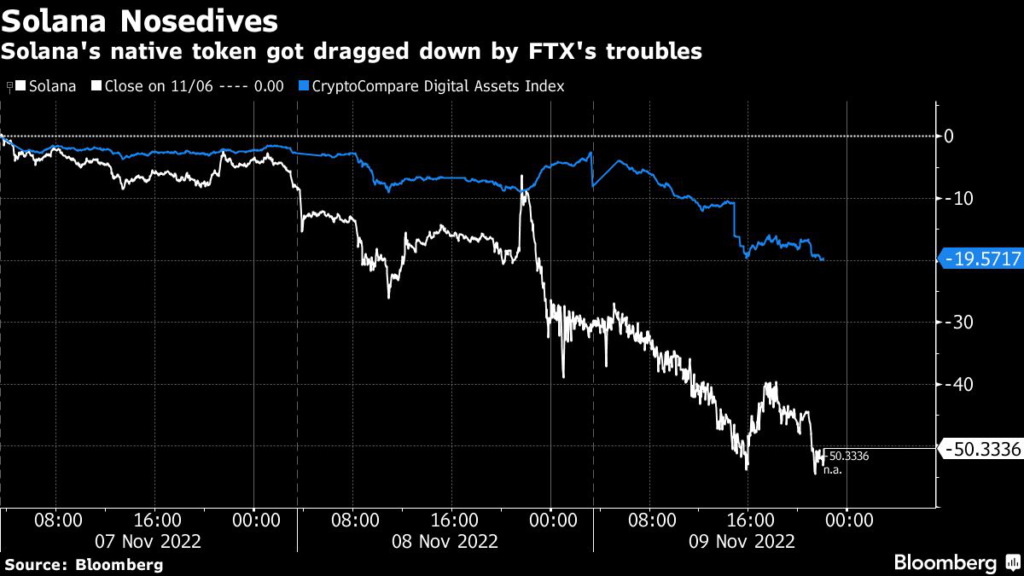
Instead, two-and-a-half-year-old Solana has become a casualty of the chaotic — and uncertain — marriage between two of the industry’s biggest players, Binance Holdings Ltd. and FTX.com. Its native token, SOL, tumbled as much as 46% on Wednesday and has lost more than half of its value this week alone. Only FTT, the native coin of FTX, has suffered a steeper drop. 

The reason: Solana is backed by Alameda Research, the crypto trading house which like FTX is run by Sam Bankman-Fried. It was reports questioning Alameda’s balance sheet health that set in motion the chain of events that led to Binance’s hastily agreed takeover of FTX.com, announced over Twitter on Tuesday. FTX’s venture capital arm has invested in several Solana-based projects. 

SOL, seen by some traders as almost a proxy for FTX, quickly became a juicy target for short sellers. Its market value has fallen from a peak of almost $80 billion last November to just over $6 billion, according to data from CoinGecko. The Solana blockchain has also been plagued by a series of outages that have been a continuing sore spot over the past year. 

“I do worry about the impact this will have, given Alameda had large holdings in SOL that could get liquidated,” said Tristan Frizza, founder of Zeta Markets, a derivative exchange built on the Solana blockchain.

SOL’s pummeling has reverberated throughout the Solana ecosystem. It has spilled over into Solend, the decentralized-finance lending protocol built on Solana, which has suffered a spike in liquidations — leading to a roughly $3.5 million pile-up of bad debts on the platform. One large position backed by 2.63 million SOL token was being partially liquidated on Wednesday, data from Solend shows. 

Representatives for Solana and Solend didn’t immediately respond to requests for comment. 

Now, Solana’s case for challenging Ethereum as the pre-eminent blockchain for DeFi applications looks to be in doubt. The total value locked on applications built on Solana has fallen by roughly half since Sunday — when a tweet from Binance founder Changpeng “CZ” Zhao set in motion FTX’s unraveling — to about $500 million, data from DefiLlama shows.

More pressure on SOL may be brewing. About 50 million SOL, worth more than $940 million, will stop being staked on Solana in the next 24 hours, data from Solana Compass shows. That means they can then be sold on markets, creating an overhang for the token. Staking is the process where holders of a cryptocurrency let their tokens be used to help order transactions on the blockchain, or digital ledger, that is used by that coin, often in exchange for additional units of the token. 

“Large net unstaking typically represents a loss in confidence in the ecosystem or a need to free up capital,” said Martin Lee, a data journalist at blockchain researcher Nansen. 

–With assistance from Dave Liedtka.

More stories like this are available on bloomberg.com

©2022 Bloomberg L.P.

FTX’s Collapse Spurs $10 Billion Drop in Decentralized Finance

(Bloomberg) — Decentralized finance is feeling the pain of Binance’s proposed takeover of FTX.com, with investors yanking cash from projects as uncertainty lingers about the future of one of the largest crypto exchanges.  

The total value of cash locked in DeFi dropped by more than 12% in the past day, after hovering around $50 billion to $60 billion since June, according to data tracker DeFi Llama. That number stood at more than $180 billion last December. 

The drop comes merely months after algorithmic stablecoin TerraUSD fell apart in early May, wiping out billions of dollars from DeFi projects. At the center of latest plunge in DeFi is the Solana blockchain, which has become a casualty of Binance’s potential takeover of its rival FTX. The total value of all cryptocurrencies on Solana blockchain and projects built on Solana plummeted by more than 47% in the past 24 hours. And its native token, SOL, tumbled nearly 40% on Wednesday. 

While the proposed deal doesn’t involve Solana’s investor Alameda Research, a trading house owned by Sam Bankman-Fried, investors are unsure about the fate of the firm. Both Alameda and FTX’s venture arm have also invested in several projects built on top of Solana. 

But some investors and project founders are still optimistic about DeFi over the long-term, as the opaqueness of FTX’s business and its relationship with Alameda urges more transparency in the digital-asset industry.  

“I think we’ve re-learned a few valuable lessons…this is the result of opaque financial relationships and hidden leverage in the system,” said Marc Weinstein, partner at venture fund Mechanism Capital. “They’ll say crypto is dead, but these types of collapses highlight the need for transparent financial infrastructure where users custody their own assets.” 

In the past, DeFi had also suffered billions of dollars worth of hacks, as the scammers have been quick to take advantage of the open-source code of some prominent projects.

More stories like this are available on bloomberg.com

©2022 Bloomberg L.P.

KFC Draws Backlash for Automated Kristallnacht Promo Message

(Bloomberg) — Users of KFC’s app in Germany received a notification on Wednesday to purchase a menu item as a promotion for Kristallnacht, a series of Nazi pogroms against German Jews. The company blamed an error in an automated process. 

The notification, which called on customers to treat themselves to cheese with their crispy chicken “in commemoration of Kristallnacht,” was shared through multiple screenshots on Twitter as users complained about the insensitive nature of the promotion. 

In a statement Wednesday, KFC Germany said the message stemmed from a semiautomated process that linked calendar items, such as holidays and days of commemoration, to promotional content. “This led the unauthorized message to be disseminated by mistake,” the Yum! Brands Inc. unit said. The company added that, as a result, it has stopped notifications and is reviewing the processes and control mechanisms within the app. 

“We emphasize that it was in no way our intention to trivialize the seriousness and historical significance of Kristallnacht or to hurt victims or their descendants,” KFC said. 

On Nov. 9, 1938, Jewish homes, establishments and synagogues in Germany were destroyed in a night of pogroms organized by the Nazi government that came to be known as Kristallnacht, or the night of broken glass. The event is more commonly called Reichspogromnacht in Germany today.

More stories like this are available on bloomberg.com

©2022 Bloomberg L.P.

Crypto Market Rout Deepens as Binance Seen Balking at Takeover

(Bloomberg) — The week’s rout in cryptocurrencies deepened, with Bitcoin tumbling to the lowest levels in two years, as Binance is seen increasingly unlikely to follow through on its takeover of FTX.com.

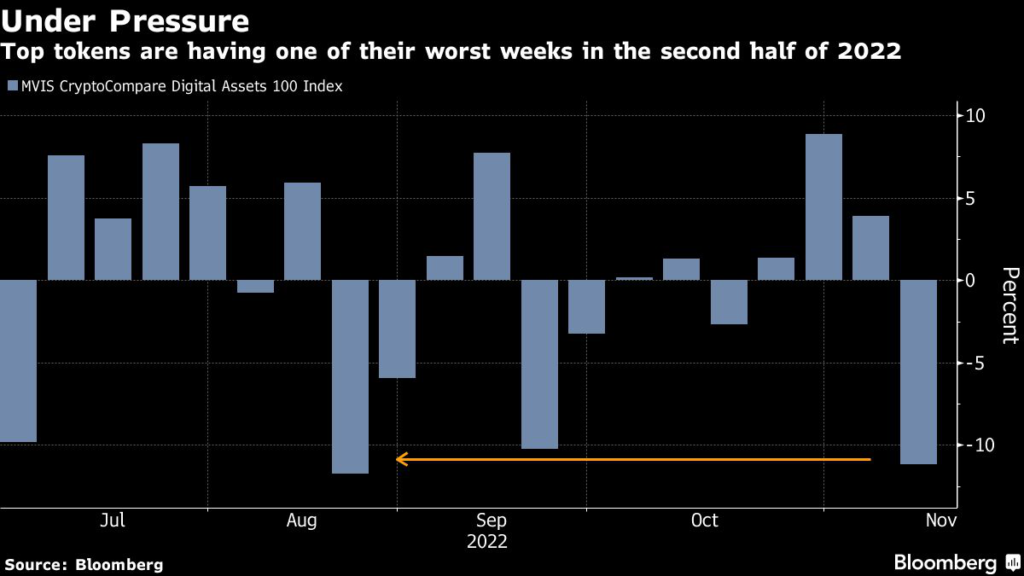
Bitcoin, the largest token by market value, fell as much as 11% to $16,705 on Wednesday, the least since November 2020. That brings this week decline to about 20%. It reached a record high of almost $69,000 a year ago. Just about every digital coin was struggling: Ether, Solana, Polkadot and Avalanche all dropped.

FTT, the utility token of the FTX exchange, collapsed by more than 40%, following a more-than-70% tumble on Tuesday.

“The market is now in full fear mode,” said Ilan​ Solot, co‑head of digital assets at Marex Solutions. “Because Pandora’s box has been opened with this Binance-FTX deal and now everyone’s looking to see if there’s more dominoes and what else needs to be liquidated.”

At issue is Binance executives finding through due diligence that the gap between liabilities and assets at FTX is likely in the billions, and possibly more than $6 billion, said a person familiar with the matter, who wasn’t authorized to publicly discuss the matter. Binance Chief Executive Officer Changpeng “CZ” Zhao had stunned the crypto world on Tuesday with an announcement that his firm was moving to take over FTX.com, which suffered a liquidity crunch after Zhao announced that he was selling a $530 million holding of FTX’s native token. 

Investors are on edge about spreading contagion given the pivotal role FTX and its co-founder Sam Bankman-Fried played in the industry.

“Since I entered the crypto industry in 2016, very few periods tested its market infrastructure and participants like the last 24 hours did,” said crypto hedge-fund manager Dan Liebau of Modular Asset Management.

Read more: FTX’s Financial Black Hole Leaves Binance Balking at Rescue

Noelle Acheson, author of the “Crypto is Macro Now” newsletter, pointed out that Bitcoin, which typically holds up better than other tokens during times of stress, was seeing greater declines than some other altcoins. That potentially points to institutional investors bailing “as a result of the drama.”

“It’s a sign that this is a blow to confidence in the industry as a whole, from the investor’s point of view,” she said in an interview. “From the industry’s point of view, it’s also a pretty steep blow, much more so than what we saw with Three Arrows Capital and with the Terra implosion. This is sitting harder.”

The sense of dread that swept across clients of fallen crypto exchange FTX.com was so intense that they pulled out $430 million worth of Bitcoin in the space of just four days. FTX had more than 20,000 Bitcoins going into Sunday, according to data from CryptoQuant. That fell to almost zero by Wednesday after fears about FTX.com’s financial health led customers to flee.

FTT, the utility token of the FTX exchange, has collapsed by more than 75% in the past 24 hours and was trading around $4.20, according to CoinGecko data. 

“The letter of intent is non-binding, which means that further issues could still arise if CZ/Binance decide to back out of the deal,” said David Moreno Darocas, research associate at CryptoCompare.

The letter of acquisition intent by Zhao’s Binance Holdings came after a bitter feud between with Bankman-Fried spilled into the open. Zhao actively undermined confidence in FTX’s finances, helping spark an exodus of users from the three-year-old FTX.com exchange. 

A day before reaching a deal, Bankman-Fried said on Twitter that assets on FTX were “fine.” 

Terms of the emergency buyout were scant, with Binance saying the agreement came after “a significant liquidity crunch” befell FTX and the firm asked for its help. 

The price of Sol, the native token of the Solana blockchain — which is associated with both FTX and Bankman-Fried’s crypto trading house Alameda Research — posted dramatic declines alongside other tokens of Solana-based projects. Sol was down as much as 36% on Wednesday, taking losses this year to 90%. 

“SBF and FTX were the biggest patrons of Solana,” Teng Yan, a researcher at digital-asset research firm Delphi Digital, said on Twitter. “This era is over. Binance has taken over, and they will heavily favor BNB chain over Solana. Alameda had ~$1B in locked and unlocked $SOL, which they’ll have to sell if insolvent. This puts a huge sell pressure on $SOL.” 

The FTX-Binance ordeal gave some traders flashbacks to the issues suffered by Celsius — the crypto lender that collapsed earlier this year — as well as those seen by other firms that were engulfed in this year’s crash in digital assets.

Teong Hng, CEO at crypto investment firm Satori Research, said the “situation is still very fluid” while adding “I am confident these two crypto giants will do the right thing to protect investors and the industry.”

–With assistance from Olga Kharif, David Pan, Yueqi Yang, Joanna Ossinger and Sidhartha Shukla.

More stories like this are available on bloomberg.com

©2022 Bloomberg L.P.

FTX Fiasco Hits Investors From Tiger Global to Tom Brady

(Bloomberg) — The FTX.com fiasco has ensnared some of the biggest names in finance.

Tiger Global Management, Third Point and Altimeter Capital Management are among hedge funds that recently participated in funding rounds for Sam Bankman-Fried’s once-high-flying crypto exchange, which now faces existential threats as regulators descend and a rival’s proposed bailout appears far from certain. 

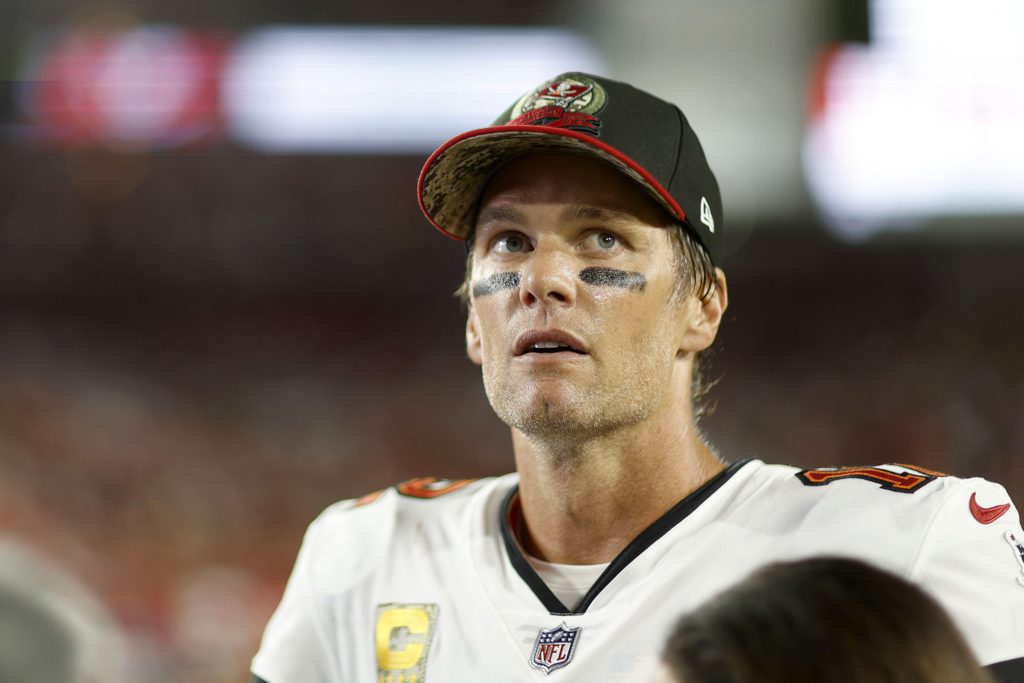
Brevan Howard Asset Management’s Alan Howard, the family office of Paul Tudor Jones and Millennium Management founder Izzy Englander also chipped in as angel investors, alongside celebrities including Gisele Bundchen and Tom Brady. 

FTX was valued at $32.5 billion early this year, but with the company suddenly facing a liquidity crunch, Binance founder Changpeng “CZ” Zhao declared Tuesday on Twitter that his firm was exploring a takeover of its competitor in response to an entreaty from FTX. 

US regulators are now investigating whether FTX properly handled customer funds and the firm’s relationship with other entities Bankman-Fried controls, and concerns raised by Binance executives during their due diligence process could torpedo the deal.

Read more: US Probes FTX Empire Over Handling of Client Funds and Lending 

Bankman-Fried’s empire includes proprietary trading firm Alameda Research, which he founded before launching FTX in 2019, and the relationship between the two entities is now getting renewed attention.

FTX also attracted capital from the Ontario Teachers’ Pension Plan, Sequoia Capital, Lightspeed Venture Partners, Iconiq Capital, Insight Partners, Thoma Bravo and Masayoshi Son’s SoftBank Group Corp. 

These investors, among others, are set to lose all or most of their invested cash. 

Representatives for all of the firms and individuals either declined to comment or didn’t respond to messages seeking comment.

Tiger Global and Ontario Teachers’ first invested in FTX in December 2019 in a funding round that valued the company at $8 billion, according to PitchBook data. Both topped up their wagers in October 2021, giving FTX a $25 billion valuation, and did so again in January, the data show. Some of the other firms and individuals backed FTX in July 2021, paying cash to participate in a $1 billion funding round that valued the crypto exchange at $18 billion. 

The abrupt reversal of fortune for FTX illustrates how quickly empires can crumble in the volatile world of cryptocurrencies, where a turn in market sentiment or company confidence can prompt a run on assets. Bankman-Fried, 30, had amassed a fortune estimated at $20 billion and was among the industry’s most prominent personalities. 

The drama also underscores the risks of backing startups that climbed to lofty valuations in an overheated market — companies that are now struggling amid surging inflation and heightened volatility. 

“Good diligence is essential even in crazy, bullish markets — if investors were not diligent, they have to be held accountable,” said Ryan Gilbert, founder of Launchpad Capital, a financial technology-focused venture firm that doesn’t count FTX among its investments. “Limited partners want to hear from venture funds regarding the state of their portfolios given the meltdown in this very well-respected name.”

–With assistance from Layan Odeh and Annie Massa.

More stories like this are available on bloomberg.com

©2022 Bloomberg L.P.

Stocks Fall as Earnings, Crypto Weigh on Sentiment: Markets Wrap

(Bloomberg) — US stocks declined as disappointing earnings and renewed selling in cryptocurrencies weighed on risk sentiment. The dollar gained for the first time in four days.

The S&P 500 halted a three-day rally, with the tech-heavy Nasdaq 100 leading losses among major benchmarks. Walt Disney Co. and News Corp. tumbled after posting results that fell short of expectations. 

Sentiment also took a hit from a deepening selloff in cryptocurrencies, with Binance seen increasingly unlikely to follow through on its takeover of FTX.com. Bitcoin sank almost 10% to the lowest since November 2020. Oil extended losses after a report that crude stockpiles rose.

Midterm elections also fell short of some market expectations. Investors had eyed prospects of a Republican comeback in Congress, with GOP taking control of both the House of Representatives and Senate. But US voters delivered a mixed verdict, with Republicans heading for control of the House by smaller margins than forecast and the race for Senate still wide open. That left Thursday’s inflation report the next catalyst for markets. 

Republicans made some gains in their drive to take control of Congress but many of the closest races had yet to be called. The final outcome may not be known for days or even weeks if the results are as close as polls have suggested and if losers challenge results. 

“It seems like we might end up essentially where we were before the elections,” Jim Paulsen, chief investment strategist at The Leuthold Group, said on Bloomberg TV. “As far as the economic and as far as the market ramifications (go), I don’t know if it will really change much. As long as there is gridlock, I think the markets are going to be okay with it.”

Read more on elections

Five Key Takeaways From the US Midterm Elections: TOPLive

Republicans Limp Toward House Control With Senate Still in Play

Ron DeSantis Victory Sets Him on Collision Course With Trump

Every State in the US Has Finally Sent a Woman to Congress

Walt Disney sank 11% as quarterly results missed across the board, and News Corp. dropped 5% after posting first-quarter adjusted earnings that missed the average analyst estimate. Meta Platforms Inc. gained after Chief Executive Officer Mark Zuckerberg said the company will cut more than 11,000 jobs.

Cryptocurrencies slipped further as reports swirled around Binance Holdings Ltd.’s potential takeover of embattled rival exchange FTX.com. Meanwhile, US financial regulators are investigating whether FTX.com properly handled customer funds. 

Thursday’s consumer-price-index data may be the next event risk for the Fed’s policy rate and comes on the heels of core consumer prices rising more than forecast to a 40-year high in September. Even if prices begin to moderate, the CPI is far above the central bank’s comfort zone.

More commentary 

  • “Portfolios will assess and adjust their risk now that the ‘uncertainty’ of the U.S. mid-term elections fading,” wrote Craig Johnson, chief market technician at Piper Sandler. “Soon enough, their focus will shift back to this week’s corporate earnings results and the upcoming October CPI data.”
  • “The market is still going to fixate on inflation, which is going to stay high and sticky at least over the next couple of quarters,” Luke Barrs, global head of fundamental equity client portfolio management at Goldman Sachs Asset Management, said on Bloomberg TV.
  • “Elections matter, but other factors matter more for markets and the economy,” Keith Lerner, co-chief investment officer at Truist Wealth, said in a note. “The path of inflation, interest rates, monetary policy, the economy, and earnings will continue to exert the greatest influence on markets over the next year.”

Key events this week:

  • EIA oil inventory report, Wednesday
  • US wholesale inventories, MBA mortgage applications, Wednesday
  • Fed officials John Williams, Tom Barkin speak at events, Wednesday
  • US CPI, US initial jobless claims, Thursday
  • Fed officials Lorie Logan, Esther George, Loretta Mester speak at events, Thursday
  • US University of Michigan consumer sentiment, Friday

Some of the main moves in markets:

Stocks

  • The S&P 500 fell 1.1% as of 1:16 p.m. New York time
  • The Nasdaq 100 fell 1.3%
  • The Dow Jones Industrial Average fell 1.1%
  • The MSCI World index fell 1%

Currencies

  • The Bloomberg Dollar Spot Index rose 0.4%
  • The euro fell 0.5% to $1.0020
  • The British pound fell 1.6% to $1.1364
  • The Japanese yen fell 0.5% to 146.36 per dollar

Cryptocurrencies

  • Bitcoin fell 10% to $16,802.12
  • Ether fell 13% to $1,160.38

Bonds

  • The yield on 10-year Treasuries advanced four basis points to 4.16%
  • Germany’s 10-year yield declined 11 basis points to 2.17%
  • Britain’s 10-year yield declined 10 basis points to 3.46%

Commodities

  • West Texas Intermediate crude fell 2.9% to $86.37 a barrel
  • Gold futures were little changed


–With assistance from Vildana Hajric, Muyao Shen, Tassia Sipahutar, Srinivasan Sivabalan and Isabelle Lee.

More stories like this are available on bloomberg.com

©2022 Bloomberg L.P.

FTX’s Financial Black Hole Leaves Binance Balking at Rescue Plan

(Bloomberg) — Changpeng Zhao moved fast when Sam Bankman-Fried’s FTX.com was on the brink, offering to take it over and stem any further crypto contagion.

Within hours, he was forced to reconsider. 

For starters, Binance executives quickly found themselves staring into a financial black hole — a gap between liabilities and assets at FTX that’s probably in the billions, and possibly more than $6 billion, according to a person familiar with the matter. 

On top of that, US regulators are circling FTX, investigating whether the firm properly handled customer funds, as well as its relationship with other parts of Bankman-Fried’s crypto empire, Bloomberg News reported Wednesday. 

It makes for a tricky decision for Zhao, known in the crypto world as CZ: Follow through with rescuing his onetime top rival and shoulder the financial and regulatory burdens, or let FTX crumble and sort through the potential wreckage? Zhao himself admits there was no “master plan” to take over FTX.

His answer, at least for now, is that the financial hole appears too deep. Binance is unlikely to follow through on its takeover of FTX, according to the person familiar, who wasn’t authorized to publicly discuss the matter.

“Binance is still in early stages of conducting due diligence and will communicate further when we have something more substantive to share,” a firm spokesperson said.

For crypto investors, the stakes are high. The downfall of Bankman-Fried, the industry’s 30-year-old wunderkind, has cast doubt about which institutions are safe in the still-loosely regulated market. Bitcoin fell below $17,000 on Wednesday to a two-year low, joining a widespread selloff in digital assets.

While Bankman-Fried is barely a billionaire anymore, Zhao remains the richest person in crypto, with a fortune estimated at $16.4 billion by the Bloomberg Billionaires Index. But even Zhao hasn’t been immune to tumbling crypto prices: His net worth peaked at $97 billion in January.

Binance has some time to make a decision. Its due diligence process could take 30 days, the person familiar said. The firm’s non-binding letter of intent allows it to fully acquire FTX, buy parts of the assets or walk away. 

If the deal with Binance were to fall through, it would likely mean FTX customers would take losses, Coinbase Chief Executive Officer Brian Armstrong said Tuesday in a Bloomberg TV interview.

“That’s a not a good thing for anybody,” he said.

For Binance, an immediate issue is the way FTX valued its utility token FTT and whether it should have been marked at a lower price, the person said. The token has plunged some 70% since Zhao said his exchange would be liquidating its FTT holdings, worth $529 million at the time.

Zhao’s move followed a story from CoinDesk saying that a potentially partial balance sheet shows FTT made up about a quarter of assets at Alameda Research, a trading house owned by Bankman-Fried. The crypto news site earlier reported that Binance was leaning against its FTX takeover. 

The proposed deal between Binance and FTX doesn’t involve Alameda, the person familiar said. Bankman-Fried had already said that the transaction would exclude FTX.US, a separate exchange he founded.

–With assistance from Lydia Beyoud and Olga Kharif.

(Updates with Bitcoin price starting in eighth paragraph.)

More stories like this are available on bloomberg.com

©2022 Bloomberg L.P.

Crypto Shock Hits ETFs With Biggest Futures Fund Briefly Halted

(Bloomberg) — The havoc engulfing the cryptocurrency universe is rattling the world of exchange-traded funds. 

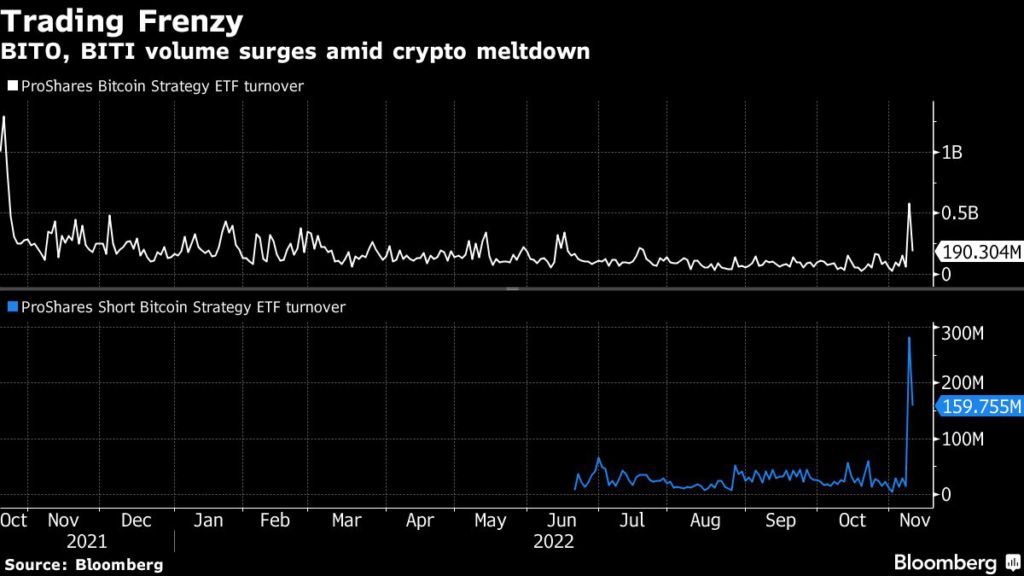
Trading in the $600 million ProShares Bitcoin Strategy ETF (ticker BITO) was briefly halted on Wednesday after the fund plunged more than 6% in a matter of minutes, triggering the exchange’s downside volatility limit. The plunge came after a report that Binance is unlikely to follow through on its takeover of rival exchange FTX.com, according to people familiar with the matter. 

The drama surrounding the crypto market over the past 72 hours has jolted ETFs designed to track the industry. On Tuesday, BITO posted its highest trading volume since its blockbuster launch last year, after news of the Binance deal broke. Its twin fund — the $72 million ProShares Short Bitcoin Strategy ETF (BITI) — also saw unprecedented turnover. 

“While an ETF can help provide liquidity to a wide range of investments, for trading to occur properly the underlying assets need to be liquid,” Todd Rosenbluth, head of research at ETF data provider and research consultant VettaFi. “Cryptocurrency futures are still an emerging investment with high volatility that can cause challenges even through an ETF.”

BITO fell as much as 8.8% on Wednesday. Bitcoin, the largest cryptocurrency, lost as much as 10% to trade below $17,000, its lowest level since November 2020. The token had dropped 10% the day prior as well. Altcoins also plunged, with Ether and XRP each falling more than 10%. Solana lost close to 30%.

FTT, the utility token of the FTX exchange, collapsed by more than 40% on Wednesday, following a more-than-70% tumble on Tuesday.

“What all of this is pointing to is that there will be more SEC oversight, regulation and scrutiny,” said Jane Edmondson, co-founder of EQM Indexes. “It certainly does not help the case for approval of a spot Bitcoin ETF in the US anytime soon.”

More stories like this are available on bloomberg.com

©2022 Bloomberg L.P.

Sam Bankman-Fried’s FTX Empire Faces US Probe Into Client Funds, Lending

(Bloomberg) — US regulators are investigating whether beleaguered crypto-exchange FTX.com mishandled customer funds, and they’re looking into the firm’s relationships with other parts of Sam Bankman-Fried’s crypto empire.

The inquiries by the Securities and Exchange Commission and the Commodity Futures Trading Commission relate to the liquidity crisis that has pushed FTX to the brink, according to three people familiar with the matter. The SEC’s scrutiny started months ago as a probe into FTX US and its crypto-lending activities, said two of the people, who who weren’t authorized to speak publicly on the matter.

FTX’s turmoil led to a tentative rescue offer by rival exchange Binance Holdings Ltd., which now may balk as the scope of FTX’s distress becomes more apparent. American regulators are also looking into the platform’s relationship with its American counterpart FTX US and Bankman-Fried’s trading house Alameda Research, two of the people said.  

Representatives for the SEC and Binance declined to comment. The CFTC, FTX and FTX US didn’t immediately respond to requests for comment.  

The troubles at FTX.com follow high-profile collapses this year by crypto firms that have prompted calls for more US regulation. Although various Washington agencies claim some turf, questions over who should oversee trading platforms continue to swirl.  

The CFTC’s jurisdiction over crypto is generally limited to derivatives, but the agency can take enforcement action if it believes there’s fraud or manipulation in the underlying market. The SEC claims oversight over digital coins that qualify as securities under its rules. Both regulators also oversee investment firms. 

In recent days, the regulators have asked for details about the ownership structure of FTX US and FTX.com, which caters to non-American clients, according to two of the people. Regulators are interested in any overlap between management and board structures, and the financial relationship between the two entities. The agencies have also asked for details on whether customer accounts were properly segregated and the composition of the investor base at FTX.com, said one of the people.

SEC Chair Gary Gensler has repeatedly warned about risks associated with digital-asset exchanges. He has said that many platforms may be violating securities laws by offering unregistered securities to Americans, improperly providing loans, or even front-running their clients’ trades. Gensler has also raised concerns that firms may be engaged in conflicting lines of business and suggested that they should potentially split up the different functions.

Top CFTC officials have expressed concerns about the risk of crypto platforms mishandling customer assets. “There is not enough awareness or attention on this critical area where customer protections dovetail with financial stability risks,” Democratic CFTC Commissioner Christy Goldsmith Romero said in a speech last month without mentioning any firms by name. 

Bitcoin, the largest token by market value, fell as much as 9.9% to $16,853 on Wednesday. That brings this week’s decline to almost 20%.

(Updates with details on probe starting in seventh paragraph.)

More stories like this are available on bloomberg.com

©2022 Bloomberg L.P.

COP27 Latest: Kerry Brushes Off Talk of a Thaw in US-China Ties

(Bloomberg) — US Special Presidential Envoy for Climate Change John Kerry downplayed suggestions that US-China climate negotiations are back on track.

Kerry said he and Xie Zhenhua “had some informal talks.”

“But we’re not in any formal negotiation at this point,” he said at the Bloomberg Green summit on the sidelines of COP27 in Sharm-el Sheikh.

Kerry described his friendship with Xie, the China climate envoy, as having been forged over years of negotiations and meetings in airports as they traveled round the world. Right now, that relationship is strained by Beijing’s decision to suspend talks on climate following House Speaker Nancy Pelosi’s visit to Taiwan.

“I certainly stand ready to negotiate,” he said. “The climate crisis is not a bilateral issue.”

Kerry spoke the same day as Al Gore, the former US vice president turned climate campaigner, who said any Republican Party efforts to slow the green transition would be at odds with market forces that are ultimately more powerful than politics.

“Markets are making a different decision,” Gore said in an interview with Bloomberg Television’s Francine Lacqua in Egypt on Wednesday. “We’re seeing a massive movement toward more climate friendly policies.”

Markets are “in the early stages of a sustainability revolution,” Gore said, repeating a line he’s used before to describe this point in history. “So whatever politicians in different countries want to opine on, we’re seeing business and investors and markets move towards solutions for the climate crisis.”

Both Gore and Kerry made their remarks on the COP summit’s Finance Day, which is a leaner affair than in Scotland last year after a number of prominent chief executives including BlackRock Inc.’s Larry Fink and Citigroup Inc.’s Jane Fraser opted to stay away. That’s as climate finance faces growing hurdles.

Earlier in the day, Mark Carney, the former Bank of England Governor and co-chair of the world’s biggest climate finance coalition, urged governments to “align financial regulation with net zero” by making net zero transition plans mandatory.

An energy crisis and a changing political landscape in the US are making it harder for banks and investors to turn their backs on fossil fuels. Financial firms are also increasingly nervous of the legal ramifications of joining net-zero alliances, with some in the US claiming that such goals are at odds with fiduciary duties. And in some cases, climate-finance alliances have even been likened to cartels.

Read More: Blackstone, Pimco Sidestep Net-Zero Group Even After Concessions

Those legal risks may intensify, depending on the outcome of midterm elections in the US. But there’s also a legal risk involved in making climate promises that firms don’t live up to.

“Firms should be wary of being caught in the riptide of unrealistic ambitions as it may expose them to both litigation and reputational risks if they don’t meet these commitments,” Sonali Siriwardena, partner and global head of ESG at Simmons & Simmons in London. 

(GFANZ is co-chaired by former Bank of England Governor Mark Carney and Michael R. Bloomberg, the founder of Bloomberg News parent Bloomberg LP.)

Read More: 10 things to watch at the COP27 summit

Highlights:

  • Click here to read the highlights from talks on Tuesday
  • China delivers blow to climate with new emissions deadline
  • Satellite spots methane cloud near Iran oil and gas facilities
  • Mark Carney sees ‘wall of opportunity’ for energy investors
  • UN panel calls out ‘greenwashers’ and seeks net-zero regulation
  • EU Lawmakers reach deal on climate goals outside carbon market
  • Click here to get read about Bloomberg Green at COP27

Here are the latest developments. All times Egypt. 

US, EU Will Pledge to Cut Methane Emissions from Fossil Fuel Production (7:14 pm)

The US, EU and other countries will announce as early as tomorrow their plan to encourage fossil-fuel importers and exporters to curb their methane emissions as part of the Global Methane Pledge, a collective goal to cut releases of the gas by 30% by the end of the decade.

The declaration, seen by Bloomberg, says countries should take efforts to stem leaks of methane — which is 80 times more powerful than carbon dioxide over 20 years — across the value chain. That includes the elimination of routine flaring as well as better measurement and verification of methane discharges.

The US Environmental Protection Agency is preparing to advance the next iteration of its plan to cap methane leaks, amid growing calls to clamp down on flaring at oil wells.

“Through our collective efforts, we aim to reduce warming by 0.1C by mid-century by accelerating methane and flaring reduction in the oil and gas sector,” the document states. “As among the world’s largest importers and exporters of fossil energy resources, we commit to taking immediate action to reduce the greenhouse gas emissions associated with fossil energy production and consumption, particularly to reduce methane emissions.”

UK’s Sunak Firmly Committed to Climate and Green Finance, Minister Says (6:14 pm)

UK Prime Minister Rishi Sunak is firmly committed to scaling up climate finance and meeting net-zero commitments, according to James Cartlidge, Exchequer Secretary to the Treasury. Britain announced late Tuesday that its export credit agency would be the first to pause debt service payments for low-income countries and small island developing states when they are hit by climate catastrophes, such as hurricanes and floods.

“What we are doing in terms of adaptation finance shows we’re still leading the way,” Cartlidge said in an interview. “Sunak has shown he’s committed to net zero.”

Banks face getting “hammered” on coal finance, Menon says (5:40 pm)

Banks are nervous of providing finance to enable the early phase-out of coal — a necessary pillar of the energy transition — because they fear a caustic response from civil society, said Ravi Menon, managing director of the Monetary Authority of Singapore. Banks know it is “the right thing to do” but they need cover, he said.

“Coal is very controversial: You’re going to get hammered by your stakeholders and NGOs and so on,” said Menon. “So we need to raise the level of understanding” and “convince the NGOs and those who are arguing for the immediate suspension of coal that, look, we will get there, but this has to be done in a responsible way to help the communities meet that condition”

UAE’s Biggest Clean-Energy Firm to Look at Deals in US, Europe (4:00 pm)

The United Arab Emirates’ biggest renewable-energy company will make acquisitions and sell bonds as part of a plan to more than double its operations this decade and help the country achieve a net-zero target.

Masdar is interested in acquisitions of power firms in places such as the US and Europe, Chief Executive Officer Mohamed al Ramahi said in an interview at the COP27 climate summit.

“Our ambition is big,” al Ramahi said. “We will consider all possibilities when it comes to financial strategy. Green bonds, specifically, are something we might consider.”

EU Says Final COP27 Conclusions Must Mobilize Finance for 1.5C Goal (3:23 pm)

Any final deal reached at COP27 should contain a clear reference to the need to mobilize all finance toward the 1.5C goal, said Jacob Werksman, the EU’s lead negotiator. The EU failed to win an agenda item on this issue on Sunday. He said there’s “every expectation” that the Egyptian Presidency will try to come forward with a so-called cover decision, similar to last year’s arrangement in Glasgow.

“We need to look at how we can create changes in the world’s financial system making sure that all flows from the public and private sector are increasing in line with the Paris Agreement,” Werksman said. “The outcomes of that particular theme will have to be captured in the cover decision,” he said.

Countries Hit by Climate on Track to Get Built-In Debt Relief (2:30 pm)

The International Capital Market Association unveiled new language for debt instruments that would enable countries hit by climate change and natural disaster to defer payments.

So-called climate-resilient debt clauses have already been used in a small number of privately financed bond issuances and loans, ICMA said. A working group chaired by the UK Treasury and including the International Monetary Fund and World Bank has now created a standardized term sheet for broader use.

IAEA Expects ‘Much Higher’ Nuclear Role to Avert Climate Change (1:28 pm)

Emissions-free nuclear power will account for a “much higher” share of global electricity generation over the next decade, though it might not reach the 20% target that International Atomic Energy Agency Director General Rafael Mariano Grossi said is needed to ensure climate goals.

“Nuclear is not a magic bullet,” Grossi said Wednesday on a panel at the COP27 climate meeting in Sharm El-Sheikh, Egypt. “But without it, everything else will be extremely complicated.”

Atomic reactors currently generate about a tenth of the world’s power, but in many western countries old reactors are being shut down without new models coming on line. The first task is to keep more old reactors operating as long as they can be safely operated, according to Grossi.

“The unsung hero in the fight against global warming is long-term operation,” he said, adding that countries also need to boost investments in new infrastructure, including small-modular reactors. “Keeping nuclear in the equation is going to give us the energy, the solution to the climate problem.”

Grids Need Better Resiliency as More EVs Plug In, Edison CEO Says (12:45 pm)

Edison International CEO Pedro Pizarro said electric vehicles are “a big part of the solution,” to climate change, even as southern California residents were asked to refrain from charging their EVs during heat waves this year.

Electricity demand surged to record highs during a period of extremely high temperatures in the state. “There has been an increase in those kind of events,” Pizarro said in an interview with Bloomberg TV at COP27, adding that they were “better prepared” than the heat wave in 2020.

Southern California Edison, a subsidiary of Edison International, supplies electricity for much of southern California. Pizarro said the focus going forward should be “making the grid more resilient.” 

Gore Is ‘Optimistic’ Xi, Biden Will Restart Climate Dialogue (12:40 pm)

Former US Vice President Al Gore said he’s “optimistic” US President Joe Biden and Chinese President Xi Jinping will resume discussions about climate action at the G20 talks in Bali next week. “I’m optimistic that, in the wake of the Communist Party Congress, now China will get back into a cooperative relationship with all the countries that are trying to solve this climate crisis,” he said in a Bloomberg TV interview. 

“China’s being hit by it worse than almost any country,” he said. “The Yangtze is at its lowest level ever. It’s really having an impact on the Chinese economy and some fear on the stability of China — and that’s what the Chinese Communist Party pays closest attention to, so I hope that they will reengage with the world community.”

China Climate Envoy Xie Says He Met With John Kerry at COP27 (12:01 pm)

China Climate Envoy Xie Zhenhua says he met with John Kerry, US special climate envoy, for unofficial talks, during the COP27 climate summit in Egypt on Wednesday.

The meeting is a potential sign that relations are warming despite a formal suspension of bilateral negotiations on the issue earlier this year.

Beijing announced it was halting negotiations with the US over climate and several other issues in August, after US House Speaker Nancy Pelosi visited Taiwan, the self-governing island over which China claims sovereignty.

HSBC’s Quinn Tells Egypt Not to Be ‘Discouraged’ by Green Bond Cost (11:55 am)

HSBC CEO Noel Quinn responded to comments from Egypt’s finance minister, Mohamed Maait, that his country had to pay more to issue green debt than regular bonds. “Don’t be discouraged,” said Quinn, whose bank was one of the arrangers of the issuance.

Costs will go down with “familiarity” and with the establishment of global disclosure methodologies, he said. “When you put the label green next to a bond everyone wants reassurance,” he said.

NinetyOne CEO Says Emerging Markets in a Strong Position (11:40 am)

Emerging markets are in a strong position, according to Hendrik du Toit, CEO and founder of NinetyOne Plc. They stand to benefit from political and economic uncertainty in the developed world, which could cause a shift in available climate finance, he said in an interview with Bloomberg Television on Wednesday.

There’s also a “very exciting and relatively low risk opportunity in the debt that finances the energy transition,” he said. This is because most companies that need to transition are carbon heavy but cashflow strong, offering reasonably well-priced debt and the opportunity to play a positive role. “Transition debt is where we think the action will be,” du Toit said.

IEA Says OPEC+ Oil Cut is Hurting Emerging Markets (11:20 am)

Last month’s decision by OPEC+ to reduce oil production was “definitely not helpful,” according to the International Energy Agency, which advises rich countries.

“It is causing inflation and economic weakness, especially in developing economies,” Executive Director Fatih Birol said to Bloomberg TV. Energy-importing countries in Africa, Asia and Latin America will suffer, he said.

Europe’s managed to refill its natural gas storage sites for this winter, but next year will be tougher, Birol said. That’s because the continent may have to make do without any supplies from Russia and because demand in China could pick up as it eases coronavirus restrictions.

While the world needs to invest more in renewables, it must continue investing in fossil fuels to enhance energy security, he said.

Germany, France Sign Deal to Give South Africa $604 Million in Climate Finance (11:15 am)

South Africa’s government signed loan agreements with French and German public development banks to support its efforts to shift from coal toward cleaner energy sources.

Agence Française de Développement and Kreditanstalt für Wiederaufbau extended concessional loans of €300 million ($302 million) each to the South African government as part of an $8.5 billion climate finance deal it was offered by wealthy nations at the COP26 talks in Glasgow last year, the National Treasury said in a statement Wednesday.

The plan is seen as a blueprint for other coal-dependent developing nations to cut greenhouse-gas emissions.

ECB Urges Banks to ‘Step Up Their Game’ on Climate Risk (11:07 am)

The European Central Bank is aware of the need for “further action to incorporate the consequences of the ongoing climate and environmental crises into our work,” said Frank Elderson, ECB executive board member.

The ECB’s interactions with banks show they’re making progress, he said. But “despite the progress we have seen, I will continue to stress that the banks under our supervision need to step up their game and truly manage climate-related and environmental risks in the same way we expect them to manage any other material risk,” Elderson said.

Malpass Says Developing Countries Are Facing Economic Crisis (10:22 am)

David Malpass, president of the World Bank, said heavy debt burdens combined with inflation and the fallout from climate change are pushing the developing world into an economic crisis. 

The World Bank reached $32 billion in climate finance this year, which is a record and was “well above our Glasgow target,” he said. “We want to dramatically increase the number and size of projects that reduce greenhouse gas emissions.”

Georgieva Says Climate Success Depends on Finance ‘Incentives’ (10:15 am)

Kristalina Georgieva, managing director of the International Monetary Fund, said the finance needed to address climate change and the energy transition will not flow without changing the incentives for financiers. And “the best incentive we have to shift from high carbon intensity to low carbon intensity is to price carbon,” she said.

The average price of carbon globally is $5 but to be at the level that “changes investment and consumer behavior” it will have to go up to at least $75 a tonne by 2030, she said.

“Adam Smith, the founder of economics, said it: the butcher and the baker don’t feed you out of the generosity of their hearts, they feed you for self interest,” she said. “So we have to create the self interest for decarbonization.”

Conservative Estimate Puts 2030 Financing Gap at $2.4 Trillion (9:51 am)

There’s a gap in financing of around $2.4 trillion, compared with what’s needed by 2030, and that represents “the most conservative figure,” said Mahmoud Mohieldin, UN Climate Change High-Level Champion for COP27.

Serious debt reduction mechanisms are needed, while multilateral development banks and international finance institutions need to play a greater role in supporting such efforts, he said.

Mohieldin also said he is “very happy to see a chapter of GFANZ established for Africa with serious consideration of being practical and supporting a pipeline of projects.”

DTEK Needs ‘Billions’ of Dollars to Fix Power Grid (9:45 am)

Ukraine’s biggest private power producer, DTEK, said it’s running out of equipment to fix power stations damaged by Russian missile attacks.

“We need millions of dollars-worth of equipment for immediate fixes and billions for the long-term, deep repairs of the grid,” Chief Executive Officer Maxim Timchenko said in an interview at the COP27 climate conference in Egypt. “We appeal to countries and companies to help us.” DTEK has had to halt power exports to the rest of Europe to focus on maintaining domestic supplies, he said.

Africa Recognizes Need to Pursue Green Growth (8:43 am)

Africa’s common position at the COP27 summit recognizes the need for growth alongside the duty to provide electricity to its 600 million inhabitants who don’t have access to energy, UN Economic Commission for Africa acting Executive Secretary Antonio Pedro said. That energy shortfall is the reason the continent is promoting natural gas as a “transition fuel,” Pedro said in an interview with Bloomberg Television.

Net-Zero Asset Managers Group Says Alliance Has Grown to 291 (8:00 am)

The Net Zero Asset Managers initiative says 86 investors have set initial targets for the proportion of assets that will be managed in line with achieving net zero emissions by 2050 or sooner, with the total number of asset managers committing to net zero rising to 291.

That brings to 169 the total number of managers with such targets, collectively representing over $55 trillion in assets under management, according to a statement by NZAMi on Wednesday. New signatories include Capital Group, Northern Trust and AllianceBernstein.

Climate Change Could Cost Africa Two Thirds of Its GDP Growth (2:01 am)

Global warming could slash Africa’s economic growth by two thirds by the end of the century unless significant investment is made in climate adaptation, a new study shows.

Current climate policies will likely see temperatures exceed the pre-industrial average by 2.7C, curbing African growth rates 20% by 2050 and 64% by 2100, Christian Aid said in a report released Wednesday. Even a 1.5C rise in temperatures would reduce growth rates by 34% by the century’s end, it said. 

While Africa is responsible for about 4% of planet-warming emissions, it’s already being hit hard by a changing climate. Devastating cyclones and floods have battered southeast and West Africa this year while the Horn of Africa is in the midst of its worst drought in four decades.

–With assistance from Salma El Wardany, John Ainger, Alfred Cang, Yousef Gamal El-Din, Paul Richardson, Akshat Rathi, Nicholas Comfort, Antony Sguazzin, Paul Wallace and Frances Schwartzkopff.

More stories like this are available on bloomberg.com

©2022 Bloomberg L.P.

Close Bitnami banner
Bitnami