
Bloomberg

Puerto Rico’s First Crypto Bank Puts Island in Exclusive Club

(Bloomberg) — The race to build a fully integrated, US-regulated crypto bank is getting some Caribbean competition.

On Wednesday, FV Bank, an international financial entity registered in the US territory of Puerto Rico, became the first bank of the commonwealth to roll out a digital-asset custody service. With a few mouse clicks, clients will be able to store, transfer and settle Bitcoin and fiat currency within a single account.

FV, which stands for FinTech Ventures, will include Ether, USDC, and USDT to its roster in coming weeks, and plans to add other cryptocurrencies in the future. 

While there are several crypto exchanges that give clients the ability to swap hard cash for digital money, few US-regulated banks have that capability. Bank of New York Mellon — the US’s oldest bank that traces its roots to Alexander Hamilton — recently launched a platform that will allow some of its clients to hold and transfer Bitcoin and Ether. State Street has also announced similar plans.

That puts FV in a rarefied field in the rapidly expanding banking-meets-crypto sector, said Steven Beattie, financial crime consulting and crypto risk leader at EY. 

“First movers are incredibly valuable,” he said, as they stake out virgin territory in what’s likely to become a crowded arena. “As a first mover you have a chance to change your competitive position across the industry. But being first creates some risk.”

Investors have been on the edge about crypto exchanges recently after Binance Chief Executive Officer Changpeng “CZ” Zhao announced that his firm was moving to take over rival FTX.com. The latter suffered a liquidity crunch after Zhao said he was selling a $530 million holding of FTX’s native token. 

While banks face tighter regulatory controls, digital-asset custody opens up a Pandora’s Box of compliance hassles, as well as money laundering and know-your-customer risks, Beattie said.

The bank has tried to minimize those threats by building its digital-custody platform from the ground up, with compliance embedded in the technology, said FV’s Chief Executive Officer Miles Paschini.

Still, FV won’t be able to tap into the growing number of crypto investors moving to the Caribbean island of 3.2 million people for its lucrative tax breaks. Puerto Rico’s IFEs and IBEs — short for international financial entities and international banking entities — are barred from doing business with institutions or individuals based in the commonwealth. 

While FV is open to individual customers, it has been focusing on institutional clients, Paschini said. About 20% of which are from the US mainland and 80% are non-US entities. Crypto exchanges Kucoin, Bybit and MEXC are among FV’s clients. 

Ultimately, Paschini sees fintech and blockchain companies as some of its primary clientele in the digital-asset custody space. 

“Those companies need a place to go so that they can build, say, the next super app — the next cash app that is better than what they have in Argentina or Brazil or someplace,” Paschini said. “They need infrastructure that’s regulated and compliant. And that’s really what this is about. We’re delivering that infrastructure to the marketplace.”

No Wild West

Puerto Rico’s regulators are quick to dispel notions that they’re creating a crypto Wild West. 

Natalia Zequeira, the island’s commissioner of financial institutions, says her office has only given a handful of banks preliminary approval to become custodians of digital assets. But only FV has built out a compliance department, and has jumped through all the capitalization and regulatory hoops required to win final approval, she said.

FV also went through an additional licensing process that allows it to not just hold, but exchange, digital assets.

Read More: Zero Taxes, Golf and Mansions Create a Crypto Island Paradise

“We are not opening the door to do business in Puerto Rico to just anyone anymore,” she said. “You must know that this is a US territory and you must comply with federal laws and regulations.”

Puerto Rico’s international banking sector often makes news for the wrong reasons. In August, Peter Schiff’s Euro Pacific Bank International Inc. was liquidated after regulators said it missed capitalization requirements. That same month, Bancredito was shuttered amid allegations that its founder made campaign contributions to then-Governor Wanda Vazquez in exchange for naming Zequeira’s predecessor. 

Read More: Puerto Rico’s Former Governor Arrested on Bribery Charges

Since assuming the post in 2021, Zequeira says she has doubled the size of the inspection staff and has denied applications from at least 20 banks. 

“The policy of this office is to promote economic development and we do not want to hinder financial innovation,” she said. “But it has to be done in a way that is safe and does not put clients’ deposits at risk.”

More stories like this are available on bloomberg.com

©2022 Bloomberg L.P.

Microsoft’s Cloud Sparks EU Complaint by Amazon-Linked Group

(Bloomberg) — A collection of Microsoft Corp.’s rivals including OVH and Amazon.com Inc.’s AWS fired off an antitrust complaint to European Union watchdogs alleging the software giant uses unfair licensing practices to lure customers in the region to its cloud infrastructure.

CISPE, a European cloud-company policy group, said it’s calling for a probe into Microsoft’s business model before some companies are shut out of the market, causing “material harm to customers.” It’s the fourth current complaint targeting Microsoft at the Brussels-based European Commission.

There is fear among CISPE members, who are “very concerned about the potential pushback from Microsoft,” Francisco Mingorance, executive secretary at the group, said by phone. “Some have told us that Microsoft could effectively turn off half of their business at the click of a finger.”

Bowing to months of pressure from rival cloud providers, Microsoft earlier this year announced changes to its software licensing terms to make it easier for customers of rival cloud-service companies in Europe to move their existing software to these other networks. The changes took effect on Oct. 1.

Read More: Mr. Smith Goes to Washington: Fully Charged

But CISPE called the changes a “smokescreen” that fail “to tackle the harms to consumers and providers” that have already been outlined in a previous complaint to the EU.

Microsoft, whose $69 billion takeover bid for Activision Blizzard Inc. was earmarked on Tuesday for an in-depth EU review, said in a statement the licensing changes it had recently introduced “give customers and cloud providers around the world even more options for running and offering our software in the cloud.” 

It said it was “committed to addressing valid licensing concerns and support a competitive environment where all providers can thrive.” 

The EU commission on Wednesday said it’s been informed by the group about the complaint and that it “will assess it based on its standard procedures.”


(Updates with responses starting in third paragraph)

More stories like this are available on bloomberg.com

©2022 Bloomberg L.P.
Vodafone Sells Stake in $16 Billion Tower Arm to KKR, GIP

(Bloomberg) — Vodafone Group Plc has agreed to sell a stake in its towers unit to KKR & Co. and Global Infrastructure Partners in a deal valuing the business at €16.2 billion ($16.3 billion).

The British telecommunications group announced the €32-a-share deal for Frankfurt-listed Vantage Towers AG in a statement Wednesday that confirmed an earlier Bloomberg News report. This represents a 19% premium to Vantage’s three month volume-weighted average share price.

Under the deal’s terms, Vodafone will move its 81.7% holding in Vantage into a joint venture with KKR and GIP. The JV will then make a takeover offer for outstanding shares in Vantage in what could be the biggest take private of a German company on record, data compiled by Bloomberg show. RRJ Capital, the second-largest minority investor in Vantage, will support the offer. 

Shares in Vantage rose as much as 12.5% following the deal’s announcement. The stock was trading above the offer price at €32.50 at 3:49 p.m. in Frankfurt, suggesting some investors see the possibility of minority shareholders asking for a higher price. Vodafone was down 2.3% in London. 

Vodafone took Vantage public at €24-a-share in an initial public offering in March 2021. Less than a year later, Vodafone’s Chief Executive Officer Nick Read said it would consider selling down its stake in the business while continuing to share control. 

The KKR and GIP consortium, which includes Tower Bridge Infrastructure Partners and funding from Saudi Arabia’s Public Investment Fund, will eventually own as much as 50% of the JV.

“This transaction successfully delivers on Vodafone’s stated aims of retaining co-control over a strategically important asset, deconsolidating Vantage Towers from our balance sheet to ensure we can optimize its capital structure and generate substantial upfront cash proceeds,” Read said in Wednesday’s statement.

Tower Tussles

For KKR and GIP, the Vantage deal comes just months after they failed in a bid to buy a controlling stake in Deutsche Telekom AG’s tower arm, which was eventually sold to Brookfield Asset Management Inc. and DigitalBridge Group Inc. in a deal valuing the business at about €17.5 billion. 

KKR and GIP faced strong competition from a host of financial and strategic bidders for Vantage, including a consortium of Spanish telecommunications group Cellnex Telecom SA and Singapore’s sovereign wealth fund GIC Pte.

Network towers are helping dealmakers defy a near-30% slowdown in global mergers and acquisitions activity this year. Telecom operators are shifting the assets to help raise funds for fiber-optic rollouts and wireless upgrades, and are finding willing buyers in the form of investment firms seeking predictable returns in volatile markets.

Bloomberg News reported this week that PIF is among suitors weighing a final bid for network towers being sold by Qatari telecom firm Ooredoo QPSC that could be valued at as much as $5 billion. And in Europe, private equity firm EQT AB is seen as the frontrunner to acquire a stake in French tower owner TDF. 

UBS Group AG and Robey Warshaw LLP advised Vodafone on the deal. Morgan Stanley advised the KKR and GIP consortium. 

–With assistance from Aaron Kirchfeld.

(Adds consortium member in sixth paragraph.)

More stories like this are available on bloomberg.com

©2022 Bloomberg L.P.
Rogers Keeps 2022 Outlook as Canada’s Population Boom Aids Wireless Unit

(Bloomberg) — Rogers Communications Inc. missed analysts’ profit estimates for the third quarter but kept its outlook for 2022 as it posted strong growth in new wireless subscribers. 

The Toronto-based cable and wireless firm earned 84 Canadian cents a share on an adjusted basis in the third quarter, narrowly missing the consensus of 87 cents. 

Adjusted EPS was 18% below last year’s third quarter because of a network failure in early July, which knocked millions of consumers and businesses offline for an entire day. Rogers gave credits to customers worth five days of service and bought advertising to apologize. 

Despite that episode, Rogers added 164,000 postpaid wireless subscribers in the quarter, beating analysts’ forecasts for about 129,000. Canada’s open immigration policy is helping: the population is growing at the fastest pace since the 1950s. 

The subscriber number “reflects the strength of our wireless franchise and confirms that the impact of the outage was very isolated,” Rogers Chief Executive Officer Tony Staffieri said on a conference call Wednesday. 

But the company was disappointed by the results in its cable television and internet business, Staffieri said. It added just 6,000 retail internet and 7,000 TV subscribers amid “aggressive” promotions from a national competitor that he didn’t name, but is BCE Inc. 

Rogers is in the middle of a protracted takeover bid for Shaw Communications Inc. for about C$20 billion ($14.8 billion). The deal has been delayed by objections from the Competition Bureau, which is trying to block it on the grounds it will weaken competition in the wireless sector, particularly in Western Canada. 

Read more: Rogers Finally Gets Its Day in Court to Rescue Shaw Takeover

Canada’s Competition Tribunal began hearings on the transaction this week. Final arguments are scheduled for mid-December, with a ruling soon after that. 

If the deal doesn’t close by the end of the year, Rogers will have to pay bondholders more than C$250 million as part of an earlier agreement to extend deal financing. Rogers and Shaw have said they want to close by then, but they have the option to extend because debt financing is in place through 2023. 

Key Insights

  • Total revenue was up 2% to C$3.74 billion ($2.8 billion). It would have increased 6% without the cost of the network problem in July.
  • Media revenue was up 12% to C$530 million, helped by a successful season for the Toronto Blue Jays. Rogers owns the baseball club as well as the broadcasting rights for radio and television.
  • The delay in the Shaw deal is costly. Free cash flow in the third quarter was C$279 million. Excluding the Shaw financing, it would have been C$347 million.

Market Reaction

  • Rogers shares were little changed at 9:42 a.m. Toronto time. They’ve fallen 5.7% year-to-date, slightly better than the 6.4% decline of the S&P/TSX Composite Communications Services index.

Get More

  • For the news release, click here

–With assistance from Esteban Duarte.

(Adds additional information on results, conference call commentary)

More stories like this are available on bloomberg.com

©2022 Bloomberg L.P.
Musk Sells Another Batch of Tesla Shares Despite Vow to Stop

(Bloomberg) — Billionaire Elon Musk unloaded another batch of Tesla Inc. shares to help fund his buyout of Twitter Inc., bringing his sales of the electric-vehicle maker’s stock to about $36 billion in the past year.

Musk disposed of 19.5 million shares worth $3.95 billion in the latest transactions, according to regulatory filings late Tuesday in New York. The documents didn’t indicate the sales — his first since August — were pre-planned.

The filings come despite assurances from Tesla’s chief executive officer and single-largest shareholder that he was done offloading the stock. Musk claimed in April no further transactions were planned, then again in August, saying it was important to avoid an “emergency sale” in case he needed to close the Twitter acquisition and struggled to bring in additional equity partners.

Tesla shares fell less than 1% at 9:36 a.m. Wednesday in New York. The stock tumbled 46% this year through Tuesday’s close, and has lost $600 billion in market capitalization since peaking last November.

Read more: Tesla’s Value Cut in Half in Year Rocked by Musk Stake Sales

The world’s richest person followed through with his takeover of the social-media platform in October, after spending months trying to get out of it. It’s not fully clear how the $44 billion deal ultimately was financed, beyond the roughly $13 billion in debt commitments by Wall Street banks. 

Several high-profile individuals promised to invest some $7 billion, though it isn’t known whether all of them stuck to their pledges. And Musk has never said publicly how he planned to gather his share of the cash needed to close the deal.

But one thing’s clear: Twitter’s losing money and now faces annual interest payments of nearly $1.2 billion. Since Musk took over, several major companies have halted their ads on the platform, waiting to see how it evolves under the billionaire’s leadership.

“It looks like Musk is preparing for things to stay bad at Twitter for the next year,” said Gene Munster of Loup Ventures after the stock sales became public. “He’s preparing for Twitter to be a money hole.”

Musk, 51, and his financial right-hand man, Jared Birchall, did not respond to an emailed request for comment.

The billionaire’s drastic moves to cut costs — including firing half the staff and later asking some to come back — and overhaul of the platform’s operations have resulted in two tumultuous weeks at the social-media company, with some employees not being entirely clear on whether they are still employed there or not.

The deal has also sparked concern among some Tesla shareholders that the CEO is spreading himself too thin and would have to get rid of even more of his stock. He still owns about 14%, according to Bloomberg data.

Of the $36 billion worth of shares Musk has sold, around half of that has come since he went public with the Twitter buyout plan, data compiled by Bloomberg show. Tesla’s stock decline has dragged down Musk’s fortune to $179.5 billion from $340 billion at its height, according to the Bloomberg Billionaires Index. 

–With assistance from Dana Hull, Ed Ludlow, Tom Maloney, Esha Dey and Craig Trudell.

(Updates with share trading in fourth paragraph)

More stories like this are available on bloomberg.com

©2022 Bloomberg L.P.
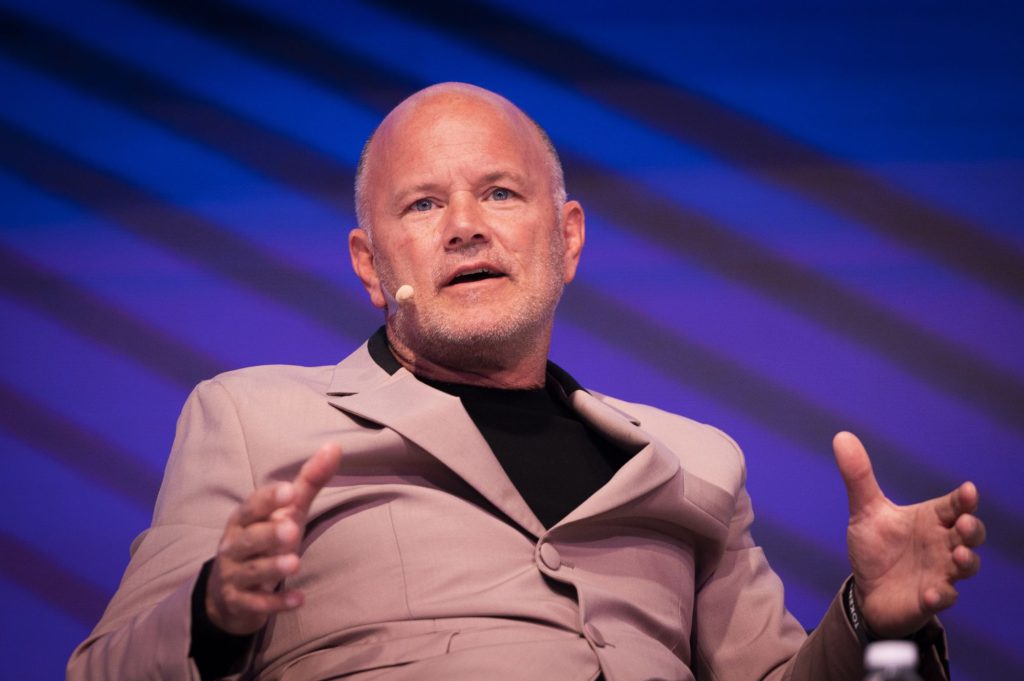
Novogratz’s Galaxy Digital Discloses FTX Exposure

(Bloomberg) — Galaxy Digital Holdings Ltd., the crypto financial services firm founded by billionaire Michael Novogratz, disclosed $76.8 million exposure to the collapsed exchange FTX.com and expects more challenging industry environment in the weeks ahead from the turmoil. 

Galaxy, which uses FTX.com to hold assets, said of its exposure, $47.5 million worth of assets is currently in the withdrawal process, the company disclosed in its third-quarter results. FTX halted withdrawals Tuesday, citing a liquidity crunch, and agreed to a buyout offer from Binance Holdings. 

Galaxy’s net comprehensive loss was $68.1 million, compared to a $517.9 million gain in the year-ago period, primarily due to unrealized losses on investments, driven by reduced valuations under external market conditions. Co-President Damien Vanderwilt will step down in mid-January, becoming a senior advisor and board director. 

On the fallout from FTX.com, “we are going to have to be nimble and agile for the next 2-to-12 weeks as this digests, and people really make sense of what happened,” Novogratz said during a conference call. He expects crypto prices will no longer driven by events like FTX and will be back to being correlated to macro market conditions “within a quarter.”

Assuming the Republican takes control of the US House of Representatives after the mid-term election, he expects “a much more aggressive Congress when it comes to the SEC, the CFTC,” Novogratz said.   

Galaxy said it maintained a liquidity position of $1.5 billion as of September. That includes $1 billion in cash.

Galaxy planned to cut about 15% of its headcount. He doesn’t expect that to change due to the fallout from FTX.com, Novogratz said on the call. The New York-based company had 395 employees globally as of the end of the third quarter. 

The crypto industry has been grappling with renewed turmoil in the wake of a plunge in token prices in the spring. Prices have tumbled this week as the failure of FTX increased concern that there is more trouble brewing within the industry and among some of its top players, following widespread layoffs and earlier bankruptcies of major firms including Three Arrows Capital, Voyager Digital and Celsius Network.


Galaxy’s mining unit incurred a net comprehensive loss of $34.9 million in the quarter, citing increased operating expense, against the backdrop of its largest third-party hosting provider reducing capacity due to market conditions, rising energy prices and constrained access to capital markets. 

Shares of Galaxy slumped 14% to $2.97 as of 9:33 a.m. in New York. They’ve dropped around 84% this year. 

(Adds Novogratz commentary from earnings call.)

More stories like this are available on bloomberg.com

©2022 Bloomberg L.P.
IBM Held Talks With Biden Administration on Quantum Controls

(Bloomberg) — International Business Machines Corp. has engaged in talks with the Biden administration on potential export controls for quantum computers as the company continues investing in the emerging technology.

IBM recommended that any regulations, if developed, cover potentially problematic uses of quantum computing rather than limiting the technology based simply on processing power, said Dario Gil, head of IBM Research. Quantum technology will likely be subject to constraints like export controls, Gil said. “We will continue to be an active participant in that dialogue,” he said.

Quantum computing is an experimental field with the potential to accelerate processing power and upend current cybersecurity standards. The Biden administration is exploring the possibility of new export controls that would limit China’s access to quantum along with other powerful emerging technologies, Bloomberg News reported last month.

IBM has installed quantum infrastructure in countries like Germany and Japan, but not China, Gil said. Big Blue has invested millions in the field, and is unveiling a new quantum processor this week that is more than three times more powerful, measured by qubits, than its version announced last year. 

In October, US President Joe Biden toured IBM’s quantum data center in Poughkeepsie, New York, saying the technology is “vital to our economy and equally important to our national security.” National Security Advisor Jake Sullivan said in September that quantum and other emerging technologies will have “an outsized importance over the coming decade,” adding that export controls could be used to maintain US advantages in the area.

IBM under Chief Executive Officer Arvind Krishna has been increasingly acquisitive, buying companies like Red Hat to bolster the company’s offerings in artificial intelligence. IBM has also invested in quantum startups such as Quantinuum, and future acquisitions in the industry are possible, Gil said.

The first real-world applications for quantum computing will likely be in the industrials sector — such as advanced simulations to develop a corrosion-resistant airplane wing — or in financial modeling, Gil said, noting that banks including Goldman Sachs Group Inc. are part of IBM’s network of partners. Quantum systems could be used in business within the decade, while the first demonstrations of superiority to traditional computers could happen within a “couple years,” Gil said.

Microsoft Corp., Alphabet Inc.’s Google and Intel Corp. are among the other companies devoting millions of research dollars to various quantum projects.

–With assistance from Ian King.

More stories like this are available on bloomberg.com

©2022 Bloomberg L.P.

Binance’s Zhao Says No ‘Master Plan’ for Takeover of FTX

(Bloomberg) — Binance Chief Executive Officer Changpeng “CZ” Zhao said in a memo to employees that there wasn’t a “master plan” to take over FTX.com and the collapse of the rival crypto exchange “is not good for anyone in the industry.”

Zhao stunned the crypto world on Tuesday with an announcement that his firm was moving to take over Sam Bankman-Fried’s FTX.com, which suffered a liquidity crunch after Zhao announced that he was selling a $530 million holding of FTX’s native token. The letter of intent signed is a non-binding agreement. Terms haven’t been disclosed.

“It was less than 24 hrs ago that SBF called me. And before that, I had very little knowledge of the internal state of things at FTX,” Zhao wrote in the memo sent Wednesday, which was obtained by Bloomberg News. “I was surprised when he wanted to talk. My first reaction was, he wants to do an OTC deal… But here we are.”

Zhao noted that “due diligence for the deal is on-going,” and reminded employees not to trade the FTT token. He also told employees not to comment on the transaction.


“Do not view it as a ‘win for us’,” Zhao said. “User confidence is severely shaken. Regulators will scrutinize exchanges even more. Licenses around the globe will be harder to get. And people now think we are the biggest and will attack us more.” 

More stories like this are available on bloomberg.com

©2022 Bloomberg L.P.

JLR Owner Posts Lower-Than-Expected Loss as Output Ramps Up

(Bloomberg) — Jaguar Land Rover’s Indian parent posted a lower-than-expected loss as an increase in production boosted the automaker that’s looking to tide over lingering semiconductor shortages by signing supply pacts with chip companies.

Mumbai-based Tata Motors Ltd.’s loss narrowed by 79% to 9.45 billion rupees ($116 million) for the three months ended Sept. 30, it said in an exchange filing Wednesday. The average analyst estimate was for a 10.92 billion-rupee loss, according to data compiled by Bloomberg. Revenue rose 30% to 796.1 billion rupees, beating estimates, while total costs surged 25%. 

Jaguar Land Rover’s revenue jumped 36% to £5.26 billion ($6 billion) and quarterly loss before tax pared to £173 million from a year ago. The British marque’s production and sales volumes are forecast to improve in the months to March and free cashflow may approach breakeven for the full financial year.

“Demand for our most profitable and desired vehicles remains strong and we expect to continue to improve our performance in the second half of the year, as new agreements with semiconductor partners take effect, enabling us to build and deliver more vehicles to our clients,” Thierry Bollore, JLR’s chief executive officer, said in the post-earnings statement. 

The earnings show how Tata Motors is working through supply snarls that have crimped output across the global car industry. The recent virus-related lockdowns in China have also curtailed car production and dampened sales, mounting more challenges for automakers that are already facing inflation and risks of a recession. 

‘Better Visibility’

To tackle these headwinds, Jaguar Land Rover is signing long-term agreements with chip suppliers to stem the shortages that have hobbled the automaker. These pacts will give the company “better visibility” on supplies, the company said. 

In a separate statement Wednesday, Jaguar Land Rover announced a strategic partnership with Wolfspeed Inc. for the supply of silicon carbide semiconductors that is “integral to electrification” of its next generation models.

The production ramp up of New Range Rover and New Range Rover Sport improved with wholesales of 13,537 units during the quarter, up from 5,790 units in the previous quarter.

Its parent, Tata Motors, raised the price of passenger vehicles by 0.9% on average earlier this month in a bid to offset the elevated input costs and protect its margins. 

Strong Demand

Despite this, demand for Tata Motors said in the filing that demand for its passenger vehicles is likely to remain strong but may taper a bit after the festive season. The parent’s global wholesales of passenger vehicles in the second quarter rose 43% to 232,750 units from a year earlier.

Tata Motors, which dominates India’s electric-car market, aims to roll out 10 electric vehicles by 2026 and launch a battery-powered hatchback at a price below 1.25 million rupees in the cost-conscious Indian market. Its electric-vehicle unit attracted investments from a TPG fund and other investors last year.

The company aims to close the Sanand plant acquisition from Ford Motor Co. by early 2023, Tata Motors’ Chief Financial Officer P.B. Balaji said in the earnings call.

Tata Motors to Delist American Depositary Shares After January

Some challenges continue for the Indian automaker whose shares have slipped almost 10% this year while the broader market benchmark S&P BSE Sensex has climbed. 

Jaguar Land Rover’s wholesale volume of 75,307 units during the quarter missed its guidance of 90,000 units due to supply problems. 

“The global markets are volatile, therefore, we will watch it cautiously,” Balaji said. “Our entire focus is on ramping up supplies.”

–With assistance from Siddharth Philip.

(Updates with details throughout.)

More stories like this are available on bloomberg.com

©2022 Bloomberg L.P.
World-Beating Abu Dhabi Stocks Are About to Get Their First ETF

(Bloomberg) —

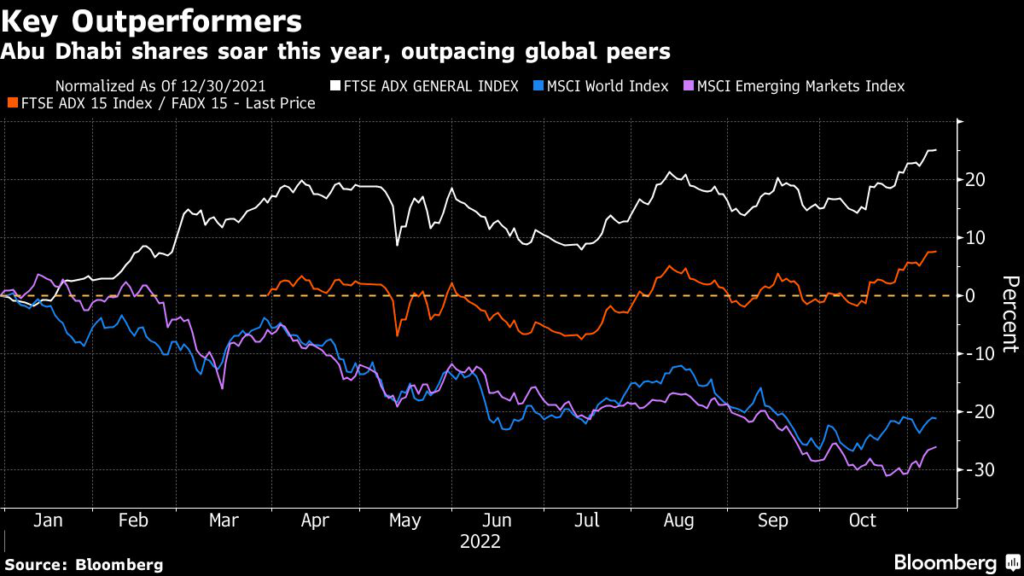
Abu Dhabi is about to get its first ETF tracking the oil-rich emirate’s own world-beating stocks.

Chimera Capital will run the Chimera FTSE ADX 15 ETF, following the 15-biggest listed companies on the Abu Dhabi stock exchange and replicating the FTSE ADX 15 Index.

The FTSE ADX 15 Index is up 7.6% since its inception in March, outperforming developed and emerging markets during that period. The broader benchmark FTSE ADX General Index is up 25% this year in dollar terms, the most among 92 global benchmarks tracked by Bloomberg, aside from those in Turkey and Lebanon. A listings boom and elevated oil prices have buoyed the market, although an 168% surge by International Holding Co. accounts for much of the rally.

The firm is part of a business empire overseen by Sheikh Tahnoon Bin Zayed, the national security adviser to the United Arab Emirates and a brother of the Gulf nation’s president. The ETF is set to include IHC and First Abu Dhabi Bank PJSC — two companies also chaired by Sheikh Tahnoon — along with Emirates Telecommunications Group Co. PJSC and Alpha Dhabi Holding PJSC.


While the Middle East’s exchange-traded funds industry remains in its infancy, Chimera Capital’s new ETF will bring the total developed by the firm to 10. It has funds passively tracking stocks listed in countries including Saudi Arabia and the US. 

The initial offer period for Chimera’s latest ETF is planned for Nov. 21 to Nov. 23, at a subscription price of 3.67 dirhams ($1) per unit. The listing is expected on Nov. 24.

More stories like this are available on bloomberg.com

©2022 Bloomberg L.P.

Close Bitnami banner
Bitnami
