Bloomberg

Stocks Push to Fresh Session Highs, Yields Slide: Markets Wrap

(Bloomberg) — US stocks rallied amid a revival in risk sentiment with Treasury yields easing and the dollar falling as Americans vote in midterm elections.

The S&P 500 extended gains into a third day. The tech-heavy Nasdaq 100 and the blue-chip Dow Industrial Average outperformed, rising more than 1%. The yield on two-year Treasuries, more sensitive to Federal Reserve policy changes, shed 5 basis points, while dollar fell against most of its major counterparts. 

A history of robust performance following midterm results has helped buoy optimism about the outlook for equity markets. While polls suggest Republicans could make gains, thereby placing a check on Democratic policies, there are multiple scenarios. The best outcome for Treasuries could be a Republican control of both the House of Representatives and Senate, while the dollar could find support should Democrats keep both chambers.

Read more on elections:

Elections Latest: Polls Open With Senate Control Up for Grabs

Deeply Divided America Votes Amid Inflation Fears, Culture Wars

Here Are Key Races to Watch Hour by Hour as Midterm Voting Ends

Still, for many the biggest headwind for markets is the Fed’s monetary tightening with Thursday’s consumer-price-index data the next event risk coming on the heels of core consumer prices rising more than forecast to a 40-year high in September. Even if prices begin to moderate, the CPI is far above the Fed’s comfort zone. 

Going forward, though, there may be a silver lining in gridlock for policy makers, according to Art Hogan, chief market strategist at B. Riley Wealth. 

“Divided government, particularly leading into a presidential election, will most likely create a standstill where very little gets done,” Hogan wrote. “That’s probably a good thing for the Fed because various stimuli have not made their work easier.”

Treasuries rallied across the board Tuesday, with the benchmark 10-year rate dropping as much as 7 basis points. Meanwhile, traders shaved bets on rate hikes, with swaps markets still leaning toward a 50 basis-point Fed rate increase in December. More notable moves were further out, with the peak reaching just above 5% in the first half of 2023.

Nvidia Corp. climbed as it began producing a processor for China. Take-Two Interactive Software Inc. fell after reducing its forecast for net bookings.

Europe’s Stoxx 600 rallied, after a weak open. Chinese equities halted a rally as traders considered a jump in virus infections and official comments defending Covid Zero.

Key events this week:

  • US midterm elections, Tuesday
  • EIA oil inventory report, Wednesday
  • China aggregate financing, PPI, CPI, money supply, new yuan loans, Wednesday
  • US wholesale inventories, MBA mortgage applications, Wednesday
  • Fed officials John Williams, Tom Barkin speak at events, Wednesday
  • US CPI, US initial jobless claims, Thursday
  • Fed officials Lorie Logan, Esther George, Loretta Mester speak at events, Thursday
  • US University of Michigan consumer sentiment, Friday

Some of the main moves in markets:

Stocks

  • The S&P 500 rose 0.9% as of 11:10 a.m. New York time
  • The Nasdaq 100 rose 1.2%
  • The Dow Jones Industrial Average rose 1.2%
  • The Stoxx Europe 600 rose 0.7%
  • The MSCI World index rose 1.1%

Currencies

  • The Bloomberg Dollar Spot Index fell 0.5%
  • The euro rose 0.5% to $1.0073
  • The British pound rose 0.4% to $1.1565
  • The Japanese yen rose 0.9% to 145.36 per dollar

Cryptocurrencies

  • Bitcoin fell 3.1% to $20,048.55
  • Ether fell 3.3% to $1,523.81

Bonds

  • The yield on 10-year Treasuries declined six basis points to 4.15%
  • Germany’s 10-year yield declined seven basis points to 2.27%
  • Britain’s 10-year yield declined seven basis points to 3.57%

Commodities

  • West Texas Intermediate crude fell 0.4% to $91.46 a barrel
  • Gold futures rose 2.2% to $1,717.10 an ounce

–With assistance from Jan-Patrick Barnert, Haidi Lun, Brett Miller, Srinivasan Sivabalan and Emily Graffeo.

More stories like this are available on bloomberg.com

©2022 Bloomberg L.P.

Mobile Operator Veon Close to Picking Buyer for Pakistan Towers

(Bloomberg) — Wireless operator Veon Ltd. is in advanced talks to sell its tower assets in Pakistan.

Veon has 10,000 to 12,000 towers in Pakistan and the sale process “is very close to conclusion,” Chief Executive Officer Kaan Terzioglu said in an interview. “The value of a tower is somewhere between $60,000 to $80,000 depending on interest rates,” Terzioglu said, implying a valuation range between $600 million and $960 million.

A Saudi Telecom Co. unit, a consortium between Pakistan’s TPL Corp. and UAE-based TASC Towers, and Pakistani conglomerate Engro are among the bidders for the assets, according to people familiar with the matter who spoke on condition of anonymity as the tender is private. 

Spokespeople for Saudi Telecom and Veon declined to comment. The TPL-TASC consortium and Engro didn’t immediately respond to a request for comment. 

In September, Pakistan’s TPL said it formed a strategic partnership with TASC to bid for an unidentified telecom tower company. 

Veon was founded in Moscow in 1992 as VimpelCom, one of Russia’s first cellular-phone providers. It has grown into a Dutch-domiciled telecommunications giant with more than 217 million customers in nine countries, although Russia still accounts for about half of its revenue. 

The firm said this month it has started the process of selling its Russian unit in an attempt to limit the fallout from the war in Ukraine, where it is the country’s biggest mobile operator. 

Last year, Veon sold more than 15,000 towers in Russia for around $970 million to Service-Telecom LLC. It has about 30,000 more towers to sell, Chief Executive Officer Kaan Terzioglu told Bloomberg News in August.

Read: Russia Wireless Operator Faces Future Where Its Roots Mean Less

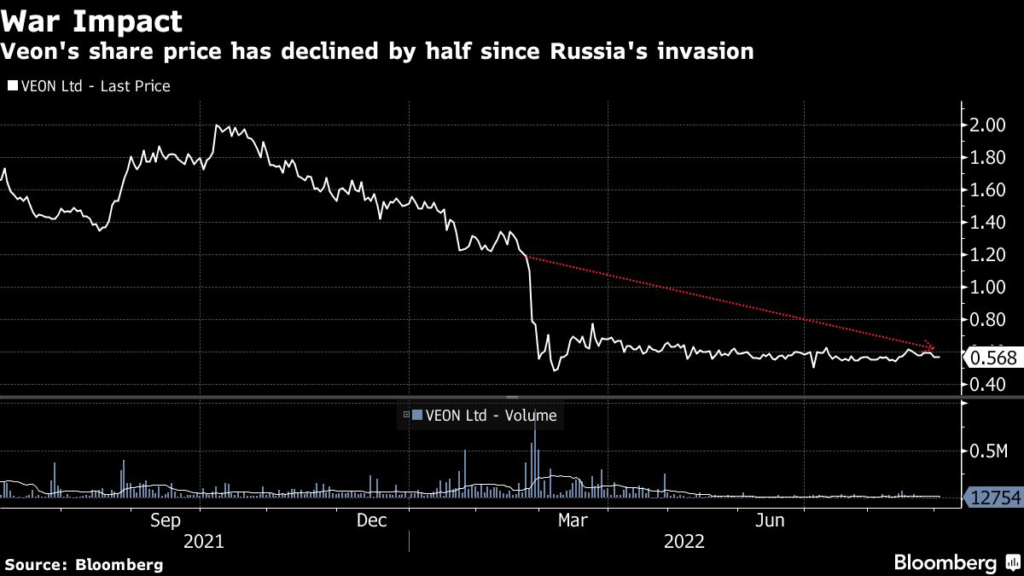
Veon’s share price has fallen by two-thirds this year as the invasion and subsequent sanctions on Russia by the US, European Union and UK undermined the company.

LetterOne Investment Holdings, founded by Russian billionaire Mikhail Fridman, owns 48% of Veon, according to data compiled by Bloomberg. Fridman was sanctioned by both the EU and the UK earlier this year, and stepped down from the boards of Veon and LetterOne.

–With assistance from Matthew Martin.

More stories like this are available on bloomberg.com

©2022 Bloomberg L.P.

COP27 Latest: Pakistan’s PM Sharif Warns of Climate ‘Debt Trap’

(Bloomberg) — South Africa’s President Cyril Ramaphosa said more climate funding needs to come in the form of grants and concessional loans, to avoid the continent ramping up debt.

Ramaphosa called on multilateral development banks to change their approach to climate finance, saying support is out of reach for most of the world’s population. The institutions are “risk averse” and their funding offers “carry onerous costs,” he said at the COP27 conference in Egypt.

Earlier, Polish President Andrzej Duda stressed the importance of energy security as the world grapples with higher prices.

“The transition is there to serve man, not the man to serve the transition,” he said.

More than 100 world leaders are set to be in Sharm el-Sheikh over the next two weeks for the UN’s annual climate talks. They’re attempting to maintain momentum in the battle to curb planet-warming emissions.

This year, delegates are aiming harsh criticism at each other over issues ranging from climate reparations to funding for mitigation and adaptation in poorer countries.

Rising energy prices, accelerated by Russia’s war in Ukraine, have led many governments to prioritize security of supply over the transition to cleaner energy since the last COP summit in Glasgow.

German Chancellor Olaf Scholz, France’s Emmanuel Macron and British Prime Minister Rishi Sunak were among the biggest names to speak on Monday. US President Joe Biden and Brazil’s President-elect Luis Inacio Lula da Silva are due to appear later on.

The most notable no shows are China’s Xi Jinping and India’s Narendra Modi, leaders of the world’s largest and third-largest emitters.

Highlights:

  • Highlights from Monday
  • Is the 1.5C warming goal dead?
  • EU’s Von Der Leyen warns of climate ‘highway to hell’
  • UK firms face new requirements to back up climate claims
  • Africa to expand the use of carbon offsets
  • Methane cloud spotted near New Mexico coal mine
  • South Africa launched an $8.5 billion plan to shift from coal to green energy

Here are the latest developments. All times Egypt.

Oman Wants to Be the Middle East’s Hydrogen Hub (5:46 pm)

Oman will be able to produce one to two million tons of green hydrogen by 2030 using the country’s solar and wind capabilities, roughly equivalent to a 10th of the EU’s future demand, according to Energy Minister Salim Al-Aufi. The country wants to reach net zero by the middle of the century, including a 50% reduction of net emissions by 2040, he said in an interview. The country will still have a prominent oil and gas sector, though, meaning it will have to rely on carbon capture and storage.

“Everybody thinks that the Middle East is not responsive enough, is not taking actions on climate change,” he said. “It’s completely the opposite. We’re taking bold decisions.”

NATO Must Tackle Security Impact of Climate Change, Stoltenberg Says (4:53 pm)

Jens Stoltenberg, secretary general of NATO, said the military alliance must address the link between climate change and security. “Climate change creates conflicts, it exacerbates conflicts,” Stoltenberg said in a video linkup.

Climate change increases competition over scarce resources and impacts military operations as forces have to adapt to more extreme weather, Stoltenberg said. He added that armed forces have to be part of efforts to reduce greenhouse gas emissions.

Pakistan PM Says a Goal on Adaptation Needs to Be Prioritized (4:30 pm)

Pakistan Prime Minister Shehbaz Sharif called on rich countries to help fund the works needed to rebuild the country in a way that doesn’t throw it into a “financial debt trap.”

Pakistan will continue its plan to move toward eliminating net emissions once it recovers from the devastating rains that flooded a third of the country and were responsible for hundreds of deaths earlier this year, he said in a speech at the UN climate talks.

“The priority of Pakistan has never been clearer – a goal on adaptation needs to be prioritized in terms of financing and timelines,” Sharif said. “Climate finance must be clearly defined, with new additional and sustained resources through a clear mechanism that meets the needs of developing countries with the speed and scale that’s required.”

Germany Highlights CO2 Neutral Progress in Response to Gas Criticism (4:15 pm)

German Chancellor Olaf Scholz responded to criticisms that his country is only using Africa for its gas needs.

“Now in the crisis, when no more gas from Russia is available, we have tapped new resources and will succeed in becoming independent of it by 2045,” he said at the UN climate talks.

“Germany is a gas country and a country that has made the most progress towards CO2 neutral production. If we have set ourselves such a big goal of ensuring that steel and chemicals are produced in a different way, then that is our big contribution to the goal of stopping man-made climate change.”

Von Der Leyen Says Developing Countries and EU Must Avoid ‘Highway to Hell’ (2:00 pm)

European Commission President Ursula Von Der Leyen called on developing countries to “team up” with the trade bloc by providing it with the clean energy sources it needs to meet its green goals and cut its dependence on Russian fossil fuels. She also called on high-emitting countries to step up their climate ambitions.

“Let us not take the highway to hell,” she said. “Let’s earn the clean ticket to heaven.”

Asian Infrastructure Bank Says Gas Has a Transition Role (1:30 pm)

Natural gas will play a role during the green transition in developing countries and the Asian Infrastructure Investment Bank will fund such projects if they’re in line with keeping global warming to 1.5 degrees, according to Vice President Danny Alexander.

The context in the developing world is different to the context in Europe, Alexander said in an interview. “We have have to be responsive to where our clients actually are and help to move them in the right direction to whichever tool is most suited to their circumstances.”

Alexander rebuffed calls from developing nations and small island states for multilateral development banks to be reformed to provide more and easier climate finance. He said it was more a question of scaling up private sector finance.

Carney Sees ‘Wall of Opportunity’ in Energy Markets (12:00 pm)

Renewable-energy assets are primed for an era of growth, emerging as the answer to both energy security risks and climate change, according to Mark Carney, the former Bank of England governor.

There’s currently a “wall of opportunity” in the renewable energy market, Carney, who co-chairs the Glasgow Financial Alliance for Net Zero, said in an interview with Bloomberg TV.

“A lot of the answer to energy security problems that have been exposed by Russia’s illegal war have to do with sustainability,” he said. “That’s why you’ve seen a five-fold increase in the ambition in the European Union for this decade. That’s why you’ve seen the big roll-out with the Inflation Reduction Act in the United States.”


Funding for ‘Bottom-Up’ Climate Action in the US Launched (11:27 am)

The US State Department and Bloomberg Philanthropies announced a new $3 million initiative to help cities, states and other regional entities steer toward net-zero goals.

The program, dubbed SCALE, or Subnational Climate Action Leaders’ Exchange, is being established with a contribution of $1.5 million each. It will start by focusing on implementing the Global Methane Pledge, a commitment by more than 120 nations to cut emissions of the potent greenhouse gas 30% by 2030.

“The federal government has, many times, been asleep at the wheel,” said Michael Bloomberg, the UN secretary-general’s special envoy for climate ambition and solutions. Even so, a coalition of cities, states, businesses tribal nations and other institutions “showed the world the American people remain committed to fighting climate change.”

Michael Bloomberg is founder and owner of Bloomberg LP, parent of Bloomberg News.

South Africa’s Ramaphosa Wants Change to Lending Approach (11:50 am)

South Africa’s President Cyril Ramaphosa called on multilateral development banks to change their approach to climate finance, decrying the failure to live up to promises to boost funding for climate adaptation and mitigation.

Multilateral support is out of reach for most of the world’s population, he said in a speech. The institutions are “risk averse” and their funding offers “carry onerous costs.”

More funding needs to come in the form of grants and concessional loans, he said.

Senegal’s Sall Urges Nations to Honor Funding Pledges (11:15 am)

African Union Chairman and Senegalese President Macky Sall called on rich nations to honor their pledges to finance African countries vulnerable to climate change, rather than giving loans to the already heavily-indebted nations.

“Developing countries are currently funding most of their climate change projects by taking on debts, when they should be receiving funding from what we have together agreed,” Sall said in a speech. “We are funding our own adaptation efforts when we the victims, which means we are being doubly punished and we are not ready to put up with that.”

“We are in favor of reduction of greenhouse-gas emissions,” he said. “But we Africans cannot accept that our vital interests be ignored as we undergo this energy transition. We are low emitters, however, we are the most vulnerable to loss and damage triggered by climate change.”

Poland Says Energy Transition Must Serve ‘Security’ (11:29 am)

Polish President Andrzej Duda used his plenary speech to stress the importance of energy security as the world grapples with higher prices.

“The transition is there to serve man, not the man to serve the transition,” he said. “People are going to ask why the energy is so expensive. The transition has to serve energy security.”

Poland is the biggest coal producer in the European Union. It’s another example of an important theme in Sharm el-Sheikh: the idea that the transition can’t come at the expense of security of supply. Others argue that’s a false choice and cheaper renewables are the answer to the energy crunch.

Duda, one of Ukraine’s staunches allies, also took the opportunity to blame Russia’s aggression for the global energy crisis.

Botswana President Wants End to Project Financing (11:27 am)

Botswana’s President Mokgweetsi Masisi called for an end to project-based climate adaptation funding, saying that the scale of the challenge necessitated direct contributions to national treasuries.

Masisi’s words echoed pronouncements made by politicians from South Africa to Barbados for a rethink on how climate finance is channeled to the developing world.

China to Working on Tighter Climate Laws (11:00 am)

China is pushing forward amendments to national laws to help cut carbon emissions, Wang Yi of the Chinese Academy of Sciences said.

There could be changes to 20-30 laws in China, with work accelerating after the people’s congress in March next year, he said.

Irish PM Calls for New Financial Tools (11:00 am)

Adaptation to climate change requires new tools for helping countries deal with weather disasters, Ireland’s Prime Minister Micheal Martin said in an interview on Bloomberg TV.

“Along with all of the measures we must take to reduce emissions, we also now have to look at adaptation, and create financial instruments in terms of dealing with catastrophic risk,” he said.

African Nations to Expand Local Carbon Markets (10:30 am)

A group of African countries including Kenya, Malawi, Gabon, Nigeria and Togo, together with Standard Chartered, are backing a new initiative to “dramatically expand” the use of carbon offsets on the continent.

It aims to produce 300 million credits annually by 2030, and 1.5 billion by 2050. Each credit will represent a metric ton of reduced, removed or avoided greenhouse gas emissions. Even 75 million credits would be double the total number issued across the entire of Africa in 2021.

World Bank to Launch Climate Fund for Poorer Nations (10:00 am)

World Bank President David Malpass will on Tuesday unveil a fund aimed at helping developing countries to cope with climate change.

It’s “a big trust fund” called SCALE, Malpass said in an interview with Bloomberg TV. “I think of it as a giant resource need that can be filled by grants from the advanced economies.”

Poor nations are struggling with a confluence of challenges, from rising prices and interest rates to the effects of climate change to a shortage in fertilizer, he said. He added that Russia’s invasion of Ukraine has exacerbated the problems.

Greece Targets Role as Europe’s Green Power Hub (9:35 am)

Greece wants to become a net exporter of renewable electricity to the rest of Europe, Prime Minister Kyriakos Mitsotakis said.

The nation is backing a plan to build cables that will bring green power to Europe via the country from Egypt and the Middle East. If such a project is successful, it would go some way to help the European Union boost supplies as everything from transport to heavy industries will use more electricity in the future.

UAE and Egypt Ink Pact for 10GW of Solar Power (9:30 am)

Egypt and the United Arab Emirates have signed a deal to develop 10 gigawatts of onshore wind power in Egypt. Abu Dhabi-based renewable energy firm Masdar is leading consortium to build the plant.

UAE President Mohammed bin Zayed and Egyptian counterpart Abdel-Fattah el-Sisi attending the signing.

EU Signs Forest Partnership with Five Countries (9:00 am)

The European Union signed a memorandum of understanding to help preserve forests in Guyana, Mongolia, the Republic of Congo, Uganda and Zambia. The bloc is set to pass legislation banning the import of products whose manufacture causes deforestation. But its demand for rubber has been criticized by non-profit organizations for contributing to trees being cut down in Africa.

Read more: Europe’s Rubber Addiction Destroys Africa’s Tropical Forests

Apple, Pepsi Join Promise to Buy Near-Zero-Carbon Metal (8:45 am)

PepsiCo, Apple and Rio Tinto are among the newest members of a corporate buyers club that has committed $12 billion to purchasing near-zero-carbon steel, aluminum and other products. Members hope to create greener supply chains and accelerating the production of clean technology.

The First Movers Coalition is also growing with new corporate pledges from companies such as automaker General Motors and Swedish power provider Vattenfall to buy next-level-green cement and concrete — at least 10% of their needs in 2030.

Taiwan’s Gogoro Sees India as ‘Holy Grail’ for EV Technology (8:27 am)

Taiwanese startup Gogoro sees huge scale for its battery-swapping technology in India, joining the race to get a slice of an electric vehicle market which is expected to reach 400 times its current size by the end of the decade.

“India represents the holy grail,” said Horace Luke, the chief executive officer, said to Bloomberg TV. The electric-scooter and battery-swapping-station maker is going to get its technology “honed, fine-tuned and calibrated to the India condition.”

Countries Set to Bolster Global Methane Pledge at Climate Summit (8:00 am)

The EU and US put methane on the map at COP26 in Glasgow — declaring the potent greenhouse gas a threat to Paris Agreement temperature goals and insisting emissions of it must be slashed 30% by 2030.

In the year since, European countries and the US have successfully encouraged more than 120 countries to sign on to a formal methane-cutting pledge, and at Sharm El-Sheikh, about 40 of them are set to outline their plans for doing so, according to a senior State Department official.

PwC Says Emissions Reductions Must Speed Up (7:15 am)

The goals set at the 2021 COP summit in Glasgow aren’t being met fast enough, according to PwC Chairman Bob Moritz.

“We sit at the table today, a year later, not seeing speed and scale of change” required to meet climate targets, he said to Bloomberg TV. “We need to move much faster. We have a long way to go.”

According to the accounting and consulting firm’s own analysis, emissions reductions globally have to happen 11 times faster than what’s been the case in the past two decades.

Japan Delays Carbon Tax Reform (4:00 am)

Japan is delaying plans to revise how it taxes carbon, the Nikkei newspaper reported, potentially slowing efforts to wean the country off fossil fuels.

The government will postpone the introduction of a new carbon tax that was planned for the fiscal year starting April 2023, the Nikkei said Tuesday without attribution. Policy makers decided it would add to already surging living costs, it said.

It’s at least the second time the changes have been pushed back. The environment ministry had requested the introduction of a more substantial carbon levy in the previous annual tax revisions, but the government backed away amid industrial protests.

Banks Fall Dangerously Short of Pledges in New Net-Zero (2:01 am)

Most banks that have published net-zero emissions targets are failing to live up to those commitments, according to a fresh study by ShareAction.

The majority of the 43 largest financiers of fossil fuels in the Net Zero Banking Alliance “have climate targets that fall short of what’s needed to prevent the worst impacts of climate crisis,” the nonprofit said Tuesday. Only 16% of the banks analyzed have set interim, overarching net-zero goals, ShareAction concluded.

UK Firms Face New Requirements to Prove Climate Claims (2:01 am)

The UK is set to require companies to provide granular details to back up their decarbonization claims, under a fresh proposal intended to stamp out greenwashing. 

The government-backed Transition Plan Taskforce is seeking feedback on its disclosure framework, which requires firms to produce evidence of “concrete” short-term action taken to reduce their carbon footprints, according to a statement on Tuesday. 

–With assistance from Alfred Cang, Stephen Stapczynski, John Follain, Paul Tugwell, Laura Millan Lombraña, David Malingha, Alastair Marsh, Yousef Gamal El-Din and Francine Lacqua.

More stories like this are available on bloomberg.com

©2022 Bloomberg L.P.

Meloni Government Weighs Options for Debt-Ridden Telecom Italia, Including a Takeover

(Bloomberg) — Italian government officials are reviewing options for Telecom Italia SpA including a possible state-backed takeover bid, as Giorgia Meloni’s administration looks to set a policy for shoring up the debt-ridden phone carrier. 

The government is expected to accelerate turnaround efforts for the company, which issued three profit warnings last year and has lost ground in its home market to low-cost rivals. But leaders including Meloni and Finance Minister Giancarlo Giorgetti have not yet made a decision on their exact approach, according to people familiar with the matter.

The so-called Project Minerva initiative, developed by Meloni’s Brothers of Italy party before the September elections, calls for Italy to first take over Telecom Italia and then combine it with smaller rival Open Fiber SpA.

The goal would be to retain control of the former phone monopoly’s network after disposals and use the cash raised to reduce the company’s debt pile. 

Telecom Italia shares trimmed their earlier declines following the Bloomberg report. 

Meloni’s government shares the goal of Italy’s previous government, led by Mario Draghi, of creating a single national network to help speed the digitalization of the country. 

Meloni Party Plan

But under her party’s plan, drawn up by undersecretary for technological innovation Alessio Butti, state lender Cassa Depositi e Prestiti SpA would bid for all of Telecom Italia rather than just buying its landline network to combine with Open Fiber’s. Cassa Depositi owns nearly 10% of Telecom Italia and controls Open Fiber. 

Representatives for Italy’s government, Cassa Depositi, Telecom Italia and Open Fiber each declined to comment. 

If Meloni goes ahead with the new project, Italy may seek to include international funds including KKR & Co. in a bid, possibly also inviting in Telecom Italia’s top shareholder Vivendi SE, according to the people. KKR already holds a stake in the phone carrier’s Fibercop unit.

Telecom Italia shares have declined about 45% this year, compared with a decline of some 5% for the Euro Stoxx Telecommunications Index. The ex-monopolist, which still needs to deal with its €30 billion ($30 billion) of debt, has lost 1.6% in landline services market share as of last June, according to communications authority Agcom.  

Memorandum of Understanding

As Meloni reviews her options, Telecom Italia is still waiting for a non-binding offer for its network from Cassa Depositi and other investors including KKR and Macquarie Group Ltd, after the deadline for bids under a memorandum of understanding was postponed to the end of this month.  

Still, the network’s value remains a sticking point. Telecom Italia’s advisers initially assessed it at about €20 billion and Cassa Depositi was weighing an offer of around €15 billion to €18 billion. Vivendi has sought about €30 billion for the asset, people familiar with the matter said earlier this year. 

Read more: Italy’s Right Plans Telecom Italia Takeover to Halve Debt

Even before her right-wing coalition won the September general elections, Meloni’s Brothers of Italy party had argued that a takeover of Telecom Italia by Cassa Depositi was preferable to the grid-only option favored by the Draghi government. 

Butti said on Saturday that a plan for the network, which would be controlled by the state, is “a priority.” Vivendi is open to discussions with Rome on creating a single landline network, Bloomberg reported on Sunday.


(Updates with shares in fifth paragraph.)

More stories like this are available on bloomberg.com

©2022 Bloomberg L.P.
US Stocks Push to Session Highs as Yields Slide: Markets Wrap

(Bloomberg) — US stocks gained traction amid a revival in risk sentiment with Treasury yields easing and the dollar falling as Americans vote in midterm elections.

The S&P 500 rose to session highs, extending gains into a third day. The tech-heavy Nasdaq 100 and the blue-chip Dow Industrial Average outperformed. The two-year Treasury yield shed 5 basis points, while dollar fell against most of its major counterparts. 

A history of robust performance following midterm results has helped buoy optimism about the outlook for equity markets. While polls suggest Republicans could make gains, thereby placing a check on Democratic policies, there are multiple scenarios. The best outcome for Treasuries could be a Republican control of both the House of Representatives and Senate, while the dollar could find support should Democrats keep both chambers.

Read more on elections:

Elections Latest: Polls Open With Senate Control Up for Grabs

Deeply Divided America Votes Amid Inflation Fears, Culture Wars

Here Are Key Races to Watch Hour by Hour as Midterm Voting Ends

Sentiment remains fragile with the Federal Reserve’s monetary tightening still the biggest headwind for markets. Thursday’s consumer-price-index data may offer the next cue for traders even as money markets are raising their peak-rate wagers. 

The inflation reading is coming after the core consumer price index rose more than forecast to a 40-year high in September. Even if prices begin to moderate, the CPI is far above the Fed’s comfort zone.

“Inflation is going up. It may be coming down periodically. But it’s going up,” Richard Harris, chief executive of Port Shelter Investment Management, said on Bloomberg Television. “The market is kind of uncertain — it’s hoping for the best but really should be preparing for the worst.” 

Meanwhile, swaps markets are leaning toward a 50 basis-point Fed rate increase in December, after a fourth consecutive jumbo hike to a target range of 3.75% to 4% at last week’s meeting. Rates are expected to peak slightly above 5% around mid-2023. 

JPMorgan Chase & Co.’s Marko Kolanovic warned of the risk to stocks from ongoing Fed hawkishness, and Morgan Stanley’s Mike Wilson said companies will need to aggressively shrink expenses, including through layoffs, before he becomes more optimistic on US equities.

Nvidia Corp. climbed as it began producing a processor for China. Take-Two Interactive Software Inc. fell after reducing its forecast for net bookings. Bitcoin tumbled as part of a crypto selloff.

Europe’s Stoxx 600 rallied, after a weak open. Chinese equities halted a rally as traders considered a jump in virus infections and official comments defending Covid Zero.

Key events this week:

  • US midterm elections, Tuesday
  • EIA oil inventory report, Wednesday
  • China aggregate financing, PPI, CPI, money supply, new yuan loans, Wednesday
  • US wholesale inventories, MBA mortgage applications, Wednesday
  • Fed officials John Williams, Tom Barkin speak at events, Wednesday
  • US CPI, US initial jobless claims, Thursday
  • Fed officials Lorie Logan, Esther George, Loretta Mester speak at events, Thursday
  • US University of Michigan consumer sentiment, Friday

Some of the main moves in markets:

Stocks

  • The S&P 500 rose 0.6% as of 10:30 a.m. New York time
  • The Nasdaq 100 rose 0.7%
  • The Dow Jones Industrial Average rose 0.9%
  • The Stoxx Europe 600 rose 0.6%
  • The MSCI World index rose 0.7%

Currencies

  • The Bloomberg Dollar Spot Index fell 0.3%
  • The euro rose 0.3% to $1.0046
  • The British pound was little changed at $1.1519
  • The Japanese yen rose 0.6% to 145.72 per dollar

Cryptocurrencies

  • Bitcoin fell 6.5% to $19,335.07
  • Ether fell 9% to $1,434

Bonds

  • The yield on 10-year Treasuries declined six basis points to 4.16%
  • Germany’s 10-year yield declined six basis points to 2.28%
  • Britain’s 10-year yield declined six basis points to 3.58%

Commodities

  • West Texas Intermediate crude fell 0.5% to $91.31 a barrel
  • Gold futures rose 1.8% to $1,710.40 an ounce

–With assistance from Jan-Patrick Barnert, Haidi Lun and Brett Miller.

More stories like this are available on bloomberg.com

©2022 Bloomberg L.P.
Robinhood Gave Its Customers Access to IPOs That All Flopped

(Bloomberg) — Robinhood Markets Inc. Chief Executive Vlad Tenev was fielding questions on the company’s latest earnings call when one person asked about a dormant project. 

When, the caller wanted to know, would Robinhood resume letting customers invest in initial public offerings? 

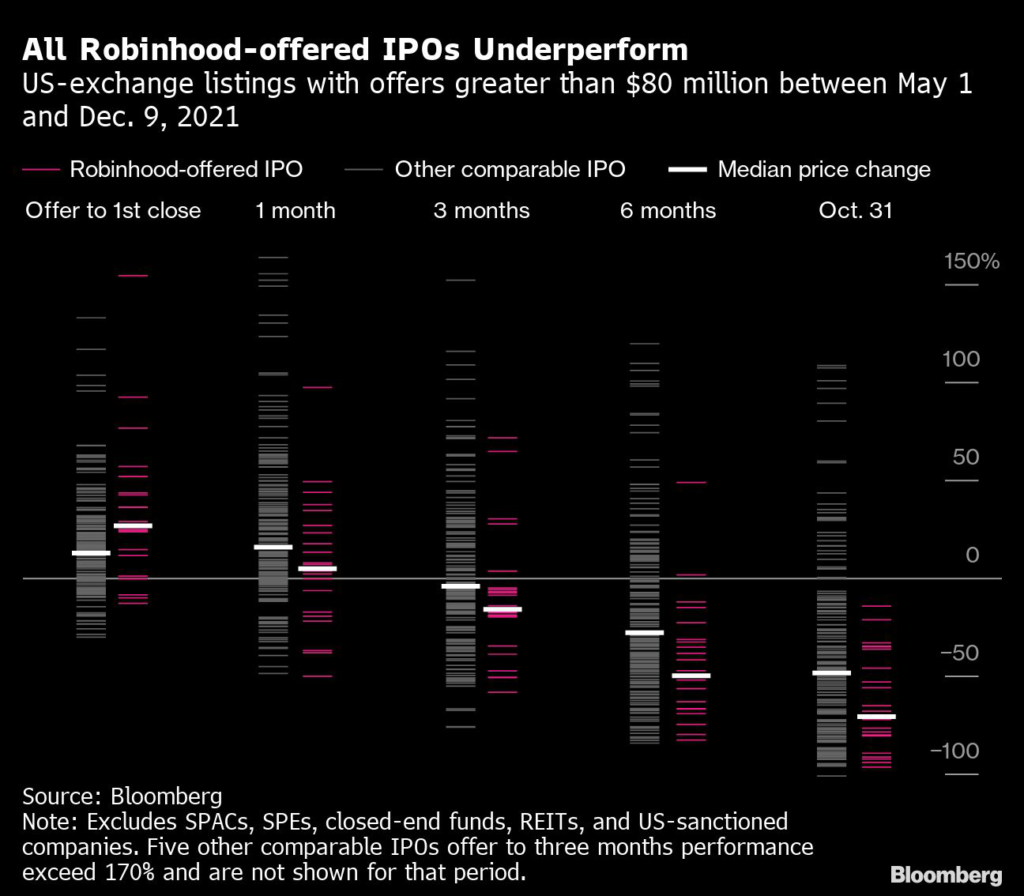
A Bloomberg analysis of the program, IPO Access, suggests it has been a flop for investors so far. 

The initiative, which allowed users to buy shares of buzzy companies like Sweetgreen Inc. and Allbirds Inc. before they debuted on stock exchanges, resulted in losses for customers who still hold the shares. In an already dismal market for IPOs, those offered by Robinhood have performed even worse.

All 23 IPOs that Robinhood opened up to its customers have declined by double-digit percentages since the stocks debuted. Five — Iris Energy Ltd., Sono Group NV, Vaxxinity Inc., Stronghold Digital Mining Inc. and Argo Blockchain Plc — lost at least 89% of their value.

Still, Robinhood is undeterred. 

“As soon as the IPO market turns around and we see more IPOs that meet those criteria, we’re going to be hard at work to bring those to our customers,” Tenev, 35, said on the call.

Robinhood’s own IPO in July 2021 was among those offered to its clients, and it hasn’t gone well. More than 300,000 users bought the shares for $38, and those who held on to their positions have gotten clobbered. The stock tumbled 10% to $10.78 at 10:15 a.m. in New York, extending its decline since the IPO to 72%.

A representative for Menlo Park, California-based Robinhood declined to comment.

While Robinhood signed up millions of new customers during the pandemic lockdowns, many of them novice traders, the firm has struggled to maintain its momentum amid rising interest rates and declines in stocks and cryptocurrencies.

Engagement is slumping. 

The app had 12.2 million monthly active users in September, down by more than a third from a year earlier. Robinhood introduced multiple new features, including a web3 wallet and extended trading hours. The app still earns most of its revenue from trades, and as engagement falters, it faces the challenge of drumming up more activity on the platform.

Robinhood announced two rounds of job cuts this year, dismissing more than 1,000 employees, and plans to shutter seven offices. 

(Updates with stock price in eighth paragraph.)

More stories like this are available on bloomberg.com

©2022 Bloomberg L.P.
Lordstown Motors Gains on $170 Million Foxconn Investment Deal

(Bloomberg) — Lordstown Motors Corp. agreed to sell a substantial stake and give two board seats to manufacturing partner Foxconn Technology Group, replacing a previous arrangement for electric-vehicle production with a new deal.

Foxconn will invest as much as $170 million in the startup through the purchase of preferred stock and 18.3% of common shares, according to a statement late Monday. The transaction will require a review by the Committee on Foreign Investment in the United States.

Lordstown shares pared an early jump Tuesday of as much as 29% to trade up 15% to $2.12 as of 10:00 a.m. in New York. The stock is down about 39% this year. 

The move deepens ties between the two companies, giving Foxconn a sizeable voting interest over the next two years as they pursue a newly announced EV development program together. Lordstown has sought to build its Endurance electric pickup with capital from Foxconn, which has had ambitions to grow in the EV market.

“It’s strengthening the strategic partnership with Foxconn,” Lordstown Chairman Dan Ninivaggi said in an interview. “It’s another step in that direction. It also provides us capital for our jointly developed EV program.”

CFIUS Review

Foxconn, the Taiwanese manufacturer best known as the maker of Apple Inc.’s iPhone, can buy 9.9% of the company without a CFIUS review, but would need US government approval to go beyond that. Assuming the deal is approved, Foxconn could own up to 19.9% of the common voting stock. Even if Foxconn buys more shares, it could not exceed that amount of voting stock, Ninivaggi said.

The first tranche of the share sales is expected to close around Nov. 22 as a second common-share sale is pending subject to a CFIUS review. Foxconn also has a two-year standstill on buying new shares in the open market, and has agreed not to buy more stock without Lordstown’s approval. That effectively means Foxconn would have to reopen negotiations with Lordstown to acquire more stock or eventually take over the company.

Lordstown has built 12 of its first batch of 500 pickups. The rate of production will increase toward end of this month and is expected to total 30 units by end of the year, with the rest built in the first half of 2023, it said. 

The company also is looking for other automakers who want to sell the Endurance under their own brand to get into the electric truck market quickly, Edward Hightower, Lordstown’s president, said on a conference call with analysts.

Foxconn completed a purchase of Lordstown’s Ohio factory earlier this year.

Cash Drain

Separately, Lordstown announced third-quarter results, revealing an operating loss of $154.8 million. It ended the period with cash and short-term investments of $204 million, according to a statement. The company reaffirmed its plan to begin Endurance deliveries in the fourth quarter, with an initial production target of 500 units.

Lordstown’s chief financial officer, Adam Kroll, said the company expects to end the year with between $150 million and $165 million in cash. It ended the third quarter with $204 million in cash and short-term investments. 

(Updates with opening shares in third paragraph; Adds deal terms.)

More stories like this are available on bloomberg.com

©2022 Bloomberg L.P.
Lyft Shares Drop as Active Riders Miss Analyst Estimates

(Bloomberg) — Lyft Inc. slumped the most in six months after reporting weaker-than-expected ridership growth, signaling that it’s losing ground to rival Uber Technologies Inc. in a rocky recovery from the pandemic.

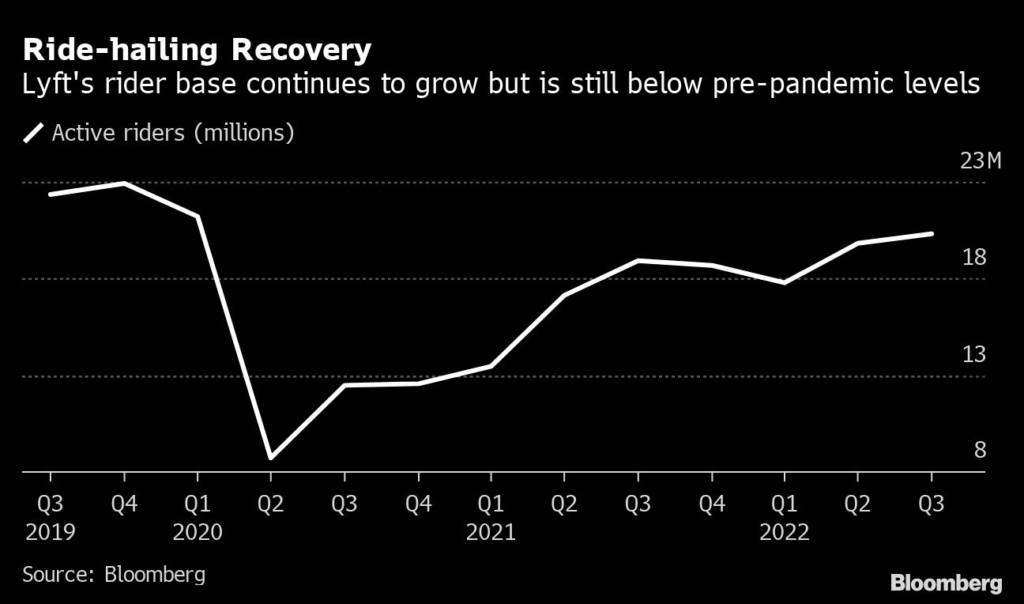
The company recorded 20.3 million active riders in the third quarter, missing an estimate of 21.1 million from a Bloomberg survey of analysts. That remains well below Lyft’s base of 22.9 million active riders at the end of 2019.

The sluggish growth comes in stark contrast to the performance of Uber, which reported last week that its ride-hailing customers had rebounded to pre-pandemic levels. Lyft had warned it was facing challenging conditions in recent days, when it said it would cut 13% of its workforce, nearly 700 people, in its second round of layoffs this year. But the latest results revealed that Lyft is struggling more than investors feared. 

The shares declined more than 18% to $11.45 at 9:43 a.m. in New York Tuesday. 

Lyft posted a net loss of $422.2 million in the quarter, significantly wider than the $159.5 analysts estimated. The deficit was primarily driven by the cost of issuing more stock to its staff, who have seen the value of Lyft shares drop about 70% this year.

The company is “proactively” taking steps to reduce its payroll expenses, Chief Financial Officer Elaine Paul said in a conference call on Monday. That includes shifting hiring toward international markets like Canada and Eastern Europe, where equity is a smaller or nonexistent portion of an overall compensation package.

Even before last week’s layoff announcement, Lyft had been taking steps to cut costs. Earlier this year, the San Francisco-based company slowed recruitment, fired about 60 people and offloaded its rental-car business.

Lyft joins a growing group of tech companies in reining in hiring and expenses. In the face of a shaky economy, soaring inflation and the specter of more interest rate hikes, companies have enacted hiring freezes, eliminated jobs and taken other steps to cut costs.

Uber, meanwhile, has avoided widespread layoffs, though it’s taking a more conservative stance on hiring. Uber Chief Executive Officer Dara Khosrowshahi said last week that while consumer spending on the platform has held up, the company is still bracing for an uncertain economic outlook.

“It is very difficult to tell where things are going to end up,” he said in an interview on Bloomberg Television. Uber reported better-than-expected third-quarter revenue of $8.3 billion and adjusted earnings before interest, taxes, depreciation and amortization of $516 million.

At Lyft, the disappointing ridership number came as a blow — especially after Uber’s stronger results, said Bloomberg Intelligence analyst Mandeep Singh. “The active rider miss is surprising,” he said.

The shortfall overshadowed some bright spots in Lyft’s report. Adjusted Ebitda was $66.2 million during the period, surpassing the $63 million analysts forecast. The company projected adjusted Ebitda in the current quarter of $80 million to $100 million, in line with the $91.7 million estimated by analysts.

Lyft revenue rose 22% to $1.05 billion, narrowly missing the $1.06 billion Wall Street was expecting. Revenue per rider rose $13.7% from last year to a record $51.88, largely driven by longer rides that typically have higher fares.

Fares have remained elevated since the pandemic, which has helped boost sales — even with lower ridership. Nationwide prices for a Lyft ride were 35% higher in September compared with the same month in 2019, according to research firm YipitData. 

While higher prices help improve ride-hailing margins and profitability, the risk of customers becoming more budget-conscious as the economic backdrop worsens looms large.

Lyft President John Zimmer said in an interview that there is still “further room for dynamic pricing to come down.” He remains confident that Lyft can sidestep inflationary pressures because of the different pricing options on the app. For example, riders can snag a cheaper fare if they’re willing to wait longer for their driver to arrive. He noted that trips to airports reached an all-time high.

“I’m not concerned about inflation impacting our ride demand,” he said. “I think we’re going to continue to see that get healthier and healthier in the quarters ahead.”

(Updates shares in first and fourth paragraphs)

More stories like this are available on bloomberg.com

©2022 Bloomberg L.P.
Apple Stock’s Safe-Haven Status at Risk as Headwinds Mount

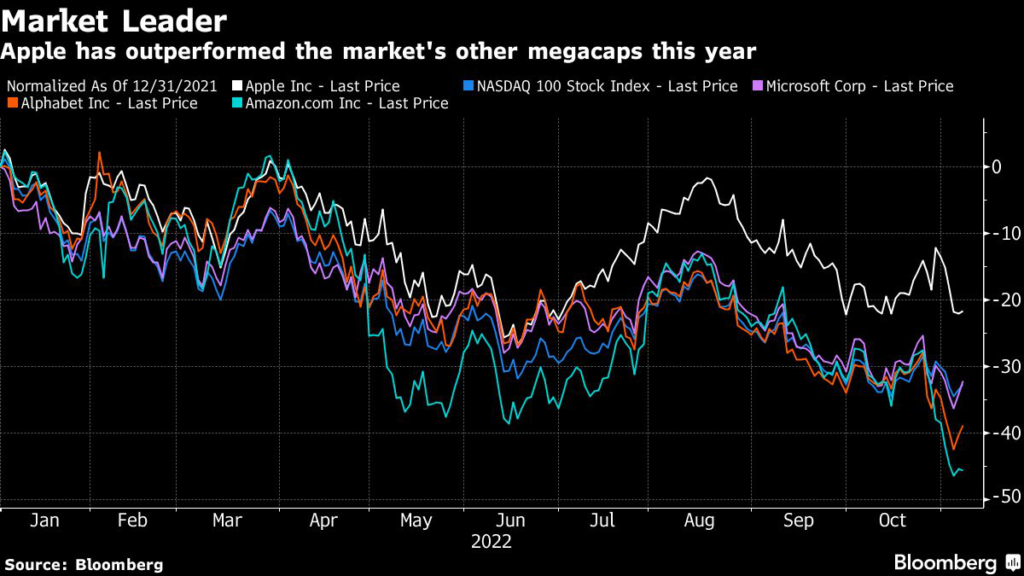
(Bloomberg) — Apple Inc.’s status as a relative haven in this year’s bear market is under threat amid growing concern that iPhone sales are weakening, portending further declines for technology stocks more broadly. 

Over the weekend, the Cupertino, California-based company said Covid-related lockdowns in China would cause shipments of its newest premium handsets to be lower than previously expected. Bloomberg News also reported that due to weaker demand, Apple expects to produce at least 3 million fewer iPhone 14s this year than first anticipated. 

The stock rose 0.6% on Tuesday, bringing its year-to-date decline to 21%. The Nasdaq 100 Index is down 32%. Other major technology and internet stocks — including Microsoft Corp., Amazon.com Inc., and Alphabet Inc. — are down between 32% and 46%.

Apple was the only megacap to rally in the wake of its results this quarter, and the report kept analysts from dramatically slashing earnings estimates, in contrast to widespread cuts elsewhere. Now the consensus for Apple is too optimistic, according to UBS Group AG. That represents a risk to the market’s biggest company at a time when it already trades at a premium to the Nasdaq 100. 

Brian Frank, chief investment officer of Frank Funds, called the lack of estimate cuts “a flashing red light” for investors.

“I don’t see any reason why Apple estimates won’t be cut at the same scale as tech overall, and because it trades with a multiple above 20, this seems like a massive risk,” he said. “Given its global exposure and the fact that consumers are facing a difficult environment because of inflation, I don’t see anything to get excited about. I think there’s a lot more downside risk for megacaps.” 

Analysts expect earnings of $6.29 per share for Apple in 2023, an estimate that has only declined by 2.6% over the past quarter. To compare, 2023 estimates have fallen 5.8% for Microsoft in the same period, 5.6% for Alphabet, and 14% for Amazon. Companies that supply to Apple have also seen estimates slashed — predicted 2023 earnings for Skyworks Solutions Inc. have fallen 11% over the past month while Qorvo Inc. estimates are down more than 20%. Both reported last week.

For the overall tech sector, Bloomberg Intelligence data show analysts expect 2023 earnings will fall 0.2%, compared with the 8% growth that was expected three months ago.

Apple trades at about 22 times estimated earnings, above its 10-year average of 17 and the 19.7 multiple of the Nasdaq 100. Should consensus estimate get slashed further, shrinking the denominator in the price-to-earnings equation, Apple would screen as more expensive than it currently does. 

“It’s overvalued relative to the rest of tech, even if there is something to be said for its cash flow and brand,” said Jim Worden, chief investment officer of Wealth Consulting Group. “The big question is how much growth could slow, since I think a recession will hurt Apple more than analysts are projecting. I like it as a long-term play, but have no idea if we’re close to bottoming and in the short term there will be a lot more volatility ahead.”

Tech Chart of the Day

Cathie Wood’s ARK Innovation ETF is a long way from its pandemic-era heyday, as rising interest rates and a rotation out of high-growth and high-valuation tech stocks has resulted in a 72% selloff over the past year. However, that has made for an ideal environment for the AXS Short Innovation Daily ETF, which tracks the inverse performance of Wood’s fund. The fund has more than doubled since it launched a year ago. 

Top Tech Stories

  • Covid cases have more than doubled in the central Chinese city of Zhengzhou, damping hopes that authorities will lift a lockdown of the area surrounding the world’s largest iPhone factory.
    • Morgan Stanley analysts have put a value on how much revenue is at risk for Foxconn Technology Group if its Zhengzhou operation is unable to ship any iPhones for the rest of the year as it battles a coronavirus outbreak.
  • Nvidia Corp., the most valuable chipmaker in the US, has begun producing a processor for China that conforms to new rules aimed at limiting that country’s access to artificial-intelligence computing.
  • Nintendo Co. cut its fiscal-year forecast for Switch video-game console sales by 10% to 19 million after reporting earnings in line with expectations.
  • German chipmaker Elmos Semiconductor SE said the country’s economy ministry is likely to block the sale of its wafer facility to a Swedish subsidiary of China’s Sai MicroElectronics Inc. after previously indicating the deal would be approved.
  • Renault SA is deepening its collaboration with Alphabet Inc.’s Google in a bid to extend capabilities on remote software updates to new vehicle models such as the electric Megane E-Tech and Austral. “We want to make the car an intelligent object that learns and one that can be upgraded over the air like a mobile phone,” Renault Chief Executive Officer Luca de Meo said.
  • Lyft Inc. fell more than 15% in extended trading after reporting weaker-than-expected ridership growth, signaling that it’s losing ground to rival Uber Technologies Inc. in a rocky recovery from the pandemic.

(Updates to market open.)

More stories like this are available on bloomberg.com

©2022 Bloomberg L.P.

Traders Working for Free Fight for Survival: Sanctioned VTB’s New Reality

(Bloomberg) — Traders are working for free and face daily struggles to keep sanctioned VTB viable, in the new reality facing a Russian trader in Europe.

Russian state-backed lender VTB Group’s commodities trading arm has slashed its headcount to 19 staff from over 80 and many had to work without pay for a “prolonged period.” All their contracts are set to expire at the end of the year, according to a recent London court ruling, which lays bare the extent to which the business has been “significantly reduced.”

VTB was among the first Russian financial services firms sanctioned by the UK and the European Union, effectively cutting it off from the global financial system. Meanwhile the British arm is still seeking administration protection in the English courts in order to safeguard creditors.

The commodities unit’s chief executive officer, Nick Hutt, turned up to court in person this month to represent the firm in a $30 million lawsuit with oil trader Petraco Oil Company SA. He said the company was having to “firefight on a daily basis.”

“VTB’s attitude appears to have been one in which it has thrown up its hands in despair, proclaiming how unfair everything is, rather than doing what it can with the resources it has to move matters along,” Judge David Foxton said in the Nov. 4 ruling, where he adjourned the trial until November next year.

In recent years, VTB had spearheaded an effort by Russian banks to fill a void left in commodities markets as their western counterparts scaled back, and its rapid expansion turned the company into a significant trader and financier in industrial metals markets.

The firm has had a “succession of crises to be managed,” the judge said, cataloging how it struggled to pay debts, worked to replace suppliers who refused to deal with the unit, and sought to replace departing staff.

Around half of the 19 staff are traders, the judge said, and the firm employs one Swiss lawyer.

VTB is applying for a license from the UK Treasury which enables sanctioned firms to pay for external legal representation.

Its former solicitors PCB Byrne stopped working for the company when VTB was unable to pay legal fees, meaning Hutt had to represent the firm himself. The trial costs will be so high that the judge said that even the newly-available broad legal license that caps costs at as much as £1 million ($1.15 million) will be insufficient in this case.

Hutt didn’t respond to a request for comment. 

–With assistance from Archie Hunter.

(Updates with number of traders in eighth paragraph.)

More stories like this are available on bloomberg.com

©2022 Bloomberg L.P.
Close Bitnami banner
Bitnami