Bloomberg

Abu Dhabi Satellite Operator Yahsat Plans Acquisitions to Expand

(Bloomberg) —

Satellite operator Yahsat, controlled by Abu Dhabi sovereign fund Mubadala Investment Co., is looking to grow by acquisitions over the next few years, according to its chief financial officer.

“M&A is definitely on the table,” Andrew Cole said in an interview. “We have a lot of cash and very strong balance sheet” to fund organic growth, while sustaining a growing dividend policy, he said. 

Mubadala last year raised $731 million from the initial public offering of Yahsat, which trades under the name Al Yah Satellite Communications Co. The company offers satellite services in more than 150 countries across Europe, the Middle East, Africa, South America, Asia and Australasia, according to its website.

Yahsat on Monday reported a third-quarter loss of $10 million after “adjusting for material, one-off items.” It posted a 16% jump in revenue and said it’s on track to grow dividend by at least 2% yearly.

Cole said Yahsat will “step on the gas” to grow its top line business over the next few years. The satellite operator is looking into multiple growth areas, including data solutions business, mobility solutions business, Internet of Things, and oil and gas. 

In October, Yahsat acquired a minority stake in eSAT Global Inc, an IoT connectivity solutions provider to meet “growing demand for connectivity using low-cost, low-power IoT devices.”

At the moment, the company is also focused on expanding satellite communications in niche areas such as fishing vessels in Vietnam and seeking to expand into other territories in the region such as the Philippines, Cole said.

Yahsat has a contract backlog worth $2 billion and $631 million in cash and short-term deposits, he said. Its total available liquidity rose by $174 million this year mainly due to receiving advance payments from the government, according to its third-quarter results.

More stories like this are available on bloomberg.com

©2022 Bloomberg L.P.

Leaving Twitter? The Alternative Social Media Sites Are Ready

(Bloomberg) — Since Elon Musk’s $44 billion purchase of Twitter Inc., there’s no shortage of users threatening to quit and go elsewhere. Concerns range from the billionaire’s stance on moderation and free speech, to his plan to let people pay for verification check marks.

But once a user closes their Twitter account, where can they go to attain some level of social media satisfaction?

“If you were following Kylie Jenner’s tweets and she left Twitter, don’t you just follow her on Instagram or TikTok instead?” said Sarah Simon, a senior media analyst at Berenberg.

Not necessarily. Here are some popular options:

Mastodon

The social network is often spoken of as an open-source alternative to Twitter. Users register their accounts on different “servers,” each of which are run independently with their own content rules, similar to Reddit’s community-controlled groups. 

Instead of joining a single platform that blends everyone’s contributions, Mastodon’s servers are themed by interests, such as hobbies, countries or activism. This gives users an immediate community, but they are still allowed to follow users on other servers. Posts are called “toots” and can include text and images. Mastodon says it will only promote servers that “are consistently committed to moderation against racism, sexism and transphobia.” 

Mastodon was founded in 2016 and has more than a million active monthly users. About half a million signed up since Musk took over Twitter on Oct. 27, according to founder Eugen Rochko.  

Read more: Mastodon Struggles to Keep Up With Flood of Twitter Defectors

Tumblr

Tumblr is angling to regain its erstwhile popularity amid the chaos of Twitter’s Muskification. In a Twitter thread, it played up to that platform’s defectors with promises of an ability to remove algorithm-suggested content, free edit features, a “ridiculously huge character limit.” and “GIFs. A lot of GIFs. So many GIFs.” 

After a $1.1 billion purchase by Yahoo! Inc. in 2013, the site failed to compete effectively with newer mobile-first platforms like Instagram. Traffic numbers faced further challenges in 2018 when the platform said it would ban sexual content. However, last week Tumblr announced that nudity would now be permitted, and in the past seven days, downloads on Apple’s App Store are up 58%, according to a tweet by Matt Mullenweg, whose company Automattic now owns the site.

While Tumblr’s focus on allowing lengthy blog posts and streams of multimedia used to starkly contrast with Twitter’s short-and-to-the-point text-only model, the latter’s expansion of character limits and support for threads and videos brought the two platforms closer from a product standpoint. It might make it a suitable new home for Twitter escapees as a result.

Parler

Parler is among a growing group of so-called alt-media sites that aim to give conservatives a forum to share views they feel are silenced on mainstream outlets. It was set up in 2018 as a place users would be “uncancellable,” with its name — which means “to speak,” in French — a nod to its ethos.

It had a surge of user registrations in 2020, with high-profile US conservatives like Ted Cruz opening accounts, and last month, Ye, formerly known as Kanye West, agreed to buy the app. It’s still small, however, with an estimated 40,000 daily active users according to download tracker Apptopia, while Twitter had an average of 238 million daily active users in the second quarter of this year.

The app has been clouded with controversy for the past few years, and was banned from both the Apple and Google app stores last year after violating policies following the Jan. 6, 2021 US Capitol riot. It returned to Apple devices in May 2021, and Google’s in September this year.

Read more: Kanye Buys His Own Little Piece of Free Speech: Parmy Olson

Truth Social

Another high-profile competitor to Twitter is one created by Donald Trump. After being forced off Twitter, Facebook and YouTube following the US Capitol insurrection, the former US president promised Truth Social would offer a free-speech service. It looks strikingly similar to Twitter, with timelines of short messages, but similar to Parler its modest audience is also largely one formed of American conservatives.

The app has about 513,000 daily active users according to Apptopia — more than ten times the total it estimates for Parler — with Trump’s widely-publicized eviction from mainstream social media platforms helping promote his latest media enterprise. Trump has just over 4 million followers on Truth Social.

WT.Social

WikiTribune Social, or WT.Social, has had a “strong rise in users leaving Twitter due to Elon Musk’s new ownership and policies,” founder Jimmy Wales said by email. Wales, who also founded Wikipedia, said the website will fund itself by selling memberships, not through advertising, which he says gives users voting rights over content.

Billing itself as the “non-toxic social network,” WT.Social wants to establish authenticity by prioritizing content based on the truthfulness of content, as judged by what the most trusted people on the site think. This is in contrast to the engagement-based algorithms of other social media sites, where controversial content is often surfaced first. 

In a version of the site coming in the next few months, users will be awarded with different “status levels” depending on how trusted their posts are deemed to be by other users. In essence, it blends the approval-by-committee model of Wikipedia with the anything-goes appeal of a service like Twitter. 

Tribel

The site came out of beta testing three months ago, which was “pretty fortuitous” timing given Musk’s purchase of Twitter, said founder Omar Rivero in a phone call. Two months ago, the site had 250,000 registered users but now has 500,000, he said. “Pretty much every time Elon Musk makes fun of people in his tweets we get an uptick,” he added. 

The text and picture-based site looks somewhat like the news feeds of Facebook or Twitter, but posts can be sent to selective audiences. Users can also search for posts in specific categories, meaning that a user’s first post can trend without having any followers, said Rivero, who also founded the partisan Occupy Democrats news site. Tribel doesn’t promote a specific political ideology, he said. 

More stories like this are available on bloomberg.com

©2022 Bloomberg L.P.

Crypto Token Takes Wild Ride as Investor Alameda Denies Sale

(Bloomberg) — A crypto token whose investors include billionaire Sam Bankman-Fried’s trading house Alameda Research took a wild ride, dipping and then recovering as worries over potential forced selling by the firm arose and then were dispelled by Alameda.

BitDAO, a decentralized community of holders of the BIT token, asked Alameda to provide proof the tokens hadn’t been sold after the coin slumped about 25% suddenly on Tuesday morning in London. The concern was that the crypto firm might have dumped them to raise money as questions swirled about the health of Alameda, a large player in the market. Alameda Chief Executive Officer Caroline Ellison denied the sale of the tokens in a reply to a post on Twitter from Ben Zhou, co-founder of the exchange that supports the BIT token, after which it recovered most of its losses to trade at about 39 cents, according to CoinGecko.

The big swing exemplifies the crypto market’s renewed jitters, reminiscent of the turbulence that rocked the industry in the spring. This time, the worries center on Alameda’s balance sheet and its reliance on a token, FTT, created by FTX. It all started after Changpeng Zhao, the chief executive officer of exchange Binance, announced plans to sell $530 million of FTT, in a Twitter post on Sunday. FTT has since dropped steeply, raising concerns about Alameda’s ability to weather the decline. Alameda’s Ellison has said the firm has more than $10 billion in assets on its balance sheet.

BitDAO had swapped 100 million BIT with Alameda for 3.36 million FTT tokens just over a year ago with a three-year no-sale commitment, according to a thread posted on BitDAO’s community forum. The BitDAO community asked Alameda to transfer the BIT tokens to a wallet address for them to “verify, and hold until the end of the agreement” within 24 hours that ends early afternoon Singapore time on Wednesday. BitDAO later said Alameda provided the proof.

–With assistance from Joanna Ossinger and Emily Nicolle.

More stories like this are available on bloomberg.com

©2022 Bloomberg L.P.

Apple’s Brain Drain Hinders Efforts to Pick Its Next Jony Ive

(Bloomberg) — Turnover at Apple Inc. has hindered efforts to replace the head of product design, leaving a gaping hole at the helm of a prominent team that’s been key to the iPhone maker’s prolonged success. 

Legendary design leader Jony Ive departed Apple in 2019, and his replacement for hardware design lasted just about three years. Now the department — still in Ive’s shadow — needs a new leader at a time when there are few obvious choices. And the fate of Apple’s hardware devices, which accounted for more than three-quarters of its nearly $400 billion in revenue last year, hangs in the balance.

Evans Hankey, who has held the job since Ive left, informed Apple last month that she will be departing. Though Hankey had been at the company for about 20 years, her relatively brief tenure at the top of the industrial design team made it hard to establish a distinct vision for new products. Apple also lacks a clear succession plan for the job, a significant problem for a company that sells premium-priced products largely based on their look.

In some ways, the department has been in flux since the death of Steve Jobs more than a decade ago, according to people with knowledge of the situation. The Apple co-founder had forged a partnership with Ive that helped establish the clean, simple aesthetic that remains the tech giant’s hallmark today. But an increased emphasis on costs, along with other distractions, created new difficulties, they say.

Apple’s modern design group started after Jobs’s return to the company in the late ’90s, becoming a roughly two-dozen-person team reporting to Ive. The idea was to dream up future products, and that they did. Apple put computers in translucent plastic cases. It sold skeptical consumers on the concept that a slab-like phone was better than one packed with buttons. It made the world’s thinnest laptop and convinced people to slap a computer on their wrists. 

Over time, the group evolved into two central teams: industrial design and human interface design. The former handles the look of hardware, while the latter, run by executive Alan Dye, oversees the appearance of Apple’s software. After Ive’s departure, both groups were placed under the purview of Jeff Williams, Apple’s chief operating officer. 

Over the past few years, the team has lost the majority of senior designers who worked under Ive, with many of them going to his new firm, LoveFrom. That has now made it harder to replace Hankey, people with knowledge of the matter said. An Apple spokeswoman declined to comment. 

The departures began when Ive moved to a part-time role — officially known as chief design officer — around the time the Apple Watch launched in 2015. That year, longtime Ive lieutenant Danny Coster departed for GoPro Inc. Two years later, another top Ive deputy, Christopher Stringer, left to found Syng, a high-end speaker maker. 

In early 2019, there was another exodus, with key designers Rico Zorkendorfer, Julian Hoenig, Miklu Silvanto and Daniele De Iuliis leaving. That June, Apple announced that Ive would exit to found LoveFrom, a design consulting firm working with Ferrari, Airbnb, Moncler and other brands.

More recently, key team members Jody Akana, Joe Tan, Anthony Ashcroft, Andrea Williams, Jeremy Bataillou and Eugene Whang departed, with the latter four heading to Ive’s firm. Altogether, at least 15 members of Ive’s core senior design team at Apple have exited since 2015. Hankey, who is leaving Apple next spring, isn’t currently planning to join LoveFrom, a person with knowledge of the matter said.

That kind of turnover had been rare. Months before the departures started, Ive touted that only two members of the design team left Apple in the 15 preceding years and that one of the two resigned for health reasons. 

Even before Ive left, Apple’s operations department had begun to wield more influence over the design team, people familiar with the matter said. That meant a focus on costs rather than purely on look and features. 

“The strength of the team was that we were a nucleus bound together by the incredible environment that there was and the things we could do in a fairly unconventional way for a large company,” said a longtime member of the group, who asked not to be identified because the matter is private. “It was a special team. It wasn’t easy after Steve passed — things started to become a lot more complicated. There were more pressures and outside distractions.”

The effort to a find a new visionary will likely begin with an internal search, but it won’t be easy to identify the next Jony Ive — or even the next Evans Hankey. When Ive left, Hankey made sense as a replacement because she was a longtime engineering manager and design leader who had worked closely with him. 

The length of Hankey’s stint means she didn’t stay long enough to oversee the end-to-end development of a released product. These cycles can take many years. So the look of the latest iPhones, iMacs and iPads were devised before Hankey’s tenure began.

Today, Apple only has a small handful of veteran senior industrial designers from the Ive era on hand, including Duncan Kerr, Bart Andre, Richard Howarth, Peter Russell-Clarke and Ben Shaffer.

The company could look to that group for Hankey’s replacement, but such a strategy hasn’t worked in the past. Howarth briefly served as head of industrial design between 2015 and 2017, but he struggled to manage a crew of former peers. Still, people close to the department believe he is the only longtime senior member of the team who could lead it. 

Howarth would be a natural choice, a person close to the situation said, adding that the team is now made up of many designers junior to him and that Ive is no longer partially involved, which previously complicated his ability to implement new ideas.

This person and others, however, questioned if Howarth wants the role — and how much longer he may remain at Apple. He, along with Andre, are the two longest-serving members of the design group. Howarth has been at Apple 26 years, and Andre’s tenure has lasted three decades. 

Apple has also replenished the design team with fresh talent in recent years, though the company is unlikely to pick a new face for the top role. Apple recently added Alex Girard — a former car designer for Alphabet Inc.’s Waymo, Lucid Motors Inc. and Volkswagen AG — to the group, along with Peter Riering-Czekalla, the former chief designer of the $1,000 Molekule air purifier. 

The iPhone maker could also consider appointing Dye, the head of software design, to oversee the look of hardware. Such a move would provide name recognition and could calm investors, though people familiar with the team say his appointment would irk the hardware-focused designers. 

Apple could also bring back a former designer, some of whom could be qualified to run the team after managerial stints elsewhere. Another possibility is recruiting from a competitor. Google and Microsoft Corp. have recently seen the designs of their products improve under executives like Google design head Ivy Ross and Surface design leader Ralf Groene.

But Apple has struggled to integrate executives from rivals into leadership positions. “It would need to be someone internal,” the longtime member of Apple’s design group said. Bringing in someone from another company would be the “death of the team.”

More stories like this are available on bloomberg.com

©2022 Bloomberg L.P.

COP27 Latest: African Leaders Say They Need Cash Not Cheap Loans

(Bloomberg) — South Africa’s President Cyril Ramaphosa said more climate funding needs to come in the form of grants and concessional loans, to avoid the continent ramping up debt.

Ramaphosa called on multilateral development banks to change their approach to climate finance, saying support is out of reach for most of the world’s population. The institutions are “risk averse” and their funding offers “carry onerous costs,” he said at the COP27 conference in Egypt.

Earlier, Polish President Andrzej Duda stressed the importance of energy security as the world grapples with higher prices.

“The transition is there to serve man, not the man to serve the transition,” he said.

More than 100 world leaders are set to be in Sharm el-Sheikh over the next two weeks for the UN’s annual climate talks. They’re attempting to maintain momentum in the battle to curb planet-warming emissions.

This year, delegates are aiming harsh criticism at each other over issues ranging from climate reparations to funding for mitigation and adaptation in poorer countries.

Rising energy prices, accelerated by Russia’s war in Ukraine, have led many governments to prioritize security of supply over the transition to cleaner energy since the last COP summit in Glasgow.

German Chancellor Olaf Scholz, France’s Emmanuel Macron and British Prime Minister Rishi Sunak were among the biggest names to speak on Monday. US President Joe Biden and Brazil’s President-elect Luis Inacio Lula da Silva are due to appear later on.

The most notable no shows are China’s Xi Jinping and India’s Narendra Modi, leaders of the world’s largest and third-largest emitters.

Highlights:

  • Highlights from Monday
  • Is the 1.5C warming goal dead?
  • EU’s Von Der Leyen warns of climate ‘highway to hell’
  • UK firms face new requirements to back up climate claims
  • Africa to expand the use of carbon offsets
  • Methane cloud spotted near New Mexico coal mine
  • South Africa launched an $8.5 billion plan to shift from coal to green energy

Here are the latest developments. All times Egypt.

Von Der Leyen Says Developing Countries and EU Must Avoid ‘Highway to Hell’ (2:00 pm)

European Commission President Ursula Von Der Leyen called on developing countries to “team up” with the trade bloc by providing it with the clean energy sources it needs to meet its green goals and cut its dependence on Russian fossil fuels. She also called on high-emitting countries to step up their climate ambitions.

“Let us not take the highway to hell,” she said. “Let’s earn the clean ticket to heaven.”

Asian Infrastructure Bank Says Gas Has a Transition Role (1:30 pm)

Natural gas will play a role during the green transition in developing countries and the Asian Infrastructure Investment Bank will fund such projects if they’re in line with keeping global warming to 1.5 degrees, according to Vice President Danny Alexander.

The context in the developing world is different to the context in Europe, Alexander said in an interview. “We have have to be responsive to where our clients actually are and help to move them in the right direction to whichever tool is most suited to their circumstances.”

Alexander rebuffed calls from developing nations and small island states for multilateral development banks to be reformed to provide more and easier climate finance. He said it was more a question of scaling up private sector finance.

Carney Sees ‘Wall of Opportunity’ in Energy Markets (12:00 pm)

Renewable-energy assets are primed for an era of growth, emerging as the answer to both energy security risks and climate change, according to Mark Carney, the former Bank of England governor.

There’s currently a “wall of opportunity” in the renewable energy market, Carney, who co-chairs the Glasgow Financial Alliance for Net Zero, said in an interview with Bloomberg TV.

“A lot of the answer to energy security problems that have been exposed by Russia’s illegal war have to do with sustainability,” he said. “That’s why you’ve seen a five-fold increase in the ambition in the European Union for this decade. That’s why you’ve seen the big roll-out with the Inflation Reduction Act in the United States.”


Funding for ‘Bottom-Up’ Climate Action in the US Launched (11:27 am)

The US State Department and Bloomberg Philanthropies announced a new $3 million initiative to help cities, states and other regional entities steer toward net-zero goals.

The program, dubbed SCALE, or Subnational Climate Action Leaders’ Exchange, is being established with a contribution of $1.5 million each. It will start by focusing on implementing the Global Methane Pledge, a commitment by more than 120 nations to cut emissions of the potent greenhouse gas 30% by 2030.

“The federal government has, many times, been asleep at the wheel,” said Michael Bloomberg, the UN secretary-general’s special envoy for climate ambition and solutions. Even so, a coalition of cities, states, businesses tribal nations and other institutions “showed the world the American people remain committed to fighting climate change.”

Michael Bloomberg is founder and owner of Bloomberg LP, parent of Bloomberg News.

South Africa’s Ramaphosa Wants Change to Lending Approach (11:50 am)

South Africa’s President Cyril Ramaphosa called on multilateral development banks to change their approach to climate finance, decrying the failure to live up to promises to boost funding for climate adaptation and mitigation.

Multilateral support is out of reach for most of the world’s population, he said in a speech. The institutions are “risk averse” and their funding offers “carry onerous costs.”

More funding needs to come in the form of grants and concessional loans, he said.

Senegal’s Sall Urges Nations to Honor Funding Pledges (11:15 am)

African Union Chairman and Senegalese President Macky Sall called on rich nations to honor their pledges to finance African countries vulnerable to climate change, rather than giving loans to the already heavily-indebted nations.

“Developing countries are currently funding most of their climate change projects by taking on debts, when they should be receiving funding from what we have together agreed,” Sall said in a speech. “We are funding our own adaptation efforts when we the victims, which means we are being doubly punished and we are not ready to put up with that.”

“We are in favor of reduction of greenhouse-gas emissions,” he said. “But we Africans cannot accept that our vital interests be ignored as we undergo this energy transition. We are low emitters, however, we are the most vulnerable to loss and damage triggered by climate change.”

Poland Says Energy Transition Must Serve ‘Security’ (11:29 am)

Polish President Andrzej Duda used his plenary speech to stress the importance of energy security as the world grapples with higher prices.

“The transition is there to serve man, not the man to serve the transition,” he said. “People are going to ask why the energy is so expensive. The transition has to serve energy security.”

Poland is the biggest coal producer in the European Union. It’s another example of an important theme in Sharm el-Sheikh: the idea that the transition can’t come at the expense of security of supply. Others argue that’s a false choice and cheaper renewables are the answer to the energy crunch.

Duda, one of Ukraine’s staunches allies, also took the opportunity to blame Russia’s aggression for the global energy crisis.

Botswana President Wants End to Project Financing (11:27 am)

Botswana’s President Mokgweetsi Masisi called for an end to project-based climate adaptation funding, saying that the scale of the challenge necessitated direct contributions to national treasuries.

Masisi’s words echoed pronouncements made by politicians from South Africa to Barbados for a rethink on how climate finance is channeled to the developing world.

China to Working on Tighter Climate Laws (11:00 am)

China is pushing forward amendments to national laws to help cut carbon emissions, Wang Yi of the Chinese Academy of Sciences said.

There could be changes to 20-30 laws in China, with work accelerating after the people’s congress in March next year, he said.

Irish PM Calls for New Financial Tools (11:00 am)

Adaptation to climate change requires new tools for helping countries deal with weather disasters, Ireland’s Prime Minister Micheal Martin said in an interview on Bloomberg TV.

“Along with all of the measures we must take to reduce emissions, we also now have to look at adaptation, and create financial instruments in terms of dealing with catastrophic risk,” he said.

African Nations to Expand Local Carbon Markets (10:30 am)

A group of African countries including Kenya, Malawi, Gabon, Nigeria and Togo, together with Standard Chartered, are backing a new initiative to “dramatically expand” the use of carbon offsets on the continent.

It aims to produce 300 million credits annually by 2030, and 1.5 billion by 2050. Each credit will represent a metric ton of reduced, removed or avoided greenhouse gas emissions. Even 75 million credits would be double the total number issued across the entire of Africa in 2021.

World Bank to Launch Climate Fund for Poorer Nations (10:00 am)

World Bank President David Malpass will on Tuesday unveil a fund aimed at helping developing countries to cope with climate change.

It’s “a big trust fund” called SCALE, Malpass said in an interview with Bloomberg TV. “I think of it as a giant resource need that can be filled by grants from the advanced economies.”

Poor nations are struggling with a confluence of challenges, from rising prices and interest rates to the effects of climate change to a shortage in fertilizer, he said. He added that Russia’s invasion of Ukraine has exacerbated the problems.

Greece Targets Role as Europe’s Green Power Hub (9:35 am)

Greece wants to become a net exporter of renewable electricity to the rest of Europe, Prime Minister Kyriakos Mitsotakis said.

The nation is backing a plan to build cables that will bring green power to Europe via the country from Egypt and the Middle East. If such a project is successful, it would go some way to help the European Union boost supplies as everything from transport to heavy industries will use more electricity in the future.

UAE and Egypt Ink Pact for 10GW of Solar Power (9:30 am)

Egypt and the United Arab Emirates have signed a deal to develop 10 gigawatts of onshore wind power in Egypt. Abu Dhabi-based renewable energy firm Masdar is leading consortium to build the plant.

UAE President Mohammed bin Zayed and Egyptian counterpart Abdel-Fattah el-Sisi attending the signing.

EU Signs Forest Partnership with Five Countries (9:00 am)

The European Union signed a memorandum of understanding to help preserve forests in Guyana, Mongolia, the Republic of Congo, Uganda and Zambia. The bloc is set to pass legislation banning the import of products whose manufacture causes deforestation. But its demand for rubber has been criticized by non-profit organizations for contributing to trees being cut down in Africa.

Read more: Europe’s Rubber Addiction Destroys Africa’s Tropical Forests

Apple, Pepsi Join Promise to Buy Near-Zero-Carbon Metal (8:45 am)

PepsiCo, Apple and Rio Tinto are among the newest members of a corporate buyers club that has committed $12 billion to purchasing near-zero-carbon steel, aluminum and other products. Members hope to create greener supply chains and accelerating the production of clean technology.

The First Movers Coalition is also growing with new corporate pledges from companies such as automaker General Motors and Swedish power provider Vattenfall to buy next-level-green cement and concrete — at least 10% of their needs in 2030.

Taiwan’s Gogoro Sees India as ‘Holy Grail’ for EV Technology (8:27 am)

Taiwanese startup Gogoro sees huge scale for its battery-swapping technology in India, joining the race to get a slice of an electric vehicle market which is expected to reach 400 times its current size by the end of the decade.

“India represents the holy grail,” said Horace Luke, the chief executive officer, said to Bloomberg TV. The electric-scooter and battery-swapping-station maker is going to get its technology “honed, fine-tuned and calibrated to the India condition.”

Countries Set to Bolster Global Methane Pledge at Climate Summit (8:00 am)

The EU and US put methane on the map at COP26 in Glasgow — declaring the potent greenhouse gas a threat to Paris Agreement temperature goals and insisting emissions of it must be slashed 30% by 2030.

In the year since, European countries and the US have successfully encouraged more than 120 countries to sign on to a formal methane-cutting pledge, and at Sharm El-Sheikh, about 40 of them are set to outline their plans for doing so, according to a senior State Department official.

PwC Says Emissions Reductions Must Speed Up (7:15 am)

The goals set at the 2021 COP summit in Glasgow aren’t being met fast enough, according to PwC Chairman Bob Moritz.

“We sit at the table today, a year later, not seeing speed and scale of change” required to meet climate targets, he said to Bloomberg TV. “We need to move much faster. We have a long way to go.”

According to the accounting and consulting firm’s own analysis, emissions reductions globally have to happen 11 times faster than what’s been the case in the past two decades.

Japan Delays Carbon Tax Reform (4:00 am)

Japan is delaying plans to revise how it taxes carbon, the Nikkei newspaper reported, potentially slowing efforts to wean the country off fossil fuels.

The government will postpone the introduction of a new carbon tax that was planned for the fiscal year starting April 2023, the Nikkei said Tuesday without attribution. Policy makers decided it would add to already surging living costs, it said.

It’s at least the second time the changes have been pushed back. The environment ministry had requested the introduction of a more substantial carbon levy in the previous annual tax revisions, but the government backed away amid industrial protests.

Banks Fall Dangerously Short of Pledges in New Net-Zero (2:01 am)

Most banks that have published net-zero emissions targets are failing to live up to those commitments, according to a fresh study by ShareAction.

The majority of the 43 largest financiers of fossil fuels in the Net Zero Banking Alliance “have climate targets that fall short of what’s needed to prevent the worst impacts of climate crisis,” the nonprofit said Tuesday. Only 16% of the banks analyzed have set interim, overarching net-zero goals, ShareAction concluded.

UK Firms Face New Requirements to Prove Climate Claims (2:01 am)

The UK is set to require companies to provide granular details to back up their decarbonization claims, under a fresh proposal intended to stamp out greenwashing. 

The government-backed Transition Plan Taskforce is seeking feedback on its disclosure framework, which requires firms to produce evidence of “concrete” short-term action taken to reduce their carbon footprints, according to a statement on Tuesday. 

–With assistance from Alfred Cang, Stephen Stapczynski, Paul Tugwell, David Malingha, Alastair Marsh, Yousef Gamal El-Din and Francine Lacqua.

More stories like this are available on bloomberg.com

©2022 Bloomberg L.P.

US Futures Rise on Hopes for a Post-Midterms Rally: Markets Wrap

(Bloomberg) — US stock-index futures rose as investors bet the outcome of midterm elections will support a nascent rally. Treasuries were steady before Thursday’s inflation print that may offer clues on Federal Reserve policy.

Contracts on the S&P 500 and Nasdaq 100 indexes rose at least 0.2% each, after US stocks posted a second-day advance on Monday. The two-year Treasury yield was little changed at 4.73%. The dollar gained after a two-day slide. NVidia Corp. climbed in early New York trading as it began producing a processor for China. Take-Two Interactive Software Inc. fell after reducing its forecast for net bookings. Bitcoin tumbled as part of a crypto selloff.

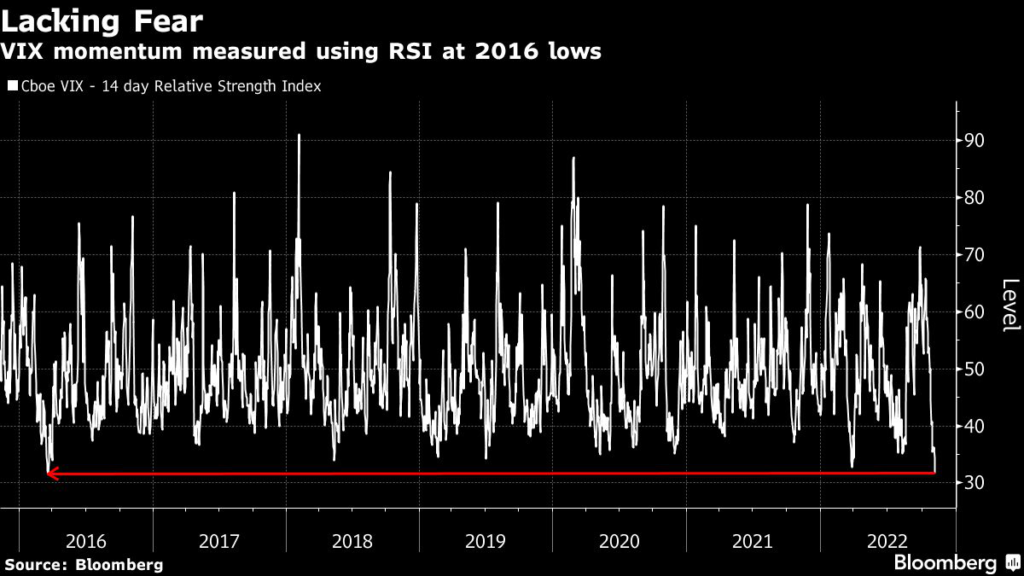
Bulls have charged back into equity markets over the past two days, taking comfort from a history of robust performance following midterm results. While polls suggest Republicans could make gains, thereby placing a check on Democratic policies, investors are busy examining multiple scenarios. The best outcome for Treasuries could be a Republican control of both the House of Representatives and Senate, while the dollar could find support should Democrats keep both chambers.

“The US debt burden could stop the Democrats from putting in place many economic reforms that they would’ve otherwise, if Republicans are sufficiently crowded to block them moving forward,” Ipek Ozkardeskaya, a senior analyst at Swissquote Bank, wrote in a note. “Hence, slowing debt under GOP could slow growth.” 

Tuesday’s two-way moves in Treasuries, however, underscored the fragile sentiment in markets where the Federal Reserve’s monetary tightening remains the biggest headwind. Thursday’s consumer-price-index data may offer the next cue for traders even as money markets are raising their peak-rate wagers.  

The inflation reading is coming after the core consumer price index rose more than forecast to a 40-year high in September. Even if prices begin to moderate, the CPI is far above the Fed’s comfort zone.

“Inflation is going up. It may be coming down periodically. But it’s going up,” Richard Harris, chief executive of Port Shelter Investment Management, said on Bloomberg Television. “The market is kind of uncertain — it’s hoping for the best but really should be preparing for the worst.” 

Meanwhile, swaps markets are leaning toward a 50 basis-point Fed rate increase in December, after a fourth consecutive jumbo hike to a target range of 3.75% to 4% at last week’s meeting. Rates are expected to peak slightly above 5% around mid-2023. 

JPMorgan Chase & Co.’s Marko Kolanovic warned of the risk to stocks from ongoing Fed hawkishness, and Morgan Stanley’s Mike Wilson said companies will need to aggressively shrink expenses, including through layoffs, before he becomes more optimistic on US equities.

Already, signs of stress in US corporate performance are becoming visible. Of the 441 S&P 500 companies that have reported quarterly results, almost a quarter have missed profit forecasts.

Take-Two tumbled 18% in premarket trading after the company cut its forecast in the wake of an industry-wide spending slowdown. SolarEdge Technologies Inc. rose after posting strong quarterly results. NVidia Corp. gained as it began producing a processor for China.

Europe’s Stoxx 600 edged higher, after a weak open. Chinese equities halted a rally as traders considered a jump in virus infections and official comments defending Covid Zero.

China’s renewed commitment to keep strict pandemic controls sparked a decline in oil. West Texas Intermediate futures dropped below $91 a barrel, after easing almost 1% on Monday.

Bitcoin fell 4.8% to below $19,700. Other cryptocurrencies also tumbled amid questions surrounding billionaire Sam Bankman Fried’s crypto trading house Alameda Research. Investors kept pulling assets from FTX, the exchange Bankman-Fried also runs, and sent its native token FTT diving as much as 32%. 

Key events this week:

  • Euro-zone retail sales, Tuesday
  • US midterm elections, Tuesday
  • EIA oil inventory report, Wednesday
  • China aggregate financing, PPI, CPI, money supply, new yuan loans, Wednesday
  • US wholesale inventories, MBA mortgage applications, Wednesday
  • Fed officials John Williams, Tom Barkin speak at events, Wednesday
  • US CPI, US initial jobless claims, Thursday
  • Fed officials Lorie Logan, Esther George, Loretta Mester speak at events, Thursday
  • US University of Michigan consumer sentiment, Friday

Some of the main moves in markets:

Stocks

  • Futures on the S&P 500 rose 0.2% as of 7:18 a.m. New York time
  • Futures on the Nasdaq 100 rose 0.4%
  • Futures on the Dow Jones Industrial Average rose 0.2%
  • The Stoxx Europe 600 rose 0.1%
  • The MSCI World index was little changed

Currencies

  • The Bloomberg Dollar Spot Index rose 0.2%
  • The euro fell 0.3% to $0.9990
  • The British pound fell 0.6% to $1.1444
  • The Japanese yen was little changed at 146.53 per dollar

Cryptocurrencies

  • Bitcoin fell 4.7% to $19,714.18
  • Ether fell 5.9% to $1,483.33

Bonds

  • The yield on 10-year Treasuries was little changed at 4.22%
  • Germany’s 10-year yield advanced two basis points to 2.37%
  • Britain’s 10-year yield advanced one basis point to 3.65%

Commodities

  • West Texas Intermediate crude fell 1% to $90.90 a barrel
  • Gold futures fell 0.5% to $1,672.70 an ounce

–With assistance from Jan-Patrick Barnert, Haidi Lun and Brett Miller.

More stories like this are available on bloomberg.com

©2022 Bloomberg L.P.

A Stock Trader’s Guide to the US Midterm Elections

(Bloomberg) — Morgan Stanley and JPMorgan Chase & Co. are staking out bullish positions on equities as voters cast their ballots in midterm elections that are expected to end Democrats’ control of the legislative branch and usher in a period of gridlock.

Divided governments have a harder time agreeing to new legislation, and therefore tend to preserve the status quo, reducing uncertainty. That could bring about lower bond yields and higher equity prices, Morgan Stanley’s chief US equity strategist Michael Wilson said in a note Monday. 

Read more: Wall Street Hopes History Repeats With a Post-Election Comeback

And though their forecast isn’t tied directly to the election, JPMorgan strategists including Mislav Matejka also have a bullish outlook on stocks against the backdrop of a potential peaking in bond yields, “very downbeat” sentiment and positioning and good seasonal factors, they wrote in a note.

For specific areas like health, energy and tech, the makeup of the next Congress will be key to determining their path forward. If Republicans win control of both chambers, GOP lawmakers would have an easier time advancing their policy priorities that favor energy, defense, pharmaceutical and biotech companies, though President Joe Biden could use his veto power.


And for Morgan Stanley, a “clean sweep” by the Republicans could greatly increase the chance of fiscal spending being frozen and historically high budget deficits being reduced, fueling a rally in 10-year Treasuries that can lift equities.

Here are areas equity investors should watch after the midterm election results:

Cannabis

The cannabis sector has been hit hard this past year amid the fitful pace of US legalization and a broader risk-off mood among investors in the highly speculative industry. The Cannabis Index has plunged 57% in 2022, with Tilray Brands Inc., Canopy Growth Corp. and SNDL Inc. all sinking at least 46% each.

Investors will be closely watching several state referendums for progress toward legalization at a local level. Voters in Maryland, Arkansas, Missouri, North Dakota and South Dakota will weigh whether to approve legalization for adults.

“If four or five approve, it would probably be deemed a positive, but if Maryland does not approve, that would definitely be deemed a negative,” said Bloomberg Intelligence analyst Kenneth Shea.

Republican control of at least one chamber of Congress would likely push federal legalization off the table for now. Democratic control of both chambers, while unlikely, would be far more favorable for the cannabis industry. The Cannabis Index surged 18% last month when Biden issued a pardon for all prior federal offenses for simple possession of marijuana.

Health Care

Investors in the healthcare industry have been closely following developments from Washington around the issue of drug pricing, with the midterm elections magnifying ramifications for the sector. 

Provisions that would empower Medicare to negotiate some drug prices under the Inflation Reduction Act are being marketed by Democrats as a landmark change that would lower drug costs for Americans. Not all high-price drugs will be subject to negotiations, but certain cancer treatments and other brand-name medicines used by seniors could have lower prices as early as 2026. 

“Republicans have traditionally been more favorable to the drug industry than Democrats,” Cowen analyst Rick Weissenstein wrote in a note Oct. 14. “While Republicans won’t be able to repeal the drug pricing provisions, they have vowed to hold hearings on the plan and to look for other ways to slow down implementation of the bill.”

Pharmaceutical companies including Pfizer Inc., AbbVie Inc., Eli Lilly & Co. and Merck & Co. could all see their revenue outlooks impacted by any changes to rules on drug pricing.

US-Listed Chinese Stocks

A threat to delist Chinese stocks that trade on US exchanges but don’t comply with Trump-era audit laws has backing from both Democrats and Republicans. That support, as well as growing geopolitical tension surrounding China, has sent the Nasdaq Golden Dragon China Index plunging about 40% this year.

If Republicans take full control of Congress it will ratchet up the intensity of oversight and likely lead to hearings not only over the status of audits but also if Chinese firms should even be listed in the US at all, according to Jaret Seiberg, an analyst at Cowen & Co.

The Securities and Exchange Commission has identified about 200 stocks that face removal for not allowing US auditors access to their records including tech giants Alibaba Group Holding Ltd., Pinduoduo Inc., and Baidu Inc.

Clean Power

Democrats recently passed a landmark climate law that includes generous long-term subsidies for clean-power installations. Even though no Republicans in Congress supported the bill, it’s highly unlikely these credits face any danger after the midterms. This bodes well for developer NextEra Energy Inc. and rooftop-solar installer Sunrun Inc. Biden still has another two years in his term — and the climate package is a signature achievement that he will be keen to protect.

Energy

Energy stocks have been a rare bright spot in an otherwise grim year for equities, boosted by skyrocketing oil and natural gas prices. That’s translated to higher fuel costs for Americans, making the sector an easy target for Democrats in an election cycle focused on the burdens caused by inflation.

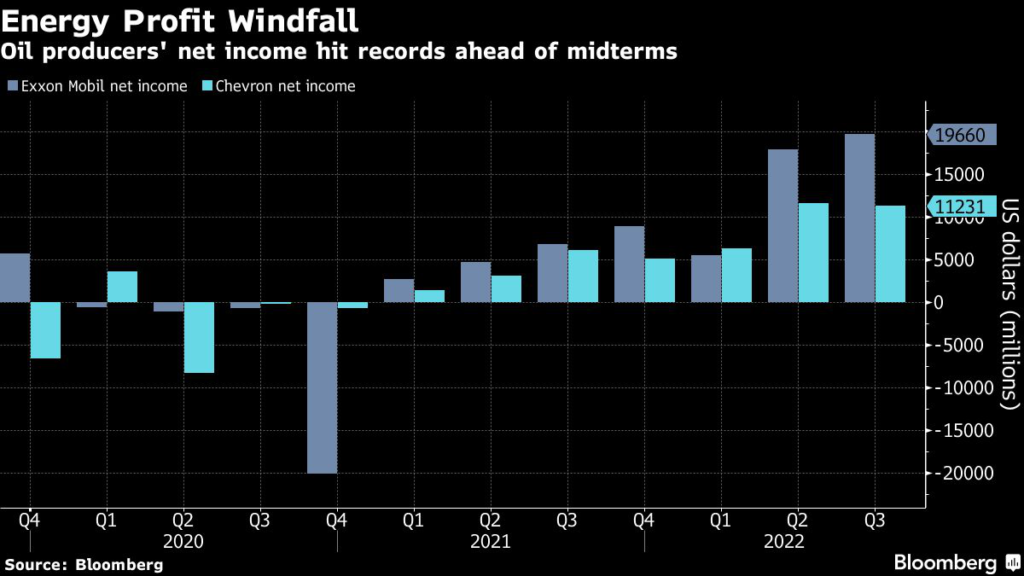
Assuming Republicans win control of either the Senate or House, energy policy is unlikely to see a major shift. While the Biden administration’s recent threat to impose a windfall tax on oil producers initially sent companies including Phillips 66, Exxon Mobil Corp. and Chevron Corp. lower, such a proposal is likely to be blocked by Republican lawmakers. 

Even under the current makeup of Congress Biden has “little power” to push his tax proposal through, according to Benjamin Salisbury, a managing director at Height Capital Markets. “It is highly unlikely that Congress will make any progress on the issue before year-end and is unlikely to address it in 2023,” he added.

Even if Biden somehow gets the votes he needs to move forward with a windfall tax — which, to be clear, is a longshot at best — there is a potential upside for energy stocks, according to Louis Navellier, the chief investment officer at Navellier & Associates. The idea is that the levy would discourage new investment, thereby curbing oil supplies and driving prices even higher.

Big Tech

Major US technology companies, from Alphabet Inc. to Meta Platforms Inc., have long been thought to be a target for potential regulation. And indeed, the White House is planning a post-midterms push for antitrust legislation, a last-ditch effort to get a stalled pair of bills through Congress before a predicted Republican takeover in January. The GOP has made it clear that they won’t support the bills if they retake control of either chamber of Congress. 

For tech investors, the midterms also bring a renewed focus to the research and development tax break put in place during the Trump administration, which expired last year. Under that legislation, firms with large R&D spending like Intel Corp. and Amazon.com Inc. could fully deduct those costs during the year in which they occurred as opposed to having to write them off over of the span of five years.

“The R&D tax credit change, if reversed, we feel would be positive for the information technology sector,” said Michael Taylor, an analyst at Wells Fargo. “If the tax credit is not reversed, a higher corporate tax bill could potentially weigh on the earnings and performance of the affected companies.”

–With assistance from Bre Bradham, Geoffrey Morgan, Ryan Vlastelica and Brian Eckhouse.

(Updates with the latest commentary from equity strategists.)

More stories like this are available on bloomberg.com

©2022 Bloomberg L.P.
Spyware Is Running Amok in Europe, EU Lawmaker Warns

(Bloomberg) — Spyware such as Pegasus is being deployed by state-run organizations across the European Union to snoop on politicians and journalists with virtually no EU-level oversight, according to a draft report for the bloc’s parliament. 

The document on the use of surveillance spyware released on Tuesday said citizens can “safely assume that all EU member states have purchased one or more commercial spyware products” such as Pegasus, developed by Israel-based NSO Group Ltd.

But, “no meaningful European oversight is in place; not to curb the illegal use of powerful spyware against individuals, nor to monitor the trade in these digital goods,” lawmaker Sophie in ‘t Veld, the report’s author, said in a statement.

The 159-page document focuses on the use of spyware based on investigations of journalists and civil society groups and the parliament’s own research missions. Its release comes after the parliament completed a fact-finding mission to Greece earlier this month where the government plans a new law to ban the use of spyware by private companies.

According to the report, which will be voted on in the coming months, Cyprus and Bulgaria, serve as export centers for spyware, Ireland offers favorable fiscal arrangements to a large vendor, and Luxembourg is a banking hub for many players in industry. Czech capital Prague hosts the annual European fair of the spyware industry, the ISS World “Wiretappers Ball.”

The report cites cases of spying including on Nikos Androulakis, president of Greece’s opposition socialist Pasok party and Polish senator Krzysztof Brejza, who served as campaign leader of the opposition party Civic Platform. Yet governments have been short on cooperation in investigating such cases, according to the document.


More stories like this are available on bloomberg.com

©2022 Bloomberg L.P.
Crypto Token’s Sudden Drop Stokes Rumors of Alameda Sale

(Bloomberg) — A sudden plunge in the value of crypto token BIT stoked speculation of a fire-sale by Sam Bankman-Fried’s trading house, adding to challenges for the billionaire as he deals with withdrawals from his exchange. 

BitDAO, a decentralized community of holders of the token, asked Bankman-Fried’s Alameda Research to provide proof the tokens hadn’t been sold in violation of a lock-in period. The BIT token fell about 25% on Tuesday morning in London before recovering some of its losses, leading to speculation that the crypto firm might have sold them to raise money. BIT is the native coin of crypto exchange Bybit.

Alameda’s Chief executive Officer Caroline Ellison denied the sale of the tokens in a reply to a post on Twitter from Ben Zhou, Bybit’s co-founder.

The debate risks adding to headwinds for Bankman Fried’s crypto empire, after the price of FTT, the native token of his exchange FTX, tumbled nearly 20% on Tuesday. This triggered a wider drop in digital asset prices, including Bitcoin and Ether, on concerns about the industry’s stability. The sell-off started after Changpeng Zhao, the chief executive officer of exchange Binance, announced plans to sell $530 million of FTT, in a Twitter post on Sunday.

BitDAO had swapped 100 million BIT with Alameda for 3.36 million FTT tokens just over a year ago with a three-year no-sale commitment, according to a thread posted on BitDAO’s community forum.

A Bybit spokesperson confirmed that BitDAO community has made a request to Alameda for verification of funds. “It is now up to Alameda to provide the proof required,” the spokesperson said in an email to Bloomberg adding that Bybit is not involved in the ongoing discourse between BitDao and Alameda. Alameda, FTX and Bankman-Fried did not respond to requests for comment.    

The BitDAO community has asked Alameda to transfer the BIT tokens to an on-chain address for them to “verify, and hold until the end of the agreement” within 24 hours that ends early afternoon Singapore time on Wednesday.

“If this request is not fulfilled, and if sufficient alternative proof or response is not provided, it will be up to the BitDAO community to decide (vote, or any other emergency action) how to deal with the $FTT in the BitDAO Treasury,” according to a post on BitDAO’s community forum.

–With assistance from Joanna Ossinger and Emily Nicolle.

More stories like this are available on bloomberg.com

©2022 Bloomberg L.P.

Coinbase Germany Faulted by Regulator Over Governance Set-Up

(Bloomberg) — Coinbase Germany GmbH was ordered by the country’s financial regulator to fix deficiencies related to its organizational set-up.

The order was issued to the company in late September and has been in effect since Oct. 27, BaFin said in a statement on its website on Tuesday. 

BaFin didn’t provide further details on the deficiencies, which it said were identified as part of a review of annual accounts.

Coinbase is cooperating fully and is committed to meeting all legal requirements for crypto custody firms in Germany, a spokeswoman said in an email to Bloomberg. The company has developed a remediation plan “fully addressing each finding” and has made “substantial progress” in doing so, she wrote.

(Updates with Coinbase comment in fourth paragraph)

More stories like this are available on bloomberg.com

©2022 Bloomberg L.P.
Close Bitnami banner
Bitnami