Bloomberg

Crypto Prices Fall Most in Two Weeks Amid FTT and Macro Risks

(Bloomberg) — Crypto markets tumbled in unison as investors raised concerns about the industry’s stability after Binance’s decision to sell $530 million of FTT, the native token of Sam Bankman-Fried’s FTX. 

Bitcoin sank as much as 6.4% to $19,370, the lowest level in two weeks. The losses were severe in smaller altcoins and tokens with ties to FTX. FTT plunged 18% and Solana, which is backed by FTX and Alameda, plunged nearly 20% on Tuesday. 

The selloff extends a week of turmoil in crypto markets after Changpeng Zhao, the chief executive officer of Binance, announced the FTT sales in a Twitter post on Monday. In an article last week, news site CoinDesk said a large portion of the balance sheet of Bankman-Fried’s trading house Alameda Research was comprised of the FTT Token. 

Bankman-Fried sought to reassure investors on Monday, noting that “unfounded rumors” had been circulating and that the exchange kept audited financials.

“Concerns around FTX and Alameda seem to be causing nervousness in the markets, which is impacting all of crypto currently,” said Vijay Ayyar, vice president of corporate development and international at crypto platform Luno.

Tensions Between Richest Crypto CEOs Erupt in Markets 

Cryptocurrency prices have also followed a wider slump in risk assets as central banks hike interest rates to combat soaring inflation. Ether slumped 5.6% to $1,486 on Tuesday. The MVIS CryptoCompare Digital Assets 100 Index fell as much as 6.6%. 

Virtual currencies have struggled this year following a series of major collapses and bankruptcies of firms including hedge fund Three Arrows Capital and lender Celsius which have heightened investor jitters. 

Given the declines, there are “potential market players who smell blood and are adding to the downward price pressure,” said Cici Lu, chief executive officer of Venn Link Partners Pte.


–With assistance from Emily Nicolle.

More stories like this are available on bloomberg.com

©2022 Bloomberg L.P.

Retailers in the US Push Big Holiday Discounts to Ease Inventory Avalanche

(Bloomberg) —

If last year’s holiday shopping season was characterized by empty store shelves and a race to meet demand in a healthy US economy, very different concerns have emerged just 12 months later: overabundance and sinking sales.

American retailers are sitting on so much inventory that brands — particularly for apparel and housewares — have resorted to listing their goods on resale websites, hosting sample sales, giving stuff to employees, offering deep discounts and even throwing goods away.

This period of plenty’s seeds were sown last year, when demand for merchandise was soaring but clogged supply chains caused long delays. Fearful of shortages, retailers including Gap Inc. and Nike Inc. ordered extra and did so earlier than usual, but a combination of poor forecasting and inflation-stung shoppers created massive gluts.

The overhang is leading to canceled orders, a sharp slowdown in global trade growth and stagnating factory activity. On one hand, it’s good that logistics networks are seeing relief from the logjams that plagued the start of 2022 — ocean-shipping rates have tumbled close to pre-pandemic levels and delivery times are shortening.

But most supply chains don’t perform well during rapid turns in either direction, and now the snapback to a surplus of transport capacity is dimming prospects for companies including rail operator Union Pacific Corp. and container-shipping giant A.P. Moller-Maersk A/S.

While retailers such as Kohl’s Corp. and Nordstrom Inc. expect to whittle down much of their bloated inventories by year end thanks to increased promotions, analysts and warehouse operators say it will likely take most of next year to wring out the excesses.

The pain is rippling upstream. In the US, the number of warehouse and storage jobs fell in October by 20,000, the most since April 2020, government data showed on Friday. Some workers, including those in the garment-manufacturing industry, are experiencing reductions in overtime hours and a decrease in take-home pay. 

Figures released on Monday showed Chinese exports fell for the first time in more than two years in October. Last week, the trade ministry of Vietnam — a popular alternative to China’s exports in recent years — warned of a significant drop in the number of orders products including sneakers and smartphones.

“There’s a double-whammy phenomenon going on where companies might experience pressure on their margins because of a lot of the discounting and promoting that’s going to happen, and they’re also going to experience pressure on the margins because at the same time that prices are coming down, costs are still high,” said Jay Sole, analyst at UBS Group AG. “That’s something that Wall Street’s very worried about.”

LA Warehouses

Mountains of merchandise are parked in places like Southern California. The vacancy rate for warehousing space in the greater Los Angeles area — home to the two largest ports in the US — sits at 0.2%, compared with the typical 4% to 6% this time of year, according to Port of Los Angeles Executive Director Gene Seroka.

“You’re going to be buying different products on the retail shelves and online between now and the holidays than are in those warehouses — the latest games, the latest tech, the latest fashion,” Seroka said in a recent interview. “How do you flush the inventory that’s been sitting in these warehouses for some time?”

The problem is acute for mass-market brands that cater to low- and middle-income Americans who are increasingly feeling the hit from higher inflation, devoting more of their budgets to necessities like food and utilities.

Apparel-industry sales are expected to decline by 1% in the final three months of this year, compared with 21% growth in 2021, according to data from NPD Group.

Traditional inventory-management methods like discounting and pack and hold — a strategy where retailers hold products in warehouses and bring them back for another season — are already being used widely.

In earnings calls in the past month, executives at brands including Vans owner VF Corp., Levi Strauss & Co., and Container Store Group Inc. all pointed to a holiday season with deeper promotions than in recent history. 

“In a promotional environment in the marketplace, it’s going to be all around us,” VF Chief Financial Officer Matt Puckett said on Oct. 26. “And we certainly expect that’s going to have some impact on our business.”

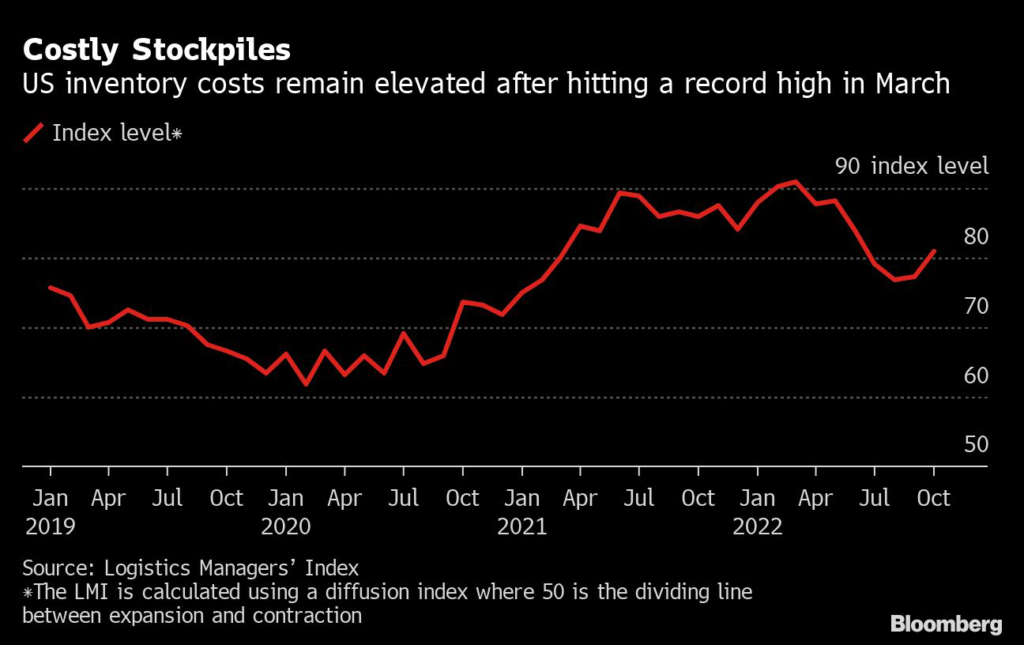
But the latest Logistics Managers’ Index shows inventory and warehousing costs remain stubbornly high, so discounting alone isn’t enough. 

Companies are getting creative when it comes to liquidating excess merchandise.

“I have some clients that are asking: Can we throw away stuff? Can we give it to our associates? Can we recycle it?” said Jeff Havelka, chief executive officer of Beyond Warehousing, a third-party logistics company based in Kansas. “They just don’t want to pay to store it anymore.”

Havelka said retailer orders are down as much as 30% over last year, but inventory is up as much as 50% which is “tying up their cash and their credit.” A number of his clients are offloading their inventory at a loss, he said. 

“There are some companies that are probably gonna die here because they weren’t dynamic enough to make it through this and were focused on the wrong things,” Havelka said.

Other brands are resorting to resale platforms including Poshmark Inc., ThredUp Inc. and Etsy Inc.-owned Depop to list excess inventory, said Josh Kaplan, co-founder of Ghost, an online marketplace where retailers can anonymously list excess inventory for sale. Some Ghost clients are turning to store pop-ups or sample sales to offload their goods, he said.

To prevent their stockpiles from getting any larger, retailers in some cases have deferred orders from suppliers, said Liana Foxvog, director of supply-chain strategies at the Worker Rights Consortium.

Kontoor Brands Inc., owner of Wrangler and Lee jeans, said on Nov. 3 that it is using downtime at its plants to control inventory levels.

Smaller Paychecks

A slower pace of inventory growth in the coming quarters is likely to be a drag on US gross domestic product, further contributing to concerns about an economy on weaker footing. Deferred or canceled orders also impact the labor market, leading to fewer hours or jobs for workers through the supply chain. 

“We are hearing that there has been a decrease in workers’ take home pay, and that’s due to cutting in overtime hours,” Foxvog said of garment workers specifically. “In many places, workers are working less total hours per month and therefore taking home less money.”

The longer-term impact of the current inventory overload will become clearer in the next month when the majority of public US apparel and home goods brands report third-quarter earnings and provide an update on inventory growth. 

“Even just in the past three days, we’ve seen some of the biggest or most valuable brands in the world contact us for help with excess inventory,” Kaplan said. “It’s a full tidal wave at this point. We need the customer to be spending, and until that happens, the product’s not going to move.”

More stories like this are available on bloomberg.com

©2022 Bloomberg L.P.

Blibli Owner Ends Flat in Jakarta’s Second-Largest Debut of 2022

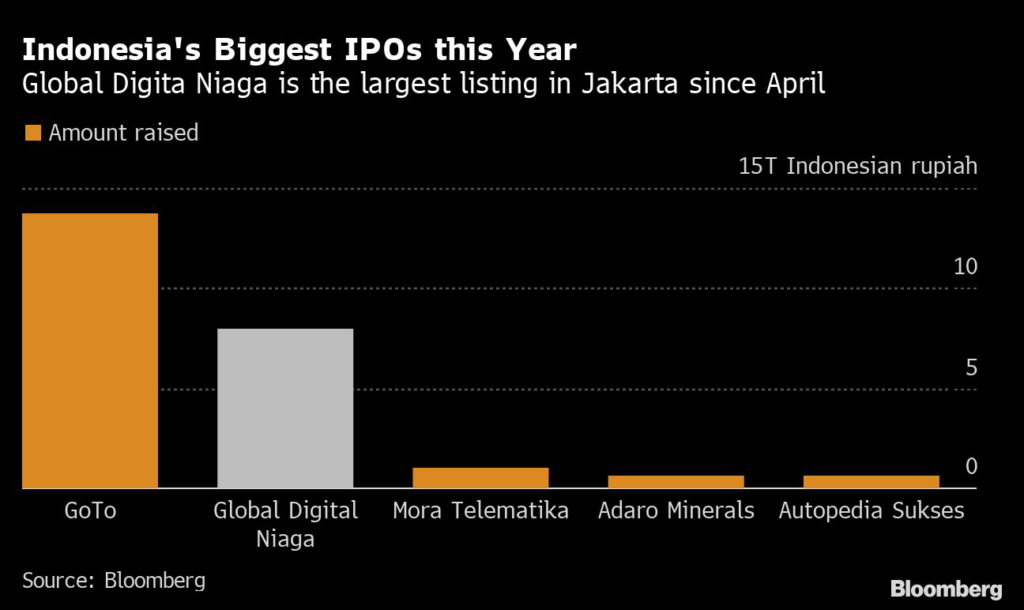
(Bloomberg) — PT Global Digital Niaga, the owner of Indonesia’s e-commerce group Blibli, ended its first day of trade unchanged after raising 8 trillion rupiah ($510 million) in the country’s second largest initial public offering this year. 

The shares finished at 450 rupiah each, erasing gains of as much as 4.9% shortly after the market opened. They were sold at the top of a marketed range in an upsized offering in October. It’s the largest listing in Jakarta since PT GoTo Gojek Tokopedia’s initial sale in April.

The company is backed by Djarum Group, one of Indonesia’s biggest conglomerates known more for its clove-flavored cigarette products. Global Digital also owns an online travel business and supermarket chains.

Before Global Digital, companies that debuted in Jakarta after raising at least $100 million over the past five years rose by a weighted average of 8.2% in their first day of trade, according to data compiled by Bloomberg. 

Indonesia’s IPO market has revved up to life recently, with ten companies starting to trade this week alone. The stock benchmark is among top performers in Asia’s major markets this year, even after pulling back 3.7% from a record high in September. 

Blibli’s free float of about 15% compares to more than 50% currently for e-commerce rival PT Bukalapak.com and tech company GoTo. They started trading in Jakarta in Aug. 2021 and April, respectively, and are trading 67% and 43% below their offer price. 

Selling Pressure

“As the existing shareholders, Djarum Group has committed to not exit from Blibli after the IPO, so we won’t see any selling pressure like we saw in Bukalapak and GoTo,” said Doni Firdaus, an investment director at Bahana TCW Investment Management. “However, the negative sentiments toward the tech sector still persist, so it will also affect the appetite for Blibli shares.”

According to the prospectus, Global Digital will have a total addressable market estimated at $440 billion in 2025. The company will focus on profitability as it sees growth in online and offline businesses amid lower costs in the first half of the year, Chief Executive Officer Kusumo Martanto said last month. Losses more than doubled to 2.5 trillion rupiah in the first six months of 2022.

The company got support from foreign investors, including sovereign wealth funds, local funds and retail investors through the offer, Chief of Corporate Secretary and Investor Relations Eric Alamsjah Winarta said in media briefing Tuesday.

Global Investama Andalan, the majority shareholder with a 98.5% stake, and 89 individual investors will have a lock-in period of eight months, according to its prospectus. Global Digital plans to use the IPO proceeds for debt repayment and working capital. 

PT BRI Danareksa Sekuritas, PT BCA Sekuritas, Credit Suisse Group AG, Morgan Stanley Asia Ltd and DBS Group Holdings arranged the offering. 

(Updates with closing price and adds comments from chief financial officer to ninth paragraph)

More stories like this are available on bloomberg.com

©2022 Bloomberg L.P.

Saudi Arabia’s PIF to Consider Bidding for Ooredoo’s Tower Unit

(Bloomberg) — Saudi Arabia’s Public Investment Fund is among suitors weighing a final bid for network towers being sold by Qatari telecom firm Ooredoo QPSC, people familiar with the matter said. Ooredoo shares jumped in Doha trading.

American Tower Corp., IHS Holding Ltd. and Helios Towers Plc are also considering binding offers for all or part of the portfolio, according to people, who asked not to be identified as the matter is private. Ooredoo’s tower assets, which span the Persian Gulf region, as well as countries including Algeria, could be valued at $3 billion to $5 billion in any deal, they said. 

Bids are due in the coming days, the people said. Deliberations are ongoing and there’s no certainty any of the suitors will decide to submit offers. 

The bid by the PIF, as the Saudi wealth fund is known, is the latest sign that the kingdom is moving on from a diplomatic spat with Qatar that began in 2017 and wasn’t resolved until 2021. PIF is also considering an investment in Qatari broadcaster BeIn Media Group, Bloomberg reported last month. As a result of the spat, Saudi Arabia, along with countries including the United Arab Emirates and Bahrain, had blocked trade and travel links with Qatar.

Ooredoo said in September that it will carve out its portfolio of almost 20,000 towers as part of a shift to an asset-light model. The state-owned telecom operator recently sold its Myanmar business for an enterprise value of $576 million and is also considering carving out its data center unit to attract new investors into the business.

A spokesperson for Ooredoo said the company planned to announce the carveout of its towers business in 2023, declining to comment further. Representatives for Helios, IHS and PIF declined to comment, while a spokesperson for American Tower didn’t immediately respond to a request for comment.

The shares of Ooredoo climbed as much as 6.9%, the most in more than five years, valuing the telecom operator at about $9 billion.  

Tower Demand

PIF plans to invest $24 billion in Middle Eastern and North African countries as oil-rich Saudi Arabia seeks to bolster regional economies, it said in October, and will channel funds into sectors including infrastructure, heath care and telecoms.

Last month, the wealth fund offered to buy a majority stake in Tawal, the telecom towers unit of phone company Saudi Telecom Co., as part of its plan to create a cellular tower behemoth. PIF plans to bid for the Ooredoo assets through Tawal, the people said. 

Deals for network towers are helping dealmakers defy a broader slowdown in global mergers and acquisitions activity this year. Telecom operators are shifting the assets to help raise funds for fiber-optic rollouts and wireless upgrades, and are finding willing buyers in the form of investment firms seeking predictable returns in volatile markets.

In Europe, KKR & Co. is leading the race for a stake in Vodafone Group Plc’s towers unit, while fellow private equity firm EQT AB is seen as the frontrunner to acquire a slice of French tower owner TDF. 

–With assistance from Scott Moritz and Matthew Martin.

(Adds details of Saudi-Qatar diplomatic dispute in fourth paragraph)

More stories like this are available on bloomberg.com

©2022 Bloomberg L.P.
Renault Seeks Margin Boost From Sweeping Overhaul Plan

(Bloomberg) — Renault SA plans plans to boost its profitability and reinstate its dividend as the French carmaker proceeds with a complex split of its electric-vehicle and combustion-engine businesses, backed by outside investors.

The manufacturer, whose mainstay is the highly competitive European market, is seeking an operating margin of more than 10% by 2030, up from more than 5% this year, Renault said Tuesday, ahead of the start of an investor day that comes as complex talks with partner Nissan Motor Co. continue. Dividend payments will resume next year as turnaround efforts take hold. 

The shares declined as much as 3.5% in early trading in Paris, trimming gains this year.

Chief Executive Officer Luca de Meo, who took over a struggling Renault in 2020, has embarked on a radical overhaul of operations as the carmaker seeks to navigate the difficult and costly transition to electrification.

The move to separate operations is expected to help Renault raise funds for EV development and technology and narrow the gap with bigger companies such as Stellantis NV, the maker of Jeep SUVs. Renault is also bringing in China’s Geely as a partner for its legacy combustion engine business.

The financial targets “appear far more ambitious than what we were expecting,” RBC analyst Tom Narayan said in a note. The plan raises a number of questions, according to the analyst, including how to separate the EV and Power businesses that share some operations and achieving break-even levels amidst battery cost inflation. 

By 2025, Renault is forecasting an operating margin above 8% with free cash flow of more than €2 billion annually on average through then, the company said. The maker of the electric Megane E-Tech cars also outlined a dividend policy set to grow “gradually” and “in a disciplined manner” to a payout ratio of as much as 35% of net income in the mid term, it said.

Five Groups

Under the plans unveiled Tuesday, Renault is reorganizing into five different units spanning electric cars, combustion- and hybrid-engine assets, the Alpine sports-car brand, financial services and new mobility and recycling businesses. 

The move follows other carmakers taking unprecedented steps to adapt to challenges posed by the EV transition. Ford Motor Co. in March said it’ll separate the fast-growing EV and software business from the combustion-engine assets that will focus on cutting costs and streamlining operations. Last year, Daimler ended more than a century of making cars and trucks under one roof, with Mercedes-Benz Group AG and Daimler Truck Holding AG now listed separately.

At Renault, the two most important steps relate to its EV and combustion-car divisions, named Ampere and Power. 

For Ampere, the company is seeking external investors. It’s also weighing an initial public offering on Euronext Paris in the second part of 2023, at the earliest. Renault plans to keep a “strong majority” in Ampere and is counting on the support of potential cornerstore investors, such as Qualcomm Inc.

Renault, an early mover in EVs with the fully-electric Zoe, is aiming for a roughly €10 billion valuation for Ampere, people familiar with the situation have said. The business will have a lineup of six electric cars before the end of the decade and plans to make about 1 million EVs annually for the Renault brand by 2031. 

That valuation would top Renault’s current market value of €9.4 billion. The target is aspirational and the IPO will be subject to market conditions, the people said.

Tense Talks

Renault’s carve-out push has been at the heart of tense talks with Japanese partner Nissan Motor Co. this year as the two companies seek to reshape a two-decade-old alliance that’s been problematic since the 2018 arrest of former leader Carlos Ghosn. 

The talks are ongoing, Renault said today, without elaborating. The valuation of Ampere has been among sticking points in the discussions, which also hit snags over intellectual property concerns, people familiar with the talks have said. 

The company is also combining its legacy combustion-engine and hybrid powertrain business with China’s Zheijiang Geely Holding Group in a major push to save costs. Renault will retain a 50% stake in the new entity with combined revenue of more than €15 billion with Geely owning the other half. The unit will employ 19,000 employees across three continents with 17 plants.

Alpine Plans

The carmaker is also pushing to broaden the appeal of its boutique Alpine sports-car brand. The maker of the A110 sports coupe is set to develop a new line-up to include hatchback and crossover models, as well as targeting further segments. Renault expects half of Alpine’s growth — the unit sold 784 cars during the third quarter — to come from new markets including potentially North America and China. 

Renault in July raised its 2022 operating margin outlook to above 5% in July after turnaround efforts started talking hold. 

Renault’s New Targets

  • Operating margin +8% in 2025, +10% in 2030
  • Free cash-flow above €2 billion per year on average over 2023-2025, above €3 billion per year on average over 2026-2030
  • Restore dividend from 2023; plan to raise payout ratio gradually to as much as 35% of net income in mid-term
  • Dividend plan hinges on Renault returning to investment grade rating
  • Ampere EV business to beak even in 2025, around 10% operating margin in 2030
  • Alpine brand to generate €2 billion in revenue in 2026, more than €8 billion in 2030 with break even targeted for 2026

(Updates with shares in third, analyst comment fifth paragraph)

More stories like this are available on bloomberg.com

©2022 Bloomberg L.P.
Grab-Singtel Digibank Executive Reuben Lai to Depart Venture

(Bloomberg) — The banking joint venture of Grab Holdings Ltd. and Singapore Telecommunications Ltd. said executive director and head of regional strategy, Reuben Lai, is leaving the company at the end of 2022.

Lai will also step down from his role as a director of the venture, GXS Bank, according to a statement from the firm Tuesday. Still, he will remain a director on the board of GXS’s digital bank in Malaysia.

Lai is among the most senior leaders of GXS, which launched in Singapore this year after getting a full digital bank license in 2020. The license allows the digital bank to take deposits and serve both retail and corporate customers. Regional ride-hailing giant Grab and phone carrier Singtel are betting on the venture to expand in financial services.

Prior to his role at GXS, Lai was a senior managing director at Grab Financial Group.

More stories like this are available on bloomberg.com

©2022 Bloomberg L.P.

Renault, Google Expand Pact to Make Cars ‘Like Mobile Phones’

(Bloomberg) — Renault SA is deepening its collaboration with Alphabet Inc.’s Google in a bid to extend capabilities on remote software updates to new models such as the electric Megane E-Tech and Austral. 

“We want to make the car an intelligent object that learns and one that can be upgraded over the air like a mobile phone,” Renault Chief Executive Officer Luca de Meo said in an interview.

Carmakers are scrambling to catch up with Tesla Inc.’s tech capabilities, including the ability to deliver updates to cars remotely. Expanding the partnership with Google, which started in 2018, will allow Renault to offer more over-the-air software updates as well as additional on-demand services, the two companies said Tuesday.

De Meo said new in-vehicle digital features will create additional revenue while bolstering the residual value of Renault cars and retain customers. Functions on demand will include drivers being able to locate their cars in large parking lots. 

“The product stays in connection with the company from cradle to grave, for more than one ownership cycle,” he said. 

The expansion of the partnership with Google shows Renault’s “horizontal” strategy under de Meo, which includes collaborations on software with developers rather than designing the tech in-house — a strategy that has yielded mixed results at other traditional carmakers. Volkswagen AG delayed crucial new models and pushed out ex-Chief Executive Officer Herbert Diess in July amid problems at its Cariad software unit.

“We are a hardware manufacturer; software is another sport,” de Meo said. “If you want to learn to play tennis, you better go with someone who plays proper tennis.”

More stories like this are available on bloomberg.com

©2022 Bloomberg L.P.

Nintendo Profit Meets Estimates With Weak Yen, Solid Game Sales

(Bloomberg) — Nintendo Co. reported quarterly earnings in line with expectations, thanks to solid software sales and a weak yen that outweighed slowing momentum of the aging Switch console. The company cut its Switch sales forecast for the year by 10% to 19 million units.

The Kyoto-based company said its operating profit was 118.7 billion yen ($809 million) in the quarter ended September, up from 100.2 billion yen in the same period a year ago. The consensus estimate was for a profit of 117.6 billion yen.

Splatoon 3, the latest installment of a core Nintendo franchise, became the company’s fastest Switch software launch ever, with 3.45 million units sold domestically over its first three days. Its September launch gave a lift to the hit-driven sales of Nintendo’s five-year-old Switch console and that momentum is expected to be sustained by the Nov. 18 launch of the latest entries in the Pokemon series.

Nintendo also got a big boost from this year’s precipitous drop in the yen’s value. The currency trades at its lowest level against the US dollar in more than 30 years, and Nintendo gets four fifths of its sales from outside Japan while its software production costs are denominated mostly in the domestic currency.

The company on Tuesday stuck to its full-year earnings forecast for an operating profit of 500 billion yen, which falls short of the consensus estimate of 592 billion yen.

Read more: Nintendo Surges After Record Debut of New Switch Game

Analysts are closely tracking the Switch console’s momentum ahead of the year-end holiday season as supply chain constraints wane. Nintendo has said demand for the handheld-hybrid console remains strong, despite the gadget’s age, and slowing sales in recent times have mostly been due to chip shortages and logistics issues stemming from the pandemic.

“The Switch has reached the 70% mark of its life cycle, but Nintendo should be able to survive with the current hardware lineup for the time being,” UBS Securities analyst Kenji Fukuyama said.

–With assistance from Yuki Furukawa.

More stories like this are available on bloomberg.com

©2022 Bloomberg L.P.
Taiwan’s Gogoro Sees India as ‘Holy Grail’ for EV Technology

(Bloomberg) — Taiwanese startup Gogoro Inc. sees huge scale for its battery-swapping technology in India, joining the race to get a slice of an electric vehicle market which is expected to reach 400 times its current size by the end of the decade. 

“India represents the holy grail where we see our technology making an impact,” said Horace Luke, the chief executive officer and founder of Gogoro Inc. on Bloomberg TV Tuesday. The electric scooter and battery-swapping-station maker is going to get its “technology honed, fine-tuned and calibrated to the India condition.”

Last week the company tied up with India’s Zypp Electric and announced a pilot in New Delhi. Gogoro will watch out for how its technology fares in India’s climate conditions, Luke added.

This comes at a time when the government has been pushing for faster adoption of electric scooters and rickshaws in India, launching a battery-swapping program earlier this year. It expects investments in the Indian EV industry to more than triple to $20 billion by 2030 from $6 billion in 2021. 

The company currently has more locations than gas stations in Taiwan, Luke said. He sees commercialization with its Indian partner Hero MotoCorp Ltd. “as well as other partners coming around the corner” as key to scaling the business in India. 


–With assistance from Rishaad Salamat, Anand Menon and Haslinda Amin.

More stories like this are available on bloomberg.com

©2022 Bloomberg L.P.

Dollar Rises, Global Stocks Mixed Before Midterms: Markets Wrap

(Bloomberg) — The dollar snapped two days of losses and global equities markets were mixed as investors awaited US midterm elections and inflation data.

US stock futures edged lower, contracts for Europe fluctuated and a gauge of Asian shares rose, led by gains in Japan.

Chinese equities fell, halting their recent rally, as traders considered a jump in virus infections and official comments defending Covid-Zero. The heaviest falls were in Hong Kong-listed technology companies.

Markets are focused on the elections later Tuesday for potential gridlock in government — which historically has been good for US stocks — and on the consumer price print Thursday for its impact on Federal Reserve interest-rate hikes. 

The greenback made small gains versus all of its Group-of-10 currency counterparts. The Bloomberg Dollar Spot Index had dropped 0.4% Monday, extending the 1.7% loss from Friday, which was its worst day since March 2020.

The inflation reading is coming after the core consumer price index rose more than forecast to a 40-year high in September. Even if prices begin to moderate, the CPI is far above the Fed’s comfort zone.

“Inflation is going up. It may be coming down periodically. But it’s going up,” Richard Harris, chief executive of Port Shelter Investment Management, said on Bloomberg Television. “The market is kind of uncertain — it’s hoping for the best but really should be preparing for the worst.” 

Yet opinion is divided on the broad outlook for markets and the economies. 

Goldman Sachs Group Inc.’s top economist said there was still a “very plausible” path for the US economy to avoid a recession. 

JPMorgan Chase & Co.’s Marko Kolanovic warned of the risk to stocks from ongoing Fed hawkishness, and Morgan Stanley’s Mike Wilson said companies will need to aggressively shrink expenses, including through layoffs, before he becomes more optimistic on US equities.

Treasury yields inched higher while benchmark Australian and New Zealand government bond yields gained more than 10 basis points.

Japan’s benchmark 10-year bond yields were stuck at the 0.25% upper limit of the central bank’s target range as trading dried up.

The Bank of Japan has been scooping up so many 10-year bonds there may soon be little left to buy. It held 73% of 10-year government notes with a residual maturity of at least seven years as of end-October, according to data compiled by Bloomberg.

Meanwhile, swaps markets are leaning toward a 50 basis-point Fed rate increase in December, after a fourth consecutive jumbo hike to a target range of 3.75% to 4% at last week’s meeting. Rates are expected to peak slightly above 5% around mid-2023.

Key events this week:

  • Euro-zone retail sales, Tuesday
  • US midterm elections, Tuesday
  • EIA oil inventory report, Wednesday
  • China aggregate financing, PPI, CPI, money supply, new yuan loans, Wednesday
  • US wholesale inventories, MBA mortgage applications, Wednesday
  • Fed officials John Williams, Tom Barkin speak at events, Wednesday
  • US CPI, US initial jobless claims, Thursday
  • Fed officials Lorie Logan, Esther George, Loretta Mester speak at events, Thursday
  • US University of Michigan consumer sentiment, Friday

Some of the main moves in markets:

Stocks

  • Futures on the S&P 500 fell 0.1% as of 3:18 p.m. Tokyo time. The S&P 500 rose 1% Monday
  • Futures on the Nasdaq 100 fell 0.1%. The Nasdaq 100 fell 1.1%
  • Euro Stoxx 50 futures were little changed
  • The Topix Index rose 1.2%
  • South Korea’s Kospi index rose 1.1%
  • The S&P ASX Index rose 0.4%
  • The Hang Seng Index fell 0.8%
  • The Shanghai Composite Index fell 0.9%

Currencies

  • The Bloomberg Dollar Spot Index rose 0.1%
  • The euro fell 0.1% to $1.0005
  • The Japanese yen was little changed at 146.68 per dollar
  • The offshore yuan fell 0.4% to 7.2558 per dollar

Cryptocurrencies

  • Bitcoin fell 4.5% to $19,744.83
  • Ether fell 6.5% to $1,473.61

Bonds

  • The yield on 10-year Treasuries was little changed at 4.22%
  • Japan’s 10-year yield was little changed at 0.25%
  • Australia’s 10-year yield advanced 13 basis points to 4.03%

Commodities

  • West Texas Intermediate crude fell 0.5% to $91.33 a barrel
  • Spot gold fell 0.3% to $1,670.17 an ounce

–With assistance from Stephen Kirkland, Vildana Hajric, Jan-Patrick Barnert and Haidi Lun.

More stories like this are available on bloomberg.com

©2022 Bloomberg L.P.

Close Bitnami banner
Bitnami