
Bloomberg

Covid Surge Tempers Hopes ‘IPhone City’ Lockdown Will Lift Soon

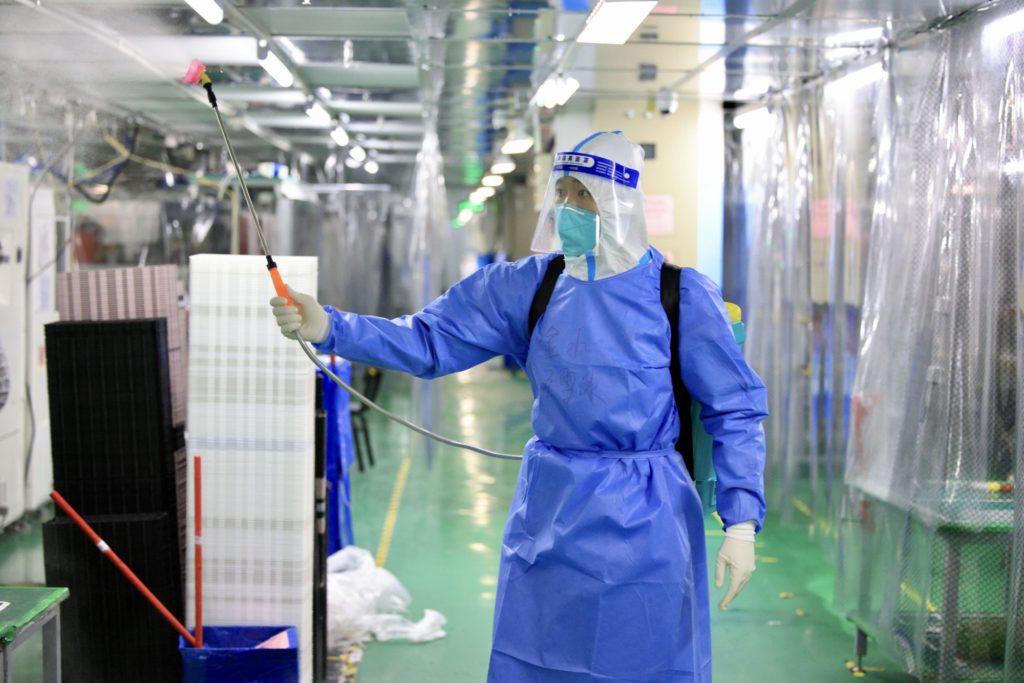
(Bloomberg) — Covid cases have more than doubled in the central Chinese city of Zhengzhou, dampening hopes that authorities will lift a lockdown of the area surrounding the world’s largest iPhone factory.

A seven-day lockdown of the Airport Economy Zone, which houses Apple Inc.’s global iPhone production base, expires noon Wednesday. The local government may extend those curbs — which curtail the flow of everything but essential goods and personnel — depending on the progress of a local outbreak. Covid cases across the city jumped to 733 as of Monday from 297 the previous day.

An extension would deal a blow to Apple and its most important supplier Foxconn Technology Group, which makes an estimated four out of five of the world’s latest iPhones from the complex in Zhengzhou dubbed “iPhone City.” Even before the seven-day prohibition, Foxconn had struggled to stem an exodus of workers fleeing a local outbreak and subsequent quarantine. 

Read more: IPhone Factory Worker Walked 25 Miles to Escape Covid Lockdown

The disruption coincides with the US holiday shopping season as well as a sharp slowdown in demand for electronics worldwide. Apple warned Sunday it would ship fewer premium devices than anticipated because of the Zhengzhou lockdown. 

The US company, which is grappling with tepid demand for less expensive iPhone 14s, expects to produce at least 3 million fewer iPhone 14 handsets than originally anticipated this year. The company and its suppliers now aim to make 87 million devices or fewer, compared with a target of 90 million units earlier, Bloomberg News reported this week. 

Even if the lockdown lifts Wednesday, it may take weeks for Foxconn to recruit and train the hundreds of workers that have left. The Taiwanese company, which typically employs around 200,000 at the site, is offering generous compensation to try and entice and retain staff.

Hon Hai Precision Industry Co, Foxconn’s main listed arm, is slated to report earnings Thursday after lowering its fourth-quarter outlook to take the lockdown into account. The company, which last month went into a “closed loop” that cut off contact with much of the outside world, has said it’s working with the local government to get its plant back on track. 

Should Foxconn get the Covid situation under control, sales will still take a hit in the first half of November before starting to recover in subsequent weeks, analysts at Citi wrote Nov. 6. Morgan Stanley analysts, describing a hypothetical worst-case scenario, estimated Foxconn could swallow a 20% hit to sales for the current quarter if Zhengzhou shipments were to grind to a halt over the remainder of 2022.

More stories like this are available on bloomberg.com

©2022 Bloomberg L.P.

Renault to Boost Returns in Split Plan With Outside Investors

(Bloomberg) — Renault SA plans to roughly double its operating margin in coming years as the French carmaker embarks on a deep overhaul to split its electric-vehicle and legacy combustion-engine businesses and take on outside investors.

The manufacturer, whose mainstay is the highly competitive European market, is seeking an operating margin of more than 10% by 2030, up from more than 5% this year, Renault said Tuesday, ahead of the start of an investor day that comes as complex talks with partner Nissan Motor Co. continue. Renault will also resume paying a dividend next year as turnaround efforts take hold. 

“After having executed one of the fastest and unexpected recovery plans, after having prepared the company for growth by securing the development of the best product line-up in decades, we intend to position ourselves faster and stronger than the competition,” Chief Executive Officer Luca de Meo said in a statement.

The former Fiat and Audi executive, who took over in July 2020 just before Renault reported a record loss, has embarked on a radical overhaul of operations as the carmaker seeks to navigate the difficult and costly transition to electrification. The move to separate operations is expected to help Renault raise funds for EV development and technology and narrow the gap with bigger companies such as Stellantis NV, the maker of Jeep SUVs.

By 2025, Renault is forecasting an operating margin above 8% with free cash flow of more than €2 billion annually on average through then, the company said. The maker of the electric Megane E-Tech cars also outlined a dividend policy set to grow “gradually” and “in a disciplined manner” to a payout ratio of as much as 35% of net income in the mid term, it said.

Five Groups

Under the plans unveiled Tuesday, Renault is reorganizing into five different units spanning electric cars, combustion- and hybrid-engine assets, the Alpine sports-car brand, financial services and new mobility and recycling businesses. 

The move follows other carmakers taking unprecedented steps to adapt to challenges posed by the EV transition. Ford Motor Co. in March said it’ll separate the fast-growing EV and software business from the combustion-engine assets that will focus on cutting costs and streamlining operations. Last year, Daimler ended more than a century of making cars and trucks under one roof, with Mercedes-Benz Group AG and Daimler Truck Holding AG now listed separately.

At Renault, the two most important steps relate to its EV and combustion-car divisions, named Ampere and Power. 

For Ampere, the company is seeking external investors. It’s also weighing an initial public offering on Euronext Paris in the second part of 2023, at the earliest. Renault plans to keep a “strong majority” in Ampere and is counting on the support of potential cornerstore investors, such as Qualcomm Inc.

Renault, an early mover in EVs with the fully-electric Zoe, is aiming for a roughly €10 billion valuation for Ampere, people familiar with the situation have said. The business will have a lineup of six electric cars before the end of the decade and plans to make about 1 million EVs annually for the Renault brand by 2031. 

That valuation would top Renault’s current market value of €9.4 billion. The target is aspirational and the IPO will be subject to market conditions, the people said.

Tense Talks

Renault’s carve-out push has been at the heart of tense talks with Japanese partner Nissan Motor Co. this year as the two companies seek to reshape a two-decade-old alliance that’s been problematic since the 2018 arrest of former leader Carlos Ghosn. 

The talks are ongoing, Renault said today, without elaborating. The valuation of Ampere has been among sticking points in the discussions, which also hit snags over intellectual property concerns, people familiar with the talks have said. 

The company is also combining its legacy combustion-engine and hybrid powertrain business with China’s Zheijiang Geely Holding Group in a major push to save costs. Renault will retain a 50% stake in the new entity with combined revenue of more than €15 billion with Geely owning the other half. The unit will employ 19,000 employees across three continents with 17 plants.

Alpine Plans

The carmaker is also pushing to broaden the appeal of its boutique Alpine sports-car brand. The maker of the A110 sports coupe is set to develop a new line-up to include hatchback and crossover models, as well as targeting further segments. Renault expects half of Alpine’s growth — the unit sold 784 cars during the third quarter — to come from new markets including potentially North America and China. 

Renault in July raised its 2022 operating margin outlook to above 5% in July after turnaround efforts started talking hold. The company’s shares are up 3.7% this year, the top-performing stock in Europe’s Stoxx 600 Automobiles & Parts Index.

More stories like this are available on bloomberg.com

©2022 Bloomberg L.P.
Rakuten’s Bonds Tumble on Concerns Over Earnings in Japan

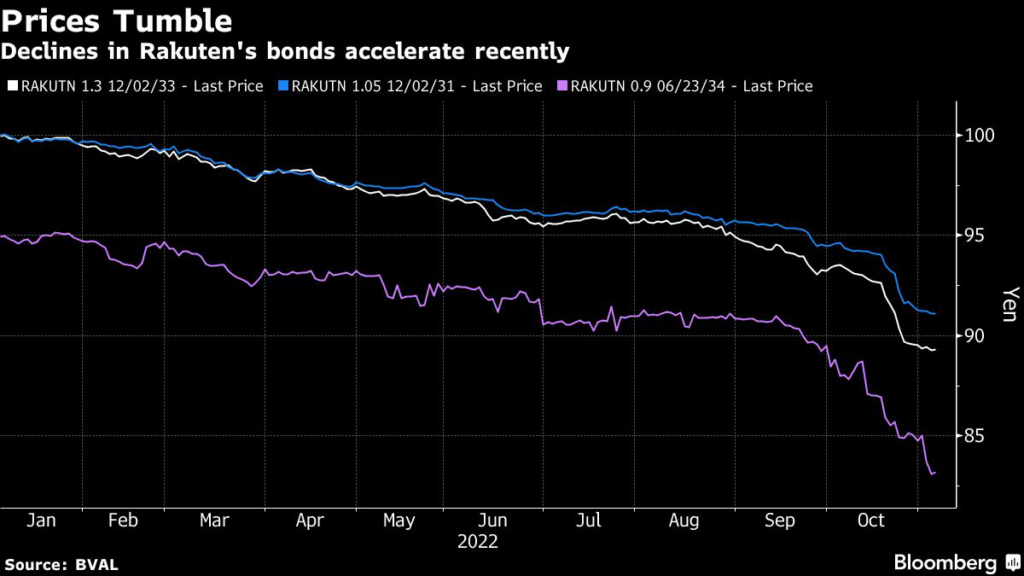
(Bloomberg) — Rakuten Group Inc.’s bonds have fallen to near all-time lows as concerns mount that the Amazon.com competitor in Japan will report more losses. 

Most of the firm’s yen debt has extended declines in recent weeks, with its 2031 note falling 3.2 yen in October, the sharpest monthly drop since it was sold almost a year ago. The e-commerce giant’s dollar and euro bonds are also hovering near record lows, data compiled by Bloomberg show. 

Billionaire Hiroshi Mikitani’s company, which is set to report earnings on Friday, faces a crucial test over whether it can raise a meaningful amount of capital to support its troubled mobile-phone business. Rakuten is also at risk of a downgrade further into junk territory by S&P Global Ratings.

The decline in the bonds reflects investor concern that Mikitani, a relative late-comer to Japan’s telecommunications sector, is carving off parts of Rakuten’s best businesses to finance his cellular aspirations. Rakuten plans to offload more of its securities unit in an initial public offering, with its banking subsidiary also poised to go public.

“These are the two possible opportunities for Rakuten to get a big amount of nondebt funds, and if it fails to do so, it may have to find other means to raise funds, which may take time,” said Chizuru Hoshi, a credit analyst at Nomura Securities Co.

A spokesman for Rakuten declined to comment on moves in the bonds.

Read more: Struggling Rakuten Might Need to Phone a Friend: Gearoid Reidy

Weak earnings may worsen its difficulties in trying to raise funds. Rakuten will probably post an operating loss of 57 billion yen ($389 million) for the quarter ended September, according to analysts’ estimates.

S&P has said it may cut the company’s credit score by the end of the year if the Tokyo-based company fails to raise a sufficient amount of nondebt funds for its non-financial unit. 

The cost to insure Rakuten’s bonds against default has also soared to a record. Its credit-default swaps have jumped 104 basis points since the start of October, compared with an 18 basis-point decline in the Markit iTraxx Japan CDS index. 

More stories like this are available on bloomberg.com

©2022 Bloomberg L.P.

Crypto Exchange FTX’s Token Tumbles Below $22 Barrier Amid Spat

(Bloomberg) — Cryptocurrency exchange FTX’s token has fallen below a level suggested by an affiliate as an offer price, after an increase in withdrawals that was triggered when competitor Binance Holdings Ltd. announced plans to sell all its token. 

On Sunday, Changpeng Zhao, CEO of top crypto exchange Binance, announced plans to sell the bourse’s roughly $530 million holding of FTT, the native token of Sam Bankman-Fried’s FTX. Caroline Ellison, the CEO of Bankman-Fried’s trading house Alameda Research, later offered to buy all of Binance’s FTT tokens at $22.

That price level has now been breached. The FTT token tumbled below $18 in Singapore on Tuesday, according to data from CoinGecko. Other cryptocurrencies like Bitcoin and Ether fell to session lows around the same time that FTT moved lower.

Zhao and Bankman-Fried have been trading barbs on Twitter in the past few months, feuding over issues ranging from lobbying US politicians to allegations of frontrunning trades. In a string of tweets on Sunday, Zhao first denied that selling FTT was a “move against a competitor,” although a later posting seemed to imply unhappiness with FTX. 

More stories like this are available on bloomberg.com

©2022 Bloomberg L.P.

Foxconn Seen Risking 20% Sales Drop in Worst-Case Covid Shutout

(Bloomberg) — Morgan Stanley analysts have put a value on how much revenue is at risk for Foxconn Technology Group if its Zhengzhou operation is unable to ship any iPhones for the rest of the year as it battles a coronavirus outbreak.

Though deemed unlikely, the worst-case scenario for Foxconn’s main listed unit, Hon Hai Precision Industry Co., would result in a 20% shortfall in expected sales for the current quarter, analysts led by Sharon Shih wrote in a research note Nov. 7. That would also entail a 36% drop in revenue from production of Apple Inc.’s iPhone.

Foxconn, the Taiwanese manufacturer best known for being Apple’s key device assembly partner, has struggled to contain a Covid-19 outbreak at its facilities in Zhengzhou, which have been subjected to a weeklong lockdown by China’s Covid Zero policy enforcers. Some of its 200,000 staff at the plant opted to leave before the lockdown while others have been pushed into strict quarantine and so-called closed-loop business operation.

The exodus of workers has disrupted output at the world’s largest iPhone plant at a crucial time ahead of the holidays, and Foxconn has made preparations to bring backup production online and raise hourly wages by more than a third to attract more workers. The major threat to recovery now may be an extension of the lockdown, due to expire Nov. 9, or the imposition of other abrupt measures that may slow or halt assembly lines.

If Foxconn can get its production back on track and the Covid situation under control, sales will still take a hit in the first half of November but will recover from then on and into December, analysts at Citi wrote in a Nov. 6 note.

The Zhengzhou facilities are responsible for more than 85% of production capacity for the iPhone 14 Pro and Pro Max devices, according to Counterpoint senior analyst Ivan Lam. Those have been Apple’s most in-demand handsets with this year’s generation, though the Cupertino, California-based company said in a statement Sunday that it now expects lower shipments and delivery delays for those top-tier devices.  

Hon Hai reported Monday that its October sales were up 41% compared to last year, but said it would be lowering its fourth-quarter forecast. The company is due to report its third-quarter results this Thursday.

–With assistance from Cindy Wang.

More stories like this are available on bloomberg.com

©2022 Bloomberg L.P.
Asian Stocks Advance Before Midterms, US Inflation: Markets Wrap

(Bloomberg) — A gauge of Asian stocks climbed, following the S&P 500 higher as investors await US midterm elections and inflation data later this week. Chinese shares fell.

Japanese equities led gains in the region, while US and European futures edged up. Technology companies were the biggest losers among Chinese shares, halting their recent rally, as investors considered a jump in virus infections and official comments defending Covid-Zero. 

Markets are focused on the elections later Tuesday for potential gridlock in government, which has historically been good for US stocks, and on the consumer price print Thursday for its impact on Federal Reserve interest rate hikes. 

The Bloomberg Dollar Spot Index was little changed after recent declines. The gauge fell 0.4% Monday, extending the 1.7% loss from Friday, which was its worst day since March 2020.

The inflation reading is coming after the core consumer price index rose more than forecast to a 40-year high in September. Even if prices begin to moderate, the CPI is far above the Fed’s comfort zone.

“Inflation is going up. It may be coming down periodically. But it’s going up,” Richard Harris, chief executive of Port Shelter Investment Management, said on Bloomberg Television. “The market is kind of uncertain — it’s hoping for the best but really should be preparing for the worst.” 

Yet opinion is divided on the broad outlook for markets and the economies. 

Goldman Sachs Group Inc.’s top economist said there was still a “very plausible” path for the US economy to avoid a recession. 

JPMorgan Chase & Co.’s Marko Kolanovic warned of the risk to stocks from ongoing Fed hawkishness, and Morgan Stanley’s Mike Wilson said companies will need to aggressively shrink expenses, including through layoffs, before he becomes more optimistic on US equities.

Treasury yields were little changed in Asian trading after rising on Monday. Benchmark Australian and New Zealand government bond yields rose more than 10 basis points.

Japan’s benchmark 10-year bond yields were stuck at the 0.25% upper limit of the central bank’s target range as trading dries up.

The Bank of Japan has been scooping up so many 10-year bonds there may soon be little left to buy. It held 73% of 10-year government notes with a residual maturity of at least seven years as of end-October, according to data compiled by Bloomberg.

Meanwhile, swaps markets are leaning toward a 50 basis-point Fed rate increase in December, after a fourth consecutive jumbo hike to a target range of 3.75% to 4% at last week’s meeting. Rates are expected to peak slightly above 5% around mid-2023.

Key events this week:

  • Euro-zone retail sales, Tuesday
  • US midterm elections, Tuesday
  • EIA oil inventory report, Wednesday
  • China aggregate financing, PPI, CPI, money supply, new yuan loans, Wednesday
  • US wholesale inventories, MBA mortgage applications, Wednesday
  • Fed officials John Williams, Tom Barkin speak at events, Wednesday
  • US CPI, US initial jobless claims, Thursday
  • Fed officials Lorie Logan, Esther George, Loretta Mester speak at events, Thursday
  • US University of Michigan consumer sentiment, Friday

Some of the main moves in markets:

Stocks

  • S&P 500 futures were little changed as of 11:45 a.m. in Tokyo. The S&P 500 rose 1% Monday
  • Nasdaq 100 futures rose 0.1%. The Nasdaq 100 rose 1.1%
  • Euro Stoxx 50 futures rose 0.1%
  • The Hang Seng Index was little changed%
  • The Shanghai Composite Index fell 0.4%
  • The Topix Index rose 1.1%
  • South Korea’s Kospi index rose 0.8%
  • Australia’s S&P/ASX 200 Index rose 0.3%

Currencies

  • The Bloomberg Dollar Spot Index was little changed
  • The euro was little changed at $1.0013
  • The Japanese yen was little changed at 146.65 per dollar
  • The offshore yuan fell 0.2% to 7.2478 per dollar

Cryptocurrencies

  • Bitcoin fell 0.2% to $20,645.61
  • Ether fell 0.2% to $1,572.25

Bonds

  • The yield on 10-year Treasuries was little changed at 4.22%
  • Australia’s 10-year yield advanced 14 basis points to 4.05%

Commodities

  • West Texas Intermediate crude fell 0.2% to $91.64 a barrel
  • Spot gold fell 0.1% to $1,673.17 an ounce

–With assistance from Stephen Kirkland, Vildana Hajric, Jan-Patrick Barnert and Haidi Lun.

More stories like this are available on bloomberg.com

©2022 Bloomberg L.P.
Nvidia to Sell New Chip in China It Says Meets US Export Ban

(Bloomberg) — Nvidia Corp., the most valuable chipmaker in the US, has begun producing a processor for China that conforms to new rules aimed at limiting that country’s access to artificial-intelligence computing.

The A800 GPU, or graphics processing unit, went into production in the third quarter and serves as an alternative to the A100 model, Nvidia said in a statement Monday. “The A800 meets the US government’s clear test for reduced export control and cannot be programmed to exceed it,” the Santa Clara, California-based chipmaker said.

Nvidia jarred investors earlier this year when it said that it was banned from selling the A100 and forthcoming H100 products to Chinese customers without special US government approval. The change put hundreds of millions of dollars in revenue at risk. The US is concerned that the processors might be used by the military, Nvidia said in a regulatory filing in August.

The Biden administration expanded the restrictions last month, escalating tensions between the two countries and adding fresh hurdles for US chipmakers already facing a slump in demand. Nvidia has lost more than half its value this year, following three straight years of gains. 

Data centers rely on graphics chips like Nvidia’s to handle AI tasks and process huge sets of information. The US government’s rules on China exports place a cap on the speeds that such chips can communicate with each other, thereby limiting their usefulness.

Reuters previously reported that Nvidia had begun offering the A800.

More stories like this are available on bloomberg.com

©2022 Bloomberg L.P.
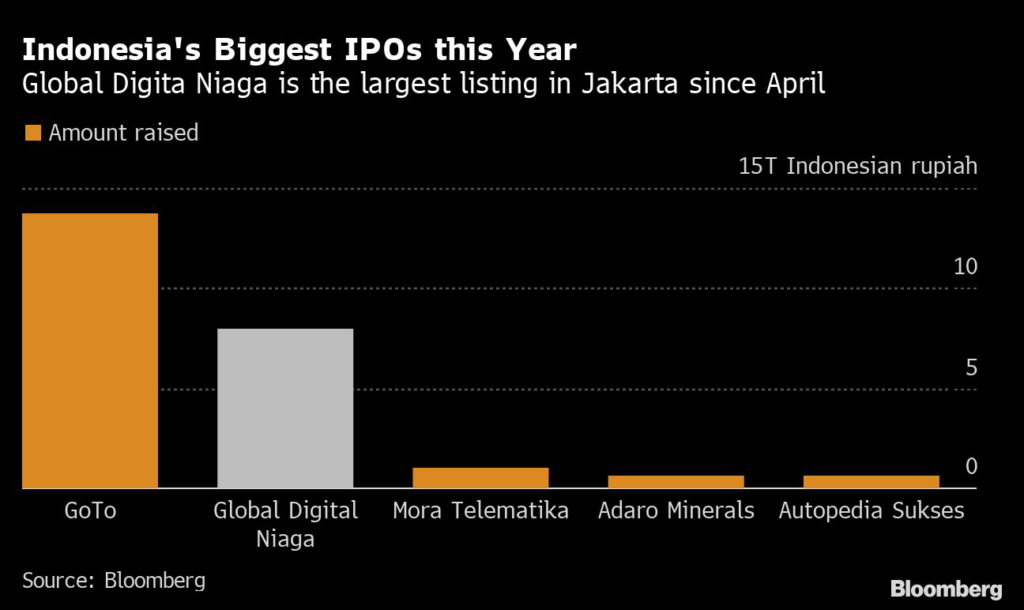
Blibli Owner Advances in Jakarta’s Second-Largest Debut of 2022

(Bloomberg) — PT Global Digital Niaga, the owner of Indonesia’s e-commerce group Blibli, rose nearly 5% on Tuesday after raising 8 trillion rupiah ($509 million) in the country’s second largest initial public offering this year. 

Shares climbed to as high as 472 rupiah in early trade after opening lower. They were sold at 450 rupiah each, the top of a marketed range in an upsized offering in October. It’s the largest listing in Jakarta since PT GoTo Gojek Tokopedia’s initial sale in April.

The company is backed by Djarum Group, one of Indonesia’s biggest conglomerates known more for its clove-flavored cigarette products. Global Digital also owns an online travel business and supermarket chains.

Companies that debuted in Jakarta after raising at least $100 million over the past five years rose by a weighted average of 8.2% in their first day of trade, according to data compiled by Bloomberg.  

Indonesia’s IPO market has revved up to life recently, with ten companies starting to trade this week alone. The stock benchmark is among top performers in Asia’s major markets this year, even after pulling back 3.5% from a record high in September. 

Blibli’s free float of about 15% compares to more than 50% currently for e-commerce rival PT Bukalapak.com and tech company GoTo. They started trading in Jakarta in Aug. 2021 and April, respectively, and are trading 68% and 42% below their offer price. 

“As the existing shareholders, Djarum Group has committed to not exit from Blibli after the IPO, so we won’t see any selling pressure like we saw in Bukalapak and GoTo,” said Doni Firdaus, an investment director at Bahana TCW Investment Management. “However, the negative sentiments toward the tech sector still persist, so it will also affect the appetite for Blibli shares.”

According to the prospectus, Global Digital will have a total addressable market estimated at $440 billion in 2025. The company will focus on profitability as it sees growth in online and offline businesses amid lower costs in the first half of the year, Chief Executive Officer Kusumo Martanto said last month. Losses more than doubled to 2.5 trillion rupiah in the first six months of 2022.

Global Investama Andalan, the majority shareholder with a 98.5% stake, and 89 individual investors will have a lock-in period of eight months, according to its prospectus. Global Digital plans to use the IPO proceeds for debt repayment and working capital. 

PT BRI Danareksa Sekuritas, PT BCA Sekuritas, Credit Suisse Group AG, Morgan Stanley Asia Ltd and DBS Group Holdings arranged the offering. 

(Updates with stock price in second paragraph, adds details to fourth paragraph)

More stories like this are available on bloomberg.com

©2022 Bloomberg L.P.

Ethereum Co-Founder Di Iorio Is Trying to Make Crypto Easier to Operate

(Bloomberg) — Ethereum co-founder Anthony Di Iorio, who last year announced he was stepping back from the cryptocurrency world, is back with a new product that he hopes will re-democratize blockchains. 

Di Iorio’s team has designed a gadget called Cube — seven inches wide, high and long — that can function as a node on blockchains like Bitcoin, Ethereum and Cardano. Nodes can take a lot of technical knowledge to assemble and operate, but Cube is meant to simplify the process. Di Iorio says it’s about as easy to install as a gaming console or WiFi router.

As blockchains’ usage has grown, so have requirements for power, technical expertise and cost to run nodes, and today most major blockchains are supported by a small number of large commercial operators. Cloud providers like Amazon Web Services and Infura hold a lot of sway. The idea of Cube is to facilitate individuals running their own blockchain networks — something that harks back to the early days of the technology, when early adopters ran nodes with their home PCs. 

“It’s how we can empower individuals to be free and get away from the clutches of third parties,” Di Iorio, who stepped back from new crypto projects last year due to safety concerns, said in an interview. 

Infura — which is owned by another Ethereum co-founder, Joe Lubin — recently announced plans to offer a decentralized option of its service, potentially letting non-corporate nodes participate.

Cube, expected to come out as soon as the latter part of next year, will be part of a gaming ecosystem called Andiami that Di Iorio is setting up. As soon as early 2023, his company Decentral Inc. will start selling player kits that are tentatively expected to cost between $500 and $5,000. Later, Decentral will launch a video game, which will use the kits and generate digital coins that users can pay to Cube operators for their work.

Worries about just a few parties holding a lot of sway over many blockchains have risen recently. After Ethereum completed its big Merge software upgrade in September, a handful of key players involved in ordering transactions on the networks have ended up with a lot of control, and with the ability to potentially censor transactions.

“The ‘faster’ and ‘higher performance’ a blockchain gets, the less possible it becomes for normal people to run nodes,” said Christopher Bendiksen, an analyst at CoinShares. “This is the fundamental tradeoff between on-chain transaction (data) capacity and decentralization.”

Decentral expects to make money on selling physical items like the Cubes and player kits. It doesn’t disclose whether or how large a share of the digital tokens to be used in the Cube ecosystem it will take for itself, Di Iorio said.

More stories like this are available on bloomberg.com

©2022 Bloomberg L.P.

Elon Musk Says That Twitter Usage Is ‘At an All-Time High LOL’

(Bloomberg) — Elon Musk, the billionaire owner of Twitter Inc., said that usage on the social media platform is “at an all-time high,” without providing evidence or explaining how he defines usage.

In another tweet he added, “I just hope the servers don’t melt!”

Earlier, the Verge reported that Twitter’s daily user growth reached “all-time highs” during Musk’s first week of owning the company, citing a company document. Since the take-private deal closed, Twitter’s so-called monetizable daily user growth accelerated to more than 20%, according to an internal document that was shared with Twitter’s sales team to use in conversations with advertisers, the Verge reported. 

More stories like this are available on bloomberg.com

©2022 Bloomberg L.P.

Close Bitnami banner
Bitnami
