Bloomberg

Rocket Lab Helicopter Unable to Catch Returning Booster in Midair

(Bloomberg) — A Rocket Lab USA Inc. helicopter failed to catch a booster in midair as it returned from space over the Pacific Ocean.

The problem was related to a “telemetry loss” from the Electron rocket’s first stage during re-entry, the company said in a tweet. The booster landed in the Pacific Ocean and a recovery vessel will collect it, Rocket Lab said.

“Unfortunately it looks like we are not going to bring Electron home dry today,” Murielle Baker, a spokesperson for Rocket Lab, said during a live web stream of the attempt. 

Launched at 1:27 p.m. New York time Friday from Rocket Lab’s site in New Zealand, the mission successfully deployed a science research satellite for the Swedish National Space Agency.

The booster was supposed to be retrieved before splashing down in the Pacific — part of Rocket Lab’s system to reuse them, potentially cutting down on costs and time between launches. In a previous mission, Rocket Lab caught a booster after a return from space, but the helicopter pilot chose to drop the rocket immediately for technical reasons.

Rocket Lab shares rose 1.6% at 2:31 p.m. in New York.

More stories like this are available on bloomberg.com

©2022 Bloomberg L.P.

Stocks Advance After Jobs Data as Dollar Sells Off: Markets Wrap

(Bloomberg) — Stocks rose, with traders weighing mixed jobs figures and awaiting next week’s inflation data for more clues on when the Federal Reserve would be able slow down its pace of rate hikes.

The S&P 500 moved back higher after earlier erasing a rally of over 2%. Some big tech names weighed on the market, with Tesla Inc. tumbling about 5% and Apple Inc. down for a fifth straight session. Treasury 10-year yields edged higher. The dollar fell the most since March 2020.

“This week is a reminder that the intense volatility and emotional trading experience through much of the year is likely to continue,” said Mark Hackett, chief of investment research at Nationwide. “Bottoming processes are rarely clean, and even if bulls are gaining control, pockets of weakness are inevitable.”

Data showed US businesses reported strong hiring and wage increases in October although the unemployment rate climbed.

The first two Fed policymakers to speak since this week’s rate hike said borrowing costs need to keep rising.

Boston Fed President Susan Collins said policy is entering a new phase that could require smaller rate hikes, but she did not rule out another 75-basis-point boost. Her Richmond counterpart Thomas Barkin told CNBC the Fed may need to raise rates above 5%, though it may slow its pace of increases.

Markets will watch the latest US inflation reading on Thursday after the core consumer price index rose more than forecast to a 40-year high in September. Even if prices begin to moderate, the CPI is far above the Fed’s comfort zone.

More Comments:

Chris Senyek at Wolfe Research:

“This report does nothing to change the Fed’s ‘higher for longer’ narrative. We probably won’t see really weak jobs numbers until the US economy is already in a relatively deep recession.”

Jason Pride at Glenmede:

“This jobs report likely does not push the Fed off its path for a 50-75 bp rate hike in December. However, the next big economic report that could move the needle for the Fed is next week’s CPI report.”

Peter Essele at Commonwealth Financial Network:

“If labor growth remains strong and earnings growth slows, it’ll be a win-win for investors since there will be less pressure on the Fed to raise rates. The result could be a soft landing in the economy as opposed to a hard one.”

Mike Loewengart at Morgan Stanley Global Investment Office:

“While the number may be disappointing for investors hoping for a dovish Fed sooner rather than later, keep in mind it was the lowest reading in nearly two years, so there could be signs that the market is slowing.”

Charlie Ripley at Allianz Investment Management:

“The most notable signal from today’s employment data is not that the data came in better than expected, but rather that some subtle signs of the economy slowing are starting to show up. Investors are looking for any signs that the Fed will pull back the reigns on policy tightening.”

Investors are fleeing to the safety of cash funds as the Fed remains firmly hawkish, according to strategists at Bank of America Corp.

The asset class had inflows of $62.1 billion in the week through Nov. 2, according to a note from the bank citing EPFR Global data. That’s contributed to $194 billion of inflows into cash from the start of October — the fastest start to a quarter since 2020.

In corporate news, US-listed Chinese stocks jumped amid fresh optimism over an easing of Covid restrictions. DoorDash Inc. reported revenue that beat estimates, a sign that customers are still ordering pricey takeout despite a squeeze from higher inflation.

Some of the main moves in markets:

Stocks

  • The S&P 500 rose 0.3% as of 2:35 p.m. New York time
  • The Nasdaq 100 rose 0.2%
  • The Dow Jones Industrial Average rose 0.3%
  • The MSCI World index rose 1.2%

Currencies

  • The Bloomberg Dollar Spot Index fell 1.5%
  • The euro rose 1.9% to $0.9937
  • The British pound rose 1.7% to $1.1353
  • The Japanese yen rose 0.9% to 146.93 per dollar

Cryptocurrencies

  • Bitcoin rose 3.4% to $20,920.05
  • Ether rose 6.1% to $1,634.67

Bonds

  • The yield on 10-year Treasuries advanced one basis point to 4.16%
  • Germany’s 10-year yield advanced five basis points to 2.30%
  • Britain’s 10-year yield advanced two basis points to 3.54%

Commodities

  • West Texas Intermediate crude rose 5.2% to $92.74 a barrel
  • Gold futures rose 3.1% to $1,681.30 an ounce

–With assistance from Emily Graffeo, Isabelle Lee, Vildana Hajric and Cecile Gutscher.

More stories like this are available on bloomberg.com

©2022 Bloomberg L.P.

Online Travel Companies Buck Job-Cut Trend as Trips Continue

(Bloomberg) — Online travel companies don’t expect to cut or freeze jobs, a contrast to the thousands of layoffs at other tech firms, suggesting the industry’s painful retrenching at the beginning of the pandemic has put it in a stronger position now.  

“We don’t intend to change anything about our hiring plans the next 12 to 18 months regardless of the economy,” Airbnb Inc. Chief Executive Officer Brian Chesky said on a call with analysts Tuesday to discuss third-quarter results. 

Before the downturn this year, Chesky said the home-rental company planned to increase its headcount of 6,000 people by 7% to 8%. In an interview with Bloomberg TV, Chesky said, “We’re not pulling back. In fact, we’re stepping on the gas.”

Job cuts and hiring freezes have picked up pace throughout the tech industry as higher interest rates squeeze consumer spending and pummel company shares. Just this week, payment processor Stripe Inc., ride-hailing company Lyft Inc. and Apple Inc. tapped the brakes on hiring. Stripe, one of the world’s most valuable startups, said that it “grew operating costs too quickly” and underestimated the likelihood of a slowdown. 

In some regards, those companies are going through what Booking Holdings Inc., Expedia Group Inc. and Airbnb went through in 2020 as Covid-19 put an end to travel. Airbnb lost almost all of its business in the early days of the pandemic, forcing the company to cut a quarter of its staff. Expedia went through a similar transition, eliminating 3,000 jobs in the early part of 2020 as part of a planned restructuring overhaul. Now, with a simpler organizational structure, CEO Peter Kern sees room to add employees again. 

“We’ve been able to maintain our headcount at a level we feel good about and we think we can grow massively on top of that without having to add lots of bodies to be able to do it,” Kern said on a call with analysts Thursday. 

In the summer of 2020, Booking said it would lay off as much as 25% of its workforce. The company wants to continue to invest in hiring, but is cognizant of the economic background, Chief Financial Officer David Goulden said on a call with analysts Wednesday.

“We’re not going to pull back anything strategic from what we want to do if we have a short-term slowdown,” he said. “But of course, we are looking at how many people we add and where we add them to make sure we are adding them against the things that really matter most for the business as you would expect us to do.”

While all three companies reported record revenue in the third quarter, the prospects for tough times ahead have made investors cautious on the sector. Airbnb and Expedia have slumped about 43% and 49% so far this year, outpacing the S&P 500’s decline of 22%, while shares of Booking have fallen around 22%. Despite Chesky’s confidence, Airbnb’s stock plunged earlier this week after the company said it expects bookings will “moderate” this quarter. Average daily rates are also set to soften as the dollar remains strong and consumers sign up for cheaper destinations.

Still, the sector may be able to cope with a mild economic contraction.

“Travel has been resilient and there’s reason to believe it can endure barring a severe recession,” said Dan Wasiolek, an analyst at Morningstar Investment Service. “There’s some case that can be made that travel could prove to be a little more resilient and they haven’t been as aggressive in hiring as other areas of technology.”

More stories like this are available on bloomberg.com

©2022 Bloomberg L.P.

Twitter Latest: Civil Rights Groups to Boost Advertiser Pressure

(Bloomberg) — Twitter Inc. began notifying employees affected by a far-reaching round of job cuts, and some learned they’ll be paid for two months. As this was happening, the new owner, Elon Musk, said the business experienced a “massive drop” in revenue as many advertisers withdrew.

The week after the billionaire took over and promised sweeping changes, workers around the world were checking two email addresses to find out if they still have a job, according to an internal memo sent to employees and seen by Bloomberg. An email to their work account means they’ve been retained. A letter in their personal inbox means they’ve been fired.

Twitter temporarily closed offices and suspended badge access “to help ensure the safety of each employee as well as Twitter systems and customer data,” the memo said.

Musk plans to eliminate half of Twitter’s workforce to slash costs at the social media platform he acquired for $44 billion last month, people with knowledge of the matter have said. The company must also find ways to cope with interest costs on a massive debt pile.

The speed of the changes is having repercussions. Twitter has already been sued for not giving proper notice of the plan to eliminate about 3,700 jobs. 

Some advertisers are also wary of Musk’s plans to reexamine Twitter’s content moderation policy. Volkswagen AG, Europe’s largest carmaker, joined Pfizer Inc. and General Mills Inc. in temporarily pausing advertising on the platform.

Bloomberg News will capture the news flow here.

Civil Rights Groups Plan to Escalate Pressure on Advertisers (2:12 p.m.)

A coalition called #StopToxicTwitter — made up of more than 60 civil rights groups, including the Anti-Defamation League and Accountable Tech — said on Friday it plans to escalate calls to Twitter advertisers that they stop buying ad space on the platform in the wake of Musk’s sweeping layoffs.

“We are witnessing the real-time destruction of one of the world’s most powerful communication systems,” said Jessica J. González, co-CEO of Free Press, one of the advocacy groups in the coalition. “Elon Musk is an erratic billionaire who’s dangerously unqualified to run Twitter.” Gonzales said the groups were stepping up their campaign in response to Musk’s failure to uphold his commitment to take the measures that would prevent Twitter from becoming a superspreader of racism and disenfranchisement.

Color Of Change President Rashad Robinson criticized Musk for reportedly dismantling employee resource groups like Twitter Women and Blackbirds, a group for Black employees at the social media company. The groups were “critical,” Robinson said, “not just for the employees, but for the communities they are connected to.”

Musk Addresses a Crowd in New York City (1:04 p.m.)

Musk predicted Twitter could eventually become the world’s most valuable company, he said Friday at the Baron Investment Conference in New York City. He made essentially the same prediction about Tesla Inc. on its earnings call about two weeks ago.

Read the full story here.

Pregnant Workers Seek Answers About Health Benefits (12:33 p.m. NY)

Many workers wrote on company Slack channels and in public Twitter posts to say goodbye. They used blue heart and salute emoji to thank their colleagues. But they lacked official information about their next steps. At least two pregnant staffers who were laid off had no information about their medical benefits going forward, according to people familiar with the matter. Even the employees who survived the cuts were reeling from the way the process occurred.

Read more here.

Read the Memo Sent to Employees (12:11 p.m. NY)

Team,

In an effort to place Twitter on a healthy path, we will go through the difficult process of reducing our global workforce on Friday. We recognize that this will impact a number of individuals who have made valuable contributions to Twitter, but this action is unfortunately necessary to ensure the company’s success moving forward.

Read the rest here.

Twitter Has ‘Massive Drop in Revenue’ Musk Says (10:33 a.m. NY)

“Twitter has had a massive drop in revenue, due to activist groups pressuring advertisers, even though nothing has changed with content moderation and we did everything we could to appease the activists,” Musk said in a tweet. “Extremely messed up! They’re trying to destroy free speech in America.”

Some Employees Will Get Severance Pay for Two Months, Lawyer Says (10:26 a.m.)

“It looks like employees are getting their notices and at least some will be paid until January 4,” said Shannon Liss-Riordan, the attorney who filed a class-action lawsuit in California on Thursday. “I am pleased that Elon Musk learned something from the lawsuit we brought against him at Tesla and is making an effort to comply with the WARN Act. We filed this case preemptively to make sure a repeat of that violation did not happen.” 

Twitter Employees Join Unions Ahead of Job Cuts (12 p.m. London)

Twitter employees in the UK have been joining trade unions in an effort to better protect their employment rights during mass job cuts announced by the social media platform’s new owner Elon Musk.

“Twitter is treating its people appallingly,” said Mike Clancy, General Secretary of Prospect, a UK-based trade union that said it has seen an influx of sign-ups from Twitter employees over the last week. Clancy called on the UK government to ensure that Twitter doesn’t become a “digital P&O,” referring to the ferry company that cut 800 jobs in March.

“We are supporting our members at Twitter and will be working with them to defend them and their livelihoods,” he added.

Britain’s United Tech and Allied Workers labor group also condemned the way employees were treated and encouraged Twitter workers to join. 

The UK’s Advisory, Conciliation and Arbitration Service says businesses must generally consult on redundancies and inform the government’s Redundancy Payments Service. An ACAS spokesman didn’t immediately respond to a request for comment on the situation.

Ex-CEO Costolo Creates Twitter Alumni Network (11:30 a.m. London) 

Former Twitter Chief Executive Officer Dick Costolo, who left the company in 2015, said his latest company has put together a resource for former Twitter employees who want to connect and “figure out what’s next.” 

Costolo is founder of 01 Advisors, a venture capital and advisory firm for tech startups in San Francisco. 

Employees Notified in Dublin (11 a.m. London) 

Twitter’s Dublin office, which employs about 500 people, have begun notifying some employees via email, according to Irish news site RTE. 

Some employees in the UK also began to share on Twitter that they’d been locked out of their work systems. 

A representative for Twitter didn’t immediately respond to a request for comment. 

Volkswagen Tells Brands to Pause Spending (8:30 a.m. London) 

Volkswagen, Europe’s biggest carmaker, recommended that all of its brands pause their paid activities on Twitter until further notice, according to an emailed statement on Friday. 

Several advertisers have tapped the brakes on placing ads on the platform until they get a clearer idea of Musk’s plans. Musk has said he wants to remove some content moderation, giving rise to concerns that hate speech, misinformation and other potentially harmful material will flourish even more freely. General Mills said it’s temporarily pausing advertising on Twitter, joining General Motors Co. in rethinking their presence on the platform.

Twitter Sued for Mass Layoffs (10:43 p.m. SF)

Twitter was sued over Musk’s plan to eliminate jobs at the social-media platform, which workers say the company is doing without enough notice in violation of federal and California law. A class-action lawsuit was filed Thursday in San Francisco federal court.

Employees Start Losing Email Access (9:13 p.m. SF)

The company started cutting employee access to email and Slack on Thursday night. Some employees who were shut out of their work tools suspected their jobs were already cut, though they had received no official confirmation yet.

Job Cuts Begin

All told, Musk wants to cut about 3,700 jobs at San Francisco-based Twitter, people with knowledge of the matter said this week. The entrepreneur had begun dropping hints about his staffing priorities before the deal closed, saying he wants to focus on the core product. “Software engineering, server operations & design will rule the roost,” he tweeted in early October.

Security staff at Twitter’s San Francisco headquarters carried out preparations for layoffs, while an internal directory used to look up colleagues was taken off line Thursday afternoon, people with knowledge of the matter said. Employees have been girding for firings for weeks. In recent days, they raced to connect via LinkedIn and other non-Twitter avenues, offering each other advice on how to weather losing one’s job, the people said. Ex-Twitter engineers are also using social media to respond to former “Tweeps” looking to land jobs elsewhere.

Musk has also been huddling with advisers to come up with new ways to make money from the blogging platform, including charging for verifications, which can help delineate real users from fake accounts. He’s also considering reviving a long-since-discontinued short-video tool called Vine, a way to vie with popular video-sharing apps like TikTok. Another product under consideration, the New York Times reported, is paid direct messages, which would let the rank and file send private messages to high-profile users.

Read more: Musk to Restore Twitter Content Moderation Tools Before US Election

–With assistance from Kurt Wagner, Olivia Solon, Monica Raymunt, Morwenna Coniam, Thomas Seal and Davey Alba.

More stories like this are available on bloomberg.com

©2022 Bloomberg L.P.

US Warehouse Sector Loses Jobs for Fourth Month in Cooling Sign

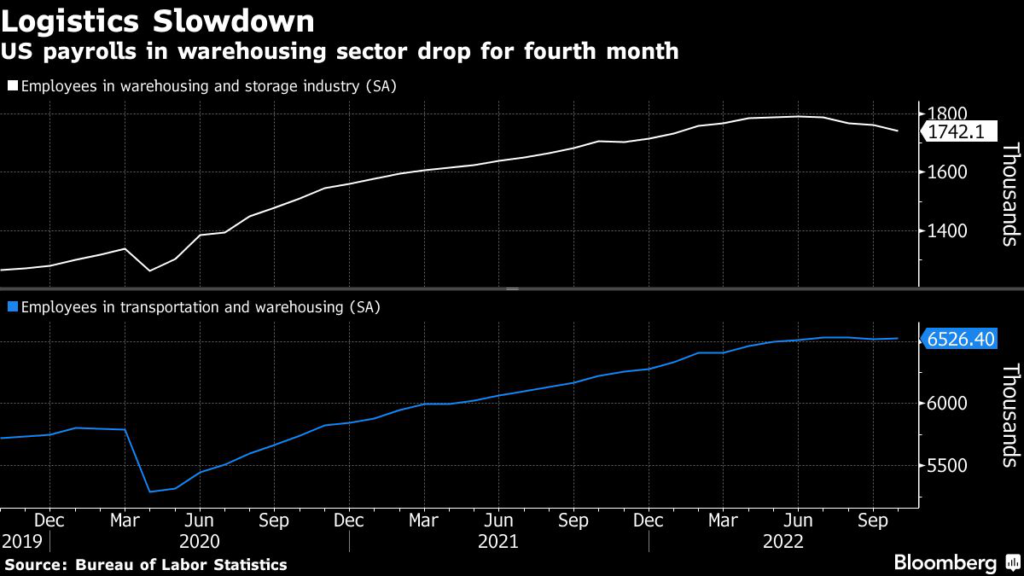
(Bloomberg) — The US warehousing sector lost jobs for a fourth month in October, suggesting employment in an industry that’s boomed during the pandemic may have peaked.

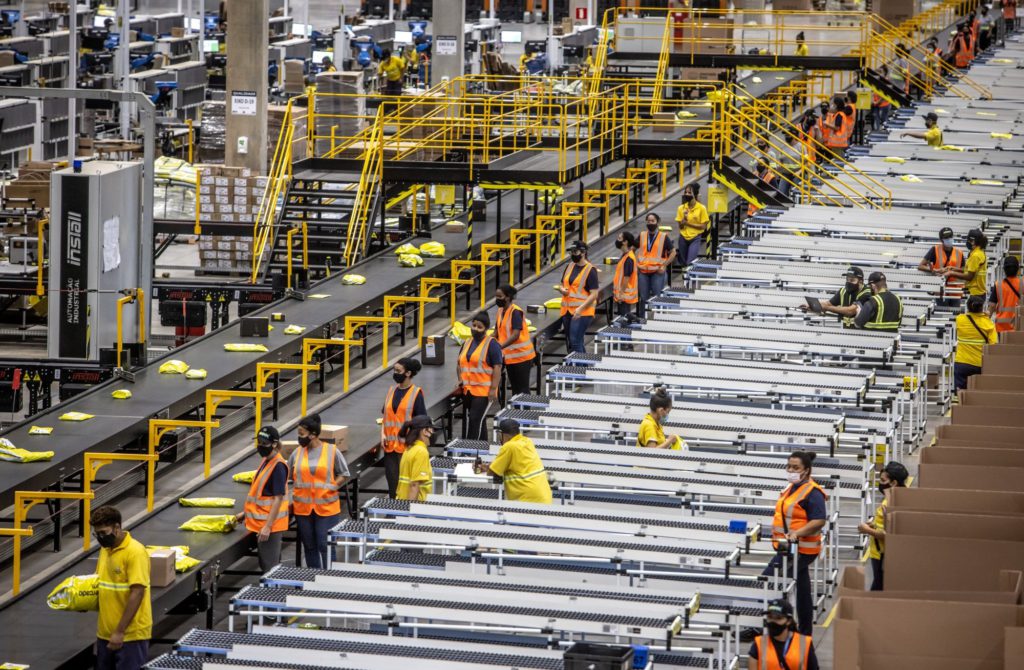
About 1.7 million people worked in warehousing and storage last month, a 1.1% decline from September, government figures released Friday show. The drop — at a time of the year when companies typically start to ramp up staffing ahead of the holidays — was the biggest since April 2020.

E-commerce saw a surge in hiring during the first years of the pandemic, when American consumers — confined at home, and enjoying a financial boost from stimulus checks — went on an online spending splurge. Warehouses and shipping companies struggled to add enough staff to keep up. 

“The goods side of the economy was caught up in a mad scramble to secure inventories ahead of the holiday season 2021,” said Bill Adams, chief economist at Comerica Bank. “That demand is slowing because people are spending less on things and more on experiences this year.”

Amazon.com Inc., which is projecting the slowest holiday-quarter growth in its history, has abandoned dozens of existing and planned warehouses around the US.

Even after the recent drop, warehouse and storage employment remains well above its pre-pandemic levels. Likewise, the broader transportation and warehousing category is up by almost 13% since February 2020, although employment has flattened in the second half of the year. 

Read More: Blackstone’s Property Fund for Retail Investors Is Losing Steam

More stories like this are available on bloomberg.com

©2022 Bloomberg L.P.

JPMorgan Hires SVB Securities Technology M&A Banker Sidarchuk

(Bloomberg) — JPMorgan Chase & Co. hired SVB Securities banker Zheniya Sidarchuk as a managing director focused on technology mergers and acquisitions, according to people with knowledge of the matter.

San Francisco-based Sidarchuk is set to join JPMorgan next week, said the people, all of whom requested anonymity as the appointment isn’t yet public. She was most recently a senior managing director at SVB, which she joined last year as part of a team exodus from UBS Group AG. Before joining UBS in 2017, she worked at Goldman Sachs Group Inc., Finra records show.  

Sidarchuk has worked on transactions including the sale of Brightly Software to Siemens AG; Precisely’s investment from Insight Partners and Partners Group; Autodesk Inc.’s acquisition of Innovyze; and the purchase of a Bazaarvoice majority stake by Thomas H. Lee Partners. 

A JPMorgan spokeswoman declined to comment and an SVB spokeswoman didn’t immediately have a comment.

More stories like this are available on bloomberg.com

©2022 Bloomberg L.P.

Return To Offices Gives CEOs a Glimmer of Hope in Earnings Calls

(Bloomberg) — Businesses ranging from office supplies retailers to childcare providers have cited major employers’ push to get workers back to offices as a tailwind during third-quarter earnings calls — or at least a reason to be hopeful. 

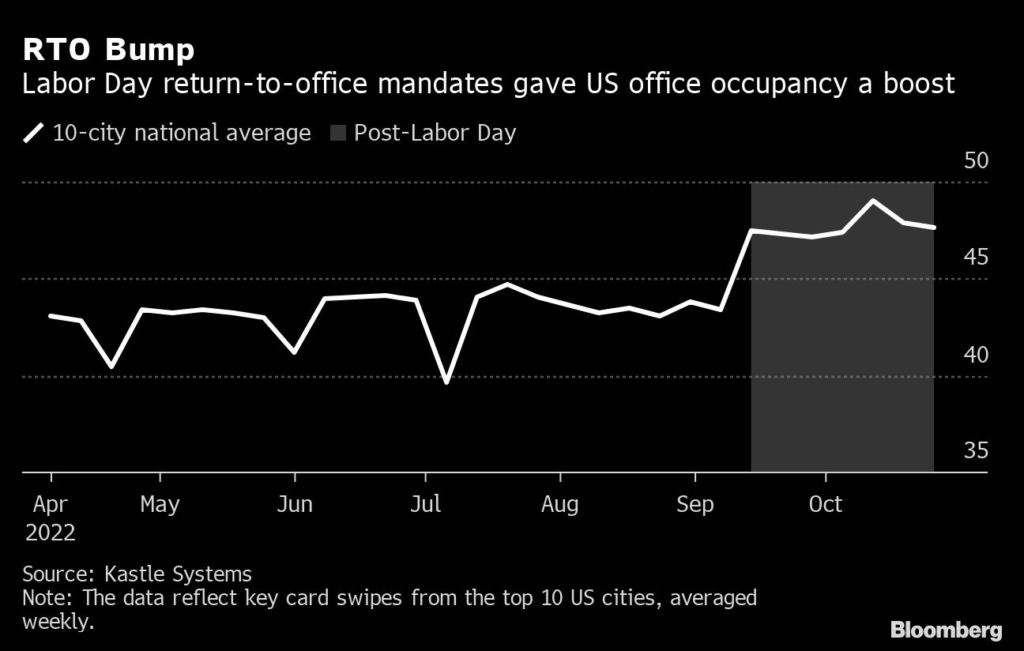
That’s a shift from last quarter, when disappointments were blamed on the stubborn persistence of work-from-home preferences. Many executives were encouraged by September’s small, but in some cases significant, post-Labor Day bump in office occupancy, though some were hoping for a quicker pace.

“I thought after Labor Day, we would get a quick read on what the story was going to be about work-from-home versus work in return to office,” said Brian Harris, chief executive officer of Ladder Capital Corp., a real estate investment trust, on the company’s earnings call. New York is “winning” in the move back to the workplace, he said.

The office market won’t be affected too much if workers never return to a five-day commute, he said. But if employees take Fridays as a work-from-home day, that will have a much bigger impact on city-center restaurants.

Read more: Offices in the US Are Still Less Than Half Full Despite Fears of Recession, Layoffs

But even some restaurant operators are upbeat. “I spent last Friday going around to a bunch of Shacks and just trying to think about and understand kind of what is Friday going to look like in cities,” said Shake Shack Inc.’s CEO Randy Garutti. “And I was pretty encouraged about what I saw, even in Midtown Manhattan on that day.”

Shake Shack reported strong performance in city-center locations driven by workers heading back to their desks and stopping by for weekday lunches or dinners — especially after Labor Day. “We remain cautiously optimistic on urban trends long term as new patterns emerge, but it’s good to see the momentum in the right direction,” Garutti said.

Though it’s not all sunshine: The company’s recovery would’ve been even more robust if return-to-office trends were stronger, according to Chief Financial Officer Katie Fogertey. While the trends were encouraging, she said, “we’re still on the road to recovery.”

Many companies are expecting the favorable winds to continue into next year. ODP Corp., which owns Office Depot, said that its ODP Business Solutions, which sells a range of office products and technology services, saw solid revenue growth as return-to-office trends gained more traction. “The return-to-office trend is a tailwind for these teams that we expect to continue through 2023,” said David Centrella, president of ODP Business Solutions.

Others have profited off of what’s often a bumpy transition. Bright Horizons Family Solutions Inc., the largest provider of employer-sponsored childcare in the US, reported strong demand as companies look for ways to support their employees as they shift back to working in-person. “I think that the core services that we are offering are very much in the interest of employers as they continue to see stressors as it relates to their own workforce and their own return-to-office plans,” said CEO Stephen Kramer. “So, overall, feeling really good going into 2023.”

  • Read more: Hershey sells more gum with people ditching face masks

And Essex Property Trust, a real estate investment trust that invests primarily in West Coast apartments, said it has seen rental requests pick up as employees that were hired remotely relocate closer to offices to return to in-person work.

To be sure, the pace of workers’ return was not as lively as many companies would’ve liked. 

Xerox Holdings Corp. saw its “page volume” — in other words, how much printing users do, which it says is strongly correlated with return-to-office trends — grow from last quarter. But still, the company was frustrated. “This just reflects some of the challenges a lot of firms are currently facing in bringing employees back to the office,” said Xavier Heiss, Xerox’s CFO.

More stories like this are available on bloomberg.com

©2022 Bloomberg L.P.

Vitol Threatens Gas Halt in €1 Billion Standoff With Germany

(Bloomberg) — Commodities giant Vitol SA is threatening to suspend gas deliveries to a German state-controlled energy business in a legal standoff that could cost the German company around €1 billion.

SEFE Marketing & Trading Ltd., a former Gazprom PJSC-trading arm, lost an urgent London court bid seeking to stop trading firm Vitol from cutting the gas supplies as soon as next week. Gas prices have surged since the contract was first signed, meaning the stakes for both sides are huge.

“I am not persuaded that the claimant has shown a seriously arguable case that a suspension will cause it significant short or medium term difficulties,” Judge Andrew Baker said in a ruling that was made public on Friday evening. 

SEFE faces potential losses of around €1 billion ($987 million) if it needs to replace the lost gas at higher prices, two people familiar with the matter said.

“These contracts were entered into when market prices were significantly lower,” SEFE said in an emailed statement. The firm “strongly refutes the validity of the announced suspension and will continue to contest it through all available channels.”

A Vitol spokesperson declined to comment.

The potential losses mean extra financial pressure on the German taxpayer, which has propped up SEFE with an €11.8 billion credit line via German state-bank KfW Group. Vitol, one of the world’s largest commodity trading houses, made a record profit of $4.2 billion last year.

A court order shows the London-based SEFE unit asked the judge to prevent Vitol from taking action that threatened to “cause immediate and irreparably harmful consequences” as soon as Tuesday.

Vitol argued it has the right to terminate or suspend supplies because of SEFE’s change in ownership in April, according to two people familiar with the matter.

The judge said a trial could potentially take place in late February or March.

The SEFE parent company, Securing Energy for Europe GmbH, was known as Gazprom Germania GmbH, and was an arm of the Russian state’s energy empire. The firm was cut loose in April after European sanctions followed its invasion of Ukraine, which prompted the German government to step in to prevent a collapse that would have sent financial waves across the global energy markets and destabilized much of Germany’s industrial region.

The German regulator BNetzA, which has oversight over SEFE, didn’t comment on any figures and referred to ongoing legal proceedings. “This is about the security of supply in Europe,” a spokeswoman said.

After Russia cut gas flows to Europe, Vitol in a separate move applied to the German government for compensation for the gas it was owed by Russia, which would have been funded by a proposed German levy on consumers. The entire levy was stopped due to political and administrative hurdles before any payments were made. 

–With assistance from Jack Farchy, Archie Hunter, William Mathis, Petra Sorge and Josefine Fokuhl.

(Updates with comments from court judgment in third and fourth paragraph)

More stories like this are available on bloomberg.com

©2022 Bloomberg L.P.
MercadoLibre Beats Profit Forecast, Sees Bad Loans Pile Up

(Bloomberg) — E-commerce retailer and fintech provider MercadoLibre Inc. posted better-than-expected profits for the third quarter, signaling it’s on track to keep expanding across Latin America while improving profitability. The shares rallied as much as 17% Friday. 

Net sales for the three months through Sept. 30 jumped to a record $2.7 billion as the company gained market share in its largest market Brazil, according to Chief Financial Officer Pedro Arnt, meeting the average estimate of analysts surveyed by Bloomberg. Operating margins rose to 11%, against the 8.4% forecast by analysts, boosting earnings per share to $2.56.

“Growth of the fintech business has been outstanding and sustained,” helping improve margins, Arnt said in an interview Thursday. MercadoLibre started its financial-services arm in 2003, and it already accounts for over 44% of total revenue. 

The Buenos Aires-based company slowed the pace of credit underwriting as it braced for a deterioration in credit quality, with its loan portfolio expanding a modest 4% from a quarter earlier. The percentage of loans more than 90 days overdue grew to about 24% from 18% in the second quarter — in line with estimates from Goldman Sachs Group Inc.

“We pulled back in originations significantly” and don’t anticipate an acceleration by year-end, said Arnt. “We aren’t trying to grow the credit book at any cost.”

Shares were up 9.4% at 12:45 p.m. in New York Friday as investors welcomed the stronger profits and a more prudent approach toward credit. 

The company is focused on delivering more robust profitability and was able to navigate a tough backdrop “with price increases and more selective origination,” said Bradesco BBI analyst Joao Andrade. 

Despite higher profits, gross merchandise volume was stable from a quarter earlier at $8.6 billion. E-commerce revenues accelerated in Brazil, offsetting a Mexico slowdown, Arnt said.

Shares are still down 52% since peaking amid the pandemic, battered by the rise in US rates. Concern over an increasingly competitive environment in Brazil has also weighed on investor appetite.   

Other key points:

  • MercadoLibre doesn’t expect a deceleration in its business in Brazil and expects the country to grow at a similar pace in the fourth quarter, according to Arnt
  • Payment volume $32.2 billion, estimate $31.8 billion
  • Unique active users surpassed 88 million

(Updates with Friday’s trading in first paragraph, analyst comments from the sixth.)

More stories like this are available on bloomberg.com

©2022 Bloomberg L.P.
Musk’s Plan to Downsize Twitter Meets European Employment Law

(Bloomberg) — Twitter Inc.’s sweeping job cuts, which have already led to a lawsuit in California, will also have to satisfy stringent employment regulations across Europe if its new owner wants to avoid more legal challenges. 

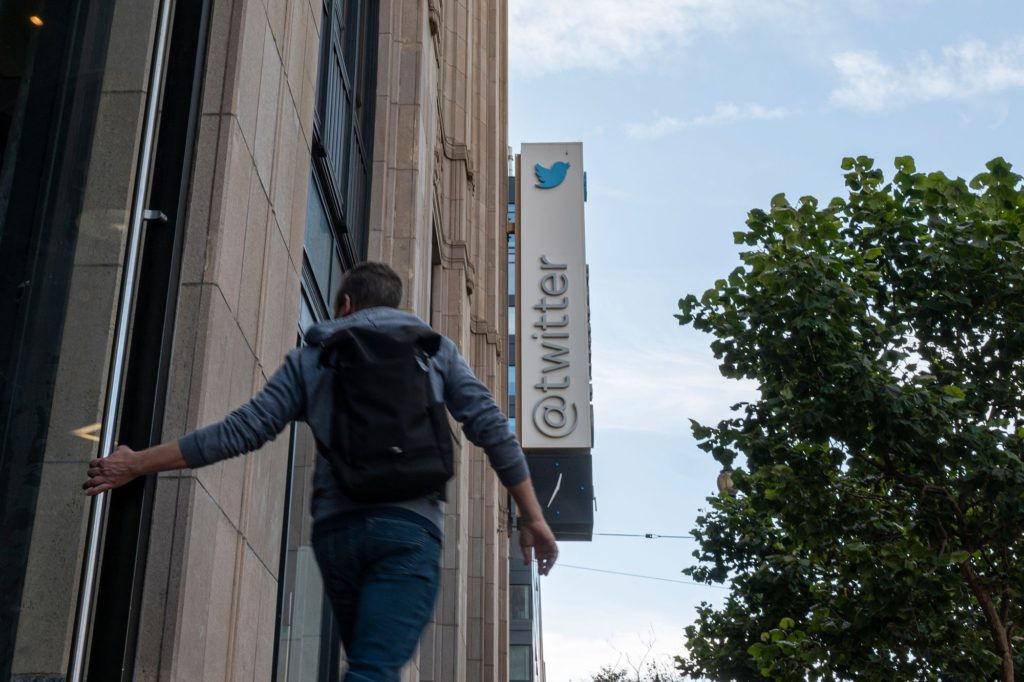
About a week after billionaire Elon Musk took control of Twitter, workers from San Francisco to Dublin have been locked out of their work accounts, and the company circulated a memo that said all employees would be notified about their status by 9 a.m. California time on Friday. 

The company has already been sued in San Francisco, although the lawyer who filed the suit later said Musk is trying to comply with the law. Musk, who plans to eliminate half of the company’s workers — some 3,700 positions — to slash costs at Twitter, won’t find the cuts any easier in Europe. 

In the UK, where Twitter employed 281 people as of last year, British employers are required by law to prove there are grounds to remove workers from their jobs. If more than 20 employees are let go from a firm, the company needs to follow consultation requirements, including reporting to the government and allowing at least 30 days between starting the process and dismissal. 

A representative for Twitter didn’t immediately respond to a request for comment.

Musk could take a lesson from P&O Ferries Ltd. The company, which runs ships across the English Channel, caused an uproar when it attempted to fire 800 workers on the spot earlier this year via a video message. P&O was subjected to civil and criminal probes by the UK government, some of the company’s ships were detained for safety inspections, and its chief executive officer was grilled at the House of Commons.

“Any failure to comply with these obligations before dismissing employees will result in potential claims,” Jo Keddie, a lawyer at Winckworth Sherwood, said in an interview. 

Keddie said that her firm has received a “mini tsunami” of inquiries from concerned Twitter employees who were affected by the sudden action.

UK employment tribunals, which would become the country’s stage for any disputes, caps awards for unfair dismissal at around £93,000 ($105,000). However, if the employee can prove discrimination then the award could be limitless. 

Twitter employees in the UK have been joining trade unions in an effort to better protect their rights. Prospect, a UK-based trade union, has seen an influx of new members from Twitter over the last week, General Secretary Mike Clancy said. 

Clancy on Friday requested an urgent meeting with UK business secretary Grant Shapps over what what he called the “unacceptable” manner of job cuts. 

Britain’s United Tech and Allied Workers labor group condemned the way Twitter employees had been treated and said it was welcoming new members from the company.

European Union members also generally require employers to give notice if they fire a significant number of workers, which vary on a country-by-country basis. 

–With assistance from Morwenna Coniam, Stephanie Bodoni and Gaspard Sebag.

More stories like this are available on bloomberg.com

©2022 Bloomberg L.P.
Close Bitnami banner
Bitnami