Bloomberg

Musk’s Plan to Downsize Twitter to Run Into European Employment Law

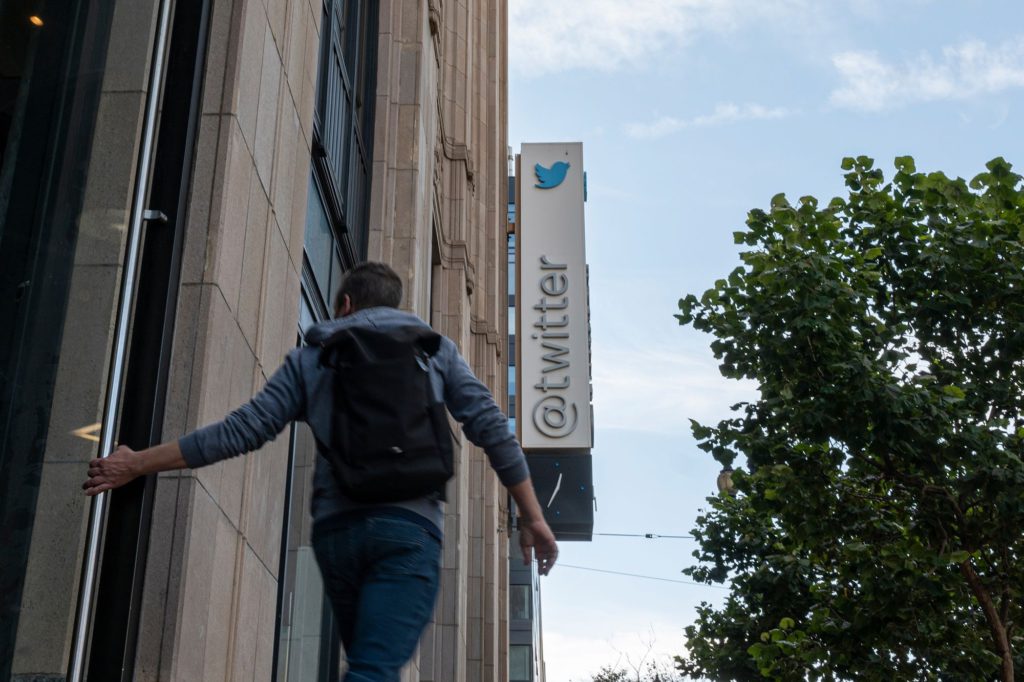
(Bloomberg) — Twitter Inc.’s sweeping job cuts, which have already led to a lawsuit in California, will also have to satisfy stringent employment regulations across Europe if its new owner wants to avoid more legal challenges. 

About a week after billionaire Elon Musk took control of Twitter, workers from San Francisco to Dublin have been locked out of their work accounts, and the company circulated a memo that said all employees would be notified about their status by 9 a.m. California time on Friday. 

The company has already been sued in San Francisco, although the lawyer who filed the suit later said Musk is trying to comply with the law. Musk, who plans to eliminate half of the company’s workers — some 3,700 positions — to slash costs at Twitter, won’t find the cuts any easier in Europe. 

In the UK, where Twitter employed 281 people as of last year, British employers are required by law to prove there are grounds to remove workers from their jobs. If more than 20 employees are let go from a firm, the company needs to follow consultation requirements, including reporting to the government and allowing at least 30 days between starting the process and dismissal. 

A representative for Twitter didn’t immediately respond to a request for comment.

Musk could take a lesson from P&O Ferries Ltd. The company, which runs ships across the English Channel, caused an uproar when it attempted to fire 800 workers on the spot earlier this year via a video message. P&O was subjected to civil and criminal probes by the UK government, some of the company’s ships were detained for safety inspections, and its chief executive officer was grilled at the House of Commons.

“Any failure to comply with these obligations before dismissing employees will result in potential claims,” Jo Keddie, a lawyer at Winckworth Sherwood, said in an interview. 

Keddie said that her firm has received a “mini tsunami” of inquiries from concerned Twitter employees who were affected by the sudden action.

UK employment tribunals, which would become the country’s stage for any disputes, caps awards for unfair dismissal at around £93,000 ($105,000). However, if the employee can prove discrimination then the award could be limitless. 

Twitter employees in the UK have been joining trade unions in an effort to better protect their rights. Prospect, a UK-based trade union, has seen an influx of new members from Twitter over the last week, General Secretary Mike Clancy said. 

Clancy on Friday requested an urgent meeting with UK business secretary Grant Shapps over what what he called the “unacceptable” manner of job cuts. 

Britain’s United Tech and Allied Workers labor group condemned the way Twitter employees had been treated and said it was welcoming new members from the company.

European Union members also generally require employers to give notice if they fire a significant number of workers, which vary on a country-by-country basis. 

–With assistance from Morwenna Coniam, Stephanie Bodoni and Gaspard Sebag.

More stories like this are available on bloomberg.com

©2022 Bloomberg L.P.

Lawyer Suing Twitter Over Layoffs Says Musk Now Trying to Comply

(Bloomberg) — The lawyer who sued Twitter Inc. “pre-emptively” on the eve of mass layoffs by Elon Musk said she’s “pleased” to learn at least some employees will continue being paid until Jan. 4.

Attorney Shannon Liss-Riordan said Friday that the billionaire “is making an effort to comply” with the law, less than half a day after she accused the company in a class-action federal lawsuit of violating federal and California statutes restricting companies from mounting mass layoffs on short notice.

Liss-Riordan, who filed a similar lawsuit over June layoffs at Musk’s automaker Tesla Inc., said she “will be monitoring the situation” at Twitter to ensure employees receive appropriate notice and compensation. 

“I am pleased that Elon Musk learned something from the lawsuit we brought against him at Tesla,” she said in an email. “We filed this case preemptively to make sure a repeat of that violation did not happen.”

Still, Liss-Riordan said she’d be looking into concerns about how the social media company chose which workers to terminate, and that the worker named as the lead plaintiff in Thursday night’s complaint appeared to have been targeted for retaliation when he was laid off Nov. 1. 

Employees have been told they will receive a severance agreement next week in which Twitter will ask them to waive any potential claims against it, she said.

Tesla hasn’t responded to inquiries about the suit, which is still pending.

Twitter on Friday began notifying many employees affected by a far-reaching round of job cuts. Musk plans to get rid of half the workforce, making good on his pledge to slash costs at the platform he acquired for $44 billion last month, people with knowledge of the matter have said.

The federal Worker Adjustment and Retraining Notification Act generally requires at least 60 days of advance notice for mass layoffs at large companies. Liss-Riordan’s lawsuit asks the court to issue an order requiring Twitter to obey the WARN Act, and restricting the company from soliciting employees to sign documents that could give up their right to participate in litigation.

In Liss-Riordan’s Tesla case, the company won a ruling from a federal judge in Austin forcing the workers to pursue their claims in closed-door arbitration instead of in open court. Musk described the Tesla lawsuit as “trivial” during a discussion with Bloomberg Editor-In-Chief John Micklethwait at the Qatar Economic Forum in June.

Liss-Riordan, a veteran Boston-based labor law attorney, gained national prominence suing Uber Technologies Inc. and other gig-economy companies for allegedly exploiting their drivers. She ran unsuccessfully in September’s Democratic primary for Massachusetts attorney general.

At Twitter, “We’ll be watching the situation to make sure the employees are treated fairly and as the law requires,” Liss-Riordan said Friday. “Billionaires are not above the law.”

The case is Cornet v. Twitter Inc., 22-cv-06857, US District Court, Northern District of California (San Francisco).

More stories like this are available on bloomberg.com

©2022 Bloomberg L.P.

Musk Says Twitter Had ‘Massive Drop’ in Revenue on Ad Pullback

(Bloomberg) — Elon Musk said that advertiser fears over content moderation on Twitter Inc. caused a “massive drop in revenue” at the platform even though no changes have been made. 

The comments come after brands including Audi, Pfizer Inc. and General Mills Inc. said they planned to temporarily pause spending on the platform while they wait to see how it evolves under Musk’s leadership. 

Musk, who has branded himself a free-speech advocate, has said he wants to change how the website treats controversial content, while reassuring advertisers that he doesn’t want it to turn into a “free-for-all hellscape, where anything can be said with no consequences.”

Still, since he took the helm, hate speech has surged on Twitter. After news broke that Musk closed the deal, the use of one particular racist slur surged 1,300% on the platform, according to data from Dataminr, a social media analysis platform.

“Elon Musk is an erratic billionaire who has promised to roll back critical safeguards Twitter has put in place,” said Nicole Gill, co-founder and executive director of digital rights group Accountable Tech, which helped organize an initiative to lobby CEOs to pull back spending from Twitter if it lowers safety standards. 

The group, which has also criticized Facebook’s protections around election disinformation, said it believes “social media giants are eroding our consensus reality and pushing democracy to the brink.”

Musk has floated plans to charge users for verification and has said he’s not a fan of permanent bans for members who broke Twitter’s rules. He plans to hold off on major decisions about reinstating accounts until the company has formed a content-moderation council that includes “widely diverse viewpoints,” he said. 

The billionaire’s takeover has already led to a string of controversies. 

Employees are checking their email to find out whether they’ve lost their jobs as part of a widespread culling of about 3,700 positions across the company. The Tesla Inc. CEO is seeking ways to cut costs following the $44 billion deal.

Musk initially tried to back out of the deal, claiming that “bots,” spam and fake accounts were a significant number of the site’s users, disputing the company’s assurances that they accounted for fewer than 5%. Twitter sued Musk, who ultimately agreed to go ahead with the deal last month. 

After closing the deal last week, hours before the court-appointed deadline, Musk cleared out the company’s executive ranks. CEO Parag Agrawal, Vijaya Gadde, the head of legal, policy and trust; Chief Financial Officer Ned Segal; and Sean Edgett, who has been general counsel at Twitter since 2012, all left. 

More stories like this are available on bloomberg.com

©2022 Bloomberg L.P.

Twitter’s Deep Job Cuts Begin; Musk Decries ‘Massive’ Sales Drop

(Bloomberg) — The emails started arriving in Twitter Inc. employees’ personal inboxes in the early morning hours Friday: “Today is your last working day at the company,” the message read.

As people frantically refreshed their work and personal accounts to learn their fate, new owner Elon Musk sought to defend his decision to terminate thousands of jobs. He said the company had experienced a “massive drop in revenue” due to a flight of advertisers from the social network.

It was an eventful week for Twitter. Since his takeover last week, Musk has assembled a transition team of close confidants to help identify deep cost cuts and quick ways to jump-start revenue. The global workforce reductions are expected to affect 3,700 jobs — about half of the company. Some outgoing staff said they will be paid at least two months of severance. Musk is also looking for places to cut within Twitter’s technical infrastructure.

At the same time, remaining employees are racing to develop new tools that can be sold to users. The most urgent is a revised subscription program that will, among other perks, let anyone get a blue badge with a check mark next to their name on the site if they pay $8 a month. Currently, the check marks are free, used as a designation for verified accounts of celebrities, politicians, journalists and other public figures to distinguish them from impostors.

Musk’s acquisition of Twitter saddled the money-losing business with a large pile of debt, and the billionaire has said they “need to pay the bills.” The hastily arranged blue-check program, which could be released as soon as next week, was met with ire from popular users on Twitter. Musk and his transition team have responded derisively. “Your feedback is appreciated, now pay $8,” Musk wrote in response to US Representative Alexandria Ocasio-Cortez, who criticized the idea of making people pay in the name of “free speech.”

Twitter faces urgent matters besides cost-cutting and increasing cash flow. A major US election is on Tuesday, and Twitter employees said they were without access to essential tools for monitoring and removing political misinformation in the days following Musk’s takeover. Musk promised civil rights leaders he would restore content moderation tools that had been blocked for some staff by the end of this week.

Read more about candidates pushing ‘the Big Lie’ on social media

Before Twitter began the mass terminations, employees preemptively filed a class-action lawsuit Thursday. They claimed the company was moving too quickly to dismiss without warning, in violation of federal and California law. When details of the layoffs were communicated Friday, the attorney leading the class-action suit, prominent labor lawyer Shannon Liss-Riordan, said she was pleased that Musk “is making an effort to comply with the WARN Act” by paying severance.

Laws aside, Musk is looking to correct what he sees as a coddled workforce. He eliminated the company’s “days of rest” policy, which had been introduced as a mental-health measure during the Covid-19 pandemic. The response to these moves from many employees in the UK was to join trade unions, an effort to better protect their employment rights ahead of the mass job cuts, said Mike Clancy, general secretary of the union Prospect. “Twitter is treating its people appallingly,” he said.

Many workers turned to company Slack channels and public Twitter posts to say goodbye. They used blue heart and salute emojis to thank their colleagues. But they lacked official information about their next steps. At least two pregnant staffers who were laid off had no information about their medical benefits going forward, according to people familiar with the matter. Even the employees who survived the cuts were reeling from the way the process occurred.

Some advertisers are wary of associating their brands with Twitter during a time of tumult. Audi, Pfizer Inc. and General Mills Inc. said they will temporarily pause spending on Twitter while they wait to see how it evolves under Musk’s leadership. 

On top of that, Musk is politically divisive, frequently promoting right-wing voices and sparring with the left. On Thursday night and early Friday morning, he was engaging on Twitter with someone who posted a meme making fun of Ocasio-Cortez and endorsed a message from the author Tom Fitton saying conservative speech is suppressed.

Musk blamed “activist groups pressuring advertisers” for a recent and swift decline in ad revenue. “Extremely messed up!” he wrote. “They’re trying to destroy free speech in America.”

More stories like this are available on bloomberg.com

©2022 Bloomberg L.P.

US Chip-Gear Makers Told to Wait for Relief From China Curbs

(Bloomberg) — Secretary of Commerce Gina Raimondo had a sobering message for US makers of chipmaking equipment this week: you’ll need to wait as long as nine months before Washington can reach an accord with US allies over strict new rules aimed at restricting China’s access to certain technologies.

The US is working on an agreement that would make companies in the Netherlands and Japan — home to some of the biggest makers of chipmaking gear — subject to limits on sales of such equipment to China. US companies are already bound by the export controls, which they say will cost them billions of dollars in revenue even as their main competitors in Europe and Japan face fewer limits on China sales.

Reaching the accord, aimed at leveling the playing field, could take six to nine months, Raimondo told representatives of the US companies, according to people with direct knowledge of the meeting.

Washington announced a new round of export control rules on Oct. 7 to limit China’s access to advanced chips and semiconductor-manufacturing equipment made with US technologies. Raimondo made the comments when she met representatives from equipment makers including Lam Research Corp. and KLA Corp., on Wednesday, said the people, who requested anonymity discussing a non-public interchange.

A spokeswoman for the US Department of Commerce declined to comment. Representatives of Lam Research and KLA did not immediately respond to requests for comments.

Read: How Biden’s Chip Actions May Be Broadest China Salvo Yet

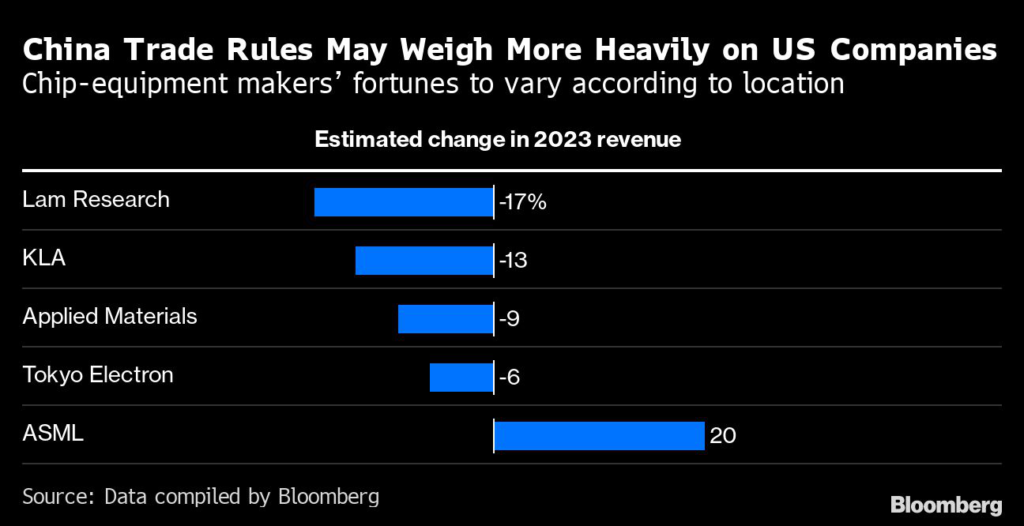
The global chip-production equipment market is dominated by US companies Lam, KLA, Applied Materials Inc., as well as ASML Holding NV in the Netherlands and Japan’s Tokyo Electron Ltd. Currently, the non-US suppliers have more latitude in doing business with China. For the US triumvirate, restrictions on what their overseas competitors can ship to China can’t come fast enough.

Applied Materials, Lam Research and KLA have warned investors that the new export control measures will cut into their revenue. The risk for them is that — until the restrictions apply in a more even-handed way — foreign peers will win market share in China, generating added revenue that in turn can be plowed into developing new products.

“I think there’s definitely a sense of disappointment that allies were not on board with this rule when it rolled out but a sense of urgency that they come on board soon to try and ensure that US companies don’t bleed out market share to their foreign competitors,” Jimmy Goodrich, vice president of global policy for the Semiconductor Industry Association, said in an online discussion hosted by the Washington International Trade Association. 

“That doesn’t help the US government achieve the objective, it harms US industry, but more importantly it does not address the national security goals, because those entities of which the US government has concern over in China are still able to access that technology the US government does not want them to obtain,” Goodrich said. 

“So on the multilateral front, that is a significant area where the private sector is watching that very closely for future developments,” he said.

While the overall market for chipmaking gear will shrink next year, according to estimates, analysts project that the three American companies will suffer steeper revenue declines than their Japanese counterpart.

Washington is now preparing to amp up pressure on allies to block chip gear sales to China. Senior US National Security Council official Tarun Chhabra and Under Secretary of Commerce for Industry and Security Alan Estevez are slated to travel to the Netherlands for discussions on China-chip curbs later this month, Bloomberg News has reported, although no deal is expected to come out of the talks. 

Estevez said last week that he expects a deal with allies to be reached in the near term. He said he wants rules for American companies to be “fair with their competition across the globe, and it’s fair for their competition with each other,” adding that he and other officials such as National Security Advisor Jake Sullivan and Raimondo are talking to allies about the issue.

–With assistance from Eric Martin.

(Updates with Semiconductor Industry Assiciation comment in eighth paragraph.)

More stories like this are available on bloomberg.com

©2022 Bloomberg L.P.

Jay-Z’s and Buttigieg’s Hometowns Both Need Biden’s EV Chargers

(Bloomberg) —

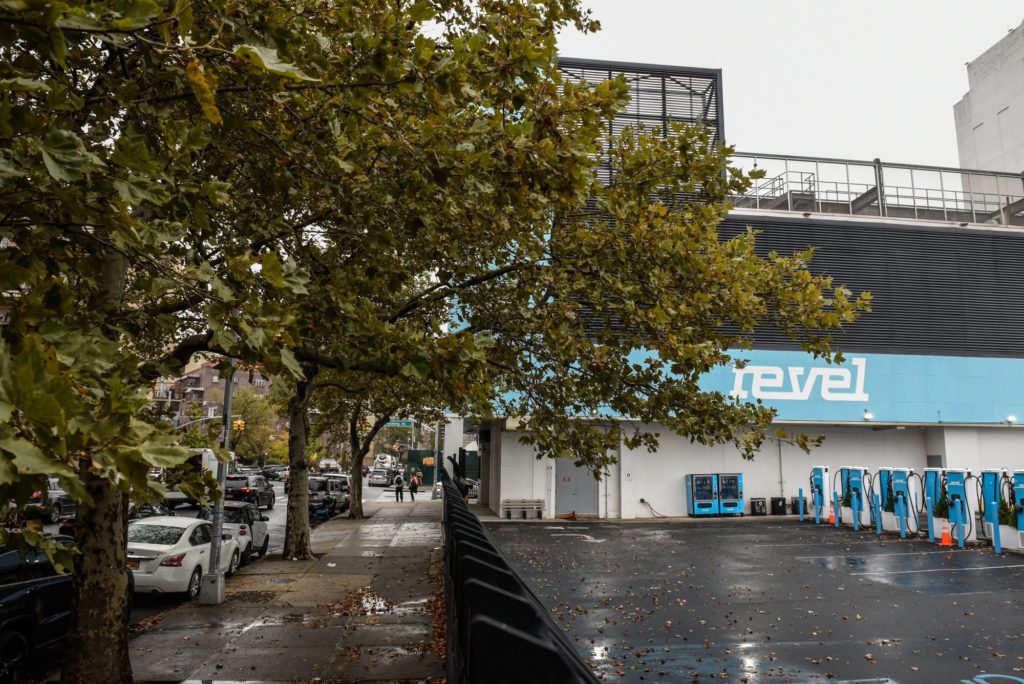
On a recent trip to New York, I spent some time using Revel, the transportation service behind a fleet of Bugatti-blue Teslas darting around the city. After chatting up my driver — a veteran cabbie who raved about how soothing it was to navigate NYC chaos in silent, driver-assisted ease — we reached what I was really after: the startup’s Brooklyn charging hub.

With a former Pfizer chemical plant hovering above it and Marcy Houses — the childhood home of rapper Jay-Z — just across the street, the hub does more than supply electricity to cabbies, delivery trucks and the occasional New Yorker charging up for a long commute. It’s the realization of both social and environmental goals: bringing jobs and technology to a low-income area with a history of industrial pollution, and chipping away at the number of exhaust-spewing cars rumbling through the neighborhood.

It’s also attractive from a business case standpoint. With more than 1 million cab rides booked each day in New York City, Revel is betting the utilization rate of its charging hub will only increase as more motorists switch to battery-powered cars.

But what about the rest of the US — the highway strips and small towns that don’t have the population or the EV adoption rates to sustain such a station? That’s the chicken-and-egg problem that’s plagued the EV industry for years, and one Tesla has confronted head-on by funding its own vast network of charging stations.

Now the US government has taken up the mission, allocating billions of dollars to build out fast-charging networks across the country — first with $7.5 billion in the infrastructure bill that President Joe Biden signed into law a year ago, and more recently with investment tax credits for charging operators in the Inflation Reduction Act.

It can be difficult to grasp the full scale and ambition of these two pieces of legislation. The public got a glimpse when Biden and Transportation Secretary Pete Buttigieg showed up at the Detroit auto show in September, announcing they were ready to disburse the first chunk of infrastructure money to states to build fast-chargers along interstate highways. Buttigieg also highlighted $2.5 billion set aside to fund “community charging.”

“There are lot of neighborhoods, a lot of multi-family buildings — including areas with more low-income residents — where it may not yet be profitable for a company to put in an electric-vehicle charger,” he told reporters at the show. “We can help buy down that difference with this funding.”

Democrats aren’t just incentivizing electrification or global competitiveness with these two bills — they’re trying to address long-standing social problems. Electric vehicles are now seen as a panacea of sorts for everything from climate change to environmental discrimination. New EV plants could revitalize depressed areas and alleviate income inequality. Charging stations that support EVs could improve air quality in neighborhoods with high levels of air pollution and asthma.

These are laudable goals, but redressing decades of disenfranchisement won’t be easy. Denise Abdul-Rahman, an environment and climate-justice activist with the NAACP in Indiana — Buttigieg hails from South Bend — has been spearheading a campaign to pressure state officials to ensure some of the federal dollars for charging stations is invested in Black and minority neighborhoods.

Cities like Gary or Hammond housed steel mills, oil refineries and coal-fired power plants that poisoned the air and water. Abdul-Rahman believes this should put them first in line for EV investment.

“We we were left out of the first New Deal,” she said. “How do we make sure we’re in this New Deal?”

Abdul-Rahman says the Indiana Department of Transportation neglected these communities when it applied for federal grant money. Her coalition wants a commitment to contracts for minority-owned businesses, apprenticeships, and chargers in places like schools and churches to help generate revenue and expose people to new technology. And she’s pushing for public metrics to hold the state accountable to its goals.

Indiana’s transportation department says it does have minority business goals and is working on making its progress public. The federal grants are part of “an entirely new program and still evolving,” a spokeswoman said in an email. “There will be ongoing opportunities to make adjustments to the plan as we advance.”

While it’s still early for these projects, Abdul-Rahman says now’s the time to start fighting for resources.

“It’s not codified” that Black businesses and communities will get some of these resources, she said. That’s why it’s necessary to “build accountability at the beginning.”

–With assistance from Keith Laing.

(Added assistance credit.)

More stories like this are available on bloomberg.com

©2022 Bloomberg L.P.

Tech Weighs on Stocks, Dollar Down Most Since 2020: Markets Wrap

(Bloomberg) — Stocks saw an earlier rally wane, with traders weighing mixed jobs figures and awaiting next week’s inflation data for more clues on when the Federal Reserve would be able slow down its pace of rate hikes.

Big tech weighed on the market, with Apple Inc. heading toward its longest losing streak since February. The dollar fell the most since March 2020. Ten-year US yields advanced.

US businesses reported strong hiring and wage increases in October although the unemployment rate climbed. Money-market traders trimmed their bets for the peak Fed rate next year after briefly pricing in 5.25% after the jobs data.

“Market rate pricing overshot a bit in the hawkish direction earlier this week and see no need for this to push higher on the news,” said Peter Williams at Evercore ISI.

Boston Fed President Susan Collins said policy is entering a new phase that could require smaller rate hikes, but she did not rule out another 75-basis-point boost. Her Richmond counterpart Thomas Barkin told CNBC the Fed may need to raise rates above 5%, though it may slow its pace of increases.

Markets will watch the latest US inflation reading on Thursday after the core consumer price index rose more than forecast to a 40-year high in September. Even if prices begin to moderate, the CPI is far above the Fed’s comfort zone.

More Comments:

Jason Pride at Glenmede:

“This jobs report likely does not push the Fed off its path for a 50-75 bp rate hike in December. However, the next big economic report that could move the needle for the Fed is next week’s CPI report.”

Gina Martin Adams at Bloomberg Intelligence:

“Maybe the equity market is taking some solace in the idea that the unemployment rate starting to tick up and that might lead to more weakness going forward, but I think its a net neutral report, frankly.”

Mark Hamrick at Bankrate:

“This report alone won’t sway the Federal Reserve to adopt a new tact on rising interest rates. It has a lot more data to digest, including on inflation, before the next policy-setting meeting in mid-December.”

Peter Essele at Commonwealth Financial Network:

“If labor growth remains strong and earnings growth slows, it’ll be a win-win for investors since there will be less pressure on the Fed to raise rates. The result could be a soft landing in the economy as opposed to a hard one.”

Mike Loewengart at Morgan Stanley Global Investment Office:

“While the number may be disappointing for investors hoping for a dovish Fed sooner rather than later, keep in mind it was the lowest reading in nearly two years, so there could be signs that the market is slowing.”

Charlie Ripley at Allianz Investment Management:

“The most notable signal from today’s employment data is not that the data came in better than expected, but rather that some subtle signs of the economy slowing are starting to show up. Investors are looking for any signs that the Fed will pull back the reigns on policy tightening.”

Investors are fleeing to the safety of cash funds as the Fed remains firmly hawkish, according to strategists at Bank of America Corp.

The asset class had inflows of $62.1 billion in the week through Nov. 2, according to a note from the bank citing EPFR Global data. That’s contributed to $194 billion of inflows into cash from the start of October — the fastest start to a quarter since 2020.

In corporate news, US-listed Chinese stocks jumped amid fresh optimism over an easing of Covid restrictions. DoorDash Inc. reported revenue that beat estimates, a sign that customers are still ordering pricey takeout despite a squeeze from higher inflation.

Some of the main moves in markets:

Stocks

  • The S&P 500 was little changed as of 11:58 a.m. New York time
  • The Nasdaq 100 was little changed
  • The Dow Jones Industrial Average rose 0.1%
  • The Stoxx Europe 600 rose 1.7%
  • The MSCI World index rose 0.9%

Currencies

  • The Bloomberg Dollar Spot Index fell 1.2%
  • The euro rose 1.5% to $0.9894
  • The British pound rose 1.1% to $1.1281
  • The Japanese yen rose 0.7% to 147.24 per dollar

Cryptocurrencies

  • Bitcoin rose 3.1% to $20,864.47
  • Ether rose 5.6% to $1,626.42

Bonds

  • The yield on 10-year Treasuries advanced two basis points to 4.16%
  • Germany’s 10-year yield advanced five basis points to 2.30%
  • Britain’s 10-year yield advanced three basis points to 3.55%

Commodities

  • West Texas Intermediate crude rose 3.8% to $91.52 a barrel
  • Gold futures rose 2.7% to $1,674.20 an ounce

–With assistance from Emily Graffeo, Isabelle Lee, Vildana Hajric and Cecile Gutscher.

More stories like this are available on bloomberg.com

©2022 Bloomberg L.P.

Crypto ‘FOMO Effect’ Emboldens Bulls; Bitcoin Tops $21,000 Again

(Bloomberg) — The crypto bulls are back — at least for now — with Bitcoin edging back toward the higher end of its monthslong trading range and smaller tokens such as Polygon, Litecoin and Solana outperforming the digital-asset benchmark. 

Bitcoin rose as much as 5.2% to $21,292, pushing the largest cryptocurrency by market value above $21,000 briefly for the first time since Oct. 29. The token has been lingering around $20,000 since August. It is down more than 50% this year. 

“All you need is one or two strong days to get people to say you’re going to get a year-end rally you don’t want to miss,” said Todd Sohn, managing director of technical strategy at Strategas Securities. “That creates the FOMO effect.”     

Risk assets rallied worldwide on Friday as traders weighed mixed jobs figures and awaited next week’s inflation data for more clues on when the Federal Reserve would be able slow down its pace of rate hikes.

Smaller so-called altcoins like Solana and Avalanche have also advanced in the past two days of trading as a slate of headlines bolster hopes for institutional adoption of digital assets. 

For example, Polygon surged 30% on Friday to post its biggest intraday gain in more than a year. Earlier this week, Meta gave more details on plans to let Instagram creators buy and sell nonfungible tokens on the Polygon blockchain.

Meanwhile, Dogecoin declined as much as 10.3%, pairing back some of the gains made amid Elon Musk’s acquisition of Twitter Inc.

Dueling forces are impacting crypto markets this week, according to Sohn. On one end, a weakening dollar and hopes that central banks could soon turn doveish have bolstered cryptocurrencies. But on the flip side, digital assets still need added liquidity to stage a true comeback, he said. 

More stories like this are available on bloomberg.com

©2022 Bloomberg L.P.

Read the Twitter Memo Sent to Employees Ahead of Layoffs

(Bloomberg) — Twitter Inc. employees around the world finding out whether they still work at the company a week after billionaire Elon Musk took over. The billionaire plans to eliminate half of Twitter’s workforce to slash costs at the social media platform he acquired for $44 billion last month, Bloomberg News has reported. 

Follow the latest updates on Twitter today.

Read the memo sent to employees obtained by Bloomberg. 

Team, 

In an effort to place Twitter on a healthy path, we will go through the difficult process of reducing our global workforce on Friday. We recognize that this will impact a number of individuals who have made valuable contributions to Twitter, but this action is unfortunately necessary to ensure the company’s success moving forward. 

Given the nature of our distributed workforce and our desire to inform impacted individuals as quickly as possible, communications for this process will take place via email. By 9AM PST on Friday Nov. 4th, everyone will receive an individual email with the subject line: Your Role at Twitter. Please check your email, including your spam folder. 

  • If your employment is not impacted, you will receive a notification via your Twitter email. 
  • If your employment is impacted, you will receive a notification with next steps via your personal email. 
  • If you do not receive an email from twitter-hr@ by 5PM PST on Friday Nov. 4th, please email peoplequestions@twitter.com.

To help ensure the safety of each employee as well as Twitter systems and customer data, our offices will be temporarily closed and all badge access will be suspended. If you are in an office or on your way to an office, please return home. 

We acknowledge this is an incredibly challenging experience to go through, whether or not you are impacted. Thank you for continuing to adhere to Twitter policies that prohibit you from discussing confidential company information on social media, with the press or elsewhere. 

We are grateful for your contributions to Twitter and for your patience as we move through this process. 

Thank you. 

Twitter

Read More: The Strange Spectacle of Musk’s Run at Twitter So Far

More stories like this are available on bloomberg.com

©2022 Bloomberg L.P.

Ukraine Latest: G-7 to Hold Russia Accountable for ‘War Crimes’

(Bloomberg) — The Group of Seven nations will formally coordinate assistance in repairing, restoring and protecting Ukraine’s energy and water infrastructure, following a foreign ministers meeting in Muenster, Germany. The G-7 said it would hold Russia accountable for “war crimes” against Ukrainian civilians. 

Chinese President Xi Jinping told German Chancellor Olaf Scholz he opposed the use of nuclear force in Europe, in his most direct remarks yet on the need to keep Russia’s war in Ukraine from escalating. 

Power rationing has widened in the capital as Ukrainian authorities seek to relieve pressure on the power grid. Kremlin troops escalated shelling of civilian infrastructure last month as Russian forces were losing ground on the battlefield.

(See RSAN on the Bloomberg Terminal for the Russian Sanctions Dashboard.)

Key Developments

  • Xi Tells Scholz China Opposes Nuclear Force in Message to Putin
  • Ukraine Seeks IT Investment at Web Summit as War Rages Back Home
  • US, Partners Opt to Set Fixed Crude Price For Russia Oil Cap
  • EU Studies Use of Russian Central Bank Assets to Rebuild Ukraine
  • How Ukrainians Are Protecting Their Centuries-Old Culture From Putin’s Invasion

On the Ground

Russian forces continue attacks near Bakhmut, Avdiyivka and Novopavlivka north-east of occupied Donetsk city, Ukraine’s General Staff said on Facebook. Ukraine downed three Shahed-136 drones over the past 24 hours, according to the statement. Russian troops tripled the number of attacks on certain areas of the front line — up to 80 per day, Ukrainian Commander-in-Chief Valeriy Zaluzhnyi said in a telephone phone call with General Christopher Cavoli, the head of US European Command on Thursday evening. Ukrainian air defense shot down nine Shahed-136 single-attack drones overnight, defense ministry said on Telegram. This includes eight drones downed in the east,and one drone in western Ukraine.

(All times CET)

Russia Seeks Sanctions Relief for Agriculture Bank: Reuters (3:44 p.m.)

Russia wants Western countries to ease curbs on state-owned agriculture lender Rosselkhozbank and clear the way for Russian grain exports, according to a Reuters report citing people it didn’t identify. 

Moscow hasn’t publicly detailed its demands beyond calling on European nations to release Russian fertilizer stuck in ports and warehouses, and allowing it to resume exports of ammonia. 

Slovak Premier Seeks Export Analysis on Russia Component Report (3:08 p.m.)

Slovakia’s premier said he’d ordered the government to analyze reports that his country had exported components to Russia that could be used for military purposes after the invasion of Ukraine started. 

Read more: Slovak Premier Seeks Export Analysis on Russia Component Report 

G-7 Creates ‘Mechanism’ to Defend Ukraine’s Key Infrastructure (2:30 p.m.)

The Group of Seven nations has agreed to coordinate assistance in repairing, restoring and protecting Ukraine’s energy and water facilities, which have been under a month of attacks from Kremlin troops. 

In the statement following their meeting in Germany, the G-7 foreign ministers said they have established a “coordination mechanism to help Ukraine repair, restore and defend its critical energy and water infrastructure.” 

Strengthening Ukraine’s “civilian resilience” will be a focus of an international conference in Paris planned for Dec. 13, they said, adding that the group “will stand firmly with Ukraine for as long as it takes.” 

G-7 Vows to Hold Russia Accountable for ‘War Crimes’ (2 p.m.)

The Group of Seven condemned Russia’s recent move to “terrorize” Ukraine’s civilian population with ongoing, “indiscriminate” attacks against energy and water facilities that have left much of the nation in the dark. 

Those strikes “constitute war crimes, and we reiterate our determination to ensure full accountability for these and crimes against humanity,” G-7 foreign ministers said in a statement following their meeting in Muenster, Germany. 

The statement also condemned “irresponsible nuclear rhetoric” by the Kremlin. “Any use of chemical, biological, or nuclear weapons by Russia would be met with severe consequences,” the G-7 said, without laying out specific steps. The group reiterated a call to Belarus “to stop enabling Russia’s war” and said the Belarusian regime risks “overwhelming additional costs.” 

Ukraine in Talks to Set Up Weapon Repair Hubs Abroad (12:30 p.m.)

The hubs for advanced maintenance and repairs of western military equipment would be set up in partner countries such as Poland, Czech Republic or Slovakia, Defense Minister Oleksii Reznikov said during a video briefing Friday.

Ukraine has enough 155-caliber munitions for artillery from western partners while supplies of munitions for Himars and other types of key weapons used to resist Russian invasion also continue, he said.

Reznikov expects an air defense network to be created in order to protect Ukrainian skies, using various systems provided by allies.

Ukraine Marks Railway Workers Day (12 p.m.)

“The Ukrainian railway has become a real road of life. And evacuation trains are a salvation for millions of Ukrainians,” President Volodymyr Zelenskiy said in an Instagram post. 

EU Says Iran Must Stop Drone Deliveries to Russia (9:30 a.m.)

The European Union urged Iran to stop the alleged supply of drones to Russia as a violation of UN resolutions, the bloc’s foreign policy chief Josep Borrell said.

“Iran denies it but Ukrainians have been providing evidence of the use of drones,” Borrell told reporters on the sidelines of a meeting of Group of Seven foreign ministers in Muenster, Germany. 

Xi Calls on World to Oppose Use of Nuclear Weapons (9:10 a.m.)

The international community should “oppose the use or threat of use of nuclear weapons,” Chinese President Xi Jinping said in talks with German Chancellor Olaf Scholz that covered the fighting in Ukraine. “Nuclear war cannot be fought,” Xi added in the meeting Friday in Beijing, according to Chinese state media.

Scholz, on Twitter, said he had asked Xi “to exert his influence on Russia.” 

Kremlin officials have warned Russia could use tactical nuclear weapons in Ukraine, though President Vladimir Putin later denied intending to do that.

Russia Is Likely Deploying ‘Blocking Units,’ UK Says (8 a.m.)

Low morale and reluctance to fight probably mean Russian forces have started to deploy “barrier troops” or “blocking units” that threaten to shoot retreating soldiers, the UK defense ministry said in an update, without offering evidence.

“Recently, Russian generals likely wanted their commanders to use weapons against deserters, including possibly authorizing shooting to kill such defaulters after a warning had been given,” the UK said. “Generals also likely wanted to maintain defensive positions to the death.” 

Kyiv Urges China to Press Russia on Infrastructure Attacks (10:04 p.m.)

Kyiv called on China to push Russia to end attacks on Ukrainian infrastructure as some of it is leased by Chinese businesses, Foreign Ministry spokesman Oleg Nikolenko said on Facebook. 

Russian missiles hit Chinese-leased terminals in Ukraine’s Mykolayiv port last month causing a $26 million loss as thousands of tons of sunflower oils leaked. There are other potential targets that include a Chinese-owned terminal, the spokesman said. 

Sanctioned Superyacht Seized in Spain as Owner Stops Paying Fees (8:32 p.m.)

A Spanish court moved to seize a superyacht valued at $140 million that’s linked to a senior executive at a Russian defense conglomerate, after the owner stopped paying maintenance fees in June.

The court order to seize the 85meter (279-foot) Meridian A — formerly called Valerie — was handed down by a Barcelona judge on Wednesday, according to the Spanish maritime authorities.

The vessel, linked to Rostec State Corp.’s chief executive officer, Sergey Chemezov, was immobilized in mid-March by Spanish authorities while it was at a Barcelona shipyard for repairs. The European Union considers the vessel is formally owned by the stepdaughter of Chemezov.

More stories like this are available on bloomberg.com

©2022 Bloomberg L.P.

Close Bitnami banner
Bitnami