Bloomberg

Ukraine Seeks IT Investment at Web Summit as War Rages Back Home

(Bloomberg) — Ukrainian startups and officials have descended on Lisbon this week to Europe’s largest tech conference, seeking investment and exposure for their country’s IT sector even as the war with Russia rages at home. 

“Technology can destroy and murder, but it can also be a saving grace,” Ukraine’s First Lady Olena Zelenska said in an interview with Bloomberg Television on the sidelines of the annual Web Summit conference.  

Ukraine’s tech sector has grown this year despite the war, now in its ninth month. The government estimates the IT industry represents about 10% of the country’s economy, which is forecast to shrink by about a third in 2022. 

Minister for Digital Transformation Mykhailo Fedorov shared a stage at the event with Microsoft Corp. Vice Chair and President Brad Smith, who said the US tech giant will provide Ukraine with support worth $100 million next year, bringing the total to over $400 million since the invasion. 

“There’s a real digital alliance supporting the people and the government of Ukraine,” Smith said in an interview. “When it comes to 2023, that digital alliance needs to continue to stand strong.” 

Microsoft withdrew from Russia after the war started and has provided government agencies and other sectors in Ukraine access to its digital infrastructure, cybersecurity solutions and the Microsoft Cloud.

First Cyberwar

The aid comes in a conflict that has been called the first full-scale cyberwar, with both sides utilizing hackers who are sometimes not part of official structures. Fedorov said in a Telegram post Thursday that Ukrainian volunteers stole data from Russian central bank networks, a claim the regulator denied. 

US and European Union officials have blamed Russia on cyberattacks that targeted the satellite company Viasat Inc., knocking out communications in much of Ukraine in the hours prior to Russia’s invasion. Microsoft research has also found suspected Russian hackers behind a series of digital assaults against Ukrainian targets. 

Even as Ukraine has scored some successes pushing Russian occupying forces back, the Kremlin has unleashed heavy barrages of missiles on power and communications infrastructure in recent weeks, causing widespread blackouts and disrupting the tech sector’s efforts to project an air of normality. 

“When you have a full-scale war in a country, it’s difficult to be successful,” said Kirill Bondar, the chief financial officer of Ukrainian startup hub Unit.city. “We’re just preparing our business for the time after victory.” 

An IT Ukraine Association poll found 61% of tech professionals were forced to relocate due to the war, with 14% moving abroad. The survey found that most plan to return to Ukraine when the fighting ends. 

When they do, they’ll find a higher-profile industry transformed by the war into one of the drivers of the Ukrainian economy, according to Victoria Repa, the founder of health tech app BetterMe.

“We aren’t like founders in the US or Europe who can can easily go to capital markets,” said Repa. “Now we have the awareness that we deserved previously.” 

More stories like this are available on bloomberg.com

©2022 Bloomberg L.P.

China Stock Frenzy Enters Overdrive on Hopes That Worst Is Over

(Bloomberg) — After nearly two years of disappointment and $6 trillion of losses, Chinese stocks soared at the fastest pace worldwide this week on frenzied speculation that a bottom has finally arrived.

A flurry of market-friendly headlines — along with unverified talk that China is poised to exit its strict Covid Zero policy — drove the Hang Seng China Enterprises Index to its best weekly gain since 2015. Led by tech names, the gauge soared as much as 8.8% on Friday, as Bloomberg News reported progress in efforts to prevent the delisting of hundreds of Chinese stocks from US bourses.

While similar rallies have all fizzled in recent months, bulls are betting that some of the world’s lowest valuations have left Chinese shares primed to surge on any hint of good news. The risk is that they could be getting ahead of themselves, especially after the nation’s top health body reaffirmed its commitment to Covid Zero.

“It seems markets are very much chomping on any bits of positive news — whether big or small — as a potential catalyst for Chinese shares,” said David Chao, global market strategist for Asia Pacific ex-Japan at Invesco Ltd. “Based on the valuations and that a lot of the bad news has been baked into these stocks, investor sentiment is more geared toward the upside than the downside.”

The wild rebound takes place just one week after a historic rout sparked by concerns about President Xi Jinping’s power grab at the Communist Party congress. And while those losses came after a carefully orchestrated leadership summit, the gains in the past days — after four months of losses for major indexes — were led by a drip feed of reopening rumors. 

“Short squeeze-driven rebounds tend to be short-lived and a lot of foreign investors are still looking to sell because they are not certain of the outlook,” said Grace Tam, chief investment adviser for Hong Kong at BNP Paribas Wealth Management. “For investors who don’t mind volatility, the reopening and consumption plays make sense but you need to be able to tolerate risk.”

Read: How a Mysterious China Screenshot Spurred $450 Billion Rally

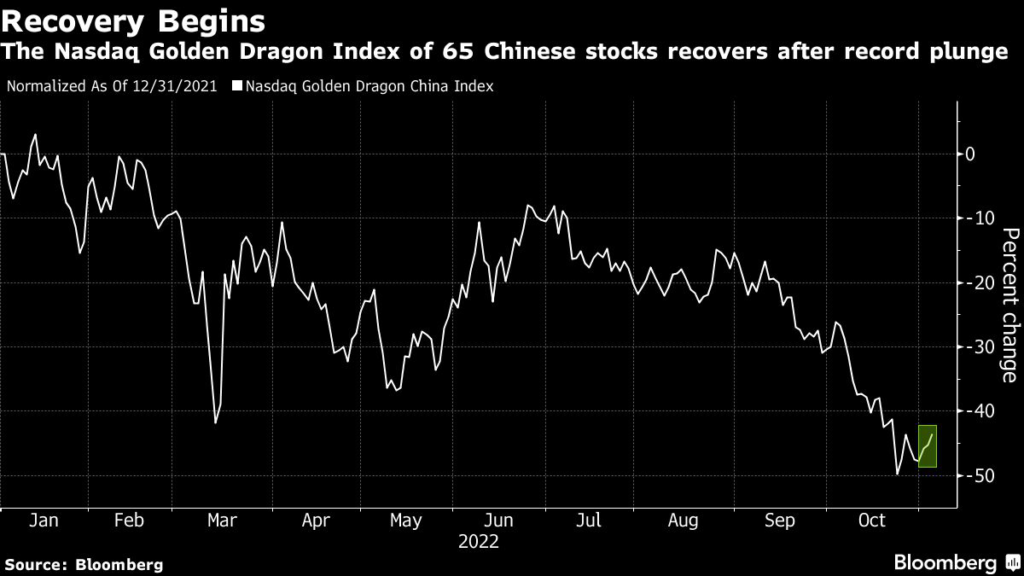
Rebounding almost 9% this week, Hong Kong’s Hang Seng Index posted its best gains since 2011. The CSI 300 Index, the benchmark for mainland stocks, also jumped more than 3% on Friday. The Nasdaq Golden Dragon China Index of US-listed Chinese stocks has also advanced 7.5% in the first four days of trading.  

The optimism spread to commodity and currency markets, with iron ore futures gaining and the the offshore yuan strengthening more than 1% at one stage. Dollar bonds of Chinese tech firms had also sold off in recent weeks, but their spreads tightened about 10 basis points Friday, according to credit traders.

Stocks related to reopening, such as Li Ning Co. and Haidilao International Holding Ltd., were among the big gainers. China is working on plans to scrap a system that penalizes airlines for bringing virus cases into the country, Bloomberg News also reported. 

Internet giants Alibaba Group Holding Ltd. and Tencent Holdings Ltd. soared at least 7% each at the close. Dozens of US Public Company Accounting Oversight Board inspectors are set to leave Hong Kong as soon as this weekend, earlier than the original schedule of mid-November, people familiar with the matter told Bloomberg News, asking not to be identified because the information is private.

The sudden surge has caught out short sellers, who earlier had bought contracts to profit from deeper declines in the Hang Seng China Enterprises gauge. 


Still, the feel-good sentiment hasn’t stopped an exodus of foreign funds. There was 5 billion yuan ($687 million) of net sales this week through trading links with Hong Kong, adding to the 13 billion yuan last week, according to Bloomberg-compiled data.

“With so many positive chatters in the market, the indexes are having a relief rally, said Willer Chen, an analyst at Forsyth Barr Asia Ltd. “There are so many rumors. Nothing is confirmed but people are buying on those tips.”


–With assistance from Abhishek Vishnoi, Dorothy Chan, Charlotte Yang and John Cheng.

More stories like this are available on bloomberg.com

©2022 Bloomberg L.P.

Twitter Latest: Class-Action Suit Filed as Musk Begins Job Cuts

(Bloomberg) — Twitter Inc. plans to start cutting staff Friday, the company said in an email to employees.

Billionaire Elon Musk plans to eliminate half of Twitter’s workforce, making good on plans to slash costs at the social media platform he acquired for $44 billion last month, people with knowledge of the matter have said.

“In an effort to place Twitter on a healthy path, we will go through the difficult process of reducing our global workforce on Friday,” Twitter management said in an email reviewed by Bloomberg. “We recognize that this will impact a number of individuals who have made valuable contributions to Twitter, but this action is unfortunately necessary to ensure the company’s success going forward.”

The company will inform affected staffers Friday at 9 a.m. San Francisco time, according to the memo. Amid the layoffs, Twitter plans to temporarily close offices and suspend badge access “to help ensure the safety of each employee as well as Twitter systems and customer data,” the memo said. 

Bloomberg News will capture the news flow here.

Volkswagen Tells Brands to Pause Spending (8:30 a.m. London) 

Volkswagen, Europe’s biggest carmaker, recommended that all of its brands pause their paid activities on Twitter until further notice, according to an emailed statement on Friday. 

Several advertisers have tapped the brakes on placing ads on the platform until they get a clearer idea of Musk’s plans. Musk has said he wants to remove some content moderation, giving rise to concerns that hate speech, misinformation and other potentially harmful material will flourish even more freely. General Mills Inc. said it’s temporarily pausing advertising on Twitter, joining General Motors Co. in rethinking their presence on the platform.

Twitter Sued for Mass Layoffs (10:43 p.m. SF)

Twitter was sued over Musk’s plan to eliminate about 3,700 jobs at the social-media platform, which workers say the company is doing without enough notice in violation of federal and California law. A class-action lawsuit was filed Thursday in San Francisco federal court.

Employees Start Losing Email Access (9:13 p.m. SF)

The company started cutting employee access to email and Slack on Thursday night. Some employees who were shut out of their work tools suspected their jobs were already cut, though they had received no official confirmation yet.

Job Cuts Begin

All told, Musk wants to cut about 3,700 jobs at San Francisco-based Twitter, people with knowledge of the matter said this week. The entrepreneur had begun dropping hints about his staffing priorities before the deal closed, saying he wants to focus on the core product. “Software engineering, server operations & design will rule the roost,” he tweeted in early October.

Security staff at Twitter’s San Francisco headquarters carried out preparations for layoffs, while an internal directory used to look up colleagues was taken off line Thursday afternoon, people with knowledge of the matter said. Employees have been girding for firings for weeks. In recent days, they raced to connect via LinkedIn and other non-Twitter avenues, offering each other advice on how to weather losing one’s job, the people said. Ex-Twitter engineers are also using social media to respond to former “Tweeps” looking to land jobs elsewhere.

Musk has also been huddling with advisers to come up with new ways to make money from the blogging platform, including charging for verifications, which can help delineate real users from fake accounts. He’s also considering reviving a long-since-discontinued short-video tool called Vine, a way to vie with popular video-sharing apps like TikTok. Another product under consideration, the New York Times reported, is paid direct messages, which would let the rank and file send private messages to high-profile users.

Read more: Musk to Restore Twitter Content Moderation Tools Before US Election

–With assistance from Monica Raymunt.

More stories like this are available on bloomberg.com

©2022 Bloomberg L.P.

Vietnam Weighs 3-Hour Pulldown of Some ‘Toxic’ Internet Info

(Bloomberg) — Vietnam’s communications ministry is proposing a decree requiring some “toxic” information in some situations be removed from social media within three hours and other false news pulled down within 24 hours.

“Fake news on the Internet, if handled slowly, will spread very widely,” Minister of Information and Communications Nguyen Manh Hung told the National Assembly. The ministry is looking to enforce 24-hour and three-hour take-down orders — up from the current 48 hours — of what it deems malicious content, he said.

Efforts to increase policing of Internet behavior by the nation’s Communist leaders comes as new rules requiring foreign tech companies to store user data in the Southeast Asian country trigger concerns from US business groups. 

The fine for disseminating false information has increased three-fold but is still 1/10 of what other countries in the region issue, Hung said. The ministry will continue to work with other government agencies to raise the fine, he said. 

The ministry is also weighing rules directing YouTube Inc. and Facebook to remove advertisements that contain false information, especially for nutritional products, Hung said. In 2020, the ministry blocked 1,700 websites that were showing signs of fraud, he said.


–With assistance from Jamille Tran.

(Updates the story with policing of the Internet in the third paragraph.)

More stories like this are available on bloomberg.com

©2022 Bloomberg L.P.

Boeing Subsidiary Jeppesen’s Services Hit By Cyberattack

(Bloomberg) — Boeing Co. unit Jeppesen has been hit by a cyberattack that’s affecting access to its flight planning software, which is used by airlines globally. 

“Our subsidiary, Jeppesen, experienced a cyber incident affecting certain flight planning products and services,” Boeing spokesman Yukui Wang said in an email Friday. “There has been some flight planning disruption, but at this time we have no reason to believe that this incident poses a threat to aircraft or flight safety.”

A red banner at the top of Jeppesen’s website said the company was experiencing technical issues with some of its products, services and communication channels. Clients can get in contact by email for support, but phone services aren’t available, it said. 

Receipt and processing of so-called notice to air missions, which inform pilots and airlines about potential hazards during flights, have also been affected, Jeppesen said.  

“We are in communication with customers and regulatory authorities, and working to restore full service as soon as possible,” Boeing’s Wang said. 

Steve Giordano, managing director of Delaware-based Nomadic Aviation Group, tweeted a picture of a notice from Jeppesen on the products rendered unavailable due to a “system outage.”

More stories like this are available on bloomberg.com

©2022 Bloomberg L.P.

Diablo’s Creator Explains Why He’s Working for a Chinese Rival

(Bloomberg) — David Brevik, an American game developer, is best known for creating the iconic Diablo franchise for Activision Blizzard Inc. The 54-year-old is the mastermind behind the action role-playing game Diablo and its sequel Diablo II, which pioneered an entire genre of real-time combat combined with randomized dungeons and bountiful loot. In 2003, Brevik left Blizzard to start his own projects and has clashed with his former employer on where the dark-fantasy series should go next.

Brevik recently joined the dev team of Torchlight: Infinite as a consulting producer. Published by Shanghai-based XD Inc., the game is among a slew of Diablo wannabes on mobile and competes with Blizzard’s own Diablo Immortal. In an interview with Bloomberg News, Brevik explained why he’s helping a Chinese rival. Below are excerpts from the interview, lightly edited for clarity.

Q: Why did you join the team of Torchlight: Infinite? 

I’m a big Torchlight fan. When there is a new one coming, of course I’m excited about that. So I was playing the closed beta and they reached out and we started talking. And then we came to a relationship where I can come on as a consulting producer.

Q: What’s your role like?

One is doing media things like this, as well as playing the game and giving feedback and interacting with the community, providing more perspective from players that are similar to me in this part of the world. 

XD is very receptive to feedback, which isn’t always the case, and they really listen and they’re willing to make changes. We’ve had some meetings over Zoom. I’m in a WeChat group with them and we chat in there as well.

Q: How many hours have you spent on this game and which hero do you favor?

It’s really the only action RPG that I have been playing lately. I probably have close to 50 hours at this point. I mainly play Moto, the dwarf guy with the robots. 

Q: Blizzard has its own Diablo game on mobile. How would you compare Immortal with Infinite?

I don’t really want to directly compare them, but I think that in general the Torchlight: Infinite experience is extremely smooth. It’s not really intense — where I feel like you have to repeat the same content over and over. I like the mechanics of the end game a lot in Infinite, and I think that it’s a friendlier thing for gamers to play. It’s a lot easier and has a lot more variety. 

Q: There’s a lot of criticism around “pay-to-win” in those action RPG mobile games, and Infinite dropped some of the add-on features it charged players for during closed beta. Do you think Western, or PC, gamers are more reluctant to accept the freemium business model?

Everybody’s definition of pay-to-win is different, right? Some people feel like they should be given everything for free. And if a company charges for anything beyond just cosmetics, then it’s automatically pay-to-win for some people. I find that’s not even true. 

I’ve been deliberately trying to play Infinite as a free player to get that experience and to report back what that’s like. I feel like this game is extremely generous and allows everybody to get the items that they want and play the game that they want for free. And that’s about all you can ask for. 

Q: Even after Infinite made some tweaks to its in-app purchases, some players still criticized the gacha system for pets in the game. Where’s the line?

Every dev team has to decide where that line is. For Infinite, it’s that we’re not going to have it affect the core gameplay, that you can play everything, you can loot everything.

Also it’s not being directly competitive with everybody else. There isn’t player-versus-player in the game. It’s not like, “hey, I can advance further and faster and have better stats to go up against somebody else.”

Those two things really are kind of like lines in the sand.

Q: What score would you give Infinite, on a scale from 1 to 10?

My friends have a joke about me that my scale doesn’t go from 1 to 10. It goes from -8 to 2. Just because I’m such a sourpuss.

But I’ve really enjoyed this game. For me, I think this is in the kind of 8 or 9 range, which is way up there on my scale.

Q: What about Diablo II, your own game?

I don’t like Diablo II when I play it. It’s different when you make a game. I’m super critical of my own decisions and my own things, so whenever I play it, I see all of the mistakes, I see all the things that I want to fix. 

I haven’t worked on it in 20 years now, but it’s still hard for me to play it without thinking about all the things that I would do to change it, to make it different. All my games are bad because I feel like I can always improve them.

Q: There’s some sort of boom in Diablo-like mobile games lately, with the launches of Immortal, Infinite, and a South Korean game called Undecember.

I think there’s lots of fun choices out there. I would like to see this genre become more popular and grow to be even bigger than it is. Just seeing a resurgence is really fun.

Q: Your early Diablo co-creators have also been trying to outdo Diablo in the action RPG genre. Are you still in touch with them?

There’s always new ways to play these games, new ways to experience the action, and new ways to handle randomization — all sorts of stuff that can come into play to create experiences that we haven’t had yet.

I created Blizzard North with two other people, Max and Eric Schaefer, two brothers that I knew. And they made the Torchlight franchise. Max and Eric live about six blocks away from me, so I see them all the time.

I’ve talked about Infinite with them. They’ve given it a try and they both have enjoyed playing.

Q: Lots of players say Infinite doesn’t feel like a new Torchlight game, instead more a mobile version of Path of Exile, which is another classic action RPG title. How do you feel about this?

I think that the Torchlight world is really interesting. I think it’s more friendly and open, but then the colors and the graphics are brighter and friendlier, not quite as dark as Path of Exile. I think it’s a great franchise, and then bringing something new to the franchise, something completely different, is really interesting.

Q: Looking at Infinite’s leaderboard, the top players are all playing the Berserker character with a similar build. Is there a balance issue?

No. You can change the balance of that for the next season. So that build really isn’t as powerful as it was during this season. And that’s okay. And then people will approach the game and play a different way. 

I think that oftentimes when you’re designing a game, the community is so clever that they come up with all these different combinations you would never think of and that create super powerful builds. And discovering those and playing through those is part of the fun. 

Q: Chinese game developers are now accelerating their global push after a year of regulatory crackdown hammered growth at their home market. Is there anything they should learn from Western devs during that process?

Chinese developers have become very good on mobile. And in general, they’ve grown into a place where I believe that they have just as good design sensibilities as anybody else in the world.

Everybody is learning from each other all the time. I would like to see their take on things. Having a different culture and having a different way of thinking about games or experiencing content. I like those cultural differences. I celebrate those things rather than trying to get rid of them. So I think that it’s important for them to have their own voice and become really good at not only making games that have broad appeal, but have a Chinese spin on it.

Q: Do you think Infinite has a Chinese spin?

Yes. It’s the fact that a mobile version of an action RPG has been done really well like that. That in and of itself is not something that has been done with other developers.

Q: Will this consulting role lead to something bigger with XD?

Who knows? Never say never. I think that would be cool. 

Q: Will you consider taking on a similar role with Immortal or Diablo IV?

No. I won’t go back to Blizzard ever.

More stories like this are available on bloomberg.com

©2022 Bloomberg L.P.

US-Listed Chinese Stocks Soar on Reopening Hopes, Audit Progress

(Bloomberg) — US-listed Chinese stocks jumped anew on Friday as fresh optimism over a possible reopening in China and progress in a US audit of Chinese tech companies to prevent their delisting fueled appetite for beaten-down names.

Shares in internet giant Alibaba Group Holdings Ltd. rose 8.9%, JD.com Inc. gained 8.3% and Baidu Inc. climbed 6.7% in US premarket trading. Pinduoduo Inc. rallied 9.4% and Bilibili Inc. jumped 13%, while electric vehicle stocks NIO Inc. and Li Auto Inc. advanced 11% and 14%, respectively.

The rally follows days of speculation on the back of unverified social media posts detailing a China reopening plan, boosting hopes that the country is preparing to exit its strict Covid Zero policy. A Bloomberg report that China is working on plans to end a system that penalizes airlines for bringing virus cases into the country also boosted sentiment. 

The Nasdaq Golden Dragon Index of 65 Chinese stocks has climbed for the past three sessions and is up 7.5% on the week, rebounding after closing at its lowest level since 2013 last week in a record selloff amid worries over President Xi Jinping’s tightening control. 

READ: Tech Audit, Reopening Bets Fuel Best China Stock Rally in Years

More stories like this are available on bloomberg.com

©2022 Bloomberg L.P.

MTN Sells Afghan Unit to Beirut Firm in New Middle East Exit

(Bloomberg) — MTN Group Ltd. is selling its Afghanistan business to Beirut-based M1 New Ventures for $35 million as Africa’s largest wireless carrier continues to reduce its presence outside the continent.

The Johannesburg-based company announced the deal Friday alongside third-quarter results. The M1 Group is owned by Lebanon’s Mikati family, who sold Middle East assets to the South African company in 2006, when MTN was seeking to expand in the region. 

MTN shares rose as much as 5.2% in early trade in Johannesburg, paring year-to-date losses to 20%.

The wireless carrier has been narrowing focus on its home continent since 2020, targeting high growth areas such as data sales and mobile-money. The group abandoned its Syrian business and transferred its Yemen unit to a partner. Operating in Afghanistan, where MTN is the biggest operator with about a 40% market share, has been complicated since the US withdrawal in August 2021. MTN remains present in Iran.

Separately, MTN said it’s advancing talks with strategic investors to buy a stake in its fintech unit. The talks are moving toward a binding-offer stage, and MTN expects outcomes by the first quarter of next year. Customers at the fintech business increased by 23.3% to 63 million in the third quarter from a year earlier, with transaction volumes up by a third to 9.5 billion. 

“In the near term, revenue growth has been impacted by new taxes in a few markets, but we continue to see the case for structural and compelling growth for fintech services in the medium term that will deepen financial inclusion across Africa,” said MTN Chief Executive Officer Ralph Mupita. 

In South Africa, where the carrier recently ended talks to acquire smaller domestic rival Telkom SA SOC Ltd., the company’s subscribers increased by more than 800,000 to 35.9 million. Group-wide, subscribers rose to 285 million. 

MTN said it has repatriated 13 billion rand ($710 million) from overseas operations so far this year. 

(Updates with share movement in third paragraph)

More stories like this are available on bloomberg.com

©2022 Bloomberg L.P.
Xi Tells Scholz China, Germany Should Unite in ‘Chaotic’ World

(Bloomberg) — Chinese President Xi Jinping told German Chancellor Olaf Scholz their nations should unite for peace in a “chaotic” world, a call for closer ties that comes amid strains between Brussels and Beijing. 

The two leaders held their first in-person talks since Scholz took office Friday in Beijing, with the German delegation including top executives from BASF SE, Volkswagen AG, Deutsche Bank AG and BioNTech SE. Scholz is the first major European leader to visit China in more than two years, as Xi returns to in-person diplomacy after his long spell of self-imposed Covid isolation stifled such exchanges. 

“As influential major powers, China and Germany should work together in this chaotic and changing situation to make more contributions to world peace and development,” Xi said, according to state broadcaster China Central Television. He added that their talks would facilitate the “next stage” of China-German relations.

The German leader said his visit came at a “time of great tension,” as Russia’s war in Ukraine challenged the rules-based order, and stressed the importance of face-to-face dialogue. “We can now talk concretely and directly with each other to respond to the challenges the world is facing and the bilateral relations between Europe and China,” Scholz said. 

He added that the two men would also discuss furthering bilateral economic ties. Scholz is also expected to meet Chinese Premier Li Keqiang, before departing Beijing this evening.

Xi has engaged in a flurry of diplomacy this week, hosting top foreign leaders from Vietnam, Pakistan and Tanzania as he begins a third term in office focused on increasing China’s global influence. The Chinese leader didn’t leave his nation for two years after Covid emerged, a period that saw Beijing’s ties with the West sour over Xi’s crackdown on Hong Kong, treatment of Muslims in Xinjiang and refusal to condemn Russian President Vladimir Putin’s invasion of Ukraine. 

Later this month, Xi is expected to expand that outreach campaign at major summits in Thailand and Indonesia, where he could sit down with President Joe Biden for the first time since the US leader took power. That meeting could ease hostilities between the world’s two largest economies, which have reached a new low during the pandemic.

Still, while Xi appears to have eased his own virus restrictions, meeting dignitaries in person and appearing unmasked in public, China remains in the grip of his Covid Zero policy that’s weighed on the economy. The German delegation had to take two PCR tests before arriving in Beijing, and another on arrival. Workers wearing hazmat suits were seen rolling out a red carpet for Scholz’s delegation.

Xi’s efforts to solidify ties with Germany this week are part of a broader push to prevent relations with the European Union from further deteriorating. Last year, the EU halted an investment agreement with China after both sides traded sanctions over Xinjiang, where the US has accused Beijing of genocide. China denies such allegations.   

For its part, Berlin is working to hone a new national strategy on China that aims to weaken reliance, diversify supply chains and enhance security, while reinforcing business ties. That leaves Scholz walking a fine line between pushing trade ties in Beijing, while voicing concerns on sensitive allegations of human rights violations by China. 

“China remains an important economic and trading partner for Germany and Europe, even under changed circumstances,” Scholz wrote in a guest article for German publication Frankfurter Allgemeine Zeitung on Wednesday that Berlin was seeking cooperation with China. “We do not want decoupling.”

China will be looking to reassure foreign business leaders that it’s open for investment and trade, despite its Covid Zero policy that’s effectively closed the nation’s borders for nearly three years. 

Jens Hildebrandt, executive director of the German Chamber of Commerce in North China, told Bloomberg TV that clarity on Xi’s Covid Zero policy was the “biggest concern” of the European nation’s businesses. “We need predictability and stability,” he said. 

–With assistance from Sarah Zheng.

More stories like this are available on bloomberg.com

©2022 Bloomberg L.P.

Crypto Gloom Deepens on JPMorgan Team’s Venture Capital Warning

(Bloomberg) — A retrenchment in venture capital funding for the digital-asset sector is the latest sign that a longer slump in crypto markets may lie ahead.

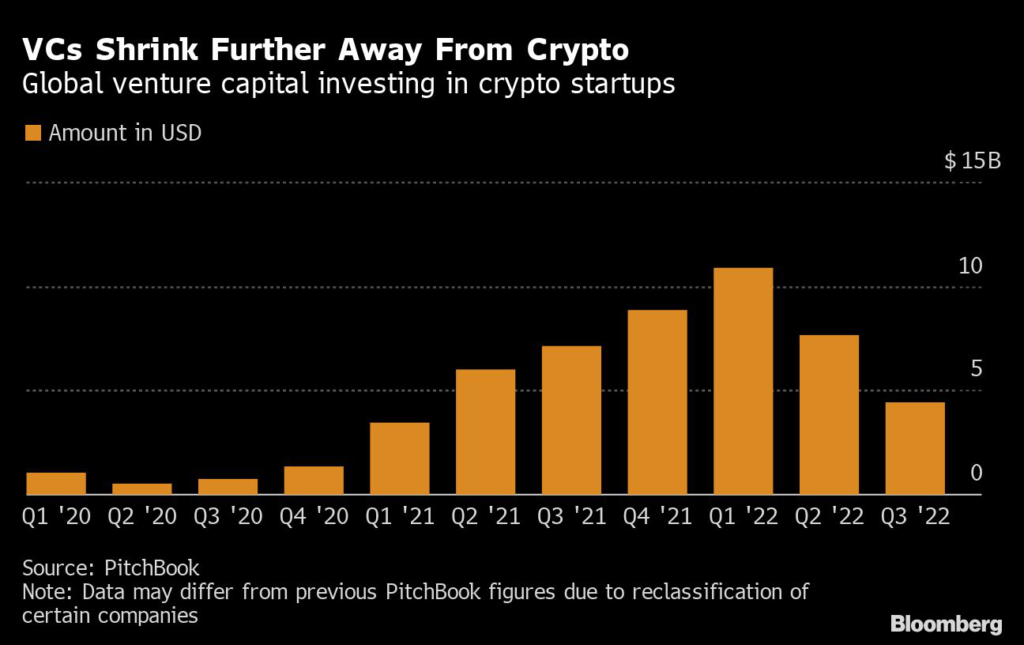
That’s the view of JPMorgan Chase & Co. strategists including Nikolaos Panigirtzoglou, who said Thursday such funding is running at the equivalent of about $10 billion a year, less than a third of the pace seen in 2021.

“This is a concerning development as it shows reluctance by VC funds to deploy capital into the digital-asset space, increasing the likelihood that the current weakness in crypto markets would be long lasting,” the team wrote in a note.

Venture capital investment into the industry hit a more than one-year low of $4.4 billion in the third quarter. The crypto sector has wilted under tightening monetary policy, which has hurt liquidity and thus demand for riskier assets.

The JPMorgan team said weak crypto venture funding in September and October imply a drop-off in July and August wasn’t purely seasonal as had been hoped.

An index of top digital assets has slumped 56% this year. Bitcoin has been mired in a trading range around $20,000 since sinking to a low in June. A rally in Chinese stocks that brightened the mood among investors helped the largest token rise about 2% to $20,645 as of 6:25 a.m. in London.

Second-ranked Ether and alternative coins like Cardano and Solana also showed some signs life. But Dogecoin sank, partially unwinding a speculative rally that was driven by the view that supporter Elon Musk might integrate the token into Twitter somehow after acquiring the social-media enterprise.

Major crypto exchange Coinbase Global Inc. said Thursday it doesn’t expect the industry to rebound swiftly from a trading slump that’s battering revenues. The firm’s Chief Financial Officer Alesia Haas said in an interview “headwinds could persist or possibly intensify.”

Global markets remain vexed by the prospect of a higher end-point in the Federal Reserve’s interest-rate hiking cycle to fight inflation. Such a backdrop suggests riskier investments like crypto still face pitfalls in the weeks and months to come.

–With assistance from Hannah Miller.

(Updates market prices from the sixth paragraph.)

More stories like this are available on bloomberg.com

©2022 Bloomberg L.P.
Close Bitnami banner
Bitnami