
Bloomberg

Want a More Diverse Applicant Pool? Make Your Job Remote

(Bloomberg) — Companies may be calling workers back to the office, but many want to stay home, particularly those who come from underrepresented groups.

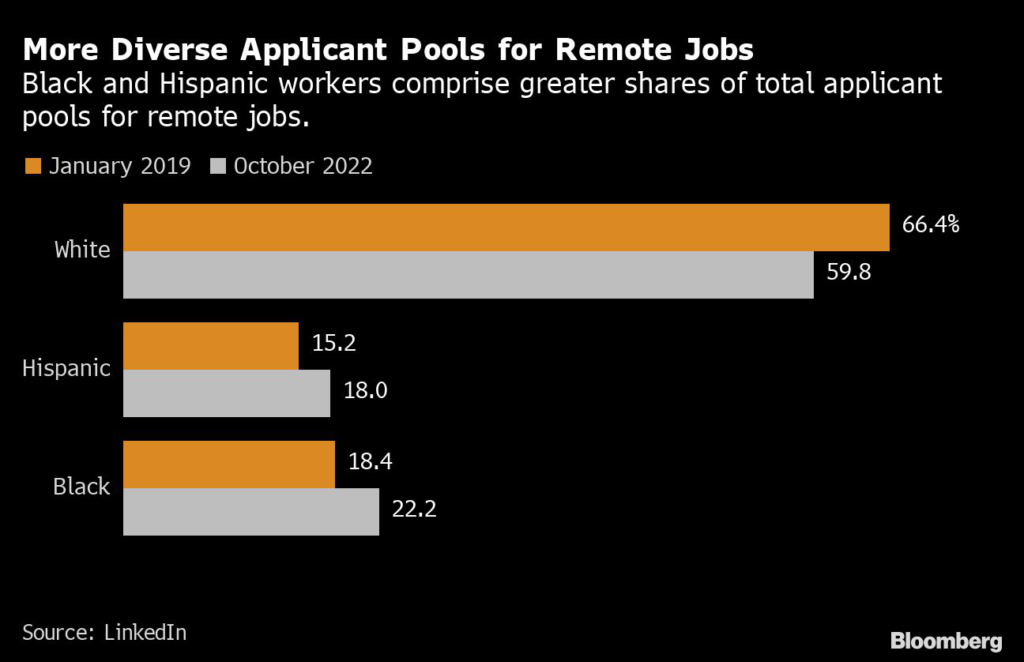
Black, Hispanic and female job seekers are making up a greater share of applicants — and new hires — for roles that can be done remotely compared to their White and male counterparts, an  analysis released Thursday by LinkedIn finds. Between January 2019 and October 2022, the platform saw a 20% increase in the share of female applicants applying to fully remote jobs, compared to a similar decrease in male applicants over the same time period.

The analysis also found a notable increase in interest for those kinds of jobs among Black and Hispanic people. LinkedIn analyzed 1 million accounts belonging to each men and women, as well as 300,000 accounts each for Black and Latinx members who chose to share demographic data about themselves.

Andrew McCaskill, a LinkedIn career expert, said the application rates will only grow increasingly important as the number of remote jobs decrease. Before March 2020, 2% of paid job listings in the US on the platform were remote, he said. The number of remote job listings jump to 20% during the pandemic and has since leveled out to 15%. In the UK, it’s 12%. Workers still want those jobs: 52% of applicants on LinkedIn are applying for remote positions.

“More and more people want remote work, but we’re having fewer and fewer remote jobs, and more and more companies are asking people to not only not have remote jobs, but to come back into the office,” McCaskill said. “That disconnect might become a problem as our companies start to look at, ‘how do we attract that talent?’”

Black workers in particular were more likely to prefer remote work throughout the pandemic, surveys found, with many saying it allowed them to escape some of the biases they faced at the office. Women with children also say it’s helped them better balance the demands of work and home life.

There are career downsides to staying home. Older bosses are more likely to want workers in the office, and the phenomenon of “proximity bias” persists, where just being seen in the office can affect performance evaluations, promotions and job security, research has found. A recent survey found that remote workers are more likely to be seen as lazy by their in-office colleagues. Women and workers of color, who already face an uphill battle at work, might be penalized for working remotely.

Though remote work is just one facet of overall company culture, McCaskill suggests it may be make-or-break when it comes to hiring a diverse team. Remote jobs can also widen the pool of where applicants are from. He pointed to the fact that 57% of the Black population in the US lives in the south and may not want to move away from established support systems and a certain quality of life.

“Remote work opens the aperture for someone in Jacksonville, Florida, or Nashville, Tennessee, or Hattiesburg, Mississippi, to get a tech job without moving to Silicon Valley,” he said. “As we start to look at the talent pools and the opportunities for equity and inclusion, remote work has to be a thought process as it relates to how talent will ultimately gravitate towards companies that lean into flexibility.”

(Corrects the chart and the fourth paragraph to update the percentage of remote job listings sent in error by LinkedIn.)

More stories like this are available on bloomberg.com

©2022 Bloomberg L.P.
Apple Pauses Hiring for Roles Outside R&D in Cost-Cutting Move

(Bloomberg) — Apple Inc. has paused hiring for many jobs outside of research and development, an escalation of an existing plan to reduce budgets heading into next year, according to people with knowledge of the matter. 

The company took the step last month, ahead of a quarterly earnings report where it said that growth would slow in the holiday period. The pause generally doesn’t apply to teams working on future devices and long-term initiatives, but it affects some corporate functions and standard hardware and software engineering roles, said the people, who asked not to be identified because the move isn’t public.

Apple joins other tech giants in tapping the brakes on hiring, a response to sluggish consumer spending and higher interest rates. The iPhone maker has fared better than many tech peers this year, but it’s still facing an industrywide slowdown for smartphones and computers.

In a statement, Apple said that it continues to hire, “but given the current economic environment we’re taking a very deliberate approach in some parts of the business.” The company added that it’s confident in Apple’s future.

“We want to be thoughtful and make smart decisions that enable us to continue fueling innovation for the long term,” the Cupertino, California-based company said.

Apple shares, which had been up in late trading Thursday, fell 1% to $137.55 after Bloomberg News reported on the plans. The shares are down 22% this year, part of a broader pullback for tech stocks.

Some teams within Apple are still able to hire in special circumstances, according to the people, and the company continues to advertise new roles on its recruiting website. While new roles remain open, the actual hiring process has largely been placed on hold. 

The move is part of a broader effort to rein in budgets, not backfill roles and decelerate headcount growth for some teams next year. Bloomberg News first reported on the push in July. As part of the belt-tightening, Apple laid off about 100 contract-based recruiters in August. Insider reported this week that hiring freezes are underway at the company. 

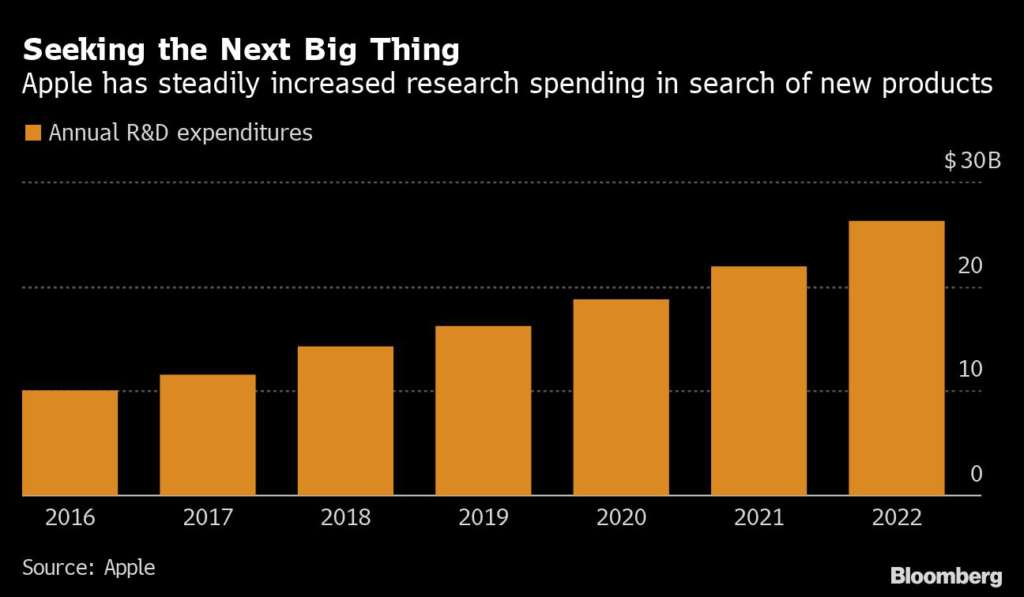
Apple’s fourth-quarter report confirmed that its research-and-development budget isn’t getting squeezed. R&D spending rose 20% in fiscal 2022, compared with a 17% gain in the prior year. The company continues to work on future augmented- and virtual-reality products, as well as an autonomous vehicle. 

Apple said in a filing alongside its earnings report that the growth in R&D spending was “driven primarily by increases in headcount-related expenses and engineering program costs.” Total operating expenses increased 17%.

The job slowdown goes well beyond Apple. Amazon.com Inc. said on Thursday that it has halted hiring of corporate employees due to an “uncertain” economy. Lyft Inc., Chime Financial Inc. and Stripe Inc. are cutting jobs as well, while Twitter Inc. is bracing for layoffs following Elon Musk’s takeover. 

(Updates with chart after fourth paragraph and updates shares in sixth paragraph.)

More stories like this are available on bloomberg.com

©2022 Bloomberg L.P.

This Chinese EV Startup Wants to Save You From Having a Heart Attack

(Bloomberg) — A new Chinese electric vehicle startup is touting its ability to monitor drivers’ health for serious incidents like a heart attack to help stand out in an increasingly crowded market. 

BeyonCa, led by Renault SA’s China head Soh Weiming, aims to unveil its first production car in the first quarter of next year, with deliveries to start in 2024. The GT Opus 1 will be priced to compete with BMW AG’s 7 Series and Porsche AG’s Taycan series, China’s top-selling super-premium EV — which starts at 898,000 yuan ($123,000) and goes up to 1.8 million yuan.

The car will be fitted with sensors and cameras that can monitor the driver’s vital signs. If abnormal symptoms are detected, an artificial intelligence assistant kicks in to speak to the driver. If there’s no response, the autonomous driving system takes over and shepherds the vehicle to safety. Virtual doctors can check in on the patient via the screen of the smart cockpit.

“If we’re able to save one life, that’s enough,” Soh said in an interview with Bloomberg Television. “We’re not making an ambulance here. We’re making a premium car that contains smart AI to help people.”   

After more than 15 years at VW China, Soh joined Renault last year, splitting his time b

etween running the European carmaker’s local unit and building his new venture — one that Renault is also a strategic investor in, alongside Dongfeng Motor Group Co. 

The startup has gathered a range of investors including a commitment of more than $1 billion from Changjiang Capital, according to 36kr, which would make it one of the largest venture-capital deals in the country this year. Soh said the startup is still working on the details of the deal. 

Flush with cash, BeyonCa wants to build “sporty, sexy cars” for China’s super-premium segment, Soh said. The company is aiming for a lineup of three to five models with production of around 100,000 units a year. 

China “is probably the largest premium market in the world. Definitely. This is not even a question. We’re talking about millions, not hundreds,” he said. “Super-premium electric vehicles will grow on a S curve and the S curve will take off somewhere around 2025.” 

Still, the hefty sticker price could make the Opus 1 a tough sell in China, where more budget friendly cars from the likes of BYD Co. are leading the way, especially among younger drivers. 

“It’s a nice humane concept, but my biggest question is whether this can become a major unique selling point for the car,” said Yale Zhang, managing director of Shanghai-based consultancy Automotive Foresight. “Chinese EV owners are generally younger than 35 years old. Most around this age think their bodies are great and might not be too concerned about health.”

More stories like this are available on bloomberg.com

©2022 Bloomberg L.P.

Globe Telecom CEO Sees Stock Trade, Loans as Next Profit Source

(Bloomberg) — Philippine-based Globe Telecom Inc. is pursuing mobile stock trading and lending to unserved consumers as growth from its traditional business tapers off, President Ernest Cu said.

Globe, which counts Singapore Telecommunications Ltd. and Filipino conglomerate Ayala Corp. as its largest shareholders, is building its lending business through its GCash platform which already has a loan portfolio of 40 billion pesos ($680 million).

“We’re trying to broaden access to loans and lending to a sector that normally would go to the informal one, where interest rates are very high,” Cu said in an interview with Bloomberg TV’s Haslinda Amin. 

Globe and the Philippine Stock Exchange will this month introduce a mobile stock trading service, aimed at expanding the local equity market’s retail investors base. Cu expects its take-up to be as “tremendous” as the other financial services that’s been added to GCash. 

“When banks asked us to acquire deposit accounts for them as a channel, hundreds of thousands come in, something that’s never been seen before,” Cu said. “I presume it will be in the millions. Hopefully, it will even double what’s going on at the exchange today or even triple. But that being said it will be a smaller amount of money.”

Like its peers worldwide, the biggest challenge facing Globe is growth, which is tapering off as traditional mobile service has matured, Cu said. The company will reduce its capital spending expenditure and continue “deleveraging” in 2023, he said.

“It’s very rare in industries around the world to find businesses with 50% margin and we continue to maintain that and that provides us the base and capital to build the GCash of the world,” Cu said.

–With assistance from Anand Menon and Sabrina Mao.

More stories like this are available on bloomberg.com

©2022 Bloomberg L.P.

Expedia Gains as CEO Sees Strong Demand Overcoming Summer Slump

(Bloomberg) — Expedia Group Inc. gained in after-hours trading after the company said strong demand for the rest of the year and into 2023 can counter a hit to bookings from an industry-wide slowdown in July that was exacerbated by hurricanes late in the season. 

“We have not seen trade downs or major moves or shifts in demand patterns,” Expedia Chief Executive Officer Peter Kern said on a call with analysts Thursday. “Putting the hurricane aside, it’s really been a very steady and very strong demand picture.”

Expedia shares were about 1.5% higher in extended trading in New York, after dropping about 7% on a third-quarter earnings report after the market close that partly missed analyst forecasts. Executives also announced that they would continue share repurchases. 

The Seattle-based company on Thursday said gross bookings, the total value of transactions booked adjusted for cancellations and refunds, rose 28% to $23.99 billion, missing the average analyst estimate of $25.1 billion. Kern said that the measure dropped 1% in July, but rebounded in August only to take a hit in September and October due to hurricanes. The company reported 93.2 million room nights in the third quarter, compared with an analyst estimate for 98.7 million.

However, Expedia also said that revenue rose 22% to a record $3.62 billion for the quarter. That just beat the average analyst projection of $3.61 billion. The report strengthens the picture of recovery in some parts of the travel industry, after Airbnb Inc. and Booking Holdings Inc., also reported quarterly revenue records earlier this week. Booking also sees gains continuing in the current quarter, and forecast room nights booked in October will beat 2019’s levels by 12%.  

Investors have punished all three companies this year as the macroeconomic outlook darkens. Shares of Expedia have sunk more than 50%, while rivals Booking and Airbnb have declined around 24% and 45%, respectively. Airbnb shares had their biggest drop Wednesday since they started trading in 2020 after the company missed analysts’ estimates on nights booked, and warned the pace of bookings would “moderate slightly” in the current period.

Executives are nevertheless upbeat about the state of travel. Booking consumers aren’t trading down or changing their preferences, CEO Glenn Fogel said Wednesday. Airbnb CEO Brian Chesky said the state of the economy won’t change how the business is run, saying he’s confident about the fourth quarter. 

Expedia reported adjusted earnings before interest, taxes, depreciation and amortization of $1.08 billion, compared with the estimate of $1.06 billion. Adjusted earnings per share came in at $4.05, compared with the estimate of $4.07.

More stories like this are available on bloomberg.com

©2022 Bloomberg L.P.

Manchin Tells CEOs to Stop Rewarding Bad Behavior With Campaign Checks

(Bloomberg) — West Virginia Senator Joe Manchin told a gathering of corporate leaders they’re rewarding “bad behavior” by sending campaign checks to politicians based on party or ideology and not asking how they’ll benefit.

“Quit writing checks to everybody,” Manchin said at a Fortune CEO conference. “The investments you’ve made in politics from the Democrat side, and the Republican side, by asking nothing in return, is a foolish investment.” 

Responding to a question about what the business community can do to better engage with a “dysfunctional” political system, Manchin, a Democrat, said the executives “are supporting bad behavior” by giving to politicians without asking questions. 

He said executives would never spend money without asking for a return in the business world or in their private lives, and he gave them a primer on how to talk to politicians.

“Say, ‘listen, I’m sorry. I don’t give checks. I don’t give a donation or contribution to any politician. But I’m willing to make an investment,” Manchin told the CEOs in attendance. “What should I expect from you? What are you going to do? What have you done in your political life, and what will you do if this is your first time? Tell me so I can make a decision on whether I want to invest in you, because I can expect something in return.’”

He said small dollar donors are rewarding bad behavior as well, contributing to dysfunction in Washington.

Manchin’s spokeswoman, Sam Runyon, said later that the senator wasn’t suggesting that donors should expect a quid pro quo for contributions.

“He has long advocated for increased transparency in campaign finances and has repeatedly made the point that both voters and donors should hold elected officials accountable when they simply obstruct progress instead of looking for lasting, bipartisan solutions that put our country ahead of partisan politics,” Runyon said in an email.

Though he doesn’t face voters until 2024 and hasn’t decided whether to run, Manchin has raised $8.7 million in the current, two-year election cycle, more than he did for his 2018 reelection campaign. The surge in donations includes more than $800,000 from donors who listed their occupation as CEO, including Marc Rowan of Apollo Global Management Inc., Laurence Fink of BlackRock Inc. and Samuel Bankman-Fried of FTX Cryptocurrency Derivatives Exchange.

–With assistance from Bill Allison.

More stories like this are available on bloomberg.com

©2022 Bloomberg L.P.
Coinbase CFO Sees Risk of ‘Sustained’ Revenue Hit in Crypto Rout

(Bloomberg) — Coinbase Global Inc., the biggest exchange for cryptocurrencies, doesn’t expect the industry to rebound swiftly from the trading slump that’s battered its revenue. 

“We are preparing for 2023 with a more conservative bias with more headwinds,” Alesia Haas, Coinbase’s chief financial officer, said in an interview. “We are preparing and we are developing plans that we will be more conservative next year. These headwinds could persist or possibly intensify.”

The market value of outstanding cryptocurrencies has plunged by more than half this year as the Federal Reserve raised interest rates, pulling back the flood of pandemic-era stimulus that fueled a steep run up in the price of risky assets. Investors’ interest in speculating in the tokens has dimmed since prices tumbled sharply from their peak, slashing Coinbase’s revenue to $590.3 million in the third quarter, less than half what it was a year earlier.

“Sustained low revenue for multiple years, I think that’s a scenario that’s very probable,” Haas said.

To prepare, Coinbase has been slashing costs, with third-quarter headcount coming in below second quarter as it stopped filing vacant positions. 

More stories like this are available on bloomberg.com

©2022 Bloomberg L.P.

Coinbase Posts a Loss as Revenue Declines More Than Forecast

(Bloomberg) — Coinbase Global Inc. reported a narrower third-quarter loss as the largest US crypto exchange reigned in expenses while bracing for potentially intensifying “macro headwinds” going into next year. 

Revenue tumbled 55% to $590.3 million, missing the $649.2 million estimate from analysts polled by Bloomberg. It was the third consecutive quarterly decline. Monthly transacting users dropped to 8.5 million, down from 9 million in the prior quarter, but beating estimate of 7.8 million. Trading volume fell to $159 billion, missing estimates. The net loss narrowed to $545 million from $1.1 billion in the prior quarter. 

“Sustained low revenue for multiple years — that’s a scenario that’s very probable,” Chief Financial Officer Alesia Haas said in an interview with Bloomberg News. 

Coinbase is “preparing for 2023 with a conservative bias and assuming that the current macroeconomic headwinds will persist and possibly intensify,” the company said in a shareholder letter. Shares of Coinbase initially rose as much as 9% in US post-market trading, before paring the gain by about half. They’ve declined 78% this year as the prices of most cryptocurrencies tumbled in what has become known as the crypto winter.

Helped by rising interest rate environment, interest income jumped to $101.8 million from $32.5 million in the prior quarter. 

“We already know trading volume is weak and will be weak in the near term,” said Owen Lau, analyst at Oppenheimer. But with “high interest rate, as well as expense control, losses are shrinking. If they continue to manage expenses, they should be able to further shrink the loss in the fourth quarter,” he said. 

To weather the crypto market downturn, Coinbase has cut staff, formed partnerships with the likes of BlackRock and reduced its venture-capital investments and acquisition activity. 

While plagued by market-share losses through much of this year, Coinbase regained some market share in October, partly as a result of making its rates more attractive to large institutional traders, according to CryptoCompare.

Coinbase said in May that the US Securities and Exchange Commission sent a voluntary request for information on its listings and listing process, and it does not yet know if this inquiry will become a formal investigation. It’s under scrutiny by the SEC for potentially making unregistered securities available for trading, Bloomberg previously reported.

Read More: Coinbase Chief Product Officer Steps Down During Reorganization

(Adds comments from the chief financial officer and an analyst.)

More stories like this are available on bloomberg.com

©2022 Bloomberg L.P.

PayPal Sees Slowdown in Spending Crimping Annual Revenue

(Bloomberg) — PayPal Holdings Inc. trimmed its forecast for annual revenue amid a slowdown in spending growth on its platform. The shares fell as much as 14%.

Payments volume on PayPal’s platforms jumped 14% to $337 billion in the third quarter, missing the $343.2 billion average estimates from analysts. PayPal said it now expects revenue for the year to jump 10% to $27.5 billion, compared with an earlier forecast of $27.85 billion.  

“Clearly, you’re seeing discretionary spending under pressure as people spend more and more of their disposable income on gas, food and rent,” Chief Executive Officer Dan Schulman said Thursday in an interview.  

Schulman is battling a slowdown in growth in spending on PayPal’s many platforms, spurred by the reopening of the US economy in the aftermath of the pandemic as well as once-in-a-generation levels of inflation.

The shares recovered some of their earlier losses after PayPal announced a deal with Apple Inc. The stock was down about 6.7% at 4:44 p.m. in extended New York trading.

In response, the company has vowed to reduce expenses — including through job cuts and the shuttering of offices across the country — which it has said will result in $900 million in savings this year and $1.3 billion next year. Schulman has been vocal about his plans to improve operating leverage, or the ability to grow revenue faster than expenses.  

Costs for the third quarter climbed to $5.73 billion, well under the $5.92 billion average estimate of 9 analysts surveyed by Bloomberg. The company now expects the push to shave expenses will buoy adjusted profit for the year even as it trimmed its forecast for annual revenue. 

“We delivered strong third-quarter results,” Schulman said in a statement announcing the results. “We will continue to invest against our key priorities to advance our leading position in digital payments and commerce.”

Revenue during the quarter jumped 12% to $6.85 billion. That was ahead of the $6.81 billion analysts predicted and PayPal said it now expects adjusted profit to be as high as $4.09 a share, up from the $3.87 to $3.97 it previously expected. 

PayPal this year has revamped its marketing to focus on encouraging existing users to become even more active rather than adding new customers who might not be heavy users of the platform. Those efforts seem to be bearing fruit: Transactions per active account soared 13% to 50.1 in the quarter. 

“We continue to execute on our strategy to deliver long-term, profitable growth,” acting Chief Financial Officer Gabrielle Rabinovitch said in the statement. “Our strong third quarter results reflect both the diversification of our business and our ongoing focus on operating discipline.”

More stories like this are available on bloomberg.com

©2022 Bloomberg L.P.

Block Shares Climb on Earnings Beat, Cash App’s Growth

(Bloomberg) — Block Inc., the digital payments firm formerly known as Square, reported gross profit for the third quarter that exceeded analysts’ expectations, boosted by an increase in business from retailers and restaurants using its sales products. Shares climbed more than 17% in after-hours trading.

In the third quarter, gross profit, the company’s profit before subtracting some costs like product development and marketing, was $1.57 billion, an increase of 38% over last year and better than the $1.52 billion analysts were projecting.

Cash App, Block’s consumer app for sending money to friends or buying stocks and cryptocurrencies, also reported gross profit up 51%. The company said it had its highest quarterly cash in-flow ever, meaning more people are depositing money into their Cash App accounts.

The app now has 49 million monthly active users, up from 47 million last quarter.

Block, which is run by Twitter co-founder Jack Dorsey, traded as high as $63.61 after closing at $53.91. The shares have slipped 67% so far this year.

More stories like this are available on bloomberg.com

©2022 Bloomberg L.P.

Close Bitnami banner
Bitnami
