Bloomberg

Peloton’s 90% Crash Is Just the Latest Spiral for Former Market Winners

(Bloomberg) — Peloton Interactive Inc.’s miserable year has sent its shares spiraling by roughly 90% over the last 12 months. But it’s hardly alone as a former market darling that is now plunging.

The fitness company is one of 45 members of the Russell 3000 Index to lose roughly 90% or more of their value in the past year, Carvana Co. and Redfin Corp. among them. Companies that thrived during Covid lockdowns, those that went public via SPAC merger and firms favored by ARK’s Cathie Wood have all taken their lumps. Combined, the group’s market value has plummeted by $174 billion to below $15 billion.

Peloton sold off early Thursday before erasing losses to climb to a six-week high despite delivering a weaker forecast for the current quarter than Wall Street was predicting. The lackluster outlook was “raising more concern about the normalization of demand for home fitness,” according to Bloomberg Intelligence analyst Geetha Ranganathan.

The issues are widespread for a cluster of companies that range from money-losing Bitcoin miner Core Scientific Inc. to fintech firm Upstart Holdings Inc., which actually generates a profit. To be fair the pain is global and has hit companies of all sizes, though not as violently as former pandemic winners and retail trader favorites. 

The benchmark S&P 500 has slumped 20% over the past year while the tech-heavy Nasdaq 100 has erased one-third of its value over the same stretch. Tech bellwethers like Meta Platforms Inc. and Amazon.com Inc. are down more than 45% in that time.

–With assistance from Tom Contiliano.

(Updates share movement throughout.)

More stories like this are available on bloomberg.com

©2022 Bloomberg L.P.

Amazon Stock Mired in Longest Slump in Years Has No ‘Quick Fix’

(Bloomberg) — Amazon.com Inc. is struggling to recover from lackluster results last week, leaving it a touch away from the longest streak of daily losses in more than three years.

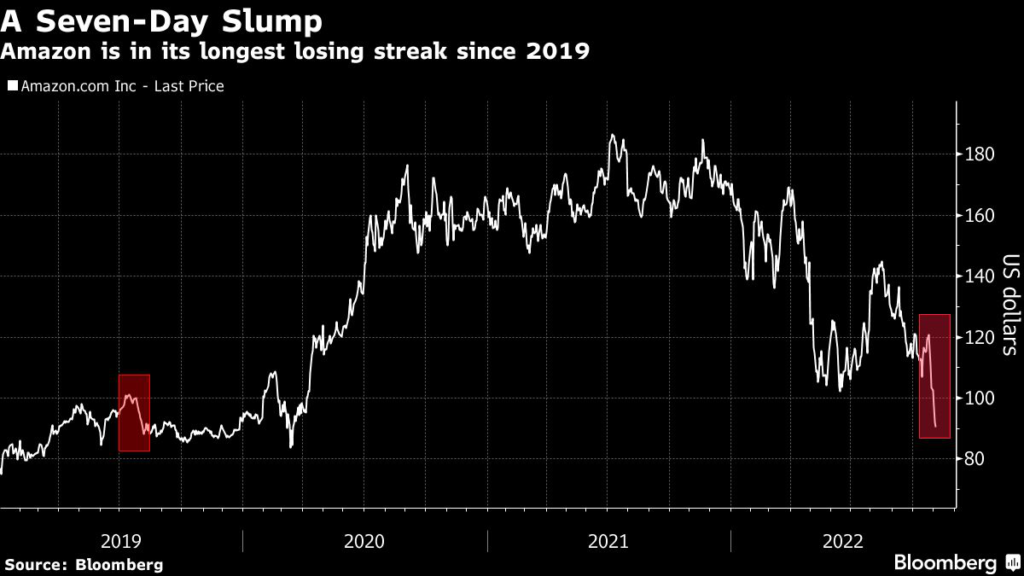
The e-commerce and cloud-computing giant’s shares are lagging behind most of its megacap peers and the market overall this year. Shares fell 3.1% on Thursday in their seventh straight daily decline, the longest such streak for the stock since an eight-day rout that ended in August 2019. The Nasdaq 100 Index fell 2% on Thursday.

The stock has lost a quarter of its value over the seven-day drop, with nearly $320 billion in market capitalization erased as it declines to its lowest level since March 2020.

“I feel like it’s just now that people are really starting to question the bull thesis on Amazon,” said Stefan Slowinski, an analyst at BNP Paribas Exane who is the only analyst tracked by Bloomberg who recommends selling. He sees no “quick fix” for the stock and cited the company’s Amazon Web Services cloud business as a particular concern.

Yet, even as its earnings multiple plummets to 2010 levels, investors are still finding the price tag hard to justify given it projected the slowest holiday-quarter growth in its history and it reported muted growth in its cloud business.

While technology and internet stocks have come under broad pressure this year, as aggressive moves by the Federal Reserve to combat inflation weighs on multiples, Amazon has stood out as an underperformer.  

“I don’t think anything is broken at Amazon, but the valuation is on the high side and its growth is modestly less impressive than it has been,” said Tim Ghriskey, senior portfolio strategist at Ingalls & Snyder, who has been trimming his position in the stock.

What’s more, Amazon said on Thursday it’s pausing “new incremental” hiring across its corporate workforce as the world’s largest online retailer prepares to weather a slower economy. 

Still, the stock remains a favorite among retail investors, who poured into the shares following its results last week. It is also a near-unanimous favorite among the analysts covering the stock. 

“Stocks rarely bottom when there’s only one seller in the market,” added Slowinski. “And so, it’s hard to see that happening now before you get more capitulation.”

–With assistance from Tom Contiliano and Subrat Patnaik.

(Updates to market close.)

More stories like this are available on bloomberg.com

©2022 Bloomberg L.P.

Stocks Sink as Hawkish Bets Revive Recession Fears: Markets Wrap

(Bloomberg) — Stocks sank before Friday’s jobs data amid concern that a deeper recession could be in store with the Federal Reserve expected to hold rates at a higher level for longer to tame inflation.

The S&P 500 saw its fourth straight decline, dragged down by big tech as Treasury yields climbed. Apple Inc. tumbled over 4% and Amazon.com Inc. suffered its longest slide since 2019. A key segment of the Treasury curve reached new extremes of inversion, touching a level not seen since the 1980s when the Fed was aggressively tightening. Curve inversions have a track record of preceding economic downturns.

Swaps that reference future Fed meetings indicate an expected peak rate above 5.1% around mid-2023. Estimates briefly dropped below 5% on Wednesday. The benchmark rate currently sits in a range of 3.75% to 4%.

“Remember, ‘lower for longer’ in 2021 in terms of the interest rate environment?,” wrote Matt Maley, chief market strategist at Miller Tabak + Co. “Well, now we have ‘higher for longer’… as well as ‘slower but higher.’ A rise in short-term rates might take longer to play out, but they’re headed for a higher level than the markets have been thinking.”

Read: Deeper US Recession Looms as Resilient Labor Market Spurs Fed

While projections show October payroll growth moderated to 198,000, such an increase would still be higher than a monthly pace shy of 100,000 that economists reckon is neither too strong nor too weak for the economy over the longer term. Applications for unemployment insurance hovered around historically low levels, reinforcing what Fed Chair Jerome Powell described as an “overheated” jobs market.

Markets are rightly more concerned with the ultimate level of rates rather than the pace of tightening, according to Mark Haefele, chief investment officer at UBS Global Wealth Management — who doesn’t believe the conditions are in place for a sustained stock rally.

“The Fed, along with other major central banks, looks likely to keep tightening rates until the first quarter of 2023,” Haefele noted. “Economic growth will likely continue to slow into the start of the new year, and global financial markets are vulnerable to stress while monetary policy continues to tighten. Such headwinds have yet to be fully reflected in earnings estimates or equity valuations.”

The pound slumped as the Bank of England told investors to rein in expectations for hikes.

European Central Bank President Christine Lagarde warned that a “mild recession” is possible, but that it wouldn’t be sufficient in itself to stem soaring prices. The comments are part of a raft of public appearances by ECB officials, as investors and analysts ponder the twin challenges of record price growth and a likely economic downturn, due largely to Russia’s invasion of Ukraine.

In corporate news, Peloton Interactive Inc. delivered a weaker estimate for the current quarter than Wall Street was predicting, even as management declared that it was beating its own timeline for turning around the fitness company. Moderna Inc. earnings offered a preview into the future of Covid-19 vaccine sales, and so far it doesn’t look pretty. Qualcomm Inc., the biggest maker of smartphone processors, gave a weaker forecast than expected.

Read: US Probes Insider Trading in Prearranged Executive Stock Sales

Key events this week:

  • US nonfarm payrolls, unemployment, Friday

Some of the main moves in markets:

Stocks

  • The S&P 500 fell 1.1% as of 4 p.m. New York time
  • The Nasdaq 100 fell 2%
  • The Dow Jones Industrial Average fell 0.5%
  • The MSCI World index fell 1.3%

Currencies

  • The Bloomberg Dollar Spot Index rose 0.6%
  • The euro fell 0.7% to $0.9750
  • The British pound fell 2% to $1.1163
  • The Japanese yen fell 0.2% to 148.23 per dollar

Cryptocurrencies

  • Bitcoin rose 0.4% to $20,259.51
  • Ether rose 2.1% to $1,543.45

Bonds

  • The yield on 10-year Treasuries advanced four basis points to 4.14%
  • Germany’s 10-year yield advanced 10 basis points to 2.25%
  • Britain’s 10-year yield advanced 12 basis points to 3.52%

Commodities

  • West Texas Intermediate crude fell 2.1% to $88.09 a barrel
  • Gold futures fell 1% to $1,633.40 an ounce

–With assistance from Vildana Hajric and Isabelle Lee.

More stories like this are available on bloomberg.com

©2022 Bloomberg L.P.

Quebecor Looks to Expand in Canada, With Freedom Mobile or Not

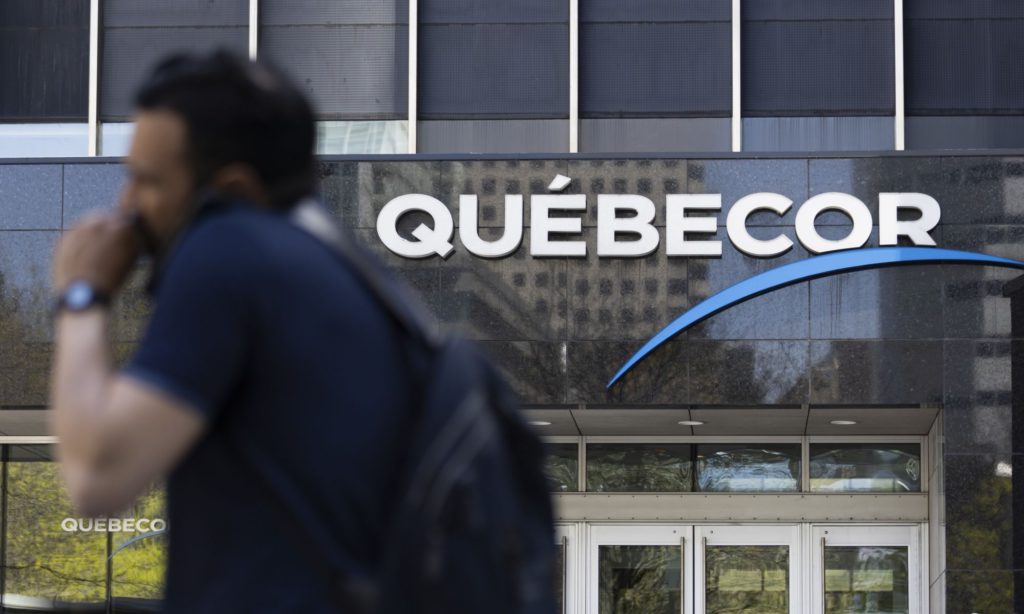
(Bloomberg) — The head of Quebecor Inc. says the company needs to expand outside its home market of Quebec, regardless of what regulators decide about its proposed acquisition of wireless assets from Shaw Communications Inc. 

Montreal-based Quebecor is trying to buy Shaw’s Freedom Mobile division, which has more than 2 million customers in Ontario and Canada’s western provinces. The deal is meant to help resolve antitrust concerns around the C$20 billion ($14.6 billion) takeover of Shaw by Rogers Communications Inc. 

But the federal Competition Bureau is still trying to stop the Rogers-Shaw deal, arguing that Freedom will be a weakened competitor under new ownership. The country’s merger court will begin hearings on the case next week. If the Rogers acquisition of Shaw is denied, Quebecor’s purchase of Freedom Mobile wouldn’t go ahead. 

“We strongly believe we need to go elsewhere, where the competition is lower and for which we believe that we’ll be able to get a significant market share,” Quebecor Chief Executive Officer Pierre Karl Peladeau told analysts Thursday. 

That could include Quebecor launching service in some regions of Canada as a mobile virtual network operator, or MVNO — a wireless provider that leases other companies’ networks at wholesale prices.   

Peladeau noted that Quebec, Canada’s second-largest province, is a relatively mature market that’s likely to have lower population growth in the years ahead because it has a more restrictive immigration policy than other parts of Canada. 

Last summer, Quebecor bought the Toronto-based VMedia, a small internet and television provider. That potentially gives the company the ability to offer a bundle of wireless and wireline services, such as home internet, to consumers outside of Quebec, Peladeau said. 

Quebecor could start the business “very quickly,” as it has “the capacity to work very closely” with equipment suppliers including Samsung, Ericsson and Nokia, he said. 

The company’s shares were flat in Toronto trading after it reported adjusted earnings of 75 Canadian cents per share for the third quarter, slightly beating Bloomberg’s consensus estimates. 

More stories like this are available on bloomberg.com

©2022 Bloomberg L.P.

GOP Rift With Chamber of Commerce Widens Over Group’s Leadership

(Bloomberg) — A rift between the Republican Party and its chief ally in the business world, the US Chamber of Commerce, is growing wider as the GOP eyes taking control of the House and the Senate after next week’s midterm election.

House Republican leader Kevin McCarthy, who is poised to become speaker if the GOP wins a House majority, has told members of the Chamber’s board that he has deep concerns about the organization’s leadership when they’ve asked him how to rebuild its credibility and repair what has become a tense relationship, according to a person familiar with the conversations.

Axios reported on Wednesday — citing unnamed sources — that McCarthy has gone further, telling Chamber members and its state leaders that the organization must replace its chief executive officer, Suzanne Clark, if Republicans win a House majority and he becomes speaker.

The Axios report ignited a swift statement of “complete support” for Clark from Mark Ordan, chairman of the chamber’s board of directors. The board’s executive committee is “unequivocally enthusiastic about Suzanne’s performance and the importance of her ongoing tenure as CEO of the US Chamber,” he said. 

McCarthy’s office didn’t respond to requests for comment.

Tension between the GOP and the powerful business lobby, long considered a reliable ally of Republicans and their causes, has been growing as the Chamber pushed back against former President Donald Trump’s stances on trade and immigration policy.

It was exacerbated after the Chamber, in a departure from the past, endorsed 23 House Democrats for re-election in 2020 over Republican challengers. The Chamber also is backing a handful of Democrats in 2022. On Thursday, US Chamber Vice President Moore Hallmark appeared with Democratic Representative Abigail Spanberger, who is in a close contest for re-election in Virginia against Republican Yesli Vega.

Hallmark defended the Chamber’s endorsement of some Democrats in the midterm elections, saying it’s long been a bipartisan organization.

“Our goal in this election cycle and every election cycle has been to grow the number of pro-business, pro-Chamber members of Congress who have a willingness to work across the aisle,” he said. “We will continue to do so.”

Hallmark cited Spanberger’s support for two top Chamber priorities in the current Congress: the bipartisan infrastructure act and semiconductor manufacturing subsidies.

The rift with the Chamber is part of wider tension between Republicans and the business community. Some Republican officeholders have vowed retaliation against companies that temporarily suspended political contributions to Republican members of Congress who objected to certification of Electoral College votes after the 2020 presidential election. There also has been a growing GOP backlash against companies adopting Environmental, Social and Governance, or ESG, policies.

An upstart business trade group, the American Free Enterprise Chamber of Commerce, bills itself as an alternative to the US Chamber of Commerce and as the voice for businesses, especially smaller firms, confronting “woke capital” and “cancel culture.”

McCarthy and other House Republican leaders have been signaling dismay with the Chamber and a desire for a change in direction for some time. One House GOP official familiar with the tensions described frequent frustration by McCarthy and other Republicans, and said that the chamber’s members should be aware of how ineffective the organization will be with a Republican House majority, if changes aren’t made.

In a January interview with the right-wing website Breitbart, McCarthy said the Chamber has lost its influence with Republicans. “The Chamber left the party a long time ago,” he said.

David McIntosh, president of the anti-tax group Club for Growth, said he wouldn’t tell another group how to organize itself but that the Chamber “would be wise to take a long look” at what McCarthy is saying if it wants to work with GOP in Congress because the leaders have gotten away from the Chamber’s principles.

“Honestly, I think the US Chamber has lost its way, that it no longer represents free enterprise,” McIntosh told reporters on a conference call Thursday. “It’s kind of sold out to Washington interests.”

–With assistance from Emily Birnbaum.

(Updates with comment from chamber official in seventh-ninth paragraphs)

More stories like this are available on bloomberg.com

©2022 Bloomberg L.P.

Blockchain Platform Cosmos Bets Its Future on a New Whitepaper

(Bloomberg) — Supporters of the Cosmos blockchain are betting a revamp of the popular crypto protocol will boost the value of its native token amid the current digital-asset bear market. 

A vote went live on Oct. 31 for a new “white paper” that will give a new look to the Cosmos Hub, a blockchain creation platform underlying a number of high-profile blockchains. While Cosmos is not as widely known as rivals such as Ethereum, Solana or Avalanche, a number of popular projects were built on Cosmos system including the infamous Terra blockchain, which collapsed in May. Decentralized derivatives exchange dYdX, which is currently based on Ethereum, announced in June that it will build its own blockchain based on the Cosmos system. 

“We are one of the most exciting ecosystems in crypto,” but one of the “least exciting tokens from crypto,” said Zaki Manian, co-author of the new white paper, or a document that explains the technology and purpose of the project. “The goal of Atom 2.0 is really to change this by making Atom exciting again.”

Atom was trading at about $13.72, according to price data from CoinMarketCap. It traded at more than $40 in January.

Similar to the newly upgraded Ethereum blockchain, Cosmos Hub uses Proof-of-Stake mechanism to verify transactions, meaning that users, or so-called validators, can put up their Atom tokens to secure the network. But chains building in Cosmos often choose to use their own tokens to pay transaction fees and secure the networks, instead of using Atom. As a result, Atom tokens have mostly failed to capture the value of Cosmos’ success. The new white paper could change that by making Atom the preferred asset used across the Cosmos system. For example, new chains in the Cosmos system could borrow Atom validators to secure their blockchains and verify transactions.

The new white paper also includes a proposal to reduce the total amount of Atom tokens and reduce the so-called inflation rate, or pace of issuance of new tokens.

Despite strong support from the community, based on the current vote, there’s been some pushback from the Cosmos community including the founder, Jae Kwon. Sunny Aggarwal, co-founder of Osmosis Labs, pointed out that Cosmos has become popular because it is “incredibly neutral.”

“There’s no token or chain at the center,” Aggarwal wrote on Twitter. “When you build in any other ecosystem, you’re just driving value to someone else token…In Cosmos, the network effects aren’t captured by any one token. The collective wins.”

But others argue that despite the risks, changes are necessarily needed, as the decentralized finance sector moves forward.

“Detractors say Atom 2.0 is risky, and they are right,” digital-asset firm Delphi Digital wrote in a research paper. “This is the riskiest thing the Hub has done in its existence. But you could argue the biggest risk to the Hub is doing nothing, for it will become irrelevant and passed by anyway.”

More stories like this are available on bloomberg.com

©2022 Bloomberg L.P.

From Amazon’s Freeze to Lyft’s Layoffs, Tech Firms Brace for Tough Times

(Bloomberg) — Tech companies are once again tapping the brakes on hiring as they contend with sluggish consumer spending, higher interest rates and the impact of a strong dollar overseas. 

Amazon.com Inc. said Thursday that it would pause adding new corporate workers, citing an “uncertain” economy and its hiring boom in recent years. Lyft Inc., the ride-hailing company, is going further: It will eliminate 13% of staff, or around 683 people.

Twitter Inc.’s cutbacks are under particular scrutiny as new owner Elon Musk shakes up the social-networking business and pares roughly half its jobs.

Tech companies made moves earlier this year to rein in costs, with many of the industry’s biggest firms freezing hiring or cutting some departments. Even Apple Inc., which has outperformed most of its peers this year, is slowing spending. But some tech giants are finding that they now need to take more dramatic steps to trim their expenses.

More broadly, Challenger, Gray & Christmas said Thursday that job-cut announcements were up 48% year-over-year in October, with more layoffs “on the way.” A federal jobs report on Friday will give a clearer picture of US hiring trends. Even with the austerity, economists expect a net gain of 200,000 for non-farm payrolls.

Here are some of the latest companies to tighten their belts:

Amazon

The e-commerce titan halted “new incremental” hiring across its corporate workforce — a decision Chief Executive Officer Andy Jassy and his team made this week. “We anticipate keeping this pause in place for the next few months, and will continue to monitor what we’re seeing in the economy and the business to adjust as we think makes sense,” according to Beth Galetti, Amazon’s top human resources executive. 

Chime

The digital-banking startup Chime Financial Inc. is cutting 12% of its staff, or 160 people. A spokesperson said the company remains well-capitalized and the move will position it for “sustained success.”

Digital Currency Group

Cryptocurrency conglomerate Digital Currency Group embarked on a restructuring last month that saw about 10 employees exit the company. As part of the shake-up, Mark Murphy was promoted to president from chief operating officer.

Galaxy Digital

Galaxy Digital Holdings Ltd., the crypto financial services firm founded by billionaire Michael Novogratz, is considering eliminating as much as 20% of its workforce. The plan may still be changed and the final number could be in a range of 15% to 20%, according to people familiar with the matter. Galaxy’s shares have plummeted 70% this year, part of a rout for cryptocurrencies.

Intel

Intel Corp. is cutting jobs and slowing spending on new plants in an effort to save $3 billion next year, the chipmaker said last week. The hope is to save as much as $10 billion by 2025, a plan that went over well with investors, who sent the shares up more than 10% on Oct. 28. Bloomberg News reported earlier that the headcount reduction could number in the thousands. 

Lyft

Lyft’s cost-saving efforts include divesting its vehicle service business. The company, which is preparing to report third-quarter results on Monday, had already said it would freeze hiring in the US until at least next year. It’s now facing even stiffer headwinds. 

“We are not immune to the realities of inflation and a slowing economy,” co-founders John Zimmer and Logan Green said in a memo. “We need 2023 to be a period where we can better execute without having to change plans in response to external events — and the tough reality is that today’s actions set us up to do that.”

Seagate

Seagate Technology Holdings Plc, the biggest maker of computer hard drives, said last week that it’s paring about 3,000 jobs. Computer suppliers, including Seagate and Intel, have been hard hit by a slowdown in hardware spending. Customers are sitting on a pile of extra inventory, hurting orders and weighing on Seagate’s financial performance, CEO Dave Mosley said. That necessitated cuts. “We have taken quick and decisive actions to respond to current market conditions and enhance long-term profitability,” he said.

Stripe

Payments company Stripe Inc., one of the world’s most valuable startups, is cutting more than 1,000 jobs. The 14% staff reduction will return its headcount to almost 7,000 — its total in February. Co-founders Patrick and John Collison told staff that they need to trim expenses more broadly as they prepare for “leaner times.”

Twitter

The upheaval at Twitter has more to do with its recent buyout — and the accompanying debt — than economic concerns. But the company is facing the deepest cuts of its peers right now. Musk, who acquired Twitter for $44 billion last month, plans to eliminate about 3,700 jobs, according to people with knowledge of the matter. 

The new owner plans to inform affected staffers Friday, said the people. Musk also intends to reverse the company’s work-from-anywhere policy, asking remaining employees to report to offices.

Upstart

Upstart Holdings Inc., an online lending platform, said in a regulatory filing this week it cut 140 hourly employees “given the challenging economy and reduction in the volume of loans on our platform.”

–With assistance from Edward Harrison, Matt Day, Ed Ludlow, Kurt Wagner, Yueqi Yang, Anna Irrera, Jenny Surane, Vildana Hajric, Muyao Shen, Katie Greifeld and Ian King.

(Updates with entries on Intel and Seagate.)

More stories like this are available on bloomberg.com

©2022 Bloomberg L.P.

Stocks Push Away From Session Lows Before Jobs: Markets Wrap

(Bloomberg) — Stocks trimmed losses before Friday’s jobs data, following a rout driven by fears that a deeper recession could be in store with the Federal Reserve expected to hold rates at a higher level for a longer period to tame inflation.

The S&P 500 pared a slide that topped 1.5% amid gains in industrial and commodity companies, but still headed toward its fourth consecutive decline. Big tech got hit as Treasury yields climbed. Apple Inc. sank 3.5% and Amazon.com Inc. slipped for a seventh straight day, the longest losing streak since August 2019. The pound slumped as the Bank of England told investors to rein in expectations for hikes.

Swaps that reference future Fed meetings indicate an expected peak rate above 5.1% in May and June 2023. Estimates briefly dropped below 5% on Wednesday. The benchmark rate currently sits in a range of 3.75% to 4%.

“From here, a consolidation into tomorrow’s jobs data will define trading in US rates for the time being,” said Ian Lyngen, head of US rates strategy at BMO Capital Markets.

While projections show October payroll growth moderated to 200,000, such an increase would still be higher than a monthly pace shy of 100,000 that economists reckon is neither too strong nor too weak for the economy over the longer term. Applications for unemployment insurance last week fell slightly, hovering around historically low levels. The figures reinforce what Fed Chair Jerome Powell described as an “overheated” jobs market.

Read: Deeper US Recession Looms as Resilient Labor Market Spurs Fed

Markets are rightly more concerned with the ultimate level of rates rather than the pace of tightening, according to Mark Haefele, chief investment officer at UBS Global Wealth Management, who doesn’t believe the conditions are in place for a sustained stock rally.

“The Fed, along with other major central banks, looks likely to keep tightening rates until the first quarter of 2023,” Haefele noted. “Economic growth will likely continue to slow into the start of the new year, and global financial markets are vulnerable to stress while monetary policy continues to tighten. Such headwinds have yet to be fully reflected in earnings estimates or equity valuations.”

European Central Bank President Christine Lagarde warned that a “mild recession” is possible, but that it wouldn’t be sufficient in itself to stem soaring prices. The comments are part of a raft of public appearances by ECB officials, as investors and analysts ponder the twin challenges of record price growth and a likely economic downturn, due largely to Russia’s invasion of Ukraine.

In corporate news, Peloton Interactive Inc. delivered a weaker estimate for the current quarter than Wall Street was predicting, even as management declared that it was beating its own timeline for turning around the fitness company. Moderna Inc. earnings offered a preview into the future of Covid-19 vaccine sales, and so far it doesn’t look pretty. Qualcomm Inc., the biggest maker of smartphone processors, gave a weaker forecast than expected.

Read: US Probes Insider Trading in Prearranged Executive Stock Sales

Key events this week:

  • US nonfarm payrolls, unemployment, Friday

Some of the main moves in markets:

Stocks

  • The S&P 500 fell 0.5% as of 2:25 p.m. New York time
  • The Nasdaq 100 fell 1.2%
  • The Dow Jones Industrial Average was little changed
  • The MSCI World index fell 1%

Currencies

  • The Bloomberg Dollar Spot Index rose 0.7%
  • The euro fell 0.7% to $0.9750
  • The British pound fell 2% to $1.1164
  • The Japanese yen fell 0.3% to 148.27 per dollar

Cryptocurrencies

  • Bitcoin rose 0.3% to $20,238.26
  • Ether rose 2.2% to $1,545.09

Bonds

  • The yield on 10-year Treasuries advanced two basis points to 4.12%
  • Germany’s 10-year yield advanced 10 basis points to 2.25%
  • Britain’s 10-year yield advanced 12 basis points to 3.52%

Commodities

  • West Texas Intermediate crude fell 1.9% to $88.33 a barrel
  • Gold futures fell 1% to $1,632.80 an ounce

–With assistance from Vildana Hajric and Isabelle Lee.

More stories like this are available on bloomberg.com

©2022 Bloomberg L.P.

Canada Orders Three Chinese Firms to Divest From Country’s Lithium Miners

(Bloomberg) — The stocks of three junior lithium explorers tumbled after Canada’s government ordered their Chinese investors to divest under tougher foreign investment rules around the nation’s critical minerals sector.

Shares of Power Metals Corp. sunk as much as 21% on the TSX Venture Exchange in Toronto, its biggest intraday decline since April 2020. Ultra Lithium Inc. fell as much as 25%, while Lithium Chile Inc. slid as much as 10% before recovering. 

The plunge came after Canada’s government said in a Wednesday statement that it ordered three Chinese firms to divest from the trio due to strengthened guidelines to protect the country’s minerals wealth. The decision comes as Canada, the US and their allies are increasingly concerned about China’s dominance of metals that are the building blocks for a global push to transition to cleaner energy sources.

Sinomine (Hong Kong) Rare Metals Resources Co. Ltd. is required to divest in Vancouver-based Power Metals, while Zangge Mining Investment (Chengdu) Co. Ltd. was ordered to divest from Ultra Lithium, also based in Vancouver, and Chengze Lithium International Ltd. was told to exit from Calgary-based Lithium Chile, Canada’s federal government said in Wednesday’s statement.

Canada’s actions caught Lithium Chile “totally by surprise,” Chief Executive Officer Steven Cochrane said Thursday in an interview.

Chinese companies are among the biggest investors in the global lithium industry and banning state-owned firms from financing projects will be felt throughout the industry, he said, adding that there hasn’t been little investment coming from Europe, the US or Canada. Lithium Chile, which has a market value of C$135 million ($98 million), has exploration projects in Argentina and Chile.

“Our sector has often relied on money from China to fuel these projects,” Cochrane said. “So the impact is going to be felt by everybody.”

The move follows updated guidelines from Canada’s government, released Friday, which make it harder for foreign state-owned companies to pursue deals and investments that target critical minerals including lithium, nickel, copper and uranium in the resource-rich country. Transactions by foreign state-owned firms will now only be approved “on an exceptional basis.”

“Though the divestiture order is not likely to affect the business operations of those three Chinese firms in the near term because all three lithium mining projects are still under early-stage exploration status, the latest attitude from Ottawa underscores the global competitions for critical battery minerals,” Susan Zou, senior analyst at RystadEnergy, said in a note to clients.

Sinomine Resource and Zangge Mining said the matter won’t have big impacts on their performance in 2022 and beyond respectively, according to separate filings to Shenzhen stock exchange Thursday. 

Meanwhile, Beijing urged Ottawa to stop “unreasonable suppression” of Chinese enterprises and said Canada’s practice will hurt the stability of the supply chain, state broadcaster CCTV reported, citing Foreign Ministry spokesman Zhao Lijian at a briefing.

Canada’s order against the Chinese investors was made after “rigorous scrutiny” of foreign firms by Canada’s national security and intelligence community, Canadian Industry Minister Francois-Philippe Champagne said in Wednesday’s statement.

“The government’s decisions are based on facts and evidence and on the advice of critical minerals subject matter experts, Canada’s security and intelligence community, and other government partners,” he said.

–With assistance from Annie Lee.

(Adds CEO comment from fifth paragraph)

More stories like this are available on bloomberg.com

©2022 Bloomberg L.P.
Europe’s ‘First’ NFT Vending Machine Gets Cold London Reception

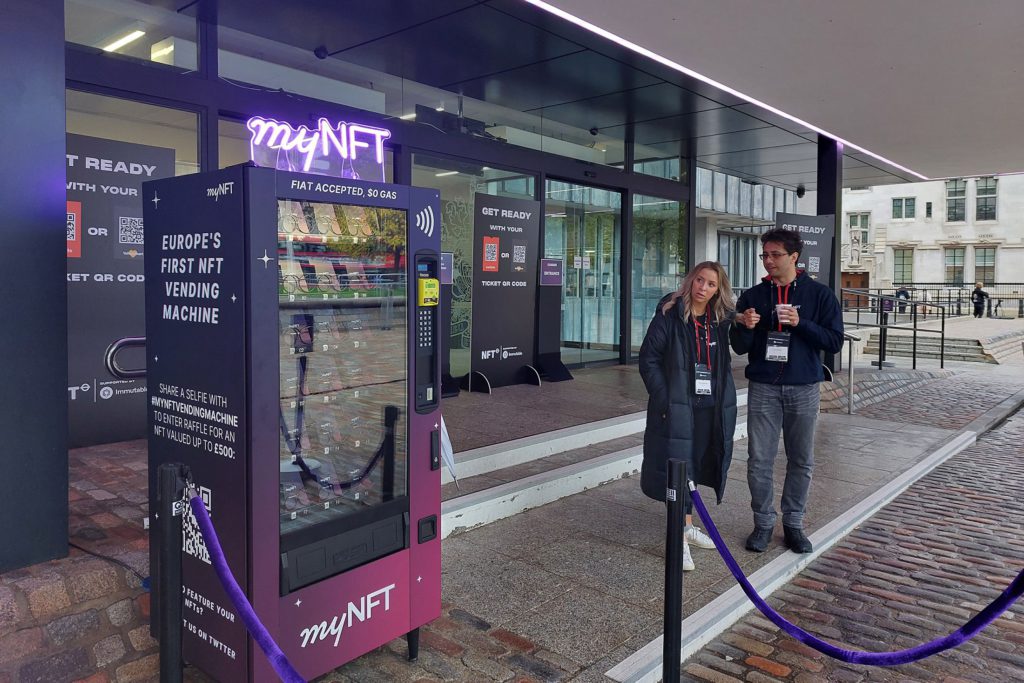
(Bloomberg) — A neon purple vending machine dispensing nonfungible tokens for £10 ($11.18) a pop has materialized in the middle of London, drawing frosty stares from passers-by in the British capital. 

The glowing gadget is the 21st century iteration of the first coin-operated machines seen in the city in the 1880s, doling out postcards. Sited at the Queen Elizabeth II Centre in Westminster, it will be available between Nov. 3-4 for the NFT.London conference, which brings together the local crypto community for debates and workshops. 

Fans have not been put off attending the event even though NFT trading volumes are scraping all-time lows. Trades of the blockchain-based digital art and collectibles have plunged 97% between a record-high seen in January, through September this year. They slid to just $466 million in September from $17 billion at the start of 2022, according to data from Dune Analytics, as investors flee riskier assets amid rate hikes by central banks aimed at curbing inflation. 

The rationale for what is being touted as “Europe’s first NFT vending machine” is that it will help make NFTs more accessible and “eliminate any barriers to entry,” Hugo McDonaugh, the co-founder of myNFT — the venture behind the device — told Bloomberg News. 

The machine accepts contactless payment alongside Apple Pay. Once a fee of £10 has been slotted in, an envelope with a QR code is disbursed, allowing users to then redeem an NFT using the myNFT platform, without the need for a crypto-wallet. 

“There is so much potential in the NFT market and it’s such a shame to see some of that go to waste when possible investors are put off getting involved by various unnecessary and complicated barriers,” McDonaugh said in a statement. “We’re determined to turn NFT investment into an everyday activity, and break it out of its current clique.” 

The NFTs that can be bought through the machine are multichain, meaning that users can hold them on Ethereum, Polygon, BNB Chain, Moonbeam and Moonriver, said McDonaugh. Tokens created by brands like Dr. Who Worlds Apart, Thunderbirds and Delft Blue Night Watch are available for purchase. 

However, the search is still on to find a more permanent home for the machine. “We are looking at a couple of bars,” said McDonaugh.

Proceeds from the NFT sales will go to Giveth and Roald Dahl’s Marvellous Children’s Charity, he added. 

More stories like this are available on bloomberg.com

©2022 Bloomberg L.P.
Close Bitnami banner
Bitnami