Bloomberg

Altice Falls Most Ever in Latest Sign of Cable Industry Woes

(Bloomberg) — Altice USA Inc., the No. 4 US cable-TV provider, fell the most on record following disappointing third-quarter results, with management saying “higher competition” threatens its business and playing down prospects for an imminent buyout of the company.

Shares of the New York-area company fell as much as 37% to $3.94, the biggest intraday drop since the US unit of France’s Altice Europe began trading in 2017.

Cable providers like Altice have been losing TV customers to cord cutting for years. Now their broadband business — providing fast internet access — is under pressure from the sluggish economy and phone companies offering less-expensive options. Altice lost 43,000 broadband subscribers in the quarter, despite expensive investments in fiber to attract new internet customers. 

In the wake of the report, several analysts lowered their ratings, and at least five cut their price targets.

The picture isn’t getting better this quarter, Chairman Dexter Goei said Wednesday on an earnings call.

“We’re still experiencing higher competition in parts of our footprint,” he said. “It’s clear that fixed wireless broadband is taking some of the growth and switchers out of the market.”

Cable giants Comcast Corp. and Charter Communications Inc. reported similar challenges last week. 

Fiber Investments

For Altice, the situation is slightly more complex given the company’s splurge on fiber expansion and capital spending of up to $1.8 billion this year, Bloomberg Intelligence analyst Geetha Ranganathan wrote in a note Wednesday. 

“It will take time to turn the corner,” she wrote.

Another telecom provider, Lumen Technologies Inc., was down sharply Monday after terminating its dividend and announcing a deal to sell its European businesses for $1.8 billion, freeing up funds to invest in the expansion of its US fiber operations.

Read more: Lumen slumps after axing dividend

A potential bright spot for Altice is the ongoing attempt to sell its Suddenlink cable business. Goei said the company could have something to announce soon. Funds from a sale would be used to further its fiber investments.

“We’re getting to a place where the decision’s pretty imminent as to whether or not we’re going to do something,” he said.

On the call, Goei was asked if taking the company private was a possibility. He said there was nothing on the table at the moment, but that could change. Altice is controlled by billionaire Patrick Drahi.

“I’m sure it will be looked at again in the future, as we continue to go through the budget process and going into 2023,” Goei said. “That’s all I could say today, and at some point in the future, maybe there’s a lot more to talk about there.”

(Adds chart after third paragraph.)

More stories like this are available on bloomberg.com

©2022 Bloomberg L.P.

Chinese Rocket Booster Renews Anxiety About Falling Space Debris

(Bloomberg) — A massive Chinese rocket booster is headed for an uncontrolled fall through the atmosphere Friday, sparking concerns that pieces of the giant vehicle could crash to Earth.

It’s the fourth time in two years a large Chinese rocket has headed for an uncontrolled impact and that has many space industry experts crying foul. Both the US and Europe adhere to a rule that any space debris that is disposed of over the Earth must not exceed a one-in-10,000 chance that it will cause an injury on the ground, a threshold experts say China’s rocket exceeds. 

“It’s a low risk thing. But it’s higher risk than is necessary,” Ted Muelhaupt, a consultant with the Aerospace Corp., told reporters during a virtual media presentation.

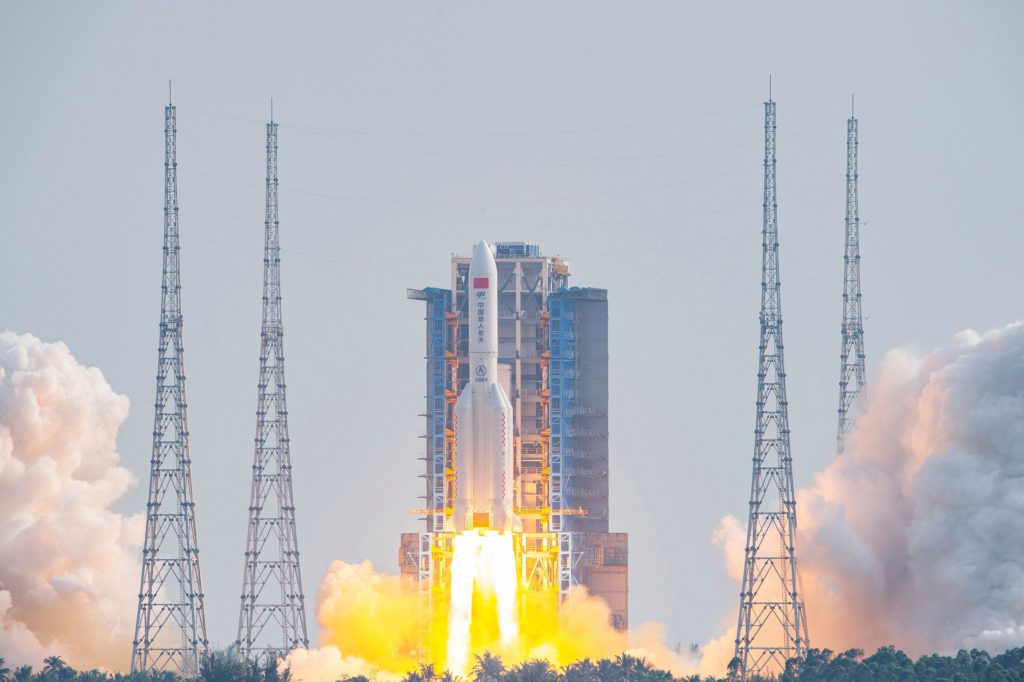
The falling booster is the large core stage of the Long March 5B rocket launched on Oct. 31. The rocket lofted an experimental laboratory module called Mengtian, meant to dock with China’s space station, Tiangong. Unlike other rockets, the Long March 5B’s core stage travels all the way into orbit during launch and circles the Earth for a few days. Eventually its orbit decays and it descends to Earth.

While China isn’t in breach of any laws or international treaties, its National Space Administration is part of the member of a 13-member Inter-Agency Space Debris Coordination Committee, or IADC, which recently recommended that space junk entering the atmosphere should not exceed a one-in-10,000 chance of injuring or killing a person.

“China has always been conducting activities that utilize the space peacefully according to international laws and customs,” said a Chinese Ministry of Foreign Affairs spokesperson. “This type of rocket makes use of a special design technology, allowing most components to burn through during the process of entering the atmosphere, and the probability of it harming the earth and aviation activities is extremely low.”

The spokesman said Chinese officials are monitoring the trail of the booster and have been “releasing information to the international society with an open and transparent attitude.”

When smaller satellites and spacecraft fall out of orbit, they mostly burn up in the atmosphere, posing little risk to the ground below.

But the core of the Long March 5B is about 108 feet (33 meters) long and weighs 48,500 pounds (22 metric tons). With an object of that size and mass, it’s likely that large pieces of debris from the rocket could survive and hit somewhere on Earth. Aerospace Corp. estimates that between 10% and 40% of the rocket could make it to the planet’s surface.

Most space-faring nations and aerospace companies take precautions when launching objects of this size to space, ensuring that their vehicles are disposed of over unpopulated areas — typically the ocean.

No such precautions appear to have been made for China’s Long March 5B, which is why there is heightened anxiety around the globe each time the rocket is launched. Debris from a Long March 5B booster struck the Ivory Coast in May of 2020, and pieces of a Long March 5B rocket were found in Indonesia after a launch in July, though in both instances no one appeared to have been injured.

China’s approach to its launch debris has been routinely condemned by officials in the space industry and the government.

“Spacefaring nations must minimize the risks to people and property on Earth,” NASA Administrator Bill Nelson said in a statement in May 2021 after a Long March 5B uncontrolled reentry. “It is clear that China is failing to meet responsible standards regarding their space debris.”

Aerospace Corp. and others are calling for the international community to come together to establish an agreed-upon set of norms, including what is the level of acceptable risk for space debris disposal.

“With our population that we have driving around on the roads today, we must have stoplights and traffic signs and rules for speed limits,” said Lael Woods, a space traffic management expert with Aerospace Corp. “We feel that there must be those same kind of rules and considerations [that] have to be brought into the space domain.”

Aerospace Corp. notes that China would be liable if the rocket caused significant damage to another state, thanks to the Liability Convention adopted in 1972.

Satellite trackers with Aerospace Corp. and other institutions will continue to monitor the rocket’s path as it moves closer to Earth, refining their predictions for where it could come down. Right now, they see various paths covering a wide swath of the world’s population.

While that may sound dire, trackers will be able to better pinpoint the rocket’s trajectory as it gets closer to reentry. In the end, the risk that a piece of a debris from the rocket will fall on any one person is roughly six in 10 trillion, Aerospace Corp. estimates.

“You’ve got far better odds of winning the lottery tonight than you are getting hit by this object,” consultant Muelhaupt said.

More stories like this are available on bloomberg.com

©2022 Bloomberg L.P.

Chinese Space Junk Likely to Come Crashing to Earth on Friday

(Bloomberg) — A massive Chinese rocket booster is headed for an uncontrolled fall through the atmosphere Friday, sparking concerns that pieces of the giant vehicle could crash to Earth.

It’s the fourth time in two years a large Chinese rocket has headed for an uncontrolled impact and that has many space industry experts crying foul. Both the US and Europe adhere to a rule that any space debris that is disposed of over the Earth must not exceed a one-in-10,000 chance that it will cause an injury on the ground, a threshold experts say China’s rocket exceeds. 

“It’s a low risk thing. But it’s higher risk than is necessary,” Ted Muelhaupt, a consultant with the Aerospace Corp., told reporters during a virtual media presentation.

The falling booster is the large core stage of the Long March 5B rocket launched on Oct. 31. The rocket lofted an experimental laboratory module called Mengtian, meant to dock with China’s space station, Tiangong. Unlike other rockets, the Long March 5B’s core stage travels all the way into orbit during launch and circles the Earth for a few days. Eventually its orbit decays and it descends to Earth.

While China isn’t in breach of any laws or international treaties, its National Space Administration is part of the member of a 13-member Inter-Agency Space Debris Coordination Committee, or IADC, which recently recommended that space junk entering the atmosphere should not exceed a one-in-10,000 chance of injuring or killing a person.

“China has always been conducting activities that utilize the space peacefully according to international laws and customs,” said a Chinese Ministry of Foreign Affairs spokesperson. “This type of rocket makes use of a special design technology, allowing most components to burn through during the process of entering the atmosphere, and the probability of it harming the earth and aviation activities is extremely low.”

The spokesman said Chinese officials are monitoring the trail of the booster and have been “releasing information to the international society with an open and transparent attitude.”

When smaller satellites and spacecraft fall out of orbit, they mostly burn up in the atmosphere, posing little risk to the ground below.

But the core of the Long March 5B is about 108 feet (33 meters) long and weighs 48,500 pounds (22 metric tons). With an object of that size and mass, it’s likely that large pieces of debris from the rocket could survive and hit somewhere on Earth. Aerospace Corp. estimates that between 10% and 40% of the rocket could make it to the planet’s surface.

Most space-faring nations and aerospace companies take precautions when launching objects of this size to space, ensuring that their vehicles are disposed of over unpopulated areas — typically the ocean.

No such precautions appear to have been made for China’s Long March 5B, which is why there is heightened anxiety around the globe each time the rocket is launched. Debris from a Long March 5B booster struck the Ivory Coast in May of 2020, and pieces of a Long March 5B rocket were found in Indonesia after a launch in July, though in both instances no one appeared to have been injured.

China’s approach to its launch debris has been routinely condemned by officials in the space industry and the government.

“Spacefaring nations must minimize the risks to people and property on Earth,” NASA Administrator Bill Nelson said in a statement in May 2021 after a Long March 5B uncontrolled reentry. “It is clear that China is failing to meet responsible standards regarding their space debris.”

Aerospace Corp. and others are calling for the international community to come together to establish an agreed-upon set of norms, including what is the level of acceptable risk for space debris disposal.

“With our population that we have driving around on the roads today, we must have stoplights and traffic signs and rules for speed limits,” said Lael Woods, a space traffic management expert with Aerospace Corp. “We feel that there must be those same kind of rules and considerations [that] have to be brought into the space domain.”

Aerospace Corp. notes that China would be liable if the rocket caused significant damage to another state, thanks to the Liability Convention adopted in 1972.

Satellite trackers with Aerospace Corp. and other institutions will continue to monitor the rocket’s path as it moves closer to Earth, refining their predictions for where it could come down. Right now, they see various paths covering a wide swath of the world’s population.

While that may sound dire, trackers will be able to better pinpoint the rocket’s trajectory as it gets closer to reentry. In the end, the risk that a piece of a debris from the rocket will fall on any one person is roughly six in 10 trillion, Aerospace Corp. estimates.

“You’ve got far better odds of winning the lottery tonight than you are getting hit by this object,” consultant Muelhaupt said.

More stories like this are available on bloomberg.com

©2022 Bloomberg L.P.

Holiday Sales Seen Growing at Slower Pace This Year

(Bloomberg) — Holiday sales will grow at a significantly slower pace than last year, according to forecasts from the National Retail Federation. 

The industry’s sales are expected to grow by 6% to 8% in November and December from a year earlier, the NRF said on Thursday. That’s well below last year’s record 13.5% increase. 

This year’s growth will likely be supported by a robust labor market and solid wage growth. But higher inflation, rising interest rates and growing economic uncertainty will weigh on holiday purchases, particularly for low-income consumers. 

“We’re seeing continued stratification among households based on income levels. Behavior and spending at higher levels continues to be robust,” Matt Shay, the NRF’s president and chief executive officer, said on a call with reporters. “Those lower-income households in particular are feeling the pinch of rising costs on everyday essentials.”

Since last year, shoppers have shifted spending away from apparel and furniture and toward experiences such as travel and dining out, further weighing on retailers’ performance. 

Brands, especially in home goods and fashion, have said in recent months that they plan to offer deeper discounts this holiday season to attract price-sensitive consumers — and also to offload excess inventory that’s built up.

“We do know that consumers are looking for discounts, for deals, for value to stretch their dollars in the face of higher energy and housing prices,” Shay said. “And we think that’s going to continue for the holiday season.”

The NRF’s forecasts aren’t adjusted for inflation, meaning that higher prices may contribute to the anticipated sales growth more than the volume of goods sold. US consumer prices rose by 8.2% in September, according to the latest data from the Bureau of Labor Statistics.

More stories like this are available on bloomberg.com

©2022 Bloomberg L.P.

Foxconn Partners With Saudi Wealth Fund to Build Electric Cars

(Bloomberg) — Saudi Arabia’s Public Investment Fund and Taiwan’s Foxconn Technology Group are moving ahead with plans to produce electric cars in the Middle Eastern country, a push that could help accelerate efforts by the oil-dependent kingdom to diversify its economy.

The pair will set up a joint venture called Ceer that will license component technology from Germany’s BMW AG and design and build vehicles including sedans and sport utility vehicles in Saudi Arabia for buyers in the region. First models are scheduled to be available in 2025, according to a statement from the PIF, as the wealth fund is known.

“Saudi Arabia is not just building a new automotive brand, we are igniting a new industry and an ecosystem that attracts international and local investments, creates job opportunities for local talent, enables the private sector, and contributes to increasing Saudi Arabia’s GDP over the next decade,” Saudi Arabia’s Crown Prince Mohammed bin Salman said in the statement. 

The country has had ambitions for years to develop a domestic carmaking industry to diversify away from oil sales, but those efforts have mostly failed. The kingdom has recently been trying a different tactic, with the PIF actively investing in the industry. It has acquired a majority stake in Lucid Motors Inc. and is backing plans by the US EV maker to build a manufacturing hub in the King Abdullah Economic City, close to the major Red Sea trading port.

The Ceer venture will bring in over $150 million of foreign direct investment and create as many as 30,000 jobs, according to the statement. It’s projected to contribute $8 billion to Saudi Arabia’s gross domestic product by 2034. Bloomberg first reported on talks to set up such a venture, including plans to source BMW chassis, late last year.

Foxconn, a key Apple Inc. assembly partner, has been branching out into EV development and production over the past two years, seeing the rising interest in the category as a source for future growth. In its most notable move to date, the Taiwanese company earlier this year acquired Lordstown Motors Corp.’s pickup manufacturing facility in Ohio for $230 million.

More stories like this are available on bloomberg.com

©2022 Bloomberg L.P.

Peloton Joins $174 Billion Boom-to-Bust Club With 90% Stock Dive

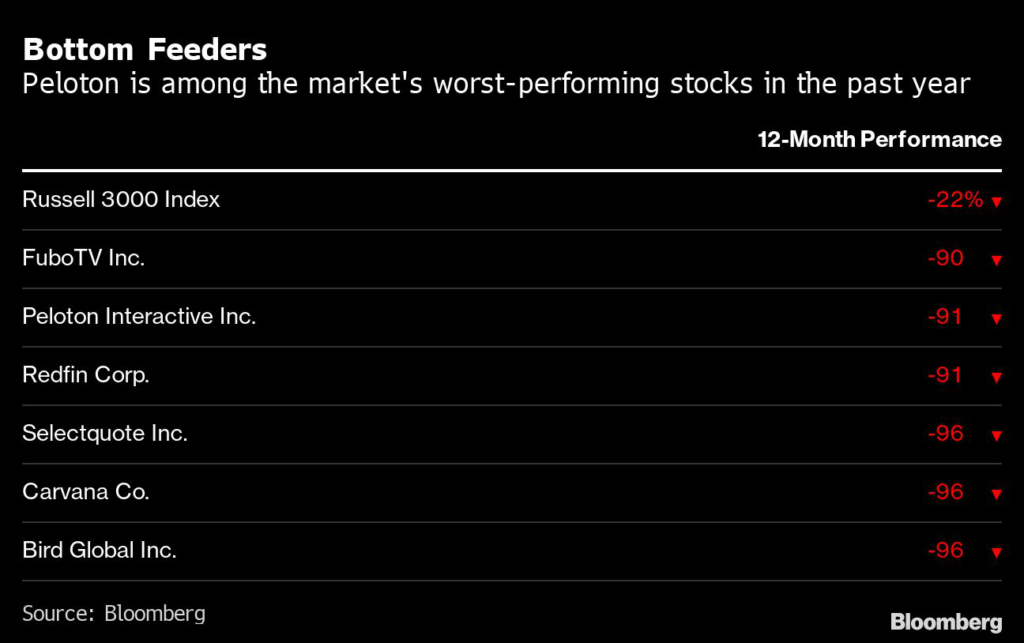
(Bloomberg) — Peloton Interactive Inc.’s miserable year has sent its shares spiraling by 90% over the last 12 months. But it’s hardly alone as a former market darling that is now plunging.

The fitness company is one of 45 members of the Russell 3000 Index to lose more than 90% of their value in the past year, Carvana Co. and Redfin Corp. among them. Companies that thrived during Covid lockdowns, those that went public via SPAC merger and firms favored by ARK’s Cathie Wood have all taken their lumps. Combined, the group’s market value has plummeted below $15 billion, compared with nearly $190 billion a year ago.

Peloton sold off early Thursday before erasing losses as the company delivered a weaker forecast for the current quarter than Wall Street was predicting. The lackluster outlook was “raising more concern about the normalization of demand for home fitness,” according to Bloomberg Intelligence analyst Geetha Ranganathan.

The issues are widespread for a cluster of companies that range from money-losing Bitcoin miner Core Scientific Inc. to fintech firm Upstart Holdings Inc., which actually generates a profit. To be fair the pain is global and has hit companies of all sizes, though not as violently as former pandemic winners and retail trader favorites. 

The benchmark S&P 500 has slumped 20% over the past year while the tech-heavy Nasdaq 100 has erased one-third of its value over the same stretch. Tech bellwethers like Meta Platforms Inc. and Amazon.com Inc. are down more than 45% in that time.

–With assistance from Tom Contiliano.

More stories like this are available on bloomberg.com

©2022 Bloomberg L.P.

Amazon Pauses Corporate Hiring on Economic Uncertainty

(Bloomberg) — Amazon.com Inc. is pausing “new incremental” hiring across its corporate workforce, as the world’s largest online retailer prepares to weather a slower economy. 

Amazon has effectively stopped recruiting for new roles companywide, broadening a pullback in hiring that had already affected various teams in recent weeks, including the profitable advertising business. The latest announcement doesn’t apply to frontline jobs in the operations and transportation groups, where hundreds of thousands of hourly workers pack and ship items.  

Senior executives made the decision to pause corporate hiring this week, human-resources chief Beth Galetti said in a corporate blog post on Thursday. 

“We anticipate keeping this pause in place for the next few months, and will continue to monitor what we’re seeing in the economy and the business to adjust as we think makes sense,” Galetti wrote.

Depending on the business, Amazon may replace employees who depart, and there are some “targeted places” where the company will add to its ranks, she wrote, adding that the company plans to hire “a meaningful number of people” in 2023. 

Amazon almost doubled its headcount during the pandemic to handle a surge in orders from home-bound shoppers. When consumers returned to their previous shopping habits this year, the company began trimming the ranks of its logistics operation. As the economic outlook darkened and it became clear that a slowdown in online sales growth was here to stay, cuts spread to Amazon’s corporate offices. 

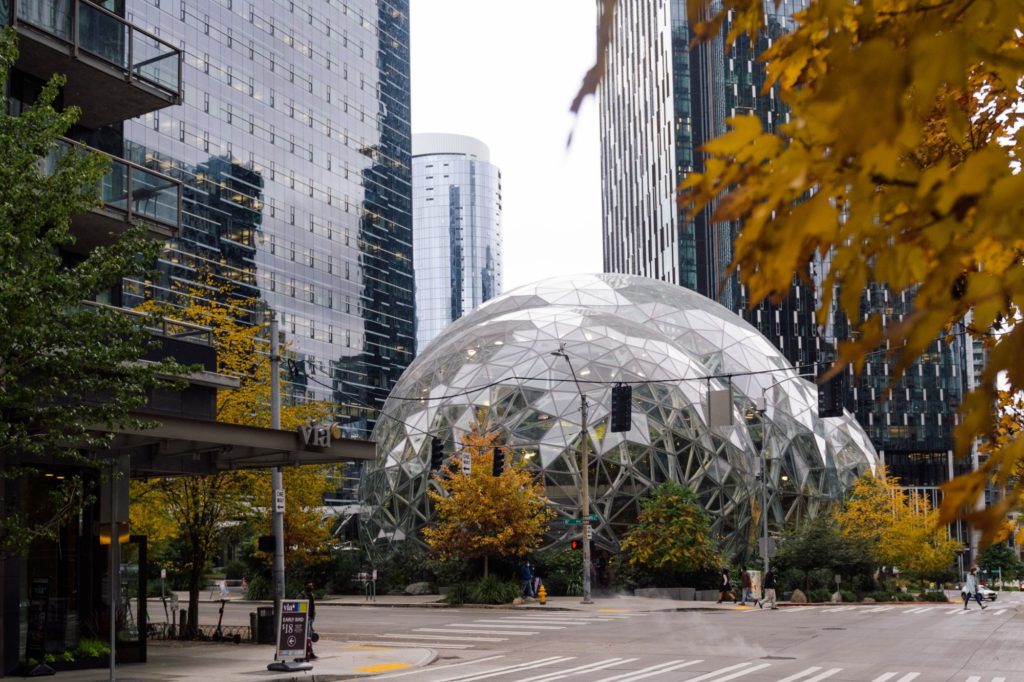
In addition to its hometown of Seattle, where Amazon is the largest corporate employer, the company has major corporate and research and development outposts near Washington, the San Francsico Bay Area, Los Angeles and Austin, among other cities. 

The company at the end of September employed 1.544 million people worldwide, up about 6% from a year earlier. Last month, Amazon said it would tack on about 150,000 seasonal workers to handle the holiday shopping season, the same figure as the prior year. 

When Amazon last week forecast its slowest-ever holiday growth, Chief Financial Officer Brian Olsavsky said the company was “taking actions to tighten our belt.” 

(Updated with details and context beginning in the second paragraph.)

More stories like this are available on bloomberg.com

©2022 Bloomberg L.P.

Musk Eliminates ‘Days of Rest’ From Twitter Employee Calendars

(Bloomberg) — Elon Musk has removed “days of rest” from Twitter Inc. staff calendars, according to people familiar with the matter.

The monthly, company-wide day off was introduced during the pandemic period. Its expiration is another sign of Musk’s impatience with Twitter’s existing work culture.

Musk also plans to cancel Twitter’s remote work policy and have staff that are spared from deep layoffs return to Twitter offices full time.

Read more about Musk’s plans for job cuts

More stories like this are available on bloomberg.com

©2022 Bloomberg L.P.

Chinese Tycoon Spent 8 Years, $3 Billion on EV That Went Unbuilt

(Bloomberg) — The image arrived in Susan Swenson’s inbox on a Wednesday evening. Her corporate headshot had been crudely crossed out in digital red ink, and the word “Kill” was written in the bottom left corner. In the hours that followed, some of her colleagues received similar threats, including messages that referenced the recent assassination of former Japanese prime minister Shinzo Abe. 

The menacing emails marked the apex of a months-long fight for control over Faraday Future Intelligent Electric Inc., a Los Angeles, California-based publicly traded electric vehicle startup that once billed itself as the next Tesla. In September, after the death threats, persistent pressure from Faraday’s largest shareholders, and a surprising cameo from property giant China Evergrande Group, Swenson, the executive chair, and three others agreed to leave Faraday’s board of directors in a sweeping restructuring.

While it’s not known who sent the death threats — the company has referred them to the FBI — some leaders inside Faraday believe they were inspired by the boardroom fight recently waged by its largest shareholders, including a group that is partially managed by the startup’s founder, exiled Chinese tycoon Jia Yueting. (The group, FF Global Partners, denies any involvement in the threats.) Bloomberg News spoke to three people familiar with the situation who were granted anonymity to discuss sensitive matters, and reviewed dozens of public regulatory and court filings for this story. Faraday Future did not respond to a list of questions.

Seven months ago, Faraday’s board sidelined Jia, who goes by YT, following an internal probe that examined his influence over day-to-day operations, as well as a series of loans employees made to the startup over the years. Now, he stands to benefit greatly from the impending board shakeup, which will be completed when Faraday holds its delayed annual meeting. He has been named an adviser to the board, and FF Global will have input on all six new members. As Faraday put it in a recent SEC filing, “YT Jia and FF Global have strengthened their already significant influence over the Company.”

But as YT reclaims power, it is over a company that’s under investigation by the US Securities and Exchange Commission in relation to the findings of the internal probe — information the Department of Justice has inquired about, too, according to Faraday. The startup also needs money, fast. After burning through more than $3 billion since it launched eight years ago, Faraday reported just $27 million in cash on Oct. 25th, and says it needs millions more if it hopes to finally ship its elusive SUV.

Debt Binge

YT ascended in China during the early 2010s, when a tsunami of cash flowed to founders with big visions. He started the “Netflix of China” and parlayed its success into a conglomerate called LeEco, which made everything from smartphones to Android-powered e-bikes. Its expansion was fueled by billions of dollars in debt, and YT personally guaranteed many of the loans. At one point, he pledged 97 percent of his shares in LeEco’s listed arm in exchange for nearly $2 billion, according to the New York Times.

Read more: Outspoken Billionaire Works to Salvage His Tech Empire in China

Meanwhile, Elon Musk was turning the auto industry on its head. Investors started placing big bets on finding the next Tesla Inc., and dozens of EV startups took root in China and the US. It was in this competitive environment that YT founded Faraday in California in 2014, betting he could beat Musk at his own game.

Eventually, LeEco crumbled under the weight of YT’s ambition. In 2017 it laid off hundreds of employees, abandoned a $2 billion acquisition of TV-maker Vizio, Inc., and halted a US expansion. Chinese creditors started pursuing LeEco, and YT. The tycoon landed on a government debtor blacklist and had some assets frozen. So he moved to the US and hunkered down with Faraday.

YT’s connection to Faraday was initially hard to discern. The company had no publicly named CEO, and early executives declined to say where the money came from. According to court filings, it was coming through YT — some $900 million or so over its first few years. He spent much of it hoovering up talent from the likes of Tesla and General Motors Co. — including a large swath of the team that created the EV1, the Detroit automaker’s first attempt at a mass-market EV.

Custody Battles

Faraday struggled to meet YT’s ambitions. He wanted an ultra-luxe EV packed with fancy technology. But by late 2017, months after revealing its first prototype, the company was running out of cash.

YT brought in a pair of former BMW executives, but when they proposed filing for Chapter 11 protection, the tycoon bucked. A restructuring would have jeopardized his control of the company, according to a person familiar with the matter, so he resisted. The executives resigned, and Faraday accused them of “dereliction of duty.”

At the end of 2017 YT found an unlikely savior in China Evergrande Group, which pledged to inject up to $2 billion into Faraday in exchange for a 45% stake. YT also officially took over as CEO. Faraday spent the first $800 million ahead of schedule. Evergrande agreed to advance another $700 million in mid-2018, according to filings from a Hong Kong arbitration case between the two companies, but on the condition that YT step aside and sacrifice his ownership.

Read more: The Chinese Developer That Reckons It Can Take on Tesla

YT obliged — at least on paper. He transferred his stake to the daughter of a Faraday vice president, which the Chinese property giant argued was not far enough. The new money never came, and in late 2018 YT and Faraday sued Evergrande in US court, claiming the property giant was “deliberately starving” the EV startup. Evergrande accused YT of “acting as a shadow director controlling or directing the decisions of directors closely associated with him.” The property giant did not respond to a request for comment.

Faraday had to furlough and lay off hundreds of employees, and suppliers hounded the startup with lawsuits. Nick Sampson, a former Tesla executive and Faraday co-founder, walked away. “The company is effectively insolvent,” he said in his resignation letter. 

On the final day of 2018, Faraday and Evergrande struck a truce. Evergrande agreed to reduce its stake to roughly 33%, and allowed Faraday to seek other investors. The property giant gave Faraday a $10 million bridge loan, and YT’s startup survived with him at the helm.

Creative Fundraising

These bitter disputes — each centered around YT’s control of the company — made it hard for Faraday to raise money. In 2019, the company made some moves that appeared to dilute the founder’s power: it set up a management group called FF Global Partners, that received a chunk of YT’s ownership. (It now owns around 30% of Faraday.) YT was also replaced as CEO by a different former BMW executive, Carsten Breitfeld.

By October, YT filed for personal bankruptcy in the US to settle billions of LeEco debt he’d guaranteed. Creditors exchanged their claims for slices of a trust that owned Faraday Future shares, allowing some repayment if the startup was acquired or went public — giving many of YT’s foes a tangible interest in his company’s success.

What kept Faraday afloat during all of this was a series of more than a dozen loans made to the company by employees or parties related to YT, according to SEC filings.

In April 2019, the company received a $9 million loan from an employee in Faraday’s Global Capital Markets department, funded by Ocean View Drive, Inc., a California corporation YT established in 2014 in order to buy three mansions on the Pacific coastline. (YT no longer controls it, according to Faraday’s SEC filings, though the current owner is the spouse of his nephew, Ruokun Jia, who also worked at Faraday.) In July, another employee from the same department loaned Faraday $16.5 million. That loan was funded by FF Global Partners LLC, whose members borrowed the money from a Delaware LLC called “Dream Sunrise,” which in turn borrowed its funding from an LLC owned by Ruokun Jia’s spouse. 

Asked about these loans, a spokesperson for FF Global said Faraday was “unable to obtain significant third-party financing” at the time, and so it instead had to rely on “numerous smaller-scale financings that YT Jia helped facilitate,” which the group said is a “typical financing approach for founder-led startups.”

“Over the past several years, YT Jia and FF Global Partners have rescued FFIE many times,” the spokesperson said.

Read more: EV Startups are Wilting in Harsh Light of Public Eye

Even after this series of multi-layered transactions, Faraday still needed a $9.2 million loan from the Paycheck Protection Program to ride out the pandemic downturn. With just $1.8 million in the bank at the end of the year, Faraday tapped into the sudden boom of special purpose acquisition company mergers, which helped turn peers like Nikola Corp, Canoo Inc., and Fisker Inc. into public companies. The startup partnered with a SPAC run by a New York City real estate investor, Jordan Vogel. Not only did he see promise in Faraday’s EV tech, according to two of the people familiar with the matter, but he was told — and believed — YT was no longer in control.

That deal came together in early 2021. By July, Faraday netted $1 billion and started trading on the Nasdaq, with institutional backing from Citadel Advisors, China’s largest private automaker Geely, and data company Palantir Technologies Inc. Breitfeld promised to start building the SUV within 12 months.

Board Fight

Vogel joined Faraday’s board following the merger, along with his brother Scott, and Swenson. Within three months the board opened a probe into YT, run by a special committee spearheaded by Swenson. The committee hired Kirkland & Ellis and forensic accounting firm Alvarez and Marsal to examine his interpersonal and financial influence on the company. 

The committee concluded that senior managers had misled investors about how much day-to-day control YT maintained over Faraday, according to an April filing with the SEC. They also found senior managers did not properly disclose “certain relationships, arrangements, and transactions” involving YT. YT was officially sidelined and stripped of his executive status. Ruokun Jia was “terminated for conduct during the Special Committee’s investigation.” (Jia did not respond to a message seeking comment.)

Faraday has said that FF Global began pushing back on the disciplinary actions as far back as February. By June, FF Global started issuing public filings agitating to replace one of Faraday’s directors, Brian Krolicki. The public spillover disrupted a funding round with Citi, according to the people familiar, and in July, Faraday once again delayed the launch of its EV, saying it needed more money to start production. 

Meanwhile, the company started getting peppered with emails from “self-described ‘employee whistleblowers’” that painted these members of the board as villains. A group of employees who work closely with YT circulated a letter, seen by Bloomberg, that claimed Swenson had “conducted a series of unfair and improper investigations and remediation to the company and its core executives.” Swenson, Krolicki, and the Vogels declined to comment for this story.

FF Global agrees, saying to Bloomberg News that the group “does not believe that the Special Committee investigation was performed fairly,” and that the probe “unfairly targeted for punishment people associated with FFGP.”

This fight culminated with FF Global suing Faraday in Delaware Chancery Court on Sept. 19, accusing the board of breaching its fiduciary duty. FF Global pushed for Swenson’s removal, and cited a key bit of leverage: that Evergrande, which still holds about 20.5% of Faraday following the 2021 merger, supported FF Global’s efforts to remake the board. 

That’s when the death threats surfaced. Krolicki received a similar image to the one that arrived in Swenson’s inbox, and other directors including the Vogels were flooded with hateful messages in the days that followed. 

Who’s the Boss

On Sept. 26, Faraday announced a truce. FF Global agreed to drop the lawsuit and arrange for roughly $100 million in near-term financing. In exchange, Swenson, Krolicki, and the Vogels agreed to leave the board at the next shareholder meeting. A week later, Swenson and the Vogels resigned early citing “threats and their fear that their continued association with the company might heighten the risk to themselves and their respective families,” according to Faraday. Krolicki resigned earlier this week. 

Whenever that next shareholder meeting happens — Faraday has yet to set a date — the startup has agreed to completely overhaul the board from 10 members to just seven. FF Global will choose three. Three more will be chosen by a panel made up of Breitfeld, FF Global’s replacement for Swenson, and a current manager of FF Global. Breitfeld is also the seventh board member. 

Breitfeld’s name didn’t come up much in FF Global’s battle for the board, and the people familiar with the fight say his alliances can be hard to parse. He was a manager of FF Global until this past May. He lived in one of the California mansions that used to be owned by YT. He has also been a force in pitch meetings, the people say, which is maybe why his contract — set to expire in September — was recently extended to March 2023. Breitfeld did not respond to a request for comment.

However instrumental Breitfeld has been to Faraday’s survival, or its failures, he has spent the last few years with YT looking over his shoulder — literally, at times. In some meetings, one of the people recalled, as Breitfeld took his place at the head of a conference table, YT would pull a chair up next to him. The implication was clear, this person said. In good times, and especially in bad ones, this is always going to be YT’s company.

(Corrects reference to Scott Vogel running real estate SPAC in 22nd paragraph.)

More stories like this are available on bloomberg.com

©2022 Bloomberg L.P.

NBA Commissioner Condemns Kyrie Irving for Antisemitic Tweet

(Bloomberg) — National Basketball Association Commissioner Adam Silver said that Kyrie Irving’s promise to donate $500,000 to groups that fight hate after he shared an antisemitic video on his Twitter account doesn’t go far enough.

Irving, a point guard for the Brooklyn Nets, “made a reckless decision to post a link to a film containing deeply offensive antisemitic material,” Silver said in a statement. “While we appreciate the fact that he agreed to work with the Brooklyn Nets and the Anti-Defamation League to combat antisemitism and other forms of discrimination, I am disappointed that he has not offered an unqualified apology and more specifically denounced the vile and harmful content contained in the film he chose to publicize.” 

Silver said that he and Irving would be meeting in-person next week. 

Silver’s comments come after Irving and the Nets said on Wednesday they would each donate $500,000 to “causes and organizations that eradicate hate and intolerance in our communities.”

“I am aware of the negative impact of my post towards the Jewish community and I take responsibility,” Irving said. “I do not believe everything said in the documentary was true or reflects my morals and principles.”

Irving defended his post about the documentary in a postgame press conference on Oct. 29. The post was later deleted from his account.

Read More: Brooklyn Nets Fire Steve Nash as Team Flops, Irving Stirs Uproar

Anti-Defamation League Chief Executive Officer Jonathan Greenblatt in the same joint statement said intervening is paramount. “At a time when antisemitism has reached historic levels, we know the best way to fight the oldest hatred is to both confront it head-on and also to change hearts and minds,” he said.

Amar’e Stoudemire, who served for two seasons as an assistant coach with the Nets, predicted on Wednesday that anything short of a direct apology would cause further concern from the NBA.

“You have to give an apology because if you’re going to promote a documentary that has false allegations inside of it, and you may not understand that these allegations that’s inside the documentary are false, OK you made a mistake, right? So apologize for it,” he said.

Billionaire Joe Tsai, the owner of the Nets, also reprimanded Irving last week, saying he was disappointed in the player and that “this is bigger than basketball.”

More stories like this are available on bloomberg.com

©2022 Bloomberg L.P.

Close Bitnami banner
Bitnami