Bloomberg

Sorrell Says ‘Meta is The Issue’ Despite Musk Twitter Drama

(Bloomberg) — Advertising mogul Martin Sorrell said that despite problems at Elon Musk’s Twitter Inc., the real concern in online advertising is Facebook-owner Meta Platforms Inc.

“Meta is the issue,” WPP Plc founder and S4 Capital Plc chairman Sorrell told Bloomberg TV at the Web Summit conference in Lisbon, Portugal on Thursday, when asked about weakness in digital advertising. “Snap and Twitter, they’re not exactly rounding errors, but each of those two platforms is about 1% of global digital media.”

He said the four key digital advertising platforms are Alphabet Inc., Meta, Amazon.com Inc. and Bytedance Ltd.’s TikTok. Meta and Amazon shares have both tumbled in recent days after they missed earnings forecasts — but it’s “not a rout,” he said.

Read more: Meta Plummets 25%; Zuckerberg Plea for ‘Patience’ Falls Flat

Following billionaire Musk’s controversial $44 billion take-private of Twitter, S4’s clients are adopting a “wait-and-see” approach to the platform, Sorrell said. Rivals such as agency holding company Interpublic Group Co. have advised pausing Twitter marketing, Variety reported earlier this week, citing an unnamed source.

“It’s not clear yet from Elon Musk where he is” on moderation, Sorrell said. “The question is: how is that going to operate?”

“Clients don’t want conflict, they don’t want controversy,” he added. “They want a stable environment, and what we’ve seen in the last week or so is too much inconsistency.” 

Twitter has historically been inflexible with advertisers and contracts, Sorrell said — advising that it needed to “listen more” and set out a moderation policy. Last week Musk tweeted an open letter to marketers in which he said he wants to make Twitter “the most respected advertising platform in the world.”

A spokesperson for Meta declined to comment on Sorrell’s statements.

WPP Chief Executive Officer Mark Read separately said his company’s advice to clients “is to continue as normal for now.”

“Elon’s ideas around verification and innovation promise to create a better Twitter, which is positive for our clients,” Read said by phone. “Concerns around brand safety should be judged on what he does and how that impacts the platform.”

–With assistance from Tom Mackenzie.

More stories like this are available on bloomberg.com

©2022 Bloomberg L.P.

Crypto Political Giving Falls Right Before US Midterm Elections

(Bloomberg) — Crypto executives pulled back on political giving in the immediate run-up to the Nov. 8 midterm elections, a move that followed the crash in digital currencies like Bitcoin and Ether.

The industry emerged as a significant player in political spending in 2022 and outpaced donor groups such as drugmakers and defense contractors for much of the current two-year election cycle. There has been a spike in the number of political action committees backed by digital-asset companies and executives, including GMI PAC — a super-PAC whose top contributors include FTX Trading Ltd. Chief Executive Officer Sam Bankman-Fried, stablecoin issuer Circle Internet Financial and venture capitalists Marc Andreessen and Ben Horowitz.

But recent campaign-finance filings to the Federal Election Commission show this spending, which has topped $80 million since January 2021, slowed significantly as candidates entered the final stretch of the midterm election races.

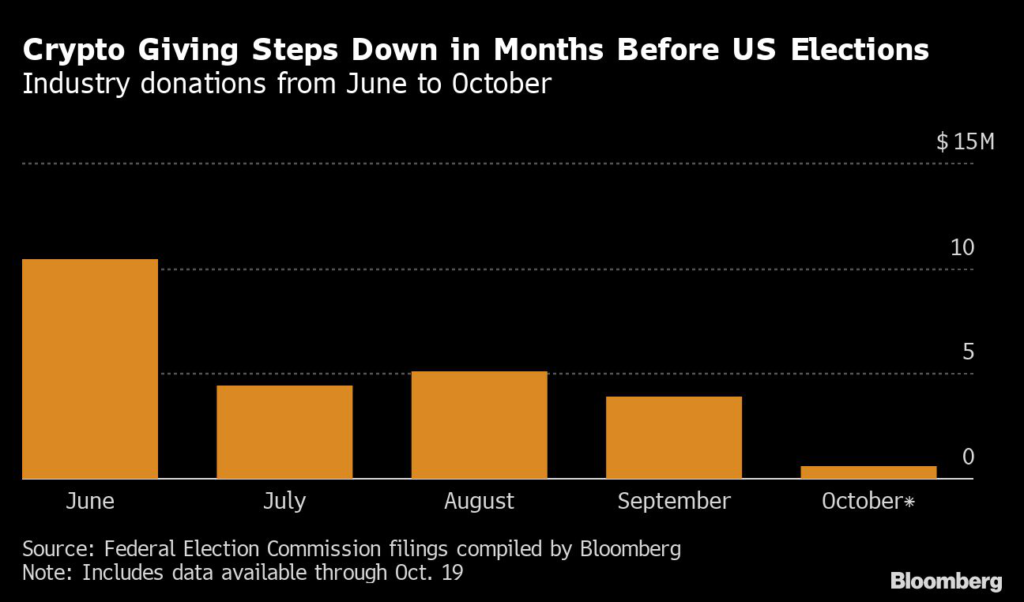
In the third quarter, donors typically pour more money into campaigns and other political committees than any other period. Yet crypto has given around $5 million or less each month since July, with September’s $3.9 million representing a 63% drop from the $10.4 million in June. The slump continued in the first 19 days of October, with a haul of less than $600,000.

There’s probably more than one reason behind the drop in political giving — which could include donors’ preferences to focus on primaries rather than general elections as a way to shift sentiment about the industry within the parties. But it’s likely driven largely by the general decline in the crypto market and token prices this year, said Kristin Smith, executive director of the Blockchain Association, which recently launched its own crypto-focused PAC.

“Those who work in the crypto industry are often heavily invested in crypto and oftentimes part of their compensation, if they work at a company, is in crypto. So when prices are down, people have less money to spend,” said Smith, an active donor.

Crypto Crunch

The prices of Bitcoin and Ether — the largest cryptocurrencies — have plunged more than 50% since the beginning of the year. The market has suffered as the US Federal Reserve hikes interest rates in an effort to curb inflation and as investors shifted from riskier assets. The sector was also hit hard after the collapse of the popular algorithmic stablecoin TerraUSD in May, which set off a chain of bankruptcies among crypto firms and accelerated the drop in token prices.

Despite the recent chill in giving, crypto donors may have provided a lift to candidates on both sides of the aisle in the primaries.

Thirteen of the 15 Republican candidates who received donations from American Dream Federal Action, a super-PAC funded by FTX executive Ryan Salame, advanced in their primary races. Recipients included US Senator John Boozman, a lead co-sponsor on legislation that would give the Commodity Futures Trading Commission — the crypto industry’s preferred regulator — more power to oversee digital assets. 

In addition, two super-PACs primarily funded by GMI PAC — Web3 Forward and Crypto Innovation PAC — also backed several winners. Web3 Forward, which only spends on behalf of Democrats, saw nine of the 11 candidates that it backed move forward to the general election on Nov. 8. Crypto Innovation, which supports Republicans, had five of the seven candidates it bankrolled advance. 

Though these PACs donated to US lawmakers like Boozman and North Carolina Representative Patrick McHenry — a Republican who’s working on legislation to regulate stablecoins — they have also given money to a number of individuals who aren’t incumbents. 

On the Democratic side, the industry has supported Jonathan Jackson, a business professor and son of civil rights activist Jesse Jackson, and Jasmine Crockett, a state representative and civil rights lawyer, for US House seats. As for Republicans, donations have gone to Bo Hines, a former North Carolina State University football player, and Mark Alford, a former Kansas City TV anchorman, in their bids for US Congress. 

For-profit industries almost exclusively give to incumbents, said Pete Quist, deputy research director at OpenSecrets. He hasn’t been following crypto giving closely but said any spending from these companies or PACs representing their interests that diverges from that trend would be “highly unusual.”

“Incumbents are in office making policy and will be in office — more than likely — since they win between 90% and 95% of the time that they run for re-election,” he said. “Those contributions are really meant to pave the way for lobbying.”

(Corrects 10th paragraph to say that Web3 Forward had nine candidates that it backed advance. The error was due to an FEC coding mistake.)

More stories like this are available on bloomberg.com

©2022 Bloomberg L.P.

Optimum Cable Parent Altice Sinks Most Ever as Subscribers Flee

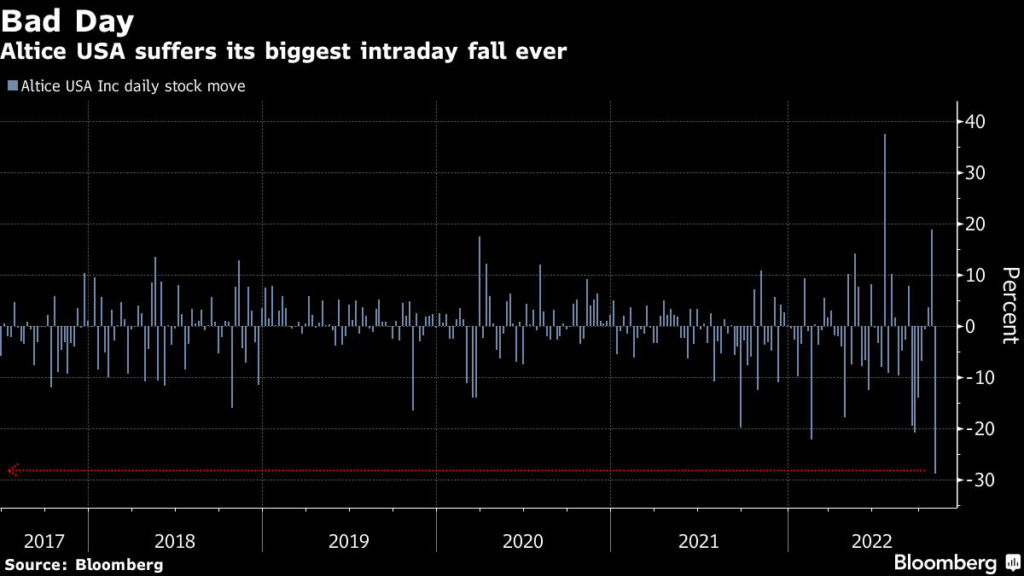
(Bloomberg) — Altice USA Inc. dropped the most on record, triggering a brief trading halt, after its earnings report highlighted continued subscriber losses for its cable and broadband services.

Shares of the company plunged as much as 37% on Thursday. While the stock has seen strong reactions to earnings updates in the past, Thursday’s move is set to be the biggest decline in a session following its results. 

At least 10 brokerages including Morgan Stanley and Goldman Sachs Group Inc. have cut their price target — or prediction for the firm’s stock 12 months from now — on the stock, bringing its average target down by 20%, according to Bloomberg data. 

“We’re worried the path forward is painful: broadband subscriber losses are likely to continue, EBITDA declines will likely flow into 2023,” KeyBanc Capital Markets Inc. analyst Brandon Nispel wrote in a note.

The firm’s indebtedness also caught the eye of analysts. It reported consolidated net debt of $24 billion at the end of the quarter.

“As interest rates have risen, cable stocks have fallen. And the most levered have fallen the fastest,” said Craig Moffett analyst at MoffettNathanson. “Altice USA is the most levered.”

Altice USA, which spun out of Europe’s Altice NV in 2018, is one of the largest broadband and video services providers in the US. It serves more than 5 million residential and business customers across 21 states through its Optimum brand, according to its website.

“Fiber will better position ATUS,” Nispel said. “The better positioning is likely several years out and in the near term, only strategic alternatives such as divesting assets, which seems unlikely, are able to improve the stock performance.”

More stories like this are available on bloomberg.com

©2022 Bloomberg L.P.

Earlier Bitcoin Bear Markets Show Price Hasn’t Hit Bottom

(Bloomberg) — Bitcoin has shed more than half its value this year, and yet the selling may not yet be over. 

That’s according to digital-assets researcher CryptoCompare, which pointed to a number of gauges and historical data, including the token’s maximum drawdown in past bear markets as well as its current volatility, as evidence it hasn’t yet hit a floor. 

Earlier bear markets, which began in 2013 and 2017, “suggest we could still experience a further decline,” CryptoCompare analysts wrote in a report released Thursday. The world’s largest digital token during those two instances saw declines of 83% and 87%, which lasted 364 and 406 sessions, respectively. 

This time around, Bitcoin has fallen 73% and we’re at 357 days as of Oct. 31, meaning that it hasn’t been as “acute” in terms of time frame and severity as those prior declines. That leaves “room for 2022 to become the worst drawdown in Bitcoin’s history,” they wrote. 

Meanwhile, during the last bear market, average annualized volatility for Bitcoin was 79%, a measure that’s right now hovering around 63%. “Under the context of the current market, we believe it’s possible for a high-stress event to take place in the traditional financial system, which would cause sell-side pressure across major asset classes, leading to a spike in volatility and a potential move downwards,” CryptoCompare said. 

While all manner of riskier assets have been stuck in the gutter this year as central banks around the world raise interest rates to tamp down inflation, cryptocurrencies have been hit especially hard. Bitcoin has been hovering around $20,000, way off its 2021 highs of nearly $69,000. Ether and others have also suffered. In this environment, retail investors have been more reticent to step into the space in the same way they had over the first two pandemic years, while high-adrenaline traders have found it harder to partake in trades that in the past had worked much better.

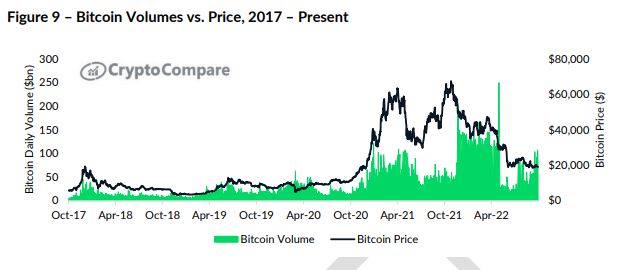
However, CryptoCompare points out that volumes haven’t deflated as much as they had in the rout that started in 2017, when they dropped more than 60% from peak to trough. In 2022, they’ve fallen 35% since their top last year. 

“This may suggest volumes have become stickier despite the downturns — or we are due for further decline in activity,” the report said.

The researchers also noted that Bitcoin’s market dominance has in the past been used as a gauge of figuring out the stage of the market cycle. In earlier instances, analysts considered that the coin’s dominance would fall during a bull market as smaller projects gained attention. During a drawdown, however, it was thought that the opposite would happen, though that hasn’t been the case this time around. Many crypto fans have already turned their attention to other projects.

“It is possible that we are not yet in the final stages of the bear market, suggesting smaller projects will continue to lose value and may lead to a rise in Bitcoin’s dominance in the short to medium-term,” the report said.

–With assistance from Eva Szalay.

More stories like this are available on bloomberg.com

©2022 Bloomberg L.P.

Ukraine Latest: Russian Bank Denies Hack; Kherson Troop Pullout

(Bloomberg) — Ukrainian President Volodymyr Zelenskiy said grain exports through the Black Sea safe-passage corridor will continue, as foreign ministers of the Group of Seven nations prepared to meet in Germany to discuss Ukraine’s plight, including Russian attacks on water and power supplies.

The G-7 is still working to bring other nations on board with its plan to cap Russian oil prices, even as the US is scaling back the scheme and trying to offer clarity about the plan to oil traders. 

A senior occupation official said Moscow’s troops will “most likely” pull out of the city of Kherson, which Russia captured in the first days of its invasion, and move to the eastern bank of the Dnipro River.

(See RSAN on the Bloomberg Terminal for the Russian Sanctions Dashboard.)

Key Developments

  • Turkey Unlikely to Sign Off on Swedish NATO Bid Before Year-End
  • Wheat Extends Slump as Russia Resumes Ukraine Grain-Export Deal
  • Ukraine’s First Lady Urges World to Resist Fatigue With the War
  • Uniper Suffers €40 Billion Loss Amid Russian Gas Supply Cuts
  • How Ukrainians Are Protecting Their Centuries-Old Culture From Putin’s Invasion

On the Ground

The areas of Bakhmut and Avdiyivka in the Donetsk region remain the most tense on the front line, Serhiy Cherevatyi, spokesman for eastern operational command, said on TV. Constant position battles are taking place there and Ukrainian troops are holding the defense line, he said. Due to lack of strategy and training, the losses of Russian troops have risen to 100 people killed and as many wounded per day. A Russian drone damaged an energy facility in the city of Kryvyi Rih in central Ukraine late Wednesday, leaving several districts without electricity and water, mayor Oleksandr Vilkul said on Telegram.

(All times CET)

Russian Forces ‘Likely’ to Leave Kherson, Occupation Official Says (1:40 p.m.)

Russian troops will “most likely” pull out of the city of Kherson and move to the eastern bank of the Dnipro River, an occupation official said, as Ukrainian forces step up pressure in the area.

“Most likely, our units, our forces will move to the left bank part of the Kherson region and those people who haven’t already should get out of the city of Kherson as fast as possible,” Kirill Stremousov, deputy head of the Russian occupation administration, said in an online interview with state media.

Though he said Russia’s defensive line is holding, Kyiv’s forces have made steady gains there in recent weeks, cutting off bridges across the Dnipro River. The city of Kherson lies on the west, or right, bank, while the rest of the Kherson region is to the east. Kherson was captured by Kremlin troops in the early days of Russia’s invasion. 

Russian Central Bank Denies That Its Systems Were Hacked (1 p.m.) 

Bank of Russia said it had found no evidence that its systems had been hacked, pushing back on a claim made on Telegram by Mykhailo Fedorov, Ukraine’s deputy prime minister for digital transformation. 

“We checked the archive published by the hackers. All these documents were on the Internet in the public domain,” the central bank’s press service said in a statement. “No information systems of the Bank of Russia were  hacked.” 

Fedorov said earlier that Ukrainian cyberwarfare volunteers hacked into the central bank’s internal networks, and posted a link to what he said were 27,000 files obtained by the so-called IT Army of Ukraine. 

About 120 Ships Still in Queue for Grain Corridor (11:55 a.m.)

While the queue has shrunk, about 120 vessels are still waiting for inspections in order to transit the Ukrainian crop-export corridor, according to an update from the United Nations. Most are waiting to head inbound for loading in Ukraine.

The Black Sea crop-export deal requires ships to be inspected in Istanbul before and after transiting Ukraine ports. A delegation from Russia re-joined the checks on Thursday, the UN said, the day after its government opted to resume participation in the pact.

Ukraine Set for More EU Funds in January (11:40 a.m.)

Ukraine could receive a first payment of a new European Union financial package in January, according to a senior EU official. There is a broad support among member states to move quickly and to accelerate the national procedures to approve the funds as much as possible, said the official, who spoke on condition of anonymity because the discussions are private.

The European Commission, the EU’s executive arm, is expected to present next week a mechanism to provide around 18 billion euros ($17.5 billion) in liquidity support to Ukraine next year in a more predictable and stable manner. A total of three billion euros promised last May still need to be approved by member states, although they could be released as part of the new package, the official added.

Microsoft Pledges Ukraine $100 Million in Tech Support (11.30 a.m.)

Microsoft Corp. will provide Ukraine with tech support worth $100 million next year, bringing the total to over $400 million since the Russian invasion, Vice Chair and President Brad Smith said at the Web Summit in Lisbon.

Microsoft withdrew from Russia after the war started and has provided government agencies, critical infrastructure and other sectors in Ukraine access to its digital infrastructure and the Microsoft Cloud.

Turkey Unlikely to Sign Off on Swedish NATO Bid Before Year-End (11:15 a.m.)

Turkey is unlikely to sign off on Sweden’s bid for NATO membership before the end of the year, and the chances of this happening even before elections due next year are slim, according to officials familiar with the issue.

Sweden has not done enough to meet Turkish demands and the Turkish parliament’s agenda is full for the rest of the year, said the officials who asked not to be named on a confidential matter. Turkish President Recep Tayyip Erdogan is keen to consolidate the votes of nationalists in the run-up to elections which are currently scheduled for June, they said. The vote may be held earlier.

Ukraine Never Put Grain Corridor at Risk, Official Says (10:55 a.m.)

Ukraine holds strictly to the grain agreement and has never exposed the corridor route to danger, Ukrainian foreign ministry spokesman Oleh Nikolenko said on Facebook.

“Moscow returned to the grain agreement thanks to the active diplomacy of UN Secretary General Antonio Guterres and Turkish President Recep Tayyip Erdogan. In coordination with Ukraine, they found words that Putin understood,” Nikolenko said. 

Russia Steps Up Air Raids Amid Logistics Problems, Hromov Says (10:50 a.m.)

Russia increased air raids from Crimea over Ukrainian territory as its artillery positioned on the right bank of the Dnipro river increasingly faces problems with supplies, military spokesman Oleksiy Hromov said in a video briefing.

Ukrainian air defenses downed four Russian military jets and nine helicopters over the past seven days, he said. Ukraine also shot down two-thirds of missiles and 40% of alleged Iranian drones launched by Russia over the same period. Russian forces fired 68 missiles and used 30 Shahed-136 drones against Ukraine since Oct. 27, according to Hromov.

Russia May Be Filling Tank Deficit With Belarus Help, UK Says (9:55 a.m.)

Russia has likely received at least 100 additional tanks and infantry fighting vehicles from the military stock in neighboring Belarus, the U.K. defense ministry said in an intelligence update.

Russian forces fighting in Ukraine have been losing more than 40 armored vehicles a day in mid-October amid the Ukrainian offensive, the ministry estimates. Russian President Vladimir Putin’s troops are struggling partially due to difficulties in sourcing both artillery ammunition and sufficient serviceable replacement armored vehicles, according to the statement.

Eight Ships Due Through Grain Corridor on Thursday, UN Says (8:55 a.m.)

Eight ships are scheduled to transit through the Ukraine crop-export corridor on Thursday, according to a United Nations spokesperson for the Black Sea Grain Initiative. That includes seven outbound ships, plus one inbound.

The moves come after Russia’s announcement Wednesday that it would resume its participation in the Ukraine grain deal, abruptly reversing course after suspending it over the weekend. The disruption had spurred a temporarily halt to vessel traffic through the channel. Ukraine exported 10 million tonnes of foodstuffs to 43 countries since the deal took effect, Infrastructure Minister Oleksandr Kubrakov said. 

Ukrainian Electricity Cutoffs Continue (8:10 a.m.)

Ukraine’s power grid operator NPC Ukrenergo continued electricity cutoffs in 10 out of the country’s 24 regions, excluding annexed Crimea, as the war-torn nation struggled to fix heavy damage inflicted by Russia’s air attacks since last month. 

Emergency blackouts were extended to Thursday from the previous day in the Kirovohrad, Zaporizhzhia and Dnipropetrovsk regions, while scheduled power cutoffs lasting several hours persist in another seven northern and central regions, and in the capital Kyiv. Ukraine says 40% of its energy infrastructure has been damaged by Russia’s missile attacks.

Zaporizhzhia Nuclear Plant Loses all External Power Again, Energoatom Says (8 a.m.)

The last two high-voltage power lines that connected the Zaporizhzhia nuclear plant to the national grid were damaged by Russian shelling on Wednesday, Ukraine’s nuclear operator Energoatom said on Telegram. The plant is now supplied by diesel generators, with fuel inventories sufficient to cover their work in complete blackout mode for 15 days, according to the statement. 

Energoatom reiterated its appeal to the international community for urgent measures to demilitarize the plant, saying that Ukraine’s capabilities of ensuring security there are limited.

Zelenskiy Says Grain Exports Will Continue (7:50 a.m.)

“The grain export initiative will continue,” President Zelenskiy said in a statement. “Russian blackmailing has led to nothing.”

Zelenskiy said he had spoken with Turkish President Recep Tayyip Erdogan about issues including the security of the Black Sea grain-export corridor, and the return of Ukrainian prisoners. “We also discussed constant Russian provocations, Iranian drones, missile strikes of the Russian army,” he said. “For example today a Russian airplane launched cruise missiles near the Snake Island, and they flew over the grain corridor. Each such launch, and they are almost daily, directly threatens food export.”

More stories like this are available on bloomberg.com

©2022 Bloomberg L.P.

Suspected Russian Plot Used Political Cartoons to Influence US Voters

(Bloomberg) — Social media users tied to Russia are using political cartoons to try to influence the outcome of tight electoral races ahead of the US midterms, according to research provided exclusively to Bloomberg News. 

Members of a Russian group accused of meddling in prior US elections have pushed internet memes that promote right-wing conspiracy theories in a way that aims to undermine support for Democratic political candidates, according to the social media analysis firm Graphika Inc. 

The users, who are associated with Russia’s Internet Research Agency, have promoted racist and inflammatory talking points in recent days about Democratic candidates including US Senator Raphael Warnock and gubernatorial candidate Stacey Abrams in Georgia, Governor Kathy Hochul in New York, US Senate candidate John Fetterman in Pennsylvania and US Senate candidate  Tim Ryan in Ohio, researchers found. The campaign also promoted misleading Russian talking points, such as the idea that Ukraine is a Nazi state and the notion that the Biden administration—by lending aid to Ukraine—is contributing to a falling standard of living in America. 

Since Oct. 29, those users have shared six new political cartoons, signed by “Schmitz,” according to Graphika’s latest findings. One post claimed that Ryan, the Democratic running for US Senate in Ohio, would release incarcerated drug traffickers from prison. Another image spread a racist image of Senator Warnock of Georgia, portraying him as threatening people who didn’t support the Black Lives Matter movement.

It remains unclear if Schmitz is a real artist whose work has been re-appropriated or an entirely fictional persona, said Jack Stubbs, vice president of intelligence at Graphika.

The Russian Embassy in Washington didn’t respond to a request for comment. Moscow has consistently denied any involvement in influence operations or cyber-espionage.

The efforts have gained limited traction online, with the activity primarily occurring on platforms popular with the far-right, such as the social-media network Gab and a discussion forum at patriots.win, according to the report. Yet the activity from people previously associated with the Internet Research Agency, or IRA, which is best known for trying to influence the 2016 US presidential elections with similar social media posts, signals an ongoing internet from Russia in trying to sway Americans’ opinion, according to Graphika.

“A lot of these narratives emanate from alternative platforms that are already popular with fringe groups,” said Stubbs. “We know the same Russian group active in elections in 2016, 2018 and 2020 are on the same platforms pushing inflammatory narratives and now directly targeting Democratic candidates in these midterm races.”  

The activity identified by Graphika is associated with the Newsroom for American and European Based Citizens, also known as NAEBC, a propaganda organization that security researchers have associated with the IRA. The threat intelligence firm Recorded Future Inc. in October determined that NAEBC has used the Gab platform to promote prominent Republican lawmakers who have criticized President Joe Biden. 

Some of assets pushed links to media entities tied to Yevgeny Prigozhin, a confidant of Russian President Vladimir Putin and founder of the IRA who is wanted by the FBI for his alleged involvement in election interference.

The number of accounts involved with amplifying the most recent activity wasn’t immediately clear. The propaganda activity in recent weeks is led by a subset of accounts that have been largely dormant since January and only recently resumed activity, according to Graphika. 

More stories like this are available on bloomberg.com

©2022 Bloomberg L.P.

Selloff Deepens After Fed Warning, BOE Rate Hike: Markets Wrap

(Bloomberg) — Stocks and bonds fell as Jerome Powell’s warning that the Federal Reserve would raise interest rates more than previously anticipated sapped risk appetite. The dollar gained.

Futures on the S&P 500 fell 1% in the wake of Wednesday’s 2.5% drop. The selloff spread to Europe and Asia, where China’s affirmation of its Covid-Zero stance dashed hopes of a reopening. Lumen Technologies Inc., Peloton Interactive Inc., Moderna Inc. and Qualcomm Inc. tumbled in premarket trading, while Etsy Inc. and EBay Inc. rose.

The Bank of England followed the Fed’s 75 basis-point increase with an equivalent hike on Thursday, but strongly pushed back against market expectations for the scale of future increases, warning that following that path would induce a two-year recession. The pound fell 1.8% to $1.1183.

Powell had disappointed traders betting on a pivot as the US economy remains resilient to stubbornly high inflation. The latest jobless claims held near a historic low, but the odds of a US recession are rising and the chances it will be mild are falling.

“Every time the market gets a little bit of dovish hope, it gets smacked on the nose with a rolled up newspaper,” said Scott Rundell, chief investment officer at Mutual Ltd. “There’s a lot of volatility still ahead.”

Global bonds tumbled on Thursday in the wake of the Fed meeting. Two-year Treasury yields rose to 4.7%, but they’re still below the 5.06% peak in yields priced into Fed funds futures. Two-year gilt yields also fell. 

“Factoring in the bond market’s assessment, markets are becoming increasingly convinced that the path toward the terminal rate will include a recession,” said Quincy Krosby, chief global strategist at LPL Financial.

Separately, European Central Bank President Christine Lagarde warned on Thursday that a “mild recession” is possible but that it wouldn’t be sufficient in itself to stem soaring prices.

Norway’s krone fell after its central bank delivered the smallest increase in its benchmark rate since June. 


Wheat prices fell after Russia agreed to resume a deal allowing safe passage of Ukrainian crop exports. Oil dropped after Powell’s comments on interest rates overshadowed tightening supply.

Elsewhere, Pakistan’s former premier Imran Khan was injured and moved to a safe location after shots were fired at his rally in eastern Punjab province, his spokesman said.

Key events this week:

  • US factory orders, durable goods, trade, initial jobless claims, ISM services index, Thursday
  • US nonfarm payrolls, unemployment, Friday

Some of the main moves in markets:

Stocks

  • Futures on the S&P 500 fell 1% as of 8:40 a.m. New York time
  • Futures on the Nasdaq 100 fell 1.2%
  • Futures on the Dow Jones Industrial Average fell 0.7%
  • The Stoxx Europe 600 fell 1.8%
  • The MSCI World index fell 1.6%

Currencies

  • The Bloomberg Dollar Spot Index rose 0.8%
  • The euro fell 0.7% to $0.9747
  • The British pound fell 1.8% to $1.1183
  • The Japanese yen fell 0.3% to 148.38 per dollar

Cryptocurrencies

  • Bitcoin fell 0.5% to $20,080.87
  • Ether rose 1% to $1,526.14

Bonds

  • The yield on 10-year Treasuries advanced nine basis points to 4.19%
  • Germany’s 10-year yield advanced 14 basis points to 2.28%
  • Britain’s 10-year yield advanced 15 basis points to 3.55%

Commodities

  • West Texas Intermediate crude fell 1.2% to $88.94 a barrel
  • Gold futures fell 1.6% to $1,624.30 an ounce

–With assistance from Richard Henderson.

More stories like this are available on bloomberg.com

©2022 Bloomberg L.P.
US Probes Insider Trading in Prearranged Executive Stock Sales

(Bloomberg) — US authorities are investigating whether executives have been gaming prearranged stock-sale programs designed to thwart the possibility of insider trading.

The Justice Department and Securities and Exchange Commission are using computer algorithms in a sweeping examination of preplanned equity sales by C-suite officials, according to people familiar with the matter. Investigators are concerned that some people are manipulating the stock-sale programs, which are intended to shield executives from misconduct allegations by letting them schedule transactions in advance and on preset dates.

Critics say the plans have many possible loopholes. There’s no cooling-off period, so executives may adopt one and then use it to trade just days later. Insiders can nix scheduled trades that would cause them to miss out on a stock-price bump tied to good corporate news. What’s more, executives can also have multiple, overlapping plans, increasing opportunities for such abuses.

Corporate America has widely adopted the so-called 10b5-1 plans since the SEC created rules for them two decades ago, and they’re now responsible for thousands of transactions collectively worth billions of dollars annually. Yet the agency hasn’t updated the regulations for years, the program’s recordkeeping has been antiquated and recent academic research has pointed to significant gaps in surveillance.

The share-sale plan investigations, which are being led by the Justice Department’s fraud section in Washington and SEC enforcement attorneys, are the latest examples of authorities taking a tougher line on long-standing Wall Street trading practices during the Biden era.

Federal officials requested information from executives early this year, said one person. They’re now preparing to bring multiple cases, said two other people. They all asked not to be identified discussing the confidential investigations.

Representatives for the SEC and Justice Department declined to comment. 

Signs of Investigations

The SEC has proposed overhauling the rules, and several Democratic senators including Elizabeth Warren and Chris Van Hollen have demanded changes. New York City’s comptroller has gone as far as calling some of the plans a form of insider trading.

Meanwhile, signs of the investigations have begun to emerge.

In October, Sientra Inc., a breast-implant maker, disclosed that it had received subpoenas from both the Justice Department and the SEC, including one from a grand jury, seeking materials concerning the trading activities of a former chief executive officer in 2019 and 2020. 

Mike Piazza, a lawyer for Jeffrey Nugent, the former CEO, said his client’s “stock sales were executed pursuant to a valid Rule 10b5-1 trading plan. He looks forward to a prompt resolution of the investigation.”

A lawyer for Sientra said the company was cooperating with the investigations. 

Just a few weeks earlier, the SEC penalized China-based Cheetah Mobile Inc.’s Chief Executive Officer Sheng Fu and its former president, Ming Xu, over the sale of American Depositary Shares of the company. The agency didn’t accuse the company of breaking securities rules. 

The SEC alleged that in 2016, the two planned to sell shares after learning that revenue from a key advertiser was in decline. The well-timed sales allowed them to avoid about $300,000 in losses, according to the SEC. The two agreed to settle with the regulator by paying a combined $756,000, without admitting or denying wrongdoing.

Cheetah Mobile’s investor relations’ representatives didn’t respond to multiple email messages seeking comment. Lawyers that served as defense counsel for the individuals in the case didn’t respond to voice and email messages. 

Surveillance gaps

Prearranged plans are appealing to corporations and executives because, if properly used, they can give a solid defense against insider-trading allegations. 

But executives often adopt short-term trading plans and sometimes only for a single transaction, according to a recent academic review of 20,000 plans. The study by business professors from Stanford University, the University of Pennsylvania and the University of Washington, found a wide disparity in the amount of time between the adoption of a plan and the first trade. About 82% had so-called cooling-off periods shorter than six months.

US officials including SEC Chair Gary Gensler — and his Trump-era predecessor Jay Clayton — have said the agency’s rules for the plans have led to gaps in its surveillance of potential insider trading. Among the changes that the agency proposed last December is a four-month waiting period for executives between a plan adoption and the sale of shares. No such waiting period is currently required. 

For years, records of the prearranged trades were submitted to the SEC on paper, stored in filing cabinets and destroyed after a period of time. The agency has started making the filings available online. 

–With assistance from David Scheer and Gao Yuan.

More stories like this are available on bloomberg.com

©2022 Bloomberg L.P.
US to Amp Up Pressure on Dutch to Block Chip Gear Sales to China

(Bloomberg) — The US and Netherlands are expected to hold a new round of talks this month on restricting China’s access to advanced chip technologies, during which Washington will ramp up pressure on its ally to block ASML Holding NV from supplying the Asian nation.

Senior US National Security Council official Tarun Chhabra and Under Secretary of Commerce for Industry and Security Alan Estevez are slated to travel to the Netherlands for the discussions, according to people familiar with the plans, who asked not to be named as they are not authorized to speak about the upcoming meeting.

The parties will discuss expanding export controls as the US has been pressuring the Dutch government to halt Veldhoven-based ASML’s sales of a wider range of its advanced chip production machines to China, according to the people, although they do not expect an agreement to come out of the new talks. The trip is part of ongoing bilateral consultations and the two sides will also talk about other issues in the US-Dutch tech partnership, according to one of the people. 

The US National Security Council, the US Department of Commerce and the Dutch Ministry for Foreign Trade and Development Cooperation all declined to comment. China’s Ministry of Foreign Affairs said the US has politicized technology, economic and trade issues, and its intention behind the “technology blockade and de-coupling” efforts is obvious. China calls on relevant parties to make independent decisions based on their long-term interests and fair market principles, the ministry said in a statement Friday.

ASML already doesn’t distribute its cutting-edge extreme ultraviolet lithography systems in China, but Washington has been pushing for that prohibition to extend into more mature tech as well.

The development highlights the Biden administration’s ongoing campaign to convince allies to align with its export control policy and keep the latest chip technologies out of the reach of the Chinese military. ASML is a linchpin of the $550 billion global chip industry, a maker of one-of-a-kind machines without which most advanced semiconductors cannot be made, and Washington needs the company on board to exert maximum pressure on China.

Read: How Biden’s Chip Actions May Be Broadest China Salvo Yet

The global chip-equipment market is dominated by three American suppliers — Applied Materials Inc., Lam Research Corp. and KLA Corp. — alongside ASML and Japan’s Tokyo Electron Ltd. 

All are subject to a thicket of regulations that limit what they can sell to Chinese customers, though the non-American firms have more latitude in doing business with China than their US peers. That gap has grown after Washington rolled out new rules on Oct. 7 further restricting the ability of American equipment suppliers to do business in the country.

ASML has been unable to get approval from the Dutch government to sell its most advanced EUV machines to China, but so far it can continue to sell its other products to Chinese customers and sees a smaller impact than its US peers from the new US export controls.

Read: Chip Industry’s China Crisis Hammers Lam But May Spare ASML

American officials have said that their latest round of trade restrictions will lose effectiveness over time if allies do not join the campaign. They’ve also been pushing for ASML to halt the sale of immersion lithography machines, its second most advanced product after EUV, to China, Bloomberg News reported earlier this year.

Commerce’s Estevez said last week that he expects a deal with global allies to limit shipments of chip-production equipment to China in the near term.

–With assistance from Diederik Baazil and Yujing Liu.

(Updates with comment from China’s foreign ministry in fourth paragraph.)

More stories like this are available on bloomberg.com

©2022 Bloomberg L.P.
Byju’s Targets IPO Valuing Tutoring Arm at Up to $4 Billion

(Bloomberg) — India’s most valuable startup, online-education giant Byju’s, is finalizing plans for a $1 billion initial public offering of its tutoring business Aakash Educational Services, according to people familiar with the matter.

The company is in talks with at least four foreign banks — JPMorgan Chase & Co., Citigroup Inc., Goldman Sachs Group Inc. and Morgan Stanley — as well as Indian banks including Kotak Mahindra Bank. Ltd. and Axis Bank Ltd. as it seeks arrangers for the listing, said one of the people, who asked not to be named discussing confidential conversations. The unit may be valued at $3.5 billion to $4 billion, the person said.

Byju’s could pick the lead bank within two weeks, and a Draft Red Herring Prospectus, the document to kick off an IPO process in India, is set to be filed in January or February, the people said. Byju’s aims for the IPO to take place around August-September, they said.

The three-decade-old Aakash, acquired by Byju’s for about $950 million last year, runs brick-and-mortar centers to help teenagers prepare for the grueling tests that rank them for entry into coveted schools such as the Indian Institute of Technology. The offline test prep leader has more than 200 centers dotting the country and has ramped up its digital test prep offerings as well.

A spokeswoman for Byju’s declined to comment. Representatives for Citigroup and Goldman Sachs declined to comment, while JPMorgan, Morgan Stanley, Kotak and Axis didn’t immediately respond to requests for comment.

Citigroup is among the frontrunners to lead the IPO since it had helped Aakash prepare for a stock-market debut in India a few years ago. The plans were shelved and Blackstone Inc. came on as an investor instead. The conversations with bankers were earlier reported by TechCrunch.

Aakash’s annual revenue is set to double in the current year ending in March 2023 and its operating margin is about 20%. The strong financials make Aakash stand out among India’s recent IPOs — high-profile but unprofitable tech companies Paytm, Zomato Ltd. and Policybazaar have floundered since their debuts.

Meanwhile, Byju’s has put talks over its own stock-market listing on the back burner, said one of the people, as global markets aren’t supportive of fresh technology debuts. Byju’s had been in conversations with multiple special purpose acquisition vehicles for a listing but a global economic slowdown and slumping tech stocks have stalled those plans.

A successful Aakash listing could encourage Byju’s to do IPOs for other recent acquisitions too, and higher-education platform Great Learning could be considered next though it’s much smaller in size, one of the people said.


(Updates with banks’ responses in the fifth paragraph)

More stories like this are available on bloomberg.com

©2022 Bloomberg L.P.

Close Bitnami banner
Bitnami