Bloomberg

BMW, Stellantis See Europe Demand Slowing as Inflation Bites

(Bloomberg) — Europe’s inflation crisis is beginning to catch up with automakers.

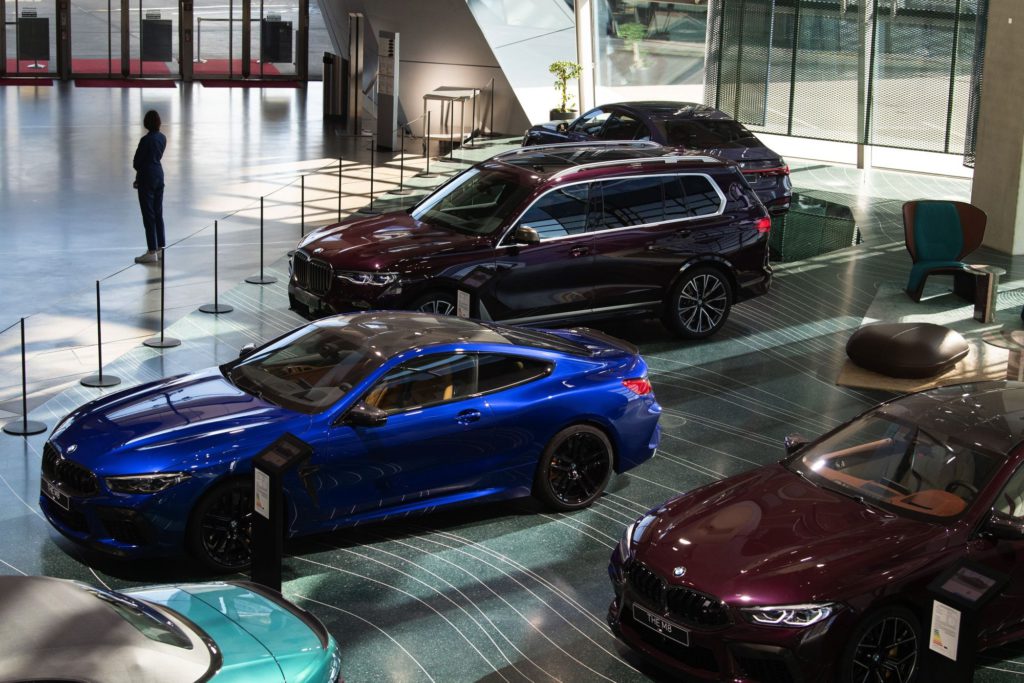
Stellantis NV on Thursday said consumers in Europe are slightly dialing back car purchases, joining Germany’s BMW AG in warning the region is on the backfoot due to surging costs for anything from energy to lending.

Carmakers long defied economic headwinds thanks to robust demand for their priciest models, with Stellantis and BMW reporting rising sales and earnings on Thursday, and Mercedes-Benz AG raising its outlook for the second consecutive quarter last month. Still, economic headwinds are building. Volkswagen AG last week cut its sales projection for the year, citing scarce semiconductor availability and persisting logistics challenges.

Demand in Europe “will level off slightly” as some markets experience double-digit inflation rates, BMW Chief Financial Officer Nicolas Peter said on a call with reporters. The trend is more pronounced in northern European countries than in the South, including France and Italy, where cost increases have been less prevalent. 

BMW declined as much as 6.5% in Frankfurt, the steepest intraday drop since August, and was 4.8% lower at 12:17 p.m. Stellantis fell as much as 3.2% in Paris.

Logistics Issues

So far, the auto industry has been shielded from the downturn by pent-up demand as parts shortages and logistics issues continue to weigh on production.

Stellantis’s vehicle inventory has ballooned 54% to 275,000 units since the start of the year — orders that should protect the maker of Ram pickups and Fiat cars in the near term, according to Chief Financial Officer Richard Palmer. Still, the executive said he’s “carefully” watching how future orders develop.

“The macro environment is clearly very challenging, particularly in Europe,” Palmer said on a call with reporters. “I wouldn’t be at all surprised if we were to see some demand softening into the middle over next year.”

BMW reported better-than-expected earnings in the third quarter as higher prices for the carmaker’s top-end models helped offset flat deliveries. But the manufacturer only confirmed its full-year guidance, which may disappoint some investors who were expecting a forecast hike, RBC analyst Tom Narayan said in a note.

BMW doesn’t currently anticipate production disruptions due to energy shortages this year and sees a jump in vehicle deliveries in the current quarter from the three months through September.

As the outlook darkens, automakers are under pressure to finance ambitious electric-car rollout plans. Stellantis is targeting more than 75 fully electric models by 2030 with annual sales of 5 million vehicles, while maintaining double-digit returns over that time. 

BMW sees sales of EVs like its iX3 sport utility vehicle jumping 70% next year after they more than doubled in the first nine months of this year. 

Last month, the German carmaker said it’s investing $1.7 billion to expand its US plant in South Carolina to build six new EV models by the end of this decade for the local market.

(Updates with BMW CFO comment in fourth paragraph)

More stories like this are available on bloomberg.com

©2022 Bloomberg L.P.

Tesla’s Twitter Overhang Has Only Just Begun

(Bloomberg) —

The phrase “Twitter overhang” was inescapable among Elon Musk’s biggest fans on the social media platform he started pursuing seven months ago.

Tesla shares fell into a funk after Musk took a stake in Twitter, agreed to buy it and then tried to wiggle out of the deal. Bulls theorized that the stock would recover once the saga was over. Some even celebrated when the deal closed last week by selling merch with the words “Twitter Overhang Lifted” and an arrow pointing to the moon.

So much for that.

Tesla shares didn’t react much after Musk clinched the acquisition, then took a whack along with much of the market Wednesday, when Federal Reserve Chairman Jerome Powell said the central bank will keep raising interest rates to tame inflation. The stock is now trading below where it was when the Twitter deal closed, and monetary policy may be the least of the carmaker’s concerns over the coming months.

It’s long been the case that Tesla is on one hand highly dependent on Musk, and on the other hand had to share its chief executive officer with his several other businesses. “Although Mr. Musk spends significant time with Tesla and is highly active in our management, he does not devote his full time and attention to Tesla,” the company says in quarterly filings.

Now that the Technoking is also Chief Twit, he’s up to running five enterprises: Tesla, SpaceX, Twitter, Neuralink and The Boring Company. And anyone who thought Musk would draw clear lines between his newest venture and his most valuable one hasn’t been paying attention.

Before Musk officially closed his deal, it began to sink in that Twitter’s problems had become Tesla’s, at least to a degree. Bloomberg was first to report that Musk had asked some of the car manufacturer’s engineers to meet with product leaders at the social media company’s San Francisco headquarters and review its code.

According to CNBC, dozens of the more than 50 Tesla staffers dispatched to Twitter were uprooted from Tesla’s Autopilot team. That group is familiar with being under the gun, having been unable to realize their leader’s self-driving vision. Last week, it emerged that statements the company has made about its technology are being investigated by the US Justice Department and Securities and Exchange Commission.

Even if the Tesla engineers’ detour ends up being short-lived, there are other ways Twitter could continue to drag on the electric-vehicle leader. The company recently disrupted three China-based operations that were covertly trying to use the service to influence American politics in the months leading up the midterm elections, the Washington Post reported this week.

Tesla is now caught between a rock and a hard place, facing potential blowback from China if Twitter continues to thwart these sorts of influence campaigns, or from the US if it fails to do so.

And Tesla has an awful lot at stake: its factory in Shanghai has quickly become its most productive and important in the world, with stated capacity to make more than 750,000 vehicles a year. The company derives almost a quarter of its revenue from China — more than $5.1 billion just last quarter. Musk’s dependence on the Chinese Communist Party already was a concern in Washington, and lawmakers’ qualms will only be exacerbated by his ownership of Twitter.

When Alex Stamos, the former chief security officer of Facebook, posited last week that Musk had made “a huge mistake,” he called out precisely these risks.

“The people who should really be angry are $TSLA shareholders,” Stamos tweeted. “The company they partially own has now become the key hostage for countries looking to control the future of online speech.”

If key shareholders are upset, they aren’t being public about it yet, though that could change. Tesla has given investors until Dec. 22 to submit proposals to be included in its next proxy statement. The company has scheduled its annual meeting for May 16.

More stories like this are available on bloomberg.com

©2022 Bloomberg L.P.

UK Farmers Earn More Money as Social Media Influencers After Rough Year

(Bloomberg) — British farmers are facing a difficult harvest. Costs are up almost a third from last year according to government figures, low rainfall and record temperatures have led to poor yields and labour shortages mean some crops are left rotting in the fields.In a bid to diversify their income, some farmers are turning to social media. American farmers started showing off their lives and work a few years ago, now their UK counterparts are following suit to boost unstable incomes. Some are making more money from YouTube than growing food.

Olly Harrison, a cereals farmer in Merseyside, said he’s made £55,000 on his YouTube channel in the last year — compared to a loss of £240,000 on his farm, due to bad weather and rising input prices. He expected to pull in “at least £8,000” from advertisements in October, an amount that will go into “propping up” his farm. Harrison has expanded his online business into merchandise, including branded hats and calendars printed with pictures of his farm.

He started uploading 10-minute videos about life on the farm every day since the beginning of lockdown in March 2020, so far gaining over 51,000 followers to his channel “Olly Blogs Agricontract farmer.” His videos have received over 21 million views in total, a number that is so high that Harrison said he was invited to speak to someone in Google’s London office.

“[YouTube] is pure profit,” he said, comparing its relatively high margins to the wafer-thin ones in agriculture, which would require an £80,000 monthly revenue to take home as much. He added that the amount he will make this year is roughly equivalent to his farming subsidy, which are being reviewed post-Brexit.

Ian Pullen, who farms mostly cattle on 60 acres in Gloucestershire, said his YouTube channel currently makes as much as the cattle on his farm. His 37,000 subscribers follow daily videos which show him dredging ditches and spreading muck. He raised enough money to buy a new barn last year.

Pullen says that one of the chief problems on his farm this year has been spiraling costs. He recently bought 11 tonnes of fertilizer for £10,000 — while the same amount would have cost £3,000 three years ago.

While UK inflation hit 10.1% in September, the rate for farm inputs has soared about three times higher with a rate of 30.7%, according to the Agricultural Price Index. Figures compiled by the AF procurement group show that fertilizer prices have more than doubled in a year, fuel was 43% more expensive and livestock feed and medicine was 36% more expensive than the same time last year.

But farmers who know the ups and downs of agriculture are also wary that YouTube income might not be guaranteed forever. Pullen said while online income was a “godsend,” it could be “gone tomorrow” if social media companies change how they operate.

The all-year income from social media is welcome income diversification for farms that have limited growing seasons, like Sarah Gray’s half-acre flower growing plot. She can only sell flowers from her East Yorkshire farm between April and October, but her YouTube channel brings in £500 to £600 a month year-round. As well as making money from advertising, she sells access to pre-recorded video tutorials, which she said are purchased as far away as New Zealand.

Mistakes or bad luck with the weather is not good for farming flowers, YouTube users can be more forgiving. “It kind of doesn’t matter if I get failures growing the flowers,” she said. “People like to see my failures as well my successes, so I’ll still always get revenue.”

While the YouTube income is welcome, some farmers would rather pack up their cameras and make the money in more traditional ways. “I would give it all up tomorrow just for a profit on the farm,” said Harrison.

More stories like this are available on bloomberg.com

©2022 Bloomberg L.P.

ICE-Backed Bakkt to Buy Apex Crypto for Up to $200 Million

(Bloomberg) — Bakkt Holdings Inc., a digital-asset platform majority owned by Intercontinental Exchange Inc., agreed to buy Apex Crypto LLC for as much as $200 million to expand its product offering.

Bakkt will pay $55 million in cash to acquire the unit owned by Apex Fintech Solutions Inc., according to a statement from the buyer. Bakkt has also offered up to $45 million of its own stock, contingent on Apex Crypto hitting certain targets.

An additional $100 million of Bakkt stock and so-called “seller notes” may be paid if Apex Crypto meets certain goals through 2025. The deal is expected to be completed in the first half of 2023. Bakkt and Apex Fintech Solutions will sign an agreement to continue to collaborate commercially.

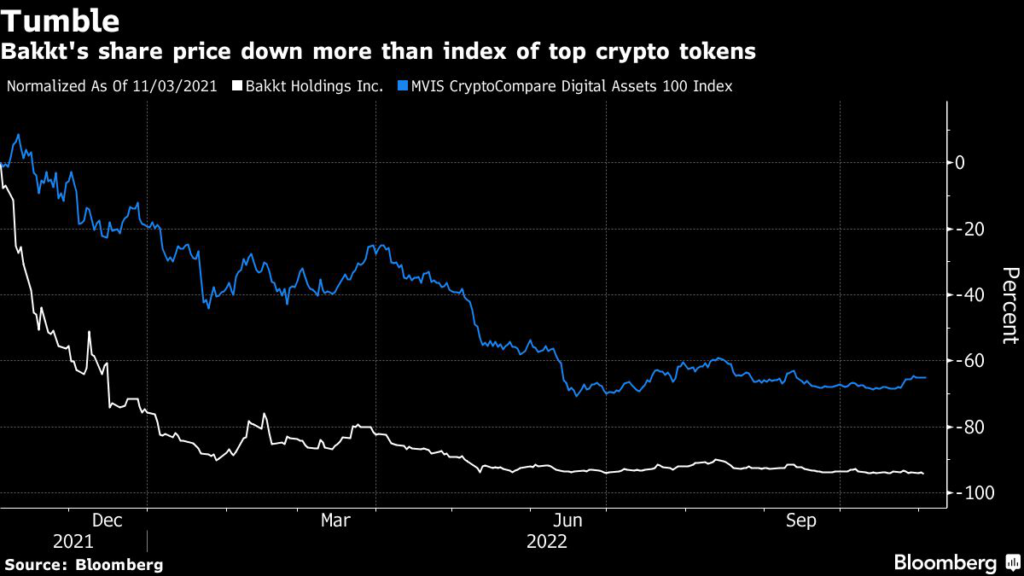
Bakkt joins a flurry of crypto industry consolidation following this year’s rout in digital assets. Its own stock has tumbled more than 75% this year. 

Through the announced acquisition, it is seeking to expand work with financial technology firms, with Apex Crypto currently servicing dozens of clients in that space to help facilitate crypto trading, clearing and custody. The Apex unit was started in 2019, one year after the formation of Bakkt within ICE.

While Bakkt was a digital asset darling for investors as it went public through a blank-check company deal last year, the plunge in its stock has spurred more than $1 billion worth of estimated impairment losses. ICE has written its holding down to $400 million from $1.5 billion at the end of June. 

More stories like this are available on bloomberg.com

©2022 Bloomberg L.P.

Nasdaq Bulls’ Remarkable Optimism Holds Firm as the Fed and Earnings Sting

(Bloomberg) — Even now, after a 34% plunge in the Nasdaq 100 Index that’s wiped $6.7 trillion off the benchmark’s value from its peak a year ago, investors are worried about missing out on the next big rally in technology stocks.

The remarkable optimism of everyone from growth-fund managers to Wall Street analysts and mom and pop traders has held up through raging inflation, Federal Reserve interest rate increases, disappointing earnings and a slowing economy. The Nasdaq 100 fell 3.4% Wednesday after the central bank’s latest move.

Investors don’t deny the headwinds, but with the November Fed meeting and third-quarter earnings now in the rear-view mirror, there’s optimism that the biggest shoes have dropped, leaving valuations at more attractive levels.

“We’re comfortable looking through the current headwinds and volatility, and we’re comfortable with our conclusion that these are very strong businesses that are going through a bit of a reset in expectations,” said Eric Schoenstein, chief investment officer at Jensen Investment Management, which counts Apple Inc., Microsoft Corp., and Alphabet Inc. among its top holdings. “Arguably, it has gotten a bit overdone,” he said of the selloff.

The Nasdaq 100 closed at a record high almost a year ago, Nov. 19, 2021. Many of its biggest companies have fallen even more than the benchmark since then, and the losses are mounting. Amazon.com Inc. fell Wednesday for a sixth straight session, ending at its lowest since March 2020, while Microsoft and Google parent Alphabet closed at their lowest since January 2021. Meta Platforms Inc. ended at its lowest since 2015.

Big tech remains broadly liked. Of Wall Street’s four largest companies — Apple, Microsoft, Alphabet and Amazon — the percentage of analysts with buy ratings ranges from a low of 75% at Apple to about 95% for Amazon. 

And far from being deterred by recent weakness, retail investors have stepped up their purchases, according to Vanda Research. 

“The selloff in mega caps was seen as a buy-the-dip opportunity rather than a capitulation moment,” wrote Vanda senior vice president Marco Iachini, who speculated the buying was a function of both earnings and FOMO — a fear of missing out.

This year’s drop has the Nasdaq 100 trading at about 19 times forward earnings, a discount to its 10-year average. And bulls point out that revenue growth at tech companies is expected to outpace that of the overall S&P 500 in both 2023 and 2024. Earnings are also expected to grow faster than the benchmark in 2024.

“We’re hopeful that the latest outlooks we got from companies reflect that the worst is behind us, from the perspective of downward estimate revisions,” said Chris Shipley, chief investment strategist for North America at Northern Trust Asset Management. “Hopefully they’ve cleared the decks for the near- to intermediate-term. That should help stocks start to form a bottom.”

He conceded that “fundamentals are likely to be sluggish for a while,” but that some big tech companies “clearly have attractive long-term prospects.”

Still, last week’s results pointed to further pressure on earnings. Tech companies in the S&P 500 now are expected to report earnings growth of 1.4% in 2023, down from the 10.5% pace expected in late June, according to data compiled by Bloomberg Intelligence. For the overall index, the consensus has dropped to 4.4% growth from 9.3% over the same period. Estimates for tech companies’ revenue growth has been halved since late June.

And optimism about the group among investors is hardly unanimous. Solita Marcelli, Americas chief investment officer at UBS Global Wealth Management, expects tech will see more pressure going forward.

“Investment in technology seems to be already slowing, and we think a deterioration in corporate profits and confidence will set up a more difficult 2023,” she wrote this week. While valuations already price in a reasonable downside scenario, “there is an exceptionally high level of uncertainty,” and this earnings season has featured “disappointments galore.”


Tech Chart of the Day

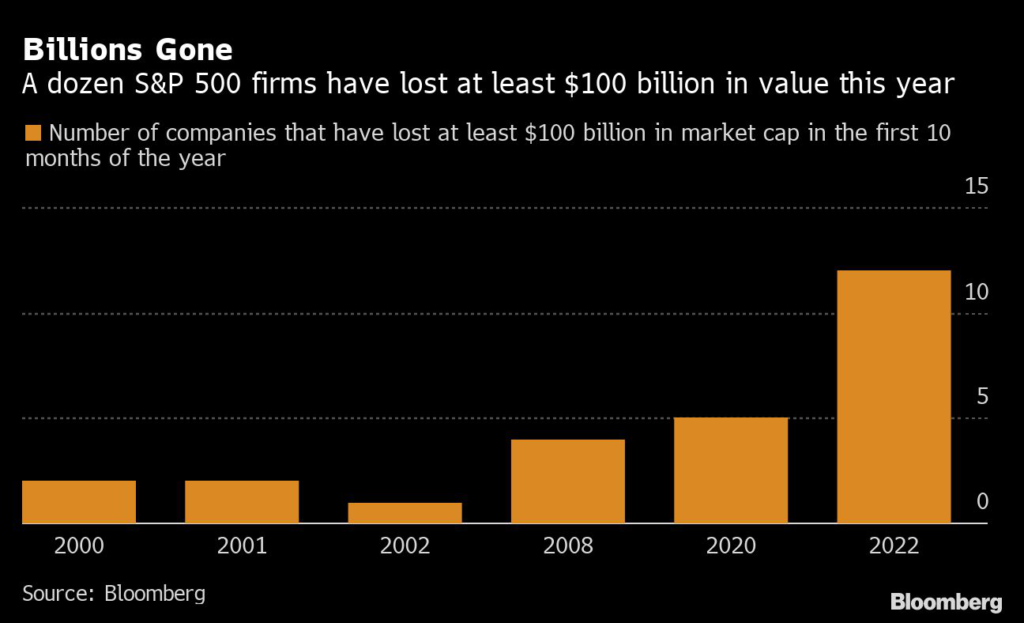
A dozen S&P 500 components have lost at least $100 billion in market value in the first 10 months of the year. The group is led by tech megacaps: Microsoft, Alphabet, Meta Platforms, Amazon and Apple have seen a combined market value of $4.7 trillion wiped out as of Oct. 31. The Windows software maker and General Electric Co. have each made the list three times. 

Top Tech Stories

  • Elon Musk plans to eliminate about 3,700 jobs at Twitter Inc., or half of the social media company’s workforce, in a bid to drive down costs following his $44 billion acquisition, according to people with knowledge of the matter.
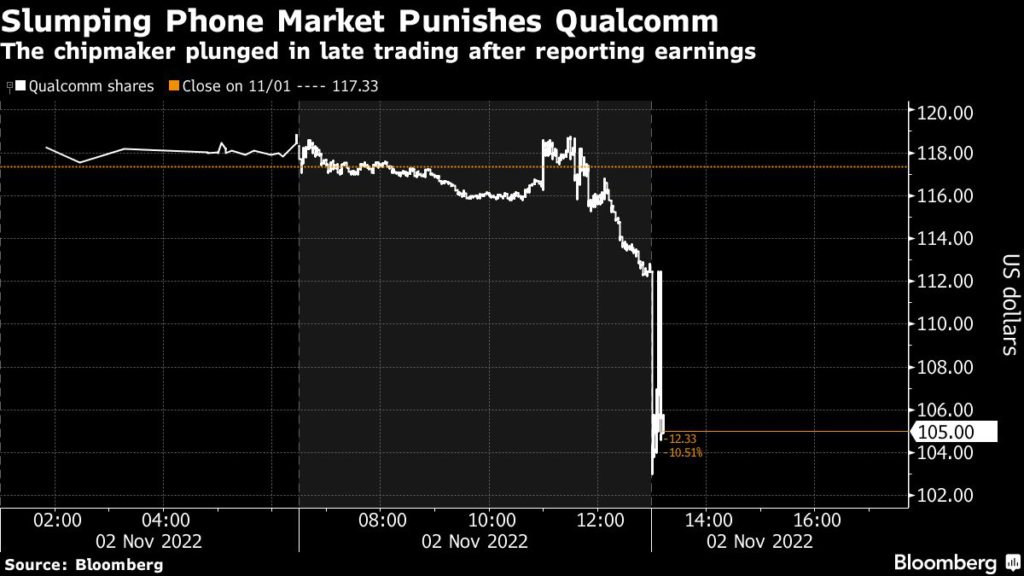
  • Qualcomm Inc., the biggest maker of smartphone processors, tumbled in late trading after giving a far weaker forecast than expected, punished by the economic slowdown and Covid-19 lockdowns in China.
    • Qualcomm will continue to provide the modem chips for the “vast majority” of iPhones in 2023, a turnabout for a company that had expected to lose the business to Apple’s homegrown components.
  • Media giant News Corp. has hired a new lobbyist to aid its ongoing fight against the country’s largest technology companies.
  • For years, Facebook, Amazon, Apple, Netflix and Google—the revered FAANG companies—were great investments. But Meta Platforms Inc.’s meltdown shows how big tech’s invincible era is over.
  • Venture capital investments in China are falling sharply this year, making it one of the worst-performing countries globally after the Communist Party’s crackdown and an overall decline in tech valuations.
  • Lenovo Group Ltd.’s earnings climbed 6% after China’s top PC maker relied on cost reductions and new businesses to weather an unprecedented slump in global computing demand.
  • Production at Foxconn’s iPhone factory in China’s Zhengzhou city is “basically normal,” an official from the Zhengzhou Airport Economy Zone, where the plant is located, said in a briefing. China on Wednesday locked down the world’s largest iPhone factory, declaring the zone off-limits to combat a local Covid-19 outbreak.
  • KKR & Co. is seen as the party to beat as it competes with Cellnex Telecom SA in the final race for a stake in Vodafone Group Plc’s towers unit, people with knowledge of the matter said.
  • Facing flagging global demand for smartphones, Chinese producer Xiaomi Corp. has given a novel one-off redesign to its flagship smartphone to remind people it has a very powerful camera inside — by strapping a Leica lens to it.

–With assistance from Subrat Patnaik and Tom Contiliano.

More stories like this are available on bloomberg.com

©2022 Bloomberg L.P.

Qualcomm Gives Downbeat Forecast as Phone Market Deteriorates

(Bloomberg) — Qualcomm Inc., the biggest maker of smartphone processors, tumbled in pre-market trading after giving a far weaker forecast than expected, punished by the economic slowdown and Covid-19 lockdowns in China. 

Revenue will be $9.2 billion to $10 billion in the fiscal first quarter, Qualcomm said Wednesday. That compares with an average analyst estimate of $12 billion. Excluding certain items, earnings will be $2.45 a share at best, Qualcomm said. The average projection was $3.40.

Qualcomm is coping with the slowdown in part by freezing hiring, executives said during a conference call. The buildup of extra inventory may take two quarters to clear, the company said. 

Qualcomm Slips on China, Android Demand Weakness: Street Wrap

The outlook showed that the market for consumer devices is eroding faster than feared, sending Qualcomm shares plunging as much as 7.2% in pre-market trading on Thursday. Even before the report, the stock was down 38% this year, hurt by concerns that smartphone demand was on shaky ground.

“The further deterioration of the macroeconomic environment and sustained Covid restrictions in China have led to broad-based demand weakening across tiers and regions,” the San Diego-based company said in a presentation to investors.

Chief Executive Officer Cristiano Amon has said that his tenure will be defined by how successful he is in pushing the chipmaker’s technology into new areas, including automotive equipment, networking and computers. While Qualcomm is getting more revenue from those newer efforts, the bulk of its sales still comes from phones, limiting the company’s overall growth.

Qualcomm’s main product is the processor that runs many of the world’s smartphones. It also sells the modem chips that connect Apple Inc.’s iPhone to high-speed data networks.

Three months ago, Qualcomm slashed its projection for smartphone shipments, predicting a decline in the mid-single-digit percentage range in 2022 from the prior year. Phone makers have been working through excess inventory before they return to ordering.

Now the picture is even more bleak. The phone market will contract in the low-double-digit percent range, and excess inventory will continue to be a drag on orders throughout the fiscal first quarter, Qualcomm said.

There is one silver lining, though. The company had expected Apple to start replacing most of Qualcomm’s 5G modems in the iPhone next year with homegrown parts. That’s no longer expected to happen in 2023.

Apple has weathered the smartphone slowdown better than many companies in the industry, but it too saw some softness last quarter. The iPhone, Apple’s flagship device, generated about $42.6 billion in the period, slightly less than analysts had projected.

Overall, Apple delivered strong results, bucking the trend of weak technology earnings this season. But the specter of higher interest rates has loomed over the company. Apple and Microsoft Corp. led tech stocks lower Wednesday after Federal Reserve Chair Jerome Powell suggested it was too early to think about pausing rate hikes.

Apple also has suffered from Covid disruptions in China, including the lockdown of a Foxconn Technology Group complex in Zhengzhou this week.

At Qualcomm, fiscal fourth-quarter revenue was $11.4 billion, in line with estimates. Profit in the period, which ended Sept. 25, was $3.13 a share, excluding some items. That also matched projections.

In addition to selling smartphone chips, Qualcomm licenses the fundamental technology that underpins modern phone networks. And even phone makers that don’t rely on its chips pay to use its intellectual property.

“While our financial outlook has been temporarily impacted by elevated channel inventory, our diversification strategy and long-term opportunities remain unchanged,” Amon said in a prepared statement.

(Updates with hiring freeze in third paragraph.)

More stories like this are available on bloomberg.com

©2022 Bloomberg L.P.
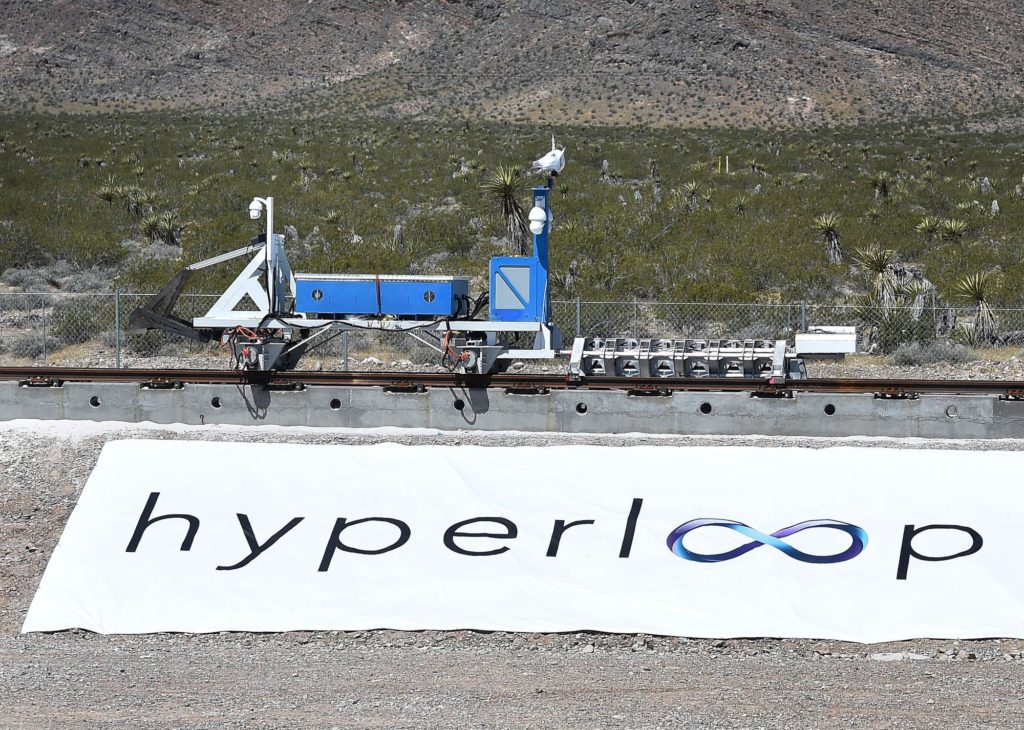
Musk’s SpaceX Dismantles Hyperloop Prototype, Puts Up a Parking Lot

(Bloomberg) — Erik Wright was thrilled when he got the news in 2016 that his business had been selected to help with an ambitious technology project: building the prototype tunnel for Elon Musk’s Hyperloop. The initiative was envisioned as a test run for a futuristic transportation system involving levitating pods hurtling through tubes at speeds of hundreds of miles per hour. Earlier this year, Wright got a text with an update on the tunnel: It was slated to be torn down. 

The demise of the test tunnel — a roughly mile-long white cylinder running along Jack Northrop Avenue near the Space Exploration Technologies Corp. office in Hawthorne, California — is symbolic of a larger retreat. While Musk still says he wants to build a Hyperloop, the project has been indefinitely shelved. Musk did end up founding a tunnel-based company called Boring Co., but it falls short of levitation and jet-like speeds. Instead, at its transit system in Las Vegas, Teslas drive conference-goers through dedicated subterranean roads at a ho-hum pace.

Boring Co. and SpaceX representatives didn’t respond to requests for comment. 

Still, Wright said, the short-lived test project remains a highlight of his career. Back when his company, San Luis Obispo, California-based Precision Construction Services, took the work, it was a small firm with just a handful of accomplishments. Since then, it has landed several high profile gigs, including building a 3D printing lab for the US Centers for Disease Control and Prevention and work on various launch facilities at Vandenberg Space Force Base.

“The Hyperloop is quite a badge of honor for us,” Wright said. It even helped the company land several non-transportation contracts, such as an 8,000 square foot climbing gym. Customers told him, “If you built the Hyperloop, you can definitely build my project,” he said.

Before it was torn down, the Hawthorne Hyperloop test tunnel served as a proving ground for would-be Hyperloop technology. Starting in 2017, it hosted student competitions for running Hyperloop pods at high speeds. 

Construction engineering firm Aecom designed and built the tunnel’s foundation and steel tube. Precision was responsible for everything inside the tube, including the concrete subtrack, concrete joints, the aluminum track and the interior lighting. Each of those components expands and contracts at different rates, making it hard to meet the forty-thousandths-of-an-inch measuring requirements.

After he learned the tunnel’s fate a few months ago via group text, Wright got on a video call with other contractors who worked on the project. The call was a remembrance. “We had a sentimental moment knowing this was going to be taken down,” he said. “Like a memorial service.” 

Today, the Boring Co. has expansive plans for its Las Vegas transportation network. But there hasn’t been any sign of a return to the ambitious dream of superfast pods — despite the occasional tantalizing tweet from Musk. Still, Wright hasn’t given up on a future Hyperloop system emerging one day, and credits the Boring Co. with taking things in the right direction.

In the meantime, last week no trace of the Hyperloop tube remained on Jack Northrop Avenue. A team of workers wearing hard hats dug and made measurements. A local city council member said parking spots for SpaceX workers would soon line the street in the spot where the tunnel once ran. 

More stories like this are available on bloomberg.com

©2022 Bloomberg L.P.
India’s Crypto Taxes May ‘Kill the Industry,’ Binance CEO Says

(Bloomberg) — Binance Holding Ltd. Chief Executive Officer Zhao “CZ” Changpeng said India’s onerous taxes on cryptocurrency transactions will probably “kill the industry” there. 

“India has high tax which is probably going to kill the industry,” Zhao said in livestreamed remarks during panel at a fintech conference in Singapore on Thursday. 

Read more: Why India Blows Hot and Cold in Dealing With Crypto: QuickTake

Zhao’s comments add to a litany of warnings on the outlook for India’s crypto industry, after the government this year introduced a tax package that’s caused trading volumes to evaporate. Instead of introducing comprehensive regulations, India has opted for heavy taxes on capital gains and transactions to curtail the business. 

ZebPay, one of India’s oldest crypto exchanges, is looking overseas for growth, CEO Avinash Shekhar said last month, adding that the 1% transaction tax “has to come down, otherwise things are not going to improve.”

More stories like this are available on bloomberg.com

©2022 Bloomberg L.P.

Sorrell Says ‘Meta Is the Issue,’ Twitter Inconsistent But Tiny

(Bloomberg) — Advertising mogul Martin Sorrell said that despite problems at Elon Musk’s Twitter Inc., the real concern in online advertising is Facebook-owner Meta Platforms Inc.

“Meta is the issue,” WPP Plc founder and S4 Capital Plc chairman Sorrell told Bloomberg TV at the Web Summit conference in Lisbon, Portugal on Thursday, when asked about weakness in digital advertising. “Snap and Twitter, they’re not exactly rounding errors, but each of those two platforms is about 1% of global digital media.”

He said the four key digital advertising platforms are Alphabet Inc., Meta, Amazon.com Inc. and Bytedance Ltd.’s TikTok. Meta and Amazon shares have both tumbled in recent days after they missed earnings forecasts.

Read more: Meta Plummets 25%; Zuckerberg Plea for ‘Patience’ Falls Flat

Following billionaire Musk’s controversial $44 billion take-private of Twitter, S4’s clients are adopting a “wait-and-see” approach to the platform, Sorrell said. Rivals such as agency holding company Interpublic Group Co. have advised pausing Twitter marketing, Variety reported earlier this week, citing an unnamed source.

“It’s not clear yet from Elon Musk where he is” on moderation, Sorrell said. “The question is: how is that going to operate?”

“Clients don’t want conflict, they don’t want controversy,” he added. “They want a stable environment, and what we’ve seen in the last week or so is too much inconsistency.” 

Twitter has historically been inflexible with advertisers and contracts, Sorrell said — advising that it needed to “listen more” and set out a moderation policy. Last week Musk tweeted an open letter to marketers in which he said he wants to make Twitter “the most respected advertising platform in the world.”

A spokesperson for Meta didn’t immediately respond to a request for comment.

More stories like this are available on bloomberg.com

©2022 Bloomberg L.P.
KKR Vies With Cellnex for $14 Billion Vodafone Tower Arm

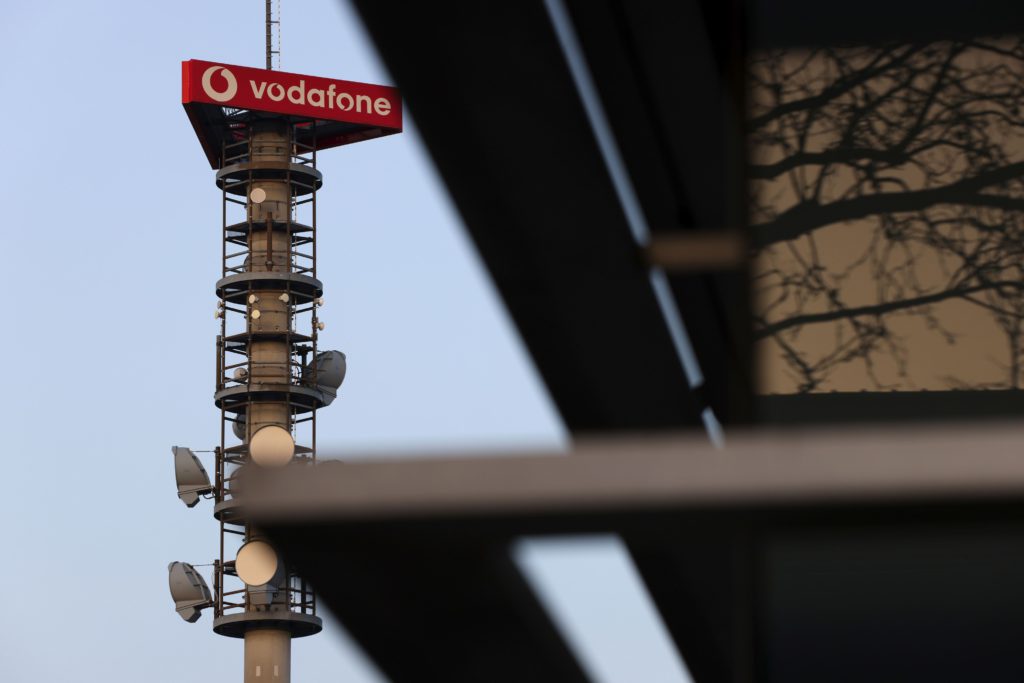
(Bloomberg) — KKR & Co. is seen as the party to beat as it competes with Cellnex Telecom SA in the final race for a stake in Vodafone Group Plc’s towers unit, people with knowledge of the matter said. 

The private equity firm, which has teamed up with Global Infrastructure Partners, is in pole position as Vodafone evaluates the binding offers it received last week for a stake in Frankfurt-listed Vantage Towers AG, the people said. 

Cellnex is bidding together with Singapore sovereign wealth fund GIC Pte, the people said, asking not to be identified because the information is private. Cellnex is seeking to buy a majority stake that would give it operational control, one of the people said. 

Shares in Vantage rose as much as 3.5% on Thursday. The stock was up 2.4% at 10:31 a.m in Frankfurt, giving the company a market value of €14.3 billion ($14 billion). A raft of private equity and strategic bidders, including EQT AB and American Tower Corp., have previously shown interest in a deal for Vantage, Bloomberg News has reported. 

While the KKR-led group aims to seal a deal as early as next week, the situation remains fluid, the people said. They want to avoid a repeat of their last-minute loss in July in the auction for a majority stake in Deutsche Telekom AG’s tower unit, which eventually went to Brookfield Asset Management Inc. and DigitalBridge Group Inc.

Vodafone, which owns 82% of the tower business, could aim to reach an agreement by the time of its Nov. 15 half-year results announcement. The company continues to study the bids and hasn’t yet picked a winner, according to the people.

Representatives for Cellnex, KKR and Vodafone declined to comment. Representatives for GIC and GIP didn’t immediately respond to requests for comment. 

Strong Demand

Europe’s phone carriers have started to sell off infrastructure assets to raise money for investments in costly fiber-optic rollouts and wireless network upgrades, as well as to cut their large debt piles. Telefonica SA and Liberty Global Plc are weighing a sale of their stake in a UK towers venture to help raise funds for fiber broadband investments, people familiar with the matter said last month.

These assets are attractive to investment firms thanks to their steady and predictable returns. Such is the strength of demand for them that the sector has been helping dealmakers defy a broader slowdown in global mergers and acquisitions activity this year. 

Bloomberg News reported this week that EQT is emerging as the frontrunner to acquire a stake in French telecom tower owner TDF. 

–With assistance from Eyk Henning, Rodrigo Orihuela and Aaron Kirchfeld.

(Updates shares in fourth paragraph.)

More stories like this are available on bloomberg.com

©2022 Bloomberg L.P.
Close Bitnami banner
Bitnami