Bloomberg

Ethereum’s Buterin Says Musk’s Twitter May Face More Competition

(Bloomberg) — Vitalik Buterin, co-founder of the Ethereum blockchain, said more rivals to Twitter Inc. could spring up amid a push for a better social media experience.

Buterin, speaking at the Singapore FinTech Festival on Thursday, said he’s “hopeful in the next five to 10 years there’s going to be some kind of better social media platform” whether that’s “Twitter itself or whether we’ll see a big ground-swelling with alternatives — we could even see both.”

He said one of the problems on Twitter that bugs him is the way other accounts try to leverage his posts and profile to market highly speculative cryptocurrency tokens that often lack any rules of operation.

Buterin was responding to questions about Twitter following Elon Musk’s $44 billion acquisition of the the company. Musk plans to eliminate half of the social media company’s workforce to cut costs, according to people familiar with the matter.

“Elon is a very high variance actor,” Buterin said. He could make Twitter “really great” or “really terrible” — and the latter scenario might open up “opportunities for other people to do something great.” 

Twitter may also end up somewhere in the middle between those two extreme outcomes, Buterin added.

The Ethereum network Buterin helped to create is the most important blockchain commercially, facilitating an array of financial applications. Buterin said he intends to maintain a leadership role at Ethereum but that he wants to create space for others to contribute as well. 

More stories like this are available on bloomberg.com

©2022 Bloomberg L.P.

Xiaomi Flaunts Phone With Detachable Leica Lens as Sales Drop

(Bloomberg) — Facing flagging global demand for smartphones, Chinese producer Xiaomi Corp. has given a novel one-off redesign to its flagship smartphone to remind people it has a very powerful camera inside — by strapping a Leica lens to it.

The Xiaomi 12S Ultra Concept features a removable mounted lens bearing the branding of Leica Camera AG, its celebrated photography partner, and an additional sensor. While the concept will not itself go on sale, Xiaomi’s hope is that consumers will track down the device with more conventional lenses attached, the 12S Ultra phone, which has a large one-inch sensor co-developed with Leica.

Xiaomi, which was once China’s largest smartphone brand, has been hit hard by a global slump, as headwinds like rising interest rates and inflation hurt consumer demand. At the same time, the company is facing stiff competition and a gloomy consumer outlook at home, alongside possible restrictions on sales in the high-growth Indian market. Its Hong Kong-listed stock has lost more than half its value this year, and its profit fell more than expected — by 83% — in the second quarter.

Chinese phone makers have sought to attract customers through collaborations with storied European photo brands like Leica, which previously worked with Huawei Technologies. Carl Zeiss AG, meanwhile, partners with Vivo, while Hasselblad’s name graces Oppo devices.

Japan’s Panasonic Holdings Corp. developed an Android handset with an extensible Leica lens in 2014, though it failed to find commercial success.

More stories like this are available on bloomberg.com

©2022 Bloomberg L.P.

China’s Venture Funding Tumbles Precipitously After Crackdown

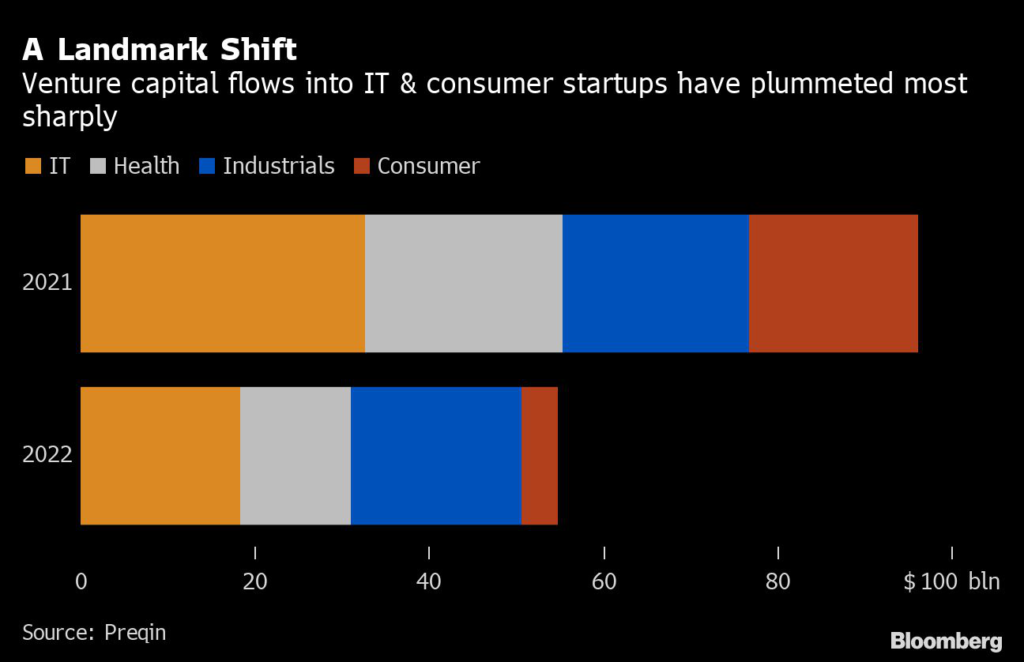
(Bloomberg) — Venture capital investments in China are falling sharply this year, making it one of the worst-performing countries globally after the Communist Party’s crackdown and an overall decline in tech valuations.

The value of venture capital deals in the country tumbled 44% to $62.1 billion through October, compared with the same period in 2021, according to research firm Preqin. China once rivaled the US for capital invested in startups, before Xi Jinping’s administration embarked on sweeping efforts to reform the practices of giants like Alibaba Group Holding Ltd. and Tencent Holdings Ltd. 

In addition, venture firms have pulled back globally as investors sour on money-losing technology companies and publicly traded stocks tumble. Still, China is among the worst performers, with a venture investment drop that is worse than the global decline and the pullback in the US. 

“The cost of capital has gone up dramatically,” Jenny Lee, a managing partner at GGV Capital, said this week during a panel at Hong Kong FinTech Week. “Every dollar that we have today now has a price.”

Read more: Bankers Replaced by Tech PhDs as Xi Sparks New Fund Talent War

One bright spot in China’s venture landscape has been the semiconductor sector, which has drawn $7.9 billion in deals so far in 2022 — a 24% increase compared to the same period last year. Xi has made it a national priority for China to build up its own semiconductor industry, an undertaking with fresh urgency after the US enacted broad measures to ban exports of chips to China and prohibit Americans from working in certain positions of its semiconductor sector. 

Read more: China’s Xi Vows Victory in Tech Battle After US Chip Curbs

The growing tensions between the US and China have driven many investors to look at investing in regional clusters, GGV’s Lee said. 

Investors have to ask “which technologies may be bifurcated because of the US and China considerations?” she said.

China’s venture landscape has been aggravated by the Communist Party’s harsh Covid Zero policy. Lockdowns in cities like Shanghai and Zhengzhou have hampered all manner of business, from advertising and investments to the production of Tesla Inc. automobiles and Apple Inc. iPhones. Before this year, Chinese venture funding had risen every year except for one in the past decade, Preqin data showed.

More stories like this are available on bloomberg.com

©2022 Bloomberg L.P.

Asian Shares Slip as Powell Primes Further Hikes: Markets Wrap

(Bloomberg) — Asian stocks and currencies fell after Jerome Powell said the Federal Reserve would raise interest rates more than previously anticipated, sapping risk appetite.

Benchmark equity gauges in Asia fell in the wake of the S&P 500’s 2.5% drop, though declines in most markets were less than in the US. Shares in Hong Kong and on the mainland underperformed after an affirmation of the government’s Covid-Zero stance dashed hopes of a reopening.

The Fed raised rates 75 basis points for the fourth time in a row, bringing the top of its target range to 4%, the highest level since 2008. Traders immediately raised the market-implied peak in interest rates for next year. 

“Every time the market gets a little bit of dovish hope, it gets smacked on the nose with a rolled up newspaper,” said Scott Rundell, chief investment officer at Mutual Ltd. “There’s a lot of volatility still ahead.”

Australian and New Zealand bonds tumbled early Thursday in the wake of the Fed meeting. Australia’s policy-sensitive three-year yield jumped more than 10 basis points. There was no cash trading of Treasuries in Asia with Japan on holiday.  

Two-year Treasuries led a selloff on Wednesday following Powell’s comments, but at 4.62% they are still about 40 basis points below the 5.06% peak in yields priced into Fed funds futures. 

“Factoring in the bond market’s assessment, markets are becoming increasingly convinced that the path toward the terminal rate will include a recession,” said Quincy Krosby, chief global strategist at LPL Financial.


Still, the dollar fell against all of its Group-of-10 counterparts as investors pivoted toward US jobs data, which may help to determine the pace of upcoming rate hikes. An index of emerging-market currencies declined. 

“There is likely some profit taking in long dollar positions after the big moves post the FOMC meeting outcome and Powell’s press conference,” said David Forrester, a senior FX strategist at Credit Agricole CIB in Hong Kong.

Wheat prices fell after Russia agreed to resume a deal allowing safe passage of Ukrainian crop exports. Oil dropped after Powell’s comments on interest rates overshadowed tightening supply.

Key events this week:

  • Bank of England rate decision, Thursday
  • US factory orders, durable goods, trade, initial jobless claims, ISM services index, Thursday
  • ECB President Christine Lagarde speaks, Thursday
  • US nonfarm payrolls, unemployment, Friday

Some of the main moves in markets:

Stocks

  • Futures on the S&P 500 rose 0.2% as of 2:43 p.m. Tokyo time. The S&P 500 fell 2.5%
  • Nasdaq 100 futures climbed 0.3%. The Nasdaq 100 fell 3.4%
  • The Hang Seng Index fell 2.6%
  • The Shanghai Composite Index fell 0.3%
  • Australia’s S&P/ASX 200 fell 1.8%
  • Euro Stoxx 50 futures fell 0.6%

Currencies

  • The Bloomberg Dollar Spot Index was little changed
  • The euro rose 0.1% to $0.9828
  • The Japanese yen rose 0.4% to 147.29 per dollar
  • The offshore yuan rose 0.3% to 7.3227 per dollar

Cryptocurrencies

  • Bitcoin rose 0.9% to $20,360.81
  • Ether rose 2.6% to $1,551.16

Bonds

  • The yield on 10-year Treasuries advanced six basis points to 4.10%
  • Australia’s 10-year yield advanced 11 basis points to 3.92%

Commodities

  • West Texas Intermediate crude fell 0.5% to $89.57 a barrel
  • Spot gold rose 0.2% to $1,637.80 an ounce

–With assistance from Georgina Mckay, Matthew Burgess and Michael G. Wilson.

More stories like this are available on bloomberg.com

©2022 Bloomberg L.P.

Carbon-Credit ‘Fraud’ Assumptions Are Challenged in New Study

(Bloomberg) — Voluntary carbon credits might not be as bad as widely assumed, according to new research from carbon credits ratings firm Sylvera.

In an analysis of 337 million carbon credits intended to prevent deforestation, Sylvera said 143 million, or more than 40%, are “high quality,” achieving its top three grades in an assessment covering factors such as a credit’s contribution to avoiding or removing CO2, as well as the permanence of such actions. 

The findings are “contrary to popular belief that all nature-based projects of this kind are unreliable or fraudulent,” the company said in a statement on Wednesday.

Carbon credits allow companies to continue polluting while funding emissions reductions elsewhere in the world. The controversial instruments are lauded by some as a key solution for fighting climate change, while critics, including scholars and activists, say the credits provide a vehicle for greenwashing, distract from meaningful climate action and exploit vulnerable communities on the frontlines of climate change.

Voluntary carbon credits, also known as offsets, represent a metric ton of reduced, removed or avoided greenhouse gas emissions, and are bought by companies and individuals to subtract emissions from their own accounts to declare improved environmental performance. The poor quality of many offsets offered on the market has invited skepticism. Credit Suisse Group AG has referred to the opaque, unregulated industry as a “ wild west.” 

Allister Furey, co-founder and chief executive officer at Sylvera, said in an interview that carbon credits are the “least worst solution” on the table. Offsets can help provide finance for stopping deforestation and removing carbon from the atmosphere, both of which will be needed if the world is to avoid catastrophic levels of warming, he said.A sizeable supply of quality credits gives options to companies that are serious about cutting their emissions, and it also removes an excuse for companies that use a lack of credible credits as a pretext for inaction, said Furey. Quality credits are a “penalty, not a get out of jail card,” he said.  “Everyone is shortchanging the atmosphere, the climate system, and what’s the penalty? There is no penalty,” Furey said. “Offset quality is now not an excuse: You have an economic disincentive to underdeliver.”

Sylvera’s “The State of Carbon Credits 2022” report focuses on deforestation credits issued from “ Reducing Emissions from Deforestation and Forest Degradation” projects, or REDD+.  Nature-based solutions represent one of the largest categories of carbon credits available in the voluntary market at about 45% of all credits, and REDD+ credits make up the lion’s share of those offsets, Sylvera said.The report found 31% of REDD+ offsets projects are “high quality and low risk investments.” This means they have been awarded a ranking of AAA to A in Sylvera’s grading system. The analysis covers carbon performance, additionality, permanence and co-benefits for local benefits. 

Sylvera, a climate tech firm based in London, uses machine learning and satellite imagery to assess the quality of carbon projects. Some 29% of credits fall in the middle of its ratings scale, between BBB and B, while 25% fall in the lowest tier, earning between C and D “due to having red flags in one or more fundamental areas,” it said.

Companies buying offsets to deliver on emissions reduction goals should “stop buying” the bottom tier, “get fussy” over the middle-ranked credits and “get deliberate” about buying the high quality credits, Furey said.

More stories like this are available on bloomberg.com

©2022 Bloomberg L.P.

Another Crypto Investor Is Calling Time After the Market Sank

(Bloomberg) — Protocol Ventures LP, a US-based investor in crypto hedge funds, is to close down and return cash following the slide in the market for digital assets, according to people familiar with the matter.

Notices were sent to investors at the end of October about the move, the people said, asking not to be named because the information isn’t public. The closure will likely be completed by year-end or the first quarter of 2023, one of the people said.

Investors in Protocol’s fund of hedge funds may have lost as much as 90% over the past year, the people said. Protocol declined to comment about the developments at the company.

Protocol Ventures is a fund of crypto hedge funds that invested in the likes of BlockTower Capital, Multicoin Capital, Pantera and Electric Capital. Protocol’s decision to wind down comes amid a broad retrenchment in the digital-asset sector, which is reeling from a $2 trillion rout over the past year.

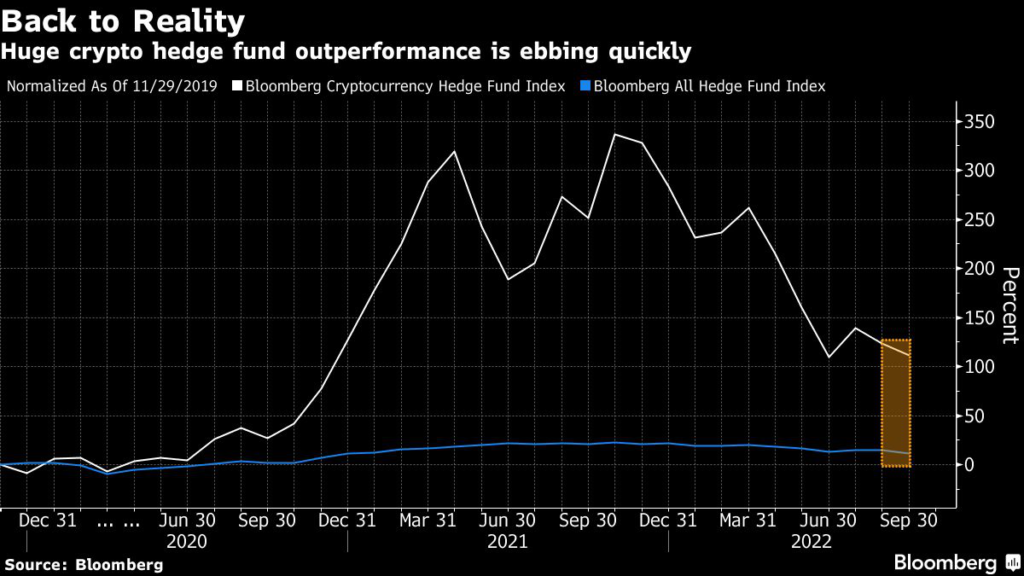
Crypto hedge funds soared in 2021 during a frenzy for speculative investments driven by huge injections of liquidity to ride out the worst of the pandemic.

But that outperformance is rapidly dissipating after central banks globally hiked interest rates to fight inflation. The hawkish shift dramatically tightened financial conditions and sapped the appetite for riskier investments.

The Bloomberg Cryptocurrency Hedge Fund Index has shed 45% this year, compared with a 9% retreat in the Bloomberg All Hedge Fund Index.

More stories like this are available on bloomberg.com

©2022 Bloomberg L.P.

China’s Top PC Maker Posts Profit Above Estimates as Sales Beat

(Bloomberg) — Lenovo Group Ltd.’s earnings beat estimates after China’s top PC maker relied on new businesses to weather an unprecedented slump in global computing demand.

Net income reached $541 million in the quarter ended September, the company said Thursday in a statement. The average analyst estimate was $473 million. Sales declined for the first time in more than two years to $17.1 billion, but still beat the $16.9 billion analysts predicted.

Lenovo and its rivals Dell Technologies Inc. and HP Inc. are struggling with a global PC market that saw its steepest quarterly drop on record — the fourth straight decline in shipments. In Lenovo’s home market, Beijing appears to prioritize Covid Zero over the economy, triggering lockdowns in major cities, smothering retail demand and disrupting manufacturing.

Read more: Intel Is Planning Thousands of Job Cuts in Face of PC Slump

What Bloomberg Intelligence Says

An extended macroeconomic overhang will likely lead to another down year for the PC market in 2023, though there’s scope for a rebound later in the year and potential for a return to growth in 2024. We’ve trimmed our 2023 PC-shipment target by 1% to 281 million, which implies a 3% unit drop. 

– Woo Jin Ho, analyst

Click here for the research.

Beyond China, the global tech outlook is clouded by a plethora of restrictions Washington imposed on chip and technology exports to China last month, which threaten to further curtail shipments to the world’s largest PC and semiconductor market. Industry bellwether Intel Corp. is planning a major reduction in headcount, likely numbering in the thousands, Bloomberg News has reported.

Lenovo has been counting on growth from businesses beyond its bread-and-butter division — such as in servers, cloud computing and data storage — to help offset worsening PC sales. But its core division still yields about four-fifths of revenue.

“Demand cracks are spreading to enterprise hardware end-markets, including PCs and data center infrastructure,” Morgan Stanley analysts wrote this month.

Read more: Global PC Sector Suffers Worst Drop as China Chip Curbs Loom

More stories like this are available on bloomberg.com

©2022 Bloomberg L.P.

Bumpy November Ahead for Kakaopay With Lock-ups, MSCI Pressuring

(Bloomberg) — South Korea’s Kakaopay Corp., part of a group once feted by local investors, is poised for a bumpy month as locked shares become free for trade while MSCI Inc. may refrain from adding the stock to its indexes after the price plunged.

The online payments firm that has Kakao Corp. as its main shareholder executed the country’s fourth-largest initial public offering in Seoul last year, after raising $1.35 billion. The stock sank on Thursday after the expiration of a lock-up period for about 65 million shares held by the company and under an employee equity options program.

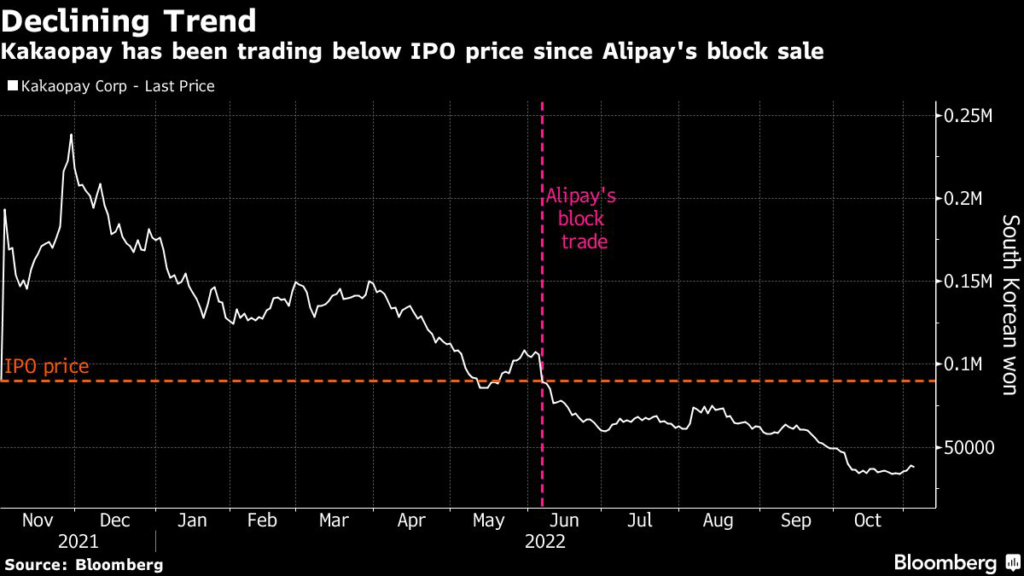
Following an initial rally that was common for startup newcomers in Seoul in 2021, Kakaopay quickly slumped to now trade about 84% lower than a peak reached last year. The selloff deepened last month amid a widespread outage that snared Kakao group shares due to service disruptions and the resignation of a top executive of the parent company. 

Read More: After $50 Billion Slide, More Pain Ahead for Kakao Investors 

Woes regarding the stock were piling up even before that since Alipay Singapore Holding Pte, its second-largest shareholder, sold five million shares in a bunched trade at a discount of about 12% in June. A lock-up period on that block expired last month, allowing the investor to sell more shares anytime. 

The recent stock-price slump makes it harder for Kakaopay to meet criteria that would allow it to be added to benchmarks compiled by MSCI in a review on Nov. 10, according to analysts. An eventual addition would trigger inflows from passive investors and lift the stock from the current price level.

“It is unlikely for Kakaopay to be included in the MSCI Korea index mainly due to its continued decline in share price,” said Douglas Kim, an analyst who publishes on the platform SmartKarma. Despite lower share prices, Kakaopay’s valuation multiples “still remain quite high,” Kim added. 

There were no additional sales by Alipay since the four-month lock-up period that ended Oct. 8, Kakaopay said in a statement to Bloomberg News. “The strategic partnership between Kakaopay and Alipay for expansion in the global payment business is continuing without changes,” the statement said, adding that it is difficult to give any response regarding MSCI’s review. 

Kakaopay “had one of the best listing debuts of 2021. However, the shares haven’t done much since,” said Sumeet Singh, head of equity research, IPOs and placements at Aequitas Research Pvt. “In our view, the prospects of Ant’s Alipay selling some of its stake in KakaoPay in June weren’t well flagged, which led to the tepid post-deal performance.” 

–With assistance from Younlim Lee.

More stories like this are available on bloomberg.com

©2022 Bloomberg L.P.

Germany’s Solo Trip to Beijing Exposes Europe’s Dilemma on China

(Bloomberg) — Chancellor Olaf Scholz will be bringing Germany’s biggest brands to China this week to underscore close economic ties, but he’ll also have to navigate growing concerns about Europe’s broader dependence on Beijing.

The powerhouse delegation — expected to include top executives from BASF SE, Volkswagen AG, Deutsche Bank AG and BioNTech SE — will showcase German success in the world’s second-largest economy. The one-day visit on Friday will also illustrate how much Berlin has to lose as calls grow in Washington, other European capitals and even within Scholz’s own coalition to change course.

After decades of viewing China primarily as a commercial opportunity, Europeans are reexamining the security risks of expanding ties with a country whose leader has declared a “no limits” friendship with Russian President Vladimir Putin. That’s left Germany, which profits from exporting cars and other goods to China, confronting a particularly difficult dilemma: how much should it rely on a market which, like Russia, might suddenly be closed.  

Berlin recognizes that China has changed during President Xi Jinping’s rule and that Germany needs to reduce dependencies in strategic industries, one senior German official said. At the same time, Scholz’s trip demonstrates that Europe’s largest economy views China as a key international player vital to addressing the world’s most pressing challenges, said the official who requested anonymity to share policy goals before the visit.

“We don’t want decoupling from China. But what does China want?” Scholz wrote Wednesday, in a guest article for German newspaper Frankfurter Allgemeine Zeitung, while reiterating his commitment to “reducing one-sided dependencies.”

Read more: US Warns Germany, Other Allies Against Allowing Chinese Control

That balancing act has become tougher in the more than three years since then-Chancellor Angela Merkel — an advocate for engagement with both China and Russia — led the last German delegation to Beijing. Besides the war in Ukraine, ties between the two sides have been strained by China’s crackdown on Hong Kong, tit-for-tat European sanctions over the alleged oppression of Muslims in Xinjiang and a Covid policy that has all-but locked out overseas business travelers.

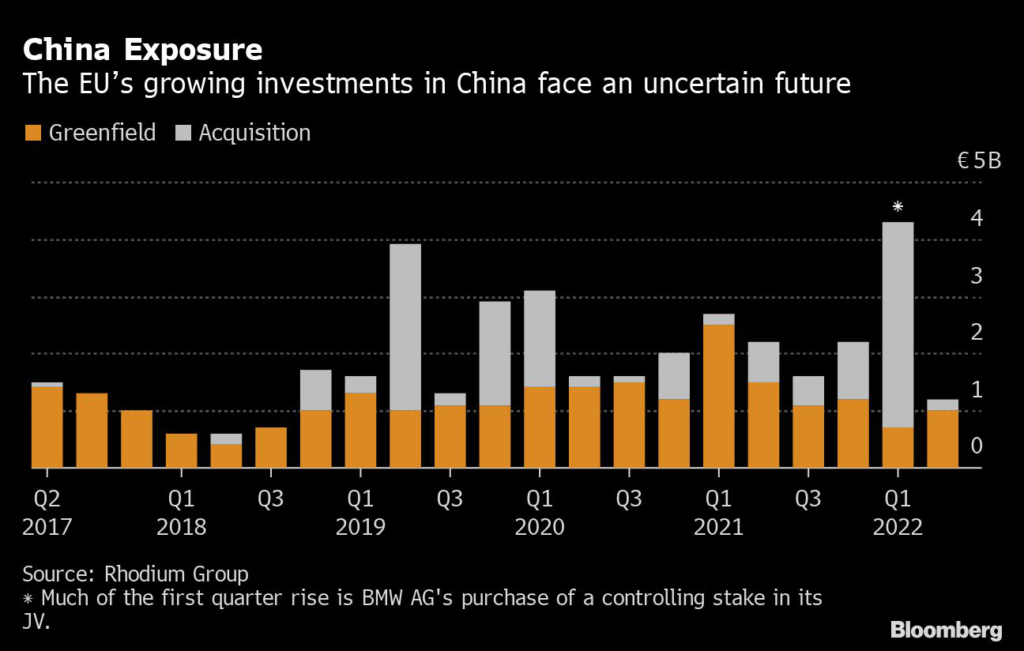
Germany’s longtime trade surplus with China has swung into deficit as the Asian country’s economy slows. While chemicals giant BASF and German carmakers were responsible for billions of euros of new investments in recent months, small and medium-sized European firms have largely frozen or reduced their commitments, according to the Rhodium Group. 

Xi has sought to maintain business ties with Europe as a bulwark against US President Joe Biden’s efforts to build a tighter coalition of liberal democracies. The Chinese leader, who secured a third term last month, has brushed off European criticism on issues like human rights and Ukraine, urging Brussels to stay out of its internal affairs and embrace a more independent policy from Washington.

Top EU diplomat, Josep Borrell, said in a speech last month that the world in which the European Union could rely on the US for its security and China and Russia for its prosperity was “no longer there.”  

“We have entered a new phase in Europe-China relations,” said Noah Barkin, managing editor of the Rhodium Group’s China practice. “Xi Jinping’s partnership with Vladimir Putin, at a time when Russia is waging a brutal war of aggression in Europe, has reinforced the view in European capitals that China is first and foremost a rival and competitor.” 

Many in Europe, such as French President Emmanuel Macron, share Germany’s concerns about joining the US’s increasingly confrontational and ideological showdown with China. They advocate a more nuanced approach that keeps Beijing as a trade partner, with Scholz telling a business conference last month that “decoupling is the wrong answer,” even as they seek to diversify.

European leaders balked at the Biden administration’s efforts to get them to join in restricting China’s access to semiconductor technology, according to people familiar with the matter, prompting the US to move ahead unilaterally. Some senior EU officials believe Washington is too preoccupied with Beijing at the expense of other concerns, said a diplomat familiar with the discussions.

European unity on China, however, largely ends there. Former Soviet bloc countries have increasingly come to view Beijing’s economic influence over the continent with suspicion, a concern driven home by China’s trade embargo on Lithuania over its pursuit of closer ties with Taiwan. 

Meanwhile, others such as Hungary continue to court Beijing. China is among several issues Scholz and Macron have struggled to get aligned on in recent months. 

“What is challenging in the context of China is how broad the spectrum of the national policies and priorities toward China is,” said Grzegorz Stec, an analyst at the Mercator Institute for China Studies. “That divergence of views creates a circle of interests that’s hard to square in a single strategy.” 

Scholz stressed in the Wednesday article that the German side had coordinated closely with European partners, including Macron, in the run up to his trip. “When I travel to Beijing as German chancellor, I do so also as a European,” he wrote.

Read More: US Suggests EU Consider Using Export Limits to Target China

Scholz also faces calls for a firmer China policy after pushing through a deal to allow Chinese state firm Cosco Shipping Holdings Co. to buy a 24.9% stake in one of Hamburg’s port terminals. The transaction was opposed by many in his cabinet, and German Green Party leader Omid Nouripour, a member of the ruling coalition, said there could be no more “business as usual” with China.

European views toward China’s domestic market, where multinationals are facing stiffer competition from home-grown brands, are also souring. Carmakers such as BYD Co. and Geely Automobile Holdings Ltd. accounted for almost 80% of the country’s electric vehicle sales in the first seven months of this year, according to China’s Passenger Car Association. Increasingly, they’re challenging European brands overseas, as well. 

“It’s not the big China market story it used to be,” said Joerg Wuttke, president of the European Union Chamber of Commerce in China and BASF’s chief representative in the country. “We have a completely different soundtrack from our home base. That definitely makes operations in China more complex and difficult.”

The automotive industry is one of Germany’s main economic engines, employing almost 800,000 people and generating the most revenue of any industrial sector in the country. VW, Mercedes and BMW have built dozens of factories in China with local partners they were forced to share technology with, and all three manufacturers now sell more vehicles in China than any other market. Getting squeezed out of the Chinese market would cascade from Germany’s carmakers to hundreds of smaller suppliers.

The trip is being watched for signs of a thaw after a difficult summit between Chinese and European leaders in April, weeks after Russia’s invasion of Ukraine, according to a European diplomat in Beijing. 

Even so, Europe’s rapid unraveling ties with Russia have forced German companies to confront the once unthinkable: a rushed exit from the Chinese market. Industry leaders are already planning for a worst-case scenario in which China enters a conflict over Taiwan and Germany backs sanctions against Beijing, according to a person familiar with discussions, who asked not to be named discussing internal deliberations.

What Scholz can accomplish during such a brief visit remains to be seen. The high-level delegation — also including executives from Mercedes-Benz AG, Adidas AG, BMW AG and Siemens AG — indicates business deals could be announced or at least reaffirmed. But he wrote Wednesday that he won’t ignore “difficult topics” including respect for civil and political liberties and the rights of ethnic minorities in Xinjiang.

There’s also the risk that the trip reinforces Chinese views that they can play Europe’s various capitals against each other, said Ivana Karásková, China research fellow at the Prague-based Association for International Affairs. 

“These solo activities will hardly strengthen the unity of the EU when it comes to China,” she said. “It will, yet again, give China an impression that EU lacks one single voice and that member states may be corrupted by bilateral deals.”

–With assistance from Alberto Nardelli, James Mayger, Jillian Deutsch, Jenny Leonard, Colum Murphy, Stefan Nicola, Jorge Valero and John Follain.

More stories like this are available on bloomberg.com

©2022 Bloomberg L.P.

Ant Digital Bank Expands in Singapore With Small Business Loans

(Bloomberg) — Ant Group Co.’s Singapore digital wholesale bank will start offering loans to small and medium-sized businesses, as the Chinese fintech giant extends its reach in the city-state. 

ANEXT Bank, which started its services in June, said it will give smaller companies loans ranging from S$5,000 ($3,530) to S$100,000. Customers can also apply for ANEXT Bank’s loans via IN Financial Technologies and Bizmann System. 

Ant is accelerating digital bank operations in Southeast Asia, replicating strategies in China that catapulted its fintech operations to becoming the country’s biggest. The move could help Ant diversify business and generate growth amid regulatory headwinds at home.

The Chinese firm will be facing stiff competition. It’s entering an arena dominated by traditional incumbents including DBS Group Holdings Ltd. and Oversea-Chinese Banking Corp.

Compared with credit offered by traditional banks, Ant’s ANEXTBank Loan baseline product doesn’t require collateral. For credit of S$30,000 and below, no documents are needed. The interest rate will start from 6.8% per annum. 

Ant was one of two groups to get a wholesale digital banking license in December 2020, allowing it to serve smaller firms and other non-retail segments. It required a capital commitment of S$100 million. That compares with a full digital bank license, which can serve all kinds of customers and eventually requires S$1.5 billion in capital as well as local control.

ANEXT Bank’s dual-currency deposit service went live in August. It takes US and Singapore dollars, and includes remote on-boarding and daily interest.

Ant also started offering a service known as Alipay+ D-store that allows businesses to build digital stores across platforms including Chope, AlipayHK and Touch ‘n Go.

–With assistance from Chanyaporn Chanjaroen.

More stories like this are available on bloomberg.com

©2022 Bloomberg L.P.
Close Bitnami banner
Bitnami