Bloomberg

Twitter Global Sales VP Leaves Company After Musk’s Takeover

(Bloomberg) — Two more top Twitter Inc. executives have departed the social network, leaving the company without most of its sales and marketing leadership days after a takeover by billionaire Elon Musk.

Chief Marketing Officer Leslie Berland, who joined Twitter in 2011, departed on Tuesday, according to people familiar with the matter. Berland was the executive who gave Musk his first tour of the office as his $44 billion deal was finalized last week.

Jean-Philippe Maheu, the vice president of global client solutions, is also exiting San Francisco-based Twitter, people familiar said. Maheu was seen being escorted out of the company’s offices, one of the people said. It’s unclear whether he resigned voluntarily or was part of Musk’s broader firings. Berland and Maheu didn’t immediately respond to requests for comment.

Musk, who acquired the company for $44 billion last week, is moving swiftly to thin the executive ranks as he looks to reshape the company to conform with his own vision. On Thursday, the day the deal closed, he started by cutting Chief Executive Officer Parag Agrawal, finance chief Ned Segal and other top leaders. More recently he has fired managers in the product organization. 

Sarah Personette, the company’s chief customer officer, said she resigned on Friday and her work access to Twitter was officially cut off on Monday night. Employees are bracing for more widespread layoffs as soon as this week, after some managers spent the weekend compiling lists of employees to cut. 

Read more: What Musk is working to change at Twitter

More stories like this are available on bloomberg.com

©2022 Bloomberg L.P.

Rogers Lawyer Rips ‘Waste’ as Antitrust Czar Digs In for a Fight

(Bloomberg) — Canada’s antitrust watchdog is still seeking a “full block” of Rogers Communications Inc.’s takeover of a rival, setting the stage for a trial to begin next week. 

The wireless and cable company says it’s a waste of the court’s time. 

Competition Commissioner Matthew Boswell believes that Rogers’ C$20 billion ($14.7 billion) deal for Shaw Communications Inc. will reduce competition in what’s already an “oligopolistic” market for communications services, Derek Leschinsky, a lawyer for the country’s antitrust body, said Tuesday during a pre-trial conference. 

Boswell filed suit to stop the deal in May. The following month, Rogers and Shaw struck a deal to sell the Shaw’s Freedom Mobile division to Montreal-based Quebecor Inc. to address the biggest concern in the merger. 

But Boswell’s Competition Bureau is pressing ahead with its case, arguing that the sale of Freedom Mobile to Quebecor will weaken it as a competitor because it separates the wireless provider from Shaw wireline infrastructure on which it is dependent.

Lawyers for Rogers and Shaw accused the bureau of focusing on the deal’s original structure — which would have seen Rogers buy all of Shaw’s assets — instead of the revised one, which includes the divestiture of Freedom.

“We are now litigating a conjured transaction. It isn’t going to happen,” said Jonathan Lisus, a lawyer for Rogers. “It is a regrettable waste of scarce judicial resources.” 

Tuesday’s conference was set up by Chief Justice Paul Crampton to discuss evidence, procedure and potential solutions to the impasse. A full hearing on the merger before Canada’s Competition Tribunal is scheduled to begin on Nov. 7. 

More stories like this are available on bloomberg.com

©2022 Bloomberg L.P.

Uber CEO Says Post-Pandemic Pickup in Prices Set to Last

(Bloomberg) — Uber Technologies Inc.’s elevated ride-share prices may be here to stay, according to Chief Executive Officer Dara Khosrowshahi. 

“I don’t think prices are going to go down to pre-pandemic levels but we have seen pricing ease,” Khosrowshahi said in a Bloomberg Television interview discussing the ride-hailing giant’s third-quarter results. 

On Tuesday, Uber reported revenue during the period ending Sept. 30 increased 72% to $8.34 billion and adjusted earnings before interest, tax, depreciation and amortization of $516 million. 

Khosroshahi said that while consumer spending on the platform remains resilient, the company is still bracing for an uncertain economic outlook. “It is very difficult to tell where things are going to end up,” Khosrowshahi said. “Europe is going to be weaker and is likely headed into a recession. In the US it’s unclear, so from our standpoint, we want to be prepared for any eventuality.” 

The CEO added that in a weaker labor environment, Uber typically sees more people interested in picking up a side-hustle by driving passengers or delivering meals. Khosrowshahi added that Uber is preparing for “an uncertain world” by taking a conservative stance on its investments. 


More stories like this are available on bloomberg.com

©2022 Bloomberg L.P.

Intuit Says Results to Top Forecast Despite Credit Karma Issues

(Bloomberg) — Intuit Inc. said fiscal first-quarter results will be higher than previously forecast when it reports earnings at the end of November, despite news the uncertain economy has hurt its Credit Karma unit.

Results in the fiscal first quarter will be above the guidance given in September of revenue growth of about 24% and profit, excluding some items, of as much as $1.20, the maker of accounting and personal finance software said Tuesday in a statement. Credit Karma, a site for consumer loans, has experienced “further deterioration” in recent weeks, Intuit said.

Earlier, Bloomberg reported that the Credit Karma unit had paused hiring, sending shares down 7.7%, the biggest single-day decline in six months, to $394.77 in New York. 

For more: Intuit Pauses Hiring at Credit Karma on ‘Revenue Challenges’

“In spite of the impact to Credit Karma, we are reiterating operating income and earnings per share guidance for fiscal year 2023, and expect to report first quarter results above guidance,” Michelle Clatterbuck, Intuit’s chief financial officer said in the statement. Intuit, based in Mountain View, California, had projected fiscal-year adjusted profit of $13.59 to $13.89 a share.

Shares gained 2.5% in extended trading after the announcement. The stock has tumbled 39% this year amid a broad decline among software companies.

The company is scheduled to report fiscal first-quarter results on Nov. 29.

More stories like this are available on bloomberg.com

©2022 Bloomberg L.P.

MicroStrategy Posts Third-Quarter Loss After Revenue Decline

(Bloomberg) — MicroStrategy Inc., the world’s largest publicly traded corporate owner of Bitcoin, posted a third-quarter loss after revenue fell despite the cryptocurrency reversing months of declines during the most recent three-month period. 

The net loss for the quarter ended Sept. 30 was $27.1 million, or $2.39 a share, compared with $36.1 million, or $3.61, in the year-ago period, the company said in a statement. Co-founder Michael Saylor stepped down in August as chief executive officer to focus on the company’s cryptocurrency strategy. 

Revenue fell 2.1% to $125.4 million as sales dropped for the enterprise software maker’s two biggest revenue sources, product licenses and support. After reporting an $1 billion impairment loss in the second quarter, that number fell to $727,000 in the the latest period. 

MicroStrategy, which has been buying Bitcoin in bulk since 2020 as a hedge against inflation, has been forced to take massive writedowns this year due to the drop in value of the digital currency. Bitcoin fell almost 60% in the first half of the year before climbing about 3.7% in the most recent quarter. 

MicroStrategy acquired about 301 additional Bitcoins this quarter, compared with almost 9,000 a year ago. The company owns 130,000 Bitcoins. 

Shares of Tysons Corner, Virginia-based MicroStrategy fell about 2% in post-market trading. The stock has dropped about 53% this year. Bitcoin was little changed at $20,464.

–With assistance from Tom Contiliano.

More stories like this are available on bloomberg.com

©2022 Bloomberg L.P.

Twitter’s Top Advertisers Are Being Urged to Avoid Site If Musk Lowers Standards

(Bloomberg) — Twitter Inc.’s top advertisers are being urged by dozens of advocacy groups to boycott the platform if its new billionaire owner Elon Musk lowers safety standards for content.

The groups pressed companies including Apple Inc., Best Buy Co., Coca-Cola Co. and Verizon Communications Inc. in a letter to their chief executive officers Tuesday to commit to stop advertising on Twitter if Musk allows hate speech, misinformation and conspiracy theories to flourish on the platform. 

“Elon Musk is an erratic billionaire who has promised to roll back critical safeguards Twitter has put in place and replatform extremists who have repeatedly spewed hate, incited violence, and undermined our democracy,” said Nicole Gill, co-founder and executive director of digital rights group Accountable Tech, which helped organize the initiative. 

“Advertisers have both the power and the responsibility to hold him to account and they must — not only for their own brand safety, but for the integrity of our now crumbling information ecosystem,” Gill added. 

The plea from more than 40 activist organizations that signed the letter comes days after Musk took control of Twitter following a prolonged legal battle. 

Twitter representatives did not immediately reply to a request for comment on Tuesday afternoon.

He bought the platform for $44 billion on Oct. 28 and started overhauling its operations over the weekend. Twitter froze some employee access to internal tools used for content moderation and other policy enforcement, Bloomberg News reported.

Musk has pledged to restore the accounts of controversial figures who have been suspended from Twitter — including former President Donald Trump, who was kicked off the platform in the wake of the Jan. 6, 2021, assault on the US Capitol. 

Since he took the helm, a wave of hate speech has swept the platform, Bloomberg News reported, including a 1,700% surge in the use of a racist slur. Musk also shared a link to a debunked conspiracy theory about House Speaker Nancy Pelosi’s husband, who was violently attacked by an intruder at the couple’s San Francisco home last week. The tweet with the link was later deleted.

Musk’s free-for-all vision of Twitter undercuts the interests of its corporate advertisers, who typically seek to ensure that their advertisements don’t run alongside hate speech, violent threats or other alarming posts, the groups maintained in their message to the CEOs of 20 Fortune 500 corporations. Advertising accounts for about 90% of Twitter’s revenue.

“We, the undersigned organizations, call on you to notify Musk and publicly commit that you will cease all advertising on Twitter globally if he follows through on his plans to undermine brand safety and community standards, including gutting content moderation,” the groups, which include digital rights groups Free Press and Access Now, wrote in the letter. 

Twitter’s top advertisers also include Amazon.com Inc., Comcast Corp., Walt Disney Co., Merck & Co., Unilever PLC, PepsiCo Inc., Procter & Gamble Co., Meta Platforms Inc., and Alphabet Inc.’s Google.

More stories like this are available on bloomberg.com

©2022 Bloomberg L.P.

Stocks Drop in Countdown to Fed as Rally Sputters: Markets Wrap

(Bloomberg) — Stocks finished lower as data showing a solid US labor market bolstered speculation that Federal Reserve policy could remain aggressively tight even with the threat of a recession.

At a time when good news is considered bad news when it comes to policy conjectures, the S&P 500 wiped out a rally as the figures highlighted an unexpected rebound in US job openings, which may keep the pressure on the Fed. It was the 26th time in 2022 that the equity gauge erased a gain or loss of at least 1% in one session — the most for any year since the financial crisis.

Big tech weighed on equities, with Apple Inc. down almost 2% and Amazon.com Inc.’s value ending below $1 trillion for the first time since 2020. After the close, Advanced Micro Devices Inc. topped earnings estimates and signaled that inroads in the lucrative server chip market will continue to bolster its finances. The Dow Jones Industrial Average traded near a resistance level that saw the index halt a few rally attempts in the past few months. 

Two-year US yields — which are more sensitive to imminent Fed moves — topped 4.5% after sliding as much as eight basis points earlier in the day.

“Hopes for a Fed dovish pivot are misplaced if today’s job openings are any guide,” said Ronald Temple, head of US equity at Lazard Asset Management. “Despite other signs of economic deceleration, the job openings data taken together with nonfarm payroll growth indicate the Fed is far from the point where it can declare victory over inflation and lift its foot off the economic brake.”

Friday’s jobs report is currently forecast to show US employers added about 196,000 workers to payrolls in October. Economists are expecting the unemployment rate to edge up to 3.6%, and for average hourly earnings to post another solid advance.

Former Treasury Secretary Larry Summers said in a tweet that the “growing chorus” for the Fed to pause interest rate hikes very soon is “badly misguided.” He added that this is “consensus of economists who have a track record, since COVID, of being dismally wrong on inflation.” Summers also noted that the Fed should “stay on the current course and then evaluate things.”

To Matt Maley at Miller Tabak + Co., a lot of what will take place in markets over the next few weeks will hinge upon Powell’s signals on Wednesday as well as the subsequent Fedspeak. Tom Porcelli at RBC Capital Markets says that if the Fed’s boss really wants to transition to shallower hikes, he should maintain some element of hawkishness as there’s a “decent risk of creating confusion.”

“As we have not yet reached the peak for Fed rate hikes, it’s highly unlikely that we’ve already seen the bottom of this bear market, especially given the history of Fed rate hikes peaking before the market troughs,” noted Seema Shah, chief global strategist at Principal Asset Management. She anticipates the market floor for this cycle will most likely be reached in the first or second quarters of 2023.

For now, Shah sees both market and inflation volatility persisting alongside further Fed rate hikes in the last few months of 2002 and into early next year.

Lauren Goodwin at New York Life Investments says she believes the Fed may pause its rate hikes soon even amid strong inflation. Financial conditions have tightened substantially, and recession should be considered a base case, she added.

“Let me be clear — a Fed pause is not the same as a pivot,” Goodwin added. “Certainly, deteriorating economic and credit conditions could cause the Fed to pivot modestly at some point, but a full pivot into accommodative territory is highly unlikely in the next year.”

Also weighing on market sentiment was a report showing US manufacturing neared stagnation in October as orders contracted for the fourth time in five months, while an index of prices paid fell to a more than two-year low. The figures added to evidence of recession concerns as central banks step up the fight to get inflation under control.

Earlier in the day, speculation that China is preparing to gradually exit the stringent Covid Zero stance helped boost equities. A gauge of the nation’s stocks listed in Hong Kong surged almost 7% intraday. Shares pared gains after Chinese Foreign Ministry spokesman Zhao Lijian said he’s “not aware” of a committee on ending the policy.

Read: ‘It Is Unacceptable’: Investors React to Toronto Exchange Outage

Key events this week:

  • EIA crude oil inventory report, Wednesday
  • Federal Reserve rate decision, Wednesday
  • US MBA mortgage applications, ADP employment, Wednesday
  • Bank of England rate decision, Thursday
  • US factory orders, durable goods, trade, initial jobless claims, ISM services index, Thursday
  • ECB President Christine Lagarde speaks, Thursday
  • US nonfarm payrolls, unemployment, Friday


Some of the main moves in markets:

Stocks

  • The S&P 500 fell 0.4% as of 4 p.m. New York time
  • The Nasdaq 100 fell 1%
  • The Dow Jones Industrial Average fell 0.3%
  • The MSCI World index rose 0.2%

Currencies

  • The Bloomberg Dollar Spot Index fell 0.2%
  • The euro was little changed at $0.9878
  • The British pound rose 0.1% to $1.1483
  • The Japanese yen rose 0.3% to 148.19 per dollar

Cryptocurrencies

  • Bitcoin rose 0.2% to $20,445.94
  • Ether rose 0.7% to $1,576.28

Bonds

  • The yield on 10-year Treasuries was little changed at 4.05%
  • Germany’s 10-year yield declined one basis point to 2.13%
  • Britain’s 10-year yield declined five basis points to 3.47%

Commodities

  • West Texas Intermediate crude rose 2% to $88.27 a barrel
  • Gold futures rose 0.6% to $1,651.30 an ounce

–With assistance from Vildana Hajric, Elaine Chen, Isabelle Lee and Emily Graffeo.

More stories like this are available on bloomberg.com

©2022 Bloomberg L.P.

Amazon Closes Below $1 Trillion in Market Value for First Time Since 2020

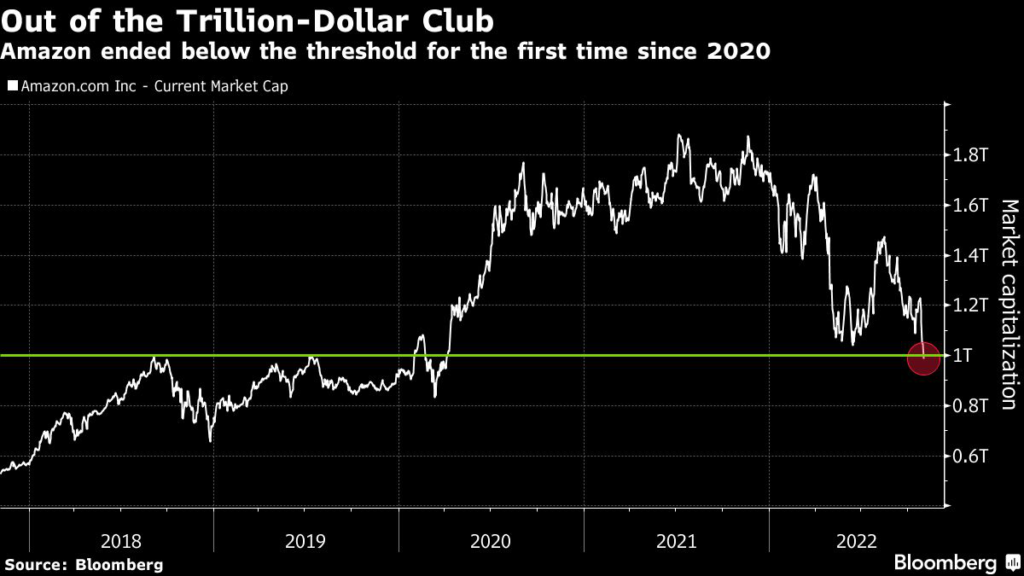
(Bloomberg) — Amazon.com Inc. shares fell on Tuesday, with the e-commerce and cloud-computing company closing below $1 trillion in market value for the first time since the early days of the Covid-19 pandemic more than two years ago.

The stock fell 5.5% to end at $96.79, representing a market capitalization of $987.4 billion. Shares closed at their lowest level since April 2020, and have dropped 42% this year. At its Nov. 18 peak, Amazon boasted a market cap of nearly $1.9 trillion. 

It was the fifth straight negative session for Amazon — down about 20% over the period. Meanwhile, the Nasdaq 100 Index fell 1% on Tuesday.

Recent weakness was spurred by the Seattle company’s earnings report last week, when it projected the slowest holiday-quarter growth in its history. Amazon, which had posted record profits during the pandemic, said sales would increase by only 2% to 8% during what has traditionally been its peak season. 

Amazon, along with most other major technology and internet stocks, has been pressured throughout 2022 by concerns over slowing growth and rising interest rates. The economic uncertainty has weighed on the multiples of high-valuation stocks. 

More stories like this are available on bloomberg.com

©2022 Bloomberg L.P.

Match Shares Climb on Quarterly Sales, Cost-Control Pledge

(Bloomberg) — Match Group Inc., the owner of dating apps including Tinder and OkCupid, rose after reporting revenue that beat analysts’ estimates and as it pledged to control costs to meet a darkening economic outlook.

Third-quarter revenue was $809.5 million, the Dallas-based company said Tuesday in a statement, compared to estimates for $794.4 million. The number of paying users rose 2% to 16.5 million, compared with analyst estimates. The shares rose about 11% in extended trading.

The results suggest more people are turning to one of Match’s myriad offerings, and are willing to pay for premium features to find a better match. The company is nevertheless now confronting a squeeze on consumer spending from soaring inflation alongside pressure on overseas sales from a strong dollar. New Chief Executive Officer Bernard Kim is trying to reverse the fortunes of a company whose shares are down about 65% this year, outpacing the 19% decline in the S&P 500.

“Because we expect a challenging operating environment for the foreseeable future, we plan to accelerate our efforts to control costs, especially in headcount-related expenses and marketing spend, in other areas of the business,” Kim and Chief Financial Officer Gary Swidler said in a letter to shareholders.

Match has had a tumultuous year. In addition to the departure of former CEO Shar Dubey in May, the company also lost the head of Tinder. Match is searching for a permanent leader for its key revenue driver, which is now being run by a leadership team composed of its chief operating, product, marketing and technology officers. 

Tinder is a priority for Kim, Swidler said at a Goldman Sachs conference in September. The CEO plans to focus on attracting more female users to the app, though will push out some virtual products like so-called Tinder coins to 2023 for the time being. Direct revenue from the division grew 6% from a year earlier, according to the statement. 

The company said sales will be $780 million to $790 million in the quarter ending in December, missing the average analyst estimate of $808.4 million.

Match is also focusing on expanding its global reach after launching Hinge in Germany in September. Hinge has been a bright spot for the company, which has thrived in English-speaking markets outside the US. Last year’s purchase of South Korean video chat company Hyperconnect is part of its focus on Asia. The number of paying users in the region rose 12% in the period, compared with a 1% drop in the Americas and Europe.

And the currency fluctuations that have hammered tech giants like Microsoft Corp. are weighing on Match’s finances. Match said it expects currency fluctuations to create a nine-point drag on total revenue in the current quarter. Competitor Bumble Inc. will announce third quarter results Nov. 9.

The company reported adjusted operating income of $284.2 million. Adjusted earnings per share was 44 cents, missing an analyst estimate for 51 cents per share. 

–With assistance from Michael Tobin.

More stories like this are available on bloomberg.com

©2022 Bloomberg L.P.

Five Things Elon Musk Wants to Change About Twitter Right Away

(Bloomberg) — Elon Musk is working to make his mark on Twitter Inc., days after assuming ownership of the service.The world’s richest man has been reviewing the company’s code with help from Tesla Inc. engineers, while consulting with powerful friends he trusts to help him make important decisions about where to take the product. 

So far, it turns out that making major changes to a 16-year-old product with about 7,000 employees is easier said than done. Here’s an overview of what Musk is noodling – and how it intersects with reality:

Job Cuts

Twitter employees have been bracing for layoffs ever since Musk took over and fired the top executive team, including Chief Executive Officer Parag Agrawal. Over the weekend, a few employees with director and vice president jobs were cut, according to people familiar with the matter. Other leaders were asked over the weekend to make lists of employees on their teams who can be cut, the people said. Employees are expecting to hear from Musk for the first time since the deal closed during an all-hands on Wednesday morning. 

Senior personnel on the product teams were asked to target a 50% reduction in headcount, according to a person familiar with the matter. Engineers and director-level staff from Tesla reviewed the lists, the person said asking not to be identified discussing private information. Layoff lists were drawn up and ranked based on individuals’ contributions to Twitter’s code during their time at the company, the people said. The assessment was made by both Tesla personnel and Twitter managers.

Top of mind for employees: Stock awards vest Tuesday. Twitter Chief Accounting Officer Robert Kaiden told employees Tuesday morning that “payroll is working on processing the vest,” though money wouldn’t hit employee bank accounts for a few more days. Some employees had been waiting for that vesting date to voluntarily resign from the company, and if they do, Musk wouldn’t have to pay them severance. Others were worried that the layoffs would come before those stock rewards were vested.

Either way, staff have been exchanging private phone numbers and adding each other on the professional social network LinkedIn in anticipation of being fired, the people said.

Leadership

Musk has turned toward old friends for advice in the first few days of his Twitter ownership. He’s been meeting regularly with David Sacks, a venture capitalist and friend from his PayPal days; Jason Calacanis, and friend and investor; and Sriram Krishnan, a former Twitter executive and current general partner at the venture firm Andreessen Horowitz. The group has been discussing Twitter’s product strategy, though it’s unknown if any of them will be full-time leaders at the company. Both Calacanis and Sacks have Twitter email addresses in the company’s internal directory, and Krishnan tweeted Sunday that he’s still “very much in my day job” at Andreessen Horowitz.

One possible full-time leader is Kayvon Beykpour, the former head of Twitter product who was fired earlier this year by the prior CEO. While Beykpour was seen in the office after the deal closed and has been approached about a return, nothing has been finalized, according to people familiar with the matter.

  • Read more:  Musk Begins to Shake Up Product Leadership at Twitter

Vine

Musk is considering a revival of Vine, according to people familiar with the matter. Vine, acquired by Twitter in 2012, was a popular short-form video app, which minted several internet stars before it faded and was shut down. The service started the trend now dominated by ByteDance Ltd.’s TikTok and copied by Instagram’s Reels and YouTube’s Shorts. Many employees are volunteering internally to work on the Vine project, according to a person familiar with the matter, hoping that joining an effort Musk is excited about might help them keep their jobs.

Bringing it back wouldn’t be as simple as turning it on. The product, shut down in 2016, is built on old code that would no longer communicate with Twitter’s current systems, and would likely have to be rewritten, according to people familiar with the matter. It would also lead to other challenges, like the possibility of music rights partnerships and need for better creator payment features.

Verification 

Musk wants to start charging users for the blue-check verification badge, according to people familiar with the matter. He has tasked a team with building the option under threat of having their roles eliminated if they don’t achieve it in 7 days, the Verge reported. 

The plan spurred lots of commentary from Twitter users, some of whom said they would never pay for something they used to get for free, while others said Twitter was leaving money on the table if it didn’t charge for something so coveted. Some critics of the plan noted that if Twitter charges, it will likely end up with fewer verified users, creating a breeding ground for impersonation and misinformation. Also, if verification becomes something users pay for — rather than qualify for, as public figures or brands — the blue tick mark could carry less social clout than it does today.

As part of the revamp of its subscription service, Twitter Blue, the company will remove a flagship feature that offered ad-free news articles from hundreds of publishers, said people familiar with the plan who asked not to be identified because the information is private. Twitter didn’t immediately respond to a request for comment. The Wall Street Journal reported the news earlier Tuesday.

Content Moderation

Musk’s most well-known proposal for Twitter’s future: making it a haven for “free speech.” But it’s not clear how he plans to do so, yet. He’s said publicly that he will hold off on making decisions about which banned users will be restored until he can consult with a council of outside experts.

Internally, employees say, Musk has raised questions about a number of the policies, and has zeroed in on a few specific rules that he wants the team to review. The first is Twitter’s general misinformation policy, which penalizes posts that include falsehoods about topics like election outcomes and Covid-19. Musk wants the policy to be more specific, according to people familiar with the matter.

Musk has also asked the team to review Twitter’s hateful conduct policy, according to the people, specifically a section that says users can be penalized for “targeted misgendering or deadnaming of transgender individuals.”

In both cases it is unclear if Musk wants the policies to be rewritten or the restrictions removed entirely.

While things get sorted out, some people who work in Twitter’s Trust and Safety organization are currently unable to alter or penalize accounts that break rules around misleading information, offensive posts and hate speech, according to people familiar with the matter. There are some exceptions, as the most high-impact violations that would involve real-world harm are handled manually. But some employees are concerned about the tools remaining frozen, days before a major US election.

  • Read more:  Twitter Limits Content-Enforcement Work as US Election Looms

–With assistance from Gerry Smith.

(Updates with employee stock vesting in the Job Cuts section)

More stories like this are available on bloomberg.com

©2022 Bloomberg L.P.

Close Bitnami banner
Bitnami