Bloomberg

Stocks, Bonds Give Up Gains on Eve of Fed Decision: Markets Wrap

(Bloomberg) — Stocks and bonds saw their gains sputter after data showing a solid US labor market bolstered speculation that Federal Reserve policy could remain aggressively tight even with the threat of an economic recession.

At a time when good news is considered bad news when it comes to policy conjectures, the S&P 500 fell on figures highlighting an unexpected rebound in US job openings, which may fuel wage gains and keep the pressure on the Fed. The report precedes Friday’s jobs print. Treasury 10-year yields edged higher after plunging as much as 13 basis points earlier Tuesday.

“Hopes for a Fed dovish pivot are misplaced if today’s job openings are any guide,” said Ronald Temple, head of US equity at Lazard Asset Management. “Despite other signs of economic deceleration, the job openings data taken together with nonfarm payroll growth indicate the Fed is far from the point where it can declare victory over inflation and lift its foot off the economic brake.”

Temple also noted that markets “may be underestimating where the Fed’s terminal rate is, and should prepare for further financial tightening.”

Also weighing on market sentiment was a separate report showing US manufacturing neared stagnation in October as orders contracted for the fourth time in five months, while an index of prices paid fell to a more than two-year low. The figures added to evidence of growing global recession concerns as central banks step up the fight to get inflation under control.

To Matt Maley at Miller Tabak + Co., a lot of what will take place in markets over the next few weeks will hinge upon Powell’s signals on Wednesday as well as the subsequent Fedspeak. He noted that a throttling back of the size of hikes “is not something that can be considered a ‘pause’… much less a ‘pivot’.”

“We believe that they merely want to do what they were always going to do: turn the rate hikes into smaller ones,” Maley added. “However, that does not mean they’ll be overly dovish in their rhetoric.”

Earlier in the day, speculation that China is preparing to gradually exit the stringent Covid Zero stance helped boost equities. A gauge of the nation’s stocks listed in Hong Kong surged almost 7% intraday. Shares pared gains after Chinese Foreign Ministry spokesman Zhao Lijian said he’s “not aware” of a committee on ending the policy.

In corporate news, Uber Technologies Inc. posted revenue that beat expectations as gains in ridership assuaged investor concerns that rising inflation would damp consumer spending. Pfizer Inc. increased its forecast for adjusted earnings for the year as sales of its Covid-19 vaccine were stronger than expected. Eli Lilly & Co. cut its 2022 profit outlook due to the stronger US dollar and one-time charges.

Key events this week:

  • EIA crude oil inventory report, Wednesday
  • Federal Reserve rate decision, Wednesday
  • US MBA mortgage applications, ADP employment, Wednesday
  • Bank of England rate decision, Thursday
  • US factory orders, durable goods, trade, initial jobless claims, ISM services index, Thursday
  • ECB President Christine Lagarde speaks, Thursday
  • US nonfarm payrolls, unemployment, Friday


Some of the main moves in markets:

Stocks

  • The S&P 500 fell 0.5% as of 11:26 a.m. New York time
  • The Nasdaq 100 fell 0.6%
  • The Dow Jones Industrial Average fell 0.6%
  • The Stoxx Europe 600 rose 0.4%
  • The MSCI World index was little changed

Currencies

  • The Bloomberg Dollar Spot Index fell 0.1%
  • The euro was little changed at $0.9875
  • The British pound was little changed at $1.1468
  • The Japanese yen rose 0.3% to 148.20 per dollar

Cryptocurrencies

  • Bitcoin rose 0.2% to $20,442.68
  • Ether rose 0.5% to $1,572.98

Bonds

  • The yield on 10-year Treasuries advanced one basis point to 4.06%
  • Germany’s 10-year yield was little changed at 2.15%
  • Britain’s 10-year yield declined one basis point to 3.51%

Commodities

  • West Texas Intermediate crude rose 2.3% to $88.55 a barrel
  • Gold futures rose 0.4% to $1,647.20 an ounce

–With assistance from Vildana Hajric.

More stories like this are available on bloomberg.com

©2022 Bloomberg L.P.

Tesco Keeps Some Traditional Cashiers in New Amazon-Style Stores

(Bloomberg) — Tesco Plc is expanding its experiment with stores where customers can walk straight out with their shopping instead of visiting a checkout counter. The only catch is, this time there will be traditional cashiers on offer as well.

Three new GetGo stores in London and Birmingham will follow a “hybrid format” designed to avoid alienating customers who have been put off by cashierless technology.

Tesco followed Amazon.com Inc. last year by opening its first cashierless store in London’s High Holborn, allowing customers to check in with the Tesco app, pick up groceries and leave thanks to a network of cameras tracking what they buy. 

The three new stores will use the same technology, but shoppers who don’t want to use the app will still be able to use self-service tills or have their goods scanned by a person.

“We want to make the shopping trip as quick and convenient as possible,” said Kevin Tindall, managing director for Tesco Convenience.

The new stores are Chiswell Street Express and Fulham Reach Express in London as well as Aston University Express in Birmingham. 

Tesco is partnering with Trigo Vision Ltd., an Israel-based company that has developed cameras and software allowing retailers to charge people automatically. Trigo is already working with German supermarket giants REWE Group and Aldi Nord, as well as Israel’s largest supermarket chain, Shufersal, and the company recently raised $100 million to help fund its expansion.

Rival J Sainsbury Plc also has a cashierless store in High Holborn using Amazon’s system of people-tracking cameras. Amazon jump-started interest in cashierless shopping with its Amazon Go-branded chain of convenience stores.


More stories like this are available on bloomberg.com

©2022 Bloomberg L.P.

Microsoft Wants AI To Change Your Job—If It Can Work Out the Kinks

(Bloomberg) — The most hyped words in tech today may be “generative AI.” The term describes artificially intelligent technology that can generate art, or text or code, directed by prompts from a user. The concept was made famous this year by Dall-E, a program capable of creating a fantastic range of artistic images on command. Now a new program from Microsoft Corp., GitHub Copilot, seeks to transform the technology from internet sensation into something broadly useful.

Earlier this year, Microsoft-owned GitHub widely released the artificial intelligence tool to work alongside computer programmers. As they type, Copilot suggests snippets of code that could come next in the program, like an autocomplete bot trained to speak in the Python or JavaScript. It’s particularly useful for the programming equivalent of manual labor—filling in chunks of code that are necessary, but not particularly complicated or creative. 

The tool is currently in use by hundreds of thousands software developers who rely on it to generate up to 40% of the code they write in about a dozen of the most popular languages. GitHub believes that developers could use Copilot to write as much as 80% of their code within five years. That’s just the beginning of the companies’ ambition.

Microsoft executives told Bloomberg the company has plans to develop the Copilot technology for use in similar programs for other job categories, like office work, video-game design, architecture and computer security. 

“We really do believe that GitHub Copilot is replicable to thousands of different types of knowledge work,” said Microsoft Chief Technology Officer Kevin Scott. Microsoft will build some of these tools itself and others will come from partners, customers and rivals, Scott said.

Cassidy Williams, chief technology officer of AI startup Contenda, is a fan of GitHub Copilot and has been using it since its beta launch with increasing success. “I don’t see it taking my job anytime soon,” Williams said. “That being said, it has been particularly helpful for small things like helper functions, or even just getting me 80% of the way there.”

But it also misfires, sometimes hilariously. Less than a year ago, when she asked it to name the most corrupt company, it answered Microsoft.

Williams’ experience illustrates the promise and peril of generative AI. Besides offering coding help, its output can sometimes surprise or horrify. The category of AI tools used for Copilot are referred to as large language models, and they learn from human writing. The product is generally only as good as the data that goes into it—an issue that raises a thicket of novel ethical quandaries. At times, AI can spit out hateful or racist speech. Software developers have complained that Copilot occasionally copies wholesale from their programs, raising concerns over ownership and copyright protections. And the program is capable of learning from insecure code, which means it has the potential to reproduce security flaws that let in hackers.

Microsoft is aware of the risks and conducted a safety review of the program prior to its release, Scott said. The company created a software layer that filters harmful content from its cloud AI services, and has tried to train these kind of programs to behave appropriately. The price of failing here could be great. Sarah Bird, who leads responsible AI for Microsoft’s Azure AI, the team that makes the ethics layer for Copilot, said these kinds of problems are make-or-break for the new class of products. “You can’t really use these technologies in practice,” she said, “if you don’t also get the responsible AI part of the story right.” 

GitHub Copilot was created by GitHub in conjunction with OpenAI, a high-profile startup run by former Y Combinator president Sam Altman, and backed by investors including Microsoft. 

The program shines when developers need to fill in simple coding—the kinds of problems that they could solve by searching through GitHub’s archive of opensource code. In a demonstration, Ryan Salva, vice president of product at GitHub, showed how a coder might select a programming language and start typing code that states they want a system for storing addresses. When they hit return, about a dozen lines of grey, italicized text appear. That’s Copilot offering up a simple address book program.

The dream is to eliminate menial work. “What percent [of your time] is the mechanical stuff, versus the vision, and what do you want the vision to be?” said Greg Brockman, OpenAI’s president and co-founder. “I want it to be at 90% and 10% implementation, but I can guarantee it’s the opposite right now.”

Eventually, the technology’s uses will expand. For example, this kind of program could allow video-game makers to auto-create dialogue for non-player characters, Scott said. Conversations in games that often feel stilted or repetitive—from, say, villagers, soldiers and other background characters—could suddenly become engaging and responsive. Microsoft’s cybersecurity products team is also in the early stages of figuring out how AI can help fend off hackers, said Vasu Jakkal, a Microsoft security vice president.

As Microsoft develops additional uses for Copilot-like technology, it’s also helping partners create their own programs using the Microsoft service Azure OpenAI. The company is already working with Autodesk on its Maya three-dimensional animation and modeling product, which could add assistive features for architects and industrial design, Chief Executive Officer Satya Nadella said at a conference in October.

Proponents of GitHub Copilot and programs like it believe that it could make coding accessible for non-experts. In addition to drawing from Azure OpenAI, Copilot relies on an OpenAI programming tool called Codex. Codex lets programmers use plain language, rather than code, to speak what they want into existence. During a May keynote by Scott, a Microsoft engineer demonstrated how Codex could follow plain English commands to write code to make a Minecraft character walk, look, craft a torch and answer questions. It October, Microsoft announced Copilot features in its Power line of products for creating apps without coding. 

The company also thinks it could develop virtual assistants for Word and Excel, or one for Microsoft Teams to perform tasks like recording and summarizing conversations. The idea calls to mind Clippy, Microsoft’s beloved but oft-maligned talking paperclip. The company will have to be careful not get carried away by the new technology or use it for “PR stunts,” Scott said. 

“We don’t want to build a bunch of superfluous stuff that is there, and it sort of looks cute, and you use it once and then never again,” Scott said. “We have to build something that is genuinely very, very useful and not another Clippy.”


Despite their utility, there are also risks that come with these kinds of AI programs. That’s mostly because of the unruly data they take in. “One of the big problems with large language models is they’re generally trained on data that is not well documented,” said Margaret Mitchell, an AI ethics researcher and co-author of a seminal paper on the dangers of large language models. “Racism can come in and safety issues can come in.”

Early on, researchers at OpenAI and elsewhere recognized the threats. When generating a long chunk of text, AI programs can meander or generate hateful text or angry rants, Microsoft’s Bird said. The programs also mimic human behavior without the benefits of a person’s understanding of ethics. For example, language models have learned that when people speak or write, they often back up their assertions with a quote, so the programs sometimes do the same—only they make up the quote and who said it, Bird said. 

Even in Copilot, which generates text in programming languages, offensive speech can creep in, she said. Microsoft created a content filter that it layered on top of Copilot and Azure OpenAI that checks for harmful content. It also added human moderators with programming skills to keep tabs.

A separate, potentially even more difficult problem is that Copilot has the potential to recreate and spread security flaws. The program is trained on vast troves of programming code, some of it with known security problems. Microsoft and GitHub are wrestling with the possibility that Copilot could spit out insecure code—and that a hacker could figure out a way to teach Copilot to place vulnerabilities in programs.

Alex Hanna, research director at the Distributed AI Research Institute, believes that such an attack may be even harder to mitigate than biased speech, which Microsoft already has some experience blocking. The issue could get more serious as Copilot grows. “If this becomes very common as a tool and it’s being used kind of widely in production systems, that’s a bit more of a worry,” Hanna said.

But the biggest ethical questions that have materialized for Copilot so far revolve around copyright issues. Some developers have complained that code it suggests looks suspiciously like their own work. GitHub said the tool can, in very rare cases, produce copied code. The current version tries to filter and prevent suggestions that match existing code in GitHub’s public repositories. However, there’s still considerable angst in some programmer communities. 

It’s possible that researchers and developers are able to overcome all of these challenges, and that AI programs will enjoy mass adoption. That will, of course, raise a new challenge: the impact on the human workforce. If AI tech gets good enough, it could replace human workers. But Microsoft’s Scott believes the impacts will be positive—he sees parallels to the gains of the Industrial Revolution.

“The thing that is going to move really, really, really fast is assisting people and giving folks more leverage with their cognitive work,” Scott said. The name Copilot was intentional, he said. “It’s not about building a pilot, it’s about real assistive technology to help people get past all of the tedium that they’ve got in their repetitive cognitive work and get to the things that are uniquely human.”

Right now the technology is not accurate enough to replace anyone, but is good enough to produce anxiety about the future. While the Industrial Revolution paved the way for the modern economy, it also put a lot of people out of a job. 

For workers, the first question is, “How can I use these tools to become more effective, as opposed to you know, ‘Oh, my God, this is my job,’” said James Governor, co-founder of analyst firm RedMonk. “But there are going to be structural changes here. The technical transformations and information transformations are always associated with a lot of scary stuff.” 

(Updates with additional features in 13th paragraph. A previous version of the story was corrected to restore a dropped word in a quote.)

More stories like this are available on bloomberg.com

©2022 Bloomberg L.P.

Dozens of US Coal Plant Closings Delayed as Green Energy Shift Slows

(Bloomberg) — As many as 40 US coal-fired power plants that were slated to shut will run for longer than expected, with operators delaying plans to retire them as supply-chain issues and reliability concerns slow the transition to greener energy. 

The plants have almost 17 gigawatts of capacity, and some have pushed back their planned closures by as long as five years, according to Andrew Blumenfeld, director of data analytics at McCloskey by Opis. Consol Energy Inc., one of the largest US coal miners, cited the research in its third-quarter earnings report Tuesday as evidence that demand for coal remains robust.

The delays reveal headwinds for a large-scale shift to cleaner energy, said Blumenfeld. Some coal plants were supposed to be replaced by solar power, but renewables projects have had setbacks as clogged supply chains slow panel deliveries from China. In other cases, utilities or grid operators reconsidered closures to ensure that enough power would be available, especially during summers marked by extreme heat waves. 

“The transition is going to happen, but it will be a little more measured,” Blumenfeld said. 

(Disclaimer: Michael Bloomberg, the founder and majority owner of Bloomberg LP — the parent company of Bloomberg News — committed $500 million to Beyond Carbon, a campaign aimed at closing the remaining coal-fired power plants in the US by 2030 and halting the development of new natural gas-fired plants. He also started a campaign to close a quarter of the world’s remaining coal plants and cancel all proposed coal plants by 2025.)

More stories like this are available on bloomberg.com

©2022 Bloomberg L.P.

Dozens of US Coal Plant Closures Delayed as Green Energy Shift Slows

(Bloomberg) — As many as 40 US coal-fired power plants that were slated to shut will run for longer than expected, with operators delaying plans to retire them as supply-chain issues and reliability concerns slow the transition to greener energy. 

The plants have almost 17 gigawatts of capacity, and some have pushed back their planned closures by as long as five years, according to Andrew Blumenfeld, director of data analytics at McCloskey by Opis. Consol Energy Inc., one of the largest US coal miners, cited the research in its third-quarter earnings report Tuesday as evidence that demand for coal remains robust.

The delays reveal headwinds for a large-scale shift to cleaner energy, said Blumenfeld. Some coal plants were supposed to be replaced by solar power, but renewables projects have had setbacks as clogged supply chains slow panel deliveries from China. In other cases, utilities or grid operators reconsidered closures to ensure that enough power would be available, especially during summers marked by extreme heat waves. 

“The transition is going to happen, but it will be a little more measured,” Blumenfeld said. 

(Disclaimer: Michael Bloomberg, the founder and majority owner of Bloomberg LP — the parent company of Bloomberg News — committed $500 million to Beyond Carbon, a campaign aimed at closing the remaining coal-fired power plants in the US by 2030 and halting the development of new natural gas-fired plants. He also started a campaign to close a quarter of the world’s remaining coal plants and cancel all proposed coal plants by 2025.)

More stories like this are available on bloomberg.com

©2022 Bloomberg L.P.
SpaceX’s Falcon Heavy Rocket Launches After Three-Year Hiatus

(Bloomberg) — SpaceX’s powerful Falcon Heavy rocket launched from Kennedy Space Center on Tuesday, lofting classified payloads for the US Space Force. The launch returned the Falcon Heavy to flight after a more than three-year hiatus.

The rocket lifted off in dense fog at 9:41 a.m. local time. It is part of a mission called USSF 44 and is the first operational national security space mission for the Falcon Heavy. 

Following takeoff, the two side boosters of the Falcon Heavy separated and landed on two of SpaceX’s landing pads off the Florida coast. The lower portion of the center core booster fell back to Earth as planned and SpaceX did not attempt to recover it.

The upper portion of the center core booster is expected to climb deeper into space and place the Space Force payloads into their intended orbit roughly 22,000 miles above Earth. Due to the classified nature of the mission, SpaceX ended the broadcast before completion of the flight and separation of the payloads.

The successful launch is good news for SpaceX, though the Falcon Heavy rocket has flown infrequently since its debut and only has a handful of customers.

Elon Musk, chief executive officer of Space Exploration Technologies Corp., first announced plans to create the rocket in 2011, it was touted as a new and powerful option for customers in need of launching large satellites. The big rocket has roughly a dozen launches planned over the next several years, with the majority of flights designated for the Defense Department and NASA’s science missions.

But the Falcon Heavy has failed to live up to its commercial promise as a can-do rocket in the same way that the Falcon 9 has. It accounts for a tiny fraction of SpaceX’s launches, while the workhorse Falcon 9 handles most of the company’s business. The low launch frequency of the Falcon Heavy speaks to the current market for satellite launches, as well as changes to SpaceX’s strategy for the marketplace. The company has vastly upgraded its Falcon 9 rocket over the last decade, making it a more powerful rocket. And as SpaceX focuses on its very large interplanetary rocket, Starship, for more ambitious deep space missions, there appears less need for the Falcon Heavy.

Said Caleb Henry, a senior analyst with the research and advisory firm Quilty Analytics: “The Falcon Heavy is being squeezed on both ends—on one end, by the Falcon 9, which has taken a lot of its responsibility, and on the other end, by Starship, which may take Falcon Heavy’s future responsibilities.”

The Falcon 9 has turned out to be suitable for much of the commercial satellite market, especially as the rocket’s capabilities have grown. Prior to 2016, SpaceX listed the Falcon 9 as capable of launching 29,000 pounds to low-Earth orbit. Thanks to various upgrades, the Falcon 9 can now get more than 50,000 pounds to low-Earth orbit.

Falcon Heavy

While the Falcon Heavy can still loft a lot more than that — more than 140,000 pounds to low-Earth orbit — its nose cone is still the same size as that of the Falcon 9, limiting the satellites it can carry. “It’s launching payloads that have more mass, but it can’t accommodate something with a significantly greater volume,” said Carissa Christensen, CEO of BryceTech, a spaceflight analytics firm. “So there are only certain payloads that really need a Heavy rather than the 9.”

With much of the commercial satellite market satisfied by the Falcon 9, that really only leaves the biggest payloads bound for distant orbits for the Falcon Heavy. It’s a small pool composed of mostly national security satellites from the Department of Defense, scientific payloads from NASA, and just a handful of the largest commercial satellites from customers like Viasat Inc. and EchoStar Corp.

One advantage that the Falcon Heavy still has over the Falcon 9 is that it can send larger satellites directly into geostationary orbit, a path 22,000 miles (35,406 kilometers) up that’s been popular for telecommunications. The Falcon 9 can get satellites into this orbit, too, but typically the rocket must lift the satellites into a lower transfer orbit first. From there, the satellites raise themselves to the higher orbit. That process takes time, often months, which delays companies from using their satellites right away.

“What we’ve seen is that the [geostationary] market has dried up,” Henry said. “And then on top of that, a surprising number of customers are willing to wait and actually allow their spacecraft to do that orbit raising over several months.”

The Falcon 9 is also SpaceX’s rocket of choice for launching the company’s own internet-from-space Starlink satellites into low-Earth orbit. It’s likely due to the rocket’s nimbleness. The Falcon 9 has the capability to take off from multiple sites in Florida and California, whereas the Falcon Heavy can only launch from one SpaceX site at the moment. And the Falcon 9 has a significantly reduced turnaround time, making it easier to launch more satellites in a given year. “There’s a stronger business case for the Falcon 9,” Henry said.

Many of the more ambitious uses touted by SpaceX for the Falcon Heavy, such as flying passengers to deep space destinations like the Moon, are no longer planned for the rocket. Such trips are now reserved for SpaceX’s Starship rocket, which is tasked with landing people on the Moon for NASA. For missions closer to home, the Falcon 9 continues to shuttle people back and forth to the International Space Station in low-Earth orbit.

Still, despite the challenges, it’s too early to write off the Falcon Heavy. It takes years for satellite manufacturers to develop new spacecraft, so it’s possible that more vehicles will come online soon that need the Falcon Heavy’s abilities. “You may have a vehicle with more capacity, and it takes a little while for payloads to catch up,” Christensen said.

(Updates with context on Falcon Heavy program. An earlier version was corrected to specify that the lower portion of center core booster wasn’t recovered.)

More stories like this are available on bloomberg.com

©2022 Bloomberg L.P.
Zimbabwe Draws on Nigeria Lessons in Crypto Currency Plans

(Bloomberg) — Zimbabwe is drawing lessons from Nigeria as it pursues plans for its own central bank digital currency and won’t be deterred by lackluster interest shown in that country.

The slow uptake of the eNaira, Africa’s first CBDC, is unlikely to sway Zimbabwe’s decision-making, according to Innocent Matshe, deputy governor of the southern African nation’s Reserve Bank. Preparations remain in place to introduce a digital currency despite the jury being “still out” on the concept, he said.

“Certainly it’s a point to consider that there is hesitancy in the market,” he said Tuesday in an interview at a conference near Port Louis, Mauritius. “We don’t think that it is a deterrent at this point, we just think that it is a learning point for us. We can then adopt measures to try and mitigate the factors that are causing that hesitancy in the Nigerian market.”

Less than 0.5% of Nigerians transact in the nation’s digital money. That’s prompted the central bank to seek new ways to boost interest, including offering discounts to drivers and passengers of three-wheeler taxis to use the eNaira.

Zimbabwe has had its own currency woes. The local dollar has lost more than 80% of its value against the greenback this year and the government tried a series of measures to contain an even steeper decline on the parallel market that stoked rampant inflation. The US dollar is widely used in the country as an alternative.

The government sent teams to visit several central banks around the world to study their plans for CBDCs, including Ghana and China, Matshe said.

“It will have its own specificities,” he said. “We are not expecting that it will be directly linked to any currency, we are keeping all our options open.”

More stories like this are available on bloomberg.com

©2022 Bloomberg L.P.

Core Scientific Creditors Tap Legal Adviser With Bitcoin Miner in Trouble

(Bloomberg) — A group of Core Scientific Inc. convertible bondholders is working with restructuring lawyers at Paul Hastings as the company weighs a potential bankruptcy, according to people with knowledge of the situation.

Investors were rattled after Core Scientific, one of the world’s largest miners of Bitcoin, warned last week that it may run out of cash by the end of the year and could seek relief by filing for bankruptcy. The company’s stock slumped to a low of roughly 20 cents following the disclosure.

Representatives for Core Scientific and Paul Hastings didn’t respond to requests for comment. Reorg earlier reported on the hire. 

Core Scientific has been weighed down by a prolonged drop in the price of Bitcoin, rising electricity costs, increased competition and litigation with bankrupt crypto lender Celsius Networks LLC. The digital-asset space has already seen a slew of bankruptcies this year, including crypto mining services firm Compute North Holdings and crypto broker Voyager Digital Ltd. 

Given its cash crunch, Core Scientific said it won’t make payments coming due in late October and early November tied to some of its debts. Those creditors could accelerate payment, sue the company for nonpayment or take other actions, which could then lead to a default under a pair of convertible notes due 2025.

As of Oct. 26, the company held 24 Bitcoins and roughly $26.6 million in cash. Its debt load at the end of June was more than $850 million. 

Core Scientific is working with PJT Partners and Weil Gotshal & Manges to explore options, including raising additional capital or restructuring its debt. 

(Update with sector distress in fourth paragraph.)

More stories like this are available on bloomberg.com

©2022 Bloomberg L.P.
‘Modern Warfare II’ Is Call of Duty Franchise’s Best Game Launch Yet 

(Bloomberg) — Activision Blizzard Inc. said its Call of Duty: Modern Warfare II generated $800 million in sell-through within the first three days of its launch, helping the franchise recover from last year’s flop.  

The video game, developed by Activision studio Infinity Ward and released on Oct. 28th, had the highest-earning opening weekend of a Call of Duty game, the publisher said in a statement on Tuesday.

Call of Duty, a first-person shooter, is Activision’s most popular franchise. The games regularly top yearly sales charts and have sold more than 400 million units since the series began in 2003. But last year’s edition, Call of Duty: Vanguard, struggled with negative reviews and competition from new Halo and Battlefield entries, stifling Activision’s fiscal performance. 

The franchise’s next installment in a free-to-play mobile version, Call of Duty: Warzone 2.0, will be released on Nov. 16th, Activision said. The Warzone series is a massive success and may have drawn players away from the premium entries. Bloomberg reported in February that the Santa Monica, California-based publisher will skip a Call of Duty release next year, the first time the series won’t have an annual release in two decades, as the company plans to space out releases more. 

Microsoft Corp. is in the process of purchasing Activision for $69 billion, and Call of Duty is being scrutinized by antitrust regulators who are concerned that Microsoft may make the game exclusive to its Xbox console, cutting it off from rival Sony Group Corp.’s PlayStation.  

More stories like this are available on bloomberg.com

©2022 Bloomberg L.P.
Uber Shares Jump as Strong Ridership Eases Inflation Worries

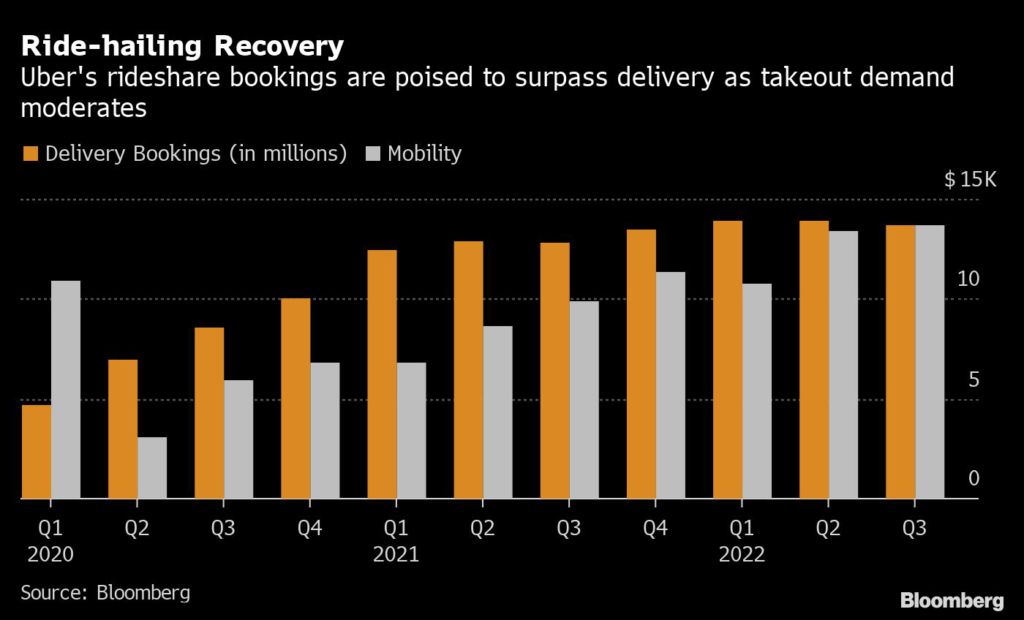
(Bloomberg) — Uber Technologies Inc. rose after reporting revenue that beat analysts’ expectations as gains in ridership assuaged investor concerns that rising inflation would damp consumer spending. 

Third-quarter sales increased 72% to $8.34 billion, the San Francisco-based company said Tuesday in a statement. That exceeded the $8.1 billion analysts were expecting, according to data compiled by Bloomberg. 

“Right now frankly we’re not seeing any signs of consumer weakness,” Chief Executive Officer Dara Khosrowshahi said in a conference call with analysts Tuesday. He added that strong ridership was driven by cities reopening, travel booming and a continued shift of consumer spending from retail to services. “October is tracking to be our best month ever for mobility and total company gross bookings,” he said.

The shares gained as much as 16.5% in early New York trading, the most since August.

The company’s monthly active users rose to a new high of 124 million, with the number of people taking ride-share trips jumping 22% in the third-quarter. However, customers are still not taking as many trips as they were pre-pandemic. “There is still significant runway to recover to pre-pandemic levels,” Khosrowshahi said.

Gross bookings, which encompass ride hailing, food delivery and freight, increased 26% to $29.1 billion, slightly below the average estimate, which Uber attributed to the impact of foreign exchange fluctuations. Adjusted earnings before interest, tax, depreciation and amortization reached $516 million. Analysts, on average, projected $458.7 million. 

Uber reported its ride-hailing driver base at the end of the period on Sept. 30 was “on par with September 2019 levels,” and the increased driver engagement continued into October. The improvement is a sign the company is moving past a protracted shortage of drivers that has also affected rival Lyft Inc., resulting in higher fares and wait times for customers. Both ride-hailing giants have spent millions to lure drivers back to their respective platforms and recruit new ones to meet resurgent rider demand. 

After surging during much of the pandemic, Uber and other gig economy peers such as Lyft and DoorDash Inc. are navigating a challenging economy that includes US inflation rising to a 40-year high while the risks of a global recession loom. The uncertainty has weighed on spending by advertisers and consumers, hitting tech giants like Meta Platforms Inc. and Amazon.com Inc. The gloomy outlook remains a risk for Uber, whose ride-hailing and delivery services carry a premium that customers may view more as a splurge than a necessity as budgets tighten.

Uber’s food-delivery arm, Uber Eats, generated $13.7 billion in gross bookings during the quarter, a decline from the previous period, and missed the $13.9 billion analysts expected. The unit, which offers delivery across restaurants, groceries and alcohol, has grown to make up about 33% of the company’s total revenue. Uber Eats initially benefited from the pandemic-induced boom in delivery and has more than doubled in size, based on bookings, from before Covid-19 emerged. The increased scale has allowed the delivery business to become more profitable, posting a record $181 million in adjusted earnings during the period.

“While the delivery category is one of the few ‘pandemic winners’ that continues to grow with a healthy top line, we welcome the newfound capital discipline amongst our peers,” Khosrowshahi said. “We will be measured with our investments, and will look to expand profitability while maintaining or growing our category position.”

Uber reached profitability on an adjusted basis for the first time in its history last summer and, earlier this year, Khosrowshahi pledged to reach $2 billion in free cash flow. One way the company plans to meet that target is by giving more attention to ads. In October, Uber launched a dedicated advertising arm to monetize its audience of 124 million monthly active users and tap a higher-margin revenue stream. The company said the business reached $350 million in run-rate revenue during the third quarter and affirmed its goal to reach $1 billion in ad sales by 2024.

The company’s freight unit completed an integration with Transplace, which it acquired last year, and reported revenue of $1.75 billion. Bookings and adjusted earnings for the division missed analysts’ estimates amid weaker demand, spot volumes and rates that affected the logistics sector, Uber said.

“The legwork will be done on the mobility side because of the higher take rates and profitability,” said CFRA analyst Angelo Zino. “Delivery may be lacking those strong pandemic numbers but now that driver supply has improved, that bodes well for profitability and cash flow metrics.”

Uber projected adjusted earnings before interest, tax, depreciation and amortization in the current quarter of $600 million to $630 million, beating estimates of $564.4 million. Gross bookings will be $30 billion to $31 billion in the period ending in December, in line with expectations.

The company recorded a net loss of $1.2 billion, or 61 cents a share, attributed in part to its equity stake in Didi Global Inc. 

(Updates share move in fourth paragraph, adds CEO comment in fifth paragraph and analyst comment in 12th paragraph)

More stories like this are available on bloomberg.com

©2022 Bloomberg L.P.

Close Bitnami banner
Bitnami
