Bloomberg

World’s Best Trading Debut of the Year Adds to Gulf IPO Bonanza

(Bloomberg) — A rare late-year flurry of activity is adding to the boom in Middle Eastern initial public offerings this year, including a tech listing that nearly quadrupled in its debut.

Geospatial and data analytics firm Bayanat AI Plc closed 273% above its listing price in Abu Dhabi on Monday, the best first-day performance globally for an IPO raising at least $100 million this year, according to data compiled by Bloomberg. The tech listing is unusual in the energy-rich Middle East.

A busy start to the week also saw Americana Group kick off what’s set to be a landmark dual listing in Abu Dhabi and Riyadh, as the operator of KFC and Pizza Hut restaurants in the Middle East and Africa received approval from Saudi Arabia’s market regulator. Dubai-based cooling firm Empower opened books, while private school operator Taaleem Holdings PJSC and Riyadh Cables Group announced IPOs.

With $16.6 billion raised so far, Middle Eastern IPOs are set for their best year on record after 2019, which saw Aramco’s mammoth $29.4 billion offering. That’s a sharp contrast to plummeting share sales in developed markets that are grappling with soaring inflation, hawkish central banks and the threat of recession.

“Successes like Bayanat could cement the trend for new introductions in the region as they incentivize companies and draw the attention of investors,” said Daniel Takieddine, CEO MENA at BDSwiss. 

Rising oil prices and investor inflows have made the Middle East a bright spot in the global listings market this year, and more companies are rushing to strike while the iron is hot. That’s spurring an unusually busy period in a region where IPOs are typically spaced out so as to not suck too much liquidity out of the market.

In the latest show of strong investor demand, Bayanat’s $171 million IPO was oversubscribed 90 times. The listing was backed by private equity firm Silver Lake and IHC, the United Arab Emirates’ most valuable company.


More stories like this are available on bloomberg.com

©2022 Bloomberg L.P.

Amazon Prime Expands Its Music Offering to 100 Million Songs

(Bloomberg) — Amazon.com Inc. is beefing up the music and podcast streaming offerings for its Prime subscribers, expanding access to 100 million songs from 2 million previously.That number of songs was only available in the company’s Unlimited Music plan, which starts at $9 per month. There’s a catch: Music on Prime can only be played in shuffle mode, or through playlists, some of which are personalized to users’ tastes and can be downloaded for offline listening. Subscribers to the Unlimited plan can select specific songs. 

The expansion comes as Prime member growth stagnates in the US, per a July report from Consumer Intelligence Research Partners, a Chicago firm that tracks Prime members through consumer surveys. Amazon raised its annual membership price by $20 in February and had about 172 million members as of June 30, the same as six months earlier, according to the report. Amazon Prime costs $15 a month and includes free shipping and access to the company’s movies and TV shows.

Steve Boom, vice president at Amazon Music, said the service was an “amazing benefit” to Prime subscribers when it first launched.

“Customer expectations have evolved, as they always do, especially as music streaming itself has become mainstream,” he told Bloomberg in an interview. “What we’ve heard consistently from our customers is they really want access to all the music.” 

The Prime tier is now the best place people can access songs without paying for a separate music streaming service, Boom said. The company has been “very successful” at converting customers to its Unlimited tier. Its ad-supported free tier, which is available to non-Prime members, counts the fewest number of listeners, he said.

“We’re obviously always looking to improve Prime and add value into Prime,” he said. “What we’re trying to really do is grow the number of Prime members taking advantage of their benefits by making it more attractive.” 

A January report from Midia, a research and consulting firm, placed Amazon Music as the third-most popular streaming service in the world, after Spotify and Apple Music. Spotify offers an ad-supported free tier that also only allows for shuffled play, while Apple requires a subscription to use its music service long-term. The Amazon updates could push some free Spotify users to switch to Amazon Music, particularly if they already subscribe to Prime.

Also as a part of Amazon’s update, podcast fans are gaining an added perk: ad-free episodes. The company will offer its Wondery show catalog without commercials, as well as some programming from third parties including the New York Times, Barstool Sports, NPR, CNN and ESPN. The platform will also exclusively include new shows from Keke Palmer, YouTuber and TikTok star MrBallen and a weekly bonus episode of basketball player JJ Redick’s The Old Man and the Three. A new tech feature within the app will allow listeners to preview episodes before they commit to listening.

Jen Sargent, chief executive officer at Wondery, said the company sought partnerships with networks catering to the “broadest selection possible” of shows, because the Prime customer is “everyone in the world.” She said the team will still look for more ad-free partnerships, as well as exclusive programming.

Amazon now operates four audio-oriented apps: Amazon Music, Wondery Plus, Audible and Amp, which lets users DJ their own shows. Boom said he doesn’t see audiobooks being integrated into Amazon Music, despite its competitor Spotify moving into the space. Wondery Plus, an app that houses ad-free podcasts and bonus content, will continue to do so for superfans, Sargent said. Meanwhile, Apple Music raised its price last week, prompting Spotify to say it would look to do so in the US, as well.

Boom said Amazon Music previously raised its prices on both its family plan and single-device plan, and that the team is always “evaluating the right price point for our customers.” 

–With assistance from Spencer Soper.

More stories like this are available on bloomberg.com

©2022 Bloomberg L.P.

NSA Watchdog Concluded One Analyst’s Surveillance Project Went Too Far

(Bloomberg) — An “experienced” analyst working at the National Security Agency developed a surveillance project about a decade ago that resulted in the unauthorized targeting and collection of private communications of people or organizations in the US, newly unearthed documents show.

An investigation into the matter, which hasn’t been previously reported, found that the analyst “acted with reckless disregard” and violated numerous rules and possibly the law, according to a 2016 report by the NSA’s Office of Inspector General. The agency released the report in response to a Freedom of Information Act lawsuit. 

The inspector general’s report sheds new light on unauthorized surveillance and lax oversight at a secretive agency whose global eavesdropping methods have faced intense scrutiny for vacuuming up massive amounts of data — including on Americans, who are protected by US law from being surveilled without authorization. The IG’s investigation unfolded as the first news stories were being published based on leaked classified documents from former NSA contractor Edward Snowden.

The inspector general’s report also reveals how a single analyst was given relatively free rein to develop a surveillance technique that many of his superiors didn’t understand. And it shows the lengths to which whistleblowers inside the agency went to get their allegations taken more seriously. The full report is here.

Many details about the analyst’s project aren’t known. The inspector general deemed the analyst’s action “egregious” in hindsight but noted he got conflicting guidance, told by some officials that his activities were acceptable and told by others to stop. The February 2016 report, which spans more than 400 pages and had been classified top secret, is heavily redacted. It’s not known if the analyst—or anyone else—was held accountable for what the inspector general described as potentially illegal surveillance.The NSA didn’t respond to specific questions about the report, including whether any action was taken against the analyst. But an NSA spokesperson provided a statement saying that the agency is “fully committed to the rigorous and independent oversight provided by the NSA Inspector General’s Office.”“The NSA operates in a culture of compliance to ensure that NSA’s foreign intelligence mission is conducted in accordance with all applicable laws, regulations and procedures,” the spokesperson said.The analyst said he was working on a “SIGDEV” effort, according to the report. That is short for signals intelligence development, aimed at finding and improving new avenues for eavesdropping. Two former NSA officials who reviewed the report told Bloomberg News that he appeared to be developing a new surveillance tool to improve spying methods that had scooped up Americans’ communications. The former officials asked not to be named in order to discuss sensitive intelligence information.

The inspector general’s investigation was sparked by two whistleblowers in May 2013. The analyst was taken aback by criticism of his work and vigorously defended it. Nonetheless, he told an investigator he had “been proceeding with his project in a ‘kind of [by the] seat of the pants’ mode” and that it was “kind of dangerous” and “unknown territory,” according to the report.

The probe began a month before the first news stories appeared based on Snowden’s leaks. Those stories revealed a massive, warrantless program to collect Americans’ phone records, map mobile phone locations worldwide and undermine encryption, and they came out at a time when the agency was already facing criticism for its expansion of surveillance capabilities after the Sept. 11, 2001, terrorist attacks. There is no indication in the inspector general’s report that the events are related to NSA activities and programs revealed in the Snowden documents, which had been secretly authorized. However, the inspector general’s investigation occurred during a period in which the NSA was under intense pressure to address alleged wrongdoings.  

Jon Callas, director of public interest technology at the Electronic Frontier Foundation, a group that defends civil liberties in the digital space, said the episode showed “there was loud and vocal dissent inside the agency.”

Noting failings of NSA oversight, Callas said the report also “appeared to show the NSA’s internal systems had permitted whistleblowers to object when they found irregularities.”

Provided an oral summary of the report’s findings, retired Gen. Keith Alexander, who was director of the NSA from 2005 to 2014, told Bloomberg News, “99.99% of the people at the NSA are trying to do the right thing. When somebody does the wrong thing, we find them, and we hold them accountable.”

Snowden, who reviewed the report, said through his lawyer that the subject of the investigation clearly violated the law and the US Constitution. “When I said in 2013 that while I was at the NSA I could pull the communications of anyone who passed through our net—including Americans—officials hotly contested the claim and a lot of folks believed them,” he said. “But it was true, as the NSA itself secretly acknowledges.”

“Defenders of broad surveillance authorities always insist that Americans don’t have to worry because our intelligence agencies are tightly constrained by law and policy,” Snowden added. “But time and again we’ve seen that when laws are violated and powers are abused, no one is held legally accountable.”


The NSA is primarily responsible for conducting foreign eavesdropping but can sometimes conduct such surveillance inside the US with a valid court order from the Foreign Intelligence Surveillance Court, known as FISA court, or approval from senior government officials.

The inspector general’s investigation found that the NSA analyst didn’t have a valid court order or other authorization to conduct his classified work. 

The redacted report didn’t provide the name of the analyst. The identities of the whistleblowers and most of the other people involved in the probe were also withheld.

In remarks to an investigator, the analyst said the foreign intelligence purpose behind his new technique was to “make the collection system healthier, the analytic process richer and the system more efficient.” 

The inspector general found that by allegedly targeting Americans’ communications without authorization and failing to flag the issue, the analyst violated several of the NSA’s bedrock rules and may have violated the law—specifically provisions of the Foreign Intelligence Surveillance Act that refer to spying on Americans on home soil and abroad.

Those conclusions were reported to the signals intelligence division, the NSA general counsel’s office and other NSA offices for further action. 

Senator Ron Wyden, who is on the Senate Intelligence Committee and has spearheaded surveillance reforms, told Bloomberg News in a statement: “This report further confirms that intelligence agencies sometimes commit abuses and violations.”

Wyden, a Democrat from Oregon, has been pressing intelligence officials for details on its surveillance methods for years, including during a congressional hearing on March 12, 2013, just before the allegations against the analyst were first raised.In that hearing, Wyden asked then-Director of National Intelligence James Clapper if the NSA was collecting “any type of data at all on millions or hundreds of millions of Americans.”“No sir,” Clapper responded, in comments he later admitted were misleading. “Not wittingly.”

Reached for comment, Clapper said he had no knowledge of the case. But he said it illustrates the challenges the NSA faces in balancing  intelligence collection with the protection of Americans’ civil liberties and privacy.

Less than two weeks before Clapper’s testimony, concerns about the analyst’s work were raised by a colleague. In an email that is attached to the inspector general’s report and heavily redacted, the analyst responded that his management was aware of what he is doing and dismissed the accusations as “purely hypothetical.”

“How is my allegation purely hypothetical?” the colleague responded, adding, “Our duty is DO NO HARM.”

Over the next two months, one of the whistleblowers,  a global network analyst, exchanged a flurry of emails and phone calls with NSA officials reiterating concerns about the analyst’s project. That person was told there wasn’t enough hard evidence to back up the claims.Frustrated by the inaction, in early May, the global network analyst and a colleague took their concerns to NSA’s inspector general, according to the report. “We believe that since October 2011 he has collected or attempted to collect a large volume of phone numbers without any foreign intelligence purpose,” the whistleblowers explained and detailed additional concerns, some of which were redacted.

The analyst took umbrage with colleagues who reported his actions, saying they came to him only after filing a complaint. “Some colleagues, eh?”

“I did not suddenly, or ever, decide to intentionally target US [redacted] persons,” the analyst wrote in a June 26, 2013 email, when questioned about his surveillance project. “This is a complicated process because the [redacted] world has become far more complicated than what it was in the old [redacted] days.”

On Feb. 12, 2016, then NSA Inspector General George Ellard sent a five-page memo to the director of the NSA’s signals intelligence office that characterized the analyst’s work as potentially illegal. The letter included recommendations to address the matter, which were redacted. As a result, it’s unclear what actions may have been taken.

While it’s not clear what happened to the analyst, he did make his feelings known about the allegations against him.

“Well now I know better,” he wrote to investigators. “I have NO intention of getting involved in this again. Period.”


–With assistance from Ryan Gallagher.

More stories like this are available on bloomberg.com

©2022 Bloomberg L.P.

Shein’s US Expansion Adds Pressure for Its Fast-Fashion Competitors

(Bloomberg) — Fast-fashion juggernaut Shein has managed to hook hordes of Gen Z shoppers in the US despite a key business disadvantage: It has typically offered e-commerce delivery windows of 10 to 15 days that are easily bested by its competitors.

Now, the apparel company founded in China is pushing to get its ultra-low priced merchandise on doorsteps more quickly by establishing distribution centers in the Midwest and California — a significant shift from its practice of shipping individual orders directly to US consumers from overseas.

The logistics investment dials up the pressure Shein has already placed on more established rivals such as H&M and Forever 21, while also threatening the newcomer’s profit margins and introducing fresh risks into its business model. 

“The time that it takes to get the products to the consumer in the fast-fashion world, where a young consumer — particularly a young female consumer — probably doesn’t want to think two weekends ahead is really important,” said Adam Cochrane, retail and luxury analyst at Deutsche Bank AG. 

One Shein distribution center, located in Whitestown, Indiana, is already operational and could reduce shipping times by up to four days. It currently has 800 employees, with plans to have 1,000 by the end of this year. A second facility is expected to open in Southern California by the spring of 2023, the company said, and it’s considering a third such space in the Northeast. 

These facilities won’t hold Shein’s full assortment of garments, but will stock certain products, especially key basics. The inventory will be chosen based on what is selling well in the US and will also reflect seasonality, with gear such as tank tops claiming more space when temperatures climb. The US centers also handle merchandise returns. 

Shein is taking a similar tack in other key markets: It has announced plans for a distribution center in Poland that will serve Europe. And on Tuesday, the company said it opened a 170,000 square-foot warehouse in Toronto, along with a corporate office in the same location. 

Improved speed could help Shein — which was valued at $100 billion in a fundraising round earlier this year — build on a remarkably fast rise.

The company, which started selling in the US in 2012, gained traction with its website and app thanks to a consistent stream of new products, ubiquitous marketing on TikTok and extremely low prices. It largely eschews physical stores, save for the occasional pop-up shop. 

It’s the ninth-most popular apparel brand among Gen Z women in the US, according to survey data from Morning Consult. That puts Shein in league with classic American labels Levi’s and Calvin Klein.

“There have always been disruptors in the fast-fashion space, but what Shein brings to this is a bigger scale, coming from China,” said Caroline Gulliver, an analyst at Stifel Financial Corp. in London. “It’s a dramatic shift in the landscape in the US.”

Shein has emerged as a formidable challenger to US chains such as Forever 21 and American Eagle Outfitters Inc. that cater to the same demographic. It also competes with international fast-fashion players with a strong presence in the US, including Hennes & Mauritz AB (H&M), Zara owner Inditex SA, and UK-based brands Asos Plc and Boohoo Group Plc. 

Shein is expected to generate $24 billion in revenue this year, according to a person familiar with the figures who asked not to be identified. In the first quarter of this year, Shein sales in the US grew 43% from a year earlier, versus a 10% decline at H&M, according to data from Bloomberg Second Measure. 

Bulk Inventory

Still, the development of a US distribution network adds the potential for new costs. The US allows up to $800 of goods from China to be imported duty-free — a limit that was mostly easy to stay clear of when shipping individual customer orders. But if Shein is now sending bulk inventory to distribution centers, it will likely need to ship in heftier bundles that are subject to tariffs. 

Also, Shein has typically made small, almost-on-demand batches of its garments — a setup that helps avoid discounting and protects profit margins. 

“Once you have a distribution center in the United States, you’re not doing made-to-order anymore,” said Sucharita Kodali, principal analyst at Forrester Research. “You’re shipping big, bulk quantities of an item that may or may not sell. I don’t think that this is some home run, but it’s too early to tell.”

“The question is, can they maintain their price point with the incremental cost of the US distribution center?” Cochrane said, noting that Shein’s pricing advantage over competitors may narrow.

Shein’s effort to expand its US distribution network is part of a race in the apparel industry to rethink logistics to find or maintain a competitive edge.

Trendy online retailer Boohoo is making a move similar to Shein’s, opening a distribution center in Pennsylvania next year which it says will provide three-day delivery windows to 95% of the country, compared with a current wait time of 10 days.

American Eagle is moving in a somewhat opposite direction, piloting a program where it will ship merchandise directly from overseas facilities to US customers in an effort to “react more quickly to changing business trends.” Quiet Platforms, the logistics arm of American Eagle, will also offer fulfillment services to other retailers looking to ship merchandise from China to consumers in the US.

“By providing companies on our platform with access to upstream pools of inventory, we’re enabling them to be less inventory-heavy and more strategic in their assortment decisions,” Shekar Natarajan, American Eagle’s Chief Supply Chain Officer, said in a statement.

Meanwhile, Asos is slowing down investment in automation at its warehouse in Atlanta, in line with expectations that it will handle a lower amount of stock as part of a broad restructuring plan. The brand is losing hope on international growth, noting in a recent earnings statement that expansion outside of the UK has become “excessively capital intensive” which has resulted in a “lack of meaningful growth.”

Longer-Term Peril

Shein’s operational gamble follows a spate of news reports calling it out for high carbon emissions, unfair labor practices and low product quality — none of which appear to have significantly dented consumers’ appetite for its merchandise.

But its business model, along with that of peers like H&M, faces longer-term peril. Legislation around the environmental and labor costs associated with garment production is gaining traction globally. A recent investigation found that Shein workers in China were working 18-hour days and being paid £3 ($3.34) per garment — just the kind of situation lawmakers may seek to crack down on.

“All of these fast fashion brands are basically going to face a reckoning in the next even 10 years,” Kodali of Forrester said. “They need to figure out how to coexist when the fundamental demand for your business is going to be shrinking, either because the consumer doesn’t want it, you’re going to be legislated against, or the cost of your raw materials is just going to go up.”


–With assistance from Katie Linsell.

More stories like this are available on bloomberg.com

©2022 Bloomberg L.P.

Paramount Has Two Hit Streaming Services: Now It Wants Some Credit

(Bloomberg) — When Walmart Inc. decided earlier this year to include a video streaming service as a perk for customers of Walmart+, its membership program, the retailing giant met with a handful of major media companies including Walt Disney Co. and Comcast Corp.’s NBCUniversal.

In the end, Walmart announced it was going with Paramount+, a major coup for the two-year-old streamer. Paramount Global, the owner of Nickelodeon, has spent years building a relationship with Walmart and even has an office in the company’s home city, Bentonville, Arkansas. But its streaming service is smaller and less well known than Netflix, Disney+ and HBO Max.

“Everybody wanted that deal, and we won,” Paramount Chief Executive Officer Bob Bakish, 58, said last month over coffee at the Four Seasons Hotel in Beverly Hills. 

The partnership is a testament to the progress the company has made in the last couple of years under Bakish’s leadership. When controlling shareholder Shari Redstone merged Viacom and CBS in 2019, many analysts and competitors wrote off the new company as too small to compete. The debut of Paramount+ in early 2021 struck many observers as late and, worse yet, second class. 

But so far this year, Paramount+ has been the fastest-growing streaming service in the US. It had 43 million subscribers as of the end of June and is expanding overseas. All told, Paramount has more than 60 million customers across all of its paid services, which include Showtime, BET+ and Noggin. The company’s free streaming service, Pluto, is more popular in the US than Apple TV+ or Peacock, according to Nielsen.

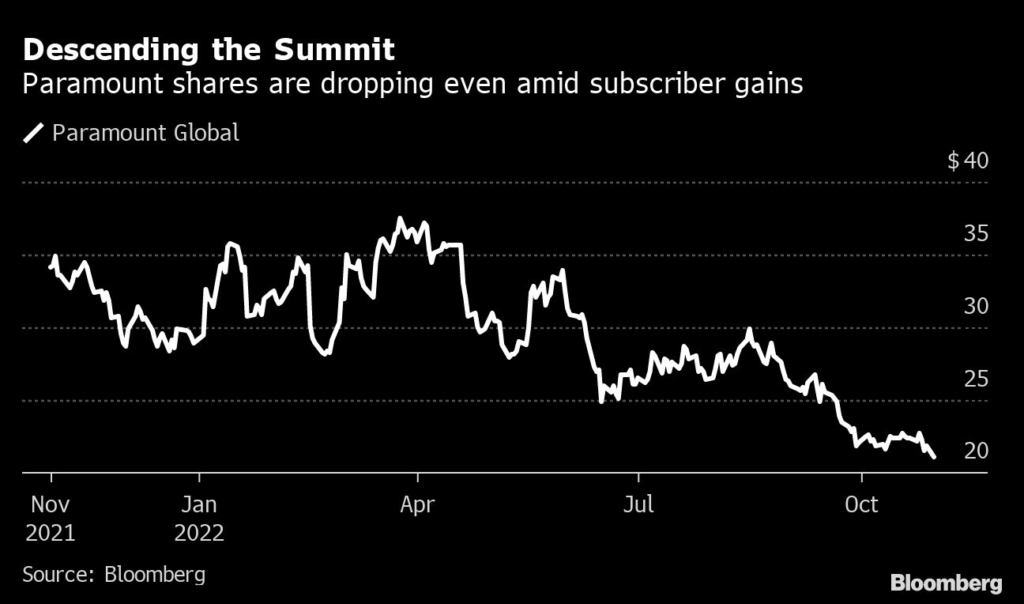
Such successes in streaming have done little to win over investors. Shares of the company have declined almost 39% this year and are down 51% since the start of 2021. Paramount faces the same challenge as many of its peers. Cable networks such as MTV and BET continue to contribute the majority of the company’s profit but are hemorrhaging viewers. Media companies have shifted most of their best shows to streaming, driving  viewers away from cable. National TV advertising sales are in decline.

Moving forward, Bakish will need to milk the legacy TV networks for cash long enough to turn streaming into a profitable business. Yet it’s not clear how long that will take, and some analysts believe streaming may never be as lucrative as the bundled-TV ecosystem that it is replacing. The company’s streaming services lost $901 million in the first half of the year, and Netflix Inc. is the only major streaming service that reports a profit. Investors and analysts believe that Paramount will need to combine with another company, such as Warner Bros. Discovery or Comcast’s NBCUniversal, to successfully compete with Netflix and Disney.

“They are stuck right now between challenging businesses on both sides,” said Robert Fishman, an analyst with MoffettNathanson.

Redstone is unlikely to sell the company or buy another one until she can lift the share price. Bakish acknowledges that the company could be in play at any moment. But with no immediate deal in the offing, he’s focused on bolstering Paramount+. The company just locked up the rights to college football from the Big Ten as well as the UEFA Champions League, a soccer tournament featuring Europe’s best clubs.

He is also working to consolidate the company’s streaming services. Customers of Showtime, the streaming companion to the premium cable network, can now watch its shows within the Paramount+ app. Bakish is planning a similar move with BET+, a streaming offshoot of the eponymous cable network, according to people familiar with the company’s plans.

“The strategy we have is indisputably working,” Bakish said just hours before HBO swept most of the major Emmys. “We’re a hell of a lot bigger than people thought we’d be a year ago.”

A former management consultant, Bakish was a relative unknown when Redstone selected him to run her family’s media empire. He’d spent most of his time at the company overseeing the small but profitable international business.

He inherited a company in distress. Redstone took control of Viacom in 2016 after winning a bruising fight with Viacom’s then-CEO Philippe Dauman, the former lawyer of her father Sumner Redstone. For years, Viacom had been at the epicenter of youth culture, delighting kids and teens with shows like The Real World, Rugrats and South Park. But Dauman had hollowed out the company by cutting costs, ignoring the internet and losing young viewers to YouTube and Netflix.

“It wasn’t going off the rails; it was off the rails,” Bakish said.

At first, Bakish didn’t enter the streaming wars. The company had a lot of debt that it needed to pay down and didn’t have the money to compete for top projects with Netflix or Amazon. He pitched the company as an “arms dealer” that would produce shows and sell them to the highest bidder. He also sold a lot of real estate, including a 55-acre lot in the Studio City neighborhood of Los Angeles.

The strategy resulted in some lamentable deals. Bakish licensed the streaming rights to Yellowstone, which would become his company’s signature show, to Peacock. He licensed the catalog of South Park, one of the longest-running shows in TV history, to HBO Max. While Bakish would later seek to claw back the rights he dealt away, the moves felt defensible at the time. The South Park arrangement alone brought in more than $500 million.

Along the way, Bakish made at least one deal that would prove prescient. In 2019, he paid $340 million for the advertising-supported streaming service Pluto TV, which offered live channels filled with reruns and old movies. “When we did Pluto, people laughed at us,” Bakish said. Pluto, which then generated about $70 million in sales, is now a $1 billion business.

“100 million of anything is a real number, and I don’t think we’re stopping there.”

Yet what Wall Street really wanted at the time was for media companies to copy Netflix, which was adding 25 million new subscribers a year. Investors rewarded companies that were willing to spend billions of dollars to create streaming services of their own.

In February 2021, Bakish hosted an investor day to unveil the company’s new streaming service Paramount+, which positioned itself as a more populist alternative to Apple or HBO. While rivals focus on awards, it offered SpongeBob SquarePants, the National Football League and Hawaii Five-O.  The company also commissioned new original series, including reboots of past hits like The Real World, as well as spinoffs of existing franchises such as Yellowstone.

Senior executives weren’t sure it would work. But Bakish was confident Paramount had the resources to compete. He just needed to get his executives to shift their priorities from linear TV to the internet. He restructured the company. Instead of putting one person in charge of all the programming for its streaming service, as some rivals did, Bakish asked different executives to oversee programming categories. The head of Nickelodeon would oversee kids programming for Paramount+, while the head of CBS would handle news and sports. 

Bakish won over most of the company’s executives with his self-deprecation and modest ego. He hosts regular forums known as “Bob Live” where he will answer questions from employees. 

“Bob is incredibly good at listening and being able to problem solve in a non-dramatic way,” said Brian Robbins, the head of Nickelodeon and Paramount Pictures. “He’s just a very practical leader.”


By the end of 2021, the company had grown sales from streaming by 64% in just one year, driven by subscriptions to Paramount+. And yet, the stock sank 19%.

Earlier this year, the company tried again to convince Wall Street that it had a winning strategy. In February, Bakish changed the company’s name from ViacomCBS to Paramount, the same name as its famed movie studio. He also announced plans to spend even more money on programming.

“The question was: Can we get to enough scale to make us matter in streaming arms race?” Robbins said. “We feel really good about where we are and how fast we got there.” The company has said it will surpass 75 million subscribers by the end of year and it will reach 100 million by the end of 2024. 

“100 million of anything is a real number, and I don’t think we’re stopping there,” Robbins said. 

Its success in streaming has coincided with a hot streak from its movie studio, Paramount Pictures. Earlier this year, the studio delivered five consecutive No. 1 movies, culminating in Top Gun: Maverick, the year’s highest-grossing film. Its latest release, the horror movie Smile, is the studio’s fifth movie to top $100 million at the global box office this year.

While Paramount+ and Pluto TV continue to add customers, Wall Street is no longer focused on subscriber growth at any cost. Netflix has reported slowing growth at the same time as economists are worrying about a potential recession. The rate of cord-cutting has accelerated to record speeds with more than 10% of people canceling their TV subscriptions from Comcast in the last year. Revenue is dropping at some of the largest and most stable media firms, such as YouTube and Meta Platforms Inc.

Investors want to see media companies focus on profitability and reconsider just how much money they are spending on streaming. Paramount isn’t spending at the scale of Disney or Netflix. It is competing to be the third or fourth or fifth biggest streaming service. But it is in the midst of expanding overseas and spending billions of dollars to fuel its growth around the world.

This week, Paramount will report financial results at a time of great economic uncertainty. Even if the company reports another quarter of industry-leading growth, it will also likely post another quarter of shrinking profit.

More stories like this are available on bloomberg.com

©2022 Bloomberg L.P.

US Futures Climb With Economy in Focus Before Fed: Markets Wrap

(Bloomberg) — Stock futures climbed and Treasury yields slumped, with traders awaiting economic data for clues on whether the Federal Reserve will decelerate its pace of monetary tightening to prevent a hard landing.

A rally in equities would put the S&P 500 closer to 4,000, a key technical and psychological level. Fed Chair Jerome Powell’s favored portion of the yield curve — the difference between where three-month rates are now versus where they are expected to be in 18 months’ time — is on the cusp of inverting. That would be a warning sign for many investors that a recession is coming.

Traders will be closely watching figures on manufacturing, construction spending and job openings on the eve of the Fed decision. At a time when bad economic news is considered good news when it comes to policy wagers, data showing a slowdown in activity helped spur a rally in stocks in October, with the Dow Jones Industrial Average wrapping its best month since 1976.

“There is a growing consensus that global central bankers are becoming more sensitive to the risk of overtightening,” said Katie Nixon, chief investment officer for Northern Trust Wealth Management. “The Fed has a conundrum, of course, in maintaining its steely inflation-fighting resolve — and credibility — while balancing the ever-growing fears of a policy mistake.”

Nixon is betting that after another 75-basis-point rate increase in November, the Fed will slow down the pace to 50 basis points in December and make an additional quarter-point hike in early 2023.

Also helping bolster sentiment Tuesday was speculation that China is preparing to gradually exit the stringent Covid Zero stance that’s been the biggest bugbear for investors. A gauge of the nation’s stocks listed in Hong Kong surged almost 7% intraday, rebounding from its lowest close since late 2005. Shares pared gains after Chinese Foreign Ministry spokesman Zhao Lijian said he’s “not aware” of a committee on ending the policy.

Key events this week:

  • EIA crude oil inventory report, Wednesday
  • Federal Reserve rate decision, Wednesday
  • US MBA mortgage applications, ADP employment, Wednesday
  • Bank of England rate decision, Thursday
  • US factory orders, durable goods, trade, initial jobless claims, ISM services index, Thursday
  • ECB President Christine Lagarde speaks, Thursday
  • US nonfarm payrolls, unemployment, Friday

Some of the main moves in markets:

Stocks

  • Futures on the S&P 500 rose 1.1% as of 8:56 a.m. New York time
  • Futures on the Nasdaq 100 rose 1.4%
  • Futures on the Dow Jones Industrial Average rose 0.7%
  • The Stoxx Europe 600 rose 1.3%
  • The MSCI World index rose 0.7%

Currencies

  • The Bloomberg Dollar Spot Index fell 0.7%
  • The euro rose 0.5% to $0.9936
  • The British pound rose 0.7% to $1.1546
  • The Japanese yen rose 1.1% to 147.05 per dollar

Cryptocurrencies

  • Bitcoin rose 0.7% to $20,538.32
  • Ether rose 1.9% to $1,595.19

Bonds

  • The yield on 10-year Treasuries declined 12 basis points to 3.93%
  • Germany’s 10-year yield declined nine basis points to 2.05%
  • Britain’s 10-year yield declined five basis points to 3.47%

Commodities

  • West Texas Intermediate crude rose 2.5% to $88.69 a barrel
  • Gold futures rose 1% to $1,656.40 an ounce

More stories like this are available on bloomberg.com

©2022 Bloomberg L.P.

VW Slow-Rolls Faster EV Charging, Handing Hyundai an Advantage

(Bloomberg) — Volkswagen’s buggy software has gotten a lot of attention, with product delays making headlines and contributing to the ousting of Herbert Diess as chief executive officer.

The automaker also lags behind the competition in another respect that’s flown relatively under the radar: charging times.

The VW ID.4 and Hyundai Ioniq 5 are similarly priced vehicles, starting around $50,000 for their 77 kilowatt-hour (kWh) battery versions. But the ID.4 takes more than double the time to charge to 200 kilometers (124 miles) of range, with the two clocking in at 20 minutes and 10 minutes, respectively.

One of the engineering decisions that’s put Hyundai toward the head of the pack in this regard was its adoption of an 800-volt architecture. This enables its car batteries to more quickly take in electricity at higher power by lowering the current, which can be a limiting factor for other vehicles.

The Volkswagen Group brought an 800-volt system to market ahead of others with the Porsche Taycan that debuted in 2019, but decided against offering it across more models, at least for a few years. That decision, presumably having to do with expense, may have lacked vision. BloombergNEF’s latest research into ultra-fast charging finds that 24 automakers are adopting 800-volt technology, including established players Stellantis, Toyota Motor and General Motors, and China’s Nio, Xpeng and BYD.

During VW’s Power Day presentation last year, executives described plans to adopt solid-state batteries in certain vehicles after 2025 and said their target was to offer vehicles that charge to 80% from 10% in 12 minutes. VW’s EVs would need to charge at significantly higher powers than the current lineup, likely leading to adoption of 800-volt technology.

In fairness to VW, there’s some debate about whether putting this technology into smaller, less-luxurious vehicles makes strategic sense. Tesla CEO Elon Musk and CTO Drew Baglino questioned this during an earnings call in April, saying the advantages of moving the Model 3 and Model Y over to 800 volts would be limited and the cost would be high.

Tesla is managing to reach similar charging powers with 400-volt systems that other vehicles achieve with 800-volt alternatives. It’s unclear if the company can squeeze more out of its 400-volt systems, though, and Musk and Baglino did say an 800-volt system was under consideration for Tesla’s larger Semi and Cybertruck models.

As the market for 800-volt components grows and automakers and their suppliers innovate, the cost gap will narrow and 800-volt technology could take more of the market. Companies including ZF Friedrichshafen, Schaeffler and Marelli have recently presented 800-volt components.

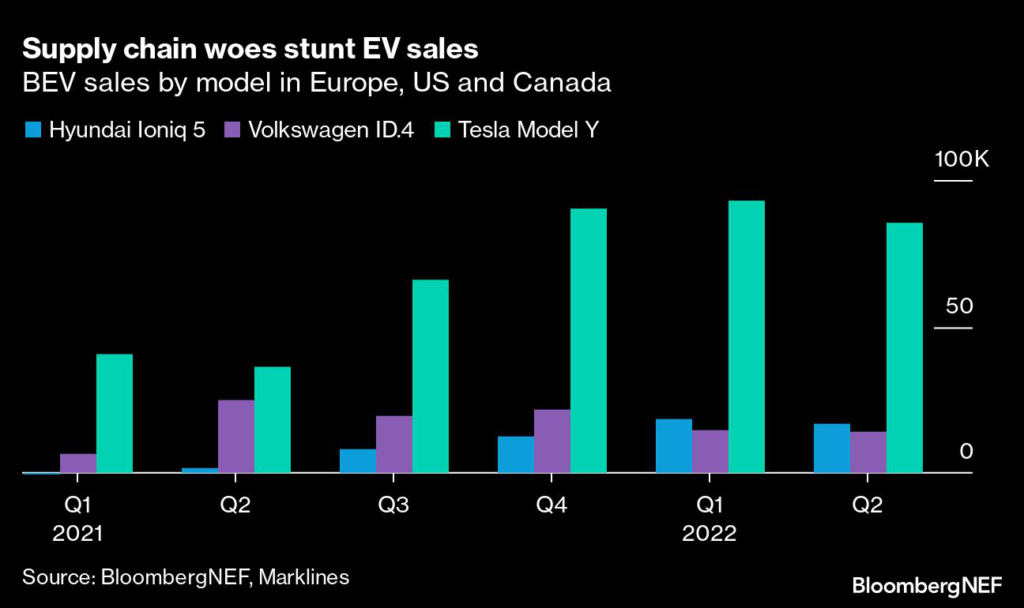
Hyundai’s willingness to adopt 800-volt technology hasn’t translated to domination of the EV market, as the manufacturer hasn’t been able to satisfy demand. In the current supply chain climate, quickly taking delivery of most EV models is challenging, with buyers waiting more than a year in some cases. Being able to produce at scale is one of the biggest competitive advantages.

Tesla is far out in front, managing to deliver about 411,000 Model Ys in Europe, the US and Canada in the last 18 months, compared with roughly 100,000 VW ID.4s and 56,000 Hyundai Ioniq 5s. But even Tesla has been production constrained, with just 18% of those sales occurring in Europe.

What’s worrying for Volkswagen is that ID.4 sales have had longer to pick up than the Ioniq 5, but were lower in the first half of this year, with just 5,300 ID4s sold in the US and Canada compared to more than 17,200 for the Ioniq 5.

Consumer demand for the fastest and jazziest things — whether they use them or not — should not be underestimated. Neither should the number of drivers who will use fast-charging more regularly.

While VW may still be jostling for charging superiority on its future vehicles, the lack of this technology across its current lineup carries risk — some consumers are going to look elsewhere for a battery that tops up quicker.

–With assistance from Charlotte Adriaenssens.

More stories like this are available on bloomberg.com

©2022 Bloomberg L.P.

India’s Central Bank Starts Pilot Digital Currency Program

(Bloomberg) — India’s central bank started a pilot program of its digital currency Tuesday, allowing select banks to use it for settling secondary-market transactions in government securities. 

Banks traded 2.75 billion rupees ($33.3 million) of bonds on the first day using the new form of currency, data from Clearing Corp. of India Ltd. showed. Nine participating banks executed 24 trades worth 1.4 billion rupees in 7.38% 2027 bond, 23 trades totaling 1.3 billion rupees in 7.26% 2032 bonds and one transaction in 6.54% 2032 bond. 

The e-rupee will be tested for retail use within a month in some locations, the Reserve Bank of India said on Monday. The launch comes as India steps up its fight against private digital currencies. Officials announced a new tax regime this year that decimated volumes on crypto exchanges. 

The limited roll-out comes a day after Singapore’s monetary authority unveiled trials of a digital version of its local dollar. The central banks of China, the euro area, the Bahamas and others have been experimenting in the field. Many others are examining ways to quell the threat to financial stability from private digital currencies. 

Central bank digital currencies “will provide the users the same experience of dealing in currency in digital form, without any risks associated with private cryptocurrencies,” the RBI said earlier in a concept note. These currencies will also ensure consumer protection “by avoiding the damaging social and economic consequences of private virtual currencies.”

Banks involved in the pilot are the State Bank of India, Bank of Baroda, Union Bank of India, HDFC Bank, ICICI Bank Ltd., Kotak Mahindra Bank, Yes Bank, IDFC First Bank and the Indian unit of HSBC Holdings Plc.

(Updates with trade details in second paragraph and context in third)

More stories like this are available on bloomberg.com

©2022 Bloomberg L.P.

Elon Musk Begins to Shake Up Product Leadership at Twitter

(Bloomberg) — Elon Musk is expected to appoint new product leadership inside Twitter, and met over the weekend with close friends and advisors on how best to change the service he just bought for $44 billion. 

Twitter’s most senior product executives are unlikely to stay at the company with Musk in charge, according to people familiar with the company who asked not to be identified as the information is private. The new owner is likely replacing Nick Caldwell, Twitter’s head of engineering, and Jay Sullivan, general manager for both consumer and revenue product, as he revamps the company and leadership team. Caldwell updated his public Twitter bio to include the word “former,” while Sullivan deleted his bio entirely. 

Musk, Caldwell and Sullivan didn’t respond to requests for comment. Twitter declined to comment.

It’s not clear who will ultimately take over but Musk has turned to old friends for advice in the first few days of his Twitter ownership. He’s been meeting regularly with David Sacks, a friend from his PayPal days; Jason Calacanis, a friend and investor; and Sriram Krishnan, a former Twitter executive and current general partner at the venture firm Andreessen Horowitz. 

The group has been discussing Twitter’s product strategy, though it’s unknown if any of them will be full-time leaders at the company. Both Calacanis and Sacks have Twitter email addresses in the company’s internal directory, and Krishnan tweeted Sunday that he’s still “very much in my day job” at Andreessen Horowitz. 

Musk has also shown interest in bringing back Kayvon Beykpour, Twitter’s former head of product, who was just fired in May, according to three of the people. It’s unclear if Beykpour will return. 

New product leadership at Twitter is just one of a number of anticipated changes at the company following Musk’s recent takeover.

Read more: Twitter Chaos Shows No Sign of Letting Up Now That Deal’s Done

Bloomberg has reported that a number of senior leaders, including CEO Parag Agrawal, have been fired, with Musk becoming interim CEO. Sarah Personette, chief customer officer, said she resigned on Friday and her work access to Twitter was officially cut off on Monday night. Employees are bracing for more widespread layoffs as soon as this week, with some managers spending the weekend compiling lists of employees to cut. 

Whoever Musk picks to take over product will have an important role in shaping one of the world’s most influential online platforms. Musk has promised major changes at Twitter, including a greater focus on subscriptions, fewer content restrictions, and the possibility of multiple algorithms for different timelines. He’s also considering charging users for blue verification badges, according to Platformer.

(Updates with departure of chief customer officer in eigth paragraph)

More stories like this are available on bloomberg.com

©2022 Bloomberg L.P.

How the US Midterm Elections Could Affect Companies’ Profits

(Bloomberg) — A Republican takeover of Congress would reshape the fiscal and regulatory landscape for a wide range of businesses that have grappled for nearly two years with Democratic efforts to boost taxes and tighten rules.

Next week’s midterm elections are expected to usher in a new era of divided government, with polls showing Democrats losing control of the House and possibly the Senate. That would spell the end of President Joe Biden’s agenda.

For businesses, the biggest impact of a GOP ascent would be the end of one-party economic policy. Democrats would no longer be able to use the partisan budget maneuvers to ram through tax increases, change Medicare drug policies, and pass pandemic relief spending that many economists say helped fuel inflation.

Even in a divided government, though, there may be room for compromises on border security and legal immigration that could address the labor shortages vexing US industries, along with possible agreements to streamline permitting and leasing for energy projects. Yet, GOP lawmakers are vowing to investigate Biden’s administration, reject his appointees to key jobs and wage a fight over the US debt limit that risks rattling markets — politically charged moves that could interfere with any bipartisan deal-making.

With a week until Election Day, here’s a look at what’s at stake for business:

Republican Congress Would Put Brakes on Business Tax Increase

Democrats came within one Senate vote of raising the corporate tax rate to 25% and imposing a global minimum profits tax. The risk of that being resurrected goes away if the GOP takes the House as expected, along with the chances of a windfall profit tax for oil companies. The midterm outcome will also likely shape December talks on renewing research and development tax breaks.

Republicans have said that in the majority they will push to extend expiring provisions of the 2017 tax cuts signed by former President Donald Trump tax cuts. Two provisions of that law are especially valuable to businesses: the 20% deduction on qualified income for many pass-through entities that expires in 2025 and bonus depreciation for qualified business purchases that phases down fully in 2027.

Anti-tax activist Grover Norquist predicts a GOP Congress would negotiate with the White House a two-year extension of those provisions before the end of 2024.

Former top Senate GOP aide Rohit Kumar, now at PWC, predicts the GOP would force tough votes on a reconciliation bill extending the Trump tax law to pressure moderate Democrats to agree to small business relief. “That would set the table for a final negotiation in 2025,” he said.

Read more: 

  • US Debt-Limit Distress Returns Next Year, With 2011 Redux Risk
  • Tax Cuts for the Rich? In This Economy? GOP Playbook Faces Doubt
  • How will the US midterms impact stocks and bonds? Fill out our  survey.

Energy Production Could Get Boost, Climate Measures Pared

Republicans plan to push for expanded domestic energy production if they take the majority and will try to use voter frustration over high gasoline prices to get the Biden administration to go along. The House Energy and Commerce Committee will look to boost development of hydrogen projects, streamline permitting and development of nuclear power plants, and accelerate approval for liquefied natural gas export facilities, Representative Bill Johnson, an Ohio Republican who serves on the committee, said.

Those measures, if enacted, would benefit companies such as nuclear operator Southern Co., small modular reactor maker NuScale Power Corp., and liquefied natural gas exporter Cheniere Energy, Inc. They could benefit drillers like Halliburton Co. and oil producers such as Exxon Mobil Corp. Johnson also plans to target a Biden administration rule phasing out some natural gas furnaces that drew the ire of the American Gas Association, which represents utilities such as Dominion Energy, Inc. and DTE Energy Co.

Republicans are already vowing strict oversight over hundreds of billions of dollars in lending authority that Biden’s Inflation Reduction Act gave to the Energy Department. Meanwhile, carmakers’ desire for an additional $7 billion in spending on electric-vehicle charging stations, favored by companies like General Motors Co. and Ford Motor Co., is likely to go ignored by GOP lawmakers. Biden cut his request for $15 billion in EV charger money in half to win GOP support for his bipartisan infrastructure bill and a second Democrats-only climate bill focused on extending EV tax credits for consumers.

US Chamber of Commerce Executive Vice President Neil Bradley said he doesn’t see the GOP being able to claw back money for renewable energy or reverse Biden’s past tax increases given the legislative hurdles in the Senate. “You are not un-ringing that bell in divided government,” he said.

Financial Regulations Could be Delayed or Thwarted

Trading firms including Robinhood Markets Inc. would benefit from a takeover by Republicans, who have sought to thwart planned regulations from the Securities and Exchange Commission under Gary Gensler. GOP lawmakers can delay rule-making with information requests to the SEC and language in annual funding bills directing the agency to hold off on regulating.

Meanwhile, one of the biggest targets for corporations is an SEC plan to require companies to disclose their greenhouse-gas emissions and in some cases from their suppliers and customers. Proposed in March, the rule has drawn the ire of industries from oil to farming. Exxon Mobil, Meta Platforms Inc. and Walmart Inc. have weighed in.

The SEC is also looking to add regulation on the crypto-currency industry.

Private equity firms and hedge funds could also benefit from any slowdown in SEC rulemaking. Gensler has proposed forcing them to disclose more about their fees and putting in place new restrictions, all of which have drawn the industry’s ire.

Antitrust Bill Opposed by Tech Companies Unlikely to Pass

Silicon Valley would likely be spared in a Republican Congress from sweeping legislation aimed at anti-competitive behavior by tech companies such as Apple Inc., Amazon.com Inc. and Alphabet Inc.’s Google. The bill has sponsors in both parties and has been cleared by key House and Senate committees, yet the tech industry has helped to stall the measure’s progress with lobbying campaign that has topped $100 million. 

House Republican leader Kevin McCarthy and likely House Judiciary Committee Chair Jim Jordan oppose the antitrust bill, which would have to be reintroduced if it doesn’t get a vote in the current Congress by the end of the year.

GOP lawmakers plan instead to focus on ending what they see as censorship of conservative voices on social media platforms, including by removing legal liability protections under Section 230, giving users an avenue to appeal when their content is removed and requiring more transparency from tech companies. None of these content-focused proposals is likely to become law, owing to insufficient support in the Senate and the strong odds of a Biden veto.

Tougher Regulations For Hospitals, Insurers

Hospitals, insurers and pharmaceutical benefit managers face the prospect of tough new regulations pushed by a Republican Congress, with the possible support from Democrats and the Biden administration. GOP lawmakers have promised to beef up requirements that hospitals post their prices online and lower drug costs by targeting drug industry middlemen known as pharmaceutical benefit managers. Party leaders have tried to shift away from promises to tear down the Affordable Care Act — also known as Obamacare — or restrict abortion rights, focusing instead on Americans’ rising medical bills.

Cathy McMorris Rodgers, the top Republican on the House Energy and Commerce Committee, ran ads in her home state of Washington vowing to require hospitals, insurers and doctors to disclose prices so consumers can shop around. Three pharmaceutical managers make up more than two-thirds of the total US market: Express Scripts Inc., CVS Health Corp. and OptumRx Inc., HCA Healthcare Inc., Ascension Health and Tenet Healthcare Corp. are hospital companies that may be affected. 

Many Democrats remain frustrated by the limited nature of the drug price negotiation provisions for Medicare in the Inflation Reduction Act, with just 10 drugs coming under negotiation in 2026. Expanding that power is unlikely under GOP control. Johnson & Johnson, Merck & Co. Inc., Pfizer Inc. and Eli Lilly & Co. have products that Medicare spends heavily on.

Five-Year, $428 Billion Farm Bill Up for Renewal

The next Congress will need to pass another five-year Farm Bill governing direct agricultural subsidies, crop insurance, food stamps and conservation programs. The 2018 farm bill authorized $428 billion in spending over five years, with about three-quarters devoted to food assistance and a quarter to farm supports.

Renewing the farm bill, a pillar of domestic agribusiness, could be more difficult under GOP control. Some conservatives want to see farm subsidies cut, though there is broad support in both parties to maintain spending. The bigger issue will likely come on nutrition programs that the GOP has previously targeted over eligibility requirements and conservation programs. Food stamps help boost sales of groceries at retail chains such as Walmart and Kroger Co. by providing low-income recipients a way of buying more food.

Direct federal government payments are a significant contributor to farm profits, accounting for between 18% and 48% of annual net US farm income since 2018, according to the US Agriculture Department. The extra income for farmers helps boost sales for seed, pesticide, fertilizer and equipment providers such as The Mosaic Co. and Deere & Co. It also reduces costs for major grain buyers such as Cargill Inc. and Archer-Daniels-Midland Co. and meat and poultry processors such as Tyson Foods Inc. that purchase animal feed.

Weapons Makers Could See Boost in Contracting

A GOP-led Congress offers both opportunities and peril for he biggest US defense contractors including Lockheed Martin Corp., Raytheon Co., General Dynamics Corp. and Boeing Co.

Republicans have complained that the Biden administration under-funds weapons systems, and the party will be under pressure to ensure that the military’s budget keeps pace with inflation. Texas Representative  Kay Granger, the likely next chair of the House Appropriations Committee, said in an interview she will prioritize increased defense spending.

Yet the defense industry also risks getting caught in GOP brinkmanship on spending to force Biden to cut social programs and boost border security. Protracted battles over spending could force lawmakers to rely more on interim bills to fund the government that don’t allow for new contracts. It’s likely oversight of the Pentagon’s contracting processes for expediting arms contracts awards for Ukraine will likely receive more scrutiny in a Republican-controlled Congress.

–With assistance from Anna Edgerton, Ari Natter, Mike Dorning, Keith Laing, Alexander Ruoff, Roxana Tiron, Anthony Capaccio, Benjamin Bain and Lydia Beyoud.

More stories like this are available on bloomberg.com

©2022 Bloomberg L.P.

Close Bitnami banner
Bitnami