

Bloomberg

Made.com to File for Insolvency as Online Retailer Collapses

(Bloomberg) —

Made.com Group Plc plans to file for insolvency after the British online furniture store failed to find a rescue buyer and ran out of cash. 

The company said Tuesday it intends to appoint PwC as administrator putting potentially as many as 500 jobs at risk. Shares of Made.com have been suspended from trading on the London Stock Exchange. 

News of Made.com’s collapse marks a steep decline for a company which only listed last year with a valuation of £775 million ($893 million) and was hailed as a millennial favorite. The company’s failure was largely driven by soaring freight costs and supply chain difficulties. 

Soon after Made.com’s IPO, the business said it was struggling to get stock due to longer shipping times and manufacturing in Vietnam being halted. Made.com issued three profit warnings this year as customers grew fed up of long wait times and then demand evaporated with rampant inflation pushing up costs for fuel, energy and food. 

Consumer interest in online shopping also fell after the pandemic when people returned to shops and offices and spent less time locked down at home buying furniture on the Internet. Several management departures have compounded the problems at Made.com with the shares slumping more than 99% this year.

PwC will handle any potential sale of Made.com’s trade, assets or brands though there can be no certainty of any deal. The company is expected to be wound up and it’s unclear yet whether any value will be left for shareholders, suppliers and creditors. 

Inventory Overload

Brent Hoberman, the creator of travel website Lastminute.com, co-founded Made.com in 2010 in an attempt to offer stylish furniture at cheaper prices by selling directly to consumers and eliminating traditional retailers. 

“Made got caught with massive inventory at just the wrong time,” Hoberman said in a LinkedIn post last week. “There are many questions about how the capital raised in the IPO was spent, who was worrying about the potential risks, and how the company had drifted from its initial business model.”

Made.com put itself up for sale in September but failed to find a buyer and warned last week that it was at risk of running out of cash. 

The company has also been beset with management upheaval with the brand’s chief financial officer, Adrian Evans, leaving in May after Chief Executive Officer Philippe Chainieux stepped down in February, citing family reasons. Nicola Thompson, the company’s chief operating officer, took over as interim CEO while Patrick Lewis, most recently CFO at John Lewis Partnership Plc, replaced Evans as finance chief. 

Waning Demand

In some ways Made.com’s decline is symptomatic of problems facing other furniture retailers, especially those relying on an online presence. Wayfair Inc., the US seller of home goods, announced it was cutting 5% of its workforce in August to save costs. John Lewis has seen customers move away from dining room furniture and Next Plc has noted higher freight costs on furniture due to its big, bulky nature versus clothing.

Made.com is also in part a victim of appetite drying up in credit markets with borrowing costs soaring to the highest in many years. The retailer said in September that as part of its strategic review it was considering debt financing, taking on a business partner or a complete sale or merger. Ultimately, none of these avenues proved viable.

(Updates with detail throughout)

More stories like this are available on bloomberg.com

©2022 Bloomberg L.P.

China Markets Rally After Unconfirmed Social Posts on Reopening

(Bloomberg) — Chinese stocks roared back from a rout and the yuan strengthened as speculation mounted that policymakers are making preparations to gradually exit the stringent Covid Zero policy that’s been the biggest bugbear for investors.

A gauge of Chinese stocks listed in Hong Kong surged almost 7% intraday, rebounding from its lowest close since late 2005, as unverified social media posts circulated online that a committee was being formed to assess scenarios on how to exit Covid Zero. Shares pared gains after Chinese Foreign Ministry spokesman Zhao Lijian said he’s “not aware” of such a committee.

The market had seen a heavy bout of selling following last month’s Communist Party congress, where President Xi Jinping’s power grab led to expectations that strict lockdowns and other market-unfriendly policies will likely persist. Previous rebounds on reopening speculation have all failed to last as authorities continued to pursue Covid Zero.

Read more: China Covertly Locks Down Cities as Covid Zero Pushback Rises

“I’m not surprised by the rumor circulating online about a conditional reopening,” said Liu Xiaodong, a fund manager at Shanghai Power Asset Management Co. “The state council could be waiting for the deliberation by the team of experts to determine the next step. The market is also willing to buy that an inflection point is near for Covid Zero.”

The impact of the speculation was felt beyond China markets. US stock index futures extended gains while a broader gauge of Asian equities climbed more than 2%. Iron ore futures in Singapore posted the biggest gain in more than a week. Copper rebounded after three days of consecutive declines, leading the gains of other metals including aluminum and zinc. Oil also gained with broader market rally.

The Hang Seng China Enterprises Index ended up 5.5%, while the Hang Seng Tech Index rallied 7.8% in its best day since April. On the mainland, the CSI 300 Index closed 3.6% higher, the most since March.

Chinese authorities have ramped up lockdowns quietly since the recently concluded party congress, as the highly transmissible omicron strain continues to breach virus defenses. Economic powerhouses including Shanghai, Zhengzhou and Guangzhou all have varying levels of restrictions in place, which have upended production and disrupted daily lives.

However, there are debates on how to fine tune the zero-tolerance approach as social and economic costs rise and the public and investors grow weary. Chinese officials are mulling a cut to travel quarantine to two days in a hotel and five days at home, down from seven days in a hotel and three days at home, Bloomberg News has reported.

Dip buyers though have suffered repeated setbacks in the face of the relentless equities rout.

“Investors are sensitive as they are waiting for a cue to buy back China related assets on reopening progress,” said Ken Cheung, chief Asia foreign exchange strategist at Mizuho Bank. “Rumor impact will not hold if there’s no follow-up and it’s not easy to speculate on timing of China policy change.”

The onshore yuan rose as much as 0.7% before paring gains to 0.4%. It fell to a 15-year low earlier in the session. The yield on 10-year government bonds rose two basis points to 2.66%, ending four straight days of declines.

The latest rally comes as global financial industry heavyweights gather in Hong Kong for a summit where China’s Covid policies are bound to be a topic of discussion.

“Efforts to resuscitate consumption and attract foreign investments cannot be done without some form of re-opening,” said Fiona Lim, senior foreign exchange strategist at Malayan Banking Bhd in Singapore. “Any confirmation by authorities to ease up on Covid-Zero would probably strengthen yuan significantly.” 

–With assistance from April Ma, Jeanny Yu, Chester Yung, Wenjin Lv, Linda Lew and Jessica Zhou.

More stories like this are available on bloomberg.com

©2022 Bloomberg L.P.
Ocado Shares Soar on Deal With South Korea’s Lotte Shopping

(Bloomberg) — Ocado Group Plc surged after signing an exclusive deal with Lotte Shopping Co. to develop the South Korean retailer’s online grocery business.

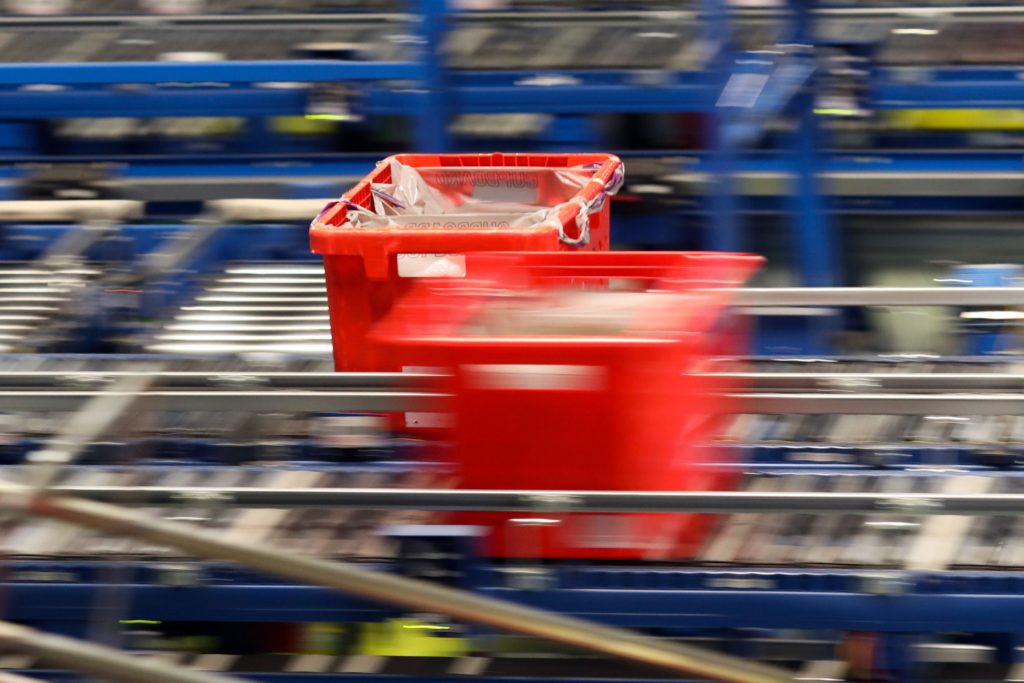
The UK developer of automated delivery systems will work with Lotte to build a network of robotic warehouses using Ocado’s Smart Platform, as well as providing technology for building online orders from Lotte’s stores. 

Lotte Shopping operates department stores, hypermarkets, supermarkets and e-commerce in South Korea, with more than 1,000 shops nationwide and an annual revenue of 15.6 trillion KRW ($11 billion). 

It’s a major signing for Ocado, whose shares had plummeted in recent months after a boost during the pandemic. In early trading Tuesday they rose 33%, though they’re still down roughly 60% this year.

Until this week, Ocado hadn’t gained a new client for its warehouse technology since expanding a deal with French supermarket chain Auchan in Poland earlier this year. Ocado now has 12 partnerships with grocers in countries including the US, France, the UK, Spain and Japan. Some of its retail partners include Kroger Co. in the US, Casino Guichard Perrachon SA in France, Morrisons in the UK, Alcampo in Spain and Aeon in Japan.

Ocado said the pipeline for potential new partners beyond Lotte is strong and that the company is targeting further growth across Asia Pacific.

“We believe we will sign more deals as our addressable market grows,” Ocado Chief Executive Officer Tim Steiner said on a call with reporters. 

Ocado’s stock slumped in the past year as the company, which benefited from Covid-19 lockdowns and the rise in online shopping, struggled to maintain its momentum while pandemic curbs eased and inflation soared. 

Read more: Ocado Plummets as Shoppers Cut Back and Energy Costs Bite (2)

The deal with Lotte should “quell the bears’ argument that there aren’t enough new deals being signed,” said William Woods, analyst at Bernstein. “South Korea was at the top of our list for new deals locations.”

As part of the new agreement, Ocado plans to build six customer fulfillment centers for Lotte by 2028 with the first due to go live in 2025. For the first time, at least some of the warehouses will be multistory. The taller facilities, designed to suit densely populated urban centers, will use Ocado’s new technology that it unveiled earlier in the year comprising lighter grids, more efficient bots and robotic arms able to directly pick products.

Ocado said the majority of additional capital expenditure will come in the year prior to the opening of the first warehouse in 2025.

(Updates with more details from statement and media call.)

More stories like this are available on bloomberg.com

©2022 Bloomberg L.P.
Skeptical Nigerians Aren’t Sold On Africa’s First Digital Currency

  • Listen to Bloomberg Crypto on the iHeartRadio App
  • Listen to Bloomberg Crypto on Apple Podcasts
  • Listen to Bloomberg Crypto on Spotify  

(Bloomberg) — About a year ago, Nigeria introduced a digital version of its official currency, the Naira.The introduction of the so-called eNaira was partly a response to concerns that the rising popularity of crypto in the country was threatening the banking system.There are a few countries experimenting with their own versions of digital money, including the Central African Republic, China, Jamaica, The Bahamas, and various islands in the Eastern Caribbean. Other countries, including the United States, are in the “studying” and “thinking deep thoughts about feasibility” phase of things.So how’s it going for Nigeria and the eNaira? Bloomberg reporter Ruth Olurounbi and Bloomberg Nigeria Bureau Chief Anthony Osae-Brown weigh in.

Follow us on Twitter @crypto, and subscribe to the Bloomberg Crypto Newsletter at https://bloom.bg/cryptonewsletter

This  podcast  is produced by the Bloomberg  Crypto   Podcast  team: Supervising producer: Vicki Vergolina, Senior Producer: Janet Babin, Producers: Sharon Beriro and Muhammad Farouk, Associate Producers: Mo Andam and Ty Butler. Sound Design/Engineer:  Desta Wondirad.

More stories like this are available on bloomberg.com

©2022 Bloomberg L.P.
Sony Bumps Up Profit Outlook as Weak Yen Juices Sensor Sales

(Bloomberg) — Sony Group Corp. nudged up its fiscal-year profit outlook, helped by a weaker yen and solid sales in its music publishing business, which made up for lackluster momentum in its games and image sensor businesses. 

The Japanese entertainment group raised its operating profit outlook to 1.16 trillion yen ($7.8 billion), up from its previous forecast of 1.11 trillion yen. A boost in streaming sales from its music publishing business helped fuel the earnings revision, along with a weak yen that bolstered overseas sales of image sensors used in Apple Inc.’s premium iPhones, the company said.

In its core games business, Sony aims to beat its current outlook to sell 18 million units of the PlayStation 5 console in the year ending March, and will target sales of 23 million PS5 units in the following fiscal year, Chief Financial Officer Hiroki Totoki said.

But Sony cut the forecast for its games segment for this year by 12% to a profit of 225 billion yen. While shortages of PlayStation 5 consoles are easing as Covid-related chip and logistics snarls end, recession fears are constraining consumer appetite for games, Totoki said.

“Players are cutting the number of titles they buy on the back of global macroeconomic conditions,” Totoki said at a news conference Tuesday. Sales of old games are faltering, while momentum for new titles remains stable, he said. “My biggest apology is that we had to cut our outlook on games for two straight quarters.”

Sony sold 3.3 million PS5 units in the quarter, the same as the previous year. The gaming division sold fewer physical software copies this year with 62.5 million units, down 18% from the same quarter a year ago. PS Plus subscribers dipped to 45.4 million from 47.3 million in the prior quarter.

“Performance of Sony’s two major pillars, games and image sensors, was bad and masked by the weak yen,” said Hideki Yasuda, an analyst at Toyo Securities. “Image sensor sales are likely to fall as demand from Chinese smartphones is falling. PlayStation software sales continued to be lackluster and still-declining PlayStation Plus subscriber numbers are concerning.” 

Sony reported an operating profit of 344 billion yen in the July-September quarter, beating the consensus forecast of 280.7 billion yen.

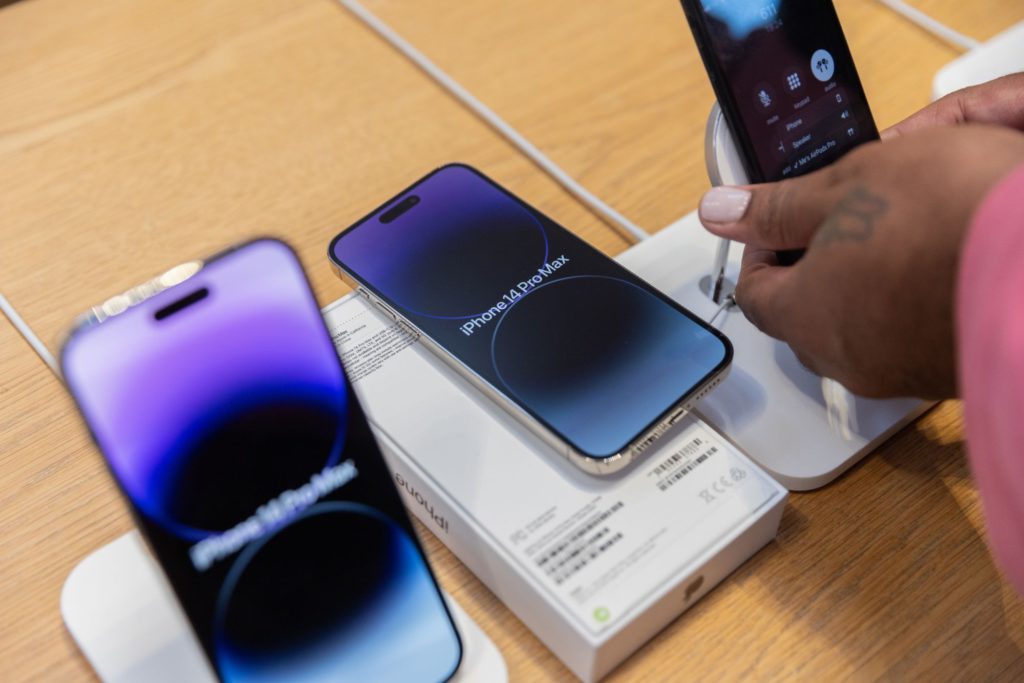
While overall smartphone demand is faltering, sales of the premium iPhone 14 Pro and 14 Pro Max, which use more cameras than the base models and require more sensors, remains strong, Sony said, echoing component suppliers such as Murata Manufacturing Co.

Sony will continue to bet on rising games momentum, calling out the upcoming God of War, to be released next week, as a driver to bring players back. It assembled more than 6.5 million PS5s between July and September, a faster production pace than expected, Totoki said.

“God of War, if coupled with better hardware availability, could prop up momentum, but I expect any recovery for the division to be limited,” said Morningstar Research analyst Kazunori Ito. 

(Updates with CFO quote, details from conference call)

More stories like this are available on bloomberg.com

©2022 Bloomberg L.P.
India’s Tata to Add Up to 45,000 Workers at IPhone Parts Plant

(Bloomberg) — Tata Group is planning to multiply the number of employees at its electronics factory in southern India that makes iPhone components, adding tens of thousands of workers as part of a push to win more business from Apple Inc.

The plant in the industrial town of Hosur, in Tamil Nadu state, will hire as many as 45,000 women workers within 18 to 24 months as it sets up new production lines, people familiar with the matter said. The factory, which produces iPhone housings or the cases which hold the device together, currently employs about 10,000 workers, most of them women.

The salt-to-software conglomerate is among Indian companies trying to benefit from Apple diversifying its supply chain beyond China. While just a small fraction of iPhones and its components are made in India, the country is making inroads with its push to challenge China as its neighbor struggles with Covid-related lockdowns and political tensions with the US.

The Hosur plant, spread over more than 500 acres, in September hired about 5,000 women, including those from the indigenous tribal communities, the people said, declining to be named as the staffing plans aren’t public. Indian companies are seeking to hire more women to improve the country’s gender imbalance in the workforce.

Tata and Apple representatives didn’t respond to emails seeking comment.

Women at the Hosur factory get gross salaries of just over 16,000 rupees ($194) a month, nearly 40% more than the Indian industry average for employees who use hands or tools for assembly, according to the people. The workers are given free food and lodging within the campus, the people said, adding that Tata also plans to provide training and education.

India’s fledgling electronics industry is trying to capitalize on China’s challenges to cope with the pandemic. Apple’s main manufacturing partner, Foxconn Technology Group, is grappling with mounting concern that a Covid flare-up at its main Chinese plant could hurt production ahead of the all-important holiday shopping season.

To diversify beyond China, Foxconn and fellow Taiwanese contract manufacturers Wistron Corp. and Pegatron Corp. have ramped up iPhone output in India — a move also boosted by Prime Minister Narendra Modi’s financial incentives program. That has helped to increase iPhone exports from the South Asian country.

Adding more local component manufacturing would also bolster India’s effort to expand deeper into the technology supply chain. Competing iPhone housing suppliers include Lens Technology Co., Jabil Inc., and Lingyi iTech Guangdong Co., according to Bloomberg Intelligence.

Separately, Tata Group is in talks with Wistron to establish an electronics manufacturing joint venture, seeking to assemble iPhones in India, people familiar with the matter said in September.

–With assistance from Mark Gurman.

More stories like this are available on bloomberg.com

©2022 Bloomberg L.P.
Foxconn Slams ‘Malicious’ Video of Staff Deaths as Outcry Grows

(Bloomberg) — Foxconn Technology Group has denied claims on social media of several deaths from a Covid outbreak at its main iPhone plant in China, calling the widely circulated videos “maliciously edited.”

The video, posted by a well-known Chinese dissident on Twitter, described the deaths of eight Foxconn workers inside a company-operated dormitory. The clip had attracted more than 27,000 views as of Tuesday afternoon. Similar posts circulated on Chinese social media including Douyin, the local equivalent of TikTok.

The iPhone-maker is grappling with mounting concern that a Covid flare-up at its main Zhengzhou plant could hurt production just as Apple Inc. gears up for the holiday season. Social media erupted over the weekend with visuals of workers fleeing the plant, some on foot, to return to hometowns miles away — scenes that provoked a national outcry.

“There are no deaths at our facility,” a Foxconn unit said in a statement. “We believe this is a maliciously edited video. The group is making every effort to ensure the production safety, and health and safety of colleagues.”

Read more: IPhone Factory Worker Walked 25 Miles to Escape Covid Lockdown

Foxconn, which makes most of the world’s iPhones from its Zhengzhou base, has scrambled in past days to mitigate potential disruption from the local Covid flare-up. It’s raising wages and arranging for backup from its other Chinese plants should assembly lines stall in Zhengzhou.

More stories like this are available on bloomberg.com

©2022 Bloomberg L.P.
Tesla Sending Workers From China to Help on Fremont Expansion

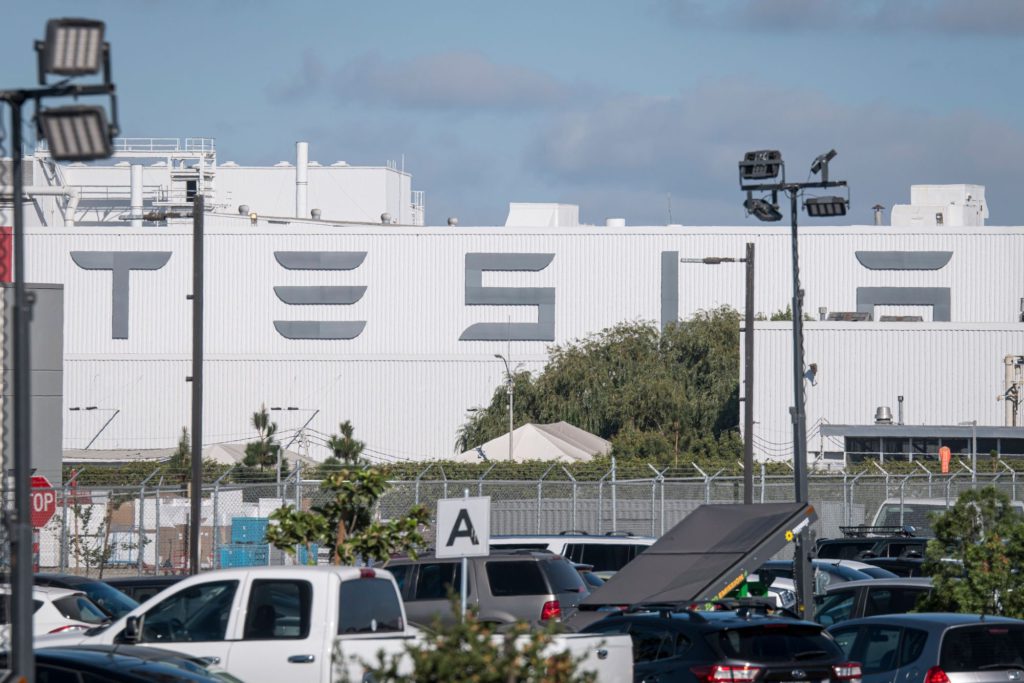
(Bloomberg) — Tesla Inc. is sending engineers and production staff from its recently upgraded Shanghai factory to help with an expansion of its plant in Fremont, California, according to people familiar with the plans, a move that could help the US facility ramp up production.  

Elon Musk’s electric carmaker will dispatch on-site staff, in particular automation and control engineers, to help ramp up production at Fremont, where Tesla’s Model S, X, 3 and Y vehicles are produced, the people said, asking not to be identified because the information is private. About 200 people will head to Fremont, on assignments that will last at least three months, one of the people said. The first workers are setting off as soon as this month, the person added.

A representative for Tesla in China declined to comment.

Tesla delivered a record 83,135 cars in China in September after increasing capacity at its Shanghai factory. The upgrade of the Chinese plant, Tesla’s first outside of the US, took about five weeks, including machinery maintenance and improvements overseen by automation and control engineers. That helped double the factory’s annual capacity to around 1 million vehicles, Bloomberg News has reported. Fremont can produce about 650,000 cars a year. 

The uptick in production has trimmed the wait time for a Tesla in China to between one to four weeks, from a peak of as long as 22 weeks earlier this year, according to the automaker’s website. Last week it cut prices across its lineup to attract buyers in the face of tougher competition from local manufacturers like BYD Co., which is also expanding globally.    

By comparison, customers ordering a Model Y sports utility vehicle in the US may have to wait until as late as April 2023 for delivery, Tesla’s website shows. In its third-quarter deliveries report, the company noted increased logistics and supply chain challenges.

Tesla delivered 343,830 cars worldwide last quarter, and has a target of 50% average annual growth. It has recently opened factories in Texas and Germany.  

“As our production volumes continue to grow, it is becoming increasingly challenging to secure vehicle transportation capacity and at a reasonable cost during these peak logistics weeks,” the automaker said last month. Tesla has for years delivered big batches of vehicles toward the end of each quarter, a practice Musk has tried to move away from by localizing production in all major regions globally.

More stories like this are available on bloomberg.com

©2022 Bloomberg L.P.
Five Things That Elon Musk Hates About Twitter and Wants to Change

(Bloomberg) — Elon Musk is working to make his mark on Twitter Inc., days after assuming ownership of the service.The world’s richest man has been reviewing the company’s code with help from Tesla Inc. engineers, while consulting with powerful friends he trusts to help him make important decisions about where to take the product. 

So far, it turns out that making major changes to a 16-year-old product with about 7,000 employees is easier said than done. Here’s an overview of what Musk is noodling – and how it intersects with reality:

Job Cuts

Twitter employees have been bracing for layoffs ever since Musk took over and fired the top executive team, including Chief Executive Officer Parag Agrawal. Over the weekend, a few employees with director and vice president jobs were cut, according to people familiar with the matter. Other leaders were asked over the weekend to make lists of employees on their teams who can be cut, the people said.

Senior personnel on the product teams were asked to target a 50% reduction in headcount, according to a person familiar with the matter. Engineers and director-level staff from Tesla reviewed the lists, the person said asking not to be identified discussing private information. Layoff lists were drawn up and ranked based on individuals’ contributions to Twitter’s code during their time at the company, the people said. The assessment was made by both Tesla personnel and Twitter managers.

Top of mind for employees: Stock awards vest Tuesday. Some were waiting for that vesting date to voluntarily resign from the company, and if they do, Musk wouldn’t have to pay them severance. Others are hoping that the layoffs don’t come before they earn those stock rewards.

Either way, staff have been exchanging private phone numbers and adding each other on the professional social network LinkedIn in anticipation of being fired, the people said.

Leadership

Musk has turned toward old friends for advice in the first few days of his Twitter ownership. He’s been meeting regularly with David Sacks, a venture capitalist and friend from his PayPal days; Jason Calacanis, and friend and investor; and Sriram Krishnan, a former Twitter executive and current general partner at the venture firm Andreessen Horowitz. The group has been discussing Twitter’s product strategy, though it’s unknown if any of them will be full-time leaders at the company. Both Calacanis and Sacks have Twitter email addresses in the company’s internal directory, and Krishnan tweeted Sunday that he’s still “very much in my day job” at Andreessen Horowitz.

One possible full-time leader is Kayvon Beykpour, the former head of Twitter product who was fired earlier this year by the prior CEO. While Beykpour was seen in the office after the deal closed and has been approached about a return, nothing has been finalized, according to people familiar with the matter.

Vine

Musk is considering a revival of Vine, according to people familiar with the matter. Vine, acquired by Twitter in 2012, was a popular short-form video app, which minted several internet stars before it faded and was shut down. The service started the trend now dominated by ByteDance Ltd.’s TikTok and copied by Instagram’s Reels and YouTube’s Shorts. Many employees are volunteering internally to work on the Vine project, according to a person familiar with the matter, hoping that joining an effort Musk is excited about might help them keep their jobs.

Bringing it back wouldn’t be as simple as turning it on. The product, shut down in 2016, is built on old code that would no longer communicate with Twitter’s current systems, and would likely have to be rewritten, according to people familiar with the matter. It would also lead to other challenges, like the possibility of music rights partnerships and need for better creator payment features.

Verification 

Musk wants to start charging users for the blue-check verification badge, according to people familiar with the matter. He has tasked a team with building the option under threat of having their roles eliminated if they don’t achieve it in 7 days, The Verge has reported. 

The plan spurred lots of commentary from Twitter users, some of whom said they would never pay for something they used to get for free, while others said Twitter was leaving money on the table if it didn’t charge for something so coveted. Some critics of the plan noted that if Twitter charges, it will likely end up with fewer verified users, creating a breeding ground for impersonation and misinformation. Also, if verification becomes something users pay for — rather than qualify for, as public figures or brands — the blue tick mark could carry less social clout than it does today. Content Moderation

Musk’s most well-known proposal for Twitter’s future: making it a haven for “free speech.” But it’s not clear how he plans to do so, yet. He’s said publicly that he will hold off on making decisions about which banned users will be restored until he can consult with a council of outside experts.

Internally, employees say, Musk has raised questions about a number of the policies, and has zeroed in on a few specific rules that he wants the team to review. The first is Twitter’s general misinformation policy, which penalizes posts that include falsehoods about topics like election outcomes and Covid-19. Musk wants the policy to be more specific, according to people familiar with the matter.

Musk has also asked the team to review Twitter’s hateful conduct policy, according to the people, specifically a section that says users can be penalized for “targeted misgendering or deadnaming of transgender individuals.”

In both cases it is unclear if Musk wants the policies to be rewritten or the restrictions removed entirely.

While things get sorted out, some people who work in Twitter’s Trust and Safety organization are currently unable to alter or penalize accounts that break rules around misleading information, offensive posts and hate speech, according to people familiar with the matter. There are some exceptions, as the most high-impact violations that would involve real-world harm are handled manually. But some employees are concerned about the tools remaining frozen, days before a major US election.

More stories like this are available on bloomberg.com

©2022 Bloomberg L.P.

Dogecoin Jump Fueled by Musk Enlivens Crypto’s Beaten-Down Bulls

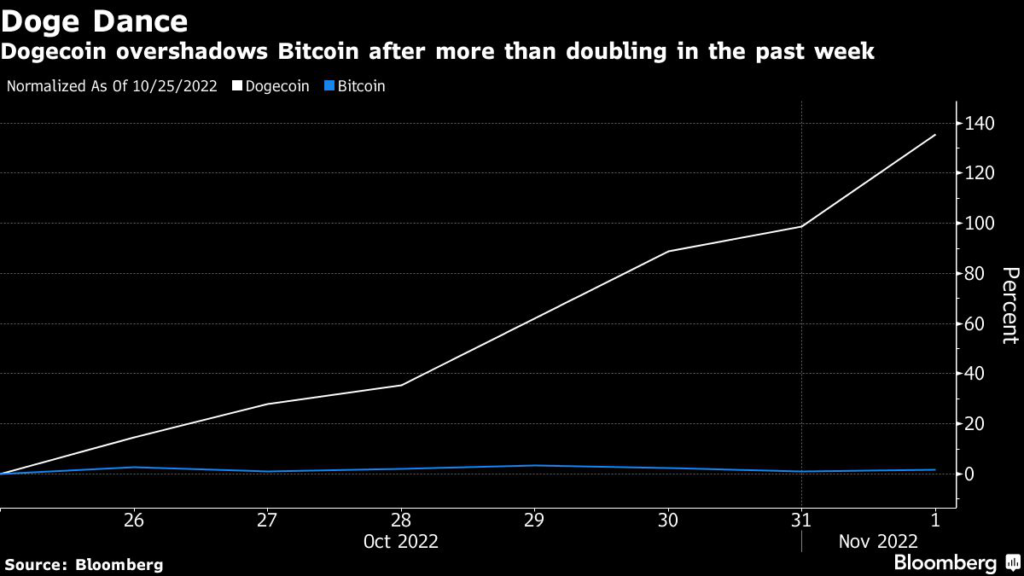
(Bloomberg) — A parabolic surge in meme cryptocurrency Dogecoin over the past week is encouraging speculation that other so-called alternative tokens could also catch a speculative tailwind.

The coin represented by an image of a Shiba Inu has climbed to almost 15 US cents from roughly 6 US cents over the period, an advance that in percentage terms far outstrips the performance of top token Bitcoin.

The proximal cause is the $44 billion purchase of Twitter Inc. by Elon Musk, a longtime supporter of the coin. Kunal Goel, a research analyst at Messari, said that some traders believe Musk will integrate the token into the platform.

Musk on Tuesday tweeted a picture of a Shiba Inu in a Twitter t-shirt, catalyzing the latest leg up in the Dogecoin price. His move also evoked memories of how past posts by the billionaire sparked frenzied rallies in the token — though that was mainly during the height of the pandemic when liquidity was flush, unlike today.

“Historically, a strong rally in DOGE has marked the beginning of an ‘alt szn’ — a time period characterized by aggressive risk-taking behavior where capital flows to crypto assets other than Bitcoin,” Priyansh Patel, an analyst at Delphi Digital, wrote in a note. 

Patel said the second-largest token Ether has posted notable gains in Dogecoin’s slipstream but added the rider that it remains to be seen if these surges are “merely generating exit liquidity before we hit new lows.”

The big event-risk for global markets is the Federal Reserve policy meeting on Wednesday, when another steep interest-rate hike is expected. But any sign of a possible pivot to a slower pace of increases could fuel optimism after a painful year for investors due to aggressive monetary tightening.

It remains very unclear what, if anything, Musk would do around Dogecoin and Twitter. He has long expressed support for the coin, quipping about his status as “The Dogefather” and earlier announcing that he owns some of it along with Bitcoin and Ether. He has also previously tweeted that it can be used to buy Tesla Inc. merchandise.

A token like Shiba Inu could “see some inflow from speculative capital following the massive rally” in Dogecoin, Fundstrat Head of Digital Asset Strategy Sean Farrell wrote in a note.

Dogecoin — originally created as a joke in 2013 — is now the eighth biggest token after its market value scaled $20 billion, according to CoinGecko. 

The bigger coins were calmer on Tuesday, with Bitcoin edging up to $20,600 and Ether adding about 2% to knock on the door of $1,600 as of 2:38 p.m. in Singapore.

As ever, it’s very much buyer beware in the notoriously capricious crypto sector, which is still nursing the wounds of a $2 trillion wipeout from a November 2021 peak.

What goes up in a straight line “tends to revert to the mean quicker than the average retail investor can pull their money,” Antoni Trenchev, co-founder and managing partner of Nexo, warned earlier this week. 

–With assistance from Suvashree Ghosh.

More stories like this are available on bloomberg.com

©2022 Bloomberg L.P.

Close Bitnami banner
Bitnami