
Bloomberg

Ukraine Latest: Putin Demands Safety Guarantee for Russian Ships

(Bloomberg) — Russian President Vladimir Putin demanded a guarantee from Ukraine on the safety of Russian vessels in the Black Sea grain corridor. The Kremlin suspended the landmark export route after claiming, without evidence, that a drone strike against its naval fleet may have come from a grain ship that’s part of the United Nations initiative.

Wheat prices soared after Russia said that shipments will become “much riskier” without its participation, even as ships loaded with grain began to leave Ukraine. Ukraine said Russia hit two tugboats pulling a grain barge outside the corridor. The UN and Turkey worked to salvage the agreement to keep seaborne exports flowing.

A fresh round of Russian missile strikes hit power and water infrastructure across Ukraine.

(See RSAN on the Bloomberg Terminal for the Russian Sanctions Dashboard.)

Key Developments

  • Russia Says ‘Unacceptable’ to Move Grain Ships Via Corridor
  • Russian Missile Strikes Cut Ukrainian Power, Water Supplies
  • Wheat Surges as Russia Warns on Ship Safety After Ditching Deal
  • Russia Is Mostly Failing in Race to Find New Oil Markets
  • Ukraine Sees ‘First Signs’ of Price Stability as War Grinds On

On the Ground

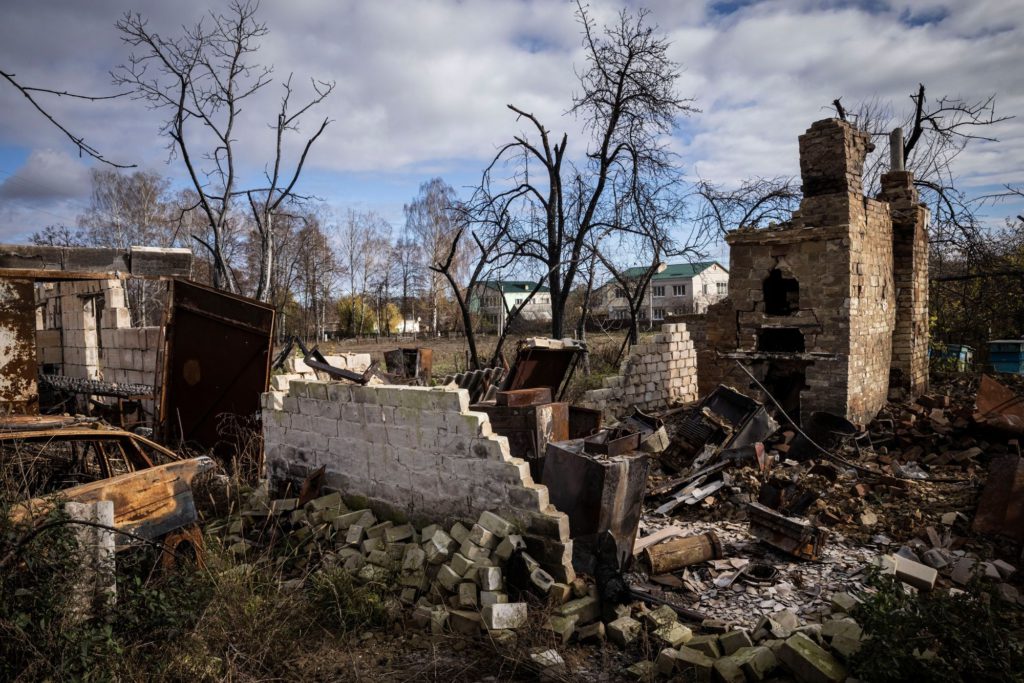
Russian missiles targeted the capital, Kyiv, including essential civilian infrastructure, leaving parts of the city without water and electricity. Explosions were also reported in regions including Kharkiv, Zaporizhzhia, Kremenchuk and Vinnytsia. Russia’s military struck the Dnipropetrovsk region with artillery and drones overnight, hitting residential buildings and other facilities as well as energy infrastructure, local authorities said on Telegram. Ukraine, however, said it had shot down 45 of 55 Russian missiles targeting the country’s energy facilities. Russian forces began preparations to remove artillery from the Dnipro River’s right bank in the Kherson region, Ukraine’s southern operational command said on Facebook.

(All times CET)


Putin Demands Guarantee Against Attacks in Grain Corridor (10:30 p.m.)

Russian President Vladimir Putin said Monday his country has not pulled out of the grain agreement as he demanded assurances from Ukraine on the safety of Russian vessels. Russia has accused Ukraine, without evidence, of using the so-called Black Sea corridor to attack its navy ships.

“Ukraine must guarantee, that there are no threats for civilian ships and Russian vessels,” Putin said at a press briefing in the Black Sea resort of Sochi. He said that drones had traveled partly through the corridor in assaults on the Russian fleet. 

“They created a threat both to our ships, which are supposed to ensure the safety of grain export, and to civilian ships that are engaged in this,” he said, calling the grain deal disruption  a suspension.

The Russian leader also said that recent Russian strikes on Ukraine territory could have been more severe, and that he would wait for Ukraine to change its position and resume peace negotiations.

Four Russian Copters Shot Down, Zelenskiy Says (10:30 p.m.)

Ukrainian President Volodymyr Zelenskiy said four Russian attack helicopters had been shot down, and underscored an earlier government report that Russia missed most of its targets in a large-scale missile attack on Monday. Ukraine’s air-defense troops, he said, shot down 45 out of 55 launched cruise missiles. 

“Of course, we will reinforce our anti-missile troops further,” Zelenskiy said in his nightly address. “But even now to achieve ten hits terrorists have to spend at least four times as many missiles. Results of Russia’s drone attacks, including those supplied by their allies from Iran are even worse.”

Zelenskiy Reaffirms Commitment to Grain Deal (8:32 p.m.)

Ukraine’s President Volodymyr Zelenskiy said in a tweet that he reaffirmed his government’s commitment to the grain shipment deal to UN Secretary-General Antonio Guterres and informed him “about the consequence of the missile terror & nuclear blackmail” by Russia.


Russia Says No Ship Assured of Safety Along Grain Corridor (7:54 p.m.)

Ships must not use the UN grain corridor, and no vessel is guaranteed safety there without further clarification from Ukraine, Russia’s Defense Ministry said.

It said ship movements along the corridor are unacceptable because Ukraine’s leaders and the command of its armed forces are using it to conduct military operations against the Russian Federation, Russia’s military said in an emailed statement. “There can be no question of guaranteeing the safety of any object on this route until the Ukrainian side accepts additional obligations not to use it for military purposes,” the Russians said.

At the same time the Defense Ministry said that it didn’t pull out of the grain deal but suspended it until the situation with drone strikes against its naval fleet is clarified.

Ukraine Says It Shot Down Most of Russia’s Missiles (7:50 p.m.)

Ukraine shot down 45 of 55 Russian missiles targeting the country’s energy facilities, including hydro power plants, on Monday, its military staff said. The rest hit energy infrastructure in Kyiv, Poltava, Zaporizhzhia, Kharkiv, Cherkasy, Chernivtsi and other regions. One rocket fell in neighboring Moldova after it was downed by Ukraine’s anti-missile troops, Ukraine said.

Ukraine also said that Russia, running short of troops, is pulling mercenary forces out of Mali to deploy them in Ukraine. 

Russia Hit Tugboats East of UN-Agreed Grain Corridor (6:42 p.m.)

Russian shelling hit two civilian tugboats near Ochakiv on the northern Black Sea coast towing a barge with grain, the Ukrainian military’s southern command said on Facebook.

The attack set the vessels on fire, killing two crew members and wounding one, while another one went missing, according to the statement.

The incident took place near the Ochakiv port in the Mykolaiv region on the northern Black Sea coast, which is to the east of a UN-agreed corridor that had been used for food exports, according to the post.

Power Restored to Kyiv Customers After Russian Missile Attack (6:40 p.m.)

Ukraine’s private power company DTEK restored electricity connections to customers and water supply facilities in the country’s capital, according to a statement on the company’s Facebook account.

While all clients in Kyiv have been connected to a temporary supply scheme, some had to remain without power in order to help the energy system, DTEK said.

Ukrainian Cabinet Cuts GDP Growth Forecast (6:11 p.m.)

Ukraine’s cabinet slashed its economic growth forecast to 3.2% from 4.6% for next year, Prime Minister Denys Shmyhal said on Telegram.

The cabinet also now sees 2023 inflation at 28%, compared with 30% expected before, he said. The next year’s budget deficit will exceed 20% of gross domestic product InteeIMF, Shmyhal said.

Russia Warns It May Move to Control Black Sea Ship Passage (6:07 p.m.)

Russia will be forced to take its own measures to control ships passing without its approval in the Black Sea, Russia’s permanent representative to the United Nations, Vasily Nebenzya, said at a meeting of the UN Security Council, according to the Russian Tass newswire.

“Given the existing facts of abuse of the humanitarian corridor and the fact that the Black Sea remains a war zone, we cannot allow the passage of ships without our inspection, and we will be forced to take independent measures to control” dry-cargo ships, he said.

The “Black Sea Initiative,” the deal between Russia, Turkey and Ukraine, which was signed in July, shouldn’t be carried out without Russia, he said.

Turkey Urges Restoration of Grain Shipments (5:28 p.m.)

Turkish Defense Minister Hulusi Akar said that he discussed the halt of grain shipments in a call with his Russian counterpart.

“The continuation of the grain initiative, which makes a great contribution to the solution of the global food crisis and shows that all problems can be solved with cooperation and dialogue, is of great importance,” he said, urging that it be “separated from the conflict conditions.”

Electricity Cut Off in Lviv After Russian Strikes (5:22 p.m.)

Electricity cutoffs started at 5 p.m. in the Lviv region in western Ukraine and would last three to four hours, regional governor Maksym Kozytskyi said on Telegram.

Lithuania Denounces Russian Missile Strikes on Ukraine Infrastructure (5:10 p.m.)

Lithuanian President Gitanas Nauseda called Russia’s attack on Ukraine’s civilian infrastructure “further evidence of grave war crimes” in a statement after meeting Greek Prime Minister Kyriakos Mitsotakis.

“We must continue military, political and humanitarian support to Ukraine and help it to counter Russia’s barbaric military aggression,” he said. “We must continue the policy of sanctions against Russia and Belarus and prepare a new package of targeted and effective sanctions. We also have to reinforce defense capabilities in NATO’s eastern flank.”

Belarus to Open Joint Military Training Centers With Russia (4:50 p.m.)

Belarus plans to create joint military training centers with Russia, the state-owned news agency Belta reported, citing a decree signed by the President Alexander Lukashenko. The country’s defense ministry is tasked with holding talks with Russia on setting up the centers and signing an agreement.

Ukraine Assesses Damage From Russian Strikes (4:45 p.m.)

Russian missiles and drones damaged infrastructure in 10 Ukrainian regions and hundreds of locations are without power in seven of them, Prime Minister Denys Shmyhal said on Telegram. The strikes left more than 80% of Kyiv residents without running water and 350,000 apartments lost electricity supply, Mayor Vitali Klitschko said on Telegram. By evening, 40% still had no water supply and 270,000 apartments remained without electricity, he said.

Russia Plans to Raise Diesel Exports Ahead of EU Ban (1:20 p.m.)

Russia’s diesel exports via its key Baltic and Black Sea ports are set to reach a seven-month high in November as Europe grapples with a fuel shortage ahead of a full ban on such purchases early next year.

EU Grain Corridors Have Carried 29 Million Tons of Goods (1:10 p.m.)

More than 14 million tons of agricultural products have been exported to Ukraine via the so-called solidarity lanes between May and Oct. 20, European Commission spokesman Stefan De Keersmaecker told reporters in Brussels. Over the same period, 15 million tons of non-agricultural products such as steel, oil and humanitarian products were exported.

Latvia Detains 37 After Removing Soviet Monuments (1:03 p.m.)

Police detained 37 people after authorities began taking down an obelisk honoring the Soviet military in Latvia’s second-biggest city of Daugavpils.

The city, near the eastern border with Belarus, is nearly half ethnic Russian. Latvia removed a tall Soviet obelisk in the capital Riga in August and plans to take down all Soviet monuments across the country.

Ukraine’s DTEK Depleted Stockpiles to Fix Power Lines (12:52 p.m.)

Ukraine’s largest private power company DTEK is running low on inventories of spare parts to fix power infrastructure damaged by Russian shelling.

“We have already used up the stockpiles of equipment which we had in our depots after the first two waves of attacks since Oct. 10,” Dmytro Sakharuk, executive director of DTEK, said on TV.

DTEK was able to buy some equipment in the market but needs to purchase millions of dollars worth of spare parts as procurement problems are mounting amid soaring prices, he said. Preliminary estimate of damage to DTEK from Russian attacks is estimated in millions of dollars, according to Sakharuk.

Poland Sees Reverse in Flow of Ukrainian Refugees 12:50 p.m.)

This month’s massive Russian attacks on Ukrainian infrastructure may trigger a new wave of refugees to Poland, Wojciech Kononczuk, deputy head of Polish Center for Eastern Studies said on Twitter.

Polish border guard data show that October is on track to be the first month since April when number of Ukrainians moving to Poland was higher than those traveling back to Ukraine.

Turkey to Talk to Russia About Grains Corridor (12:29 p.m.)

Turkish Defense Minister Hulusi Akar said he will discuss Russia’s withdrawal from the Ukraine grain corridor deal in a phone call with his Russian counterpart Sergei Shoigu later on Monday.

“The suspension of this initiative is neither to the benefit of Russia nor Ukraine,” a Turkish Defense Ministry statement said. “We are continuing to hold talks with Ukrainian and Russian defense ministers.”

Kremlin Says Grain Shipments Without Russia ‘Much Riskier’ (12:38 p.m.)

Kremlin spokesman Dmitry Peskov said grain shipments from Ukraine’s Black Sea ports become “much riskier” after Russia suspended participation in a deal to protect them, but he declined to comment on what conditions Moscow is setting out for rejoining the pact.

“In circumstances where Russia is talking about the impossibility of ensuring the security of shipping in these areas, of course such a deal is hardly implementable,” he told a conference call. “It takes on a different character, much riskier and more dangerous.”

He said diplomatic consultations are underway with Turkey and the UN on the future of the pact.

Russia Hit Infrastructure in 10 Regions of Ukraine (11:26 a.m.)

Russia’s missile and drone attacks on Monday damaged 18, mainly energy, facilities in 10 regions of Ukraine, Prime Minister Denys Shmyhal said on Telegram.

“They are not targeting military facilities, but critical civilian infrastructure,” he said, adding that “hundreds of locations have had power cut off in seven Ukrainian regions.” 

Ukraine has 25 regions, including Crimea, which was annexed by Russia in 2014.


More stories like this are available on bloomberg.com

©2022 Bloomberg L.P.
Twitter’s Credit Grade Cut by Moody’s Following Leveraged Buyout

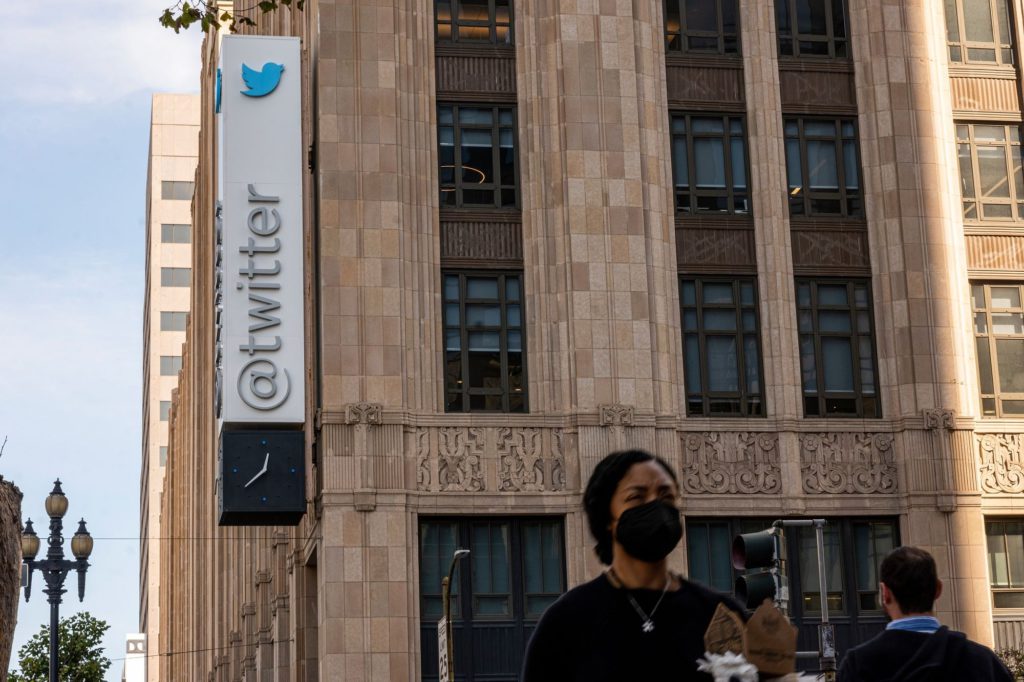
(Bloomberg) — Moody’s Investors Service lowered its credit rating for Twitter Inc. following the close of the social-media giant’s leveraged buyout by Elon Musk. 

The credit rating company cut Twitter two notches to B1, or four steps into junk territory, according to a statement Monday. Moody’s said it expects that a substantial increase in debt and reduction of cash will result in a material increase in leverage and weakening of other credit metrics. Moody’s cited governance “as a major driver” of the rating action. The credit ratings remain on review for downgrade. 

“Twitter’s governance risk is highly negative reflecting Moody’s expectation for aggressive financial policies and concentrated ownership by Elon Musk,” Moody’s said.

Musk closed his $44 billion acquisition of Twitter last week. 

More stories like this are available on bloomberg.com

©2022 Bloomberg L.P.

Stocks Trim Big October Rally as Bond Yields Climb: Markets Wrap

(Bloomberg) — Stocks pared their monthly surge as bond yields climbed, with investors awaiting Wednesday’s Federal Reserve decision for clues on whether officials will dial back the pace of rate hikes as early as December.

Big tech weighed heavily on the S&P 500, while energy shares whipsawed on news that President Joe Biden will call on Congress to consider tax penalties for producers accruing record profits. Equities may also have come under pressure as pension funds that rebalance on a monthly basis potentially dumped shares amid an 8% rally for the US benchmark gauge in October.

A selloff in bonds across the curve sent two-year US yields to around 4.5%. Swap markets are pricing in a 75-basis-point hike this week amid the Fed’s most-aggressive tightening campaign in four decades. The outlook for the following meetings is less certain, with traders seeing a “coin toss” between an increase of that size and a 50-basis-point boost in the final month of 2022.

“This week will be loaded with scary stuff, from the Fed meeting and press conference to employment data on Friday,” wrote Paul Nolte, portfolio manager at Kingsview Investment Management. “Market expectations are for the Fed to begin signaling that their very aggressive rate hiking cycle will begin slowing down.”

JPMorgan Chase & Co.’s Marko Kolanovic is joining strategists who believe the aggressive hiking is nearing an end. The US will likely raise rates by 50 basis points in December and pause after one more 25-basis-point hike in the first quarter, he said. Indicators such as the inversion of the yield curve between 10-year and three-month Treasuries “all support a Fed pivot sooner rather than later,” wrote Morgan Stanley’s Michael Wilson.

Read: Treasury Strategists Mull Fed Pivot Fallout: Research Roundup

Although October can evoke fear on Wall Street following stock market crashes in 1929, 1987 and 2008, it’s living up to its reputation as the best month in US midterm election years. Now traders are holding out hope this October will follow a historical pattern of being a “bear-market killer” following a turbulent year for equities.

When it comes to elections, the fourth quarter of midterm years and the following first quarter historically have been the two strongest of the 16-quarter presidential cycle, delivering average gains of 6.4% and 6.9% respectively for the S&P 500, according to investment research firm CFRA.

November has historically been one of the strongest months of the year for US stocks, said Bespoke Investment Group. The S&P 500 has experienced an average gain of 0.82% with positive returns 69% of the time, according to data going back to 1983. Over the last 10 years, the gauge saw a median advance of 1.26% and gains nine out of 10 times.

Read: Marathon’s Richards Sees Defaults Hitting 10% If Rates Stay High

To Jason Draho at UBS Global Wealth Management, while the recent rally in stocks didn’t really look sustainable, that doesn’t mean markets can’t keep grinding higher in coming weeks, “provided that the Fed and labor and inflation data don’t disappoint.”

Global economic reports didn’t help sentiment on Monday. Euro-area inflation surged to a fresh all-time high, while the bloc’s economy lost momentum — reinforcing fears that a recession is now all-but unavoidable. China’s factory and services activity contracted in October, with signs that things could worsen in the coming months.

Wheat prices soared after Russia suspended a deal guaranteeing safe passage of Ukrainian exports, with Moscow warning that shipments become “much riskier” without its participation even as new vessels loaded with crops set sail from Ukraine. 

Key events this week:

  • Reserve Bank of Australia policy decision, Tuesday
  • US construction spending, ISM manufacturing index, Tuesday
  • EIA crude oil inventory report, Wednesday
  • Federal Reserve rate decision, Wednesday
  • US MBA mortgage applications, ADP employment, Wednesday
  • Bank of England rate decision, Thursday
  • US factory orders, durable goods, trade, initial jobless claims, ISM services index, Thursday
  • ECB President Christine Lagarde speaks, Thursday
  • US nonfarm payrolls, unemployment, Friday

Some of the main moves in markets:

Stocks

  • The S&P 500 fell 0.7% as of 4 p.m. New York time
  • The Nasdaq 100 fell 1.2%
  • The Dow Jones Industrial Average fell 0.4%
  • The MSCI World index fell 0.4%

Currencies

  • The Bloomberg Dollar Spot Index rose 0.7%
  • The euro fell 0.8% to $0.9883
  • The British pound fell 1.3% to $1.1468
  • The Japanese yen fell 0.7% to 148.68 per dollar

Cryptocurrencies

  • Bitcoin fell 1.5% to $20,374.98
  • Ether fell 2% to $1,563.92

Bonds

  • The yield on 10-year Treasuries advanced three basis points to 4.05%
  • Germany’s 10-year yield advanced four basis points to 2.14%
  • Britain’s 10-year yield advanced four basis points to 3.52%

Commodities

  • West Texas Intermediate crude fell 2% to $86.16 a barrel
  • Gold futures fell 0.5% to $1,636.40 an ounce

–With assistance from Vildana Hajric and Isabelle Lee.

More stories like this are available on bloomberg.com

©2022 Bloomberg L.P.

Getty Images Surges as Meme and De-SPAC Stock Frenzy Returns

(Bloomberg) — Retail traders returned in force on Monday, creating a volatile session for de-SPAC firms like Getty Images Holdings Inc.. as well as meme stock favorites including GameStop Corp.

Shares of Getty Images, which went public earlier this year after merging with a blank-check firm, climbed 35% — their biggest one-day jump since July. GameStop had a similar rollercoaster ride after it spiked as much as 24% before ultimately paring nearly its entire gain to close up 0.5%. 

The rapid rallies triggered volatility-related trading halts for both stocks earlier Monday. Meanwhile, the broader S&P 500 Index ended down 0.7% and the Nasdaq 100 Index closed lower by 1.2%.

“We’re heading into a seasonally strong period for the stock market,” said Keith Lerner, chief market strategist at Truist Advisory Services Inc. “This may just be the way of some investors trying to trade that.” 

A basket of so-called meme stocks tracked by Bloomberg rose by about 1%, while the De-SPAC index ended higher for a second straight day, adding 1.6%. Both gauges have plunged this year as concerns about a possible US recession diminished investor demand for shares of riskier assets.

The sudden resurgence in interest for the group comes ahead of what is likely to be a bumpy two weeks for the stock market. A Federal Reserve rate decision on Wednesday will kick off a span of seven trading sessions that will feature four major events including a key jobs report, mid-term elections and inflation data for October.

Other stocks popular with retail traders also saw brief surges on Monday. Bed Bath & Beyond Inc. and AMC Entertainment, two stocks synonymous with the meme stock movement, both gained at least 9.5% at one point. Shares of Rumble Inc., a Peter Thiel-backed conservative video network which went public last month in a SPAC merger with CF Acquisition Corp. VI, jumped 5.5%.

“Stocks that can move up that much in one day on no news can move down just as quickly,” Lerner added. “That’s the warning flag for investors.”

(Updates with closing prices throughout.)

More stories like this are available on bloomberg.com

©2022 Bloomberg L.P.
Bulls on Meta Stock Have One Big Problem: Mark Zuckerberg

(Bloomberg) — Mark Zuckerberg built Meta Platforms Inc. into one of the biggest companies in the world, but some investors now see him as an obstacle to the stock recovering from a historic selloff.

The Facebook parent has tumbled 72% this year, with last week’s earnings pushing the shares to a multi-year low. The biggest weight on the stock: Meta is spending billions of dollars to develop the metaverse, an immersive virtual world that the chief executive officer has long believed represents the future of computing. 

The strategy is curbing earnings even as the company acknowledges it’s unlikely to deliver significant revenue for years. While investors may long for Meta to renew its focus on selling ads to its billions of social-media users, the company’s structure gives Zuckerberg total control, so there’s little they can do but what they’ve already been doing: sell.

“He’s tone deaf to what the owners of the company want, outside of himself,” said David Katz, chief investment officer at Matrix Asset Advisors. “The stock could double in a year with better management, with management that is more focused on shareholders.”

Despite these issues, Katz views the stock as “dirt cheap,” and said that “on a longer time horizon, if you’re willing to hold your nose, I think there’s a great likelihood that Meta will be significantly higher than it is today.”

Its shares fell 6.1% on Monday, ending at their lowest since October 2015 as it led a broad decline for technology and internet stocks. The Nasdaq 100 Index fell 1.2%.

Zuckerberg owns or controls about 90% of the company’s unlisted Class B shares, which have 10 votes each versus one vote each for the Class A shares that are publicly traded. 

The structure prevents activists from influencing the board and management, something that has happened with big tech in the past. In 2014, Carl Icahn pushed for Apple Inc. to accelerate its buyback program as a way of pushing up the stock price.

Asked about Zuckerberg’s control, a Meta spokesman referred to the company’s proxy statement, which reads, “We believe that our capital structure is in the best interests of our shareholders and that our current corporate governance structure is sound and effective.”

Under Zuckerberg, the statement adds, “we have established a track record of creating value for our shareholders and navigating important opportunities and challenges.” The company’s investments to improve privacy and safety “may not have been possible if our board of directors and CEO were focused on short-term success over the long-term interests of our community and our company.”

In the S&P 500, 33 companies have unequal voting rights similar to those at Meta, according to ISS Corporate Solutions, including Google parent Alphabet Inc., Paramount Global, and Comcast Corp.

Zuckerberg’s stake means he has been hit especially hard by the stock’s collapse. Over the past 13 months, his total wealth loss has exceeded $100 billion. His apparent willingness to stomach such losses is a sign of his faith in the metaverse, and if the bet does play out, investors may one day look back with relief that Zuckerberg wasn’t forced to change course.

Zuckerberg deserves the benefit of the doubt, said Mark Iong, a fund manager at Homestead Advisers. 

“He took Facebook public when it had huge margins, so he clearly cares about making money. He waited years to monetize WhatsApp, so he’s clearly patient. And he bought Instagram early, so he’s clearly smart,” he said. “I think he’s earned the right to pursue this long-term strategy.”


Tech Chart of the Day

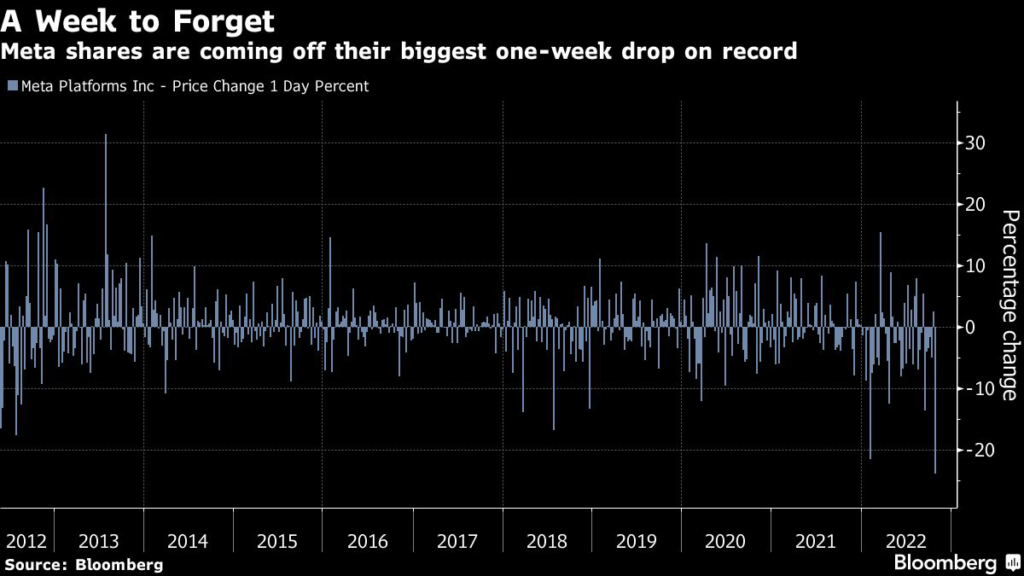
Meta shares sank 24% last week, the biggest one-week drop on record for the company, which went public a decade ago. The collapse even exceeded a 21% crash in the first week of February, when another disastrous earnings report vaporized $251.3 billion in market value in a single session. Due to how much the stock has already declined this year, last week’s drop translated to $86.4 billion in lost market value.

Top Tech Stories

  • Elon Musk has started a poll on Twitter Inc. asking users whether he should bring back short-video app Vine, which was shut down by the social media platform in 2016.
  • A rapid fall in China’s weekly iPhone sales may signal bigger challenges ahead for Apple Inc., whose smartphone had mostly been resilient to the global economic downturn, according to Jefferies.
    • Foxconn Technology Group is preparing to bring backup production online and raise hourly wages by more than a third, after an exodus of workers threatened to disrupt output at the world’s largest iPhone plant ahead of the holidays.
  • Global chip sales contracted for the first time since early 2020, in a blow to South Korea’s economy which is highly geared to the industry and struggling to adjust to weaker demand.
  • Cathie Wood is back to buying the battered shares of online broker Robinhood Markets Inc. that rebounded from record lows hit just four months ago.
  • An intensifying US-China space rivalry and Elon Musk’s ambitious Mars program have fired up scores of startups across the world chasing lucrative contracts, as humans race for resources that could foster life beyond Earth.
  • Bayanat AI Plc more than tripled in its Abu Dhabi trading debut, after raising $171 million in an IPO backed by private equity firm Silver Lake and the United Arab Emirates’ most valuable company. The geospatial and data analytics firm went public at a valuation of 7.5 billion dirhams ($2 billion) and is on course for the best first-day performance globally this year for an IPOs raising at least $100 million, data compiled by Bloomberg show.

–With assistance from Subrat Patnaik.

(Updates to close.)

More stories like this are available on bloomberg.com

©2022 Bloomberg L.P.

Musk Consolidates Power at Twitter After Board Is Dismissed

(Bloomberg) — Elon Musk consolidated his control of Twitter Inc. on Monday after the entire board was dismissed. 

Musk, 51, completed his purchase of Twitter last week for $44 billion and immediately started molding the company to his liking. One of the first steps he took was to fire four of the most senior executives of the company, including Parag Agrawal, the chief executive officer. Calling himself Chief Twit, Musk plans to effectively run the company himself in the immediate term, people familiar with his plans have said. 

On Monday, Musk became the sole director of the social media company after the removal of all nine other board members, in accordance with the terms of the merger agreement, according to a securities filing. It wasn’t clear who Musk would nominate to fill the board. At the other companies he runs, including Tesla Inc., the boards are packed with Musk loyalists. His brother Kimbal Musk, is a board member at Tesla, for example.

As a result of the closing of the merger, Twitter will purchase outstanding 3.875% senior notes due 2027 and 5% senior notes due 2030 at an offer price of 101% of principal plus accrued and unpaid interest, according to the filing. The bond agreements required Twitter to offer to buy back its debt in the event of a change in control of the company. Musk has also asked a judge to dismiss a lawsuit over his attempt to pull out of the acquisition now that the deal has closed.

Musk’s first few days on the job have been filled with rumor and speculation, including about how he will handle content moderation on Twitter and how many jobs he’ll cut in an effort to control costs. Concerns over massive layoffs swirled in the run-up to Musk’s take-private transaction, when potential investors were told that he’d eliminate 75% of the workforce. Musk later denied that the cuts would be that deep, though he hasn’t elaborated on the plans. In recent weeks, Musk has hinted at his staffing priorities, saying he wants to focus on the core product.

Just three days in to his new job, the billionaire’s views on content moderation were also being tested after he posted and deleted a tweet spreading a baseless anti-LGBTQ conspiracy theory about the recent attack on the husband of House Speaker Nancy Pelosi.

The episode underscored the pressures that Musk, a self-styled “free speech absolutist,” now faces in running the popular social media website — particularly in how to place limits on misinformation and hate speech on its service. Musk has pledged to advertisers that Twitter won’t become a “free-for-all hellscape” under his leadership but at the same time pronounced that unfettered speech should be the norm on the site. 

Musk has also been busy making changes to the Twitter product. He has told engineers to work on rebooting the looping-video app Vine, Axios reported, and he apparently wants to take away the blue badges of verified users if they don’t pay as much as $20 a month for the site’s new subscription service Twitter Blue, according to reports in The Verge and Platformer.

–With assistance from Kurt Wagner and Davey Alba.

(Updates with reports of Vine comeback and the cost of the blue check in final paragraph.)

More stories like this are available on bloomberg.com

©2022 Bloomberg L.P.

Ukraine Latest: Russia Warns Ships Aren’t Safe in Grain Corridor

(Bloomberg) — Russia warned it can’t guarantee safety in the United Nations-forged grain corridor on the Black Sea unless Ukraine accepts additional assurances “not to use it for military purposes.” The Kremlin suspended the landmark export route after claiming without evidence that a drone strike against its Black Sea naval fleet may have come from a grain ship that’s part of the initiative.

Wheat prices soared after Russia said that shipments will become “much riskier” without its participation, even as ships loaded with grain began to leave Ukraine. Ukraine said Russia hit two tugboats pulling a grain barge outside the corridor. The UN and Turkey worked to salvage the agreement to keep seaborne exports flowing.

A fresh round of Russian missile strikes hit power and water infrastructure across Ukraine.

(See RSAN on the Bloomberg Terminal for the Russian Sanctions Dashboard.)

Key Developments

  • Russian Missile Strikes Cut Ukrainian Power, Water Supplies
  • Wheat Surges as Russia Warns on Ship Safety After Ditching Deal
  • Russia Is Mostly Failing in Race to Find New Oil Markets
  • Ukraine Sees ‘First Signs’ of Price Stability as War Grinds On
  • Wheat Surges Even as Grain Ships Defy Russian Deal Exit
  • Iran’s Oil Minister Heads to Russia on Monday for Deal Talks

On the Ground

Russian missiles targeted the capital, Kyiv, including essential civilian infrastructure, leaving parts of the city without water and electricity. Explosions were also reported in regions including Kharkiv, Zaporizhzhia, Kremenchuk and Vinnytsia. Russia’s military struck the Dnipropetrovsk region with artillery and drones overnight, hitting residential buildings and other facilities as well as energy infrastructure, local authorities said on Telegram. Ukraine said it shot down 45 of 55 Russian missiles targeting the country’s energy facilities. Russian forces began preparations to remove artillery from the Dnipro River’s right bank in the Kherson region, Ukraine’s southern operational command said on Facebook.

(All times CET)

Russia Says No Ship Assured of Safety Along Grain Corridor (7:54 p.m.)

Ships must not use the UN grain corridor, and no vessel is guaranteed safety there without further clarification from Ukraine, Russia’s Defense Ministry said.

It said ship movements along the corridor are unacceptable because Ukraine’s leaders and the command of its armed forces are using it to conduct military operations against the Russian Federation, Russia’s military said in an emailed statement. “There can be no question of guaranteeing the safety of any object on this route until the Ukrainian side accepts additional obligations not to use it for military purposes,” the Russians said.

At the same time the Defense Ministry said that it didn’t pull out of the grain deal but suspended it until the situation with drone strikes against its naval fleet is clarified.

Ukraine Says It Shot Down Most of Russia’s Missiles (7:50 p.m.)

Ukraine shot down 45 of 55 Russian missiles targeting the country’s energy facilities, including hydro power plants, on Monday, its military staff said. The rest hit energy infrastructure in Kyiv, Poltava, Zaporizhzhia, Kharkiv, Cherkasy, Chernivtsi and other regions. One rocket fell in neighboring Moldova after it was downed by Ukraine’s anti-missile troops, Ukraine said.

Ukraine also said that Russia, running short of troops, is pulling mercenary forces out of Mali to deploy them in Ukraine. 

Russia Hit Tugboats East of UN-Agreed Grain Corridor (6:42 p.m.)

Russian shelling hit two civilian tugboats near Ochakiv on the northern Black Sea coast towing a barge with grain, the Ukrainian military’s southern command said on Facebook.

The attack set the vessels on fire, killing two crew members and wounding one, while another one went missing, according to the statement.

The incident took place near the Ochakiv port in the Mykolaiv region on the northern Black Sea coast, which is to the east of a UN-agreed corridor that had been used for food exports, according to the post.

Power Restored to Kyiv Customers After Russian Missile Attack (6:40 p.m.)

Ukraine’s private power company DTEK restored electricity connections to customers and water supply facilities in the country’s capital, according to a statement on the company’s Facebook account.

While all clients in Kyiv have been connected to a temporary supply scheme, some had to remain without power in order to help the energy system, DTEK said.

Ukrainian Cabinet Cuts GDP Growth Forecast (6:11 p.m.)

Ukraine’s cabinet slashed its economic growth forecast to 3.2% from 4.6% for next year, Prime Minister Denys Shmyhal said on Telegram.

The cabinet also now sees 2023 inflation at 28%, compared with 30% expected before, he said. The next year’s budget deficit will exceed 20% of gross domestic product InteeIMF, Shmyhal said.

Russia Warns It May Move to Control Black Sea Ship Passage (6:07 p.m.)

Russia will be forced to take its own measures to control ships passing without its approval in the Black Sea, Russia’s permanent representative to the United Nations, Vasily Nebenzya, said at a meeting of the UN Security Council, according to the Russian Tass newsire.

“Given the existing facts of abuse of the humanitarian corridor and the fact that the Black Sea remains a war zone, we cannot allow the passage of ships without our inspection, and we will be forced to take independent measures to control” dry-cargo ships, he said.

The “Black Sea Initiative,” the deal between Russia, Turkey and Ukraine, which was signed in July, shouldn’t be carried out without Russia, he said.

Turkey Urges Restoration of Grain Shipments (5:28 p.m.)

Turkish Defense Minister Hulusi Akar said that he discussed the halt of grain shipments in a call with his Russian counterpart.

“The continuation of the grain initiative, which makes a great contribution to the solution of the global food crisis and shows that all problems can be solved with cooperation and dialogue, is of great importance,” he said, urging that it be “separated from the conflict conditions.”

Electricity Cut Off in Lviv After Russian Strikes (5:22 p.m.)

Electricity cutoffs started at 5 p.m. in the Lviv region in western Ukraine and would last three to four hours, regional governor Maksym Kozytskyi said on Telegram.

Lithuania Denounces Russian Missile Strikes on Ukraine Infrastructure (5:10 p.m.)

Lithuanian President Gitanas Nauseda called Russia’s attack on Ukraine’s civilian infrastructure “further evidence of grave war crimes” in a statement after meeting Greek Prime Minister Kyriakos Mitsotakis.

“We must continue military, political and humanitarian support to Ukraine and help it to counter Russia’s barbaric military aggression,” he said. “We must continue the policy of sanctions against Russia and Belarus and prepare a new package of targeted and effective sanctions. We also have to reinforce defense capabilities in NATO’s eastern flank.”

Belarus to Open Joint Military Training Centers With Russia (4:50 p.m.)

Belarus plans to create joint military training centers with Russia, the state-owned news agency Belta reported, citing a decree signed by the President Alexander Lukashenko. The country’s defense ministry is tasked with holding talks with Russia on setting up the centers and signing an agreement.

Ukraine Assesses Damage From Russian Strikes (4:45 p.m.)

Russian missiles and drones damaged infrastructure in 10 Ukrainian regions and hundreds of locations are without power in seven of them, Prime Minister Denys Shmyhal said on Telegram. The strikes left more than 80% of Kyiv residents without running water and 350,000 apartments lost electricity supply, Mayor Vitali Klitschko said on Telegram. By evening, 40% still had no water supply and 270,000 apartments remained without electricity, he said.

Russia Plans to Raise Diesel Exports Ahead of EU Ban (1:20 p.m.)

Russia’s diesel exports via its key Baltic and Black Sea ports are set to reach a seven-month high in November as Europe grapples with a fuel shortage ahead of a full ban on such purchases early next year.

EU Grain Corridors Have Carried 29 Million Tons of Goods (1:10 p.m.)

More than 14 million tons of agricultural products have been exported to Ukraine via the so-called solidarity lanes between May and Oct. 20, European Commission spokesman Stefan De Keersmaecker told reporters in Brussels. Over the same period, 15 million tons of non-agricultural products such as steel, oil and humanitarian products were exported.

Latvia Detains 37 After Removing Soviet Monuments (1:03 p.m.)

Police detained 37 people after authorities began taking down an obelisk honoring the Soviet military in Latvia’s second-biggest city of Daugavpils.

The city, near the eastern border with Belarus, is nearly half ethnic Russian. Latvia removed a tall Soviet obelisk in the capital Riga in August and plans to take down all Soviet monuments across the country.

Ukraine’s DTEK Depleted Stockpiles to Fix Power Lines (12:52 p.m.)

Ukraine’s largest private power company DTEK is running low on inventories of spare parts to fix power infrastructure damaged by Russian shelling.

“We have already used up the stockpiles of equipment which we had in our depots after the first two waves of attacks since Oct. 10,” Dmytro Sakharuk, executive director of DTEK, said on TV.

DTEK was able to buy some equipment in the market but needs to purchase millions of dollars worth of spare parts as procurement problems are mounting amid soaring prices, he said. Preliminary estimate of damage to DTEK from Russian attacks is estimated in millions of dollars, according to Sakharuk.

Poland Sees Reverse in Flow of Ukrainian Refugees 12:50 p.m.)

This month’s massive Russian attacks on Ukrainian infrastructure may trigger a new wave of refugees to Poland, Wojciech Kononczuk, deputy head of Polish Center for Eastern Studies said on Twitter.

Polish border guard data show that October is on track to be the first month since April when number of Ukrainians moving to Poland was higher than those traveling back to Ukraine.

Turkey to Talk to Russia About Grains Corridor (12:29 p.m.)

Turkish Defense Minister Hulusi Akar said he will discuss Russia’s withdrawal from the Ukraine grain corridor deal in a phone call with his Russian counterpart Sergei Shoigu later on Monday.

“The suspension of this initiative is neither to the benefit of Russia nor Ukraine,” a Turkish Defense Ministry statement said. “We are continuing to hold talks with Ukrainian and Russian defense ministers.”

Kremlin Says Grain Shipments Without Russia ‘Much Riskier’ (12:38 p.m.)

Kremlin spokesman Dmitry Peskov said grain shipments from Ukraine’s Black Sea ports become “much riskier” after Russia suspended participation in a deal to protect them, but he declined to comment on what conditions Moscow is setting out for rejoining the pact.

“In circumstances where Russia is talking about the impossibility of ensuring the security of shipping in these areas, of course such a deal is hardly implementable,” he told a conference call. “It takes on a different character, much riskier and more dangerous.”

He said diplomatic consultations are underway with Turkey and the UN on the future of the pact.

Russia Hit Infrastructure in 10 Regions of Ukraine (11:26 a.m.)

Russia’s missile and drone attacks on Monday damaged 18, mainly energy, facilities in 10 regions of Ukraine, Prime Minister Denys Shmyhal said on Telegram.

“They are not targeting military facilities, but critical civilian infrastructure,” he said, adding that “hundreds of locations have had power cut off in seven Ukrainian regions.” 

Ukraine has 25 regions, including Crimea, which was annexed by Russia in 2014.

Revolut Billionaire Gives Up Russia Citizenship (11:22 a.m.)

Nikolay Storonsky, the 38-year-old co-founder and chief executive officer of London-based fintech startup Revolut Ltd., has renounced his Russian citizenship amid his outspoken opposition to the war in Ukraine.

“Nik is a British citizen. Earlier this year he renounced his citizenship by birth to Russia. His position on the war is on the public record: the war is totally abhorrent and he remains resolute in calling for an immediate end to the fighting,” a spokesman for Revolut said.

A former derivatives trader at Credit Suisse Group AG and Lehman Brothers, Storonsky and several partners launched Revolut in 2015. 

Russian Missile Targeting Ukraine Power Unit Falls in Moldova (10:38 a.m.)

One of the missiles launched by Russia during its attack on Ukraine’s critical power infrastructure fell in the town of Naslavcea in Moldova, which is only 10 kilometers away from Dnister dam in Ukraine. The downing shattered windows of several houses, Moldova’s Interior Ministry said in a statement. 

Czech Premier Visits Kyiv (10:06 a.m.)

Czech Prime Minister Petr Fiala and several other members of his cabinet arrived in Kyiv for talks with Ukrainian Prime Minister Denys Shmyhal. 

Ukraine Downed Most Russian Missiles Fired on Monday (9:13 a.m.)

Ukrainian air defense forces shot down 44 of more than 50 missiles launched by Russian forces this morning, the country’s air force command said on Telegram.

Russian Tu-95 and Tu-160 bombers launched Х-101 and Х-555 cruise missiles from above the Caspian Sea and from area near Volgodonsk in Russia, according to Ukrainian air forces.

Crop Ships Are Leaving Ukraine Again (9:08 a.m.)

Wheat prices soared early Monday as traders watched for developments on exports. Ukraine is one of the world’s biggest suppliers of wheat, corn and vegetable oil and the July agreement to open three Black Sea ports has been vital to help alleviate a global food crisis.

Russia has only temporarily suspended its participation in implementing the deal, which was brokered by Turkey and the UN, but is still a signatory to the agreement, according to Ismini Palla, a UN spokeswoman for the Black Sea Grain Initiative.

Under the terms of the initiative, all parties agreed not to undertake attacks against merchant and civilian ships. Palla confirmed at that time that outbound ships were moving and assembling near the entrance to the corridor.

Ukraine Reports Huge Russian Missile Strikes (8:12 a.m.)

Ukraine said Russia launched a massive wave of missile attacks across the country after the Kremlin accused Kyiv of strikes against its Black Sea fleet and pulled out of a grain-export deal.

Those attacks caused large scale power and water supply cut offs on Monday morning across the country.

More stories like this are available on bloomberg.com

©2022 Bloomberg L.P.

Tether Bank-Fraud Probe Gets Fresh Look by Justice Department

(Bloomberg) — A Justice Department probe into a controversial corner of the crypto world — Tether — has been struggling to reach a conclusion. Now a new team is taking a crack at investigating whether executives behind the popular stablecoin committed a crime.

Last year, federal prosecutors in Washington warned top officials at Tether that they could be charged for allegedly deceiving banks they used to move cash, people familiar with the situation said at the time. But after months of legal wrangling, the case has been transferred within the department, according to people familiar with the matter.

US Attorney Damian Williams in Manhattan took over the inquiry in recent weeks, the people said, asking not to be named discussing the confidential case. His office, based in the Southern District of New York, has been one of the most aggressive in pursuing suspected cryptocurrency crimes and recently secured a guilty plea from a person affiliated with one of Tether’s payment processors.

The unusual decision to move an investigation after it’s reached such a late stage underscores the uncertain legal terrain in the rapidly developing realm of digital currencies, according to former federal prosecutors. The Southern District office’s experience tracking money flows in banking and crypto probes may also give it an edge in gathering evidence or establishing other sources of information, they said.

Transferring cases “doesn’t happen often and there’s going to be pretty individual, unique circumstances each time,” said Robertson Park, a partner at Davis Wright Tremaine who previously spent two decades in the Justice Department’s fraud section. But passing crypto cases to certain offices could become more common and makes sense, he said. “There’s a steep learning curve for folks who get involved in these investigations and probably a fairly limited number of people who have real experience and understanding.”

A representative for Tether declined to comment before publication of this article. In a statement posted online afterward, Tether said it is “old news that isn’t even factual.”

“Tether executives have had no interactions with the DOJ in connection with any investigation for well over a year and the DOJ does not appear to be actively investigating Tether,” it wrote in the statement. Tether said it does have regular, open dialogue with law enforcement including the Justice Department and that it collaborates with authorities around the world.

“It is business as usual at Tether, as we continue to lead the industry in transparency,” it said. “Any claims otherwise are blatant lies.”

Representatives for the Justice Department and Williams’ office declined to comment. An investigation doesn’t mean that charges will necessarily result.

Banks’ Reluctance

Tether is the third-biggest cryptocurrency, with a market value of about $69 billion that trails only Bitcoin and Ether, according to CoinMarketCap. The stablecoin was first issued in 2014, serving as a digital stand-in for dollars. By accepting Tether, exchanges could offer traders price stability, letting them park their balances without being exposed to Bitcoin’s gyrations. Tether’s creators have said that each token is backed by a US dollar, either in cash or other holdings, such as US Treasuries.

The Justice Department investigation initially examined those public statements before narrowing to focus on Tether’s use of banks to hold money and process customer transactions, the people said.

Tether struggled to connect to the global financial system at a time when many banks wouldn’t open accounts for virtual-currency exchanges, amid fears that doing so could run afoul of US laws against preventing the handling of funds tied to drug trafficking, cyberattacks or terrorism.

Some of Tether’s interactions with banks came to public light after Wells Fargo & Co. in 2017 blocked wire transfers that had been sought by Tether through Taiwanese banks. Tether sued Wells Fargo, saying the San Francisco-based bank knew or should have known that the transactions were being used to obtain US dollars so clients could purchase digital tokens. The company soon dropped the case. Wells Fargo said at the time that it had no duty to complete the wire transfers arranged through other banks. It’s unclear whether the Justice Department investigation involves those transactions.

In Washington, prosecutors examined whether Tether officials had opened any bank accounts under false pretenses, such as by obscuring that the cash was connected to crypto. The government was considering a so-called right-to-control theory, accusing executives of fraud if they made misrepresentations. Such a case, however, would face potential legal uncertainties, the people said.

Right to Control

For one, while accepting cash tied to crypto might pose a risk to a bank, there’s no accusation Tether inflicted any losses on a bank, the people said. The right-to-control theory itself is under review, with the US Supreme Court preparing to hear arguments in a case stemming from the conviction of a New York developer.

Posing another hurdle, the crypto landscape has evolved during the investigation as some banks started helping clients buy or bet on digital currencies. If a case were brought against Tether officials, jurors could potentially hear from witnesses that the relationships at the heart of the prosecution would be allowed today, they said.

Last year, prosecutors sent letters to some Tether officials alerting them that they’re targets of the investigation. The notices signaled that a decision on whether to bring a case could be made soon. Tether’s lawyers pushed back with direct appeals to Justice Department brass, the people said. More recently, they’ve sought a formal declination, assuring executives that charges are off the table, the people said.

Then the U.S. attorney’s office in Manhattan took over.

Resolving Probes

Some of its prosecutors are familiar with Tether’s business, after investigating Crypto Capital, a payment-processing firm that Tether used once it lost the bulk of its banking relationships. 

Prosecutors began filing charges in 2019 against a few people who worked with Crypto Capital, including Reginald Fowler, a former co-owner of the Minnesota Vikings football team. Authorities said Fowler opened up several accounts at US banks by falsely claiming they were for real estate investment transactions when the true purpose was to handle cryptocurrency transactions. He pleaded guilty in April to five charges including bank fraud, wire fraud and operating an unlicensed money transmitting business. He faces life in prison when sentenced next year.

The parent company of Bitfinex — a crypto exchange run by some of Tether’s executives — enlisted the help of courts as it sought to recoup hundreds of millions of dollars from Crypto Capital. In one court filing, Giancarlo Devasini, the finance chief at both Bitfinex and Tether, said customers transferred more than $1.5 billion to bank accounts held or controlled by Crypto Capital from early 2017 until late 2018. He also said Crypto Capital had accounts with several banks including Citigroup Inc., Bank of America Corp., HSBC Holdings Plc and Wells Fargo.

Meanwhile, Tether has resolved government accusations that it overstated its holdings.

From June to September 2017, Tether never had more than $61.5 million in funds while about 442 million coins were in circulation, the Commodity Futures Trading Commission said last year. A separate investigation by New York Attorney General Letitia James found that Tether and Bitfinex hid losses and lied in statements.

Tether and Bitfinex resolved the probes, agreeing to a total of $61 million in financial penalties without admitting or denying wrongdoing.

(Updates with Tether’s statement after publication from sixth paragraph)

More stories like this are available on bloomberg.com

©2022 Bloomberg L.P.

AmEx Joins Firms Posting Salary Ranges for All US Job Postings

(Bloomberg) — American Express Co. is joining the small but growing number of companies choosing to post salary ranges with job listings across the US, even where doing so isn’t required by law.

The credit-card giant has pay included in postings for positions in New York City, ahead of a requirement that goes into effect Tuesday for all companies with four or more employees. Legislatures in California, Washington and New York have passed new rules that would require inclusion of a reasonable pay range with help-wanted ads in those states. A law in Colorado, which set the precedent, took effect last year.

“Although the law is only applicable within New York City, we have extended this same level of transparency across the US to ensure a consistent experience for job seekers interested in finding their place on our team,” the company said in an e-mailed statement.

Wage transparency is seen as being particularly important for women, who are often paid less and could benefit from information that helps them negotiate higher salaries. The pay gap for women has been stalled for more than a decade, with female employees making about 83% of what their male counterparts earn, according to US Census figures. Pay disclosure still isn’t required in most states.

A sampling of New York City job postings shows an American Express marketing analyst posting with a salary range of $55,000 to $105,000 a year, along with a listing for a senior executive assistant at $38.45 to $57.70 an hour. American Express is one of the few major companies to disclose its unadjusted pay gap, a blunt assessment of the difference in wages it pays to employees based on gender and race. Globally, female employees made 106.7% of the median pay for men last year.

Citigroup Inc. is already posting salary ranges with job listings nationally, and Microsoft Corp. has said it will do the same starting next year. A majority of companies are at least considering it, according to a survey in June and July by consultant Willis Towers Watson Plc. Only 17% of companies surveyed at that time were already disclosing pay in all postings where not required by law.

The practice is already common in ads for hourly workers, and salaried employees will now see more compensation disclosure as well, said Tauseef Rahman, a partner at consultancy Mercer who has studied the evolution of pay transparency. When the California law takes effect next year, current employees will also be able to ask for the wage ranges for their existing jobs, even if they’re not posted, he said.

–With assistance from Jennifer Surane.

More stories like this are available on bloomberg.com

©2022 Bloomberg L.P.

AmEx Joins Firms Posting Salary Ranges for All US Job Listings

(Bloomberg) — American Express Co. is joining the small but growing number of companies choosing to post salary ranges with job listings across the US, even where doing so isn’t required by law.

The credit-card giant has pay included in postings for positions in New York City, ahead of a requirement that goes into effect Tuesday for all companies with four or more employees. Legislatures in California, Washington and New York have passed new rules that would require inclusion of a reasonable pay range with help-wanted ads in those states. A law in Colorado, which set the precedent, took effect last year.

“Although the law is only applicable within New York City, we have extended this same level of transparency across the US to ensure a consistent experience for job seekers interested in finding their place on our team,” the company said in an e-mailed statement.

Wage transparency is seen as being particularly important for women, who are often paid less and could benefit from information that helps them negotiate higher salaries. The pay gap for women has been stalled for more than a decade, with female employees making about 83% of what their male counterparts earn, according to US Census figures. Pay disclosure still isn’t required in most states.

A sampling of New York City job postings shows an American Express marketing analyst posting with a salary range of $55,000 to $105,000 a year, along with a listing for a senior executive assistant at $38.45 to $57.70 an hour. American Express is one of the few major companies to disclose its unadjusted pay gap, a blunt assessment of the difference in wages it pays to employees based on gender and race. Globally, female employees made 106.7% of the median pay for men last year.

Citigroup Inc. is already posting salary ranges with job listings nationally, and Microsoft Corp. has said it will do the same starting next year. A majority of companies are at least considering it, according to a survey in June and July by consultant Willis Towers Watson Plc. Only 17% of companies surveyed at that time were already disclosing pay in all postings where not required by law.

The practice is already common in ads for hourly workers, and salaried employees will now see more compensation disclosure as well, said Tauseef Rahman, a partner at consultancy Mercer who has studied the evolution of pay transparency. When the California law takes effect next year, current employees will also be able to ask for the wage ranges for their existing jobs, even if they’re not posted, he said.

–With assistance from Jennifer Surane.

More stories like this are available on bloomberg.com

©2022 Bloomberg L.P.

Close Bitnami banner
Bitnami