Bloomberg

Big Tech Weighs on Stocks as Oil Giants Whipsaw: Markets Wrap

(Bloomberg) — Stocks fell at the start of another busy week for corporate earnings, with investors awaiting Wednesday’s Federal Reserve decision for clues on whether officials will dial back the pace of rate hikes as early as December.

The S&P 500 pared its October rally as big tech slumped amid higher bond yields. Energy shares whipsawed as a White House official said President Joe Biden will call on Congress to consider tax penalties for oil and gas companies accruing record profits. Retail traders returned in force Monday, creating a volatile session for meme favorites including GameStop Corp. and Bed Bath & Beyond Inc.

Swap markets are pricing in a 75-basis-point hike this week amid the Fed’s most-aggressive tightening campaign in four decades. The outlook for the following meetings is less certain, with traders seeing a “coin toss” between an increase of that size and a 50-basis-point boost in the final month of 2022.

“This week will be loaded with scary stuff, from the Fed meeting and press conference to employment data on Friday,” wrote Paul Nolte, portfolio manager at Kingsview Investment Management. “Market expectations are for the Fed to begin signaling that their very aggressive rate hiking cycle will begin slowing down.”

Financial indicators such as the inversion of the yield curve between 10-year and three-month Treasuries “all support a Fed pivot sooner rather than later,” wrote Morgan Stanley’s Michael Wilson. Goldman Sachs Group Inc. strategists said the potential slowdown in tightening, light positioning and anticipation of strong fourth-quarter seasonality had lifted equity markets in recent weeks.

Read: Treasury Strategists Mull Fed Pivot Fallout: Research Roundup

Although October can evoke fear on Wall Street following stock market crashes in 1929, 1987 and 2008, it’s living up to its reputation as the best month in US midterm election years. Now traders are holding out hope this October will follow a historical pattern of being a “bear-market killer” following a turbulent year for equities.

When it comes to elections, the fourth quarter of midterm years and the following first quarter historically have been the two strongest of the 16-quarter presidential cycle, delivering average gains of 6.4% and 6.9% respectively for the S&P 500, according to investment research firm CFRA.

Looking ahead, November has historically been one of the strongest months of the year for US stocks, said Bespoke Investment Group. The S&P 500 has experienced an average gain of 0.82% with positive returns 69% of the time, according to data going back to 1983. Over the last 10 years, the gauge saw a median advance of 1.26% and gains nine out of 10 times.

Read: Marathon’s Richards Sees Defaults Hitting 10% If Rates Stay High

To Jason Draho at UBS Global Wealth Management, while the recent rally in stocks didn’t really look sustainable, that doesn’t mean markets can’t keep grinding higher in coming weeks, “provided that the Fed and labor and inflation data don’t disappoint.”

Global economic reports didn’t help sentiment on Monday. Euro-area inflation surged to a fresh all-time high, while the bloc’s economy lost momentum — reinforcing fears that a recession is now all-but unavoidable. China’s factory and services activity contracted in October, with signs that things could worsen in the coming months.

Elsewhere, a plunge in Brazil’s Petrobras erased $6 billion from its value after Luiz Inacio Lula da Silva won the presidential election. Traders grew concerned about how the left-wing leader’s policies will impact Latin America’s largest oil company, with JPMorgan Chase & Co. downgrading the shares.

Wheat prices soared after Russia suspended a deal guaranteeing safe passage of Ukrainian exports, with Moscow warning that shipments become “much riskier” without its participation even as new vessels loaded with crops set sail from Ukraine. 

Key events this week:

  • Reserve Bank of Australia policy decision, Tuesday
  • US construction spending, ISM manufacturing index, Tuesday
  • EIA crude oil inventory report, Wednesday
  • Federal Reserve rate decision, Wednesday
  • US MBA mortgage applications, ADP employment, Wednesday
  • Bank of England rate decision, Thursday
  • US factory orders, durable goods, trade, initial jobless claims, ISM services index, Thursday
  • ECB President Christine Lagarde speaks, Thursday
  • US nonfarm payrolls, unemployment, Friday

Some of the main moves in markets:

Stocks

  • The S&P 500 fell 0.5% as of 2:20 p.m. New York time
  • The Nasdaq 100 fell 1%
  • The Dow Jones Industrial Average fell 0.2%
  • The MSCI World index fell 0.3%

Currencies

  • The Bloomberg Dollar Spot Index rose 0.6%
  • The euro fell 0.8% to $0.9890
  • The British pound fell 1.2% to $1.1471
  • The Japanese yen fell 0.7% to 148.57 per dollar

Cryptocurrencies

  • Bitcoin fell 1.4% to $20,395.44
  • Ether fell 1.8% to $1,565.86

Bonds

  • The yield on 10-year Treasuries advanced three basis points to 4.04%
  • Germany’s 10-year yield advanced four basis points to 2.14%
  • Britain’s 10-year yield advanced four basis points to 3.52%

Commodities

  • West Texas Intermediate crude fell 2.1% to $86.07 a barrel
  • Gold futures fell 0.4% to $1,638.80 an ounce

–With assistance from Vildana Hajric and Isabelle Lee.

More stories like this are available on bloomberg.com

©2022 Bloomberg L.P.

Electronic Arts Strikes Three-Game Deal With Marvel

(Bloomberg) — Electronic Arts Inc. will develop three video games inspired by Marvel comic book characters after forging a deal that gives the company access to the most popular entertainment franchise in the world.

The first game EA is making is based on Iron Man, a billionaire inventor and superhero who was the subject of one of the first hit Marvel movies, it announced in September. The Redwood City, California-based developer plans to create a single-player action-adventure game for PCs and consoles that features an original story based on Iron Man’s history. EA didn’t provide details about other characters it plans to use, or give a release timetable.

Marvel games could bring in gaming customers who haven’t been drawn to other popular EA titles, like the FIFA soccer franchise, according to Laura Miele, the company’s chief operating officer. The comic book brand, which is owned by Walt Disney Co., underpins the Marvel Cinematic Universe, an interconnected web of movies that have grossed tens of billions of dollars at the box office.

EA has also partnered with Disney’s Lucasfilm to make games set in the world of Star Wars, such as Star Wars: Battlefront and Star Wars: Jedi Fallen Order. That could serve as a model for EA’s relationship with Marvel, which has licensed its characters to several different video game publishers over the last few years.

“We have an intentional, deliberate strategy to have a balanced portfolio,” Miele said. “There will be Marvel fans who don’t play other EA games. That’s been true with Star Wars.”

Miele first contacted Marvel Studios president  Kevin Feige four years ago for advice on overseeing EA’s many gaming studios. She reached out again during the pandemic and struck up a relationship with Jay Ong, Marvel’s head of gaming, which eventually led to the deal. The Iron Man game is being developed by Motive Studio, a Montreal-based unit of Electronic Arts.

(Corrects date of game release in second paragraph.)

More stories like this are available on bloomberg.com

©2022 Bloomberg L.P.

MTN Asks Nigeria to Reverse Block on Tariff Hikes as Costs Soar

(Bloomberg) — MTN Group Ltd. asked the Nigerian government to reverse a directive canceling an increase in telecom tariffs implemented by operators last month, citing rising costs in the industry.

The local unit of Africa’s largest wireless carrier, the Lagos-listed MTN Nigeria Communications Plc, is engaging with the industry regulator to push through the price increase, Chief Executive Officer Karl Toriola said on an investor call on Monday.

The Nigerian Communications Commission this month ordered mobile companies to reverse the 10% tariff hike, citing the non-approval of its board. MTN started a phased implementation of the increase in mid-September, Toriola said.

Read: Telecomunication Firms Told to Reverse Tariff Hikes in Nigeria

Wireless-service providers in Nigeria are facing increased operating costs, with inflation accelerating to a 17-year high of 20.7% in September. That’s been compounded by a weakening currency and a more than 200% jump in the price of diesel, which is required to power towers across the country due to the poor supply. 

Besides soaring costs, the country’s largest telecom services provider is monitoring the impact of flooding on its operations, the CEO said, adding that the impact on the business has been “minimal.”

Nigeria’s worst floods in at least a decade are affecting 33 of the country’s 36 states and hampering businesses in agriculture and industries. About 180,000 houses have been destroyed and around 1.4 million acres of farmland has been damaged, according to the Ministry of Humanitarian Affairs. 


More stories like this are available on bloomberg.com

©2022 Bloomberg L.P.

Ralph Lauren to Launch Fortnite Fashion Line With First Polo Logo Mashup

(Bloomberg) — American fashion house Ralph Lauren Corp. is diving deep into the metaverse by launching a new fashion line with one of the most popular games online, Fortnite.

Drawing inspiration from designs of the 1990s, the “Polo Stadium Collection” includes a limited run of physical hoodies, sweatshirts, sweatpants, button-down shirts, polo shirts and caps, with some items available on Nov. 2, and others releasing in early December. Prices will range from $59.50 to $188. The clothing features a mashup of the Polo logo with its iconic jockey riding the Fortnite llama. This marks the first time in Ralph Lauren’s 55-year history that the logo has been redesigned.

There will be digital outfits for sale in-game from Nov. 5 through Nov. 12, for around 1500 VBUX, or the equivalent of about $6, as well as a la carte accessories.

Rapper Polo G. kicks off launch festivities with a livestreamed concert for fans on Nov. 3. The luxury brand’s retro-preppy items have become a hot collectible in the hip-hop community.

The company has been reinventing itself for Gen Z through various collaborations in the metaverse, including one last holiday season with the gaming platform Roblox Corp. Ralph Lauren Chief Executive Officer Patrice Louvet credits young customers for pushing online sales to 26% of revenue, and expects that figure to reach about 33% over the next several years. Looking ahead to the next three years, the company has set full-year revenue targets that exceed Wall Street estimates, and is planning to raise prices while it pivots away from discounting and focuses on building its next generation of customers.

Chief Branding and Innovation Officer David Lauren said he sees growth coming from immersive marketing experiences in spaces where young people gather — like video games. 

“They’re not going to walk into a store like their parents did, so we want to create something joyous where the brand can be discovered in a fresh light,” he said. “It’s not about selling millions, it’s about selling to a targeted audience of influencers.” 

Digital apparel is big business for Epic Games Inc.’s Fortnite, with collaborations including deals with Walt Disney Co.’s Marvel, the NFL and Nike Inc. generating tens of millions of dollars in revenue, according to Forbes. The game currently has more than 400 million registered accounts worldwide.

More stories like this are available on bloomberg.com

©2022 Bloomberg L.P.

Ralph Lauren Launches Fortnite Fashion Line With Redesigned Polo Logo

(Bloomberg) — American fashion house Ralph Lauren Corp. is diving deep into the metaverse by launching a new fashion line with one of the most popular games online, Fortnite.

Drawing inspiration from designs of the 1990s, the “Polo Stadium Collection” includes a limited run of physical hoodies, sweatshirts, sweatpants, button-down shirts, polo shirts and caps, with some items available on Nov. 2, and others releasing in early December. Prices will range from $59.50 to $188. The clothing features a mashup of the Polo logo with its iconic jockey riding the Fortnite llama. This marks the first time in Ralph Lauren’s 55-year history that the logo has been redesigned.

There will be digital outfits for sale in-game from Nov. 5 through Nov. 12, for around 1500 VBUX, or the equivalent of about $6, as well as a la carte accessories.

Rapper Polo G. kicks off launch festivities with a livestreamed concert for fans on Nov. 3. The luxury brand’s retro-preppy items have become a hot collectible in the hip-hop community.

The company has been reinventing itself for Gen Z through various collaborations in the metaverse, including one last holiday season with the gaming platform Roblox Corp. Ralph Lauren Chief Executive Officer Patrice Louvet credits young customers for pushing online sales to 26% of revenue, and expects that figure to reach about 33% over the next several years. Looking ahead to the next three years, the company has set full-year revenue targets that exceed Wall Street estimates, and is planning to raise prices while it pivots away from discounting and focuses on building its next generation of customers.

Chief Branding and Innovation Officer David Lauren said he sees growth coming from immersive marketing experiences in spaces where young people gather — like video games. 

“They’re not going to walk into a store like their parents did, so we want to create something joyous where the brand can be discovered in a fresh light,” he said. “It’s not about selling millions, it’s about selling to a targeted audience of influencers.” 

Digital apparel is big business for Epic Games Inc.’s Fortnite, with collaborations including deals with Walt Disney Co.’s Marvel, the NFL and Nike Inc. generating tens of millions of dollars in revenue, according to Forbes. The game currently has more than 400 million registered accounts worldwide.

More stories like this are available on bloomberg.com

©2022 Bloomberg L.P.

Portugal Says It’s Better Prepared to Face a Crisis This Winter

(Bloomberg) — Portugal is better prepared to face the current economic challenges than it was during the euro area crisis more than a decade ago, when the southern European nation requested an international bailout. 

“Ten years ago our economy was in a recession and our debt was rising,” Economy Minister Antonio Costa Silva said in an interview in Lisbon. “Today we have exactly the opposite situation — a growing economy and falling debt. But we can’t have any illusions: 2023 will be a very tough year.” 

For now, Costa Silva said the government is keeping its 1.3% economic growth forecast for 2023. However, things can change rapidly as rising interest rates increase the likelihood of a recession in Europe, he said. The minister also cited an unprecedented global energy and geopolitical crisis triggered by the war in Ukraine as risks to growth. A cold snap this winter could further increase energy costs and threaten Portugal’s growth prospects, according to Costa Silva.

“We’re facing a completely different cycle marked by major geopolitical clashes, fragmentation of world trade, disruptions in logistics chains and high rates of inflation,” said Costa Silva, 69, who was previously chief executive officer of Partex Oil & Gas. “The situation is very volatile.”

Read more: Portugal Raised to BBB+ by Fitch on Narrowing Budget Deficit

Tourism, which accounts for about 15% of Portugal’s gross domestic product, will continue to be one of the country’s main growth drivers, he said. Revenue from the travel industry is expected to reach a record 20 billion euros ($20 billion) this year compared to 18 billion euros before the pandemic in 2019, Costa Silva said.

The minister also said growth is being driven by the country’s heavy industries, including the metal and mechanical sector, and exports of products including footwear. Portugal, which is hosting the Web Summit conference this week, is also discussing ways to attract more startups and technology companies. Costa Silva said there will soon be new legislation for the sector, without providing more details.

More stories like this are available on bloomberg.com

©2022 Bloomberg L.P.

Dogecoin’s Rally Reminds Crypto Bulls of Simpler Times

(Bloomberg) — The hottest cryptocurrency is a token bearing the face of a Shiba Inu meme that is currently trading near 13 cents. 

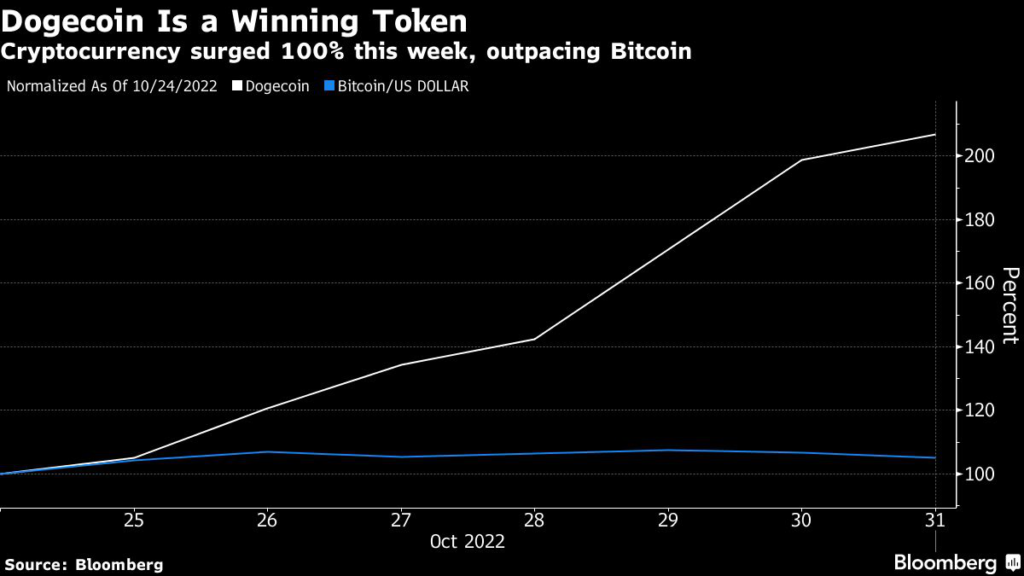
Dogecoin, a long-time favorite of billionaire Elon Musk, has gained 100% this past week, far exceeding the advances of the world’s two largest tokens, Bitcoin and Ethereum, up around 6% and 17%, respectively. That surge makes Dogecoin a top performer among the 10 largest coins by market capitalization, according to CoinMarketCap.com Monday morning. 

Dogecoin has been known to surge and plummet despite the performance of other digital assets. Its volatility has mainly been driven by the retail-trading mania. 

During the crypto bear market of 2018, for example, the memecoin nearly tripled in value over a 30-day period, while Bitcoin’s price barely changed in that time.

Dogecoin’s rally comes as Musk completed his $44 billion acquisition of Twitter Inc. The Tesla CEO has expressed his support of the meme coin in the past via tweets like “Who let the Doge out” and his embrace of the nickname, The Dogefather. 

Kunal Goel, a research analyst at Messari, said that some traders believe Musk will integrate the token into the platform and “drive Dogecoin’s adoption.” 

However, Musk’s commitment to cryptocurrencies has wavered, and it’s unclear if he plans to bolster the presence of digital assets, let alone Dogecoin, on the social media platform. 

Dogecoin’s rise does not mark the end of the crypto winter. October will likely disappoint crypto hopefuls looking for large advances in the start of the fourth quarter. This time last year, Bitcoin gained 40% and advanced 30% in 2020. This month, the largest digital asset is on track to gain less than 10%. 

Year-to-date, Dogecoin has declined about 30%, while Bitcoin has plunged close to 55%. Memes and Musk aside, it will take more than a Dogecoin rally to pull digital assets out of the doldrums. 

But the memecoin is a bright spot in the mostly muted digital asset space. 

“It’s a good start,” said Quantum Economics founder and Chief Executive Officer Mati Greenspan. “But our problems are far from over.”

More stories like this are available on bloomberg.com

©2022 Bloomberg L.P.

Ukraine Latest: Russia Warns on Ships; Missile Strikes Cut Power

(Bloomberg) — A fresh round of Russian missile strikes hit power and water infrastructure across the country after the Kremlin blamed Kyiv for strikes against its Black Sea fleet and pulled out of a landmark grain export deal.

Wheat prices soared after Russia warned that shipments will become “much riskier” without its participation, even as ships loaded with grain began to leave Ukraine. The United Nations and Turkey worked to salvage the agreement to keep seaborne exports flowing. 

Russia suspended the agreement after drone strikes against its naval fleet, claiming without evidence that one of the drones launched on Saturday might have come from a grain ship that’s part of the Black Sea initiative. The Kremlin also said underwater drones were launched from Odesa region. 

(See RSAN on the Bloomberg Terminal for the Russian Sanctions Dashboard.)

Key Developments

  • Russian Missile Strikes Cut Ukrainian Power, Water Supplies
  • Wheat Surges as Russia Warns on Ship Safety After Ditching Deal
  • Russia Is Mostly Failing in Race to Find New Oil Markets
  • Ukraine Sees ‘First Signs’ of Price Stability as War Grinds On
  • Wheat Surges Even as Grain Ships Defy Russian Deal Exit
  • Iran’s Oil Minister Heads to Russia on Monday for Deal Talks

On the Ground

Russian missiles targeted the capital, Kyiv, including essential civilian infrastructure, leaving parts of the city without water and electricity. Explosions were also reported in regions including Kharkiv, Zaporizhzhia, Kremenchuk and Vinnytsia. Russia’s military struck the Dnipropetrovsk region with artillery and drones overnight, hitting residential buildings and other facilities as well as energy infrastructure, local authorities said on Telegram. Russian forces began preparations to remove artillery from the Dnipro River’s right bank in the Kherson region, Ukraine’s southern operational command said on Facebook.

(All times CET)

Ukraine Assesses Damage From Russian Strikes (4:45 p.m.)

Russian missiles and drones damaged infrastructure in 10 Ukrainian regions and hundreds of locations are without power in seven of them, Prime Minister Denys Shmyhal said on Telegram. The strikes left more than 80% of Kyiv residents without running water and 350,000 apartments lost electricity supply, Mayor Vitali Klitschko said on Telegram. By evening, 40% still had no water supply and 270,000 apartments remained without electricity, he said.

Russia Plans to Raise Diesel Exports Ahead of EU Ban (1:20 p.m.)

Russia’s diesel exports via its key Baltic and Black Sea ports are set to reach a seven-month high in November as Europe grapples with a fuel shortage ahead of a full ban on such purchases early next year.

EU Grain Corridors Have Carried 29 Million Tons of Goods (1:10 p.m.)

More than 14 million tons of agricultural products have been exported to Ukraine via the so-called solidarity lanes between May and Oct. 20, European Commission spokesman Stefan De Keersmaecker told reporters in Brussels. Over the same period, 15 million tons of non-agricultural products such as steel, oil and humanitarian products were exported.

Latvia Detains 37 After Removing Soviet Monuments (1:03 p.m.)

Police detained 37 people after authorities began taking down an obelisk honoring the Soviet military in Latvia’s second-biggest city of Daugavpils.

The city, near the eastern border with Belarus, is nearly half ethnic Russian. Latvia removed a tall Soviet obelisk in the capital Riga in August and plans to take down all Soviet monuments across the country.

Ukraine’s DTEK Depleted Stockpiles to Fix Power Lines (12:52 p.m.)

Ukraine’s largest private power company DTEK is running low on inventories of spare parts to fix power infrastructure damaged by Russian shelling.

“We have already used up the stockpiles of equipment which we had in our depots after the first two waves of attacks since Oct. 10,” Dmytro Sakharuk, executive director of DTEK, said on TV.

DTEK was able to buy some equipment in the market but needs to purchase millions of dollars worth of spare parts as procurement problems are mounting amid soaring prices, he said. Preliminary estimate of damage to DTEK from Russian attacks is estimated in millions of dollars, according to Sakharuk.

Poland Sees Reverse in Flow of Ukrainian Refugees 12:50 p.m.)

This month’s massive Russian attacks on Ukrainian infrastructure may trigger a new wave of refugees to Poland, Wojciech Kononczuk, deputy head of Polish Center for Eastern Studies said on Twitter.

Polish border guard data show that October is on track to be the first month since April when number of Ukrainians moving to Poland was higher than those traveling back to Ukraine.

Turkey to Talk to Russia About Grains Corridor (12:29 p.m.)

Turkish Defense Minister Hulusi Akar said he will discuss Russia’s withdrawal from the Ukraine grain corridor deal in a phone call with his Russian counterpart Sergei Shoigu later on Monday.

“The suspension of this initiative is neither to the benefit of Russia nor Ukraine,” a Turkish Defense Ministry statement said. “We are continuing to hold talks with Ukrainian and Russian defense ministers.”

Kremlin Says Grain Shipments Without Russia ‘Much Riskier’ (12:38 p.m.)

Kremlin spokesman Dmitry Peskov said grain shipments from Ukraine’s Black Sea ports become “much riskier” after Russia suspended participation in a deal to protect them, but he declined to comment on what conditions Moscow is setting out for rejoining the pact.

“In circumstances where Russia is talking about the impossibility of ensuring the security of shipping in these areas, of course such a deal is hardly implementable,” he told a conference call. “It takes on a different character, much riskier and more dangerous.”

He said diplomatic consultations are underway with Turkey and the UN on the future of the pact.

Russia Hit Infrastructure in 10 Regions of Ukraine (11:26 a.m.)

Russia’s missile and drone attacks on Monday damaged 18, mainly energy, facilities in 10 regions of Ukraine, Prime Minister Denys Shmyhal said on Telegram.

“They are not targeting military facilities, but critical civilian infrastructure,” he said, adding that “hundreds of locations have had power cut off in seven Ukrainian regions.” 

Ukraine has 25 regions, including Crimea, which was annexed by Russia in 2014.

Revolut Billionaire Gives Up Russia Citizenship (11:22 a.m.)

Nikolay Storonsky, the 38-year-old co-founder and chief executive officer of London-based fintech startup Revolut Ltd., has renounced his Russian citizenship amid his outspoken opposition to the war in Ukraine.

“Nik is a British citizen. Earlier this year he renounced his citizenship by birth to Russia. His position on the war is on the public record: the war is totally abhorrent and he remains resolute in calling for an immediate end to the fighting,” a spokesman for Revolut said.

A former derivatives trader at Credit Suisse Group AG and Lehman Brothers, Storonsky and several partners launched Revolut in 2015. 

Russian Missile Targeting Ukraine Power Unit Falls in Moldova (10:38 a.m.)

One of the missiles launched by Russia during its attack on Ukraine’s critical power infrastructure fell in the town of Naslavcea in Moldova, which is only 10 kilometers away from Dnister dam in Ukraine. The downing shattered windows of several houses, Moldova’s Interior Ministry said in a statement. 

Czech Premier Visits Kyiv (10:06 a.m.)

Czech Prime Minister Petr Fiala and several other members of his cabinet arrived in Kyiv for talks with Ukrainian Prime Minister Denys Shmyhal. 

Ukraine Downed Most Russian Missiles Fired on Monday (9:13 a.m.)

Ukrainian air defense forces shot down 44 of more than 50 missiles launched by Russian forces this morning, the country’s air force command said on Telegram.

Russian Tu-95 and Tu-160 bombers launched Х-101 and Х-555 cruise missiles from above the Caspian Sea and from area near Volgodonsk in Russia, according to Ukrainian air forces.

Crop Ships Are Leaving Ukraine Again (9:08 a.m.)

Wheat prices soared early Monday as traders watched for developments on exports. Ukraine is one of the world’s biggest suppliers of wheat, corn and vegetable oil and the July agreement to open three Black Sea ports has been vital to help alleviate a global food crisis.

Russia has only temporarily suspended its participation in implementing the deal, which was brokered by Turkey and the UN, but is still a signatory to the agreement, according to Ismini Palla, a UN spokeswoman for the Black Sea Grain Initiative.

Under the terms of the initiative, all parties agreed not to undertake attacks against merchant and civilian ships. Palla confirmed at that time that outbound ships were moving and assembling near the entrance to the corridor.

Ukraine Reports Huge Russian Missile Strikes (8:12 a.m.)

Ukraine said Russia launched a massive wave of missile attacks across the country after the Kremlin accused Kyiv of strikes against its Black Sea fleet and pulled out of a grain-export deal.

Those attacks caused large scale power and water supply cut offs on Monday morning across the country.

More stories like this are available on bloomberg.com

©2022 Bloomberg L.P.

Stocks Trade Off Lows, Treasury Yields Keep Rising: Markets Wrap

(Bloomberg) — Stocks trimmed their losses at the start of a busy week for earnings, with investors awaiting Wednesday’s Federal Reserve decision for clues on whether officials will dial back the pace of rate increases as early as December.

Energy shares led gains in the S&P 500, while big tech slumped and bond yields climbed with the dollar. Swap markets are pricing in a 75-basis-point hike this week amid the Fed’s most-aggressive tightening campaign in four decades. The outlook for the following meetings is less certain, with traders seeing a “coin toss” between an increase of that size and a 50-basis-point boost in the final month of 2022.

Financial indicators such as the inversion of the yield curve between 10-year and three-month Treasuries “all support a Fed pivot sooner rather than later,” wrote Morgan Stanley’s Michael Wilson. Separately, Goldman Sachs Group Inc. strategists said the potential slowdown in tightening, light positioning and anticipation of strong fourth-quarter seasonality had lifted equity markets in recent weeks.

“Much has been said about the potential for a pivot toward a slower cadence of tightening,” said Ian Lyngen, head of US rates strategy at BMO Capital Markets. “The larger uncertainty is whether this ‘pivot lite’ is interpreted as the beginning of the end of the Fed’s hawkish stance or simply an indication that tighter for longer will be the new norm.”

The latest MLIV Pulse survey suggests that if Fed Chair Jerome Powell gives any dovish signals this week, he might send investors scrambling. 

Almost half of 250 respondents polled last week said they were buying the dollar ahead of the November meeting, and about 78% expected two-year yields to go up. These bets could go sour if Powell suggests a step down toward a 50 basis-point increase in December, or quarter-point moves to finish off the hiking cycle in early 2023.

Read: Treasury Strategists Mull Fed Pivot Fallout: Research Roundup

Although October can evoke fear on Wall Street following stock market crashes in 1929, 1987 and 2008, it’s living up to its reputation as the best month in US midterm election years. Now traders are holding out hope this October will follow a historical pattern of being a “bear-market killer” following a turbulent year for equities.

And when it comes to elections, the fourth quarter of midterm years and the following first quarter historically have been the two strongest of the 16-quarter presidential cycle, delivering average gains of 6.4% and 6.9% respectively for the S&P 500, according to investment research firm CFRA.

To Jason Draho at at UBS Global Wealth Management, while the recent rally in stocks didn’t really look sustainable, that doesn’t mean markets can’t keep grinding higher in coming weeks, “provided that the Fed and labor and inflation data don’t disappoint.”

“A sustainable rally is unlikely until investors have certainty on the end of Fed rate hikes and economic activity is close to troughing,” Draho noted, adding that neither is likely until at least the first quarter. “But of the upcoming data and events, positive news on labor market cooling should do the most to favorably shift the medium-term risk-reward outlook.”

Elsewhere, euro-area inflation surged to a fresh all-time high, while the bloc’s economy lost momentum — reinforcing fears that a recession is now all-but unavoidable. The region’s bond yields climbed, while the common currency fell.

Key events this week:

  • Reserve Bank of Australia policy decision, Tuesday
  • US construction spending, ISM manufacturing index, Tuesday
  • EIA crude oil inventory report, Wednesday
  • Federal Reserve rate decision, Wednesday
  • US MBA mortgage applications, ADP employment, Wednesday
  • Bank of England rate decision, Thursday
  • US factory orders, durable goods, trade, initial jobless claims, ISM services index, Thursday
  • ECB President Christine Lagarde speaks, Thursday
  • US nonfarm payrolls, unemployment, Friday

Some of the main moves in markets:

Stocks

  • The S&P 500 fell 0.3% as of 11:45 a.m. New York time
  • The Nasdaq 100 fell 1%
  • The Dow Jones Industrial Average was little changed
  • The Stoxx Europe 600 rose 0.5%
  • The MSCI World index fell 0.2%

Currencies

  • The Bloomberg Dollar Spot Index rose 0.7%
  • The euro fell 0.9% to $0.9877
  • The British pound fell 1% to $1.1496
  • The Japanese yen fell 0.8% to 148.80 per dollar

Cryptocurrencies

  • Bitcoin fell 1.6% to $20,368.31
  • Ether fell 1.7% to $1,567.4

Bonds

  • The yield on 10-year Treasuries advanced two basis points to 4.03%
  • Germany’s 10-year yield advanced three basis points to 2.13%
  • Britain’s 10-year yield advanced four basis points to 3.52%

Commodities

  • West Texas Intermediate crude fell 1.3% to $86.75 a barrel
  • Gold futures fell 0.3% to $1,640.30 an ounce

–With assistance from Vildana Hajric and Isabelle Lee.

More stories like this are available on bloomberg.com

©2022 Bloomberg L.P.
Saudi Arabia Says Apple Among High-Profile Tenants at New Riyadh Economic Zone

(Bloomberg) — Saudi Arabia has opened its first integrated special-economic zone in Riyadh and is citing iPhone maker Apple Inc. as among the first high-profile tenants. 

The area, built on 3 million square meters near the capital’s airport, is seeking to lure the world’s largest international firms to the kingdom with exemptions from certain taxes and labor regulations, according to Transport and Logistics Minister Saleh Al-Jasser.  

Apple will base a regional distribution center there and may undertake activities ranging from assembly line and repair work to light manufacturing in the future, the minister said. 

“We are already engaged with 20 other multinationals, some of which we’re at a very advanced stage of negotiations,” Al-Jasser said in an interview. The focus will be on industries such as technology, telecommunications, aviation and pharmaceutical, he said. 

The world’s biggest oil exporter is looking to attract foreign talent and convince companies to move regional headquarters to Riyadh to help build new industries that would employ its largely young population. The kingdom has emerged from the coronavirus pandemic with a fast-improving balance sheet thanks to a rebound in crude prices, and is now stepping up efforts to diversify away from oil.

The special economic zone, which will be connected to the rest of the kingdom by rail, is intended to boost air-freight fivefold and help meet the objectives of Crown Prince Mohammed bin Salman’s agenda — called Vision 2030 — which seeks to open up the economy. 


More stories like this are available on bloomberg.com

©2022 Bloomberg L.P.

Close Bitnami banner
Bitnami