Bloomberg

GameStop, Getty Images Surge as Meme and De-SPAC Frenzy Returns

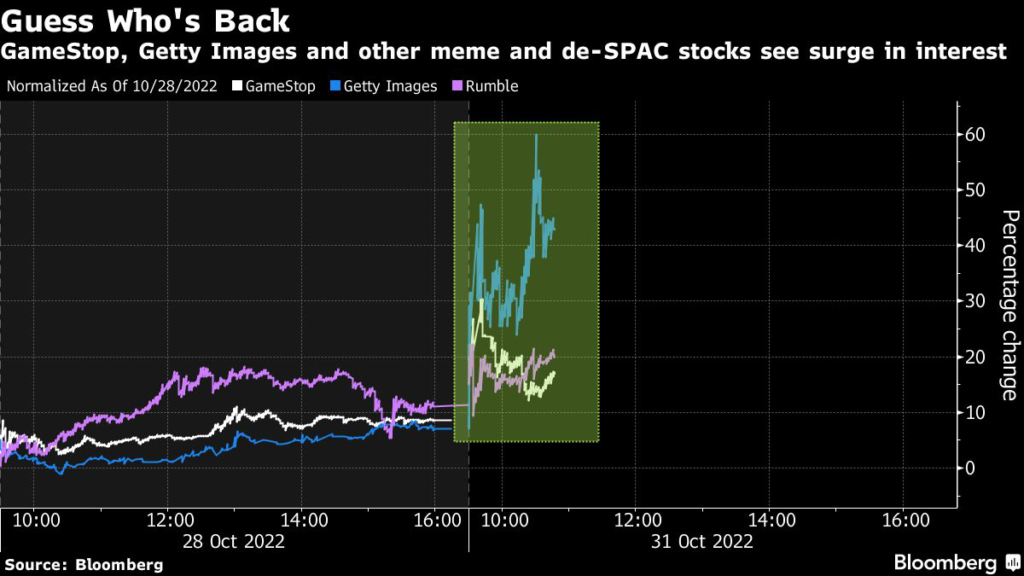
(Bloomberg) — Retail traders returned in force on Monday, creating a volatile session for meme stock favorites including GameStop Corp. as well as de-SPAC firms like Getty Images Holdings Inc..

Shares of video-game retailer GameStop surged as much as 24%, triggering at least one volatility-related pause in trading. Getty, which went public earlier this year after merging with a blank-check firm, saw its shares jump as much as 50%, also causing its trading to briefly be halted. Meanwhile, the broader S&P 500 Index is down 0.5% and the Nasdaq 100 Index is lower by 1.1%.

“The first thing you have to realize with these stocks is there’s no rhyme or reason,” said Keith Lerner, chief market strategist at Truist Advisory Services Inc. “They don’t trade based on the big macro trends normally. They trade on speculation and liquidity.”

A basket of so-called meme stocks tracked by Bloomberg rose 1.4%, while the De-SPAC index is lower by about 0.2%. Both gauges have plunged this year as concerns about a possible US recession diminished investor demand for shares of riskier assets.

The sudden resurgence in interest for the group comes ahead of what is likely to be a bumpy two weeks for the stock market. A Federal Reserve rate decision on Wednesday will kick off a span of seven trading sessions that will feature four major events including a key jobs report, mid-term elections and inflation data for October.

Other stocks popular with retail traders also gained on Monday. Bed Bath & Beyond Inc. and AMC Entertainment, two stocks synonymous with the meme stock movement, both gained at least 2%. Shares of Rumble Inc., a Peter Thiel-backed conservative video network which went public last month in a SPAC merger with CF Acquisition Corp. VI, jumped as much as 9.8%.

“Stocks that can move up that much in one day on no news can move down just as quickly,” Lerner added. “That’s the warning flag for investors.”

More stories like this are available on bloomberg.com

©2022 Bloomberg L.P.

India Probing MG Motors Unit as Scrutiny on Chinese Firms Widens

(Bloomberg) — India has begun an inquiry into MG Motors India Private Ltd. over alleged financial irregularities, according to people with knowledge of the matter, deepening a scrutiny of Chinese firms operating in the country.

The probe against the local unit of the Chinese carmaker SAIC Motor Corp has been initiated by India’s Ministry of Corporate Affairs. The scrutiny started after a detailed analysis of the company’s financial statements indicated suspicious related-party transactions, alleged tax evasion, under and over-invoicing of bills and other irregularities, the people said, asking not to be identified as the matter is not public.   

The company’s top management, including directors, managing director and auditors have been summoned next month by the ministry seeking more clarification, the people said. An email sent to the company after business hours was not immediately answered.

The ministry also declined to comment for this story.

The move follows similar action against other China-based firms including Xiaomi Corp., local units of ZTE Corp., Oppo and Vivo Mobile Communications Co amid continued hostility between the two nuclear-armed neighbors since 2020 when the deadliest fighting in decades erupted along their disputed Himalayan border. 

Since then, the Prime Minister Narendra Modi’s government has banned more than 300 Chinese mobile applications, including shopping services from Alibaba Group Holding Ltd., the TikTok short video hit from ByteDance Ltd. and apps used on Xiaomi phones. 

The ministry is already investigating the account books of more than 500 Chinese companies to look into allegations of significant financial impropriety, Bloomberg News had reported earlier.

More stories like this are available on bloomberg.com

©2022 Bloomberg L.P.

Oracle to Close Some Cerner Kansas City Offices Following Purchase

(Bloomberg) — Oracle Corp. is closing some offices of health care records company Cerner in Kansas City and will move staff to a single location, following the software giant’s purchase of the firm. 

Cerner will consolidate its Kansas City workforce at its Innovations campus, Misti Preston, a spokeswoman for Cerner, said in an emailed statement. 

The company is “actively hiring and bringing people to the area from across Oracle’s operations,” and with nearly 2 million square feet of office space, the Innovations location offers “a large amount of room to further expand as our workforce grows in the region,” Preston said.

World Headquarters and Realization are other Cerner locations in the area. The company is a major employer in Kansas City, and had been divesting office space amid a transition to a hybrid workforce before Oracle closed its $28.3 billion deal for the company in June.

Best known for its legacy database software, Oracle purchased Cerner to make inroads into the health care industry, which has been comparatively slow to adopt cloud technology. The transaction left it with a significant amount of debt. Earlier this month, it set a new long-term goal of $65 billion in sales by 2026, fueled by growth in its cloud segment.

More stories like this are available on bloomberg.com

©2022 Bloomberg L.P.

Twitter Offers to Buy Back Bonds as Musk Consolidates Power

(Bloomberg) — Twitter Inc. and Elon Musk took further actions on Monday to consolidate control of the company under its new owner, including launching an offer to buy back all of the outstanding bonds and dismissing the board.

Musk, 51, completed his purchase of Twitter last week for $44 billion and immediately started molding the company to his liking. One of the first steps Musk took was to fire four of the most senior executives of the company, including Parag Agrawal, the chief executive officer. Calling himself Chief Twit, Musk plans to effectively run the company himself in the immediate term, people familiar with his plans have said. 

On Monday, Musk became the sole director of the social media company after the removal of all nine other board members, in accordance with the terms of the merger agreement, according to a securities filing. It wasn’t clear who Musk would nominate to fill the board. At the other companies he runs, including Tesla Inc., the boards are packed with Musk loyalists. His brother Kimbal Musk, is a board member at Tesla, for example.

According to the filing, Twitter will purchase outstanding 3.875% senior notes due 2027 and 5% senior notes due 2030 at an offer price of 101% of principal plus accrued and unpaid interest, according to a filing Monday. The bond agreements required Twitter to offer to buy back its debt in the event of a change in control of the company. Musk has also asked a judge to dismiss a lawsuit over his attempt to pull out of the acquisition now that the deal has closed.

Musk’s first few days on the job have been filled with rumor and speculation, including about how he will handle content moderation on Twitter and how many jobs he’ll cut in an effort to control costs. Concerns over massive layoffs swirled in the run-up to Musk’s take-private transaction, when potential investors were told that he’d eliminate 75% of the workforce. Musk later denied that the cuts would be that deep, though he hasn’t elaborated on the plans. In recent weeks, Musk has hinted at his staffing priorities, saying he wants to focus on the core product.

Just three days in to his new job, the billionaire’s views on content moderation were also being tested after he posted and deleted a tweet spreading a baseless anti-LGBTQ conspiracy theory about the recent attack on the husband of House Speaker Nancy Pelosi.

The episode underscored the pressures that Musk, a self-styled “free speech absolutist,” now faces in running the popular social media website — particularly in how to place limits on misinformation and hate speech on its service. Musk has pledged to advertisers that Twitter won’t become a “free-for-all hellscape” under his leadership but at the same time pronounced that unfettered speech should be the norm on the site. 


–With assistance from Kurt Wagner and Davey Alba.

(Updates with background on the transaction throughout)

More stories like this are available on bloomberg.com

©2022 Bloomberg L.P.

Looking for a Fright? Here Are Some Chilling Markets Charts

(Bloomberg) — Stock investors don’t need to look far this Halloween to give themselves a fright.

Plenty has been scary on Wall Street this year, from the crash in equities that’s sent some once-high-flying companies down 80% or more, to the spike in yields and the drubbing in cryptocurrencies. 

Yet investors see many more potential hazards ahead. Here are some charts keeping Wall Street up at night:

Ghostly Curve

Doug Longo, co-head of product specialists at Dimensional:

“Last month’s US Treasury yield curve has taken on a ghostlike appearance. Since bond yields are one indicator of future returns, an investor’s position on the curve may determine whether this ghost is friendly like Casper or scary like Samara from The Ring.”

“For example, fear of future Fed rate hikes may have driven some to seek shelter in cash. But investors should remember that expected Fed activity is already priced in. The higher yields available from extending into the short end of the curve may be worth embracing, just like the friendly apparition.”

“On the other end of the spirit spectrum, core bond investors may have reason to fear indexed approaches to capturing the market. Lower yields around the 10-year segment of the curve suggest not all market segments have equally appealing returns, yet index bond funds may hold just as much in the dips as the bumps on the curve. That’s like getting candy corn instead of M&M’s in your trick-or-treat bag.”

Worker Dangers

Steve Chiavarone, portfolio manager and equity strategist at Federated Hermes:

“Prior to the pandemic, the equilibrium of the US labor market was defined, on average, by wage inflation of 3.3% with 4.7 million more unemployed workers than job openings. Currently, wage inflation is running as high as 6.7%, with 4 million more job openings than unemployed workers.”

“With wage inflation serving as the biggest driver of persistent inflation, this implies that in order to get inflation back down to the Fed’s target, we need to see an increase in the labor supply (less likely) or an increase in unemployment (more likely) of roughly 8.7 million jobs. Given a 159-million-person US labor force, this would imply a potential increase in unemployment of over 5% in order to re-establish labor market equilibrium.”

Spiking Mortgages

Liz Ann Sonders, chief investment strategist for Charles Schwab:

“The economy continues to suffer from a ‘rolling recession’ with different pockets hit at different times. Housing is undoubtedly one area in a recession, with housing affordability being hit from all sides, including the spike in mortgage rates, historically elevated home prices and negative real (inflation-adjusted) incomes.”


Rent Threats

George Pearkes, global macro strategist at Bespoke Investment Group: 

“Hopes of a Fed pivot have to contend with high rental inflation. While leading indicators of rent inflation have crashed to negligible levels around 1% annualized, the construction of rent indices in CPI means that index is lagged.” 

“At 40% of core CPI, rent inflation needs to decline dramatically to get monthly core prints close to 2% annualized.”

Foreboding Bear

Victoria Greene, founding partner and chief investment officer at G Squared Private Wealth:

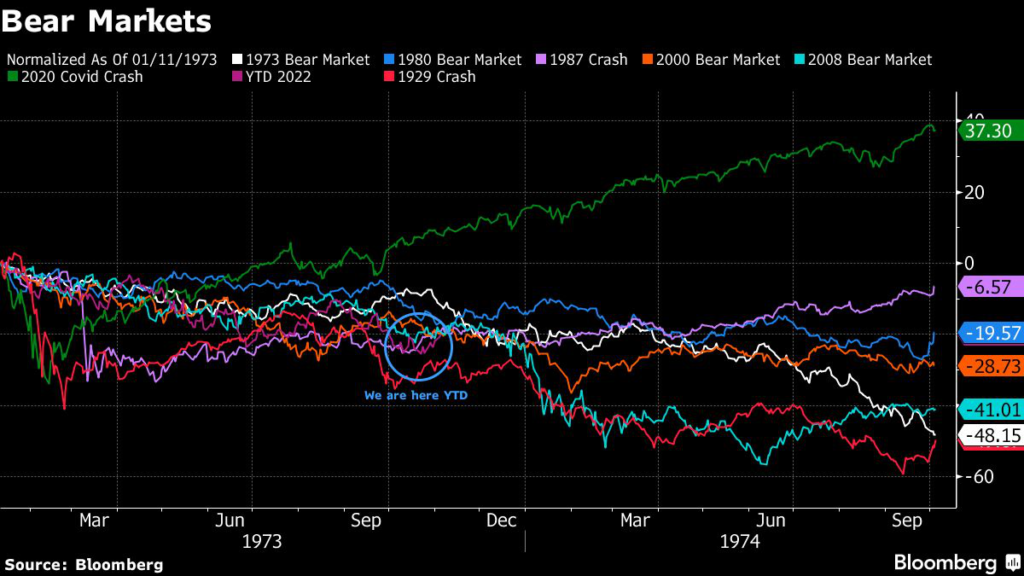
“Average bear markets tend to not be too long or too painful, but the current pattern aligns closer to the really bad crashes of 2009 and 1929 than I would like. During different economic periods, the Fed has shown a willingness to step in and provide a floor before it ever becomes that bad again.” 

“What flavor of bear market will 2022 end up being? Consensus says moderate, normal, everyday bear market. This chart should spook investors that it might not be that way. Obviously 1929, 2020 and 1987 all had major 2x+ standard deviation selloff days. Might we see that in 2022 as well?” 

Mauled Manufacturing

Matt Miskin, co-chief investment strategist at John Hancock Investment Management:

“One of the top leading economic indicators for the United States is the Institute of Supply Management (ISM) Manufacturing PMI New Orders index. It is a timely monthly business survey that asks manufacturing companies on the front lines of the economy whether new orders are picking up or slowing down.” 

“When the index is in a downtrend and moving lower than the 47% level we are at today, there has often been a significant economic slowdown and likely recession.”

Liquidity Curse

Lauren Goodwin, economist and multi-asset portfolio strategist at New York Life Investments:

“Liquidity could be this cycle’s curse — or blessing. On aggregate, a sharp decline in central-bank liquidity creates risks for financial assets, and non-linear ones at that.”

“Central bankers don’t have as much experience in adjusting their balance sheets as they do with policy rates. However, as economic and market risks intensify, liquidity providers could present meaningful opportunity, both in bridging the economic gap for high-value assets, and by finding price opportunities in distressed ones.”

QT Winds

Steve Sosnick, chief strategist at Interactive Brokers:

“The Fed’s balance sheet has only declined roughly to start-of-year levels, and the monthly declines have been quite modest compared to the gains we saw in late 2020 through 2021 (not to mention the early 2020 explosion).”

“This visualizes just how much of a headwind QT might be for equities. It’s only just begun in earnest, and there is no reason to expect that even if the Fed slows or pauses rate hikes (let alone pivots) that they will take their foot off the QT brakes anytime soon.”

Missing Fear

Amy Wu Silverman, equity derivatives strategist at RBC Capital Markets:

“Despite recent earnings, rising inflation fears, geopolitical headwinds and tail risks, we are just not seeing fear and demand for hedges. This is why equity volatility has dramatically underperformed rates/FX volatility.”

“The SDEX Index gauges the market’s willingness to accept a one standard deviation loss by comparing the cost of ATM [at-the-money] options to the cost of OTM [out-of-the-money] puts struck one standard deviation OTM — in options speak, the ‘skew.’ Skew remains extremely low.”

“The TDEX Index gauges the market’s estimation of the likelihood of a three standard deviation drop in SPY over the next 30 days and the cost of insuring against such a drop. In options speak, the ‘convexity.’ TDEX is in its 15th percentile. Tails remain in its bottom quartile.”

Capex Collapse

Neil Dutta, head of economics at Renaissance Macro Research:

“The Fed has shot residential investment, but there is not much evidence of weakness outside housing. Could business investment be next?”

“Our tracker of capital spending intentions from the various regional PMIs points to slowing ahead. Over the last six months core durable goods shipments have been flat. Look for this to go negative.”

More stories like this are available on bloomberg.com

©2022 Bloomberg L.P.

iPhone Factory Worker Walked 25 Miles to Escape Covid Lockdown in China

(Bloomberg) — It was Sunday when Dong Wanwan decided to give up her job at the world’s largest iPhone factory and walk home.

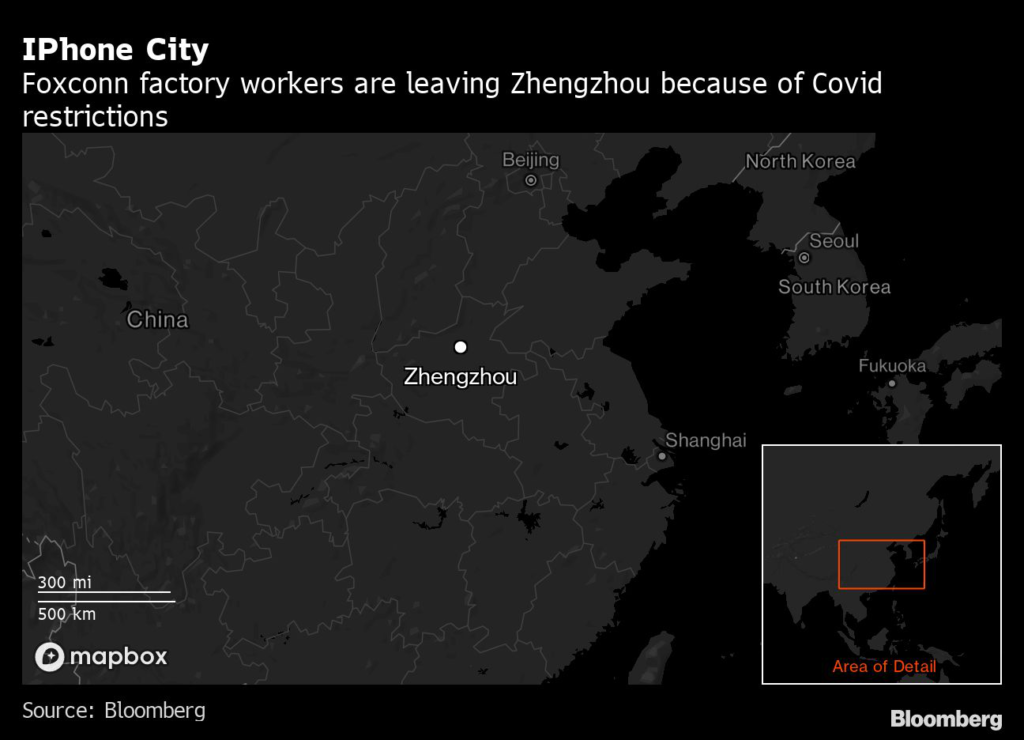
The 20-year-old had been working for the past three months on the production lines at Foxconn Technology Group’s plant in Zhengzhou, one of tens of thousands helping put together Apple Inc. iPhones that would be sent around the globe. It was a coveted job, among the country’s best-paid blue-collar gigs.

Then Covid began spreading on the manufacturing campus. The factory went into a “closed loop,” walling off the giant complex from the outside world. Trash piled up in hallways. Food was harder to come by. Many who got infected said they were forced to subsist on bread for a spell. 

That’s when Dong collected her 19-year-old brother and set off on a journey where they walked some 40 kilometers (25 miles), with luggage in tow, to get home. The trip to a small town southeast of Zhengzhou took almost nine hours. 

“Foxconn really messed up, I don’t think a lot of people would want to go back. I know I wouldn’t,” Dong told Bloomberg News.

In Xi Jinping’s China, millions live with the fear of getting caught up in an abrupt lockdown and forced to fend for themselves — a nightmare scenario that’s become more and more common this year as cities from Shanghai to Chengdu ground to a halt to stop the virus. It was no different within Foxconn’s vast worker populace, a contingent of some 200,000 forced to share cramped dormitories with up to 11 other people. 

Something snapped over the weekend, when hundreds if not thousands of workers walked, hitched rides or dipped into their savings to escape the Covid flareup. Their collective ordeal was captured in videos and photos that flooded social media in China, exposing the toll of Covid Zero, a policy that’s already up-ended parts of the world’s second-largest economy and global supply chains. 

While still largely popular for avoiding the scale of death seen in places like the US, pushback against the strategy is emerging. Videos about workers walking home along highways with their luggage received hundreds of likes on Douyin, China’s version of TikTok.

For Dong, the experience was far more visceral.

It started when she went into quarantine after reporting a cold in late October. She developed a fever of 39.5 degrees celsius (103.1 degrees Fahrenheit) and couldn’t get out of bed. Dong tried calling an employee assistance hotline, then hospitals nearby. None of her calls got through. 

Even a messaging group for Foxconn employees set up on WeChat — the WhatsApp-like platform most Chinese use religiously as a real-time forum — went silent despite multiple pleas for help. If it wasn’t for Dong’s line supervisor, who got her colleagues to send over food and medicines, she would have run out of supplies.

Sympathetic Bystanders

That experience sealed her decision. Dong set out for a small town near Kaifeng, to the southeast, at 8 am on Sunday, beginning what was to become a nine-hour trek across Zhengzhou’s open plains.

Dong got a lot of help along the way. Despite Zhengzhou effectively being in lockdown, sympathetic residents, alerted to the mobilization on social media, left bottled water and snacks by the main highways. Those acts of kindness, captured in detail on Douyin, lifted her spirits. She and her brother even managed to snag a ride on the back of an open truck for part of the way.

Explore Bloomberg’s China Covid Outbreak Dashboard on the terminal

Dong got assistance in part because these desperate experiences are becoming commonplace around China, creating a groundswell of resentment. While the strict measures have kept China’s official Covid death toll below 6,000, they’re exacting a heavy economic cost, fomenting discontent and isolating the country from the rest of the world.

As the virus mutates into ever-more transmissible variants, stopping its spread has become a Sisyphean task: China reported 2,675 new local Covid cases for Sunday, 802 more than the day before, marking the biggest nationwide surge in infections since Aug. 10.

Saves Lives

Many China watchers expected Xi to signal a pivot away from what has become a signature policy when he took the podium at the Communist Party’s congress on Oct. 16. Instead, he defended the no-tolerance strategy as one that saves lives, and offered no steer on when it’s likely to end.

This Is How Long Experts See China Clinging on to Covid Zero

It’s unclear how many workers have left Foxconn in the past few days. Dong said the talk among her colleagues was of thousands, though that wasn’t immediately possible to verify. The company has scrambled to mitigate the potential disruption, raising wages and arranging for backup from its other Chinese plants should assembly lines stall in Zhengzhou. The company has repeatedly emphasized workers are their top priority.

Dong said she didn’t know much about that, focusing instead on her journey.

It helped that the local government eventually pitched in, she recounted. It was 4 pm by the time the siblings finally reached an ad-hoc assembly point that officials had set up to help transport departing Foxconn workers back to the surrounding towns.

Dong estimated there were about 500 people waiting for buses. From there, they were sent to a quarantine facility converted from an elementary school, finally reaching their hometown, though still subject to China’s Covid rules.

“I was completely spent from walking, I got a massive blister filled with blood,” she said.

–With assistance from Gao Yuan, Debby Wu and K. Oanh Ha.

More stories like this are available on bloomberg.com

©2022 Bloomberg L.P.

Abbott’s Texas Business Allies Want a Pivot From Culture War

(Bloomberg) — Greg Abbott looks set for a third term as Texas governor, but what exactly he has planned for the next four years is harder to predict. Even business groups who tend to side with the GOP can’t tell for sure what’s in store.

The “Issues” section of his campaign website is full of policy proposals made in 2017 and 2018. He’s posted a few one-page position papers elsewhere on the site, but they’re sparse on details. In public appearances, Abbott’s speeches often focus on big ideas about cutting property taxes, deterring unauthorized immigration and shoring up the economy, but are light on the nitty-gritty. 

And that’s got some in Texas nervous. Moderates and business-oriented Republicans are hoping Abbott will steer clear of the culture-war issues that dominated his most recent term, when he pursued staunchly conservative policies on abortion, LGBTQ rights and voting limits, among other contentious topics.

Companies would love a focus on regulation, taxes and core business issues, according to interviews with business groups, party strategists and others who study Texas politics. They may get some of what they wish for, partly because the economic backdrop is bringing bread-and-butter issues to the fore. The fastest inflation in 40 years, soaring housing costs and speculation that a recession is on the horizon are looming over the Lone Star State.

“Tax and spending, jobs, the economy and fiscal-financial sort of things,” said Brendan Steinhauser, an Austin-based Republican consultant, who serves as chief strategy officer for Young Americans for Liberty. “There’s just a big constituency for that.”

Abbott’s campaign said the governor is focused on “economic opportunity for all Texans,” expanding energy production, securing the border and fully funding police. “Governor Abbott is running for re-election to secure the future of Texas,” spokeswoman Renae Eze said in an email.

Abbott looks to be headed to a win over Democratic challenger Beto O’Rourke, whose party hasn’t won a statewide contest since 1994. Polls have shown the Republican enjoying a lead in the mid-single digits, signaling that O’Rourke is falling flat in his attempts to sway voters with promises to support abortion rights and shore up the electric grid after widespread blackouts last year left hundreds of people dead.

The governor went all-in on conservative priorities during the most recent legislative session, partly to undercut primary challengers that attacked him from the right. Some of the country’s strictest limits on abortion, rules that declared some treatment for transgender youth to be child abuse and a broad voting clampdown prompted companies from Salesforce Inc. to Citigroup Inc. to American Airlines to issue statements decrying the moves. 

Other Texas politicians have also clashed with the business community, most notably Comptroller Glenn Hegar’s effort to create a list of financial companies and funds that allegedly boycott the energy industry as part of efforts to keep them from doing business with the state.

And, there’s no doubt Abbott will be under pressure to satisfy GOP stalwarts. The Republican Party of Texas’s legislative priorities for next year include “Stop Sexualizing Texas Kids,” “Abolish Abortion in Texas” and “Defend Our Gun Rights” — issues that might be popular with the base, but not necessarily the business community. Lieutenant Governor Dan Patrick has also released a list of 2023 roadmap that’s heavy on socially conservative priorities.

Abbott “can be a cipher when it comes to legislative priorities,” said James Henson, a political science professor at the University of Texas at Austin. “As much as I’ve watched him and know about him, I’m not sure.”

At GregAbbott.com, visitors can buy “Don’t Beto My Texas” t-shirts and find links to the latest campaign ads in English and Spanish. But the Issues section of his website seems outdated, with four policy proposals from his last campaign as well as links to detailed papers that seem to have been made in 2013 and 2014, when Abbott was first running for governor.

Even on issues where the business community might get behind him, the governor’s proposals have left question marks. One of Abbott’s most consistent talking points these days is the need to lower property taxes, which are high in Texas because the state has no levy on incomes.

But property-tax rates are set by local governments — not the state — so his ability to provide relief is limited.

He’s said at least half of the state’s $27 billion budget surplus should be used to cut the burden on taxpayers, and a statement on his campaign website from January says he’ll direct more money toward schools and make it harder for local governments to raise money through bond sales, which could lead to lower local rates.

Business groups are eager for the state to replace a corporate subsidy program that helped lure Tesla Inc. to build a factory outside of Austin and Samsung Electronics Co. for a $17 billion chip factory in the town of Taylor. The incentive framework — known as Chapter 313 for its position in the tax code — was allowed to expire amid bipartisan concern that it wasn’t being administered efficiently.

Abbott hasn’t taken a position on a new plan, though business groups are optimistic he will support one.

Texas needs to figure out a replacement as soon as possible, according to Glenn Hamer, the chief executive officer of the Texas Association of Business.

“The governor has been a great champion of economic development and he has been one of the major reasons we’ve been able to attract these great semiconductor, auto manufacturing, energy developments,” Hamer said.

The reliability of the electric grid has been a high-profile issue in Texas since a winter storm in early 2021 caused widespread blackouts that left more than 200 people dead. While O’Rourke, a 50-year-old former US congressman from El Paso, has sought to hammer the governor over the issue, Abbott says changes implemented after the blackout have shored up the grid to the point it’s never been more reliable.

One reason Abbott hasn’t come in for greater pressure on abortion, the electric grid and other issues championed by O’Rourke is that so many Texans are supportive of his efforts to clamp down on immigration. Polls show enthusiastic support for Abbott’s Operation Lone Star, a $4 billion program that vastly increased law enforcement’s presence at the border.

It’s also likely that Abbott will resist any attempts to tighten gun restrictions in the state, despite the pressure created by the school shooting in Uvalde in May that left 19 kids and two teachers dead. Instead, the governor has said the key to reducing that type of violence is better mental-health resources.

Despite Abbott’s wide lead, next month’s election is expected to be the most competitive since he was first elected in 2002 as attorney general. Even the 11-point margin produced by the Texas Politics Project poll would be closest ever victory for Abbott in a statewide race.

A tight contest could prompt Abbott to put more focus on the bread-and-butter issues that appeal to a wide spectrum of Texans like good infrastructure and transportation, according to Mark Jones, a political science professor at Rice University in Houston.

“The larger the margin he wins by, the more willing Abbott will be to pull to the right,” Jones said. “But the more narrow it is, the more likely Abbott will try to plant in the center.”

More stories like this are available on bloomberg.com

©2022 Bloomberg L.P.

Charter Is Offering Free Mobile Phone Lines in Battle for Customers

(Bloomberg) — Charter Communications Inc. is offering a free wireless phone line to some new and existing customers, in the latest escalation of the fight between cable companies and their telecom rivals.

Wireless customers who purchase a new mobile line for $30 a month will get a second line for free, Charter said in a press release Monday. The company is already offering Spectrum One, a $50-a-month plan that includes internet access and one mobile line. 

The company lowered the cost of its mobile service to $30 a month from $45 as part of the promotion. The No. 2 cable TV provider will tout the new pricing in a media campaign starting this week. 

Charter, which has seen its broadband growth collapse at the hands of wireless home internet and fiber services, is hoping the low-cost wireless offer will help stem some of the customer losses it’s seeing in its 41-state territory. The promotion comes at the same time that Charter is sending out notifications to broadband customers that they will see a $5 rate increase on their next bills.

Those price increases apply to internet-only customers in most markets, according to a Charter spokesman.

Wireless service has been a big draw for Charter and Comcast Corp., the largest cable provider. The two companies each added more than 300,000 mobile subscribers last quarter. 

Packaging mobile and broadband promotions like Spectrum One is a way to revive broadband growth, Charter executives said on an earnings call last week. 

“Spectrum One has the opportunity to drive incremental internet growth,” said Chris Winfrey, chief operating officer, who will take over as CEO when Tom Rutledge steps down in December. 

The Spectrum One bundle will compete directly with T-Mobile US Inc.’s $50 wireless home internet and mobile phone package. Verizon Communications Inc. has also been aiming discounted plans at cable customers. In June, Verizon cut the price of its entry level broadband service to $25 a month for wireless customers on top tier plans.

More stories like this are available on bloomberg.com

©2022 Bloomberg L.P.

Russia-Born Revolut Billionaire Gives Up His Citizenship

(Bloomberg) — Nikolay Storonsky, the 38-year-old co-founder and chief executive officer of London-based fintech startup Revolut Ltd., has renounced Russian citizenship amid his outspoken opposition to the war in Ukraine.

“Nik is a British citizen. Earlier this year he renounced his citizenship by birth to Russia. His position on the war is on the public record: the war is totally abhorrent and he remains resolute in calling for an immediate end to the fighting,” a spokesman for Revolut said.

Storonsky’s move came before his father, an executive at a unit of Russia’s Gazprom, was sanctioned by Ukraine earlier this month, the spokesman said. The news was first reported by the Telegraph. 

A former derivatives trader at Credit Suisse Group AG and Lehman Brothers, Storonsky and several partners launched Revolut in 2015. He’s worth $6.7 billion, according to the Bloomberg Billionaires Index.

–With assistance from Volodymyr Verbyany and Ivan Levingston.

More stories like this are available on bloomberg.com

©2022 Bloomberg L.P.

Ukraine Latest: Grain Ships Move Again; Russian Missile Strikes

(Bloomberg) — A fresh round of Russian missile strikes hit power and water infrastructure across the country after the Kremlin blamed Kyiv for strikes against its Black Sea fleet and pulled out of a landmark grain export deal.

Ships loaded with grain are beginning to leave Ukraine as the United Nations and Turkey work to salvage the agreement to keep seaborne exports flowing even after Russia’s weekend announcement that it was halting its involvement in the accord. 

Russia suspended the agreement after drone strikes against its naval fleet, claiming without evidence that one of the drones launched on Saturday might have come from a grain ship that’s part of the Black Sea initiative. The Kremlin also said underwater drones were launched from Odesa region. 

(See RSAN on the Bloomberg Terminal for the Russian Sanctions Dashboard.)

Key Developments

  • Russian Missile Strikes Cut Ukrainian Power, Water Supplies
  • Crop Ships Are Leaving Ukraine Despite Russian Move to Halt Deal
  • Russia Is Mostly Failing in Race to Find New Oil Markets
  • Ukraine Sees ‘First Signs’ of Price Stability as War Grinds On
  • Wheat Surges Even as Grain Ships Defy Russian Deal Exit
  • Iran’s Oil Minister Heads to Russia on Monday for Deal Talks

On the Ground

Russian missiles targeted the capital, Kyiv, including essential civilian infrastructure, leaving parts of the city without water and electricity. Explosions were also reported in regions including Kharkiv, Zaporizhzhia, Kremenchuk and Vinnytsia. Russia’s military struck the Dnipropetrovsk region with artillery and drones overnight, hitting residential buildings and other facilities as well as energy infrastructure, local authorities said on Telegram. Russian forces began preparations to remove artillery from the Dnipro River’s right bank in the Kherson region, Ukraine’s southern operational command said on Facebook.

(All times CET)


Russia Plans to Raise Diesel Exports Ahead of EU Ban (1:20 p.m.)

Russia’s diesel exports via its key Baltic and Black Sea ports are set to reach a seven-month high in November as Europe grapples with a fuel shortage ahead of a full ban on such purchases early next year.

EU Grain Corridors Have Carried 29 Million Tons of Goods (1:10 p.m.)

More than 14 million tons of agricultural products have been exported to Ukraine via the so-called solidarity lanes between May and Oct. 20, European Commission spokesman Stefan De Keersmaecker told reporters in Brussels. Over the same period, 15 million tons of non-agricultural products such as steel, oil and humanitarian products were exported.

Latvia Detains 37 After Removing Soviet Monuments (1:03 p.m.)

Police detained 37 people after authorities began taking down an obelisk honoring the Soviet military in Latvia’s second-biggest city of Daugavpils.

The city, near the eastern border with Belarus, is nearly half ethnic Russian. Latvia removed a tall Soviet obelisk in the capital Riga in August and plans to take down all Soviet monuments across the country.

Ukraine’s DTEK Depleted Stockpiles to Fix Power Lines (12:52 p.m.)

Ukraine’s largest private power company DTEK is running low on inventories of spare parts to fix power infrastructure damaged by Russian shelling.

“We have already used up the stockpiles of equipment which we had in our depots after the first two waves of attacks since Oct. 10,” Dmytro Sakharuk, executive director of DTEK, said on TV.

DTEK was able to buy some equipment in the market but needs to purchase millions of dollars worth of spare parts as procurement problems are mounting amid soaring prices, he said. Preliminary estimate of damage to DTEK from Russian attacks is estimated in millions of dollars, according to Sakharuk.

Poland Sees Reverse in Flow of Ukrainian Refugees 12:50 p.m.)

This month’s massive Russian attacks on Ukrainian infrastructure may trigger a new wave of refugees to Poland, Wojciech Kononczuk, deputy head of Polish Center for Eastern Studies said on Twitter.

Polish border guard data show that October is on track to be the first month since April when number of Ukrainians moving to Poland was higher than those traveling back to Ukraine.

Turkey to Talk to Russia About Grains Corridor (12:29 p.m.)

Turkish Defense Minister Hulusi Akar said he will discuss Russia’s withdrawal from the Ukraine grain corridor deal in a phone call with his Russian counterpart Sergei Shoigu later on Monday.

“The suspension of this initiative is neither to the benefit of Russia nor Ukraine,” a Turkish Defense Ministry statement said. “We are continuing to hold talks with Ukrainian and Russian defense ministers.”

Kremlin Says Grain Shipments Without Russia ‘Much Riskier’ (12:38 p.m.)

Kremlin spokesman Dmitry Peskov said grain shipments from Ukraine’s Black Sea ports become “much riskier” after Russia suspended participation in a deal to protect them, but he declined to comment on what conditions Moscow is setting out for rejoining the pact.

“In circumstances where Russia is talking about the impossibility of ensuring the security of shipping in these areas, of course such a deal is hardly implementable,” he told a conference call. “It takes on a different character, much riskier and more dangerous.”

He said diplomatic consultations are underway with Turkey and the UN on the future of the pact.

Russia Hit Infrastructure in 10 Regions of Ukraine (11:26 a.m.)

Russia’s missile and drone attacks on Monday damaged 18, mainly energy, facilities in 10 regions of Ukraine, Prime Minister Denys Shmyhal said on Telegram.

“They are not targeting military facilities, but critical civilian infrastructure,” he said, adding that “hundreds of locations have had power cut off in seven Ukrainian regions.” 

Ukraine has 25 regions, including Crimea, which was annexed by Russia in 2014.

Revolut Billionaire Gives Up Russia Citizenship (11:22 a.m.)

Nikolay Storonsky, the 38-year-old co-founder and chief executive officer of London-based fintech startup Revolut Ltd., has renounced his Russian citizenship amid his outspoken opposition to the war in Ukraine.

“Nik is a British citizen. Earlier this year he renounced his citizenship by birth to Russia. His position on the war is on the public record: the war is totally abhorrent and he remains resolute in calling for an immediate end to the fighting,” a spokesman for Revolut said.

A former derivatives trader at Credit Suisse Group AG and Lehman Brothers, Storonsky and several partners launched Revolut in 2015. 

Kyiv Suffers Major Water and Power Outage, Mayor Says (10:48 a.m.)

More than 80% of Kyiv residents remain without running water after Russian missile attacks, Mayor Vitali Klitschko said on Telegram. Some 350,000 apartments in Kyiv remained without electricity, he said.

Russian Missile Targeting Ukraine Power Unit Falls in Moldova (10:38 a.m.)

One of the missiles launched by Russia during its attack on Ukraine’s critical power infrastructure fell in the town of Naslavcea in Moldova, which is only 10 kilometers away from Dnister dam in Ukraine. The downing shattered windows of several houses, Moldova’s Interior Ministry said in a statement. 

Czech Premier Visits Kyiv (10:06 a.m.)

Czech Prime Minister Petr Fiala and several other members of his cabinet arrived in Kyiv for talks with Ukrainian Prime Minister Denys Shmyhal. 

Ukraine Downed Most Russian Missiles Fired on Monday (9:13 a.m.)

Ukrainian air defense forces shot down 44 of more than 50 missiles launched by Russian forces this morning, the country’s air force command said on Telegram.

Russian Tu-95 and Tu-160 bombers launched Х-101 and Х-555 cruise missiles from above the Caspian Sea and from area near Volgodonsk in Russia, according to Ukrainian air forces.

Crop Ships Are Leaving Ukraine Again (9:08 a.m.)

Wheat prices soared early Monday as traders watched for developments on exports. Ukraine is one of the world’s biggest suppliers of wheat, corn and vegetable oil and the July agreement to open three Black Sea ports has been vital to help alleviate a global food crisis.

Russia has only temporarily suspended its participation in implementing the deal, which was brokered by Turkey and the UN, but is still a signatory to the agreement, according to Ismini Palla, a UN spokeswoman for the Black Sea Grain Initiative.

Under the terms of the initiative, all parties agreed not to undertake attacks against merchant and civilian ships. Palla confirmed at that time that outbound ships were moving and assembling near the entrance to the corridor.

Ukraine Reports Huge Russian Missile Strikes (8:12 a.m.)

Ukraine said Russia launched a massive wave of missile attacks across the country after the Kremlin accused Kyiv of strikes against its Black Sea fleet and pulled out of a grain-export deal.

Those attacks caused large scale power and water supply cut offs on Monday morning across the country.

More stories like this are available on bloomberg.com

©2022 Bloomberg L.P.

Close Bitnami banner
Bitnami