

Bloomberg

Futures Fall Before Earnings, Central Bank Moves: Markets Wrap

(Bloomberg) — Stocks were mixed at the start of another busy week of earnings and key central bank decisions. 

US futures declined after posting their best two-week rally since November 2020, while Europe’s benchmark was little changed. US-listed shares of Brazilian oil firm Petrobras tumbled in premarket trading after Luiz Inacio Lula da Silva won the presidential election. Chipmakers and US-listed Chinese stocks were also lower.

The dollar rose and the yen fell as traders positioned for another large interest-rate hike by the Federal Reserve this week, widening the policy divergence with the Bank of Japan. The euro and the pound also declined.

The yield on the 10-year Treasuries rose to 4.05% after surging by nine basis points on Friday. Yields on UK gilts were steady ahead of what could be the Bank of England’s biggest interest-rate hike in more than 30 years.

Wheat soared after Russia pulled out of a grain-export deal even as vessels continued to depart from Ukraine. Meanwhile, Ukraine warned of widespread blackouts after a massive wave of Russian missile attacks damaged power and water supplies across the country including in the capital Kyiv.

Read: Treasuries Swept Up in Global Rout as Inflation Fears Resurface

In Europe, inflation surged to a fresh all-time high, while the bloc’s economy lost momentum — reinforcing fears that a recession is now all-but unavoidable. That’s after a core gauge of US inflation accelerated in September, bolstering the case for more tightening. 

All eyes will be on the US central bank, which is widely expected to raise rates by 75 basis points on Wednesday for a fourth time, while investors will be dissecting Chair Jerome Powell’s commentary for guidance on future moves. 

Economists surveyed by Bloomberg the Fed will maintain its hawkish stance, laying the groundwork for interest rates reaching around 5% by March 2023, potentially leading to a US and global recession. 

European natural gas fell after two days of gains as unseasonably warm weather reduces demand and eases concerns about shortages for the winter and oil declined as weak economic data from China fanned concerns about energy demand, but it was still set for the first monthly advance since May on OPEC+’s planned supply cuts.

Gold headed for its seventh straight month of declines, the longest losing streak since at least the late 1960s.

Key events this week:

  • Companies reporting earnings this week include: Moderna, Pfizer, Airbnb, AIG, Maersk, Barrick Gold, BMW, Bharti Airtel, BP, ConocoPhillips, Estee Lauder, Ferrari, ING, Intercontinental Exchange, KKR, Mitsui, Newmont, Petrobras, Qualcomm, Restaurant Brands, Saudi Arabian Oil, SoftBank, Sony, Starbucks, Toyota, Uber and Yum! Brands.
  • Reserve Bank of Australia policy decision, Tuesday
  • US construction spending, ISM manufacturing index, Tuesday
  • EIA crude oil inventory report, Wednesday
  • Federal Reserve rate decision, Wednesday
  • US MBA mortgage applications, ADP employment, Wednesday
  • Bank of England rate decision, Thursday
  • US factory orders, durable goods, trade, initial jobless claims, ISM services index, Thursday
  • ECB President Christine Lagarde speaks, Thursday
  • US nonfarm payrolls, unemployment, Friday

Some of the main moves in markets:

Stocks

  • Futures on the S&P 500 fell 0.5% as of 8:30 a.m. New York time
  • Futures on the Nasdaq 100 fell 0.7%
  • Futures on the Dow Jones Industrial Average fell 0.5%
  • The Stoxx Europe 600 was little changed
  • The MSCI World index rose 1.2%

Currencies

  • The Bloomberg Dollar Spot Index rose 0.5%
  • The euro fell 0.4% to $0.9926
  • The British pound fell 0.7% to $1.1530
  • The Japanese yen fell 0.8% to 148.73 per dollar

Cryptocurrencies

  • Bitcoin was little changed at $20,709.94
  • Ether rose 1.5% to $1,619.11

Bonds

  • The yield on 10-year Treasuries advanced four basis points to 4.05%
  • Germany’s 10-year yield advanced two basis points to 2.13%
  • Britain’s 10-year yield advanced one basis point to 3.49%

Commodities

  • West Texas Intermediate crude fell 1.7% to $86.37 a barrel
  • Gold futures fell 0.1% to $1,643.10 an ounce

–With assistance from Tassia Sipahutar, Garfield Reynolds and Brett Miller.

More stories like this are available on bloomberg.com

©2022 Bloomberg L.P.

US Earnings to Watch: Pfizer, Qualcomm, CVS, Peloton, Coinbase, Uber

(Bloomberg) — Alphabet’s earnings misses, and disappointing forecasts last week from Amazon and Meta Platforms exposed tech giants’ vulnerability to a slowing economy. Defying the tech rout to trounce its peers, Apple’s better-than-expected earnings gave the shares their best 1-day move in more than two years, even as the iPhone maker plans to trim production in a move that could hurt suppliers like Qualcomm, due to report its own results this week. Meanwhile, Exxon closed at a record high and Chevron touched intraday highs after smashing analysts’ expectations in what could be one of the biggest profit hauls for Big Oil.

Despite the bright spots, overall corporate earnings are on a bleaker trajectory than last quarter, based on the number of negative surprises so far this season. Of the 40% of S&P 500 companies that have posted results, only 73% have beaten earnings estimates, compared with 75% at this point in the second-quarter reporting season. Bottom-line misses also rose to 22% from 20% a quarter ago. CVS Health’s full-year guidance update this week will put healthcare companies’ resilience to test, while Pfizer will shed light on Covid-related revenues as the pandemic recedes.

On Wednesday, earnings could be overshadowed by the Federal Reserve, expected by the vast majority of surveyed economists to raise rates by 75 basis points for a fourth consecutive meeting, a case supported by latest core inflation readings, with uncertainty looming around the pace of future hikes required to tame widespread price pressures. 

Brazilians voted yesterday to elect Luiz Inacio Lula da Silva as president over incumbent Jair Bolsonaro in what could signal a change of direction for Latin America’s largest economy. Petroleo Brasileiro, the government-controlled oil giant, is slumping in early US and European trading as the election results could hurt privatization plans intended by the outgoing administration.

  • To subscribe to earnings coverage across your portfolio or other earnings analysis, run NSUB EARNINGS.
  • Click to see the highlights to watch this week from earnings reports in Europe and Asia.

Earnings highlights to look for this week:

Monday: Stryker (SYK US) is due after the closing bell. The maker of medical and surgical equipments is projected to see single-digit gains on both the top and bottom lines, compared with the prior year. Johnson & Johnson’s (JNJ US) recovery in orthopedic procedures seen in its earnings report two weeks ago bodes well for Stryker, BTIG analysts wrote. Management also reassured investors of its confidence to deliver on the raised full-year organic growth target of 8%-9%, Wells Fargo analysts said in September, adding that Stryker was “incrementally less pessimistic” about the macro environment. 

Tuesday: Pfizer (PFE US) is due premarket following recent upbeat news on pricing for its Covid shot. Nonetheless, Wall Street analysts are bracing for a weak report driven by lower vaccine revenue for the third quarter. BMO analysts noted that delayed shipments of doses to the EU will likely drag down Comirnaty segment revenue, which is estimated to fall to the lowest level since first deliveries in late-2020. On the earnings call, the drug maker could face questions over the booster uptake, Paxlovid use and implications of the US government’s plan to shift to a private-market model next year, Bloomberg Intelligence said. 

  • Uber (UBER US), holding its earnings call at 8 a.m., is contending with challenges from California and the Biden Administration over how the gig company classifies its workers. A recent San Francisco Superior Court ruling and plans from the White House could raise risks the company would face in potentially reclassifying its drivers as employees and impact the company’s revenue, cost of revenue, incentives and promotions. To read more, see the ESG Stock Watch.

Wednesday: CVS Health (CVS US) will post third-quarter results before the market open. BofA and Cowen analysts are once again expecting a “solid” and “steady” report, underscoring the drugstore operator’s consistent earnings beats over the last 26 quarters. That said, the company’s 2023 and 2024 outlooks will be key, as investors seek clarity on financial implications of the drop in US government’s Medicare Advantage star ratings. Management can expect to address Centene’s drug benefits contract to Cigna, as well as its M&A strategy, considering reports on its interest in Cano Health and the announcement to buy Signify Health, according to Bloomberg Intelligence. 

  • Qualcomm (QCOM US) is due after the close. The chipmaker is likely to get caught in the onslaught of tech misses seen in the past week as Apple, which accounts for 22% of Qualcomm’s revenue, moves to cut iPhone production and as the White House curbs chip technology exports to China. Adjusted revenue for the fiscal fourth quarter is projected to grow at the slowest pace in two years, according to Bloomberg consensus. BI even floated the possibility of a miss due to Qualcomm’s elevated smartphone exposure, clouding the upcoming outlook for the fiscal first quarter.

Thursday: Peloton (PTON US) will deliver fiscal first-quarter results before market. Consensus estimates point to the third straight quarter of year-over-year revenue decline, a sign that the fitness technology company is not yet out of the woods despite its repeated turnaround efforts to cut costs and jobs. Demand has been slow to recover as customers began returning to offices and gyms. Cash burn will also be a focus as analysts assess whether it can turn cash flow neutral in fiscal 2023 after burning through $2.4 billion in cash in fiscal 2022.

  • Cryptocurrency-exposed companies Coinbase (COIN US) and Block (SQ US) are expected to deliver y/y EPS declines when they report after-market as the crypto winter persists with Bitcoin trading around the $20,000 mark since mid-September. Coinbase is expected to post a third consecutive quarter of sequential declines in revenue and monthly transacting users. Its ability to control costs and cash burn will be key to the near-term outlook, BI said, adding that maintaining 2022 guidance for an adjusted Ebitda loss of $500 million will be important for potential future investments. For digital payments firm Block, analysts at Wells Fargo lowered their estimates for gross profit after observing a decline in Cash App and Square user numbers, as well as weaker consumer spending on the heels of major bank earnings.

Friday: Hershey (HSY US) is due before market. The confectionery maker is expected to post double-digit revenue growth for a third quarter, according to consensus estimates. Unlike many companies whose earnings have been affected by a strong dollar, it faces minimal currency risk as it is not exposed to macro headwinds in the UK and Europe, according to Piper Sandler analysts, whose model ranks the stock at the top spot. Consumer surveys by the research firm shows that consumers continue to cite candy as “one of the least likely categories for trading down,” giving the snack company strong pricing power in a slowing economy. 

–With assistance from Rafael Mendes.

More stories like this are available on bloomberg.com

©2022 Bloomberg L.P.
Twitter Offers to Buy Back Outstanding Bonds as Musk Takes Helm

(Bloomberg) — Twitter Inc. launched an offer to buy back any and all of its outstanding bonds under a provision that allows investors to sell them back in the event of an acquisition. 

The social-media company will purchase outstanding 3.875% senior notes due 2027 and 5% senior notes due 2030 at an offer price of 101% of principal plus accrued and unpaid interest, according to a filing Monday. 

Elon Musk is now the sole director of Twitter after the removal of all other board members, the filing said. 

Musk closed his $44 billion acquisition of Twitter last week. 

More stories like this are available on bloomberg.com

©2022 Bloomberg L.P.
A Methane Cloud Highlights Cracks in Canada’s Climate Ambitions

(Bloomberg) — Canadian regulators said they were unaware of a methane cloud spotted by the European Space Agency’s Sentinel-5P satellite last month near gas pipelines, highlighting a disconnect between the nation’s climate ambitions and its emissions, which are the second highest per capita among G-20 countries. Methane is a greenhouse gas about 80 times as potent in the short term as carbon dioxide.

Geoanalytics firm Kayrros SAS, which analyzed data from Sentinel-5P, identified the Sept. 28 plume. The French-based firm estimated the methane cloud had an emissions rate of 11 metric tons an hour. If the event lasted an hour at that rate, it would have the same short-term climate impact as the annual carbon emissions equivalent from about 200 US cars. Kayrros attributed the cloud to the oil and gas sector.

Both federal and local regulators said they weren’t informed of the plume, observed near the Albertan town of Lloydminster, close to the Saskatchewan-Alberta border in an area dense with oil and gas infrastructure. The Canada Energy Regulator said oil and gas operators are only required to report unintended or uncontrolled releases of methane. 

The Alberta Energy Regulator, which uses a subset of Sentinel-5P data most appropriate for observing regional, persistent emitters, said the plume didn’t show up in that data. “There were no significant venting events in the area reported to the AER at that time,” said Adrian Mrdeza, an AER spokesperson, in an email. “It should be noted that elevated methane concentrations do not mean there was a non-compliance or industry related event.” 

Still, the responses suggest holes in the country’s emissions reporting and tracking efforts and paint a picture at odds with the climate progress Prime Minister Justin Trudeau said his country had made in an interview with Bloomberg Green in Ottawa on Oct. 18. (You can listen to the full conversation with Trudeau on the Zero podcast on Apple, Spotify or Google.) 

Trudeau said that if Canada’s oil and gas operators reduce their emissions intensity there is room for the nation to expand its production. Many climate scientists and activists argue that expanding fossil fuel output is incompatible with averting catastrophic climate change, because existing infrastructure contributes so much emissions already through intentional releases and accidental leaks. 

Earth is on track to heat up between 2.1C and 2.9C by the end of the century compared to pre-industrial times and governments must accelerate efforts to cut greenhouse gas emissions to avoid the worst of global warming, scientists with the United Nations Framework Convention on Climate Change said in a report last week. Despite some progress in the last year, governments need to do more by 2030 to ensure that the global temperature increase is below 2C and ideally closer to 1.5C, the goal set in the Paris Agreement reached in 2015. 

Methane generated from human activity is responsible for about a quarter of the planet’s warming and concentrations of the gas from all sources last year had the biggest year-on-year jump since measurements began four decades ago, a separate study from the World Meteorological Organization found. Methane is the primary component of natural gas and has long flown under the radar of governments in part because the colorless, odorless gas is so hard to track. But the ability to identify some of the world’s biggest leaks has changed over the past few years as new satellites with multispectral capabilities enter orbit. 

Kayrros analyzed the so-called Level 2 dataset from Sentinel-5P that reflects methane concentrations from each orbit. Level 3 data, the subset used by the Alberta regulator from the same satellite, averages methane observations from multiple orbits over time. This approach can make it easier to observe persistent emitters, although it can also make intermittent emissions harder to detect. 

Kayrros’ estimated location for the source of the release was within 10 kilometers of gas pipelines operated by SaskEnergy Inc. and TC Energy Corp. A spokesperson for SaskEnergy said the company didn’t have any planned or unplanned releases within a 30-kilometer radius. TC Energy declined to say if its pipeline system had any releases and the company said it doesn’t comment on third-party information. Cenovus Energy Inc., which operates an asphalt refinery in Lloydminster, said it had “no indication that our operations are the source of the methane emissions in question.” 

The area in which the plume was spotted is a hub of oil and gas production and includes both active horizontal and abandoned wells, according to Kayrros. The Sept. 28 release was just the third concentration of methane identified in Canada by Kayrros this year, and the nation isn’t among a list of major oil and gas polluters in the International Energy Agency’s Methane Tracker, which identifies Russia, the US and Iran as top emitters.

Canada was an inaugural member of the Global Methane Pledge that launched in 2021 and now includes more than 120 nations that are aiming to slash global emissions of the gas from all sectors at least 30% from 2020 levels by the end of the decade. This fall, Canada announced it is aiming to reduce methane emissions more than 35% from 2020 levels by 2030. Environment minister Steven Guilbeault has said the country is on track to cut methane emissions more than 40% by 2025, relative to a 2012 baseline. 

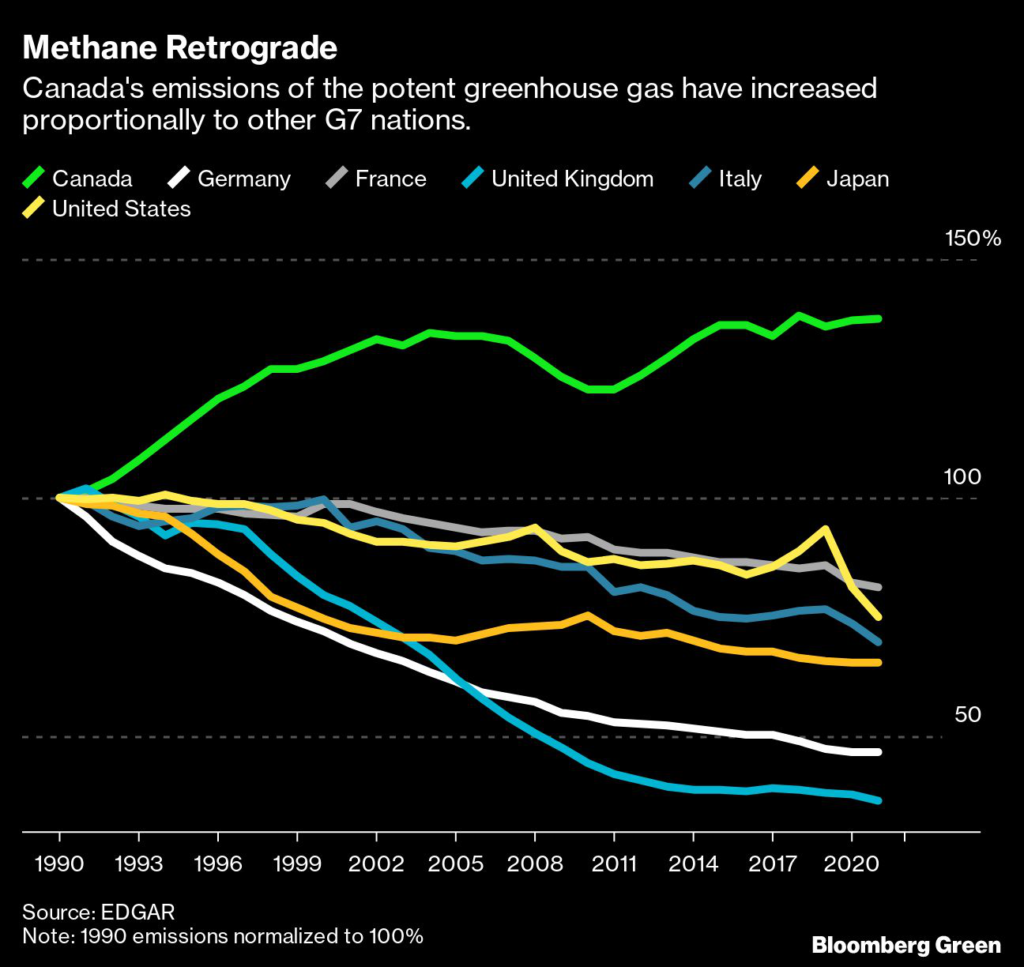
Canada’s methane and carbon dioxide releases have climbed more than any other G-7 country, relative to a 1990 baseline, according to European Commission data through early 2021. (When asked about this data, from the EC emissions database EDGAR, Bruce Cheadle, a spokesperson for the Minister of Environment and Climate Change of Canada, wrote in an email that Canadian “officials are not very familiar with EDGAR and are taking some time to better understand the methodology questions you raise.”) 

Trudeau in his Oct. 18 interview defended climate action in the seven years he’s been prime minister and said the government had for the first time set a price on pollution that would continue to increase, although he acknowledged “it’s taking a while” for the impact to show up in emissions.

Bloomberg Green investigations into satellite observations of methane clouds across North America over the past year have found multiple instances in which the observations coincided with so-called pipeline blowdowns, when operators intentionally release gas directly into the atmosphere to perform inspections and maintenance. Although that practice was standard across the industry for decades, groups including the IEA have called on industry to eliminate all non-emergency venting of the gas. 

Up to 90% of emissions from blowdowns can be eliminated through techniques like burning the gas through a flare and other mitigation approaches, according to a 2016 report commissioned by the Environmental Defense Fund. 

Multiple studies have found methane emissions from the oil and gas industry are often higher than what operators and governments report. Releases of the gas from the US supply chain in 2015 were about 60% higher than the U.S. Environmental Protection Agency inventory estimate, a 2018 study published in Science found. Livestock, landfills and natural sources such as mud volcanoes also generate and release methane. 

More stories like this are available on bloomberg.com

©2022 Bloomberg L.P.

China Home Sales Drop 28% as Covid Flare-Up Adds to Risks

(Bloomberg) — China’s home sales slump intensified in October, the latest sign that a recovery in the nation’s property market remains distant. 

The 100 biggest real estate developers saw new-home sales drop 28.4% from a year earlier to 556.1 billion yuan ($76.2 billion) in October, according to preliminary data from China Real Estate Information Corp. That plunge widened from a 25.4% slump in September.

China’s housing market remains fragile despite a wave of measures to restore confidence that’s been battered by Covid Zero and a debt crisis among cash-strapped developers. Builders have offered more property projects in the past two months, hoping that the traditionally fast season for sales will help them recoup more cash, CRIC said earlier. 

Investors in Chinese developers got another fright on Monday after Longfor Group Holdings Ltd.’s billionaire Chairperson Wu Yajun stepped down, triggering a plunge in its shares and bonds. The company has the highest credit rating among private Chinese peers. 

Chinese authorities have eased home ownership rules, trimmed interest rates and urged banks to step up lending in a bid to turn around the ailing property market, which remains a drag on the world’s second-largest economy. Hopes for more substantive industry support have dimmed after President Xi Jinping gave little signal of a deeper shift in policies on housing and Covid Zero during the ruling party’s congress. 

“The Covid situation remains the key factor for the home market rebound,” said Chen Wenjing, associate research director at China Index Holdings.

What Bloomberg Intelligence Says: 

China’s housing market could see only a sluggish recovery in 2023 with new-home sales growing at a low single-digit rate or slower, driven by a weak economy, falling housing prices, the sector’s liquidity crunch and the Covid-Zero policy.

— Kristy Hung and Lisa Zhou, real estate analysts 

Click here to read the research. 

China has reported a surge in cases of the virus in recent days, putting a strain on workers and families. An outbreak in the populous Henan province, the location of a major production plant for Apple Inc.’s iPhones, spurred some workers to escape hastily enacted Covid measures on their own. 

–With assistance from Yujing Liu.

More stories like this are available on bloomberg.com

©2022 Bloomberg L.P.

Israeli Investor Vintage Raises $631 Million to Fund Venture Capitalists

(Bloomberg) — Israeli technology investment firm Vintage Investment Partners has raised $631 million to finance venture capitalists, giving it additional capital to back top managers at a time when the broader private technology market is slowing down. 

The Herzliya-based firm closed its seventh fund-of-funds, bringing its assets under management to more than $3.6 billion, according to a statement Monday. Vintage is an investor in venture capital funds, including those of Andreessen Horowitz, Accel and General Catalyst, and has also directly funded startups such as Sweden’s Klarna Bank AB.

The new fund comes amid signs that money for startups is drying up due to rising interest rates and plunging valuations for public technology companies. Global venture funding slumped by a third quarter-on-quarter to $74.5 billion in the past three months, according to CB Insights. 

Vintage previously raised $500 million in 2021 for its last fund-of-funds. Part of the new vehicle will be dedicated to investing in health-tech money managers, following dramatic changes in that sector caused by the pandemic, General Partner Abe Finkelstein said in an interview. 

“In our view, the next two, three, four years will be a fantastic time to be investing in venture because prices are going to come down,” Finkelstein said. He added that Vintage took advantage of rising valuations in recent years to sell out of some holdings and return cash to its limited partners.

Read more: Investor in Andreessen Horowitz, Accel Funds Raises $812 Million

The firm had exposure into startups that held initial public offerings or were acquired in recent years such as Monday.com Ltd., UiPath Inc., Roblox Corp., JFrog Ltd. and Wolt Enterprises Oy, Finkelstein said.

Founded in 2002, Vintage’s newest fund-of-funds will back VC firms and early-stage investors in the US, Europe and Canada. It also includes an Israel-dedicated fund and one that focuses on health tech, according to the statement.

More stories like this are available on bloomberg.com

©2022 Bloomberg L.P.

Blackstone to Buy Emerson’s $14 Billion Climate Tech Unit

(Bloomberg) — Blackstone Inc. agreed to buy control of Emerson Electric Co.’s climate technologies arm in a deal valuing the business at about $14 billion.

The private equity firm will acquire a majority stake in the unit, which sells the Copeland line of compressors used in heating and cooling equipment, according to a statement Monday. St. Louis-based Emerson will receive upfront pretax cash proceeds of around $9.5 billion and keep a 45% stake.

The business, which also includes Emerson’s portfolio of products and services related to heating, ventilation, air conditioning and refrigeration, represents around $5 billion of net sales in its 2022 financial year. Bloomberg News reported in early October that Blackstone was in talks to buy assets from Emerson’s commercial and residential solutions division. 

Emerson plans to use the proceeds for “strategic M&A to strengthen and diversify its automation portfolio in four targeted adjacent markets,” the company said, adding that it expects to return cash to shareholders via its dividend and around $2 billion in share buybacks next year.

Shares of Emerson have fallen about 6% in New York trading this year, giving the company a market value of nearly $52 billion. The transaction marks a sizable private equity deal in an increasingly difficult environment. Tightening credit markets and slowing economic growth are keeping many buyout firms on the sidelines. 

Rising Sales

Emerson also reported adjusted earnings per share for the fiscal fourth quarter that beat the average analyst estimate on rising net sales. The company said it expects adjusted earnings per share of as much as $4.15 for 2023 and net sales growth of as much as 9%.

The Abu Dhabi Investment Authority and Singapore sovereign wealth fund GIC Pte are investing in Emerson’s climate technologies business alongside Blackstone, according to the statement. 

The deal comes following a pandemic boom in the US housing market, which saw home prices and home-improvement activity soar. The market has begun cooling in recent months amid rising interest rates and recession fears. 

Emerson has been reshuffling its business mix through divestitures after merging its industrial software business earlier this year with Aspen Technology Inc. In August, it agreed to sell its garbage-disposal arm to Whirlpool Corp. for $3 billion.

–With assistance from Kamaron Leach, Dinesh Nair and Kit Rees.

(Updates with Emerson’s earnings results in the sixth paragraph)

More stories like this are available on bloomberg.com

©2022 Bloomberg L.P.

Bharti Airtel’s Profit Misses Estimate as 5G Rollout Begins

(Bloomberg) — Bharti Airtel Ltd. reported a 90% jump in quarterly profit but fell short of the average analyst estimate, spurring India’s No.2 wireless operator to make a case for higher tariffs as it rolls out 5G services across the country.

The carrier, led by billionaire Sunil Mittal, posted a net income of 21.5 billion rupees ($260 million) for the quarter ended Sep. 30, according to an exchange filing Monday. It missed the average profit of 25.44 billion rupees estimated by analysts in a Bloomberg survey.

Revenue rose 22% to 345.3 billion rupees while total costs advanced 17% to 169.3 billion rupees compared with the same period last year, the filing said. Bharti saw its revenue from South Asia mobile services drop 27% to 695 million rupees while capital expenditure inched up.

“We are now rolling out 5G and are confident that Airtel 5G Plus will deliver the best experience in India while being kinder to the environment,” Gopal Vittal, Bharti’s chief executive officer for India and South Asia, said in a post-earnings statement Monday. He added that Bharti management was “concerned” about the low return on capital employed due to the world’s lowest prices. 

“Given the large investments required to drive digital adoption in India, we believe there is a need for tariff correction,” Vittal said in the statement.

KEY INSIGHTS

  • The tepid earnings come weeks after Indian telecom carriers kicked off their speedier 5G networks that’s touted to revolutionize everything from gaming to manufacturing and health care. It may also decide who dominates the digital era in a country of billion-plus people that’s rapidly switching to smartphones.
  • Bharti, which has not announced its 5G investment or tariffs, intends to offer these services in urban centers by 2023 and go pan India in 2024. While bigger rival and sector leader, Reliance Jio Infocomm Ltd. plans to invest $25 billion to roll out the world’s most affordable 5G services across India by December 2023.
    • “The key thing to watch out from results would be commentary on pace of 5G rollout and any visibility on tariff hike,” Bank of America analysts Sachin Salgaonkar and Priyank Mahajan wrote in a report earlier this month.
  • Analysts and investors are keen to see how Indian carriers are able to profit off 5G technology which has been available in China and South Korea for years and where operators have struggled to recoup their investment of billions of dollars. In South Korea, despite efforts to come up with killer apps, average revenue per person has only climbed slightly since the 4G era.
  • Bharti, like its peers, has been boosted in the past by a couple of rounds of tariff hikes starting August last year. Vittal had said in February that another round of tariff hikes may happen this year and reiterated the need for it again on Monday.
    • India’s telecom sector has shrunk to just three private sector players now — Reliance Jio, Bharti and smallest of the trio, Vodafone Idea Ltd. — after Mukesh Ambani’s upstart unleashed a bruising tariff war in 2016. The oligopolistic market structure has meant that tariff hikes by any other operator are usually followed on by others.
  • Bharti, which received as much as $1 billion from Alphabet Inc. in January, spent 430.8 billion rupees in August in a government-conducted auction of airwaves to gear up for providing 5G services.

Market Reaction

  • Bharti shares jumped 16.8% in the September quarter, outpacing the 8.3% gains clocked by the S&P BSE Sensex. The carrier has surged almost 22% this year.
  • Earnings were announced after the close of India trading hours.

Get More

  • India mobile average revenue per user was 190 rupees, +3.8% q/q
  • Bharti’s total subscriber base, as of Sept. 30, was 501 million, with almost 364 million users in India where it added 3 million q/q
  • Ebitda margin 51.3% vs. 49.5% y/y
  • Net debt $25.61 billion, +21% q/q
  • Other income 2.02 billion rupees, +84% y/y


(Updates with details throughout.)

More stories like this are available on bloomberg.com

©2022 Bloomberg L.P.
UN Says Crypto Use in Terror Financing Likely Soaring 

(Bloomberg) — A United Nations official said more cases of crypto use in terror-financing are being detected amid stepped up scrutiny of such practices.

A couple of years ago 5% of terrorist attacks were viewed as crypto-financed or linked to digital assets, but “now we’re thinking that it may reach about 20%,” Svetlana Martynova, senior legal officer at the United Nations Counter-Terrorism Committee Executive Directorate, said in an interview in Mumbai.

“Statistics here are not our best friends,” Martynova stressed in the Oct. 28 interview. “We’re just seeing more as we’re looking more into it.”

Cryptocurrency-based crime hit an all-time high in 2021, with illicit digital-asset addresses receiving $14 billion, up from $7.8 billion in 2020, according to a report by blockchain specialist Chainalysis Inc. 

A number of militant organizations, like Al-Qaeda or al-Qassam Brigades — Hamas’ military wing — tried to finance operations with crypto but it’s hard to find “a group that has gotten away with it,” Chainalysis said. 

Martynova said a UN Security Council resolution specifically calls on member states to tackle the risks linked to virtual assets and terrorism financing. 

She added that the Financial Action Task Force has helped to set global standards on regulations, particularly for tracking information on blockchains across jurisdictions — known as the Travel Rule.

In a recent survey, only 27 out of 98 jurisdictions that responded had begun putting together regulations, and even fewer were actually enforcing them.

Still, traditional methods like using illicit cash are still prevalent for terrorist purposes, Martynova said. “Cash is always king,” she said. “It’s as anonymous as can be, it’s the most difficult to detect in reality.”

More stories like this are available on bloomberg.com

©2022 Bloomberg L.P.

Bitcoin Miner Argo’s Shares Drop After Fundraising Fails

(Bloomberg) — Bitcoin miner Argo Blockchain Plc warned that it could be forced to shut down after a $27 million share sale appeared to have collapsed, sending the stock plummeting the most since its 2018 initial public offering. 

Argo said in a statement on Monday that it raised about $5.6 million by selling almost 4,000 new Bitmain mining machines and is exploring other funding avenues. 

“Should Argo be unsuccessful in completing any further financing, Argo would become cash flow negative in the near term and would need to curtail or cease operations,” Argo said in the statement. 

The stock dropped as much as 73% and traded at £8.75 at 11 a.m. in London on Monday, down 44%. Argo has fallen about 90% this year, as a slump in cryptocurrency prices roiled the mining industry. 

Read more: Bitcoin Miner Argo’s Shares Plummet as Liquidity Concern Rises

As the crypto bear market approaches the one-year anniversary of Bitcoin peaking at close to $69,000, the firms that mine the token are coming under financial strain. Core Scientific Inc., one of the world’s largest miners of Bitcoin, last week warned that it may run out of cash by the end of the year and could seek relief through bankruptcy protection.

Compute North Holdings Inc., a provider of data services for miners and blockchain companies, filed for bankruptcy in September. 

More stories like this are available on bloomberg.com

©2022 Bloomberg L.P.

Close Bitnami banner
Bitnami