
Bloomberg

China’s Electric Car Upstarts Face a Crucial Earnings Season

(Bloomberg) —

The gloss is coming off China’s three US-listed electric-car makers.

Shares of Xpeng Inc. (-86%), Nio Inc. (-69%) and Li Auto Inc. (-56%) have plunged this year, destroying a combined $77 billion in market value.

While some factors have been out of the automakers’ control — such as fears Chinese companies could be delisted from US exchanges, and investor concern over Xi Jinping’s consolidation of power — there’s no denying shareholders are looking for hard evidence the trio are on track to turn profitable after years of losses.

There are several headwinds on that front. Battery material costs have been surging, sales growth even in China’s booming EV market has been less-than-stellar, and intensified competition from homegrown rival BYD Co. and Elon Musk’s Tesla Inc. is squeezing margins.

On top of that, there’s the long-running semiconductor shortage, and China’s rolling Covid Zero lockdowns that have snarled supply chains show no signs of ending anytime soon.

That makes third-quarter earnings to be released in the next couple of weeks crucial.

“Gross margins will be a key focus because earlier prices hikes should start to help offset battery cost inflation,” said Bloomberg Intelligence auto analysts Steve Man and Joanna Chen. “We’re also looking for color on supply chains and new model order intake.”

The news there is likely to be mixed, at best. Nio, for example, is expected to post a gross margin of 15.1% in the three months ended Sept. 30, down from 20.3% a year earlier, according to data compiled by Bloomberg. Li Auto is expected to report a gross margin of 20.6%, down from 21.1%.

All three are expected to post another quarter of losses, throwing further doubt on their own projections of breaking even or turning profitable in the near term. Xpeng is forecast to report a 1.86 billion yuan ($257 million) quarterly loss and may miss its target to be profitable by as soon as next year.

While the trio may blame the Covid turmoil and supply chain issues for their unsatisfactory delivery numbers, they’re harder to explain away in the face of the exceptional performance of BYD. The automaker backed by Warren Buffett’s Berkshire Hathaway sold a record 200,973 electric vehicles last month — equal to three-quarters of Xpeng, Li Auto and Nio’s combined sales in the first nine months of 2022.

Dwarfed by their “less cool” local competitor, the upstarts may learn a lesson that most Chinese customers are looking for a sharply priced ride, rather than a fully spec’d high-tech model with features they rarely use.

Tesla seems to have got that message, as it cut prices across its lineup in China even after delivering a record 83,135 cars last month. With its Shanghai factory now capable of churning out about 1 million cars a year following an upgrade, the company now needs to attract more buyers.

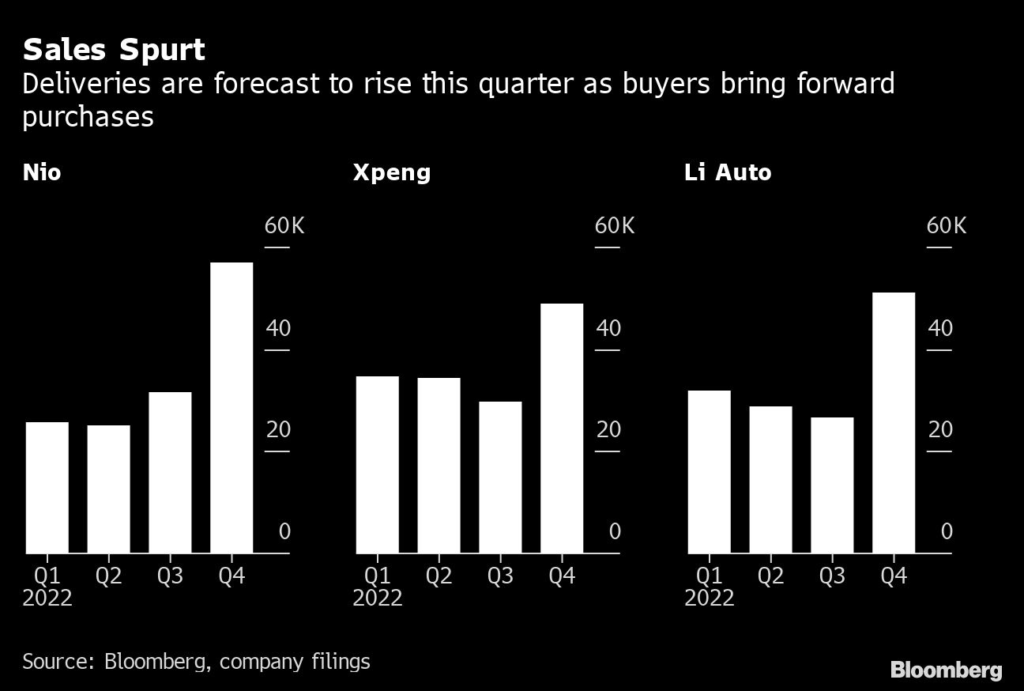
One bright spot is that after stalling in the third quarter, deliveries should jump in the final three months of the year as buyers bring forward purchases before EV subsidies are potentially phased out.

Still, confronted with more muscular, deeper-pocketed rivals and unpredictable economic environment, Xpeng, Nio and Li Auto may be facing a rough ride ahead.

More stories like this are available on bloomberg.com

©2022 Bloomberg L.P.

China Stocks Extend Post-Congress Rout Amid Lockdowns

(Bloomberg) — Chinese shares extended losses following last week’s selloff as a ramp-up of Covid restrictions and poor economic data worsened the outlook for the market.

The Hang Seng China Enterprises Index ended Monday’s volatile session with a 1.8% loss, closing at its lowest since November 2005. Property shares plunged, while tech shares bucked the downtrend following BYD Co.’s record earnings. The CSI 300 Index, a benchmark of onshore shares, fell 0.9% to its lowest close since February 2019.

Chinese stocks have faced relentless selling pressure through most of the year, hammered by Covid curbs and tensions with the US. Sentiment suffered a fresh blow after President Xi Jinping’s power grab and his recommitment to the Covid Zero strategy at the Communist Party congress, which spurred the worst ever five-day rout for the Hang Seng China gauge following any leadership meet since its 1994 inception.  

Down 40% this year, the Hang Seng China Enterprises Index is the worst performer among more than 90 global equity measures tracked by Bloomberg.

“Investors appear to be increasingly concerned about three issues in particular,” namely that China’s reopening might take longer than expected, China’s social priorities may take precedence over the economy and Beijing’s emphasis on security means a higher risk premium, strategists at Nomura Holdings Inc. including Chetan Seth wrote in a note.

China’s factory and services activity contracted in October, data showed on Monday. That signaled Covid curbs and an ongoing slump in the property market are continuing to pressure the world’s second-largest economy. The official manufacturing purchasing managers index fell to 49.2, below an estimate of 49.8 in a Bloomberg survey.

Foreign investors net sold a combined 57.3 billion yuan ($7.9 billion) of Chinese A-shares in October, the most since March 2020, when the pandemic triggered a global market rout, Bloomberg data shows.

Read: China Factory, Services Activity Slump as Covid Hits Recovery

Policymakers last week imposed fresh lockdowns from Wuhan to the nation’s industrial belt on the east coast, following a pickup in cases. Meantime, Macau mandated residents to undergo three days of rapid Covid tests and locked down a casino resort over the weekend. China reported 2,675 new local Covid cases for Sunday, marking the biggest nationwide surge in infections since Aug. 10.

The worst performer on the HSCEI was Longfor Group Holdings Ltd., which plummeted most on record following the resignation of its chairman. 

Read: Longfor Billionaire Wu Quits as Chair, Shocking Investors

–With assistance from Jeanny Yu.

(Corrects spelling of party name in third paragraph.)

More stories like this are available on bloomberg.com

©2022 Bloomberg L.P.
Raytheon Wires $1 Million to Whistleblower Over Fake GPS Test Results for Air Force

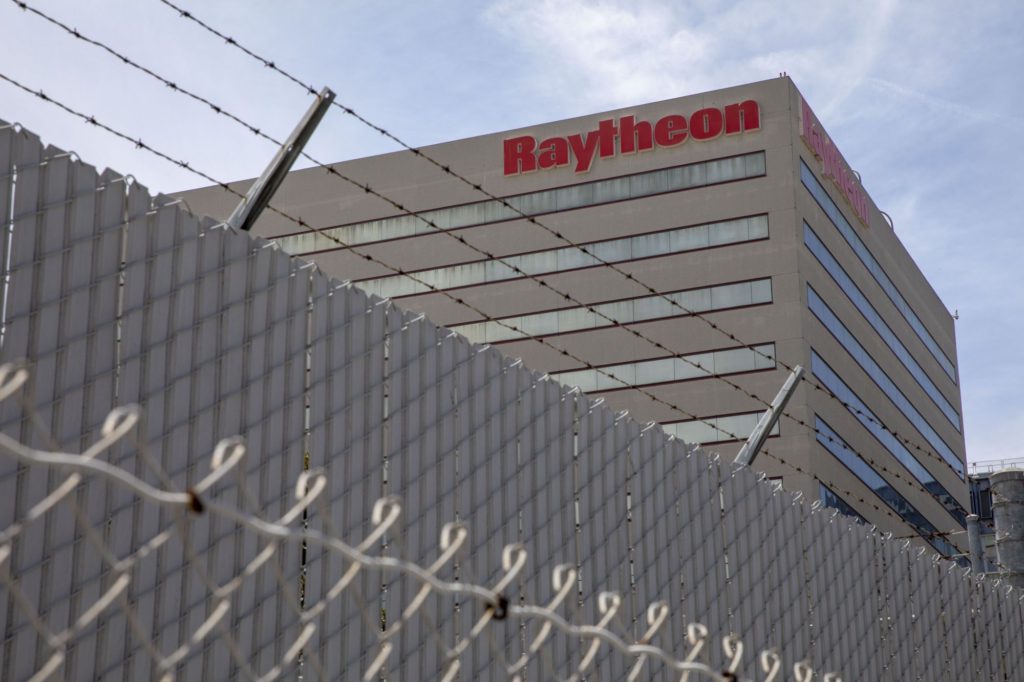
(Bloomberg) — A whistleblower said Raytheon Technologies Corp. has paid him $1 million after he was punished for revealing that he was instructed to submit false test results to the US Air Force on the company’s troubled ground system for GPS satellites.

Former Raytheon engineer Bruce Casias said in an email that he received the million-dollar wire payment on Thursday. That was after the defense contractor let a mid-October deadline pass to mount a Supreme Court challenge to a 3-0 ruling by the 10th US Circuit Court of Appeals upholding a jury award in his favor.

Raytheon’s program to create new ground stations for Global Positioning System satellites remains years behind the original schedule and has soared in cost from $3.9 billion to an estimated $6.3 billion.

Casias, of Denver, presented evidence at trial to show Raytheon demoted him for reporting to management that a superior told him to falsify test results starting in November 2015 on the Raytheon network of worldwide ground stations and antennas called the Operational Control System, or OCX, the appeals court said in its July ruling.

Raytheon spokesman Chris Johnson said the Waltham, Massachusetts-based company had no comment on the case. Company officials say the ground station project is now on track. 

“Raytheon’s performance remains in line with government expectations, considering the large scale of software and Covid-related impacts” since 2020, Major Remoshay Nelson, an Air Force spokesperson, said in a statement. The system “has moved on to the final pre-delivery stages,” she said.

The Global Positioning System developed and operated by the U.S. military is ubiquitous, providing turn-by-turn directions on the smartphones of drivers as well as coordinates for smart bombs. The new ground system is needed to take full advantage of improved GPS III satellites being built by Lockheed Martin Corp. They promise increased accuracy for navigation, a signal compatible with similar European satellites and improved resistance against cyberattacks.

‘Falsified Information’

Raytheon “falsified information for use by the United States military — this, if left unchecked and undiscovered, could have far-reaching repercussions,” the appeals court said in its ruling. “Then, when an employee attempted to report the falsification, it removed him from his data-collection role entirely. This is a serious violation” of the Defense Contractor Whistleblower Act, according to the court. 

“Over the next months, Casias received emails from the Air Force asking why the data was suddenly different,” the court said. “He responded only to defer the questions” to the superior who directed the falsification, it said. At the time “the project was going poorly — it was far behind schedule and more than $1 billion over budget,” the court said.

Casias has said he was reassigned from his OCX testing position to a minor role managing only two employees, eventually left Raytheon and then sued for violations of the whistleblower law. “Casias contacted both Raytheon’s Ethics Department” and the Pentagon fraud hotline, the court said.

The Pentagon decided in late 2015 to stick with the Raytheon contract rather than cancel it over delays. Months later the head of the Air Force Space and Missile Systems Center said that Raytheon’s OCX was the Defense Department’s “No. 1 troubled program.”

The Air Force was forced in 2016 to hire Lockheed to provide initial controls for the new ground system. Raytheon’s program is now on track for qualification testing in November before a December delivery, the service said.

Sandy Brown, a vice president at Raytheon Intelligence & Space, said the company has completed the deployment and integration of 17 globally distributed monitoring stations and four ground antennas. It has also finished deployment of the Master Control Station at Schriever Space Force Base in Colorado Springs, he said.

The system is expected to become operational in April 2023. The originally planned date was October 2016, according to Air Force records.

More stories like this are available on bloomberg.com

©2022 Bloomberg L.P.

Stocks Mixed Before Earnings, Central Bank Moves: Markets Wrap

(Bloomberg) — European stocks fluctuated and US equity futures fell at the start of another busy week of earnings and key central bank decisions. 

Commodity shares were lower in Europe, while travel shares gained. US contracts declined after posting their best two-week rally since November 2020. 

The dollar rose and the yen fell as traders positioned for another large interest-rate hike by the Federal Reserve this week, widening the policy divergence with the Bank of Japan. The euro and the pound also declined.

The yield on the 10-year Treasuries rose to 4.06% after surging by nine basis points on Friday. Yields on UK gilts also advanced ahead of what could be the Bank of England’s biggest interest-rate hike in more than 30 years.

Meanwhile, wheat soared after Russia pulled out of a grain-export deal even as vessels continued to depart from Ukraine.

Read: Treasuries Swept Up in Global Rout as Inflation Fears Resurface

Fed Chairman Jerome Powell “should be a bit less hawkish”at his press conference on Wednesday compared to after the last meeting, according to Yardeni Research. With the expectation that another 75 basis points is penciled in this week, “Powell will have to acknowledge that the federal funds rate is now further into restrictive territory and will be even more so come the FOMC’s December meeting,” it said in a note.

Economists surveyed by Bloomberg expect Fed officials will maintain its hawkish stance, laying the groundwork for interest rates reaching around 5% by March 2023, potentially leading to a US and global recession. A core gauge of US inflation accelerated in September, bolstering the case for more tightening. 

Brazilian assets are set to weaken on Monday after Luiz Inacio Lula da Silva won the presidential election. The extent of the market drop will depend on whether President Jair Bolsonaro will concede as a contested election would likely trigger larger losses.

European natural gas fell after two days of gains as unseasonably warm weather reduces demand and eases concerns about shortages for the winter and oil edged lower as weak economic data from China fanned concerns about energy demand, but it was still set for the first monthly advance since May on OPEC+’s planned supply cuts.

Gold headed for its seventh straight month of declines, the longest losing streak since at least the late 1960s.

Key events this week:

  • Companies reporting earnings this week include: Moderna, Pfizer, Airbnb, AIG, Maersk, Barrick Gold, BMW, Bharti Airtel, BP, ConocoPhillips, Estee Lauder, Ferrari, ING, Intercontinental Exchange, KKR, Mitsui, Newmont, Petrobras, Qualcomm, Restaurant Brands, Saudi Arabian Oil, SoftBank, Sony, Starbucks, Toyota, Uber and Yum! Brands.
  • Eurozone CPI and GDP, Monday
  • Reserve Bank of Australia policy decision, Tuesday
  • US construction spending, ISM manufacturing index, Tuesday
  • EIA crude oil inventory report, Wednesday
  • Federal Reserve rate decision, Wednesday
  • US MBA mortgage applications, ADP employment, Wednesday
  • Bank of England rate decision, Thursday
  • US factory orders, durable goods, trade, initial jobless claims, ISM services index, Thursday
  • ECB President Christine Lagarde speaks, Thursday
  • US nonfarm payrolls, unemployment, Friday

Some of the main moves in markets:

Stocks

  • The Stoxx Europe 600 was little changed as of 9:45 a.m. London time
  • Futures on the S&P 500 fell 0.5%
  • Futures on the Nasdaq 100 fell 0.6%
  • Futures on the Dow Jones Industrial Average fell 0.4%
  • The MSCI Asia Pacific Index fell 1.7%
  • The MSCI Emerging Markets Index fell 1.6%

Currencies

  • The Bloomberg Dollar Spot Index rose 0.3%
  • The euro fell 0.3% to $0.9940
  • The Japanese yen fell 0.4% to 148.22 per dollar
  • The offshore yuan fell 0.6% to 7.3143 per dollar
  • The British pound fell 0.4% to $1.1564

Cryptocurrencies

  • Bitcoin fell 0.2% to $20,654.73
  • Ether rose 1% to $1,611.66

Bonds

  • The yield on 10-year Treasuries advanced five basis points to 4.06%
  • Germany’s 10-year yield advanced four basis points to 2.15%
  • Britain’s 10-year yield advanced two basis points to 3.50%

Commodities

  • Brent crude fell 0.7% to $95.14 a barrel
  • Spot gold fell 0.3% to $1,639.81 an ounce

–With assistance from Tassia Sipahutar, Garfield Reynolds and Brett Miller.

More stories like this are available on bloomberg.com

©2022 Bloomberg L.P.

China Builders Slide to Record Lows as a Top Chairwoman Resigns

(Bloomberg) — A sudden resignation by the founder and chairwoman of a top Chinese builder has added to concerns over China’s ailing property sector, fueling a further selloff that dragged many securities to record lows.

Longfor Group Holdings Ltd., the country’s 10th-largest builder, tumbled in the bond and share markets Monday after billionaire Chairwoman Wu Yajun stepped down, citing health and age reasons. China’s builder-dominated high-yield dollar bonds, which haven’t posted a daily gain in nearly four weeks while logging one of their worst-ever monthly losses, fell another 1 cent to 3 cents, according to credit traders.  

The departure of Longfor’s chairwoman comes at a time investors’ confidence in China’s property sector had already been shattered by record defaults, slumping new-home sales and few signs of effective support for the debt-ridden industry. Junk dollar notes have been setting record lows on a daily basis of late, in contrast to October gains for such debt in the US and Europe. 

Meanwhile, a Bloomberg Intelligence stock gauge of Chinese builders is at levels unseen since 2011. The equity index fell 4.7% Monday to put this year’s slump at 51%. Shares of China’s largest developers by sales, Country Garden Holdings Co. and China Vanke Co., skidded at least 9.8% on the day in Hong Kong, hitting record lows, while third-ranked Poly Developments and Holdings Group Co. fell the 10% limit in Shanghai.

Investment-grade Longfor was the first among a small group of private-sector real estate firms to sold local bonds under a program which emerged in August for state-owned China Bond Insurance Co. guarantee such offerings. A company official said earlier this month that Longfor was planning a second sale.

That scheme initially fueled a rally in the broader market for Chinese builders’ dollar notes. But the optimism quickly faded amid worries about CIFI Holdings Group Co., which ultimately failed to honor a convertible-bond coupon in early October just weeks after raising money under the guarantee program. 

Monday’s rout in Longfor securities has created fresh doubts about if the scheme will help developers. 

“The guaranteed-note sales could ease refinancing pressure slightly, but it won’t be able to hold up market confidence for long,” said Yang Hao, a bond analyst at Nanjing Securities Co. “Ultimately, investors need positive signs from developers’ fundamentals.” The next data point will be preliminary October sales data due later Monday from China Real Estate Information Corp. 

Longfor on Monday tried to soothe market nerves, disclosing a partial early repayment of a syndicated loan due in 2023 and saying its controlling shareholder bought stock during the morning’s plunge. 

The firm’s debt and equity climbed off session lows to stem a bit of the losses. Still, shares closed down 24% to put this month’s plunge at 56%, both the most ever. Longfor’s longer-dated dollar bonds, which slumped by record amounts last week, fell as much as 15 cents further Monday. Also, four onshore notes suffered trading halts after skidding more than 20%.

More stories like this are available on bloomberg.com

©2022 Bloomberg L.P.
IPhone Maker Lifts Wages, Preps Backup for Covid-Hit China Plant

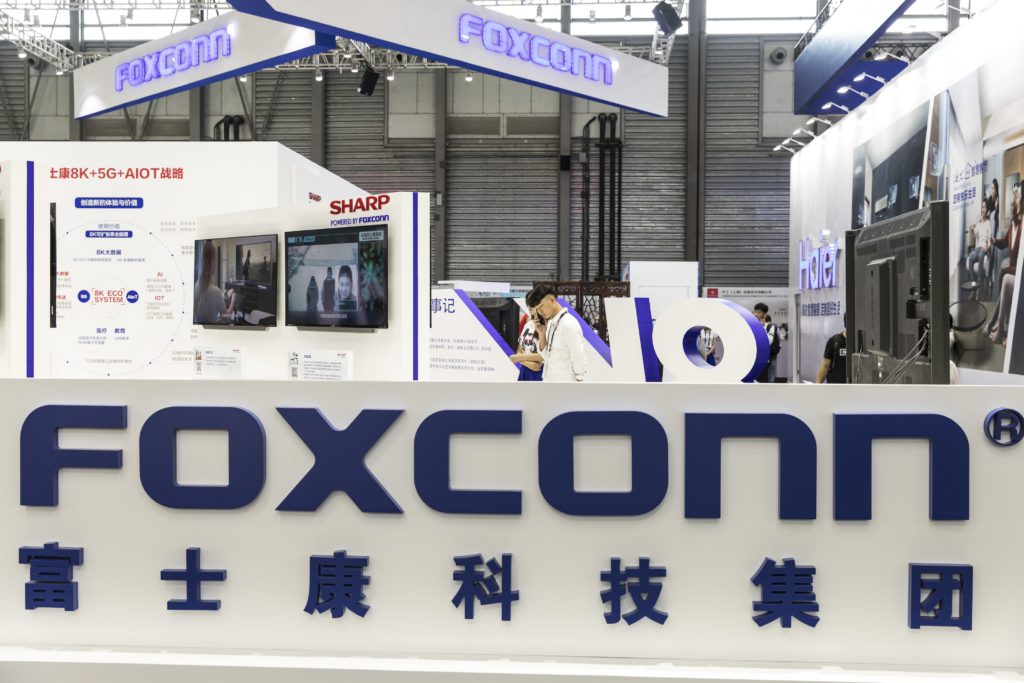
(Bloomberg) — Foxconn Technology Group is preparing to bring backup production online and raise hourly wages by more than a third, after an exodus of workers threatened to disrupt output at the world’s largest iPhone plant ahead of the holidays.

Foxconn, whose listed vehicle is Hon Hai Precision Industry Co., is grappling with mounting concern that a Covid flare-up at its main Zhengzhou plant could hurt production just as Apple Inc. gears up for the crucial year-end season. Its shares fell 1.4% Monday, the worst decline in three weeks.

Social media erupted over the weekend with photos and videos of workers departing the Zhengzhou plant, some on foot, to return to hometowns miles away. They were seeking to escape hastily enacted Covid-prevention measures that have left many of the 200,000 staff grappling with inadequate living conditions. Other videos depicted local residents offering food and shelter to some of the departing staff. Bloomberg hasn’t verified the authenticity of the social media content. 

To keep plants running at fill speed, Foxconn is raising hourly pay by as much as 36% to roughly 38 yuan ($5.20) an hour for key positions, compared with the early days of iPhone 14 production around September, people familiar with the matter said, asking not to be identified because the move isn’t public.

On the operations side, Foxconn has said it may boost capacity at alternative sites. The Taiwanese company also makes iPhones at a factory in Shenzhen, which together with Zhengzhou cranks out the majority of the world’s iPhones. Representatives for the company declined to comment on wage plans.

“Further developments will be important as 4Q is the peak season for iPhone shipments,” Morgan Stanley analysts wrote. “The potential impact on iPhone production is worth monitoring as Zhengzhou is one of Hon Hai’s major production sites, particularly for iPhone assembly.”

Read more: Workers Leave Biggest IPhone Plant to Escape Covid Curbs

The rising tensions underscore the economic and social costs of Xi Jinping’s Covid Zero policy — a rigorously policed system of mass testing and lockdowns that has fostered growing resentment. It also shows the potential risk to global supply chains and products from China’s approach.

Discontent has been brewing among staff at Foxconn’s factory in Zhengzhou. The emergence of Covid cases led to the implementation of a closed loop system, where workers’ movements are strictly limited. Food became a source of unrest after the company shut cafeterias at the manufacturing site known as “iPhone City.” 

At one point, only workers on production lines were given meal boxes, with those infected or afraid to leave their company-provided dormitories given more basic fare like bread and instant noodles, Bloomberg News reported. On Monday, Foxconn said the local government had agreed to let it re-open cafeterias on campus.

It’s unclear how many workers were allowed to leave Foxconn. The company hires many temporary staff from nearby regions to assemble electronics including Apple’s latest iPhone 14 devices. Foxconn last week described the situation as a “small” outbreak. 

“We are deeply aware that it’s a ‘protracted war’ in terms of how to take care of over 200,000 workers and their security” in Zhengzhou, Foxconn said in a Monday stock exchange filing.

The “Zhengzhou park operation, in coordination with the government’s epidemic prevention, is gradually coming under control,” Foxconn said in a brief statement Sunday. “The Group will also coordinate back-up production capacity with our other parks to reduce any potential impact.”

The discontent comes at a crucial time for Apple, which launched the iPhone 14 during an unprecedented slump in global electronics demand. While faring better than other smartphone makers, it’s backed off plans to increase production of its new iPhones this year after an anticipated surge in demand failed to materialize, Bloomberg has reported. Apple reported better-than-expected results Thursday but warned of a holiday slowdown.

Any disruption at Zhengzhou threatens to snarl Apple’s finely orchestrated supply chain. Thousands of components from Europe to Asia are shipped into Zhengzhou, assembled manually into devices, then shuttled off to the rest of the world.

More stories like this are available on bloomberg.com

©2022 Bloomberg L.P.
BT Network Openreach Holds Talks to Lower Wholesale Rates

(Bloomberg) — BT Group Plc’s infrastructure division Openreach is in talks to offer lower-cost deals to internet service providers that use its network across the UK, according to two people familiar with the matter. 

Proposals include lower line rental costs, no volume commitments for sellers, and a cut to the amount charged for migrating customers from copper lines to fiber, according to the people, who asked not to be named discussing non-public information. 

Companies such as Vodafone Group Plc, TalkTalk Telecom Group Ltd. and Comcast Corp.’s Sky are among those that sell services using London-based Openreach’s fiber optic connections.

“We’re in constant discussion with the retail providers about potential offers and options,” said a spokesman for Openreach, who didn’t dispute the details being reported. 

BT shares rose 1.5% to 128.7 pence at 8:55 a.m. in London. The Telegraph separately reported that BT rival Virgin Media O2 had shelved its plan to acquire TalkTalk.

The new Openreach offer is dubbed Equinox 2 and was earlier reported by the Financial Times. The move could lower retail prices for fiber and accelerate consumers’ take-up of the faster technology, upgrading them from older copper connections.

“Our initial reaction is to be slightly disappointed that Openreach isn’t fully flexing its current pricing power, which has been a general theme lacking across all EU telcos,” New Street Research analyst James Ratzer said in a note to clients Monday. 


More stories like this are available on bloomberg.com

©2022 Bloomberg L.P.

In True Halloween Form, Zombie Coins Just Won’t Die

(Bloomberg) —  

  • Listen to Bloomberg Crypto on the iHeartRadio App
  • Listen to Bloomberg Crypto on Apple Podcasts
  • Listen to Bloomberg Crypto on Spotify  

You’ve likely heard of Bitcoin and Ether as digital tokens, but there’s actually tens of thousands of cryptocurrencies you probably haven’t heard of. In fact over 12,000 of those coins are virtually defunct. Not that they’re ‘dead’ per say, but they’re also not considered ‘alive’ or active.

They’re called ‘zombie’ coins: tokens that have stopped trading activity lately and are simply dormant. 

These zombified coins are not a new phenomenon, but the substantial increase in their volume (from the hundreds in 2019 to 12,100 at recent count) has been eye-opening as another symptom of chilly market conditions.

Bloomberg reporter Olga Kharif joins Bloomberg senior markets editor Mike Regan to wade through what happens when a market has so many inactive currencies, and what it says about the crypto industry’s overall health. 

Follow us on Twitter @crypto, and subscribe to the Bloomberg Crypto Newsletter at https://bloom.bg/cryptonewsletter

More stories like this are available on bloomberg.com

©2022 Bloomberg L.P.

US Warns Ransomware Attacks Are Outpacing Ability to Stop Them

(Bloomberg) — The pace and sophistication of ransomware attacks is increasing faster than the US’s ability keep up with efforts to disrupt and recover from them, a senior Biden administration official said Sunday.

In the face of continued attacks against governments and the private sector, the US is hosting the International Counter Ransomware Summit that begins Monday. The summit brings together nearly three dozen countries to tackle the pernicious rise of one of the most challenging cybersecurity threats, which can paralyze hospitals and shut down major gas pipelines.

Firms like CrowdStrike Holdings Inc., Mandiant Inc. and Microsoft Corp. will also be participating in the summit, the White House said. Those companies have long had visibility into the scope of cyberattacks, and some are involved in responding to incidents when companies or governments are attacked.

The US is continuing to work on severing illicit payment methods that make ransomware financially viable, namely through cryptocurrency, said the White House official, who spoke on condition of anonymity. Pointing to a spike in attacks when Bitcoin became more widely used, the official called the threat borderless.  

In March, President Joe Biden signed sweeping cybersecurity legislation that mandates certain sectors report breaches to the US Department of Homeland Security within 72 hours of discovery of the incident, and 24 hours if they make a ransomware payment. Many states also require companies to report breaches.

Still, ransomware actors have appeared to widen their targets and continue to release private troves of data if their demands aren’t met. That includes an attack this fall on the Los Angeles Unified School District, the nation’s second-largest, in which confidential information about students was leaked when the ransom wasn’t paid. 

More stories like this are available on bloomberg.com

©2022 Bloomberg L.P.

US Suggests EU Consider Using Export Limits to Target China

(Bloomberg) —

The US has raised with European allies the idea of drawing upon lessons from the export control regime they’re using to punish Russia to target China, according to people familiar with the matter. 

The conversations came up as European Union and US officials are negotiating the agenda for their next high-level trade forum in early December. The allies have cooperated on restricting exports to Moscow since President Vladimir Putin invaded Ukraine, and the Biden administration is exploring using some of the same information sharing and enforcement coordination to reinforce its own bilateral restrictions on exports to China, said the people, who asked for anonymity to address sensitive topics.

So far, the people added, the EU isn’t inclined to consider following the same approach to China as with Russia because the circumstances are different, but one of the people said there may be room to look at goods that could be used by Beijing to bolster its military capability. It’s unclear whether the topic will come up when US Trade Representative Katherine Tai meets EU trade ministers who are in Prague for an informal meeting on Monday. 

“The U.S. is not considering extending the Russia export controls to China nor have we raised doing so with the Europeans,” Saloni Sharma, a spokeswoman for the US National Security Council, said in response to questions.

Export controls have been one of the more effective tools to cripple Russia’s arsenal and are seen as potentially useful to slow down China in the global tech race. Earlier this month, the Biden administration restricted US companies from selling some chips used for supercomputing and artificial intelligence to Chinese firms.

Chinese Foreign Minister Wang Yi criticized US export curbs in a call with US Secretary of State Antony Blinken, underscoring the tensions between the nations before a possible face-to-face meeting of their leaders. “The US side should stop its containment and suppression of China and not create new obstacles to bilateral relations,” said Wang, according to a statement Monday from the Foreign Ministry in Beijing.

Senior EU and US officials are set to meet Dec. 5 near Washington to agree on a list of economic plans in the third meeting of the Trade and Technology Council. The European Commission, the EU’s executive arm, is considering six priorities, including the joint development of digital infrastructure projects, an artificial intelligence roadmap or megawatt electric vehicle charging, the people said. 

US Expects Deal With Allies on China Chip Curbs in Near Term

Some member states have been wary of the US efforts to turn the forum into an anti-China body and instead have preferred to focus on a positive bilateral agenda.

But European countries are increasingly worried about what they see as the confrontational stance of the Chinese government, in particular following the recent party congress that cemented President Xi Jinping’s leadership. Some member states including Germany have suggested that the bloc should revise its approach toward China, as Beijing is becoming less a partner or a competitor and more a rival, the people said.

EU leaders held a strategic discussion on China this month, where there was consensus on the need to reduce critical dependences on Beijing, a senior EU diplomat summarized.

Some European capitals are in favor of using the TTC to bolster coordination with the US to develop effective anti-coercion and trade defense tools against non-market economies, including China, a second senior EU official said.

US Eyes Expanding China Tech Ban to Quantum Computing and AI

Commission spokesperson Miriam Garcia Ferrer said that contacts with the US administration are ongoing as the EU analyzes the implications of the latest US restrictive measures on China.

Last year, the US and EU agreed on a joint statement after a TTC meeting which said that “a multilateral approach to export controls is most effective for protecting international security and supporting a global level-playing field,” and restrictions should not unduly disrupt strategic supply chains.

The Netherlands have expressed concerns about the impact of the US export controls, especially in the field of semiconductors, the people said. The country is home to ASML Holding NV, a Dutch maker of semiconductor manufacturing gear.

Negotiations ahead of the next TTC meeting have been hampered by the recently passed US Inflation Reduction Act, which provides subsidies to support green technologies in the US and is seen as discriminatory by the EU and other countries. Officials from both sides are scheduled to meet this week to address the European concerns, and the EU executive’s arm hoped to solve these irritants before the high-level meeting takes place in early December

Tai said the US and EU have overcome other trade disputes under the Biden administration, including fights over subsidies to civilian aircraft makers and the aluminum trade. 

“I feel like we have every right to feel confidence about our ability to navigate these conversations around the EU’s concerns on the Inflation Reduction Act also,” she said in an interview at Bloomberg’s Washington office Friday. “In terms of our actual work with the EU, it is an important and additional item that we have to take on now. But it is not in my view, overshadowing.”

Biden Trade Chief Says Next Phase of China Relationship Unclear

A large majority of member states expressed serious concerns about the US law during a meeting of EU ambassadors last week, the people said, noting that the law could hurt the bloc’s green transition and its competitiveness in general. France said that it could lose 8 billion euros ($8 billion) in green investments, the people said.

Countries including Germany and France believe that the best solution would be to obtain the same treatment Mexico and Canada get under the IRA and the bloc should use all the tools available to that end, the people said.

–With assistance from Jenny Leonard and Alberto Nardelli.

(Updates with Wang-Blinken call in sixth paragraph)

More stories like this are available on bloomberg.com

©2022 Bloomberg L.P.

Close Bitnami banner
Bitnami