Bloomberg

Twitter’s Top Executives Are Set to Exit With $100 Million Payout as Musk Takes Over

(Bloomberg) — Three of Twitter Inc.’s top executives who were said to be fired after Elon Musk completed his takeover are poised to collect more than $100 million in severance and payouts of previously granted equity awards.

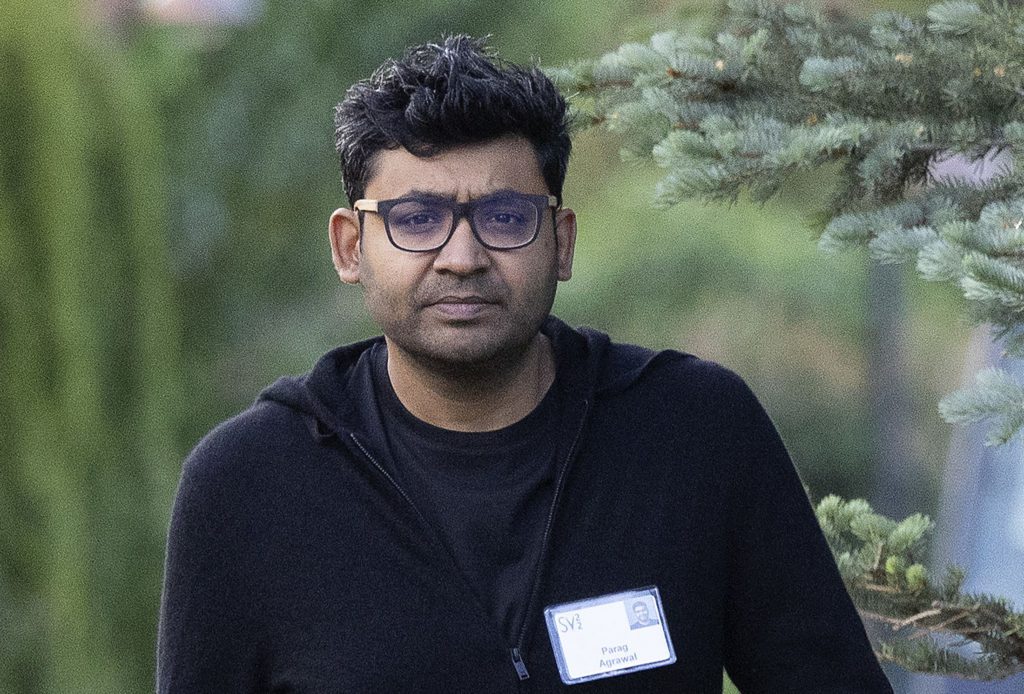
Chief Executive Officer Parag Agrawal, who stepped into the role less than a year ago, is eligible to receive roughly $50 million, according to calculations by Bloomberg News. Chief Financial Officer Ned Segal and Vijaya Gadde, head of legal, policy and trust, are in line for about $37 million and $17 million each, respectively.

The three and other major Twitter executives were among those to depart after Musk took the helm at the social media giant on Thursday, people familiar with the matter said. Their exits cap more than six months of public and legal wrangling that now have ended with Musk, the world’s richest person, seizing the CEO job.

Like many top leaders at big public companies, Agrawal and his lieutenants were entitled to severance equal to a year’s salary and cash-outs of unvested equity awards if Twitter was bought and they lost their jobs in the process, according to the terms of the company’s severance policy. Twitter must also cover their health insurance premiums for a year, amounting to about $31,000 each.

Critics often point out the unfairness of granting bosses gilded exit packages while normal employees who lose their jobs after a merger or buyout hardly get as soft of a landing. Defenders of golden parachutes say they let executives focus on what’s best for shareholders instead of worrying about whether they’ll be replaced if a deal is struck.

In the case of Agrawal, 38, who had been at Twitter for almost a decade, he held firm that the company see through Musk’s acquisition at $54.20 per share even though the Tesla Inc. co-founder said he didn’t have confidence in management. Text messages unveiled during the lawsuit over the deal show that the two had a contentious text exchange early on in the process after Musk asked his followers whether Twitter was “dying.” 

A Twitter representative didn’t immediately respond to a request for comment.

More stories like this are available on bloomberg.com

©2022 Bloomberg L.P.

Musk Takes Twitter Helm, Enacts Sweeping Change as Deal Closes

(Bloomberg) — Elon Musk wasted no time taking complete control of Twitter Inc. The billionaire appointed himself chief executive officer, dismissed senior management and immediately began reshaping strategy at one of the world’s most influential social media platforms as his $44 billion take-private deal closed.

Musk, 51, is replacing Parag Agrawal, who was fired along with three other top executives, a person familiar with the matter said, asking not to be identified discussing internal deliberations. The mercurial entrepreneur, who also leads Tesla Inc. and SpaceX, may eventually cede the Twitter CEO role in the longer term, the person added. Twitter representatives declined to comment.

Musk’s acquisition puts the world’s richest man in charge of a struggling social network after six months of public and legal wrangling. Among Musk’s first moves: changing the leadership. Departures include Vijaya Gadde, the head of legal, policy and trust; Chief Financial Officer Ned Segal, who joined Twitter in 2017; and Sean Edgett, who has been general counsel at Twitter since 2012. Edgett was escorted out of the building, Bloomberg News reported.

Musk also intends to do away with permanent bans on users because he doesn’t believe in lifelong prohibitions, the person said. That means people previously booted off the platform may be allowed to return, a category that would include former president Donald Trump, the person said. It’s unclear however if Trump would be allowed back on Twitter in the near term.

In response to a Twitter user complaining they are being “shadowbanned, ghostbanned, searchbanned,” as well as having followers removed, Musk said in a tweet on Friday that he will be “digging in more today.”

The takeover caps a convoluted saga that began in January with the billionaire’s quiet accumulation of a major stake in the company, his growing exasperation with how it’s run and an eventual merger accord that he later spent months trying to unravel. Musk’s buyout marks the end of nine years of public trading. Twitter debuted with a bang on the New York Stock Exchange in 2013 but failed to match the rocket ride achieved by some other tech heavyweights.

The change in leadership will bring immediate disruption to Twitter’s operations, in part because many of Musk’s ideas for how to change the company are at odds with how it has been run for years. He’s said he wants to ensure “free speech” on the social network. 

Twitter banned Trump days after the 2021 Capitol insurrection, citing the “risk of further incitement of violence.” With the former president widely expected to make another run for the White House in 2024, a return to Twitter could grant him an opportunity to turbocharge his message.

More broadly, Musk’s initiatives threaten to undo years of Twitter’s efforts to reduce bullying and abuse on the platform.

The prospect of less restrictive content moderation under Musk’s leadership has prompted concerns that dialogue on the social network will deteriorate, eroding years of efforts by the company and its “trust and safety” team to limit offensive or dangerous posts. On Thursday, Musk posted a note to advertisers seeking to reassure them he doesn’t want Twitter to become a “free-for-all hellscape.”

As the Oct. 28 deadline neared, Musk began putting his stamp on the company, posting a video of himself walking into the headquarters and changing his profile descriptor on the platform he now owns to “Chief Twit.”

He arranged meetings between Tesla engineers and product leadership at Twitter, and he planned to address the staff on Friday, people familiar with the matter said. Twitter’s engineers could no longer make changes to code as of noon Thursday in San Francisco, part of an effort to ensure that nothing about the product changes ahead of the deal closing, the people said.

Read more: Twitter Faces Only Bad Outcomes If $44 Billion Musk Deal Closes

Twitter employees have been bracing for layoffs since the transaction was announced in April, and Musk floated the idea of cost cuts to banking partners when he was initially fundraising for the deal. Some potential investors were told Musk plans to cut 75% of Twitter’s workforce, which now numbers about 7,500, and expects to double revenue within three years, a person familiar with the matter said earlier this month.

While visiting Twitter headquarters on Wednesday, Musk told employees that he doesn’t plan to cut 75% of the staff when he takes over the company, according to people familiar with the matter.

The past six months have been challenging for Twitter employees, who have primarily followed the ups and downs of the roller-coaster deal through the news headlines.

Many have been unhappy with Musk’s involvement and some have questioned his qualifications to run a social networking company. His support of a far-right political candidate in Texas, plus sexual harassment accusations from a former SpaceX flight attendant in May, have raised additional concerns. During a video Q&A with Musk in June, some employees mocked Musk on internal Slack channels. Others have ridiculed or chided him publicly on Twitter throughout the deal process.

(Updates with Musk tweet in fifth paragraph)

More stories like this are available on bloomberg.com

©2022 Bloomberg L.P.

Charter Profit Misses, Hit by Unpaid Bills and Marketing Costs

(Bloomberg) — Charter Communications Inc. earnings missed Wall Street estimates as the cable giant warned that more customers are having trouble paying their bills.

  • Profit was $7.38 a share in the third quarter, while analysts were looking for $8.33 on average. Charter said Friday that higher bad debt as well as increased fuel and freight costs are making it more expensive to service customers. Marketing costs also rose due to more staffing and better pay, the company said.
  • See more details.

Key Takeaways

  • Higher bad debt is another alarming sign for the US economy amid widespread inflation and sluggish spending. Charter said most of its overdue accounts were customers who participated in government-assistance programs that included video services, and they are downgraded to a fully subsidized Internet-only service.
  • Charter added 61,000 residential broadband subscribers in the quarter, reversing a loss of 42,000 in the prior quarter. That was better than analysts had projected and could point to the beginning of a recovery. The company has been losing customers to streaming services and new broadband offers from phone companies.
  • The TV business lost 211,000 subscribers, more than analysts had estimated. The results come a day after cable peer Comcast Corp. reported better-than-expected earnings, despite posting a record loss of more than a half a million video subscribers. Cable operators have been raising prices on their TV and internet offerings, even as they face new competitive threats.
  • In wireless, Charter added 396,000 new mobile-phone customers in the quarter, topping the 338,000 average estimate. That segment is the Stamford, Connecticut-based company’s biggest area of growth.

Market Reaction

  • Charter shares were little changed in early trading Friday. The stock is down more than 45% this year, compared with a 36% decline for Comcast.

Get More

  • Read the statement.
  • See Charter estimates.

More stories like this are available on bloomberg.com

©2022 Bloomberg L.P.

JPMorgan Eclipses Meta’s Market Value for First Time Since 2015

(Bloomberg) — Wall Street leaders have spent the past decade making the case that they’re really running technology companies — and that their stocks should fetch lofty Silicon Valley valuations. Suddenly, being a bank isn’t so bad.

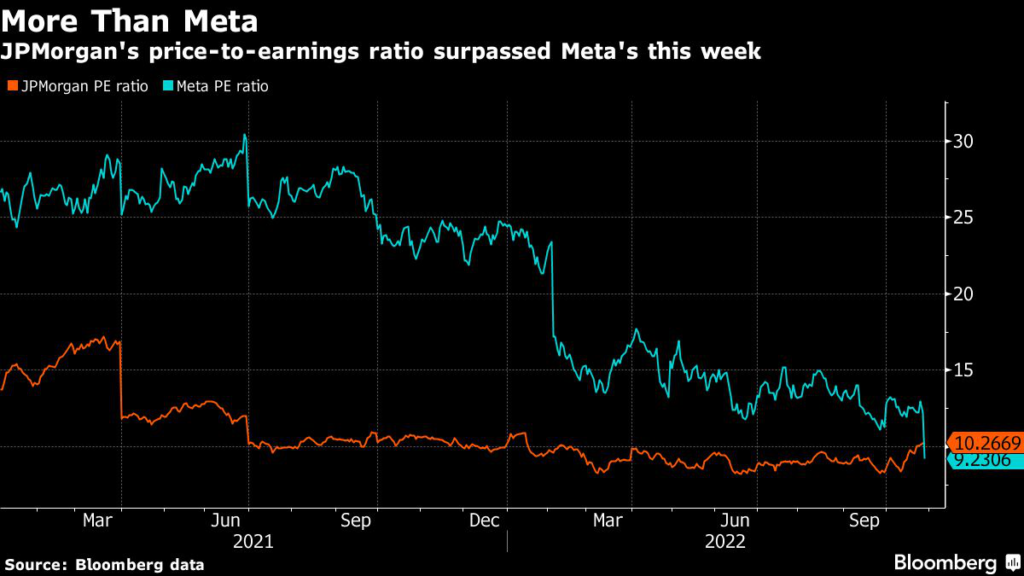
JPMorgan Chase & Co., the nation’s largest lender, surpassed Meta Platforms Inc.’s market value this month for the first time since 2015. The bank was worth more than $365 billion by Thursday’s close of New York trading, overshadowing the social-media giant once valued at more than $1 trillion.

Even JPMorgan’s price-to-earnings ratio — comparing the price of the company’s stock to its earnings per share — is now higher than Meta’s in a sign that investors have more faith in the centuries-old lender’s ability to grow. JPMorgan traces its roots to 1799, while Facebook, which evolved into Meta, was founded in 2004.

Meta fell 25% Thursday after reporting disappointing third-quarter earnings. Tech stocks have fallen twice as hard as the finance sector this year, with the Nasdaq 100 Index down 31%, compared with the 15% decline for the S&P 500 Financials Index. Fintech valuations have taken a hit as well: Both PayPal Holdings Inc. and Block Inc. have fallen more than 70% from their all-time highs last year.

–With assistance from David Scheer.

More stories like this are available on bloomberg.com

©2022 Bloomberg L.P.

Top India Carmaker Beats Profit Forecast as Supply Woes Ease

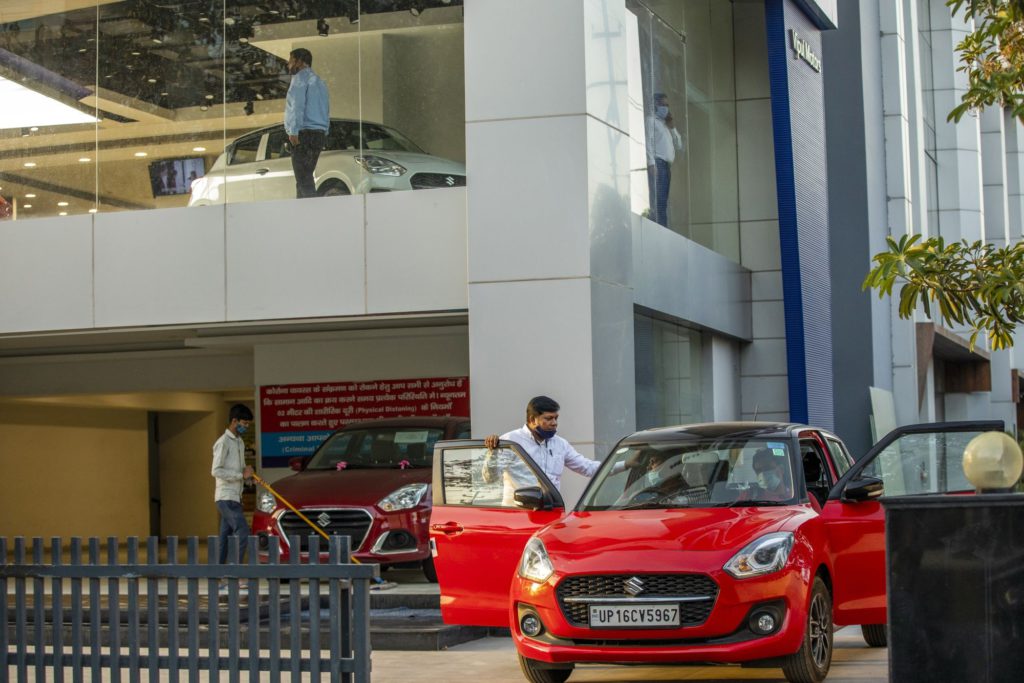
(Bloomberg) — Maruti Suzuki India Ltd., India’s biggest carmaker, reported a higher-than-expected quarterly profit, aided by a weaker Japanese yen and easing of some supply chain constraints that boosted production recovery. 

Net income was 20.6 billion rupees ($250 million) for the three months ended Sept. 30, the unit of Japan’s Suzuki Motor Corp. said in a statement Friday to exchanges, compared with a profit of 4.75 billion rupees a year earlier. That beat the average analyst estimate of 18.09 billion rupees, according to data compiled by Bloomberg. 

Revenue rose 46% to 299.3 billion rupees, which was higher than estimates. Total costs climbed 36% while raw material expenses surged 44% compared to same period last year, according to the filing. Shares advanced as much as 3.4% during trading in Mumbai after the earnings were announced.

“We are forecasting overall sales by the end of this year to be roughly of the same order as they were in 2018-19,” Chairman R.C. Bhargava said in a post-earnings media call. The industry will grow by around 8% next year and Maruti will be in line with that, he said.

While some lingering component shortages hurt output by 35,000 units, the carmaker said it sold 517,395 vehicles during the quarter — the highest ever — with 454,200 units sold in the domestic market. Maruti “has been making simultaneous efforts in securing electronic components availability, cost reduction and improving realization from the market to better its margins,” the filing said. 

Bhargava also flagged favorable currency movements as one of the tailwinds for the carmaker. “One of our major gains in this period has been because the rupee became stronger than the yen. That has benefited imports side,” he told reporters.

Depreciating Yen

Depreciation of yen against the rupee this year has boosted Maruti by lowering the cost of its imports and reducing the burden of royalty payments to its Japanese parent.

Pending customer orders stood at about 412,000 vehicles at the end of the September quarter, of which about 130,000 vehicle pre-bookings are for recently launched models. It also added in the filing that the latest earnings were not strictly comparable to the same quarter last year, which was beset by “acute shortage of electronic components” and a steep rise in commodity prices.

Maruti, known for selling cheaper cars, has also been increasing the price of vehicles to offset rising input costs due to higher commodity prices. The New Delhi-based automaker announced a price hike of 1.3% on average across its models in April. 

The shortage of electronic components had a “minor impact” on Maruti’s production in September, the company said earlier this month, adding that a year-on-year comparison of output may not be “meaningful” considering production was severely hit in 2021 during Covid. Its output jumped 118% to 177,468 units last month.

–With assistance from Anirban Nag.

(Updates with Maruti chairman’s comments in the fourth paragraph.)

More stories like this are available on bloomberg.com

©2022 Bloomberg L.P.

VW, Mercedes and BMW Cross Their Fingers as China Risk Escalates

(Bloomberg) —

German carmakers long ago went all in on China, building dozens of factories with local partners they were forced to share technology with. The risks seemingly were outweighed by an unprecedented expansion of what’s become the world’s largest car market.

For years, these bets paid off. Surging demand from a burgeoning middle class and the nouveau riche bolstered Volkswagen, Mercedes-Benz and BMW’s revenues and profits. All three now sell more vehicles in China than any other market. The idea Beijing would ever pull the rug out from under international companies was brushed aside as fear-mongering.

One might think Russia’s abrupt cut-off of the gas Germany relied on before Moscow’s invasion of Ukraine would lead to some soul-searching about China dependence in Wolfsburg, Stuttgart and Munich. If there has, it’s not coming across from CEOs Oliver Blume, Ola Kallenius and Oliver Zipse.

Next week, VW’s Blume will join a delegation led by Chancellor Olaf Scholz on their first trip to Beijing since the two ascended to their respective roles. Whereas Scholz used his initial speech as Germany’s leader at the United Nations last month to denounce China’s human rights record, including the treatment of Uyghurs in Xinjiang, VW has carefully limited its comments about the region to what goes on inside the factory it shares with state-run manufacturer SAIC. In  a letter to the World Uyghur Congress, Blume reiterated that VW doesn’t mistreat any workers, that its presence in the region has a positive effect on the community and that it will stay put in Xinjiang.

Blume’s counterpart Ola Kallenius, meanwhile, has suggested the west’s hands will be tied if Beijing were to try to seize Taiwan. “If one thinks that the Chinese economy could be unbundled from the European or the American, it is a total illusion,” he said in an interview with Die Welt last month. “It would have dramatic consequences for the world economy that would in no way be comparable to those of the Ukraine war.”

BMW CEO Oliver Zipse last week even went so far as to defend China’s market policies and compare them favorably to how President Joe Biden is changing the playing field in the US. The 50-50 joint ventures that Beijing required foreign carmakers to set up in China were “fair for everyone,” Zipse said in an interview near BMW’s plant in Spartanburg, South Carolina. He warned that the Biden administration’s climate law designed to wean the US off battery materials sourced from China could provoke retaliatory steps and set off a “dangerous” game of trade barriers.

It would be unreasonable of these companies to make any rash, pre-emptive moves before any further escalation of geopolitical tensions. But after having had to turn their energy-sourcing strategies on a dime and contemplate writing off big investments in Russia this year, Germany’s automakers are crossing their fingers that they’re not forced to make much tougher choices about their far more consequential business presence in the People’s Republic.

President Xi Jinping’s consolidation of power has only worsened worries that extend far beyond the auto industry. Chinese stocks have had their worst showing ever following a Communist Party Congress, after this year’s gathering dashed hopes for more market-friendly policies.

Within the car sector, there’s concern that international carmakers’ dominance of the combustion-engine age won’t carry over to the electric era. Domestic automakers accounted for almost 80% of EV sales through the first seven months of the year, according to China’s Passenger Car Association. VW has been having the toughest time coping with what’s become a particularly more competitive mass market.

“What we see from VW at the moment is more firefighting mode than innovation leadership on the Chinese market,” said Patrick Hummel, an analyst at UBS. “Volkswagen’s position in the Chinese market is structurally at risk.”

To be sure, the Germans aren’t alone. Tesla’s reliance on China has mushroomed since the company opened a factory outside Shanghai in early 2020. Earlier this month, CEO Elon Musk told the Financial Times that Taiwan should agree to become a special administrative zone of China to resolve tensions with Beijing, a proposal that angered Taipei and raised eyebrows in Washington. Democratic Senator Mark Warner said he’s frustrated that companies including Tesla seem to reckon China is so big, they’ve got to “turn a blind eye” to abuses.

There is another way. Stellantis CEO Carlos Tavares last week suggested he’s ready to cease making cars in China. The producer of Peugeot and Citroën cars may implement an “asset-light” strategy for those brands, repeating a phrase he used earlier in the year when announcing plans to withdraw from the company’s Jeep-making venture.

Stellantis’ pullback has been made easier by the fact it wasn’t doing so well there in the first place. VW has much more to lose, as it operates over 40 vehicle and component factories along with partners in China. When asked Friday about his upcoming trip, Blume said it’s important that Berlin and Beijing get in touch after the party congress to exchange ideas and positions and plan further cooperation.

BMW is doing just that, shifting production of electric Mini hatchbacks to China from the UK and assembling an SUV model there through its partnership with Great Wall Motor. At Mercedes, well over half of the ultra-luxury — and ultra-profitable — Maybach vehicles the company sells go to customers in China, supporting its push further upmarket.

“The Germans can’t bite the hand of the one that feeds them,” said Matthias Schmidt, a Berlin-based auto analyst. “For Mr. Tavares, it’s a different story — he is likely saying what a lot of other automotive executives are thinking.”

–With assistance from William Wilkes and Gabrielle Coppola.

More stories like this are available on bloomberg.com

©2022 Bloomberg L.P.

Comcast Considers Selling German Unit Sky Deutschland

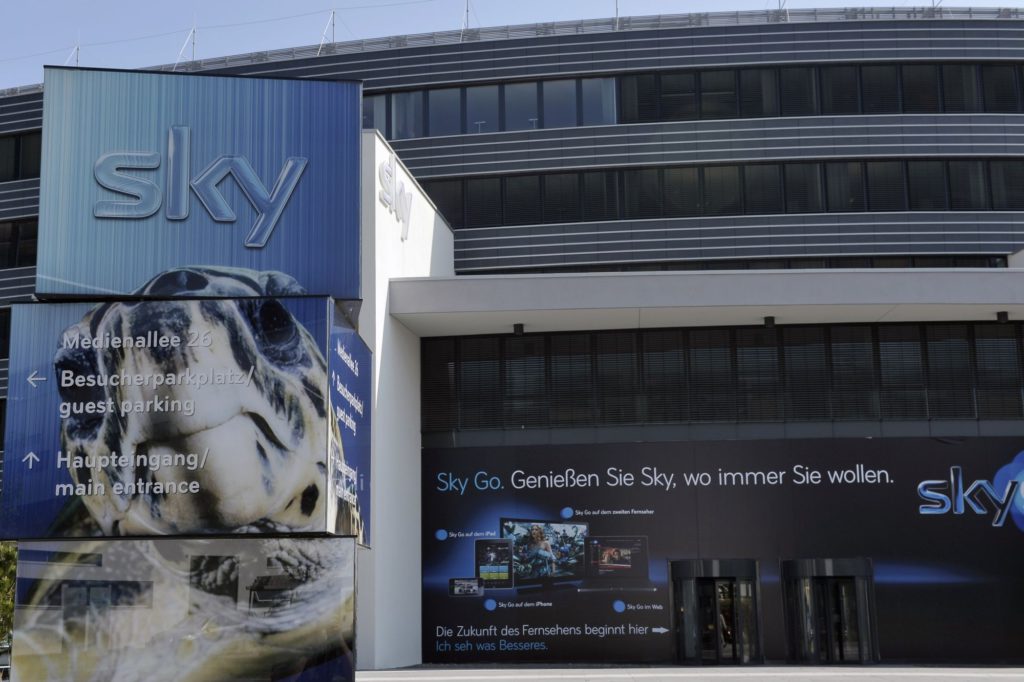
(Bloomberg) — Comcast Corp. is considering a sale of its pay-TV business in Germany, which weighed on its European operations in the most recent quarter, people familiar with the matter said. 

The US broadcaster is working with an adviser as it explores options for Sky Deutschland, the people said, asking not to be identified discussing confidential information. Deliberations are ongoing and Comcast may also decide not to sell, they said.

The unit could be valued at about €1 billion ($998 million) in any sale, according to the people. A representative for Comcast declined to comment. 

Comcast, which is the biggest pay-TV provider in the US, acquired Sky Deutschland as part of its $39 billion purchase of British broadcaster Sky in 2018. In third-quarter results, Comcast said that in Europe lower sales in Italy and Germany had offset gains in its UK market. The company took a $8.6 billion non-cash charge on Sky, due to “macroeconomic conditions” in Europe.

Sky Deutschland has in recent years faced increasing competition from streamer DAZN Group Ltd., which has been winning rights to show football matches from Germany’s Bundesliga and some UEFA Champions League games in the country. 

“From the 2021-22 season, Sky DE lost the Champions League coverage and its share of Bundesliga coverage declined,” said Francois Godard, a media analyst at Enders Analysis. “There was a negative impact on subscriptions, a loss of possibly two or three hundred thousands, and on the average spend by subscriber.”

But Godard said Sky Deutschland’s lower revenue was being offset by declining costs, putting the German platform on a financially sustainable path. 

“Sky Deutschland is subscale compared to its UK sister,” he said. “They have no telecoms operations. Maybe a German buyer could merge it with something else and get to scale.”

Comcast shares rose 1.5% on Thursday after profit forecasts, valuing the company at $138 billion.

–With assistance from Ruth David.

(Adds analyst quote in sixth paragraph, share move in final paragraph.)

More stories like this are available on bloomberg.com

©2022 Bloomberg L.P.

Congo Returns Telecom Executive Passports After Signing Tax Deal

(Bloomberg) — The Democratic Republic of Congo returned passports to phone-company executives after they agreed to sign up to a controversial new tax law, according to people familiar with the matter. 

The deal was brokered with the African nation’s four major carriers — Orange SA, Airtel Africa Plc, Vodacom Group Ltd. and Africell Holding SAL — and was negotiated after the government banned executives from leaving the country, said the people, who asked to remain anonymous as the information is still private. 

Approval for the executives to travel again is expected in coming days, they said.

While the framework of the agreement is similar to the initial demand, a cap has been placed on how much operators can owe the state, said the people. The limit is set at $65 million next year and $70 million annually from 2024, divided up between the companies according to their market share, they said.   

Airtel, Vodacom and Africell declined to comment on the matter. Orange didn’t respond to requests for comment. Congo’s telecom regulator Christian Katende didn’t respond to multiple messages requesting comment. 

‘Irregular, Unenforecable’

The carriers initially rejected the levy as “irregular and therefore unenforceable,” the Federation des Entreprises du Congo, the country’s main business association, said previously. 

Congo’s plan to increase takings from telecom operators follows numerous similar initiatives around Africa, where phone companies carry great influence due to their revenue-generating mobile-money services. For their part, wireless carriers argue that taking more of their profit will force them to cut investment. 

In Congo, they will not be allowed to pass the additional cost onto consumers, the people said.

Read More: Congo Bans Telecom Executives’ Travel in Row Over New Tax

The Congolese government is looking for ways to shore up its finances after years of mismanagement and corruption. President Felix Tshisekedi’s administration plans to broaden its tax base and boost revenue as it undertakes a nationwide infrastructure development plan ahead of elections scheduled for the end of next year.

Read More: Wireless Firms Receive Notice to Pay About $180 Million to Congo


–With assistance from Benoit Berthelot.

More stories like this are available on bloomberg.com

©2022 Bloomberg L.P.

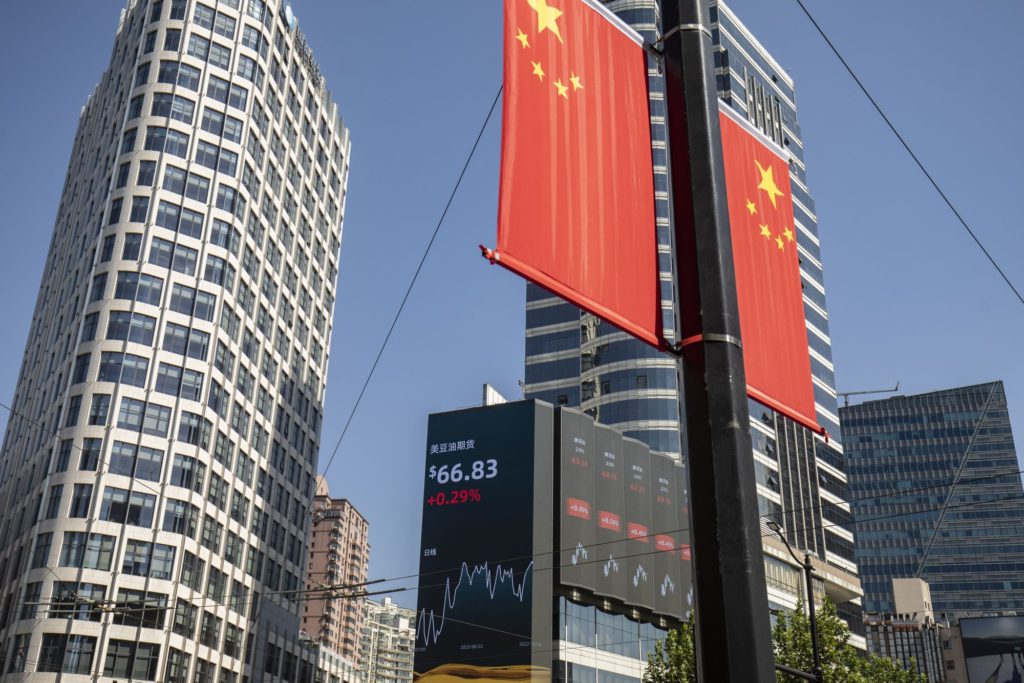
Xi Leaves China Stocks in Tatters With Record Post-Congress Drop

(Bloomberg) — China stocks’ frenzied week has ended how it began: with jaw-dropping losses. 

Distraught over President Xi Jinping’s power grab and his recommitment to the Covid Zero strategy at the Communist Party Congress, investors rushed to exit Chinese shares, triggering an epic rout on Monday. The selloff resumed with a vengeance on Friday, sending an index of Chinese shares traded in Hong Kong to the lowest level since 2008 and turning it into the world’s worst-performing stock gauge for the year. 

A loss of almost 9% this week in the Hang Seng China Enterprises Index also meant that the measure capped its worst ever five-day loss following any party congress since the gauge’s inception in 1994.

While optimism has been in short supply in China’s markets for a long time and expectations from the leadership gathering weren’t particularly high, the intensity of this week’s losses has shocked local and global investors alike.

“I was unprepared for the depth of this selloff,” Nirgunan Tiruchelvam, head of consumer and Internet at Aletheia Capital in Singapore, said by phone. “A lot of investors and analysts were caught with their pants down.”

His views on the magnitude of the rout were echoed by fund managers at Edmond de Rothschild Asset Management in Paris and Baring Asset Management Asia Ltd. in Hong Kong. For Sun Jianbo, president at China Vision Capital based in Beijing, “the market is in chaos” and hopes for any relaxation in Covid controls were dashed “over and over again.” 

At the twice-a-decade meeting, Xi stacked the leadership ranks with allies, limiting the scope for opposition to his strategies that have sought to exert greater state control over markets and the economy. Frustrated and angry, international investors pulled a record $2.5 billion from mainland stocks on Monday alone. The HSCEI gauge sank 7.3% in its biggest plunge since 2008 that day. 

The reaction was even more violent in the nation’s US-listed equities, with the Nasdaq Golden Dragon China Index tanking a record 21% intraday. 

“The magnitude was surprising,” said William Fong of Baring. “No one even cared about fair value of companies and just wanted to sell. I think the future for the stock market is still bumpy. Lots of people will continue selling, because it’s very very difficult to price in the future under the new leadership.”

While sentiment seemed to somewhat stabilize in the three days following Monday’s rout, the resumption of losses Friday was a reminder of the risks of dip buying when it comes to Chinese shares. The HSCEI lost another 4.1% on the day as the expiry of monthly futures and options contracts on the gauge as well as news of spreading Covid restrictions boosted volatility. The selling also came ahead of expected appointments of key party and cabinet roles in the coming weeks.

Intensifying Sino-American tensions didn’t help, with the Hang Seng Tech Index tumbling 5.6% on Friday. The top US official overseeing export controls said he expects a deal with global allies to limit shipments of chip-production equipment to China in the near term. Such a move would expand the US’s efforts to keep cutting-edge semiconductor technology out of China.

On the mainland, China’s benchmark CSI 300 Index capped the week with a loss of over 5%, the worst in 15 months.

“The market is still in a downward trend” given the disappointment from the party congress, weak consumption, lackluster industrial profits and sporadic Covid outbreaks across the country, said Yan Kaiwen, an analyst with China Fortune Securities Co. in Shanghai. 

Amid all the gloom, some money managers have used the market turmoil as an opportunity to buy as they look to take advantage of historically-low valuations.

“Some of those traded in the US were at a big discount from their prices in Hong Kong and we took advantage of that price discrepancy,” said Tom Masi, a New York-based portfolio manager at GW&K Investment Management. Patient investors are going to “benefit handsomely from having a position in China,” he said.

Feeling a “heightened sense of excitement” as stocks plunged, Robert Horrocks, chief investment officer at Matthews Asia in San Francisco, said nothing had fundamentally changed for China’s policy, hence little reason for a revaluation of businesses. For Dan Suzuki, deputy chief investment officer at Richard Bernstein Advisors LLC in New York, the fact that no one wants to invest in China may mean “there’s big opportunities and that’s reflected in the much cheaper valuations for China.”

For now, bearish sentiment still prevails. As traders struggle to determine how long the rout will persist, fresh lockdowns are being imposed from Wuhan, coronavirus’s original epicenter, to China’s industrial belt on the east coast are making matters worse. 

“Hard to say how the selloff plays out, but again, a sustained recovery in investor confidence is still dependent on developments like changes to China’s zero COVID policy,” said Christina Woon, investment director for Asia equities at abrdn plc in Singapore. “While we have seen some movement here, it is still a story in its infancy.”

–With assistance from Catherine Ngai, Lin Zhu, Abhishek Vishnoi, Norah Mulinda and Ellie Harmsworth.

More stories like this are available on bloomberg.com

©2022 Bloomberg L.P.

Europe’s Top Copper Producer Aurubis Is Hit by Cyberattack

(Bloomberg) — Aurubis AG, Europe’s biggest copper producer, was hit by a cyberattack overnight that prompted a preventative shutdown of its IT systems.

The scope of the attack is being investigated and the company’s internal systems are being examined, Aurubis said on Friday, without giving more details. The company’s shares fell as much as 4.2%. 

Industrial companies around the world are facing a rising threat from cyberattacks that can wreak havoc on production and supply lines. In 2019, European aluminum producer Norsk Hydro ASA was forced to run its operations manually while it scrambled to recover from a ransomware attack, while a 2017 attack on pharmaceutical giant Merck & Co. caused $1.3 billion in losses.

Aurubis has fared better than some producers of other metals including aluminum and zinc, which have been forced to cut back their highly power-intensive production processes. The company has also been looking to cutting gas usage and secure alternative supplies, and is in the process of winding down purchases of Russian copper.

“We can ensure our client base that we are going to meet all our commitments in metal supply in the next calendar year and thereafter without Russian cathodes,” Chief Executive Officer Roland Harings said in an interview in London on Wednesday. “In the case of copper, there’s no need for Europe to take Russian metal.”

(Updates with more details throughout.)

More stories like this are available on bloomberg.com

©2022 Bloomberg L.P.
Close Bitnami banner
Bitnami