

Bloomberg

Houston’s Solugen Wants to Make Greener Chemicals — and Profits

(Bloomberg) — Solugen, a Houston chemicals startup, is one of several companies trying the replace the dirtiest ingredients in common industrial materials—like fertilizer, cleaning products and cement—with cleaner natural materials. 

Unlike many businesses entering this field, which have struggled to find commercial traction, Solugen says it’s making serious money. Chief Executive Officer Gaurab Chakrabarti says his company’s on track for more than $100 million in revenue this year. Last week, the company raised $200 million in financing, just a year after taking $357 million from investors. That puts Solugen’s valuation “well north of $2 billion,” says Chakrabarti. 

Other clean technology upstarts rely on “a lot of hopes and dreams,” he adds. “We hope to be the company that shows that world it’s possible to be profitable.” 

Solugen pitches itself as a sustainable chemical plant, without the noxious waste and emissions. The company takes corn syrup and mixes it with genetically engineered enzymes, through a proprietary process, to create substitutes for common chemicals normally made using phosphates and oil. Solugen produces about ten thousand metric tons of product a year from its Bioforge facility, a plant in Texas converted from an old petroleum wax distillery. And it sells to more than 30 customers in industries like agricultural and personal care products as well as the Defense Department.

Most petrochemicals in the US come from China or other parts of Asia. So Solugen has a smaller energy footprint both from its natural materials, as well as cutting out the need to ship products from overseas. “It’s really a double whammy,” says Stefan Unnasch, managing director for Life Cycle Associates, an environmental consultancy.

His firm analyzed Solugen’s manufacturing process to find that, in some instances, the startup had a “carbon-negative” operation—Solugen can store the embedded carbon dioxide from sugars in a way that negates its other emissions from hauling in corn and churning out chemicals. (Solugen only gets this carbon-negative footprint with its ingredients for concrete production and toxic disposal operations, according to the analysis, but not for other uses like water treatment facilities.)

The Texas startup is one of several companies working on synthetic biology, an umbrella term for redesigning molecules for use in healthcare, life sciences or manufacturing. It’s a big potential market—as large as $1.2 trillion, according to estimates from investment bank William Blair.

But few companies have entered the field without losing gobs of money. The first startups designing sustainable materials, which emerged a couple decades ago, were outmatched when oil and natural gas prices fell. More recent entrants have struggled beyond the pilot phase of production in getting commercial interest. Amyris Inc., a California business creating synthetic materials for beauty products, lost $342 million last year. Zymergen, a once-hot company working on genetically modified chemicals, sold earlier this year to Gingko Bioworks Inc. after a 60% decline in Zymergen’s stock price and a year generating zero product revenue.

“It’s been a very choppy road because of the capital investment required,” says Matt Larew, a life sciences analyst with William Blair. “This is a very nascent industry.”

Solugen’s investors are bullish on the company because they believe it’s not reliant on one industry or even one chemical formula. For now, Solugen uses the sugar molecules in corn syrup. But it soon expects to replicate its genetic engineering process with recycled carboard, somehow turning the material into a stand-in for common petrochemicals. (That’s coming within “a couple years,” says Sean Hunt, Solugen’s chief technology officer.)

“They didn’t just get lucky. They’ve actually got a repeatable process and platform,” says Natalie Hugh Tydeman, senior investment director for Kinnevik AB, a Swedish firm that invested $50 million into Solugen’s latest financing round. Kinnevik is planning to help Solugen enter the European market soon. 

Europe’s fertilizer shortage since the war in Ukraine has already boosted Solugen’s fortunes. “All of a sudden farmers and agriculture companies needed a supply,” says Chakrabarti, the CEO. “And we just happened to be at the right place at the right time.”

Solugen’s production plant, which opened in 2021, has “software-like margins” of around 60%, says Chakrabarti. But the company isn’t profitable yet because it’s plowing money into expansion. Next year, Solugen plans to open a production facility in Minnesota that is three times larger than its Texas plant. It raised money to finance the project. 

It also raised money because it could. “We don’t know where the world is going,” says Chakrabarti. “We might as well have as much cash on hand.” 

More stories like this are available on bloomberg.com

©2022 Bloomberg L.P.
Chicago Bets on Quantum Tech as ‘Next Big Thing’ for Its Future

(Bloomberg) — Chicago is betting on quantum — a technology that could ensure everything from emails to online shopping is 100% secure –to fuel future economic growth. But there’s still much work to do before the city realizes its dream of becoming the nation’s capital for the promising technology.

Best known for traditional industries including food, agriculture and manufacturing, the Windy City has been trying to lure investments from companies such as Google Inc. and Amazon.com as it shifts its focus to quantum, which promises to make Internet communication unhackable. 

Illinois already gets 40% of all the federal dollars for the technology and has four of the nation’s 10 quantum centers, the most of any state. But being at the forefront of quantum developments requires the city to focus on translating science into companies and jobs, said Brad Henderson, chief executive officer at P33, a non-profit founded by former Secretary of Commerce Penny Pritzker. 

“We have a top five science setting and we’re not even in the top 10 at translating science into commerce,” he said. “We’re targeting tens of billions of dollars in annual GDP that we expect to have in 10 years. That’s our goal. And tens of billion dollars actually translates into thousands of jobs.”

Last week, scientists from the University of Chicago carried out the first test of the quantum network with the general public in the US, an event that came with a surprise visit from former President Barack Obama.

“Quantum computing is the way of the future,” Mayor Lori Lightfoot said at an event hosted by the Executive Club of Chicago. “Forty cents of every federal dollar being spent on quantum computing is being spent in Chicago and the surrounding area. This is the next big thing in our economy.”

Chicago has been trying to prop up its beleaguered finances, with the city paying required contributions to all its severely underfunded pensions for the first time ever in 2022. The bet on quantum is still some years away, but could fuel economic growth as manufacturing continues to decline.

The idea that properties of quantum mechanics could be harnessed to make a new kind of computer was first touted by Nobel Prize-winning physicist Richard Feynman in the 1980s. Unlike conventional computers, which interpret data in “ones” and “zeros,” quantum machines can store information in multiple forms — ones, zeros, both, or something in between.

Multitasking

That ability allows a quantum system to multitask in ways today’s binary equipment cannot, rapidly decreasing processing times. But while computers with those capabilities are still about a decade away from widespread commercial application, quantum communications could become available much earlier, according to consultants McKinsey & Co. 

That’s where Chicago excels. The third-biggest US city already has the country’s longest quantum network — 124 miles (200 kilometers) connecting the US Department of Energy’s Argonne National Laboratory in the outskirts to the University of Chicago and the Chicago Quantum Exchange, a hub for advancing quantum technology. 

“There is this misconception that quantum is only on the West Coast or the East Coast,” said Marco Pistoia, head of global technology applied research at JPMorgan Chase & Co., which joined the Chicago Quantum Exchange as a partner in 2020. “In reality, Chicago is a big center for quantum.”

The finance industry, another stalwart of Chicago, will be one of the biggest beneficiaries. Quantum computing will help algorithms sort large amounts of data and solve complex mathematical problems that would take traditional machines days, months and even years.

Long before, quantum communications will solve a more basic problem: How do you ensure no one can clone your 16-digit credit card number when you buy something online? Or get hold of your email and social media passwords?

Quantum communications guarantee that any message intercepted gets destroyed, said David Awschalom, vice dean for research at the Pritzker School for Molecular Engineering at the University of Chicago, and founding director of the Chicago Quantum Exchange. So not only will a hacker be unable to get the information, but the parties of the attempted hack will also know someone tried to intercept it. 

Quantum Secure

“That’s baked into the fundamental aspects of quantum science, so this is a great thing for communications,” Awschalom said in an interview. “Not a great thing if you’re hacker, but a great thing for communications because it is quantum secure.”

The technology could also be used to make elections more secure. Switzerland has used the so-called quantum-key distribution to protect its local elections. It’s this technology that students from Chicago’s Kenwood Academy High School tested last week in a vote on the question: Should social media companies be allowed to censor information/misinformation?

Read more: US eyes expanding China tech ban to quantum computing

“Knowledge is power,” Obama told the students. “If you know how to sort out good information from bad information, you will have more power to make good decisions that take you where you want to go.”

Chicago and other cities around the world face a huge talent gap. Demand for workers outpaces the number of graduates times three, according to McKinsey, which compared active job postings as of December 2021, with the number of graduates ready to fill such roles. 

Keomi Brame, 16, said she had heard a few things about quantum, but after the mock vote, she now would consider it as a potential career path.

“After today, I understand why it’s so important,” she said. “It can make processes around the world much easier, especially when it comes to security because it makes it harder for people to hack.”

Coastal Challenge

Another challenge for Chicago is that the largest employers — IBM, Amazon and Google — are still on the coasts. Venture capital is also concentrated in computing, while Illinois’s biggest competitive advantage is in materials, sensors and the quantum network. Still, the city has attracted quantum hardware company EeroQ Corp.

“Chicago is just a one of those places where people have gathered enough resources, recruited a lot of talent to push quantum science forward,” said Jun Ye, a professor at the University of Colorado Boulder. But there’s also Colorado, California and Cambridge, where Harvard and the Massachusetts Institute of Technology are doing a “huge amount” of quantum work, he said.

Quantum technology is also a source of geopolitical tension. The Biden administration is exploring the possibility of new export controls that would limit China’s access to some the most powerful emerging computer technologies, including quantum, Bloomberg reported last week.

Luring Companies

Illinois Governor JB Pritzker, who is seeking re-election next month, has already committed $200 million for quantum, but more will be needed. The city and the state will also need to avoid errors of the past and focus on attracting companies, startups and building a quantum industry, said Henderson of P33, whose non-profit was founded by the governor’s sister.

To help achieve that, P33 created the Quantum Cohort to bring research and industry together. It also helped start Chicago-based Duality, the nation’s first accelerator program dedicated exclusively to supporting early-stage quantum firms, which counted Amazon.com as its first investor. 

“We believe Chicago can be the Quantum Valley of the United States, there’s no reason it can’t,” Awschalom said. “Every federal agency, everyone is funding programs here.”


–With assistance from Hugo Miller, Amy Thomson and Dina Bass.

More stories like this are available on bloomberg.com

©2022 Bloomberg L.P.
Stocks Slump Under Weight of Renewed Yield Surge: Markets Wrap

(Bloomberg) — Stocks slid along with US equity futures as disappointing results from tech giants soured sentiment and marred a tentative recovery in equities. Treasuries slumped, with benchmark yields topping 4%.

Contracts on the tech-heavy Nasdaq 100 paced losses, slumping more than 1% on Amazon.com Inc.’s plunge after hours as its sales forecast trailed estimates. S&P 500 futures and the Stoxx Europe 600 pared earlier losses but remained as much as 0.7% lower.

“We are starting to see some companies’ bleeding in terms of forecasts and unfortunately we’re starting to see the big caps in the market disappointing,” Banque Syz CIO Charles-Henry Monchau said in an interview with Bloomberg TV. “Earnings for us is still a headwind.”

Despite the downturn, the S&P 500 is heading for a second week of gains for the first time since August.

The 10-year benchmark Treasury yield surpassed 4% as a rally in government bonds began to fizzle. Government bonds posted strong gains in recent days amid hopes that policymakers are preparing a downshift in aggressive rate hikes amid softer economic data.   

The ECB delivered a second straight 75 basis-point hike on Thursday but dropped a prior reference to rate increases continuing for “several meetings,” an outcome that was considered dovish.

The Bank of Japan held its negative rate Friday, 10-year yield cap and asset purchases at the end of a two-day policy meeting Friday. The result was in line with the view of 49 economists surveyed by Bloomberg.

Economists still expect the Federal Reserve to hike by three-quarters of a percentage point for the fourth time in a row next week, and tighter policy is starting to crimp corporate earnings.

Amazon shares plunged almost 20% in extended trading before paring losses, after the tech giant projected sluggish sales for the holiday quarter. Apple Inc. was steady in post-market trading after posting weaker-than-expected iPhone and services sales for its latest quarter.

Chinese assets also remained in focus, with foreign investors dumping a record amount of mainland China stocks this week and sending Hong Kong equities to a 13-year low. President Xi Jinping’s tightening grip on power hasn’t had the same impact domestically, with mainland investors hunting for bargains in Hong Kong. 

Oil pared its weekly gain as investors shied away from risky assets on a dimming outlook for China and the wider global economy. West Texas Intermediate slid below $88 a barrel.

Key events this week:

  • US personal income, personal spending, pending home sales, University of Michigan consumer sentiment, Friday

Some of the main moves in markets:

Stocks

  • The Stoxx Europe 600 fell 0.6% as of 10:51 a.m. London time
  • Futures on the S&P 500 fell 0.7%
  • Futures on the Nasdaq 100 fell 1.2%
  • Futures on the Dow Jones Industrial Average fell 0.2%
  • The MSCI Asia Pacific Index fell 1.7%
  • The MSCI Emerging Markets Index fell 1.6%

Currencies

  • The Bloomberg Dollar Spot Index rose 0.3%
  • The euro was little changed at $0.9958
  • The Japanese yen fell 1% to 147.73 per dollar
  • The offshore yuan fell 0.3% to 7.2729 per dollar
  • The British pound fell 0.3% to $1.1532

Cryptocurrencies

  • Bitcoin fell 1% to $20,191.14
  • Ether fell 1.4% to $1,506.93

Bonds

  • The yield on 10-year Treasuries advanced nine basis points to 4.01%
  • Germany’s 10-year yield advanced 16 basis points to 2.12%
  • Britain’s 10-year yield advanced nine basis points to 3.49%

Commodities

  • Brent crude fell 1.1% to $95.87 a barrel
  • Spot gold fell 0.9% to $1,648.98 an ounce

–With assistance from Michael Msika, Kurt Schussler and Allegra Catelli.

More stories like this are available on bloomberg.com

©2022 Bloomberg L.P.

The Year’s Biggest Winners in the Solar Sector Don’t Make Panels

(Bloomberg) — Producers of raw materials for the solar sector are the key beneficiaries of rising demand this year, outpacing profit growth posted by the largest panel manufacturers. 

Tongwei Co., the top global producer of polysilicon, a key solar material, saw earnings more than triple in the first nine months to 21.7 billion yuan ($3 billion) as prices soared, according to filings. Net profit for rival Xinjiang Daqo New Energy Co. surged 237% in the year through September.

Polysilicon prices surged to the highest level since 2011 earlier this year amid plant outages, shipping snarls and strong demand fueled by China’s world-leading acceleration of clean energy installations. The nation is on track to add a record 100 gigawatts of new solar capacity this year.  

Polysilicon prices could remain at high levels until early 2023, according to UBS Group AG. Chinese authorities on Friday urged polysilicon makers to control prices, and said those that keep the rate at a reasonable range will be exempted from local power rationing plans. 

While solar modules have also benefited from strong demand — and have raised prices — their profit margins have been squeezed by rising costs. 

Longi Green Energy Technology Co., the world’s dominant solar equipment manufacturer, reported a 45% rise in net income for the first nine months of the year, the company said in a filing on Friday. JA Solar Technology Co., the world’s second-largest solar module maker, posted a 151% jump in net income for the first three quarters of the year, according to the company’s filing released Thursday.

One raw-material supplier that failed to benefit during the quarter was Hoshine Silicon Industry Co., the leading producer of industrial silicon that is used to make polysilicon. The company, a supplier to Tongwei and Daqo, recorded a 61% drop in net income for the third quarter as it faced a tough comparison with the year-earlier period. The price of industrial silicon surged more than 400% during the third quarter of 2021 due to China’s power crunches, but soon fell after supply resumed. 

(Updates with new government policy and Longi earnings in fourth and sixth paragraphs.)

More stories like this are available on bloomberg.com

©2022 Bloomberg L.P.

Apple Loses UK Patent Appeal Over Essential Technologies

(Bloomberg) — Apple Inc. lost a London appeal over essential technology patents that are used in iPhones. 

The Court of Appeal upheld a previous decision that Optis Cellular Technology LLC can restrict Apple from using the crucial patents for 3G and 4G telecommunications unless Apple commits to fair and reasonable terms of use.

The dispute is a part of long running legal standoff between Apple and Optis that has spilled into six separate trials and multiple UK appeals. The case could set a precedent as it concerns the licensing of standard essential patents — technology that is crucial to the running of specific products or services.

Optis first sued Apple in UK in February 2019 alleging Apple infringed eight of its patents. Apple countered that Optis has abused its dominant position.

They may have to commit to take a court-determined rate once a patent is found valid and infringed, or risk their products being blocked from the U.K.  

Emails to Optis and Apple seeking comment were not immediately answered.

The litigation between the companies reflected “dysfunctional state of the current system” for determining disputes over standard essential patents and fair terms, the judges said in the ruling. “Each side has adopted its position in an attempt to game the system in its favor.”

More stories like this are available on bloomberg.com

©2022 Bloomberg L.P.

Pinterest Surges on Revenue Beat as Social Peers Struggle

(Bloomberg) — Pinterest Inc. surged after reporting third-quarter revenue that beat analysts’ estimates, standing out from its social media peers in a difficult market.

Third-quarter sales grew 8% to $684.55 million, the company said, topping the average analyst estimate for $666.85 million. Monthly active users also grew slightly to 445 million, from 444 million in the year-ago period, after three straight quarters of declines.

The stock gained about 8% in premarket trading on Friday before exchanges opened in New York. Pinterest’s shares had fallen 40% this year through Thursday’s close.

Pinterest stands out “amidst the wreckage that has become the digital advertising sector” this week, Barclays Plc analyst Ross Sandler said in a note following the results. 

Read More: Pinterest Surges on ‘Inspiring’ Results Amid Gloom: Street Wrap

Pinterest, which helps users find and share image-based lifestyle ideas, is operating under its new chief executive officer, Bill Ready. Ready, a former executive at at Alphabet Inc.’s Google and PayPal Inc, replaced co-founder Ben Silbermann earlier this year. Ready has focused on growing users and improving opportunities and tools for ads on the platform, he said in an interview. 

Pinterest’s revenue beat follows a miss by larger peers Snap Inc. and Alphabet, while Meta Platforms Inc. was in line with expectations. For the three months ending in December, Pinterest expects revenue growth to continue in the mid-single digit range.

The social media industry has been grappling with a decrease in spending on digital ads as marketers worry about economic uncertainty and cope with a change in Apple Inc. privacy policy that made some platforms’ advertisements less effective.

Advertisers are under pressure to deliver reReady said. Pinterest’s revenue growth “in an ad market that has been decelerating pretty rapidly, I think that demonstrates we’re showing up with good value for advertisers.”

–With assistance from Kit Rees.

(Updates with premarket trading in third paragraph, analyst’s comment in fourth paragraph)

More stories like this are available on bloomberg.com

©2022 Bloomberg L.P.
Warburg Pincus Cuts Seven China Dealmakers After Slowdown

(Bloomberg) — Warburg Pincus LLC is cutting about seven China dealmakers as the private-equity firm weighs scaling back consumer Internet investments, joining other finance firms in reducing staff as markets tumble and the world’s second-largest economy struggles to expand.

Two partners, Vera Yang and Gordon Ding, and five more junior employees will leave the asset manager as part of the reshuffle, a person with knowledge of the matter said, asking not to be identified because the firm doesn’t comment on personnel changes. Yang and Ding couldn’t be immediately reached for comment.

“As we have done at various points over the course of our nearly 30 years of history investing in China, we have made some modest changes to the structure and size of our team to better align our organization to the evolving mix of opportunities in China,” a spokeswoman at the firm said, declining to comment on details of the changes.

Warburg Pincus joins other finance firms such as Goldman Sachs Group Inc. and UBS Group AG in cutting staff focused on China amid escalating political tension, strict Covid curbs and a broad crackdown on private enterprise. Companies such as Alibaba Group Holding Ltd. and Tencent Holdings Ltd., once the kingmakers of China’s private sector, are now mired in next-to-zero growth after years of rapid expansion.

Markets tumbled further after China President Xi Jinping unveiled his leadership lineup for the next five years by installing loyalists in all key positions. The Hang Seng Internet & Information Technology Index has slumped almost 11% over the past five days and is down more than 50% so far this year. 

Ant Group Co.’s valuation was trimmed several times by global investors who bought private shares ahead of its suspended initial public offering. Boston-based Fidelity Investments cut its estimate for the fintech giant to $70 billion at the end of May, according to Bloomberg calculations based on filings, down from $235 billion just before Ant’s IPO was torpedoed by regulators in November 2020. Warburg Pincus, an early backer of Ant, last year also marked down the value of its investment. 

China-focused private equity firms are also struggling to raise new cash, hit by increased skepticism among U.S. pension funds and endowments about political and market risks in Asia’s largest economy. 

Warburg Pincus’ co-head of China, Julian Cheng, is also retiring after two decades at the firm. The China team is led by Frank Wei, a more than 20-year veteran at the firm, who works with 8 other deal partners.  

(Adds ANT IPO writedown in sixth and seventh paragraphs. An earlier version of the story was corrected as the surname of Vera Yang was misspelled.)

More stories like this are available on bloomberg.com

©2022 Bloomberg L.P.

Taiwan’s Economy Faces Mounting Risks From Demand Slowdown

(Bloomberg) — Taiwan’s economy expanded faster than expected last quarter as an easing in Covid restrictions helped to spur spending and offset sliding global demand for its exports.

Gross domestic product grew 4.1% in the July-to-September period from a year ago, the Directorate General of Budget Accounting and Statistics said Friday, much higher than the 3.2% growth expected by economists in a Bloomberg survey. That was the strongest expansion since the final three months of 2021. 

Officials attributed the increase to a rise in domestic demand, boosted in part by easing Covid restrictions.

“The surprise was coming from private consumption, which accelerated strongly from 2.9% to 7.5%” on the recovery from Covid, government support and a low base of comparison, said Michelle Lam, Greater China economist at Societe Generale SA.

The broader picture for Taiwan is mixed, though. The numbers don’t reflect the entirety of a downturn that began weighing on trade in September. And while it outperformed economist expectations, the growth rate is weaker than an official government estimate from August of a 4.71% expansion for the quarter.

The official miss was “due to sluggish exports performance from a worse-than-expected weakening in demand,” Wu Pei-hsuan, a senior executive officer at Taiwan’s statistics bureau, told reporters at a briefing.

Worsening Trade

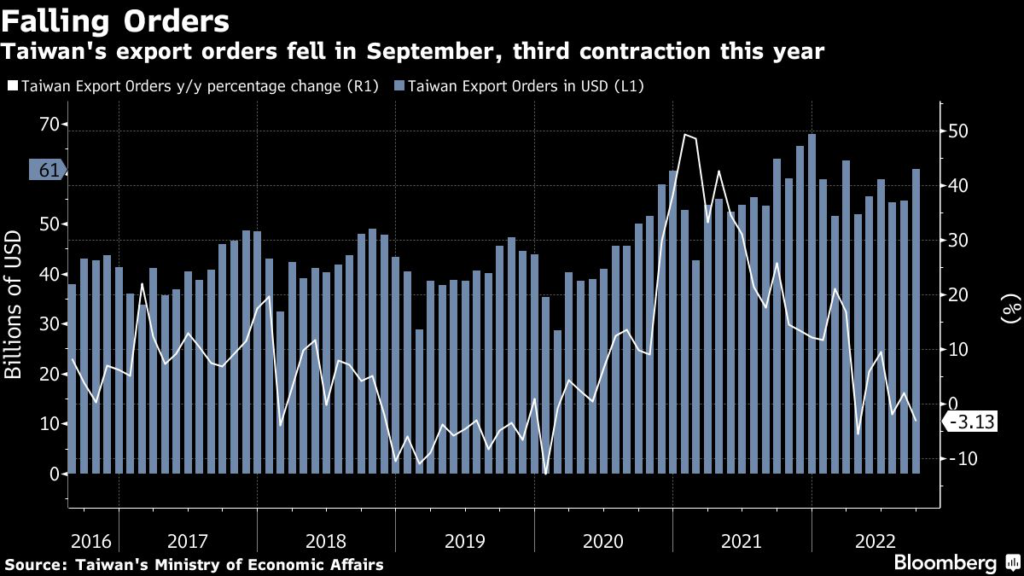
Taiwanese officials have already warned that the trade outlook for the rest of the year is grim after overseas shipments dropped last month for the first since 2020.

Exports and investments slowed as expected due to weak global demand, especially for tech goods as work-from-home demand normalizes,” Lam said. “The challenging tech demand outlook will continue to weigh on exports and investments, while geopolitical tensions could add further downside risks to the latter.”

Taiwan faces an number of global challenges, including high global inflation that is contributing to the slump in demand that’s dented exports and weighed on manufacturing output. China’s pursuit of Covid Zero has snarled trade with a critical economic partner, while Russia’s war in Ukraine and rising geopolitical tensions between the US and China involving Taiwan have further muddled the picture.

The decline in exports in September ended a two-year period of stellar trade performance. Officials cautioned then that overseas shipments may continue to struggle through the rest of this year as demand in China and the rest of the world is sluggish, and the slowdown has begun weighing on businesses in Taiwan, with industrial production unexpectedly dropping last month as demand for manufactured goods weakened. 

Added Risks

US technology restrictions on China have added to risks for Taiwan, as the island’s economy and trade is heavily reliant on exporting semiconductors. While Taiwan’s economic affairs minister downplayed the impact of new chip curbs on the economy, the US announcement still rattled the global semiconductor industry, with shares in Taiwan Semiconductor Manufacturing Co. falling dramatically.

Read More: Taiwan Needs Diverse Trade Amid US-China Row: Finance Chief 

While officials have stressed a need to diversify trade with other places, China and Hong Kong remain a top destination for Taiwan’s exports. 

Economists expect Taiwan’s economic growth to reach 3.2% this year before slowing to a 2.6% expansion in 2023, which would be the worst performance since 2016. On Friday, officials said 2022 GDP could rise 3.6% from last year based on the third quarter data. 

Raymond Yeung, chief economist for Greater China at Australia & New Zealand Banking Group Ltd, said Friday’s number would still offer another reason for Taiwan’s central bank to raise interest rates when it meets in December. 

“However, this should be the last hike in the current tightening cycle as the growth outlook becomes more uncertain,” he added.

–With assistance from Argin Chang and James Mayger.

(Updates with economist comments.)

More stories like this are available on bloomberg.com

©2022 Bloomberg L.P.

EU Commissioner Warns Musk That Twitter Must ‘Fly by Our Rules’

(Bloomberg) — European Commissioner Thierry Breton took to Twitter to send a warning to the social-media platform’s new owner, hours after billionaire Elon Musk closed his $44 billion deal for the company. 

“In Europe, the bird will fly by our rules,” Breton, the EU’s internal markets commissioner, said on Friday in response to Musk’s Tweet: “the bird is freed.” 

Earlier this year, Breton had also reminded Musk that his free-speech focus on Twitter would be limited by the EU’s own content-moderation laws. Breton traveled to Texas in May where the two said there was “no disagreement” over their approach to content. 

Read More: Musk’s Charm Offensive for Twitter Takeover Begins With EU

On Thursday, Musk posted a note to advertisers seeking to reassure them he doesn’t want Twitter to become a “free-for-all hellscape,” full of violent or dangerous posts. 

The EU’s Digital Services Act gives governments more power enforce rules governing how tech companies moderate content and to decide when they must take down illegal content. If Musk doesn’t comply, Twitter will face fines of as much as 6% of annual sales and could even be banned. 

Musk completed the deal late Thursday, changing the executive ranks and taking over as chief executive officer, people familiar with the matter said. Musk also intends to do away with permanent bans on users because he doesn’t believe in lifelong prohibitions, potentially allowing people such as former US President Donald Trump to rejoin, one of the people said. 

More stories like this are available on bloomberg.com

©2022 Bloomberg L.P.

This Week in Crypto: One Story to Rule Them All; ‘Wen Uptober?’

  • Listen to Bloomberg Crypto on the iHeartRadio App
  • Listen to Bloomberg Crypto on Apple Podcasts
  • Listen to Bloomberg Crypto on Spotify  

(Bloomberg) — This week in crypto, we are settling in to new norms: like Bitcoin now being range-bound, trading steadily between $19k-$20k. And we are still waiting to see if the so-called ‘Uptober’ will shake out.

But, hey, trading is still happening, and the SEC’s uptick in regulation efforts are being viewed as a boon to investors. According to the latest MLIV Pulse survey, would-be crypto investors are cautiously optimistic about having more guardrails on the way.

Also, Apple updated its language regarding crypto transactions on every app in its store.  And finally, we have a big story. Actually one story to rule them all. That’s The Crypto Story by Bloomberg Columnist Matt Levine.

To break down the latest, crypto senior editor Philip Lagerkranser is joined by Bloomberg crypto senior editor Anna Irrera and Bloomberg reporter Tanzeel Akhtar.

Follow us on Twitter @crypto, and subscribe to the Bloomberg Crypto Newsletter at https://bloom.bg/cryptonewsletter

More stories like this are available on bloomberg.com

©2022 Bloomberg L.P.

Close Bitnami banner
Bitnami