

Bloomberg

Twitter CEO Among Top Executives Departing as Musk Takes Over

(Bloomberg) — Twitter Inc. Chief Executive Officer Parag Agrawal is among executives planning to depart as Elon Musk completes his $44 billion deal to take over the social network, according to people familiar with the matter.

Also leaving are Vijaya Gadde, the head of legal, policy and trust; Chief Financial Officer Ned Segal, who joined Twitter in 2017; and Sean Edgett, who has been general counsel at Twitter since 2012, according to people familiar with the matter, who declined to be named because the information isn’t public. 

Twitter didn’t immediately respond to a request for comment.

Agrawal stepped into the CEO role in November, when co-founder Jack Dorsey unexpectedly resigned. Agrawal had been at Twitter for almost a decade, most recently as chief technology officer, but his run as CEO was quickly disrupted by Musk’s arrival as a major shareholder and increasingly vocal antagonist of its current leadership.

After Musk showed up, it became clear that Agrawal was unlikely to keep his job. “I don’t have confidence in management,” Musk said in one early filing about the deal, and the two executives exchanged some public swipes. In May, Musk replied to a Twitter thread from Agrawal defending the company’s user metrics by tweeting back a poop emoji.

Text messages unveiled during the lawsuit show that the two men had a contentious exchange early on during the deal process after Musk asked his followers whether Twitter was “dying.” 

Agrawal confronted him via text. “You are free to tweet ‘is twitter dying?’ or anything else about Twitter,” he wrote on April 9, “but it’s my responsibility to tell you that it’s not helping me make Twitter better in the current context.” Musk fired back, “What did you get done this week?” And then: “I’m not joining the board this is a waste of time.”

The following week, in messages with a friend, Musk mocked Agrawal for being on vacation in Hawaii during deal negotiations. “Shouldn’t he be in a war room right now?!?” investor Jason Calacanis messaged Musk. “Does doing occasional zoom calls while drinking fruity cocktails at the Four Seasons count?” Musk replied.

Efforts by former Twitter CEO Jack Dorsey to reconcile Musk, a longtime Dorsey friend, and Agrawal after the deal was announced also ended poorly. “At least it became clear that you can’t work together,” Dorsey messaged Musk after a group call. “That was clarifying.”

Agrawal won’t be leaving empty handed. As part of the deal, the CEO will vest 100% of his unvested equity awards, according to a filing. Research firm Equilar estimated that means he’ll make an estimated $42 million, Reuters reported.

As Twitter’s head of legal and policy issues, Gadde has overseen the creation and enforcement of rules for hundreds of millions of internet users, including prominent ones that are subject to looser content limitations under the company’s exemptions for newsworthy posts or world leaders’ communications. In acquiring Twitter, Musk has promised to turn it into a less-restrictive platform for free speech, a move he has said is “essential to a functioning democracy.” 

Gadde was hit with a spate of online abuse earlier this year after Musk publicly criticized content-related decisions at Twitter. The company permanently banned former US president Donald Trump in January 2021 following his supporters’ attack on the Capitol. Musk’s statements leading up to his purchase of the social-media company have led many to expect the billionaire will restore Trump’s account and reinstate other users who have been blocked for breaking rules on offensive or dangerous content.

More stories like this are available on bloomberg.com

©2022 Bloomberg L.P.
The iPhone Is Lone Bright Spot in Gloomy Quarter for Smartphones

(Bloomberg) — Apple Inc. was alone among the world’s top five smartphone vendors to register growth in the third quarter this year as the mobile market suffered a double-digit decline.

Global leader Samsung Electronics Co. slumped 8% to 64 million units in the three months ended September, while Chinese vendors Oppo and Vivo were each down at least 20%, according to the latest data from Canalys and Counterpoint researchers. Weak demand in China, which Samsung called out as a major drag on its sales of phone components this week, has weighed on the industry this year. 

Xiaomi Corp. weathered the hit better than its compatriots because of its wider international presence, the researchers said. Shipments of iPhones, whose latest generation was released earlier this year than last, were up slightly.

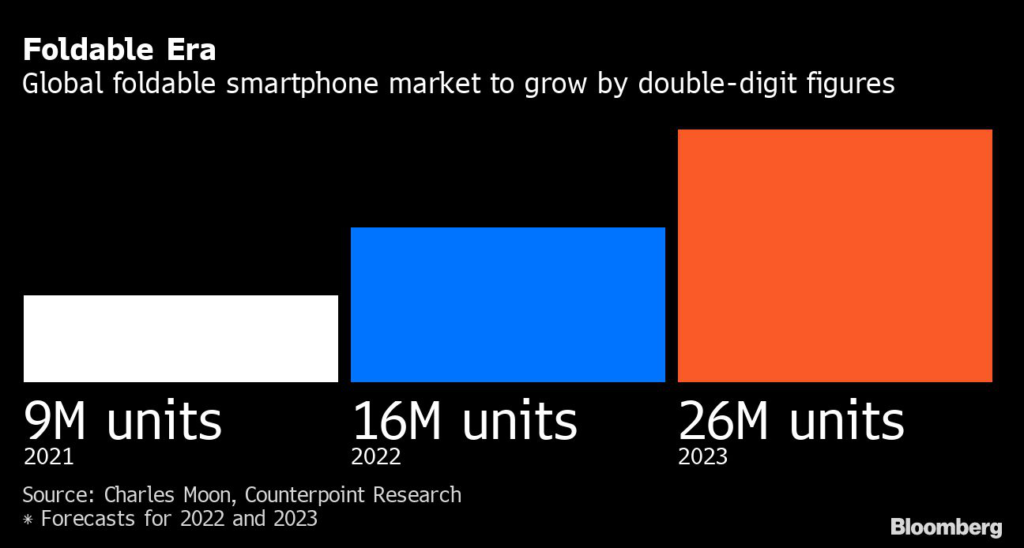
The premium tier is the only segment of the mobile market that’s shown resilience, and Apple’s strength in that category helped it reach its best third-quarter share to date, according to Canalys. It further closed the gap on Samsung, whose highlight in the period was the launch of new foldable handsets that improved its product mix with more high-end offerings. The South Korean electronics giant, which appointed Jay Y. Lee as its executive chairman this week, is betting on foldables as the key to unlocking growth in the largely stagnant smartphone business.

“Slow inventory turnover and poor economic figures have affected the channel’s confidence, falling back to major brands with iconic devices to generate traffic,” said Canalys analyst Toby Zhu. “Managing the gloomiest Q4 outlook in over a decade will show which vendors are well-positioned for the long-term.”

–With assistance from Sam Kim.

More stories like this are available on bloomberg.com

©2022 Bloomberg L.P.
DBS to Be First Bank to Tap New Crypto Platform From SGX Unit

(Bloomberg) — Singapore’s DBS Group Holdings Ltd. will be the first bank to utilize a digital-asset platform being launched by a unit of SGX Group.

The platform, MaxxDigital, is from SGX’s MaxxTrader, which provides foreign-exchange and risk solutions for institutions. 

Lee Beng Hong, head of FICC at SGX Group, said in an interview that their offering is “trusted, stable, robust institutional grade infrastructure” in a market that’s “relatively inefficient, still relatively fragmented.”

Singapore’s stance on cryptocurrencies has evolved amid 2022’s rout. Regulators are clamping down on risks for retail traders, though the city state continues to seek to become a digital-asset hub beyond that segment.


More stories like this are available on bloomberg.com

©2022 Bloomberg L.P.

Amazon, Intel Pressed to Slash Costs After Years of Bulking Up

(Bloomberg) — Tech giants like Amazon.com Inc., Meta Platforms Inc. and Intel Corp., which have long touted their ambitious growth plans, are now being judged by a different measure: how quickly they can make cuts.

Amazon vowed to rein in expenses after warning Thursday of its slowest holiday season ever, saying it would pause hiring in some businesses and wind down products and services. Already, the company been on a purge in recent weeks, shutting down a delivery robot business, a virtual tour feature and a kids-focused video calling device.

“We’re taking actions to tighten our belt,” Amazon Chief Financial Officer Brian Olsavsky said on a conference call. “We believe our resources are better spent elsewhere.”

At Intel, talk has shifted from the chipmaker’s factory expansion plans to an aggressive headcount reduction. After announcing a 20% decline in revenue last quarter, the company said it would begin cutting jobs and spending as it tries to save $3 billion next year.

Meta, the owner of Facebook and Instagram, drew ire this week in part by not trying to keep a lid on expenses. The company posted its second straight quarter of disappointing earnings, but Chief Executive Officer Mark Zuckerberg urged shareholders to be patient with its expansion plans. They weren’t. 

With Meta’s costs growing — including its spending on an elusive metaverse dream — investors sent the shares down 25% on Thursday.

Even Apple Inc., which has fared better than its tech peers this year, has been cutting back. Though it has avoided mass layoffs, the company plans to trim expenditures in 2023 and slow hiring. “Obviously we’re being deliberate in our decisions of where to invest,” CEO Tim Cook said in July.

Companies have been battered by inflation and a strong dollar, which has reduced the value of overseas sales. The choppy economic outlook is worrying consumers, who are cutting their spending. 

The pressure on the big technology companies to do more with less has only grown during a disastrous run of earnings reports this week. Alphabet Inc., Amazon, Meta, Microsoft Corp. and others all fell short of projections, sending their shares plunging and shaving hundreds of millions of dollars from their valuations. 

Some of the few companies to emerge unscathed were the ones pledging to go on a diet. Intel, which has struggled for years to turn around its business and now faces a broader slump in personal computers, placated investors with its latest cutback plans. Even after results suggested that its plight is only getting worse, the shares climbed more than 5% in late trading Thursday.

Intel’s cost-cutting plan was “more aggressive than what investors expected,” said CJ Muse, an analyst at Evercore ISI. “It’s something that gives some comfort.”

Chipmaker SK Hynix Inc. reported a 60% in third-quarter profit but soothed fears by vowing to cut its capital expenditures by at least half next year. 

Companies connected with the personal computer market — like Intel and Hynix — are under particular pressure because that market has begun to collapse. Consumers had snapped up PCs during the pandemic, as they equipped home offices, but are now holding off on purchases.

Seagate Technology Holdings Plc, the biggest maker of computer hard drives, announced plans to eliminate about 3,000 jobs this week.

“The whole industry has to get more pragmatic about PCs because they went irrationally high during the pandemic,” said Glenn O’Donnell, director of research at Forrester Research Group. “There was this surge, and now we’ve having the hangover.”

Amazon also has acknowledged that it grew too fast during the pandemic, betting that a shift to e-commerce would justify its sprawling delivery infrastructure. Instead, online sales slowed as consumers sought to return to pre-pandemic lifestyles. 

Amazon has adjusted by delaying warehouse openings, freezing hiring in its retail group and shutting down experimental projects. But inflation and a shaky economy have only added to the company’s woes. 

Amazon said it expects revenue of $140 billion to $148 billion in the holiday quarter, far short of the $156 billion estimate. It’s not the only one feeling the pain. Adobe Inc., which tracks e-commerce sales, said US online sales will rise just 2.5% in in November and December from the prior year.

“Clearly, Amazon went too big too soon on its expansion plans,” Matt Britzman, an analyst Hargreaves Lansdown, said in a note. “It’s had to put the brakes on and then some to try and get costs back under control.”

–With assistance from Mark Gurman and Alex Barinka.

More stories like this are available on bloomberg.com

©2022 Bloomberg L.P.
Biden Crows About Chips Bill, Says Xi ‘Concerned’ About US Plans

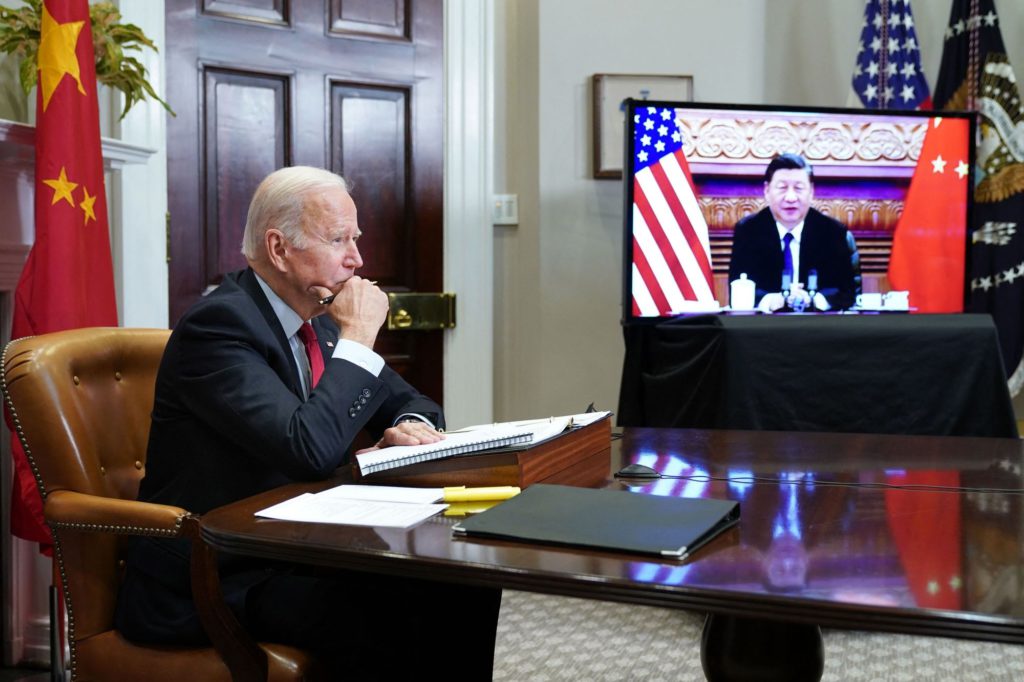
(Bloomberg) — President Joe Biden said China’s leader had expressed worries about the US strengthening its domestic production of semiconductor chips as his administration moves to reduce reliance on Asian suppliers and restrict Chinese access to chipmaking technology.

“I’ve heard from Xi Jinping that he’s a little concerned about that,” Biden said Thursday in Syracuse, New York, as he delivered a speech touting job growth and his economic agenda ahead of the Nov. 8 midterm elections. 

Biden hailed the bipartisan Chips and Science Act, which he signed into law in August, and said it would help the US “out-compete the rest of the world” in chipmaking. The president spoke at a Micron Technology Inc. site, where the company plans to invest $100 billion to bolster chip manufacturing, an investment Biden said was spurred by the measure.


“Because of the new law I signed and Chuck designed and delivered, we’re turning things way around,” said Biden, who was joined by New York lawmakers and officials, including Senate Majority Leader Chuck Schumer. 

Biden said Micron’s investment alone would “increase America’s share of global memory chips and production by 500%.”

Read more: Micron Plans to Invest Up to $100 Billion in NY Chip Factory (1)

The semiconductor subsidy bill is intended to make the US less dependent on Asian chipmaking giants. Yet the measure has spurred concerns abroad, including among American allies such as South Korea and Japan, about the impact on their companies.

The US Commerce Department also unveiled sweeping regulations on Oct. 7, intending to curb the sale of advanced semiconductors and equipment to China and banning Americans from helping with the country’s development of chip technologies. The moves strike at the very foundation of China’s efforts to build its own cutting-edge chips.

China’s embassy hit back against the recent US economic measures aimed at curbing Beijing’s access to advanced technology. Speaking in an online briefing on Thursday, before Biden’s remarks, senior Chinese diplomat Wang Hongxia criticized the new chip rules as an “abuse of export control measures,” and accused the Biden administration of a “politicized and weaponized” approach to normal economic and business cooperation.

“These negative measures have brought huge losses to businesses and consumers in both countries,” said Wang, who is a counselor in the embassy’s office of economic and commercial affairs. “Once the Chinese market is lost, it will be hard to regain.”

Read more: China Says Biden’s New Chip Technology Curbs Will Harm Recovery

On Thursday, the top US official overseeing export controls said he expects a deal with global allies to limit shipments of chip-producing technology to China.

“We expect to have a deal done in the near term,” Alan Estevez, under secretary of Commerce for industry and security, said at an event hosted by the Center for a New American Security.

Tensions between the US and China have intensified in recent months, with the world’s two largest economies sparring over trade, human rights and Beijing’s aggressive moves against Taiwan.

Xi in a letter to the National Committee on US-China Relations’ annual dinner Wednesday, though, said his nation is willing to work with the US to find ways to cooperate. 

The conciliatory tone comes before a potential face-to-face meeting with Biden at a Group of 20 summit next month in Indonesia. The planning for that encounter is ongoing, though, and a date has not been confirmed.

Read more: US Expects Deal With Allies on China Chip Curbs in Near Term (1)

Biden on Thursday said making chips in the US would lower costs for American consumers, as the administration seeks to counter perceptions it is not doing enough to combat soaring inflation. With the midterms less than two weeks away, polls show rising costs are voters’ top concern and Democrats are at risk of losing one or both chambers of Congress.

“Making these chips in America is going to help lower the costs for families looking to buy a car, replace your washing machine, get a new cellphone,” he said.

Micron, which first announced its investment earlier this month, has said the plans will generate about 50,000 jobs in the state, including 9,000 high-paying positions. 

Biden’s visit to New York is the latest he’s taken to celebrate the chips law. The president visited an IBM Corp. campus in Poughkeepsie, New York, earlier this month where the company plans to invest $20 billion in quantum computing, and the groundbreaking for an Intel Corp. facility in Ohio in September.

Explainer: Why Making Computer Chips Has Become a New Arms Race

–With assistance from Iain Marlow and Debby Wu.

More stories like this are available on bloomberg.com

©2022 Bloomberg L.P.
T-Mobile Raises Subscriber Forecast Again After Strong Quarter

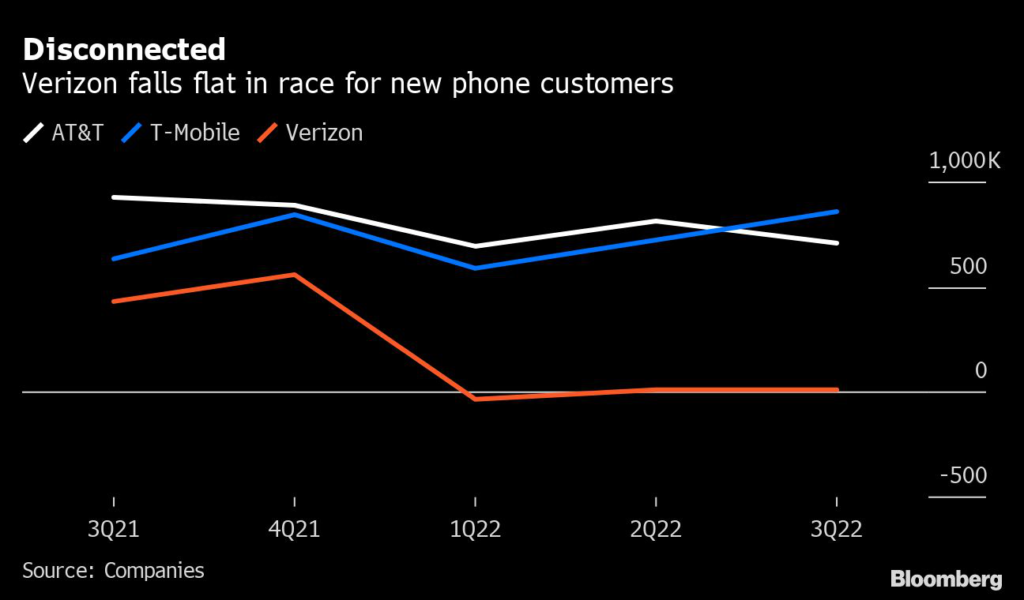
(Bloomberg) — T-Mobile US Inc. raised its subscriber forecast for the third straight quarter after posting better-than-expected customer gains. The company said it signed up more new subscribers than rivals AT&T Inc. and Verizon Communications Inc. combined.

  • T-Mobile now expects to add as many as 6.4 million new subscribers this year, up from a prior view of 6.3 million. Analysts surveyed by Bloomberg are projecting 6.3 million.
  • During the third quarter, the company added 1.7 million total wireless subscribers, including 854,000 new phone customers. Analysts predicted a total of 1.5 million, with 714,500 of them phone subscribers. Earnings came in at 40 cents per share on $19.5 billion in sales. Analysts had expected 38 cents on $19.9 billion in revenue, according to estimates compiled by Bloomberg.

Key Insights

  • “The industry is starting to normalize,” Chief Executive Officer Mike Sievert said on an earnings call Thursday. “We’ve seen in these last couple quarters, overall postpaid growth was more moderate and yet our performance is fantastic.”
  • The second-largest mobile carrier in the country added 578,000 wireless home broadband subscribers, better than the 554,800 analysts predicted. T-Mobile now has 2.1 million total broadband users. At $50 a month, wireless broadband service has cut into to the cable companies’ landline internet service.
  • Unlike the price hikes earlier this year by Verizon and AT&T, T-Mobile has kept its fee increases to a minimum, focusing instead on 5G network expansion to improve service quality and in selling more services to business customers. T-Mobile committed to a three-year price freeze in April 2020 as a condition of its purchase of Sprint Corp.
  • T-Mobile raised the low end of its full-year, free cash forecast to $7.4 billion from $7.3 billion previously. Analysts are projecting as much as $7.6 billion for the year.

Market Reaction

  • T-Mobile shares rose 3.4% in late trading after the announcement. The stock is the best performer among the three big US wireless companies this year with a 21.3% gain through Wednesday’s close.

Get More

  • Read the statement.
  • See AT&T story.


(Updates with phone subscriber chart and CEO comments. Earlier version corrects analysts’ broadband estimate in fourth paragraph.)

More stories like this are available on bloomberg.com

©2022 Bloomberg L.P.

Rogers Takeover of Shaw Headed to Court as Antitrust Talks Fail

(Bloomberg) — Rogers Communications Inc. failed to settle a dispute with Canada’s antitrust watchdog about its takeover of Shaw Communications Inc. during mediated talks, almost certainly sending the parties to court. 

The companies said they’re committed to the deal and are confident of their chances in litigation. That step is scheduled to begin next month, with Rogers, Shaw and the Competition Bureau making their arguments in front of the federal Competition Tribunal.

At stake is one of the largest mergers in Canada’s history — a C$20 billion ($14.7 billion) deal to unite Rogers, the country’s largest wireless and cable firm, with Shaw, a major provider of cable and internet services in the western provinces.

Rogers and Shaw tried to appease antitrust regulators by striking a deal to sell Shaw’s Freedom Mobile division to Montreal-based communications company Quebecor Inc. That wasn’t enough for the Competition Bureau, which has argued in court documents that Freedom will be a weaker competitor under new ownership and consumers are likely to pay higher prices. 

“We are disappointed with this outcome and believe that litigation is both unnecessary and harmful to competition. The Bureau’s unwillingness to meaningfully engage unduly delays lower wireless prices for Canadian consumers,” Rogers, Shaw and Quebecor said in a joint statement late Thursday. 

Earlier this week, Industry Minister Francois-Philippe Champagne signaled his support for the asset sale to Quebecor by setting out two conditions for his approval of it.

Shaw shares jumped 7% on Wednesday, as traders saw Champagne’s intervention as making the deal more likely to happen. Rogers rose nearly 6% that day and another 1% on Thursday. 

Freedom Mobile is the country’s fourth-largest wireless provider, competing against Rogers, BCE Inc. and Telus Corp. in Ontario and Western Canada. 

“We remain committed to completing this pro-competitive series of transactions and are confident in the strength and merits of our case in front of the Competition Tribunal, including the many benefits of these transactions to Canadians,” Rogers, Shaw and Quebecor said in their statement. 

More than 85% of Canada’s wireless market is controlled by the three largest providers. Smaller regional companies like Freedom, Quebecor and Saskatchewan Telecommunications Holding Corp. have the rest. 

(Adds additional context from companies statement, share prices.)

More stories like this are available on bloomberg.com

©2022 Bloomberg L.P.
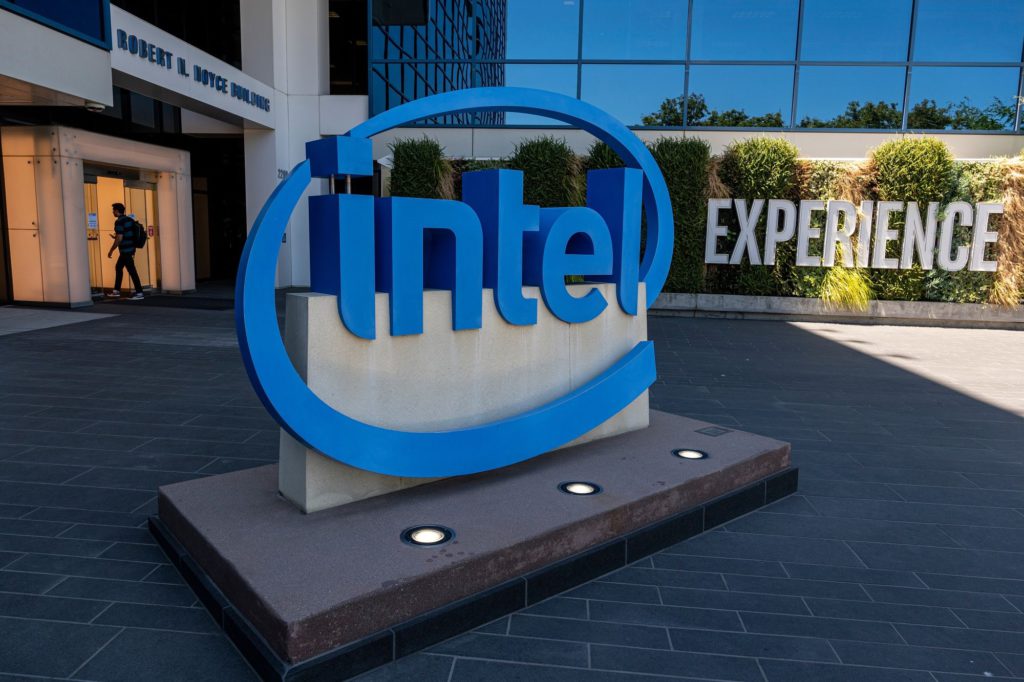
Intel Pledges More Cost Cuts as Sales Forecast Misses Estimates

(Bloomberg) — Intel Corp. shares climbed in late trading after the chipmaker pledged to slash costs, an effort to weather a persistent slump in computer demand that is dragging down sales and profit and obstructing its turnaround efforts.

The company said actions including headcount reductions and slower spending on new plants will result in savings of $3 billion next year, with annual cuts swelling to much as $10 billion by the end of 2025. Third-quarter profit and revenue tumbled, Intel said Thursday in a statement, and it again scaled back 2022 revenue and profit targets.

Chief Executive Officer Pat Gelsinger had been banking on a rapid rebound in semiconductor sales to help fund his ambitious plans to restore Intel to its former dominance in the $580 billion industry. Gelsinger, who predicted three months ago that the third quarter would be the nadir for the company’s performance, instead said that demand for Intel’s computer processors has fallen off even more sharply than projected and the outlook remains dour.

“The worsening macro was the story and is the story,” Gelsinger said in an interview. “There’s no good economic news.” Predicting a bottom for the market for computer chips currently would be “too presumptive,” he said. 

Third-quarter net income was $1 billion, or 25 cents a share, down from $6.8 billion, or $1.67 a share, in the same period a year ago. Revenue dropped 20% to $15.3 billion. Before certain items, profit was 59 cents a share. Wall Street was looking for a profit of 33 cents on sales of $15.4 billion.

Intel shares initially fell, then rose about 5.4% in late trading following the announcement. Earlier, they closed at $26.27. The stock has plummeted 49% this year.

Earlier this month, Bloomberg News reported that Intel was planning a major reduction in headcount, likely numbering in the thousands, according to people with knowledge of the situation. Some divisions, including Intel’s sales and marketing group, could see cuts affecting about 20% of staff, according to the people. In its earnings report Thursday, the company didn’t specify how many jobs would be eliminated.

Fourth-quarter revenue will be about $14 billion to $15 billion, the company said, compared with analyst estimates for $16.3 billion. Profit, excluding certain items, will be 20 cents a share, below the average prediction of 66 cents.

For the year, Intel reduced its revenue forecast to $63 billion to $64 billion, a decline of as much as 20% from 2021. Gross margin will narrow further than earlier anticipated to 47.5%, and earnings per share will be about $1.95.

Gelsinger said that level of profitability isn’t good enough, and is partially a result of inefficiencies in Intel’s operations that need to be addressed. The company’s plants, once the industry leader, will be forced to report their utilization rates, and chip designers will have to improve at getting the blueprints they send to those facilities right the first time. Intel’s rivals use fewer people to get better results, he said.


One bright spot in Gelsinger’s plans to reshape the company came earlier this week, when Intel’s self-driving technology unit, Mobileye Global Inc., began publicly trading in a partial spinoff. Its shares surged 38% in their market debut Wednesday. Intel retains control of the division, which raised $861 million in the share sale. Gelsinger has said Mobileye may serve as a template for other such transactions that will help Intel capitalize on the value of some of its assets.

Third-quarter sales for Intel’s data-center division — which typically contributes an outsized portion of profit –- dropped 27% to $4.2 billion, lower than the average analyst estimate of $4.83 billion. Client computing, Intel’s PC-chip unit, reported a sales decline of 17% to $8.1 billion, compared with projections for $7.78 billion. The unit picked up market share, Gelsinger said.

A collapse in consumer gadget-buying has spread into corporate spending amid concern that the global economy is heading toward a recession. That has confounded predictions by chip-industry leaders that the boom of the past two years could endure, driven by the proliferation of semiconductor use into more types of devices. Computer and smartphone demand remains the primary influence on the fortunes of the broader chip industry, which expanded by more than $100 billion last year and some predicted would rapidly double to become a $1 trillion business.

Many of Intel’s largest rivals have posted downbeat reports or warnings about the outlook for computer components, falling billions short of estimates or slashing their predictions. While periodic slumps are not unusual for the chip business, analysts are concerned that the current decline is driven more by a contraction of the economy than a buildup of excess inventory that would have the potential to clear out quickly.

(Updates with comments from CEO starting in third paragraph.)

More stories like this are available on bloomberg.com

©2022 Bloomberg L.P.

US Stocks Fall Before Amazon, Apple Add to Woes: Markets Wrap

(Bloomberg) — Wall Street contended with another volatile session as investors mulled the Federal Reserve’s path of interest-rate hikes while assessing mixed economic data and a slew of earnings reports. 

Amazon.com Inc. plunged after hours as its sales forecast trailed estimates. Shares of Apple Inc. struggled for direction postmarket after it reported weaker-than-expected iPhone and services sales in its latest quarter. 

The S&P 500 closed lower, after swinging between gains and losses for most of the session. The Nasdaq 100 fell more than 1% in regular trading and an exchange-traded fund tracking it slid further after 4 p.m. in New York. Lackluster earnings from several megacap firms this week dampened sentiment and underscored the impact of the Fed’s tightening regime. Meta Platforms Inc. posted its worst one-day drop since February on Thursday, triggered by burgeoning metaverse costs and a decline in revenue.

Markets were also mixed on US gross domestic product data. The report showed the US economy rebounded after two quarterly contractions, which briefly assuaged concerns of an imminent recession. But it also highlighted that consumer spending remains under pressure because of inflation. Treasuries gained, with the 10-year yield pushing below 4% on speculation of a Fed pivot. The dollar snapped a two-day drop.  

The stock and currency markets digested the GDP data differently because it’s difficult to tell what the Fed is planning to do next, said Fiona Cincotta, senior financial markets analyst at City Index.

“The US dollar is reading into this that perhaps it’s going to keep the Fed on that hawkish path for longer,” Cincotta said by phone. “Whereas the stock market seems to be reading it completely differently, almost as if it’s expecting the Fed to be sort of moving toward that less hawkish stuff.”

Read More: US Economy Rebounds as Consumers, Businesses Show Resilience

Economists still expect the Fed to hike by three-quarters of a percentage point for the fourth time in a row when it meets next week. But with recent data highlighting the effects of the Fed’s sharp rate hikes on the economy, investors expect the central bank to slow its pace of tightening after November’s meeting.  

“It’s not about a pivot and cutting interest rates,” Alec Young, chief investment strategist at MAPsignals, said in an interview. “It’s just about the Fed becoming more data-dependent and acknowledging there’s already a lot of tightening in the pipeline from all the rate hikes they’ve put through so far.”

Earlier, the European Central Bank lifted its policy rate by 75 basis points — in line with expectations — and signaled more tightening ahead. But ECB officials weren’t unanimous about the size of the interest-rate hike and sought to avoid giving a specific signal on their next move in December, according to people familiar with the matter.

Key events this week:

  • Bank of Japan policy decision, Friday
  • US personal income, personal spending, pending home sales, University of Michigan consumer sentiment, Friday

Some of the main moves in markets:

Stocks

  • The S&P 500 fell 0.6% as of 4 p.m. New York time
  • The Nasdaq 100 fell 1.9%
  • The Dow Jones Industrial Average rose 0.6%
  • The MSCI World index was little changed

Currencies

  • The Bloomberg Dollar Spot Index rose 0.4%
  • The euro fell 1.1% to $0.9971
  • The British pound fell 0.4% to $1.1575
  • The Japanese yen rose 0.1% to 146.20 per dollar

Cryptocurrencies

  • Bitcoin fell 0.6% to $20,630.98
  • Ether rose 0.6% to $1,562.65

Bonds

  • The yield on 10-year Treasuries declined seven basis points to 3.93%
  • Germany’s 10-year yield declined 15 basis points to 1.96%
  • Britain’s 10-year yield declined 17 basis points to 3.40%

Commodities

  • West Texas Intermediate crude rose 1.3% to $89.01 a barrel
  • Gold futures fell 0.2% to $1,665.50 an ounce

–With assistance from Elaine Chen, Emily Graffeo and Peyton Forte.

More stories like this are available on bloomberg.com

©2022 Bloomberg L.P.

‘Wolf of Airbnb’ Charged With Fraud in New York Rental Scheme

(Bloomberg) — Federal prosecutors in New York charged a Florida man who called himself the “Wolf of Airbnb” with wire fraud and identity theft, alleging he took advantage of a Covid-19-era relief program and defrauded landlords by listing apartments illegally on the home-rental platform. 

Konrad Bicher, 31, and those working with him entered into leases with landlords and broke rules forbidding rentals on Airbnb Inc.’s website, prosecutors in New York alleged. Bicher was arrested in June and charged Thursday. Prosecutors say that from 2019 to this year, Bicher signed at least 18 leases and failed to pay more than $1 million in rent while reaping close to $1.2 million in income from the rentals.

Attorneys for Bicher said he plans to plead not guilty.

The indictment follows actions from New York City regulators seeking to rein in illlegal rentals. In July, the city sued the owners of a building, and will implement stricter rules next year that will block Airbnb and others from processing payments of unregistered properties. The housing market in New York has grown tighter in recent years, and by one measure, the number of short-term rentals outpaced the supply of available apartments. 

Bicher used the name “Wolf of Airbnb” as a reference to being “hungry and ruthless enough to get on top of the financial ladder,” according to the indictment. Prosecutors allege companies owned by Bicher received $565,000 in Paycheck Protection Program loans, the applications for which contained false information.

More stories like this are available on bloomberg.com

©2022 Bloomberg L.P.

Close Bitnami banner
Bitnami
