Bloomberg

Hijacked New York Post Site Highlights the ‘Insider Threat’ — Again

(Bloomberg) — When a New York Post employee on Thursday hijacked the company’s website and Twitter Inc. account to post death threats, as well as racist and misogynistic headlines, it was just the latest example of a company insider abusing their access for their own gain. 

The Post fired the unnamed employee after headlines on the news site included offensive headlines, including calling for the assassination of some US leaders  

For all the attention on foreign hackers, rogue employees constitute a major threat to organizations.

“The New York Post hack is just the tip of the iceberg,” Howard Ting, chief executive of cybersecurity company Cyberhaven Inc. said in an interview. “We read all the time about external hacking threats, but I think of them as the big pipe that bursts in your neighborhood and causes a flood. The internal threats are the faucets leaking in your neighbor’s home, the hidden problem that is dripping away over time.” 

A company with 1,000 employees experiences an average of 45 “data exfiltration incidents” each month, a rate that increased to 2,254 per month for a company with 50,000 workers, according to a study by Cyberhaven.  Such incidents include staffers sending work from a corporate account to a personal email address, accessing sensitive project files or gathering client data. Client data comprises 44.6% of the sensitive information employees exfiltrate, Cyberhaven said. 

“Most of the time these companies don’t even know,” Ting said.

In August a product manager at the cryptocurrency company Coinbase Inc. named Ishan Wahi was charged in the first-ever crypto insider trading case in August. Wahi, who pleaded guilty, shared details of new coins that Coinbase planned adding to add its exchange with his brother and friend so they could buy them in advance in anticipation of rising prices. The Securities and Exchange Commission said Wahi made a profit of more than $1.1 million by passing on the confidential information. 

History has shown that internal threats can do more than just reputational damage, and can cost a company its valuable secrets. 

Mayank Choudhary, executive vice president and general manager for information protection at cybersecurity vendor Proofpoint Inc. said that insider threats cost organizations $15.4 million every year according to the company’s latest research. 

In June, an employee at ByteDance Ltd.-owned social media app TikTok leaked audio from more than 80 internal meetings which suggested that China-based employees were able to access sensitive data about TikTok users in the US, something that the company had long denied was possible. The so-called TikTok tapes added yet more scrutiny onto the app, which narrowly dodged a ban under President Donald Trump. 

Last November, Pfizer Inc. sued an employee it said had stolen thousands of files relating to its Covid-19 vaccine, including development plans for new drugs. Pfizer said the suspect, Chun Xiao Li, allegedly took the information to a competitor. It claimed she provided a “decoy” laptop when quizzed on why she had downloaded the data. Li is now cooperating with the investigation and Pfizer has taken the matter outside of court, the company said. 

Self-driving competitors Waymo LLC and Uber Technologies Inc. were shadowed by a lengthy and expensive legal battle over employee Anthony Levandowski, who was famously accused of stealing files from former employer Alphabet in 2016 and bringing them to his new Uber gig. Uber settled in February this year, and was required to pay a “substantial portion” of the $120 million. 

Such incidents sometimes pose a risk to national security. A former Twitter Inc. employee was convicted of spying for Saudi Arabia in August. The worker sent on the personal information of Twitter users who used anonymous handles to criticize the Saudi royal family and Kingdom.

More stories like this are available on bloomberg.com

©2022 Bloomberg L.P.

ServiceNow Rallies on Higher Subscription-Revenue Forecast

(Bloomberg) — ServiceNow Inc., a maker of business workflow software, rallied after reporting profit that topped expectations and increased its forecast for constant currency growth, signaling that demand remains strong in a choppy economic environment. 

Third-quarter earnings excluding some items were $1.97 a share, the Santa Clara, California-based company said Wednesday in a statement. Analysts, on average, predicted $1.85 a share. Subscription revenue, which makes up the overwhelming majority of company sales, increased 22% to $1.74 billion in the period ended Sept. 30, in line with estimates. That growth was damped 6.5 percentage points by currency fluctuations.

The shares gained 13% to $415.67 at the close Thursday in New York, the biggest single-day gain since April 2016. The stock has dropped 36% this year.

Annual subscription revenue will increase 23% to $6.87 billion, the company said. In constant currency terms, that’s 28.5% growth, a half percentage point increase from ServiceNow’s previous guidance in July. Currency fluctuations will now cost $290 million this year, a 5.5 percentage point headwind.

While the numbers themselves “are not stellar,” the market was anxious after a surprise guidance miss by Microsoft Corp. on Tuesday, wrote Raimo Lenschow, an analyst at Barclays Capital. Rob Owens of Piper Sandler said the results were better than feared, with momentum in large deals underpinning a strong quarter. 

ServiceNow sells applications that help companies organize and automate their personnel, customer service and information technology operations. Its subscription-based sales have been affected by customers hesitating to sign large deals and a strengthening US dollar, which reduces revenue pulled in from overseas clients.

Executives remained bullish about the company’s future. “We continue to see a robust pipeline and are maintaining our investments in growth hires as the opportunity in front of us remains enormous,” Chief Financial Officer Gina Mastantuono said in the statement. The CFO told analysts on a conference call after the results that she is “confident” the company’s guidance factors in the difficult economic climate.

Current remaining performance obligations, which are contract sales that will be recognized as revenue in the next 12 months, gained 18% to $5.87 billion in the quarter, missing analysts’ average estimate of $6.02 billion, according to data compiled by Bloomberg.

ServiceNow said it had 1,530 customers with more than $1 million in annual contract value when the period ended, a 22% increase from a year earlier. Customers paying over $10 million in annual contract value grew 60%, the company said.

“ServiceNow matched consensus and came in exactly where they said, so no slowdown here,” said Anurag Rana of Bloomberg Intelligence. “We continue to expect that demand could slow in 2023 with more cautious tech budgets, but it may remain resilient, given the critical nature of ServiceNow’s business.”

ServiceNow also announced that Chief Executive Officer Bill McDermott was also named chairman, succeeding founder Fred Luddy who will remain on the board of directors.

(Updates with closing shares in the third paragraph.)

More stories like this are available on bloomberg.com

©2022 Bloomberg L.P.

Shopify Rises as Revenue Beat Signals Worst Days May Be Past

(Bloomberg) — Shopify Inc. gained as the Canadian e-commerce company reported revenue that beat analysts’ expectations after adding more avenues for merchants to sell and promote their products.

Revenue was $1.4 billion in the third quarter, the Ottawa-based company said in a statement Thursday. That exceeded expectations for $1.3 billion, according to the median of analyst estimates compiled by Bloomberg. Shopify reported a loss of 2 cents per share on an adjusted basis, compared with estimates of a seven cent loss.

The US-traded shares closed 17.3% higher, the biggest increase since May.

The better-than-expected results suggest Chief Executive Officer Tobi Lutke’s changes to cope with a tough retail environment, including job cuts and measures to improve services for small-business customers, may be starting to bear fruit. The company nevertheless has a long path to a full recovery, with the shares down more than 75% in the year through Wednesday amid strains from the return of in-person shopping and pressure on consumer spending from high inflation. 

The report may counter some of the gloom this week across the tech sector after heavyweights Meta Platforms Inc., Alphabet Inc. and Microsoft Corp. announced results that disappointed investors, triggering a stock selloff across the industry. 

However, Shopify is still coping with the CEO’s misplaced bet that a surge in pandemic-era online shopping marked a permanent change in habits. Lutke acknowledged in July that the company’s rapid expansion during Covid was unsustainable, and the company said it would cut about 10% of its workforce. 

“Shopify’s better-than-expected sales versus consensus across all business units could mean that the company is past the toughest comparisons to a much stronger 2021,” Anurag Rana, Bloomberg Intelligence analyst, said in a note. “Its results give us confidence that 2023 sales growth may be higher than 2022, fueled not only by smaller merchants, but also by increased migration of larger retailers from older software platforms to Shopify.”

Shopify said in the third quarter gross merchandise volume, which represents total sales from Shopify vendors, was $46.2 billion, missing analysts’ estimates of $46.8 billion. It projected an adjusted operating loss for the full year, and the fourth quarter loss will be about the same as that in the third. Currency headwinds from a stronger U.S. dollar, higher inflation and rising interest rates will all weigh on consumer spending, the company said. 

Lutke has been spending for future growth, acquiring delivery startup Deliverr Inc., which provides two-day delivery services for companies including Amazon.com Inc. and Walmart Inc., for $2.1 billion in May to help it build a fulfillment network. The idea is to offer another revenue-generating service that will complement the company’s subscription software. While the strategy will squeeze operating margins in the short term, that pressure could ease next year as the efforts start to pay off, Rana wrote in a note before Thursday’s report.

The earnings statement highlighted the launch of Shopify’s digital payments in more European countries and its lending system in Australia. The e-commerce firm also introduced Shopify Markets Pro in September, a feature that provides select merchants tools to manage international transactions.

Shopify said Thursday merchant solutions, which includes services such as payments, lending and shipping, gained 26% to $990 billion. The division accounts for more than 70% of revenue.

Its concerns on inflation come as other e-commerce companies are set to report, with Amazon issuing its statement after the market close. With the year-end holiday season approaching, there’s a risk that big discounts to spur spending by price-conscious consumers will weigh on retailers’ earnings. 

(Updates share price in third paragraph.)

More stories like this are available on bloomberg.com

©2022 Bloomberg L.P.

Meta Plummets 25%; Zuckerberg Plea for ‘Patience’ Falls Flat

(Bloomberg) — Meta Platforms Inc. plunged 25% Thursday, its biggest one-day drop since February, after Chief Executive Officer Mark Zuckerberg asked investors for patience with the social-media giant’s swelling investments in unproven bets at an already-challenging time for digital-advertising companies.

On a call Wednesday after giving a disappointing revenue outlook, Zuckerberg sought to justify Meta’s ballooning costs to fund its version of virtual reality, the metaverse, as well as the artificial intelligence fueling major changes to its social networks.

Investors, who have already sent the stock down 71% this year, so far aren’t buying it. The Facebook parent’s market value has collapsed by a whopping $676 billion this year, removing it from the ranks of the 20 largest US companies. But Zuckerberg said he is confident that Meta’s largest bets in areas such as short-form video, business messaging and the metaverse were headed in the right direction — he just couldn’t say for sure how big the payoff would be.

Read more about how Meta fell out of the top 20 biggest US stocks

“I think we’re going to resolve each of these things over different periods of time,” Zuckerberg said. “And I appreciate the patience and I think that those who are patient and invest with us will end up being rewarded.”

It’s proving to be a hard sell when the company expects its already-falling revenue to be less than analysts expected, and costs to be more. On Wednesday, Meta said third-quarter revenue declined 4.5% from a year prior, only the second time the company’s sales have ever declined — the first being last quarter. In the final three months of the year, Meta expects that trend to continue. The company’s fourth quarter forecasts came in at the low end of analysts’ estimates.

Meta now expects total expenses for this year to be $85 billion to $87 billion. For 2023, that number will grow to an expected $96 billion to $101 billion, the company said on Wednesday.

Meta has already been grappling with both a contraction in marketer spending due to economic uncertainty, and a change in Apple Inc.’s privacy policy that made all social media ads less effective. The company has cut costs by slowing hiring and narrowing priorities to focus on keeping its social media platforms relevant and expanding virtual reality offerings. 

The company, which changed its name from Facebook to Meta a year ago, is also betting big on the metaverse, virtual-reality-fueled gathering places that Zuckerberg thinks will host the future of work and communication. The effort is losing Meta billions, and the company expects to lose more money on the metaverse business next year.

EXPLAINER: What Is the Metaverse, and Will It Be Worth the Wait?: QuickTake

Meta’s not the only internet company suffering from a weak advertising market; both Alphabet Inc. and Snap Inc. got hammered on similarly lackluster results. It is the only company that’s overhauling how its social media platforms work while spending about one in every 10 dollars it generates in sales on a virtual future that’s still years off.

In the past year, Meta has changed Facebook and Instagram’s experiences to show more algorithmically chosen content and fewer posts from the people users follow. It’s also prioritizing short-form videos, called Reels, in response to ByteDance Ltd.’s popular TikTok app, which has won users’ time and accustomed them to a feed of vertical videos based on specific interests. 

Meta’s legacy social media products need to remain popular enough to generate the advertising revenue that will fund Zuckerberg’s metaverse vision. In the third quarter, 4% more people spent time on Meta’s platforms every day, compared with the same period last year, with 2.93 billion daily active users. Monthly, the tech giant saw 3.71 billion active users for its family of apps, which also includes Messenger and WhatsApp.

On Wednesday, the company touted that Instagram surpassed 2 billion monthly active users, and said those people are spending more time watching Reels — and marketers are spending to advertise there, at an implied rate of $3 billion a year in revenue. But Reels is dragging on revenue, to the tune of $500 million in the recent quarter, as the newer product cannibalizes other ad spaces that monetize at faster rates. It could be as much as 18 months before that changes, Zuckerberg said. 

“How investors are feeling right now is that there are just too many experimental bets versus proven bets in the core,” Brent Thill, an analyst at Jefferies LLC, said on the earnings call with Meta executives.

Zuckerberg has asked for patience before. In 2015, investor questions focused on when WhatsApp, Instagram and Messenger would make money. The difference then was those applications already had hundreds of millions of users each.

“Meta needs to turn its business around,” said Debra Aho Williamson, an analyst at Insider Intelligence. “As Facebook Inc., it was a revolutionary company that changed the way people communicate and the way marketers interact with consumers. Today it’s no longer that innovative groundbreaker.”

(Updates with closing shares)

More stories like this are available on bloomberg.com

©2022 Bloomberg L.P.

Meta’s $676 Billion Rout Boots It Out of World’s Top 20 Stocks

(Bloomberg) — Meta Platforms Inc. shareholders are paying dearly for its spending on the metaverse: The Facebook parent’s market value has collapsed by a whopping $676 billion this year, forcing it out from the ranks of the world’s 20 largest companies.

The punishment shows no signs of easing anytime soon. Meta’s stock tumbled 25%, its worst one-day drop since February, after it spooked investors with ballooning costs to fund its version of virtual reality and a decline in revenue.

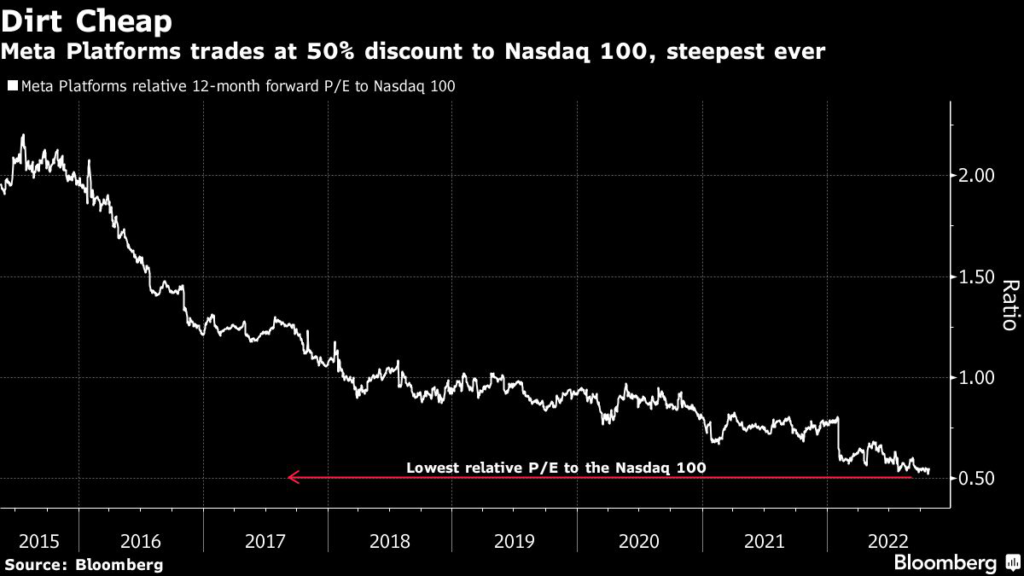
Meta was the sixth biggest US company by market capitalization at the start of the year, flirting with a $1 trillion market value. Fast forward 10 months and the stock is now worth about $260 billion, ranking it 27th in the world. Its market value is now smaller than companies including Chevron Corp., Eli Lilly & Co. and Procter & Gamble Co.

Once a Wall Street darling, Meta is gradually losing favor with brokerages. At least three investment banks — Morgan Stanley, Cowen and KeyBanc Capital Markets — cut their rating on the stock after the company gave a disappointing quarterly revenue outlook.

“Meta remains too aggressive with its investments in long-term initiatives despite a sharp deceleration in expected revenue growth,” said Mandeep Singh, an analyst at Bloomberg Intelligence. “The company’s opex and capex view for 2023 is surprising, given the lack of traction so far with its metaverse efforts.” 

While Thursday’s slump was a big move, it pales in comparison to its record-setting rout in February when it plunged 26% on the back of woeful earnings results, and erased about $251 billion in market value. That was the biggest wipeout in market value for any US company ever. 

The decline in the stock this year has attracted value investors, who buy beaten-down stocks in anticipation of a turnaround. But there’s no sign of those bets paying off any time soon. 

Meta announced its shift to investing in virtual reality a year ago, along with a name change of the company from Facebook Inc. to Meta Platforms. The company said Wednesday it expects total expenses for this year to be $85 billion to $87 billion. 

For 2023, that number will grow to an expected $96 billion to $101 billion. That’s the big negative, since investors were hoping Meta would aggressively cut costs, said Neil Campling, an analyst at Mirabaud Securities. 

The company’s quarterly capital expenditure was more than all but what 16 of the S&P 500 companies spent last year, according to Bloomberg data. 

Campling likened a buillish trade in Meta to IBM in 2005, saying “like IBM symbolizes dinosaur tech 1.0… so Meta faces the risk of being the next-generation fossil.”

–With assistance from Tom Contiliano, Kit Rees and Matt Turner.

(Updates pricing throughout)

More stories like this are available on bloomberg.com

©2022 Bloomberg L.P.

Bitcoin Miner Core Scientific Says It May Seek Bankruptcy

(Bloomberg) — Core Scientific Inc., one of the world’s largest miners of Bitcoin, warned that it may run out of cash by the end of the year and could seek relief through bankruptcy protection. 

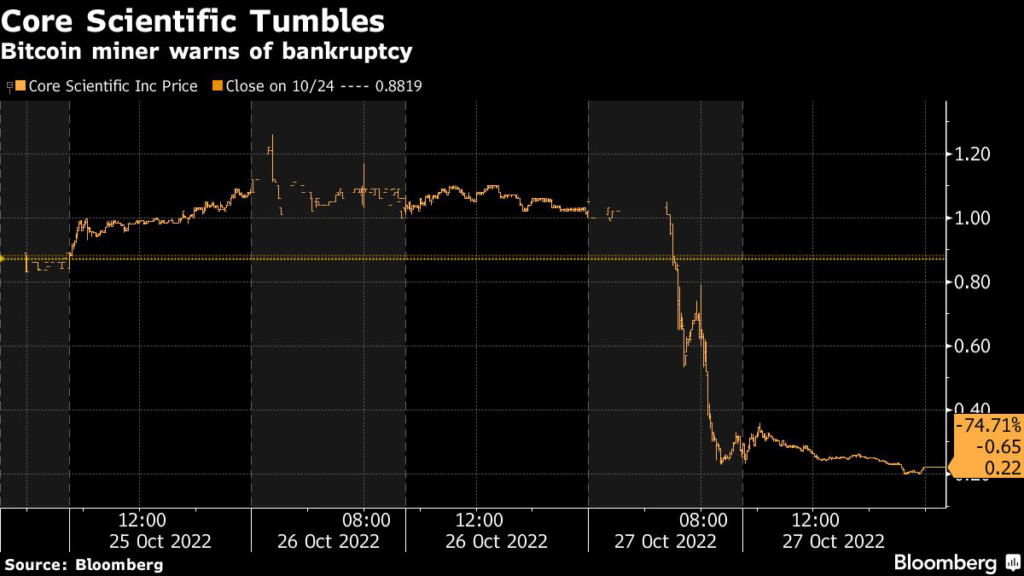
Operating performance and liquidity have been severely impacted by the prolonged drop in the price of Bitcoin, a rise in electricity costs, increased competition and litigation with bankrupt Celsius Networks LLC, the Austin, Texas-based company said in a US Securities and Exchange Commission filing on Thursday. Shares of Core Scientific  dropped 78% on Thursday, its worst trading day since going public earlier this year through a merger. 

Bitcoin mining companies such as Core Scientific had recently been increasingly opting to sell equity, resorting to one of their least attractive options to raise money as profits dry up and higher interest rates makes borrowing more expensive. The company entered into a $100 million common stock purchase agreement with B. Riley Principal Capital II in July. Bitcoin has slumped almost 70% since reaching a record high in November 2021.

“We could see similar filings within the sector,” said Brian Dobson, an analyst at Chardan Capital, who had a ‘buy’ rating on the shares. “This is going to weigh on all of the publicly traded crypto miners.”

Should Core Scientific file for bankruptcy, it would likely be the first large publicly traded Bitcoin miner to do so, Dobson said. 

A slew of bankruptcies has already hit the digital asset space. Compute North Holdings Inc., a provider of data services for miners and blockchain companies, filed for bankruptcy in September. This summer, crypto broker Voyager Digital Ltd. filed for Chapter 11 bankruptcy protection. 

“It’s no secret that the space has been struggling in general with the low Bitcoin prices,” said Chase White, an analyst at Compass Point Research & Trading who also has a ‘buy’ rating on Core Scientific shares. “They are running out of options here with their ability to raise additional liquidity.”

Core Scientific said it won’t make payments coming due in late October and early November with respect to several of equipment and other financings, including two bridge promissory notes. The company is exploring alternatives, including hiring strategic advisers, raising additional capital or restructuring its existing capital structure. 

Core Scientific held 24 Bitcoins and approximately $26.6 million in cash as of Thursday. That’s compared with 1,051 Bitcoins and about $29.5 million in cash as of September, the company said in the filing.

The shares, which traded as much as $14.32 late last year, closed at 22 cents. they’ve tumbled 98% since the start of the year. 

Riot Blockchain Inc. fell 3% to $6.84, while Marathon Digital Holdings Inc. dropped 1% to $13.65. The companies are down about 69% and 58% this year, respectively. 

Other Actions by Core Scientific: 

  • Engaged Weil, Gotshal & Manges as legal advisers, and PJT Partners as financial advisers
  • Begun to engage in discussions with creditors regarding initiatives to improve liquidity
  • May seek alternative sources of equity or debt financing, delay capital expenditures or evaluate potential asset sales
  • Potentially could seek relief under the applicable bankruptcy or insolvency laws

(Updates with closing share prices.)

More stories like this are available on bloomberg.com

©2022 Bloomberg L.P.

Elon Musk Wants a Washington Agency to Embrace the Digital Age

(Bloomberg) —

A few weeks from now, Tesla will notify owners of almost 1.1 million vehicles about a safety issue the electric-car maker already started addressing last month.

The US National Highway Traffic Safety Administration didn’t force the manufacturer to make the fix — Tesla discovered the window glitch through internal testing and determined it warranted a voluntary recall. But the company is required by law to send out letters to each owner’s mailboxes, and deem this a recall, even if it remedied the issue with an over-the-air (OTA) software update.

Elon Musk isn’t the only one who thinks this is anachronistic. Justin Demaree, who owns a Model 3 and a Model Y, has at least twice received a letter from Tesla about a problem Tesla had addressed with an OTA update a week or two before.

“It’s confusing for customers,” says Demaree, whose YouTube account Bearded Tesla Guy has more than 60,000 followers. “Getting that letter does seem wasteful.”

Musk no doubt has more pressing issues with NHTSA. The agency has been scrutinizing Tesla’s driver-assistance system Autopilot through two defect investigations, one of which was opened after its vehicles repeatedly collided with police cars and fire trucks at crash scenes. Shortly after that probe was opened, the company may have undercut its chief executive officer’s bellyaching by neglecting to issue a recall when it deployed an OTA update intended to improve how Teslas detect emergency vehicles.

Nevertheless, as more automakers follow Tesla’s lead and build OTA update capability into their vehicles, at least one former NHTSA administrator agrees the agency could afford to update its notification protocols.

“It is time to bring the recall process into line with the technology now available,” says Mark Rosekind, who headed the regulator during the Obama administration.

Congress gave NHTSA the ability to pivot from the requirement that recall notices be sent by mail as far as back as 2012. A highway funding law passed then permitted the agency to move to a system where notifications would be sent in a manner prescribed by the Transportation Secretary.

While federal law still requires manufacturers to send recall notifications by first-class mail all these years later, NHTSA said in a statement that it’s working on a rulemaking to also require electronic recall notification. The agency noted that a federal transportation bill that superseded the 2012 measure allows for electronic notifications, but only in addition to the first-class mail requirement.

“These letters are often the only way an owner learns about a recall, the safety issue involved and the risk from the safety defect,” NHTSA said.

With recall response rates stuck in the roughly 70% range, Michael Brooks, executive director of the Center for Auto Safety, believes NHTSA should consider adopting an all-the-above approach to notifications.

“In an ideal world, you have everything bugging the hell out of you — email, text, snail mail, car alert,” Brooks says. “The more outreach on unfixed safety issues, the merrier.”

Rosekind said that each new element of a proposed update to the recall notification process “would need to be evaluated for the most appropriate mechanism.”

Brooks could see NHTSA employing a workaround that might be enough to satisfy Musk — an exemption from the mail provision, provided that manufacturers certify the software update has already been applied to all vehicles and that owners have been notified. But he isn’t holding his breath, in part because the portion of recalls being resolved over the air is still small.

“Overhauling the entire recall notification system based on OTAs probably doesn’t make sense,” he said.

(Corrects spelling of name in third and fourth paragraphs.)

More stories like this are available on bloomberg.com

©2022 Bloomberg L.P.

Tech Losses Weigh on US Stocks in Seesaw Session: Markets Wrap

(Bloomberg) — Wall Street is contending with another volatile session as investors mull the Federal Reserve’s path of interest-rate hikes while assessing mixed economic data and conflicting earnings reports from major companies.

The S&P 500 dropped after swinging between gains and losses. The Nasdaq 100 fell more than 1%. Meta Platforms Inc. plunged as much as 25% as at least three investment banks downgraded the stock after disappointing earnings. But Caterpillar Inc. shares surged the most in two years after the bellwether company highlighted strong buyer demand.

Still, lackluster earnings from big-term firms this week has underscored the impact of the Fed’s tightening regime and consequently, the surging dollar. Amazon.com Inc. and Apple Inc. are among megacap companies slated to report earnings Thursday after hours. 

Meanwhile, Treasuries gained, with the 10-year yield pushing below 4% on speculation of a Fed pivot. The dollar pared gains after data showed that US gross domestic product advanced for the first time this year. But the stock and currency markets are digesting this data differently because it’s difficult to tell what the Fed is planning to do next, said Fiona Cincotta, senior financial markets analyst at City Index.

The GDP report showed the US economy rebounded after two quarterly contractions, which briefly assuaged concerns of an imminent recession. But the data also highlighted that consumer spending remains under pressure because of inflation.

“The US dollar is reading into this that perhaps it’s going to keep the Fed on that hawkish path for longer,” Cincotta said by phone. “Whereas the stock market seems to be reading it completely differently, almost as if it’s expecting the Fed to be sort of moving toward that less hawkish stuff.”

Read More: US Economy Rebounds as Consumers, Businesses Show Resilience

In any case, GDP numbers may not provide investors with a complete picture of the current state of the economy because they’re backward looking, said Tom Hainlin, national investment strategist at US Bank Wealth Management. Traders will be more focused on October’s inflation print and the upcoming jobs report for further clues on the Fed’s path of rate hikes, he said.

Economists still expect the Fed to hike by three-quarters of a percentage point for the fourth time in a row when it meets next week. 

“The number one driver of capital market performance right now is this discussion of where does the Fed end up with its rate hikes, how long does it stay there, and at what point does it start to reduce those rates once it gets to the inflation level it wants?” Hainlin said by phone. “The second would be corporate profits. Is it a shallow glide lower? Is it a big stair step lower in terms of the outlook for 2023? That’s still unknown.” 

More opinions on the GDP data:

Chris Zaccarelli, chief investment officer for Independent Advisor Alliance

“On the one hand, it is good to see that the economy is continuing to grow and that should bode well for the stock market. However, given that we are in the middle of an inflation fight, the Federal Reserve will likely feel that they need to continue to be aggressive in their rate hikes.”

Richard Flynn, managing director at Charles Schwab UK

“Investors may be relieved by today’s GDP figures which exceeded expectations. This announcement follows strong September job data showing that, despite some stress fractures beneath the surface, the labor market remains strong in terms of net jobs created. That has helped bolster consumer spending; the downside is that credit card debt has increased, and savings rates have plunged due to still-hot inflation.”

Stan Shipley, economist at Evercore ISI

“Demands for the economy was fine as real GDP climbed a more-than-expected +2.6% in 3Q. The GDP deflator advanced less than expected +4.1%. The inflation story is probably the most influential part of this release. Attention will now shift to 4Q activity. Despite news stories of layoffs, initial unemployment claims stayed low. For now, the fixed income market is discounting the risk of a near term recession.”

Earlier, the European Central Bank lifted its policy rate by 75 basis points — in line with expectations — and signaled more tightening ahead. The euro fell. 

Key events this week:

  • Bank of Japan policy decision, Friday
  • US personal income, personal spending, pending home sales, University of Michigan consumer sentiment, Friday

Some of the main moves in markets:

Stocks

  • The S&P 500 fell 0.5% as of 2:56 p.m. New York time
  • The Nasdaq 100 fell 1.8%
  • The Dow Jones Industrial Average rose 0.8%
  • The MSCI World index was little changed

Currencies

  • The Bloomberg Dollar Spot Index rose 0.4%
  • The euro fell 1.2% to $0.9963
  • The British pound fell 0.6% to $1.1560
  • The Japanese yen rose 0.1% to 146.22 per dollar

Cryptocurrencies

  • Bitcoin fell 0.8% to $20,580.49
  • Ether was little changed at $1,555.13

Bonds

  • The yield on 10-year Treasuries declined seven basis points to 3.94%
  • Germany’s 10-year yield declined 15 basis points to 1.96%
  • Britain’s 10-year yield declined 17 basis points to 3.40%

Commodities

  • West Texas Intermediate crude rose 1.2% to $88.96 a barrel
  • Gold futures fell 0.3% to $1,663.80 an ounce

–With assistance from Elaine Chen, Emily Graffeo, Vildana Hajric and Peyton Forte.

More stories like this are available on bloomberg.com

©2022 Bloomberg L.P.

US Expects Deal With Allies on China Chip Curbs in Near Term

(Bloomberg) — The top US official overseeing export controls said he expects a deal with global allies to limit shipments of chip-production equipment to China in the near term. 

Such a move — if achieved — will expand Washington’s efforts to keep cutting-edge semiconductor technology out of China and away from the country’s military.

“We expect to have a deal done in the near term,” Alan Estevez, under secretary of Commerce for industry and security, told an audience at an event hosted by the Washington-based Center for a New American Security on Thursday. Making the controls multilateral is “a work in progress,” he said.  

The US Commerce Department unveiled the sweeping regulations on Oct. 7, aiming to curb the sale of advanced semiconductors and equipment to China and ban Americans from helping with the country’s development of chip technologies, striking at the foundation of the country’s efforts to build its own cutting-edge chip technologies.  

Commerce officials have said they are working to coordinate export controls with other nations and that its rules will lose effectiveness over time if allies do not join the US. 

The global chip-equipment market is dominated by three American suppliers — Applied Materials Inc., Lam Research Corp. and KLA Corp. — as well as Japan’s Tokyo Electron Ltd. and the Netherlands’ ASML Holding NV. 

All of them are subject to complicated regulations that limit what they can sell to Chinese customers, but the non-American firms have more latitude in doing business with China than their US peers. 

US officials have recently indicated that they may be able to restrict the flow of foreign chip machinery to China by demanding that any non-US tools that use even the smallest amount of American technology cannot be sold to China without Washington’s approval, a measure if adopted could affect both ASML and Tokyo Electron. 

Estevez reiterated this on Thursday, saying that the so-called foreign direct product rule, an export-control measure that could allow the US to restrict the flow of foreign machines made with US technologies, is a tool Washington can wield when needed. 

Information Sharing

Estevez said the US will share information on Chinese threats, which also affect other countries, during talks with allies on the multilateral approach, and that American officials are talking to companies directly too about export controls. He said US semiconductor manufacturing-equipment suppliers have told officials that they want export-control measures to be multilateral. 

The BIS chief said he wants rules for American companies to be “fair with their competition across the globe, and it’s fair for their competition with each other,” adding that he and other officials such as National Security Advisor Jake Sullivan and Commerce Secretary Gina Raimondo are talking to allies about the issue. 

Estevez said that Washington briefed allies before announcing the latest round of measures. 

The move sent shock waves through the $550 billion industry. Already, US chip-equipment suppliers have stopped employees from working with China’s top memory chipmaker and indicated their sales will take a hit. 

Estevez said that with the new rules, the US is targeting China’s capabilities at making advanced chips and it is not trying to eliminate the country’s capabilities at making more mature semiconductors altogether. 

–With assistance from Ian King.

(Updates with comment from Estevez in ninth paragraph.)

More stories like this are available on bloomberg.com

©2022 Bloomberg L.P.

Ukraine Latest: Putin Denies Russia Plans to Use Nuclear Weapons

(Bloomberg) — Russian President Vladimir Putin said there was no need for Russia to launch a nuclear strike on Ukraine, and denied his country had ever discussed the use of atomic weapons in the war, now in its ninth month.

Putin claimed Russia has only used “hints” in response to repeated US and European discussion of a possible atomic conflict, telling an audience of foreign-policy experts that the West was trying to influence Moscow’s friends and allies by showing “how terrible Russia is.” 

China is willing to deepen its cooperation with Russia at all levels, according to a Chinese readout of a phone call between Foreign Minister Wang Yi and his Russian counterpart Sergei Lavrov that also said the pair discussed Ukraine. Russia hasn’t commented. 

Ksenia Sobchak, the celebrity-journalist daughter of Putin’s political mentor fled Russia for Europe as police detained a close associate and raided her home as part of a criminal case for alleged extortion.

(See RSAN on the Bloomberg Terminal for the Russian Sanctions Dashboard.)

Key Developments

  • Putin-Linked Celebrity Journalist Sobchak Flees Russia
  • Is Putin Strangling Russia’s Golden Gas Goose? The IEA Thinks So
  • Russia Crisis Heralds Turning Point for Global Energy, IEA Says
  • Biden Team Reworks Plan for Russia Oil-Price Cap as Markets Sour
  • What Is a ‘Dirty Bomb’ and Why Is Ukraine Worried?: QuickTake

On the Ground

Russian forces struck the Kyiv region and the southern city of Zaporizhzhia overnight, Ukrinform reported, citing local authorities. Ukraine’s “South” command said air defense downed a Russian Ka-52 helicopter and an Su-25 fighter jet in the Kherson region Thursday morning. Ukrainian troops downed 18 out of 20 Iranian-made Shahed-136 drones launched by Russia over the past 24 hours at the country’s critical infrastructure, Commander-in-Chief of the Armed Forces Valeriy Zaluzhnyi said on Telegram. Russian assaults near seven settlements in the Donetsk and Luhansk regions were repelled over the past day, the General Staff of the Ukrainian military reported on Facebook.

(All times CET)


Putin Keeps Up Suspense on G-20 Summit Plans (7:15 p.m.)

Putin said he still hasn’t decided whether to go to next month’s G-20 summit in Indonesia, as the US and its allies have pushed for him to be excluded over his invasion of Ukraine.

“We’ll think about how we’ll do it. Russia definitely will be represented at a high level,” Putin told a questioner from Indonesia at the Valdai Discussion Club outside Moscow. “I may still go.”

Most Russians Want Peace Talks With Ukraine, Survey Shows (6:36 p.m.)

For the first time, a majority of Russians favor opening peace talks with Ukraine, according to a poll by the independent Levada Center, which also found that just a third of respondents now support the war.

Those backing negotiations with Ukraine rose to 57% in October from 48% a month earlier, while the proportion supporting continuation of the invasion fell to 36% from 44% in September, according to the nationwide survey of 1,600 Russians conducted Oct. 20-26.

Support for peace talks was highest among 18-to-24-year-olds, at 68%, and lowest among those 55 years and older, at 42%, Levada said on its website. The figures were reversed when it came to backing Russia’s mobilization of reservists to fight in Ukraine, with 58% of the younger respondents opposed to the measure and 66% of older Russians in favor.

Putin Says Plan for Ukraine Operation Remains Unchanged (6:21 p.m.)

Putin said his plan for the “special military operation” in Ukraine remains to ensure the security of the Donbas region, but didn’t mention the sweeping goals of “de-Nazification” and “de-militarization” that he’d cited earlier in the invasion.

Putin, whose public statements of his goals for the war have shifted in the months since he dispatched troops, didn’t explain the apparent omission. He described the neighboring regions of Ukraine that Russia also illegally annexed last month as part of a historic ‘Novorossiya’ region.

His comments came in response to a question from the host of the Valdai event, foreign policy analyst Fyodor Lukyanov, who noted that “society doesn’t really understand what the plan is.”

US Defense Secretary Says No Sign Putin Plans Nuclear Attack (6 p.m.)

“We have not seen anything to indicate that Putin has made a decision to use a dirty bomb,” Defense Secretary Lloyd Austin told reporters at the Pentagon Thursday. “Nor have we seen any indications that the Ukrainians are planning such a thing. Ukrainians have, in fact, their leadership have indicated to us that is not in their plans.”

Austin said it was important to keep talking to both allies and adversaries to tamp down “dangerous talk.”

Putin Says ‘No Point’ in Making Nuclear Strike on Ukraine Weapons (5:48 p.m.)

“We don’t need a nuclear strike on Ukraine –there is no point, either military or political,” Putin said.

Former President Dmitry Medvedev has been among Kremlin officials warning that using tactical nuclear weapons in Ukraine was possible. US and European defense officials said this week that a claim by Russian Defense Minister Sergei Shoigu that Ukraine may use a so-called “dirty bomb” may be an indication the Kremlin is planning such an operation.

Pentagon Rejects Ban on Using Nukes Against Conventional Threats (5:36 p.m.)

Citing burgeoning threats from Russia and China, the Pentagon’s new National Defense Strategy rejects limits on using nuclear weapons long championed by arms control advocates and, in the past, by President Joe Biden.

Read more: Pentagon Rejects Ban on Using Nukes Against Conventional Threats

Ukraine Grain Group Says Exports May Hit 50M Tons, Urges Extension of Deal (3:25 p.m.)

If the safe-transit deal for Black Sea grain exports is renewed, shipments for the current marketing year could reach 50 million tns, the Ukrainian Grain Association said. 

The group petitioned the UN to secure an extension beyond November for the agreement, which has seen more than 9 million tons shipped since August from three ports. 

If the corridor is suspended, Ukraine will be able to send abroad a maximum of 35 million tns of grains and oilseeds, the group said. Either way, shipments will trail the 62 million tns exported in 2021-22.  

Russia Authorizes Drafting Convicts to Fight in Ukraine (2:19 p.m.)

The Russian lower house of parliament has passed a law that allows for drafting convicts to fight in Ukraine, the state news service RIA Novosti reported. 

The mechanism excludes prisoners convicted of the most serious crimes, such as terrorism, spying and treason, it said.

Separately, Russia’s Wagner mercenary group has recently been recruiting prisoners to fight in Ukraine, offering them early release. 

Kyiv May Face 30% Power Deficit From Repeated Attacks (1:27 p.m.)

Kyiv may face a 30% power supply deficit due to additional heavy Russian strikes on local energy infrastructure on Thursday morning, the capital’s grid operator Yasno said in a Facebook statement. “The damage is serious. Therefore, we have a sharp shortage of energy supply,” the company said. 

“Usually, Kyiv consumes 1,000-1,200 MW. Currently, the estimated available capacity is 600-800 MW.” Yasno said upcoming blackouts will be longer and will affect much larger number of consumers than before. 

City authorities expect more widespread, stricter limits on power supply in the next days to avoid complete outages.

Putin Told Guinea-Bissau Leader He’s Still Ready for Ukraine Talks (12:20 a.m.)

Russian President Vladimir Putin told his Guinea-Bissau counterpart that his country remains ready for talks with Ukraine, while accusing Kyiv of refusing dialog, the Kremlin said.

Putin accepted an offer by President Umaro Sissoco Embalo to convey this message to Ukraine’s Volodymyr Zelenskiy, Putin’s spokesman Dmitry Peskov told reporters on a conference call. The African leader met with Putin and Zelenskiy on consecutive days this week.

“Russia isn’t changing its position, we’re ready to talk at the table, but it’s a matter now of the complete refusal of Ukraine to negotiate,” Peskov said. Putin has so far refused to meet Zelenskiy. The Ukrainian leader has formally ruled out holding talks with Putin and tied negotiations with a future leader to a withdrawal by Russia from all the territory it’s occupied in Ukraine.

Russian Missile Attacks Become Less Intense, Official Says (11:45 a.m.)

The number of Russian missile attacks has fallen by almost two-thirds since Oct. 19 compared to a previous seven-day period, Ukrainian military spokesman Oleksiy Hromov said in a video briefing Thursday.

Ukrainian forces downed nearly half of the 52 missiles fired by Russia during the latest period, he said, which compares to Russia firing 146 missiles over the previous seven days. Single-use drone attacks declined by a third, with Ukraine shooting down 79% of the 114 drones fired.

Russian Lawmakers Tighten Ban on ‘Gay Propaganda’ (11:35 a.m.)

Russian lawmakers approved a sweeping expansion of a ban on “propaganda of non-traditional sexual relations,” broadening the restrictions to include adults and outlawing the portrayal of gay relationships in books, films, the media and the internet.

The Kremlin has stepped up its public embrace of what it calls “traditional values” in the months since its invasion of Ukraine, a conflict it portrays as a showdown with what it describes as western attitudes alien to Russia. 

Ukraine Exports 9M Tns of Farm Products Through Grain Corridor (11 a.m.)

Ukraine has loaded 397 ships and exported over 9 million tns of grain and other farm products to Africa, Europe and Asia since the opening of the grain corridor, the Ukrainian Sea Ports Administration said on Facebook.

Oleksiy Vostrikov, the administration’s chief, said Russia is “deliberately delaying the full implementation of the ‘grain initiative,’ thus Ukrainian ports work at only 30% of their capacity.” He added: “But we are doing everything possible to ensure the regularity of shipments and increase the volume of cargo processing.”  

Foodstuffs have been shipped under a safe-transit deal brokered by Turkey and the UN for three Black Sea ports. There’s currently a huge and growing backlog of ships — some 175 — waiting to move to port to load grain.  

Ukraine to Get Hawk Defense from Spain, Reznikov Says (10:45 a.m.)

Spain will be the first country to provide Ukraine with Hawk air defense systems, the country’s Defense Minister Oleksii Reznikov said on Twitter. Reznikov wrote that he expects the new military aid package from Spain to arrive soon.

Ukraine Limits Power Supply in Central Regions After Latest Attacks (10:05 a.m.)

Ukraine’s grid operator Ukrenergo instructed local operators to limit power consumption in four regions and in the city of Kyiv after Russian attacks overnight hit the electric grid in the center of the country. Energy supply will be limited in the regions around Kyiv, Chernihiv, Cherkasy and Zhytomyr after infrastructure was damaged by Russian forces.

Journalist Daughter of Putin Mentor Flees Russia (9:45 a.m.)

Ksenia Sobchak, 40, a socialite and TV presenter who has publicly questioned the invasion of Ukraine, is in Lithuania, authorities in the Baltic nation said Thursday. She called the investigation an attack on her online media outlet.

Sobchak, a celebrity who took part in anti-Kremlin protests that erupted before the 2012 presidential election, also ran in the 2018 race against Putin but got less than 2% of the vote. The opposition branded her participation as a ploy by the Russian leadership to give the appearance of democracy after officials barred Putin’s top opponent from contesting the vote. Her late father Anatoly Sobchak was the mayor of St. Petersburg.

Ukraine’s Grid Operators Still Struggling, IEA Says (9:05 a.m.)

Ukraine’s electricity-grid operators continue struggling to cover nationwide demand after two weeks of Russian strikes against power infrastructure. Generation trailed supply for a fourth consecutive day on Wednesday, according to the latest data published by the International Energy Agency.

Zelenskiy has appealed to Ukrainians to save energy after convening a meeting with advisers to discuss infrastructure repairs made more difficult by the Russian attacks, according to the Telegram channel of grid operator Ukrenergo.

Russia Says Civilian Satellites Used By Ukraine May Be Targets: Tass (8:45 a.m.)

Russia may consider civilian satellites used by Ukraine and its allies as “legitimate targets for retaliation,” a senior diplomat said, according to Tass.

Calling such equipment “quasi-civilian infrastructure,” Konstantin Vorontsov, deputy head of the arms control department at the Foreign Ministry, told a United Nations session that its use for military purposes is a “very dangerous trend.” He didn’t specify under what circumstances Russia might make such a strike.

Kyiv and its allies have used commercial satellites for intelligence information and communications to combat the Russian invasion.

More stories like this are available on bloomberg.com

©2022 Bloomberg L.P.

Close Bitnami banner
Bitnami