
Bloomberg

Bitcoin Breakout Stalls With Daily Trading Volume Also Tumbling

(Bloomberg) — Cryptocurrency price increases have mostly stalled following two days of gains that had spurred optimism for a more sustainable rally. 

Bitcoin, the largest token by market value, declined as much as 1.5% on Thursday to once again trade around $20,000, a level it’s been stuck around for weeks. Ether was little changed, while an index tracking the 100 largest coins also fell.

“After a two-day reminder of the potential for crypto markets to rally, momentum has taken pause,” Genesis analysts wrote in a note. 

Interest in crypto has waned amid a slump in prices that’s seen Bitcoin lose 70% from its all-time high of near $69,000 in November. Retail investors, in particular, have been disenchanted by the asset class. They’ve not been wading into the market in the same way they did during the first two pandemic years, with Google searches for the word “crypto” falling to the lowest levels in the past year.

Dogecoin on Thursday, however, was again posting some of the biggest gains among the thousands of tokens available for trading. The Shiba Inu meme coin that was initially launched as a joke has increased about 30% since Monday. Tesla Inc. CEO Elon Musk, an ardent supporter of the Doge token, which traded around 8 cents, pledged to close his acquisition of Twitter Inc. by Friday. Musk has talked about using cryptocurrency as a payment method for social-media platforms.  

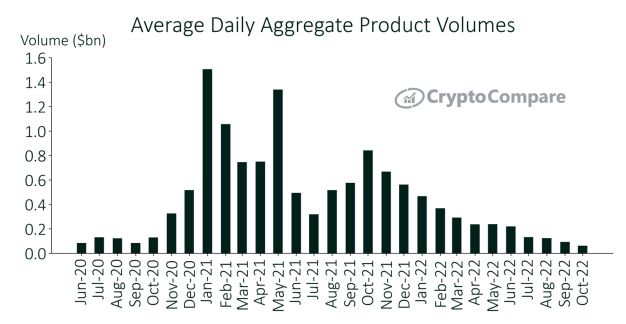
Meanwhile, institutional digital-asset products this month saw their lowest-ever volume in data going back to June 2020, with average daily trading volume dropping 34% to $61 million, according to CryptoCompare.  

“This paints a bleak picture for crypto-based institutional products, as the macroeconomic climate still possesses much uncertainty,” a note from the researcher said. 

A surge in prices earlier this week rekindled hope for digital-asset advocates that the crypto winter was thawing. Cryptocurrencies, like other riskier investments, have been suffering in a tighter-monetary-policy environment where the Federal Reserve is raising interest rates aggressively to tamp down inflation. But given that prices have been mired in a slump for months, interest has remained low. The proportion of Bitcoin that has been held for one year and over is at an all-time high, with more than a quarter of total supply now not having moved on-chain for at least five years, according to Genesis. 

The amount of Bitcoin that hasn’t moved in over a year reaching a record of over 66% this week means that there’s “less and less BTC readily available to new entrants,” said Noelle Acheson, author of the “Crypto is Macro Now” newsletter. 

But there are plenty of other signs investors remain uninvolved. The 14-day moving average of perpetuals volumes, as measured via FTX, reached its lowest point since the start of 2021, according to data compiled by Strahinja Savic at FRNT Financial. And the drop in derivatives volumes has come alongside a slump in spot volumes. Savic points out that the 14-day moving average volume of BTC/USD on the crypto platform is also at its lowest since April of last year. 

“The fact that we are seeing perp volumes taper off, paired with low Google search levels, suggests that retail traders have pushed a bit of a pause button in participating in crypto,” he said. 

More stories like this are available on bloomberg.com

©2022 Bloomberg L.P.
Facebook Is Running Partisan Ads From ‘Pink Slime’ Newsrooms, Watchdog Says

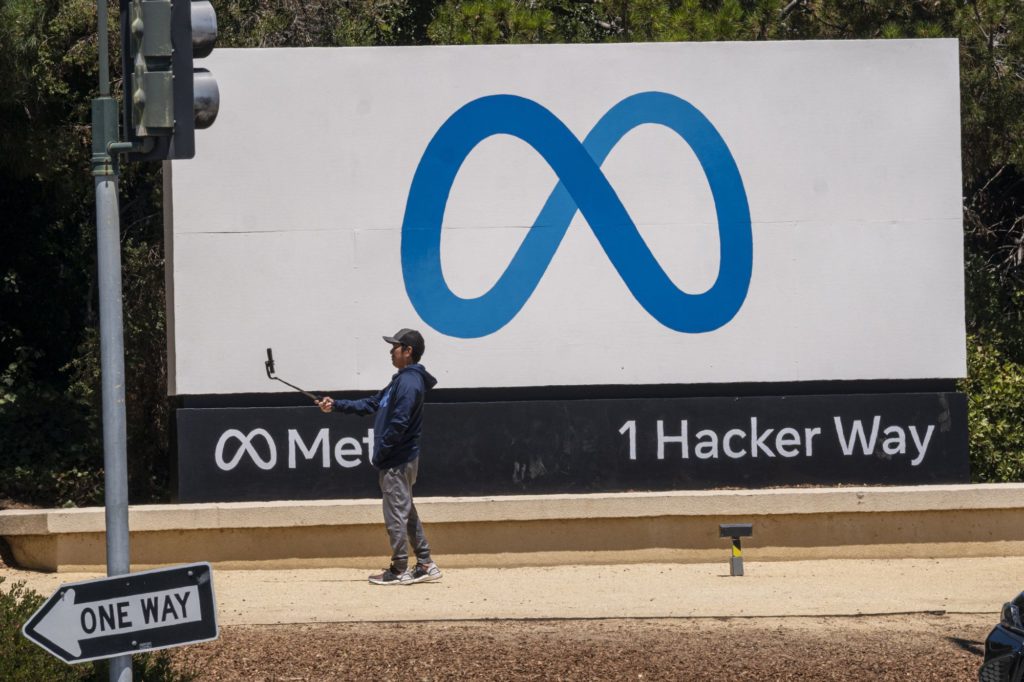
(Bloomberg) — Facebook and Instagram are running millions of dollars in ads from so-called pink-slime newsrooms — partisan organizations masquerading as local media outlets — in battleground states heading into the midterm elections, according to a report Thursday from NewsGuard.

The media watchdog, which rates the credibility of news outlets, said that both left- and right-leaning organizations are relying on the tactic, spending a total of about $3.94 million on Facebook and Instagram ads so far in 2022. The ads, which are able to reach highly specific audiences using proprietary tools, have been featured on Facebook and Instagram feeds more than 115 million times, NewsGuard found.

“The result is a new kind of political dark money,” according to the report, which analyzed the social networks’ Ad Library, a database of their political ads. “The partisan networks can, and often do, identify their funders as seemingly apolitical entities.”

Meta Platforms Inc., the parent company of Facebook and Instagram, said in response that — while news publishers connected to political entities are allowed on Facebook — they aren’t eligible to be included in the service’s News feature and “are held to the same standards as political entities when it comes to advertising.”

“People access political information in many ways, but on Facebook they benefit from a level of transparency around political advertising that not only leads the tech industry, but TV, radio and print, as well,” said Andy Stone, a spokesperson for the company.

In August 2019, ahead of the 2020 US presidential election, Facebook and Instagram updated their advertising policies to require “paid for” disclosures on political ads running on those services. A year later, the company added a rule for news publishers connected to political entities that barred them from claiming a “news exemption” in Meta’s ads authorization process.

Facebook has other transparency measures in place, including the Ad Library used by NewsGuard and a page transparency feature that shows what group is behind every Facebook page — along with some information about where page managers are located. But in spite of these policies, the news sites identified by NewsGuard are allowed to create and manage their own disclosures, NewsGuard said.

Operations such as Courier Newsroom, the American Independent and the Main Street Sentinel on the left, and Metric Media on the right, have run ads on Facebook and Instagram while veiling their ties to partisan donors on the services, the report found. Their spending has been increasing in the weeks ahead of the Nov. 8 elections, according to the watchdog.

In one example that NewsGuard identified, an article from the Main Street Sentinel was used in an ad to target millions of Facebook and Instagram feeds in Michigan, reporting that the state’s Republican gubernatorial candidate, Tudor Dixon, “said that a 14-year-old girl raped by her uncle was a ‘perfect example’ of a case in which abortion should not be allowed under the law.” On Facebook and Instagram feeds, the post carried a “sponsored” label, saying it was “paid for by the Main Street Sentinel.”

The quote attributed to Dixon was accurate, but the article left out that she favors a statewide ban that makes allowances to save the life of the mother. Moreover, the article wasn’t a case of a local news outlet simply wanting to get more eyes on its journalism, NewsGuard said. As Axios reported in March, the Main Street Sentinel’s listed publisher, Star Spangled Media LLC, was formed in February and had a connection to Will Robinson, a Democratic strategist. Other investors aren’t known, but the site has run multiple stories with President Joe Biden and Michigan Governor Gretchen Whitmer as beneficiaries.

The other operations identified by NewsGuard have a similar structure of being used by partisan operatives. In 2020, the New York Times reported that Metric Media, another network named in NewsGuard’s report, runs a fast-growing propaganda network of about 1,300 websites in all 50 states, taking advantage of a void left by vanishing local news outlets across the country. In some cases, the Times found, Metric Media outlets print physical newspapers and deliver them directly to people’s doorsteps.

When reached for comment, some of the news sites identified by NewsGuard objected to the way they were characterized.

Tara McGowan, a former Democratic operative and founder of Courier Newsroom, said that grouping Courier with the other publications mentioned by NewsGuard was inappropriate. The company added that its outlets were eligible for Facebook’s News feature, unlike the others named in NewsGuard’s report. Courier is “using every tool available to us to better inform passive news consumers who are being inundated with disinformation online,” McGowan said in a statement.

“Because of this, old guard media elites have decided to paint us with the same broad brush they use for actual so-called pink-slime operations like the ones mentioned by NewsGuard’s report.” The media company’s website says that it prioritizes hiring reporters and editors who live in the communities it serves.

The executive editor of the American Independent, meanwhile, said that outlet is “combating this disinformation by delivering readers relevant, fact-based reporting through both our national and state news platforms.”

“Right-wing extremists have flooded Facebook with conspiracy theories and lies disguised as news and designed to influence the media,” said the editor, Jessica McCreight.

Metric Media and the Main Street Sentinel didn’t immediately respond to requests for comment.

The NewsGuard report found that Meta bears responsibility for “contributing to the deception,” by adopting tools and ad policies that facilitate the schemes.

The company provides “the ideological networks with powerful tools to target audiences in battleground states, with loose standards that can be manipulated by partisan actors,” NewsGuard said.

(Updates with additional comment from Courier in 13th paragraph.)

More stories like this are available on bloomberg.com

©2022 Bloomberg L.P.
Here’s How Mergers Close as Musk and Twitter Move to the Altar

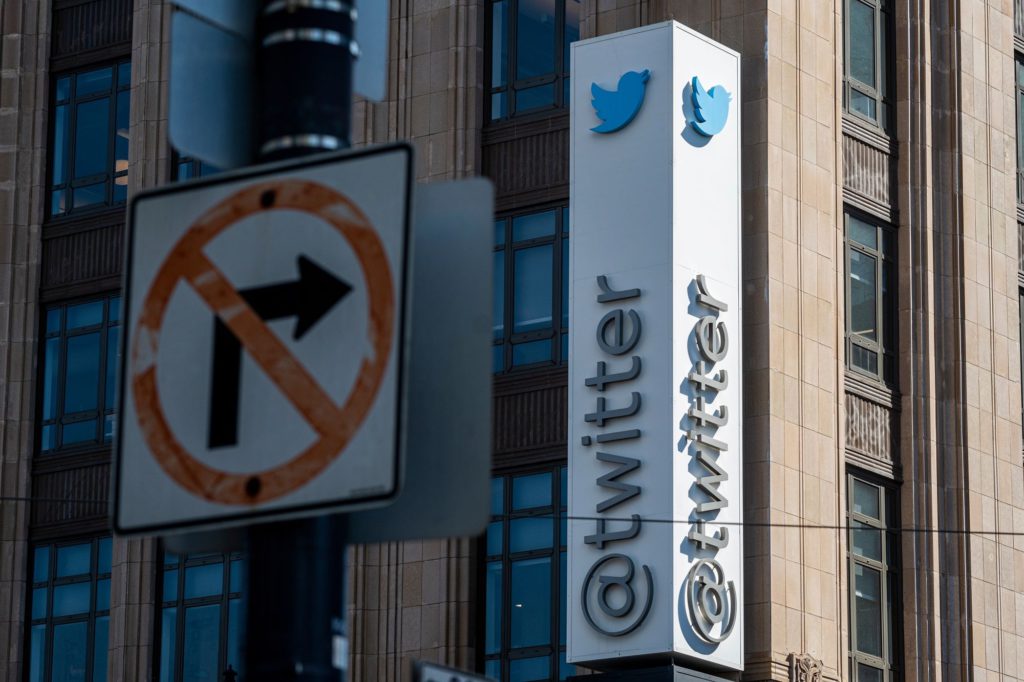
(Bloomberg) — Elon Musk’s acquisition of Twitter Inc. — one of the messiest mergers in recent history — is slated to close by Friday under the supervision of a Delaware court, Bloomberg News has reported. While deal announcements get a lot of attention, closings tend to attract far fewer eyeballs. 

But they are just as important. After all, a deal isn’t done until it’s, well, done. Primarily a legal matter handled by junior lawyers, here’s how closings typically work. 

Validating Conditions

In the days leading up to closing, lawyers and bankers confirm that the closing conditions stated in the merger agreement have been met. These conditions are usually outlined on one of the dozens of pages of deal documents. The biggest conditions to check off: obtaining regulatory and shareholder approvals. In these wake-of-the-pandemic times, this usually involves those junior lawyers hopping on a Zoom call to sort out which documents are needed, rather than gathering in a room with a checklist and binders of paperwork.

Some deals include a financial condition stating that the deal can only close if and when the funds are in place. Musk’s lawyers argued in Delaware that the Twitter deal has a financial stipulation, even though it’s not spelled out in the merger agreement. Contracts typically set a very high bar and only allow parties to withdraw from the merger if financing banks fail to turn up with the money. 

Merger Certificate

As mergers are regulated by the state where the target is incorporated, the secretary of state will have to sign off on the transaction. 

Delaware, where chancery court judges are business-law experts who hear cases on a fast-track basis, typically signs off with little delay and posts the merger certificate on its website within the hour. In some other states, like California, this process can be delayed by up to three weeks. 

Delaware, America’s incorporation destination, is home to more than half of US public companies, including Twitter and Musk’s Tesla Inc., along with more than 60% of Fortune 500 firms. The state also allows companies to confidentially pre-clear a merger certificate to confirm that there are no technical errors. 

Fund Flows 

Once the certificate is issued, lawyers representing both sides get notified and begin the fund-transfer process. 

In this case, funds from financing banks including Morgan Stanley, Musk and co-investors such as Oracle Corp. co-founder Larry Ellison, venture capital firm Sequoia Capital and others will be wired to the paying agent, typically an investment bank.

The paying agent will then distribute the funds to Twitter stockholders, as well as any holders of restricted stock units and options. The transfer is almost instantaneous. 

On the other side, Twitter shares will be transfered to the new owners. Usually it is a several-days process from when the transfer begins to when the stock hits the destination — wherever the new holders deposit them. Exceptions can be made to speed things up. 

Delisting

Simultaneously, lawyers also draft documents with the stock exchanges and the US Securities and Exchange Commission for de-listing the shares. They file them once the payment is received. This process can be done within a day. 

Closing Dinner 

When a deal is friendly, executives and advisers from both sides usually come together for a closing dinner. Junior bankers prepare skits or PowerPoint presentations taking jabs at their bosses, clients or peers. In the increasingly remote world, not all deals end with a dinner.

In more contentious situations the parties can host their own, separate dinners. If Musk does complete his acquisition of Twitter, it isn’t clear who will be celebrating with whom.

More stories like this are available on bloomberg.com

©2022 Bloomberg L.P.
AutoNation’s CEO Warns of Used-Car Price Drop as Rising Rates Curb Demand

(Bloomberg) — AutoNation Inc., the biggest US chain of car dealerships, warned that used-vehicle prices are softening as rising interest rates curb demand from more price-sensitive buyers.

The company said Thursday that third-quarter earnings rose to $6 a share excluding some items. That was below the $6.29 a share average of analysts’ estimates. Revenue increased 4% to $6.67 billion, roughly in line with the average of Wall Street projections.

Mike Manley, who took over as chief executive officer of AutoNation a year ago, said he’s been aggressively turning over his portfolio of used cars to make sure he doesn’t get stuck selling them for less than he paid.

“We’re beginning to see used-car prices mitigate with faster depreciation” among mainstream and budget cars, Manley said in an interview. “We benefit from the mix of our portfolio being premium luxury.”

Shares of the company, which also said its board approved a stock buyback of up to $1 billion, pared an early gain of as much as 6.7% to trade up 3.2% to $105.64 as of 9:57 a.m. in New York. 

Separately, Hertz Global Holdings Inc. said Thursday that its depreciation costs jumped in the third quarter, reflecting the decline in prices its used cars fetch at auction. Still, the rental-car company narrowly beat Wall Street’s estimates for profit in the period.

Pent-Up Demand

AutoNation’s CEO said new-vehicle inventory is still tight, despite the chip shortage beginning to ease, and there is strong, pent-up demand for vehicles priced above $30,000. 

“It’s easing rather than becoming a glut,” he said. 

New-car inventory will remain below pre-pandemic levels next year as automakers try to preserve margins to pay for electrification, Manley said on an earnings call Thursday.

In the used-car market, it’s just a matter of time before weaker prices at car auctions filter through to the retail market, pressuring margins for dealers, he said.

Last month, used-car retailer CarMax Inc. said profit from wholesale vehicles dropped 30% in its second quarter as buyers encountered “affordability challenges” and its bank of used cars depreciated.

(Updates with opening shares in fifth paragraph.)

More stories like this are available on bloomberg.com

©2022 Bloomberg L.P.
New York Post Confirms Twitter Feed, Website Were Hacked

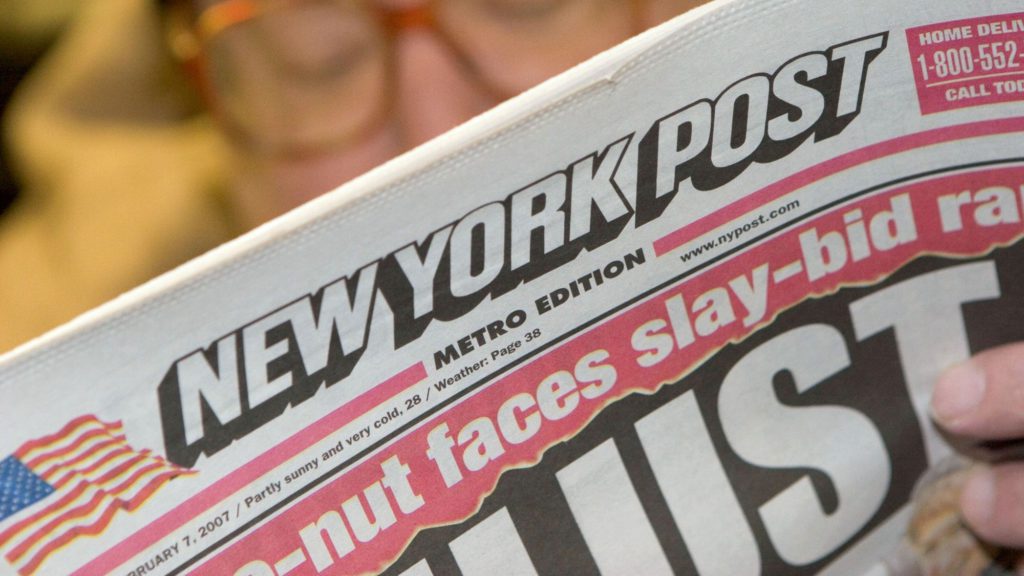
(Bloomberg) — The New York Post’s Twitter feed and website were hacked on Thursday morning, a spokesperson confirmed.

The incident is currently being investigated. Tweets on the paper’s account linked to pages on its website with offensive headlines including calling for the assassination of some US leaders, as well as racist and misogynistic content. 

The tweets and stories were quickly taken down by the news outlet. Rupert Murdoch’s News Corp. owns the New York Post. 

More stories like this are available on bloomberg.com

©2022 Bloomberg L.P.
Meta Plummets 25% as Zuckerberg’s Plea for ‘Patience’ Falls Flat

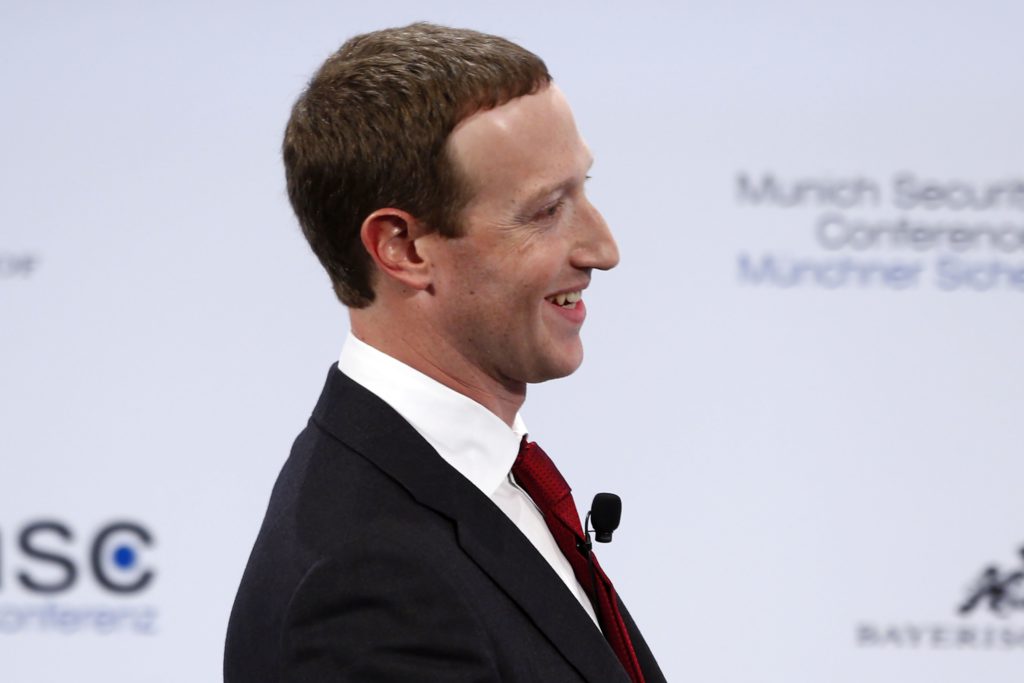
(Bloomberg) — Meta Platforms Inc. plunged as much as 25% Thursday morning after Chief Executive Officer Mark Zuckerberg asked investors for patience with the social-media giant’s swelling investments in unproven bets at an already-challenging time for digital-advertising companies.

On a call Wednesday after giving a disappointing revenue outlook, Zuckerberg sought to justify Meta’s ballooning costs to fund its version of virtual reality, the metaverse, as well as the artificial intelligence fueling major changes to its social networks.

Investors, who have already sent the stock down 61% this year, so far aren’t buying it. The Facebook parent’s market value has collapsed by a whopping $672 billion this year, putting it at risk of being removed from the ranks of the 20 largest US companies. But Zuckerberg said he is confident that Meta’s largest bets in areas such as short-form video, business messaging and the metaverse were headed in the right direction — he just couldn’t say for sure how big the payoff would be.

Read more about how Meta is on the brink of falling out of the top 20 biggest US stocks

“I think we’re going to resolve each of these things over different periods of time,” Zuckerberg said. “And I appreciate the patience and I think that those who are patient and invest with us will end up being rewarded.”

It’s proving to be a hard sell when the company expects its already-falling revenue to be less than analysts expected, and costs to be more. On Wednesday, Meta said third-quarter revenue declined 4.5% from a year prior, only the second time the company’s sales have ever declined — the first being last quarter. In the final three months of the year, Meta expects that trend to continue. The company’s fourth quarter forecasts came in at the low end of analysts’ estimates.

Meta now expects total expenses for this year to be $85 billion to $87 billion. For 2023, that number will grow to an expected $96 billion to $101 billion, the company said on Wednesday.

Read More: Meta Tumbles as Sales Forecast Shows Depth of Ad-Market Weakness

Meta has already been grappling with both a contraction in marketer spending due to economic uncertainty, and a change in Apple Inc.’s privacy policy that made all social media ads less effective. The company has cut costs by slowing hiring and narrowing priorities to focus on keeping its social media platforms relevant and expanding virtual reality offerings. 

The company, which changed its name from Facebook to Meta a year ago, is also betting big on the metaverse, virtual-reality-fueled gathering places that Zuckerberg thinks will host the future of work and communication. The effort is losing Meta billions, and the company expects to lose more money on the metaverse business next year.

Meta’s not the only internet company suffering from a weak advertising market; both Alphabet Inc. and Snap Inc. got hammered on similarly lackluster results. It is the only company that’s overhauling how its social media platforms work while spending about one in every 10 dollars it generates in sales on a virtual future that’s still years off.

In the past year, Meta has changed Facebook and Instagram’s experiences to show more algorithmically chosen content and fewer posts from the people users follow. It’s also prioritizing short-form videos, called Reels, in response to ByteDance Ltd.’s popular TikTok app, which has won users’ time and accustomed them to a feed of vertical videos based on specific interests. 

Meta’s legacy social media products need to remain popular enough to generate the advertising revenue that will fund Zuckerberg’s metaverse vision. In the third quarter, 4% more people spent time on Meta’s platforms every day, compared with the same period last year, with 2.93 billion daily active users. Monthly, the tech giant saw 3.71 billion active users for its family of apps, which also includes Messenger and WhatsApp.

On Wednesday, the company touted that Instagram surpassed 2 billion monthly active users, and said those people are spending more time watching Reels — and marketers are spending to advertise there, at an implied rate of $3 billion a year in revenue. But Reels is dragging on revenue, to the tune of $500 million in the recent quarter, as the newer product cannibalizes other ad spaces that monetize at faster rates. It could be as much as 18 months before that changes, Zuckerberg said. 

“How investors are feeling right now is that there are just too many experimental bets versus proven bets in the core,” Brent Thill, an analyst at Jefferies LLC, said on the earnings call with Meta executives.

Zuckerberg has asked for patience before. In 2015, investor questions focused on when WhatsApp, Instagram and Messenger would make money. The difference then was those applications already had hundreds of millions of users each.

“Meta needs to turn its business around,” said Debra Aho Williamson, an analyst at Insider Intelligence. “As Facebook Inc., it was a revolutionary company that changed the way people communicate and the way marketers interact with consumers. Today it’s no longer that innovative groundbreaker.”

(Updates with opening shares)

More stories like this are available on bloomberg.com

©2022 Bloomberg L.P.
Bolsonaro Claims Unfair Treatment in Election Before Runoff

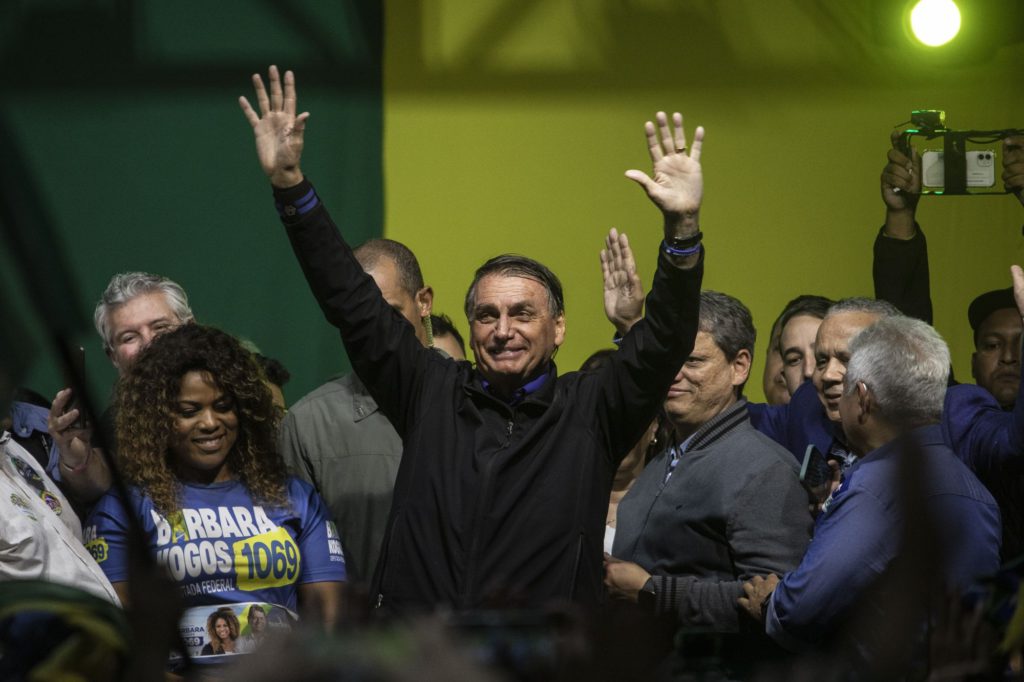
(Bloomberg) — President Jair Bolsonaro ratcheted up attacks on Brazil’s electoral authority after it denied a request to investigate radio stations for allegedly giving preference to his opponent, former President Luiz Inacio Lula da Silva.

Speaking in the presidential palace late Wednesday, Bolsonaro slammed Alexandre de Moraes, chief of the electoral court, and announced plans to appeal his decision. Brazil holds its presidential runoff on Oct. 30.

“We will go to the limits, by what’s allowed by the constitution, and prove what our audits show, that there is truly a huge disparity,” he said.

Bolsonaro’s allegations come after a series of campaign mistakes and a shocking incident involving one his most vocal supporters forced him to spend days on the defensive. The decision to claim unfair treatment by radios and electoral authorities wasn’t consensual within his campaign, with some advisers worried it may be seen by voters as a preparation for his possible defeat on Sunday.

Lula said such allegations show Bolsonaro is desperate. “The campaign is coming to an end and he realized he may lose the election,” he said in a radio interview on Thursday. 

Bolsonaro Versus Moraes

The latest row between the conservative president and Moraes, a Supreme Court justice who heads a wide-reaching investigation into disinformation, centers on air space for campaign propaganda. By law, TV and radio stations have to lot equal time to each presidential hopeful in the final stretch of the race.

On Monday, lawyers from the Bolsonaro campaign said broadcasters in Brazil’s North and Northeast regions, strongholds of support for the leftist challenger, had played a disproportionate amount of Lula’s radio spots. 

Read More: Bolsonaro’s Brawl With a Top Justice Tests Brazil’s Democracy

Moraes, who often clashes with Bolsonaro for his attacks on Brazil’s institutions, said the incumbent failed to provide evidence. He also ordered an investigation into the president’s campaign for a possible attempt to disrupt the election.

Tensions are running high ahead of the Sunday vote, with polls showing Lula holding a narrow lead. Well before this year’s campaign kicked off, the incumbent has cast doubt on Brazil’s electronic voting system, raising fears of a potential contested result if he loses.

In his speech, Bolsonaro also claimed without providing evidence that he underperformed in the first-round vote in cities that didn’t air his campaign ads. 

“My side has been hurt a lot, and not just now,” he said.

–With assistance from Simone Iglesias.

(Updates with context and comment from Lula in paragraphs 4-5)

More stories like this are available on bloomberg.com

©2022 Bloomberg L.P.
Musk Tells Twitter Staff He Doesn’t Plan to Cut 75% Of Jobs

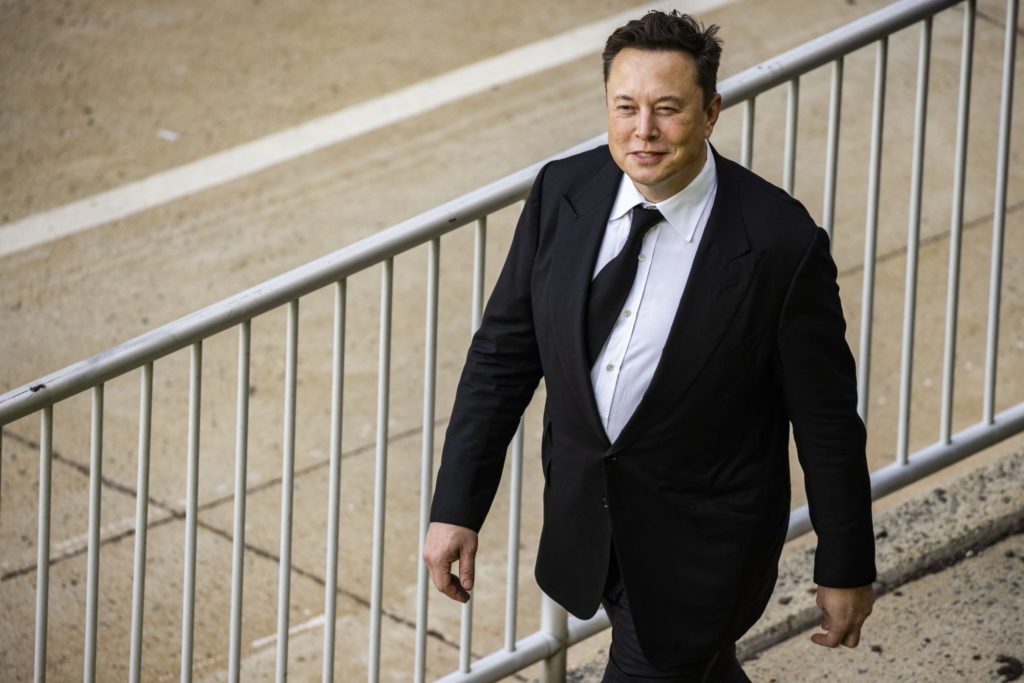
(Bloomberg) — Elon Musk told Twitter Inc. employees on Wednesday that he doesn’t plan to cut 75% of the staff when he takes over the company, according to people familiar with the matter.

Musk, whose $44 billion deal for Twitter is on track to close Friday, denied the previously reported number in an address to employees at the company’s San Francisco office, said the people, who declined to be named because the information isn’t public. 

The billionaire is still expected to cut staff as part of the takeover, causing anxiety among workers. Earlier on Thursday, Musk posted a video clip of himself walking into the offices carrying a kitchen sink. He changed his Twitter profile description to read “Chief Twit.”

The social-media company’s workforce now numbers about 7,500, and many employees are greeting the prospect of ownership by Musk with trepidation. The billionaire expects to double revenue within three years, a person familiar with the matter said last week. In recent days, fears have been growing about a major reduction in headcount or another reorganization, another person said.

Read More about Musk’s visit to Twitter HQ

Musk on Thursday posted a tweet to Twitter advertisers, saying he was buying the company “to try to help humanity, whom I love.” Musk also said that when done right, advertising can “delight, entertain and inform you.” In order for that to be true, he added, Twitter needs to run ads that are relevant to users’ needs.

The deal is expected to close by 5 p.m. New York time Friday, as lawyers and bankers on both sides race to finalize the paperwork. Completing the transaction would mark the culmination of a months-long saga that saw Musk amass a big stake in the company, agree to join its board before changing his mind and then embark on a hasty quest to take Twitter private. Aside from the debt financing, he also rounded up a who’s who of billionaire buddies and other investors to pony up part of the equity needed, signing the takeover agreement while waiving the right to examine Twitter’s financials.

As markets tumbled and it became clear that he had vastly overpaid, Musk reversed course again, backing out of the deal and alleging that Twitter misled him about the prevalence of fake accounts. After Twitter took him to court in Delaware to force his hand, Musk relented and negotiations resumed.

Musk offered $54.20 a share for the company and his efforts to back out of the transaction sent the shares roughly 40% below the offer price in July. On Tuesday, Bloomberg reported that Musk has told bankers he expected the deal to close by the deadline. Banks were expecting a borrowing notice from Musk for $13 billion in debt financing, with the intention of the funds going into escrow Thursday.

The gap between Twitter’s share price and the takeover offer narrowed to less than $1 as the stock closed at $53.35 on Wednesday in New York. The shares rose about 1% to $53.91 at 9:35 a.m. Thursday. 


(Updated with background from fourth paragraph, shares.)

More stories like this are available on bloomberg.com

©2022 Bloomberg L.P.

Musk Says Twitter Can’t Become a ‘Free-for-All Hellscape’

(Bloomberg) — Elon Musk, who’s on track to buy Twitter Inc. for $44 billion on Friday after earlier trying to back out of the deal, said he’s making the purchase “to try to help humanity, whom I love.”

Musk said Thursday in a post on the social media platform that he’s buying it because it’s “important to the future of civilization to have a common digital town square,” but it “obviously cannot become a free-for-all hellscape, where anything can be said with no consequences!”

The tweet was addressed to advertisers, and he said much of the speculation around why he is buying the platform and what he thinks about advertising has been wrong. He said that when done right, advertising can “delight, entertain and inform you.” In order for that to be true, however, Twitter needs to show advertising that is relevant to users’ needs, he said.

To view the source of this information click here

More stories like this are available on bloomberg.com

©2022 Bloomberg L.P.
Big Tech Earnings Signal Disappointment Ahead for Amazon

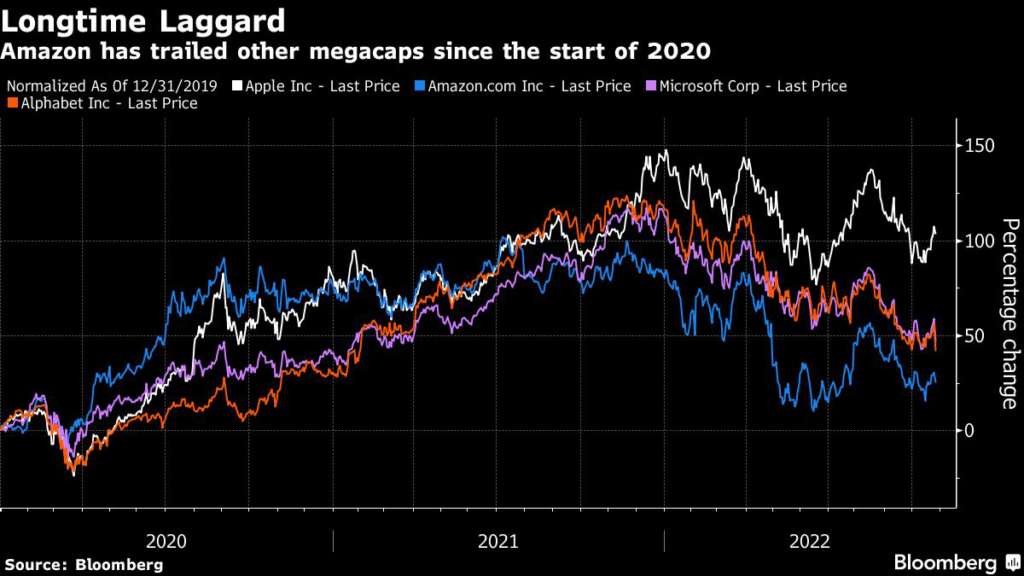
(Bloomberg) — In both bull market and bear over the past two years, Amazon.com Inc.’s shares have lagged behind those of other megacap companies, and tepid results from some of its biggest peers suggest a long-awaited rebound could remain elusive.

Since the start of 2020, a period that includes the tailwind it saw from the pandemic, Amazon is up 23%, the weakest performance of Wall Street’s four largest companies — Apple Inc. has more than doubled, and Microsoft Corp. and Alphabet Inc. are up more than 40%. 

Amazon fell 1.9% on Thursday, while the Nasdaq 100 Index was flat.

Amazon’s third-quarter earnings after the market close on Thursday are likely to show the same signs of slowing growth that have afflicted Alphabet Inc. and Microsoft Corp. The Seattle-based company’s cloud-storage business, Amazon Web Services, has been expanding quickly, but Microsoft gave a lackluster forecast this week for its own cloud unit, Azure.

“Big tech earnings haven’t been particularly positive, and it seems like there’s no place to hide,” said David Klink, senior equity analyst at Huntington Private Bank. “What’s taking people a little by surprise is that the cloud, which had been viewed as something of a haven for the past few years, is showing some weakness.” 

Microsoft’s results led to the biggest one-day drop for the stock since March 2020. Alphabet sank 9.1% in the wake of its own earnings, and while weaker-than-expected ad revenue was the focus of the report, the Google parent’s cloud offering lost $699 million in the quarter. Facebook parent Meta Platforms Inc. also gave a weak revenue forecast, sending shares to their lowest since 2016.

Both cloud and advertising are key pillars of Amazon’s growth narrative. While its overall revenue increased 21.7% in 2021, its advertising services business expanded by 58% and Amazon Web Services grew 37%, according to data compiled by Bloomberg. The two businesses accounted for almost 20% of company revenue last year.

Klink is positive on Amazon’s long-term potential, but he wants to see an increased focus on earnings over revenue growth. “It needs to move in that direction, because right now it is still valued like a growth stock and growth is slowing.” 

Revenue is expected to rise 11% this year, considerable for a company valued at $1.18 trillion, but that would be its slowest pace on record. Snap Inc. last week reported its slowest quarterly sales growth ever and the shares plunged 28%.

At the same time, Amazon’s stock trades at 40 times estimated earnings, well below its 10-year average of 61, but twice the multiple of the Nasdaq 100 Index.

High inflation has pushed the Federal Reserve to raise interest rates, contributing to the yield on the 10-year US Treasury moving above 4%, compared with 1.5% at the start of the year. This has contributed to investors rotating out of high-valuation stocks and into ones that screen as value plays. 

Barry Knapp, managing partner at Ironsides Partners, expects this trend will continue as inflation remains elevated and the Fed stays hawkish.

“Cloud is still a great business for Amazon and Microsoft, but it’s not going to keep growing at the pace it was, and right now you’re paying an above-average price for below-average growth,” he said. “Big tech doesn’t look cheap the way financials or energy or materials do, and the higher-rate environment means the backdrop is just less favorable. The days of investors chasing growth at any price are over.”


Tech Chart of the Day

While stock losses have been widespread this year, the selloff in big tech has had an outsized impact on the Nasdaq 100. The index, which is weighted by the market capitalization of its components, is down 30% this year, while an equal-weighted version of the index is down a narrower 26%. On Wednesday, the equal-weight index dipped 0.4%, compared with a drop of 2.3% for the cap-weighted index, which was pressured by Alphabet and Microsoft’s results. Over the past five years, however, the Nasdaq 100’s 84% gain easily outpaces the 57% rise of the equal-weighted version.

Top Tech Stories

  • Meta Platforms gave a forecast for revenue in the fourth quarter that was on the low end of analysts’ estimates, showing the social-media platform continues to struggle with a weak advertising market amid an economic slowdown.
    • Meta Chief Executive Officer Mark Zuckerberg asked investors for patience with the social-media giant’s swelling investments in unproven bets at an already-challenging time for digital-advertising companies.
    • Meta shareholders are paying dearly for its spending on the metaverse: The Facebook parent’s market value has collapsed by a whopping $520 billion in the past year, and now it’s on the brink of getting booted from the ranks of the 20 largest US companies.
  • Elon Musk told Twitter Inc. employees on Wednesday that he doesn’t plan to cut 75% of the staff when he takes over the company, according to people familiar with the matter.
  • Samsung Electronics Co. named Jay Y. Lee executive chairman of South Korea’s largest company, finalizing a long-anticipated elevation just as a supply chain crisis and escalating geopolitical tensions roil the world’s biggest chipmaker.
    • Over the past two weeks, every major memory chipmaker has warned of a supply glut and tumbling prices, announcing it was time to slash capital spending. Not so market leader Samsung.
  • Huawei Technologies Co.’s net income fell about 40% in the first three quarters of this year as the Chinese telecom giant couldn’t revive its cash cow smartphone business and spent heavily on research and development.
  • STMicroelectronics NV signaled its sales momentum in the fourth quarter may begin to slow amid signs that demand for chips globally is weakening. The shares sank as much as 8.5% in Paris trading.

–With assistance from Subrat Patnaik.

(Updates to market open.)

More stories like this are available on bloomberg.com

©2022 Bloomberg L.P.

Close Bitnami banner
Bitnami
