Bloomberg

Meta’s $677 Billion Rout Boots It Out of World’s Top 20 Stocks

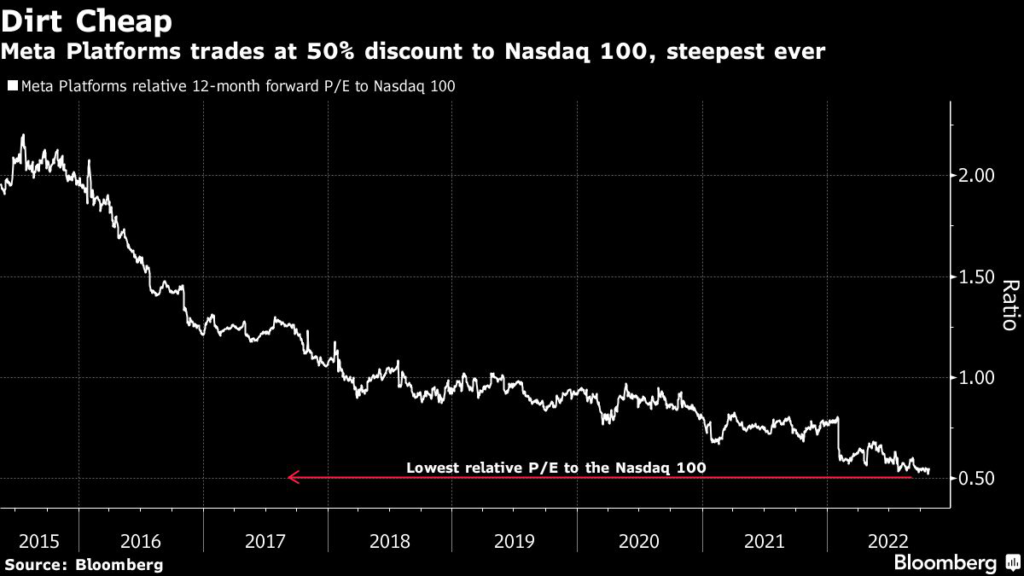
(Bloomberg) — Meta Platforms Inc. shareholders are paying dearly for its spending on the metaverse: The Facebook parent’s market value has collapsed by a whopping $677 billion this year, forcing it out from the ranks of the world’s 20 largest companies.

The punishment shows no signs of easing anytime soon. Meta’s stock is down as much as 25% after it spooked investors with ballooning costs to fund its version of virtual reality and a decline in revenue. 

Meta was the sixth biggest US company by market capitalization at the start of the year, flirting with a $1 trillion market value. Fast forward 10 months and the stock will be worth about $258 billion, ranking it 26th. Its market value is now smaller than companies including Chevron Corp., Eli Lilly & Co. and Procter & Gamble Co.

Once a Wall Street darling, Meta is gradually losing favor with brokerages. At least three investment banks — Morgan Stanley, Cowen and KeyBanc Capital Markets — cut their rating on the stock after the company gave a disappointing quarterly revenue outlook.

“Meta remains too aggressive with its investments in long-term initiatives despite a sharp deceleration in expected revenue growth,” said Mandeep Singh, an analyst at Bloomberg Intelligence. “The company’s opex and capex view for 2023 is surprising, given the lack of traction so far with its metaverse efforts.” 

While Thursday’s premarket slump is a big move, it pales in comparison to its record-setting rout in February when it plunged 26% on the back of woeful earnings results, and erased about $251 billion in market value. That’s the biggest wipeout in market value for any US company ever. 

The decline in the stock this year has attracted value investors, who buy beaten-down stocks in anticipation of a turnaround. But there’s no sign of those bets paying off any time soon. 

Meta announced its shift to investing in virtual reality a year ago, along with a name change of the company from Facebook Inc. to Meta Platforms. The company said Wednesday it expects total expenses for this year to be $85 billion to $87 billion. 

For 2023, that number will grow to an expected $96 billion to $101 billion. That’s the big negative, since investors were hoping Meta would aggressively cut costs, said Neil Campling, an analyst at Mirabaud Securities. 

The company’s quarterly capital expenditure was more than all but 16 of the S&P 500 companies spent all of last year, according to Bloomberg data. 

Campling likened a buillish trade in Meta to IBM in 2005, saying “like IBM symbolizes dinosaur tech 1.0… so Meta faces the risk of being the next-generation fossil.”

–With assistance from Tom Contiliano and Kit Rees.

(Update stock moves throughout.)

More stories like this are available on bloomberg.com

©2022 Bloomberg L.P.

Hertz Tumbles as Cooling Used-Car Market Hurts Profit

(Bloomberg) — Hertz Global Holdings Inc. shares fell after the car rental company’s latest earnings showed that falling used-car prices are starting to hurt profits.

Hertz posted third-quarter adjusted earnings of $1.08 a share, slightly above a consensus estimate of analysts for $1.05 a share, but still down from $1.20 in the same period a year ago. One of the chief culprits was rising depreciation costs for the cars in its fleet.

Rental-car companies have enjoyed a sustained period of record used-car prices that reduce costs by minimizing depreciation and also brought in fat profits at auction. That started changing earlier this year and the bonanza may well be over.

See also: AutoNation CEO Warns of Used-Car Price Drop as Rising Rates Bite

“Depreciation is going to go up because of the net effect of used-car prices coming down,” Hertz Chief Executive Officer Stephen Scherr said in an interview. “But utilization is remaining high across the industry and Hertz. We’re seeing undeniable strength.”

The rental business has been strong as travel has bounced back in both domestic and international markets, he said. The company is renting out 80% of its cars, which is on par with the industry’s utilization before the Covid-19 pandemic.

Shares of the Estero, Florida-based company fell 7% to $17.55 at 9:33 a.m. in New York. The stock fell about 24% this year through Wednesday’s close. 

Rental rates remain high. Hertz said it brought in an average of $68.57 a day per car globally, which is $22 a day more than the company brought in during 2018 before the pandemic and its 2020 bankruptcy. Even with used-car prices falling in the quarter, Hertz’s margins of 28% more than doubled pre-pandemic levels.

In the third quarter, Hertz’s monthly depreciation costs per vehicle in the US climbed to $198 — up from just $21 in the third quarter of 2021. That’s headed closer to historic rates that have usually run between $250 and $300 monthly per car.

Prices Down

Scherr said used-car prices fell 8% nationwide in the quarter. Hertz was able to sell most of the cars it needed to dispose of early in the quarter and before the price decline accelerated. 

Going forward, Scherr said he expects travel to remain strong and used-car prices will fall, but not rapidly. Automakers haven’t been able to return to full production rates due to the ongoing semiconductor shortage. That means there will be sustained demand for used cars.

“I think it trends flat to slightly down from here,” he said. “Our expectation is that new-car production is not going to come back that quickly.”

(Updates with CEO comments throughout)

More stories like this are available on bloomberg.com

©2022 Bloomberg L.P.

Revenue-Starved Nigeria to Use UK Fintech Platform to Boost Online Gaming Taxes

(Bloomberg) — Revenue-starved Nigeria will use a platform developed by a UK-based financial technology firm to improve tax collection from online gaming companies.

The Federal Inland Revenue Service will use e-Technologies Global Ltd.’s Sentinal National Payment Gateway to automate the administration of taxes on online gaming, Muhammad Nami, the agency’s executive chairman, said in an emailed statement. The platform will “not only collect tax revenues at source, but also provide us with tax-reporting and monitoring tools in real time,” he said.

Nigerian authorities are looking at ways to address revenue shortfalls that President Muhammadu Buhari said in his budget statement earlier this month “remain the greatest threat to Nigeria’s fiscal viability.” Africa’s largest economy’s revenue-to-gross domestic product ratio is about 8%, compared with peer South Africa’s 24.9%, complicating government efforts to rein in debt and fund infrastructure projects. Debt-service costs consumed 83% of government revenue in the eight months through August, according to the budget office.

Connecting to the platform is mandatory for local and foreign online gaming operators with immediate effect, the tax agency said.

More stories like this are available on bloomberg.com

©2022 Bloomberg L.P.

LA Clippers Partner With Globant for New Stadium Tech Experience

(Bloomberg) — The Los Angeles Clippers are partnering with software firm Globant SA to integrate technologies that will be used by fans at the basketball team’s new arena. 

Globant’s agreement with the team marks its first such partnership in the National Basketball Association. It also follows recent deals with soccer governing body FIFA for a streaming platform and Spanish soccer league LaLiga on a tech venture. The agreement will last several years, according to a statement that didn’t include the specific length or the value of the deal. 

Read More: Globant Partners With FIFA on Streaming Ahead of World Cup

The Clippers, owned by former Microsoft CEO Steve Ballmer, plan to open their new stadium Intuit Dome in 2024, in Inglewood, California. There, technology from Buenos Aires-based Globant will be used to “reinvent” the fan experience, according to a statement. 

“Intuit Dome will apply cutting-edge, emerging technologies to create a fan experience that reaches previously unseen levels of immersivity and engagement,” said Fernando Matzkin, Globant’s chief business officer in North America. 

Sports and entertainment make up the company’s second-largest revenue category trailing only financial services. Shares of Globant have dropped 40% so far this year as part of a broad sell-off in tech stocks. 

More stories like this are available on bloomberg.com

©2022 Bloomberg L.P.

CNN Names Web Video Veteran to  Oversee Digital Efforts

(Bloomberg) — CNN has named Athan Stephanopoulos as its new chief digital officer, appointing a veteran of the online video business to grow its audience as the network braces for further cost-cutting.

Stephanopoulos, who will start in the new position on Nov. 14, was previously the president of NowThis, a news site aimed at younger audiences that’s owned by Vox Media. He’ll oversee editorial, product, technology and other operations, and report to CNN Chief Executive Officer Chris Licht, the company said in a statement.

Stephanopoulos is a first cousin of ABC News anchor George Stephanopoulos.

In the statement, Licht said that Stephanopoulos’s “vision for digital journalism, alongside his leadership and business acumen, is exactly what we need to build CNN’s digital future.”

He’ll take over one of the most read news websites with CNN.com, which had a monthly average of 144 million unique users in 2021. But he joins the network as it has undergone a series of cuts in recent months and likely faces more. Warner Bros. Discovery Inc., which took over CNN in April, shut down the CNN+ streaming service just a few weeks after its launch. Last month, CNN laid off a number of employees in its podcasting unit. 

Stephanopoulos replaces Andrew Morse, who left CNN after the shutdown of the streaming service.

Warner Bros. faces significant debt and has been seeking $3 billion in cost savings since its merger with Discovery Inc. In a memo to staff Wednesday, Licht said CNN has restructured its digital team and is “investing significantly in the product.” But he also warned that “there is widespread concern over the global economic outlook, and we must factor that risk into our long-term planning.”

“All this together will mean noticeable change to this organization,” he said. “That, by definition, is unsettling. These changes will not be easy because they will affect people, budgets, and projects.”

On Thursday, Licht also announced that Wendy Brundige, interim leader of CNN’s digital organization, will become senior vice president of CNN Digital Worldwide.  

More stories like this are available on bloomberg.com

©2022 Bloomberg L.P.

CNN Names Web Video Veteran to Oversee Digital Efforts

(Bloomberg) — CNN has named Athan Stephanopoulos as its new chief digital officer, appointing a veteran of the online video business to grow its audience as the network braces for further cost-cutting.

Stephanopoulos, who will start in the new position on Nov. 14, was previously the president of NowThis, a news site aimed at younger audiences that’s owned by Vox Media. He’ll oversee editorial, product, technology and other operations, and report to CNN Chief Executive Officer Chris Licht, the company said in a statement.

Stephanopoulos is a first cousin of ABC News anchor George Stephanopoulos.

In the statement, Licht said that Stephanopoulos’s “vision for digital journalism, alongside his leadership and business acumen, is exactly what we need to build CNN’s digital future.”

He’ll take over one of the most read news websites with CNN.com, which had a monthly average of 144 million unique users in 2021. But he joins the network as it has undergone a series of cuts in recent months and likely faces more. Warner Bros. Discovery Inc., which took over CNN in April, shut down the CNN+ streaming service just a few weeks after its launch. Last month, CNN laid off a number of employees in its podcasting unit. 

Stephanopoulos replaces Andrew Morse, who left CNN after the shutdown of the streaming service.

Warner Bros. faces significant debt and has been seeking $3 billion in cost savings since its merger with Discovery Inc. In a memo to staff Wednesday, Licht said CNN has restructured its digital team and is “investing significantly in the product.” But he also warned that “there is widespread concern over the global economic outlook, and we must factor that risk into our long-term planning.”

“All this together will mean noticeable change to this organization,” he said. “That, by definition, is unsettling. These changes will not be easy because they will affect people, budgets, and projects.”

On Thursday, Licht also announced that Wendy Brundige, interim leader of CNN’s digital organization, will become senior vice president of CNN Digital Worldwide.  

More stories like this are available on bloomberg.com

©2022 Bloomberg L.P.

Microsoft’s First Median Pay Report Shows Racial Gaps in Top Jobs

(Bloomberg) — Microsoft Corp.’s first-ever report on median pay for its workforce shows that women do better than the US average, while Black and Hispanic employees remain under-represented in higher-level roles.

Microsoft is at pay parity when comparing women and people of color doing equal work with men or White workers, the data released Thursday also shows. But the median pay figures — which measure compensation across the entire workforce regardless of title — show employees of color overall make less, indicating disparities between who is in higher-paying positions.

“This is an additional layer to the journey we have been on,” said Lindsay-Rae McIntyre, Microsoft’s chief diversity officer, referring in part to a pledge to double the number of Black and Hispanic employees in senior and leadership roles by 2025. “We are one of the first, if not the first, to be this transparent on the topic of median pay, which is really about a representation gap.”Microsoft, the world’s third-largest company by market value, is one of only about a dozen big publicly traded US employers to disclose median pay, even as many companies are under pressure from shareholders and workers to be more transparent about their businesses. In the UK, companies with 250 or more employees are required to report the median gender pay gap annually. 

In addition to showing compensation, Microsoft is among a growing number of companies releasing previously private federal data on the race and gender of its workforce by job classification, which plays a direct role in how median pay is calculated. The Redmond, Washington-based company also will release an independent report next month on the company’s sexual harassment and gender discrimination policies, McIntyre said.

US women at Microsoft earned about 90 cents for every dollar men earn in median pay, according to Thursday’s report on global diversity and inclusion. Across the US, the pay gap between men and women has stalled at about 83 cents on the dollar for more than a decade, according to Census Bureau data.Microsoft’s Black US workers earned about 77 cents on the dollar, Hispanic workers were at about 82 cents, and Asian workers were at about 95 cents for every dollar earned by White workers, the company’s data showed.

The 2025 diversity goals for leaders is a primary way the software maker can improve the median pay gap, McIntyre said. Microsoft managers and executives are already paid, in part, based on their success in meeting diversity benchmarks, she said. 

More stories like this are available on bloomberg.com

©2022 Bloomberg L.P.

Meta Plunges 20% as Zuckerberg Seeks ‘Patience’ on Strategy

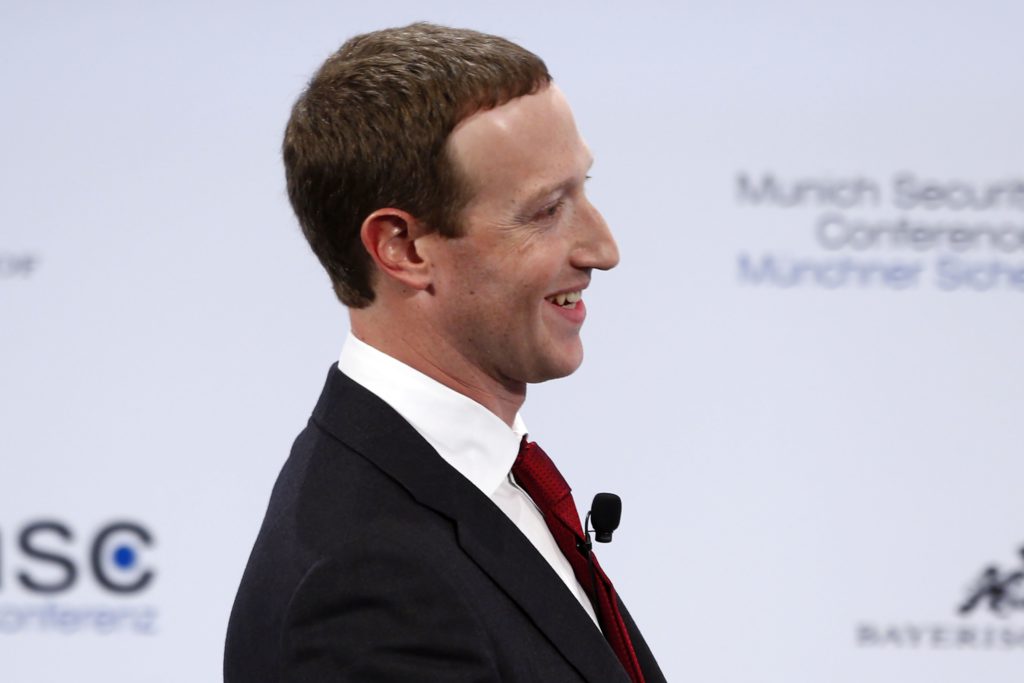
(Bloomberg) — Meta Platforms Inc. plunged more than 20% in premarket trading after Chief Executive Officer Mark Zuckerberg asked investors for patience with the social-media giant’s swelling investments in unproven bets at an already-challenging time for digital-advertising companies.

On a call Wednesday after giving a disappointing revenue outlook, Zuckerberg sought to justify Meta’s ballooning costs to fund its version of virtual reality, the metaverse, as well as the artificial intelligence fueling major changes to its social networks.

Investors, who have already sent the stock down 61% this year, so far aren’t buying it. The Facebook parent’s market value has collapsed by a whopping $591 billion this year, putting it at risk of being removed from the ranks of the 20 largest US companies. But Zuckerberg said he is confident that Meta’s largest bets in areas such as short-form video, business messaging and the metaverse were headed in the right direction — he just couldn’t say for sure how big the payoff would be.

Read more about how Meta is on the brink of falling out of the top 20 biggest US stocks

“I think we’re going to resolve each of these things over different periods of time,” Zuckerberg said. “And I appreciate the patience and I think that those who are patient and invest with us will end up being rewarded.”

It’s proving to be a hard sell when the company expects its already-falling revenue to be less than analysts expected, and costs to be more. On Wednesday, Meta said third-quarter revenue declined 4.5% from a year prior, only the second time the company’s sales have ever declined — the first being last quarter. In the final three months of the year, Meta expects that trend to continue. The company’s fourth quarter forecasts came in at the low end of analysts’ estimates.

Meta now expects total expenses for this year to be $85 billion to $87 billion. For 2023, that number will grow to an expected $96 billion to $101 billion, the company said on Wednesday.

Read More: Meta Tumbles as Sales Forecast Shows Depth of Ad-Market Weakness

Meta has already been grappling with both a contraction in marketer spending due to economic uncertainty, and a change in Apple Inc.’s privacy policy that made all social media ads less effective. The company has cut costs by slowing hiring and narrowing priorities to focus on keeping its social media platforms relevant and expanding virtual reality offerings. 

The company, which changed its name from Facebook to Meta a year ago, is also betting big on the metaverse, virtual-reality-fueled gathering places that Zuckerberg thinks will host the future of work and communication. The effort is losing Meta billions, and the company expects to lose more money on the metaverse business next year.

Meta’s not the only internet company suffering from a weak advertising market; both Alphabet Inc. and Snap Inc. got hammered on similarly lackluster results. It is the only company that’s overhauling how its social media platforms work while spending about one in every 10 dollars it generates in sales on a virtual future that’s still years off.

In the past year, Meta has changed Facebook and Instagram’s experiences to show more algorithmically chosen content and fewer posts from the people users follow. It’s also prioritizing short-form videos, called Reels, in response to ByteDance Ltd.’s popular TikTok app, which has won users’ time and accustomed them to a feed of vertical videos based on specific interests. 

Meta’s legacy social media products need to remain popular enough to generate the advertising revenue that will fund Zuckerberg’s metaverse vision. In the third quarter, 4% more people spent time on Meta’s platforms every day, compared with the same period last year, with 2.93 billion daily active users. Monthly, the tech giant saw 3.71 billion active users for its family of apps, which also includes Messenger and WhatsApp.

On Wednesday, the company touted that Instagram surpassed 2 billion monthly active users, and said those people are spending more time watching Reels — and marketers are spending to advertise there, at an implied rate of $3 billion a year in revenue. But Reels is dragging on revenue, to the tune of $500 million in the recent quarter, as the newer product cannibalizes other ad spaces that monetize at faster rates. It could be as much as 18 months before that changes, Zuckerberg said. 

“How investors are feeling right now is that there are just too many experimental bets versus proven bets in the core,” Brent Thill, an analyst at Jefferies LLC, said on the earnings call with Meta executives.

Zuckerberg has asked for patience before. In 2015, investor questions focused on when WhatsApp, Instagram and Messenger would make money. The difference then was those applications already had hundreds of millions of users each.

“Meta needs to turn its business around,” said Debra Aho Williamson, an analyst at Insider Intelligence. “As Facebook Inc., it was a revolutionary company that changed the way people communicate and the way marketers interact with consumers. Today it’s no longer that innovative groundbreaker.”

(Updates with lost value in second paragraph.)

More stories like this are available on bloomberg.com

©2022 Bloomberg L.P.

US Futures Rise After GDP; ECB Decision in Focus: Markets Wrap

(Bloomberg) — US stock futures rose after data showed the US economy rebounded in the third quarter, with traders still digesting the European Central Bank’s decision to raise its policy rate and signal more tightening ahead.

Contracts on the S&P 500 rose, while futures on the Nasdaq 100 are little changed. Meta Platforms Inc. shares plunged as much as 21% in premarket trading after the Facebook parent gave a disappointing revenue forecast and asked investors for patience as costs soared.

The Stoxx Europe 600 Index fell 0.8% after the ECB lifted its policy rate by 75 basis points, in line with expectations. The euro extended losses against the dollar and the yield on 10-year German bunds pared a rise.


The yield on the 10-year Treasury bond rebounded after inching below 4% earlier, with investors positioning for less aggressive rate hikes as earnings and economic data indicate a slowdown. The benchmark US yield has dropped more than 20 basis points over the past two days. A gauge of the dollar gained after two days of steep declines.

A contraction in services and manufacturing, and fewer new home sales showed the Fed’s efforts to cool the economy seem to be bearing some fruit. Still, economists expect the Fed to hike by 75 basis points for the fourth time in a row when it meets next week. Traders have cut expectations for rates to peak next year to 4.86% from 5% a week ago.

Oil fluctuated after touching the highest level in about two weeks after US Secretary of State Anthony Blinken said a deal with Iran would be unlikely to advance in the short term. 

Traders placed bets on a soaring price for aluminum as the US considers adding the metal to sanctions against Russia, a major producer. Iron ore futures slumped to the lowest since May 2020 on concern overan economic slowdown in China. 

Key events this week:

  • Bank of Japan policy decision, Friday
  • US personal income, personal spending, pending home sales, University of Michigan consumer sentiment, Friday

Some of the main moves in markets:

Stocks

  • Futures on the S&P 500 rose 0.4% as of 8:32 a.m. New York time
  • Futures on the Nasdaq 100 were little changed
  • Futures on the Dow Jones Industrial Average rose 0.8%
  • The Stoxx Europe 600 fell 0.7%
  • The MSCI World index was little changed

Currencies

  • The Bloomberg Dollar Spot Index rose 0.4%
  • The euro fell 0.7% to $1.0013
  • The British pound fell 0.4% to $1.1574
  • The Japanese yen fell 0.2% to 146.59 per dollar

Cryptocurrencies

  • Bitcoin fell 0.3% to $20,683.22
  • Ether rose 0.4% to $1,559.45

Bonds

  • The yield on 10-year Treasuries advanced two basis points to 4.02%
  • Germany’s 10-year yield declined three basis points to 2.08%
  • Britain’s 10-year yield declined two basis points to 3.55%

Commodities

  • West Texas Intermediate crude rose 0.6% to $88.44 a barrel
  • Gold futures fell 0.4% to $1,661.70 an ounce

–With assistance from Allegra Catelli, Richard Henderson, Ruth Carson and Masaki Kondo.

More stories like this are available on bloomberg.com

©2022 Bloomberg L.P.

Tesla, Ford and VW Sound the Death Knell for Driverless Car Hype

(Bloomberg) —

The autonomous-driving sector just endured a day that tech and automotive giants may well look back on the way Wall Street recalls March 16, 2008.

Whereas the day Bear Stearns collapsed was an epochal event in the global financial crisis, when flawed assumptions about the value of mortgages pushed banks to the brink — and some over the precipice — Oct. 26, 2022, will go down as the date that seismic consequences emerged from years of faulty presumptions about driverless-vehicle technology.

First came the shock that Argo AI, the startup Ford and Volkswagen had each seeded with multibillion-dollar investments, was shutting down. Within hours, Reuters reported that Tesla’s self-driving claims are under criminal investigation. A person familiar with the matter told Bloomberg that Justice Department prosecutors in Washington and San Francisco have been probing statements by the electric-car company and its executives since last year.

It’s difficult to come up with two more polar-opposite approaches to a mission one Ford executive said Wednesday will be harder than putting a man on the moon.

Elon Musk put a target on Tesla’s back in 2016 by starting to charge thousands of dollars for what the company calls Full Self-Driving (FSD) capability. Six years later, the CEO acknowledges the system still isn’t “feature complete,” and cautions customers to expect two steps forward and one step back.

By contrast, Argo CEO Bryan Salesky emphasized the need for safe and limited deployments of test vehicles and close partnerships with cities and stakeholders that its driverless cars would share the road with.

Neither the scorched-earth nor the nice-guy method is working.

Tesla is the subject of two defect investigations by the National Highway Traffic Safety Administration and headed for the first of several potential trials over crashes blamed on Autopilot, its driver-assistance system. California accused the company in August of misleading consumers, and a Golden State resident who sued last month is proposing class-action status for his claims that Musk has been stringing the public along with perpetual promises that the company is on the cusp of perfecting the technology.

Read more:  Self-driving cars starting to look like a $100 billion bust

Fans of the world’s richest man have gotten accustomed to frequent posts from the soon-to-be Twitter owner about new iterations of FSD beta software beaming to their vehicles. After Musk tweeted recently about a next major release coming this week, one follower replied with relief, writing that he’d been hesitant to use the latest version of FSD after his Tesla veered toward an oncoming car.

Ford thought when it first invested in Argo five years ago that it would be able to broadly market cars capable of going driverless in certain conditions by 2021. Now, the automaker has concluded it needs to invest in driver-assistance technology that’s more achievable in the near term. Its decision to switch gears led VW to walk away, too, according to people familiar with the matter, and Argo was unable to attract new investors.

The $2.7 billion impairment recorded on its investment in Argo dragged Ford to an $827 million net loss last quarter. VW, which reports earnings on Friday, announced an almost identical injection in the startup in 2019.

“The team we have at Argo has been working on what I consider to be the hardest technical problem of our time,” said Doug Field, who Ford hired away from Apple’s car project last year. “It’s harder than putting a man on the moon.”

This is a world away from what car and tech leaders were saying when driverless-car hype was at its peak. McKinsey predicted just three years ago that global revenue generated by autonomous vehicles could reach $1.6 trillion annually by the end of this decade. The head of General Motors-owned startup Cruise similarly talked in early 2020 of a trillion-dollar addressable market. Chris Urmson, who said while at Google that the goal was for his son to never need a driver’s license, sent out a memo to staff at his cash-strapped startup Aurora Innovation last month laying out options including cost cuts and even a potential effort to sell to Apple or Microsoft.

Argo is arguably the most substantial casualty within the self-driving space to date, though it isn’t the first. San Francisco-based Zoox sold to Amazon in 2020, and Uber cut bait with its self-driving unit months later, offloading it to Aurora. Early last year, GM’s Cruise acquired Voyage, a startup that had been trying the narrow use case approach to autonomy, operating in Florida retirement communities.

When GM reported quarterly results this week, analysts pressed Cruise CEO Kyle Vogt about the state of autonomy. He argued companies that are deploying and expanding now have game, and are distinguishing themselves from those that don’t.

“We’re seeing increased separation between the companies operating commercial driverless services, and those that are still stuck in the trough of disillusionment,” Vogt said. “What’s happening here is that the companies with the best product have pulled ahead and are accelerating.”

Time will tell just how far along GM and Cruise will get in building a viable business. The unit aiming for $1 billion revenue by 2025 lost $497 million in the most recent quarter, bringing its total deficit this year to $1.4 billion.

Ford CEO Jim Farley is skeptical the industry is anywhere close. “Profitable, fully autonomous vehicles at scale are a long way off,” he said Wednesday. “And we won’t necessarily have to create that technology ourselves.”

–With assistance from Keith Naughton, Monica Raymunt, Edward Ludlow and Tom Schoenberg.

More stories like this are available on bloomberg.com

©2022 Bloomberg L.P.

Close Bitnami banner
Bitnami